INTRODUCTION
Bryde's whales (Balaenoptera edeni Anderson, Reference Anderson1879Footnote 1) are a poorly known species worldwide and are still included in the IUCN Red list of threatened species under the status of Data Deficient (IUCN, 2013). Several reasons may explain this lack of knowledge. Most of the existing data was collected in whaling grounds, when the distinction between Sei whales (Balaenoptera borealis Lesson, 1828) and Bryde's whales had not yet been made (Williamson, Reference Williamson1975). Besides, Bryde's whales are fast swimmers that show a rather more cryptic behaviour and higher rate of activity when compared with other baleen whales (Cummings, Reference Cummings, Ridgway and Harrison1985; Kato, Reference Kato, Perrin, Wursig and Thewisseneds2002), making observations more difficult.
In Brazil, they have been reported mainly along the south-eastern coast; most sightings having occurred at Arraial do Cabo, north Rio de Janeiro (22°57′57.56″S 42°1′43.80″W) and in offshore areas of São Paulo (Zerbini et al., Reference Zerbini, Secchi, Siciliano and Simões-Lopes1997; Siciliano et al., Reference Siciliano, Santos, Vicente, Alvarenga, Zampirolli, Brito, Azevedo and Pizzorno2004; Carneiro, Reference Carneiro2005). Occasional sightings and strandings in higher latitudes were documented along the coast of Santa Catarina State (28°14′25.95″S 48°40′13.08″W) (Groch K., Right Whale Project, 2006, personal communication), Rio Grande do Sul (Carvalho et al., Reference Carvalho, Messias and Silva1998) and Paraná (Zerbini et al., Reference Zerbini, Secchi, Siciliano and Simões-Lopes1997). Further north, eventual occurrences have been reported on the coast of Bahia (Lima et al., Reference Lima, Gonçalves and Queiroz2006), Paraiba (Andriolo et al., Reference Andriolo, Rocha, Zerbini, Simões-Lopes, Moreno, Lucena, Danilewicz and Bassoi2010) and Maranhão (Almeida, Reference Almeida1995). Data obtained from whaling – before its prohibition in Brazil – indicate the presence of this species in a broader area along the Brazilian coast, from the north-east to the coast of Paraná State (south of São Paulo State) (Hetzel & Lodi, Reference Hetzel and Lodi1993). In all likelihood the population has been strongly reduced, currently concentrated mainly in the south-east.
Cetaceans are iconic animals often referred to as keystone and umbrella species (Paine, Reference Paine1969, Reference Paine1995) and their populations have been reported worldwide as being affected by anthropogenic activities (e.g. Zerbini & Kotas, Reference Zerbini and Kotas1998; Rocha-Campos et al., Reference Rocha-Campos, Moreno, Rocha, Palazzo, Groch, Oliveira, Gonçalves, Engel, Marcondes, Muelbert, Ott and Silva2011; Kucklick et al., Reference Kucklick, Schwacke, Wells, Hohn, Guichard, Yordy, Hansen, Zolman, Wilson, Litz, Nowacek, Rowles, Pugh, Balmer, Sinclair and Rosel2011; Bearzi, Reference Bearzi2012). In addition, conflicts with these activities are expected to increase along the Brazilian coastline with population growth (Andriolo et al., Reference Andriolo, Rocha, Zerbini, Simões-Lopes, Moreno, Lucena, Danilewicz and Bassoi2010).
The Brazilian coastline and oceans are no exception to this worldwide scenario. As an emergent country with an expanding population, the government is developing plans to increase coastal development in several ways. As a solution to this emerging problem, Marine Protected Areas (MPAs) are being established to guarantee space and time for the necessary biodiversity recovery as just one of the marine conservation strategies (Prates, Reference Prates, Bensusan and Prates2014a, Reference Prates and Littleb; Prates & Sousa, Reference Prates, Sousa, Bensusan and Prates2014).
In 2008, a new multiple-use MPA was designated along the coast of São Paulo State, forming a mosaic of Protected Areas (PAs) and MPAs which includes Laje de Santos Marine State Park, Ilhabela State Park, Alcatrazes Island (now under a re-categorization process to become a marine park) and others. Laje de Santos Marine State Park, designated in 1993, was the first of this category in São Paulo State and has been regarded as a site of high marine diversity including reef fish, rays, sea turtles, benthonic algae and seabirds (Neves, Reference Neves1997; Amado-Filho et al., Reference Amado Filho, Horta, Brasileiro, Barros-Barreto and Fujii2006; Stampar et al., Reference Stampar, Silva and Luiz2007; Luiz et al., Reference Luiz, Carvalho-Filho, Ferreira, Floeter, Gasparini and Sazima2008, Reference Luiz, Balboni, Kodja, Andrade and Marum2009).
The entire MPA along the São Paulo coast is vital for conservation; Laje de Santos Marine State Park offers special characteristics for reducing human-induced impacts and/or as a monitoring site. About 25 nautical miles from the coast, this preserved area is totally closed to fishing, in contrast to the more populated and developed regions of Brazil which allow researchers to evaluate fishing impacts on local rocky reefs (Floeter et al., Reference Floeter, Halpern and Ferreira2006). Recreational activities allowed in the park are mainly scuba diving and boating and cetaceans are often seen during tourism boat operations.
Despite its importance, the area still lacks the scientific knowledge needed to suitably create public policy and to direct management activities. Most publications are focused on reef fish taxonomy (Moura, Reference Moura1995), fish behaviour (Sazima et al., Reference Sazima, Sazima, Francini-Filho and Moura2000), a species list of benthic algae (Amado Filho et al., Reference Amado Filho, Horta, Brasileiro, Barros-Barreto and Fujii2006) and reef fish species lists (Luiz et al., 2007). Earlier papers describe feeding, breeding and nesting activities of seabirds and manta rays (Neves, Reference Neves1997; Gadig, Reference Gadig2003; Luiz et al., Reference Luiz, Carvalho-Filho, Ferreira, Floeter, Gasparini and Sazima2008). Cetacean populations were occasionally reported on, but remained largely unknown in the region until the Bryde's Whale Project/Brazil – the first long-term project for this species along the coast of São Paulo; it began in 2001 in Laje de Santos Marine State Park.
This area has recently received increased attention since 2006 due to new discoveries of oil reserves within the pre-salt layer. Studies on cetacean populations and biological behaviours are extremely valuable as a baseline to define strategies to mitigate the impacts from oil exploration and other economic activities – in addition to its important contributions to global biodiversity research and conservation activities.
In this paper we present the results of our investigation on the occurrence and behaviour of Bryde's whales along the São Paulo State coastline, both within and outside the area of Laje de Santos Marine State Park. Studies have been developed between 2003 and 2005 as a contribution to our biological and behavioural knowledge of Bryde's whales under a conservation scope and as a tool towards the creation of management issues for this species in MPAs and coastal and offshore areas – those that are currently being exploited for oil and gas.
METHODS
Observations were done through systematic field trips and opportunistic sightings, including offshore areas. The shipboard surveys covered an area between 20 and 3000 m isobaths, between 22°S and 24°S and 39°W to 46°W in south-east Brazil. However, most of this study was undertaken between isobaths 0 and 100 m where Laje de Santos Marine State Park is located (24°15′48″S 46°12′00″W; 24°15′48″S 46°09′00″W; 24°21′12″S 46°09′00″W; 24°21′12″S 46°12′00″W). Since 2008, the legally protected area has become broader, changing into the less-restricted Marine Environmental Protection Area of São Paulo Coast (IUCN: Category V – see Day et al., Reference Day, Dudley, Hockings, Holmes, Laffoley, Stolton and Wells2012). Offshore observations were done aboard the oceanographic vessel ‘N. Oc. Prof. Wladimir Besnard,’ a 49.35 m long research ship belonging to the Oceanographic Institute/University of São Paulo.
During the surveys several variables were recorded: the abiotic components (cloudiness, sea conditions (Beaufort), ocean waves measures), geographic location, beginning and ending times of the observation, ocean depth, distance from shore, size and composition of the whale groups, behaviour and species characterization.
Surveys using dive-tourism boats at Laje dos Santos Marine State Park
METHODS AND EFFORT
The surveys were carried out aboard two speedboats with twin engines, respectively 12.5 and 11.2 m long, with an average height of 3 m above the water line, usually hired for dive-tourism operations and thus long-experienced in that particular MPA.
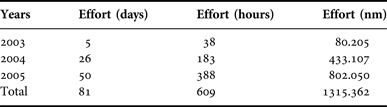
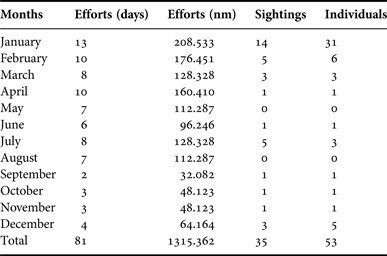
Departures occurred every fortnight from January 2003 to August 2005. The frequency of expeditions depended on navigation conditions because these boats do not sail with a Beaufort scale greater than 3. Observation lasted 8 h, with 2 h of travel and 6 h anchored (Table 1).
Study effort during the expedition to Marine State Park of Laje de Santos during survey trips (2003–2005) with scuba diving operators.
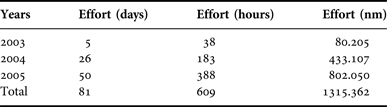
nm, nautical miles.
Diving operators in this MPA work under national regulations that forbid the driving of boats towards whales, in order to prevent any impact with or injury to the animals (Portaria IBAMA 117/1996, modified by Portaria IBAMA 24/2002).
Sighting cruises along coastal MPAsFootnote 2
METHODS AND EFFORT
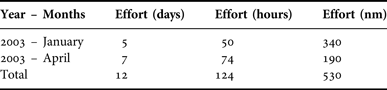
There were two cruises (summer: 340 nm – January/autumn: 190 nm – April) (Table 2), both on an 11.2 m dual motor speedboat, which travelled at a speed of approximately 10 knots during observations.
Study effort during the 2003 Bryde's whale expedition along the Marine Protected Area of São Paulo.
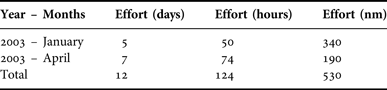
nm, nautical miles.
Whale watching was carried out by two observers standing on the bow of the vessel and two observers standing at its highest point (in the middle, 3 m above the water line). Another member of the team stayed in the middle of the boat, their task being to record data in specific spreadsheets.
The area chosen for the cruises encompassed the main insular PAs of the São Paulo coast (from south to north: Queimada Grande (24°29′S 46°40′W), Laje de Santos (24°19′S 46°11′W), Alcatrazes Archipelago (24°06,0′S – 045°41,5′W), Ilhabela Archipelago (24°01′S 45°01′W) – whose main islands are São Sebastião o (23°50′S 045°20′W), Buzios (23°48′S 45°08′W) and Vitoria (23°45′S 45°0,7′W).
Sighting cruises on board the Oceanographic Vessel ‘N. Oc. Prof. Wladimir Besnard’
METHODS AND EFFORT
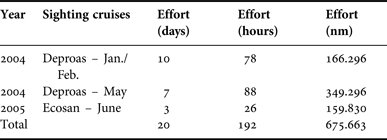
Two cruises were held, one in 2004 (January/February and May) and another in 2005 (June) (Table 3).
Effort during the RV ‘N. Oc. Prof. Wladimir Besnard’ (IOUSP) cruise carried out in January/February and May 2004 and June 2005.

Observations were carried out by one observer (January–February 2004) and two observers (2004 and May–June 2005) respectively, positioned on the highest part of the vessel (6.8 m above the water line) with a 360° observation angle. Observations were always carried out by the same observers, previously trained for precise species identification. Observations were done with reticulate binoculars (FUJINON 7 × 50) and a specific spreadsheet was created to record sightings. Oceanographic data such as depth and surface temperature were obtained through sampling equipment available on the oceanographic vessel.
Sampling during these expeditions realized an area between the isobaths 50 and 3000 m, on the south-eastern coast of Brazil (22o56′55S 41o59′07W and 23o35′10S 39o47′50W). Routes had been previously defined by researchers of the Oceanographic Institute/University of São Paulo (IOUSP) for two projects: ‘Dynamics of the Shelf Ecosystem of the South Atlantic Western Region Project – DEPROAS/IOUSP’ (cruises in January/February and May 2004) and ‘The Influence of the Estuarine Complex of Baixada Santista on the Ecosystem of the Adjacent Platform– ECOSAN/IOUSP’ (cruise held in June 2005) – this one between the isobaths 20 to 100 m, along the coast of São Paulo State from the Peruíbe region to São Sebastião Archipelago.
Behavioural observations
Observations were made only during daytime hours under good sea conditions (Beaufort < 3). Boat speed ranged from 2 to 10 knots. The behavioural data, geographic coordinates (GPS – Global Positioning System), depth and group composition were taken hourly. The focal animal method (Altmann, Reference Altmann1974; reviewed for cetaceans – Mann 1999) was used for behavioural observations, where each observer was focused on one individual. Behaviours were categorized as: (a) swimming – individual in displacement activity changing from one direction to another; (b) parental care – always considered when we could clearly see mother and calf together (despite other authors usually presenting parental care as part of socializing activity, in this study we preferred to consider this as an independent category given its importance); (c) feeding – when the individual or individuals were swimming in circles and we could clearly see a school of fish in the same area; and (d) socializing – when the individuals were together and where various aerial displays such as breaching, spy-hopping (head exposure) and flipper slapping were observed. These categories are mutually exclusive; each individual observed was included in only one category (type of behaviour) during sightings. Composition and group sizes were recorded, as well as events such as blows, dorsal fin exposure, dorsal exposure, breaching, ventral exposure and spy-hoppings and were registered under the categories above. Besides these behaviours, feeding interactions with other groups of vertebrates, notably seabirds, were also recorded and were defined as intentional movements made by a group of seabirds toward a cetacean(s) or vice versa, according to Evans (Reference Evans1982).
Data management and analysis
Sighting rates and individual rates per day of observation were obtained by dividing the number of sightings and the number of individuals by the number of nautical miles covered per expedition per day.
Dive time and intervals between blows were also recorded. In addition, the following environmental conditions were noted: reflection of the sun's rays on the surface, considering the field view (180°) as 100%, cloud cover (%), surface temperature and sea conditions according to the Beaufort Scale. Visibility was rated on a scale ranging from very bad (cloudy sky, mist on the horizon and rough sea), bad (cloudy sky, sea without crests or with occasional whitecaps) and good (blue sky, calm sea without crests, clear horizon with no fog). Surface temperature was measured using dive equipment during the surveys by diving professionals; during the cruises dedicated to Bryde's whale observations in the RV ‘N. Oc. Prof. Wladimir Besnard’, the temperature was measured with a thermosalinograph.
As for the behavioural analysis, the rate of performed behaviour was obtained by dividing the number of behaviour patterns by the duration of sightings per expedition day. The behaviour diversity for each category was estimated, i.e. how many and which behavioural performances occurred within each category. Data were analysed using the Kolmogorov–Smirnov test, modified by Liliefors, aiming to test its normality. Data non-normal distribution was determined through the non-parametric analysis of Kruskal–Wallis and Mann–Whitney, using Statistica 6.0 software (by Statsoft).
RESULTS
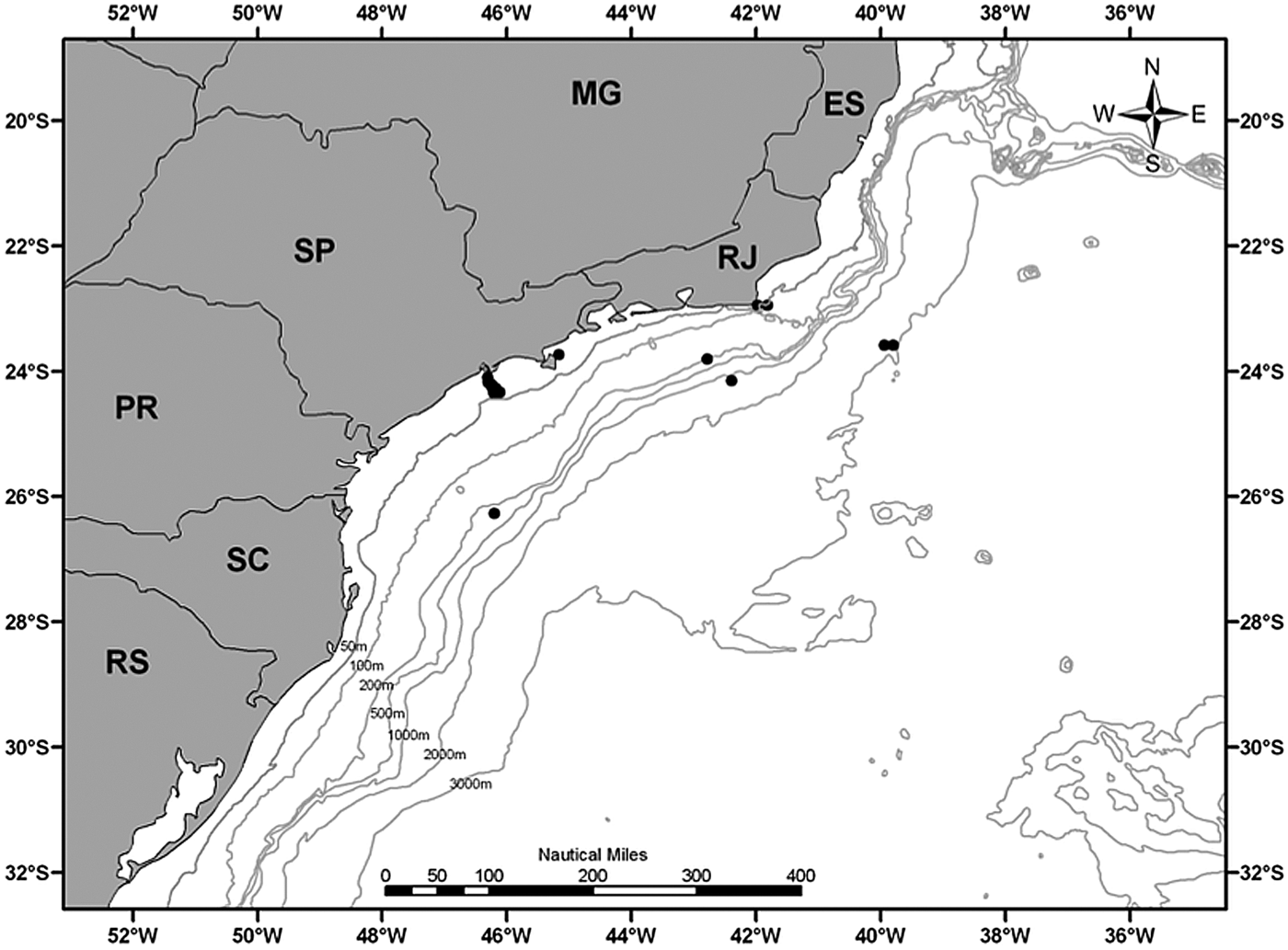
Monitoring of Bryde's whales along the south-eastern Brazilian coast resulted in 42 sightings, with a total of 71 individuals recorded (Figure 1). In addition, the behaviour of 43 individuals was registered in detail with an average observation time of 24.9 (SE = ±2.126) minutes per individual. The greatest depth recorded during sightings was for a whale sighted at the 3000 m isobath (2.967 m) in summer, at an approximate distance of 127 nm (204 km, 23°35′10S 39°47′50W) from the coast. In contrast, the shallowest sighting occurred at 21 m depth, also in summer, at an approximate distance of 16 nm from the coast (24 km, 24°05′54S 46°18′295W).
Study area showing sightings during the survey trips on-board scuba diving boats, on cruises dedicated to Bryde's whales watching (MCAF), and on-board RV ‘N. Oc. Prof. Wladimir Besnard’.
Surveys using dive-tourism boats on Laje de Santos Marine State Park
Sea conditions varied from 0 to 2 according to the Beaufort scale, cloud cover from 0 to 100%, sea reflection from 5 to 50%. Visibility remained good for sightings in most of the surveys (60 expeditions), with the sea at a scale of 0, a cloud cover of 0% and reflection 10%. Specifically in the area of Laje dos Santos Marine State Park, and throughout the 3 years of tracking, there were 35 sightings amounting to a total of 56 individuals: these animals were sighted almost every month except May and August (Table 4).
Sighting survey in the Marine State Park Laje de Santos area (PEMLS) with scuba diving operators between 2003 and 2005.
nm, nautical miles.
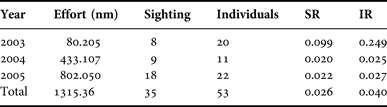
Temperature ranged from 19 to 24°C with a mean of 23.3°C (±EP1.4). Twenty-two sightings (62.85%) were observed at 24°C. Presence of this species was thus verified over years of study (Table 5).
Numbers related to Bryde's whale studies and expeditions from 2003 to 2005 in the Laje dos Santos Marine State Park on board expeditions with scuba divers.
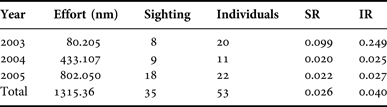
nm, nautical miles; SR, sighting rates (sightings/nautical miles covered tracking the whales); IR, individual rates (number of observed individuals/ nautical miles covered during expedition).
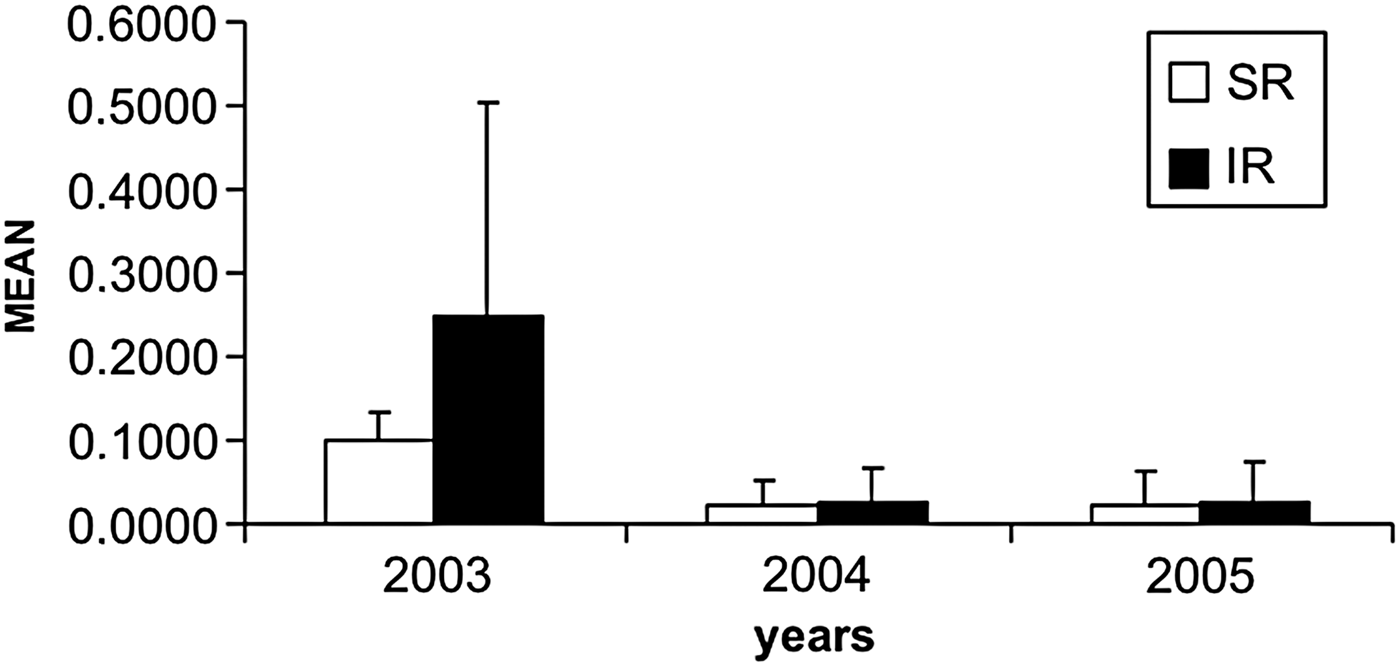
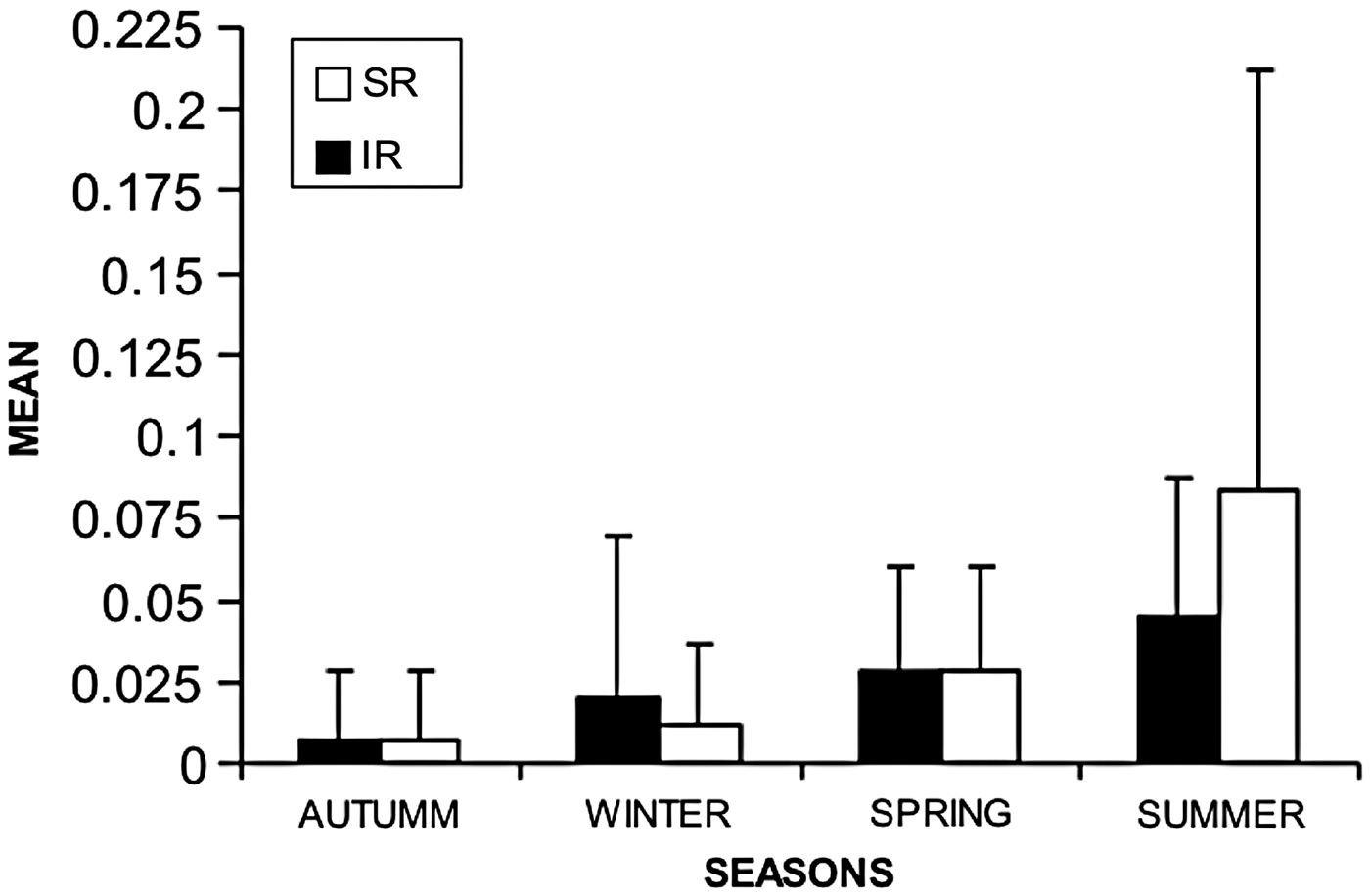
Sighting rates showed statistically significant differences (H 2,82 = 14.001; P = 0.001) during those 3 years (2003: 0.099±0.015 sightings nm−1; 2004: 0.020±0.005 sightings nm−1; 2005: 0.022±0.005 sightings nm−1). Individual rates were also calculated and compared over those 3 years (2003: 0.249±0.113 ind. nm−1; 2004: 0.025±0.007 ind. nm−1; 2005: 0.027±0.006 ind. nm−1) showing a statistically significant difference (H 2,82 = 14.645; P < 0.001). 2004 and 2005 did not show any statistically significant differences when comparing rates of sightings (U = 661.5; P = 0.885), as well as individual rates (U = 665.500; P = 0.919). Sightings rates (autumn: 0.007 ± 0.004 sightings nm−1; winter: 0.019 ± 0.012 sightings nm−1; spring: 0.027 ± 0.010 sightings nm−1; summer: 0.044 ± 0.007 sightings nm−1; H 3,82 = 16.001; P = 0.001), and individual rates (autumn: 0.007 ± 0.004 ind. nm−1; winter: 0.011 ± 0.006 ind. nm−1; spring: 0.027 ± 0.010 ind. nm−1; summer: 0.083 ± 0.022 ind. nm−1; H 3,82 = 19.753; P < 0.001) showed statistically significant different occurrences of Bryde's whales over the different seasons, with an increase in summer (Figures 2 & 3).
Sightings and individual mean rates according to the year period, numbers achieved on board scuba diving boats. SR, sighting rates; IR, individual rates.
Sightings and individual mean rates according to the season period, numbers achieved on board scuba diving boats. SR, sighting rates; IR, individual rates.
Sighting cruises along coastal MPAs
All sightings occurred during summer in and around the MPA along the coast of São Paulo; this included Laje de Santos Marine State Park and Ilhabela State Park, as well as Vitoria and Búzios Islands. No sightings occurred during the autumn expedition.
During the summer expedition, sea conditions varied between 0 and 1 (Beaufort scale) providing good visibility for sightings, amounting to an overall 80% rate of sightings. Cloud cover ranged from 0 to 70%, and sea reflection from 5 to 30%, with 10% sky coverage and 5% of water reflection.
The autumn expeditions were held with sea conditions ranging from 0 to 4, with good to very bad visibility, 15–100% sky coverage. Conditions were not appropriate for observation throughout most of the expedition effort (100 nm): cloud cover and Beaufort 1 amounted to 70% of the expedition time, which resulted in a reduced path track (reduction of the itinerary) in comparison with the summer expedition. Considering that Bryde's whales are fast and very difficult to sight and confirm identification, Beaufort 0 is the best sea condition.
Sighting cruises on board the Oceanographic vessel ‘N. Oc. Prof. Wladimir Besnard’
Sea conditions ranged from 0 to 8 Beaufort scale, though it remained at 0 for 472.964 nm of the expedition. Cloud cover ranged from 0 to 100%, but on 450.698 nm of the expedition surveys it stayed at 30%. Surface sea reflection ranged from 0 to 60%, and a value of 5% prevailed during 472.964 nm of the effort. Five sightings were made with a total of nine individuals.
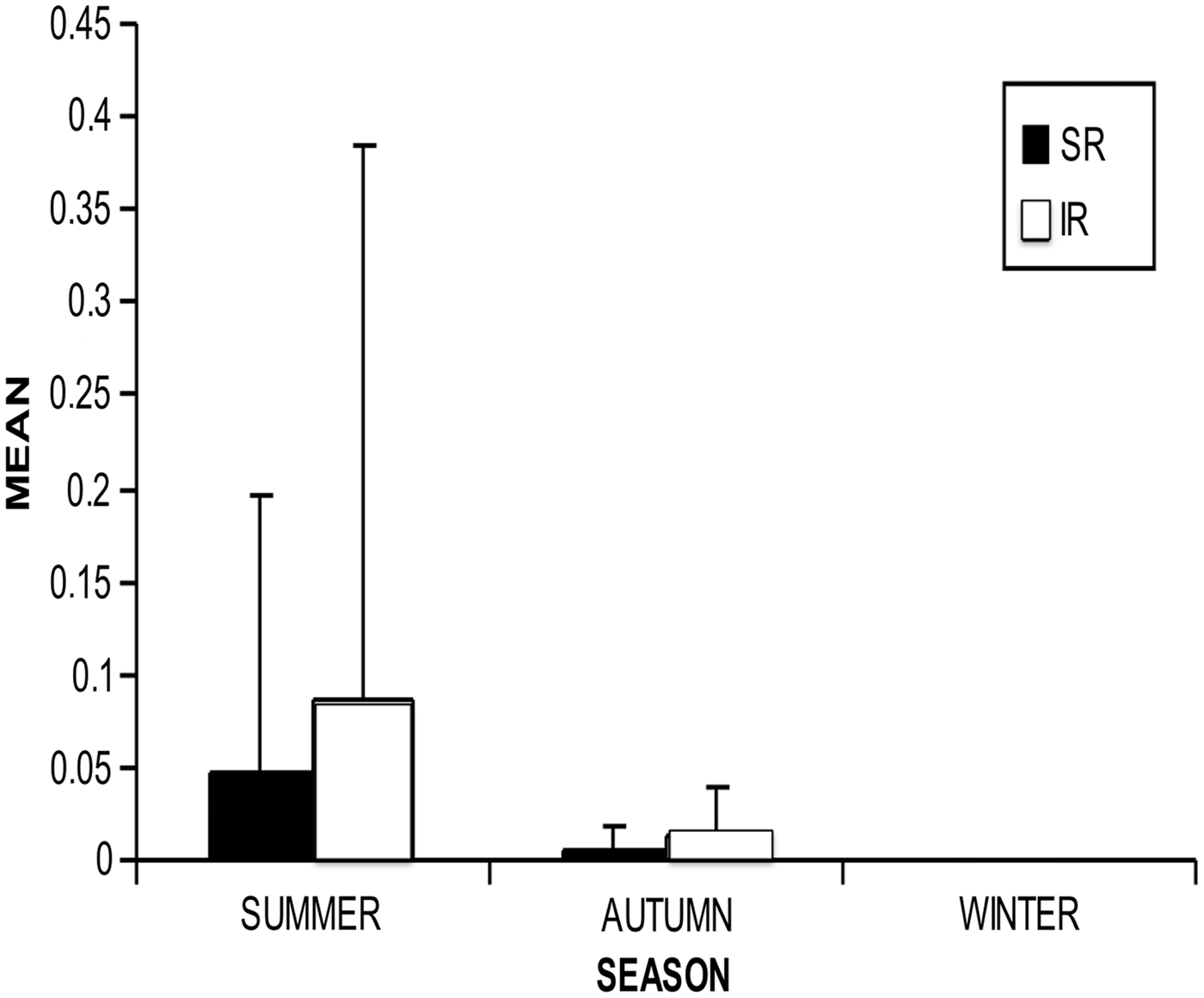
There was no significant difference concerning individual rates (U = 59.00; P = 0.948) between the autumn (0.012±0.008) and summer (0.086±0.076) expeditions (Figure 4).
Sightings and individual mean rates achieved on board RV ‘N. Oc. Prof. Wladimir Besnard’ during the summer, autumn and winter. Sighting rates (SR) = sighting/nautical miles and Individual Rates (IR) = individuals/nautical miles.
Results confirmed occurrence of this species in deeper ocean areas and in different depth ranges (Table 6). No significant difference was observed concerning species distribution along depth lines, neither in relation to sighting rates (H 5,156 = 3.522; P = 0.620), nor to individual rates (H 5,156 = 3.521; P = 0.620).
Distribution of sampling in nautical miles (nm) according to depth, means and standard errors for sighting rates, and individual rates.
nm, nautical miles; SE, standard errors; S (N): number of sightings; I(N), individual sightings; SR, sighting rates mean; IR, individual rates mean.
Behaviour
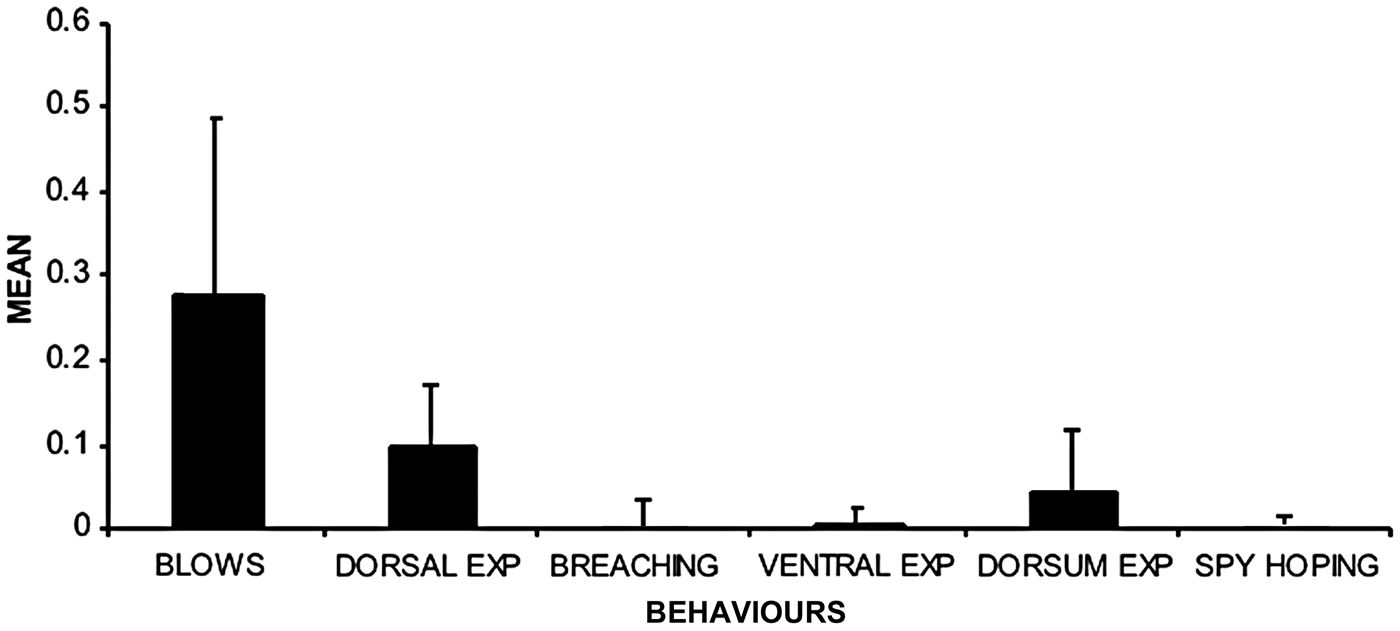
Travelling was the most frequent behaviour observed (N = 33) while feeding was the behaviour category with the longest observation times and thus the most evident (0.147 ± 0.042), during which it was possible to observe the whales for a significantly longer period of time (H 3,258 = 13.693; P = 0.003). Within behaviour categories, all behavioural modes were recorded, but they occurred in a varied way among them (performed behaviours/minutes of observation on the day of effort: travelling: 0.409 ± 0.034; feeding: 0.416 ± 0.083; social interaction: 1 ± 0; parental care: 0.583 ± 0.148). Social interaction was the behavioural category that revealed the greatest diversity of behaviours (H 3,258 = 16.974; P < 0.001) (Table 7; Figure 5).
Behavioural mean rates related to Bryde's whales found along Brazilian south-eastern waters from 2003 to 2005.
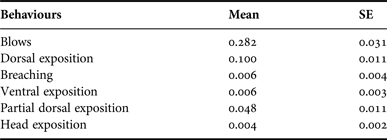
Mean and standard error (SE) of behaviour rates of Bryde's whales sighted from 2003 to 2005.
Significant differences were found amongst the different behaviour categories (H 5,258 = 185.952; P < 0.001). Blows accounted for most of the whales’ behaviours, followed by dorsal exposure, both of which usually occurred together. Dorsum exposure was often witnessed when individuals came up to the surface to breathe, but without dorsal fin exposure, which meant they were moving along the surface. Dorsum exposure and dorsal fin exposure behaviours showed a statistically significant difference when compared (U = 4.081; P < 0.001). Ventral exposure, spyhopping and breaches occurred during a single sighting 86.137 nm away from the coast in a 1200 m deep oceanic area. Four adults were sighted on that particular occasion and they remained near the ship (200 m away of the vessel) for 40 min. Among the whales sighted on this occasion, only two were observed through the focal animal method because of the presence of just two observers on board.
Behaviour expression in the different categories
Each behaviour was observed within the context of a specific category, i.e. travelling, feeding, social interaction and parental care. Significant differences were found for respiratory frequencies (H 3,43 = 13.529; P = 0.003) amongst the different behavioural categories (performed behaviours/minutes of observation on the day of effort: travelling: 0.224 ± 0.023; feeding: 0.645 ± 0.091; social interaction: 0.225 ± 0.024; parental care: 0.200 ± 0.099), with higher occurrences during feeding and similar occurrences within the other categories. Dorsal fin exposure within the different behavioural categories (performed behaviours/minutes of observation on the day of effort: travelling: 0.090 ± 0.011; feeding: 0.116 ± 0.026; social interaction: 0.063 ± 0.012; parental care: 0.117 ± 0.082) was not significant (H 3,43 = 6.812; P = 0.078). The dorsum exposure observed when the individual was moving close to the water surface also did not reveal any significant difference between the various categories (H 3,43 = 7.770; P > 0.05) (performed behaviours/minutes of observation on the day of effort: travelling: 0.034 ± 0.009; feeding: 0.072 ± 0.042; social interaction: 0.175 ± 0.024; parental care: 0.067). Head exposure in social interaction was the most frequent (H3,43 = 28.736; P < 0.001), but was almost never witnessed within the other categories (performed behaviours/minutes of observation on the day of effort: travelling: 0.001; feeding: 0; social interaction: 0.063±0.012; parental care: 0). Ventral exhibition was a significantly different behaviour (H 3,43 = 20.256; P < 0.001), with a higher rate of occurrence within the social interaction category (performed behaviours/minutes of observation on the day of effort: travelling: 0.003±0.002; feeding: 0; social interaction: 0.063 ± 0.012; parental care: 0.017 ± 0.016). Breaching was seen only once, in the context of social interaction observation (0.125 ± 0.024 (performed behaviours/minutes of observation on the day of effort)).
Evidences of feeding behaviour – interactions with other vertebrates
Amongst the 43 individuals more closely surveyed in the course of six sightings at the Laje de Santos Marine State Park, evidence of feeding behaviour was observed. These sightings were done in a coastal area (up to the 100 m isobath) during summer and autumn afternoons. Each time, the presence of groups of brown boobies (Sula leucogaster) was noted, as well as schools of sardines at the surface (probably Sardinella sp.) in a feeding aggregation with Bryde's whales, characteristic of a frenzy feeding. On these occasions, schools of sardines formed a compact ball close to the surface, making the boobies on the slab fly quickly in flocks toward the school.
Composition and group size
Bryde's whales were sighted alone (N = 31, 71%) or in pairs (N = 8, 17%), but when exhibiting feeding behaviour, especially in coastal areas, they were seen in groups of up to 10 individuals. Despite differences in behavioural patterns found across different areas, when individual rates were analysed, there were no significant differences in group size in both locations (U = 884.500; P = 0.192).
Parental care
During sightings of an adult and a juvenile (23°35′10″S 39°47′50″W), it was possible to see a mother and her offspring in parental care behaviour. The mother was ~14 m long, and the calf ~7 m long. This sighting took place in summer, in February, at a depth of 2967 m and approximately 127 nm from the coast. The mother was much more active than the calf, often abruptly changing her direction and with a frequency of blows three times higher than the calf. During the 30 min of observation the latter never left her side, remaining on the opposite side of the boat, always under her protection.
Dive duration
Diving duration was recorded for 10 individuals out of the 71 sighted. The maximum dive time was 17 min and the minimum was 30 s, with an average (mean) of 6.790 min (EP = ±1.483).
Shorter dives were preceded by blows and quick dorsal fin exposure, or a simple dorsum exposure denoting a more superficial movement. Longer dives occurred after 4 or 5 short dives with an extra arched dorsum exposure. After this behavioural pattern the whale submerged for more than 10 min.
Dive duration was related to the behavioural category that was being displayed at the time, and was noted differently only during feeding and travelling (feeding: 2.483 ± 0.957; travelling: 5.142 ± 1.222). Individuals dived for a maximum time of 7 min when feeding, while those travelling reached a maximum dive time of 17 min, although we did not find significant differences (U = 24.500; P = 0.148) between the diving times for these categories.
DISCUSSION
Surveys using dive-tourism boats on Laje de Santos Marine State Park
Considering temperatures measured in this and other studies, it seems that Bryde's whale occurrences could be related more to temperature influence over prey availability than directly over the whales themselves. Zerbini et al. (Reference Zerbini, Secchi, Siciliano and Simões-Lopes1997) previously mentioned the possibility that prey behaviour could affect the dynamics of these whales in the coastal waters of southern and south-eastern Brazil. Carneiro (Reference Carneiro2005) also found that Bryde's whale occurrences on Arraial do Cabo (the north coast of Rio de Janeiro State) were seasonally concentrated, mostly during summer. The spring–summer is the intrusion period of the South Atlantic Central Water (SACW, or ACAS in Portuguese), a cold and nutrient-rich water mass that approaches the coastal areas, influencing the primary productivity (Rocha-Jorge, Reference Rocha-Jorge2010) of the whole food chain and increasing the availability of prey. This may explain the present concentration of Bryde's whales in the south-east, for in this region the continental shelf has a broader area and contains high stocks of sardines (Matsuura, Reference Matsuura1979).
For many years, species distribution and abundance have been related to the movement and density of prey whilst pursuing pelagic schools of small fish, including sardine and herring (Best, Reference Best1960; Tershy, Reference Tershy1992). In Brazil, Matsuura (Reference Matsuura1979) and Saccardo (Reference Saccardo, Sharp and Csirke1983) showed that for sardines (Sardinella brasiliensis (Steindachner, 1879)), spawning season occurs from spring to summer, with peaks in December and January influenced by the intrusion of the SACW. This season is also the time when Bryde's whales are usually seen in coastal areas, which could support the hypothesis that their presence on the coast is related to prey density.
The mean water temperature found for the observations aboard tourism boats was 23.4°C. Even though this temperature corresponds with the assertion that Bryde's whales live in tropical marine ecosystems and thus warmer waters, this temperature was considered relatively high when compared with results mentioned in the literature. There are reports of Bryde's whales in waters ranging from 16.3 to 20°C (Omura & Nemoto, Reference Omura and Nemoto1955; Kato, Reference Kato, Perrin, Wursig and Thewisseneds2002), nevertheless Miyazaki & Wada (Reference Miyazaki and Wada1978) spotted solitary individuals and groups in waters with mean temperatures of 28.5°C, and as high as 30°C. Data correlating the occurrence of Bryde's whales and surface water temperatures in Brazil indicate that the individuals reported at Arraial do Cabo (a prominent upwelling area) were in waters with temperatures ranging from 16 to 18°C, which was a lower temperature than the one observed by Carneiro (Reference Carneiro2005). This may imply that Bryde's whales are tolerant to temperature variations, which may be one more reason to believe that their distribution is more associated with prey availability.
Sighting distribution varied significantly throughout the year. It must be noted, however, that in 2003, despite fewer cruises, there was a concentrated effort during summer when most of the records were compiled; consequently, it was representative when calculating the 2003 mean, even if taking into account the sightings and the individual rates. Comparing 2004 and 2005 data – the most similar samplings in a temporal scale show no significant difference throughout the seasons – this comparison makes clear that longer and more systematic efforts are needed along the Brazilian south-eastern sea in order to track annual seasonality and growth of Bryde's whales. Whales were sighted every month except May and August, however, when comparing individual rates and sighting rates through the seasons it was possible to distinguish a seasonal sighting variation, and a still higher variation related to the individual rates during summer, followed by spring. Various researchers previously reported the occurrence of Bryde's whales during summer, as well as in different sites such as Japan (Ohsumi, Reference Ohsumi1981; Kato et al., Reference Kato, Shinohara, Kishiro and Noji1996), South Africa (Best, Reference Best2001) and the south-eastern coast of Brazil (Zerbini et al., Reference Zerbini, Secchi, Siciliano and Simões-Lopes1997; Siciliano et al., Reference Siciliano, Santos, Vicente, Alvarenga, Zampirolli, Brito, Azevedo and Pizzorno2004; Carneiro, Reference Carneiro2005). Variation amongst individuals and sighting rates may suggest a more intense gathering of individuals, most likely due to aggregations for feeding purposes as reported here during summer. During other seasons the sighting rate was the same as the occurrence rate (autumn and spring), or it was greater than the individual rate (winter), denoting a higher dispersion of individuals throughout the other seasons.
Moreover, it became clear through the rate of sightings that there was a concentration of individuals near the Laje dos Santos Marine State Park, probably a consequence of the incidence of macro algae, along with phytoplankton, creating a high primary productivity photosynthetic biomass in those seawaters (Neves, Reference Neves1997). Mature sardines visit these macro algae ‘reefs’ attracted by phytoplankton and zooplankton; they are considered the main group of Bryde's whale's prey (Cummings, Reference Cummings, Ridgway and Harrison1985; Hetzel & Lodi, Reference Hetzel and Lodi1993; Carneiro, Reference Carneiro2005). According to Matsuura (Reference Matsuura1979) and Saccardo (Reference Saccardo, Sharp and Csirke1983), sardine abundance is higher along the coast during December and January, which may explain the higher whale individual rate during summer along the same coast. These facts suggest that Bryde's whales come near the coast to feed and are drawn towards the sardines that are, in turn, attracted by the high primary productivity, which happens mostly in summer.
Sighting cruises along coastal MPAs
The species was not sighted during the autumn cruise. Sea and weather conditions were not appropriate for cetacean observation, leading to smaller distance cruise coverage than the summer cruise. However, when comparing rates, data confirm the higher sighting frequency on coastal areas in summer. Most sightings occurred within MPAs and these preliminary data give additional grounds for the creation, development, implementation and management of MPAs, especially off the coast of São Paulo. Moreover, Bryde's whales can be used as key tools to foster awareness throughout general society about the importance of marine conservation. Since these MPAs welcome visitors throughout the year, mainly tourists in summer, this is when this species can be more frequently observed.
Sighting cruises on board the Oceanographic Vessel ‘N. Oc. Prof. Wladimir Besnard’
These results provide clear evidence that Bryde's whales showed reproductive behaviour in oceanic areas; however, the data are not sufficient for a final conclusion regarding Bryde's whale behaviour in relation to seasonality. Bryde's whales behave differently from other great whale species and still do not have a primary migration area identified – if one exists at all – which makes the sighting efforts difficult and random.
Information concerning distribution of individuals along sites with different depths, together with seasonality, is an important data source going forward towards the study of Bryde's whale migration patterns. In this study, distribution of individuals regarding group size and depth did not reveal any significant difference between coastal and oceanic areas. However, behavioural differences between areas could be noted, since in the coastal area individuals were seen in feeding groups while in ocean areas they exhibited social interactions (likely reproductive interactions), which supports the hypothesis that these animals perform short migrations from the coast to deeper waters. There is not enough information yet about the pattern of migration of Bryde's whales in Brazil or on its population biology, and thus their simultaneous occurrence in ocean and coastal areas is of extreme importance for a better understanding of the biology of the species and the possible existence of different populations, or similar populations, with migration patterns from coastal areas to the open ocean. It is possible that the same population pattern described by Best (Reference Best1977) exists in the western South Atlantic, which sees a coastal population during the year and another, migratory oceanic population. The same hypothesis was raised by Carneiro (Reference Carneiro2005) regarding the area around Arraial do Cabo where the oceanic population described by Best (Reference Best1977) may be found due to the proximity of 100 and 200 m isobaths to the coast, similar to occurrences in South Africa. However, data from this study show that is possible that the Bryde's whales sighted in the south-east region are part of a single population that carries out short migrations from the coastal area, where they feed following schools of prey (belonging to a high primary productivity), and then migrate to deeper oceanic areas to breed and look after their offspring. These short migrations, related to seasonal variations, can be found in other species of oceanic balaenopterids, such as fin whales, that have varying degrees of mobility depending upon access to food resources throughout the year. Moreover, individuals may travel from coastal to oceanic areas, varying the pattern according to the energetic and reproductive costs these migrations represent (Reeves et al., Reference Reeves, Silber and Payne1998).
Behaviour
The length of time for behavioural observations was no longer than 30 min, which prevented the observation of more than one type of behaviour from any one individual. Bryde's whales have a rather limited repertoire of surface behaviour when compared with other whales, probably due to the lack of behavioural study of this species. Locomotion was the behavioural category most shown by the animals observed. This is a low-cost activity in terms of energy efficiency; cetaceans, with their spindle-shaped body, are well adapted to moving efficiently in aquatic environments (Hui, Reference Hui1987). Moreover, the bigger the size of the body, the less it costs the whale to move and thus, mysticetes spend even less energy on locomotion than odontocetes (Bose & Lien, Reference Bose and Lien1989).
Nevertheless, there was a significant difference among the kinds of behaviour quantified in this study with a higher number of blows, followed by exposure of the dorsal fin and dorsum exposure, which occurred mainly while travelling. The dorsal fin and dorsum exposure were considered separately in this study, due to multiple observations when the individuals were moving the dorsal fin at the surface, while the rear end was not visible. These kinds of behaviour characterize Bryde's whales as they travel, during which 4–5 blows occur before a longer dive, usually preceded by dorsal fin exposure. This longer dive is deeper and when an individual showed only its back, it was indicating a shorter and doubtless more superficial dive (Best et al., Reference Best, Butterworth and Rickett1984). Furthermore, feeding was the behavioural category that we were able to observe most often and to describe in more detail. When feeding, whales usually come together and stay in the same place over a relatively longer period than usual. Social interaction and parental care were also observed in detail, because the types of behaviour shown in this category were more visible at the surface and for a longer period of time.
Breathing rates presented some differences among the behavioural categories. The highest breathing rate was observed during feeding, as this activity tends to increase breathing. According to Cummings (Reference Cummings, Ridgway and Harrison1985), when feeding, Bryde's whales go through sudden changes in direction and swim in circles. This behaviour pattern is aimed at capturing prey and is responsible for an increase in energy expenditure for the whales (Kawamura, Reference Kawamura1975).
Few studies have focused on the Bryde's whales ‘aerial’ behaviour, probably because of the low incidence of sightings. However, even in the case of humpback whales, which are the balaenopteridae best known for their display behaviour, the functions of such performance is not yet conclusive. Some suggestions have been made: Whitehead (Reference Whitehead1985b) proposed that such behaviour could mean a type of physical claim emphasizing acoustic or visual communication; he also noted that the leaps are seven times more common at reproduction areas than at feeding grounds. Whitehead (Reference Whitehead1985a) has criticized other explanations for this kind of behaviour, such as parasite removal or aggressive responses to human maritime traffic. He attributes jumps with ventral exposure to social interaction, but he believes there is not a single function for such behaviour, since it has already been displayed by all ages and genders and in different and varied behavioural contexts.
Among the behavioural records available in literature related to Bryde's whales, the most commonly found is the behaviour of blows followed by the exposure of the dorsal fin (Best et al., Reference Best, Butterworth and Rickett1984). These behaviours were observed in all sightings and once, during the May expedition, in a single sighting (24°09′23″S 42°23′20″W), a group of four adult individuals were recorded performing breaching, ventral and head exposure.
Breaching, ventral exposure and head exposure have rarely been seen as part of the Bryde's whale behavioural pattern in other parts of the world (Rice, Reference Rice1979; Best et al., Reference Best, Butterworth and Rickett1984; Shimada & Pastene, Reference Shimada and Pastene1995), however, some researchers argue that this species does breach more often than other balaenopterids (Hetzel & Lodi, Reference Hetzel and Lodi1993; Kato, Reference Kato, Perrin, Wursig and Thewisseneds2002). The observations reported here present the first specific study of Bryde's whale behaviour in Brazil and highlight the need for more observational efforts in oceanic areas.
Dorsum and dorsal fin exposure were not significant within the behavioural categories, most likely because every time an individual rises to the surface it necessarily exposes its dorsum or dorsal fin, and this is regardless of any behavioural category. Exposure of the dorsum or dorsal fin occurs indiscriminately amongst the various behaviour categories; they are the parts of the whales’ bodies most often displayed by this species (and therefore used for photo-identification by some researchers, as Breese & Tershy, Reference Breese and Tershy1988). Other behaviours, however, such as blows, head exposure, ventral exposure and jumps, were expressed in exclusive ways within the behavioural categories, indicating significant occurrences in the case of courting rituals or offspring protection, for instance.
Evidence of feeding behaviour – interactions with other vertebrates
In his review about interactions between seabirds and cetaceans, Evans (Reference Evans1982) defined interaction as an intentional move made by a marine bird towards a cetacean or vice versa. Ultimately, these associations can occur frequently amongst many types of both birds and cetaceans and this usually tends to be related to feeding habits or hunting strategies, an interaction that is sufficiently significant to play an important role in the normal process of a marine ecosystem, as well as in the evolution or dynamics of a particular species’ populations (Katona & Whitehead, Reference Katona and Whitehead1988). Besides those behaviours, interactions with predators such as boobies, dolphins and whales have been described by several other researchers (Olsen, Reference Olsen1913; Evans, Reference Evans1982; Nortabartolo-di-Sciara, Reference Nortabartolo-di-Sciara1982; Best et al., Reference Best, Butterworth and Rickett1984; Breese & Tershy, Reference Breese and Tershy1988; Shimada & Pastene, Reference Shimada and Pastene1995).
Similar feeding interactions have been recorded in Brazil by Siciliano et al. (Reference Siciliano, Santos, Vicente, Alvarenga, Zampirolli, Brito, Azevedo and Pizzorno2004) in coastal regions such as the Alcatrazes Archipelago where this species was seen hunting Brazilian sardines (Sardinella brasiliensis (Steindachner, 1879)) and associated with other predators such as the brown booby (Sula leucogaster), tuna (Scombridae), mahi mahis (Coryphaena hippurus (Linnaeus, 1758)), and unidentified sharks.
In Arraial do Cabo, RJ, Carneiro (Reference Carneiro2005) observed individuals feeding near fishing boats, alongside other marine vertebrates such as the brown booby, pelagic fish and long-beaked common dolphins (Delphinus capensis). These interactions made up the majority of the whales’ feeding behaviour (67.8%), out of which 63% of these interactions occurred with brown boobies. Groups of boobies were recorded in all feeding interactions observed in the course of this work. The brown booby is a resident bird of Laje dos Santos Marine State Park.
Reports of Bryde's whales feeding around the area of the Laje dos Santos Marine State Park were more frequent during summer, probably motivated by feeding needs. The immediate benefit of hunting together provided a higher incidence of finding prey, an increased rate of success in capturing prey, and an increased capacity for the group to defend itself (Baird, Reference Baird, Mann, Connor, Tyack and Whitehead2000). On the other hand, the interactions observed in autumn, which seemed to be for social interaction, did not display a specific cause or purpose for grouping. Social interaction occurred within various behavioural contexts, such as courting behaviour, competitive behaviour amongst males or simple socialization.
Composition and group size
The distribution of sightings, when considered in relation to group formations throughout the seasons, showed that Bryde's whales were often solitary, although they tended to congregate in coastal areas, especially around Laje dos Santos Marine State Park. This evidence confirms what has been reported in the literature which shows that Bryde's whales are usually sighted alone or in pairs, although some researchers have also observed this species in dense groups of 7–12 individuals (Miyazaki & Wada, Reference Miyazaki and Wada1978; Cummings, Reference Cummings, Ridgway and Harrison1985; Kato, Reference Kato, Perrin, Wursig and Thewisseneds2002).
Moreover, Bryde's whales have been frequently reported in coastal regions, with the exception of Andriolo et al. (Reference Andriolo, Rocha, Zerbini, Simões-Lopes, Moreno, Lucena, Danilewicz and Bassoi2010) who observed a low density Bryde's whale presence in Brazil's north-eastern waters at depths of 800 and 2900 m. Even though it represents a small number of individuals, this information is important and emphasizes the need for a greater conservation effort in other Brazilian coastal areas and oceanic areas.
Parental care
Knowledge about parental behaviour of balaenopterids is limited, but it is well known that in the case of humpback whales, only the mother provides this care. The mother provides the offspring with food in the form of rich fatty milk. These mother–offspring pairs are generally found in reproduction areas, where, besides feeding their calves, mothers also protect them by keeping their big bodies between their calves and approaching vessels, always staying ahead as a sign of protection (Clapham, Reference Clapham, Mann, Connor, Tyack and Whitehead2000).
In this study, parental care behaviour amongst Bryde's whales was observed only in oceanic areas (3000 m). This event was observed only once, in deep waters, and though an extensive sampling of São Paulo coastal waters was conducted, at no time were females observed with their offspring. This occurrence of parental care behaviour spotted in an oceanic area expands our knowledge about this species, and supports the reproductive migration hypothesis that Bryde's whales move to deeper oceanic areas to reproduce and look after their calves.
Dive duration
Bryde's whales are a very dynamic species, performing sequences of short dives followed by long dives. Diving times recorded in our work, which ranged from a minimum time of 30 s to a maximum time of 17 min, are consistent with Cummings (Reference Cummings, Ridgway and Harrison1985), whose observations for this species reported dives for as long as 20 min, as well as rare fluke exhibitions.
Because they are fast swimmers, it was often possible to record a single dive, and after the whale dived again, if it did not re-emerge within the field of observation during an interval of 10 min, the observation was considered as final. Other whales were also sighted realizing more than one diving interval, thus providing minimum and maximum dive times. It may therefore be the case that diving time for this study was underestimated. Best et al. (Reference Best, Butterworth and Rickett1984), on the South African coast, reported 100 dives lasting between 11 s and 9 min, all of those dives followed an average pattern of one to six short dives followed by a longer dive. Other authors also found similar patterns of short dives preceding a longer dive. Nortabartolo-di-Sciara (Reference Nortabartolo-di-Sciara1982) reported a mother with her offspring taking seven to –12 dives, Rice (Reference Rice1979) observed a range between one and seven dives, and Olsen (Reference Olsen1913) observed between four and five dives. None of these authors found any link between these dive patterns with any abiotic factors.
These studies are essential to promote management and conservation of Bryde's whales and are critical in decision-making regarding impacts resulting from oil and natural gas exploitation – a booming activity in the region studied here. This will represent a major advance in research and should be used to contribute to policy development for the conservation of large cetaceans in Brazil.
The study of Bryde's whales in Brazil is still in its early stages, and both the use of new methodologies and the undertaking of new research programmes are necessary in order to expand the technical-scientific knowledge about this species, as well as to create mechanisms for their conservation. Although data were collected through opportunistic surveys, important results have been achieved, especially when taking into account the lack of information about this species. Therefore, this study can be considered as an important baseline to define priorities for future research and actions towards Bryde's whale conservation in Brazil.
ACKNOWLEDGEMENTS
We wish to thank the staff of Laje de Santos Marine State Park for all of their support and facilities and to the Oceanographic Institute of S. Paulo University (Universidade de São Paulo), for recognizing the importance of our work and providing us the access to board the oceanographic vessel ‘N. Oc. Prof. Wladimir Besnard.’ We are also grateful to the ship's crew for supporting the sighting cruises in several aspects, including the oceanographic data provided for this research project, and especially Francisco Luiz Vicentini Neto (LIO-USP) who captured the images of Bryde's whales breaching in offshore areas. Many thanks to all Marine State Park Laje de Santos scuba diving operators who logistically supported our work for many years, mainly João Paulo Scola who also joined us in the MCAF cruises along the islands. To José Truda Palazzo Jr. (former IWC/Brazil), MSc. Marcia H. Engel (Humpback Whale Institute/Brazil and staff) and PhD Karina Groch (Right Whale Project/Brazil) for their valuable comments and assistance to support the project, as well as MSc Tatiana Neves (Albatroz Project/Brazil) for her comments and suggestions on seabirds of Laje de Santos. We are also deeply grateful to the anonymous reviewers who also helped us with inestimable suggestions for this paper. We also thank the observers Daniel Capell, Thalassa Neder Teixeira Potiens, Marilia Olio, Carolina Neves and others who joined us on the expeditions. And last, but not least, to all Bryde's Whales Project/Brazil staff and collaborators that supported us throughout these years.
FINANCIAL SUPPORT
This work was financially supported by the Marine Conservation Action Fund and Fundação O Boticário (edital 2004/2005). In addition, CAPES Foundation granted L.R.G. a Master's degree scholarship which enabled this research project.