Introduction
The developmental origins of health and disease hypothesis proposes that adverse fetal exposures may lead to permanent fetal adaptations in both anatomy and physiology. These adaptations may be beneficial for short-term fetal survival and may result in an altered long-term risk of metabolic diseases later in life.Reference Hales and Barker1–Reference Gluckman, Hanson, Cooper and Thornburg3 Being born with a low birth weight (BW) or small-for-gestational-age (SGA) has often been used as a marker for an adverse fetal environment, and over the last two decades numerous studies have shown that individuals born small are at increased risk of developing type 2 diabetes (T2D) later in life.Reference Vaag, Brøns and Gillberg4, Reference Whincup, Kaye and Owen5 Recently, two reviews suggested that insults in utero may impact the individual’s food preferences towards energy-dense, less healthy foods, and further proposed that these alterations in food intake could contribute to the risk for later disease.Reference Portella, Kajantie and Hovi6, Reference Molle, Bischoff, Portella and Silveira7 Among other things, they highlighted that several observational studies in children, young adults and in middle-aged subjects have shown that individuals born small or exposed to famine during gestation had higher intake of palatable foods high in carbohydrate and/or fat compared to normal BW individuals.Reference Barbieri, Portella and Silveira8–Reference Perälä, Männistö and Kaartinen12 An observational study of young Finnish adult men and women born pre-term (n = 307) observed that prenatal growth retardation was associated with lower intake of vegetables, fruits and berries in young adulthood, compared to controls.Reference Kaseva, Wehkalampi and Hemiö13 These findings are supported by animal studies of rats that showed an adverse fetal environment can alter food preferences towards unhealthy eating habits.Reference Bellinger, Lilley and Langley-Evans14, Reference Krechowec, Vickers and Breier15 In addition, a small human intervention study (n = 16) showed that intrauterine growth restriction (IUGR) correlated with a reduced hedonic response to a sweet solution in pre-term infants on their first day of life, when examining their orofacial expression, compared to controls exposed to a water solution.Reference Ayres, Agranonik and Portella16 This suggests that IUGR infants are less sensitive to the enjoyment of sweet taste, and therefore need an increased intake of sugar to achieve the pleasure associated with the consumption of sugar.Reference Ayres, Agranonik and Portella16 Thus, these two reviews show evidence from multiple sources for fetal programming on food preferences later in life. However, many of the studies are based on small sample sizes and not all studies adjust for potential confounders.
The potential mechanisms by which dietary intake in childhood, youth and adulthood are influenced by being born small are not well understood. It has been proposed that nutritional insult during fetal life may program food preferences later in life, possibly mediated by alterations in leptin, ghrelin and dopamine levels, that jointly impact the reward response to food.Reference Portella, Kajantie and Hovi6 These previous studies, linking an adverse intrauterine environment with an altered unfavourable food intake later in life, were of variable size (n = 16–2036 subjects), with the largest studies focussing on food intake in adulthood.Reference Barbieri, Portella and Silveira8, Reference Lussana, Painter and Ocke10, Reference Perälä, Männistö and Kaartinen12 Poor dietary habits during adolescence have been associated with an increased risk of developing obesity and T2D in adulthood.Reference Malik, Fung and van Dam17, Reference Naja, Hwalla and Itani18 This can be due to the fact that food habits in adolescence tend to be tracked into adulthood.Reference Wiium, Breivik and Wold19 From a preventive point of view, insight into dietary intake recognized in adolescence is of high importance, because it enables intervention in their habitual diet before onset of disease. Since previous studies have reported sex-dependent differences in food choice and energy intakeReference Pedersen, Christensen and Matthiessen20, Reference Westenhoefer21 and knowing that girls and boys at adolescent age behave differently and have different attitudes towards diet,Reference Salvy, Elmo, Nitecki, Kluczynski and Roemmich22 it is relevant to take potential sex-specific differences into account when examining the association between size at birth and dietary intake later in life.
In order to fill out existing gaps in the evidence between SGA and later food intake, we took advantage of the large prospective Danish National Birth Cohort to examine this association in a general population of adolescents not exposed to extreme intrauterine conditions such as famine. More specifically, we aimed to compare food and nutrient intake in 14-year-old boys and girls born SGA or normal-for-gestational-age (NGA) at term, and included adjustment for potential fetal and postnatal exposures.
Methods
Study population
The study participants originate from the Danish National Birth Cohort, a large prospective cohort study of pregnant women and their offspring, which has been described in detail elsewhere.Reference Olsen, Melbye and Olsen23 Briefly, the Danish National Birth Cohort enrolled more than 100,000 pregnancies between 1996 and 2002. Data were collected by telephone interview in gestational weeks 12 and 30, and 6 and 18 months postpartum. Additional data from the offspring were collected at age 7, 11 and 14 using questionnaires.
When the children reached 14 years of age, approximately 70,000 children were eligible for invitation to complete a food frequency questionnaire. When the present study was performed, the 14 years follow-up study was still ongoing and had a participation rate of approximately 45%, allowing the present study to include dietary data from 21,082, 14-year-old offspring from the Danish National Birth Cohort. We excluded multiple births (724 twins, eight triplets) and only included the first-born child enrolled for each woman (excluding 214 younger siblings) due to a higher risk of complications and different growth pattern among twins as compared with singletons. We only included full-term births, defined as being born at gestational week 38–42 where information on BW was available, resulting in a study sample of 17,493. The inclusion of full-term births only was based on possible differential aetiology between SGA and those born small due to being born pre-term. Subjects were excluded from the analysis if their reported daily dietary intake resulted in an unrealistic estimate of energy intake (set to <2.5 MJ/day or >25 MJ/day based on the Nordic nutrition recommendation (2012)24; n = 200). Eight outliers were removed, because the self-reported height and bodyweight were not compliant. We further excluded subjects born large-for-gestational-age(n = 1678). Therefore, our final study sample included 15,607 subjects.
Birth measures
Date of birth and BW was extracted from the Danish Medical Birth Registry.Reference Knudsen and Olsen25 Information on gestational age at birth was assessed by either (i) the mothers last menstrual period, (ii) based on the expected date of delivery or (iii) derived from the Danish Medical Birth Registry.Reference Knudsen and Olsen25
In order to define SGA and NGA, sex and gestational-age-specific BW standard curves from full-term (gestational week 38–42) singleton births offspring from the entire Danish National Birth Cohort were developed. Individuals were classified as being born SGA if their BW was below the 10th percentile, NGA if their BW was between the 10th and 90th percentile and large-for-gestational-age if their BW were above the 90th percentile.
Assessment of dietary intake
Information on diet was obtained from a validated semi-quantitative web-based food frequency questionnaire filled out by the 14-year-old offspring,Reference Bjerregaard, Halldorsson, Kampmann, Olsen and Tetens26 and has been described in detail elsewhere.Reference Bjerregaard, Tetens, Olsen and Halldorsson27 In short, the food frequency questionnaire was designed to assess the habitual diet during the past 12 months, and consisted of 158 food items which were clustered into eight food groups. For the nutritional calculations, we applied assumptions of standard portion sizes. Since we did not have any standard portion size specifically for adolescents available, portion sizes were derived from a Danish population of 4–75-year-old men and women, which was developed by the Danish National Food Institute.Reference Ygil28 The nutritional software program FoodCalc v.1.3 was used to convert frequencies of intake into grams per day.Reference Lauritsen29 Intake of nutrients was quantified based on the National Food Composition tables.30
Dietary intake
The selection of specific dietary outcomes included in the analysis was based on a priori knowledge about foods and nutrients previously shown to be associated with the development of T2D. We included total energy intake, macronutrient intake [protein, carbohydrate (CHO) and total fat], dietary fibre,Reference Hauner, Bechthold and Boeing31, Reference Ye, Chacko, Chou, Kugizaki and Liu32 added sugar,Reference Mann, De Leeuw and Hermansen33 saturated fatty acids (SFA), monounsaturated fatty acids (MUFA) and polyunsaturated fatty acids (PUFA).Reference Sylvia, Hamdy, Mohan and Hu34 Intake of essential fatty acids, including total n−6, and n−6/n−3 ratio were also separately estimated. We further reported intake of fruits,Reference Schwingshackl, Hoffmann and Lampousi35 vegetables,Reference Schwingshackl, Hoffmann and Lampousi35 sugar sweetened beverages (SSB)Reference Schwingshackl, Hoffmann and Lampousi35, Reference Malik, Popkin and Bray36 and red meat.Reference Schwingshackl, Hoffmann and Lampousi35, Reference Pan, Sun and Bernstein37
Covariates
Information on parental socio-occupational status and maternal lifestyle characteristics were derived from telephonic interviews during and after pregnancy. Maternal diet during pregnancy was obtained from a food frequency questionnaire filled out by the mother at gestational week 25. From these data, a healthy eating index score of the maternal diet was calculated based on the Danish national food-based dietary guidelines. Data on waist circumference of the adolescents were obtained from the 7-year questionnaire, and current body weight (kg) and height (cm) of the adolescents was obtained from the food frequency questionnaire filled out at 14 years of age. All information was self-reported by the adolescent at home, except for maternal age at delivery and current age of the adolescent, which were calculated based on their date of births.
Statistical analyses
We applied general linear models to test for interaction between sex and size for gestational age on all dietary outcomes (P < 0.05 for interaction for: MUFA, PUFA, total n−6 and vegetables). All analyses were conducted separately for boys and girls, to account for sex-specific associations. Since our main focus was to examine whether adolescents born SGA had higher proportional intake of the nutrients in question, dietary outcomes were expressed as continuous variables and reported in relation to total daily energy intake [e.g., fruits (g/MJ) = fruits (g)/total energy intake (MJ)]. Total energy intake was reported in MJ/day, macronutrients in energy percent (E%) and intake of foods and nutrients as g/MJ or mg/MJ. Deviations from normality for continuous variables were assessed using histograms and box-plots. Normally distributed, continuous outcomes were expressed as mean and sd. All food groups, as well as total energy intake, dietary fibre, added sugar, total n−6 (for girls) and n−6/n−3 ratio (for boys) were skewed. These became normally distributed after log-transformation, and were presented as median and 10–90th percentile, whereas categorical outcomes were presented as n (percentages).
Differences in offspring and parental characteristics between SGA and NGA were analysed using Student’s t-test for normally distributed continuous variables and Wilcoxon’s rank-sum test for skewed continuous variable. χ2-test was used for categorical outcomes.
We applied multiple linear regression analysis to compare differences in food and nutrient intake between girls born SGA and NGA while adjusting for potentially confounding and mediating variables. Model I was adjusted for parental socio-occupational status during pregnancy, maternal smoking during pregnancy and maternal healthy eating index score during pregnancy. Since we had data on maternal pre-pregnancy body mass index (BMI), maternal weight gain during pregnancy and duration of breastfeeding only in a sub-sample of participants, we performed a sensitivity analysis (model II) by further adding these covariates to the first model (model I). Socio-occupational status was included because it is known to influence food availability and consumptionReference Riediger, Shooshtari and Moghadasian38 and is associated with SGA.Reference Räisänen, Gissler and Sankilampi39 Maternal smoking during pregnancy is associated with reduced fetal growth, and is inversely associated with educational and economical status.Reference Phung, Bauman and Nguyen40 Maternal healthy eating index score was included since maternal diet during pregnancy may influence the risk of having a SGA child, and has been associated with the child’s food preferences later in life.Reference Mennella, Jagnow and Beauchamp41 Breastfeeding is involved in the early development of eating behaviour of the child,Reference Mennella, Jagnow and Beauchamp41 and could mediate the association between size at birth and later dietary intake, that is why it was included in our sensitivity analysis (model II, Table 5). For all regression models, assumptions of normally distributed residuals and equal variance were visualized by histogram and QQ plots. Skewed residuals became normally distributed after log-transformation, and the requirements for linear regression were met.
Statistical analyses were performed using the statistical program SAS version 9.4 (SAS Institute, 127 Cary, NC, USA). All tests were two-sided and a P-value ⩽0.05 was considered statistically significant.
Results
Background characteristics
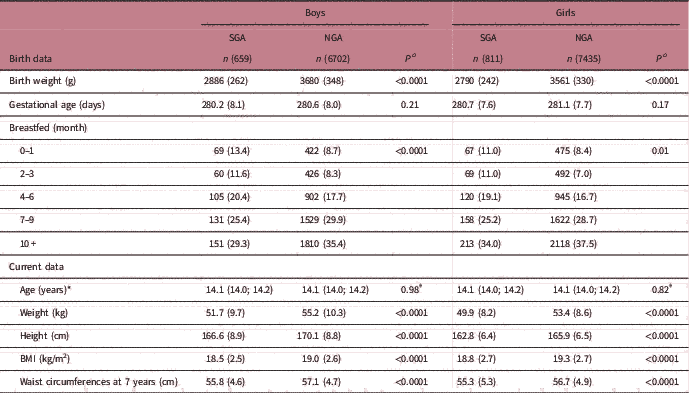
We included 7361 boys and 8246 girls in our analyses, of which 659 of the boys and 811 of the girls were born SGA. Table 1 summarizes the birth and current background characteristic of these offspring. The mean BW for SGA was 2886 g for boys and 2790 g for girls and was, on average, 793 g (95% CI: −825; −761 g) lower in boys and 773 g (95% CI: −800; −746 g) lower in girls compared to offspring born NGA. For these term infants there were no significant differences in the mean gestational age between SGA and NGA for either boys or girls (boys: P = 0.21, girls: P = 0.17). For both boys and girls, we found that those born SGA were breastfed for a shorter period compared to NGA offspring, had a smaller waist circumference at 7 years of age, were shorter, weighed less and thus had lower BMI at 14 years of age, compared to offspring born NGA (Table 1). The SGA and NGA subjects did not differ in age at the time they filled out the food frequency questionnaire.
Characteristics of SGA and NGA boys and girls at birth and age 14

SGA, small-for-gestational-age (<10th percentile); NGA, normal-for-gestational-age (10–90th percentile); BMI, body mass index.
Data are presented as mean (sd) for normally distributed variables, median* (10–90th percentile) for skewed variables and n (%) for categorical variables.
P a : P-values are calculated using Student’s t-test, Wilcoxon’s rank-sum test ǂ or χ2-test.
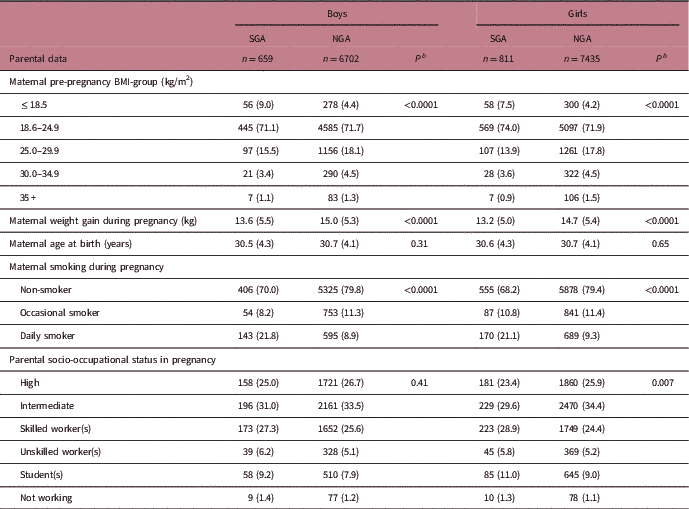
Twice as many SGA offspring were exposed to daily maternal smoking during pregnancy compared to NGA offspring (Table 2). In addition, SGA mothers had a lower pre-pregnancy BMI and gained less weight during pregnancy, compared to NGA mothers. These findings were similar for boys and girls. No significant differences in parental socio-occupational status at the time of pregnancy between SGA and NGA subjects were observed among boys (P = 0.41), while parents of girls born SGA reported lower socio-occupational status compared to parents of NGA girls (P = 0.007).
Parental characteristics of the study participants stratified by sex

SGA, small-for-gestational-age (<10th percentile); NGA, normal-for-gestational-age (10–90th percentile); BMI, body mass index.
Data are presented as mean (sd) for normally distributed variables, median* (10–90th percentile) for skewed variables and n (%) for categorical variables.
P b : P-values are calculated using Student’s t-test or χ2-test.
Energy and nutrient intake
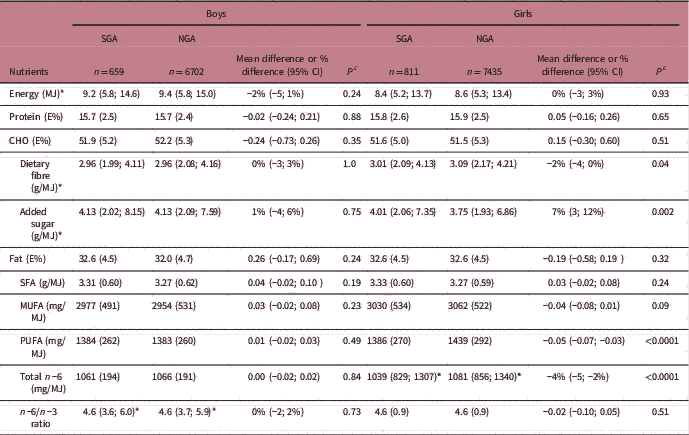
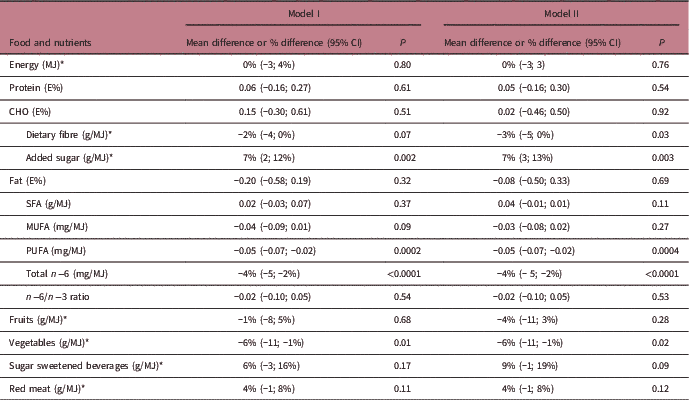
Table 3 shows the daily energy and nutrient intake for SGA and NGA offspring, stratified by sex. For boys, no statistically significant differences between SGA and NGA in energy intake, macronutrients or micronutrients intake were observed. We did not find any differences in energy intake, macronutrients, n−6/n−3 ratio or SFA intake between girls born SGA and NGA. However, girls born SGA reported a 7% (95% CI: 3–12%, P = 0.002) higher intake of added sugar. Consumption of dietary fibre, PUFA and total n−6 was 2–8% lower in SGA girls, a finding that was statistically significant for all variables (P < 0.05). These differences were independent of parental socio-occupational status, maternal smoking during pregnancy and maternal pregnancy healthy eating index score, except for differences in dietary fibre, which were attenuated after adjustment and no longer statistically significant (Table 5). In addition, in the sensitivity analysis, after adjusting for maternal pre-pregnancy BMI, maternal pregnancy weight gain and duration of breastfeeding, the observed differences in SGA and NGA girls still persisted (Table 5).
Energy intake and daily nutrient intake pr. MJ in SGA and NGA male and female adolescents

SGA, small-for-gestational-age (<10th percentile); NGA, normal-for-gestational-age (10–90th percentile); SFA, saturated fatty acids; MUFA, monounsaturated fatty acids; PUFA, polyunsaturated fatty acids.
Data are presented as mean (sd) for normally distributed variables, and median* (10–90th percentile) for log-transformed variables.
P c : Crude estimates and P-values for the difference are obtained by simple linear regression.
Food intake
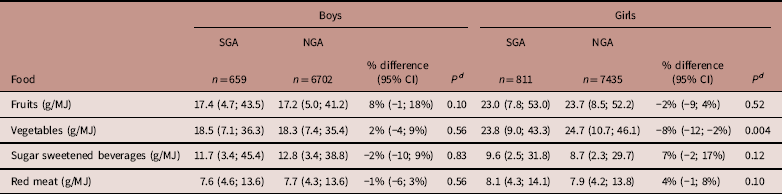
Daily food intake of selected food groups is presented in Table 4. There were no significant differences in any of the food groups between boys born SGA or NGA. For girls, there were no significant differences in intake of fruit, SSB or red meat. Since differences in intake of added sugar among the girls could not be explained by differences in SSB intake, further sub-analyses of ‘sweets and cakes’ were performed. Independently of potential confounders, girls born SGA consumed 6% more ‘sweets and cakes’ (95% CI: 1; 11%, P = 0.02) compared to girls born NGA [median: 5.4, 10–90th percentile: (2.6; 10.0) g/MJ v. median: 5.0, 10–90th percentile: (2.5; 9.4) g/MJ] (data not shown). No statistical differences in intake were observed among boys (data not shown). Furthermore, girls born SGA reported an 8% lower (95% CI: −12; −2%, P = 0.004) intake of vegetables compared to NGA girls (Table 4). Differences in intake of vegetables remained significantly lower in SGA girls after adjustment (Table 5). When not taking total energy intake into account, similar significant associations between SGA and food intake were obtained (data not shown).
Food intake in SGA and NGA boys and girls at age 14

SGA, small-for-gestational-age (<10th percentile); NGA, normal-for-gestational-age (10–90th percentile).
Data are presented as median (10–90th percentile).
P d : Crude estimates and P-values for the difference are obtained by simple linear regression.
Adjusted differences in food and nutrient intake between SGA and NGA female adolescents

SGA, small-for-gestational-age (<10th percentile); NGA, normal-for-gestational-age (10–90th percentile); SFA, saturated fatty acids; MUFA, monounsaturated fatty acids; PUFA, polyunsaturated fatty acids.
Estimated differences in food intake between SGA and NGA girls are obtained by multiple linear regressions and presented as either mean differences for normally distributed residuals or as % differences* for log-transformed data.
Model I: Adjusted for paternal socio-occupational status, maternal smoking during pregnancy and maternal healthy eating index score during pregnancy. n = 5983.
Model II: Adjusted for paternal socio-occupational status, maternal smoking during pregnancy, maternal healthy eating index score during pregnancy, duration of breastfeeding, maternal pre-pregnancy BMI and maternal weight gain during pregnancy. n = 5417.
Discussion
In this study, we observed that being born SGA is associated with an unfavourable dietary intake in adolescent girls compared to girls born NGA. These eating patterns included a relatively higher consumption of added sugar, and lower intake of dietary fibre, vegetables and unsaturated essential fatty acids. Most of our findings persisted after adjustment for parental socio-occupational status, maternal pregnancy diet, and maternal smoking during pregnancy and were not related to differences in maternal pregnancy weight gain or duration of breastfeeding, indicating a ‘fetal programming’ effect on dietary intake in girls born SGA.
Sex-specific associations
Interestingly, our findings of unfavourable dietary habits in individuals born SGA were only evident among girls. Other cohorts and animal studies have also found sex-specific differences in feeding behaviour and food intake in a BW-dependent manner,Reference Barbieri, Portella and Silveira8, Reference Bellinger, Lilley and Langley-Evans14, Reference Silveira, Agranonik and Faras42–Reference Stafford and Lucas44 although no consistent pattern is apparent. Contrary to our results, some studies have shown a stronger effect of BW on food intake in boys compared to girls,Reference Shultis, Leary and Ness43, Reference Stafford and Lucas44 whereas others, like us, found that the association between IUGR and unfavourable diet and dietary behaviour was only evident among girls.Reference Barbieri, Portella and Silveira8, Reference Silveira, Agranonik and Faras42 Speculatively, our findings could be related to differences in levels of glucocorticoids between boys and girls, since glucocorticoids stimulate intake of highly palatable food in humansReference Epel, Lapidus, McEwen and Brownell45 and have been shown to be transferred to a greater extent across the placenta in females than in males rat fetuses.Reference Montano, Wang and vom Saal46 From our results, it could be suggested that girls might be more sensitive to insults during fetal life in relation to programming of dietary habits in later life. Alternatively, it could also be speculated that girls are able to recall and report food intake more accurately compared to boys, since adolescent girls might pay more attention to what they eat compared to boys. This could be reflected in more accurate reporting and therefore less bias introduced by noise in the analyses among the girls.
Energy and macronutrient intake
From a fetal programming point of view, it can be hypothesized that individuals born SGA have a higher energy intake compared to NGA individuals to compensate for a fetal sparse nutritional environment. Supporting this hypothesis, previous findings have shown that exposure to an adverse intrauterine environment may lead to alterations in appetite regulation towards an orexigenic state, enhancing food consumption.Reference Block and El-Osta47 However, we did not find any differences in energy intake or in percentage of energy intake from fat, CHO, or protein between adolescents born SGA and NGA. Our findings were in accordance with the results of Kaseva et al., who also reported similar energy intake, percentages of energy intake from fat, CHO and protein, assessed by a 3-day food record, in 307 young Finnish adults born pre-term with a BW <1500 g and NGA term-born controls.Reference Kaseva, Wehkalampi and Hemiö13 In contrast, several other observational studies have shown higher intake from fat (E%) in 10-year-old childrenReference Crume, Scherzinger and Stamm9 and in middle-aged adultsReference Lussana, Painter and Ocke10–Reference Perälä, Männistö and Kaartinen12 who were born small or were exposed to famine during fetal life. In addition to preferences for fatty foods, severe growth restriction has also been associated with a greater CHO to protein ratio consumption in young adult women (n = 37) compared to non-growth-restricted controls (n = 942), although this was not displayed in higher or lower consumption of specific foods.Reference Barbieri, Portella and Silveira8 In the present study, we found that higher intake of some foods and nutrients at the expense of others can result in an overall less healthy diet without affecting the total energy intake. In addition, evidence substantiates that dietary quality of CHO and dietary fats, rather than quantity of these macronutrients, is more crucial from a health perspective.Reference Sylvia, Hamdy, Mohan and Hu34, Reference Salas-Salvad, Martinez-González, Bulló and Ros48
Added sugar
Higher intake of added sugar and lower intake of vegetables all point towards craving for more energy-dense, less healthy diet in SGA girls. Limited consumption of added sugar has been recommended in the prevention of T2DReference Mann, De Leeuw and Hermansen33 due to its association with adverse metabolic disorders, weight gain and obesity.Reference Te Morenga, Mallard and Mann49 Our results showing higher added sugar consumption among SGA girls are consistent with findings from a small randomized human intervention study (n = 16) by Ayres et al. Reference Ayres, Agranonik and Portella16 They found that the intensity of IUGR was highly and positively correlated with decreased sensitivity towards sweet taste in pre-term infants on the first day of life. The authors proposed that IUGR individuals need a higher consumption of sugar in order to achieve a higher degree of pleasure.Reference Ayres, Agranonik and Portella16 However, whether this decreased sensitivity persists beyond the first few days of life in individuals born IUGR and has long-term effects on their food intake is not known. Several studies have demonstrated an increased level of fasting leptin in individuals born SGA.Reference Hjort, Jørgensen and Gillberg50–Reference Jornayvaz, Vollenweider and Bochud52 Leptin is related to perception of sweet tasteReference Shigemura, Ohta and Kusakabe53 and subjects with elevated levels of leptin have been shown to need higher concentrations of sweeteners to detect the sweet stimuli.Reference Umabiki, Tsuzaki and Kotani54 Therefore, alterations in leptin levels in SGA individuals could speculatively contribute to the increased intake of added sugar observed in our study in SGA girls. Unfortunately, biological specimens were not available in the present study, and we are therefore not able to explore this further. From our sub-analyses, it seems that a higher intake of added sugar among girls born SGA was driven by intake of ‘sweets and cakes’, and not by differences in intake of SSB among the two exposure groups. In contrast to these findings, an observational study has shown a positive association between BW and the intake of total sugar in middle-aged adults,Reference Perälä, Männistö and Kaartinen12 and others have reported no association between IUGR and consumption of sucroseReference Barbieri, Portella and Silveira8 or calories derived from sweetsReference Kaseva, Wehkalampi and Hemiö13 in young adults. These studies were of variable size (n-total: 307–2036) and diets were assessed at an older age compared to our study. Since age is known to influence food choice,Reference Westenhoefer21, Reference Navarro-Allende, Khataan and El-Sohemy55 the diversity in results could partly reflect differences in age-range of the study populations.
Fruits and vegetables
Comparisons across studies can be challenging, however, our finding of a significantly lower intake of vegetables among girls born SGA is in line with the findings from the Finnish study by Kaseva et al. Reference Kaseva, Wehkalampi and Hemiö13 On the contrary, we did not observe an association between being born small at birth and a lower intake of fruits as has been seen in other studies.Reference Perälä, Männistö and Kaartinen12, Reference Kaseva, Wehkalampi and Hemiö13 Discrepancies between the studies examining vegetables and fruits intake could also reflect variations in how food items are clustered into food groups, and divergence in food tables and recipes used when calculating foods and nutrient intake. One example is clustering vegetables, fruits and berries into the same food group, as was done in the study by Kaseva et al.,Reference Kaseva, Wehkalampi and Hemiö13 compared to our study where vegetables were clustered into one food group and fruits and berries into another food group.
Fatty acids
Lower intake of essential unsaturated fatty acids, including PUFA and total n−6, further substantiates an unfavourable diet among girls born SGA. In particular, substitution of SFA for PUFA has been suggested to be protective in relation to development of T2D.Reference Sylvia, Hamdy, Mohan and Hu34, Reference Salas-Salvad, Martinez-González, Bulló and Ros48 In contrast to our findings, higher intake of PUFA was reported in IUGR young adults compared to NGA controls in the study by Kaseva et al. Reference Kaseva, Wehkalampi and Hemiö13 These differences could be due to the older age group in the Finnish study, since dietary habits changes during life.Reference Westenhoefer21, Reference Navarro-Allende, Khataan and El-Sohemy55 It could also be speculated that PUFA have been estimated more accurately among the adults using 3-day food records compared to an adolescent study population using a food frequency questionnaire and who are described as less motivated to record diet.Reference Livingstone and Robson56 Other studies did not find any associations between BW and PUFA in middle-aged adults,Reference Perälä, Männistö and Kaartinen12 and to our knowledge, no one has reported intake of total n−6 in these studies.
Influence of age and residual confounding
The establishment of dietary habits are complex and multidimensional, are affected pre- and postnatally by biological, social and environmental factors,Reference Portella, Kajantie and Hovi6, Reference Salvy, Elmo, Nitecki, Kluczynski and Roemmich22, Reference Riediger, Shooshtari and Moghadasian38, Reference Birch, Arbor, Savage and Ventura57, Reference Ayres, Silveira and Barbieri58 and change throughout the lifetime.Reference Westenhoefer21, Reference Navarro-Allende, Khataan and El-Sohemy55 It has been suggested that parents of children born small might feed their babies differently in order to promote growth, and thereby affect food preferences in early age.Reference Barbieri, Portella and Silveira8, Reference Shultis, Leary and Ness43 During adolescence, parental influence of the child’s food intake seems to decline,Reference Salvy, Elmo, Nitecki, Kluczynski and Roemmich22 and the adolescents food habits may to a higher degree reflect a more autonomous independent food intake. The degree of influence from parents and the complex surroundings and their potential effects on the adolescent’s food intake is not known in this study. Though we adjusted for available information of fetal and postnatal exposures, for example breastfeeding and socio-occupational factors, we cannot exclude that residual confounding, for example, related to parental socio-occupational position could have influenced our findings among girls.
Effect size
The effect size in the present study may appear small, but measurements of diet may include a degree of imprecision, and the true effect size of being born SGA on dietary intake is difficult to establish. It has been suggested that even small nutritional imbalances throughout life could impact long-term health.Reference Portella, Kajantie and Hovi6, Reference Barbieri, Portella and Silveira8 In addition, the excess risk of T2D due to an unhealthy lifestyle in individuals born small has been found to be more pronounced in younger than older individuals.Reference Li, Ley and Tobias59 Taken together, this further emphasizes the importance of our findings of high-risk eating behaviours among adolescent girls born SGA, in spite of an immediate modest effect size.
Strengths and limitations
The main strength of this study is the use of a large sample size, including both male and female adolescents nested within a large-scale prospective cohort, representing all regions of Denmark. Furthermore, information on BW was obtained from reliable records, and gestational age and sex were taken into consideration when subjects were classified as being born SGA or NGA. This reduced the risk of potential misclassification within the two exposure groups, since both gender and gestational age affect BW. A limitation of this study is that we excluded subjects born large for gestational age. This was not to discount the increased risk of metabolic diseases in individuals born LGA, but rather because our main focus was specifically on the association between offspring born small and their dietary intake later in life. The examination of an adolescent study population can be challenging when assessing dietary intake because of their lack of motivation to report food intakeReference Livingstone and Robson56 and their unstructured eating habits.Reference Livingstone and Robson56, Reference Birch, Arbor, Savage and Ventura57 However, we do believe that the use of a food frequency questionnaire to assess dietary data reduces the respondent burden, and it is an acknowledged method to rank subjects according to habitual food or nutrient intake.Reference Biró, Hulshof, Ovesen and Amorim Cruz60 The food frequency questionnaire used in our study was evaluated as valid to rank adolescents according to their food intake, with a low level of misclassification (3%), of for example PUFA.Reference Bjerregaard, Halldorsson, Kampmann, Olsen and Tetens26 Furthermore, both energy and macronutrients intake in both exposure groups was within the expected range for this age group,Reference Pedersen, Christensen and Matthiessen20 supporting the reliability of our findings.
In the present study, we used retrospective data on dietary intake, and a recall period of 1 year, which might have increased the risk of recall bias. Difficulties in recalling and estimating sweets consumed during weekends were evaluated to be challenging in the applied food frequency questionnaire.Reference Bjerregaard, Halldorsson, Kampmann, Olsen and Tetens26 However, the potential biases apply to the entire study population, and comparability across groups is not be compromised. Finally, we had no information on current parental socio-occupational status, and cannot exclude that the present socio-occupational position could confound the results.
In conclusion, our results suggest that being born SGA may modify food intake in adolescent girls in an unfavourable direction, which could potentially increase their risk of developing metabolic diseases later in life. However, the association we observe might be mediated through factors operating early in childhood until 14 years of age such as early feeding practice and there may be residual confounding from this, and other factors that warrant further investigation in future studies.
Acknowledgements
We gratefully acknowledge the adolescents and their parents for their contributions to this study.
Financial Support
The study was supported by grants from The Danish Research Council (S.F.O., grant numbers 09-067124, 09-075611); Nordea-fonden (S.F.O., grant number 02-2013-2014), the Innovation Fund Denmark (A.A.V., grant number 11-115923); the Danish Diabetes Academy supported by the Novo Nordisk Foundation; and the Technical University of Copenhagen – DTU Food.
Conflicts of Interest
A.A.V. is employed by AstraZeneca, Mölndal, Sweden. No other potential conflicts of interest relevant to this article were reported.
Ethical Standards
The study was performed according to the Declaration of Helsinki and the protocol was approved by the National Committee on Health Research Ethics in Denmark (H-4-2011-045). Written informed consent was provided by the mothers in the Danish National Birth Cohort on behalf of their children and themselves.