INTRODUCTION
Most children build their first multi-clause discourse before the age of three; instead of uttering one clause at a time, they start producing combined clauses (cf. Clark, Reference Clark2003). At first, the semantic meaning relations or ‘coherence relations’ (Hobbs, Reference Hobbs1979; Sanders, Spooren & Noordman, Reference Sanders, Spooren and Noordman1992) between these clauses remain implicit. For instance, the Dutch contrastive relation in (1) could have been marked with maar ‘but’, and the causal relation in (2) with want ‘because’.Footnote 1 To make these coherence relations explicit, children need to learn how to use connectives (see (3) and (4)), the prototypical linguistic markers of coherence relations (Sanders & Spooren, Reference Sanders, Spooren, Geeraerts and Cuykens2007).
(1) Ik wil niet teken(en). Ik wil verven. (Josse, 2 ; 8.18) ‘I do not want to draw. I want to paint.’
(2) Even liggen. Beetje moe. (Matthijs, 2 ; 9.15) ‘Lay down for a moment. Bit tired.’
(3) Jij mag niet eh van drop, want dat is van mij! (Thomas, 2 ; 10.19) ‘You can't have uh licorice, because that's mine!’
(4) Ik wil geen motor. Maar nou wil ik een politieauto. (Josse, 2 ; 11.23) ‘I don't want a motorbike. But now I want a police car.’
The acquisition of connectives like want ‘because’ and maar ‘but’ is at the heart of the current paper, which takes up two questions concerning the acquisition of connectives in Dutch and English child language: Do connectives emerge in a fixed order? And if so, how can this order be explained? Presupposing for a moment that there is indeed a more or less fixed order of connective acquisition, at least three answers to the second question spring to mind. A first explanation is conceptual complexity: some relations are more complex than others and children will first learn to use the relatively simple relations before they acquire the more complex ones. A second explanation might be syntactic complexity: conjunctions may relate clauses in a coordinating or in a subordinating structure, and these structures vary in complexity. A third explanation is based on the frequency of use in parental input: the more frequent a linguistic item is used by parents, the earlier it will be used by the child.
As we shall see, proponents of all three answers can be identified in the acquisition literature. It is even likely that all three explanations have some role to play. In the current paper, we focus on conceptual as well as syntactic complexity, and we will argue that conceptual complexity is of primary importance. In addition to complexity, we assume parental input to be of decisive importance – following the work of, among others, Brown (Reference Brown1973), Brown & Hanlon (Reference Brown, Hanlon, Brown and Hayes1970), Diessel (Reference Diessel2004) and Tomasello (Reference Tomasello2003). However, a thorough discussion of parental input either as an alternative theory or as a component of an integrative theory goes beyond the scope of this paper. We present an account of cumulative conceptual complexity which is based on a cognitive theory of coherence relations and connectives (CCR – Sanders et al., Reference Sanders, Spooren and Noordman1992, Reference Sanders, Spooren and Noordman1993; Sanders, Reference Sanders1997; Spooren & Sanders, Reference Spooren and Sanders2008). In this theory, we take coherence relations as cognitive entities. All coherence relations share a limited set of basic semantic characteristics. For instance, all relations show polarity: they are either of a positive (and, because), or of a negative (but, although) nature. The theory predicts differences in conceptual complexity and we expect these differences to be reflected in acquisition: complex relations are expected to be mastered by children only after the simpler ones are learned. For example, positive relations will appear before negative relations.
The basic idea of cognitive complexity which ‘sets the pace for acquisition, at least in part’ (Clark & Clark, Reference Clark and Clark1977: 338) is highly similar to earlier work (cf. Brown, Reference Brown1973; Clark, Reference Clark, Ferguson and Slobin1973). Brown (Reference Brown1973: 254ff.) introduced the notion of cumulative complexity extensively, in connection with the question of why fourteen English grammatical morphemes are acquired in a particular order. He studied cumulative semantic complexity as well as cumulative grammatical complexity, and compared them, as predictors of order of acquisition, to each other and to the relative frequency of the forms in the parental input. Bloom, Lahey, Hood, Lifter & Fliess (Reference Bloom, Lahey, Hood, Lifter, Fiess and Bloom1980; reprinted in a slightly revised version in Bloom, Reference Bloom1991) also give an account in terms of cumulative complexity. They found that English children follow the same route in acquiring coherence relations or – to put it in their terms – semantic relations:
(5) additive<temporal<causal<adversative
Bloom et al. also investigated the order of emergence of sentential connectives, which are taken to be the prototypical linguistic markers of coherence relations. For connectives, their data give a less clear picture. Although and always appears first, the four children in their study show a variety of developmental patterns for the connectives and then, because, so and but. In other words, for English there is ‘consistency among children in acquiring content and variation in acquisition of form’ (Bloom, Reference Bloom1991: 260).
The current study elaborates on this line of work, setting out to increase the generalizability of conceptual complexity accounts in three ways. First of all, we add cross-linguistic comparison by extending the field of connective acquisition with an analysis of data from twelve Dutch children acquiring their native language. Second, we present a multidimensional approach to the acquisition process which accounts for the diversity as well as the uniformity in the developmental sequences of Dutch-speaking and English-speaking children, improving the explanatory power of conceptual complexity accounts. Finally, we account for differences in conceptual complexity in terms of general cognitive principles that are not just relevant for acquisition data; rather, these cognitive principles explain how humans lexicalize linguistic categories across languages (cf. Knott & Sanders, Reference Knott and Sanders1998; Sweetser, Reference Sweetser1990), how they understand inter-clausal relations (Costermans & Fayol, Reference Costermans and Fayol1997; Noordman & Vonk, Reference Noordman and Vonk1998) and how they process these relations on-line (Sanders & Noordman, Reference Sanders and Noordman2000). For instance, the finding that negative relations are harder to process than positive ones is classical (Clark, Reference Clark and Sebeok1974; Wason & Johnson-Laird, Reference Wason and Johnson-Laird1972). From the point of view of a cognitive theory of coherence relations it is likely that such principles also account for the way in which children learn to build discourse by relating propositions. After we have elaborated on this cumulative conceptual complexity account, we discuss syntactic complexity as a possible additional account.
CUMULATIVE CONCEPTUAL COMPLEXITY
Our cumulative complexity approach can be regarded as a multidimensional elaboration of the explanation that Bloom et al. (Reference Bloom, Lahey, Hood, Lifter, Fiess and Bloom1980: 258) give for the uniformity in the development of coherence relations. They explain the similarity in the development of coherence relations on the basis of cumulative semantic or conceptual complexity: children first acquire a certain relation, and only later on start producing coherence relations that can be characterized in terms of that same relation plus something more. For example, ‘adversative sentences were all additive in that two events or states were joined; causal was both additive and temporal; some of the adversative sentences were both additive, temporal and quasi-causal’ (Bloom et al., Reference Bloom, Lahey, Hood, Lifter, Fiess and Bloom1980: 258). Although their theory accounts for similarities in the orders of emergence, it does not give an account of the variation among children.
Our theory starts from the idea that there is no inherent need for one fixed order of emergence. Contrary to Bloom et al. – who order the conceptual notions additive, temporal, causal and adversative along a single dimension – we propose that each connective can be characterized on the basis of several conceptual dimensions. Per dimension, one relatively simple and one relatively complex value can be distinguished. The interaction between these dimensions themselves leaves room for variation in the course of acquisition.
We base our approach on the cognitive approach to coherence relations developed in Sanders et al. (Reference Sanders, Spooren and Noordman1992, Reference Sanders, Spooren and Noordman1993). They categorize coherence relations with a restricted set of cognitive primitives. The saliency of their categorization has been shown in various experiments (Sanders, Reference Sanders1997; Sanders et al., Reference Sanders, Spooren and Noordman1992, Reference Sanders, Spooren and Noordman1993). Furthermore, these cognitive primitives are relevant to discourse processing and representation: they affect on-line processing as well as memory representations (Sanders & Noordman, Reference Sanders and Noordman2000). It is likely that a cognitively plausible classification of coherence relations can also be used for connectives, the linguistic counterparts of these cognitive entities. And indeed, there is a vast amount of (text-)linguistic literature that shows how very similar distinctions are useful in describing the differential meaning of connectives and lexical cue phrases expressing coherence relations (cf. Knott & Dale, Reference Knott and Dale1994; Knott & Sanders, Reference Knott and Sanders1998; Sweetser, Reference Sweetser1990). Hence, we will use three of these primitives to categorize connectives, and discuss how they ‘produce’ differences in conceptual complexity.
Hypotheses based on cumulative conceptual complexity
The first primitive, the basic operation, distinguishes between additive (weakly connected) and causal (strongly connected) relations, such as (6) and (7). An additive operation exists if a relation of logical conjunction (P & Q) can be deduced between the two discourse segments. A causal operation exists if an implication relation (P→Q) can be deduced (cf. Sanders et al., Reference Sanders, Spooren and Noordman1992: 7).
(6) Kim is een meisje. En jij bent een jongetje he? (Thomas, 2 ; 8.23) ‘Kim is a girl. And you are a boy, aren't you?’
(7) Ik heb (een) beetje griep. Want ik ben laat gaan slapen. (Abel, 3 ; 3.8) ‘I've got a touch of flu. Because I went to bed late.’
A causal implication relation presupposes an additive relation; causal relations add more information to the additive relation and are therefore regarded as more complex than additive relations. This analysis can be represented in terms of features: an additive connective like en ‘and’ is underspecified for the feature ‘causal’ (represented as [α causal]), whereas a causal connective like want ‘because’ is positively specified for the same feature (represented as [+causal]). This idea of an underspecification in features is in line with the observation that certain ‘underspecified’ connectives can occur in more specific coherence relations (e.g. additive and can be used to express temporal relations). In line with the difference in conceptual complexity, the following prediction can be made concerning the acquisition of additive versus causal connectives: the first causal connective should not appear before an additive connective has occurred. In (8), this acquisition order is indicated by placing causal below additive.
(8) Prediction based on the basic operation:


The second primitive is polarity, which distinguishes between positive ([α negative]) relations as in (9) and negative ([+negative]) relations such as the one in (10). A relation is positive if the two discourse segments S1 and S2 function in the basic operation as P and Q respectively. A relation is negative if not S1 or S2 but their negative counterparts, not-S1 or not-S2, function in the basic operation (Sanders et al., Reference Sanders, Spooren and Noordman1992: 10–11).
(9) parent: Nou rijdt 'ie. ‘Now it (lit. ‘he’) drives.’ peter: En nou gaat 'ie in het schuur. (Peter, 2 ; 3.7) ‘And now it goes into the barn.’
(10) 'k Wou bij oma een molen maken, maar dat kon ik niet. (Laura, 4 ; 9.10) ‘I wanted to make a mill at grandma's, but I couldn't.’
Negative relations can be classified as more complex than positive ones, a prediction that goes back to Clark & Clark (Reference Clark and Clark1977), who summarize effects of negation on processing and acquisition. Both clause complexes in (9) and (10) state something; in addition, the negative relation denies a relation between the propositions contained in (10), and is therefore more complex than the positive relation. For connectives, this results in prediction (11): the first negative connective should not appear before a positive connective has occurred.
(11) Prediction based on polarity:
The third primitive, temporality, distinguishes between clause complexes that either do or do not show a temporal ordering of the segments S1 and S2. The utterances in (12) give an example of a temporal causal relation (in this case marked with and), whereas (13) shows a ‘non-temporal’ causal relation marked with cause (=(13) and (12) in Bloom et al., Reference Bloom, Lahey, Hood, Lifter, Fiess and Bloom1980: 244). The semantic relation in (12) involves a causal link at the locutionary level; it describes two real-world events that show a specific temporal order: S1 precedes S2. The pragmatic relation in (13) involves a causal link at the illocutionary level; Eric gives a motivation for performing his speech act ‘get them’. In this case, the temporal order of the segments is irrelevant (Sanders et al., Reference Sanders, Spooren and Noordman1992).
(12) She put a band-aid on her shoe and it maked it feel better. (Peter, 3 ; 2)
(13) Get them cause I want it. (Eric, 2 ; 5)
For connective acquisition, we predict (see (14)) that the first temporal connective should not appear before a non-temporal connective has occurred.
(14) Prediction based on temporality:
Looking at the three primitives separately, the conceptual complexity account seems to result in relatively strong claims, which predict uniformity in the acquisition processes. The diversity arises when the interaction between these factors is taken into account. For instance, the primitives basic operation and polarity do not operate independently, since each connective can be characterized by both primitives: a positive additive relation is unspecified for both features, whereas a negative causal one is positively specified for both features. Our prediction is that negative causals (e.g. English although) are the most complex (cf. also Piaget, Reference Piaget and Piaget1969; Spooren & Sanders, Reference Spooren and Sanders2008), given their double specification, and so should appear last, after negative additives (e.g. but) and positive causals (e.g. because), which are both only specified for one feature. This is depicted in the diagram in (15) by placing the negative causal use below both negative additive and positive causal use.
(15) Predictions based on the interaction between basic operation and polarity:
Negative additives and positive causals are placed on the same level: they are not ordered in relation to one another, because our complexity theory does not make predictions about the relative complexity of the feature ‘negative’ versus the feature ‘causal’. Of these two, children can first acquire either a negative additive connective or a positive causal connective. However, they should both occur only after a positive additive connective has entered the language of the child, since positive additive is unspecified for both features. The diagram in (15) shows that our complexity theory leaves room for variation in the developmental sequence.
A similar story holds for the interaction between basic operation and temporality. Additive relations may or may not show a temporal ordering of the segments. Similarly, causal relations are not necessarily based on a temporal ordering of the segments. From the point of view of cumulative complexity we predict that both temporal additives and non-temporal causals will appear after the first use of a purely (non-temporal) additive connective. In addition, the emergence of temporal additives and non-temporal causals is ordered with respect to the emergence of temporal causals, but not in relation to one another. Again, the interaction between the two primitives predicts both uniformity and variety in the developmental sequences of individual children.
Our hypotheses can be summarized as in (16). Again, placement on the same level implies indeterminacy in order of emergence, whereas placement on a lower level implies that the connective should emerge later than connectives on a higher level.
(16) Hypotheses based on the interaction between the three primitives:
In this diagram, the combination temporal negative additive (which would be placed on the lowest row) is omitted. An example of a connective involving both a negative and a temporal relation is Dutch terwijl ‘while’. The temporal relation it expresses is one of simultaneity instead of sequence (which is discussed here). It appears that children acquire this connective relatively late: it is not attested to at all in any of the Dutch corpora for children up to five years old.
Another combination that is omitted in this diagram is the combination temporal negative causal (with a positive specification of all three features). This would be the most complex combination. We do not know of any Dutch or English connectives that force this specific interpretation.
For ease of reference, we have split the diagram in (16) into four separate hypotheses (see (17)). The notation A⩾B means that A will not emerge before B has occurred. Sentence symbols separated by commas (e.g. A, B) are to be read as not ordered relatively to one another. The first two hypotheses predict uniformity in the developmental sequences; the other two hypotheses leave room for variation among children.
(17) Hypotheses based on increasing cumulative complexity:
(a) first causal connective⩾additive connective (=the first causal does not appear before an additive has occurred)
(b) first negative connective⩾positive connective
(c) first negative causal⩾positive causal connective, negative additive connective
(d) first temporal causal⩾(non-causal) temporal⩾non-temporal additive connective
In order to test these hypotheses, we have analyzed data on the acquisition of Dutch connectives by very young children (with ages ranging from 1 ; 5 to 5 ; 6). This longitudinal analysis complements previous experimental analyses of the connective used by Dutch children aged six and older (see Roelofs, Reference Roelofs1998; Spooren, Reference Spooren1997; Spooren & Sanders, Reference Spooren and Sanders2008; Van Hell, Verhoeven & Wengelin, Reference Van Hell, Verhoeven and Wengelin1999).
Dutch connective selection and materials
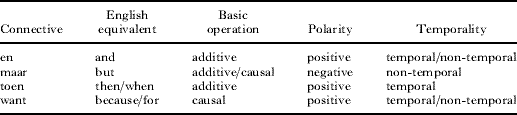
Our research focuses on four of the most frequent Dutch connectives (in adult language, cf. Uit den Boogaart, Reference Uit den Boogaart1975), which represent all the conceptual primitives mentioned above (see Table 1). These Dutch connectives are similar to the earliest connectives mentioned in the studies that focus on English connectives (cf. Bloom et al., Reference Bloom, Lahey, Hood, Lifter, Fiess and Bloom1980; Braunwald, Reference Braunwald1985; Diessel, Reference Diessel2004), which makes it possible to compare the Dutch results to the English data. There are some relevant differences between the languages, too. For example, Dutch toen, which can be used either as an adverbial or as a subordinator, can only refer to past tense events.
Dutch connective selection

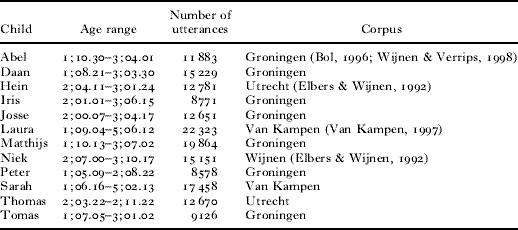
We have examined transcripts of spontaneous speech data of twelve monolingual Dutch-speaking children. All these materials are available through CHILDES (MacWhinney, Reference MacWhinney2000). The transcripts in these longitudinal corpora are based on audiotape recordings made at home, in an unstructured home setting. The recordings were made at relatively small (often two-week) intervals. This is a significanlyt more dense sample compared to the English study by Bloom et al., in which approximately eight-week and twelve-week intervals separated each of the observations that provided the data for analysis (Bloom et al., Reference Bloom, Lahey, Hood, Lifter, Fiess and Bloom1980: 259). The relatively high density allows us to give a more precise characterization of the development, probably with fewer connectives emerging at the same time. The children's age ranges are given in Table 2, which also shows the total number of utterances produced by each child.
Dutch corpus data (with ages in years ; months.days)

Method
To determine the Dutch orders of emergence, a method is needed to establish whether a connective has been ‘acquired’. Bloom and her colleagues try to guarantee the quality of the early connective usage by applying a quantitative criterion (cf. also Brown & Hanlon, Reference Brown, Hanlon, Brown and Hayes1970). With five occurrences they avoid the risk of basing their order of emergence on utterances that do not necessarily presuppose knowledge of the meaning represented by the connective. In our view, however, it is not necessary to use a quantitative approach to rule out such so-called non-productive utterances. By setting qualitative criteria in advance, it is equally possible to guarantee the productivity of the first usage.
In order to establish the Dutch order of emergence, it seems reasonable, then, to stay as close as possible to the earliest emergence by using first occurrence complemented with certain qualitative criteria, as mentioned in (18).
(18) Method used to establish the emergence of a connective:
First occurrence in which the connective is used
(a) in a correct way
(b) as a word combining two clauses
(c) in a creative way.Footnote 2
The first criterion is needed to avoid establishing the acquisition of a connective on the basis of a fragment that is not grammatical from an adult perspective. First, this implies that only connective fragments in which the related utterances are intelligible are considered ‘correct’. Second, it implies that it is possible to interpret the connective in its particular context as expressing an appropriate coherence relation that we know from adult language users. For the connective maar ‘but’, the first criterion demands that utterances such as in (19), in which this word does not clearly mark a contrastive relation, are disregarded.
(19) mother: Er ligt nog (ee)n stukje koekje op jouw beker. Dat is van jou. ‘There is still a cookie on your mug. That's yours.’
matthijs: Eh! Maar ik lus(t) ook ee(n) koekje! (Matthijs, 2 ; 10.8) ‘Uh! But I also like a cookie!’
The second criterion excludes the contextual use of connectives, in which the child chains the utterance to a non-linguistic event that was either something the child did or saw in the context (e.g. (20)). The second criterion also excludes the phrasal use of en and maar (as in (21) and (22)), in which the child connects two constituents instead of two clauses. Only connective clauses containing a subject and a verb are taken into account. These connective clauses may be linked to either an utterance in the child's speech or to a previous utterance in the parent's speech. The previous clause need not be a full clause; the crucial point is that it can be interpreted as a proposition. For example, the maar-clause in (23) is linked to the interactive expression ja ‘yes’, which takes up the propositional content of the mother's utterance. This example is disregarded, however, because of the first criterion: there is no clear local contrastive relation between ja and the maar-clause.
(20) [Picking up a box of furniture.] And let's see this. (Bloom et al., Reference Bloom, Lahey, Hood, Lifter, Fiess and Bloom1980: 240)
(21) Slak. En een hond. (Sarah, 2 ; 0.17) ‘Snail. And a dog.’
(22) Die niet hè? Maar deze. (Hein 2 ; 8.10) ‘Not that one, right? But this one.’
(23) mother: Is de trompet op de slaapkamer? ‘Is the trumpet in the bedroom?’ thomas: Ja, maar Loekie wil zoeken. (Thomas, 2 ; 7.2) ‘Yes, but Loekie wants to look.'
The third criterion excludes fixed expressions (e.g. lines from a song or frequent utterances from an adult conversation partner) and direct imitations from the analysis. This criterion of creativity should lead to the exclusion of utterances that might be regarded as memorized wholes.
RESULTS
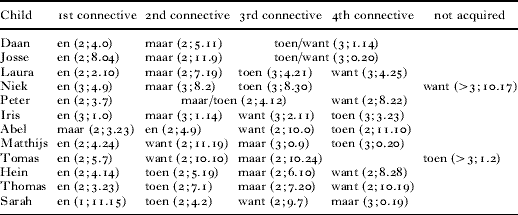
Table 3 shows the Dutch acquisition orders per child based on first correct and creative clausal connective use, together with the ages at which these connectives emerge. The ordering of the children is such that children following the same route are grouped together. Connectives that occur at the same age are placed in-between columns. For example, Daan starts using toen and want at the same time (3 ; 1.14).
Dutch orders of emergence per child (with ages in years ; months.days)

How do these results relate to the hypotheses we formulated? Our first prediction – based on the basic operation – is that the first causal connective does not appear before an additive connective has occurred. This prediction is borne out: all children use the additive en before they come up with the causal connective want (compare as an illustration Thomas' ages at his first production of en (24) and want (25)).
(24) mother: Ja in mijn bord zit pap. ‘Yes in my plate there's porridge.’ thomas: En Loek eet de appelsap. (Thomas, 2 ; 3.23) ‘And Loek eats the apple juice.’
(25) Jij mag niet eh van drop want dat is van mij. (Thomas, 2 ; 10.19) ‘You may not uh have licorice because it's mine.’
The second prediction – based on polarity – claims that the first negative connective does not appear before a positive connective has occurred. Most of the data are in line with this prediction: eleven children start with the positive en, and only later on produce the negative connective maar. Abel forms a remarkable exception to this acquisition pattern; contrary to our prediction, his first connective is maar (for example, compare Abel's ages at the time of his first maar in (26) and his first clause combining en in (27): 2 ; 3.23 versus 2 ; 4.9). In (26), Abel's maar-utterance can be seen as a negation of the adult's claim that ‘Abel can leave the radio where it is’: the fact that Abel wants to build a tunnel in that place, implies that he cannot leave the radio over there. In this fragment, then, maar marks a real contrastive relation.
(26) adult: Je kan hem (=een radio) toch gewoon laten staan? ‘Can't you just leave it (=a radio) there?’ abel: Nee. ‘No.’ adult: Jawel. ‘Yes.’ abel: Nee. ‘No.’ adult: Nou. ‘Well …’ abel: Maar ik moet even daar ee(n) tunnel bouwen. (Abel, 2 ; 3.23) ‘But I just have to build a tunnel there.’
(27) mother: En het nijlpaard ging ook onder de douche, hè Abel? Ging 'ie drinken. ‘And that hippo also took a shower, didn't he Abel? He drank.’ mother: (Two side remarks to the researcher, who is also present.) abel: En [/] en die nijlpaard moet poetse(n). (Abel, 2 ; 4.9) ‘And the hippo has to brush.’
This implies that our second prediction is not completely borne out, since there is one counter-example we cannot explain, (26).
A third prediction is that – because of different interactions between the basic operation and polarity – there is room for variation in the developmental sequences: after the first positive additive it is possible to encounter either a negative additive or a positive causal. Negative causals, however, should occur last. Nine children acquire the negative additive maar before the positive causal want, while only three children show the reverse sequence. Considering this fact, the conclusion can be drawn that variation due to different interactions can be borne out. A more detailed analysis of the early occurrences of maar reveals that these are all instances of negative additive use, as in example (28). The negative causal use of maar (as in (29)) only emerges after the first positive causal (or in the same file, as is the case for Peter). In example (29) a causal relation can be derived between S1 and the negative counterpart of S2: ‘because the barrier does not open, he cannot go through’. This relation is a negative causal one, because not S2 but its negative counterpart, not-S2, functions in the basic operation. The negative causal nature of (29) can also be attested by reformulating the relation with the negative causal connective ‘although’ (‘Although the barrier does not open, he can go through’).
(28) Ik wil geen motor. Maar nou wil ik een politieauto. (Josse, 2 ; 11.23) ‘I don't want a motorbike. But now I want a police car.’
(29) Slagboom gaat niet open. Maar hij kan wel erdoor. (Peter, 2 ; 8.22) ‘Barrier does not open. But he can go through.’
Our fourth prediction concerns the interaction between the basic operation and temporal order: purely additive connectives should occur first. Additive relations which also show a temporal order will appear later and causal relations based on temporal order will appear last. The prediction that pure additives appear before temporal additives is borne out for all twelve children; all children only come up with toen after they have produced en. Compare, for example, Matthijs' ages at the moment of his first production of en and toen.
(30) En eh dat is een schoen. (Matthijs, 2 ; 4.24) ‘And uh that is a shoe.’
(31) En toen waren dieren wakker en toen waren dieren slaap. (Matthijs, 3 ; 0.20) ‘And then animals were awake and then animals were asleep.’
However, there is variation in the acquisition order of temporal versus causal. Eight children show the developmental sequence toen–want (this includes Daan and Josse, who start producing toen and want at the same time), whereas four children produce want before toen. Whether these last findings run counter our hypothesis depends on the type of relation marked by want. In cases where the causal relation is not based on a temporal relation, the cumulative complexity predicted for the relations ordered as non-temporal additive–temporal additive–temporal causal does not hold. This seems a plausible explanation: three of the four children who produce toen after their first want start with a causal relation that is not based on a temporal relation. For example, the want-clause in (32) is a pragmatic one: it provides the reason for asking the question. Hence, the want-clause does not function at the semantic level, but at the pragmatic level, where temporal order of the clauses is irrelevant.
(32) Wil je even m'n haar borstelen? Want ik heb slordig haar. (Iris, 3 ; 2.11) ‘Could you brush my hair? Because I have messy hair.’
Again, Abel is the remarkable exception. He is the only child who produces a temporal causal want before he utters his first creative temporal additive toen. In other words, in terms of complexity it seems as if he skips a step in the acquisition process. This is probably too strong a claim, since there are two earlier instances of toen (see (33) and (34)), which both appear before the occurrence of Abel's first want. Although these occurrences are only semi-creative, since Abel repeats the connective toen from the question previously uttered by the adult, they indicate that Abel must have some idea of the notion temporal order at an earlier age.
(33) adult: En toen? ‘And then?’ abel: Toen ga voetballen. (Abel, 2 ; 4.23) ‘Then go (and) play football.’
(34) adult: En toen? ‘And then?’ abel: En toen is eh ijs op. (Abel, 2 ; 7.29) ‘And then there's no ice left.’
It seems as if Abel's acquisition route deviates in more than one respect from those of the other eleven children. Further research is needed to identify whether some other factor triggers his remarkable developmental sequences. The acquisition data of the other children seem to provide ample support for the four hypotheses we put forward. We can conclude that cumulative conceptual complexity seems to offer a solid explanation for the Dutch findings.
Cumulative syntactic complexity
In the first part of this paper, the regularities in the order of emergence of connectives have been linked to cumulative semantic or conceptual complexity. However, Brown (Reference Brown1973) and Slobin (Reference Slobin, Ferguson and Slobin1973) have demonstrated before that even when a meaning is potentially accessible to a child, he may be delayed in expressing it, at least in a conventional way, because of complexity in the formal linguistic mechanism used to encode it (cf. Bowerman, Reference Bowerman, Fletcher and Garman1979: 298). Therefore, it has been argued that semantic or conceptual complexity must be distinguished from grammatical, formal or syntactic complexity – the complexity of the linguistic devices each language has for the expression of ideas (cf. Clark & Clark, Reference Clark and Clark1977: 337–39).
In order to study the influence of structural or syntactic complexity, an independent criterion is needed to establish the degree of syntactic complexity. We define syntactic complexity in a cumulative way: a sentence Y is considered syntactically more complex than another sentence X, if the production of Y involves all the syntactic abilities that the production of X requires, plus at least one more. We will use Diessel's (Reference Diessel2004) theory about different degrees of clause integration as a variant of this cumulative syntactic complexity approach that can be applied to the acquisition of connectives. We will first present his ideas, and then show how those can be related to syntactic complexity.
Diessel (Reference Diessel2004: 149) argues that different types of English conjoined clauses develop from simple non-embedded sentences. He regards the development of conjoined clauses as a process of clause integration: starting from multiple-clause structures that consist of juxtaposed clauses, children gradually learn the use of complex structures in which two or more clauses are integrated in tightly organized grammatical constructions (cf. (35)).
(35) The development of conjoined clauses (Diessel 2004: 171, Figure 7.5)
The earliest multiple-clause utterances consist of juxtaposed clauses (compare example (1) and (2) at the beginning of this paper), i.e. clauses in which the link between two semantically associated utterances is not expressed overtly by a connective (Diessel, Reference Diessel2004: 158). In Braunwald's (Reference Braunwald1985) terms this first developmental step involves ‘the conjoining of two thoughts in a single context of use’ (p. 513).
The earliest conjoined clauses with an explicit connective are pragmatically combined with an utterance in the previous discourse. The majority of these clauses are linked to a clause that constitutes a separate intonation unit (indicated by an utterance with a period). Moreover, they are often associated with an utterance across speaker turns (see (36) and (37), from Diessel, Reference Diessel2004: 159).
(36) child: Nina has dolly sleeping. adult: The doll is sleeping too? child: And the man's sleeping on the big bed. (Nina, 2 ; 2)
(37) adult: Flipper's on TV yeah. child: And Shaggy's not on TV. (Sarah, 3 ; 8)
Diessel labels the intonationally unbound use of and the ‘discourse marker’ use, in order to distinguish it from its use as a coordinating connective.Footnote 3 In coordinate constructions marked with and, the conjoined clauses are intonationally bound and linked to a clause within the same utterance. The final development involves the ordering of the conjoined clauses: while children's early adverbial clauses always follow the associated utterance, their later conjoined clauses can also precede the associated clause.
The developmental pattern observed by Diessel can be regarded as a syntactic extension of the cumulative complexity approach presented in the first part of this paper. First, producing two syntactically and intonationally integrated clauses is more complex than producing each clause separately. Second, the production of integrated final adverbial clauses can be regarded as more complex than the production of integrated coordinate sentences. In order to produce final adverbial clauses the child needs to order the related clauses in a hierarchical way. Such a hierarchical ordering is not needed in the production of coordinate sentences. Finally, initial adverbial clauses are cognitively more complex – at least in terms of processing cost – than final adverbial clauses: they require children to plan two clauses at a time, instead of one clause after another.
In line with Diessel, we predict that the relative syntactic complexity of a coherence relation will influence children's acquisition route of connectives. However, we expect this influence of syntactic complexity on the course of connective acquisition to be restricted. Syntactic complexity is expected to influence the acquisition order of the different syntactic variants of each coherence relation, i.e. we predict that young children will follow Diessel's scheme in their acquisition of each connective. In addition, we expect that two connectives expressing (nearly) the same coherence relation will be acquired in an order that reflects increasing syntactic complexity. However, we do not expect syntactic complexity to influence the acquisition order of different types of coherence relations. Understanding the semantics of a coherence relation appears to be a necessary prerequisite for producing that coherence relation in any of the syntactic variants mentioned above; hence, syntactic complexity seems to be of secondary importance in determining the acquisition order of connectives. Next, we will investigate whether the development of Dutch connectives is in line with these predictions based on cumulative syntactic complexity.
Connective selection, materials and methodology
The role of cumulative syntactic complexity has only been examined for three Dutch connectives: want, omdat ‘because’ and toen. Since three of the four connectives selected in the conceptual complexity study exhibit a similar syntactic complexity in that they are all coordinators (en, maar and want), we do not expect their relative syntactic complexity to cause differences in their age of emergence. However, syntactic complexity may be a major determinant in accounting for the relative order of acquisition of the Dutch coordinator want versus the subordinator omdat, which is semantically almost equivalent to want. An important difference between Dutch coordination and subordination is that coordinated clauses show verb second, as in want hij is ziek ‘because he is ill’, whereas subordinate clauses show verb final, as in omdat hij ziek is ‘lit. because he ill is’.
In addition, syntactic complexity may be relevant in the acquisition order of the adverbial use (cf. (38)) versus the complementizer use of the temporal connective toen (see (39)). The adverb toen occurs in clauses that are juxtaposed or coordinated to a preceding clause; the complementizer toen occurs in subordinating clauses. This complementizer use of toen is syntactically more complex than the adverbial use of toen, since it requires a hierarchical ordering of the combined clauses. The verb-second word order in (38) indicates the main clause status of the toen-clause. The verb-final word order of the toen-clause in (39) marks this clause as subordinate to the main clause in Niek's previous utterance.Footnote 4
(38) [Talking about a door handle. ](Niek, 3 ; 8.30) Moest ik even vasthouden. Dat moest van garage. En toen ging ikke boos worden. ‘I had to hold (it) for a minute. The garage told me so. And then I got angry.’
(39) niek: Ik ben al in het ziekenhuis (ge)legen. ‘I have already been in hospital.’ father: Ja. ‘Yes.’ niek: Toen ik nog baby was. (Niek, 3 ; 10.3) ‘When I was still a baby.’
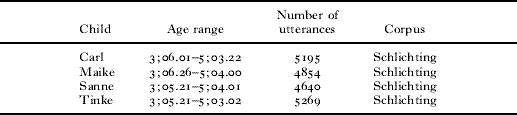
We have examined the longitudinal data of the twelve children that were mentioned in the previous section. These data were used to establish orders of acquisition. However, because the subordinators omdat and toen hardly occurred in these data, we also analyzed the data of four older children (see Table 4) in order to obtain a more general developmental picture. These data were gathered by Schlichting (Reference Schlichting1996) with three-month intervals. The transcriptions in these corpora are based on audiotape recordings made at home, in three different settings (telling a story on the basis of four pictures, free conversation, and conversation during an activity like drawing or making a jigsaw puzzle).
Data on the Schlichting Corpus (with ages in years ; months.days)

We tested our hypotheses: (a) by establishing per connective pair (want vs. omdat and adverbial toen vs. complementizer toen) in which order the two variants were acquired; and (b) by comparing per connective the degrees of clause integration to the acquisition pattern proposed by Diessel (Reference Diessel2004). In performing the latter analysis, we relied on punctuation in the transcripts: CHILDES data are transcribed according to the convention that each utterance ended with a period reflects a separate intonation unit. Two clauses separated by a comma are regarded as one intonation unit. So, if S1 and S2 are transcribed as one sentence, they are considered integrated. If they are transcribed as two separate sentences, they are considered non-integrated. This non-integrated character of utterances is very often confirmed by intermediating remarks by adults involved in the conversation (cf. (39)).
Results for want and omdat
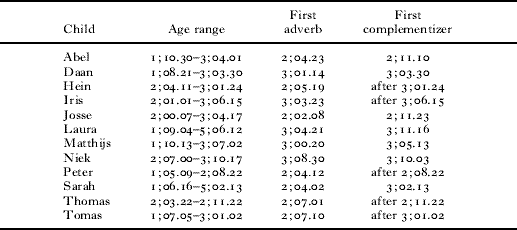
Our analyses reveal that only four of the twelve younger children used omdat creatively during the period in which they were recorded, whereas all these children, except for Niek, used want. The four older children – Carl, Maike, Sanne and Tinke – all produced both connectives. As Table 5 shows for the four younger children who use both connectives, the emergence of the coordinator want always precedes the acquisition of the subordinator omdat.
Age of first emergence of want and omdat

The qualitative analysis of want shows that the earliest want-clauses appeared in separate utterances (cf. (40)). Only later on did integrated use of want develop (cf. (41)).
(40) adult: Past die er niet in? ‘Doesn't that one fit in it?’ abel: Nee, die past er niet in. Want die te groot voor. (Abel, 3 ; 3.8) ‘No, that one does not fit in it. Because that one (is) too big for (it).’
(41) Ze kunnen ook niet praten want het zijn geen mensen. (Carl, 5 ; 1.3) ‘They also cannot talk because they are not human.’
A quantitative analysis of the want-clauses in the final two recordings of the four older children shows that sixteen want-clauses were integrated intonationally into their matrix clause, whereas forty want-clauses were produced in independent utterances. Even around their fifth birthday, children still preferred to produce want-clauses separately. The increasing degree of clause integration in the use of want is in line with Diessel's findings.
The developmental data on omdat reflect Diessel's acquisition pattern as well. The earliest omdat-clauses appeared in separate utterances. In the data of the younger children, sixteen of the twenty-one interpretable omdat-clauses that were produced separately were responses to why-questions from the parents (cf. (42)). Only five interpretable omdat-clauses were intonationally integrated into their matrix clause. These five utterances came from Laura's data: three with a postposed omdat-clause (cf. (43)), and two with a preposed omdat-clause (see (44)).
(42) adult: Waarom wil jij mij niet helpen? ‘Why do you not want to help me?’ hein: Omdat ik niet zin heb. (Hein, 3 ; 0.11) ‘Because I don't feel like it.’
(43) Die hebben allemaal dekens gepakt, omdat ze [//] ik hun bedje moet maken. ‘They all took blankets, because I have to make their beds’ (Laura, 5 ; 2.21)
(44) Omdat je niet zoveel gedrinkt heb, moet je nog een keer (…) (Laura, 5 ; 2.21) ‘Because you did not drink so much, you have to go one more time (…)’
The number of integrated omdat-clauses hardly increases with age. A quantitative analysis of the omdat-clauses in the final two recordings of the four older children shows that only five of the twenty-nine interpretable omdat-clauses were integrated intonationally into their matrix clause. It can be concluded that children aged five still prefer to produce omdat-clauses separate from the matrix clause to which they relate.
Results for toen
The first use of toen is restricted to the adverbial use, as illustrated in (45).
(45) Toen was ik ook mee, hoor. (Laura, 3 ; 4.21) ‘Then I also came along.’
As Table 6 shows for the younger children in this study, the emergence of adverbial toen always precedes the emergence of complementizer toen. In addition, the adverbial use of toen remains the more frequent of the two throughout the development.
First emergence of adverbial and complementizer toen

The complementizer use of toen is illustrated in (46) to (48), in which square brackets denote overlap. The first complementizer toen-clauses always occur in a separate clause, functioning as an afterthought or a postmodification (cf. (46)). Only later on do children really integrate the toen-clause into the matrix clause (cf. (47) and (48)). This is in line with Diessel's observations that intonationally and syntactically unintegrated clauses precede adverbial clauses that are intonationally bound to their matrix clause.
(46) adult: Oh, heb je die van Rosie gekregen? ‘Oh, did you get that one from Rosie?’ josse: Ja. ‘Yes.’ adult: Dat is ook een [hele mooie]. ‘That's also a very pretty one.’ josse: [Toen we in Sloten] waren. (Josse, 3 ; 1.10) ‘When we were in Sloten.’
(47) Maar deze was kapot toen ik hem vond. (Sanne, 5 ; 4.1) ‘But this one was broken when I found him.’
(48) Toen ik jarig was dan komt zwarte piet. (Laura, 4 ; 0.20) ‘When I had my birthday ‘zwarte piet’ came.'
The acquisition of complementizer toen-clauses in postposition precedes the acquisition of toen-clauses in preposed position in the recordings of six of the seven children who acquire the complementizer toen during the period in which they are recorded. Furthermore, the postposed toen-clauses outnumber the preposed ones. Only twenty-four of the seventy-four fragments with complementizer toen have the toen-clause in preposed position. Sarah's developmental sequence is the exceptional one: her first toen-clause in which toen functions as a complementizer is in preposed position (age 3 ; 2.13). Her first postposed toen-clause occurs two months later, at the age of 3 ; 4.13. The data of the other six children are in line with Diessel's claim that the acquisition of final adverbial clauses precedes the acquisition of initial clauses.
It can be concluded that children start with the adverbial use of toen, which is used mainly in topic position, and only later acquire the complementizer use of toen. The developmental patterns of the complementizer use of toen – except that of Sarah – are in line with Diessel's acquisition route.
Conclusions on cumulative syntactic complexity
Our analysis shows that the connective clauses are all first used in intonationally unbound clauses and only later occur in syntactically and intonationally integrated clause combinations. That is, in their use of connectives under investigation, children adhere to the developmental pattern observed by Diessel. With age, children become more and more proficient in integrating conceptual ideas in syntactic constructions that are more complex in terms of processing cost or the amount of planning that is needed.
These findings imply that the cognitive complexity approach can be maintained, but that it needs to be extended with a syntactic complexity component. The degree of syntactic complexity influences the relative order of emergence of different connectives (cf. the results on want and omdat), but it also affects the order of emergence of the different uses of one and the same connective (cf. the results on toen).
DISCUSSION AND CONCLUSION
Returning to the questions asked at the beginning of this paper, we can now conclude that there is indeed an order of acquisition that has some cross-linguistic validity. More specifically, for the Dutch connectives en, maar, toen and want, as well as for their English counterparts, we found that children vary in their acquisition route, but that this variation obeys specific boundaries: conceptually more complex connectives only occur after relatively simple ones are acquired. The Dutch order we found, as well as the English order of emergence mentioned in Bloom et al. (Reference Bloom, Lahey, Hood, Lifter, Fiess and Bloom1980), can be explained on the basis of our multidimensional approach to conceptual complexity. Thereby, we have improved the generalizability of conceptual complexity as an explanation for connective acquisition.
Our approach to cumulative cognitive complexity is not completely new. It builds on the cumulative complexity approach proposed by Bloom and her colleagues. It differs from that approach in that the conceptual notions are not ordered along one dimension (additive<temporal<causal<adversative), but rather so that each connective is defined on the basis of several conceptual primitives that are of a general cognitive nature, such as polarity (positive versus negative) or relation type (additive versus causal) (following Sanders et al., Reference Sanders, Spooren and Noordman1992). The fixed routes are explained by reference to the relative complexity of different values on the same primitive (e.g. [α causal] vs. [+causal]), whereas the variation among acquisition routes of Dutch-speaking and English-speaking children can be explained by reference to the different interactions between the conceptual primitives that characterize each connective.
All in all, cumulative conceptual complexity seems to offer a solid explanation for the findings both on Dutch and English connective acquisition. Our multidimensional approach accounts both for the uniformity and for the diversity in this acquisition. However, this approach needs to be extended in order to give an account of the emergence of other connectives as well. For example, within the temporal domain a distinction between priority and anteriority is needed to account for differences between connectives expressing sequentiality. Adding more primitives will make the model much more restrictive, and hence, more attractive.
Our study has shown that a syntactic complexity component should be added to the overall model. The degree of syntactic complexity influences the relative order of emergence of different connectives expressing (nearly) the same coherence relation (cf. the results on the causal connectives want and omdat). In addition, it affects the order of emergence of the different uses of one and the same connective (cf. the results on adverbial and complementizer toen). However, we do not expect syntactic complexity to influence the acquisition order of different types of coherence relations. Understanding the semantics and pragmatics of a coherence relation appears to be a necessary prerequisite for producing that coherence relation in any of its syntactic variants; hence, syntactic complexity seems to be of secondary importance in determining the acquisition order of connectives.
We believe we have significantly increased the explanatory power of cumulative complexity to account for connective acquisition. Needless to say, several crucial issues require further empirical investigation. The most prominent one is arguably the fundamental debate in current studies of language acquisition: Is the course of acquisition of linguistic elements largely determined by the inherent complexity of linguistic and conceptual structures or rather (also) by the language input children receive, as increasingly influential usage-based accounts propose? A comprehensive theory of connective acquisition needs to take both factors into account simultaneously and deepen our understanding of how they interact. Given the limitations of time and space, this was not possible in the current paper. One way to determine the relative contribution of these factors is to analyze connective use in relatively dense corpora, linking the children's output to their increasing cognitive abilities as well as to their parents' connective input, and see to what extent both factors predict the data. Van Veen, Evers-Vermeul, Sanders & Van den Bergh (Reference Van Veen, Evers-Vermeul, Sanders and Van den Bergh2008) have performed this type of analysis for one German child. Their data show that both factors are needed to correctly predict the frequency of use by the child. However, research comparing data from several children is required to establish the relative contribution of parental input and cognitive complexity. It will be fascinating to find out whether our cognitive complexity approach will survive this type of test. Luckily, such research, in which the contribution of ‘inherent complexity’ can be compared to ‘input factors’ is within reach, thanks to the dense data that researchers like Tomasello (Reference Tomasello2003) and Behrens (Reference Behrens2006) provide us with. Only this type of interaction between data, theory and empirical testing will reveal the way in which children learn to build discourse by connecting clauses.