INTRODUCTION
To flower, plants must be hydrated. The phenomenon of woody plants flowering while leafless during the tropical dry season has long intrigued ecologists (Janzen Reference JANZEN1967, Murphy & Lugo Reference MURPHY and LUGO1986, van Schaik et al. Reference VAN SCHAIK, TERBORGH and WRIGHT1993). These plants shed their leaves early in the dry season before substantial water stress occurs (Choat et al. Reference CHOAT, BALL, LULY, DONNELLY and HOLTUM2006, Fallas-Cedeno et al. Reference FALLAS-CEDENO, HOLBROOK, ROCHA, VASQUEZ and GUTIERREZ-SOTO2010, Wright & Cornejo Reference WRIGHT and CORNEJO1990) rather than later in the dry season in response to water stress. This leaf shedding triggers an improvement in their water status and there is evidence that this improvement can be a cue to flowering (Borchert Reference BORCHERT1983, Reference BORCHERT1994a, Reference BORCHERTb).
Insight into this behaviour has contributed substantially to our understanding of the relationship between the proximal cues or drivers and the ultimate (adaptive) implications of plant phenology in the tropics. In tropical areas seasonal variation in day-length and temperature is muted compared with higher latitudes, so a greater role for moisture availability as a proximal cue and possible ultimate driver of the timing of leafing, flowering and fruiting events has been posited, particularly for seasonally dry environments (Borchert Reference BORCHERT and Raghvendra1991, Reich & Borchert Reference REICH and BORCHERT1984). Nevertheless, tropical plants can respond to changes in day-length (Rivera & Borchert Reference RIVERA and BORCHERT2001, Rivera & Cozza Reference RIVERA and COZZA2008), and also to seasonal changes in solar radiation (Yeang Reference YEANG2007), both of which are more predictable than moisture. Prolonged seasonal dryness constrains adaptive phenological variation (Borchert et al. Reference BORCHERT, MEYER, FELGER and PORTER-BOLLAND2004, van Schaik et al. Reference VAN SCHAIK, TERBORGH and WRIGHT1993). Janzen (Reference JANZEN1967) offered an adaptationist perspective with specific application to woody tropical plants that flower while leafless. He argued that this renders the flowers more obvious to vertebrate and invertebrate pollinators, and that temporal separation of reproduction and leafing optimizes vegetative success by enabling greater diversion of resources to growth during the period when moisture is abundant and light may be limited due to heavy cloud cover and canopy closure.
Leaflessness limits a plant's ability to take up moisture from soil (Worbes et al. Reference WORBES, BLANCHART and FICHTLER2013). However, during the tropical dry season, leafless plants may compensate by transpiration though tap roots (Scholz et al. Reference SCHOLZ, BUCCI, GOLDSTEIN, MOREIRA, MEINZER, DOMEC, VILLALOBOS-VEGA, FRANCO and MIRALLES-WILHELM2008) or by having thickened leaves, stems or roots that permit water to be stored (Borchert Reference BORCHERT1994a, Bullock & Solis-Magallanes Reference BULLOCK and SOLIS-MAGALLANES1990, Fallas-Cedeno et al. Reference FALLAS-CEDENO, HOLBROOK, ROCHA, VASQUEZ and GUTIERREZ-SOTO2010, Worbes et al. Reference WORBES, BLANCHART and FICHTLER2013). Even in these cases, this raises the question: if water supplies are adequate for flowering and fruiting but not for leaf retention as well, is the availability of water a constraint on the extent of flowering or fruiting and the timing of re-leafing?
In this study we present phenological data (foliage, flowers, fruit) for Brachychiton megaphyllus Guymer collected over a 12-mo period in a seasonally dry, tropical environment. Our results have implications for the debate about the nature of proximal cues to and ultimate drivers of flowering during the prolonged tropical dry season whilst plants are leafless, as well as possible responses to climate change. We present the results of an irrigation experiment testing the hypotheses that moisture availability constrains the extent of flowering and fruiting, and the timing and extent of re-leafing.
METHODS
Study site and species
Phenological observations and the irrigation experiment were conducted in well-wooded savanna in the grounds of the CSIRO Tropical Ecosystems Research Centre near Darwin in the Northern Territory, Australia (130.9°E, 12.4°S). The mean annual rainfall of c. 1700 mm reliably includes one wet and one dry season per year, though the onset and conclusion of wet-season rains vary by up to several months. The dry season comprises 4–7 mo with no effective rainfall (McDonald & McAlpine Reference MCDONALD, MCALPINE, Haynes, Ridpath and Williams1991), typically from April or May to September or October. Temperatures are consistently high (though somewhat lower in the cool dry season from June to August) with daily maxima always 25°C or greater and overnight minima very rarely dropping below 15°C. Relative humidity is highest in the wet season and varies diurnally to a greater extent during the dry season. The soil is shallow sandy loam to 1 m over laterite. The vegetation is tropical savanna in the broad sense of comprising a continuous grass layer with interspersed trees (Huntley & Walker Reference HUNTLEY and WALKER1982), but may equally be described as an open forest. It comprises a canopy cover of about 50% dominated by evergreen Eucalyptus tetrodonta and E. miniata, a midstorey of broad-leaved deciduous and evergreen trees and shrubs, and a continuous understorey of annual and perennial grasses such as is widespread in the Darwin area (Wilson & Bowman Reference WILSON and BOWMAN1987). The site had not been burnt for the previous 3 y. The study plants were spread over an area 240 by 140 m with no perceptible slope.
Brachychiton megaphyllus is a sparingly branched shrub or small understorey tree confined to tropical savannas of the north-west of the Northern Territory, Australia (Franklin & Bate Reference FRANKLIN and BATE2013, Guymer Reference GUYMER1988). Its large (15–40 cm long and wide), broadly ovate to circular, entire or lobed leaves are notably few and mostly on the few terminal shoots. The open-tubular flowers are 2.5–5 cm in diameter and are clustered in former leaf axils on old wood. Fruits are woody follicles to 10 cm long that split longitudinally. The species occurs in areas that are warm to hot throughout the year and have intensely seasonal rainfall, but span a range of mean annual rainfall from c. 800 to 2000 mm.
We identified 60 B. megaphyllus individuals between 0.5 and 1.5 m high. We selected two subsamples (irrigation treatment and controls) of n = 15 using random number tables and stratifying to the extent possible for height of the main stem (small = 0.5–0.75 m; medium = 0.75–1.25 m; large = 1.25–1.5 m). Irrigated and control plants were separated by at least 10 m to ensure no effect of irrigation on control plants. One plant was lost, one damaged by a falling tree, and one died, leaving n = 13 irrigated plants (two small, five medium, six large) and n = 14 controls (three small, seven medium, four large).
Observations
We recorded phenological states for each control and experimental tree approximately weekly from April to December 2012, then monthly to April 2013; 38 times in total. The states individually counted for each tree were the number of: leaves in length classes; flower buds; open flowers; fallen flowers; developing (closed) fruits; mature (open) fruits. Leaf length classes were: 0–10, 10–50, 50–100, 100–200, 200–300, >300 mm. We removed fallen flowers after counting. We also recorded estimates of the per cent of foliage area that was missing due to herbivory, or necrotic, for each plant.
Irrigation
We commenced irrigation on 6 April 2012 after 15 consecutive days of daily rainfall less than 10 mm. The intermittency of the rains, with 13 consecutive days of rain less than 10 mm in January and 14 in early February, dried the soil to the extent that the surface cracked so we continued the irrigation to mid-February 2014. Water was delivered by four drippers laid close to the trunk. Each plant received 16 L d−1, equivalent to 20.4 mm of rain daily over a circle 0.5 m in radius (5.1 mm over a circle 1 m in radius). In consequence, surface soil around irrigated plants was almost constantly moist. When we attempted to obtain soil cores to measure moisture, soil below c. 20 cm depth on control plants had set so hard the manual corer could not penetrate it, but we readily cored around irrigated plants. Between 18 August and 1 November we sampled soil from five irrigated plants at 90, 85, 83, 80 and 30 cm depths and from four control plants at 20–30 cm depth and determined moisture content by the gravimetric method (De-Angelis www.nature.berkeley.edu/ soilmicro/methods/Soil moisture content.pdf). Ratios of water weight/dry soil weight were 0.18, 0.16, 0.1, 0.14, 0.15 for the irrigated group and 0.08, 0.08, 0.07, 0.13 for the Control group.
Data analysis
Daily rainfall records for the study period were collected by CSIRO at the research centre where the study was conducted. We obtained mean monthly rainfall from c. 40 y of data from an Australian Bureau of Meteorology gauge at Berrimah Farm, 4 km away (the landscape is flat), downloaded from www.bom.gov.au on 23 November 2014.
Our phenological analyses are from control (non-irrigated) plants. The numbers of buds and fruits were instantaneous counts of the numbers present at each assessment but this proved to be an inadequate measure for flowering activity because flowers were shorter-lived than the intervals between assessments. We therefore combined the counts of standing and fallen flowers, producing a total which accumulated between assessments. For the phenological summary, we standardized the rate of flower production to the number per 7 d using the interval leading up to the count. For analyses of the effects of irrigation, we used measures of reproductive effort summed for each plant over the entire season, and intensity, which is effort divided by the number of days of budding or flowering. For each assessment interval: bud d is the number of buds by the number of days for which the assessment date was the midpoint; flower d is the number of flowers by the number of days to the previous assessment. Bud and flower seasons are the number of days between the first and last assessments at which these organs were present.
The standing leaf area of each plant was calculated assuming that leaves are circular and using the mid-length to calculate area for each leaf-length class. Leaves >300 mm long were assumed to have an upper bound of 350 mm. For phenology analyses only, the estimated leaf area of each plant was reduced by the per cent attributed to herbivory or necrotic damage.
We expected that if soil moisture is a limiting factor acting on plant development leaf flush would occur after the first rains of the wet season, and irrigated plants would show greater leafiness, earlier leaf flush, and greater reproductive activity and success. We investigated the effects of irrigation using two-factor permutational ANOVAs with an interaction term. We included plant-size category as a factor because larger plants are likely to produce more flowers and fruit, and have larger canopies. Further, because small plants may have smaller root masses (Eamus et al. Reference EAMUS, CHEN, KELLEY and HUTLEY2002), they may respond differently to irrigation than larger plants. Initially, we selected a parsimonious set of five response variables to reflect plausible hypotheses about the effects of irrigation on extent of reproductive activity and the timing and extent of growth: bud d and flower d (defined above), maximum number of developing fruit, first date of leaf flush and maximum leaf area.
As some of the response variables could not readily be normalized (in particular, the maximum number of developing fruit was somewhat zero-inflated), we ran the ANOVAs in the PERMANOVA+ add-on to the software PRIMER (Anderson et al. Reference ANDERSON, GORLEY and CLARKE2008). Probabilities in this software are calculated by permutation (we used 9999 permutations) and are thus not dependant on normality and equality of variances in the response variable. This permutation approach operates on a similarity matrix, for which we employed the Euclidean distance measure.
RESULTS
Phenology of Brachychiton megaphyllus
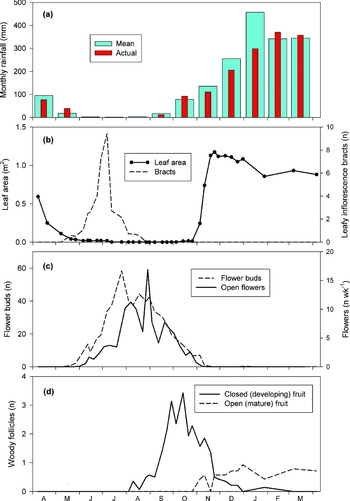
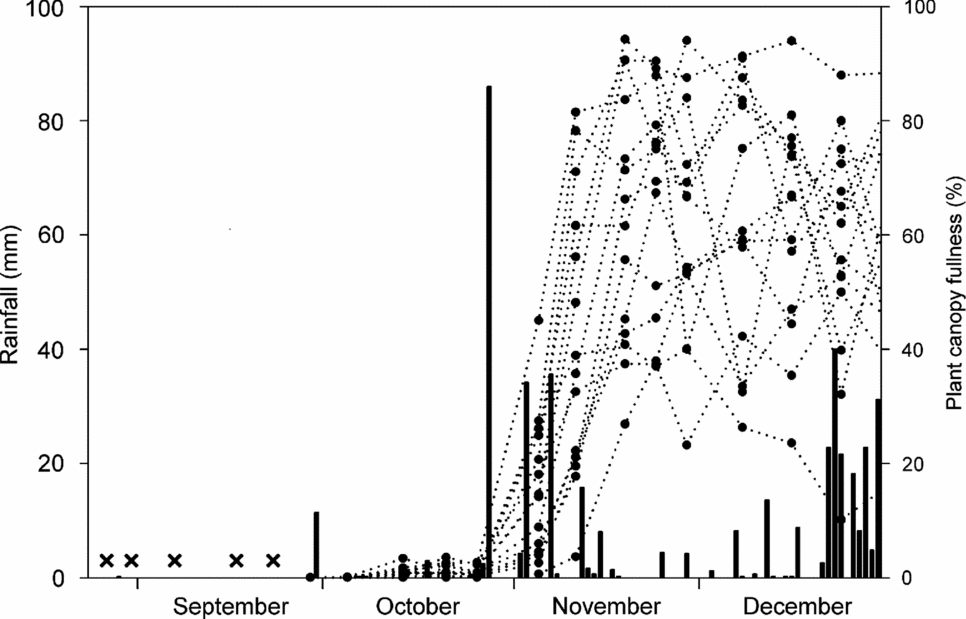
Rainfall in the wet season prior to the study was remarkably close to monthly averages. That during the study period was also close to average in both timing and quantity although somewhat depressed in the early wet-season months of November 2012 to January 2013 (Figure 1a). The dry season lasted from 5 May to 29 September 2012, with just 2.0 mm in 148 d. Minor falls in the 4 wk from 30 September 2012 were followed by substantial falls in late October and early November, with persistent monsoonal rains commencing in late December (Figure 2).
A 12-mo (April 2012–April 2013) phenology of control (non-irrigated) Brachychiton megaphyllus in savanna near Darwin, northern Australia: monthly rainfall (a), leaf area and number of bracts (b), numbers of flower buds and open flowers (c) and mature and developing fruit (d). Data are per plant, the mean from 14 plants; frequency of observations is indicated by points in b.

Plant canopy fullness (points and traces) in 14 Brachychiton megaphyllus, and pre-monsoonal and early wet-season rain (bars) near Darwin, northern Australia, in 2012. Crosses are dates of plant assessment in which all plants had zero leaf area. Canopy fullness is expressed as a percentage of the maximum leaf area achieved during the study period – which in all cases occurred in January to April 2013 after the arrival of monsoonal rains. Plant data are from control (non-irrigated) plants.
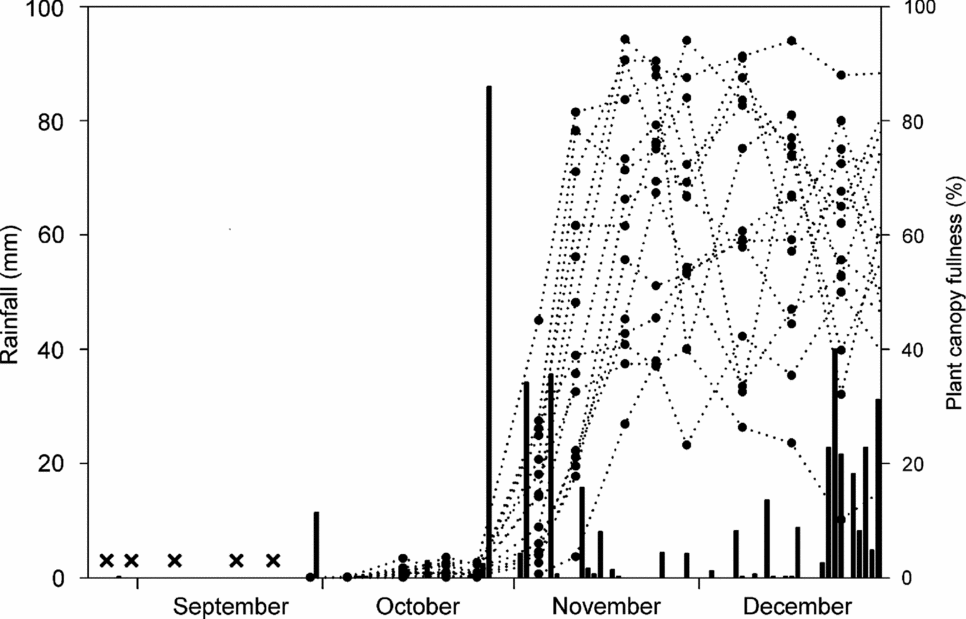
Leaf drop in 2012 was almost complete by the end of the last substantial rainfalls of the wet season (Figure 1b). Plants remained mostly leafless for 6 mo and all were absolutely leafless in the latter part of the dry season (Figure 2). Five of 14 plants commenced leaf flush before any rain; substantial canopy development in most plants rapidly followed heavier rain 29 d later (Figure 2). In all plants, maximum leaf area was achieved in the mid- to late-wet season after the commencement of monsoonal rains.
In at least 11 of the 14 plants, onset of reproductive activity was marked by a flush of small leaves. These proved to be bracts, being short-lived, rarely exceeding 10 mm length and emerging from the axils of fallen leaves – normal leaves mostly emerge terminally. In most plants they appeared about 1 mo after fall of the last normal (200–300+ mm) leaf (Figure 1b). (The bracts were included in leaf area estimates, but their small size compared with normal leaves precluded a substantial contribution.) The first flower buds emerged within a month of these bracts (Figure 1b, c). Open flowers appeared c. 1 mo after buds (first in early June, Figure 1c) but appeared to last only a few days. Woody follicles first appeared in early August, about 2 mo after initial flowering, and began splitting open in early November (Figure 1d), well after the first wet-season rains. Seeds were shed rapidly after splitting.
The reproductive phenophases, from bracts to developing woody follicles, remained active in the population for 4–5 mo (Figure 1c), between them spanning the entire dry season and early wet season, though some open follicles persisted to the following dry season long after having shed seed.
All 14 plants produced flower buds, 13 had open flowers, nine produced developing fruits, and three yielded seed. Very high levels of attrition of reproductive parts at all stages were noted within plants, with an average of only one follicle per plant yielding seed, the three successful plants yielding two, three and eight follicles respectively. By definition, a follicle arises from a single flower. Loss of developing follicles was associated with boring insects.
Effects of irrigation
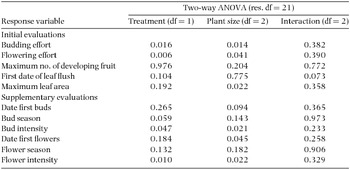
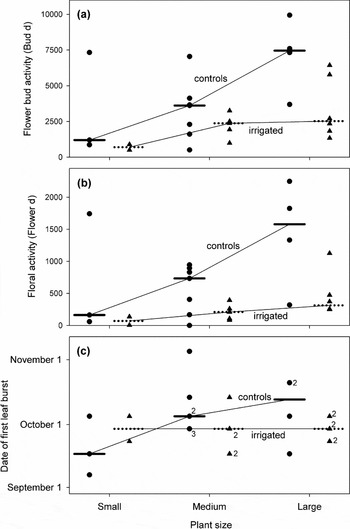
Contrary to expectation, irrigation reduced rather than increased flower bud and floral activity, and quite substantially so – by c. 50% to 75% (Figure 3a, b). It did so primarily by reducing the intensity of flowering (Table 1). We found no difference in the number of fruit produced (Table 1).
Permutational probabilities from initial and supplementary evaluation of the effects of irrigation on reproduction and leafing in Brachychiton megaphyllus. Date first flowers: residual degrees of freedom reduced by one because one control plant produced no flowers.

Effects of irrigation on reproductive activity and leaf phenology in Brachychiton megaphyllus: flower bud activity (a), floral activity (b), date of first leaf burst (c); horizontal bars are medians, circles are individual control plants, triangles are individual irrigated plants, numbers are the numbers of plants represented by a point.

We found no significant effects of irrigation on leaf area in the wet season following the irrigation period (Table 1). There was also no significant effect on date of first leaf flush, but the data distribution suggested large irrigated plants may have flushed earlier than large control plants with the converse for small plants (Figure 3c).
DISCUSSION
Phenology, cues and root systems
Two distinct but related issues in the ecology of woody plants in the seasonally dry tropics are presently in question: the relationship between soil moisture and leafiness in deciduous species, and the ability to flower when leafless during the dry season. The latter impinges on the former in demonstrating that the plant has access to moisture during the dry season. Brachychiton megaphyllus well exemplifies these issues. Our study places it in that group of deciduous woody plants whose phenologies strongly correspond with seasonal patterns of rainfall yet are neither directly driven by severe desiccation (Borchert Reference BORCHERT1983, Choat et al. Reference CHOAT, BALL, LULY, DONNELLY and HOLTUM2006, Fallas-Cedeno et al. Reference FALLAS-CEDENO, HOLBROOK, ROCHA, VASQUEZ and GUTIERREZ-SOTO2010) nor strongly responsive to additional sources of moisture (Myers et al. Reference MYERS, WILLIAMS, FORDYCE, DUFF and EAMUS1998, Wright & Cornejo Reference WRIGHT and CORNEJO1990).
Leaf flush at the beginning of the wet season was demonstrably not cued by soil moisture in B. megaphyllus both because some control plants flushed before any rain fell and because irrigation failed to have any substantial impact on its timing. Notwithstanding, it is possible that substantial rain is required to complete canopy development, an issue of interest given variability in the onset of the wet season (Garnett & Williamson Reference GARNETT and WILLIAMSON2010, Taylor & Tulloch Reference TAYLOR and TULLOCH1985) and a projected decrease in early rains under a climate-change induced increase in the frequency of El Niño Modoki events (Taschetto et al. Reference TASCHETTO, UMMENHOFER, SEN GUPTA and ENGLAND2009, Yeh et al. Reference YEH, KUG, DEWITTE, KWON, KIRTMAN and JIN2009). Though leaf shed was completed as the wet-season rains concluded, i.e. before severe soil desiccation, we cannot rule out sensitivity to slight desiccation as the cue for its occurrence. However, Choat et al. (Reference CHOAT, BALL, LULY, DONNELLY and HOLTUM2006) found that leaf drop in two tropical deciduous species (including another species of Brachychiton) was not associated with a drop in leaf water potential, and Fallas-Cedeno et al. (Reference FALLAS-CEDENO, HOLBROOK, ROCHA, VASQUEZ and GUTIERREZ-SOTO2010) that leaf drop preceded a drop in soil moisture. Wright & Cornejo (Reference WRIGHT and CORNEJO1990) found that irrigation improved plant water status yet in most species did not change the timing of leafing events. The failure of irrigation to advance first flower bud emergence in B. megaphyllus also suggests that flowering is not cued by the improvement in plant water status that follows leaf shed, contrary to earlier findings (Borchert Reference BORCHERT and Raghvendra1991, Reference BORCHERT1994a). Our evidence and the consistency of our phenological observations with those of Williams et al. (Reference WILLIAMS, MYERS, MULLER, DUFF and EAMUS1997) lead us to suggest that B. megaphyllus responds to daylength, as is the case with stem-succulent tropical plants (Borchert & Rivera Reference BORCHERT and RIVERA2001), though other possible cues such as solar radiation cannot certainly be ruled out.
The moisture required for flowering and early leaf flush could be obtained by deep roots from residual subsoil moisture, or from water stored by the plant. Among two north Australian deciduous trees, Planchonia careya has deeper roots than Terminalia ferdinandiana (Eamus et al. Reference EAMUS, CHEN, KELLEY and HUTLEY2002), with the former flushing leaves prior to the first rains and showing little response to irrigation whereas the converse is true of the latter (Myers et al. Reference MYERS, WILLIAMS, FORDYCE, DUFF and EAMUS1998, Williams et al. Reference WILLIAMS, MYERS, MULLER, DUFF and EAMUS1997). Brachychiton megaphyllus has a deep fleshy tap root and thick terminal branchlets (Franklin & Bate Reference FRANKLIN and BATE2013), suggesting a capacity to store water. Water storage capacity is associated with thickened trunks, branchlets and tap roots in other species of this genus (Buist et al. Reference BUIST, YATES and LADD2000, Choat et al. Reference CHOAT, BALL, LULY and HOLTUM2005, Guymer Reference GUYMER1988). It is a feature of a number of deciduous species of seasonally dry forests in Central America (Borchert Reference BORCHERT1994a, Worbes et al. Reference WORBES, BLANCHART and FICHTLER2013).
Brachychiton megaphyllus also has no major lateral (surface) roots and very few fine roots in the top 50 cm of soil when examined during the dry season (Franklin & Bate Reference FRANKLIN and BATE2013). It is possible that the fine roots of this species are seasonal, regrowing with wet-season rains as is the case with other species in the forest in which it occurs (Janos et al. Reference JANOS, SCOTT and BOWMAN2008). Regardless, B. megaphyllus appears to have no capacity to exploit unseasonal rainfall that wets only surface soils.
Impact of irrigation on flowering
The markedly reduced flowering activity of irrigated B. megaphyllus, which took the form of fewer flowers and buds at any given time, was quite contrary to expectation. Four explanations appear worthy of consideration.
Firstly, it is conceivable that irrigation caused waterlogging. However, we think this unlikely except perhaps for small plants because: (1) there was a possible advance in leaf flush date in larger irrigated plants, and certainly no overall delay in leaf flush; (2) extreme desiccation of surrounding soils (Duff et al. Reference DUFF, MYERS, WILLIAMS, EAMUS, O’GRADY and FORDYCE1997) and competition from the evergreen overstorey trees is expected to have caused strong dissipation of irrigation water; and (3) maximum leaf areas occurred mid-wet season when irrigation would most probably waterlog soils, but were not different from the control group.
A second possibility is that irrigation encouraged plants to divert resources from reproduction to growth. However we detected no marked effect of irrigation on maximum leaf area in the following wet season, so if such an effect exists it must be delayed, perhaps with growth initially focused on stems, branches and roots.
A third, intriguing hypothesis is that flowering is cued by dryness, but evidence for or against this is lacking. Yet another possibility is that irrigated B. megaphyllus converted early flowers to fruit more successfully, producing fewer buds and flowers after early fruit set had occurred. Development of buds, flowers and fruit occurred over a prolonged and overlapping period, and our data hint of this possibility.
In contrast to buds and flowers, we detected no reduction in fruit production in irrigated plants. However, the small number of plants that produced ripe fruit precluded further investigation and we have no direct measure of conversion efficiency. Low reproductive success, with only six of 27 plants (three controls, three irrigated) producing ripe fruit, was also unanticipated. Losses during bud development may have been by abortion; those during fruit development were clearly the result of borers. We speculate that losses from flowering to fruiting might be due to insufficiency of pollination. The open-tubular brick-red flowers of B. megaphyllus contain nectaries and are visited by a variety of birds and insects (Franklin & Bate Reference FRANKLIN and BATE2013, Franklin & Noske Reference FRANKLIN and NOSKE2000), though the pollination syndrome remains to be formally confirmed.
CONCLUSION
In that irrigation did not enhance reproductive activity in B. megaphyllus, nor have any major effect on the timing or extent of canopy development, moisture availability does not appear to either cue or limit these activities. High levels of soil moisture are evidently insufficient to defray the costs of maintaining foliage through the predictable dry season, in contrast to the many deep-rooted evergreen species prevalent in the north Australian savannas (Bowman & Prior Reference BOWMAN and PRIOR2005). It seems likely that water storage has provided B. megaphyllus with the capacity to flower at a time that may be optimal in relation to pollination opportunity or other factors, while growth may be optimized during the wet season, a temporal separation that Janzen (Reference JANZEN1967) suggested applied to many woody plants of the seasonally dry tropics.
ACKNOWLEDGEMENTS
We thank the CSIRO Tropical Ecosystem Research Centre and its director Alan Andersen for providing supporting facilities. At CSIRO, Jon Schatz provided local knowledge, advice and direct assistance, Adam Liedloff weather-station data, and Anne Richards and Ben Hoffman background information. From Charles Darwin University Bronwyn Myers, Mila Bristow and Jillian Segura provided design advice and loaned equipment. Many volunteers supported this study, in particular William Duiker and Roger Redford; also Jan Allen, Craig Bellamy, Rocky Hauser, Ken Plew, Ian Hance, Peter Holberry, Jan Carter, Anne Highfield, Helen and Nick Wozniak, Sjany Dow, and Graham Brown. Personnel from the CSIRO Bushland – Mammal Mark-Recapture Study, the CSIRO Ant Projects and Bushfires NT provided cooperative help. Financial support was provided by the Northern Territory Field Naturalists Club Inc. We are grateful to reviewers for constructive comments on presentation and on data interpretation.