Introduction
The number of people living with dementia worldwide is estimated at 35.6 million and expected to increase to 115.4 million by 2050 (Prince et al., Reference Prince, Bryce, Albanese, Wimo, Ribeiro and Cleusa2013). Seventy percent of dementia is due to Alzheimer's disease (AD); 98% of people with AD (PwAD) develop at least one neuropsychiatric symptom (NPS) over the course of the disease (Steinberg et al., Reference Steinberg2008; Gonfrier et al., Reference Gonfrier, Andrieu, Renaud, Vellas and Robert2012). At least 20% of outpatients (Lyketsos et al., Reference Lyketsos, Steinberg, Tschanz, Norton, Steffens and Breitner2000) and 40% of long-term care residents (Selbæk et al., Reference Selbæk, Høgset, Söderhamn and Kirkevold2013) exhibit disrupted NPS such as agitation and aggression (A/A) encompassing a range of affective, verbal, and motor disturbances such as restlessness, cursing, aggression, hyperactivity, combativeness, wandering, repetitive calling out, irritability, and disinhibition (Cohen-Mansfield et al., Reference Cohen-Mansfield, Werner, Watson and Pasis1995). A/A tends to co-occur with sleep disorders, delusions, hallucinations, anxiety or dysphoria (Canevelli et al., Reference Canevelli2013). A/A is associated with greater caregiver burden (Okura and Langa, Reference Okura and Langa2011), earlier institutionalization and death (Okura et al., Reference Okura, Plassman, Steffens, Llewellyn, Potter and Langa2011), poorer functioning (Okura et al., Reference Okura, Plassman, Steffens, Llewellyn, Potter and Langa2010), greater cost of care (Murman et al., Reference Murman, Chen, Powell, Kuo, Bradley and Colenda2002), and more acute hospitalizations (Soto et al., Reference Soto2012). Thus, the management of A/A is a major priority in caring for PwAD.
Consensus guidelines and expert opinion statements recommend non-pharmacological approaches to be first line (Benoit et al., Reference Benoit2006; Lyketsos et al., Reference Lyketsos2006; Rabins et al., Reference Rabins2007; Gauthier et al., Reference Gauthier2010; Kales et al., Reference Kales, Gitlin and Lyketsos2014) but there are limited options. Examples include caregiver education, training in problem solving, and targeted interventions to causes for specific behaviors (Gitlin et al., Reference Gitlin, Kales and Lyketsos2012). Patients in both community dwelling (CD) (Brodaty et al., Reference Brodaty and Arasaratnam2012) and nursing home (NH) settings benefit (Deudon et al., Reference Deudon2009; Husebo et al., Reference Husebo, Ballard, Sandvik, Nilsen and Aarsland2011; Ritcher et al., Reference Richter2012).
Pharmacological treatment for A/A is recommended when non-pharmacological interventions fail or when A/A is linked to dangerousness to others or marked distress. The most studied medication class is antipsychotics (APs), both conventional and atypical. Between 1999 and 2008, several RCTs assessed APs for treating A/A in PwAD. Eleven RCTs used conventional APs, which mostly involved small sample sizes and with durations of 4 and 12 weeks (Schneider et al., Reference Schneider, Pollock and Lyness1990; De Deyn et al., Reference de Deyn1999; Teri et al., Reference Teri2000; Lonergan et al., Reference Lonergan, Luxenberg, Colford and Birks2002; Ballard et al., Reference Ballard2009). Outcome was defined as a 30% improvement on standardized behavioral rating scales, as per convention. A high placebo response was found in these RCTs. Since 1995, 18 RCTs have examined the efficacy of atypical APs in patients with AD, mainly with durations of 6–12 weeks (only three trials of 6–12 months) (Ballard and Howard, Reference Ballard and Howard2006; Schneider et al., Reference Schneider, Dagerman and Insel2006). Small scale trials of treatment with drugs other than APs (antidepressants and anti-convulsants mood stabilizers) have produced equivocal results (Ballard et al., Reference Ballard2009). The available data are limited by small numbers of subjects or shortcomings in study design such as the (non-random) statistical distribution of behavior test scores and lack of consideration of effect size.
In a general description all the previous studies since 1990 were placebo-controlled and were parallel-group, fixed-dose range, or adjustable/titrated-dose trials, in the majority involving nursing home patients with a mean age over 80 years of age. Among subjects studied, there was a wide degree of variation in type and severity of symptomatology. The clinical trials endpoints were based on behavior rating scales, including the Brief Psychiatric Rating Scale (BPRS), the Behavior Pathology in Alzheimer's Disease Rating Scale (BEHAVE-AD), the Neuropsychiatric Inventory (NPI), the Cohen-Mansfield Agitation Inventory (CMAI) and subscales (proxy-based more common than direct observation), and global assessments (Salzman et al., Reference Salzman2008). A non-pharmacologic intervention before enrolling a patient in a clinical trial and a placebo run-in period were not common. Repeated measurement analyses were not performed in most trials.
Atypicals APs, mainly risperidone, have the best evidence for short-term efficacy (6–12 weeks), although meta-analyses have not indicated significant benefit for non-aggressive symptoms of agitation (Ballard and Howard, Reference Ballard and Howard2006; Schneider et al., Reference Schneider, Dagerman and Insel2006). Efficacy is modest and AP use is associated with serious adverse effects including cerebrovascular accidents and mortality (Schneider et al., Reference Schneider, Dagerman and Insel2006; Kales et al., Reference Kales2012; Langballe et al., Reference Langballe, Engdahl, Nordeng, Ballard, Aarsland and Selbæk2013). In the European Union, risperidone is indicated for the short-term treatment of severe aggression. In Australia the regulatory authority, the Pharmaceutical Benefits Advisory Committee (PBAC), indicates risperidone for the treatment of psychotic symptoms and aggression with unsuccessful non-pharmacological methods. The Food and Drug Administration (FDA) has published a black box warning for the use of atypical APs in PwAD. In North America there are no approved drugs for treatment of NPS in AD. As a result, most agents are used off-label (Maher et al., Reference Maher2011). Thus, management of severe, persistent or recurrent A/A unresponsive to non-pharmacologic intervention is a real challenge for clinicians.
Emerging neurobiological research about pathogenesis has led to investigation of repositioned and novel therapeutics for A/A in PwAD, as an alternative to APs. However, the limited benefits reported so far may result from limited understanding of pathogenesis but also from key methodological issues. We hypothesized that a great heterogeneity in the design of recent RCTs of drugs for A/A in AD would be found and that specific key methodological issues could be identified. Thus, the objective on this paper was to review methodological aspects from recent RCTs of drugs for A/A in AD since 2008; the date of the most recent consensus statement on clinical trials methodology of treatments for A/A in dementia (Salzman et al., Reference Salzman2008).
Methods
Reports of RCTs of medications for the treatment of A/A in AD published in the English language were identified by searching PubMed between January 2008 and December 2013, using terms (“Dementia”[Mesh] OR “Alzheimer”[Mesh]) AND (“Clinical Trial”[Mesh] OR “therapeutics”[MeSH Terms]) AND (“Agitation”[Mesh] OR “Aggression”[Mesh]) OR “Behavioral symptoms”[Mesh]). Free text was used to identify articles on “neuropsychiatric symptoms,” “treatment for neuropsychiatric behaviors,” and “behavioral and psychological symptoms of dementia.” This search was supplemented by hand searching of reference lists of selected articles, meta-analyses, and review articles. Google Scholar was searched for additional articles, especially of ongoing RCTs and new drugs.
In addition, we searched the Cochrane Central Register of Controlled Trials and ClinicalTrials.gov between January 2008 and December 2013. We included reports (1) whose publication appeared between 2008 and 2013 and (2) registered in a clinical trial registry (including RCTs with no publications or posted results). We included studies where A/A was the primary or co-primary outcome. Studies, where A/A was a secondary outcome, were not included. Studies focused only on psychosis, depression or apathy in PwAD were excluded. Only randomized, parallel-group, controlled trials comparing medication to placebo or to another medication were included.
Results
We identified 18 RCTs evaluating efficacy of medications for treatment of A/A in AD. Of these, 11 were completed RCTs and seven ongoing. These trials were characterized by a great deal of methodological heterogeneity.
The therapeutic agents divide into: (1) repurposed drugs marketed for other indications (e.g., citalopram, dextromethorphan, delta-9-tetrahydrocannabinol (THC) or prazosin) or (2) new chemical entities not approved for any indication (e.g., mibampator or scyllo-inositol). Of these drugs only two were APs.
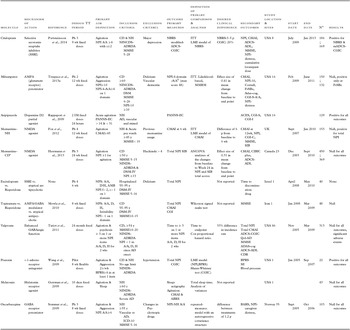
Table 1 lists RCTs completed between 2008 and 2013. Nine compared drug to placebo; two used an active drug comparator (risperidone vs. escitalopram or risperidone vs. topiramate). Five RCTs had < 50 subjects.
Completed randomized controlled trials (RCTs) of drugs for agitation and aggression in Alzheimer's disease*

*Completed RCT registered in a clinical trial registry between 2008 and 2013 and/or published between 2008 and 2013.
aRandomized, completed.
bThe NPI-4 A/A is a 4-domain subscale chosen which combines from the NPI-10 four domains: agitation/aggression; aberrant motor behavior; irritability/emotional lability; and disinhibition.
cThis study was prematurely terminated due to recruitment problems.
Abbreviations: Ph = phase; TT = Treatment; y = years; wk = week; NPS = neuropsychiatric symptoms; A/A = agitation/aggression; D/H = delusions/hallucinations; AMB = Aberrant Motor Behavior; s = severity; f = frequency; AAN = American Academy of Neurology; CD = community-dwelling; NH = nursing home; ITT = intention to treat; NINDS-ADRDA = National Institute Of Neurological and Communicative Disorders and Stroke and the Alzheimer's Disease and Related Disorders Association, DSM = Diagnostic and Statistical Manual of Mental Disorders; NPI = Neuropsychiatric Inventory; CMAI = Cohen-Mansfield Agitation Inventory; ADCS-ADL = Alzheimer's Disease Cooperative Study-Activities of Daily Living Inventory; ADCS-CGIG = Alzheimer's Disease Cooperative Study-Clinical Global Impression of Change; FrSBe = Frontal Systems Behaviors Scale; CGI-C = Clinical Global Impression of Change; CGI-I = Clinical Global Impression Improvement Score; CGI-S = Clinical Global Impression Severity of Illness Score; PANSS-EC = Positive and Negative Syndrome Scale – Excited Component; ACES = Agitation-Calmness Evaluation Scale; BPRS = Brief Psychiatric Rating Scale; SIB = Severe impairment Battery; CIBIC-plus = Clinician's Interview-Based Impression of Change-plus version; ABRS = Agitation Behavior Rating Scale; NIA = National Institute of Aging; QoL-AD = Quality of Life-AD; p = points; IN = intramuscular; LME model = linear mixed effects model; ANCOVA = analysis of covariance; MMRM = mixed-effects model repeated measures analysis.
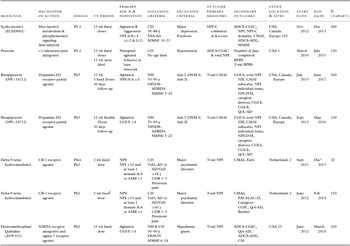
Table 2 lists seven ongoing RCTs, three assessing new chemical entities, and four repurposing drugs marketed for other indications. Only brexpiprazole is in phase III. Most are U.S. trials with some in Europe, Canada, and other regions. The mix of outcomes and industry sponsorship is similar to completed trials.
Ongoing randomized controlled trials (RCT) of drugs for agitation and aggression in Alzheimer's disease

aActive trial but with a closed recruitment with a 6-month open label safety extension until March 2014.
bThree arms = placebo, delta-9-tetra hydrocannabinol and acetaminophen.
Abbreviations: AD = Alzheimer's disease; VaD = Vascular Dementia; Ph = phase; TT = Treatment; y = years; wk = week; NPS = neuropsychiatric symptoms; N = enrollment; A/A = agitation/aggression; AMB = Aberrant Motor Behavior; y = years old; S = severity; F = frequency; D/H = delusions/hallucinations; CD = community-dwelling; NH = nursing home; NIA-AA = National Institute of Aging-AD; NINDS-ADRDA = National Institute of Neurological and Communicative Disorders and Stroke and the Alzheimer's Disease and Related Disorders Association, DSM = Diagnostic and Statistical Manual of Mental Disorders; CDR = Clinical Dementia Rating; NPI = Neuropsychiatric Inventory; CMAI = Cohen-Mansfield Agitation Inventory; ADCS-ADL = Alzheimer's Disease Cooperative Study-Activities of Daily Living Inventory; ADCS-CGIG = Alzheimer's Disease Cooperative Study-Clinical Global Impression of Change; CGI-C = Clinical Global Impression of Change; CGI-I = Clinical Global Impression Improvement Score; CGI-S = Clinical Global Impression Severity of Illness Score; CSI = Caregiver Strain Index; NIA = National Institute of Aging; SE = side effects; QoL-AD = quality of life-AD; PACSLAC-D = pain assessment checklist for seniors with limited ability to communicate Dutch version.
Completed RCTs do not report superiority of any drug over placebo, or over active comparator, but rather improvement in both groups (Table 1), with three exceptions. The prazosin pilot study (Wang et al., Reference Wang2009) reported superiority of drug to placebo; the drug is being further studied in an ongoing RCT. Improvements over placebo were reported in a trial of intramuscular aripiprazole (Rappaport et al., Reference Rappaport, Marcus, Manos, McQuade and Oren2009). In the very recent CitAD trial, citalopram showed significant improvement compared to placebo on both primary outcome measures (Porsteinsson et al., Reference Porsteinsson2014).
Two trials report no effect on primary outcomes but improvement in secondary outcomes. Mibampator (Trzepacz et al., Reference Trzepacz2013a) led to better outcomes on the Frontal Systems Behaviors Scale, and memantine-NH on NPI total score (Fox et al., Reference Fox2012).
The next section highlights key methodological aspects of the completed and on-going RCTs.
Population studied
Age
Most trials included patients aged between 50 and 90 years; with the youngest of 40 in THC and the oldest of 95 in topiramate versus risperidone trial. There was no age limit in both prazosin RCTs.
Dementia diagnosis
Diagnosis of AD was based on DSM IV and/or NINDS-ADRDA criteria (McKhann et al., Reference McKhann1984). The ongoing scyllo-inositol trial used recent AD criteria of the National Institute of Aging-AD Association (McKhann et al., Reference McKhann2011). The ongoing THC trial includes patients with vascular or mixed dementia.
Dementia severity
Dementia severity was assessed on Mini-Mental State Examination (MMSE) (Folstein, Reference Folstein, Folstein and McHugh1975) or Clinical Dementia Rating scale (CDR) (Rosen, Reference Rosen, Mohs and Davis1984). The divalproex trial included patients with moderate to severe dementia, while memantine and oxcarbazepine trials studied severe dementia. Citalopram, mibampator, and aripiprazole trials included a wide range of severity. Among ongoing trials, Scyllo-inositol include moderate to moderately-severe AD (MMSE 10–20), while the THC, dextromethorphan-quinidine, and brexpiprazole trials include patients at all severities.
Setting
Of the 11 completed RCTs, 5 were NH studies, 3 CD studies, while 1 (risperidone vs. escitalopram) assessed hospitalized patients (see Table 1). Only two RCTs (CitAD and prazosin) included patients from both NH and CD. Regarding ongoing RCTs, four are only CD, two NH only (brexpiprazole), and one (dextromethorphan) CD and NH.
Diagnosis of clinically significant a/a
There is not a “gold standard” definition of A/A in AD (Salzman et al., Reference Salzman2008). In its absence two approaches have been used: (1) judgment by experienced clinicians that medication is appropriate and/or (2) severity rating above a scale cut-off indicative of at least moderate A/A. CitAD and dextromethorphan-quinidine trials combined both. A/A encompass a range of recognizable features (such as hitting, pacing, or disinhibition) but these are shared with other behavioral disturbances of AD. It is not surprising that inclusion criteria vary between RCTs. Several trials have used cutoffs on total NPI (mibamptor, and THC). The THC trials additionally require high scores on two domains of the NPI: A/A or motor disturbance.
Although NPI is widely used to define A/A across RCTs, the specific definitions have varied (Tables 1 and 2). Some trials (CitAD, brexpiprazole, and scyllo-inositol) used the NPI A/A domain, while the mibampator trial required the presence of at least one of four NPI domains.
Thresholds for agitation severity similarly vary: in memantine-NH trial agitation was high (CMAI > 45) (Fox et al., Reference Fox2012), while in the memantine CD trial it was low (NPI A/A ≥ 1) (Herrmann et al., Reference Herrmann, Gauthier, Boneva and Lemming2013). Recent RCTs (CitAD and mibampator), and the ongoing scyllo-inositol and brexpiprazole trials use a threshold of ≥4 on NPI A/A; CiTAD adds the requirement that A/A occur at least several times/week (“frequently”) to improve relevance and applicability to real-life situations.
Moreover, the CitAD, brexpiprazole, and scyllo-inositol trials require a history of poor response to non-pharmacological interventions for inclusion.
The FDA appears to be increasingly accepting A/A as a target indication, examples being the ongoing dextromethorphan and scyllo-inositol trials.
Caregiver participation
Most trials require a reliable caregiver as informant for patient symptoms and caregiver burden. In CitAD the requirement was for a primary caregiver who spends at least several hours a week with the patient, supervises his/her care and attends clinic visits with the patient. Mibampator required “frequent or daily contact with the patient.” Dextromethorphan requires a caregiver who is with the patient a minimum of three times per week on three separate days, THC requires a caregiver who is in touch with patient at least twice weekly, while the ongoing prazosin trial requires a caregiver who spends 10 hours per week with the patient.
Concomitant psychotropic medication
All trials allow AD specific medications (cholinesterase inhibitors and memantine) with doses stable for at least one month prior to enrollment. Criteria for concomitant psychotropics vary considerably. Mibamptor and CiTAD excluded most concomitant psychotropics (except for “rescue” medications). Both memantine trials allowed psychotropic medications at baseline (including antidepressants, antipsychotics, or anxiolytics), while the ongoing prazosin trial allows such medication if the patient is a partial responder. The ongoing THC trial allows psychotropic medications except tricyclics, fluoxetine or carbamazepine.
Study design
Randomization
Stratification of randomization varies with some trials stratifying by clinical site and others adding presence of antidepressant treatment (scyllo-inositol), or severity (scyllo-inositol, mibamptor).
Pharmacological intervention
These are fixed-dose or adjustable/titrated-dose trials. All studies used oral formulations except one trial of intramuscular aripiprazole (Rappaport et al., Reference Rappaport, Marcus, Manos, McQuade and Oren2009). In completed RCTs, the duration of treatment was 8–12 weeks except for melatonin (ten days), memantine (24 weeks), or divalproex (24 months). Among ongoing RCTs, the duration of treatment is 12 weeks except for dextromethorphan (10 weeks), and 3 weeks for THC.
Allowed rescue medication
All RCTs allowing “rescue” medication for severe A/A used lorazepam with doses ranging from 0.5 mg to 4 mg daily. Trazodone was used at low doses (50 mg per day) for sleep disorders (CitAD) and at higher doses (50–150 mg per day) for severe A/A in the memantine trial (Fox et al., Reference Fox2012). Haloperidol was used in the oxcarbazepine trial.
Non-pharmacological intervention
In CitAD, mibampator and divalproex trials, different interventions, at inclusion and regularly over treatment period, have been used but vary in concept, content, and intensity. In CitAD the psychosocial intervention during the study was more intense than mibampator, for example. The goal of the CiTAD intervention is to systematize education and support in RCTs (Rosenberg et al., Reference Rosenberg2010) by providing “enhanced usual care” to patients and caregivers regardless of treatment assignment (Drye et al., Reference Drye2012).
Outcome measures
NPS measures may be narrow spectrum, (assessing depression or agitation, for example), or broad spectrum (Steinberg and Lyketsos, Reference Steinberg, Lyketsos, Rush, First and Blacker2008), including the NPI. The NPI originally included 10 domains (Cummings et al., Reference Cummings, Mega, Gray, Rosenberg-Thompson, Carusi and Gornbein1994) but expanded to 12 by the addition of sleep and appetite domains (Cummings et al., Reference Cummings1997). Domains of NPI are commonly used in studies with varied degrees of validation. Dennehy et al. (Dennehy et al., Reference Dennehy, Kahle-Wrobleski, Sarsour and Milton2012) evaluated a cluster of items from the NPI in the hope of validating A/A assessment. Based on epidemiology and consultation with clinicians, they selected the individual NPI-10 domains of agitation, irritability, disinhibition, and aberrant motor behavior as a four-item measure of agitation and aggression (NPI-4-A/A). The 4-A/A subscale of NPI-Q was validated in the Alzheimer's Disease Neuroimaging Initiative and National Alzheimer's Coordinating Center cohorts (Trzepacz et al., Reference Trzepacz2013b).
One limitation of NPI is that assessment relies solely on subjective caregiver input with resultant bias. Recently, the Neuropsychiatric Inventory Clinician Rating (NPI-C) was developed in part to address this issue (de Medeiros et al., Reference de Medeiros2010). Aberrant vocalization was added as a new domain, whereas the A/A domain of the NPI was split to arrive at a total of 14 domains. Unlike NPI, each domain and each item within a domain can be rated on the NPI-C. Trained clinicians use input from caregiver and patient to rate frequency, severity, and distress of each item. NPI-C was field tested in an international validation study and compared with focused scales to determine convergent validity (de Medeiros et al., Reference de Medeiros2010). It was found to have greater reliability than the conventional NPI.
The CMAI (Cohen-Mansfield, Reference Cohen-Mansfield1996) is widely used particularly in more advanced dementia and NH settings. Items are rated on a seven-point scale assessing the frequency of agitated behaviors (ranging from “never” to “several times an hour”). Items are presented in four subscales: aggressive behavior; physical non-aggressive behavior; verbally agitated behavior; hiding and hoarding. There are versions for both settings, NH (29 items) and a non-validated CD (36 items). CMAI provides the richest description of A/A but has the limitations of a relatively long administration time and assessments based solely on subjective caregiver input.
The Alzheimer's Disease Cooperative Study-Clinical Global Impression of Change (ADCS-CGIC) is a clinician-rated judgment of change from baseline (Schneider et al., Reference Schneider1997) and is based on the Clinical Global Impression of Change (CGI-C) (Guy, Reference Guy1976). The modified ADCS-CGIC (mADCS-CGIC) version targets global functioning in specific NPS domains is particularly suited to blinded assessments in RCTs. The CitAD and scyllo-inositol trials have chosen a modified version of the ADCS-CGIC assessing specific A/A related domains.
The divalproex trial (Tariot et al., Reference Tariot2011) uniquely measured incident A/A as the primary outcome. Of 18 RCTs, NPI was the primary outcome in ten trials and a secondary outcome in eight. The subscale NPI-4-A/A domain was primary outcome in the mibampator trial (Trzepacz et al., Reference Trzepacz2013a). The ongoing scyllo-inositol trial has chosen as primary outcome the NPI-C (combined scores on agitation + aggression domains) and other NPI-C domains as secondary outcomes. Three completed and two ongoing trials, such as the brexpiprazole trials, used and are using CMAI as primary outcome. In eight RCTs CMAI was a secondary outcome. All RCTs used a global impression of change measure as secondary outcome except for both prazosin trials and the ongoing CitAD where they were co-primary outcomes.
Other outcomes include: Alzheimer's Disease Cooperative Study Activities of Daily Living (ADCS-ADL) (Galasko et al., Reference Galasko1997) in five RCTs and seven quality of life (Qol-AD, Logsdon et al., Reference Logsdon, Gibbons, McCurry and Teri2002) in five RCTs. MMSE is the most widely used cognitive (secondary) outcome. Caregiver burden was assessed in four completed and three ongoing trials, using the NPI-caregiver distress item (total or specific items); one THC trial uses the Zarit Burden Inventory (Zarit et al., Reference Zarit, Reever and Bach-Peterson1980).
Safety outcomes
Most RCTs of A/A include a typical safety evaluation: adverse events (AE), serious adverse events (SAV), and AEs leading to withdrawal. Specific safety outcomes related to psychotropic medication effects have included cognition (based on MMSE), falls, sedation, weight change, and QT prolongation. After the FDA issued an advisory regarding dose-dependent risk of QT prolongation with citalopram, CiTAD increased surveillance of QT intervals and reported notable QT prolongation with citalopram at 30 mg. Balance, gait, and mobility are targets of assessments for CitAD, brexpiprazole, and THC. Brexpiprazole also assesses specific AEs related to AP use such as extra-pyramidal symptoms (Simpson-Angus Scale), tardive dyskinesia (Abnormal Involuntary Movement Scale), and akathisia (Barnes Akathisia Rating Scale).
Most of trials reported AE and SAV based on caregivers and physicians. AE could be recorded as spontaneous but also a checklist could be used like in CitAD and mibampator trials.
Analytic strategies
All statistical analysis plans for these RCTs were intention-to-treat (ITT). Primary comparisons were made using: (1) Analysis of covariance (ANCOVA) with “last observation carried forward” (LOCF) to estimate change from baseline to endpoint in the memantine CD trial, or (2) mixed models (CitAD, mibampator, memantine in NH, and prazosin). Recently, the general superiority of mixed models over LOCF was established (Siddiqui et al., Reference Siddiqui, hung and O’neill2009), especially for RCTs with longer treatment periods.
Among mixed models, linear mixed models or mixed models of repeated measures (MMRM) are options. The latter treat time as a continuous or categorical variable, estimating mean change from baseline, adjusting for baseline performance. MMRMs are attractive because they make no assumption about the shape of the outcome's trajectory over time. A recent paper compared MMRM to linear models using data from several trials (Donohue and Aisen, Reference Donohue and Ainsen2012). Neither approach was more robust to missing data, an important issue in AD trials. CitAD and prazosin used linear effects models with random intercept and slope in the primary comparison, while mibampator used MMRM.
Choice of drug
NPS in AD are thought to reflect one or more types of CNS dysfunction: (1) synaptic or circuit disconnections in specific neuronal networks, (i.e., frontal-subcortical and cortico-cortical networks); (2) dysfunction in ascending monoaminergic systems involving serotonin, norepinephrine, or dopamine neurons primarily located in the brain stem and diffusely projecting via long axons to virtually all parts of the brain; and (3) glutamate-mediated excitatory neurotoxicity. These CNS alterations are not mutually exclusive and likely synergize to mediate NPS.
Scyllo-inositol appears to improve synaptic activity in networks underlying NPS via a dual mechanism of action: (1) regulation of brain myo-inositol metabolism and phosphoinositol signaling, and (2) protection from oligomer-induced toxicity due to amyloid anti-aggregation effects (Townsend et al., Reference Townsend2006). Loss of serotonin in the inferior frontal cortex was reported to be limited to AD patients with prominent aggressive behavior (Lai et al., Reference Lai2003). Citalopram, a selective serotonin reuptake inhibitor, improves functional serotonorgic neurotransmission. Aggressive behavior has been associated with up regulation of α1-adrenoceptors in AD prefrontal cortex and excessive noradrenergic reactivity is associated with anxiety and agitation in dementia (Szot et al., Reference Szot, White, Greenup, Leverenz, Peskind and Raskind2007). Prazosin antagonizes norepinephrine at postsynaptic α1-adrenoreceptors.
Brexpiprazole is chemically similar to aripiprazole and has broad activity across multiple monoamine systems with reduced partial agonism for D2, 5HT1A receptors, and enhanced antagonism for 5-HT2A, and α1-adrenoreceptors. There is growing interest in modulators of glutamate neurotransmission, implicated in many neuropsychiatric diseases including schizophrenia and AD (Blanchard et al., Reference Blanchard, Chen, Rozeboom, Stafford, Weigele and Ingram2004). Dextromethorphan hydrobromide (DM) (the active main molecule) modulates glutamate signaling in two ways: (1) pre-synaptic inhibition of glutamate release (by sigma-1 receptor agonism), and (2) post-synaptic glutamate response modulation (by weak blockage of NMDA receptor and modulation of NMDA response to glutamate by the sigma-1 receptor). In the compound, quinidine sulfate increases the bioavailability of DM. DM-quinidine is FDA-approved for treatment of pseudo-bulbar affect whose symptoms overlap partially with A/A in AD. Mibampator is an AMPA glutamatergic receptor potentiator (O’Neill, Reference O’Neill2004). Activation of AMPA receptors strengthens synapses and changes in glutamatergic synaptic transmission that contributes to neural plasticity in the central nervous system (Yamada, Reference Yamada2000). Memantine's mechanism of action is related to glutamatergic synaptic transmission.
Delta-9-tetrahydrocannabinol (THC) is the most biologically active isomer of THC, a psychoactive compound extracted from the resin of Cannabis sativa (marijuana). The ongoing THC trial is testing a very similar molecule to dronabinol, synthetic delta-9-THC, indicated for severe nausea and vomiting caused by chemotherapy, or for anorexia with weight loss in patients with acquired immunodeficiency syndrome. THC activates cannabinoid receptors (mainly type 1), repressing neurotransmitter release in the brain. The rational for its use in NPS is based on its psychoactive effects and association with reduced pain sensation. Although earlier retrospective data reported benefits of dronabinol for A/A in severely demented patients (Woodward et al., Reference Woodward, Harper, Stolyar, Forester and Ellison2014), the exact mechanism of action is not known. This could be explained by preventing aggregation of amyloid-beta with consequent microglial activation (Ramirez et al., Reference Ramírez2005).
Discussion
We reviewed recent 11 completed and 7 ongoing RCTs of current and emerging medications for the treatment of A/A in AD. The major result of this review is the great heterogeneity found in the design of these RCTs. Only three (pilot prazosin, intramuscular aripiprazole, and CitAD) report results favoring drug treatment of A/A, emphasizing the lack of current evidence for a definitive treatment strategy. Most trials report improvement on placebo likely due to intangible benefits of being in RCTs, variability in outcomes, and variability in the course of A/A (Garre-Olmo et al., Reference Garre-Olmo, López-Pousa, Vilalta-Franch, de Gracia Blanco and Vilarrasa2010), with spontaneous remissions or improvement without treatment. This high rate of response on placebo decreases the statistical power of trials to detect drug effects. Additional challenges include: (1) disentangling treatment effects from competing effects on the outcome in the presence of psychosocial interventions; (2) varied approaches to use of rescue and concomitant psychotropic medications; (3) heterogeneity of target symptoms and overlap of NPS (Lyketsos et al., Reference Lyketsos2011); (4) variable inclusion criteria; and (5) the use of global AD measures rather than measures specific to A/A or individual A/A symptoms (Drye et al., Reference Drye2012).
The field does not yet have a tight consensus on primary outcome measures, on what constitutes a clinically significant effect size (Mohlar et al., Reference Molnar, Man-Son-Hing and Dean Fergusson2009), or how to translate effect size between different A/A scales. There are two overall approaches to assess treatment response both of which should be used: (1) outcomes based on the judgment of experienced clinicians (such as the mADCS-CGIC) and/or (2) outcomes measuring the severity of A/A symptoms.
The heterogeneous approach toward defining caregiver role and assessing caregiver outcomes is another issue in RCTs of A/A. The field needs consensus on who is a caregiver (family, formal/professional caregiver, time spent with the patient, etc.). Caregiver opinion is clearly necessary in the evaluation of A/A symptoms, which by their nature vary over time, and need to be assessed by history-taking rather than merely observation in the clinic. But caregiver opinion is by its nature subjective and, therefore, vulnerable to reporting bias; there is a role for training the caregiver in the assessment in order to obtain more standardized reports. One important innovation is the NPI-C that provides anchors for experienced clinician judgments that can overcome caregiver biases and allows for input from all available information including the clinical record, caregiver input, and direct observation.
Methodological enhancements of recent RCTs: suggestions for improvement
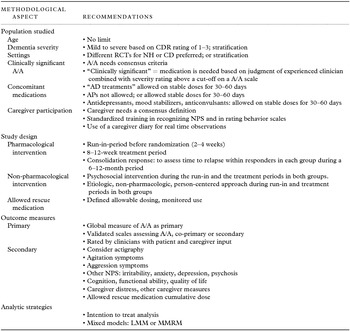
We propose in Table 3 methodological considerations for future trials for A/A in PwAD.
Recommendations for future RCTs targeting A/A in patients with AD

Abbreviations: AD = Alzheimer's disease; NPS = neuropsychiatric symptoms; A/A = agitation/aggression; CD = community dwelling; NH = nursing home; CDR = clinical dementia rating; MMRM: mixed model of repeated measures; linear mixed models.
Population studied
Disease severity
The THC trial is the first trial to use the CDR to measure dementia severity for inclusion. The MMSE's major limitation is that the estimate of disease severity is based solely on cognitive performance, and does not capture, as CDR does, cognitive and physical impairments which are key features of AD. Therefore, disease severity should be based on CDR.
In recent trials there is a tendency to include patients at all levels of disease severity and, thus, patients at milder stages. This is important, given that the pathological processes leading to AD begins decades before a clinical diagnosis, and drugs targeting NPS may need to be assessed earlier in the disease process.
Setting
The majority of trials have included patients from CD or from NH settings and only two (CitAD and dextromethorphan trials) have patients from both. It is important for generalizability to include participants from both settings, either in separate trials or in a single trial; the latter strategy might be best implemented by stratifying randomization by care setting (as is being done in CiTAD, for example). Additionally, it is important to validate methods of caregiver data collection since most caregivers in CD are family members and most in NH are paid staff who may have different agendas and different reporting bias. It is important not to exclude NH participants since the majority of A/A in advanced dementia is in the NH setting.
Concomitant psychotropic medications
Most patients with A/A will already be taking psychotropic medications, and the approach toward these needs to find a middle ground between maximal rigor (no concomitant medications) and maximal generalizality (allow concomitant medications and assess intervention as an “add-on” therapy). Many RCTs have chosen the former approach to assess efficacy of an intervention as monotherapy, with the trade offs of rendering recruitment more challenging, possibly inadvertently excluding the most severe A/A, and limiting generalizability. The alternative approach could be proposed for these reasons. The ongoing prazosin trial follows this approach, allowing all stable concomitant psychotropic medications at inclusion, if the patient is a partial responder. However, doses of concomitant psychotropic should remain stable over the treatment period. Regarding APs medication, since they are the only one having proved efficacy, even modest, their concomitant use it is questionable and should be address by an expert panel (see Table 3).
Study design
Placebo run-in
One design feature to diminish the effect of placebo response is to have a placebo run-in period, which is becoming the norm in other fields of psychopharmacology (Iovieno and Papakostas, Reference Iovieno and Papakostas2012), accounting for the benefit of non-pharmacologic interventions, and improving statistical power (Frost et al., Reference Frost, Michael, Kenward and Fox2008). None of these trials included a placebo run-in period before randomization. Two trials in related fields used two to four week placebo run-ins and reported relatively low on-placebo response rates in the randomized treatment period (Howard et al., Reference Howard2007, Cummings et al., Reference Cummings2013). We suggest that for RCTs of A/A the period be kept to two weeks because this is a reasonable period of time for relying solely on non-pharmacologic interventions, the duration needs to be short due to the acuity of symptoms (see Table 3).
Pharmacological intervention
Most completed and current RCTs administer drug treatment for 9 to 12 weeks, adequate for assessing acute response, but not stability of response over longer periods of time. Some design strategies partly address this issue. The prazosin trial has included a 12-week open label observation period after the strict RCT period. There is an ongoing safety extension RCT to evaluate persistence of the effects of scyllo-inositol on A/A, beyond the treatment period covered by the trial. All patients will receive scyllo-inositol, but masking from the first trial will be maintained. Another strategy could be a two-week washout after the RCT period to assess if there is a rebound in symptoms.
Open-label observation under treatment drug it could be interesting if the period was long enough to assess “consolidation” of response, preferably 6 to 12 months for maximizing clinical generalizability. However, having no comparator, such a methodology will not inform efficacy. In order to address consolidation efficacy the observation period should be long enough (six6 months to one year) and the analysis should measure time. It will also be interesting to assess time to remission or relapse, as is done in evaluation of anticonvulsants, for example.
Non-pharmacologic intervention
The citalopram and mibampator trials include a psychosocial intervention for all participants regardless of treatment assignment, and this design feature is important to provide ethically “enhanced usual care” to all participants, to improve recruitment and retention, (Drye et al., Reference Drye2012) and, to reduce variance in outcome reporting by caregivers via education about the features of the disease (Tariot et al., Reference Tariot2011).
Allowed rescue medication
A/A can truly be a crisis for family or institutional caregivers, and rescue medication is often needed to have viable retention. The CiTAD trial is a model, monitoring the use and dose of rescue medication by treatment group (Drye et al., Reference Drye2012).
Outcome measures
The choice of the optimal primary outcome is probably the most important decision in study design in this field. As this review shows, the choices have been very heterogeneous in completed and ongoing RCTs due to the lack of a gold standard outcome measure. However, the field appears to be reaching a consensus in using both agitation-specific quantitative measures (e.g., relevant domains of NPI-C or CMAI) plus a global rating of change for agitation outcomes (mADCS-CGIC). This combined approach has been successfully used in the CitAD trial. Although the pimavanserin trial is not included in this review (targeting psychosis in Parkinsons’ disease) the assessment process is worth noting: central raters assessed the primary outcome, site-based raters assessed CGI, and caregivers assessed the Zarit burden scale (Cummings et al., Reference Cummings2013). Assessing different outcomes with different raters may provide robust support for convergent clinical benefits. Actigraphy offers the possibility of objective measurement of activity associated with agitation and has reasonable validation versus NPI in two studies (Mahlberg et al., Reference Mahlberg, Walther, Eichmann, Tracik and Kunz2007; Kirste et al., Reference Kirste2014).
Analytical strategies
An issue to take into account in statistical analyses is measurement variance that may be exaggerated in some trials especially multinational studies where translations and cultural interpretations are required. In most recent RCTs (citalopram, mibampator, memantine (Fox et al., Reference Fox2012) trials) mixed models have been estimated. Currently, mixed models seem to be more appropriated than ANCOVA and LOCF in RCTs of drugs in AD. However, up to date there is no available data to better propose MMRM or linear mixed models as statistical strategy in RCTs of drugs for A/A in AD.
There are several important methodologic obstacles to drug development in this area that might be best amenable to expert consensus on the: (1) definition of A/A for inclusion; (2) choice of primary outcome; (3) role of adaptive designs to minimize exposure to a drug or placebo that is “not working” (Mugno et al., Reference Mugno, Zhus and Rosenberger2004; Kairalla et al., Reference Kairalla, Coffey, Thomann and Muller2012); (4) standardization of non-pharmacological person-centered interventions (Gitlin et al., Reference Gitlin, Kales and Lyketsos2012) in both arms; and (5) placebo run-in-period prior to randomization. Once eligibility is confirmed at baseline, only patients with persisting A/A or at higher levels of A/A severity would participate in the treatment period. This etiologic non-pharmacological centered person approach, in addition to the psychosocial intervention, should be prolonged over the treatment period. This approach will reflect real-life clinical practice, reduce placebo response rate, and address the real-life issue which is whether a drug can demonstrate superior efficacy to placebo in the presence of non-pharmacological intervention for all participants.
Our review has limitations. First, even all studies were randomized and controlled trials and thus with a high quality, differences in the methodological quality were not deeply analyzed. Second, comparisons between RCTs’ reports inter-rater reliability were not available. Third, only publications in English were included.
Finally, in comparison to pre-2008 RCTs, it is notable that other potential pharmacological alternatives to atypical APs, have been and are being tested in recent RCTs. However, despite considerable efforts in crafting appropriate designs for RCTs of promising therapeutics agents for A/A, it is urgent to gain more clarity regarding the underlying neural regions and circuitry involved in NPS, to thereby shed light on symptom pathogenesis. However, so far, there has been very little developmental work based on this better understanding that could offer an opportunity to develop more new targeted drug treatments (Ballard et al., Reference Ballard, Francis and Corbett2013; Geda et al., Reference Geda2013).
Conclusion
Despite the urgent need to identify effective pharmacological treatments for A/A in PwAD, progress has been slow. In the past six years a small number of RCTs of drugs for treatment of A/A in AD have been conducted with disappointing results. These trials are characterized by methodological heterogeneity. Several issues have been encountered: the need for stronger consensus on the syndromal definition of A/A as a target, choice of primary efficacy outcome measure, the content and timing of the non-pharmacological intervention in placebo and drug arms before and/or during the trial, concomitant psychotropic medication, definition of caregivers and their participation. Consensus is necessary to enhance the design of future trials. The fact that placebo effects are substantial and consistently observed suggests that non-pharmacological approaches are currently the standard of care that we are still waiting for clear and consistent evidence on drug efficacy.
Conflict of interest
Dr Soto has served as consultant for Ethypharm. Dr. Rosenberg has received research support from National Institute on Aging (1K08AG029157-01; A15R01AG039384-03), American Federation for Aging Research, Lilly, Functional Neuromodulation, and Pfizer, and has served as a consultant/advisor to Janssen, Pfizer, Lundbeck, and Abbvie.
Description of authors’ roles
M. Soto, B. Vellas, C. Lyketsos, and P. Rosenberg designed the manuscript. M. Soto wrote the manuscript. C. Lyketsos and P. Rosenberg assisted with writing the article. B. Vellas, C. Ballard, S. Andrieu, F. Nourhashemi, P. Robert, and PJ Ousset revised and corrected the manuscript.
Acknowledgment
This work was supported by NIH grant P50AG005146 to the Johns Hopkins Alzheimer's Disease Research.