Highlights:
-
This study highlights the clinico-genetic profile of 16 cases of PRKN-gene-related parkinsonism.
-
The study consolidates the literature on the Asian cohort.
-
The broader Asian cohort enlightens us on the crucial phenotypic-genotypic characteristics of PARK-PRKN and emphasises the role played in shaping the epidemiology of the spectrum of genetically mediated Parkinson’s disease.
Introduction
Mutations within the PRKN gene are the most common cause of the autosomal recessive form of Parkinson’s disease (PD). Reference Lesage, Lunati and Houot1 The PRKN gene, also commonly known as PARK2 and Parkin, encodes for the protein parkin, a ubiquitin ligase that plays a pivotal role in proteasomal degradation. Disease-causing variants in the PRKN gene lead to the loss of function of this protein, resulting in the accumulation of neurotoxins that subsequently contribute to the degeneration of catecholaminergic neurones in the substantia nigra and locus coeruleus. Reference Chia, Tan and Chao2 Early-onset PD (EOPD) is currently defined as PD with age of onset (AAO) after 21 years up to 50 years based on the latest recommendations from the International Parkinson and Movement Disorder Society Task Force 2022. EOPD has shown to have a high frequency of PRKN mutations, not only in those who have a positive family history but also in apparently sporadic cases of idiopathic PD. Reference Mehanna, Smilowska and Fleisher3 There have been notable differences in the clinical presentations of PRKN cases among different ethnic groups. For instance, individuals of European and North African descent, with disease-causing variants in the PRKN gene, displayed symptoms that resembled idiopathic PD, while on the other hand, Japanese cases of PRKN exhibited a younger AAO, a greater frequency of dystonia as the initial presentation, hyperreflexia and prominent dyskinesia with levodopa therapy. Reference Lücking, Dürr and Bonifati4–Reference Lücking, Abbas and Dürr6 The Consortium on Risk for Early-Onset Parkinson Disease Study 2010 (CORE-PD) analysed 956 cases of EOPD (age criteria of AAO <51 years) and found 64 cases (6.7%) with PRKN mutation. Reference Marder, Tang and Mejia-Santana7 However, the study had very few patients of Asian origin. Although PRKN cases have been extensively documented across various regions worldwide, and among diverse ethnic groups, individuals of Asian descent are notably underrepresented in the existing literature. The data is also scarce in South Asian countries, particularly in India. Against this backdrop, we performed a retrospective chart review of all cases diagnosed with PRKN type of parkinsonism with or without additional movement disorder(s), focussing on the salient clinical presentation, therapeutic response and genotype. Additionally, we consolidated the Asian cohort of PRKN-related cases reported in the literature, delineated their clinical phenotype and emphasised the genetic variants involved.
Methods
Patients and methods
We conducted a retrospective observational study of patients, presenting with isolated or combined movement disorders, with or without parkinsonism, and harbouring a pathogenic or likely pathogenic mutation in the PRKN gene based on either clinical exome sequencing or whole exome sequencing (WES). The study was conducted after approval by the National Institute of Mental Health and Neurosciences ethics committee (no. NIMH/DO/IEC (BS & NS DIV)/2022–23). Data were extracted with regard to the AAO, age at assessment (AAA), first symptom at onset, the spectrum of motor and non-motor symptoms, neuroimaging parameters, levodopa responsiveness, drug-induced dyskinesia and the outcomes of deep brain stimulation, if performed. As per the International Parkinson and Movement Disorder Society Task Force 2022, patients with parkinsonism were classified based on the AAO into juvenile PD (JOPD) (AAO <21 years) and EOPD (AAO 21 to <50 years). Based on previous studies, further classification was made into middle-onset PD (MOPD) (50–69 years) and late-onset PD (>69 years). Reference Mehanna, Smilowska and Fleisher3,Reference Mehanna, Moore, Hou, Sarwar and Lai8 Analysis was based on standard motor scales of the Unified Parkinson’s Disease Rating Scale (UPDRS III). Only the patients whose genetic data were available were included. Patients with homozygous and compound heterozygous mutations in the PRKN gene were recruited in the study. Written informed consent was obtained from patients for the publication of recorded videos.
Genetic analyses
The genetic testing genomic DNA extraction using QIAamp DNA Blood Mini Kit (Qiagen Germany, #51104) was performed on the blood samples of the recruited patients. Subsequently, raw reads underwent alignment to the human reference genome (GRCh38) utilising the BMA-mem algorithm. PCR duplicates were eliminated with the Picard toolkit (https://broadinstitute.github.io/picard/) after a quality check. Reference Li and Durbin9 Identification of variants employed the Genome Analysis Toolkit framework (Broad Institute, Cambridge, MA, USA). Variants underwent base quality score recalibration for filtration, and annotation was performed using the freely available platform ANNOVAR (http://www.openbioinformatics.org/annovar/). Reference DePristo, Banks and Poplin10 The variants were annotated utilising the online platform, ANNOVAR (http://www.openbioinformatics.org/annovar/) Reference Wang, Li and Hakonarson11 (34791404). In addition to SNVs and small indels, copy number variants (CNVs) are detected from targeted sequence data using the ExomeDepth method. This algorithm detects CNVs based on a comparison of the read depths in the sample of interest with the matched aggregate reference dataset. The common variants with a minor allele frequency >0.01 were not considered. A comparison was made with the Exome Aggregation Consortium (ExAC), 1000 Genomes Project and gnomAD database (https://gnomad.broadinstitute.org/). The individual sequence variants were interpreted using PolyPhen-2, Sorting Intolerant from Tolerant webserver and MutationTaster. Reference Sim, Kumar, Hu, Henikoff, Schneider and Ng12–Reference Adzhubei, Schmidt and Peshkin14 The variants were classified in accordance with American College of Medical Genetics and Genomics (ACMG) standards and guidelines into benign, likely pathogenic or pathogenic. Reference Richards, Aziz and Bale15 The variants were checked for their novelty by analysis in mutation databases (ClinVar).
Review of literature
We conducted a comprehensive search across a publicly accessible medical database of PubMed, employing specific medical subject headings (MeSH): “PARKIN,” “PRKN,” “parkinsonism,” “young onset Parkinson’s disease,” “early onset Parkinson’s disease,” “dystonia” and “disorder” to identify relevant studies. Subsequently, we screened the titles and abstracts of these studies, specifically focussing on those involving the Asian population. Additionally, we also searched the Movement Disorders Society (MDS) gene database (https://www.mdsgene.org/d/1/g/4 last accessed on 10-11-2024) to identify the Asian cases of PRKN-related movement disorders. 16 The Movement Disorder Society Genetic mutation database (MDSGene) is a publicly available database that is supported by the International Parkinson and Movement Disorder Society and can be used for individual, personal, educational and research purposes (https://www.mdsgene.org/ last accessed on 10-11-2024). 17 We compared our current study data from the extended Asian cohort comprising the published data from the Asian continent including the current study with the currently published data of the MDSGene cohort (https://www.mdsgene.org/d/1/g/4?action=plot&fc = 0&_mu = 1&_country = 1 last accessed on 10-11-2024). 18 Subgroup analysis of the different mutations, including deletions or duplications, missense and frameshift mutations, was done to elucidate the distinctions in demographic and clinical characteristics among patients from the Asian continent. Our data curation process was focussed on demographic parameters, clinical phenotype and variant specifics. Studies not presented in English or lacking patient details were excluded from consideration.
Statistical methods
Categorical variables were expressed as frequencies, while continuous ones were expressed as mean with standard deviation. Descriptive statistics was performed as a first step for the analysis of demographic and clinical parameters. Normality tests were performed using the Shapiro–Wilk test. Qualitative data were subjected to χ2 tests for comparison. Comparison of normally distributed data was done using independent samples T-test, while non-normally distributed data were analysed using Mann–Whitney U test. Subgroup analyses of the categorical variables among the three genetic groups were made using χ2 followed by Bonferroni correction to identify the individual differences within the subgroups. The quantitative data comparison of these three groups was done using one-way ANOVA followed by post hoc analysis by Bonferroni correction. A p-value of 0.05 was considered to be statistically significant. SPSS version 23.0 was used for all statistical computations.
Results
Demographic data
We identified 16 cases hailing from 14 different families harbouring disease-causing variants in the PRKN gene. There were two families (10 and 12), who had two cases each. The majority of cases were males (n = 10, 62.5%). The median AAO and that at assessment were 28.5 (IQR 21.3–36.9, range 14–46) years and 36.5 (IQR 27.8–49.5, range 19–73) years, respectively. Based on the latest classification as per AAO, 3 cases (18.8%) were JOPD, while the remaining 13 (81.3%) cases were EOPD. These patients had a median duration of illness of 6 (IQR 4–22.8) years. The maximum duration of illness prior to presentation was 27 years. Positive family history with an autosomal recessive pattern of inheritance was noted in eight patients (50%) involving six families (42.9%). Among those with a positive family history, consanguinity was reported in four families (66.7%). However, overall consanguinity was reported across eight families (57.1%).
Clinical profile
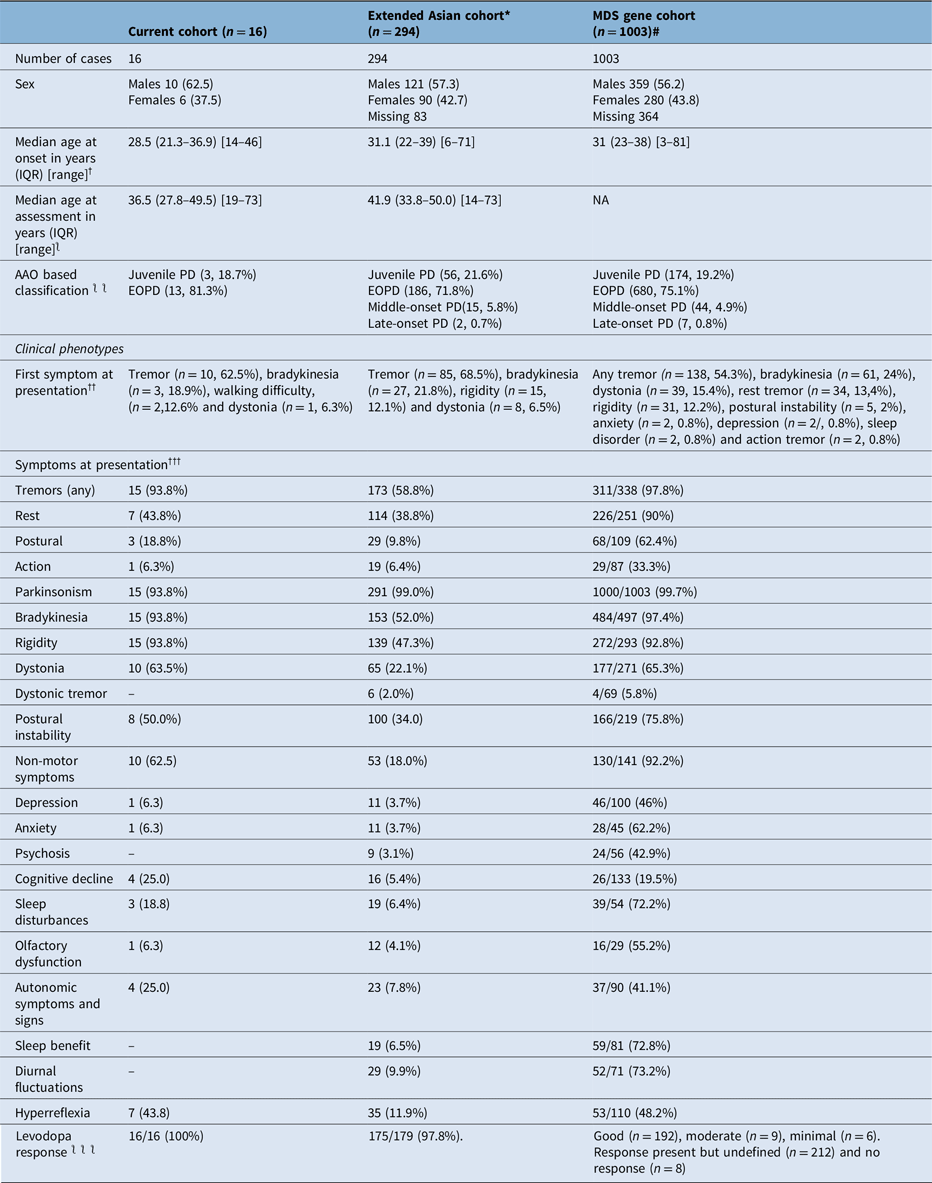
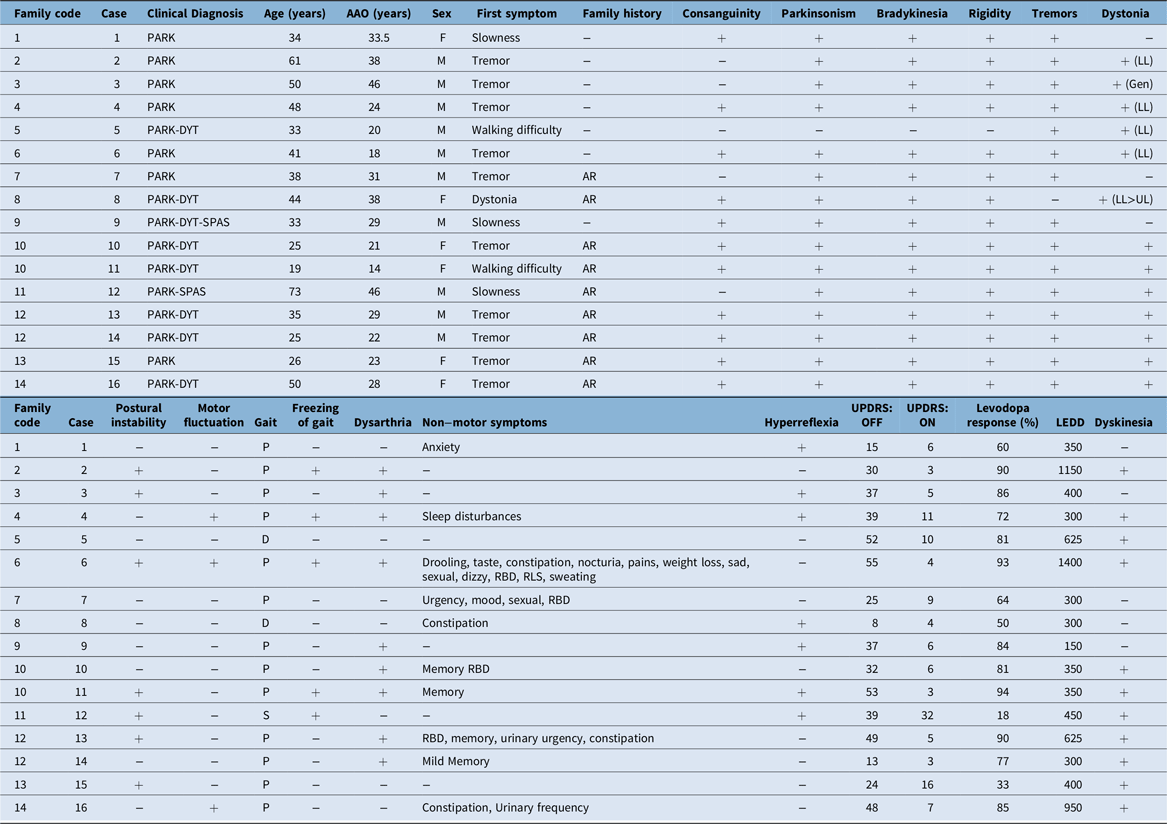
Motor symptoms: Parkinsonism, manifesting with tremors, rigidity and bradykinesia were the most common clinical manifestation, notable in all except one case (case 5). Dystonia was present in 10 cases (62.5%), of which 6 (37.5%) were focal, involving the lower limb alone; 2 (12.5%) were multifocal, showing involvement of upper limbs in addition to lower limbs; and 2 (12.5%) had generalised dystonia. Postural instability was seen in seven cases (43.8%), which were graded as severe and moderate in two cases. All patients had gait abnormalities with 13 (87.5%) of them having parkinsonian gait, while among the remaining 3 cases, 2 had dystonic, and 1 had spastic gait. Notably, freezing of gait was observed in five (31.5%) of them, while start hesitation was present in a single case. Despite the high prevalence of postural instability and falls, these symptoms were reported in only two cases. Motor fluctuation was reported in two cases (cases 4 and 16). Sleep benefit of motor symptoms was seen in a single case (case 1). Dysarthria of the hypokinetic type was present in five cases (31.3%). Pyramidal signs in the form of hyperreflexia were detected in 7 (43.8%).
First symptom at onset: With regard to the first symptom at onset, tremulousness was the most common (n = 10, 62.5%) followed by slowness in the activities of daily living (n = 3, 18.8%) and walking difficulty due to stiffness (n = 2, 12.6%) and dystonia (n = 1, 6.3%). Rest tremors predominated in a majority of cases (n = 6, 60%), which was followed by postural tremors (n = 2, 20%). A majority of them had upper limb involvement at onset (n = 7, 70%). Focal dystonia involving the left leg was the main presenting symptom in a single case (case 5). The clinical phenotypes were isolated parkinsonism (PARK, n = 8, 50%), parkinsonism with dystonia (PARK-DYT, n = 6, 37.5%) and single cases each of parkinsonism with spasticity (PARK-SPAS) and parkinsonism-dystonia-spasticity (PARK-DYT-SPAS) (Tables 1 and 2).
Demographic, clinical and genetic parameters of PRKN-related movement disorders across various cohorts

# Updated till 2 December 2020.
* The extended Asian cohort includes 16 cases from the current study.
† Data were available for 124 cases in the Asian cohort. MDS gene cohort had data on 254 cases. Rest 749 (74.38%) were missing.
†† Data were available for 124 cases in the Asian cohort. MDS gene cohort had data on 254 cases. Rest 749 (74.38%) were missing.
††† Data are not uniformly available for each symptom in MDS gene cohort, and hence denominator is mentioned along with the percentage.
ƪ Missing data on age at assessment in the Asian cohort are 113.
ƪ ƪ Data were available for 259 cases and 905 cases for AAO in the extended Asian cohort and MDS gene cohort, respectively.
ƪ ƪ ƪ Data were available for 179 cases and 427 cases in the extended Asian cohort and MDS gene cohort, respectively.
Non-motor symptoms (NMS): NMS were observed in 10 cases (62.5%). The spectrum of symptoms comprised memory impairment (n = 4, 25.0%), sleep disorders (n = 3, 18.8%), rapid eye movement behaviour disorder (n = 2, 12.5 %) and autonomic symptoms (n = 4, 25.0%). There were single cases each with olfactory dysfunction, mood disorders including anxiety and depression, drooling and sexual dysfunction (Tables 1 and 2).
Clinical profile of all patients with PRKN-mediated parkinsonism

+ = present, − = absent, AAO = age at onset, AR = autosomal recessive, D = dystonic, DYT = dystonia, F = female, Gen = generalized, LL = lower limb, M = male, NA = not available, P = parkinsonian, PARK = parkinsonism, RBD = rapid eye movement behaviour disorder, RLS = restless leg syndrome, S = spastic, UL = upper limb.
Investigations and treatment response: Brain MRI was normal in 10 (62.5%) cases. There was evidence of subtle globus pallidi interna mineralisation in three cases (cases 1, 9 and 11). One of the cases had non-specific periventricular signal hyperintensities, while left cerebellar volume loss was observed in a single case. In one patient, mild cervical cord compression due to cervical spondylosis was detected incidentally on MRI spine screening with no corresponding clinical features apart from the brisk deep tendon reflexes. One of the patients, who had sluggish deep tendon reflexes, had sensorimotor demyelinating neuropathy on nerve conduction studies (case 4).
With regard to the treatment, levodopa responsiveness was observed in all. Levodopa in combination with dopamine agonist was used in 12 cases (75%), while levodopa was the only treatment option in 2 cases (12.5%) and dopamine agonist alone in 2 cases (12.5%). The median levodopa equivalent dose (LEDD) was 375 (IQR 300–625). The median UPDRS motor scores (part III) were 37 (IQR 24.8–48.8) and 6 (IQR 4–9.8) in the OFF and ON states, respectively. Drug-induced dyskinesia was seen in eight cases (50%). Two of the cases underwent bilateral subthalamic nucleus Deep brain stimulation (DBS). Both patients showed a significant subjective as well as objective clinical improvement in UPDRS scores. Their LEDD could be reduced from 1150 to 450 in case 1 and 1400 to 950 in case 6. At 4 years’ follow-up, case 1 was maintaining well with minimal dyskinesia that involved both the toes, markedly reduced rigidity, bradykinesia and stooped posture. He continued to have a mild tendency for stooped posture. The follow-up details of case 6 are provided in the case vignette (Tables 1 and 2).
Results of genetic analysis
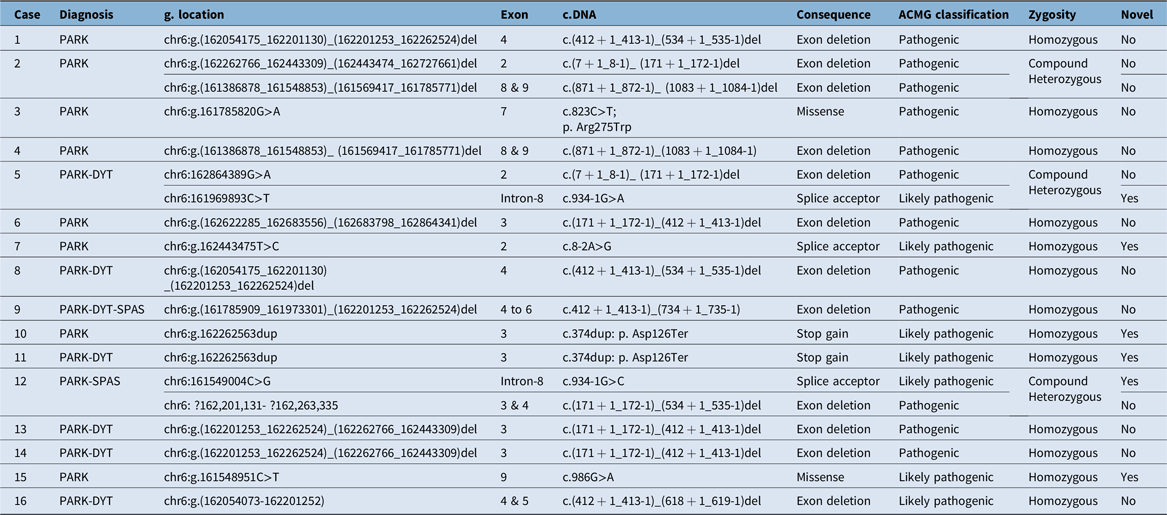
The genetic analysis based on WES identified 19 total variants in total across 14 families involving 16 cases. Pathogenic or likely mutation as per ACMG mutation was detected in 15 cases (87.5%), while the remaining case was variant of uncertain significance (VUS) (case 15). However, based on the recent ACMG classification, the case with VUS was reclassified as likely pathogenic. With regard to the zygosity of the variants, 13 were homozygous, while 3 cases were compound heterozygous. Of the total 19 variants identified, exon 2 deletion (2 patients), exon 3 deletions (3 patients), exon 4 deletion (2 patients), exon 8–9 deletion (2 patients) and c.374dup;p. Asp126Ter (2 patients) were seen in more than one patient and making it to 13 unique variants. Among 13 unique variants identified, the most common variant detected was exon deletion (n = 7) followed by splice site mutation (n = 3), missense (n = 2) and stop-gain mutation (n = 1). Five among these 13 variants were found to be novel (Table 3, Figure 1). Of these five novel variants, three were splice-acceptor variants (c.8–2A in homozygous state in 1 patient and c.934–1G>A and c.934–1G>C in compound heterozygous state in 1 patient each), one was a stop-gain variant (c.374dup:p. Asp126Ter in homozygous state in two patients of same family) and the remaining was a missense variant (c.986G>A;p. Gly329Asp in homozygous state in 1 patient). The splice-acceptor and the stop-gain variants were classified as likely pathogenic as they are predicted to result in a truncated protein and are rare (PVS1PM2), whereas the missense variant was classified as likely pathogenic variant as the variant was rare, a pathogenic variant with different amino acid change in the same locus has been reported (c.986G>T;p. Gly329Val, PMID: 32446772), multiple computational prediction tools predicted the variant as deleterious and the matching phenotype (PM2PM5PP3PP4). The clinical, genetic and follow-up details of four cases (case 6, case 10 and case 11 and case 13) belonging to three families (Family 6, Family 10 and Family 12) are described in the supplementary document along with the supportive clinical videos (Supplementary Video S1–Video S4).
Distribution of genetic variants of PRKN in the current cohort. CH = compound heterozygous; HOM = homozygous; SNVs = single nucleotide variants.

Genetic details of all patients with PRKN-mediated parkinsonism

ACMG = American College of Medical Genetics and Genomics; DYT = dystonia; PARK: parkinsonism; VUS-LP = variant of uncertain significance-likely pathogenic.
Clinical and genetic characteristics of the extended Asian cohort
Our systematic search strategy yielded a total of 278 cases of PRKN-related parkinsonism. The current study with 16 additional cases extended the Asian cohort to 294. At par with the MDS gene cohort of 1003 cases (Table 1), there was a male preponderance (57.3% vs 56.2%) and a similar AAO (31.1 [IQR 22–39] vs 31 [IQR 23–38]) years. Of the 294 included cases in the Asian cohort, 3 patients did not have parkinsonism. Compared to the MDS gene cohort, the extended Asian cohort had a greater proportion of cases with JOPD (21.6% vs 19.2%) and EOPD (71.8% vs 75.1%). With regard to the phenotypic characterisation, the earliest clinical symptom was predominated by tremors (n = 85, 68.5%) followed by bradykinesia (n = 27, 21.8%), rigidity (n = 15, 12.1%) and dystonia (n = 8, 6.5%), displaying a spectrum that stands at par with the overall known literature. The spectrum of clinical features showed a greater frequency of tremors overall and its subtypes: rest, postural and action. There was also a higher prevalence of bradykinesia, rigidity, dystonia, postural instability, dyskinesia, motor fluctuations, NMS, dysautonomia, diurnal fluctuations and hyperreflexia (Table 1).
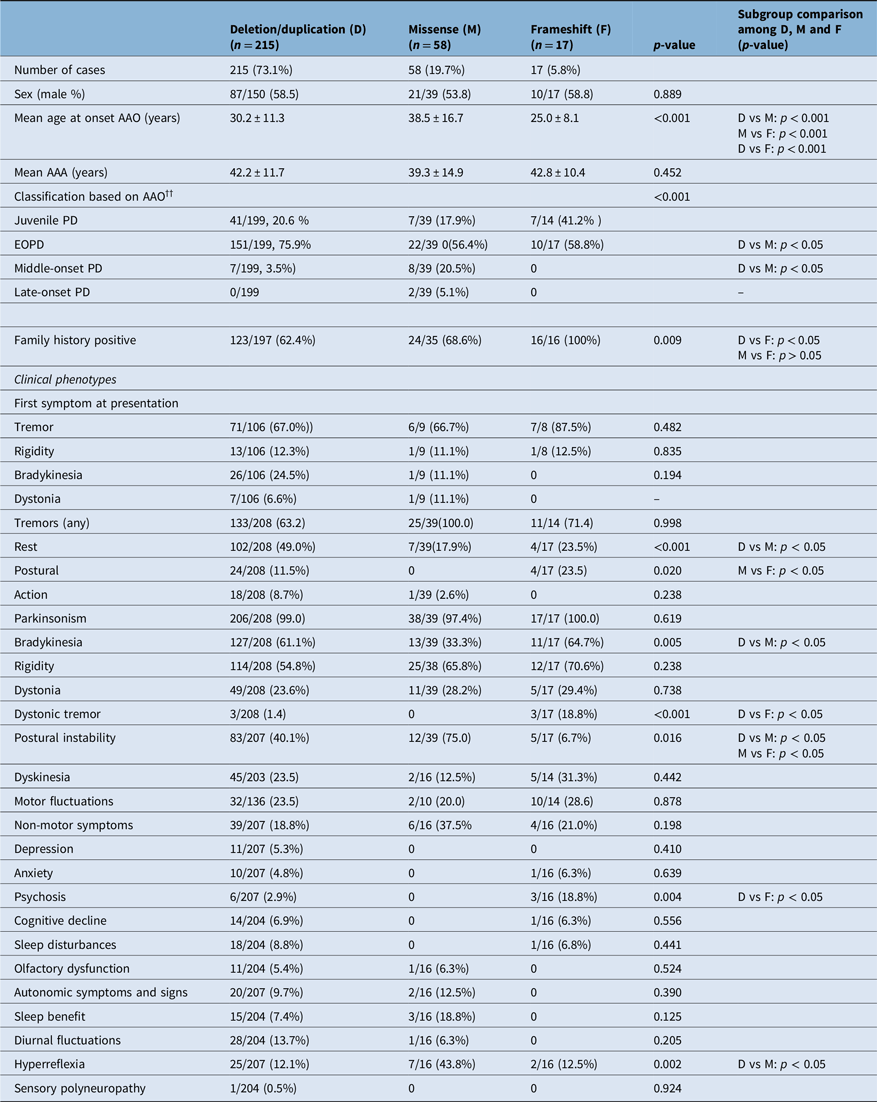
Genetic analysis: Genetic analysis of the extended Asian cohort revealed 215 cases harbouring deletion/duplications (73.1%), which was followed by missense mutations (n = 58, 19.7%) and frameshift mutations (n = 17, 5.8%). There were three cases with stop loss (1.02%) mutations and a single case with splice site mutation (n = 1, 0.3%). Patients with frameshift mutations in the PRKN gene had the lowest AAO, statistically significant when compared to the other two genetic subgroups (p < 0.001). Despite the difference in AAO, the AAA had no significant difference across the groups. The proportion of patients with EOPD was significantly higher in the deletion/supplication subgroup (p < 0.001, overall). Interestingly, all patients harbouring frameshift mutations had a positive family history of PD (p = 0.009), with post hoc analysis suggesting that the difference lies between the deletion/duplication and frameshift group (p < 0.05). While there was no significant difference across the genetic subgroups with regard to the onset presentation, as the disease evolved, bradykinesia (n = 127, 61.1%, p = 0.005) and postural instability (n = 83/207, 40.1%, p = 0.016) had a greater incidence in the deletion/duplication subgroup as compared to the rest. On the other hand, psychosis had a slight but statistically significant predisposition among patients harbouring a frameshift mutation (n = 3/16, 18.8%, p = 0.004). Hyperreflexia was commoner in the missense group (n = 7/16, 43.8%, p = 0.002), highlighting the relevance of a thorough clinical evaluation in predicting the genetics. With regard to the inheritance pattern, homozygous mode of inheritance (n = 166, 56.5%) predominated followed by compound heterozygotes (n = 27.9%) and heterozygotes (n = 20, 6.8%). The most common variant identified among the homozygotes was c.(171 + 1_172-1)_(534 + 1_535-1)del (n = 28/166, 16.9%) followed by c.412 + 1_413-1)_(534 + 1_535-1)del (n = 26/166, 15.7%) (Table 4).
Comparison of clinical profile of different mutations in the extended Asian cohort (n = 290)†

† Asian cohort includes the current study. In the tests for statistical significance, splice site (n = 3) and stop loss variants (n = 1) were not considered due to the low sample size.
†† Juvenile = <21 years; EOPD = <50 years; middle-onset PD = 50–69 years; late-onset PD = ≥70 years; AAA = age at assessment; AAO = age at onset; EOPD = early-onset Parkinson’s disease.
Note: The denominator in each of the cells represents the number of cases for which data were available.
In all countries from the Asian group except India and Israel, exon(s) deletions were the responsible pathogenic variants in the majority of their patients (China: 77/85, exon 5 deletion most commonly seen in 25 patients; Japan: 43/46; exon 3–4 deletion: 12 patients; Iran: 32/42, exon 3 deletion: 10 patients; Korea: 16/17, exon 4 deletion: 8; Turkey: 8/12; exon 2 and exon 3 deletions in 3 patients each; Jordan: 2/2; exon 4 deletion in both; Taiwan: 2/2, exon 4 deletion in both; India: 22/72 patients, exon 8–9 most common in 4 patients; and Israel: 6/17 patients; exon 4 deletion most frequent in 4 patients).
Clinical characteristics based on classification: Data on AAO was available in 257 cases. JOPD cases (n = 56/257) accounted for 21.8% of the extended Asian cohort. The mean AAO and AAA were 15.3 ± 3.6 and 34 ± 11.5 years, respectively. On between-group comparison across the three subgroups, the JOPD subgroup had a significantly greater frequency of rest tremors (n = 31, 55.4%, p < 0.05 compared to MOPD), bradykinesia (n = 34, 60.7%, p < 0.05 compared to MOPD) and dystonia (n = 24, 42.9%, p < 0.05 compared to EOPD). There was no other significant difference across with regard to other motor and non-motor parameters (Figure 2A).
Distribution of Asian cohort of PRKN-related parkinsonism based on family history and AAO-wise classification. (A) Showing distribution of familial and sporadic cases of PRKN type of parkinsonism. (B) Showing distribution of cases of PRKN type of parkinsonism across the three subgroups: juvenile PD, early-onset PD and middle-onset PD. AAO = age at onset, PD = Parkinson’s disease. Note: There were three cases of late-onset PRKN-related parkinsonism, not shown in the figure (panel 2). There were missing data on AAO in nine cases. *: p-value < 0.05; **: p-value < 0.01; ***: p-value < 0.001 and ns = not significant.

Familial versus sporadic cases: The presumed familial cases of PRKN-mediated PD in the extended Asian cohort had no significant difference in the AAO (30.2 ± 12.2 vs 33.4 ± 13.2 years, p = 0.065) and AAA (43.1 ± 11.1 vs 39.7 ± 13.5 years, p = 0.088) compared to the presumed sporadic cases. With regard to the clinical phenotype, the presumed familial cases had a higher frequency of tremors (n = 121, 72.9% vs 44, 51.2%, p = 0.01), rest tremors (n = 82, 49.4% vs 27, 31.4%, p = 0.004), bradykinesia (n = 105, 63.3% vs 42, 48.8%, p = 0.031), rigidity (n = 114, 69.1% vs 33, 38.4%, p < 0.001), motor fluctuations (n = 31, 20.7% vs 7, 8.9%, p = 0.025), postural instability (n = 74, 48.4% vs 21, 26.6%, p = 0.002), dyskinesia (n = 41, 27.5% vs 9, 11.4%, p = 0.007), NMS (n = 45, 30% vs 6, 7.6%, p < 0.001), sleep disorders (n = 17, 11.3% vs 2, 2.5%, p = 0.023) and autonomic symptoms (n = 21, 13.7% vs 2, 2.5%, p = 0.005) (Figure 2B).
Discussion
The current study represents one of the largest series of South Asia, emphasising the wide range of manifestations of PRKN-related disorders. It adds 16 new cases to the medical literature, of which 5 variants were identified to be novel. Representing the largest cohort from the Indian population, the study describes several noteworthy findings that include a substantially higher prevalence of EOPD compared to the world literature, a high frequency of tremors, bradykinesia, rigidity, dystonia, postural instability and hyperreflexia. The consolidated summary of 294 cases from the Asian continent (extended Asian cohort) revealed the differences in clinical phenotype among the various genetic subgroups. The presumed familial forms of the disorder had younger AAO, older AAA, greater frequency of tremor including rest and action tremors and higher proportion of bradykinesia, dyskinesia, rigidity, dyskinesia and NMS. Furthermore, a greater prevalence of dystonia and bradykinesia was observed among the JOPD cases. With regard to the subtypes of PD, EOPD was the most prevailing in the Asian cohort (extended Asian cohort).
PRKN in the Asian context: Previous studies across various ethnicities and continents have highlighted on the clinical spectrum of PRKN-related PD. Several studies have identified PRKN as the most common mutation in among patients with genetically determined PD. Reference Taghavi, Chaouni and Tafakhori19 In the Asian context, studies on PRKN type of PD have emerged from China, Reference Fang, Mao, Zhu and Li20–Reference Li, Yusufujiang and Naser32 Japan, Reference Ohsawa, Kurokawa and Sonoo33–Reference Kitada, Asakawa and Hattori35,Reference Kobayashi, Wang, Hattori, Matsumine, Kondo and Mizuno37 Korea, Reference Choi, Woo and Il36–Reference Kim, Lee, Kim, Lee and Kim39,Reference Jeon, Kim, Lee, Hattori and Mizuno43 Iran, Reference Taghavi, Chaouni and Tafakhori19,Reference Bravo, Darvish and Tafakhori40 Israel, Reference Ben-Shachar, Afawi and Masalha41–Reference Jeon, Kim, Lee, Hattori and Mizuno43 Jordan, Reference Myhre, Steinkjer and Stormyr44 Turkey, Reference Hattori, Matsumine and Asakawa5,Reference Hanagasi, Serdaroglu, Ozansoy, Basak, Tasli and Emre45–Reference Dogu, Johnson and Hernandez48 India Reference Chaudhary, Behari and Dihana49,Reference Pandey, Tomar, Kumar, Dinesh and Thelma50 and Taiwan. Reference Wu, Bounds and Lincoln51 The largest among them constitute the series published by Taghavi et al. of Iran in 2017, who reported on 40 cases. The majority of cases were EOPD and had rest tremors as the initial presentation. Reference Taghavi, Chaouni and Tafakhori19 So far, there are two Indian studies reported in the literature, highlighting the dearth of research from this part of the world. Reference Biswas, Gupta and Naiya52,Reference Madegowda, Kishore and Anand53 A genetic study to identify PRKN variants, conducted among PD patients hailing from eastern India, identified PRKN mutation in 10 of 138 cases (7.24%), of which 8 of them were heterozygous carriers. With regard to the nature of mutation, exon deletion/duplication was the most common PRKN variant identified among the patients of our study (73.1%), which stands at par with the world literature derived from the MDS gene cohort. The Asian cohort also followed a similar trend (73.1%). The two common deletion variants involving deletion of exon 3 and 4, which were identified in the Asian cohort, stand at par with other studies in different ethnic groups and the Western literature where similar frequencies were observed. Reference Marder, Tang and Mejia-Santana7,Reference Mizuno, Hattori, Mori, Suzuki and Tanaka54 However, another variant found commonly among the Hispanics (255delA) was not detected in the extended Asian cohort, highlighting the influence of ethnic factors in shaping the genotype of a neurological disorder.
With regard to the management aspects, despite a lack of prospective studies, anecdotal reports have demonstrated the efficacy of DBS individuals with PRKN mutations similar to idiopathic PD. Furthermore, mutation-specific therapeutic approaches, comprising small molecule activators of mitophagy, are in the preclinical phase of development, underscoring the importance of identifying these cases. Reference Wasner, Grünewald and Klein55
Limitations
First, ours constitutes a tertiary neurology centre, so the true prevalence could not be estimated due to referral bias. Second, the data were retrospective and non-consecutive. Third, functional studies that are crucial for understanding pathogenicity were not done in our cases. Additionally, not all patients underwent parental genetic testing or familial segregation analysis. Importantly, therapeutic options were constrained due to inadequate financial support for DBS.
Conclusions
This study highlights the clinical and genetic profile of 16 new cases of PRKN-gene-mediated movement disorders. It significantly contributes to the literature on genetic parkinsonism, particularly within the Indian population. This represents the largest sample size from the country thus far. The study, in addition, consolidates the literature on the Asian cohort. The broader Asian cohort enlightens on the crucial phenotypic and genotypic characteristics of the PRKN gene and emphasises the role played in shaping the epidemiology of the spectrum of genetically mediated PD.
Supplementary material
The supplementary material for this article can be found at https://doi.org/10.1017/cjn.2024.366.
Acknowledgements
None.
Author contribution
-
1. Research project: A. Conception, B. Organisation, C. Execution
-
2. Statistical analysis: A. Design, B. Execution, C. Review and Critique
-
3. Manuscript preparation: A. Writing of the first draft, B. Review and Critique
VVH: 1A, 1B, 1C, 2A, 2B, 3A
DD: 1A, 1B, 1C, 2A, 2B, 3B
PP: 1B, 1C, 2B, 3B
MMS: 1C, 2B, 2C, 3B
SDK: 1A, 2C, 3B
NK: 1A, 2C, 3B
BM: 1A, 1B, 1C, 2C, 3B
RY: 1A, 1B, 1C, 2C, 3B
PKP: 1A, 1B, 1C, 2C, 3B
Funding statement
The study was partially funded by the Department of Biotechnology, Government of India, for the project (BT/PR26428/MED/12/783/2017).
Competing interests
The authors declare that there are no conflicts of interest relevant to this work.
Ethical statement
The study received approval from the National Institute of Mental Health and Neurosciences Institute Ethics Committee (NO. NIMH/DO/IEC [BS & NS DIV] 2022-23). Patients’ details were anonymised to maintain patient privacy, and informed consent was obtained for the study, video recording, dissemination and publication. We confirm that we have read the journal’s position on issues involved in ethical publication and affirm that this work is consistent with those guidelines.