I. INTRODUCTION
For important applications in solar cells,Reference Díaz, Bryant, Jaskólski and Zieliński1–Reference Sawabe and Inuzuka3 optoelectronic devicesReference Yamaguchi, Uemura and Yamamoto4–Reference Oda, Yamamoto, Seiwa, Kano, Inoue, Mori, Shimakura and Oyake7 and transferred electron devices,Reference Lin, Woods and Callcott5 the III–V semiconductors, indium phosphide (InP) nanocrystals and nanowires are widely studied.Reference Reshak8–Reference Al-Douri and Reshak11 The phase transition in solid state is one of the most important subjects in solid state physics, and has been discussed in relation to many systems. In the previous studies, it was found that InP has a semiconductor-to-metallic phase transition from zincblende (ZB) to rocksalt (RS) between 10 and 13.3 GPa.Reference Minomura and Drickamer12–Reference Menoni and Spain15 All of these results are experimentally confirmed with the phase transition pressures of about 10.0 GPa,Reference Trommer, Müller, Cardona and Vogl16 10.8 GPa, 10.33 GPaReference Mujica, Rubio, Muňoz and Needs17 and 10.5–11 GPa.Reference Minomura and Drickamer12 Though experimental methods bring us the most objective results, the investigation of high-pressure-induced phase transition of III-V semiconductor compound is proliferative and there are many related factors such as electromagnetism, local thermal effect, etc.. DFT is another excellent theoretical method to study phase transition.
Perhaps the greatest success of DFTReference Yin and Cohen18–Reference Harmon, Weber and Hamann24 has been its ability to predict the relative stability of semiconductor phases and determine the pressure at which these transitions occur.Reference Yin and Cohen18–Reference Ihm and Cohen21 Within the last several years, phase diagrams of a number of solid state systems have been predicted. For example, pseudopotential solid state stability studies for silicon correctly predicted the pressure for the transition from diamond structure silicon to white tin (β-Sn) structure silicon. Theoretical studies based on total energy calculationsReference Rino and Branicio25–Reference Zaoui, Certier, Ferhat and Khelifa29 have clearly predicted a first-order phase transformation from the ZB structure to the RS structure under hydrostatic pressure. Meanwhile, Arbouche et al.Reference Arbouche, Belgoumène, Soudinia, Azzaz, Bendaoud and Amara30 studied the structural properties and phase stability of Group III phosphides [boron phosphide (BP), gallium phosphide (GaP), aluminum phosphide (AlP) and indium phosphide (InP)], in which the phase transition pressure of InP was about 7.35 GPa.
In this paper, first principle is applied to investigate pressure-induced solid phase transition of InP from III-V semiconductor phase (ZB crystal structure) to metallic phase (RS crystal structure). Changes of crystal structure, electronic structure, covalent bond with pressure are discussed in detail. Moreover, we obtain elastic constants under different pressures. Results display that variations of antibonding state cause transition of In-P covalent bonds mainly, which would cause evident changes of elastic properties on the {100} and {110} planes.
II. THEORETICAL METHOD
To our knowledge, DFT is an excellent method to study the phase transition of III–V semiconductors from ZB structure to RS structure under high pressure. In this article, we investigate the pressure-induced phase transition of InP by plane-wave pseudopotential DFT, and all calculations are performed based on CASTEP codeReference Perdew, Burke and Ernzerhof31, Reference Hammer, Hansen and Norskov32. Nonlocal ultrasoft pseudopotential, together with the Perdew-Burke-Ernzerhof (PBE) generalized gradient approximation (GGA) exchange-correlation functionalsReference Perdew, Burke and Ernzerhof31, Reference Hammer, Hansen and Norskov32 are applied. Plane-wave basis set with energy cut-off 350.00 eV is applied for RS and ZB structures of InP. Pseudoatomic calculations are performed for In 4d 10 5s 2 5p 1, P 3s 2 3p 3 for both RS and ZB structures. For the Brillouin-zone sampling, we use the 4 × 4 × 4 Monkhorst-Pack mesh, where the self-consistent convergence of the total energy is at 10−6 eV/atom.
The elastic constants are calculated by means of Taylor expansion of the total energy, E (V, δ), for the system with respect to a small strain δ of the cell volume V. The elastic energy of a strained system is expressed as followsReference Fast, Wills, Johansson and Eriksson33:

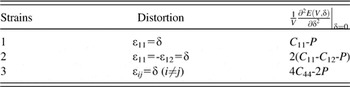
where E(V0, 0) is the energy of the unstrained system with equilibrium volume V0, τi is an element of stress tensor, and ξi is a factor present to take care of the Voigt index.Reference Fast, Wills, Johansson and Eriksson33 There are three independent components of the elastic tensor for cubic InP, i.e. C 11, C 12, and C 44. C 11 is obtained directly by deforming one of the three edges of the cubic unit cell. C 12 is given indirectly, via the linear combination C 11–C 12, from a volume-conserving strain involving the contraction of the two edges and the stretching of the other by twice as much. The shear constant C 44 resulted from the application of a volume-conserving rhombohedral strain along the <111> direction. A detailed description of the calculation method has been reported in Ref. Reference Sin′ko and Smirnow34. In our calculations, the strains enforced in the crystal are labeled in Table 1. Without considering the phononic effect in cubic InP, we obtain the elastic constants and the bulk modulus at different values of pressure.
The strains used to calculate the elastic constants of cubic InP.

III. RESULTS AND DISCUSSION
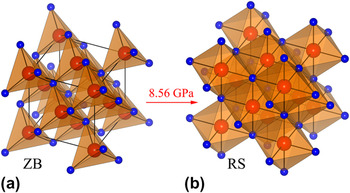
Figure 1 shows crystal structures of ZB and RS structures of InP. As shown in Fig. 1(a), in ZB lattice, one indium atom and four nearest phosphorus atoms build up a tetrahedron, and each As atom is shared by four nearest tetrahedrons. Compared with ZB structure, RS lattice is made of close-packed octahedrons, which are composed of one indium atom and six nearest phosphorus atoms. A phosphorus atom is shared by six nearest octahedrons.
Crystal structures of zincblende (ZB) and rocksalt (RS) of InP (In: red atom, P: blue atom). (a): zincblende structure; (b): rocksalt structure.

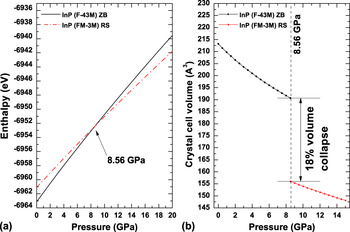
To investigate the phase transition, a series of geometry optimizations of ZB and RS structures under different pressures are executed. After optimization, enthalpy per cell and crystal cell volumeversus pressures are displayed in Fig. 2. The estimation of the zero-temperature phase transition pressure between ZB and RS structures of InP can be obtained from the usual condition of equal enthalpies; in other words, the pressure at which the enthalpy of two phases is the same. Enthalpy of RS structure is lower than ZB while hydrostatic pressure is more than 8.56 GPa [Fig. 2(a)]. According to thermodynamic stability theory, lower enthalpy of RS structure indicates that RS structure is steadier, then, a solid phase transition occurs at 8.56 GPa. As shown in Fig. 2(b), cell volume curvesversus pressure of InP (ZB) and InP (RS) reduce continuously with increasing pressure. The ZB-to-RS phase transition, which is associated with metallization, is accompanied by an 18% volume collapse, which agrees with the result of Fig. 1.
Enthalpy per cell and crystal cell volume of two phases of InP as a function of pressure. (a): enthalpyversus pressure; (b): cell volume versus pressure.

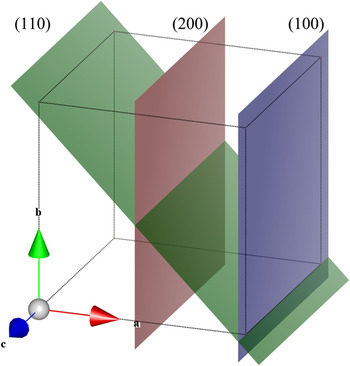
Figure 3 is a sketch map of (100), (200) and (110) planes in cubic crystal lattice. Figure 4 shows typical electron density contour of (100), (200) and (110) planes of ZB and RS structures. As shown in Figs. 4(a) and 4(b), there is clear distribution of electrons between the nearest In and In atoms. Moreover, much more obvious electron cloud distributions between the nearest In and P atoms [in (110) plane] is observed [Fig. 4(c)], whereas, nothing is found between the nearest P and P atoms [Fig. 4 (c)]; which indicates that covalent bonds InP-ZB are In-P covalent bonds mainly. Just as shown in Figs. 1(a) and 4(a), one indium atom (in ZB structure) is in the center of tetrahedron and bonds with four nearest phosphorus atoms as covalent bond (tetrahedral covalent bonds). Similarly, after phase transition (RS structure), there is no strong covalent interaction between the nearest As-As or In-In atoms [Fig. 4(d), 4(e) and 4(f)], but there is still clear electron distribution between the nearest In and P atoms [Fig. 4(f)]. This shows that each In atom (in RS structure) is in center of octahedron and covalent bonds with six nearest As atoms (octahedral covalent bonds). Directional variation of As-In covalent bond would affect elastic properties of InP greatly.
Sketch map of (100), (200) and (110) planes of cubic crystal.

Typical electron density contour of (100), (200) and (110) planes of ZB and RS structures of InP. (a): (100) plane of ZB-InP; (b): (200) plane of ZB-InP; (c): (110) plane of ZB-InP; (d): (100) plane of RS-InP; (e): (200) plane of RS-InP (f): (110) plane of RS-InP.

Considering the underestimate in respect of the energy gap of GGA, local density approximation (LDA) method is applied. Results indicated that the energy gaps of InP as calculated by GGA and LDA methods agreed without obvious difference (the results of LDA is not plotted in this article). Accordingly, GGA method could be used to study the energy gap of InP in present work. Figure 5 displays the typical energy band structure and partial density of states (PDOS) of ZB and RS structures of InP. Figure 5(a) and (b) are band structures of ZB structure of InP under the condition of 0 K, 0 GPa and 0 K, 8 GPa. They are typical semiconductor’s energy band with direct band gaps being 0.427 eV and 1.025 eV respectively. As shown in Fig. 5(a), in valence band, In-5p and P-3p overlap in the range from −3 ∼ 0 eV; In-5s and P-3p overlap together in the energy region of −6 ∼ −4 eV, which corresponded to bonding state. At the same time, In-5p, P-3p, In-5s and P-3p overlap together in conduction band from about 1 ∼ 6.5 eV, which are antibonding electrons. With increasing pressure, as shown in Fig. 5(b), the width of energy band corresponding to bonding state keeps stability without obvious change; however, the energy band correspond to antibonding state broadens clearly. And it could be observed that whereas DOS corresponding to bonding electrons is reducing; DOS of antibonding electrons is increasing. This demonstrates that bonding effect of In and P would be weakened by pressure. Weakened tetrahedral In-P covalent bonds would be destroyed and rebuilt to octahedral In-P covalent bonds. Figure 5(b) also shows that the energy level of antibonding electron is enhanced, which would cause raising band gap of InP-ZB.
Energy band structures and PDOS of ZB and RS structures of InP. (a): 0 GPa (ZB); (b): 8 GPa (ZB); (c): 9 GPa (RS); (d): 15 GPa (RS).

As shown in Figs. 5(c) and 5(d), typical band structures of metallic phase are displayed. InP (RS structure) is not a semiconductor any more. Compared with Fig. 5(b), though DOS of In-5s, In-5p, P-3s, and P-3p of bonding electrons decrease in various degrees, the overlapped energy region of these electrons are greatly broadened [shown in Fig. 5(c) and 5(d)]. This means that the bonding effect is reinforced, and In-P covalent bonds (tetrahedral In-P covalent bond) have been rebuilt to octahedral In-P covalent bonds (ZB to RS phase transition). Furthermore, some In-5s, In-5p, P-3p and a few P-3s move to unoccupied high energy level, across Fermi level, and migrate from valence band to conduction band, and then generate metallic properties of InP.
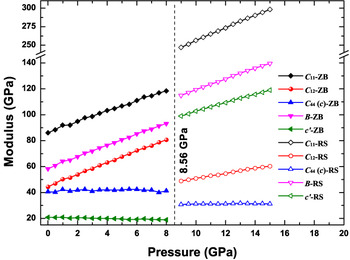
Bulk modulus B, and the elastic constants of InP under different pressures obtained are listed in Fig. 6. Bulk modulus of two phases of InP rise with pressure. According to C. Kittel,Reference Kittel35B = 1/K (K is compressibility), which indicates that the higher the pressure is, the lower the compressibility of InP is. Though, we have no detailed experimental data of InP for checking our calculated elastic constants under different pressures, the mechanical stability in a cubic crystal under isotropic pressure could be judged using the following conditionReference Sin′ko and Smirnow34:

Bulk modulus, elastic constants of ZB and RS structures of InP.

where  . Figure 6 and Eq. (2) indicate that the elastic constants of InP-ZB and InP-RS should be mechanical stable in the range of 0–8.56 and more than 8.56 GPa respectively. It is obvious from Fig. 6 that C 11 and C 12 of InP-ZB increase monotonically with increasing pressure; however, C 44 remains about 40 GPa. C 11 and C 12 of InP-RS rise obviously with increasing pressure too; nevertheless C 44 keeps about 30 GPa with pressure. For cubic crystals, with elastic constants C 11, C 12 and C 44, there are two shear moduli, c and c′ corresponding to shear on the {100} and {110} planes respectivelyReference Poirier36: c = C 44, c′ = (C 11–C 12)/2.
Figure 6 shows c and c′ of InP at different pressures. As shown in Fig. 6, c and c′ of InP keep about 40 GPa and 20 GPa respectively with pressure (less than 8.56 GPa, ZB structure), which indicates that shears moduli on the {100} and {110} planes are not obvious under pressures. Steady c and c′ of InP-ZB illustrate that stable ratio of shear stress and strain on the {100} and {110} planes. After phase transition, shears moduli on the {100} are still stable. According to Fig. 4, covalent interaction on {100} of InP-RS is not much stronger than that of InP-ZB, then c of InP-RS keeps 30 GPa (lower than that of InP-ZB). However, c′ of InP-RS increases with pressure linearly, and which is far more than that of InP-ZB. The obvious variation is just due to transition of In-P covalent bond from tetrahedral to octahedral. Octahedral In-P covalent bonds on {110} could keep lower strain under same shear stress and generate large c′.
IV. CONCLUSIONS
In summary, in this work, the pressure-induced metallic phase transition and elastic properties of indium phosphide III-V semiconductor is investigated by DFT. We find that the phase transition of InP from III-V semiconductor phase (ZB) to metallic phase (RS) occurs at 8.56 GPa accompanied by an 18% volume collapse. It is found that the nearest In and P atoms bonded as covalent bond. We also find that crystal space of ZB structure is just occupied by In-P tetrahedrons partly with many interstices, but crystal space of RS is fulfilled by close-packed octahedrons. With pressures, the broadened energy band correspond to antibonding state and reduced DOS of bonding state cause the weakened tetrahedral In-P covalent bonds. And then ZB structure is destroyed and rebuilt to RS structure. Some In-5s, In-5p, P-3p and a few P-3s move to unoccupied high energy level, across Fermi level, and distribute from valence band to conduction band, and then generate metallic properties of InP. Furthermore, changes of covalent bond would cause evident variation of shear on the {100} and {110} planes. The results of this work will benefit our future study of pressure-induced phase transition of III–V semiconductors.