1 Introduction
Various terms have been used to characterise the distinction between (1a), where only the final coordinate of a genitive noun phrase is marked with genitive case,Footnote 2 and (1b), where all the coordinates are marked.
(1)


The terms used here, single genitive and multiple genitive, are adopted from Huddleston & Pullum et al. (Reference Huddleston and Pullum2002: 481–2, 1330–2).
What drives the choice between single genitive and multiple genitive? In examples like (1), where neither coordinate is a personal pronoun, semantic factors are typically invoked. However, opinions differ as to how strong the relation actually is between form and interpretation. Huddleston, Payne & Peterson (Reference Huddleston and Pullum2002: 1330–1) claim that single and multiple genitives are not semantically contrastive, i.e. both (1a) and (1b) can have a joint interpretation (where Pat and Kim are parents of the same children) and a disjoint interpretation (where Pat and Kim are parents of separate children). At the same time, they point out that where the coordinates function as an established unit, as say with a coordination like Gilbert and Sullivan, the single genitive will be preferred, i.e. we have Gilbert and Sullivan's popularity rather than Gilbert's and Sullivan's popularity. By contrast, Quirk et al. (Reference Quirk, Greenbaum, Leech and Svartvik1972: 202, Reference Quirk, Greenbaum, Leech and Svartvik1985: 964) appear to imply a fixed association between the single genitive and joint interpretations, while the multiple genitive, at least in Quirk et al. (Reference Quirk, Greenbaum, Leech and Svartvik1985: 963), is explicitly said to allow either a joint or a disjoint interpretation. Partial empirical light is shed on this question by Herriman (Reference Herriman1999), who, in a corpus-based analysis using the Collins COBUILD corpus, but restricted solely to multiple genitives, establishes that multiple genitives widely exhibit both joint and disjoint interpretations.Footnote 3
When any of the coordinates is a personal pronoun, the use of either the single genitive or the multiple genitive is further complicated by syntactic and sociolinguistic factors relating to the choices speakers must make about the appropriate form of the pronoun. The goal of this article is to examine these factors, and to establish how they interact with the semantic factors outlined above. The investigation is based on the British National Corpus (henceforth BNC), from which all exemplars of both single and multiple genitives with one or more personal pronoun coordinates are extracted.
Section 2 of the article examines first the multiple genitive, whose syntactic analysis is well established. Section 3 is then devoted to the single genitive, which is considerably more problematic and where a novel syntactic analysis is proposed. In each of these two sections, a brief introduction is followed first by the corpus investigation and then a theoretical analysis which accounts for the observed forms. In section 3, there is also a brief discussion of some non-standard choices which are sometimes made by speakers in the use of the single genitive, and which, although not found in the BNC, can be observed in web-based sources. In the conclusion, there is a summary of the various factors involved and the motivations for the use of one form or the other.
2 Multiple genitives with personal pronouns
In standard descriptions, there appears to be a consensus that multiple genitives with pronominal coordinates are grammatical whether the pronoun occurs first or last, and also when all coordinates are pronominal:
- (2)
(a) [Kim's and your] children
(b) [your and Kim's] children
(c) [his and her] children
The main proviso is found in Quirk et al. (Reference Quirk, Greenbaum, Leech and Svartvik1972: 601–2), who suggest that pronouns are not normally linked in an all-pronominal coordination unless the first coordinate is his as in (2c). They actually star forms like [our and my work], or [her or his] friends, but note also that sometimes combinations such as [your, his and my] reports might occur (they say in informal speech), with the order of pronouns reflecting the politeness convention of second person first and first person last.
The restriction of first coordinates to his, Quirk et al. argue, reflects the fact that his is the sole personal pronoun whose dependent and independent genitive forms are identical. All other personal pronouns (apart from its, whose independent usages are very limited) have distinct dependent and independent forms (my~mine, your~yours, her~hers, our~ours, their~theirs). The distribution of dependent pronouns is essentially straightforward: dependent forms occur in noun phrase structures when the pronoun functions as a subject-determiner and the head noun is overt, as in [my children], and independent forms occur elsewhere. In particular, independent forms occur whenever the noun phrase contains no overt head noun, as with the use of mine in a sentence such as [Mine] are over there. Although the relevant passage is obscure, Quirk et al. appear to be suggesting that all multiple genitives, not just all-pronominal ones, are most acceptable when there is no choice to be made in the first coordinate between dependent genitive and independent genitive forms. Thus all non-pronominal noun phrases like Kim's are automatically unproblematic, but amongst the personal pronouns only his has this property.
Quirk et al. (Reference Quirk, Greenbaum, Leech and Svartvik1972: 602) make the further interesting observation that for some speakers the independent pronominal forms might be more acceptable as first coordinates than the normal dependent ones, as in (3):
(3) ?[yours and Mary's] neighbours
As Herriman (Reference Herriman1999: 10 fn. 8) reports, such examples appear to have been noted by Jespersen (Reference Jespersen1914: 402f.), Kruisinga (Reference Kruisinga1922: 439) and Curme (Reference Curme1931: 69–70, 529). Two examples in fact occur in the Collins COBUILD corpus, although Herriman remarks in the same footnote that ‘this type of coordination is rather unusual in present-day English’. We return to examples of this type below in our own corpus investigation.
No special claims are generally made about the interpretation of multiple genitives with one or more pronominal coordinates. Quirk et al. (Reference Quirk, Greenbaum, Leech and Svartvik1972: 202) do, however, make the observation that coordinations with pronouns, when acceptable, can be ambiguous between joint and disjoint interpretations (in contrast here with their attribution of disjoint readings to multiple genitive coordinations which do not contain pronominal coordinates). Herriman (Reference Herriman1999: 7) gives separate figures for all coordinations in which the first coordinate takes the form of an independent genitive pronoun. Although such coordinations are rare compared to coordinations in which the first coordinate is a non-pronominal or his/its, they distribute as follows: 7 joint, 4 disjoint and 5 ambiguous. In other words, just as for non-pronominal coordinations, both interpretations seem to be freely available.
In addition, Herriman (Reference Herriman1999: 6) makes an intriguing observation about the acceptability and interpretation of multiple genitives such as (4):
- (4)
(a) *[Rachel's and my] husbands were late.
(b) [Rachel's and Alice's] husbands were late.
Example (4a), which she stars, involves a dependent genitive pronoun as second coordinate, and a plural count head noun which under normal circumstances implies a singular disjoint interpretation. According to Herriman's informants, this interpretation is, however, freely available for non-pronominal examples like (4b), i.e. the interpretation equivalent to ‘Rachel's husband was late and Alice's husband was late’. But it is not available for (4a). This would then be a very specific constraint on singular disjoint interpretations with pronominal final coordinates: it is claimed not to hold for plural disjoint interpretations, i.e. [Rachel's and my] friends were late could certainly mean ‘Rachel's friends were late and my friends were late’, with disjoint sets of friends.Footnote 4
2.1 Corpus investigation
The BNC is a 100-million-word corpus of British English from the later part of the twentieth century. Approximately 90 per cent of the texts are written, from a wide-ranging variety of sources, and 10 per cent are spoken. For the purposes of this investigation, the version used of the BNC was BNCweb (CQP Edition).Footnote 5
In section 2.1.1, we first isolate examples of the type NP+Pronoun, i.e. coordinations with a non-pronominal first coordinate and a pronominal second coordinate. This is followed in section 2.1.2 by examples of the type Pronoun+Pronoun, and finally in section 2.1.3 by examples of the type Pronoun+NP. The examples considered are solely coordinations with and, and also ones in which the coordination functions as subject-determiner to an overt head noun, e.g. [Rachel's and my] house. That is, we do not consider examples in which the coordination functions as a predicative complement, e.g. This is [Rachel's and mine], or as an oblique genitive, e.g. a friend of [Rachel's and mine]. Nor do we consider examples in which there is ellipsis, e.g. You'll need to find another house: [Rachel's and mine] is not available.Footnote 6 In such examples, only independent forms of the genitive pronouns are found, regardless of position. The number of such examples is small, but including them would partially obscure the results for the subject-determiner case.
2.1.1 Multiple genitives: NP+Pronoun
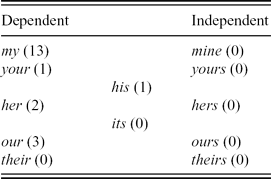
The distribution of pronominal forms found as final coordinate is given in table 1.
Multiple genitives: NP+Pronoun
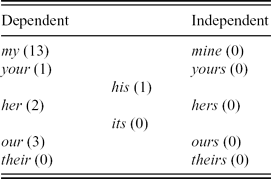
Altogether two examples, one with your and one with our, were from the spoken corpus, and 18 were from the written corpus. This is much as would be predicted by chance, given the relative sizes of the two parts of the corpus. And also as expected, there are no instances of a final coordinate which takes a specifically independent form. It is tempting to attribute the greater frequency of my in final position to the politeness constraint (first person last). However, the number of instances in which a first-person form occurs first in combination with a non-pronominal second coordinate, while fewer, are not significantly different (see table 3).Footnote 7
As far as interpretations are concerned, we identified clear-cut joint interpretations of the multiple genitive in 7 out of the 20 examples. Two of these are given in (5):
- (5)
(a) Oh, I wished I still had even my scorpion on a string to run up and down somebody's back! I answered my mum. ‘Yes, mam,’ I went off into [Meg's and my] bedroom. I sat down at the little table, as well I might. Could homework stay in anybody's head in broad daylight outside? (G3P 1990)
(b) ‘Very little point in [your brother's and my] getting together, Anneliese,’ Caroline heard herself laugh flippantly, rigid with embarrassment at the other girl's blunt attempts at matchmaking. (GUE 3160)
The majority of examples such as (6) were difficult to classify one way or the other:
(6) With majority voting the European Commission and the Council of Ministers can put things through that may not be in [the Labour Party's and our] interests. (64 KLY)
Are these collective or separate interests? And a few examples could be given unequivocally disjoint interpretations:
- (7)
(a) ‘There are only odd occasions when [Keith's and my] guitar parts are different,’ explains Bryan. ‘Mostly they just double each other. Of course there are lines that Keith does in second verses, melodic lines which build up to the chorus, and then it all apexes at the solo, hopefully.’(C9L 138)
(b) These findings are in accordance with those reported by Graham et al., who randomly treated 26 patients with H pylori positive gastric ulcers with either ranitidine alone or triple therapy plus ranitidine. The only factors in [Graham's and our] studies associated with ulcer recurrence were H pylori infection and the use of non-steroidal anti-inflammatory drugs. (HWT 1987)
Thus, the results from the BNC generally confirm the conclusion that both joint and disjoint interpretations are freely available to the multiple genitive.
Example (7b) is a plausible counterexample to the constraint illustrated by (4a), i.e. the constraint against singular disjoint interpretations when the head noun is a count plural. In context, it appears that the work referred to as Graham et al. represents a single study, as does the article from the medical journal Gut from which the extract is taken and whose findings are being reported. Thus Graham's and our studies most probably has the interpretation ‘Graham et al.'s study and our study’. This contrasts with examples such as (7a), also disjoint, but which appear in context to refer to multiple parts for each guitarist. In the limited number of examples found in the corpus, there were no totally incontrovertible cases with head nouns like husband.
All the examples in table 1 are straightforward instances of the multiple genitive. However, the searches also revealed 5 superficially similar examples in which the final pronoun is directly associated with the form own: two examples each with my and his, and one with its. Two of these are given in (8), the first with a joint and the second with a disjoint interpretation:
- (8)
(a) If popularity is low then economic variables are manipulated to ‘correct’ the picture, whereas with comfortable popularity the government will follow [its supporters’ and its own] ideology, i.e. will be responsive. (HWH 879)
(b) Meanwhile, he decided, slackening his pace as the distance between [Dotty's and his own] breathless form increased, he must set about persuading his mother that a little kid would be very useful for keeping Tullivers’ grass down. (ASE 1568)
In such coordinations, the form own appears to be associated solely with the pronoun, i.e. the interpretation of [Dotty's and his own] breathless form is ‘Dotty's breathless form and his own breathless form’ rather than ‘Dotty's own breathless form and his own breathless form’. The analysis we propose is therefore that these examples should be treated as instances of delayed right constituent coordination (Huddleston, Payne & Peterson Reference Huddleston and Pullum2002: 1343–5). The coordination is at a higher level than the simple coordination of two genitive noun phrases; rather, two incomplete noun phrases are coordinated, each of which contains a genitive subject-determiner, and a delayed nominal is then shared between them. The structural analysis assigned to the noun phrase in (8b) would then be [[NPDotty's _] and [NPhis own _]] breathless form. Note that this higher-level analysis is only forced when a dependent genitive pronoun in the second coordinate is followed by own, or a set of similar intensifying or contrastive adjectives.Footnote 8 It cannot naturally be extended to the generality of multiple genitive constructions without making the false prediction that independent genitive forms should occur as final coordinates.
2.1.2 Multiple genitives: Pronoun+Pronoun
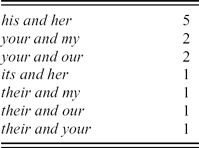
The number of pronoun plus pronoun examples was relatively small, 13 in all. The frequencies of the individual combinations are given in table 2.
Multiple genitives: Pronoun+Pronoun
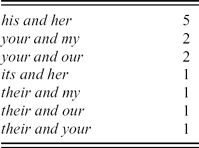
The majority of examples follow the politeness constraint: in particular, first-person pronouns occur last. But their and your is a counterexample to the condition that second-person pronouns should occur first.
A first observation is that these coordinations are not restricted to his in the first coordinate. Combinations such as your and my, your and our, their and my and their and our are first-person plural (either inclusive or exclusive), and might in principle be replaced by our. But the use of the coordination typically serves to reinforce a disjoint interpretation:
- (9)
(a) It is inevitable that one or more of these sub-groups will be disappointed in me from time to time and I will be disappointed in them. As Handy has argued, the more reconciled [their and my] expectations are, the more positive the effect on my performance. (EAA 1296)
(b) Once you book your holiday with us this brochure forms the basis of the agreement between Club 18–30 and you and your party. Set out below are further details of [your and our] obligations once the booking has been made. (AM0 1617)
The combination their and your is a mixture of third and second persons and could not be replaced by a single pronoun:
(10) If you are able to meet my clients’ price expectations by revising your offer, I would then propose that you meet with them this month to exchange [their and your] thoughts for the future. (BP8 1393)
Similarly, the combination its and her is third-person plural, but cannot simply be replaced by their when there is a mixture of non-human and human antecedents:
(11) In 1898 Emma, Lady Sherborne, converted the Lodge into her dower house, built two little lodges to herald [its and her own] grandeur and to house her staff, destroyed the staircase and made the two long rooms into four apartments. (AB4 372)
These examples almost invariably involve disjoint interpretations, but note the following example with your and my:
(12) I'm thinking actually of here in the university itself, we've got three different groups in those areas that are now collaborating, and I think we've got a good chance of – especially in the area of schools curricula – but also in the area, I think, of helping business people, and I'm thinking now of senior management, who might be [your and my] age, Brian, for whom computers didn't exist when we went through university or college, erm who've probably more or less given up any hope . . . (KRF 225)
This example comes from a radio broadcast in which an invited speaker is responding to questions from a presenter. In this context, it will at best only be a tacit assumption that the participants share a common age, and the presenter therefore foregrounds this by using the coordination your and my in preference to the simple first-person plural our. The vocative Brian is employed immediately afterwards as a means of increasing empathy.
The greater frequency of examples with his and her is related to the special gender-neutral function of this combination. His and her could simply be replaced by their in these examples, but the coordination reinforces the disjoint interpretation:
- (13)
(a) Many choruses from the Messiah were learnt, but again we decided to give ‘Olivet to Calvary’ in Holy Week. Our tiny underground Church was too small, so we invited everyone to the main hall of Munster Road School. It was our best work, every soloist gave of [his and her] best. (B2E1093)
(b) Perhaps the Rainfords had one of those marriages where each did [his and her] own thing? (HGK 3158)
(c) McQueen was accompanied on location by Ali MacGraw, whom he had met on The Getaway, and whose presence he admitted saved him from going round the bend. Both [his and her] children were there too. (C9U 1730)
(d) A lot of people inside and outside the country make a lot of money from caricaturing and criticising the Royal Family. It is, perhaps, not too much to ask on their behalf for a period of calm during which they can reassert, each in [his and her] own way, the tradition of public service to which they are clearly dedicated. (K5M 216)
In example (13d), the form own relates to both coordinates (see fn 7), and is therefore bracketed outside the coordination.
The final example of his and her has essentially the same function, but is interestingly used in the context of titles:
(14) No other place was so lavish as the Iranian embassy on Massachusetts Avenue, with its mirror-domed ceilings, its drapes and its silks, all dominated by two full-length portraits of [His and Her] Imperial Majesties and brought alive by the bounding, capacious personality of Zahedi, the ultimate host. (G3R 1654)
2.1.3 Multiple genitives: Pronoun+NP
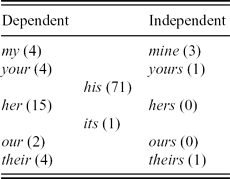
The distribution of pronominal forms found as initial coordinate is given in table 3.
Multiple genitives: Pronoun+NP

A first observation is that examples with his, which neutralises the distinction between dependent and independent genitive, are indeed most frequent. For comparison, the overall ratio of occurrences of his to their/theirs in all environments is approximately 3:2, and to my/mine 3:1. Typical examples are given in (15):
- (15)
(a) Some time after this, Mullova went to live in Vienna with Claudio Abbado, who was then music director of the Vienna State Opera. [His and Mullova's] relationship ended when Mullova became pregnant. (AJV 343)
(b) In the meantime, it is his only source of income and he has to pay for everything out of it, both his personal and official expenses, including the upkeep of [his and Diana's] homes, their household, their wardrobes, the children's schooling, the official cars, and the cost of entertaining. (A7H 734)
(c) And now Gower is wondering whether the war of words in [his and Gooch's] summer biographies has finished him off. (CH31109)
As with multiple genitives of the form NP+Pronoun, there is a mix of clearly joint, indeterminate, and clearly disjoint interpretations. Example (15a) is unequivocally joint. In (15b), we would not know without world knowledge whether Charles and Diana have separate houses in addition to any which might be shared. And in (15c), the interpretation, based on world knowledge about the nature of biographies, is clearly disjoint.
Most interestingly, however, there are a number of examples with other pronouns, and although dependent forms predominate, there is variable use of dependent and independent forms. We give first examples of all the explicitly dependent forms:
- (16)
(a) [My and colleagues’] data has shown that for uncomplicated acute pyelonephritis five days of treatment with either an aminoglycoside, a β lactam, or a quinolone is highly effective. (FSY 1719)
(b) This way you will have a better idea of whether the job will suit you, you avoid wasting [your and the interviewer's] time, and you sidestep one possibility of creating a negative impression. (BNA 311)
(c) She felt a deep flush of embarrassment crawl up her neck as she gauged how far the sound of [her and Mandy's] conversation might have carried. (JY6 438)
(d) You do [her and her mum's] hair then? (KB6 2310)
(e) Addressing the plenum on July 25, Gorbachev criticised ‘the representatives of communist fundamentalism who are unable to escape the grip of dogmatic conceptions’ and said that the party had to move away from Marxism-Leninism to ‘include in our ideological arsenal all the riches of [our and the world's] socialist and democratic thought’. (HL9 1644)
(f) A questionnaire was then drafted and sent to a random sample of headteachers for [their and their staff's] comments. (HNW 1813)
All examples with the dependent genitive are from the written part of the corpus, with the exception of (16d).
The examples with independent genitives are given in (17):
- (17)
(a) If she had a particular experience or some expertise, fine. In the end the Chairman of Governors went with me. Now I was voicing both [mine and Gill's] view at that point. (CMS 805)
(b) She was trying to rub it off! Jenny wants my, [mine and Russell's] name on her, and mine, just mine. (KSW 547)
(c) We'll get some at the party tonight. Oh yeah that'll be well funny. [Mine and Aaron's] erm [mine and Aaron's] idea of sticking the erm microphone in the toilet, yeah, right hiding it and then erm later on during the party yeah taking the tape yeah and telling everyone to be quiet and listen to it. (KP4 3801)
(d) Barney gave him a knowing wink, ‘we shall be coming to watch this project of [yours and Julie's] mind,’ he called after him. (B3J 2012)
(e) In particular, there is a concern to design certification procedures that:
1 allow a much wider range of achievements to be acknowledged;
2 make it possible for all pupils to have some testimony to their achievement;
3 will give information to potential customers which is relevant to [both theirs and the pupils’] needs; (CN5 1391)
Examples (17b) and (17c) are from the spoken part of the corpus. In (17b), there is an explicit correction of my to mine after a hesitation in which the speaker projects a shift from a non-coordinate to a coordinate genitive. And in (17c), the coordination is repeated after a hesitation. These hesitations may reflect the insecurity which we are arguing that speakers feel when confronted by the need to form a coordination which involves genitive pronouns, but the final output is clearly deliberate. Indeed, the remaining three examples are from the written part of the corpus and must be planned. They cannot, we believe, simply be dismissed.
2.2 Theoretical analysis
We follow here the basic analysis of coordinate structures found in Huddleston, Payne & Peterson (Reference Huddleston and Pullum2002: 1277–8), revised in Huddleston & Pullum (Reference Huddleston and Pullum2005).Footnote 9 In this analysis, when noun phrases are coordinated, they form a distinct constituent called simply a ‘coordination’. A coordination of noun phrases is not the same as a noun phrase: even though the two may have a similar external distribution, coordinations are internally exocentric rather than endocentric structures. We also follow the basic analysis of subject-determiner constructions found in Payne & Huddleston (Reference Payne and Huddleston2002) and extended in Payne (Reference Payne2009).
With the addition of case annotations, which we place in square brackets, simple multiple genitive constructions such as (1b) and (2a–c) would be assigned the structure in (18):
(18)
In this tree diagram, each node bears both a function and a category. In particular, in the multiple genitive construction the subject-determiner function will be fulfilled by a coordination in which each coordinate is a genitive noun phrase. In effect, the genitive case required by the subject-determiner construction is marked separately on each coordinate. Whether the head of each coordinate is a noun or a pronoun, it simply assumes the correct form (typically suppletive for pronouns) of the genitive case.
With pronouns, there is however the issue of whether the genitive should be dependent or independent. We have seen from the corpus that, for the second coordinate, dependent genitive forms are invariably chosen. On the other hand, there is some variation as to whether the first coordinate should be a dependent genitive or an independent genitive: the form his, which avoids the choice, is by far the most common pronoun to occur in this position. For the remaining pronouns, dependent forms are preferable, but independent forms do occur. Herriman (Reference Herriman1999) suggests that a structural analysis analogous to (18) should generally be assigned to joint interpretations of multiple genitive coordinations, whether pronouns are involved or not, while disjoint interpretations should have a structure where the coordination is at a higher level and the first coordinate is effectively elliptical, thus [his _] and [Pat's children]. But this seems implausible: if this were indeed the structure we would expect to find far more examples of disjoint interpretations with initial independent genitive pronouns than we actually do. And further, at least one of the 5 examples with initial independent genitives in the corpus appears to have a joint interpretation: example (17c) is particularly clear. A simplistic mapping of structure onto interpretation would lead to a contradiction here.
It seems preferable therefore to assume that the choice between dependent and independent genitives is based on both adjacency and structure. Dependent forms like my must be selected when adjacent to a head nominal, and can be selected when dominated by the subject-determiner function. Straightforward cases like my children and [Pat's and my] children satisfy both conditions, the latter because my is dominated by the subject-determiner coordination, even if not immediately dominated. Independent forms like mine must be selected when not dominated by the subject-determiner function and can be selected when not adjacent to a head nominal. Predicative uses (this is mine), elliptical uses (mine is broken), and oblique genitives (a friend of mine) readily satisfy both conditions. Initial coordinates are not adjacent to a head nominal, and therefore dependent forms are not forced. Nor are they not dominated by the subject-determiner function, therefore independent forms are not forced. Both dependent and independent forms can be selected under these circumstances, though forms like his which avoid the necessity for choice are most frequent. If a choice has to be made, the weight of the subject-determiner condition is apparently greater than that of the non-adjacency condition and dependent forms are more frequently observed.
This is not all that needs to be said, however. Payne & Huddleston (Reference Huddleston and Pullum2002: 481) note that the distinction between multiple and single genitives cross-cuts the distinction between head genitives and phrasal genitives.Footnote 10 In an example like (18), each coordinate in the multiple genitive is a simple NP with no postmodification, and therefore the exponence of genitive case is on the head of the NP. This accounts for all of the examples given so far: the genitive case of each coordinate is passed to the head of that coordinate, and when this is a pronoun, the pronoun simply assumes the genitive case (typically the dependent form).
However, it is perfectly possible for either of the coordinate NPs to be postmodified, and in this case the genitive passes as an exterior case to the rightmost element in the individual coordinate NP. The case is external because it must be layered on top of any case which the rightmost element independently requires. There are no such examples that we are aware of in the BNC, but a web-based search quickly turns up examples with multiple genitive coordinations like [my and a friend of mine's] computer.Footnote 11 In this example, the genitive case of the first coordinate is a head genitive, and the form is my. But the genitive case of the second coordinate is phrasal, and layered externally to the independent genitive case required by the oblique genitive construction in a friend of mine. The form mine's therefore has two cases, the internal genitive case expressed by the independent genitive mine, and the external genitive case expressed by the regular ’s formative.
Following the analysis of the phrasal genitive in Payne (Reference Payne2009), the structure of the coordination my and a friend of mine's would be (19):Footnote 12
(19)
As before, this is a multiple genitive and this is signalled by the genitive case marking on each coordinate. From that point, however, the two coordinates behave differently. In the first coordinate, the genitive case is passed to the pronoun head and we have the simple head genitive my. In the second coordinate, however, genitive marking becomes external when the genitive feature passes away from the head noun to the PP on its right. As an external feature, it is layered outside the genitive case assigned to the rightmost NP by the preposition of in the oblique genitive. In the representation of mine's there are then two genitives expressed by the feature combination [[gen] gen], the feature on the right being the external one. The genitive of the second coordinate is therefore phrasal.
The analysis of head and phrasal genitives is crucial to an understanding of the single genitive, to which we now turn.
3 Single genitives with personal pronouns
It is not particularly well documented in descriptions of English grammar that the use of the single genitive creates major difficulties when one or more of the coordinates are personal pronouns. Traditional descriptive grammars, e.g. Kruisinga (Reference Kruisinga1922: 985–6) and Quirk et al. (Reference Quirk, Greenbaum, Leech and Svartvik1972), concentrate rather on the potential use of pronouns in the multiple genitive. However, Huddleston & Pullum et al. (Reference Huddleston and Pullum2002: 1331–2) point out that examples such as (20a) with pronoun last are ungrammatical in the standard language, while examples such as (20b) with pronoun first are ‘at best very marginal’:
- (20)
(a) *[Kim and your] children
(b) ?[you and Kim's] children
However, no explanation is given why this should be so.
One reason why the difficulties illustrated in (20) might largely have escaped attention is the tradition, as found for example from Jespersen (Reference Jespersen1894: 313–15) to Quirk et al. (Reference Quirk, Greenbaum, Leech and Svartvik1972: 202), of assimilating the single genitive to the phrasal genitive, the construction discussed above in which genitive marking is attached to the final element of a noun phrase, rather than to the head when this is non-final. Thus in a postmodified noun phrase such as [the woman next door's] children, genitive marking attaches to the noun door rather than to the head noun woman. Under this analysis, genitive marking is attached strictly to the final element of the coordination Kim and Pat in the single genitive construction [Kim and Pat's] children, rather than just to the head Pat of the final coordinate. But then, as Huddleston & Pullum et al. (Reference Quirk, Greenbaum, Leech and Svartvik2002: 482) observe, no explanation can be given why genitive marking cannot similarly be attached to a coordinate phrase with a final pronoun as in (21a). The ungrammaticality of (21a) indeed contrasts starkly with the grammaticality of (21b), in which genitive marking is associated with the final pronoun in a postmodified phrase:Footnote 13
- (21)
(a) *[Kim and you's] children
(b) [the woman next to you's] children
When coordinations containing personal pronouns are felt to constitute an established unit, as with a coordination like my wife and I, all possible options for an acceptable solution then appear to be barred.
First of all, as Zwicky (Reference Zwicky2006) points out in an entertaining short contribution to Language Log, the use of the multiple genitive, as in my wife's and my problems, ‘risks losing the sense of your wife and you as a unit, a couple’. But then, whether the single genitive is analysed as an instance of the phrasal genitive, as in (22a), or as genitive marking of just the second coordinate, as in (22b), no standard version of the single genitive is permitted with this order of coordinates:
- (22)
(a) *[my wife and I's] problems
(b) *[my wife and my] problems
Reversing the order of coordinates, as in (23), does not help much either, since it is usually not a good strategy to infringe politeness constraints on the order of coordinates and mention oneself in advance of one's wife.
(23) ?[I and my wife's] problems
But in any event, there is the problem illustrated in (20b), namely that difficulties appear to arise with the choice of an appropriate form for an initial pronoun in a single genitive. Nominative I does not really seem to work, and accusative me in %[me and my wife's] problems is clearly non-standard. Finally, the indirect multiple genitive construction my wife's problems and mine is obviously not an option, since this invariably has a disjoint interpretation.
3.1 Corpus analysis
The total number of secure tokens of the single genitive construction found in the corpus in which one or more coordinates was a personal pronoun was only 7, with an extra two of arguable status.Footnote 14 All of these were pronoun-first, i.e. of the type exhibited in (20b) and (22c). In addition, in all cases the second coordinate was non-pronominal. No pronoun-last examples were found, either with a group-genitive marking as in (21a) and (22a), or a genitive form of the pronoun as in (22b). The corpus investigation thus essentially confirms the intuitive judgments expressed about the difficulties which arise with these constructions.
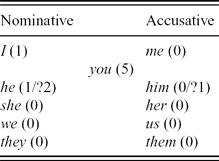
The actual forms of the pronouns found as first coordinate in the single genitive are listed in table 4.
Single genitive: Pronoun+NP
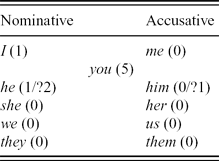
What is immediately striking is that the most common form is you, where no choice has to be made between nominative and accusative. Otherwise, there is an obvious reluctance to use a specifically nominative form: only I and he are attested in the corpus. And specifically accusative forms are avoided almost completely (we return to the one possible example below).Footnote 15
Of the 5 examples with you as first coordinate, 4 are examples in which you is paired with a second coordinate with determiner your. These are given in (24):
- (24)
(a) Pocket sprung mattresses can cope with weight differences of up to four stone, but if [you and your partner's] weight differs by more than four and a half stone (30 kg) your best bet is a pair of ‘zip-and-link’ mattresses. (BPF 1675)
(b) You can check with whoever you like but I was totally exonerated of any blame at the time, and I resent [you and your family's] implications that I was responsible for Eddie's death! (CFS 2717)
(c) The insurer's decision on whether to provide cover, and if so how much, depends on what the insurer thinks of [you and your customers’] credit ratings. (CD0 280)
(d) It is important for [you and your baby's] health that you are regularly examined throughout your pregnancy, so make the effort to keep your appointments. (A0J 1044)
Examples (24a) and (24b) are unequivocally examples of the single genitive, and our judgment is that (24c) and (24d) are also to be analysed as such in context. For example, in (24c) it is not what the insurer thinks of you, but rather of your credit rating.
Interestingly, it should be noted that, while collocations such as you and your X may well be construed as denoting a unit of some kind, the interpretation is not necessarily a joint one. For example, in (24a), it is clear that it is the difference between the two weights that is intended, not the combined weight of you and your partner. Similarly, in (24c), there will be two sets of credit ratings, one for you and one for your customers. Only (24b) is most likely to be given a joint interpretation, with one set of implications rather than separate implications by you and your family. These examples are limited in number, but suggest that it may be more conducive to a preferred use of the single genitive that the noun phrase denote a unit, rather than that this unit necessarily act jointly on a particular occasion.
The only other occurrence of you, and the only example from the spoken section of the corpus, is (25):
(25) He said don't worry about it. Be alright. He said I'm going out again with him and gonna get you, [you and dad's] cigarettes and . . . (KBE 5419)
The choice of what is plausibly treated as an occurrence of the single genitive in this example is probably facilitated by the immediately preceding use of you as object of the verb get. Then, as a switch from an anticipated continuation with just your cigarettes, the unplanned coordination occurs. And again, assuming that you and dad smoke separate cigarettes, this example does not predispose to a joint interpretation.
There are only two clear examples of single genitives with explicitly nominative initial pronouns, and these are given in (26):
- (26)
(a) [I and others’] main objections both the draft plan and the deposit plan, is there should be as a general location in H in H two. This is not a new matter, this is a matter on which the County Council could have directed their mind to for several years. (HVH 115)
(b) Of the approximate one and a half thousand pounds from the sale of the Volvo, minus expenses, that he regarded legitimately as his, added to the four thousand in [he and Zoe's] joint account, there remained one hundred and seventy pounds. (K8R 776)
Example (26a) is from the spoken part of the corpus, though in the rather formal setting of a speech, and contains obvious features of spoken language such as the omission of the preposition to following objections, the omission of the complement after there should be, and the repetition of in H. On the other hand, (26b) is written. The noun phrase others is a frequent collocation of I and, in fact the most frequent single collocation in the corpus (19 examples) if one excludes collocations of the type I and Thou, or I and my/the/a X. And he and Zoe in (26b) appear to be a couple. So in both cases it is possible to invoke a single-unit interpretation of the noun phrase. This time however the interpretations are most likely to be joint, and in (26b) in particular it is explicitly so.
The remaining two potential examples of a pronoun-first single genitive are from the conversational spoken part of the corpus, and rather dubious. However, we give them here for completeness:
- (27)
(a) A. Why, what you got ta do?
B. [unclear] that car back from [unclear] Fiesta got the minibus going out got the estate car, [unclear] [he and Jimmy's] look, he talks about Mr [gap:name], he has left that like a tip! (KCT 13795)
(b) A. I know Sharon told us
B. he'll
C. you know [him and Jimmy's] new travelling night
B. I mean (KBM 2440)
These are in fact two entirely different conversations, and the occurrence of Jimmy in both examples is a coincidence. While example (27a) with a nominative is from a dialogue between skilled manual (C2) female interlocutors in the south, example (26b) with the accusative is from a dialogue between young professional (AB) male interlocutors in south Manchester. Most likely, though, he and Jimmy's in (27a) refers to a jointly owned estate car, and in (27b) to the night someone and Jimmy go travelling to pubs. This latter example is then the sole example of an accusative.
To conclude, we can say that there are clear difficulties with constructing single genitives with pronominal coordinates. There are no examples in the corpus which contain final pronouns, and those with initial pronouns are highly infrequent. The most natural examples in written register are with you, which uniquely does not distinguish between nominative and accusative case. Speakers largely avoid examples in which a choice between nominative and accusative has to be made, and such examples as do occur with a nominative feel somewhat unnatural or hypercorrect, while the sole example of an accusative feels non-standard.
3.2 Theoretical analysis
We have noted the long-standing tradition in English grammar that single genitives are to be treated simply as manifestations of the phrasal genitive, and the main objection to this: the phrasal genitive account gives no explanation for the ungrammaticality of single genitives like *[Kim and you's] children, given the acceptability of [the woman next to you's] children.
Further, we have noted the observation in Payne & Huddleston (Reference Huddleston and Pullum2002: 481) that the distinction between multiple and single genitives cross-cuts the distinction between head genitives and phrasal genitives. Thus single genitives like multiple genitives can have as individual coordinates either a noun phrase which requires a head genitive, or a noun phrase which requires a phrasal genitive. When a single genitive contains a final coordinate which requires not a head genitive but a phrasal genitive, it appears to be acceptable: that is, the grammaticality of you's in [you and the woman next to you's] children matches that of you's in [the woman next to you's] children, not that of you's in *[Kim and you's] children. This contrast is inexplicable if *[Kim and you's] children is itself just another phrasal genitive.
The solution opted for by Payne & Huddleston (Reference Huddleston and Pullum2002: 481–2) is therefore to analyse the single genitive as a coordination in which genitive case is marked on the final coordinate only, and this genitive can itself be either a head genitive or a phrasal genitive depending on the nature of the final coordinate.
Firstly, this solution neatly accounts for the problems which arise when the first coordinate is a pronoun. No specific case is assigned to the first coordinate of a single genitive coordination, and the structure therefore forces the first coordinate to assume a default form. In the case of ordinary nouns, this is simply the plain case. The form you, which likewise does not distinguish between nominative and accusative, also presents no problems. But it is unclear for pronouns which distinguish between nominative and accusative what the default case should be: accusatives in non-standard environments tend to be thought of as non-standard, while nominatives appear hypercorrect.
Secondly, this solution also naturally accounts for some of the problems which arise when the second coordinate is a pronoun. In particular, it accounts for the unacceptability of the phrasal genitive in *[Kim and you's] children, where the final coordinate is predicted to be a head genitive, compared with the acceptability of the phrasal genitive when applied specifically to a final coordinate which itself requires it, as in [you and the woman next to you's] children. But there is a drawback: there is no explanation now for the unacceptability of standard genitive pronouns as instantiations of the head genitive. That is, there is no account of the ungrammaticality of your in *[Kim and your] children or my in *[Pat and my] children, compared with the head genitive Kim's of the final coordinate in [Pat and Kim's] children.
In order to resolve this conundrum, we propose a new solution: the final coordinate in a single genitive, if a head, must satisfy simultaneously the constraints of being a phrasal genitive and of being a head genitive. The genitive must be a phrasal genitive because the coordination itself is a headless phrase, but it must also be a head genitive when applied to the head of the final coordinate. These conditions are easily satisfied by regular nouns, for which the exponence of both the head genitive and the phrasal genitive is the regular ’s formative. But there is no standard form of a personal pronoun which can meet both requirements simultaneously. A form like you's satisfies the phrasal genitive requirement, but fails to satisfy the head genitive requirement, and similarly, a form like your satisfies the head genitive requirement, but fails to satisfy the phrasal genitive requirement. Note also that, if the final coordinate is one which itself requires a phrasal genitive rather than a head genitive, there is no longer a conflict: the phrasal genitive will be acceptable.
If we instantiate this solution, then a straightforward single genitive like [Pat and Kim's] children would be assigned the structure in (28):
(28)
In contrast to the multiple genitive structure in (18), the subject-determiner is a coordination in which genitive case is marked on the final coordinate both as the standard feature [gen] which is appropriate for subject-determiner NPs, and simultaneously as the external feature [[] gen] appropriate to the phrasal status of the coordination. We represent the idea that the features must be simultaneously satisfied by placing a colon between them. Both features of the final coordinate are simply retained as features of its head, which the pronoun form my cannot satisfy.
It should be noted that this analysis entails an interaction between the phrasal genitive and the head genitive which is difficult to envisage within a clitic-based analysis. The difficulty is especially acute since the forms of the head genitive for personal pronouns are typically suppletive, and thus perforce inflectional. But the phrasal genitive would be formed postlexically in a clitic analysis such as that of Anderson (Reference Anderson2005), and could not therefore be sensitive to the suppletive exponence of the head genitive. The prediction would be that a form like my would instantiate the head genitive, and the clitic would subsequently be applied to the phrase to form my's. If both the head genitive and phrasal genitive are inflectional, however, it is simply a matter of morphology whether a form can satisfy both features.
The representation N[gen]:[[]gen] further accounts neatly for some of the forms observed by Zwicky (Reference Zwicky2006) as unorthodox attempts to resolve the problem of forming an acceptable genitive for the coordination my wife and I.Footnote 16 Zwicky points to web-based sightings of such forms as my wife and my's and my wife and mine's. Examples are given in (29):
- (29)
(a) That's why I don't give out financial advice. The purpose of these articles is strictly to share [my wife and my's] experiences in planning our own retirement so that others can see how a real life couple handled these issues.
(b) Today marks [my wife and mine's] 10th Wedding Anniversary. To celebrate we're taking a Harley road trip up into the mountains for the night.
In these examples, the head and phrasal genitive features are not realised simultaneously, but separately.
Note then that a single genitive counterpart of the multiple genitive in (19) is predicted to be grammatical, pace the difficulty of choosing a default form for the pronoun in the first coordinate:
(30)
The features are as before up until the point where the standard genitive feature [gen] on the Nom head of the final coordinate passes to the PP, and becomes the external feature [[] gen]]. At this point, there is no conflict between the external feature which derives from the coordination and the external feature which derives from the final coordinate, and we assume that the two features simply collapse into one external feature. This is then layered externally to the [gen] feature of the oblique genitive mine, and we end up with an acceptable phrasal genitive.
4 Conclusion
In this article, we have established that both multiple and single genitive coordinations with personal pronoun coordinates freely admit joint and disjoint interpretations, and that in this respect there is no close association between form and interpretation. Many examples are simply indeterminate. Nevertheless, there is clear evidence that the single genitive is preferred when the coordinates are viewed as forming an established unit, whether or not the interpretation is joint or disjoint.
Both the multiple and the single genitive can be problematic when one or more of the coordinates is a personal pronoun. In the multiple genitive, the problems arise principally with the form of the first coordinate, where the choice between dependent and independent genitive forms creates some awkwardness. Thus, as suggested in the literature, the form his, which avoids the necessity of choice, occurs with far greater frequency than any other. Otherwise, dependent forms such as my are more frequently chosen, though independent forms like mine are not excluded. Similarly, combinations of pronouns are not restricted to those in which his is the first coordinate, though these are more frequent, largely because of the common coordination his and her which functions as a gender-neutral anaphor. All-pronoun coordinations tend to reinforce disjoint interpretations, though not exclusively so.
The single genitive is problematic in both the first coordinate and the second coordinate. The first coordinate has no specific case assigned, and therefore default forms are selected. With ordinary nouns, this creates no difficulties: the plain form is simply chosen. With pronouns, however, a choice is forced between nominative and accusative forms where these are distinct. Neither of these is obviously the default form, since accusative forms are perceived to be non-standard and nominative forms hypercorrect. The form you, which is a plain form and avoids these choices, is the most frequent to occur. No option is acceptable for pronouns as head genitives in the final coordinate. This we attribute to the impossibility of satisfying the requirement that the form be appropriate for both a phrasal genitive, because of the coordination, and a head genitive, because of the nature of the final coordinate. This marks a departure both from the traditional analysis in which the single genitive is analysed as always phrasal, and from the Payne & Huddleston (Reference Payne and Huddleston2002) analysis in which the final coordinate in a single genitive is analysed either as a head genitive or as a phrasal genitive depending on the nature of the final coordinate alone. This analysis countenances an interaction between the phrasal genitive and the head genitive which implies an inflectional rather than a clitic analysis.
Finally, we note that the number of examples encountered in the BNC of genitive coordinations with pronoun coordinates is relatively small. This undoubtedly reflects the difficulties which speakers feel when faced by the necessity to form such coordinations. It is of course dangerous to extrapolate too far when faced by such infrequent constructions. However, the fact that coordinations such as [my wife and I's] children or [my wife and my] children were not encountered at all in the BNC is suggestive of what is felt to be standard usage. A systematic web-based search must be left to a subsequent investigation.