Atrioventricular nodal re-entrant tachycardia is a common arrhythmia among children.Reference Ko, Deal, Strasburger and Benson 1 Before 1989, the mainstay of treatment for this condition was medical therapy or surgery. The advent of radiofrequency ablation ushered in a new era for the treatment of life-threatening arrhythmias in adults and children.Reference Van Hare, Lesh, Scheinman and Langberg 2 No longer were patients subjected to a lifetime of medical management. With radiofrequency ablation, such arrhythmias could be eliminated with a high degree of success.Reference Campbell, Strieper, Frias, Danford and Kugler 3 , Reference Kugler, Danford and Deal 4
On the other hand, radiofrequency ablation is not without its potential for complications. Most notably, there is a non-trivial risk of as much as 1.6% for adverse consequences such as complete heart block when radiofrequency ablation is used to treat atrioventricular nodal re-entrant tachycardia.Reference Schaffer, Silka, Ross and Kugler 5 In the last decade, cryoablation has become popular as an alternate ablation therapy to treat arrhythmias such as septal accessory pathways and atrioventricular nodal re-entrant tachycardia, particularly in higher-risk populations such as children and adolescents.Reference Hanninen, Yeung-Lai-Wah and Massel 6 – Reference Miyazaki, Blaufox, Fairbrother and Saul 12 Cryoablation holds the promise of achieving similar results but with lower risk of complete heart block. Indeed, our group recently showed that cryoablation could be used to treat atrioventricular nodal re-entrant tachycardia successfully with a low incidence of recurrence and no episodes of heart block.Reference Das, Law and Von Bergen 13
Although both radiofrequency ablation and cryoablation can be used to treat atrioventricular nodal re-entrant tachycardia in children, it is unclear which option may offer a better value, with value in healthcare being defined as “outcomes relative to costs”.Reference Porter 14 In the current healthcare environment with rising costs for procedures such as ablation of arrhythmias,Reference Burns, Evans, Pearson, Berul and Kaltman 15 , Reference Desai, Kelton, Czosek and Heaton 16 demonstrating appropriate outcomes at reasonable costs becomes of paramount importance. Indeed, the American Heart Association and the American College of Cardiology now include value assessments as an important criterion in developing guidelines.Reference Anderson, Heidenreich and Barnett 17 To better understand the value of radiofrequency ablation and cryoablation, we therefore sought to compare the outcomes and costs of these two procedures for the treatment of atrioventricular nodal re-entrant tachycardia in children.
Materials and methods
We performed a retrospective cohort study of 96 atrioventricular nodal re-entrant tachycardia ablation cases for children (age⩽18 years) from 1 July, 2009 to 30 June, 2011 at a single institution. Each study included general anaesthesia, diagnostic electrophysiology study to document atrioventricular nodal re-entrant tachycardia, and ablation. A three-dimensional mapping system was not used during this era.
The unit of analysis was at patient level. Cost data were manually extracted by the financial analysts of the institution, including fixed cost of the facility, administrative costs, utility and disposable costs, and labour costs. The facility costs included the space, utility, and maintenance costs. The utility and disposable costs count in the one-time consumptions during the procedure, and the labour costs are determined by the duration of the procedure and the hourly salary of the physicians, nurses, and other supporting staff. All the costs were converted into 2011 dollar value according to Consumer Price Index of Medical Goods as published by the Bureau of Labor Statistics.
Our outcomes of interest were total cost of the procedure, acute success – that is, successful ablation of the arrhythmia during the procedure with no evidence of inducible atrioventricular nodal re-entrant tachycardia or dual atrioventricular node physiology, defined by no sustained slow pathway conduction, no AH jump, and no echo beats – long-term success – that is, no documented return of arrhythmia within 6 months following the initial ablation procedure – and occurrence of adverse events. We first conducted a simple T-test to compare the total costs and outcomes by ablation procedure types including cryoablation only, radiofrequency ablation only, and combination cases, either starting with cryoablation or radiofrequency ablation. Second, we conducted a series of regression analyses to investigate whether the choice of procedure influenced the total cost and outcomes, and, if so, by how much. The independent variables included the ablation procedure, patient’s gender, patient’s age, patient's body surface area, and the physician who carried out the procedures. We used linear regression to estimate the cost equation, and used logistic regression to estimate the short- and long-term success of the ablations.
Results
There were 96 unique patients who underwent initial ablation for atrioventricular nodal re-entrant tachycardia at our institution from July, 2009 to June, 2011. The average age was 13.5 years (range 4–19), and the average body surface area was 1.56 m2 (range 0.78–2.19) (Table 1). There were no significant differences between the radiofrequency ablation and cryoablation groups.
Key characteristics of children undergoing ablation for atrioventricular nodal re-entrant tachycardia.

*Owing to low numbers of the combination group, comparisons were made between cryoablation and radiofrequency ablation categories only
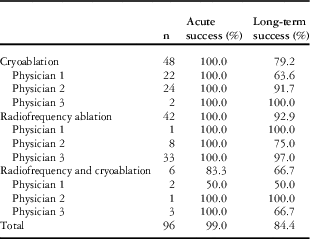
Overall, the acute success rate was 99.0%, and the long-term success rate was 84.4% (Table 2). Radiofrequency ablation was used exclusively in 42 cases, and cryoablation was used exclusively in 48 cases. Both techniques when used alone demonstrated 100% acute success. At long-term follow-up, those with radiofrequency ablation had recurrence in 7.1% of cases, whereas those with cryoablation had recurrence in 20.8% of cases (p=0.01); however, the long-term success for radiofrequency ablation versus cryoablation was not consistent among providers, with atrioventricular nodal re-entrant tachycardia recurrence rates ranging from 0 to 25% for radiofrequency ablation and from 0 to 36% for cyroablation. In six cases, a combination of radiofrequency ablation and cryoablation was used. For these cases, acute success was 83.3% and the long-term success was 66.7%. There were no notable acute or long-term adverse events in any of the procedures.
Acute and long-term success of ablation for atrioventricular nodal re-entrant tachycardia in children by physician.

The total average cost for the 96 procedures was $9751 (95% CI $7456–$13,755) with an average time of 242 (95% CI 151–359) minutes. Costs were similar between radiofrequency ablation and cryoablation groups: $9708 for radiofrequency ablation versus $9636 for cryoablation (Table 3). The average time per procedure was 246 (95% CI 151–315) minutes for radiofrequency ablation versus 210 (95% CI 155–315) minutes for cryoablation (p=0.62). For those cases with a combination of radiofrequency ablation and cryoablation, the average cost was $10,967 (95% CI $8958–$13,830) and the average time was 266±(95% CI 201–349) minutes. The differences in the total costs by procedure are primarily due to the longer procedure time that increased the cost of physician labour.
Comparisons of costs for ablation for atrioventricular nodal re-entrant tachycardia in children.

*Owing to low numbers of the combination group, comparisons were made between cryoablation and radiofrequency ablation categories only
Discussion
In our experience, both radiofrequency ablation and cryoablation were shown to have excellent acute outcomes at similar costs – that is, both were associated with similar value in the short term. In the long term, which option may hold better value is unclear. There was a strong physician preference for one procedure over another in this observational study, and which technique was associated with better outcomes in the long term was more dependent on the provider than on the procedure. These findings may vary in other institutions depending on provider preference and the laboratory equipment used.
These findings have important clinical and financial implications. The three primary factors to consider when offering various interventions for patients include physician comfort with a particular intervention, the expected risks and benefits of the intervention, and cost. Similar to previous studies, we found similar acute outcomes for the radiofrequency ablation and cryoablation for the treatment of atrioventricular nodal re-entrant tachycardia.Reference Hanninen, Yeung-Lai-Wah and Massel 6 , Reference Eckhardt, Leal, Hollis, Tanega and Alberte 18 – Reference Deisenhofer, Zrenner and Yin 20 What this study adds, however, is that the costs are likewise similar between the procedures, even when taking into account all of the various contributors to cost, including supplies, facilities, procedure duration, and labour costs. Although we were unable to compare long-term outcomes in this observational study because of provider variability, other studies have demonstrated similar long-term outcomes between the two techniques.Reference Papagiannis, Papadopoulou, Rammos and Katritsis 21 – Reference Reents, Springer and Ammar 23 With similar outcomes and costs, both options are reasonable choices for the treatment of atrioventricular nodal re-entrant tachycardia, with the ultimate decision dependent on physician comfort and preference. Provider-specific experiences in long-term outcomes may be a deciding factor; however, if it can be shown definitively that cryoablation has a higher recurrence rate at long term, and thus incurs higher costs due to a need for re-intervention, as has been shown in a large randomised control trial,Reference Deisenhofer, Zrenner and Yin 20 then radiofrequency ablation may ultimately be more cost-effective. As cryoablation catheters and techniques evolve, however, long-term recurrence risk for cryoablation may be similar to that of radiofrequency ablation.Reference Silver, Silva and Ceresnak 24
Our study is not without its limitations. First, this study was retrospective in nature. This aspect makes it difficult to compare true outcomes as would be possible in a prospective study. Second, there was clear personal bias on the part of the physicians with regard to which procedure – radiofrequency ablation or cryoablation – to perform. This personal bias, which reflects real-world conditions, prevented us from being able to compare long-term outcomes while controlling for provider, given the low numbers of procedures per physician and the clear interaction between physician and technique – that is, the fact that some physicians performed better on some techniques than others. Third, we did not observe any adverse events in our study. A theoretical advantage of cryoablation over radiofrequency ablation is a decrease in the likelihood of induced atrioventricular block.Reference Schwagten, Knops and Janse 22 , Reference Chan, Choy and Lau 25 , Reference Rodriguez-Entem, Exposito, Gonzalez-Enriquez and Olalla-Antolin 26 If one procedure was to truly have a greater occurrence of adverse events in practice, the value equation would have to be revisited. Finally, our length of follow-up was limited to 6 months. Variations in outcomes beyond 6 months, such as longer-term recurrence or effects of radiation exposure, may alter the value equation.
Our study also has its strengths. First, although the retrospective study design limits the ability to compare outcomes, we believe it is preferable for a prospective trial in comparing costs. Although there may be a bias to control costs by staff who know they are part of a prospective study of value, a retrospective design most closely reflects the real-world scenario. Second, the rigorous cost-accounting method used in this study adds validity to the value proposition proposed. Utilising charges or even cost-to-charge ratios are not as reliable as measuring the costs themselves.Reference Porter 14 , Reference Shwartz, Young and Siegrist 27
For the treatment of atrioventricular nodal re-entrant tachycardia in children, both cryoablation and radiofrequency ablation offer similar value in the short term, with both having excellent outcomes and similar costs. Future studies are warranted to assess variation in such costs at other facilities and to determine the long-term value of each procedure, which may vary by physician.
Acknowledgements
None.
Financial Support
This research received no specific grant from any funding agency, commercial, or not-for-profit sectors.
Conflicts of Interest
None.
Ethical Standards
The authors assert that all procedures contributing to this work comply with the ethical standards of the Federal Policy for the Protection of Human Subjects and with the Helsinki Declaration of 1975, as revised in 2008, and is deemed by the institutional committee at Emory University as being exempt.