INTRODUCTION
Five species of ungulate commonly occur throughout the Amazon basin and are sympatric in most areas (Emmons & Feer Reference EMMONS and FEER1997): the red brocket deer (Mazama americana Erxleben, 1777), the grey brocket deer (M. gouazoubira G. Fischer, 1814, recently also classified as M. nemorivaga F. Cuvier, 1817 (Duarte et al. Reference DUARTE, GONZALEZ and MALDONADO2008)), the collared peccary (Pecari tajacu Linnaeus, 1758), the white-lipped peccary (Tayassu pecari Link, 1795) and the lowland tapir (Tapirus terrestris Linnaeus, 1758). Despite their large distribution range as well as their importance as game species for subsistence hunters (Alvard et al. Reference ALVARD, ROBINSON, REDFORD and KAPLAN1997, Bodmer Reference BODMER1995, Peres Reference PERES2000), only few studies exist on the ecology and resource partitioning of these five species.
According to the competitive exclusion principle, in order for ecologically similar species to coexist there must be a difference in their realized niches (Hardin Reference HARDIN1960). There are usually three different possible axes considered for resource partitioning in animals; food, habitat and time or activity period (Schoener Reference SCHOENER1974). All five Amazonian ungulate species have broad diets including fruit, browse and fibre in different proportions (Beck Reference BECK, Forget, Lambert, Hulme and Vander Wall2005, Bodmer Reference BODMER1991, Gayot et al. Reference GAYOT, HENRY, DUBOST and SABATIER2004, Tobler Reference TOBLER2008), with a possible high competition for fruit. Bodmer (Reference BODMER1991), studying the resource partitioning of Amazonian ungulates in northern Peru, analysed the diet and habitat use of all five species and concluded that each species partitioned at least one resource type from every other species. The red brocket deer differed from the grey brocket deer in its use of habitat and the same was true for the collared and white-lipped peccaries. The two peccary species differed from brocket deer in their diet, and the tapir differed from all other species in its diet. In summary, the data of Bodmer (Reference BODMER1991) showed that the closely related species have a very similar diet and therefore resource partitioning should occur at a spatial level.
Using data from camera traps we tested the hypothesis of spatial separation of species. First we tested if species show a preference for terra firme or floodplain forests. We then tested if species were distributed independently of each other or if there was a spatial separation of certain species within each habitat type. We also looked at activity patterns to investigate possible temporal niche differentiation, and we present data on the use of mineral licks.
Study species
The two species of peccary differ greatly in their social behaviour and use of space. White-lipped peccary form large herds of 30–300 individuals or more, while collared peccary herds usually contain fewer than 15 individuals (Fragoso Reference FRAGOSO1999, Keuroghlian et al. Reference KEUROGHLIAN, EATON and LONGLAND2004, Kiltie & Terborgh Reference KILTIE and TERBORGH1983, Peres Reference PERES1996). White-lipped peccary herds range over areas from 10–100 km2 and have been reported to follow seasonally available resources (Carrillo et al. Reference CARRILLO, SAENZ and FULLER2002, Fragoso Reference FRAGOSO1998, Keuroghlian et al. Reference KEUROGHLIAN, EATON and LONGLAND2004). Collared peccary herds have much smaller home ranges between 0.1 and 10 km2 and usually show little seasonal variation in home-range size (Fragoso Reference FRAGOSO1999, Judas & Henry Reference JUDAS and HENRY1999, Keuroghlian et al. Reference KEUROGHLIAN, EATON and LONGLAND2004). Both species are mostly frugivorous, but have a broad diet including plant material such as leaves, tubers and roots, as well as invertebrates and even some vertebrates (Beck Reference BECK, Forget, Lambert, Hulme and Vander Wall2005). The diets of the two species largely overlap (Beck Reference BECK, Forget, Lambert, Hulme and Vander Wall2005, Bodmer Reference BODMER1991, Fragoso Reference FRAGOSO1999), but the lower bite force of the collared peccary makes some food items (mainly hard seeds) unavailable to that species (Kiltie Reference KILTIE1982). However, most authors suggest that niche differentiation for the two species occurs on a spatial level through habitat use and the spatial scale at which resources are used (Bodmer Reference BODMER1991, Fragoso Reference FRAGOSO1999, Keuroghlian et al. Reference KEUROGHLIAN, EATON and LONGLAND2004). Brocket deer presumably have small home ranges of less than 1 km2 (Maffei & Taber Reference MAFFEI and TABER2003), but no data are available from the Amazon. Both species are frugivores, but their diet can also include large quantities of leaves, flowers, and other plant material as well as fungi when fruit is not available (Bodmer Reference BODMER1991, Branan et al. Reference BRANAN, WERKHOVEN and MARCHINTON1985, Gayot et al. Reference GAYOT, HENRY, DUBOST and SABATIER2004). They are generalists, feeding on a large variety of plant species, with the grey brocket deer eating more fruit than the red brocket deer and being more selective (Gayot et al. Reference GAYOT, HENRY, DUBOST and SABATIER2004). The lowland tapir has a home range size of 1.5–4 km2 with little seasonal variation in size and some overlap between different individuals (Ayala Reference AYALA2003, Tobler Reference TOBLER2008). Its diet contains larger quantities of browse than the diet of the other ungulate species, but it also feeds extensively on fruit when available (Bodmer Reference BODMER1991, Fragoso & Huffman Reference FRAGOSO and HUFFMAN2000, Henry et al. Reference HENRY, FEER and SABATIER2000, Salas & Fuller Reference SALAS and FULLER1996, Tobler Reference TOBLER2008).
MATERIALS AND METHODS
Study area
This study was carried out at two different sites in the department of Madre de Dios in south-eastern Peru. The first site, Los Amigos, was located at the Los Amigos Conservation Concession, a 1400-km2 private protected area along the Madre de Dios and the Los Amigos rivers. Our study area at this site was about half in the concession and half in two adjacent active logging concessions (12°57'–12°36'S, 70°02'–70°09'W, 250–320 m asl). The second site, Tambopata, was within the Bahuaja Sonene National Park along the Tambopata River, 5 km south of the Malinowski guard post (12°30'–13°01'S, 69°25'–69°30'W, 200–250 m asl). Both sites have an extensive trail network (over 150 km) that was used for this study. Mean annual rainfall in the region is between 2500 and 3500 mm with a marked dry season from June to September. Most precipitation falls during the months from December through February. Mean annual temperature is 24 °C with a range from 10–38 °C.
Both sites have an intact large mammal fauna with most species known for the region being present (Tobler et al. Reference TOBLER, CARRILLO-PERCASTEGUI, LEITE PITMAN, MARES and POWELL2008), including healthy populations of both jaguar (Panthera onca) and puma (Puma concolor). There has been very little hunting at Los Amigos and no hunting at Tambopata over the last 5–10 y. The vegetation at both sites is mostly pristine lowland Amazonian moist forest with three distinct vegetation types: terra firme forests, floodplain forest and palm swamps (aguajales) dominated by the palm Mauritia flexuosa. The floodplain forest is partly inundated during the rainy season (November–March), but during most years inundation results largely from pooling of local rainfall rather than river flooding, except for a narrow fringe of less 1 km along the river. There was little inundation during the time of the surveys.
Mineral licks are common at Los Amigos, occurring at 11 sites within the study area and many more sites in other areas of the Los Amigos River watershed. At the Tambopata site we know of at least three licks within the study area with several more in the surrounding area. Licks are located in the floodplain or on exposed edges of the terra firme.
Camera traps
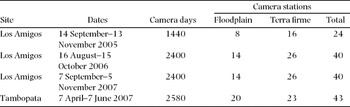
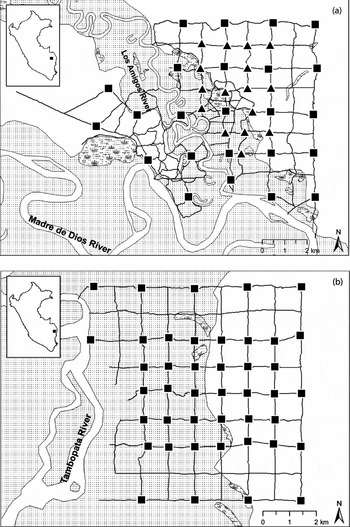
We carried out four camera trap surveys, three at Los Amigos and one at Tambopata (Table 1). Surveys were carried out at the end of the dry season/beginning of the wet season (September to November) and at the end of the rainy season/beginning of the dry season (April to June). We used Deercam (NonTypical Inc.) 35 mm film cameras with a passive infrared motion sensor. The cameras were operating 24 h a day, the delay between pictures was set to 5–10 min, and the sensitivity of the motion sensor was set to high. Cameras were checked every 5–6 d to replace film and batteries if needed. All cameras were set at intersections of existing trails with a camera station consisting of two cameras facing each other, one on each side of the trail. Cameras were set in a regular grid with 2 km between stations and an area in the centre with 1-km camera spacing (except for the Los Amigos 2005 survey where the 1-km grid was missing) (Figure 1). The total area covered at Los Amigos was approximately 50 km2 and at Tambopata 65 km2.
Dates and number of camera stations for four 60-d camera trap surveys carried out at two sites in Madre de Dios, Peru. Camera days are the number of survey days multiplied by the number of camera stations.

Study areas and location of camera stations along the trail system. Los Amigos (a), Tambopata (b). Dotted areas indicate floodplain forests, the white areas are terra firme forests. Triangles in figure (a) indicate camera stations not used in the 2005 survey.

To study the use of mineral licks by different ungulate species, we set camera traps at five mineral licks in the Los Amigos area during 2005 and 2006. For the licks we used Cuddeback (NonTypical Inc.) digital cameras. The delay was set to 5 min and sensitivity was set to high.
Data analysis
Images from all surveys were scanned and entered into Camera Base (http://www.atrium-biodiversity.org/tools/camerabase/) for data management and analysis. For all analyses, we defined the minimum time between two independent events as 1 h. This means that if the same species was photographed more than once by the same camera in the course of 1 h, this was only counted as one event. Capture frequencies (event per 1000 camera days) and activity patterns were directly calculated by Camera Base.
To investigate habitat preferences for the different species we looked at difference in occupancy rates in terra firme and floodplain forests. Since the identification of individuals is very difficult for ungulates, the estimation of abundance using capture-recapture models used in camera-trap surveys of large cats (Karanth & Nichols Reference KARANTH and NICHOLS1998) was not possible. Raw count data on the other hand are often a poor index for relative abundance in surveys where detection probability is < 1 (Gibbs Reference GIBBS, Boitani and Fuller2000). One possible solution is to use occupancy as a surrogate for abundance (MacKenzie & Nichols Reference MACKENZIE and NICHOLS2004). MacKenzie et al. (Reference MACKENZIE, NICHOLS, LACHMAN, DROEGE, ROYLE and LANGTIMM2002) developed a model to estimate site occupancy and detection probability based on repeated presence–absence data from multiple sites. Royle & Nichols (Reference ROYLE and NICHOLS2003) extended this model to allow for abundance-induced heterogeneity. The idea behind the Royle–Nichols (RN) model is that site-specific detection probabilities vary due to differences in the number of individuals present at each site and, using a mixture model, these abundances can be modelled based on repeated presence-absence data. In the RN model, the occupancy Ψ is not directly estimated and has to be derived from λ, the average number of individuals at each site as Ψ = 1−e −λ. In simulations this model significantly improved occupancy estimates for data with high levels of heterogeneity (Dorazio Reference DORAZIO2007). The RN model assumes that populations are closed and that individuals are distributed in spaces according to a Poisson process. If these assumptions are violated, the estimated parameters should not be interpreted as abundance but rather as a random effect (MacKenzie et al. Reference MACKENZIE, NICHOLS, ROYLE, POLLOCK, BAILEY and HINES2006, p. 141). However, occupancy estimates will still be less biased than under models that do not include heterogeneity.
Preliminary data analysis confirmed that our camera trap data had a high level of heterogeneity which led us to use the RN model for all data analysis. The 60-d datasets were divided into ten sampling periods of 6 d each. This was necessary in order to increase the detection probability for each sampling period. Three possible covariates were used: Habitat (terra firme or floodplain), Site (Los Amigos or Tambopata) and Survey (Los Amigos 2005, Los Amigos 2006, Los Amigos 2007, Tambopata 2007), as well as their interactions. Models were ranked based on the Akaike information criterion (AIC) with the lowest value of AIC indicating the most parsimonious model (Burnham & Anderson Reference BURNHAM and ANDERSON1998). All analyses were carried out in Presence (http://www.mbr-pwrc.usgs.gov/software/presence.html).
To investigate if the presence of one species at a site influences the presence of another species we did pair-wise comparisons for all species using two-species occupancy models (MacKenzie et al. Reference MACKENZIE, BAILEY and NICHOLS2004). We used the same covariates that were used in the best single-species model to account for habitat preference and differences in occupancy between sites. Given that we were using camera traps to detect species and that we were pooling data over 6 d we assumed that the detection probabilities for both species were independent and that they were the same whether or not the other species was present. The parameters we were interested in was γ (γ = Ψ AB / Ψ A × Ψ B) which defines the relationship between the occurrence of both species. Values of γ < 1 indicate species avoidance, values γ > 1 indicate species attraction and γ = 1 suggests that species occur independently (MacKenzie et al. Reference MACKENZIE, BAILEY and NICHOLS2004). To test for interaction we compared a full model using the parameter γ to a model where γ was set equal to 1 (MacKenzie et al. Reference MACKENZIE, NICHOLS, ROYLE, POLLOCK, BAILEY and HINES2006).
RESULTS
Habitat use and spatial overlap
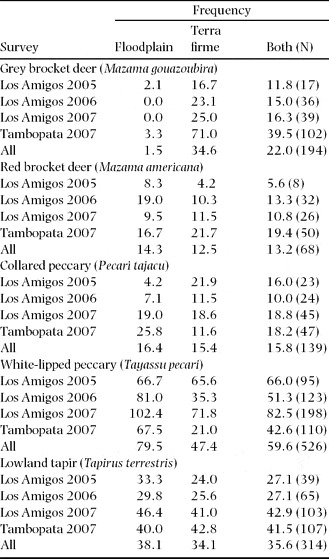
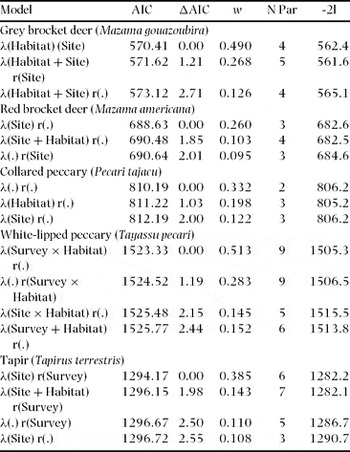
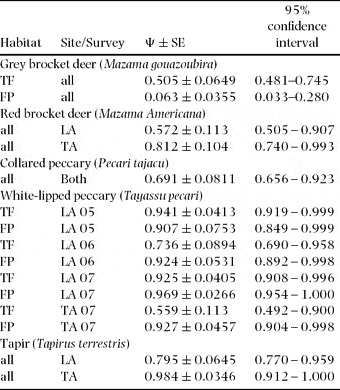
Average capture frequencies for all surveys ranged from 13.2 events per 1000 camera days for the red brocket deer to 59.6 events per 1000 camera days for the white-lipped peccary (Table 2). Frequencies differed greatly between the two habitats for the grey brocket deer, with much higher rates for terra firme forests. Capture frequencies were also higher for the white-lipped peccary in floodplain forest, but did not differ much between habitats for any of the other species. The results from the occupancy analysis showed the same patterns (Table 3, Table 4). All of the highest-ranking models for the grey brocket deer included Habitat as a covariate. Occupancy for terra firme forests was much higher than for floodplain forests (Ψ = 0.505 vs Ψ = 0.063). For the red brocket deer the covariate Site was present in all models and occupancy was 20% higher for Tambopata compared with Los Amigos (Ψ = 0.812 vs Ψ = 0.572). None of the covariates was included in the top-ranking model for the collared peccary, indicating no preference for a habitat and similar occupancy for both sites (Ψ = 0.691). For the white-lipped peccary both Survey and Habitat, as well as an interaction term, were included in the highest-ranking model. This indicates that habitat use varied between different surveys. While for LA 05 and LA 07 there was little difference between the two forest types, white-lipped peccaries were using more of the floodplain forest for the surveys LA 06 and TA 07. For the tapir both site and survey were included in the model, indicating a difference in occupancy between sites and a difference in detection probability between surveys, but no habitat preference. Tapirs were more common in the Tambopata area with an occupancy of Ψ = 0.986 compared with Ψ = 0.795 at Los Amigos.
Capture frequencies expressed as number of photos per 1000 camera days for five ungulate species in the Peruvian Amazon. N: total number of photos taken.

Summary of occupancy model selection for the Royle-Nichols model for data on five Amazonian ungulate species. Only models with a model weight (w) >0.1 are shown. AIC: Akaike Information Criterion, ΔAIC: difference in AIC values between each model and the best model, w: AIC model weight, N Par: number of parameters, -2l: twice the negative log-likelihood.

Occupancy estimates (Ψ) for five Amazonian ungulate species based on camera trap data. Estimates were made using the Royle-Nichols model. TF: terra firme, FP: floodplain, LA: Los Amigos, TA: Tambopata.

For all but one two-species models, models with the parameter γ = 1 were selected, indicating that species are distributed independently and that there is no spatial separation of species within habitat types. The only exception was the model for the grey brocket deer and the tapir where the tendency of co-occurrence was slightly higher than expected under independence (γ = 1.12 ± 0.07, CI = 1.11–1.43).
Activity patterns
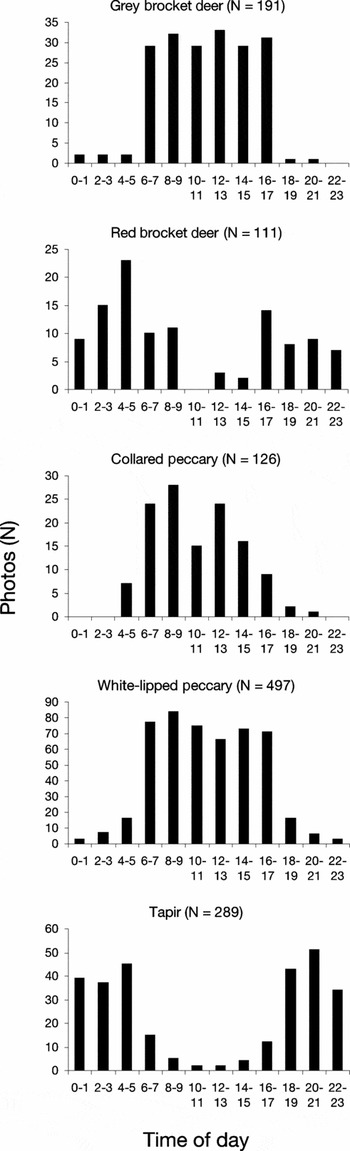
The activity data show that the two peccary species and grey brocket deer are mostly diurnal, red brocket deer are active day and night and tapirs are mostly nocturnal with some occasional activity during the day. The activity graphs (Figure 2) show that grey brocket deer and white-lipped peccaries are continuously active throughout the day from 06h00 until 18h00, while collared peccaries seems to have an activity peak in the early morning and are less active in the late morning and late afternoon. Red brocket deer had two activity peaks, one in the late afternoon after 16h00 and the other in the morning before sunrise; they mostly rest during the day between 10h00 and 16h00. Tapirs are active all night from 18h00 until 06h00 and show some activity in the early morning and late afternoon.
Activity patterns for five species of ungulate: grey brocket deer (Mazama gouazoubira), red brocket deer (Mazama americana), collared peccary (Pecari tajacu), white-lipped peccary (Tayassu pecari) and lowland tapir (Tapirus terrestris), based on camera-trap photos from the Peruvian Amazon. The total number of photos is indicated in parentheses.

Use of mineral licks
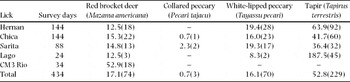
There were clear differences in the use of mineral licks among the five species (Table 5). The tapir was the most frequent visitor at all licks with an average visitation rate of 52.8 visits per 100 d (range: 36.4–187.5 visits per 100 d). The white-lipped peccary and the red brocket deer had a similar frequency of 16.1 visits per 100 d (range: 8.3–19.4 visits per 100 d) and 17.1 visits per 100 d (range: 12.5–52.9 visits per 100 d) respectively. The collared peccary was only observed on three occasions during 434 camera days, and the grey brocket deer was never seen at any of the licks.
Visitation frequencies of Amazonian ungulates at five different mineral licks in the Los Amigos Conservation Concession, Peru. Frequencies are expressed as number of visits per 100 d and the number of independent events are given in parentheses. The grey brocket deer (Mazama gouazoubira) was never observed at any of the licks.

DISCUSSION
Habitat use and spatial overlap
The definition of habitat use is slightly different for the five species. The two habitats considered in this study, terra firme and floodplain forest occur in large, continuous areas (Figure 1). For all species with relatively small home ranges (brocket deer, tapir and most likely collared peccary), this means that most individuals have their home range in either of the two habitat types and do not choose among habitats for their daily activities. Habitat use for these species is equal to difference in abundance in the two habitat types and we do not expect seasonal variation. The situation is different for the white-lipped peccary, which ranges over large areas and can easily move between the two forest types (Fragoso Reference FRAGOSO1998). For the white-lipped peccary habitat use actually describes the proportion of use of the two habitats and can vary throughout the year.
The only species showing a clear habitat preference was the grey brocket deer. Only five out of 189 photos for this species were taken in floodplain forests, indicating that the grey brocket deer almost exclusively inhabits terra firme forests. Bodmer (Reference BODMER1990) found that both brocket deer species prefer terra firme forests in northern Peru, but other data showed that grey brocket deer preferred drier habitats than red brocket deer (Bodmer Reference BODMER1991). Data from other sites in the Amazon indicate that the red brocket deer is more common than the grey brocket deer (Gómez et al. Reference GÓMEZ, WALLACE, AYALA and TEJADA2005, Hurtado-Gonzales & Bodmer Reference HURTADO-GONZALES and BODMER2004), however, it is not clear if this holds for both floodplain and terra firme forest. Occupancy rates for red brocket deer in terra firme forests were higher than for grey brocket deer at both sites but only significantly higher for the Tambopata site.
While several authors have shown that the collared peccary has a preference for terra firme forests (Bodmer Reference BODMER1990, Fragoso Reference FRAGOSO1999, Peres Reference PERES1996), this was not the case at our study sites. Collared peccaries showed no clear preference for either forest type, and in Tambopata were photographed more frequently in floodplain forest. A possible explanation for this difference is that the floodplain forests in our study areas are only partly flooded, flooding is local, and for a relatively short period of a month or less, while in other parts of the Amazon they can flood for much longer periods of time.
White-lipped peccaries showed a preference for floodplain forests in half of the surveys and no preference in the other half. Since white-lipped peccaries can move over large distances, this is most likely caused by temporal differences in habitat use. White-lipped peccaries are often found in floodplain forests at the end of the dry season, feeding on the fruits of various palm species. The high overall occupancy values can be explained by the high mobility of the species. Occupancy in this case should be interpreted as use, and the results show that almost all of the forest is being used by white-lipped peccaries over a 2-mo period.
Tapirs show no preference for either of the two forest types and are common throughout the forest occupying 80–100% of the area. The tapir is often associated with swamps and riparian vegetation (Emmons & Feer Reference EMMONS and FEER1997), but it seems that it is equally abundant in terra firme forests. Telemetry data from Los Amigos showed that individual tapirs can have their home range exclusively in terra firme forests (Tobler Reference TOBLER2008).
Activity patterns
Of the five ungulate species studied, three were diurnal, one cathemeral and one mostly nocturnal. This largely agrees with results found in the Madidi National Park in Bolivia (Gómez et al. Reference GÓMEZ, WALLACE, AYALA and TEJADA2005). The two peccary species show no difference in activity patterns, while the two brocket deer species have only little overlap in activity in the morning and late afternoon. Rivero et al. (Reference RIVERO, RUMIZ and TABER2004) also found a clear difference in the activity patterns of brocket deer in the Bolivian chaco, with red brocket deer being active mostly at night and grey brocket deer being active in the early morning. Data for three sites in the chaco-chiquitanía habitat in Bolivia show that grey brocket deer are largely diurnal (Maffei et al. Reference MAFFEI, CUÉLLAR and NOSS2002). In the Madidi National Park red brocket deer were more active at night and dawn than during the day (Gómez et al. Reference GÓMEZ, WALLACE, AYALA and TEJADA2005). It is unclear if the observed difference in activity patterns between the two species is caused by competition, the higher vulnerability of the smaller grey brocket deer to predators such as jaguar and puma or physiological differences caused by a different evolutionary history. The activity data for the tapir are in accordance with the data obtained with GPS collars from various individuals at Los Amigos (Tobler Reference TOBLER2008), indicating that camera traps collect reliable and unbiased activity data. Activity patterns at licks were almost identical with the data from the trails, with white-lipped peccaries entering exclusively during the day, tapirs mostly at night and red brocket deer during day and night.
Use of mineral licks
Mineral licks are an important resource for at least three of the five Amazonian ungulate species. Geophagy, the ingestion of soil, has been described for a large number of species of herbivore around the world, and in the case of large mammals, it has mostly been explained as mineral supplementation (Holdo et al. Reference HOLDO, DUDLEY and MCDOWELL2002, Jones & Hanson Reference JONES and HANSON1985, Kreulen Reference KREULEN1985, Mills & Milewski Reference MILLS and MILEWSKI2007). Several studies showed that sodium is the main element sought by animals visiting licks (Holdo et al. Reference HOLDO, DUDLEY and MCDOWELL2002, Moe Reference MOE1993, Stark Reference STARK1986, Tankersley & Gasaway Reference TANKERSLEY and GASAWAY1983, Tracy & McNaughton Reference TRACY and MCNAUGHTON1995), but other elements found in elevated concentration in lick soils are calcium, magnesium and potassium (Emmons & Stark Reference EMMONS and STARK1979, Jones & Hanson Reference JONES and HANSON1985, Klaus Reference KLAUS1998, Montenegro Reference MONTENEGRO2004). Montenegro (Reference MONTENEGRO2004) analysed tapir diet in northern Peru and showed that sodium requirements cannot be met through the browse and fruits tapirs eat. She suggests that tapirs in that region therefore depend on sodium from mineral licks. Her data also showed that fruits have a much lower concentration of sodium than browse. Considering that peccaries and deer are largely frugivorous (Bodmer Reference BODMER1991), we would expect a similar or even higher deficiency for all species.
Tapirs were by far the most frequent visitors of mineral licks, followed by white-lipped peccaries and red brocket deer. The data show that there are large differences between licks, indicating that certain species prefer some licks over others. However, caution has to be used when comparing visit frequencies between species. Tapirs and deer usually visit licks solitarily so that each individual counts as one event, whereas peccaries visit licks in groups, each group counting as only one event. Also, white-lipped peccaries move over large areas and can use many different licks. Therefore, visitation rates do not necessarily reflect the frequency with which individuals visit licks.
All known licks in the Los Amigos River watershed occur in the floodplain forest. Therefore, animals with home ranges in the terra firme forest have to travel long distances to visit licks. Recent data from telemetry studies showed that tapirs may walk over 10 km to visit a mineral lick (Tobler Reference TOBLER2008) and white-lipped peccaries usually include floodplain forests with licks in their home range area (G. Powell, unpubl. data). It is not known if red brocket deer and collared peccaries make long-distance travel to licks.
We have no clear explanation why grey brocket deer and collared peccaries in our study area are not using licks, or how they cope with mineral deficiencies. The grey brocket deer has been reported to visit licks in the Bolivian chaco (Maffei et al. Reference MAFFEI, CUÉLLAR and NOSS2002) and in the Pantanal of Brazil (Coelho Reference COELHO2006) but was not found in two other studies in the Peruvian Amazon (Montenegro Reference MONTENEGRO1998, Reference MONTENEGRO2004). One possible explanation is that all the licks we monitored were too far away from the terra firme to be visited by grey brocket deer, which almost exclusively inhabit terra firme forests. However, the same explanation cannot be used for collared peccaries, which are similarly abundant in both forest types.
While mineral licks are important resources for ungulates, they are at the same time well-known places for local hunters and hunting at licks is often the preferred method for hunting tapirs (Montenegro Reference MONTENEGRO2004, M. Tobler pers. obs.). Considering that licks are visited by a large number of individuals from the whole populations surrounding the lick, the potential impact of hunting at licks can be high. It is therefore important to give special attention to mineral licks when developing conservation or management plans for ungulate populations.
Resource partitioning
Our data show that the five species occur together throughout the landscape and they do not support the hypothesis of a difference in habitat preferences or a spatial separation of species, at least not at the scale investigated here. The grey brocket deer was the only species that was almost completely restricted to terra firme forests, and the white-lipped peccary seasonally showed a preference for floodplain forests but was also common in terra firme forests. All other species were equally common in both habitat types and the two-species occupancy models did not show any spatial avoidance of species. If we assumed a high competition between the grey and the red brocket deer due to their similar diets, we would expect the red brocket deer to be more common in floodplain forest where the grey brocket deer is absent. This however is not supported by our data. It is possible that resource partitioning between the two brocket deer species occurs on a temporal scale instead, with the grey brocket deer being mostly active during the day and the red brocket deer during the night. However, resource partitioning solely at the temporal dimension is rare (Schoener Reference SCHOENER1974) and it is likely that the dietary overlap of the two species is small enough to allow coexistence (Gayot et al. Reference GAYOT, HENRY, DUBOST and SABATIER2004).
Collared peccaries and white-lipped peccaries share the same activity patterns and are common in both habitat types. Resource partitioning likely takes place at the scale at which these two species use the landscape as suggested by Fragoso (Reference FRAGOSO1999). Collared peccaries exploit dispersed resources on a small scale and white-lipped peccaries moving between large patches of abundant resources such as palms dispersed throughout the landscape (Fragoso Reference FRAGOSO1999, Kiltie & Terborgh Reference KILTIE and TERBORGH1983).
The tapir is common throughout the study areas and is the species with the highest occupancy. The tapir has a diet that includes much more browse than the diet of the other ungulates (Bodmer Reference BODMER1991). Therefore, resource partitioning with the other species most likely takes place at the diet level.
In conclusion our data suggest that there is a high spatial overlap between species and that diet seems to be a more important factor in resource partitioning between Amazonian ungulates. Even though there is an apparent competition for fruits, the high diversity and spatial distribution of plant species seems to allow for enough variation in their diet to permit the five species to coexist.
ACKNOWLEDGEMENTS
We would like to thank the Gordon and Betty Moore Foundation for the generous funding of this research through grants to BRIT and WWF. The following people are thanked for their help with the camera trapping: Renata Leite Pitman, Rafael Mares, Angel Balarezo, Darío Cruz, Dario Cruz Junior, Alberto Escudero, Rene Escudero, Ernesto Gamarra, Lucas Huaymana, Javier Huinga, Armando Mendoza, Emeterio Nunoca, Juan Racua, Jhin Pierr Solis and Vicente Vilca. We are grateful to the BRIT AABP team, especially John Janovec, Keri McNew, Asha McElfish and Amanda Neill, as well as the WWF Areas management team, Karim Ledesma, Cintya Verastegui and Arnaldo Marquez, for their support. We would also like to thank INRENA for granting us permission to carry out this research in Peru. We also thank the Amazon Conservation Association for logistical support at Los Amigos and the Bahuaja Sonene Park Administration for their help in the Tambopata area. John Janovec, Louise Emmons, Carlos Peres and Tiana Franklin provided valuable comments on the manuscript.