Introduction
In preterm infants, postnatal growth is a potentially modifiable risk factor for neurodevelopmental impairment. Many prematurely born infants experience relative growth restriction in the neonatal intensive care unit (NICU) and at the time of hospital discharge, usually near term equivalent, many are small for gestational age (<10th percentile).Reference Clark, Thomas and Peabody 1 , Reference Ehrenkranz, Younes and Lemons 2 Subsequently, these infants often exhibit accelerated growth in weight, length and head circumference in the first 2–3 years of life, and this is associated with better neurodevelopmental outcomes at school age.Reference Kan, Roberts and Anderson 3 – Reference Casey, Whiteside-Mansell and Barrett 5
Although greater weight gain might be beneficial for preterm infants’ developmental outcomes, it is also associated with higher blood pressure,Reference Rotteveel, van Weissenbruch and Twisk 6 lower insulin sensitivity,Reference Rotteveel, van Weissenbruch and Twisk 6 higher body mass index (BMI)Reference Euser, Finken and Keijzer-Veen 7 and more abdominal fat,Reference Euser, Finken and Keijzer-Veen 7 which are predictive of hypertension and metabolic syndrome later in life.Reference Sun, Grave and Siervogel 8 – Reference Sinaiko, Donahue and Jacobs 10 Thus, the optimal rate of weight gain after premature birth is not known.
We are aware of no studies examining the relationship of rates of weight gain during early childhood to cognitive function as well as blood pressure (BP) and BMI at school age. The objective of this study was to evaluate the association of weight gain in the first 5 years of life with intelligence quotient (IQ), systolic blood pressure (SBP) and BMI at 9 years of age in very low birth weight (VLBW, <1501 g) children.
Methods
Study participants
Participants were born with VLBW between April 1992 and May 1995. As neonates, these individuals participated in a randomized placebo-controlled trial of dexamethasone to reduce the duration of ventilator dependence.Reference Kothadia, O’Shea and Roberts 11 Eligibility criteria for the randomized trial were (1) birthweight <1501 g, (2) age 15 to 25 days, (3) lack of weaning of ventilator settings, (4) absence of clinical signs of sepsis, (5) absence of patent ductus arteriosus by echocardiography and (6) parental informed consent.Reference Kothadia, O’Shea and Roberts 11 Of the 118 children who were randomized, 95 survived to 1 year of age corrected for prematurity (subsequently referred to as 1 year CA), and all 95 survivors were examined at least once, at or beyond 1 year CA. From hospital records, we collected data on birth weight and weight on the day of discharge from neonatal intensive care. Additional anthropometric measurements were collected by research staff on 93 children (98%) at 1 year CA age, 74 (78%) at or around 5 years and 68 (72%) at or around 9 years of age. A convenience sample of 65 surviving participants in the trial of dexamethasone had outcome data collected at the 9-year visit, measurement of weight at 1 year CA and measurement of weight at either discharge or the 5-year visit and were included in this analysis. Post hoc power calculations based on a significance level of 0.05 and two-sided testing indicate that the study sample provided about 80% power to detect a 0.7 standard deviation difference in 9-year outcomes (i.e. 8 mm Hg in SBP, 14 points in Verbal IQ) between children with rates of weight gain above the median and those with rates of weight gain below the median.
This study was approved by the Institutional Review Board and the General Clinic Research Center (GCRC) of the Wake Forest University Baptist Medical Center and Forsyth Medical Center. Parents gave written informed consent and children over the age of 7 years gave assent.
Definitions and measurements
Infancy was defined as the interval from NICU discharge until 1 year CA. Early childhood was defined as the period from 1 year CA to 5 years of age. The following measures of weight gain during infancy and early childhood were of primary interest: (1) change in weight from the beginning to end of the interval of interest, divided by elapsed time between measurements; (2) change in weight z-score during the interval of interest; and (3) change in weight z-score divided by the elapsed time. To evaluate the possible effects of differences among participants with respect to ages at NICU discharge and during observed intervals of infancy and childhood, results of analyses were compared to an approach that statistically estimates weight gain per unit time in each participant at two fixed ages, 6 months and 2.5 years, adjusted for prematurity (refer to Statistical methods).
Data on neonatal characteristics and diagnoses were obtained by a research nurse from medical records. The estimate of gestational age in completed weeks was based on a hierarchy of the quality of information available. Most desirable was last menstrual period, followed sequentially by an obstetrician’s estimate from ultrasound measurements and an assessment of the neonate. Infants whose mothers were treated with betamethasone or dexamethasone (any number of doses) prior to delivery were considered to have had antenatal steroid exposure. Whether the obstetrician diagnosed maternal hypertension during pregnancy was ascertained from a review of the medical record. Chronic lung disease (CLD) was defined as the use of supplemental oxygen at 36 weeks postmenstrual age.Reference Shennan, Dunn and Ohlsson 12 Severe cranial ultrasound abnormality was defined as (1) subependymal or intraventricular hemorrhage with posthemorrhagic hydrocephalus requiring placement of a shunt, (2) persistent but non-progressive ventricular dilation, or (3) intraparenchymal echodensity or echolucency in the periventricular white matter on the basis of the last cranial ultrasound obtained during the neonatal hospitalization.Reference Stewart, Reynolds and Hope 13 Race of the child was obtained from the medical records and categorized for analysis as Caucasian v. African American. Maternal education was assessed via questionnaire when the infant was 1 year CA and was categorized for analysis as less than 12 v. 12 or more completed years of education.
Birth weight and discharge weight were measured as part of clinical care; measurements at 1 year CA and 5 years of age were made by research nurses. Anthropometric measurements at 9 years were made in triplicate by GCRC nutritionists and averaged for analyses. Weight was measured without shoes using a digital platform scale and height was measured using a wall-mounted stadiometer. Children with BMI (kg/m2) 85th to less than 95th percentile were considered overweight and those with BMI ⩾ 95th percentile were considered obese.Reference Barlow 14 BP at 9 years of age was determined using the average of three measurements made with an automated oscillometric device (Alaris medical systems, Model 4410) by General Clinical Research Center nursing staff certified in BP measurement following guidelines established by the National High Blood Pressure Education Program Working Group on Hypertension Control in Children and Adolescents. 15 Child psychologists administered The Wechsler Intelligence Scale for Children, 3rd Edition (WISC-III) to assess Verbal and Performance IQReference Wechsler 16 as previously described.Reference O’Shea, Washburn and Nixon 17 , Reference Washburn, Nixon and O’Shea 18
Gender-specific birth weight and discharge weight z-scores were determined using United States natality data.Reference Oken, Kleinman and Rich-Edwards 19 Weight z-scores at 1 year CA were determined using Epi info 2000 (Centers for Disease Control, Atlanta, GA, USA) by entering the expected date of confinement as the birth date.Reference Kuczmarski, Ogden and Grummer-Strawn 20 Age- and gender-specific weight z-scores at 5 and 9 years and BMI z-scores at 9 years were derived from the 2000 reference data using the birth date. Age- and gender-specific oscillometric BP standards for children were used to determine SBP z-scores.Reference Park, Menard and Schoolfield 21
Statistical methods
Characteristics of study participants and their mothers were summarized using counts, percentages, sample means and standard deviations. Between-group differences were tested for statistical significance using Fisher’s exact test (categorical measures) and two-sample t-test (continuous measures).
Primary modeling analyses of the 9-year outcome measures (dependent variables) – Verbal IQ, Performance IQ, SBP and BMI – were performed using multiple linear regressions. For models of SBP and BMI, a natural logarithmic transformation was applied to each outcome measure first, and results were compared using SBP z-score and BMI z-score, respectively.
To address our main hypotheses, the weight gain measures were evaluated as potential independent predictors in the multivariate modeling, including rate of change in weight, rate of change in weight z-score and interval change in weight z-score. These independent variables, measured during the two time intervals, infancy and early childhood, were evaluated using separate models. Additional independent variables were selected a priori for multivariate adjustment from among known predictors and potential confounders: age (at the 9-year visit), gender, exposure to antenatal steroids (yes/no), birth weight, CLD (yes/no), severe cranial ultrasound abnormality (yes/no) and level of maternal education (included in models for IQ only). Modification of the predictive effect of weight gain by weight at the start of the interval (initial weight) was tested using an interaction model with main effects for weight gain and initial weight, and the interaction, weight gain–initial weight, adjusting for the other covariates. Prior to evaluation of weight gain as a potential predictor, the interaction term was dropped from the model if not statistically significant; if the interaction term was dropped, then the main effect for initial weight was evaluated (under the no-interaction model) and was similarly dropped if not significant.
The multivariate regression modeling just described assumes no correlation between age of the child at the beginning and end of the interval of interest (i.e. infancy or early childhood) and rate of weight gain. Since the age of the children differed at discharge and at the follow-up visits at 1 year adjusted age and 5 years, we compared the results of the multivariate modeling described above with results obtained using estimates of what each child’s rate of weight gain was at 6 months of age (an estimate of the rate of weight gain during infancy) and 2.5 years of age (an estimate of the rate of weight gain during early childhood). First, we estimated weight and change in weight per unit time (slope in the weight-by-age curve) for each participant at pre-specified ages. This estimation procedure was then followed up with the same multivariate modeling as described above, except that the estimates were used as independent variables in place of the observed initial weights and weight changes. The estimated intercepts and slopes were calculated under random intercept and slope mixed models of weight as a function of age and age squared.
We used locally weighted regression curves (i.e. lowess curves) to describe patterns in weight z-scores for three groups of study participants, defined by tertiles of outcomes at 9 years of age. These curves can be used to visually compare the pattern of weight gain for the upper, middle and lower third of the study sample for each of the four outcomes assessed at 9 years. All analyses were performed using either SAS statistical software, version 9.1 (SAS Institute Inc., Cary, NC, USA), or S-PLUS software, version 8.0 (Insightful Corp., Seattle, WA, USA). P-values ⩽0.05 were considered statistically significant.
Results
Study participants
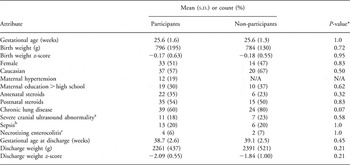
Neonatal and maternal characteristics of study participants are shown in Table 1. Children whose data are included in this study were similar to participants in the original randomized trial except that children not included in this study were more likely to have CLD. Postnatal dexamethasone treatment was unrelated to the outcomes assessed at 9 years in the neonatal trial and in the subset described in this study (results not shown); thus, dexamethasone- and placebo-treated children were combined for the analyses reported here.Reference O’Shea, Washburn and Nixon 17 , Reference Washburn, Nixon and O’Shea 18
Comparison of attributes in children included in this study (participants), and children who were members of the original study cohort but were not included in this study (non-participants)

N/A, data not available.
*P-values are for comparison of participant and non-participant attributes using two-sample t-test or Fisher’s exact test.
aSevere cranial ultrasound abnormality: post-hemorrhagic hydrocephalus, persistent ventricular enlargement or periventricular echolucency.
bPositive blood culture.
cBell’s stage II or higher.
Weight and weight gain through 9 years
As shown in Table 1, the mean birth weight z-score was −0.17, indicating that the birth weights for gestational age among study participants were on average similar to the US population reference sample. In contrast, at the time when study participants were discharged from the NICU, mean weight z-score was −2.09, indicating that the average growth rate during the initial hospitalization was well below intrauterine rates of weight gain.
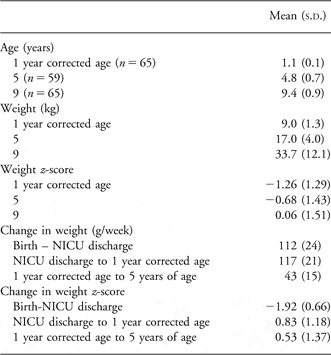
As shown in Table 2, mean change in weight z-scores between 1 year CA and 5 years increased by 0.83 and 0.53, respectively, indicating that in the intervals between follow-up visits, the study participants’ average rate of weight gain (117 g/week from NICU discharge to the visit at 1 year CA and 43 g/week from 1 year CA to the visit at year 5) exceeded that of the reference sample. Thus, by 9 years of age, the average weight z-score for study children was 0.06, similar to the reference sample.
Observed weights and rates of weight gain during infancy and early childhood

NICU, neonatal intensive care unit.
Outcomes at 9 years
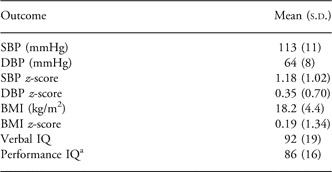
Data for the three outcomes of primary interest are summarized in Table 3. The average SBP was 1 standard deviation higher than age- and gender-specific SBP reference values. Eighteen percent of participants at the 9-year visit were obese (BMI ⩾ 95th percentile), 11% were overweight (BMI 85th to less than 95th percentile) and 9% were underweight (BMI < 5th percentile). The mean Verbal IQ was 0.5 standard deviation below the normative sample and the mean Performance IQ was almost 1 standard deviation below that of the normative sample.
Outcomes at 9-year visit (n = 65)

SBP, systolic blood pressure; DBP, diastolic blood pressure; BMI, body mass index; IQ, intelligence quotient.
a n = 64.
Weight gain in infancy and early childhood and outcomes at 9 years
Verbal and performance IQ
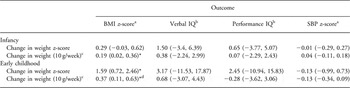
In bivariate analyses, exposure to antenatal steroids was associated with higher Verbal IQ (P = 0.02) and the diagnosis of CLD was associated with lower Verbal IQ (P = 0.004). Severe cranial ultrasound abnormality was associated with lower Performance IQ (P = 0.02). Although not quite statistically significant, Verbal IQ was higher among children with higher birth weight z-score (P = 0.07), higher weight z-score at 1 year CA (P = 0.09) and greater rate of weight gain (expressed as g/week) from NICU discharge to 1 year CA (P = 0.06). In multivariate models that included antenatal steroid exposure, gender, race, birth weight z-score, CLD, severe cranial ultrasound and level of maternal education, no association was found between rates of weight gain and either Verbal or Performance IQ (Table 4).
Regression coefficients (95% CI) for final models relating rates of weight gain during infancy (discharge to 1 year corrected age) and early childhood (1 year corrected age to 5 years of age) to SBP, BMI and IQ at 9 years of age

BMI, body mass index; SBP, systolic blood pressure; IQ, intelligence quotient.
*P < 0.05.
aAdjusted for race, antenatal steroids, birth weight z-score, major intracranial lesions on ultrasound and chronic lung disease.
bAdjusted for race, gender, maternal education, antenatal steroids, birth weight z-score, major intracranial lesions on ultrasound and chronic lung disease.
cEstimates are calculated assuming the model described in Statistical Methods for mixed modeling; confidence intervals are approximate.
dRegression coefficient for interaction term (weight at 1 year corrected age × early childhood weight gain) = −0.07 (−0.14, −0.01).
SBP z-score
None of the rates of weight gain were associated with SBP z-score at 9 years of age (Table 4). SBP z-score was not associated with BMI z-score at age 9 years.
BMI z-score
In bivariate analyses, higher BMI at 9 years was associated with the African American race (P = 0.0007), higher weight at 1 year CA (P = 0.003) and greater rates of weight gain during infancy (P = 0.004) and early childhood (P < 0.0001). In multivariate analyses, adjusting for birth weight z-score, race, antenatal steroid exposure, severe cranial ultrasound abnormality and chronic lung disease, rates of weight gain during infancy (P < 0.03) and early childhood (P < 0.006) were positively associated with BMI z-score at 9 years. As shown in Table 4, the magnitude of the association was about 2-fold greater for weight gain during early childhood compared to weight gain during infancy. The interaction term for weight at 1 year CA × weight gain in early childhood was significant (P = 0.02) with a β-coefficient of −0.07 indicating that the lower the weight at 1 year CA, the steeper the slope of the line relating weight gain during early childhood and BMI z-score at age 9 years. When weight gain was expressed as change in weight z-score, only weight gain during early childhood was associated with BMI z-score at 9 years of age (P < 0.0001).
Patterns of weight gain in infancy and early childhood and outcomes at 9 years
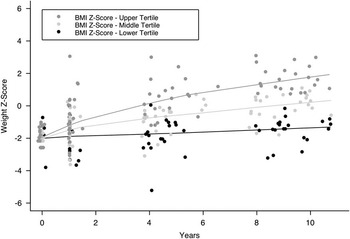
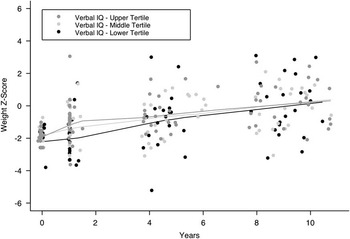
In Figures 1 and 2, we present lowess curves showing patterns of weight gain for children classified according to tertiles of BMI z-score and Verbal IQ at school age. Weight z-score is plotted v. age in years (corrected for prematurity) at NICU discharge and three follow-up visits. The curves in Figure 1 suggest that children in the highest tertile of BMI z-score at 9 years tended to have higher rates of change in weight z-score beginning at NICU discharge and persisting through childhood, while those in Figure 2 suggest that children in the upper tertile for Verbal IQ tended to have more rapid weight gain through 1 year CA, but not after that age. Lowess curves for weight z-score were nearly identical for tertiles of Performance IQ and SBP z-score (not shown).
Weight z-scores through early childhood as a function of body mass index (BMI) z-score at study year 9: Time plot of weight z-score v. age in years (corrected for prematurity) at hospital discharge and three follow-up visits. Locally weighted regression (lowess) curves are displayed for comparison of patterns in weight z-scores between participants grouped by BMI z-score tertile.

Weight z-scores through early childhood as a function of verbal intelligence quotient (IQ) at study year 9: Time plot of weight z-score v. age in years (corrected for prematurity) at hospital discharge and three follow-up visits. Locally weighted regression (lowess) curves are displayed for comparison of patterns in weight z-scores between participants grouped by verbal IQ tertile.

Discussion
The aim of our study was to examine the relationships of weight gain in infancy and early childhood to IQ, BP and BMI in school age VLBW children. Our findings suggest that the rate of weight gain in infancy and especially in early childhood is positively associated with BMI z-score at age 9 years. We did not find a relationship between early weight gain and Verbal or Performance IQ or SBP z-score at 9 years of age.
We found that weight gain in infancy and early childhood was predictive of BMI at school age. Similarly, Euser et al. reported that in premature infants, rates of weight gain between birth and 3 months postterm and between 3 months and 1 year postterm were positively correlated with BMI at 19 years of age.Reference Euser, Finken and Keijzer-Veen 7 We found that the association of weight gain during early childhood and school age BMI was twice as strong as the association with weight gain during infancy. Similarly, among individuals born small for gestational age at term, adult BMI was correlated with the magnitude of gain in BMI during childhood only when the gain persisted after the first year of life.Reference Ezzahir, Alberti and Deghmoun 22 Our study subjects were also small for gestational age at term because they experienced growth failure relative to intrauterine growth rates while in the NICU.
The VLBW children whom we studied, born 1992–1995, have already attained a BMI comparable to the reference population at age 9 years. In contrast, the VLBW cohort studied by Hack et al., born 1977–1979,Reference Hack, Schluchter and Cartar 23 did not attain a mean BMI equal to the mean of the reference sample until young adulthood. Similarly, Doyle et al.Reference Doyle, Faber and Callanan 24 reported longitudinal follow-up on a cohort of prematurely born infants whose weight was lighter than average at 8 years but not different from the population mean by ages 14 and 20 years. Interestingly, one-third of the 20-year-old participants whom Doyle et al. studied had BMI > 25.Reference Doyle, Faber and Callanan 24 It is a matter of concern that 29% of our cohort are overweight or obese (BMI ⩾ 85th percentile for age and gender) at age 9 years in view of the fact that the mean weight at about term age equivalent was two standard deviations below the mean in the reference sample. Findings of the Minneapolis BP Study suggest that childhood weight gain rather than the actual weight at school age is the factor related to young adult risk factors for cardiovascular disease.Reference Sinaiko, Donahue and Jacobs 10
In contrast to our findings of no association between rates of weight gain in infancy and early childhood to SBP z-score at school age, Rotteveel et al. reported that weight gain during infancy or childhood was positively associated with BP in young adults born prematurely.Reference Rotteveel, van Weissenbruch and Twisk 6 Perhaps this is due to the differences in the age of the participants (21 years v. 9 years). Further study of our cohort is warranted because an association of weight gain and BP might become evident when our study participants reach adulthood as the BP elevation associated with low birth weight is thought to amplify with age.Reference Davies, Smith and May 25
Although we did not detect an association between the rate of weight gain after discharge from neonatal intensive care and school age IQ, larger studies of premature infants have described better neurocognitive outcome among those with greater post-NICU weight gain.Reference Kan, Roberts and Anderson 3 – Reference Casey, Whiteside-Mansell and Barrett 5 In studies that include measurements of head circumference, head growth is more strongly related to improved outcome than weight gain.Reference Kan, Roberts and Anderson 3 , Reference Cooke and Foulder-Hughes 4 , Reference Franz, Pohlandt and Bode 26
Our finding that the mean SBP z-score of our cohort was higher than the reference population is consistent with the findings of other studies of premature infants during childhood.Reference Bonamy, Martin and Jorneskog 27 – Reference Keijzer-Veen, Finken and Nauta 32 We did not find the expected correlation between BP z-score and BMI z-score at age 9 years. Although the etiology of elevated BP among children born prematurely is unknown, it seems to be mediated by factors other than elevated BMI.
Our failure to detect an association of rate of weight gain with school age IQ or SBP z-score might have resulted from insufficient power provided by our relatively small sample. The generalizability of our results may be limited because our study included only infants requiring mechanical ventilation for at least 2 weeks. For example, we would expect that a more representative sample of VLBW infants (lower rate of CLD than that of our study cohort) would have exhibited better weight gain.Reference deRegnier, Guilbert and Mills 33 , Reference Ehrenkranz, Walsh and Vohr 34 We also recognize that including measurements of head circumference and length or height would allow for a more complete assessment of postnatal growth and body composition.Reference Olsen, Lawson and Meinzen-Derr 35 While weight gain during intensive care can influence later outcomes,Reference Euser, Finken and Keijzer-Veen 7 , Reference Ehrenkranz, Dusick and Vohr 36 we restricted our analysis to post-NICU discharge changes in weight because all of the infants in our cohort experienced slowed growth during their initial hospitalization.
Infants born prematurely are at risk for cognitive impairment, elevated blood pressure,Reference Bonamy, Martin and Jorneskog 27 – Reference Keijzer-Veen, Finken and Nauta 32 insulin resistanceReference Rotteveel, van Weissenbruch and Twisk 6 , Reference Hovi, Andersson and Eriksson 37 , Reference Hofman, Regan and Jackson 38 and abdominal adiposity.Reference Euser, Finken and Keijzer-Veen 7 , Reference Uthaya, Thomas and Hamilton 39 Evidence is accumulating that growth rates in infancy and early childhood are important for later neurocognitive, metabolic and cardiovascular health. Follow-up studies of prematurely born infants suggest that neurodevelopment is improved when post-discharge growth failure is prevented and growth in head circumference occurs.Reference Kan, Roberts and Anderson 3 – Reference Casey, Whiteside-Mansell and Barrett 5 , Reference Franz, Pohlandt and Bode 26 , Reference Latal-Hajnal, von Siebenthal and Kovari 40 – Reference Kuban, Allred and O’Shea 46 Increased rates of weight gain, however, are associated with elevated blood pressure, insulin resistance and increased abdominal adiposity in young adults.Reference Rotteveel, van Weissenbruch and Twisk 6 , Reference Euser, Finken and Keijzer-Veen 7
Our findings suggest that among VLBW infants, weight gain during infancy is predictive of higher BMI at school age, but rapid weight gain in early childhood is an even stronger predictor of increased school age BMI. The optimum pattern of weight gain for infants born prematurely to promote adequate brain growth and prevent obesity or excessive abdominal adiposity is not known. A more detailed study of growth patterns to identify critical periods of growth, and mechanisms associated with growth, in VLBW infants, might provide strategies for improving neurodevelopmental outcomes and decreasing the risk of obesity and cardiometabolic disease in adulthood.
Acknowledgments
This research was supported by the General Clinical Research Center of Wake Forest University Baptist Medical Center grant MO1-RR07122, NICHD PO1 HD047584, and the Brenner Center for Child and Adolescent Health. We thank Alice Scott, RN, the GCRC staff and the participants and their families for their dedication to the study.
Statement of Interest
None.