The constitutions of most democracies permit judges to exercise judicial review, or to veto statutes as inconsistent with constitutional texts. Some democratic constitutions, such as that of the United States, enable what we might characterize as “entrenched” judicial review, because only supermajorities may overcome judicial vetoes by amending constitutional texts. Other constitutions enable “nonentrenched” judicial review, because ordinary majorities may overcome judicial vetoes by amending constitutional texts. Relative to the alternatives, entrenched judicial review is a less majoritarian institution, one that allows unelected judges to overturn policies enacted by legislative and/or popular majorities, and that then protects judicial rulings from those majorities. It may increase the likelihood of less majoritarian policy outcomes, like decreased redistribution and increased inequality.Footnote 1 Yet accurately estimating the impact of entrenched judicial review requires an understanding of its institutional origins. Why do some democratic constitutions provide for entrenched judicial review, while others do not?
Some scholars have addressed this question at least indirectly in the context of tracing the origins of federal judicial review in the United States, the first known instance of entrenched judicial review. These studies have generally emphasized either some influential aspect of British legal heritage or the postindependence intergovernmental conflicts engendered by federalism.Footnote 2
Yet anomalies remain. Early state constitutions and the U.S. federal Constitution diverged in their approaches to judicial review, despite their authors' sharing the same British legal inheritance. State constitutions generally enabled nonentrenched judicial review, with ordinary majorities able to amend state constitutions at will. The federal Constitution of 1789 instead enabled entrenched judicial review, requiring several supermajorities for constitutional amendment. Moreover, supermajority constitutional amendment requirements at the national level appeared as early as the first drafts of the Articles of Confederation in 1776, well before conflicts between the state and national governments had arisen.
We also know little about the origins of entrenched judicial review outside the context of the United States. Ginsburg and Versteeg's recent econometric analysis of the adoption of “constitutional review” does not distinguish between entrenched and nonentrenched judicial review. Case studies of the adoption of judicial review likewise mix cases of entrenched and nonentrenched judicial review.Footnote 3
Drawing on recent work on the economic origins of political institutions, this article proposes an explanation for the adoption of entrenched judicial review in democracies based on the extent of ex ante economic inequality.Footnote 4 Where economic inequality is higher, economic elites have more to lose from the advent of majority rule. These elites thus have greater incentives to resist or check institutions responsive to popular majorities and/or to endorse institutions unresponsive to those majorities. We may then be more likely to see the adoption of less democratically responsive institutions, like entrenched judicial review, where more unequal distributions of economic resources are threatened by the advent of majority rule. These less majoritarian institutions may then contribute to the persistence of resource inequalities, even in democracies governed by the principle of majority rule.
The plausibility of the economic account of the origins of entrenched judicial review is here explored using the historical record from five former British colonies, namely the United States, India, Jamaica, Australia, and Canada. The historical evidence appears to be broadly consistent with the economic account's predictions. In the case of the United States, the economic account also appears to explain the early divergence in the approaches to judicial review embodied in the state and national constitutions.
The economic account is also here tested more generally for the set of former European colonies that had become democracies by 2008. Pre-independence European mortality data is used as a proxy for pre-independence economic inequality, a measurement choice supported by the close associations among former European colonies between a) pre-independence European mortality and pre-independence proportion European, b) pre-independence proportion European and pre-independence Gini coefficients of income inequality, and c) pre-independence European mortality and pre-independence Gini coefficients. Controlling for a variety of alternative explanations for the origins of entrenched judicial review, including British colonial heritage and the presence of federalism, higher pre-independence European mortality rates are strongly associated with an increased probability of the presence of entrenched judicial review in the first year of continuous post-independence democracy. These findings indicate that the adoption of entrenched judicial review may have been motivated at least in part because of its anticipated protection for the higher levels of economic inequality found in adopting democracies.
THE ORIGINS OF ENTRENCHED JUDICIAL REVIEW IN THE UNITED STATES
British Legal Heritage
Several historians have suggested that the inclusion of judicial review in the U.S. Constitution was significantly influenced by its drafters' British legal heritage. Some have pointed to particular aspects of British legal doctrine, such as the hierarchical precedence given to statutory law relative to the common law, that are analogous to American federal judicial review.Footnote 5 Others have suggested that the British practice of issuing written charters for its colonies enabled colonial judges to disallow laws passed by colonial assemblies, creating the precedent for later federal judicial review.Footnote 6 Yet others have proposed that the supervision exercised by the British Privy Council over the laws enacted by colonial assemblies was the prototype for the later practice of federal judicial review in the United States.Footnote 7 A variant of the legal heritage argument suggests that the American revolutionaries rejected contemporaneous British legal institutions like legislative supremacy, while reaching further back in time to an older British tradition of limits on legislative power.Footnote 8
All variants of this claim suggest that these inherited British traditions were present in the American colonies at the time of the revolution. They enabled the early practice of judicial review in several states prior to the Constitutional Convention of 1787.Footnote 9 They then led to the adoption of federal judicial review in the 1789 Constitution.
FEDERALISM
A competing explanation for the adoption of judicial review in the U.S. Constitution is based on the early American experience with federalism. This explanation suggests that judicial review was in fact a distinctive break with British legal heritage, one induced by the distinctive federalist structure of the new American republic (a structure not found in the parent country). Noting that state-level judicial review did not arise until the 1780s, those proposing this explanation locate the impetus for these rulings in the conflict between unchecked state legislatures and the Confederation Congress between 1781 and 1787. James Madison and others, insufficiently convinced that state courts could effectively check unruly state legislatures, are said to have proposed federal judicial review at the 1787 Constitutional Convention as a further check on state lawmaking.Footnote 10
Evaluating the Historical Explanations
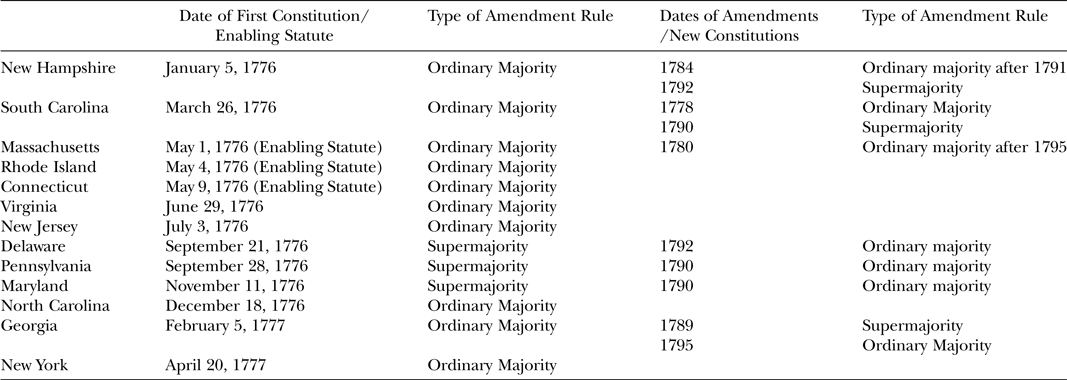
The central problem with explanations from British legal heritage is that, whatever one's understanding of what that heritage entailed, its influence logically should have been equally exercised on both the early state and the early national constitutions. Yet these constitutions sharply diverged in their approaches to one of the institutional foundations of judicial review, namely constitutional amendment requirements. As reported in Table 1, the first state constitutions generally required only ordinary legislative or popular majorities for constitutional amendment, with only three of these constitutions (those of Maryland, Pennsylvania, and Delaware) requiring any supermajorities for constitutional amendment. Under these majoritarian constitutions, electoral majorities could alter constitutions at will:
The New Jersey legislature never questioned its ability to alter the fundamental law, in 1777 changing by simple act the very wording of the Constitution . . . the Georgia legislature at least three times throughout the eighties assumed the authority to explain portions of the fundamental law. The South Carolina legislature seemed especially flagrant in its repeated “irregularities” and suspensions of the Constitution . . . an emergency act of the North Carolina legislature in 1780 . . . compelled the governor, who was without a veto, to resign rather than submit to an abrogation of his power over the military granted to him by the Constitution . . . Connecticut had actually “no constitution but the laws of the state” which like any statute could be altered at pleasure by the legislature.Footnote 11
Early State Constitutions

Source: Francis Newton Thorpe, The Federal and State Constitutions, Colonial Charters, and Other Organic Laws of the States, Territories, and Colonies Now or Heretofore Forming the United States of America (Washington, DC: GPO, 1909). “Enabling Statute” refers to statutes permitting states to continue to operate under colonial charters. States permitting multiple routes to constitutional amendment are coded as “Ordinary Majority” if at least one of those routes permitted amendment or the convening of constitutional conventions by ordinary legislative or popular majorities.
These majoritarian constitutions were not merely a temporary phase. On net, the states moved in an even more majoritarian direction between 1776 and 1795. As reported in Table 1, by 1795, Maryland, Pennsylvania, and Delaware had eliminated their supermajority amendment requirements, while only New Hampshire and South Carolina had added permanent supermajority amendment rules to their constitutions.Footnote 12
Because the early state constitutions generally eschewed supermajority amendment rules, constitutional rulings by state judges could easily be overcome by ordinary majorities. Thomas Jefferson observed in the case of Virginia's 1776 constitution, for example, that, “the ordinary legislature may alter the constitution itself.” As a result, the legislature's actions were de facto constitutional: “If therefore the legislature assumes executive and judiciary powers, no opposition is likely to be made; nor, if made, can it be effectual; because in that case they may put their proceedings into the form of an act of assembly, which will render them obligatory on the other branches.”Footnote 13 In a case arising in New York City in 1784, wherein the defendant had challenged the state legislature's authority to enact the statute under which her conviction had been secured, Mayor James Duane (acting as judge in the case) characterized the legislature's position under the state's 1777 constitution in similar terms: “The supremacy of the Legislature need not be called into question; if they think fit positively to enact a law, there is no power which can controul them.”Footnote 14
The case wherein Duane issued this opinion, Rutgers v. Waddington, is one of the handful of cases often cited in support of the argument that the kind of judicial review permitted under the 1789 Constitution was already being practiced in the state courts. But all of these cases, like that of Rutgers v. Waddington, arose in states without supermajority constitutional amendment requirements (see note 9). Judicial rulings in these states could easily be overcome by ordinary majorities. However, this was decidedly not the case for later rulings issued by federal judges under the 1789 U.S. Constitution. Article V's requirement of multiple supermajorities for constitutional amendment made federal judicial rulings of unconstitutionality much more difficult to overturn.Footnote 15 Explanations based on British legal heritage cannot explain the appearance of these divergent forms of judicial review within the same former colony.
Yet, the post-1781 intergovernmental conflicts said to have been produced by federalism are also unlikely to be the primary explanation for this divergence. The nature of this divergence lay in constitutional amendment requirements. But divergent constitutional amendment requirements had already appeared in July of 1776, when supermajority amendment rules appeared in the draft Articles of Confederation.Footnote 16 This was well before the development of any conflicts between the states and the national government, indicating some important difference between state and national levels of decision making over institutions as early as 1776.Footnote 17
The Economic Origins of Entrenched Judicial Review: A Theory
Entrenched judicial review is a less majoritarian form of judicial review, relative to non-entrenched judicial review (or no judicial review). Recent economic models of institutional choice may offer insight into its adoption.Footnote 18 These models have directed attention to the redistributive consequences of alternative institutional arrangements. In particular, because institutions that are more democratic are ceteris paribus more likely to result in higher levels of redistribution, they are less likely to be adopted under the condition of greater economic inequality. Conversely, institutions that are less democratic are more likely to be adopted under the condition of greater economic inequality.
The intuition behind this prediction is straightforward. Most economies tend to have income and wealth distributions that are skewed to the right, although they vary in how unequally economic resources are distributed. The median individual in a right-skewed distribution of economic resources has resources that are less than the average, and would therefore benefit from increased taxation and redistribution, at least up to the highest tax rate that does not produce net economic losses. The more right-skewed the distribution of economic resources, or the larger mean resources are relative to median resources, the more the median individual will benefit from higher levels of taxation and redistribution, again up to the highest tax rate that does not produce net economic losses. We would then expect that the median individual would prefer levels of taxation that increase the distance between his or her own economic resources and mean resources, or the degree of economic inequality, up to some highest feasible tax rate. Under the condition of universal suffrage, where the median individual is also the median voter, greater economic inequality should then lead ceteris paribus to higher levels of taxation and redistribution. This comparative static has been replicated under a variety of models; recent econometric evidence has supported the prediction.Footnote 19
Economic elites thus have more to fear from democracy under conditions of greater economic inequality. As Acemoglu and Robinson observe, “Elites (rich) prefer nondemocracy, and they do so more intensely when inequality is higher and they expect more redistribution away from them in democracy. The higher the inequality, the more attractive nondemocracy is relative to democracy for the elites.”Footnote 20 We would expect to find, then, that greater inequalities in economic resources will be associated with less democratic forms of governance, and that more democratic institutions will be granted by governing economic elites in these societies only under significant pressure from those excluded from governance. Again, evidence appears to support these predictions.Footnote 21
Economic elites who are able to resist democratic policy-making institutions have little need for additional nonmajoritarian institutions like entrenched judicial review. When economic elites can make policy directly, they derive little benefit (and possibly some harm) from permitting judges to veto their policy choices. But when economic elites are unable to prevent the advent of majoritarian policy making, they may seek at least some checks on majoritarian decision making. Resisting pressures for complete democratization may be costly, most obviously in the form of future political capital, but elites in more unequal societies will have greater incentives to pay these costs.Footnote 22 Their efforts may make it more likely that nonmajoritarian institutions like entrenched judicial review will be included in those democratic constitutions drafted in more economically unequal societies.
The resistance of economic elites to fully democratic constitutions may take several forms. Incumbent elites may simply refuse to cede control of governance to majorities unless nonmajoritarian institutions like entrenched judicial review are included in new democratic constitutions. Alternatively they may structure decision-making processes for the drafting of new democratic constitutions so as to ensure a disproportionate representation of elite preferences, thereby indirectly increasing the likelihood of the inclusion of nonmajoritarian institutions like entrenched judicial review in these constitutions. Nonincumbent elites may also threaten to withdraw their considerable resources from the country unless their institutional demands are satisfied.
In more economically equal societies, we would expect constitutional decision making to follow a different path. In these societies, economic elites have less to fear from the advent of majority rule. They would be less likely to spend scarce political capital by insisting on the inclusion of nonmajoritarian institutions in democratic constitutions. They would also be less able to cause significant economic harm by withdrawing their wealth from a society. Their relative lack of effective resistance to democratization should make it less likely that nonmajoritarian institutions like entrenched judicial review would be included in democratic constitutions drafted in more economically equal societies.
This economic account of the origins of entrenched judicial review in democratic constitutions is related to, yet distinct from, existing work on the origins of judicial review. Ran Hirschl suggests that the adoption of judicial review may be motivated by economic elites' fear of the consequences of majority rule, but does not predict that judicial review would be more likely to be adopted as economic inequality increases, and does not distinguish between entrenched and nonentrenched judicial review.Footnote 23 Tom Ginsburg and Mila Versteeg suggest that the adoption of judicial review may be motivated by incumbents' desire for “political insurance” and predict that as the likelihood of incumbent electoral loss increases, incumbents are more likely to adopt judicial review in new constitutions.Footnote 24 This account may overlap with the economic account insofar as preconstitutional incumbents are also economic elites. Yet Ginsburg and Versteeg also do not distinguish between entrenched and nonentrenched judicial review.
More generally, the economic account distinctively emphasizes the importance of a constitution's amendment procedures for understanding the kind of judicial review enabled by that constitution (and thus the possible motivations for its adoption). This emphasis is not without precedent. Chief Justice John Marshall noted the importance of supermajority constitutional amendment requirements as a precondition for the exercise of federal judicial review in Marbury v. Madison (1803):
The constitution is either a superior, paramount law, unchangeable by ordinary means, or it is on a level with ordinary legislative acts, and like other acts, is alterable when the legislature shall please to alter it. If the former part of the alternative be true, then a legislative act contrary to the constitution is not law: if the latter part be true, then written constitutions are absurd attempts, on the part of the people, to limit a power in its own nature illimitable.Footnote 25
Some more modern discussions of judicial review also emphasize the significance of constitutional amendment requirements. John Harrison, for example, says of the exercise of federal judicial review in the United States, “Article V is the conceptual keystone of the arch.”Footnote 26 Arend Lijphart has observed more generally that, “judicial review can work effectively only if it is backed up by constitutional rigidity . . . If there is strong judicial review but the constitution is flexible, the majority in the legislature can easily respond to a declaration of unconstitutionality by amending the constitution.”Footnote 27 However, as previously noted, the economic account's emphasis on constitutional amendment requirements is not widely adopted by those who study judicial review.
Second, the economic account draws a relatively bright line between judicial review exercised under constitutions amendable by ordinary majorities, whether legislative or popular, single or multiple, from that exercised under constitutions ultimately amendable only by supermajorities, whether legislative or popular, single or multiple. Again, an emphasis on this particular dichotomy is not without precedent. Marshall, just before making the above quoted distinction between amendment by ordinary majorities and amendment by supermajorities, stated flatly, “Between these alternatives there is no middle ground.”Footnote 28 More recently, Lijphart noted that, “the conventional distinction is between flexible constitutions that can be changed by regular majorities and rigid constitutions that require supermajorities in order to be amended.”Footnote 29
However, the economic account's emphasis on majoritarian versus supermajoritarian amendment rules is somewhat orthogonal to existing work on the variation in constitutional amendment rules. This work tends to focus on the “rigidity” (“flexibility”) of a constitution, or its “difficulty” (“ease”) of amendment. As noted in the Lijphart quote above, there is some overlap between the concepts of “difficulty” of amendment and the presence of supermajority amendment rules. However, these concepts are also distinct. Those who code constitutions for “rigidity” or “difficulty” of amendment do not clearly distinguish between majority and supermajority rules.Footnote 30 The approach here instead distinguishes those constitutional amendment procedures requiring any kind or level of supermajority at any stage in the amendment process from those requiring only ordinary majorities throughout the amendment process.
The Economic Origins of Entrenched Judicial Review: Historical Evidence
The economic theory of the origins of entrenched judicial review predicts that, under conditions of greater economic inequality, economic elites under pressure to democratize will have stronger incentives and greater ability to secure the inclusion of less majoritarian institutions like entrenched judicial review in new democratic constitutions. Qualitative accounts of constitutional choices in several former British colonies suggest that this is not an implausible prediction.
In pre-independence British North America, for example, both economic and political resources were relatively equally distributed in the Northern and Middle Atlantic colonies. The average Gini coefficient of income inequality for the four New England colonies (New Hampshire, Massachusetts, Rhode Island, and Connecticut) was .35 in 1774, and for the four Middle Atlantic colonies (New York, New Jersey, Pennsylvania, and Delaware) was .38; these are the lowest documented Gini coefficients for any place in the world at that time. While colonial suffrage immediately prior to independence was generally limited by wealth and/or property requirements in all colonies, a relatively small share of the estimated labor force in the non-Southern colonies was enslaved and thereby categorically excluded from voting in elections for colonial assemblies. Unfree labor in 1774 made up only 1 percent of the estimated labor force in the New England colonies, and only 11 percent in the Middle Atlantic colonies.Footnote 31
In the Southern colonies, however, both income and participation in governance were, unsurprisingly, much more unequally distributed. The average Gini coefficient for the five Southern colonies (Maryland, Virginia, North Carolina, South Carolina, and Georgia) in 1774 was .46, and fully 55 percent of the Southern labor force consisted of slaves who were categorically excluded from participating in colonial elections.Footnote 32
Upon independence, the non-Southern states used their existing relatively inclusive assemblies to draft relatively democratic state constitutions. Consistent with the economic account, these constitutions generally did not include entrenched judicial review.
The newly independent Southern states likewise used their existing nonmajoritarian assemblies to draft state constitutions that continued to exclude slaves, the majority of the labor force, from participation in governance. Again, consistent with the economic account, these nondemocratic constitutions also generally did not include entrenched judicial review. The exclusion of at least the bottom half of the income distribution from governance significantly reduced income inequality among the free white Southern population to a level lower than that found even in egalitarian New England (among free white Southerners, the average Gini coefficient in 1774 was only .33).Footnote 33 This drastic political exclusion reduced the threat of redistributive majorities in state legislatures, thus reducing the need for less majoritarian institutions such as entrenched judicial review.
But union with the non-Southern states posed a different redistributive threat to free Southerners' wealth. Free Southerners' incomes, boosted by the profits from coerced slave labor, were significantly higher than those of non-Southerners. The top 1 percent of free Southern households had incomes that were 3.7 times larger than the top 1 percent of New England households, and more than twice as large as the top 1 percent of Middle Atlantic households. As a result, national income inequality in 1774 was considerably higher than regional income inequality, with a national Gini coefficient of .44. Driven by the South's even greater wealth advantage, the gap between national and regional wealth inequality in 1774 was even greater than the gap for income inequality.Footnote 34
The relatively inclusive political institutions adopted by the non-Southern states implied that their delegates to national assemblies would be likely to faithfully represent their less wealthy constituents' preferences for redistribution at the national level. Moreover, non-Southern delegates would have had majorities in national assemblies if votes were counted either by state or by population. Southern economic elites would thus have had powerful incentives to insist upon nonmajoritarian institutions at the national level in order to check the threat of redistribution by non-Southerners. Their wealth would likely have given them leverage greater than their numbers.
The documentary record of the first postindependence national assemblies is consistent with this account. In the First Continental Congress, meeting in 1774, delegates from the eight colonies north and east of the Chesapeake supported majority voting by colony, a voting rule that would have given them a clear majority.Footnote 35 No Southern delegates spoke in favor of this voting rule; several Southern delegates spoke in opposition to it.Footnote 36 Thomas Lynch of South Carolina and Patrick Henry of Virginia argued in favor of weighting colonies' votes by their wealth.Footnote 37 No Northern delegates spoke in favor of weighting voting by property; John Jay of New York instead characterized the Southerners' proposal as “a matter of danger,” arguing that the delegates ought “to be bound by a majority.”Footnote 38 The Southern delegates eventually agreed to concede the question temporarily for logistical reasons, there being no practicable way at the time to accurately value the colonies' wealth.Footnote 39 However, South Carolina later defied majority rule by threatening to defect from a nonexportation agreement unless indigo and rice were excepted from its scope; the threat resulted in the exclusion of rice from the agreement.Footnote 40
Sectional disagreements over institutional choices continued into the Second Continental Congress; John Adams referred to the conflict of “a Southern party against a Northern” in that body.Footnote 41 These tensions were particularly evident in the debates over the Articles of Confederation. The committee charged with producing a first draft of the Articles, consisting of one member appointed from each colony, used as a template a document written by Pennsylvanian Benjamin Franklin in 1775, providing for a unicameral national legislature apportioned by population, with both legislation and constitutional amendments decided by ordinary majorities.Footnote 42 But Franklin's plan elicited strong opposition from the Southern members of this committee. South Carolina member Edward Rutledge denounced the draft based on Franklin's plan as facilitating the redistributive goals of the non-Southern colonies:
If the Plan now proposed should be adopted nothing less than Ruin to some Colonies will be the Consequence of it. The Idea of destroying all Provincial Distinctions and making every thing of the most minute kind bend to what they call the good of the whole, is in other Terms to say that these Colonies must be subject to the Government of the Eastern Provinces . . . I dread their over-ruling Influence in Council, I dread their low Cunning, and those levelling Principles which Men without Character and without Fortune in general Possess, which are so captivating to the lower Class of Mankind, and which will occasion such a fluctuation of Property as to introduce the greatest disorder. I am resolved to vest the Congress with no more Power than what is absolutely necessary, and to use a familiar Expression to keep the Staff in our own Hands, for I am confident if surrendered into the Hands of others a most pernicious use will be made of it.Footnote 43
We lack records of the internal debates of this committee. We do know that Rutledge would later threaten the South's defection were its delegates' demands unmet in the 1787 Constitutional Convention.Footnote 44 We know that other Southern delegates would also threaten defection from the Second Continental Congress were Southerners' preferences disregarded.Footnote 45
We also know that, by the time the draft Articles of Confederation came out of this committee in July 1776, a crucial element of Franklin's plan had been altered: supermajority rules had been substituted for majority rule, both for enacting legislation and for constitutional amendment.Footnote 46 The Articles now required a majority of nine states to pass any significant legislation and unanimity for constitutional amendment. These provisions, the first appearance of supermajority rules in the postindependent United States, would remain unchanged through the remaining drafting and ratification processes.
Sectional disagreements over institutional choices also surfaced during the 1787 Constitutional Convention. Virginian James Madison, for example, urged that the new constitution “protect the minority of the opulent against the majority.”Footnote 47 One of Madison's proposed devices to check majority rule was embodied in the provision of the Virginia Plan permitting unelected federal judges to veto proposed federal statutes through a body called the Council of Revision, composed of the “National Executive” and an unspecified number of federal judges, the latter to have a majority on the council.Footnote 48 Every proposed federal statute would have to be approved by the council or be repassed by an unspecified supermajority.Footnote 49 Madison defended the inclusion (and numerical dominance) of unelected federal judges on the council by arguing on June 4 that national majorities needed to be restrained and that the presence of unelected judges would increase the likelihood that the council would veto congressional acts.Footnote 50 On June 6, Madison went so far as to say that an elected executive would be too inclined to defer to popular preferences and “would stand in need therefore of being controuled as well as supported” by unelected judges.Footnote 51
Madison's plan for the Council of Revision ran into trouble with non-Southern delegates, who objected to unelected judges having such a formidable veto power over the national legislature.Footnote 52 The judge-dominated council was defeated three times in favor of an executive veto, after which Madison proposed that the Supreme Court have its own independent veto over proposed bills, in addition to the executive's veto. This proposal was also defeated.Footnote 53
But the defeat of the Council of Revision did not imply that federal judges would be unable to veto enacted statutes. No provision in the Virginia Plan prohibited federal judges from ruling on the constitutionality of enacted federal or state statutes. Several delegates instead noted that under the Virginia Plan, the federal judiciary would possess the power of “exposition of the laws, which involved a power of deciding on their Constitutionality.”Footnote 54 This understanding of the Virginia Plan was never disputed, although the merits of this judicial veto power were questioned; John Dickinson of Delaware, for example, in considering “the power of the Judges to set aside the law,” argued that “no such power ought to exist.”Footnote 55
The critical question then became the nature of the constitutional amendment process. The original Virginia Plan had not specified the size of the required majorities for constitutional amendment. In the first discussion of this provision Charles Pinckney of South Carolina opposed any possibility of amendment, while Elbridge Gerry of Massachusetts supported the option of “periodical revision;” no rule was agreed upon.Footnote 56 In the closely related context of ratification of the proposed constitution, James Wilson of Pennsylvania argued on June 5 against allowing a minority of states to block ratification, while Charles Pinckney instead argued for a supermajority requirement of at least nine states.Footnote 57 When this debate was taken up again on August 30, Wilson again moved that only seven states be sufficient to ratify the proposed constitution, “that being a majority of the whole number & sufficient for the commencement of the plan;” fellow Pennsylvania delegate Gouverneur Morris likewise opposed a supermajority requirement.Footnote 58 Edmund Randolph, James Madison, and George Mason of Virginia, and Pierce Butler of South Carolina endorsed instead a supermajority rule of at least nine; Daniel Carroll and Luther Martin of Maryland preferred a rule of unanimity.Footnote 59
As indicated by the identities of those speaking for and against supermajority requirements, debates over the size of the majorities required to ratify and amend the Constitution had a clear sectional cast. Hugh Williamson of North Carolina observed in another context that Southerners required supermajority rules in order to protect themselves from the Northern majority: “Mr. Williamson was in favor of making two thirds instead of a majority requisite, as more satisfactory to the Southern people,” given their fear that “a majority of Northern States should push their regulations too far. He knew the Southern people were apprehensive on this subject and would be pleased with the precaution.”Footnote 60
After the Committee of Detail had reported an amendment process by which two-thirds of state legislatures could call for a constitutional convention, the latter to decide questions by majority rule, both Northern and Southern delegates objected. Northern delegates defended majority rule in a constitutional convention, but sought to relax the supermajority rule to call a convention. Gouverneur Morris of Pennsylvania argued that a congressional majority instead should be able to call a constitutional convention “whenever they please.”Footnote 61 Alexander Hamilton of New York spoke in support of the provision allowing the convention to speak with “the major voice,” but argued for “an easier mode for introducing amendments.”Footnote 62 Roger Sherman of Connecticut and Elbridge Gerry of Massachusetts proposed to add as an additional avenue of constitutional amendment that “the Legislature may propose amendments to the several States for their approbation, but no amendments shall be binding until consented to by the several States.”Footnote 63 Madison countered with dual supermajority requirements of either two-thirds of both congressional chambers or two-thirds of state legislatures to propose amendments, to be ratified by three-fourths of state legislatures or state conventions. This proposal was unanimously supported by the Southern states; the Northern states were divided, but the proposal passed.Footnote 64
Madison's move eliminated majority rule from both of the avenues of constitutional amendment then on the floor. Gouverneur Morris and Elbridge Gerry later moved to substitute for proposal of amendments by two-thirds of the state legislatures that the same supermajority be able to call a constitutional convention; this was agreed to by a unanimous vote. Roger Sherman of Connecticut then moved to remove the three-fourths requirement for ratification for all proposed amendments, which motion was supported by a majority of Northern states but was unanimously opposed by the Southern states.Footnote 65 Sherman and David Brearley of New Jersey moved to strike Article V's cumbersome multiple supermajority requirements altogether, which was again unanimously opposed by the South, with the Northern states divided.Footnote 66
Progressive-era historian J. Allen Smith would later write that Article V was the critical provision distinguishing the “reactionary” 1789 Constitution from the early state constitutions: “[The Federal Constitution] repudiated entirely the doctrine then expressly recognized in some of the states and virtually in all, that a majority of the qualified voters could amend the fundamental law.”Footnote 67 Not least among the consequences of Article V's supermajority requirements was the power it gave to unelected federal judges, whose rulings on the constitutionality of statutes could not be overturned by ordinary majorities.
As in the Continental Congresses, Southern delegates were in the minority at the Constitutional Convention, yet they were able to win on several issues, including that of entrenched judicial review. A contributing factor to wealthy Southerners' disproportionate influence may have been their threats to leave the confederation (with their considerable wealth) were their institutional demands unmet. On July 12, for example, William Davie of North Carolina declared that his state “would never confederate on any terms” were slaves not counted as at least three-fifths of free persons for the purpose of representation; should non-Southerners reject that demand, “the business was at an end.”Footnote 68 On August 21, Edward Rutledge of South Carolina noted that it was still an open question “whether the Southn. States shall or shall not be parties to the Union.”Footnote 69 Rufus King of New York acknowledged the power of the Southern threat of disunion: “As the Southern States are the richest, they would not league themselves with the Northn. unless some respect were paid to their superior wealth. If the latter expect those preferential distinctions in Commerce & other advantages which they will derive from the connection they must not expect to receive them without allowing some advantages in return.”Footnote 70
As noted earlier, existing histories of the origins of federal judicial review in the United States struggle to explain the divergent approaches to judicial review in the state and national constitutions, a divergence that appeared as early as 1776. Yet both this divergence and its timing are consistent with the predictions of the economic theory of the origins of entrenched judicial review. In the non-Southern colonies, pre-independence incomes were relatively equally distributed; after independence these former colonies drafted relatively democratic state constitutions that generally did not include entrenched judicial review. In the Southern colonies, pre-independence incomes were much more unequally distributed; after independence these former colonies drafted relatively nondemocratic state constitutions that also generally did not include entrenched judicial review. At the national level, pre-independence incomes were also relatively unequally distributed, with the richest Americans in the South. As a condition of their agreement to relatively democratic federal constitutions, wealthy Southern elites insisted that these documents include nonmajoritarian supermajority rules and, in 1787, entrenched judicial review.Footnote 71
Given the centrality of African slavery to the economies of the Southern colonies, it might seem plausible that Southern support for entrenched judicial review was motivated by a particular desire to protect slavery from Northern majorities, rather than the more general desire to protect Southern wealth and incomes predicted by the economic account. However, the historical records of other British colonies that drafted democratic post-independence constitutions appear to provide support for the economic account of the origins of entrenched judicial review. Those British colonies with relatively equal pre-independence distributions of economic resources had relatively inclusive procedures for drafting their first post-independence constitutions, which generally did not include entrenched judicial review. Those with more narrowly concentrated economic resources pre-independence, whether African slave colonies or not, had more exclusive procedures for drafting their first post-independence constitutions. These latter generally included entrenched judicial review. Neither shared British colonial heritage nor the presence of federalism appeared to have had any effect on post-independence decisions over entrenched judicial review.
In the British penal colonies of Australia, for example, while we lack detailed pre-independence data on income and wealth distributions, qualitative accounts indicate that economic resources were distributed relatively equitably.Footnote 72 By the time that elections were held in 1897 to select delegates to a convention to draft a federated constitution, five of the six colonies had adult male suffrage; only Tasmania retained a small property qualification for male suffrage.Footnote 73 In the constitutional convention of 1897–98, wherein measures passed by ordinary majorities, delegates generally shared a preference for inclusive, majoritarian institutions. During discussions over the constitution's amendment rule, for example, many delegates expressed concern that “the Constitution ought not to be overly rigid, as was claimed to be the case in the United States.”Footnote 74 Rejecting supermajority amendment rules as too conducive to “an activist judiciary,” delegates opted instead for amendment via a series of legislative and popular ordinary majorities, making their constitution's amendment process, which “merely required majorities,” “‘very much more easy than the American’.”Footnote 75 The proposed federal constitution was eventually ratified by ordinary majority referenda in the colonies.Footnote 76
A similar sequence of events occurred in Britain's colonies in Canada, which did not have the full authority to amend their federal constitution until passage of the Constitution/Canada Act in 1982. At the time of the passage of this act, Canada's Gini coefficient of .29 was among the lowest of Europe's former colonies, and elections for provincial and national legislatures were conducted under full adult suffrage.Footnote 77 During the discussions preceding passage of the act, some in the Trudeau government advocated for a judicially enforced bill of rights supported by supermajority amendment rules, but this proposal was opposed by majorities in eight out of the ten provincial legislatures. Majority support for the Constitution Act was reached by the inclusion in the act of the “notwithstanding clause” at the behest of the dissenting provinces; the clause allows a legislative majority, provincial or federal, to protect a statute from judicial review for a renewable five-year period.Footnote 78
The experiences of other British colonies were more similar to that of the Southern United States. British India, for example, although not an African slave colony, was marked by narrowly concentrated economic and political resources. At the time of independence in 1947, India's Gini coefficient was estimated to be .50.Footnote 79 British colonial authorities, making up only a tiny minority of India's population, still retained legislative authority over British India in 1946, when they finally agreed to allow the drafting of a federal constitution for an independent India. Representatives of the Congress Party, the most broadly based Indian party, requested a constitutional convention “elected by the people on the basis of adult franchise.”Footnote 80 This request was rejected by British authorities, who instead directed that delegates to a Constituent Assembly would be selected in part by the Provincial Assemblies elected under the terms of the 1935 Government of India Act, which had enfranchised approximately 15 percent of the adult population, and in part by the autocratic rulers of the nondemocratic princely states. The provincial assemblies would moreover not be free to select provincial representatives via majority rule. Instead, delegates from each province would be apportioned to each of three religious groups, proportional to that group's population in the province, and then selected by the members from each denomination serving in each assembly.Footnote 81 Voting in the Constituent Assembly would not proceed in all cases by majority rule; some decisions would need to be agreed to by majorities of each religious community, thereby enabling the Muslim minority to veto proposals supported by the Hindu majority.Footnote 82 The British also required that the draft constitution include “adequate provision for the protection of the minorities.”Footnote 83 Adherence to the British terms was a condition of British approval of Indian independence.Footnote 84
This institutional framework drew criticism from the leaders of the Congress Party. Gandhi observed in 1946, “The proposed Constituent Assembly is not a free Assembly.”Footnote 85 Pandit Nehru stated on July 8, 1946, “If I am asked to give my own point of view, I would say it [the Assembly] is not obviously something which we have desired and worked for . . . the scales are weighted against us.”Footnote 86 The Congress Party particularly objected to the appointed representatives from the princely states, noting, “While the representation of an Indian State in the constitution-making body is fixed on a population basis, the people of the States have no voice in choosing those representatives, nor are they to be consulted at any stage while decisions really affecting them are being taken.”Footnote 87 The constitution drafted under these procedures included lengthy statements of individual rights, including property rights, to be enforced by courts acting under the shadow of supermajority constitutional amendment rules.Footnote 88
Britain's West Indian colonies, former African slave colonies generally characterized by high pre-independence economic inequality, likewise all drafted post-independence constitutions endorsing democracy but including entrenched judicial review. Jamaica, the largest of these colonies, illustrates the typical causal path. Jamaica's pre-independence Gini coefficient was estimated to be .56 in 1958.Footnote 89 At the time of the drafting of the Jamaican independence constitution in 1961–62, one of the chambers of the national legislature was elected by adult suffrage, but members of the second chamber were appointed by the British governor general. The initial drafting of the constitution was done by a committee representing both legislative chambers. One of the appointed members of this committee, the wealthy chairman of the board of directors of Jamaica's only morning newspaper, prominently advocated for a bill of rights, including property rights, to be enforced by courts acting under the shadow of supermajority amendment rules.Footnote 90 These provisions were included in the nonfederated constitution reported by the drafting committee.
In the parliamentary debates over the draft constitution, several members of the drafting committee complained that they had agreed to supermajority amendment rules (entrenchment) only under pressure from those controlling large economic assets. Vernon Arnett, minister of finance and elected member of the drafting committee, reported, for example, “First of all we did not entrench it [the constitution], pressure was applied and we entrenched it. That is an index of the power of the articulate in this country. Let us be frank.” He also observed, “men of property look to the Constitution and entrench; the ordinary masses, the ordinary folk, look to the Parliament.”Footnote 91 Another member of the elected House of Representatives characterized the supermajority amendment rules as “aimed at protecting certain vested interests.”Footnote 92
In the United States, India, and Jamaica, where pre-independence economic inequalities were relatively high, post-independence democratic constitutions were drafted using procedures that gave disproportionate weight to economic elites. In the United States, Southern delegates to national constitutional conventions were chosen using highly exclusionary state laws that excluded the majority of the Southern workforce from the selection process. In India, delegates to the Constituent Assembly were selected under procedures that varied from moderately (in British India) to wholly (in the princely states) nondemocratic. In Jamaica, approximately one-third of the members of the constitution drafting committee were not elected. In the United States and Jamaica, the historical record indicates that delegates selected through these nondemocratic procedures insisted upon entrenched judicial review as a condition of their participation in the post-independence polity. In India, incumbent British elites insisted upon the inclusion of nonmajoritarian institutions in the post-independence constitution as a condition of Indian independence.
In Australia and Canada, by contrast, two former British colonies characterized by low pre-independence economic inequality, post-independence constitutions were drafted under relatively inclusive procedures. In Australia, almost all delegates to the constitutional convention held during 1897 and 1898 were elected directly or indirectly using adult male suffrage; a small number of delegates were directly elected using suffrage rules that included a relatively low property threshold. In Canada, all participants in the process leading to the Constitution Act of 1982 were directly elected using full adult suffrage. In neither country did economic elites successfully demand the inclusion of entrenched judicial review in post-independence constitutions; this is consistent with a sufficiently low level of economic inequality to render economic elites either insufficiently incentivized or insufficiently powerful to effectively make such demands.
The historical evidence from these five former colonies is moreover inconsistent with the two leading explanations for the appearance of entrenched judicial review in the United States. All five were former British colonies, presumably inheriting a largely similar set of legal institutions and practices, yet only three of the five adopted entrenched judicial review. Four of these former British colonies adopted post-independence constitutions enshrining federalism as an important constitutional principle, yet only two of these four adopted entrenched judicial review (the United States and India), while two did not (Australia and Canada). Jamaica's non-federalist constitution also endorsed entrenched judicial review.
However, evidence from only five countries is insufficient to make an inference of causality; qualitative evidence is moreover perhaps susceptible to selection bias on the part of the researcher. The next section examines whether a relationship between economic inequality and the adoption of entrenched judicial review in democracies can be found more broadly, controlling for alternative explanations like colonial legal heritage and federalism. Answering this question is complicated by the fact that institutions, once established, tend to endure.Footnote 93 Restricting the sample to the set of former European colonies at least partially alleviates this problem. These countries of necessity underwent a process of constitutional decision making upon independence. The question then becomes, among the set of former European colonies that became democracies post-independence, were those with greater pre-independence economic inequality more likely to adopt entrenched judicial review, controlling for possible alternative explanations?
DATA AND ANALYSIS
The economic theory of institutional origins suggests that those former colonies with higher pre-independence economic inequality would have been more likely to adopt nonmajoritarian constitutions post-independence, including otherwise majoritarian constitutions that yet provide for entrenched judicial review. Pre-independence inequality data are not directly available for most former European colonies. However, pre-independence European mortality rates may be a good proxy for pre-independence economic inequalities. Before independence, Europeans generally controlled economic resources in their overseas colonies. Where pre-independence European mortality rates were higher, Europeans constituted a smaller proportion of a colony's pre-independence population, and pre-independence control of economic resources tended to be more narrowly concentrated. Where pre-independence European mortality rates were lower, Europeans constituted a larger proportion of a colony's pre-independence population, and pre-independence control of economic resources tended to be more broadly distributed.Footnote 94 We would thus expect pre-independence European mortality to be positively correlated with pre-independence economic inequality.
Pre-independence data on European mortality, proportion European, and income inequality are available for a subset of former European colonies, enabling a series of validity checks of this causal chain.Footnote 95 Pre-independence European mortality rates are also available for the “Southern” and “Northern” North American colonies; in the validity checks reported here these logged mortality rates are paired with the pre-independence labor force and income inequality data for the Southern and New England colonies, respectively.Footnote 96 For those former colonies attaining independence after 1900, pre-independence proportion European is represented by the proportion European in 1900.Footnote 97 For those former colonies attaining independence after 1950, some Gini coefficients of income inequality calculated either pre-independence or within ten years of independence are available in the All the Ginis database.Footnote 98 A few additional pre-independence Gini coefficients are available for those former colonies achieving independence prior to 1950.Footnote 99
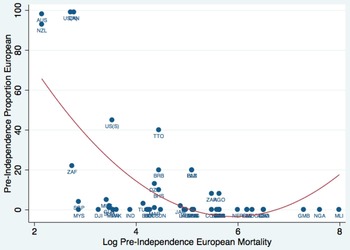
Figure 1 reports the association between logged pre-independence European mortality rates and pre-independence proportion European for fifty-eight former European colonies. The relationship is nonlinear; pre-independence mortality has a steep negative association with pre-independence European settlement up to a threshold above which mortality rates appear to have almost completely deterred European emigration. Using the predicted values from the quadratic regression graphed in Figure 1, moving from Australia's low pre-independence European mortality rate to Jamaica's higher rate generates an estimated 64 percentage point drop in the predicted pre-independence proportion European. Even moving from the more European-friendly disease climate of the British colonies in New England to that of the colonies south of the Chesapeake produces an estimated 23 percentage point drop in the pre-independence proportion European. These differences are both significant with at least 90 percent confidence.
Pre-Independence European Mortality and Pre-Independence Proportion In European Former European Colonies.

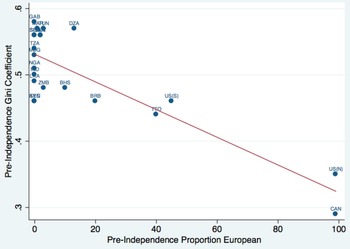
Figure 2 reports the relationship between pre-independence proportion European and pre-independence Gini coefficients of income inequality. Increases in the pre-independence proportion European are associated with a steep drop in pre-independence Gini coefficients. In the linear regression graphed in Figure 2, an increase in the pre-independence proportion European from the levels observed in India or Jamaica to the levels seen in Canada or the New England colonies produces an estimated 20 to 21 percentage point drop in pre-independence Gini coefficients. Even an increase in the pre-independence proportion European from its level in the southern American colonies to that of the New England colonies produces an estimated 11 percentage point drop in pre-independence Gini coefficients. These differences are all significant with at least 95 percent confidence, and indicate that we should expect pre-independence European mortality also to be related to pre-independence Gini coefficients.
Pre-Independence Proportion European and Pre-Independence Gini Coefficients In Former European Colonies.

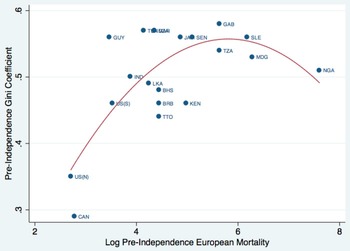
Finally, Figure 3 reports the association between pre-independence European mortality and pre-independence Gini coefficients. Pre-independence European mortality has a steep positive association with pre-independence income inequality up to the very high mortality rates observed in Africa, at which point the slope of the association levels off. In the quadratic regression graphed in Figure 3, an increase in the pre-independence European mortality rate from its level in the New England colonies to that for Jamaica produces an estimated 18 percentage point increase in pre-independence Gini coefficients. Even an increase in the pre-independence European mortality rate from its level in the New England colonies to that for the Southern colonies produces an estimated 9 percentage point increase in pre-independence Gini coefficients. These differences are significant with at least 90 percent confidence.
Pre-Independence European Mortality and Pre-Independence Gini Coefficients In Former European Colonies.

These validity checks indicate that pre-independence European mortality rates are a good proxy for pre-independence economic inequality in former European colonies. While measures of pre-independence inequality are available for only a handful of former European colonies, pre-independence European mortality rates are available for a relatively large sample of democratic former colonies. Unlike pre-independence proportion European, pre-independence mortality rates also have the attractive feature of exogeneity to both pre-independence economic distributions and post-independence constitutional choices. Finally, the strength of the association between pre-independence European mortality and pre-independence income inequality is strong, with an F statistic of 10.13 for the quadratic regression graphed in Figure 3. This is a sufficiently strong association to make pre-independence European mortality a good instrument for pre-independence income inequality in a 2SLS regression, and supports its use here as a proxy for pre-independence income inequality.
The next question is whether pre-independence European mortality is associated with a higher probability of the presence of entrenched judicial review in the first year of continuous post-independence democracy in former European colonies. Post-independence democracies are identified using the binary indicator constructed by Jose Cheibub, Jennifer Gandhi, and Jim Vreeland.Footnote 100 Former European colonies were included in the sample if they were coded as democracies in 2008, the last year for which the Cheibub, Gandhi, and Vreeland indicator is available. The presence of entrenched judicial review was recorded in the year in which a country first became consistently democratic prior to 2008.
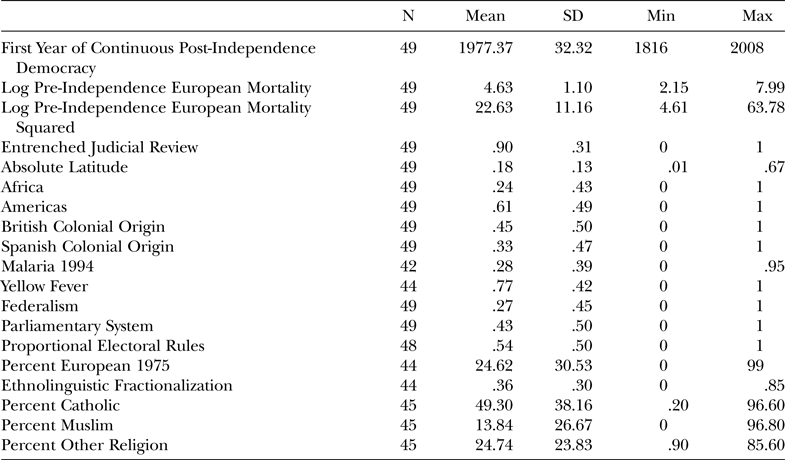
The presence of entrenched judicial review in the first year of continuous democracy prior to 2008 was identified via a two-step process. The first step was to ask whether a national constitution required supermajorities for constitutional amendment. The second step was to ask whether any of the constitutions with supermajority amendment rules nonetheless contained provisions disabling effective judicial review. For example, Section 33 of Canada's Constitution Act of 1982 permits simple legislative majorities to immunize statutes from judicial review via the use of “notwithstanding” clauses.Footnote 101 Constitutions that required supermajority amendment rules, and that did not explicitly disable the power of judicial review, were characterized as enabling entrenched judicial review.Footnote 102 Table 2 reports summary statistics.Footnote 103
Summary Statistics

Dependent Variable: Presence of Entrenched Judicial Review in First Year of Post-Independence Democracy, Former European Colonies

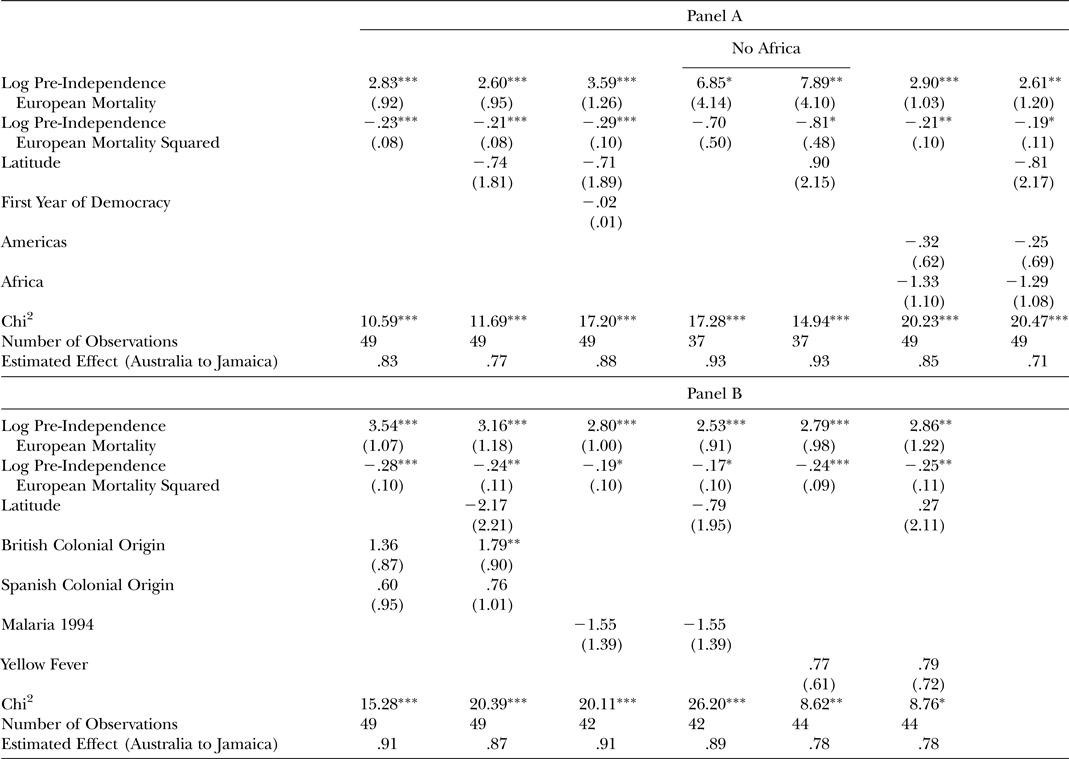
Note: The presence of entrenched judicial review in first year of post-independence democracy estimated with probit link function. Robust standard errors in parentheses. Estimated effects of pre-independence European mortality simulated using Clarify.
Dependent Variable: Presence of Entrenched Judicial Review in First Year of Post-Independence Democracy, Former European Colonies

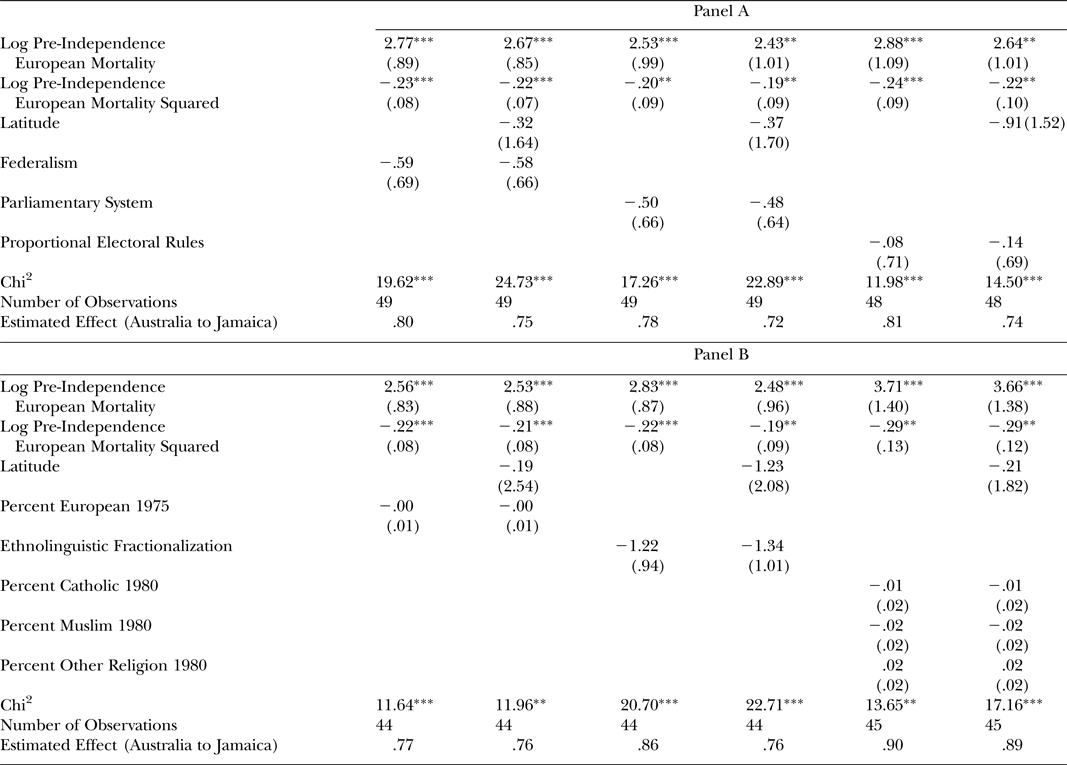
Note: The presence of entrenched judicial review in first year of democracy estimated with probit link functions. Robust standard errors in parentheses. Estimated effects of variable of interest simulated using Clarify.
Tables 3 and 4 report estimates of the association between pre-independence European mortality and the presence of entrenched judicial review in the first year of continuous democracy for the set of former European colonies that had become democracies by 2008. These estimates indicate that increases in pre-independence European mortality rates are in fact associated with significant increases in the probability of adoption of entrenched judicial review in post-independence democratic constitutions. The coefficients on pre-independence European mortality are large, positive, and significant at conventional thresholds in all models. The coefficients on mortality's squared term are small, negative, and significant in all models, indicating a diminishing effect of pre-independence mortality on the probability of observing entrenched judicial review as mortality increases. With only one exception, there are no associations between any of the control variables and the presence of entrenched judicial review.
Substantively, the effects of pre-independence European mortality are large. Tables 3 and 4 report for each model the estimated effect on the probability of observing entrenched judicial review in a former colony's first continuous year of post-independence democracy as a function of an increase in the logged pre-independence European mortality rate from its level in Australia to the level observed for Jamaica, while holding any control variables at sample means. Australia is at the lower end of pre-independence European mortality for the sample used in Tables 3 and 4, while Jamaica is near the mean; a move from Australia to Jamaica represents an increase in pre-independence European mortality of approximately two standard deviations. All estimated effects of this move reported in Tables 3 and 4 are significant with at least 95 percent confidence.
Panel A of Table 3 reports estimates controlling for latitude, the number of years of continuous democracy as of 2008, and regional effects. The absolute value of latitude is scaled to take values between 0 and 1. Regions are defined as the Americas (including North, Central, and South America), Africa, and Asia.Footnote 104
Without controls, increasing the pre-independence European mortality rate from its level in Australia to that observed in Jamaica is associated with an 83 percentage point increase in the adoption of entrenched judicial review in the first year of continuous post-independence democracy. After controlling for latitude and the year in which a former colony first attained continuous democracy prior to 2008, neither of which have independent associations with the presence of entrenched judicial review, this estimated difference increases to 88 percentage points.
Because the mortality data from Africa are somewhat more suspect than that from other continents, two columns of Panel A report estimates with Africa excluded. Outside of Africa, moving from Australia's pre-independence European mortality rate to that of Jamaica is associated with a 93 percentage point increase in the probability of observing entrenched judicial review in the first continuous year of post-independence democracy; again latitude has no independent association with the latter. Panel A also reports estimates from the full sample with dummy variables for Africa and the Americas, on the theory that the initial adoption of entrenched judicial review in the United States may have had a greater impact on the more proximate New World colonies than on colonies in other regions. Neither continent dummy is significant, however. Mortality continues to have a large positive association with the presence of entrenched judicial review: Moving from Australia's pre-independence European mortality rate to that of Jamaica is associated with a 71 to 85 percentage point increase in the probability of observing post-independence entrenched judicial review.
Panel B of Table 3 reports an additional series of estimates after conditioning on colonial origin and the current disease climate. Colonial origin is measured by including indicators for British and Spanish colonial origin; all other countries of colonial origin constitute the omitted category.Footnote 105 Malarial risk is measured by the fraction of the population living in an area where P. falciparum malaria was endemic in 1994, while the incidence of yellow fever is measured by a dummy equal to 1 if a country contains the known habitat of the mosquito responsible for carrying the yellow fever parasite, or if it had yellow fever epidemics prior to 1900.Footnote 106 Controlling for colonial origin, pre-independence European mortality continues to have a large effect; moving from Australia's pre-independence European mortality rate to that of Jamaica is associated with an 87 to 91 percentage point increase in the probability of observing post-independence entrenched judicial review. While Spanish colonial origin has no discernible relationship with the presence of entrenched judicial review, British colonial origin appears to have a weakly positive association with judicial review, an association that becomes significant in the model controlling for latitude. However, the substantive impact of this association is small. A former non-British colony with pre-independence European mortality at the level of Jamaica has a predicted probability of adopting post-independence entrenched judicial review of .91. For former British colonies at this level of pre-independence mortality, the predicted probability of adopting post-independence entrenched judicial review is .99; the difference between the two predicted probabilities is not significant at conventional thresholds.
Neither measure of current disease climate is associated with the presence of entrenched judicial review in the first year of democracy. Controlling for current malaria incidence, moving from Australia's pre-independence European mortality rate to that of Jamaica is associated with an 89 to 91 percentage point increase in the probability of observing entrenched judicial review in the first year of continuous post-independence democracy. Controlling for yellow fever incidence, the same move is associated with a 78 percentage point increase in the probability of observing entrenched judicial review.
Panel A of Table 4 reports estimates conditioning on the presence of other political institutions in the first year of continuous post-independence democracy. Federalism is a binary indicator reported by the World Bank's Database on Political Institutions, where 1 indicates the presence of subnational governments that are autonomous or self-governing, and 0 their absence. Parliamentary System is also a binary indicator, where 0 indicates a presidential system and 1 indicates a premierial system.Footnote 107 Proportional Electoral Rules is also a binary indicator reported by the Inter-Parliamentary Union, where 0 indicates a majoritarian or mixed electoral system and 1 indicates proportional representation. If entrenched judicial review is generally adopted along with one of these other institutions, and if the adoption of these other institutions is associated with pre-independence European mortality, then it is possible that the observed relationship between the latter and the presence of entrenched judicial review is simply a spurious association. Yet there is no support for this hypothesis. None of these institutions has any association with entrenched judicial review, with or without a control for latitude, yet pre-independence European mortality continues to be strongly associated with the presence of entrenched judicial review. Across the estimates in Panel A of Table 4, moving from Australia's pre-independence European mortality rate to that of Jamaica is associated with a 72 to 81 percentage point increase in the probability of observing entrenched judicial review in the first year of post-independence continuous democracy.
Panel B of Table 4 reports estimates including controls for various kinds of demographic heterogeneity that may have had direct or indirect causal connections with the adoption of entrenched judicial review in the first year of democracy. These measures include the proportion of Europeans in 1975, an average of five different indices of ethnolinguistic fragmentation, and the proportions of the population identifying as of 1980 (or as of 1990–95 for countries formed more recently) as Catholic, Muslim, and all other religions, with the exception of Protestantism.Footnote 108 These demographic indicators have little association with the adoption of entrenched judicial review, while pre-independence European mortality continues to have a very strong association. After controlling for the proportion of Europeans in 1975, the move from Australia's mortality rate to that of Jamaica is associated with a 76 to 77 percentage point increase in the probability of observing entrenched judicial review in the first year of continuous post-independence democracy. After controlling for ethnolinguistic fractionalization, the same move is associated with a 76 to 86 percentage point increase in the probability of observing entrenched judicial review in the first year of continuous post-independence democracy. After controlling for religion, this move is associated with an 89 to 90 percentage point increase in the probability of observing entrenched judicial review in the first year of continuous post-independence democracy.
The analyses reported in Tables 3 and 4 can be replicated using alternative measures of European mortality.Footnote 109 These replications, available from the author, report virtually identical estimates for the associations between pre-independence European mortality and post-independence entrenched judicial review.
DISCUSSION
The findings reported here suggest that pre-independence economic inequalities may have played a large role in post-independence decisions over entrenched judicial review among those former European colonies that adopted democratic policymaking institutions. Where disease climates were more hostile to European colonists and fewer Europeans settled, greater economic inequalities resulted. We already know that former colonies with higher European mortality and greater economic inequalities were less likely to adopt democratic policymaking institutions after independence.Footnote 110 The findings reported here indicate that, in addition, among those former colonies adopting post-independence democratic policymaking institutions, the concerns of economic elites in countries with greater economic inequality appear to have induced a greater demand for constitutional checks on the power of electoral majorities to redistribute income, checks like entrenched judicial review.
These findings suggest that, contrary to the existing historiography, the adoption of entrenched judicial review in the United States had little to do with either the former colony's British legal heritage or the presence of federalism. Instead, the dominance of slave labor in the South, induced at least in part by the South's more hostile disease climate, appears to have been an important influence on the adoption of entrenched judicial review. Slavery in the South created significant income and wealth inequalities, both in the Southern population and in the free population of the nation as a whole. Wealthy white Southerners were the primary proponents of the inclusion of nonmajoritarian institutions in post-independence national constitutions, including the nonmajoritarian institution of entrenched judicial review. Their success in securing the inclusion of these nonmajoritarian institutions suggests that their wealth gave them an influence greater than their numbers.
As illustrated by the Indian case, African slavery was only one of the means by which significant inequalities in resources could result from minimal European settlement. The findings reported here indicate that it was these inequalities in wealth and income, rather than the presence of African slavery per se, that drove choices over entrenched judicial review. Across Britain's former colonies, for example, all those colonies with pre-independence European mortality rates at the level of the Southern United States and higher adopted entrenched judicial review in their first post-independence democratic constitutions. But among Britain's former colonies with pre-independence European mortality rates below those found in the Southern United States, only 25 percent adopted entrenched judicial review in their first post-independence democratic constitutions.
These findings, while of intrinsic historical interest, may also help scholars better estimate the consequences of the adoption of entrenched judicial review. Some have suggested, for example, that entrenched judicial review may lead to decreased redistribution and increased inequality, and may account for some of the inequality gap between the United States and its comparably wealthy OECD peers.Footnote 111 But because the institution of entrenched judicial review is not randomly assigned, estimates of its effects on outcomes must take into account the circumstances underlying its adoption. The empirical identification of the association between pre-independence European mortality and the adoption of entrenched judicial review may enable future research to better address the endogeneity of this institution, thereby enabling more accurate estimates of its effects.