Eating disorder symptoms refer to both behavioural (e.g., dieting) and cognitive symptoms (eating, weight and shape concern) of eating disorders, which may be exhibited without meeting a specific eating disorder diagnosis. This is especially the case in adolescents, who often show less explicit forms of disordered eating than adults (Overas, Winje, & Lask, Reference Overas, Winje, Lask, Wonderlich, Mitchell, de Zwaan and Steige2008). Unfortunately, early identification in adolescents is often hampered because of the absence of clear guidelines concerning the assessment of eating disorder symptoms (Workgroup for Classification of Eating Disorders in Children and Adolescents [WCEDCA], 2007). However, eating disorder symptoms can lead to several physical (e.g., growth delay and decreased bone density) and psychological consequences (e.g., full-blown eating disorders and/or obesity) in adolescents, indicating both the severity of the problem and the importance of early detection (Kotler, Cohen, Davies, Pine, & Walsh, Reference Kotler, Cohen, Davies, Pine and Walsh2001; Neumark-Sztainer et al., Reference Neumark-Sztainer, Wall, Guo, Story, Haines and Eisenberg2006).
Currently, the Eating Disorder Examination (EDE; Cooper & Fairburn, Reference Cooper and Fairburn1987) is still considered as the golden standard for diagnosing eating disorder pathology in adults (e.g., Wilson, Reference Wilson, Fairburn and Wilson1993) as it adequately measures the core pathology of eating disorders, following the transdiagnostic model of Fairburn, Cooper, and Shafran (Reference Fairburn, Cooper and Shafran2003). Within the EDE, the interviewer has the ability to explain complex concepts, such as binge eating and loss of control, and to adjust the questions to the cognitive abilities of the interviewee to ensure correct scoring (Bryant-Waugh, Cooper, Taylor, & Lask, Reference Bryant-Waugh, Cooper, Taylor and Lask1996). Due to the training and time costs of the EDE, the Eating Disorder Examination-Questionnaire (EDE-Q; Fairburn & Beglin, Reference Fairburn and Beglin1994) has been proposed as a possible alternative. This self-report questionnaire can be administered in groups, which guarantees the anonymity of the respondent and makes it less time consuming and more cost-effective (Fairburn & Beglin, Reference Fairburn and Beglin1994). Thanks to these advantages, the questionnaire may possibly be used as a screening tool that may enhance early detection. Therefore, it is important to investigate the convergence between the interview and the questionnaire in order to optimise the quality of assessment (Berg, Peterson, Frazier, & Crow, Reference Berg, Peterson, Frazier and Crow2011).
The convergence between the EDE and the EDE-Q was first investigated in several studies with adults (e.g., Carter, Aime, & Mills, Reference Carter, Aimé and Mills2001; Fairburn & Beglin, Reference Fairburn and Beglin1994). The results were generally consistent and showed a strong correlation between the subscales of the interview and the questionnaire, that is, restraint, weight concern, shape concern and eating concern. Nevertheless, the scores on each of the subscales of the EDE-Q were higher than those on the EDE. More specifically, the agreement between the EDE and the EDE-Q was the strongest for unambiguous features such as restraint, self-induced vomiting and laxative abuse. Larger differences were found between the interview and the questionnaire if more ambiguous concepts such as binge eating were reported.
Studies in Adolescence
More recently, some studies also investigated the convergence between the EDE and the EDE-Q in adolescents with subclinical and clinical forms of anorexia nervosia (AN) and bulimia nervosia (BN; Binford, Le Grange, & Jellar, Reference Binford, Le Grange and Jellar2005; Loeb et al., Reference Loeb, Jones, Roberto, Gugga, Marcus, Attia and Walsh2011; Passi, Bryson, & Lock, Reference Passi, Bryson and Lock2003). The results were generally consistent with the findings in adults. However, in these studies, adolescents with eating disorders scored lower on the EDE and the EDE-Q than adults with the same diagnosis. This might be due to the nature of the assessment tools, which do not take into account specific developmental aspects, thereby questioning the usefulness of the adult EDE and the EDE-Q in adolescents (Binford et al.; Passi et al., Reference Passi, Bryson and Lock2003). The fact that adolescents do not have the same cognitive and emotional skills as adults ensures that the abnormal eating behaviour they show is often less explicitly present. Furthermore, adolescents often underestimate or minimise the severity of the eating disorder symptoms, making it difficult to detect and diagnose them (Bryant-Waugh et al., Reference Bryant-Waugh, Cooper, Taylor and Lask1996; Couturier & Lock, Reference Couturier and Lock2006; Overas, Winje, & Lask, Reference Overas, Winje, Lask, Wonderlich, Mitchell, de Zwaan and Steige2008). In addition, the assessment tool itself can influence the reporting behaviour of adolescents: the shorter duration of the questionnaire and the increased sense of anonymity on the EDE-Q could possibly be more desirable for adolescents, with reduced reporting behaviour on the interview as result (Passi et al., Reference Passi, Bryson and Lock2003). For the above-mentioned diagnostic problems, child versions of the interview and the questionnaire were developed; namely, the Child Eating Disorder Examination (ChEDE; Bryant-Waugh et al., Reference Bryant-Waugh, Cooper, Taylor and Lask1996; Decaluwé & Braet, Reference Decaluwé and Braet1999a) and the Child Eating Disorder Examination-Questionnaire (ChEDE-Q; Decaluwé & Braet, Reference Decaluwé and Braet1999b).
To our knowledge, only two studies have investigated the convergence between these child versions, namely the ChEDE and ChEDE-Q (Decaluwé & Braet, Reference Decaluwé and Braet2004; Goossens & Braet, Reference Goossens and Braet2010), and these were in adolescents who were overweight or obese (M age = 13.5). The applicability of the assessment instruments has not yet been investigated in the general population. In both studies, a significant correlation was found between each of the four subscales of the ChEDE and ChEDE-Q. Decaluwé and Braet (Reference Decaluwé and Braet2004) reported the following correlation coefficients: .41 for restraint, .57 for eating concern, .56 for weight concern and .76 for shape concern. The correlation coefficients from the study of Goossens and Braet (Reference Goossens and Braet2010) were, respectively, .38, .59, .46, and .67. Despite the consistent relationship between the two instruments, the subscale scores of ChEDE-Q were again consistently higher than the subscale scores of the ChEDE (Decaluwé & Braet, Reference Decaluwé and Braet2004; Goossens & Braet, Reference Goossens and Braet2010).
The Current Study
The aim of the current study was to investigate the use of the ChEDE and the ChEDE-Q in a sample of 12- to 16-year-olds from the general population. First, the reliability of the ChEDE and the ChEDE-Q was determined by calculating the internal consistency of the various subscales of the interview and the questionnaire. In addition, the interrater reliability of the interview and the test–retest reliability of the questionnaire was determined. Finally, consistent with previous research with the adult instruments, the convergence between the ChEDE and ChEDE-Q was measured independently of the influence of a number of variables that are known to be associated with eating disorder symptoms, such as gender (Hoek & van Hoeken, Reference Hoek and Van Hoeken2003) and body mass index (BMI) (Neumark-Sztainer & Hannan, Reference Neumark-Sztainer and Hannan2000). The above research is important to determine whether the questionnaire can be used as a screening instrument for eating disorder symptoms in adolescence, to promote early detection and in this way enhance the quality of the assessment.
Method
Participants
The sample of this community study consisted of 57 adolescents aged from 12 to 16 years (M = 13.4, SD = 1.19), who were recruited from a Dutch secondary school. Information letters were distributed to the parents of the youngsters. Of the 103 contacted parents, 57 allowed their child to participate in the study, comprising 35 girls (61.4%) and 22 boys (38.6%). The socioeconomic status, determined by the level of education and occupation of the parents, showed that 54.4% of the adolescents came from a family belonging to the middle class, 43.8% from the high social class and 1.8% from the low social class. Of the participants, 87.7% lived in an intact, two-parent family; 10.5% had divorced parents and one adolescent (1.8%) lived in a family where one of the parents was deceased. Participation in the study was voluntary. All respondents were compensated for their participation with cinema tickets. The informed consents were signed by all minor adolescents and their parents and the study was approved by the university's research ethics committee.
Procedure
The questionnaire (ChEDE-Q) and the interview (ChEDE) were both administered at the same time (time 1). This was to ensure that both assessment instruments focused on the same time frame to assess eating disorder symptoms. The ChEDE-Q was always administered before the interview, since research shows that the administration of the interview before the questionnaire may lead to biased results. For this reason, a standard format was used instead of contra-balancing (Fairburn & Beglin, Reference Fairburn and Beglin1994). A total of 57 data-points were administered by three different researchers who received a training in the administration of the interview. To calculate the interrater reliability, the interviews were double-scored by an independent researcher who was blind to the scores of the initial interviewer. To calculate the test–retest reliability of the ChEDE-Q, all 57 participants were asked to fill out the questionnaire again 2 weeks after the interview was administered (time 2). In total, 37 of the 57 participants responded to this demand.
Instruments
Adjusted body mass index (adjusted BMI)
Adolescents’ height and weight was measured at the university. These anthropometric data allowed us to calculate the adjusted BMI. This is an indicator of the body weight of children and adolescents, which can be graphically represented using age and gender-specific BMI curves. The adjusted BMI can be calculated by dividing the general BMI by the average BMI expected for age and gender, and multiplying it by 100. To determine the average BMI, norms are available for children and adolescents between 2 and 21 years old (Frederiks, Van Buuren, Wit, & Verloove-Vanhorick, Reference Frederiks, van Buuren, Wit and Verloove-Vanhoric2000). An adjusted BMI between 85 and 120 indicates a normal weight (Van Winckel & Van Mil, Reference Van Winckel, Van Mil, Braet and Van Winckel2001).
Pubertal Development Scale (PDS)
The PDS (Petersen, Crockett, Richards, & Boxer, Reference Petersen, Crockett, Richards and Boxer1988) is a five-item, self-report questionnaire assessing the pubertal status of adolescents. The questionnaire consists of three general items intended for both boys and girls. These ascertain changes in growth, growth of body hair, and skin changes. The two remaining items are gender specific. Boys are asked about voice changes and beard growth. Girls are questioned about breast development and the presence of menstruation. Based on the five items, a mean continuous pubertal score can be computed for each gender, with a high score indicating a more advanced pubertal development. Beside this continuous scoring method, scores on the body hair item and gender-specific items can also be used to compute the pubertal stage of the adolescent following the Tanner stages, that is, pre-puberty, early-puberty, mid-puberty, late-puberty and post-puberty (Marshall & Tanner, Reference Marshall and Tanner1969, Reference Marshall and Tanner1970). In the present study, Cronbach's alphas were .89 for boys and .78 for girls.
The ChEDE
The ChEDE (Decaluwé & Braet, Reference Decaluwé and Braet1999a) is a standardised, semi-structured, investigator-based clinical interview that measures the severity and frequency of both cognitive (eating, weight and shape concern) and behavioural symptoms (restraint) of eating disorders in children and adolescents aged from 8 to 18. The ChEDE is composed of four subscales, namely, restraint, eating concern, weight concern and shape concern. As well as the 28 items that comprise the four subscales, the ChEDE also contains seven diagnostic items whose existence is ascertained over a period of 3 months (in accordance with the DSM-IV criteria). These diagnostic items refer to three forms of overeating, including objective binge eating, subjective binge eating and objective overeating; and four forms of weight control: self-induced vomiting, laxative abuse, abuse of diuretics and excessive exercise with the aim of changing weight and/or body shapes. The diagnostic items are scored according to the number of days and times the behaviours occur. Besides the four subscale scores and the item scores, an overall score, referring to the overall severity of eating pathology can also be obtained (Cooper & Fairburn, Reference Cooper and Fairburn1987; Fairburn & Cooper, Reference Fairburn, Cooper, Fairburn and Wilson1993).
Studies on the reliability and the validity of the ChEDE are limited. The study by Watkins, Frampton, Lask, and Bryant-Waugh (Reference Watkins, Frampton, Lask and Bryant-Waugh2005) has shown that the interview has a high internal consistency (α = .80 to α = .91) and a high interrater reliability (r = .91 to r = 1.00). However, in a recent study by Goossens and Braet (Reference Goossens and Braet2010), lower alpha coefficients were found, (α = .57 to α = .84), with the lowest value for restraint.
The ChEDE-Q
The ChEDE-Q (Decaluwé & Braet, Reference Decaluwé and Braet1999b), for children aged from 8 to 18 years, measures the same constructs as the ChEDE. The questionnaire contains 30 items, which are based on the same main questions as the items on the interview, and consists of the same four subscales (Fairburn & Beglin, Reference Fairburn and Beglin1994). The ChEDE-Q only asks about the presence of a particular characteristic in the past 4 weeks. The diagnostic items related to binge eating and compensatory behaviour are therefore not questioned over a period of 3 months, as required to establish a DSM diagnosis (Goossens & Van Durme, Reference Goossens and Van Durme2011). Based on the study by Goossens and Braet (Reference Goossens and Braet2010), the internal consistency of the four subscales of the questionnaire can be considered sufficient (α = .77 to α = .93).
Statistical Analyses
Missing values
A total of 37 adolescents provided all the necessary data, resulting in 7% missing data-points. Little's (Reference Little1988) Missing Completely At Random (MCAR) test, a comparison of the means and covariances of all study variables, resulted in a normed chi-square (χ² = 154 396/df = 180) of .86, p = .92). The key statistic was not significant, suggesting that the data were likely missing at random (Bollen, Reference Bollen1989). Therefore, missing values could be estimated on the basis of the expectation maximisation (EM) algorithm as available in SPSS (Schafer, Reference Schafer1997).
Data analyses
In both the interview and questionnaire, a number of preliminary analyses were performed to determine whether the subject variables of age, gender (using a dummy variable), puberty and adjusted BMI had a significant effect on the eating pathology variables, using a multivariate analysis of covariance (MANCOVA).
To calculate the interrater reliability of the interview and the test–retest reliability of the questionnaire, a bivariate correlation was used. The internal consistency of the subscales was calculated for both the interview and the questionnaire using Cronbach alpha coefficients. The alpha coefficients were calculated separately for the interview scored by assessor one (A1) and assessor two (A2; as well as across both assessors) and for the questionnaire at time one (T1) and time two (T2).
A combined measure of the interview, consisting of average scores across both assessors, was used to perform most statistical analyses. To examine the convergence between the interview and the questionnaire independently of the effect of any control variables, a partial correlation was used. To test whether there was a significant difference between the average subscale scores on the interview and the average subscale scores on the questionnaire, a paired samples t test was used. The relationship between the interview and the questionnaire could not be calculated for the binge-eating variables and compensatory behaviours because of the low prevalence of these types of disordered eating behaviour within the community sample of this study.
Results
Characteristics of the Sample
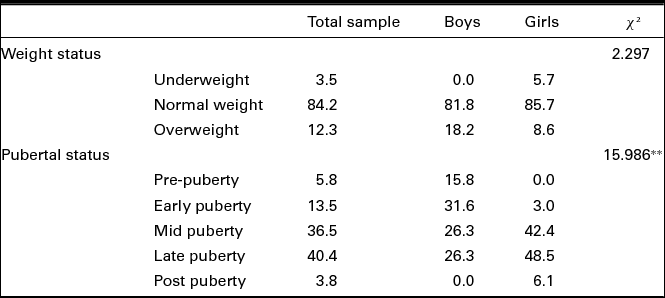
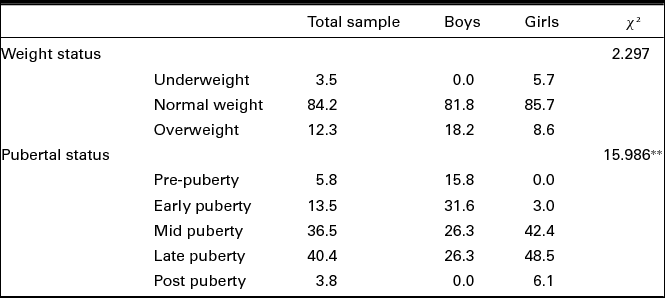
In the sample, an average adjusted BMI of 105.07 (SD = 17.11) was found. Regarding weight status, 84.4% of the adolescents had a normal weight, 3.4% were underweight and 12.3% were overweight. Although Table 1 shows some absolute differences between boys and girls concerning the distribution of weight status, the relationship between gender and weight status was non-significant, χ²(2, N = 57) = 2.30, p = .32.
The Percentage Adolescents With a Certain Weight Status and Pubertal Status
Note: χ² = chi-square; *p < .05; **p < .01; ***p < .001.
Table 1 further shows that most of the adolescents in the total sample were aged from mid to late puberty. However, there is a significant difference between boys and girls when looking at the pubertal development stage, χ²(4, N = 57) = 15.99, p = .003, with girls being further evolved in puberty than boys. Most girls in the sample were in late puberty (48.5%) while the majority of the boys (31.6%) were in early puberty.
Preliminary Analyses
On both the interview and the questionnaire a significant multivariate effect was found for gender, respectively F(4,49) = 3.21, p = .02, F(4,49) = 2.79, p = .04; and adjusted BMI, respectively F(4,49) = 6.64, p < .001, F(4,49) = 9.22, p < .001 on all four of the eating pathology features. No significant multivariate effect was found for age, respectively F(4,49) = .43, p = .79, F(4,49) = 1.55, p = .20 and pubertal status, respectively F(4,49) = 1.95, p = .12, F(4,49) = 1.31, p = .28. Based on the above findings, it was decided to include both gender and adjusted BMI as control variables in this study.
Research Questions
Reliability of the interview and the questionnaire
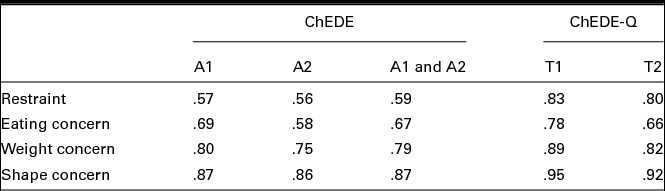
The interrater reliability of the interview (ChEDE) ranged from r = .80 to r = .94 in the current study. More specifically, for restraint, eating concern, weight concern and shape concern, an interrater reliability of .94, .80, .91 and .94 respectively was found. The internal consistency of the subscales of the interview (see Table 2) was then calculated for both A1 (α = .57 to α = .87) and A2 (α = .56 to α = .86), as well as across both assessors (α = .59 to α = .87). The Cronbach's alpha coefficients for the questionnaire taken at time 1 (T1) (α = .78 to α = .95) and time 2 (T2) (α = .66 to α = .92) were also sufficient. An overview of the Cronbach's alphas for the various subscales of the interview and the questionnaire can be found in Table 2. The four subscales of the questionnaire (ChEDE-Q) further showed a test–retest reliability of .67 for restraint, .81 for eating concern, .92 for weight concern and .91 for shape concern.
The Internal Consistency (Cronbach's Alpha) of the ChEDE and the ChEDE-Q

Note: A1 = Assessor 1; A2 = Assessor 2; A1 and A2 = across assessor 1 and 2; T1 = Time 1; T2 = Time 2.
Convergence between the interview and the questionnaire
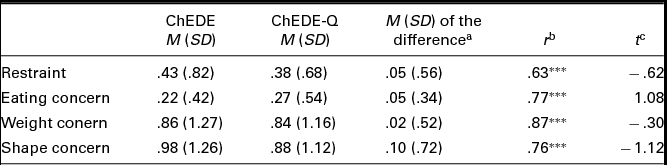
For each of the four subscales of the interview and the questionnaire, a significant partial correlation was found: r(55) = .63, p < .001, for restraint; r(55) = .77, p < .001, for eating concern; r(55) = .87, p < .001, for weight concern; and r(55) = .76, p < .001, for shape concern (see Table 3). This result indicates that adolescents who have the highest scores on the interview also report the highest scores on the questionnaire. Using paired-samples t tests, it was also tested whether there was a significant difference between the mean subscale scores of the interview and the mean subscale scores of the questionnaire. Based on this analysis, no statistically significant differences were found between the mean subscale scores of the two research instruments (see Table 3). This means that the sample's average scores on the subscales in the interview (restraint: M = .43, SD = .82; eating concern: M = .22, SD = .42; weight concern: M = .86, SD = 1.27; and shape concern: M = .98, SD = 1.26) are not significantly higher or lower than the average subscale scores on the questionnaire (restraint: M = .38, SD = .68; eating concern: M = .27, SD = .54; weight concern: M = .84, SD = 1.1; and shape concern: M = .88, SD = 1.12).
The Degree of Agreement Between the ChEDE and ChEDE-Q on the Subscales Restraint, Eating Concern, Weight Concern and Shape Concern

Note: aThe difference between the average subscale scores on the interview and the questionnaire. bThe partial correlation coefficient for the various subscales of the interview and the questionnaire. cPaired-samples t test. *p < .05. **p < .01. ***p < .001.
Discussion
The ChEDE (Decaluwé & Braet, Reference Decaluwé and Braet1999a) and the ChEDE-Q (Decaluwé & Braet, Reference Decaluwé and Braet1999b) were developed to better suit the cognitive abilities of adolescents compared to the adult versions of the instruments (Bryant-Waugh et al., Reference Bryant-Waugh, Cooper, Taylor and Lask1996). However, the use and the degree of similarity between the ChEDE and ChEDE-Q have only been investigated in a limited number of studies and only in adolescents who are overweight or obese (Decaluwé & Braet, Reference Decaluwé and Braet2004; Goossens & Braet, Reference Goossens and Braet2010). Therefore, the main objective of this study was to investigate the convergence between the two instruments in adolescents, and more specifically, the utility of the CHEDE-Q for the detection of eating disorder symptoms in young people from the general population.
Reliability of the Interview and the Questionnaire
The alpha coefficients of the various subscales of the interview — that is, restraint, eating concern, weight concern and shape concern —found for A1 (α = .57 to α = .87) and A2 (α =.56 to α = .86) and as calculated for both reviewers (α = .59 to α = .87), seems to conform with the Cronbach's alpha, as found in the studies of Decaluwé and Braet (Reference Decaluwé and Braet2004) and Goossens and Braet (Reference Goossens and Braet2010) of adolescents who are overweight or obese. Therefore, the reliability seems to be sufficient for weight, shape and eating concern, and to some extent less sufficient for restraint. Finally, in accordance with the studies of Decaluwé and Braet (Reference Decaluwé and Braet2004) and Watkins et al. (Reference Watkins, Frampton, Lask and Bryant-Waugh2005), a good interrater reliability was found for the interview in this study (r = .80 to r = .95).
As concerns the questionnaire, a sufficient internal consistency was found for the various subscales for both time 1 (α = .78 to α = .95) and time 2 (except for eating concern; α = .66 to α = .92), which seems to be in accordance with the study by Goossens and Braet (Reference Goossens and Braet2010). In congruence with the study of Luce and Crowther's (Reference Luce and Crowther1999) adult version of the questionnaire, this study also showed a good test–retest reliability for the subscales of the ChEDE-Q (r = .67 to r = .92) with a 2-week time interval.
In accordance with the studies of Decaluwé and Braet (Reference Decaluwé and Braet2004) and Goossens and Braet (Reference Goossens and Braet2010), the internal consistency was lower for the interview than for the questionnaire, which is most notable for the subscale restraint. This may be the result of the more complex formulation of questions measuring restraint in the interview. The questionnaire only asks about the number of days the adolescents have attempted not to eat certain foods or have eaten less than they would like, while the interview also questions the number of days on which the adolescent has tried not to eat even though he or she did not succeed. It is possible that the addition of the phrase ‘even though you did not succeed’ causes confusion in adolescents, which makes them report less accurately in the interview.
The convergence between the interview and the questionnaire
In line with previous research (Berg et al., Reference Berg, Peterson, Frazier and Crow2011; Decaluwé & Braet, Reference Decaluwé and Braet2004; Goossens & Braet, Reference Goossens and Braet2010), a significant correlation was found for each of the four subscales of the interview and the questionnaire, with partial correlation coefficients ranging from r = .63 to r = .87. However, the correlation coefficients of the current study are higher compared to those of other studies (e.g., Berg et al., Reference Berg, Peterson, Frazier and Crow2011), which might be due to the use of an average score on the interview across two independent interviewers, thereby increasing the reliability and validity of the assessment measure. On the other hand, this might also be due to the population in which the research tools were compared. The weaker consistency in studies with adolescents who are overweight or obese could be due to the difficulties they experience in reporting about their eating habits, weight and body shapes in an interview because this is more personally relevant and challenging for them (Goossens & Braet, Reference Goossens and Braet2010). Consequently, this may lead to underreporting in the interview, causing a larger difference in the reporting pattern on the two measurement instruments, resulting in a less strong cohesion. This is in contrast to our study, where the degree of agreement between the instruments was examined within the general population.
No significant differences were found between the mean scores of the questionnaire and the interview. This finding is not consistent with previous research (Berg et al., Reference Berg, Peterson, Frazier and Crow2011; Decaluwé & Braet, Reference Decaluwé and Braet2004; Goossens & Braet, Reference Goossens and Braet2010), where respondents reported significantly higher scores on the questionnaire than on the interview. It is possible that the limited range of scores on the eating disorder symptoms scales in this community study led to a higher degree of agreement between the interview and the questionnaire. However, the higher degree of agreement can also mean that the adolescents in this sample reported as accurately in the interview as in the self-report questionnaire. Moreover, this might indicate that the questionnaire is as reliable as the interview to detect eating disorder symptoms in adolescents, meaning that the questionnaire may be particularly useful as a ‘quick’ screening tool for eating disorder symptoms in the general population.
Strengths and Limitations
Strengths
The current study was the first to compare the ChEDE and the ChEDE-Q in a sample of adolescents retrieved from the general population. Previous studies had only compared both instruments in youth who were overweight or obese (e.g., Decaluwé & Braet, Reference Decaluwé and Braet2004). However, studies in adolescents from the general population are necessary to promote early detection, proper screening and adequate early interventions, as the risk for developing disordered eating reaches a peak within this age group (Carter et al., Reference Carter, Aimé and Mills2001).
A second strength is related to the combined measure of the interview that was used. Because the ChEDE was double scored by two independent evaluators in order to calculate the interrater reliability, the statistical analyses could be performed with the average scores on the interview across A1 and A2; thus, the influence of the interviewer on the scores can be eliminated and the reliability and validity of the interview enhanced.
Limitations
First, the generalisability of the results might be limited due to the relatively homogeneous sample and the small sample size (N = 57). The young participants were mainly White, belonging to a middle or high socio-economic class. Additionally, the age range of the adolescents limited the generalisability of the results to older or younger age groups. However, regarding gender, weight status and pubertal status, our data showed realistic variation.
A second limitation is related to the low prevalence of the number of binges and compensatory behaviours in this study, so no statistical analyses could be performed with these variables.
Recommendations for Future Research and Clinical Practice
Based on the results and limitations of the current study, it would be interesting to replicate this study in a larger group of adolescents in both general and clinical populations, with a wider age range and with a larger number of subject variables (e.g., social class, ethnicity, geographic location) that are approximately equally represented. Furthermore, more attention could be paid to the qualitative deficiencies of the assessment tools. The fact that the wording of some questions is insufficiently specific leads to problems in scoring and interpretation. For example, the questions only ask for the number of days in the last month in which the adolescent wanted to lose weight. However, some adolescents report that they want to remain stable in weight or even want to gain weight. Boys especially often wish to gain weight to form more muscles. Unfortunately, there is no space provided to take this into account. Nevertheless, a too strong desire to gain weight can also be problematic, and wanting to remain stable in weight can also lead to the development of eating disorder symptoms. These issues apply to both the interview and questionnaire, as they are based on the same item pool.
A possible solution for these qualitative deficiencies could be the reformulation or the inclusion of a number of additional questions and scoring guidelines. On the questionnaire more space could be provided for the definition of some key concepts, as the literature has already shown that the addition of an instruction sheet with such definitions can promote the agreement between the interview and the questionnaire (Goldfein, Devlin, & Kamenetz, Reference Goldfein, Devlin and Kamenetz2005). Finally, future research could investigate whether the interview and the questionnaire can reliably measure the number of reported binges and compensatory behaviour in the general population, which is also important to determine whether the questionnaire can be used as a screening instrument.
To conclude, both the ChEDE and the ChEDE-Q can be considered reliable for determining eating disorder symptoms in boys and girls aged from 12 to 16 years from the general population. Furthermore, the results of this study showed a high degree of similarity between the ChEDE and ChEDE-Q, which indicates that both assessment instruments measure the same constructs and the use of the ChEDE-Q might be approved as a screening instrument for eating disorder symptoms in adolescents.
Acknowledgments
This work was supported by the Special Research Funds of Ghent University.