1 Introduction
Tiny particles with non-spherical shape are encountered in a variety of natural and industrial processes (Voth & Soldati Reference Voth and Soldati2017). A prominent example is plankton in oceanic flows (Pedley & Kessler Reference Pedley and Kessler1992; Guasto, Rusconi & Stocker Reference Guasto, Rusconi and Stocker2012). The various shapes of plankton have probably evolved through natural selection since shape is likely to affect their ability to feed and reproduce. Turbulence (Ruiz, Macías & Peters Reference Ruiz, Macías and Peters2004; Barry et al. Reference Barry, Rusconi, Guasto and Stocker2015) and shape (Siewert et al. Reference Siewert, Kunnen, Meinke and Schröder2014) are known to affect the sinking rate of plankton-like particles and their eventual deposition in homogeneous isotropic turbulence (HIT). The hydrodynamic forces depend on the plankton-particle alignment with the flow, which is altered by the presence of mean shear (Reidenbach, Koseff & Koehl Reference Reidenbach, Koseff and Koehl2009). Recently, Ardeshiri et al. (Reference Ardeshiri, Benkeddad, Schmitt, Souissi, Toschi and Calzavarini2016, Reference Ardeshiri, Schmitt, Souissi, Toschi and Calzavarini2017) demonstrated the crucial role of local shear in copepods’ dynamics. The ability of copepods to escape from localized high strain rates affects their preferential concentration and thereby also the growth and reproduction rates.
1.1 Dynamics of tracer non-spherical particles
Inertia-free particles passively follow the translational fluid motion irrespective of their shape, whereas only spherical tracer particles rotate along with the fluid vorticity. Although non-spherical particles are oriented randomly with respect to an inertial reference frame in HIT, their anisotropic shape induces a preferential alignment with the local velocity gradient tensor (Pumir & Wilkinson Reference Pumir and Wilkinson2011). Computational studies showed that rod-like particles tend to align their symmetry axis
 $\boldsymbol{p}$
with the instantaneous vorticity vector
 $\unicode[STIX]{x1D734}$
(Parsa et al.
Reference Parsa, Calzavarini, Toschi and Voth2012, Byron et al.
Reference Byron, Einarsson, Gustavsson, Voth, Mehlig and Variano2015), whereas disk-like particles preferentially orient
 $\boldsymbol{p}$
perpendicular to
 $\unicode[STIX]{x1D734}$
(Gustavsson, Einarsson & Mehlig Reference Gustavsson, Einarsson and Mehlig2014; Byron et al.
Reference Byron, Einarsson, Gustavsson, Voth, Mehlig and Variano2015). The qualitatively different alignments of rod- and disk-like particles impact on their rotational behaviours such that the rods spin and disks tumble. These findings are supported by sophisticated laboratory measurements by Parsa et al. (Reference Parsa, Calzavarini, Toschi and Voth2012), Marcus et al. (Reference Marcus, Parsa, Kramel, Ni and Voth2014) and Ni et al. (Reference Ni, Kramel, Ouellette and Voth2015). They used multiple cameras with viewing axes in different planes to allow the full fibre orientation vector
 $\boldsymbol{p}$
to be determined. In spite of the shape dependence of the partition between spinning and tumbling rates of non-spherical particles, the full solid-body rotation rate is nevertheless almost independent of the actual particle shape; see e.g. Parsa et al. (Reference Parsa, Calzavarini, Toschi and Voth2012) and Byron et al. (Reference Byron, Einarsson, Gustavsson, Voth, Mehlig and Variano2015).
The orientation and rotation of non-spherical tracer particles have also been studied in turbulent channel flows which serve as a prototype of wall-bounded turbulence (WT). Although particles orient almost randomly in the centre of the channel, where the vorticity field is nearly isotropic (Andersson, Zhao & Variano Reference Andersson, Zhao and Variano2015), the alignment near the channel walls depends crucially on aspect ratio. Disk-like particles strongly align their symmetry axis
 $\boldsymbol{p}$
in the wall-normal direction, whereas rod-like tracer particles align parallel with the wall and mostly in the streamwise direction (Challabotla, Zhao & Andersson Reference Challabotla, Zhao and Andersson2015b
). The strong preferential orientation of non-spherical particles reduces the mean particle rotation
 $\langle \unicode[STIX]{x1D714}\rangle$
below that for spheres, the latter of which equals the mean fluid rotation
 $\langle \unicode[STIX]{x1D6FA}\rangle$
. In spite of the substantial reduction of mean angular velocity
 $\langle \unicode[STIX]{x1D714}\rangle$
of tracers with high asphericity, enhanced fluctuations of the streamwise component of the angular velocity were observed by Challabotla et al. (Reference Challabotla, Zhao and Andersson2015b
).
Zhao et al. (Reference Zhao, Challabotla, Andersson and Variano2015) showed that there are two qualitatively different rotation modes of tracer spheroids in channel-flow turbulence. Just as in HIT (Parsa et al.
Reference Parsa, Calzavarini, Toschi and Voth2012; Byron et al.
Reference Byron, Einarsson, Gustavsson, Voth, Mehlig and Variano2015), rods preferentially spin and disks tumble in the central region (Mode I). In the near-wall region, however, both tumbling and spinning are suppressed with increasing asphericity (Mode II). Spheroidal particles in Mode I are nearly randomly oriented in the channel centre, where the mean shear vanishes and the vorticity field is almost isotropic. The local fluid vorticity vector
 $\unicode[STIX]{x1D734}$
and the orientation vector of rod-like particles
 $\boldsymbol{p}$
are both preferentially aligned in the strongest Lagrangian stretching direction, while disk-like particles orient in the Lagrangian compression direction, which is perpendicular to the fluid vorticity vector (Ni, Ouellette & Voth Reference Ni, Ouellette and Voth2014; Zhao & Andersson Reference Zhao and Andersson2016). The shape-dependent particle rotational behaviour is therefore caused by how an aspherical particle orients itself relative to the local fluid vorticity. In Mode II, rod- and disk-like spheroidal particles are preferentially aligned in the streamwise (Lagrangian stretching) direction and the wall-normal (Lagrangian compression) direction, respectively. The rotational behaviour is strongly affected by the mean shear (i.e. anisotropic fluid vorticity), and is therefore qualitatively consistent with a spheroid’s rotation in uniform shear flow following so-called Jeffery orbits (Challabotla et al.
Reference Challabotla, Zhao and Andersson2015b
). This suggests a negligible influence of the turbulent vorticity fluctuations. Although tracer spheroids are preferentially oriented in the Lagrangian stretching or compression direction in shear-dominated regions, the vorticity vector is essentially uncorrelated with Lagrangian stretching (Zhao & Andersson Reference Zhao and Andersson2016). Accordingly, we hypothesize that the particle’s preferential orientation and the rate of fluid shear are the two factors that determine the rotational mode of spheroidal tracer particles.
1.2 Point particles versus fully resolved particles
Particulate additives to a homogeneous fluid can be treated as point particles provided that the size
 $\unicode[STIX]{x1D6FF}$
of the additives are smaller than the tiniest turbulent eddies, i.e. the Kolmogorov length scale
 $\unicode[STIX]{x1D702}$
. This assumption can be justified for several different applications, including planktonic organisms in the ocean. While
 $\unicode[STIX]{x1D702}\sim 0.1{-}10$
mm in marine turbulence (Jiménez Reference Jiménez1997), phytoplankton cells are typically of size
 $\unicode[STIX]{x1D6FF}\sim 1{-}100~\unicode[STIX]{x03BC}\text{m}$
(Durham et al.
Reference Durham, Climent, Barry, De Lillo, Boffetta, Cencini and Stocker2013). In addition to the size constraint,
 $\unicode[STIX]{x1D6FF}/\unicode[STIX]{x1D702}\ll 1$
, the particle Reynolds number
 $Re_{p}$
has to be smaller than one. This implies that the flow in the immediate vicinity of a particle can be considered as Stokesian, which is required in order to derive exact analytical expressions for the viscous forces and torques acting on the particle. However, approximate formulae aimed to be valid also for
 $Re_{p}>$
1 were recently derived and employed by Ouchene et al. (Reference Ouchene, Khalij, Arcen and Taniére2016) and Arcen et al. (Reference Arcen, Ouchene, Khalij and Taniére2017). The advantages and shortcomings of the point-particle approach to simulate dispersed multiphase flows have been discussed in review articles by Balachandar (Reference Balachandar2009), Eaton (Reference Eaton2009) and Balachandar & Eaton (Reference Balachandar and Eaton2010).
For larger particles, i.e. when the particle size is larger than the Kolmogorov length, the point-particle approach can no longer be justified. In direct numerical simulation of particle-laden flows major difficulties arise with respect to the treatment of the solid surface of each of the moving particles. The particles occupy parts of the computational volume and the surface of the particle has to be embedded in the computational mesh. Four different approaches to numerically resolve the flow around each individual moving particle were summarized by Lucci, Ferrante & Elghobashi (Reference Lucci, Ferrante and Elghobashi2010). At that time these methods were only used to simulate finite-sized spherical particles in turbulence. More recently, however, Do-Quang et al. (Reference Do-Quang, Amberg, Brethouwer and Johansson2014), Rosén, Lundell & Aidun (Reference Rosén, Lundell and Aidun2014) and Eshghinejadfard, Hosseini & Thevenin (Reference Eshghinejadfard, Hosseini and Thevenin2017) used a lattice-Boltzmann (LB) method, whereas Ardekani et al. (Reference Ardekani, Costa, Breugem, Picano and Brandt2017) used an immersed boundary (IB) method to simulate the motion of non-spherical particles in viscous fluid flow. Rosén et al. (Reference Rosén, Lundell and Aidun2014) were concerned with the rotational dynamics of a single neutrally buoyant prolate spheroid in a laminar shear flow. Their fully resolved LB simulation enabled an exploration of the competition between fluid inertia and particle inertia. Do-Quang et al. (Reference Do-Quang, Amberg, Brethouwer and Johansson2014) and Eshghinejadfard et al. (Reference Eshghinejadfard, Hosseini and Thevenin2017) also used a lattice-Boltzmann method to simulate the translational and rotational motion of elongated particles in turbulent channel flow. Do-Quang et al. (Reference Do-Quang, Amberg, Brethouwer and Johansson2014) considered cylindrical particles with aspect ratios from 2 to 15, whereas Eshghinejadfard et al. (Reference Eshghinejadfard, Hosseini and Thevenin2017) studied prolate spheroids with aspect ratios 1, 2 and 4. Ardekani et al. (Reference Ardekani, Costa, Breugem, Picano and Brandt2017), by means of an IB method, showed that finite-sized oblate spheroids with aspect ratio 1:3 could lead to drag reduction in turbulent channel flow. All these approaches to finite-sized particle simulations require additional computational efforts and the particle number in such simulations are therefore limited and typically of the order of 10 000.
1.3 Wall turbulence in the absence of mean shear
A characterizing feature of turbulent channel flows, i.e. pressure-driven plane Poiseuille flows, is the presence of near-wall streaks and coherent vortical structures educed by the locally high mean shear rate; see e.g. Kim, Moin & Moser (Reference Kim, Moin and Moser1987), Robinson (Reference Robinson1991), Jeong et al. (Reference Jeong, Hussain, Schoppa and Kim1997). Strikingly similar near-wall turbulence is observed also in shear-driven plane Couette flow (Bech et al. Reference Bech, Tillmark, Alfredsson and Andersson1995). Typical near-wall turbulence is accordingly associated with the presence of a relatively high mean shear rate at the solid wall. However, Lee, Kim & Moin (Reference Lee, Kim and Moin1990) demonstrated that elongated streaky flow structures developed also in the absence of a solid surface, provided that the mean shear rate was sufficiently high. On the other hand, Kuroda, Kasagi & Hirata (Reference Kuroda, Kasagi, Hirata, Durst, Kasagi, Launder, Schmidt, Suzuki and Whitelaw1995) showed that the streaky flow pattern along with the mean shear rate vanished near a moving wall in a Couette–Poiseuille flow, provided that the speed of the moving wall was adjusted with a view to eliminating the skin friction. Essentially the same flow field, but at higher Reynolds numbers, was examined independently by Coleman et al. (Reference Coleman, Pirozzoli, Quadrio and Spalart2017) and Yang, Zhao & Andersson (Reference Yang, Zhao and Andersson2017b ).
Moving walls or belts are occasionally used in experimental facilities for a variety of different reasons. Practical occurrences of Couette–Poiseuille-type flows are beneath flat-bottomed vessels operating in shallow waters with small underkeel clearance (Gourlay Reference Gourlay2006) and in the ground gap underneath a moving vehicle (Katz Reference Katz2006). The turbulent Couette–Poiseuille flow has also been used by Thurlow & Klewicki (Reference Thurlow and Klewicki2000) and Spencer et al. (Reference Spencer, Lee, Parthasarathy and Papavassiliou2009) to explore the mechanisms of drag reduction of ultrahydrophobic surfaces.
1.4 Present study
Despite the recent advances in the development of a phenomenology of preferential alignment and rotation in HIT and WT, as outlined in § 1.1, the actual role of mean shear has not yet been clarified and the following questions remain unanswered: What is the role played by mean shear in particle rotation in a turbulent flow? Do non-spherical particles exhibit preferential orientations in the absence of mean shear? Is the particle rotation mode, i.e., Mode I or Mode II, uniquely decided by the anisotropy of the particle orientation? To address these issues, the alignment and rotation of inertia-free spheroids with different shapes (from oblate to prolate) will be explored in a tailor-made Couette–Poiseuille flow (see § 2.1). The choice of spheroids without inertia frees the discussion of preferential concentration or turbophoresis. The numerically simulated flow field is designed with the view to have conventionally sheared wall turbulence at the stationary surface and shear-free conditions at the moving surface (Yang et al. Reference Yang, Zhao and Andersson2017b ). As an outcome, a wide core region resembles almost homogeneous shear turbulence (HST); e.g. Sekimoto, Dong & Jiménez (Reference Sekimoto, Dong and Jiménez2016). Our goal is to interpret the particles’ rotation modes in the vicinity of the two differently sheared walls in terms of the spheroids’ alignments with the fluid vorticity vector (§ 3.2) and with the Lagrangian stretching directions (§ 3.3).
2 Eulerian–Lagrangian modelling approach
2.1 Turbulent Couette–Poiseuille flow with zero wall shear
For the purpose of the present study, we realized a turbulent Couette–Poiseuille flow by means of direct numerical simulation (DNS). The flow between two parallel walls separated by a distance
 $2h$
was driven in the positive
 $x$
-direction by means of a prescribed mean pressure gradient
 $\text{d}P/\text{d}x<0$
. The wall at
 $z=0$
was at rest whereas the other wall at
 $z=2h$
was moving in the
 $x$
-direction with a constant speed
 $U_{w}$
.
 $U_{w}$
was systematically adjusted until the mean shear rate
 $\text{d}U/\text{d}z$
almost vanished at the moving wall. Thus, in the absence of friction at the moving wall, the shear stress
 $\unicode[STIX]{x1D70F}_{w}$
at the stationary wall alone balanced the pressure gradient such that
 $\unicode[STIX]{x1D70F}_{w}=-2h\,\text{d}P/\text{d}x$
. The governing Navier–Stokes equations were integrated in time by means of an explicit Adams–Bashforth scheme while subjected to the mass conservation constraint. A pseudo-spectral method was used in the two homogeneous directions
 $(x,y)$
whereas second-order finite-difference discretization was used in the wall-normal
 $(z)$
direction (Mortensen et al.
Reference Mortensen, Andersson, Gillissen and Boersma2008). No slip and impermeability conditions were imposed at both walls whereas periodicity was assumed in the homogeneous directions.
The Reynolds number
 $Re_{\unicode[STIX]{x1D70F}}$
based on the friction velocity
 $u_{\unicode[STIX]{x1D70F}}=(\unicode[STIX]{x1D70F}_{w}/\unicode[STIX]{x1D70C})^{1/2}$
and the wall separation distance
 $2h$
was 180. The simulation was performed on a
 $36h\times 10h\times 2h$
computational domain; see Yang et al. (Reference Yang, Zhao and Andersson2017b
). This particular Couette–Poiseuille flow exhibited a monotonically increasing mean velocity all the way from the stationary wall to the moving wall with
 $U(z=2h)=U_{w}=20u_{\unicode[STIX]{x1D70F}}$
. The flow field near the stationary wall closely resembled conventional wall turbulence typically found in plane channel flows. Next to the moving wall, however, the anisotropy of the turbulence was qualitatively different with almost isotropic two-componential velocity and vorticity fluctuations in homogeneous wall-parallel
 $(x,y)$
-planes. In a wide quasi-homogeneous central region, the mean shear rate
 $\text{d}U/\text{d}z$
turned out to be almost constant and approximately
 $1.5\,\%$
of the wall value. Elongated streaky structures were observed near the stationary wall, similarly to plane Poiseuille flows (e.g. Kim et al.
Reference Kim, Moin and Moser1987) and plane Couette flow (e.g. Richter & Sullivan Reference Richter and Sullivan2013), whereas contours of streamwise velocity fluctuations near the moving surface revealed significantly shorter but wider flow structures, as shown in figure 9 in Yang et al. (Reference Yang, Zhao and Andersson2017b
).
Even in the absence of mean shear, the moving wall exerts distinct effects on the nearby flow field due to pressure reflections from the wall and viscous damping of velocity fluctuations. The fluctuating velocity field approaches a two-dimensional (2-D) limit at the wall due to the impermeability condition which blocks wall-normal fluctuations. Similarly, the fluctuating vorticity field also approaches a 2-D limit in which the wall-normal vorticity is suppressed due to the no-slip conditions on the velocity components aligned with the shear-free wall (Yang et al. Reference Yang, Zhao and Andersson2017b ). These features make the turbulence in the vicinity of the moving wall distinctly different from the turbulent velocity and vorticity fluctuations near a free surface; see e.g. Handler et al. (Reference Handler, Swean, Leighton and Swearingen1993), Pan & Banerjee (Reference Pan and Banerjee1995) and Nagaosa & Handler (Reference Nagaosa and Handler2003).
The mean shear rate
 $\text{d}U/\text{d}z$
decreases almost monotonically with
 $z$
from a high value at the stationary wall to almost zero at the moving wall. The reciprocal
 $(\text{d}U/\text{d}z)^{-1}$
can be considered as a characteristic time scale of the mean motion. An often used turbulent time scale is
 $k/\unicode[STIX]{x1D716}$
. The ratio between the two time scales becomes
 $(k/\unicode[STIX]{x1D716})/(\text{d}U/\text{d}z)^{-1}=(\text{d}U/\text{d}z)/(\unicode[STIX]{x1D716}/k)$
. This is the dimensionless ratio used by Lee et al. (Reference Lee, Kim and Moin1990) in their study of strongly sheared homogeneous turbulence. They reported that streaky structures, like those found in near-wall turbulence, formed when the dimensionless shear rate parameter exceeded approximately 30. We can alternatively use the time scale
 $E^{-1/2}$
as representative of the turbulent vorticity where
 $E$
is the enstrophy. The time scale ratio then becomes
 $E^{-1/2}/(\text{d}U/\text{d}z)^{-1}=(\text{d}U/\text{d}z)/E^{1/2}$
. This is probably more relevant in the present context since we aim to compare the role of mean shear (or mean rotation) with the role of vorticity fluctuations in the spheroids’ preferential orientations. The former time scale
 $k/\unicode[STIX]{x1D716}$
is representative of the energy-containing large-eddy motions whereas the latter time scale
 $E^{-1/2}$
characterizes the dissipative small-scale eddies.
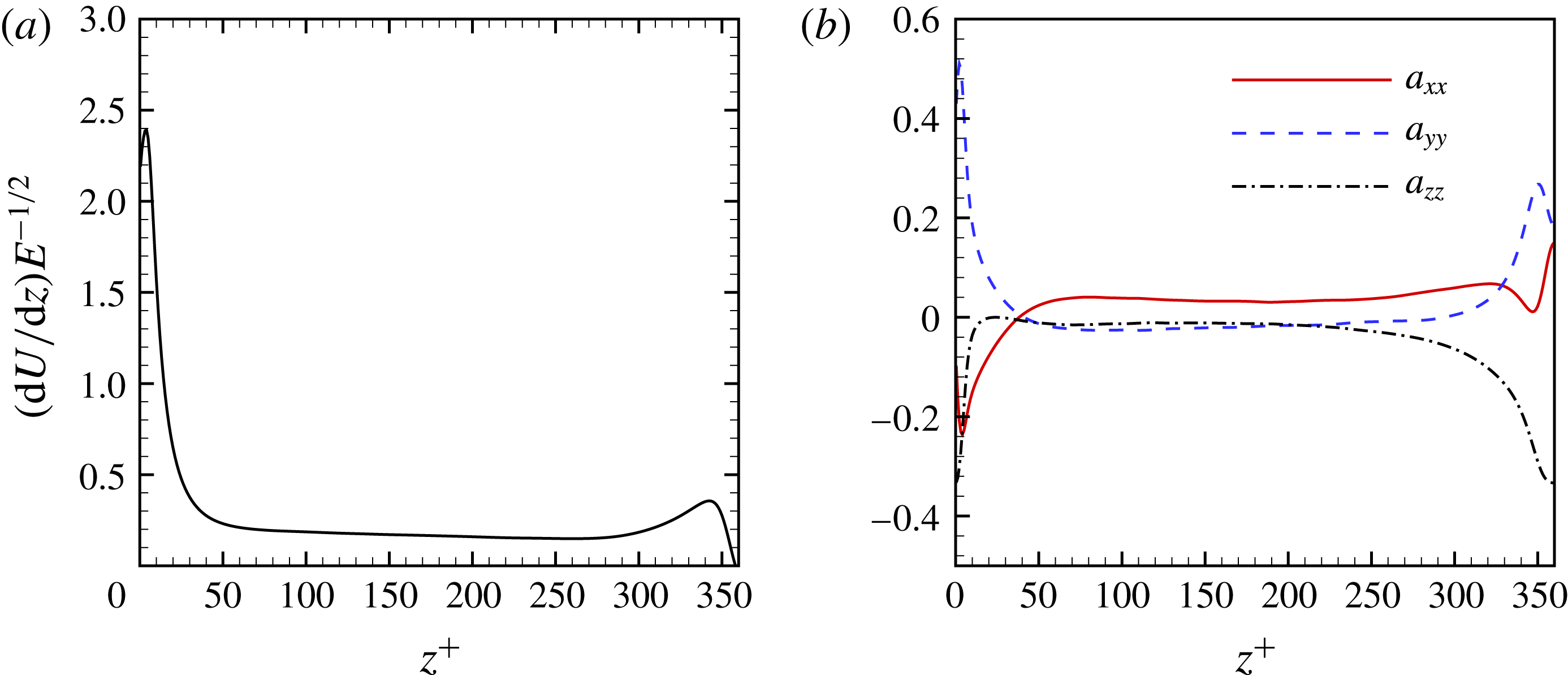
(a) The ratio between the mean vorticity to the square root of the enstrophy
 $(\text{d}U/\text{d}z)E^{-1/2}$
; (b) the anisotropies of the vorticity fluctuations.

Statistics and structures of the simulated Couette–Poiseuille flow were presented by Yang et al. (Reference Yang, Zhao and Andersson2017b
). Since the vorticity field is believed to have a decisive impact on the rotation mode of the tracer spheroids, some results deduced from the flow simulation by Yang et al. (Reference Yang, Zhao and Andersson2017b
) are shown in figure 1. The ratio between the mean vorticity to the square root of the enstrophy is provided in figure 1(a). The mean vorticity is by definition equal to two times the mean fluid rotation, i.e.
 $2\langle \unicode[STIX]{x1D6FA}_{y}\rangle$
, which in the present case happens to be equal to the mean shear rate
 $\text{d}\langle U\rangle /\text{d}z$
. The enstrophy
 $E$
is defined here as the trace of the second-moment tensor of the vorticity fluctuations
 $2\unicode[STIX]{x1D6FA}_{i}^{\prime }$
, where the primes indicate deviations from the mean vorticity component
 $\langle 2\unicode[STIX]{x1D6FA}_{i}\rangle$
. The mean shear rate, and thus the mean vorticity, attains its highest value at the stationary wall from where it decreases monotonically almost all the way to the moving wall. The mean vorticity exceeds
 $E^{1/2}$
in the viscous-affected layer near the stationary wall. Over most of the cross-section, from
 $z^{+}=50$
to 300, the enstrophy measure
 $E^{1/2}$
is five times larger than the mean vorticity. It is particularly noteworthy that
 $\langle 2\unicode[STIX]{x1D6FA}_{y}\rangle /E^{1/2}$
tends to zero at the moving wall, in contrast to behaviour near the stationary wall.
The anisotropies of the vorticity fluctuations are shown in figure 1(b). Here, the anisotropy of the streamwise vorticity fluctuations
 $\langle 2\unicode[STIX]{x1D6FA}_{x}^{\prime }\rangle$
is measured as:
 $$\begin{eqnarray}a_{xx}=\frac{\langle 2\unicode[STIX]{x1D6FA}_{x}^{\prime }2\unicode[STIX]{x1D6FA}_{x}^{\prime }\rangle }{\langle 2\unicode[STIX]{x1D6FA}_{i}^{\prime }2\unicode[STIX]{x1D6FA}_{i}^{\prime }\rangle }-\frac{1}{3}=\frac{\langle \unicode[STIX]{x1D6FA}_{x}^{\prime }\unicode[STIX]{x1D6FA}_{x}^{\prime }\rangle }{\langle \unicode[STIX]{x1D6FA}_{i}^{\prime }\unicode[STIX]{x1D6FA}_{i}^{\prime }\rangle }-\frac{1}{3}\end{eqnarray}$$
and similarly for
 $a_{yy}$
and
 $a_{zz}$
in the two other directions. We readily observe that
 $a_{xx}$
is almost constant over a wide central region. That
 $a_{xx}>0$
implies that the streamwise component of the vorticity fluctuations is larger than the fluctuations of the two other components of the vorticity vector. Although
 $a_{zz}\approx -1/3$
at both walls, as a direct consequence of the no-slip wall conditions, the vorticity fluctuation vector is oriented completely differently at the two walls. Fluctuations in the spanwise direction are totally dominating near the stationary wall, whereas streamwise fluctuations are equally important as spanwise vorticity fluctuations near the moving wall.
2.2 Prolate spheroids as model of non-spherical tracers
Solid particles are usually identified by a characteristic time scale
 $\unicode[STIX]{x1D70F}_{p}$
which is a measure of how promptly a particle responds to changes in the local flow field. This relaxation time can be expressed as
 $\unicode[STIX]{x1D70F}_{p}=2\unicode[STIX]{x1D70C}_{p}a^{2}\unicode[STIX]{x1D6F9}(\unicode[STIX]{x1D706})/9\unicode[STIX]{x1D707}=2\unicode[STIX]{x1D70C}_{p}a^{2}\unicode[STIX]{x1D6F9}(\unicode[STIX]{x1D706})/9\unicode[STIX]{x1D70C}_{f}\unicode[STIX]{x1D708}$
, where the shape function
 $\unicode[STIX]{x1D6F9}(\unicode[STIX]{x1D706})$
can be expressed analytically for either oblate or prolate spheroids and becomes equal to 1.0 for spherical particles (
 $\unicode[STIX]{x1D706}=1$
). If the particle relaxation time
 $\unicode[STIX]{x1D70F}_{p}$
is much shorter than the shortest time scale of the turbulence, i.e. the Kolmogorov time scale
 $\unicode[STIX]{x1D70F}_{K}$
, the particle responds almost immediately to turbulent fluctuations. Such particles are often referred to as tracers since they passively translate along with the flow. This limiting case when
 $\unicode[STIX]{x1D70F}_{p}\ll \unicode[STIX]{x1D70F}_{K}$
corresponds to a Stokes number
 $St=\unicode[STIX]{x1D70F}_{p}/\unicode[STIX]{x1D70F}_{K}\ll 1$
. Such particles are also referred to as inertia free or non-inertial, which hints at the negligible influence of their inertia and does not necessarily imply that the particles are massless (
 $\unicode[STIX]{x1D70C}_{p}=0$
). For instance in the case of neutrally buoyant spheres (
 $\unicode[STIX]{x1D70C}_{p}=\unicode[STIX]{x1D70C}_{f}$
),
 $St\ll 1$
provided that the particle time scale
 $2a^{2}/9\unicode[STIX]{x1D708}$
is much smaller than the Kolmogorov time.
Such inertia-free particles travel with the same velocity as the local fluid and are unaffected by inertial drag and lift forces, both of which are related to the relative velocity between the particle and the fluid. Also the torques exerted by the viscous fluid on the spheroids become negligible in the
 $St\ll 1$
limit. Non-spherical particles will nevertheless rotate differently from the surrounding fluid. This phenomenon, which is in the focus of the present study, exists only for non-spherical particles with aspect ratios
 $\unicode[STIX]{x1D706}\neq 1$
.
Non-inertial spheroidal particles with aspect ratio
 $\unicode[STIX]{x1D706}$
(
 $\unicode[STIX]{x1D706}$
defined as the ratio between the symmetry axis and the two equal axes) were added into a turbulent channel-flow field and tracked by a Lagrangian approach (Challabotla et al.
Reference Challabotla, Zhao and Andersson2015b
; Zhao & Andersson Reference Zhao and Andersson2016). The tracer particles translate passively along with the fluid flow, but exhibit a rotational motion governed by:
 $$\begin{eqnarray}\left.\begin{array}{@{}c@{}}\displaystyle \unicode[STIX]{x1D714}_{x^{\prime }}=\unicode[STIX]{x1D6FA}_{x^{\prime }}-\unicode[STIX]{x1D61A}_{y^{\prime }z^{\prime }}\frac{\unicode[STIX]{x1D706}^{2}-1}{\unicode[STIX]{x1D706}^{2}+1},\\ \displaystyle \unicode[STIX]{x1D714}_{y^{\prime }}=\unicode[STIX]{x1D6FA}_{y^{\prime }}+\unicode[STIX]{x1D61A}_{x^{\prime }z^{\prime }}\frac{\unicode[STIX]{x1D706}^{2}-1}{\unicode[STIX]{x1D706}^{2}+1},\\ \unicode[STIX]{x1D714}_{z^{\prime }}=\unicode[STIX]{x1D6FA}_{z^{\prime }},\end{array}\right\}\end{eqnarray}$$
obtained by equating the Jeffery torques (Jeffery Reference Jeffery1922) to zero. Here,
 $\unicode[STIX]{x1D74E}$
denotes the particle rotation vector in the particle frame of reference
 $\langle x^{\prime },y^{\prime },z^{\prime }\rangle$
with the origin at the centre of mass and
 $z^{\prime }$
aligned with the spheroid’s axis of symmetry. For the special case of a sphere, i.e.
 $\unicode[STIX]{x1D706}=1$
, the effect of the fluid strain-rate tensor
 $\unicode[STIX]{x1D61A}_{i^{\prime }j^{\prime }}$
vanishes and the particle rotates along with the fluid rotation vector
 $\unicode[STIX]{x1D734}$
. The particles were smaller than the Kolmogorov length scale so that the point-particle approach can be justified. The one-way coupled simulation, neglecting flow field modulations and particle–particle collisions, can be justified for sufficiently dilute suspensions. The Jeffery torques, from which equation (2.2) was derived, have also been used to simulate the rotational behaviour of inertial spheroids by Zhang et al. (Reference Zhang, Ahmadi, Fan and McLaughlin2001), Mortensen et al. (Reference Mortensen, Andersson, Gillissen and Boersma2008) and Challabotla, Zhao & Andersson (Reference Challabotla, Zhao and Andersson2015a
).
Particle swarms, each consisting of 2.5 million spheroidal particles, with 10 different aspect ratios
 $\unicode[STIX]{x1D706}$
, were randomly distributed in the already fully developed turbulent Couette–Poiseuille flow field described by Yang et al. (Reference Yang, Zhao and Andersson2017b
). The parameter space spans from flat disk-like particles (oblate spheroids with
 $\unicode[STIX]{x1D706}=0.01$
) to long rod-like particles (prolate spheroids with
 $\unicode[STIX]{x1D706}=50$
). The tendency of particles to concentrate preferentially in a turbulent flow field is an important phenomenon. Preferential segregation and concentration of spherical particles in the Couette–Poiseuille flow were investigated by Yang, Zhao & Andersson (Reference Yang, Zhao and Andersson2017a
, Reference Yang, Zhao and Andersson2018). These fascinating effects are caused by inertia and do not occur for inertia-free particles. It should therefore be emphasized that the present non-inertial spheroids remain randomly distributed over the entire flow field.
3 Results and discussion
3.1 Preferential particle orientation in the laboratory frame
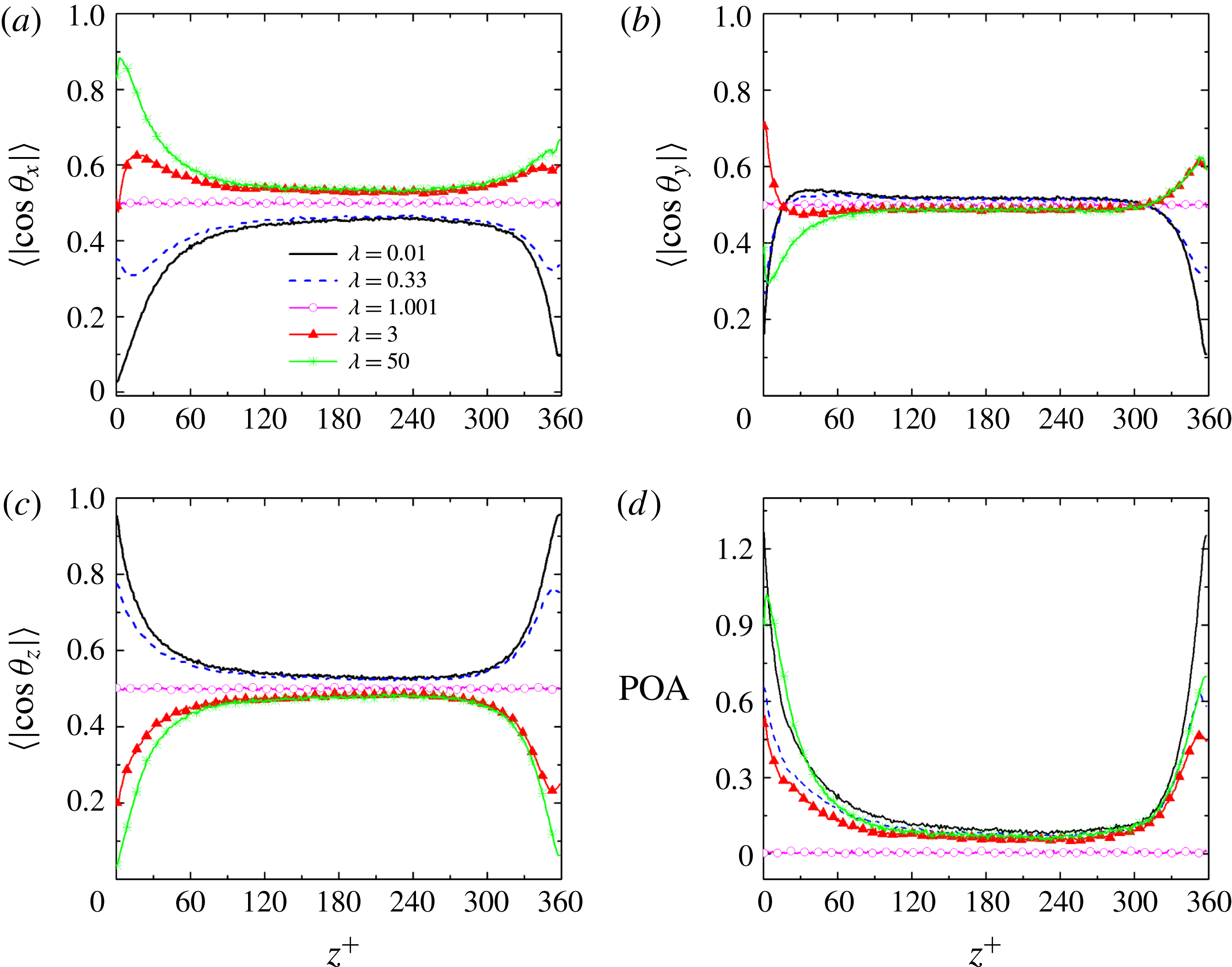
Figure 2 shows the direction cosines of the particle orientation vector
 $\boldsymbol{p}$
relative to the axes
 $\langle x,y,z\rangle$
of the inertial coordinate frame in which the flow field is computed. Close to the stationary wall, tracer spheroids orient similarly as in the channel flow (Challabotla et al.
Reference Challabotla, Zhao and Andersson2015b
). Long rods and thin disks align preferentially in the streamwise direction (
 $\langle |\text{cos}\,\unicode[STIX]{x1D703}_{x}|\rangle \approx 0.8$
) and the wall-normal direction (
 $\langle |\text{cos}\,\unicode[STIX]{x1D703}_{z}|\rangle \approx 0.9$
), respectively. Near the moving wall, where the mean shear is approaching zero, we observe that the disks orient similarly (
 $\langle |\text{cos}\,\unicode[STIX]{x1D703}_{z}|\rangle \approx 0.9$
) as they do close to the stationary wall, whereas the alignment of rods is relatively more random in the
 $(x,y)$
-plane (
 $\langle |\text{cos}\,\unicode[STIX]{x1D703}_{x}|\rangle \approx \langle |\text{cos}\,\unicode[STIX]{x1D703}_{y}|\rangle \approx 0.6$
) for
 $\unicode[STIX]{x1D706}=50$
.
Mean direction cosines of particle orientation (a)
 $\langle |\text{cos}\,\unicode[STIX]{x1D703}_{x}|\rangle$
, (b)
 $\langle |\text{cos}\,\unicode[STIX]{x1D703}_{y}|\rangle$
and (c)
 $\langle |\text{cos}\,\unicode[STIX]{x1D703}_{z}|\rangle$
in streamwise, spanwise and wall-normal directions, respectively; (d) scalar measure of particle orientation anisotropy
 $\text{POA}=|\langle |\text{cos}\,\unicode[STIX]{x1D703}_{x}|\rangle -0.5|+|\langle |\text{cos}\,\unicode[STIX]{x1D703}_{y}|\rangle -0.5|+|\langle |\text{cos}\,\unicode[STIX]{x1D703}_{z}|\rangle -0.5|$
.

Even though the mean shear rate
 $\text{d}U/\text{d}z$
is finite and approximately
 $1/3$
of the magnitude of the vorticity fluctuations in the central region of the Couette–Poiseuille flow (Yang et al.
Reference Yang, Zhao and Andersson2017b
), the spheroids tend towards almost random orientation irrespective of their aspect ratio
 $\unicode[STIX]{x1D706}$
. Randomized orientations of inertia-free spheroids were earlier observed in the shear-free centre of a plane channel flow by Challabotla et al. (Reference Challabotla, Zhao and Andersson2015b
) and in HIT by Parsa et al. (Reference Parsa, Calzavarini, Toschi and Voth2012), in both of which the vorticity field is (almost) isotropic.
According to figure 2(a–c), the preferential orientation of the spheroids is distinctly different near the two walls, whereas the orientation is almost isotropic in the centre region. A measure of the anisotropy of the orientation is shown in figure 2(d) where the particle orientation anisotropy POA is an indicator of the degree of departure from a random distribution
 $\langle |\text{cos}\,\unicode[STIX]{x1D703}_{i}|\rangle =0.5,i=1,2,3$
. Disk-like particles exhibit almost the same degree of anisotropy at both sides of the Couette–Poiseuille flow, whereas long rods orient more anisotropically near the stationary wall than in the vicinity of the moving wall. Earlier studies in HIT (Marcus et al.
Reference Marcus, Parsa, Kramel, Ni and Voth2014; Ni et al.
Reference Ni, Kramel, Ouellette and Voth2015) and WT (Zhao et al.
Reference Zhao, Challabotla, Andersson and Variano2015) show that the orientation of spheroids relative to the local fluid vorticity plays a vital role in particle rotational behaviour. It is therefore interesting to further examine how spheroids rotate with the different orientation distributions in the current Couette–Poiseuille flow.
3.2 Rotation modes in the particle frame
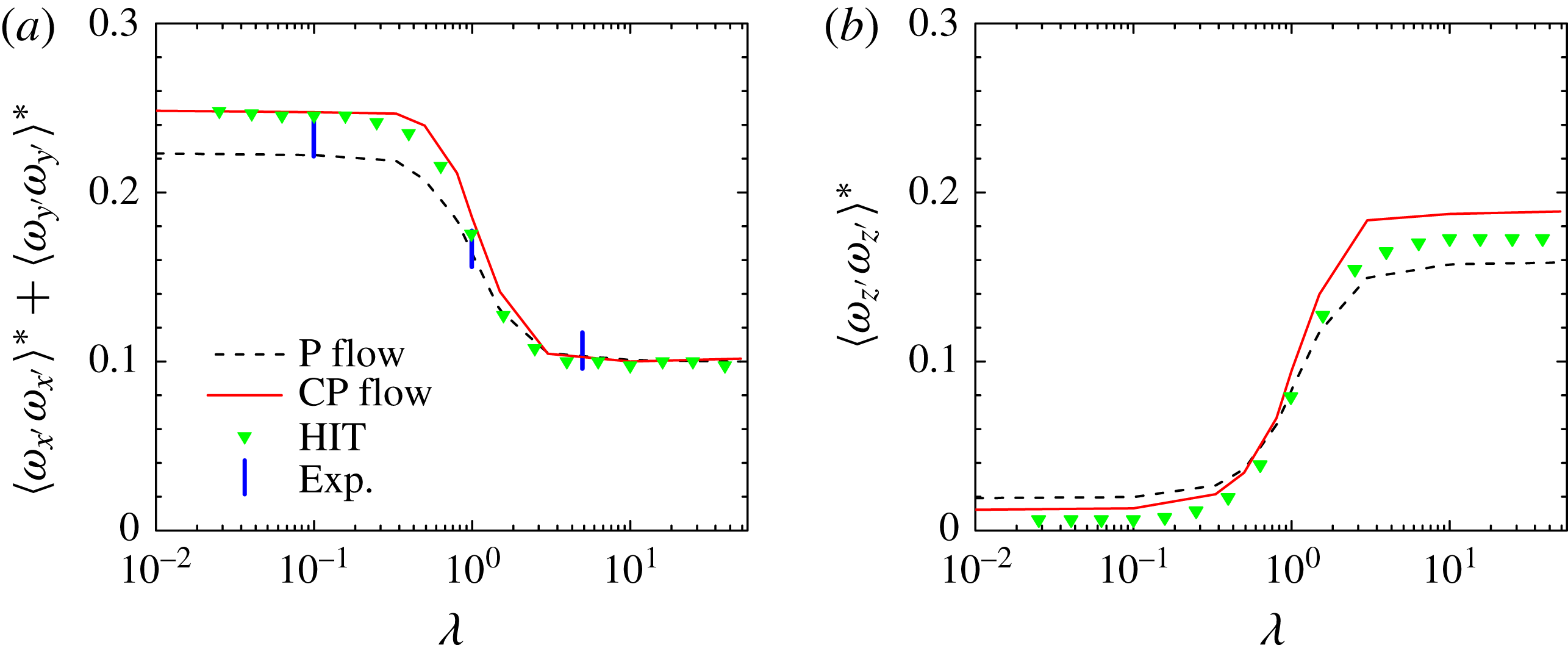
We firstly explore how a spheroid rotates in the centre of the Couette–Poiseuille flow where the particles orient almost randomly (see figure 2), although the local fluid vorticity is anisotropic due to the presence of mean shear. Figure 3 shows the tumbling and spinning rates in the centre compared with earlier channel-flow results and experimental measurements in HIT. The close agreement indicates that the spheroids rotate in Mode I also in the present case, similarly to HIT and channel flow. Accordingly, we conclude that the isotropy of the particle orientation plays a more important role in the particle rotation mode, namely that rods spin and disks tumble, as long as their orientation is (almost) isotropic and no matter whether the vorticity field is isotropic (as in a channel centre and HIT) or anisotropic (as in the present flow). The slightly faster tumbling of disks and spinning of rods is most likely caused by the different Taylor-scale Reynolds number (
 $Re_{\unicode[STIX]{x1D706}}\approx 52$
compared to
 $Re_{\unicode[STIX]{x1D706}}\approx 24.8$
in the channel flow). Although a mean shear persists all across the Couette–Poiseuille flow, the shear rate
 $\text{d}U/\text{d}z$
in the centre region is only approximately
 $1.5\,\%$
of the shear rate at the stationary wall and is therefore approximately of the same order of magnitude as the vorticity fluctuations.
Channel-centre results of (a) tumbling component, and (b) spinning component of the particle rotation vector
 $\unicode[STIX]{x1D74E}$
. Dashed black line: channel (P) flow (Zhao et al.
Reference Zhao, Challabotla, Andersson and Variano2015); solid red line: Couette–Poiseuille flow; green symbols: HIT (Byron et al.
Reference Byron, Einarsson, Gustavsson, Voth, Mehlig and Variano2015); blue bars: experimental data (Parsa et al.
Reference Parsa, Calzavarini, Toschi and Voth2012; Marcus et al.
Reference Marcus, Parsa, Kramel, Ni and Voth2014). The superscript * indicates normalization by the local Kolmogorov time scale.

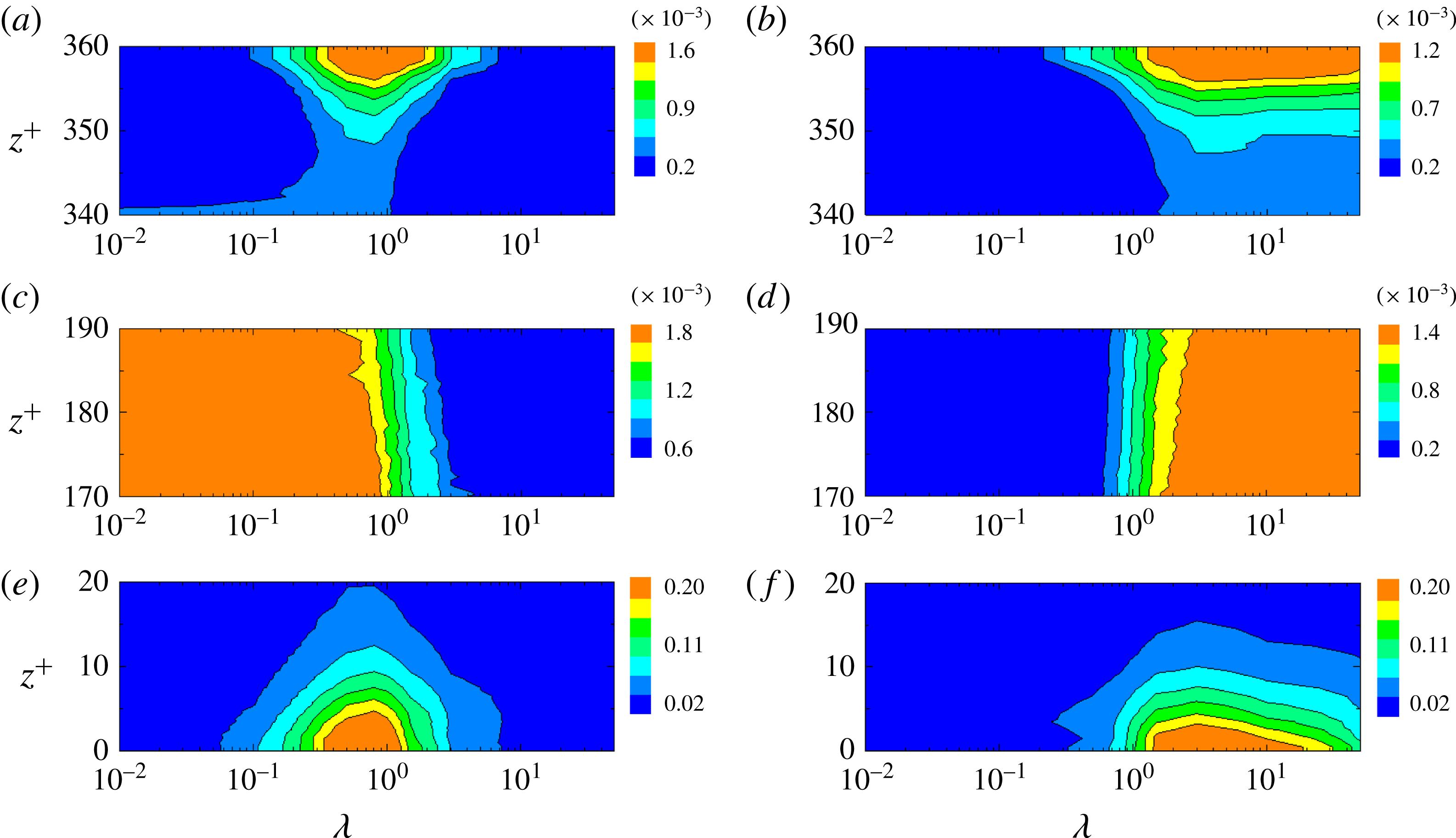
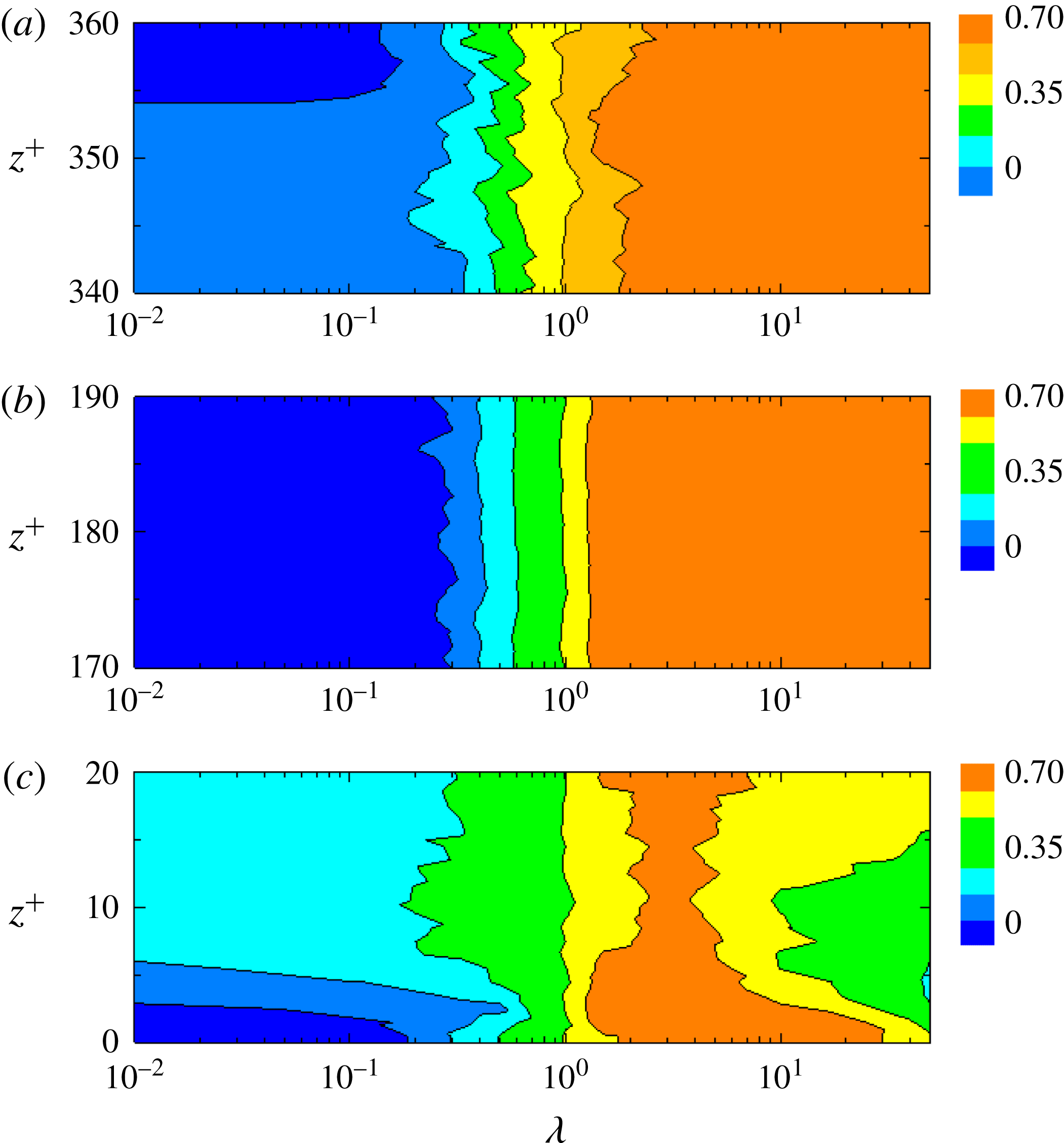
Zhao et al. (Reference Zhao, Challabotla, Andersson and Variano2015) showed that strong mean shear does play an important role in the particle rotation in the wall region where the particles are preferentially aligned relative to the channel walls. Let us therefore take a closer look at how the particles rotate in the Couette–Poiseuille flow where the mean shear is distinctly different at the two walls. Figures 4(a,c,e) and 4(b,d,f) show contours of tumbling and spinning rates, respectively. The two plots in the middle row show that rods preferentially spin whereas disks preferentially tumble in the centre region. This Mode I rotation persists over a fairly wide core region and not only at the centre (i.e. at
 $z^{+}=180$
, as shown in figure 3).
Contours of tumbling (a,c,e) and spinning (b,d,f) rates of spheroids near the moving wall, in the channel-centre region and near the stationary wall region (from top row to bottom row).

The particle rotation in the shear-dominated near-wall region from
 $z^{+}=0$
to 20 is shown in the lower row of figure 4. The highest tumbling rate is observed for spheroids with an aspect ratio slightly below unity (
 $\unicode[STIX]{x1D706}\approx 0.8$
), whereas the largest spinning rate is seen for intermediate aspect ratios
 $\unicode[STIX]{x1D706}\approx 3$
. Both spinning and tumbling are suppressed with increasing asphericity. These findings are consistent with our earlier observations in channel-flow turbulence (Zhao et al.
Reference Zhao, Challabotla, Andersson and Variano2015). This is to be expected since the near-wall turbulence in the Couette–Poiseuille flow exhibits the same anisotropic vorticity field and the same coherent flow structures as the channel flow (see Yang et al.
Reference Yang, Zhao and Andersson2017b
). While Zhao et al. (Reference Zhao, Challabotla, Andersson and Variano2015) showed results only at
 $z^{+}=10$
, the present results reveal that the strong tumbling rate of slightly flattened disks (
 $\unicode[STIX]{x1D706}\approx 0.8$
) and the fast spinning rate of intermediate (
 $\unicode[STIX]{x1D706}\approx 3$
) rods decay rapidly with the distance from the stationary wall. This is likely to be associated with the decreasing mean shear rate
 $\text{d}U/\text{d}z$
.
In contrast to the strong shear near the stationary wall, the shear rate is negligibly small near the moving wall. Here, we recall from figure 2 that disks preferentially aligned in the wall-normal direction whereas rods oriented almost randomly in the homogeneous
 $(x,y)$
-plane. Since disk-like particles orient similarly near the moving and stationary walls, it is interesting to observe that disks also rotate similarly near the moving wall (figure 4 top row) as near the stationary wall (lower row). This is perhaps surprising since the local flow conditions are quantitatively and qualitatively different at the two walls of the Couette–Poiseuille flow. The mean shear rate, in particular, has its maximum at the stationary wall and almost vanishes at the moving wall.
On the other hand, the rotational behaviour of rod-like particles is different at the two walls. Short rods in the vicinity of the moving wall (figure 4 top row) almost equally spin and tumble. However, the tumbling rate decreases as the rods become longer, similarly to the centre region and at the stationary wall. The rapid spinning of the rods nevertheless persists even for the largest aspect ratio
 $\unicode[STIX]{x1D706}=50$
considered. This observation is in contrast to the gradual reduction of the spinning of long rods (increasing
 $\unicode[STIX]{x1D706}$
) near the stationary wall. Rod-like spheroids near the moving wall seem to exhibit Mode I rotation rather than Mode II rotation seen near the stationary wall as well as in channel-flow turbulence. The almost random orientation of rod-like particles in wall-parallel planes observed in figure 2 appears to play a dominating role in their rotational behaviour even in the moving wall region. This explains why the rods rotate differently at the two sides of the Couette–Poiseuille flow, while disk-like particles exhibit the same rotational behaviour in spite of the distinctly different mean shear rates. Here, we have learned that the preferential particle orientations have a deciding effect on the preferred mode of rotation. We recently demonstrated that the actual orientations of spheroidal particles are caused by alignment of rods (disks) with the strongest Lagrangian stretching (compression) direction in channel-flow turbulence and, furthermore, we conjectured this preferential alignment to be a universal phenomenon (Zhao & Andersson Reference Zhao and Andersson2016).
Cosine of the angle
 $\unicode[STIX]{x1D6FC}$
between particle orientation vector
 $\boldsymbol{p}$
and fluid vorticity vector
 $2\unicode[STIX]{x1D734}$
near (a) the moving wall, (b) channel centre and (c) the stationary wall.

The alignment of a non-spherical tracer particle relative to the local fluid vorticity has been used to explain the shape-dependent rotational behaviour (Gustavsson et al.
Reference Gustavsson, Einarsson and Mehlig2014; Zhao et al.
Reference Zhao, Challabotla, Andersson and Variano2015). In figure 5 we examine the angle
 $\unicode[STIX]{x1D6FC}$
between particle orientation
 $\boldsymbol{p}$
and fluid vorticity vector
 $2\unicode[STIX]{x1D734}$
. Firstly, we observe that rods align in the direction of the vorticity vector in the centre region whereas disks orient normal to
 $\unicode[STIX]{x1D734}$
. This preferred alignment causes rods to preferentially spin and disks to tumble (Ni et al.
Reference Ni, Ouellette and Voth2014; Zhao et al.
Reference Zhao, Challabotla, Andersson and Variano2015). In the region next to the stationary wall, the alignment of the tracer spheroids closely resembles the near-wall orientation in channel-flow turbulence (Zhao et al.
Reference Zhao, Challabotla, Andersson and Variano2015). In spite of the absence of mean shear, however, disk-like particles also align similarly near the moving wall. This observation explains the close similarity of disk rotation at the two distinctly different walls of the Couette–Poiseuille flow seen in figure 4. In contrast, however, rod-like particles orient themselves fundamentally differently relative to the local fluid vorticity near the two walls. Indeed, the alignment angle
 $\unicode[STIX]{x1D6FC}$
of rods relative to
 $\unicode[STIX]{x1D734}$
in figure 5(a) is strikingly similar to the alignment in the centre region in figure 5(b). Yang et al. (Reference Yang, Zhao and Andersson2017b
) showed that
 $\unicode[STIX]{x1D734}$
approaches a 2-D isotropy at the moving wall, see also figure 4(b). Now we have seen that this induces an orientational isotropy in wall-parallel planes of rod-like particles. This, in turn, might explain why the rotation of rods near the shear-free moving wall tends to Mode I.
In spite of the fact that the mean shear rate
 $\text{d}U/\text{d}z$
at the moving wall is lower than
 $1\,\%$
of the shear rate at the stationary wall, the disk-like particles orient and rotate similarly as they do near the stationary wall where conventional wall turbulence prevails in presence of a high shear rate. This suggests that even a very modest shear rate might play a non-negligible role provided that the particles are preferentially aligned in the flow field.
3.3 Alignment with Lagrangian fluid stretching and compression
The important role played by the orientation of differently shaped spheroids in their rotational behaviour in the Couette–Poiseuille flow, as demonstrated in § 3.2, raises the fundamental question regarding why spheroids orient differently relative to the local fluid vorticity near the moving and the fixed walls. According to the recent study by Ni et al. (Reference Ni, Ouellette and Voth2014), Lagrangian fluid stretching and compression cause preferential alignment of tracer spheroids in homogeneous isotropic turbulence (HIT), whereas Zhao & Andersson (Reference Zhao and Andersson2016) demonstrated that similar preferential alignments also exist in anisotropic wall turbulence (WT). In both HIT and WT, long rods and thin disks were found to orient in the direction of Lagrangian fluid stretching and compression, respectively. Zhao & Andersson (Reference Zhao and Andersson2016) accordingly suggested that this is a universal mechanism. If so, the preferential alignment of tracer spheroids near the moving wall, as already observed in figure 5, can also be explained by means of Lagrangian fluid stretching. This as yet unanswered question will be addressed in the present subsection.
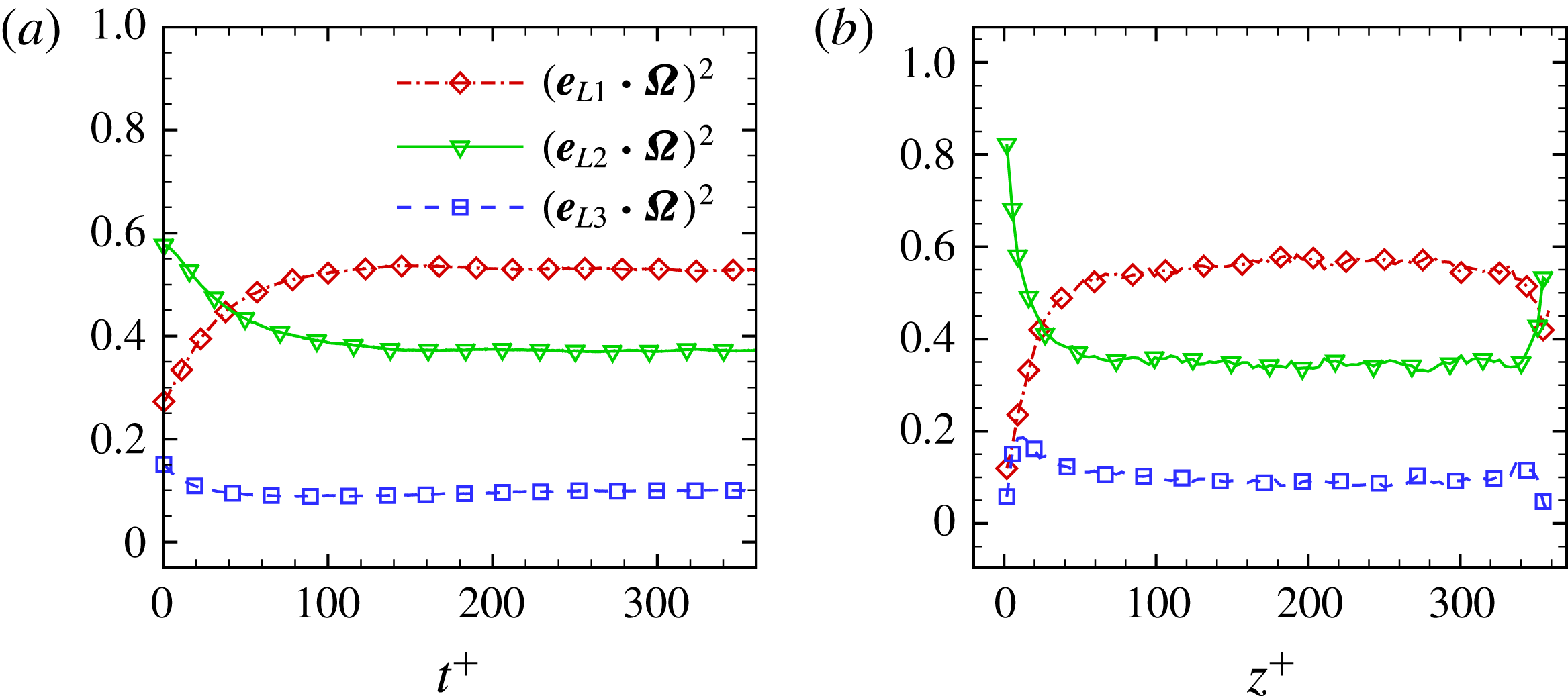
Alignment of the local fluid rotation vector
 $\unicode[STIX]{x1D734}$
relative to the three eigenvectors
 $\boldsymbol{e}_{Li}$
of the left Cauchy–Green strain tensor. Here,
 $\boldsymbol{e}_{L1}$
and
 $\boldsymbol{e}_{L3}$
are the maximum (extensional) and minimum (compressional) eigenvectors, respectively. (a) Time evolution of
 $\langle (\boldsymbol{e}_{Li}\boldsymbol{\cdot }\unicode[STIX]{x1D734})^{2}\rangle$
; (b) variation of
 $\langle (\boldsymbol{e}_{Li}\boldsymbol{\cdot }\unicode[STIX]{x1D734})^{2}\rangle$
from the stationary wall at
 $z^{+}=0$
to the moving wall at
 $z^{+}=360$
sampled over an almost statistically steady state period from 300 to 360
 $\unicode[STIX]{x1D708}/u_{\unicode[STIX]{x1D70F}}^{2}$
. Notice that the vorticity vector is two times the rotation vector, i.e. 2
 $\unicode[STIX]{x1D734}$
, and random alignment gives
 $\langle (\boldsymbol{e}_{Li}\boldsymbol{\cdot }\unicode[STIX]{x1D734})^{2}\rangle =1/3$
.

The Lagrangian stretching and compression directions are given by the maximum and minimum eigenvectors,
 $\boldsymbol{e}_{L1}$
and
 $\boldsymbol{e}_{L3}$
, of the left Cauchy–Green strain tensor, respectively. We computed the Cauchy–Green strain tensor by using 50 000 stored Lagrangian trajectories together with the particle orientation vector
 $\boldsymbol{p}$
, the particle rotation vector
 $\unicode[STIX]{x1D74E}$
and local fluid velocity gradient tensor
 $\unicode[STIX]{x1D608}_{ij}$
for each of the particle shapes
 $\unicode[STIX]{x1D706}=0.01$
, 0.1, 0.33, 3, 10 and 50. When the simulation had been advanced for a time
 $324\unicode[STIX]{x1D708}/u_{\unicode[STIX]{x1D70F}}^{2}$
after the tracer spheroids were initially introduced at randomly distributed locations, data were sampled and stored every
 $\unicode[STIX]{x0394}T=0.72\unicode[STIX]{x1D708}/u_{\unicode[STIX]{x1D70F}}^{2}$
over a total time window
 $T=360\unicode[STIX]{x1D708}/u_{\unicode[STIX]{x1D70F}}^{2}$
, i.e. 500 fields. This sampling frequency is the same as that used by Zhao & Andersson (Reference Zhao and Andersson2016) in their channel-flow simulation, but the time window over which statistics were gathered was more than twice as long in the present study. The detailed procedure to compute the three eigenvectors of the Cauchy–Green strain tensor followed the same approach as in the earlier work by Parsa et al. (Reference Parsa, Guasto, Kishore, Ouellette, Gollub and Voth2011), Ni et al. (Reference Ni, Ouellette and Voth2014) and Zhao & Andersson (Reference Zhao and Andersson2016).
Firstly, we examine the correlation between fluid rotation and the three eigenvectors of the left Cauchy–Green tensor. We observe from figure 6(a) that a statistically steady state has been reached after approximately 150 viscous time units
 $\unicode[STIX]{x1D708}/u_{\unicode[STIX]{x1D70F}}^{2}$
. A modest alignment between the fluid rotation vector
 $\unicode[STIX]{x1D734}$
and the maximum eigenvector of the left Cauchy–Green strain tensor
 $\boldsymbol{e}_{L1}$
can be seen since
 $\langle (\boldsymbol{e}_{L1}\boldsymbol{\cdot }\unicode[STIX]{x1D734})^{2}\rangle \approx 0.53$
. This alignment is in between the alignment
 ${\approx}0.60$
in HIT (Ni et al.
Reference Ni, Ouellette and Voth2014) and
 ${\approx}$
0.50 at the centre of a turbulent channel flow (Zhao & Andersson Reference Zhao and Andersson2016). The weaker alignment observed in the channel flow was ascribed to the alteration of the alignment of the fluid rotation vector
 $\unicode[STIX]{x1D734}$
with the eigenvector
 $\boldsymbol{e}_{L1}$
from the channel walls to the channel centre. The fluid rotation vector was preferentially aligned in the direction of Lagrangian stretching only in the centre region of the channel, whereas the fluid rotation turned out to be perpendicular to both Lagrangian stretching and compression directions near the channel walls. In the Couette–Poiseuille flow, we observe in figure 6(b) similar alignments near the stationary wall and in the core region (
 $z^{+}\approx 180$
) as in turbulent channel flow. In spite of the finite mean shear rate
 $\text{d}U/\text{d}z$
over a wide core region in the Couette–Poiseuille flow, the same alignment
 $\langle (\boldsymbol{e}_{L1}\boldsymbol{\cdot }\unicode[STIX]{x1D734})^{2}\rangle \approx 0.57$
as at the centre of the channel flow where
 $\text{d}U/\text{d}z=0$
is found. This is remarkably close to the distinct alignment
 ${\approx}0.60$
in HIT.
However, near the moving wall, where the mean shear is almost zero, the fluid rotation vector still tends to align in the direction of Lagrangian fluid stretching, similarly to the channel-centre region and in HIT, but the preferential alignment is somewhat reduced to
 $\langle (\boldsymbol{e}_{L1}\boldsymbol{\cdot }\unicode[STIX]{x1D734})^{2}\rangle \approx 0.40$
in the immediate vicinity of the wall, but yet significantly higher than
 $1/3$
for random alignment. The observed similarities between the preferential orientations at the moving wall and in the centre region suggest that mean shear plays a crucial role in how the fluid vorticity orients relative to the Lagrangian fluid stretching direction. In turn, as already discussed in § 3.2, the relative alignment between particle orientation and fluid vorticity affects the particle’s rotational mode.
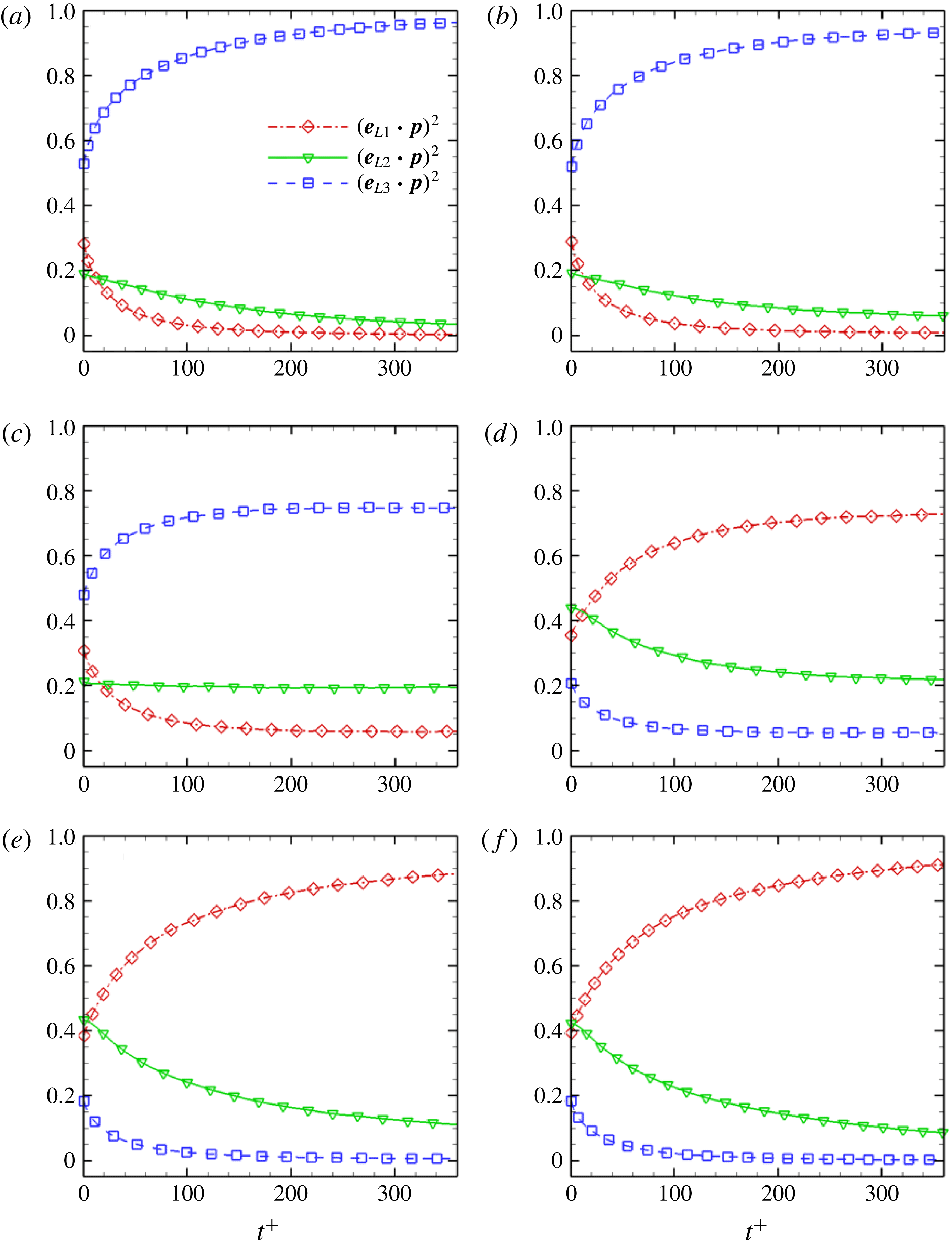
Time evolution of the alignment of the orientation vector
 $\boldsymbol{p}$
of spheroids with aspect ratio
 $\unicode[STIX]{x1D706}$
relative to the three eigenvectors
 $\boldsymbol{e}_{Li}$
of the left Cauchy–Green strain tensor. Here,
 $\boldsymbol{e}_{L1}$
and
 $\boldsymbol{e}_{L3}$
are the maximum (extensional) and minimum (compressional) eigenvectors, respectively. Random alignment gives
 $\langle (\boldsymbol{e}_{Li}\boldsymbol{\cdot }\boldsymbol{p})^{2}\rangle =1/3$
. (a)
 $\unicode[STIX]{x1D706}=0.01$
; (b)
 $\unicode[STIX]{x1D706}=0.1$
; (c)
 $\unicode[STIX]{x1D706}=0.33$
; (d)
 $\unicode[STIX]{x1D706}=3$
; (e)
 $\unicode[STIX]{x1D706}=10$
; (f)
 $\unicode[STIX]{x1D706}=50$
.

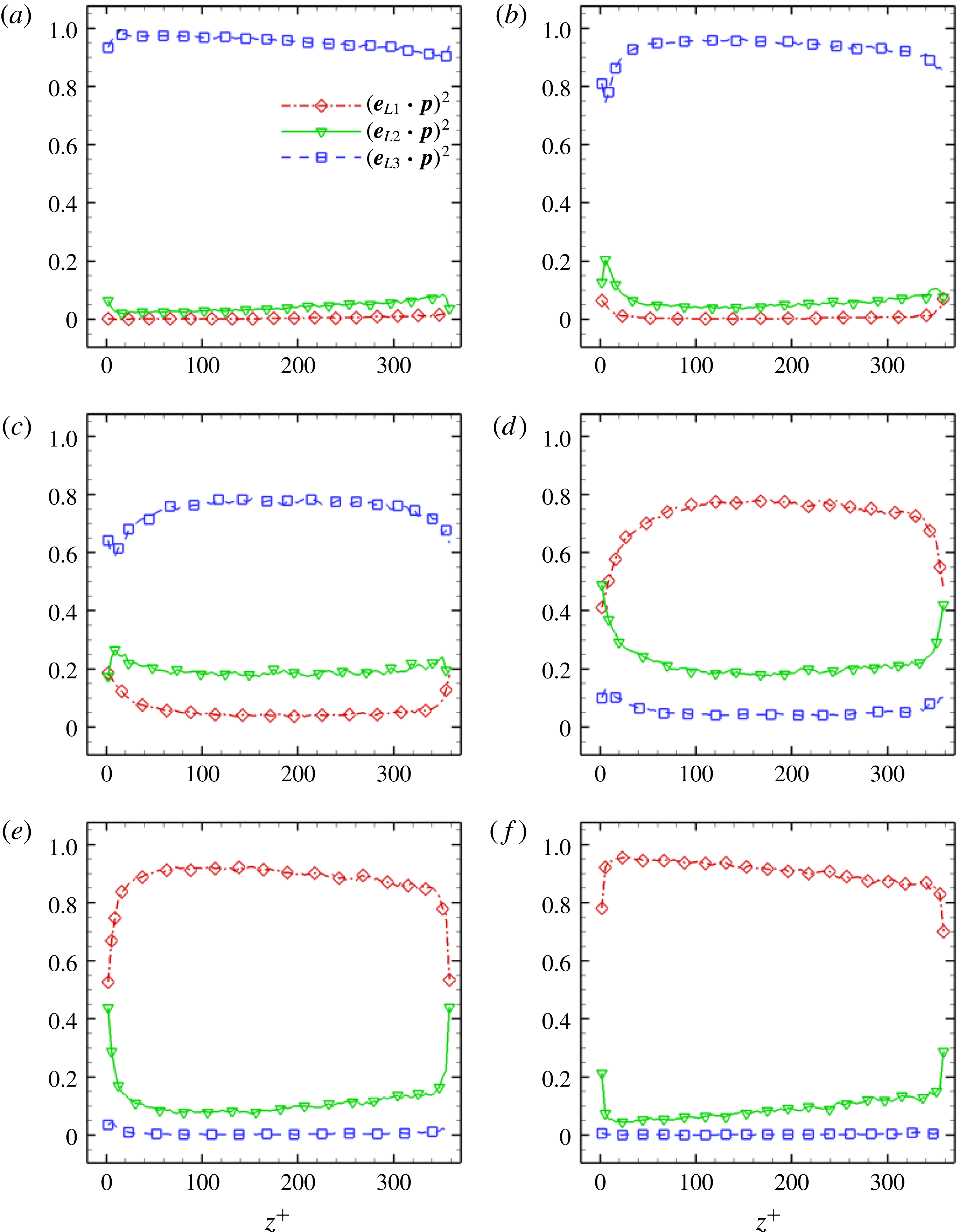
Variation of the alignment of the orientation vector
 $\boldsymbol{p}$
of spheroids with aspect ratio
 $\unicode[STIX]{x1D706}$
relative to the three eigenvectors
 $\boldsymbol{e}_{Li}$
of the left Cauchy–Green strain tensor from the stationary wall (
 $z^{+}=0$
) to the moving wall (
 $z^{+}=360$
). Here,
 $\boldsymbol{e}_{L1}$
and
 $\boldsymbol{e}_{L3}$
are the maximum (extensional) and minimum (compressional) eigenvectors, respectively. Random alignment gives
 $\langle (\boldsymbol{e}_{Li}\boldsymbol{\cdot }\boldsymbol{p})^{2}\rangle =1/3$
. (a)
 $\unicode[STIX]{x1D706}=0.01$
; (b)
 $\unicode[STIX]{x1D706}=0.1$
; (c)
 $\unicode[STIX]{x1D706}=0.33$
; (d)
 $\unicode[STIX]{x1D706}=3$
; (e)
 $\unicode[STIX]{x1D706}=10$
; (f)
 $\unicode[STIX]{x1D706}=50$
.

As a final task we explore how tracer spheroids orient with the eigenvectors of the Cauchy–Green tensor. Results for six representative aspect ratios, from flat disks (
 $\unicode[STIX]{x1D706}=0.01$
) to long rods (
 $\unicode[STIX]{x1D706}=50$
), are shown in figures 7 and 8. The time evolution of the alignments in the Couette–Poiseuille flow in figure 7 are strikingly similar to the corresponding results in HIT and channel-flow turbulence reported by Ni et al. (Reference Ni, Ouellette and Voth2014) and Zhao & Andersson (Reference Zhao and Andersson2016), respectively. The rods preferentially orient in the direction of Lagrangian stretching
 $\boldsymbol{e}_{L1}$
, while disks tend to align in the direction of Lagrangian compression
 $\boldsymbol{e}_{L3}$
. It is noteworthy that the longest time it takes to reach a statistically steady state is for the most aspherical particles.
Of major interest is the alteration of the alignments across the Couette–Poiseuille flow, and in particular how the spheroids align themselves near the moving wall. The variation of
 $\langle (\boldsymbol{e}_{Li}\boldsymbol{\cdot }\boldsymbol{p})^{2}\rangle$
with
 $z$
has been sampled from
 $t^{+}=300$
to 360 and is presented in figure 8. Recall from figure 7 that almost all the adaption of the correlations
 $\langle (\boldsymbol{e}_{Li}\boldsymbol{\cdot }\boldsymbol{p})^{2}\rangle$
to steady state has occurred at
 $t^{+}=300$
. Unlike the distinctly asymmetric variation of the alignment of the fluid rotation
 $\unicode[STIX]{x1D734}$
relative to the eigenvectors
 $\boldsymbol{e}_{Li}$
in figure 6(b), the variations of
 $\langle (\boldsymbol{e}_{Li}\boldsymbol{\cdot }\boldsymbol{p})^{2}\rangle$
from the stationary wall to the moving wall are surprisingly symmetric, irrespective of particle shape. The results near the stationary wall, e.g.
 $z^{+}<100$
, are almost identical with the near-wall results in the channel flow (Zhao & Andersson Reference Zhao and Andersson2016) and show a modest weakening of the preferential alignments close to the wall. In spite of the almost vanishing mean shear rate in the vicinity of the moving wall, the preferred alignments remain nearly the same as next to the stationary wall; i.e. rods align preferentially in the Lagrangian stretching direction and disks orient in the Lagrangian compression direction. The results in figure 8 suggest that the alignment of a particle’s symmetry axis relative to the Lagrangian stretching (rod-like spheroids) or compression direction (disk-like spheroids) persists all across the Couette–Poiseuille flow, even though the flow structures and the vorticity field are strongly location dependent. These findings give further support to our conjecture that the preferential particle orientation in Lagrangian stretching or compression directions is robust and universal in both isotropic and anisotropic turbulence fields.
On the other hand, the alignment of fluid vorticity 2
 $\unicode[STIX]{x1D734}$
relative to the Lagrangian stretching direction
 $\boldsymbol{e}_{L1}$
is affected by the wall conditions. This leads to distinctly different alignments at the moving and stationary walls of the Couette–Poiseuille flow. It is already known that a particle’s rotational behaviour is determined by how the particle orientates relative to the fluid vorticity, e.g. rods spin if aligned in the direction of the fluid vorticity but tumble if orientated perpendicular to the fluid vorticity. Now, on the basis of the present analysis of how the fluid rotation vector and the particle orientation vector orient relative to Lagrangian stretching or compression directions, a more comprehensive explanation of earlier findings is provided and a more complete interpretation of tracer particles rotation modes in different flow fields has been given.
4 Concluding remarks
Rotational motion of spheroidal particles suspended in fluid turbulence is of vital importance for particle transport in general and collision outcome of nearby particles in particular. In this work, two distinctly different rotation modes of tracer spheroids reported in channel-flow turbulence (Zhao et al. Reference Zhao, Challabotla, Andersson and Variano2015) were further investigated in a tailor-made Couette–Poiseuille flow. Contrary to the channel flow, the present flow case comprised a strongly sheared wall region (close to the stationary wall), a nearly homogeneous shear region (in the centre) and a region with almost negligible mean shear close to the moving wall. The objective was to achieve a better understanding of spheroidal particle rotation in sheared turbulence by exploring the different mechanisms that distinguish between the two rotation modes, namely the anisotropy of the particle orientation and fluid shear. These are considered to be the two major factors influencing the particle rotational behaviour.
In accordance with the present findings, particle orientation generally plays the most dominating role. In the centre region, the mean shear has practically no influence on particle rotation due to the isotropy of the particle orientations. In the two wall regions, however, mean shear plays a role in particle rotation whenever the particles are preferentially oriented (e.g. preferential alignments of disks and rods near the stationary wall in wall-normal and streamwise directions, respectively, and of disk-like particles in the wall-normal direction near the moving wall). The magnitude of the mean shear rate turned out to be of little importance for the particle rotation since disk-like particles were found to rotate in Mode II near the moving wall where the shear is rather modest (Yang et al. Reference Yang, Zhao and Andersson2017b ). As the isotropy of the orientation of rod-like particles increased near the moving wall, the effect of mean shear was weakened and rods rotated in Mode I, similarly to the centre region.
Furthermore, we measured the angle between the particle orientation vector and the local fluid vorticity vector. Similar particle alignments relative to fluid vorticity in the channel flow were observed in the centre region and near the stationary wall. Near the moving wall, however, long rods aligned with the direction of the vorticity vector and therefore spin preferentially. Thin disks, on the other hand, preferentially orientated perpendicular to the vorticity vector. Nevertheless, no preference of tumbling could be observed. This is due to the preferential orientation of disks in the wall-normal direction along with the influence of weak mean shear.
We finally examined if and how the differently shaped spheroids preferentially aligned with the direction of Lagrangian stretching and compression. The correlations between the orientation vector
 $\boldsymbol{p}$
and the left Cauchy–Green strain tensor
 $\boldsymbol{e}_{Li}$
explained the distinctly different alignments of the spheroids in the centre of the Couette–Poiseuille flow and near the two differently sheared walls. We were led to the conclusion that the preferential particle orientation along the Lagrangian stretching or compression directions is universally found in both isotropic and anisotropic turbulence and is independent of the mean shear rate.
In the present Couette–Poiseuille flow with vanishing mean shear at the moving wall, we observed roll-cell-like large-scale structures (LSSs) similarly to a plane Couette flow (Yang et al.
Reference Yang, Zhao and Andersson2017b
), but these LSSs were considerably weaker and less coherent than those observed in DNS of plane Couette flow, e.g. Papavassiliou & Hanratty (Reference Papavassiliou and Hanratty1997) and Andersson, Lygren & Kristoffersen (Reference Andersson, Lygren, Kristoffersen and Bruneau1998). Such LSSs do have an impact on the distribution of inertial spheres in plane Couette flow (Bernardini, Pirozzoli & Orlandi Reference Bernardini, Pirozzoli and Orlandi2013 and Richter & Sullivan Reference Richter and Sullivan2013), but also in Couette–Poiseuille flow (Yang et al.
Reference Yang, Zhao and Andersson2017a
, Reference Yang, Zhao and Andersson2018). The non-spherical particles studied in the present paper have zero inertia and accordingly distribute themselves randomly across the entire flow field. The orientations and rotations of these sub-Kolmogorov-sized particles are determined only by the local flow conditions, i.e. the small-scale eddies, whereas the size of the LSSs is of the order of the channel height
 $2h$
, i.e. order-of-magnitudes larger than the particle size. The presence of LSSs does therefore not impact on the tiny inertialess spheroids studied in the present work.
The preferential orientations of spheroidal particles reported herein are based on the assumption that the spheroids are inertialess. This assumption offers two major advantages. Firstly, the interpretations of the results are freed from a discussion of preferential concentration and turbophoresis since tracer particles remain evenly distributed in the flow field and passively follow the fluid motion. Secondly, the analysis of correlations between the particle orientation and the eigenvectors of the left Cauchy–Green tensor in § 3.3 relies on the fact that tracer spheroids follow the same trajectories as the Lagrangian fluid trajectories.
Another flow in which effects of mean shear on particle orientation and rotation can be investigated is homogeneous shear turbulence (HST). Rogers & Moin (Reference Rogers and Moin1987), Gerz, Schumann & Elghobashi (Reference Gerz, Schumann and Elghobashi1989), Lee et al. (Reference Lee, Kim and Moin1990) and Schumacher & Eckhardt (Reference Schumacher and Eckhardt2000) advocated different approaches towards DNS of HST, each with its own advantages and disadvantages (Sekimoto et al. Reference Sekimoto, Dong and Jiménez2016). A particularly attractive advantage of such flows over the Couette–Poiseuille flow is that the mean shear rate is the same everywhere. Potential direct or indirect interactions between the strongly sheared turbulence near the stationary wall and the weakly sheared region next to the moving wall are therefore excluded. However, the anisotropies of the fluctuating velocity and vorticity fields in HST are qualitatively different from the anisotropies observed in the vicinity of the moving wall in the Couette–Poiseuille flow (Yang et al. Reference Yang, Zhao and Andersson2017b ). In the nearly homogeneously sheared centre region, however, the turbulence field resembles HST. We are therefore inclined to conjecture that the observed particle behaviour in the centre region of the Couette–Poiseuille flow resembles what one would observe at similar mean shear rates in HST. However, the turbulence in the vicinity of the moving wall in the present Couette–Poiseuille flow is fundamentally different from HST. A primary motivation for the investigation was to explore particle behaviours in a flow field in which the role of the turbulence dominates over the effect of the mean shear rate. This objective cannot be fulfilled in HST.
The present findings of the roles played by preferential particle orientation and mean shear in rotation of non-spherical particles have obvious practical relevance, not only for plankton in the presence of wind shear, as mentioned in the introduction, but also for the behaviour of microplastics in marine environments (Barboza & Gimenez Reference Barboza and Gimenez2015).
Acknowledgements
The Research Council of Norway provided financial support through grant no. 250744 ‘Turbulence-plankton interactions’ and Sigma2 provided support of computational resources through grant no. NN2694K (Program for Supercomputing). The Second author was supported by Natural Science Foundation of China through grants nos 11702158, 91752205 and 11490551.