INTRODUCTION
Ecological monitoring increasingly involves members of the public, amateur naturalists, volunteers, and resource-dependent communities. In collaboration with scientists, these people use simple scientific techniques to monitor populations of species, dynamics of habitats and the provision of ecosystem services (Danielsen et al. Reference Danielsen, Burgess and Balmford2005; Lawrence Reference Lawrence and Lawrence2010). This ‘participatory ecological monitoring’ may raise environmental awareness, promote communication between stakeholders, improve environmental decision-making and contribute to assessing indicators for the Convention on Biological Diversity (Ballard et al. Reference Ballard, Fernandez-Gimenez and Sturtevant2008; Danielsen et al. Reference Danielsen, Burgess, Funder, Blomley, Brashares, Akida, Jensen, Mendoza, Stuart-Hill, Poulsen, Ramadhani, Sam, Topp-Jørgensen and Lawrence2010, Reference Danielsen, Pirhofer-Walzl, Adrian, Kapijimpanga, Burgess, Jensen, Bonney, Funder, Landa, Levermann and Madsen2013).
Much has been done to assess the accuracy and precision with which participatory monitoring can detect changes in biodiversity (Danielsen et al. Reference Danielsen, Burgess and Balmford2005; Hernandez-Stefanoni et al. Reference Hernandez-Stefanoni, Bello Pineda and Valdes Valadez2006; Evans & Guarigauata Reference Evans and Guariguata2008; Holck Reference Holck2008; Jones et al. Reference Jones, Andriamarovololona, Hockley, Gibbons and Milner-Gulland2008; Carvalho et al. Reference Carvalho, Williams, January and Sowman2009). Research also considers volunteer motivations, internal ‘meaning-making’ and knowledge creation associated with participatory monitoring (Ellis & Waterton Reference Ellis and Waterton2004; Bell et al. Reference Bell, Marzano, Cent, Kobierska, Podjed, Vandzinskaite, Reinert, Armaitiene, Grodzinska-Jurczak and Muršic2008; Lawrence Reference Lawrence2009; Lawrence & Turnhout Reference Lawrence and Turnhout2010). More recently, critical work has drawn attention to how monitoring may ignore local knowledge and decision-making processes, and how it can be reshaped on the ground to serve particular local interests (Nielsen & Lund Reference Nielsen and Lund2012; Funder et al. Reference Funder, Danielsen, Ngaga, Nielsen and Poulsen2013; Staddon et al. Reference Staddon, Nightingale and Shrestha2014).
Participation in participatory monitoring can occur in various forms and with different end uses (Danielsen et al. Reference Danielsen, Burgess, Balmford, Donald, Funder, Jones, Alviola, Balete, Blomley, Brashares, Child, Enghoff, Fjeldså, Holt, Hübertz, Jensen, Jensen, Massao, Mendoza, Ngaga, Poulsen, Rueda, Sam, Skielboe, Stuart-Hill, Topp-Jørgensen and Yonten2009), however, project success and sustainability are closely related to the level of participation offered (Carter Reference Carter1995; Abbot & Guijt Reference Abbot and Guijt1998). We aimed to further explore what participation in participatory monitoring involves, what it delivers and to whom. We searched for interdisciplinary lessons on participation (Campbell & Vainio-Matilla Reference Campbell and Vainio-Mattila2003) by turning to scholarship on participation in international development.
Participatory approaches to development, conservation (generally) and ecological monitoring (specifically) differ in what they aim to deliver to communities (for example clean water supplies, a share in wildlife tourism revenue, or data with which to manage resources more sustainably, respectively), however they operate in very similar ways. They all tend to involve the establishment of a committee or core group of participants to lead activities, assumptions that information and skills will trickle-down from these groups to the wider community, and a belief that community involvement will increase the relevance, knowledge base, and uptake of interventions. For this reason, scholarship on participatory development (and community-based conservation) has much to offer towards an understanding of participation in ecological monitoring.
Participation is mainstreamed in international development, such that it is now considered unable to counter ‘top-down’ approaches and has itself become subject to critical analysis (Cooke & Kothari Reference Cooke and Kothari2001; Cornwall Reference Cornwall2002; Hickey & Mohan Reference Hickey and Mohan2004). Cooke and Kothari (Reference Cooke and Kothari2001) questioned whether participation in international development was the ‘new tyranny’, tyranny being defined as the unjust exercise of power. Such critique suggests that participation may constitute a tyranny in three ways: as a tyranny of the group, as a tyranny of the method, and as a tyranny of decision-making and control. We outline these three arguments, along with a consideration of their relevance for understanding participation in participatory ecological monitoring, specifically in the context of projects involving resource-dependent communities in the global South.
Tyranny of the group
Cooke and Kothari (Reference Cooke and Kothari2001) suggested that group dynamics can mean supposedly participatory decisions serve only to reinforce the interests of the already powerful. Some claim that conservation projects are engaged with ‘mythic communities’ (Agrawal & Gibson Reference Agrawal and Gibson1999), as they assume they are working with a group of homogenous people who share common views and interests that promote the making of desirable collective decisions. This is whilst evidence points to communities being internally differentiated according to gender, class, race, wealth, education or age, for example, producing local power relations that confer differentiated access to and control over natural resources (Nightingale Reference Nightingale2003). Others highlight that much of what is considered participation is rather a process whereby large numbers of people are represented by a relatively small group of participants (Hickey & Mohan Reference Hickey and Mohan2004).
Considering the contention that participation may represent a tyranny of the group, we analysed the distribution of costs and benefits arising from participatory monitoring projects both at an individual level (to reflect the impact of social differences), and at the wider community level to assess potential trickle-down of knowledge, information and benefits.
Tyranny of the method
Cooke and Kothari (Reference Cooke and Kothari2001) suggested that participatory methods could drive out others that have advantages that participation cannot provide. Whilst participatory projects may attempt to draw on local knowledge, it has been claimed that this is unable to negotiate on an equal basis with scientific knowledge, and that outsiders prioritize local knowledge that conforms to their scientifically driven environmental goals (Blaikie Reference Blaikie2006). With regards to the draw of particular methods, economic rationality is assumed to override social norms in explaining motivations to participate (Cleaver Reference Cleaver, Cooke and Kothari2001). Others see participation not as choice or opportunity to be offered by others employing particular methods, but rather as a way of promoting a rights-based approach to participation, seeing it as a basic human right to be demanded in what they term uninvited or citizenship participation (Cornwall Reference Cornwall2002).
Considering the contention that participation may represent a tyranny of the method, we paid particular attention to the forms of monitoring involved in participatory monitoring projects and what motivated participants.
Tyranny of decision-making and control
Cooke and Kothari (Reference Cooke and Kothari2001) suggested that participatory approaches can override legitimate decision-making processes already in place. Decisions made in formal committees established through participatory projects can be hotly disputed and are not automatically complied with, with much debate and decision-making occurring instead as part of people's daily interactions (Cleaver Reference Cleaver, Cooke and Kothari2001). With regards to control, although communities may be afforded the opportunity to engage in decision-making processes through participatory natural resource management projects, important issues remain over who retains control and how that is negotiated (Songorwa Reference Songorwa1999).
Considering the contention that participation may represent a tyranny of decision-making and control, we analysed the place of participatory monitoring in local systems of environmental decision-making and negotiations for control (material or symbolic) over natural resources.
We drew on case studies of two community forest user groups (CFUGs) in Nepal. Nepal's community forestry (see Supplementary material) provides an interesting case study for this research, as, despite fame for its decentralized forest governance, issues remain in terms of elite capture, transparency, and the difficult relationship between knowledge and power (Malla et al. Reference Malla, Neupane and Branney2003; Ojha et al. Reference Ojha, Timsina, Chhetri and Paudel2008). Control over forest resources is aligned with those who are seen to have the appropriate knowledge to manage the resource and typically this favours the Western science promoted by government foresters over the local ecological knowledge held by CFUG members, despite rhetoric to the opposite (Nightingale Reference Nightingale2005). A pertinent example of this was the introduction in 2002 of a mandatory forest inventory for all CFUGs. The inventory is based on technical forestry expertise and no opportunities were provided for local people's knowledge systems to be incorporated at the policy formation stage, nor subsequently for them to put this into practice (Ojha Reference Ojha2002; Paudel & Ojha Reference Paudel, Ojha, Ojha, Timsina, Chhetri and Paudel2008).
We examine case studies of participatory monitoring in the community forests of Nepal in relation to critiques of participatory development as tyrannical. We reflect on wider social, political and institutional contexts in order to understand how these produce conditions for tyranny in Nepal's community forests. Importantly, we consider ways in which the analysis offers opportunities for challenging tyrannies.
METHODS
Study sites
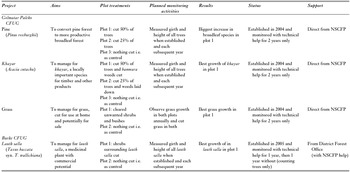
The case studies involved two CFUGs in Ramechhap district in the Middle Hills of eastern Nepal. Participatory monitoring projects were established under the name of community forest management schools (CFMS) by the Nepal Swiss Community Forestry Project (NSCFP). The projects aimed to provide a joint learning platform around forest management for particular products, whilst participants also benefited from the provision of forest products harvested as part of the monitoring plot establishment (firewood, grass and fodder). Approximately 30 CFUG members were chosen to participate in each project, and underwent one or two days of training, after which they carried out particular management practices within plots in the forest and with the help of forest technicians, aimed at monitoring the effects of the management annually over a five-year period (during which time the plots were ‘closed’ for harvesting forest products). The aims and plot treatments reflected local priorities in terms of management or use of particular forest products (Table 1). NSCFP had overall responsibility for the projects, although, in one case, direct assistance was provided by the local District Forest Office (DFO).
Details of the participatory monitoring projects, or ‘community forest management schools’ (CFMS), in the two community forest user groups (CFUGs) studied. NSCFP = Nepal Swiss Community Forestry Project.

In both CFUGs, for one or two years, participants performed official annual monitoring and some could recall comparing the measurements made during plot establishment with those taken at the time of monitoring. Since then, however, there has been no official monitoring, as technical support was withdrawn with the intention that CFUG members would take over responsibility and maintain the monitoring programme. Fieldwork for this study occurred 4 or 5 years after initiation of the projects.
Research methods
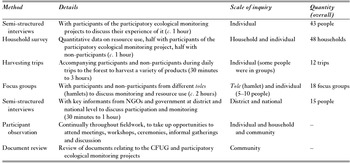
Fieldwork was carried out in Nepal between June 2007 and July 2008 by Sam Staddon and Shyam Shrestha, with the latter providing all translations. A mixed method approach was used, employing structured and unstructured methods to gather both quantitative and qualitative data (Table 2). Within both CFUGs, interviews were conducted with all available participants in the participatory monitoring projects (some participants had since left the villages for work or employment). A household survey, ‘harvesting trips’ and focus groups were also conducted, which aimed to engage not only with project participants, but also with other members of the community. Using the CFUG member list, respondents were chosen for these on a stratified random basis, with stratification based on tole (hamlet), caste and gender. This ensured a sample that represented the existing range of these important social distinctions.
Summary of methods employed during fieldwork (see text for sampling details). NGO = non-governmental organization; CFUG = community forest user group.

Quantitative data was analysed by comparing the means and totals of various categories of interest. Qualitative data in the form of discussions held during interviews, harvesting trips and focus groups was digitally recorded, later transcribed and then coded (Richards Reference Richards2005). We used NVivo 2.0 to aid the coding and qualitative analysis process. Quotes given in the results use the following notation: ‘CFMS’ denotes that the quote is from an interview with a CFMS participant, whilst ‘FG’ denotes that it derives from a focus group, either from ‘GP’ (Golmatar Paleko CFUG) or ‘B’ (Burke CFUG). The number (starting from ‘01’) denotes the respondent number from that part of the sample, and the date of the interview or focus group completes the notation.
Both qualitative and quantitative data are presented, with the aim of balancing some objective, quantified measures of how participants were involved in the monitoring projects, with more subjective, descriptive understandings. The strength of a case study approach, as used here, is not in its ability to make statistically-supported generalizations, but rather its ability to raise issues and questions that may be relevant to explore in analogous cases (‘analytic generalization’; Yin Reference Yin2003).
RESULTS
Tyranny of the group
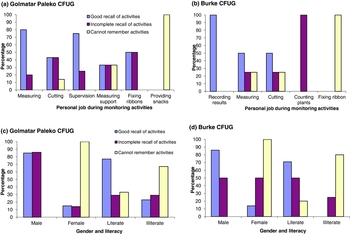
Establishing the monitoring plots involved a number of jobs (ways to participate): measuring and recording details of plants, cutting unwanted vegetation, fixing ribbons on trees to mark plot boundaries, supervising activities, counting trees, and providing snacks. Jobs were allocated by the CFUG committee and collaborating technicians in both CFUGs such that predominantly literate men and some young literate women measured and recorded plants, older men supervised, illiterate women fixed ribbons to trees and provided snacks, and everyone cut vegetation. Knowledge of and ability to recall activities carried out whilst establishing the plots varied amongst participants (Fig. 1). Men and those who were literate tended to have good recall of activities, whilst women and those who were illiterate tended not to not know of the different activities or plot treatments.
Knowledge and recall of monitoring activities based on jobs done personally during monitoring in (a) Golmatar Paleko community forest user group (CFUG) and (b) Burke CFUG, and on gender and literacy in (c) Golmatar Paleko CFUG and (d) Burke CFUG.

Knowledge of and information about the participatory monitoring projects had largely failed to reach the wider community. The approximately 30 participants in each project represented just 7% and 6% of households in Golmatar Paleko CFUG and Burke CFUG, respectively. In surveying households across the entire community, we found that only 20% of households in Golmatar Paleko CFUG and 33% in Burke CFUG knew anything about the projects; of which only half knew any details. For example, women in Golmatar Paleko CFUG knew that the plot areas were closed for harvesting products, but they had no idea why or what it was for [FG GP02 28 May 2008]. A woman in Burke CFUG relayed that ‘the plots were established as per the committee [decisions] so if someone is not involved in the [CFMS], it is closed for products so they don't need to go there so they don't know what is happening; the committee members know’ [FG B04 15 June 2008]. In Burke CFUG there were several misconceptions of what the monitoring plots were for; for example, one respondent thought that they were for ‘finding out who did miscutting [illegal cutting] or if someone steals’ [FG B02 13 June 2008].
Tyranny of the method
Whilst the projects aimed to provide joint learning platforms between participants and forest technicians, the majority of participants claimed they were involved only in learning, not exchanging their own skills; 95% of participants in Golmatar Paleko CFUG and 100% in Burke CFUG reported following a technician's advice in at least some aspects of monitoring. However, 25% in Golmatar Paleko CFUG and 17% in Burke CFUG reported feeling that their own knowledge was also included, although others (5% in Golmatar Paleko CFUG and 17% in Burke CFUG) reported what one man put succinctly: ‘we discussed about what we learnt in the past but we implemented what the technicians taught’ [CFMS B12 7 November 2007].
Forest technicians were responsible for producing an official report of monitoring results on behalf of the CFUGs; although one man reported that these were ‘difficult for all to understand. Only a few people understand [them]’ [CFMS GP11 29 October 2007] and one woman echoed others in saying ‘I have been told [about the official results] but I have [since] forgotten’ [CFMS GP16 30 October 2007]. However, participants discussed observing the plots themselves and seeing a change based, not on cumulative differences in volume or height (namely the official, technical results), but on appearance of the plot in terms of the growth form of the remaining trees, the density of the vegetation, the presence of new species and the growth of seedlings (descriptions based on local systems of monitoring). People reported of the pine conversion plots that they ‘found drastic change amongst the plots. In the plot where nothing was done it is not good and is bushy and no different from the past. Where we cut more, it is growing well and seedlings of chilaune, foril and lakouri are regenerating’ [CFMS GP04 28 October 2007]. Some expressed their surprise at observing these results; ‘where we cut 50% I thought it would not be safe for the forest, but we found there was better growth’ [CFMS GP08 28 October2007]. Similar responses were gained in relation to the other plots in both CFUGs. Even people who did not participate in the CFMS learnt of the monitoring results through their own observations.
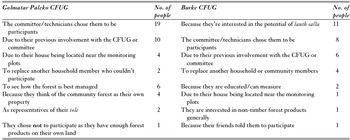
Motivations to participate in the monitoring projects were varied and multiple (Table 3). The majority of participants in Golmatar Paleko CFUG and almost half in Burke CFUG were involved (partly) because they were chosen as participants by either the committee or technicians, and often because they were regular participants in CFUG activities or were committee members. As one participant explained ‘the committee decided who [would participate], according to who would be interested and who had time’ [CFMS GP01 27 October 2007]. However, one man stated: ‘they [the committee] put my name down anyway, so I have to go; I thought it was an obligation’ [CFMS B13 7 November 2007]. Many in Burke CFUG wanted to be involved as they saw economic potential in the lauth salla, although some complained that benefits in terms of future sales had not to date materialized, suggesting that motivations to participate can change over time.
Responses given during interviews with project participants to the question ‘why did you become involved in the monitoring project?’ (many respondents gave more than one response; n = 26 for Golmatar Paleko community forest user group [CFUG] and n = 17 for Burke CFUG).

Tyranny of decision-making and control
Although forest technicians were responsible for producing an official report of monitoring results on behalf of the CFUGs, the DFO rangers assisting Burke CFUG failed to produce one, despite requests from participants. One participant reported ‘the first time the Rangers came all the data went with them. We have measured twice since. We informed the DFO office and, as per instruction, we performed all the measurements and sent in the results and the CFUG are demanding the [technical] results [back], but the [DFO] office have not sent them yet’ [CFMS B01 5 November 2007]. In Golmatar Paleko, CFUG participants also discussed technical results being retained by NSCFP technicians.
Despite the inaccessibility of official results and lack of perceived ownership over them, the communities were influenced by what they had learnt in the monitoring plots, at least in some instances. In Golmatar Paleko, CFUG observations of change within the grass plots had empowered the community to further experiment with management regimes, as well as to harvest and sell products from the plot. They were unable, however, to recreate this success throughout the forest as they could not enforce the strict no-grazing policy on that scale. However, upscaling results to the wider community forest was possible in relation to the pine plots, and 74% of participants in Golmatar Paleko CFUG reported implementing the result of the pine plots when they conducted regular forest thinning and pruning in the way demonstrated to be most effective. In Burke CFUG, 46% of participants thought there were plans to apply the findings of the lauth salla plots in the rest of the community forest, but that, to date, this had not been done. This was again partly due to difficulties in recreating the conditions in the plots in the wider community forest.
An interesting insight into processes of decision-making and control over forest resources occurred during fieldwork, when a pharmaceutical company representative (recently given the only Nepalese permit to trade in lauth salla, following a temporary ban on its harvest) visited the Chair of Burke CFUG. The Chair made a quick unilateral decision to refuse the request of the company representative to buy harvests of lauth salla from the CFUG, citing as his reason the presence of the participatory monitoring plots, which he said were to be protected for five years, although the ultimate aim of the project was to promote the sustainable harvest and sale of the species. When later asked whether he intended to mention the visit to other members of the CFUG he said ‘no’, because the operational plan (see Supplementary material) stated that the plots were to be protected for five years. He clearly felt that authority resided in the operational plan and the DFO, rather than in himself or the collective decision of the community.
Others discussed the perceived power that lies with the operational plan and the District Forest Officer (head of the DFO), the latter referred to by some as ‘the big boss’ or ‘the main master’. When explaining why they could not upscale monitoring results to the whole forest, participants were concerned that they would be ‘suspected of thieving’ and that ‘orders should be given [first] by the DFO’, suggesting that they ‘can do if it is in the operational plan, but significant decisions can't be made [ourselves]’ [FG GP03 30 May 2008]. The situation in Burke CFUG is therefore in contrast to that in Golmatar Paleko CFUG, where the feeling of control and authority may be partly explained by their proximity to the DFO and fairly frequent physical interactions with them, in contrast to Burke CFUG, which has little contact given their remoteness. Leadership in Burke CFUG is another significant factor, as the current chair was put in place following the sudden death of a particularly popular predecessor. As one man reported: ‘after the death of the Chair, we haven't decided anything about the lauth salla’ [CFMS B10 6 November 2007].
DISCUSSION
Can participatory monitoring be ‘tyrannical’?
The contention that participation may constitute a tyranny of the group is supported in the present study, which found uneven participation that provided minimal benefits to the most marginalized (women and those who are illiterate). Even if participatory monitoring projects select participants to ensure representation based on gender, age or ethnicity, certain people may end up merely ‘sitting in’ (see Nightingale Reference Nightingale2002) rather than being empowered. Only one other study reports (briefly) on the impacts of participatory monitoring on non-participants (van Rijsoort et al. Reference van Rijsoort, Jinfeng, Ten Hoonte, Lei and Lawrence2010); in the present study these are minimal, and thus this may be something other participatory monitoring projects wish to consider in their evaluations.
The contention that participation may constitute a tyranny of the method is only partly supported in the present study, as whilst the projects were dominated by technical scientific knowledge, most local people knew of the results of the plots through their own practices of local monitoring which, it may be argued, have infiltrated or overridden the participatory process. In this way, local monitoring may be considered a form of uninvited or citizenship participation (see Cornwall Reference Cornwall2002). Although practices of local monitoring are recognized (Berkes & Folke Reference Berkes, Folke, Berkes and Folke1998; Danielsen et al. Reference Danielsen, Burgess, Balmford, Donald, Funder, Jones, Alviola, Balete, Blomley, Brashares, Child, Enghoff, Fjeldså, Holt, Hübertz, Jensen, Jensen, Massao, Mendoza, Ngaga, Poulsen, Rueda, Sam, Skielboe, Stuart-Hill, Topp-Jørgensen and Yonten2009), participatory monitoring projects may continue to be ‘expert driven systems’ that merely incorporate some indicators that build on local knowledge (Garcia & Leschuyer Reference Garcia and Leschuyer2008, p. 1306). Participatory monitoring projects that aim to influence decision-making by communities over local resources (as here) may wish to engage seriously with local practices of monitoring and actively work with these, given they may nonetheless dominate. The case studies reveal the varied, contingent and dynamic nature of participant motivations, which warns against the rather tenuous assumption that people will necessarily see value in participatory monitoring (see Abbot & Guijt Reference Abbot and Guijt1998).
The contention that participation may constitute a tyranny of decision-making and control may be partly upheld in the present study, given that in one CFUG the monitoring projects have enabled and promoted independent decision-making and therefore a demonstration of control over resources, whilst in the other it has resulted in the opposite. Whilst some authors promote participatory monitoring for its ability to demonstrate a community's commitment to ‘planned, rational forest use’ (Carter Reference Carter1995, p. 246), others warn that it may inadvertently reinforce existing power relations, diverting control away from communities and towards forestry authorities (Paudel & Ojha Reference Paudel, Ojha, Ojha, Timsina, Chhetri and Paudel2008). Both of these scenarios were played out in the present study, suggesting that neither is inevitable, but rather dependent on other aspects of the situation, such as the wider social and political context in which the project is located.
Contexts creating tyranny
Conditions for tyranny are created by the wider context within which participatory monitoring projects operate. Manifestations of tyranny at the local level, such as the reinforcement of power relations which favour young literate men , occur as a consequence of circumstances at multiple scales, from the (intra-)household level to the global. Nepal, for instance, has an entrenched hierarchical caste system that, despite challenges by Maoists and others, is still keenly felt by marginalized lower castes, particularly in rural areas. Similarly, although huge sums have been spent on international donor and government gender equality programmes, women in Nepal still face discrimination on a daily basis. In many ways, it is no wonder that participatory monitoring projects in the country may struggle to overcome such historical conditions and avoid the elite capture that dominates community forestry.
As key stakeholders in the participatory monitoring projects, NSCFP and the DFO play a crucial role in negotiating the production of tyranny. Whilst NSCFP retain a privileged position with the communities in terms of being benefactors of resources, staff and project initiation, there remains an uneasy relationship in which CFUG members consider NSCFP (and any outside technical actors) to be in possession of superior knowledge. This discourse is familiar in relation to government and non-governmental organizations in Nepal's community forestry (Ojha Reference Ojha2006), suggesting that individual participatory monitoring projects will struggle to challenge it. The DFO is not only imbued with a sense of superiority in terms of knowledge for sustainable forest management, its relationship to CFUG members is tainted by historical relations in which DFOs were charged with restricting access to forests by local communities. Repercussions of that were heard in this study, with people not feeling able to engage with them on an equal standing. Such historical and institutional contexts are important to the potential success of participatory monitoring projects.
At the national level, government community forestry policy creates a broader sphere in which tyranny may be produced. As mentioned above, in 2002, the government introduced a mandatory inventory for all CFUGs that was based entirely on technical forestry expertise (Ojha Reference Ojha2002; Paudel & Ojha Reference Paudel, Ojha, Ojha, Timsina, Chhetri and Paudel2008). By necessitating the input of forestry technicians, the power to list and quantify forest resources, and therefore determine their use and distribution, was retained, at least symbolically, by the state. Despite rhetoric to the contrary, such policies demonstrate how the promotion of particular forms of knowledge and expertise may marginalize the communities that community forestry claims to champion (Nightingale Reference Nightingale2005). It is within such contexts that ideas for participatory monitoring take shape, but projects that promote technical scientific methods of monitoring run the risk of inadvertently reinforcing power relations which favour one particular form of knowledge over another. Where projects aim to foster particular local environmental stewardship they may miss this ultimate goal by contributing to discourses that privilege science and holders of scientific knowledge, thus engraining feelings of inferiority and lack of authority amongst local communities. However, one of the participatory monitoring projects in the present study did empower the community to make further experiments and take control, both materially and symbolically, of their forest resources. Tyranny is thus not inevitable, rather it may be transformed by certain circumstances and through particular processes.
Transforming tyranny
To transform the potential tyranny involved in participatory monitoring, and address wider contributors to tyranny, projects can make practical steps. Firstly participatory monitoring projects might interrogate what they mean by the term community and how they envisage the project will interact with the community. Who will the project target as participants: men, women, young, old, literate or illiterate? Why will they conduct the work: to harness local knowledge and skills, to empower participants, or to make effective use of local human resources? How will any non-data benefits (such as empowerment) be assessed: for participants as a group, for individual participants based on subjectivity, or for the community as a whole including non-participants? Whilst there are no correct answers to these questions, honesty is required in addressing them and communicating them to the communities involved.
Secondly, if participatory monitoring projects are designed to promote more sustainable local resource use, they might pay attention to the potential of local systems of monitoring and aim to achieve a deep understanding of these before imposing systems based on science. By starting with local systems of monitoring, projects may not only be more effective, given the information base is more meaningful, they may also counter the discourse that promotes feelings of inferiority amongst those not trained in science. This would represent a step towards transforming the tyranny produced at multiple levels from privileging universal science over local knowledge.
When participatory monitoring projects specifically intend to impart new skills and knowledge to participants, promoting local systems of monitoring may be inappropriate. Projects may be cautious of assuming that the skills or knowledge taught will automatically lead to the desired environmental actions by participants or the wider community. As this study demonstrates, some communities may act on the knowledge or skills generated, whilst others are constrained by physical conditions, institutional arrangements, social norms, or historical and political power relations. Government policies and practices may constrict the application of monitoring data (Danielsen et al. Reference Danielsen, Burgess, Funder, Blomley, Brashares, Akida, Jensen, Mendoza, Stuart-Hill, Poulsen, Ramadhani, Sam, Topp-Jørgensen and Lawrence2010; van Rijsoort et al. Reference van Rijsoort, Jinfeng, Ten Hoonte, Lei and Lawrence2010), and having the necessary control and authority to use, manage and govern resources may ultimately be more important than the type of information on which decisions are based (Diamond Reference Diamond and Lawrence2002).
Together, these actions may serve to reduce the potential for the production of tyranny in the context of participatory monitoring projects, as well as to challenge wider processes and practices which produce tyranny on a broader scale.
CONCLUSIONS
We explored the contention that participatory approaches may be tyrannical (Cooke & Kothari Reference Cooke and Kothari2001) in the context of participatory monitoring projects involving resource-dependent communities in the community forests of Nepal. The finding may be applicable to analogous projects in the global South, where participants typically lead subsistence livelihoods and enjoy devolved rights and responsibilities over the local resources they are monitoring. We do not claim to make predictions about other projects, rather we identified issues and questions that they may wish to consider.
We identified a tyranny of the group, created because elites within the community stood to benefit at the cost of those already marginalized. Tyranny was, in theory, produced in relation to the methods employed in the projects, which promoted scientific systems of monitoring at the expense of local understandings of environmental change; however, in practice, the latter overrode official monitoring to enable effective learning from the projects. In some instances, tyranny was produced in relation to decision-making and control, whilst, in others, the reverse was true and communities were empowered through their participatory monitoring efforts.
Policy makers and those involved in participatory monitoring may transform tyranny created at local, and wider, scales. Participatory monitoring holds huge potential in the assessment of biodiversity, natural resources and ecosystem services (Danielsen et al. Reference Danielsen, Skutsch, Burgess, Jensen, Andrianandrasana, Karky, Lewis, Lovett, Massao, Ngaga, Phartiyal, Poulsen, Singh, Solis, Sørensen, Tewari, Young and Zahabu2011, Reference Danielsen, Pirhofer-Walzl, Adrian, Kapijimpanga, Burgess, Jensen, Bonney, Funder, Landa, Levermann and Madsen2013), but programmes and projects must strive to effectively deliver the associated benefits of conservation and community empowerment.
ACKNOWLEDGEMENTS
We thank the communities of Golmatar Paleko and Burke CFUGs in Nepal for generous help with the research, staff at the Nepal Swiss Community Forest Project in the Kathmandu and Ramechhap district offices, and the Government of Nepal and Tribhuvan University for permission and assistance in conducting research. We also thank three anonymous reviewers for their insightful comments and suggestions.
Supplementary material
To view supplementary material for this article, please visit http://dx.doi.org/10.1017/S037689291500003X.