The consistency and flexibility of consumer decision-making are major issues in ethical consumption. Consumers, who are concerned about adverse environmental and societal impacts, often want to adopt sustainable and prosocial behaviors by patronizing companies that focus on ethical issues, such as sustainability, fair trade, and minority empowerment (Bray, Johns, & Kilburn, Reference Bray, Johns and Kilburn2011; Paavola, Reference Paavola2001; Schaefer & Crane, Reference Schaefer and Crane2005). Although consumers have growing awareness that they should be ethical consumers, many show an “ethical purchasing gap” in failing to make consistent ethical consumption decisions (Barbarossa & Pelsmacker, Reference Barbarossa and De Pelsmacker2016; Carrigan & Attalla, Reference Carrigan and Attalla2001; Kidwell, Farmer, & Hardesty, Reference Kidwell, Farmer and Hardesty2013; Nicholls & Lee, Reference Nicholls and Lee2006; Prothero, McDonagh, & Dobscha, Reference Prothero, McDonagh and Dobscha2010; Zabel, Reference Zabel2005).
Research in business ethics has long been interested in understanding the conditions under which ethical consumption is consistent versus context-dependent (e.g., Cooper-Martin & Holbrook, Reference Cooper-Martin and Holbrook1993; De Pelsmacker, Dreisen, & Rayp, Reference De Pelsmacker, Driesen and Rayp2005). Opinions and recommendations that come from others, particularly ingroup members, such as family, friends, colleagues, and fellow citizens, are acutely persuasive social influences (Goldstein, Cialdini, & Griskevicius, Reference Goldstein, Cialdini and Griskevicius2008; Thorne, Massey, & Jones, Reference Thorne, Massey and Jones2004; White & Dahl, Reference White and Dahl2007). Ingroup bias (i.e., the preference of ingroups over outgroups) is an especially strong force that motivates behaviors, ethics, and moral intentions and disparages behaviors identifying outgroup individuals, such as people from other universities, companies, or countries (e.g., Brewer, Reference Brewer1999; Escalas & Betman, Reference Escalas and Bettman2005; Garcia, Bazerman, Kopelman, Tor, & Miller, Reference Garcia, Bazerman, Kopelman, Tor and Miller2010; Granitz & Ward, Reference Granitz and Ward2001; Tajfel & Turner, Reference Tajfel, Turner, Austin and Worchel1979). In addition, people tend to be more outraged by corporate malfeasance that victimizes their ingroup rather than an outgroup (Antonetti & Maklan, Reference Antonetti and Maklan2016).
Construal level theory (CLT) (Liberman & Trope, Reference Liberman and Trope1998) explains that construal levels affect how ingroup and outgroup cues influence perceptions. That is, under abstract construal, consumers focus on broad, general features and essences of issues; under concrete construal, they focus on contextual specifics (Trope, Liberman, & Wakslak, Reference Trope, Liberman and Wakslak2007). For instance, consumers might abstractly construe recycling as “saving the planet,” or concretely construe it as “sorting the garbage.” For our studies, we merge the social influence literature with CLT to ask: Does construal moderate ingroup bias and affect ethical consumption decisions?
Drawing from construal level and contextual influence research (Ledgerwood & Callahan, Reference Ledgerwood and Callahan2012; Ledgerwood, Trope, & Chaiken, Reference Ledgerwood, Trope and Chaiken2010; Luguri & Napier, Reference Luguri and Napier2013; McCrea, Weiber, & Myers, Reference McCrea, Wieber and Myers2012), we propose that when individuals use concrete construal to consider ethical consumption, they focus on contextual information and align their responses with their ingroup bias. Conversely, when they use abstract construal, they make less context-dependent evaluations and act more consistently with inner goals, beyond ingroup bias. Furthermore, social goodwill, which indicates desires to give back to society, mediates the impact of construal level on ethical consumption.
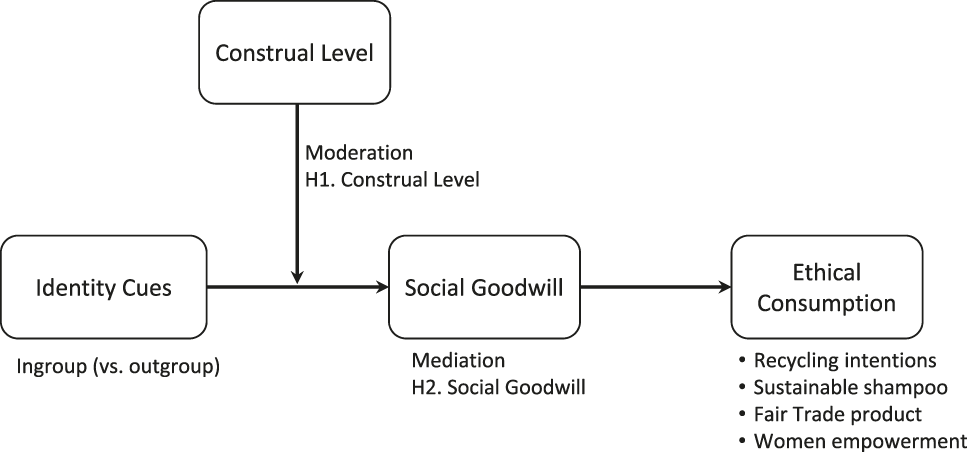
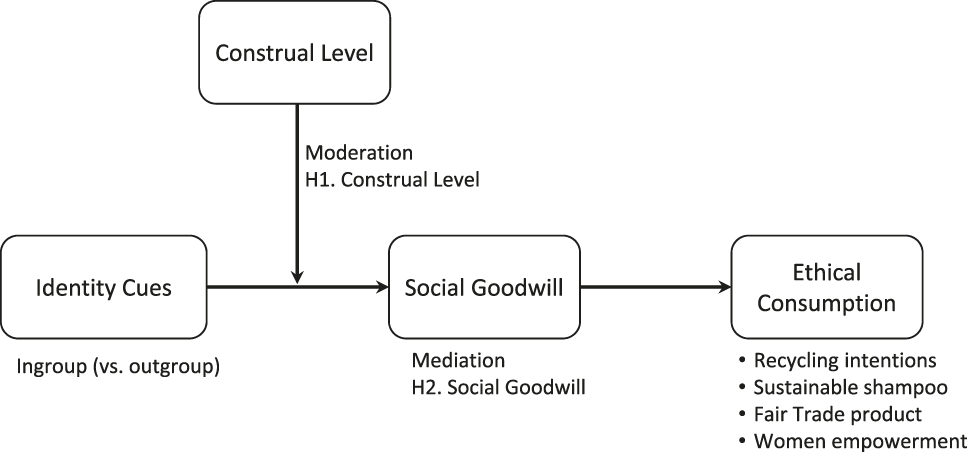
To test our hypotheses, we conducted four studies across recycling (Study 1), sustainable products (Study 2), fair trade (Study 3), and women empowerment (Study 4) ethical consumption domains. In Studies 1–3, we analyzed how construal level moderates influences from identity cues and ingroup bias. In Study 4, we tested social goodwill and several alternative mediators. Figure 1 presents our theoretical model and summarizes the research hypotheses.
Construal Level and Social Influence on Ethical Consumption
Our research makes important contributions to the literature on social influence (e.g., Goldstein et al., Reference Goldstein, Cialdini and Griskevicius2008) and ethical consumption (e.g., Antonetti & Maklan, Reference Antonetti and Maklan2016; Doran, Reference Doran2010; Ghorbani, Liao, Çayköylü, & Chand, Reference Ghorbani, Liao, Çayköylü and Chand2013). First, we extend previous findings on ingroup bias and ethical consumption. Whereas past research (Escalas & Bettman, Reference Escalas and Bettman2005) stated that people usually prefer ingroups over outgroups, we show that abstract (vs. concrete) construal reduces ingroup bias in ethical consumption. We thus contribute to the research on social influence (e.g., Goldstein et al., Reference Goldstein, Cialdini and Griskevicius2008) and ethical consumption (e.g., Ghorbani et al., Reference Ghorbani, Liao, Çayköylü and Chand2013; Antonetti & Maklan, Reference Antonetti and Maklan2016; Doran, Reference Doran2010), showing that construal level moderates ingroup bias. Second, this research highlights a novel mechanism of social goodwill (i.e., the importance of giving back to society). Based on the previous literature on construal level and contextual influence (Ledgerwood et al., Reference Ledgerwood, Trope and Chaiken2010), we propose that social goodwill mediates the effects of construal level and identity cues on ethical consumption. By doing so, we contribute to recent research (Chernev & Blair, Reference Chernev and Blair2015) showing conditions under which the mediation of social goodwill predicts ethical consumption.
Finally, this research has implications for practice in business ethics, combining identity cues and construal levels to foster ethical consumption. For instance, managers and public policymakers could use campaigns that associate concrete construal and ingroup cues, increasing consumers’ social goodwill and willingness to pay premium prices for ethical products and services. In addition, ethical consumption campaigns for broad audiences can mitigate ingroup bias effects by activating consumers’ abstract construal and ensuring ethical consumption consistency, independently of ingroup or outgroup cues. Such proposed strategies can have positive impacts on society by increasing ethical consumption while positively enhancing company profits.
INGROUP BIAS, IDENTITY CUES, AND ETHICAL CONSUMPTION
Psychological research has long focused on how consumer behavior is guided by ingroup bias (e.g., Axt, Nguyen, & Nosek, Reference Axt, Nguyen and Nosek2018; Brewer, Reference Brewer1999; Mullen, Brown, & Smith, Reference Mullen, Brown and Smith1992; Tajfel & Turner, Reference Tajfel, Turner, Austin and Worchel1979), which refers to “intended or unintended favoritism in evaluation, judgment, or behavior for one social group over another” (Axt et al., Reference Axt, Nguyen and Nosek2018: 337). People tend to adhere to ingroup biases to maintain positive social identities (Tajfel & Turner, Reference Tajfel, Turner, Austin and Worchel1979).
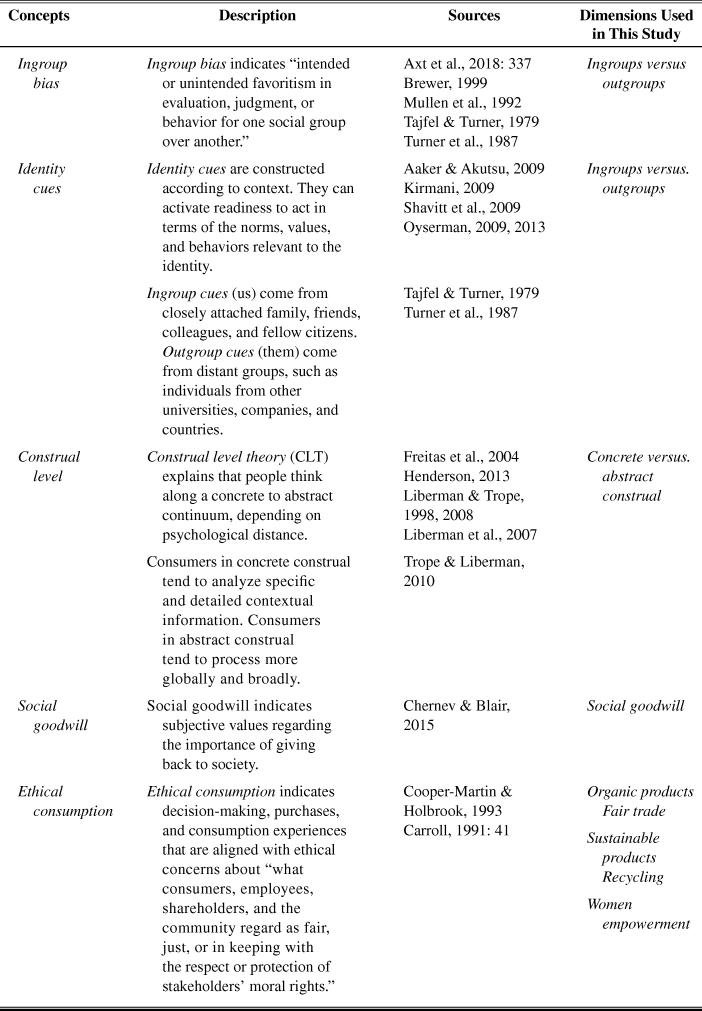
Ingroup bias has been extensively documented (Vermue, Seger, & Sanfey, Reference Vermue, Seger and Sanfey2018), but recent research indicates that contextual cues can alter ingroup self-categorization (Fasoli, Cadinu, Carnaghi, Galdi, Guizzo, & Tassara, Reference Fasoli, Cadinu, Carnaghi, Galdi, Guizzo and Tassara2018) and determine whether individuals think, feel, and act in alignment with ingroups (us) or outgroups (them) (Turner, Brown, & Tajfel, Reference Turner, Brown and Tajfel1979; Turner, Hogg, Oakes, Reicher, & Wetherell, Reference Turner, Hogg, Oakes, Reicher and Wetherell1987). Context dynamically indicates ingroup/outgroup identity cues and can thus activate understandings and actions in terms of norms, values, and behaviors relevant to particular identities (Aaker & Akutsu, Reference Aaker and Akutsu2009; Kirmani, Reference Kirmani2009; Oyserman, Reference Oyserman2009, Reference Oyserman2013; Shavitt, Torelli, & Wong, Reference Shavitt, Torelli and Wong2009). Table 1 provides a summary of these concepts, including ingroup bias, identity cues, construal level, social goodwill, and ethical consumption.
Summary of Concepts Used

Identity cues and ingroup biases are known to have social consequences (e.g., Tajfel & Turner, Reference Tajfel and Turner1986) for gender groups (e.g., Fasoli et al., Reference Fasoli, Cadinu, Carnaghi, Galdi, Guizzo and Tassara2018), racial groups (e.g., Singh & Burns, Reference Singh and Burns2006), nationality groups (e.g., Stoddard & Leibbrandt, Reference Stoddard and Leibbrandt2014), religious groups (e.g., Rotella, Richeson, Chiao, & Bean, Reference Rotella, Richeson, Chiao and Bean2013), and even for donor-recipient group relationships (Masuda, Reference Masuda2012). People use identity cues to access ingroup identifications (Gaither, Sommers, & Ambady, Reference Gaither, Sommers and Ambady2013). For instance, women can use gender ingroup cues to stereotype their differentiation from men (Casper & Rothermund, Reference Casper and Rothermund2012).
However, we know much less about how identity cues influence consumption choices (Ding, Wan, & Xu, Reference Ding, Wan and Xu2017) beyond intentions to signal desirable social identities (Berger & Heath, Reference Berger and Heath2007; White & Dahl, Reference White and Dahl2007). In terms of ethical consumption, people are known to be naturally biased toward helping fellow ingroup members (Cadsby, Du, & Song, Reference Cadsby, Du and Song2016; Line, Hanks, & Zhang, Reference Line, Hanks and Zhang2016; Nilsson, Erlandsson, & Västfjäll, Reference Nilsson, Erlandsson and Västfjäll2016) by way of donating to charity (Schons, Cadogan, & Tsakona, 2015), providing reparations for injustices (Ghorbani et al., Reference Ghorbani, Liao, Çayköylü and Chand2013), feeling moral emotions and reasoning about ethics (Granitz & Ward, Reference Granitz and Ward2001), judging irresponsible corporate behavior (Antonetti & Maklan, Reference Antonetti and Maklan2016), consuming fair trade products (Doran, Reference Doran2010), evaluating ethical leadership (Tumasjan, Strobel, & Welpe, Reference Tumasjan, Strobel and Welpe2011), making unethical decisions (Wood, Noseworthy, & Colwell, Reference Wood, Noseworthy and Colwell2013), and favoring domestic products (Gineikiene, Schlegelmilch, & Auruskeviciene, Reference Gineikiene, Schlegelmilch and Auruskeviciene2017).
We use the term ethical consumption to indicate actions and purchase decisions made according to ethical concerns (Cooper-Martin & Holbrook, Reference Cooper-Martin and Holbrook1993). Society generally expects business leaders to engage in ethical behaviors and activities beyond what is expected in legal terms (Carroll, Reference Carroll1979), reflecting concerns about what consumers, employees, shareholders, and the community regard as fair and just protections of stakeholders’ moral rights (Carroll, Reference Carroll1991). Therefore, we test ingroup versus outgroup bias across a range of possible ethical topics: fair trade, organic production, empowerment of disadvantaged minorities, and conservation of natural resources (Bray et al., Reference Bray, Johns and Kilburn2011).
Construal Level as Moderating Identity Cues
CLT explains that people perceive objects, events, and people along a continuum, from concrete to abstract, depending on psychological distance from the zero point of the “self, here and now” (Liberman & Trope, Reference Liberman and Trope1998, Reference Liberman and Trope2008; Liberman, Trope, McCrea, & Sherman, Reference Liberman, Trope, McCrea and Sherman2007). As psychological distance recedes from the zero point, perceivers move from concrete construal involving specific, detailed, context-dependent evaluations regarding “how” actions are performed toward abstract construals involving general, broad, global evaluations regarding “why” actions are performed, beyond specific contextual information (Freitas, Gollwitzer, & Trope, Reference Freitas, Gollwitzer and Trope2004; Henderson, Reference Henderson2013; Trope & Liberman, Reference Trope and Liberman2010).
Construal level affects identity cues (Ledgerwood & Callahan, Reference Ledgerwood and Callahan2012; Luguri & Napier, Reference Luguri and Napier2013; McCrea et al., Reference McCrea, Wieber and Myers2012; Rim, Uleman, & Trope, Reference Rim, Uleman and Trope2009; Stephan, Liberman, & Trope, Reference Stephan, Liberman and Trope2010, Reference Stephan, Liberman and Trope2011). For example, students tend to form abstract views about distant foreign students and concrete views about local students (Rim et al., Reference Rim, Uleman and Trope2009). People tend to feel more familiar with close entities and more separated from distant social targets (Stephan et al., Reference Stephan, Liberman and Trope2011). Construal level also influences ethical consumption. For instance, when people use abstract construal for considering immoral behaviors, they respond more severely than when they use concrete construal (Tumasjan et al., Reference Tumasjan, Strobel and Welpe2011). Recycling campaigns are more successful when they focus on abstract benefits rather than concrete harm (White, MacDonnell, & Dahl, Reference White, MacDonnell and Dahl2011).
We suggest that construal levels will determine responses to ethical consumption. On the one hand, context-specific responses allow individuals to flexibly adapt to the current social environment and guide their behavior (Schwarz, Reference Schwarz2007). Consumers using concrete construal will consider specific, detailed contextual information and be more likely to use current social identity cues as optimal behavioral guidelines (Schwarz, Reference Schwarz2007; Trope & Liberman, Reference Trope and Liberman2010). Thus, we propose that concrete construals will increase the use of identity cues and ingroup bias.
On the other hand, however, ethical consumption requires consistent, long-term behaviors that protect individual well-being regardless of group membership and group biases (Nilsson et al., Reference Nilsson, Erlandsson and Västfjäll2016). For example, successful recycling programs must encourage long-term environmental responsibility and considerations for society as a whole. Given that identity cues and ingroup biases have such strong contextual influences, how can we induce consumers to focus on high-level broad principles, values, and enduring views of long-term normative societal standards (Ferguson & Bargh, Reference Ferguson and Bargh2007; Ledgerwood et al., Reference Ledgerwood, Trope and Chaiken2010; Lord & Lepper, Reference Lord and Lepper1999; Torelli & Kaikati, Reference Torelli and Kaikati2009)? This type of mental inference—high-level motivation, broad, long-term, and context-independent—is related to an abstract way of thinking (abstract construal) (Liberman & Trope, Reference Liberman and Trope1998). Thus, we suggest that abstract construal is key for persuading consumers to act, according to their inner goals (Torelli & Kaikati, Reference Torelli and Kaikati2009), in the interest of both ingroups and outgroups. These observations motivated us to hypothesize:
Hypothesis 1. Construal level will moderate the influence of identity cues on ethical consumption.
Hypothesis 1a. Under salient concrete construal, ingroup cues will have a higher influence on ethical consumption.
Hypothesis 1b. Under salient abstract construal, ingroup and outgroup cues will equally influence ethical consumption.
The Mediation of Social Goodwill
Social goodwill causes individuals to subjectively value benevolence, to desire to give back to society, and to assume social responsibility (Chernev & Blair, Reference Chernev and Blair2015). Accordingly, social goodwill should mediate how construal level and identity cues affect ethical consumption. Under abstract construal, however, people tend to behave according to their inner goals, despite context; under concrete construal, they tend to focus on contextual details, social relationships, and group behaviors, so as to create socially shared viewpoints (e.g., Brennan & Clark, Reference Brennan and Clark1996; Hardin & Higgins, Reference Hardin, Higgins, Sorrentino and Higgins1996; Ledgerwood et al., Reference Ledgerwood, Trope and Chaiken2010; Turner, Reference Turner1991). We argue that socially shared viewpoints, might then, increase social goodwill.
We propose that when consumers’ construal level is concrete, they focus on such social identity features of events (e.g., ingroup cues). Under these circumstances, consumer ethical behavior, rather than stemming from consumers’ ethical values, is likely to emerge as one way to give back, or reciprocate, to the socially closer ingroup, but not so much to the socially more distant outgroup (a form of ingroup bias). If so, under concrete construal, consumers will show ingroup bias toward close ingroup members, mediated by social goodwill. However, this mediation effect of social goodwill on the impact of social identity cues on ethical consumption should vanish when consumers’ construal level is abstract. Under abstract construal, consumers will be focused on broad ethical principles and values over social identity and other secondary features, so social goodwill should lose its mediation effect. This is because abstract construal focuses on the gist or superordinate features of the events (e.g., broad ethical principles and values), rather than focusing on the features of social identity cues (and other secondary). Thus, abstract construal is expected to override ingroup bias and cause ethical consumption to be largely independent of social identity cues. Consequently, and more important for our second hypothesis, social goodwill will lose its role as a mediator.
In sum, under concrete construal, social goodwill may act as a mediator of ethical consumption, according to identity cues. That is, the construal level changes the subjective importance of social goodwill, which, in turn, increases ethical consumption (construal level and identity cues → social goodwill → ethical consumption). We hypothesize that under concrete construal, social goodwill will have higher subjective importance for ingroups and will increase ingroup bias, regarding ethical consumption decisions. However, abstract construal reduces the importance of contextual information; instead, individuals process information according to their inner goals (Torelli & Kaikati, Reference Torelli and Kaikati2009) and will adopt consistent behaviors without consulting identity cues or being motivated by social goodwill. Formally, we hypothesize:
Hypothesis 2. Social goodwill mediates the impact of identity cues on ethical consumption under salient concrete (vs. abstract) construal.
Overview of the Studies
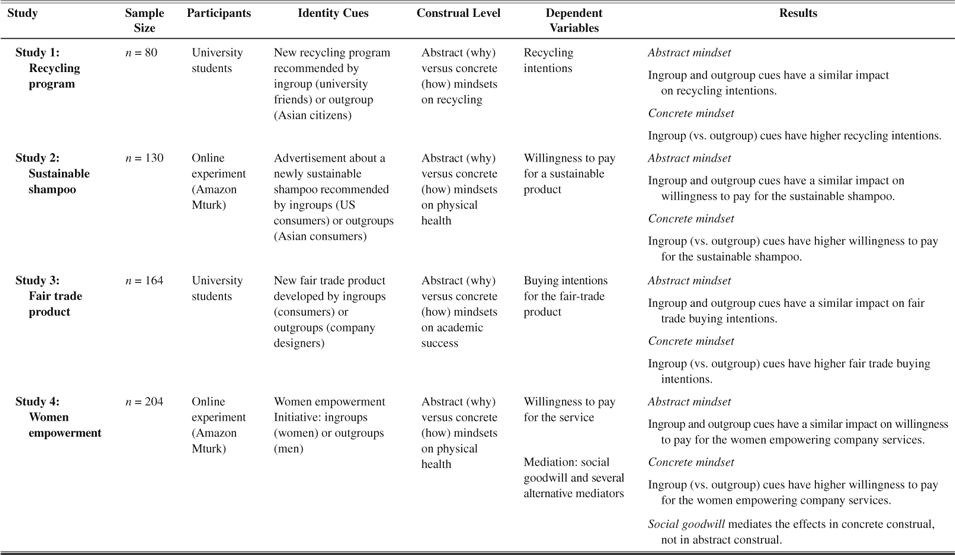
We conducted four studies to test our proposed theoretical model. In Studies 1–4, we tested the hypothesis that construal level moderates the effects of identity cues on ethical consumption (H1, H1a, H1b), and we verified the mediation hypothesis through social goodwill in Study 4 (H2). In Studies 1–3, we activated identity cues to observe ethical consumption decisions in a recycling program, a sustainable product campaign, and a fair trade product campaign. In Study 4, we analyzed naturally occurring gender identity cues in a woman’s empowerment initiative. Our studies provide evidence that construal level moderates ingroup bias across ethical consumption dimensions, methodological procedures, and samples, increasing the external validity of our findings. Table 2 presents a summary of the studies.
Summary of the Studies

STUDY 1: RECYCLING PROGRAM
The objective of Study 1 was to fully verify our prediction that construal level moderates the effects of identity cues on ethical consumption (H1, H1a, and H1b), by analyzing how identity cues relate to recycling intentions.
Pretest for Study 1
Before conducting Study 1, we tested perceptions regarding ingroup or outgroup identities separately, with 102 French undergraduate students participating, in return for course credit (63.2 percent women, M age = 20.5, SD = 1.27). We based our procedure from the pretest conducted on White and Dahl (Reference White and Dahl2007) to identify ingroups and outgroups. In particular, participants categorized ten identities, according to us for ingroups or them for outgroups. Ingroup categories included me (98.1 percent), my best friend (99.1 percent), my family (97.2 percent), my friends (96.2 percent), and a colleague (61.3 percent). Outgroup categories included a student in my country (74.5 percent), an acquaintance (84.9 percent), a person in my country (83.0 percent), a person in the world (81.1 percent), and a Chinese student (91.5 percent). Overall, friend-related identity cues were most associated with ingroup categorizations, while Asian-related identity cues were most associated with outgroup categorizations. Previous studies have used nationalities as outgroups (e.g., Choi and Winterich, Reference Choi and Winterich2013; White and Dahl, Reference White and Dahl2007; Winterich et al., Reference Winterich, Mittal and Ross2009). More importantly to our context, the pretest results indicate Asian identity cues as an outgroup, being consistent with previous research findings on outgroup cues (Choi and Winterich, Reference Choi and Winterich2013; Winterich et al., Reference Winterich, Mittal and Ross2009). Thus, we chose to use university friends as an ingroup identity cue and Asian citizens as an outgroup identity cue.
Participants and Design
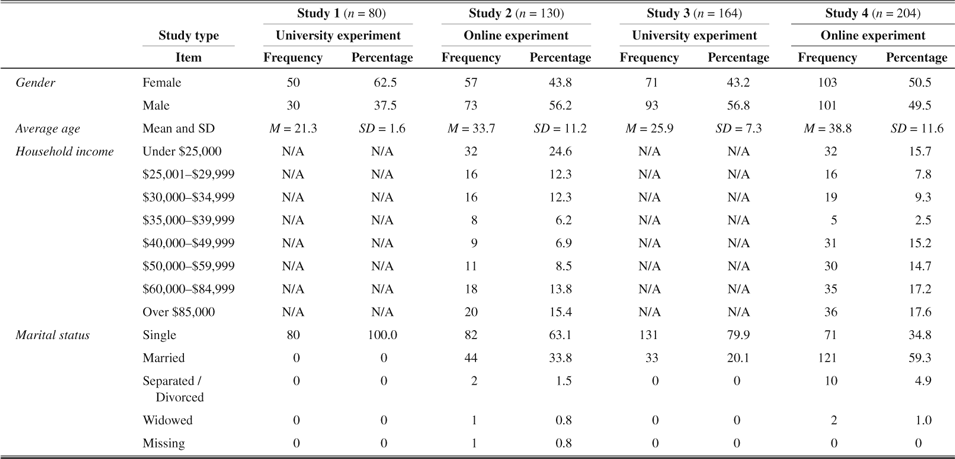
Eighty French undergraduate business students from an introductory marketing course voluntarily participated in Study 1 (62.5 percent women; M age 21.3, SD = 1.63), an examination of how construal levels interact with identity cues to influence recycling intentions, using a 2 x 2 (construal level: abstract, concrete x identity cues: ingroup, outgroup) between-subjects experimental design. Table 3 provides participants’ characteristics in the studies.
Participants’ Characteristics in the Studies

Note. N/A indicates data not available. Income information in Study 1 and Study 3 is not available due to university research guidelines.
Procedure and Stimuli
Participants were first randomly assigned to abstract or concrete construal conditions. To make construal levels salient, we used the “why and how” mindset task, adapted from Fujita, Trope, Liberman, and Levin-Sagi (Reference Fujita, Trope, Liberman and Levin-Sagi2006). Participants in the abstract condition read this question: “What are your reasons and goals for recycling?” They then followed these instructions: “Use the space below to detail reasons, meanings, and general implications of recycling.” Participants in the concrete condition read: “What specific products do you recycle and what procedures do you follow? Use the space below to detail concrete recycling steps.”
Immediately after completing the construal level manipulation, participants were randomly assigned to ingroup or outgroup identity cue conditions (adapted from Goldstein et al., Reference Goldstein, Cialdini and Griskevicius2008). Participants in both conditions were told that the International Environmental Organization (IEO) has launched a new recycling program. Those in the ingroup condition were told that the IEO message reads as follows: “Seventy-five percent of our students are participating in our new recycling program. Join your university friends in recycling to preserve the environment.” Participants in the outgroup condition read the following message: “Seventy-five percent of Asian citizens are participating in our new recycling program. Join with Asian citizens in recycling to preserve the environment.” In this study, we selected only participants that did not define “Asian citizens” as their ingroup, to avoid ingroup bias.
Measure
Recycling intentions are the main dependent variable in Study 1. Participants indicated their recycling intentions by answering the question: “Do you want to know more about this new recycling program?” Answers were coded 0 (no) or 1 (yes).
Findings
Manipulation Checks And Controls
To check whether the “why and how” mindset task manipulated construal level as intended, two independent judges analyzed whether participants provided salient abstract (1), concrete (-1), or neither abstract nor concrete (0) construal level representations (procedure from Liberman & Trope, Reference Liberman and Trope1998). A third judge resolved disagreements in 11 cases. A one-way ANOVA showed that construal level manipulation had a significant main effect on construal levels (F (1, 78) = 699.37, p < .001, Ƞp2 = .900). Contrasts indicated that participants in the abstract condition provided more abstract representations (M = .93, SD = .33) and that those in the concrete construal condition provided more concrete descriptions (M = -.92, SD = .28).
Checks on the manipulation of identity cues comprised two variables: identity importance and identity influence on decisions. Participants evaluated identity importance by answering: “How much importance do you attach to identifying yourself as [a university student/an Asian citizen]?” on a seven-point scale (1 = no importance to 7 = great importance). To measure identity influence on decisions, we used three items (α = .740; Dodds, Monroe, & Grewal, Reference Dodds, Monroe and Grewal1991) answered on a seven-point Likert scale (1 = strongly disagree to 7 = strongly agree): “My thinking is influenced by my perceptions of what [university students, Asian citizens] expect of me”; “My feelings are influenced by my perceptions of what [university students, Asian citizens] expect of me”; and “My actions are influenced by my perceptions of what [university students, Asian citizens] expect of me.” One-way ANOVAs demonstrate that the manipulation of identity cues had a significant main effect on identity importance (F (1, 78) = 151.03, p < .001, Ƞp2 = .659) and decisions (F (1, 78) = 40.77, p < .001, Ƞp2 = .343). Contrasts indicated that participants attributed higher importance to ingroup (M = 5.26, SD = 1.37) rather than outgroup (M = 1.83, SD = 1.24) identities, and that identities had higher influences on decisions to conform with ingroup (M = 4.58, SD = 1.95) rather than outgroup (M = 2.19, SD = 1.37) identities.
To ensure that recommendation conditions rather than advert message credibility evoked recycling intentions, we tested message credibility across three items (α = .895, Kukar-Kinney & Walters, Reference Kukar-Kinney and Walters2003) on a seven-point scale (1 = strongly disagree to 7 = strongly agree): The message “is credible,” “speaks the truth,” and “corresponds to reality.” A one-way ANOVA showed that identity cues had no main effect on credibility (F (1, 78) = .83, ns, Ƞp2 = .011). Contrasts indicated that participants in the ingroup (M = 3.72, SD = 1.28) and outgroup (M = 3.44, SD = 1.40) conditions attributed similar credibility to both versions of the advertisement, eliminating confounding possibilities. Consequently, the recycling program messages have similar credibility for manipulating identity cues.
Recycling Intentions
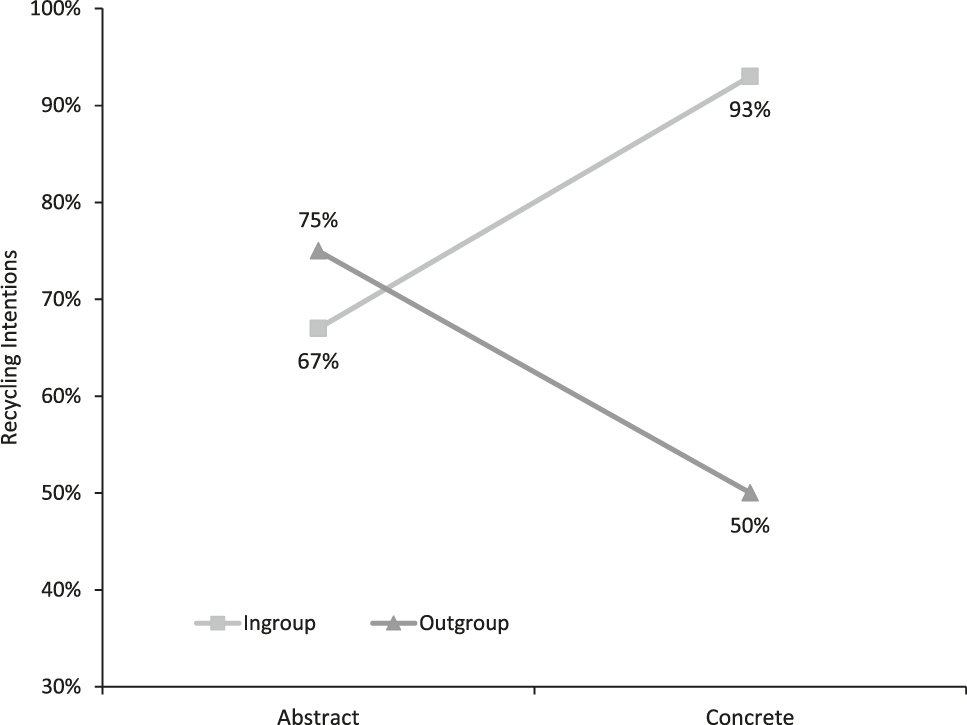
A 2 x 2 GLM logistic regression revealed that construal level had a statistically significant effect on the interaction between identity cues and recycling intentions (Wald χ2(1, N=80) = 5.15, p < .05; Phi φ = .576; Cramer’s V = .407), supporting H1. Wald chi-square tests the significance in logistic regression for a binary outcome variable (recycling intentions: yes, no). A significant Wald test indicates that the parameters associated with the variables are not zero and should be included in the model. Follow-up contrasts showed that participants in the concrete construal condition reported higher recycling intentions (M difference = .43; p = .001), in response to ingroup cues (M = .93, SE = .07) rather than outgroup cues (M = .50, SE = .11), supporting H1a. In addition, participants in the abstract construal condition reported similar recycling intentions (M difference= -.08; ns), in response to both ingroup (M = .67, SE = .10) and outgroup cues (M = .75, SE = .10), supporting H1b. Figure 2 illustrates how construal level and identity cues interact to affect recycling intentions.
Construal Level and Identity Cue Effects on Ethical Consumption in Study 1

Discussion
Study 1 provides evidence that construal level moderates the effects of identity cues on ethical consumption by showing that consumers using concrete construal will respond more strongly to ingroup identity cues, but consumers using abstract construal will rise above ingroup or outgroup identity cues. Thus, we show how construal level effects may counter ingroup biases when consumers make ethical decisions. To enhance external validity, in Study 2, we tested our prediction in a new ethical consumption context.
STUDY 2: SUSTAINABLE PRODUCT
To further investigate whether construal level moderates ingroup and outgroup cue influences on ethical consumption, in Study 2, we used willingness to pay for a sustainable product as a dependent variable (procedure from Luchs, Naylor, Irwin, & Raghunathan, Reference Luchs, Naylor, Irwin and Raghunathan2010). We primed the construal level using a different domain to avoid carry-over effects (Freitas et al., Reference Freitas, Gollwitzer and Trope2004), and we observed a nonstudent sample to enhance the validity of the findings.
Pretest for Study 2
Before conducting Study 2, we recruited 61 US consumers from Amazon MTurk (58.3 percent men; M age 36.4, SD = 13.2) to classify 16 identities as us or them (procedure from White and Dahl, Reference White and Dahl2007). Ingroup categories included me (83.6 percent), my family (83.3 percent), my best friend (77.0 percent), U.S. citizens (75.4 percent), U.S. consumers (68.3 percent), and a school/work colleague (55.0 percent). Outgroup categories included European Americans (52.5 percent), Latin Americans (53.3 percent), African Americans (53.3 percent), Asian Americans (55.7 percent), an acquaintance (59.0 percent), Latin consumers (61.7 percent), African consumers (62.3 percent), Asian consumers (70.0 percent), and European consumers (70.5 percent). Participants equally classified people worldwide as both ingroup and outgroup (50.0 percent). Furthermore, consistent with previous research on outgroup cues (Choi & Winterich, Reference Choi and Winterich2013; Winterich et al., Reference Winterich, Mittal and Ross2009), the pretest results indicate Asian identity cues as an outgroup. Thus, in Study 2, we classified US consumers as the ingroup and Asian consumers as the outgroup.
Participants and Design
To examine the interaction effect of construal level and identity cues on willingness to pay for a sustainable product, we recruited 130 US consumers (56.2 percent men, M = 33.7, SD = 11.2) through Amazon MTurk, in exchange for a fee. To avoid potential issues, we analyzed all data by verifying open-ended questions while checking IPs and duplicate responses. We employed a 2 x 2 (construal level: abstract, concrete x identity cues: ingroup, outgroup) between-subjects experimental design.
Procedure and Stimuli
Participants were first randomly assigned to a construal level manipulation task adapted from Fujita et al. (Reference Fujita, Trope, Liberman and Levin-Sagi2006). Participants in the abstract condition were asked to explain why they should try to maintain and improve their physical health. Participants in the concrete condition were asked to explain how they might do so. We chose the physical health context because it is unrelated to the dependent variable (willingness to pay for a sustainable product) and will avoid carry-over effects.
After participants completed the construal level manipulation task, they were randomly assigned to identity cue conditions (Goldstein et al., Reference Goldstein, Cialdini and Griskevicius2008), either ingroup US consumers or outgroup Asian consumers. We selected only participants that did not define “Asian consumers” as their ingroup, to avoid ingroup bias. They then read the following advertisement for a new sustainable shampoo (Luchs et al., Reference Luchs, Naylor, Irwin and Raghunathan2010):
Our 24 oz. bottle of adult shampoo is available from mass retailers and specialty stores. It has a sustainability rating of 10 (superb) based on pro-environmental and prosocial factors such as sensitivity to pollution and resource usage. A 2016 study showed that 75% of U.S. [Asian] consumers favor using the shampoo. You can join U.S. [Asian] consumers to help save the environment.
Measures
Our main dependent variable is willingness to pay for a sustainable product. After participants read the product description and identity cues, they answered an open-ended question: “How much would you be willing to pay for this shampoo?”
Findings
Manipulation Checks and Controls
The manipulation check for construal level comprised one item evaluated on a seven-point scale (“To improve and maintain my health, I focus on” . . . 1 = why I should do so to 7 = how I can do so [Burrus & Roese, Reference Burrus and Roese2006]). Lower scores indicated abstract construal; higher scores indicated concrete construal. A one-way ANOVA showed that construal level manipulation had a marginally significant main effect on construal levels (F (1, 128) = 3.07; p = .082, Ƞp2 = .023). Contrasts indicated that participants in an abstract mindset focused on the why (M = 3.38, SD = 1.72); participants in a concrete mindset focused on the how (M = 3.89, SD = 1.58). As an additional manipulation check, we used the procedure from Study 1 (Liberman & Trope, Reference Liberman and Trope1998). A third judge resolved disagreements in six cases. A one-way ANOVA showed that construal level manipulation had a significant main effect on construal levels (F (1, 128) = 671.75, p < .001, Ƞp2 = .840). Contrasts indicated that participants in the abstract condition provided more abstract representations (M = .81, SD = .52); those in the concrete construal provided more concrete representations (M = -.97, SD = .17).
To check the manipulation of identity cues, we asked participants to evaluate whether Asian consumers (1) or US customers (7) favor the shampoo. Lower scores indicated outgroup identity cues; higher scores indicated ingroup identity cues. A one-way ANOVA indicated the main effect of the identity cue manipulation on perceptions regarding those who prefer the product (F (1, 128) = 8.16; p < .01, Ƞp2 = .060). Contrasts indicated that participants in the ingroup condition (M = 4.05, SD = 1.65) were more likely to name US consumers as favoring the product, compared with participants in the outgroup condition (M = 3.23, SD = 1.63).
Willingness to Pay for a Sustainable Product
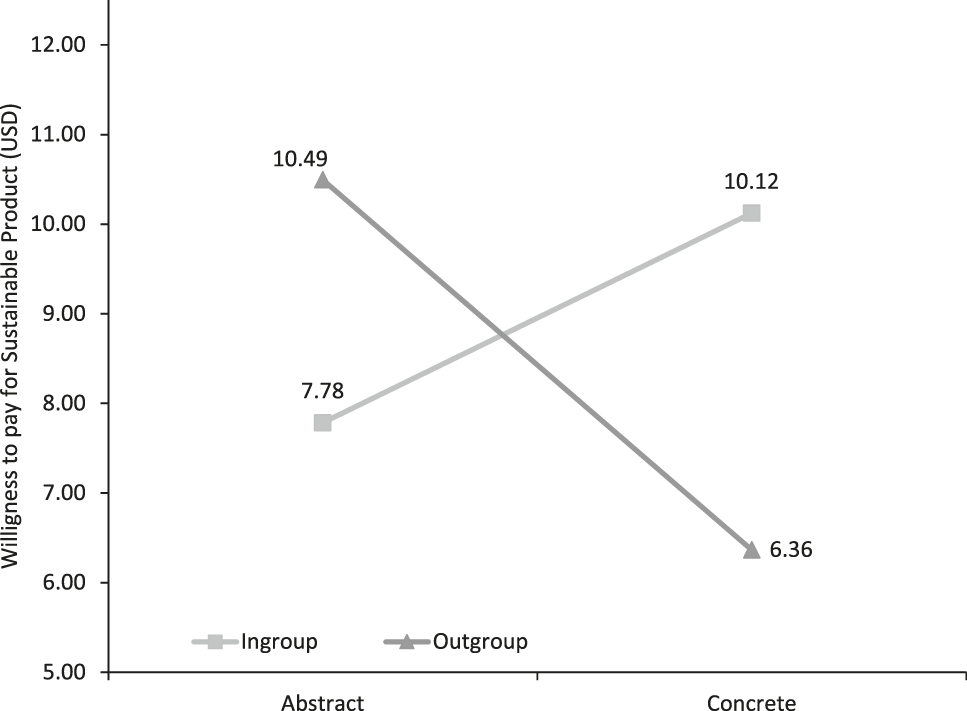
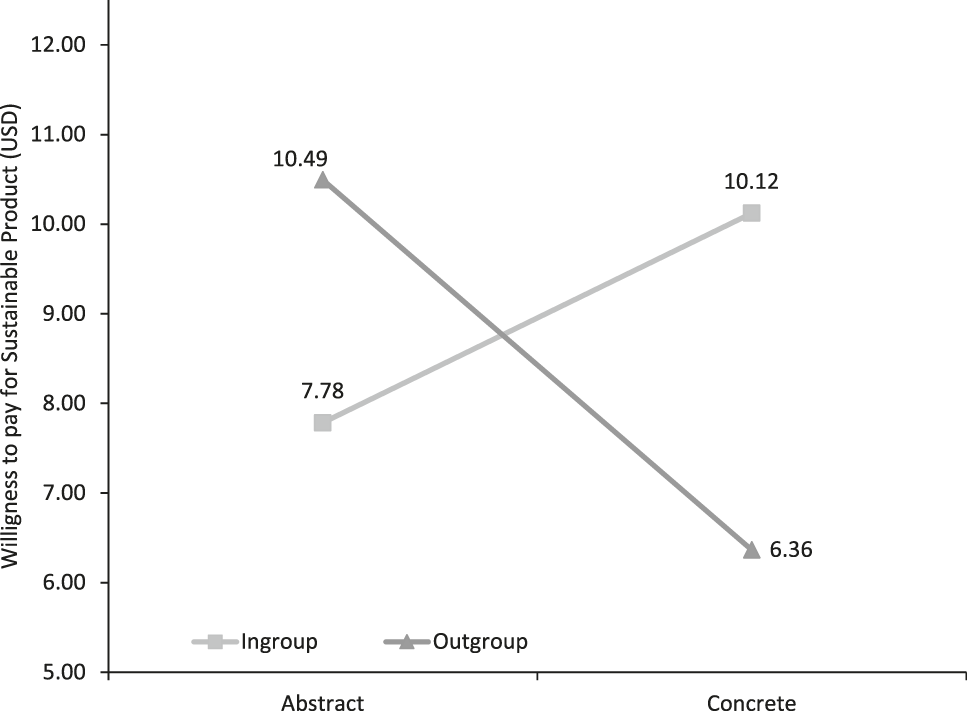
A 2 x 2 ANOVA showed that construal level interacted with identity cues to significantly predict willingness to pay (F (1,126) = 6.02, p < .05, Ƞp2 = .046), additionally supporting H1. Specifically, participants in the concrete construal condition reported higher willingness to pay for the shampoo (F (1, 126) = 4.06; p < .05, Ƞp2 = .031), when ingroups favored it (US consumers, M = 10.12, SD = 8.01) rather than when outgroups favored it (Asian consumers, M = 6.36, SD = 4.00), also supporting H1a. In contrast, participants in the abstract construal condition indicated a similar willingness to pay (F (1,126) = 2.11, ns, Ƞp2 = .017), whether the product was recommended by ingroups (US consumers, M = 7.78, SD = 6.08) or outgroups (Asian consumers, M = 10.49, SD = 10.58), also supporting H1b. To avoid problems with heterogeneity of variance, we also conducted Welch’s ANOVA, that yielded similar results (Welch’s ANOVA = 2.84, p < .05). Results from this robust test of equality of means further support our predictions and provide converging evidence for our findings. Figure 3 shows how construal level interacted with identity cues to motivate ethical consumption.
Construal Level and Identity Cue Effects on Ethical Consumption in Study 2
Discussion
Consistent with Study 1, Study 2 further indicates that construal moderates the effects of identity cues on ethical consumption: concrete construal increases willingness to pay for a sustainable product, only when ingroups rather than outgroups favor it. However, abstract construal increases willingness to pay for the sustainable product without regard to ingroup or outgroup preferences.
STUDY 3: FAIR TRADE PRODUCT
The objective of Study 3 was to further support our prediction that construal level moderates the effects of identity cues on ethical consumption (H1) in a new ethical context: fair trade products. We manipulated identity cues by informing participants that they would be evaluating a consumer-created product (ingroup identity cue) or a company-developed product (outgroup identity cue).
Participants and Design
We recruited 164 university students (56.8 percent men; M age 25.9, SD = 7.26) who participated voluntarily, without pay. Study 3 followed a 2 x 2 (construal level: abstract, concrete x identity cues: ingroup, outgroup) between-subjects experimental design.
Procedure and Stimuli
Participants were first randomly assigned to abstract or concrete construal level conditions. Again, we adopted the “why and how” mindset task (Fujita et al., Reference Fujita, Trope, Liberman and Levin-Sagi2006; Laran, Reference Laran2009) and selected academic success as a familiar context, unrelated to the dependent variable, regarding buying intentions for fair trade products. Participants in the abstract condition indicated why they should pursue academic success; those in the concrete condition indicated how they could do so.
After participants completed the construal level manipulation, they were randomly assigned to ingroup or outgroup identity cue conditions. Participants in both conditions viewed the same fair trade milk packaging image with a clear fair trade label, visible weight information, product and brand image, easy opening system, and vivid colors. We used a fictitious fair trade milk brand to avoid previous attitudes toward products or brands. Participants in the ingroup condition read that “Consumers cooperated in designing this aesthetic fair trade milk packaging.” Participants in the outgroup condition read that “The company’s design team designed this aesthetic fair trade milk packaging.” We selected only participants that did not define “company designers” as their ingroup, to avoid ingroup bias.
Measures
We measured buying intentions for the fair trade milk with three items (α = .876; Dodds et al., Reference Dodds, Monroe and Grewal1991) answered on a seven-point Likert scale (1 = strongly disagree to 7 = strongly agree): “I would like to buy this fair trade milk”; “I intend to buy this fair trade milk”; “I believe people should buy this fair trade milk.”
We controlled for subjective product knowledge that might explain buying intentions, beyond who designed the product (three items, α = .917; Flynn & Goldsmith, Reference Flynn and Goldsmith1999): “I know a lot about food”; “In my circle of friends, I am a food expert”; and “Compared to most other people, I know a lot about food,” answered on a seven-point Likert scale (1 = strongly disagree to 7 = strongly agree). We used the final part of the questionnaire to gather demographic information.
Findings
Manipulation Checks and Controls
The manipulation check for construal level regarding academic success was a one-item, nine-point semantic differential scale (Laran, Reference Laran2009). Specifically, participants evaluated whether they used concrete construal by focusing on “getting my books, studying hard, and going to classes” or abstract construal by “focusing on who I want to be in my personal and professional life.” Lower scores related to concrete construal; higher scores to abstract construal. A one-way ANOVA revealed that construal level manipulation had a main effect on construal levels (F (1, 162) = 4.43; p < .05, Ƞp2 = .027). Specifically, participants in the abstract condition (M = 6.75, SD = 1.85) perceived academic achievement more abstractly than those in the concrete condition (M = 6.08, SD = 2.19).
To check the manipulation for identity cues, we asked: “Who designed the fair trade milk product?” Participants responded on a seven-point scale (1 = company designers to 7 = consumers like me). Lower scores related to outgroup identity cues; higher scores related to ingroup identity cues. A one-way ANOVA revealed that identity cue manipulation had a main effect on perceptions regarding the packaging origins (F (1, 162) = 6.35; p < .05, Ƞp2 = .038). Specifically, participants in the ingroup condition (M = 5.67, SD = 1.46) were more likely to identify consumers as originators; those in the outgroup condition were more likely to identify company designers as originators (M = 5.13, SD = 1.30).
Fair Trade Buying Intentions
A two-way ANOVA showed that construal level moderated the effects of identity cues on buying intentions for a fair trade product (F (1, 160) = 3.94; p < .05, Ƞp2 = .024), further supporting H1. Specifically, participants in the concrete construal condition indicated higher buying intentions (F (1, 160) = 23.47; p < .001, Ƞp2 = .128) under the presence of ingroup identity cues (M = 4.26, SD = 1.36), rather than outgroup identity cues (M = 2.79, SD = 1.36), supporting H1a. However, participants in the abstract construal condition demonstrated similar levels of buying intentions (F (1, 160) = 3.82; ns, Ƞp2 = .023) under ingroup (M = 3.72, SD = 1.63) or outgroup identity cues (M = 3.11, SD = 1.19), supporting H1b.
Discussion
Study 3 supports and extends our previous findings by indicating that construal level moderates the influence of ingroup and outgroup cues on ethical consumption. Results reinforce our prediction that ingroup identity cues and concrete construal increase ethical consumption. The study increases external validity by testing a different procedure for identity cues in the ethical consumption context of fair trade products.
STUDY 4: WOMEN EMPOWERMENT
In Studies 1–3, we showed how construal level moderates social influences of identity cues on ethical consumption. In Study 4, we proposed and tested whether social goodwill underlies the interaction between construal level and identity cues to motivate ethical consumption (H2) of products that support women empowerment. We used participants’ gender information as identity cues: women (ingroup) versus men (outgroup).
Pretest for Study 4
Before we conducted Study 4, we performed a pretest to find a brand that carries neutral perceptions in terms of social responsibility and attitudes. In exchange for a fee, 304 US consumers (53 percent men, M age = 34.7, SD = 9.99) from Amazon MTurk took part in the pretest. Participants were randomly assigned to indicate whether they agreed with Forbes (2018), regarding the ten most valuable brands: Apple (technology), Nike (apparel), Coca-Cola (beverage), Toyota (automotive), Disney (entertainment), McDonalds (food), GE (home appliances), AT&T (telecom), Louis Vuitton (luxury), and Walmart (retail), on a seven-point scale (1 = highly disagree to 7 = highly agree). Social responsibility (three items, α = .935; Pinto, Nique, Herter, & Borges, Reference Pinto, Nique, Herter and Borges2016) was measured by “This brand is socially responsible”; “This brand is congruent with my values”; and “This brand has values close to mine.” Brand attitude (five items, α = .979; Spears & Singh, 2004) was measured according to “appealing/unappealing, good/bad, pleasant/unpleasant, favorable/unfavorable, and likeable/unlikeable.”
The pretest showed that participants perceived the AT&T brand as neutral for social responsibility (M = 3.73, SD = 1.58) and attitude (M = 4.21, SD = 1.65) in that perceptions were not significantly different from the scale midpoint: social responsibility (t (30) = -.933, ns) and attitude (t (30) = .719, ns). Thus, in Study 4, we described “AT&T’s Women Empowerment Initiative.”
Participants and Design
In exchange for a fee, 204 US consumers (50.5 percent women, M = 38.8, SD = 11.6) were recruited through Amazon MTurk to examine the interaction effect of construal level and identity cues on willingness to patronize a company that supports a socially responsible initiative, and to examine whether social goodwill and other alternative mediators act as underlying mechanisms. Study 4 followed a 2 x 2 (construal level: abstract, concrete x identity cues: ingroup, outgroup) between-subjects experimental design.
Procedure and Stimuli
Participants were randomly assigned to abstract or concrete construal conditions. Participants in the abstract condition were asked to describe why they should maintain and improve their physical health; participants in the concrete condition were asked to describe how they could do so. The physical health context avoided carryover effects because it is unrelated to the dependent variable regarding willingness to pay for a product supporting an ethical initiative.
After participants completed the construal level manipulation task, they read about the AT&T Women Empowerment Initiative:
AT&T, a world leader in communications, media, entertainment, and technology, has 254,000 employees and operates in more than 90 countries. AT&T is building a media empire with premium content distributed by streaming services such as HBO Now, DirecTV Now, and Boomerang. Through AT&T’s Women Empowerment Initiative, the company has committed $400 million to help provide childcare access and professional development for women employees.
We used gender information to identify women as the ingroup and men as the outgroup. We also analyzed gender differences in the previous studies (Studies 1–3), to ensure that gender identity cues only influenced the results when they were important to the context (i.e., women empowerment). As expected, we did not obtain any gender differences, except for Study 4, which is consistent with our proposition that gender represents ingroup and outgroup cues regarding women empowerment.
Measures
To measure willingness to pay, we asked “Would you be willing to pay for AT&T internet services?” with responses on a seven-point scale: 1 = would not pay a premium price to 7 = would pay a premium price. We assessed social goodwill as a mediator variable: “How important do you think it is for companies to give back to society?” (Chernev & Blair, Reference Chernev and Blair2015), evaluated on a seven-point scale (1 = not at all important to 7 = very important).
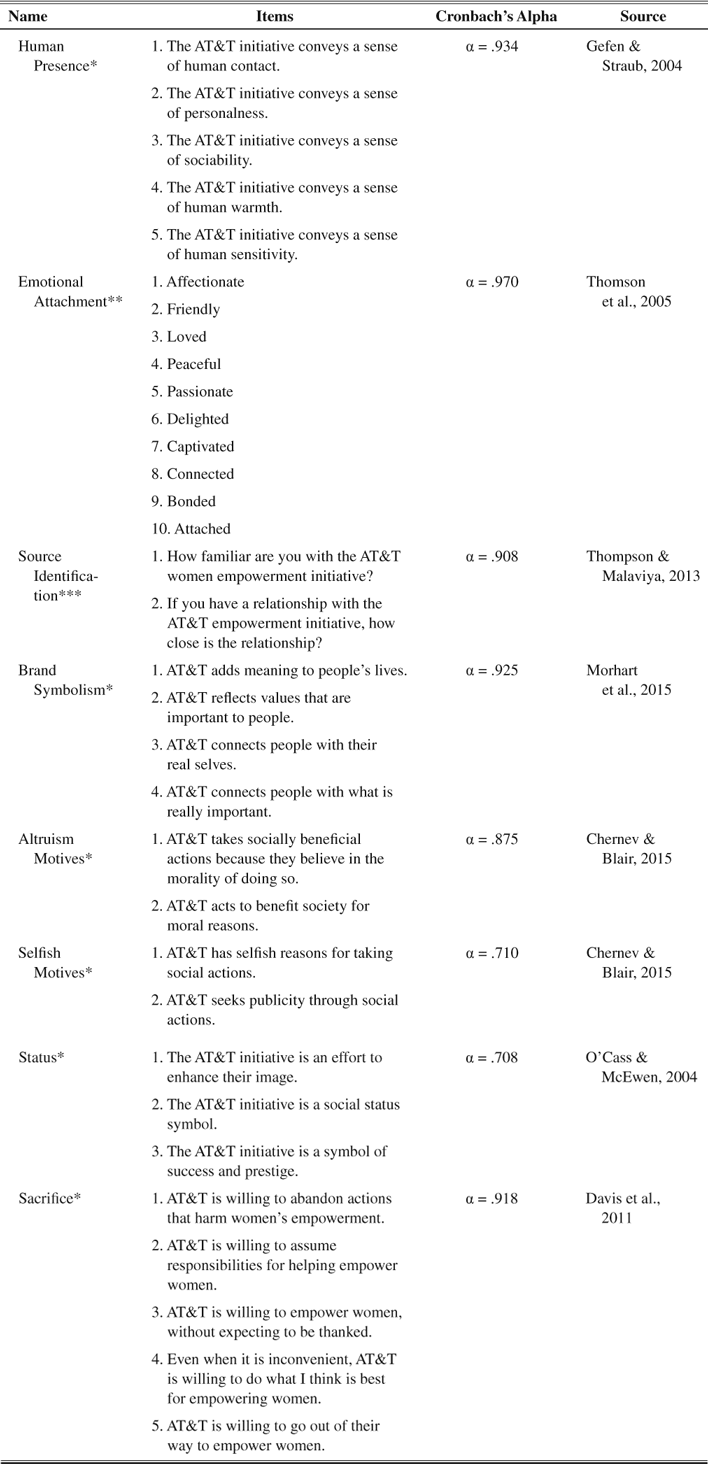
To examine influences of alternative mediators, we measured several that the literature has identified as important drivers of ethical consumption: human presence (five items, α = .934, Gefen & Straub, Reference Gefen and Straub2004), emotional attachment (ten items, α = .970, Thomson, MacInnis, & Park, Reference Thomson, MacInnis and Park2005), source identification (two items, α = .908, Thompson & Malaviya, Reference Thompson and Malaviya2013), brand symbolism (four items, α = .925, Morhart, Malär, Guèvremont, Girardin, & Grohmann, Reference Morhart, Malär, Guèvremont, Girardin and Grohmann2015), altruism motives (two items, α = .875, Chernev & Blair, Reference Chernev and Blair2015), selfish motives (two items, α = .710, Chernev & Blair, Reference Chernev and Blair2015), sacrifice (five items, α = .918, Davis, Le, & Coy, Reference Davis, Le and Coy2011), and status (three items, α = .708, O’Cass & McEwen, Reference O’Cass and McEwen2004), all measured on seven-point scales. Appendix A has additional scale details.
Findings
Manipulation Checks and Controls
As before, we used the narratives from the “why and how” mindset task to check for construal manipulation (Liberman & Trope, Reference Liberman and Trope1998). A third judge resolved disagreements in 11 cases. A one-way ANOVA showed that construal level manipulation had a significant main effect on construal (F (1, 202) = 403.29, p < .001, Ƞp2 = .666). Contrasts indicated that participants in an abstract condition provided more abstract representations (M = .58, SD = .77); those in the concrete construal condition provided more concrete representations (M = -.97, SD = .17). Welch’s ANOVA for heterogeneous variance also yielded similar results (Welch’s ANOVA = 382.16, p < .001).
By using a well-established company, we needed to control for whether participants were AT&T clients and, if so, for how long. Chi-square tests showed that our data had a similar percentage distribution of AT&T clients across identity cues and construal level conditions (χ 2 (204) = 1.265, ns; women concrete = 48 percent, women abstract = 52 percent, men concrete = 55 percent, men abstract = 45 percent). In addition, a 2 x 2 ANOVA across conditions indicated that participants had used AT&T services for similar amounts of time (F (1, 200) = .445, ns, Ƞp2 = .002). Thus, we ruled out the possibility of confounding from previous AT&T experiences.
Willingness to Pay for Women Empowering Services
A 2 x 2 ANOVA showed that construal level interacted with identity cues to significantly predict willingness to pay for women empowering services (F (1,200) = 5.69, p < .05, Ƞp2 = .028), additionally supporting H1. As predicted, participants in the concrete construal condition reported higher willingness to pay (F (1, 200) = 3.35; p = .069, Ƞp2 = .016) for ingroups (M = 6.94, SD = 1.75) rather than outgroups (M = 6.29, SD = 2.03), also supporting H1a. In contrast, participants in the abstract construal condition indicated similar willingness to pay (F (1,200) = 2.40, ns, Ƞp2 = .012) whether as ingroups (M = 6.52, SD = 1.74) or outgroups (M = 7.09, SD = 1.73), also supporting H1b.
Mediation of Social Goodwill
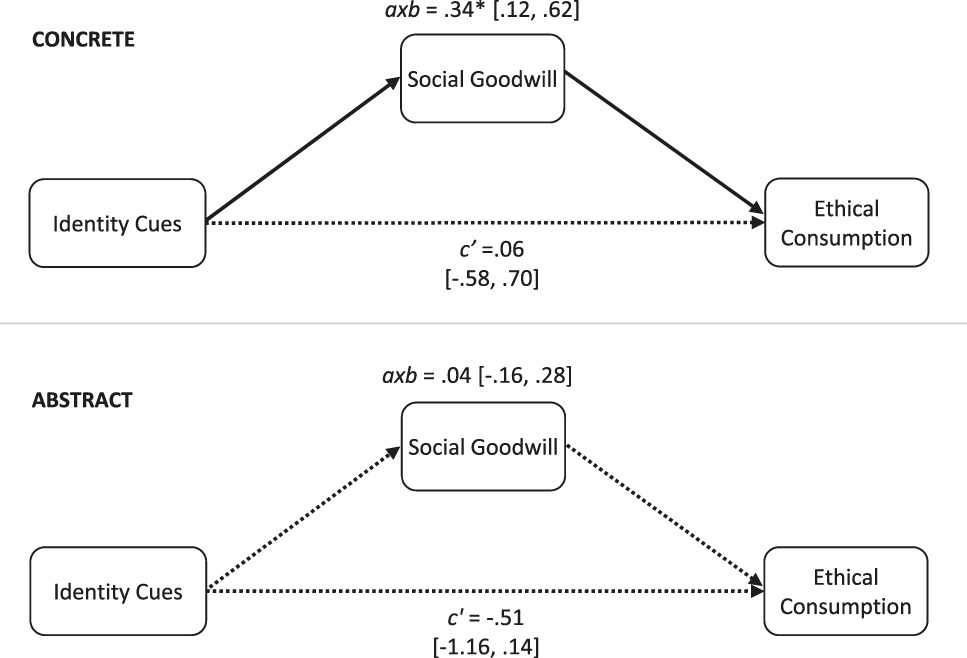
We analyzed ingroup versus outgroup identity cues and abstract versus concrete construal levels for their effects on ethical consumption through social goodwill. Our framework proposes that under concrete construal, ingroup bias increases social goodwill and mediates the interaction with ethical consumption. To test the theoretical framework, we conducted a moderated-mediation analysis (Hayes, Reference Hayes2013; model 8, n = 5,000) and uncovered that the suggested moderated-mediation pathway had a positive, significant indirect effect (b = .32, SE = .15; 95 percent confidence interval CI = [.08, .68]), supporting H2. Specifically, salient concrete construal caused social goodwill to have a significant indirect effect, but not a direct effect (indirect effect (a x b) = .34; 95 percent CI [.12, .62]; direct effect [c] = .06, ns). Thus, under concrete construal, social goodwill had a stronger mediating effect, while ingroup identity had a weaker direct effect on ethical consumption. In contrast, under salient abstract construal, social goodwill had a nonsignificant indirect effect (a x b = .04; 95 percent CI [-.16, .28]). Identity cues also failed to have a significant direct effect on ethical consumption (c = -.51, ns). Thus, under salient abstract construal, social goodwill had no mediation effect on ethical consumption (Figure 4).
Social Goodwill Effects on Ethical Consumption in Study 4
Note. Social goodwill fully mediated the effect of gender identity cues (ingroup vs. outgroup) on ethical consumption in study 5. Dashed lines indicate paths that are not statistically significant. Bracketed numbers indicate 95% confidence intervals.
*p < .05, **p < .01, ***p < .001.

To understand the influence of additional constructs suggested in the ethical consumption literature, we conducted a moderated-mediation analysis (Hayes, Reference Hayes2013; model 8, n = 5,000) with construal level, identity cues (gender), and their interaction, along with the alternative mediators (scaled items averaged) on ethical consumption. Results showed no significant mediation effects for human presence, emotional attachment, source identification, brand symbolism, altruism motives, selfish motives, sacrifice, and status (all ps were nonsignificant). Appendix B shows mediation analysis details, including alternative underlying processes.
Discussion
Study 4 extends our previous findings and has important theoretical and practical implications for companies investing in empowerment initiatives. First, we show that identity cues and construal levels affect ethical consumption via social goodwill. That is, consumers using concrete construal subjectively value social goodwill and ethical consumption that favors ingroups. However, alternative mediators suggested in the literature fail to influence the effects of identity cues and construal level on ethical consumption.
GENERAL DISCUSSION
The business ethics literature and marketing practitioners have long believed that ingroup biases and cues can be used effectively to influence ethical consumption decisions (e.g., Antonetti & Maklan, Reference Antonetti and Maklan2016; Garcia et al., Reference Garcia, Bazerman, Kopelman, Tor and Miller2010; Granitz & Ward, Reference Granitz and Ward2001). To investigate those assumptions, we conducted four studies and found converging evidence that ingroup biases do enhance ethical consumption, but only under abstract construal allowing ingroup and outgroup cues to have similar influences on ethical consumption.
In experimental Studies 1–4, we find that construal level moderates the influence of identity cues on ethical consumption decisions in recycling, sustainability, fair trade, and women empowerment contexts. In Studies 1–3, the ingroup bias effect occurs among study participants who have received identity cues. In Study 4, the effect is observed among naturally occurring gender groups. The effect holds across several “why and how” construal manipulations regarding recycling (Study 1), maintaining physical health (Studies 2 and 4), and achieving academic success (Study 3). In Study 4, we show that the subjective importance of social goodwill mediates the effect. We also analyze possible alternative explanations provided in the ethical consumption literature.
Theoretical Contributions
Our findings have several theoretical and managerial implications and indicate directions for future research. We contribute to business ethics literature (e.g., Antonetti & Maklan, Reference Antonetti and Maklan2016; Ghorbani et al., Reference Ghorbani, Liao, Çayköylü and Chand2013; Schons et al., 2015) by demonstrating that identity cues and construal levels have effects in various consumption contexts. First, activated ingroup identity cues are thought to motivate ethical decisions (Berger & Heath, Reference Berger and Heath2007; Escalas & Bettman, Reference Escalas and Bettman2005; Oyserman, Reference Oyserman2009), especially in business ethics contexts (Antonetti & Maklan, Reference Antonetti and Maklan2016; Granitz & Ward, Reference Granitz and Ward2001). As an extension, we reveal that abstract construal moderates the effects of ingroup biases on ethical consumption decisions.
Second, ethical consumption research has separated construal influences (e.g., Irmak, Wakslak, & Trope, Reference Irmak, Wakslak and Trope2013) from identity influences (e.g., Oyserman, Reference Oyserman2013), but we observe the previously overlooked interaction between ingroup and outgroup identities and construal levels. By showing downstream effects on ethical consumption, we contribute to CLT and social influence literature (e.g., Ledgerwood & Callahan, Reference Ledgerwood and Callahan2012; Luguri & Napier, Reference Luguri and Napier2013; McCrea et al., Reference McCrea, Wieber and Myers2012; Zhao & Xie, Reference Zhao and Xie2011).
Third, researchers have demonstrated that ingroup cues can increase ethical consumption (e.g., Torelli & Kaikati, Reference Torelli and Kaikati2009); others suggest that outgroup cues motivate ethical behavior (e.g., Griskevicius, Tyber, & Bergh, Reference Griskevicius, Tybur and Bergh2010). To reconcile the contradictions, we draw on construal level and social influence (Ledgerwood & Callahan, Reference Ledgerwood and Callahan2012; Ledgerwood et al., Reference Ledgerwood, Trope and Chaiken2010; Luguri & Napier, Reference Luguri and Napier2013; McCrea et al., Reference McCrea, Wieber and Myers2012) to show that consumers using concrete construal focus on social contextual cues and are thus more influenced by ingroups rather than outgroups, reinforcing the ingroup bias effect. However, abstract construal reduces ingroup bias so that consumers align their behaviors with their inner goals. Consequently, ingroups and outgroups have equal influences on ethical consumption.
Fourth, we contribute to the literature by exploring the subjective importance of social goodwill as a force underlying influences of identity cues and construal level (Chernev & Blair, Reference Chernev and Blair2015). Based on arguments regarding construal level and contextual influence (Ledgerwood et al., Reference Ledgerwood, Trope and Chaiken2010), we propose that social goodwill can motivate ethical consumption, but construal level is a boundary condition that changes the influence. That is, under concrete construal, social goodwill mediates ethical consumption aligned with social identity cues, but under abstract construal, ethical values are more important than contextual information (Torelli & Kaikati, Reference Torelli and Kaikati2009). As a result, ethical consumption is not mediated by social goodwill but rather relies on ethical value consistency. By doing so, we contribute to recent research (Chernev & Blair, Reference Chernev and Blair2015) showing under which conditions the mediation of social goodwill predicts ethical consumption. We also extend previous findings on construal level fit (e.g., McCrea et al., Reference McCrea, Wieber and Myers2012; Zhao & Xie, Reference Zhao and Xie2011) and identity-based motivation (Oyserman, Reference Oyserman2009, Reference Oyserman2013).
Managerial and Social Implications
We also provide important managerial and social implications regarding strategies and public policies for enhancing ethical consumption and reducing adverse environmental and social impacts (Paavola, Reference Paavola2001; Schaefer & Crane, Reference Schaefer and Crane2005). We show that managers and public policymakers may fail to enhance ethical consumption when they use ingroup bias strategies. Instead, we suggest that they combine identity cues and construal levels to foster ethical consumption.
Concrete Construal and Ethical Consumption
We recommend that managers and public policymakers, who use campaigns that focus on concrete construal, should ensure that ingroup identity cues are salient, especially when they are introducing new ethical products or services. For example, the Always campaign slogan “Like a Girl” countered the public stigma that girls are weaker and slower than boys, by showing girls excelling in many activities, a concrete construal that effectively appealed to the intended ingroup target. In 2016, the WWF created a campaign called “We Love Cities” to raise awareness about the need for cities worldwide to focus on sustainability. The campaign urges consumers to “join the millions of people shaping the future of sustainable cities all over the world.” We propose that WWF might be more successful in focusing on concrete construal, by asking people to think about how cities can be sustainable and by highlighting ingroup recommendations. For example, an advertisement that says, “Join people of your city” would associate concrete construal and ingroup cues. In addition, our findings imply that customers might have increased social goodwill and willingness to pay premium prices for products or services, if brands that support ethical causes use concrete construal to emphasize relevance for ingroups. Such strategies can have positive impacts on society by increasing ethical consumption while positively enhancing company profits.
Abstract Construal and Ethical Consumption
We counsel that ethical consumption campaigns for broad audiences can mitigate ingroup bias effects by activating abstract construal. Thus, we advise that managers and public policymakers invest in campaigns that focus on abstract construal, such as focusing on why, so that ingroup and outgroup cues will similarly impact ethical consumption and ensure that ethical consumption is more consistent. In contrast, concrete construal increases the focus on contextual cues. For example, Ben & Jerry’s ice cream is known as a fair trade product. The company can appeal to both outgroup and ingroup customers through abstract construal emphasizing why consumers should consume fair trade products. Another example of a public policy was launched by the Canadian city Calgary, which created a recycling program campaign explaining why the population should recycle (White et al., Reference White, MacDonnell and Dahl2011). Consumers would form similar recycling intentions if the initiative reinforced ingroup cues by referring to recommendations from “Canadian friends” or the “local community,” or by reinforcing outgroup cues by referring to “European citizens.”
Limitations and Future Research
Despite our contributions, our study presents limitations that also represent opportunities for further studies. First, we activated construal levels through the “why and how” mindset task. Other manipulations, such as temporal distance, might be used to activate construal levels (e.g., Chang & Pham, Reference Chang and Pham2013). Thus, a campaign might emphasize shorter rather than longer temporal distance (e.g., save the planet now vs. later). Additionally, future studies should measure whether participants have chronic construal levels (e.g., Vallacher & Wegner, Reference Vallacher and Wegner1987).
We activated ingroup and outgroup identities through cues, such as recommendations (Studies 1–3) and naturally occurring groups (Study 4). Future studies can manipulate identity cues using other variables, such as politeness and perceived familiarity (Stephan et al., Reference Stephan, Liberman and Trope2010, Reference Stephan, Liberman and Trope2011). Moreover, social identities can also be classified as associative (increased preference for identity-linked recommendations) or dissociative (avoidance of identity-linked recommendations) (White & Dahl, Reference White and Dahl2007), which should be tested in future studies of ethical consumption.
ACKNOWLEDGEMENTS
The authors acknowledge Yaacov Trope, Darren Dahl, Carlos Torelli, and Alison Ledgerwood, for their insightful comments during early stages of this research. The authors also thank the Business Ethics Quarterly associate editor and anonymous reviewers for their insightful comments.
APPENDIX A
Measurement of Alternative Mediators

APPENDIX B
Mediation Analysis in Study 4 Social Goodwill (Chernev & Blair, Reference Chernev and Blair2015) Human Presence (Gefen & Straub, Reference Gefen and Straub2004) Emotional Attachment (Thomson et al., Reference Thomson, MacInnis and Park2005) Source Identification (Thompson & Malaviya, Reference Thompson and Malaviya2013) Brand Symbolism (Morhart et al., Reference Morhart, Malär, Guèvremont, Girardin and Grohmann2015) Altruism Motives (Chernev & Blair, Reference Chernev and Blair2015) Selfish Motives (Chernev & Blair, Reference Chernev and Blair2015) Company Sacrifice (Davis et al., Reference Davis, Le and Coy2011) Status (O’Cass & McEwen, Reference O’Cass and McEwen2004)