Cholelithiasis is rare in children. Although CHD is listed as an aetiological factor for paediatric cholelithiasis, the prevalence and risk factors of gallstones in these patients remain unclear. In addition, there is some uncertainty concerning optimal treatment of gallstones in CHD patients. With this study, we try to address these questions and examine the role of open-heart surgery in the development of gallstones in these patients. We evaluate the role of cholelithiasis as a co-morbid condition in children with CHD.
Patients and methods
We carried out a retrospective, medical chart review. From 2005 to 2014, all patients treated for CHD at the department of paediatric cardiology with a diagnosis of biliary diseases – cholecystolithiasis or choledocholithiasis – were selected via a medical database. We included patients admitted at least for one night for evaluation or treatment of a CHD. Out-patients and day hospital-patients were excluded. CHD ranged from benign ventricular septal defects to complex univentricular conditions. Premature infants with patent ductus arteriosus were not included. Medical records were reviewed for demographic data, clinical findings, time of diagnosis, treatment, complications, and outcome of treatment. Patients were divided into two groups depending on having undergone open-heart surgery 3 months before the diagnosis of cholelithiasis or not.
Results
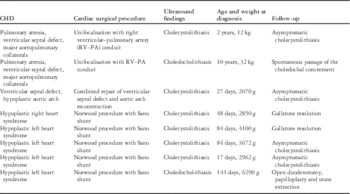
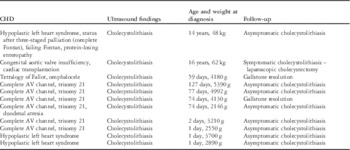
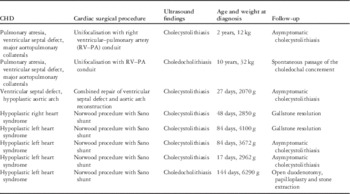
Out of 4729 patients treated for various CHDs, 19 patients with cholelithiasis were identified (0.4%). Cholecystolithiasis was found in 17 and choledocholithiasis in two children. All 19 children suffered from complex CHDs (Tables 1 and 2). The median age at diagnosis was 74 days and ranged from 1 day to 16 years (eight girls and 11 boys). At the time of diagnosis of cholelithiasis, 15 patients were under 1 year of age.
Group 1.
Group 2.

AV=atrioventricular
Group 1
In this group, eight infants had undergone open-heart surgery 3 months before the diagnosis of cholelithiasis. A heart–lung machine was required for all these surgical procedures. In the study period, 2582 children underwent cardiac surgical procedures with a heart–lung machine, resulting in a prevalence of cholelithiasis of 0.3%.
In total, five patients underwent a Norwood procedure with Sano shunt, two unifocalisation with right ventricular–pulmonary artery conduit, and one patient underwent combined repair of a ventricular septal defect and aortic arch reconstruction (Table 1).
Group 2
In this group, 11 children had no cardiac surgical procedure within 3 months before cholelithiasis was diagnosed (Table 2). The prevalence of cholelithiasis in group 2 was 0.5%. In six patients with trisomy 21 and complete atrioventricular channel, gallstones were diagnosed during preoperative routine examination.
In two infants with complex cardiac defects, cholecystolithiasis was diagnosed in the 1st month of life – that is, neonatal cholecystolithiasis. Further two teenagers developed gallstones: one after heart transplantation, who was treated with cyclosporine A, and another with protein-losing enteropathy due to failing Fontan circulation. In one infant with tetralogy of Fallot, cholecystolithiasis presented a few days after Norovirus gastroenteritis.
At the time of diagnosis, all children (groups 1+2) were treated with diuretics except for the two cases of neonatal cholecystolithiasis.
The diagnosis of cholelithiasis was established via abdominal ultrasound. At our department of paediatric cardiology, abdominal ultrasound evaluation is performed routinely before open-heart surgery using a heart–lung machine. This led to incidental diagnosis of asymptomatic gallstones in nine children. Elevated liver enzymes weeks after the Norwood procedure led to ultrasound evaluation of the hepatobiliary system in three children. Furthermore, vague abdominal complaints, in five patients, and colicky abdominal pain in the right upper quadrant, in two patients, led to abdominal ultrasound examination.
All 17 patients with cholecystolithiasis received ursodeoxycholic acid orally for at least 2 months. In four cases of cholecystolithiasis, the gallstones resolved within 1 month; these four children were under 1 year of age. Recurrence of cholelithiasis was not observed in these four infants. In one child, laparoscopic cholecystectomy was performed because of recurrent upper abdominal pain. The other asymptomatic gallstone carrier remained asymptomatic for a mean follow-up of 2 years. In one case of choledocholithiasis, the concrement in the common bile duct passed spontaneously, whereas another child underwent open duodenotomy because of an incarcerated prepapillar gallstone and signs of progressive extrahepatic cholestasis. Both abdominal surgical procedures were carried out without additional morbidity. The child requiring duodenotomy died 1 month later following severe cardiac problems.
Discussion
Cholelithiasis in childhood is a rare and heterogenic condition. Numerous risk factors have been identified, including obesity, haemolytic disease, parenteral nutrition, cephalosporins, dehydration, urinary tract infections, CHD, and a history of cardiac surgery.Reference Bogue, Murphy and Gerstle 1 – Reference Wesdorp, Bosman and de Graaff 3
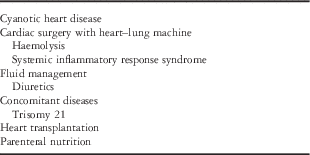
Children with CHD seem to be at risk for developing gallstones for several reasons. Cyanotic CHDs per se have been reported to predispose for cholelithiasis in adulthood.Reference Shiina, Toyoda and Kawasoe 4 In addition, there are several predisposing factors (Table 3).
Risk factors for the development of gallstone disease in children with CHD.

An accumulation of risk factors can be found, especially in the postoperative period after surgical correction of CHDs. Gallstone disease after prosthetic valve surgery has been attributed to haemolysis.Reference Williams and Johnson 5 Cardiac surgery with a heart–lung machine also produces haemolysis, contributing to bile stone formation.Reference Azemoto, Tsuchiya and Ai 6 Systemic inflammatory response syndrome occurring after cardiac surgery with extracorporal circulation might also have lithogenic potential comparable with sepsis.Reference Jeanty, Derderian and Courtier 7 After correction of CHDs, patients often require aggressive diuretic treatment leading to bile stone formation.Reference Gilger 8 In the postoperative period, intestinal paralysis may necessitate temporary parenteral nutrition, which contributes to bile stone formation too.Reference Randall, Shaddy and Sturtevant 9
The occurrence of gallstones after heart transplantation due to the use of cyclosporine A as an immunosuppressant, as found in one of our patients, has been described.Reference Sakopoulos, Gundry and Razzouk 10 ,11
An association of cholelithiasis with Down’s syndrome has been addressed to gallbladder hypomobility.Reference Taşdemir, Cetinkaya and Polat 12 ,13 In our series, six patients with cholelithiasis and complete atrioventricular canal had Down’s syndrome.
The frequency of childhood gallstones has been estimated before resulting in prevalence between 0.13 and 0.22%.Reference Gilger 8 ,14 Compared with this, the prevalence of 0.4% in our series is as twice as high. Although a selection bias cannot be questioned, children with CHD may have frequent ultrasound examinations for several reasons, resulting in a higher chance to identify asymptomatic gallstones. Given the wide range of risk factors, especially in the postoperative period after surgical correction of CHD, the prevalence of gallstones in these patients (0.3%) is surprisingly low. Therefore, open-heart surgery even with heart–lung bypass plays a minor aetiological role.
As in otherwise healthy children, surgical intervention in children with CHD and cholelithiasis is exclusively reserved for symptomatic patients.Reference Svensson and Makin 2 Combining cholecystectomy with cardiac surgery as proposed in adultsReference Charokopos, Antonitsis and Spanos 15 is in not justified in children with CHD and cholecystolithiasis. In these patients, any non-cardiac surgical procedure increases mortality.Reference Baum, Barton and Gutgesell 16 ,17 In a single-centre review three children with CHD died in the postoperative period after emergency cholecystectomy for acute cholecystitis;Reference Miltenburg, Schaffer and Breslin 18 nevertheless, this experience cannot be an argument to perform cholecystectomy in asymptomatic CHD patients.
The frequency of spontaneous resolution of gallstones seems to be inversely related to ageReference Bogue, Murphy and Gerstle 1 ,19 as seen in our patients. The effect of ursodeoxycholic acid on dissolution of gallstones is still questionable.Reference Della Corte, Falchetti and Nebbia 20 ,21 Nevertheless, Ai et alReference Ai, Azemoto and Saisho 22 showed that the prophylactic administration of ursodeoxycholic acid prevented gallstone formation after cardiac surgery in adults. This study raises the question whether prophylactic administration of ursodeoxycholic acid may be indicated in children undergoing surgical correction of cardiac heart defects with heart–lung machine. Considering the rare occurrence of gallstones as found in our study, prophylactic medical treatment does not seem to be justified. In about half of the cases, cholelithiasis is an incidental finding and patients stay asymptomatic.
In children with CHD, we found no mortality and limited morbidity resulting from cholelithiasis. We conclude that cholelithiasis is a manageable problem in children with CHD.
Acknowledgement
None.
Financial Support
This research received no specific grant from any funding agency, commercial, or not-for-profit sectors.
Conflicts of Interest
None.
Ethical Standards
Dr Kargl and coauthors adhered to the ethical standards in publishing scientific articles.