I. INTRODUCTION
Nowadays, the storage and conversion of energy into chemical fuels from sunlight by water oxidation has become one of the most exciting topics in the energy field. Water and sunlight playing in harmony can provide a clean, unlimited, sustainable, and renewable energy free from carbon produced by photoelectrochemical (PEC) water splitting using a photosensible material. Fujishima and Honda Reference Fujishima and Honda1 were pioneers in demonstrating the photocatalytic effect using a semiconductor material to directly convert sunlight irradiation into chemical energy (hydrogen and oxygen). Since this seminal work, the PEC cell has been considered a more elegant and practical way to produce environmentally friendly fuels. Reference Bard, Whitesides, Zare and McLafferty2–Reference Tachibana, Vayssieres and Durrant5 For this purpose, many semiconductor materials such as WO3 Reference Liu, Wang and Wang6–Reference Wang, Deutsch and Turner10 or TiO2 Reference Cowan, Tang, Leng, Durrant and Klug11,Reference Ni, Leung, Leung and Sumathy12 were exploited as photoanodes in PEC cells exhibiting considerable activity; however, due to their low stability in aqueous ambient and/or large band gap conferred a low usable portion of the solar spectrum, limiting commercial utilization. Reference Sivula, Le Formal and Grätzel4,Reference Klahr, Gimenez, Fabregat-Santiago, Hamann and Bisquert13–Reference Hagfeldt and Grätzel15 In the last decade, experimental and theoretical studies have been dedicated to finding an ideal material to efficiently mimic nature by artificially producing the biologic photosynthesis. Reference Wang, Deutsch and Turner10,Reference Ni, Leung, Leung and Sumathy12,Reference Sun, Zhong and Gamelin16–Reference Alexander, Kulesza, Rutkowska, Solarska and Augustynski22 In this context, hematite arise as the cheapest and most promising semiconductor material due to its natural abundance, low band gap (2.1 eV, allowing absorption of a large portion of solar irradiation), high stability in an aqueous environment, favorable valence band edge for photo-water-oxidation, and up to 12.9% efficiency predicted theoretically. Reference Sivula, Le Formal and Grätzel4,Reference Murphy, Barnes, Randeniya, Plumb, Grey, Horne and Glasscock23 Although hematite meets many requirements, the efficiency reported until now is far from the theoretical prediction. For instance, as a consequence of hematite light absorption, the paths of photogenerated electron–hole pairs occur by promotion of electrons from valence to the conduction band and the electron vacancies (holes) from valence band to surfaces for oxidizing water. The electron vacancies (holes) have a short diffusion length of around 2–4 nm, Reference Hardee24–Reference Dare-Edwards, Goodenough, Hamnett and Trevellick26 which means that the electron vacancy is generally filled by electrons before reaching the surface, drastically increasing the recombination rate. Reference Eggleston27 The origin of the electronic states of these electrons is poorly understood. Moreover, the poor electronic conductivity (∼10−2 cm2/V/s) can be also responsible for inefficient photoanode performance. Hematite electronic conductivity has been recently reviewed, and after decades of investigation, the electronic transport of this semiconductor remains not completely understood. Reference Sivula, Le Formal and Grätzel4,Reference Walter, Warren, McKone, Boettcher, Mi, Santori and Lewis28–Reference Shimizu, Lasia and Boily32
To overcome these limitations, many efforts have been focused on the development of different nanostructures Reference Liu, Shahid, Ko, Kim, Ahn, Park and Kwon33–Reference Souza, Lopes, Nascente and Leite38 modifying the hematite surface by doping, Reference Ling, Wang, Wheeler, Zhang and Li36,Reference Cesar, Kay, Gonzalez Martinez and Grätzel39–Reference Sanchez, Sieber and Somorjai45 prelayer deposition of metal oxide Reference Hisatomi, Dotan, Stefik, Sivula, Rothschild, Grätzel and Mathews46,Reference Hisatomi, Brillet, Cornuz, Le Formal, Tetreault, Sivula and Grätzel47 and an undoped ultrathin layer mainly for combining light penetration depths with hole length diffusion and electron collection to increase hematite efficiency. Reference Hamann14,Reference Souza, Lopes, Longo and Leite48–Reference Zandi, Klahr and Hamann50
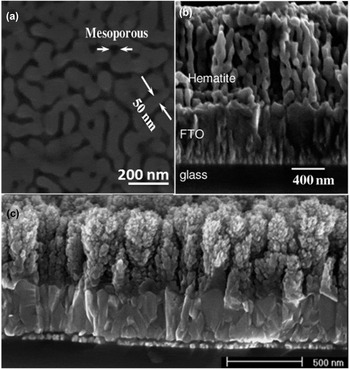
The first results showing the relevance of building hematite films with morphology in nanoscale were reported by Grätzel et al. Reference Hagfeldt and Grätzel15,Reference Bjoerksten, Moser and Grätzel51 This strategy of using nanostructured films has been considered an unique solution in PEC cell applications. Since that time, several synthetic routes have been reported to produce nanostructured hematite with a variety of morphology, Reference Kharisov, Kharissova and Jose-Yacaman52 some of which include sol–gel, Reference Souza, Lopes, Longo and Leite48,Reference Armelao, Granozzi, Tondello, Colombo, Principi, Lottici and Antonioli53,Reference Woo, Lee, Ahn and Park54 anodic aluminum oxide (AAO), Reference Mao, Han and Park55 sonoeletrochemical anodization, Reference Mohapatra, John, Banerjee and Misra56 spray pyrolysis, Reference Murth and Reddy57 ultrasonic spray pyrolysis, Reference Duret and Grätzel58 atmospheric pressure chemical vapor deposition (APCVD), Reference Sivula, Le Formal and Grätzel4,Reference Kay, Cesar and Grätzel40,Reference Le Formal, Sivula and Grätzel59 vapor phase deposition, Reference Mohapatra, John, Banerjee and Misra56,Reference Beermann, Vayssieres, Lindquist and Hagfeldt60,Reference Wheeler, Wang, Ling, Li and Zhang61 thermal pyrolysis, Reference Murth and Reddy57,Reference Jorand Sartoretti, Alexander, Solarska, Rutkowska, Augustynski and Cerny62 atomic layer deposition (ALD), Reference Martinson, DeVries, Libera, Christensen, Hupp, Pellin and Elam63,Reference Klahr, Martinson and Hamann64 colloidal dispersion of nanocrystal, Reference Sivula, Zboril, Le Formal, Robert, Weidenkaff, Tucek, Frydrych and Grätzel65 eletrodeposition, Reference Zhong, Cornuz, Sivula, Grätzel and Gamelin66,Reference Mao, Kim, Shin, Wang, Yoo, Han and Park67 solvothermal, Reference Zhong, Hu, Liang, Cao, Song and Wan68–Reference Li, Lai, Xing and Wang70 and hydrothermal processes. Reference Lin, Wang, Chowdhury and Adhikari71–Reference Deng, Zhong, Pu, Zhang, Li, Sun and Lee74 From this variety of synthetic routes, the most promising nanostructures developed show a remarkable photocurrent allied to low overpotential reported in the last five years are related to APCVD, ALD, colloidal nanocrystal, and the hydrothermal method. Figure 1 illustrates some examples of successful morphologies synthesized by APCVD and colloidal nanocrystal route that provides great PEC performance.
SEM images of hematite nanostructures: (a) top-view and (b) cross section of six layers of mesoporous hematite films prepared by colloidal dispersion magnetite nanocrystals approach, and (c) top view of nanocauliflower hematite developed by APCVD method. Reprinted with permission from Refs. 35 and 40. Copyright 2006 and 2011, American Chemical Society.

The pure hematite films prepared from the colloidal nanocrystal approach [Figs. 1(a) and 1(b)] show a high photocurrent around 1.1 mA/cm2 at 1.23 V RHE with an onset potential as low as 0.8 V RHE (under backside illumination in AM 1.5G sunlight of 1000 W/m2). The PEC performance can be comparable to the best hematite modified with different catalysts. Reference Gonçalves, Lima and Leite35 The hematite cauliflower films doped with different catalysts such as SiO2 or IrO2 grown by the APCVD method [Fig. 1(c)] on the fluorine-doped tin oxide (FTO) conductor glass substrate showed a higher photocurrent from 2.2 to 3.0 mA/cm2 at 1.23 V RHE in AM 1.5G sunlight of 1000 W/m2. Reference Kay, Cesar and Grätzel40,Reference Tilley, Cornuz, Sivula and Grätzel41 These photocurrent values starting at a low onset potential remain unmatched for any other oxide. Recently, these nanostructures were the focus of an interesting discussion in the literature, which the authors point out these morphologies as champion nanostructures for solar water splitting. They correlate the morphology with an efficient charge transport for explaining the remarkable performance. Reference Warren, Voïtchovsky, Dotan, Leroy, Cornuz, Stellacci, Hébert, Rothschild and Grätzel75
Alternatively to these nanostructures, a one-dimensional structure such as nanowire or nanorod vertically aligned, FTO conductor glass substrate has been pointed out as an optimal architecture for PEC water splitting. The reasons are large surface area and short diffusion length perpendicular to the charge-collecting substrate leading to lower recombination. For instance, hematite films composed by vertically aligned nanorods on the FTO conductor glass substrate could satisfy two important requirements; a high absorption coefficient (absorbing significant fraction of solar spectrum) and a wire/rod diameter (between 5 and 20 nm) close to the charge carrier diffusion length. Reference Walter, Warren, McKone, Boettcher, Mi, Santori and Lewis28,Reference Katz, Riha, Jeong, Martinson, Farha and Hupp30 It is well known that, the band gap determines the region of the light or solar spectra the material is able to absorb. However, the fractions, f, of the photons that will be really absorbed by the materials are dependent on the absorption coefficient, α, and thickness, l, as summarized in the Beer's Law by the equation below:
 $$f = 1 - {e^{ - {\rm{\alpha }}l}}\quad .$$
As previously reported, for hematite to reach 95% of light absorption at 550 nm, the films must be 0.4-µm thick, a requirement easily achieved for films composed of nanowires or nanorods without compromising their diameter size. Reference Hamann14
Another requirement satisfied by films composed of one-dimensional nanostructures vertically aligned on the substrates is the morphology favorable to the electron–hole diffusion because the light absorption can be decoupled from the charge carrier diffusion length. This means that the photogenerated carriers must only reach the rod surface before recombination, contrary to films composed of nanoparticles or planar morphology wherein the carriers must travel the entire thickness of the electrode to be collected, increasing the recombination possibility. This distance that the carrier must diffuse before recombination is called diffusion length, L D, and described as following in the equation below:
 $${L_{\rm{D}}} = \sqrt {D{\rm{\tau }}} \quad ,$$
where D is the minority carrier diffusion coefficient, and τ is the minority carrier lifetime. Particularly for hematite with vertical rod morphology to achieve the highest performance, the radius must be similar to L D, i.e., the available area needs to be large enough to allow collecting all the carriers. More details about the carrier diffusion length on nanostructured materials can be found in a recent review. Reference Walter, Warren, McKone, Boettcher, Mi, Santori and Lewis28
Hematite films with morphology composed by vertically aligned nanorods, nanotubes, or nanowires can be obtaining by different methods such as metal organic vapor deposition, Reference Wu, Lee, Chiang and Wong76 electrochemical deposition using AAO templates, Reference Mao, Han and Park55,Reference Mao, Park, Han and Park77 thermal oxidation and pyrolysis, Reference Rao and Zheng78–Reference Vincent, Gross, Dotan and Rothschild80 ALD, Reference Lin, Zhou, Sheehan and Wang81 APCVD, Reference Kay, Cesar and Grätzel40 hydrothermal and solvothermal processes. Reference Lin, Wang, Chowdhury and Adhikari71–Reference Xi, Tran, Chiam, Bassi, Mak, Mulmudi, Batabyal, Barber, Loo and Wong73,Reference de Carvalho, Luz, Lima, Crespilho, Leite and Souza82–Reference Hu and Yu84 The hydrothermal approach has been extensively studied offering a simple experimental apparatus, easy control of rod or wire size, and large scale production. Among different strategies for building metal oxide nanostructured films in hydrothermal conditions, the purpose built material (PBM) process has recently gained special attention (for the past two decades since its first report). Reference Vayssieres, Hagfeldt and Lindquist85
In this context, we address the current status and recent progress in improvements reached on photocatalytic performance using vertically aligned hematite nanorod photoanodes with respect to aqueous systems under hydrothermal conditions (called PBM). Several research groups in the world have been dedicated great efforts to contribute to the understanding of the fundamental properties of hematite nanorods synthesized by the PBM process (such as the work done by Mao et al. Reference Kronawitter, Zegkinoglou, Shen, Guo, Himpsel, Mao and Vayssieres86–Reference Kronawitter, Vayssieres, Shen, Guo, Wheeler, Zhang, Antoun and Mao88 ) but will not be discussed in this manuscript.
II. HYDROTHERMAL
A. PBM method
The hydrothermal approach has attracted scientists and those from the industrial sector along the years because this process offers a low effective cost and easy production on a large scale. The term hydrothermal has a purely geological origin and can be defined as any heterogeneous reaction in the presence of an aqueous solvent or mineralizers under pressure and temperature. Reference Byrappa and Yoshimura89 More details about the origin and definition of the term hydrothermal are reviewed by Byrappa and Yoshimura Reference Byrappa and Yoshimura89 in their Handbook. The action of water at an elevated temperature and pressure was first observed in the earth's crust as it leads to the formation of rocks and minerals by the British geologist Sir Roderick Murchison. From this observation, the hydrothermal approach was probably developed and adopted by Schafthaul to produce quartz crystals. Reference Byrappa and Yoshimura89 Since that time, the hydrothermal technique became a very useful route to simulate the natural conditions found in the earth's crust to artificially synthesize a variety of materials and morphology, such as iron oxides (the focus of our review), in the laboratory. Reference Morey and Niggli90–Reference Eckert, Hung-Houston, Gersten, Lencka and Riman92
It is well known that iron salts can generate iron oxides in appropriate conditions, producing hematite and goethite from amorphous iron(III) hydroxide at an elevated temperature at a different pH. Reference Christensen, Savolainen, Johansson, Tolboe and Paasivirta93 To produce iron oxides under hydrothermal conditions, the pH of the aqueous solutions and the temperature seem to play an important role and must be carefully controlled. As an example, the most common material phases obtained from hydrolysis of aqueous iron chloride (FeCl3) solution, oxyhydroxides such as goethite (α-FeOOH), akaganeite (β-FeOOH), and eventually direct pure hematite (α-Fe2O3), can be reached at specific conditions. Reference Blesa and Matijević94 For instance, the formation of goethite preferentially occurs at an alkaline pH (8–11), and from a 100 to 200 °C temperature range, hematite also can eventually be formed. The equation of the stable solid phase's formation is shown as below, which reflects the relatively simple nucleation of each phase and the transformation of goethite in hematite Reference Blesa and Matijević94 :
 $${\rm{Fe}}\left( {{\rm{III}}} \right)\left( {{\rm{aq}}} \right) \to {\rm{Fe}}_2 {\rm{O}}_3 \cdot x{\rm{H}}_2 {\rm{O}} \to {\rm{\alpha }} - {\rm{FeOOH}} \to {\rm{\alpha }} - {\rm{Fe}}_2 {\rm{O}}_3 \quad .$$
Particularly, the aqueous solution at a pH range of 0.8–2.6, kept around 100 °C, forms akaganeite, whereas at a higher temperature, only hematite is expected as the reaction product.
In the next topic, iron oxide films produced in hydrothermal conditions on the transparent conductor glass substrate (FTO) with controllable morphology composed by vertically aligned nanorods, first reported by Vayssieres et al. Reference Vayssieres, Hagfeldt and Lindquist85,Reference Vayssieres95,Reference Vayssieres, Beermann, Lindquist and Hagfeldt96 and named as PBM will be addressed. This iron oxide nanorod arrays supported on the FTO conductor glass substrate has attracted the academic and industrial community because of its potential application as a photoanode in PEC cells to generate alternative, clean, and sustainable fuels.
B. Undoped vertical hematite nanorod electrodes
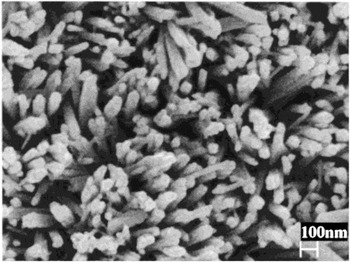
Early works related to the preparation of material in hydrothermal conditions were done using appropriate equipment (such as autoclaves) at high temperature and pressure. However, in search of methods to achieve more practical and capable approach for producing nanostructures with controlled morphology, Vayssieres et al. Reference Vayssieres, Hagfeldt and Lindquist85,Reference Vayssieres95,Reference Vayssieres, Beermann, Lindquist and Hagfeldt96 developed a method called PBM. Along these two decades, innumerous variations of the PBM process were proposed to improve the quality, reproducibility, and properties of the synthesized materials. As aforementioned, here we will focus only the improvements reached on photocatalytic performance of the iron oxide nanostructure (hematite) grown on the conductor glass substrate (FTO) by the PBM method, simulating a photoanode in the PEC cell. Reference Vayssieres, Beermann, Lindquist and Hagfeldt96–Reference Shen, Kronawitter, Jiang, Mao and Guo98 Generally, synthesis of iron oxide performed under hydrothermal conditions at low temperatures results in FeOOH, the hydrated phase of iron oxide (akaganeite and/or goethite), being necessarily an additional treatment at elevated temperature to obtain pure and active hematite electrodes. The original PBM process can be easily described by the preparation of an aqueous solution containing ferric chloride (FeCl3·6H2O) and sodium nitrate (NaNO3) set at pH 1.5 (using HCl) in an autoclavable screw cap. An interesting insight given by the authors was the immersion of the transparent conductor glass substrate (FTO) for directly producing nanostructured films. To obtain substrates with iron oxide layers composed of vertically aligned rods (in nanoscale), the precursor solution was kept during 24 h at 100 °C in a regular oven. The final product of the synthesis is a film with a large covered area by vertically aligned nanorod arrays on the FTO conductor glass substrate in the hydrated phase of iron as depicted in Fig. 2.
SEM micrographs of oriented self-assembled bundles of β-FeOOH/hematite nanorods onto FTO substrates synthesized by the PBM process. Reprinted with permission from Reference Vayssieres, Beermann, Lindquist and HagfeldtRef. 96. Copyright 2001, American Chemical Society.

Hagfeldt et al. Reference Beermann, Vayssieres, Lindquist and Hagfeldt60,Reference Lindgren, Wang, Beermann, Vayssieres, Hagfeldt and Lindquist99 used this novel concept of vertical nanorod array films showing significant improvements in photoelectrohemical performance compared with other hematite film morphologies. Reference Kennedy25,Reference Bjoerksten, Moser and Grätzel51 It is worth mentioning that to obtain films in the hematite phase from the PBM method, an additional thermal treatment at 550 °C for 1 h was conducted; however, no drastic changes were observed on that morphology, as illustrated in Fig. 2. The enhancement of photocurrent response was related to the morphology constituted by vertically aligned hematite nanorods with a sufficiently small diameter (4–5 nm) Reference Vayssieres, Sathe, Butorin, Shuh, Nordgren and Guo100 close to the diffusion length of a photogenerated hole (2–4 nm). Reference Walter, Warren, McKone, Boettcher, Mi, Santori and Lewis28,Reference Katz, Riha, Jeong, Martinson, Farha and Hupp30 This means that the poor hematite hole transport can be overcome using a morphology composed of sufficiently narrow wires or rods, ensuring the proximity of the diffusion length to reach the hematite surface and oxidize water before the recombination. Reference van de Krol, Liang and Schoonman17 Moreover, they showed that the wires and rods with very narrow radii can present one-dimensional quantum confinement, manifesting a significant blue-shift and making feasible the direct reduction of water without additional external bias. This is possible due the upward shift of the conduction band; however, using hematite as a photoanode to split water without the assistance of an external bias was not yet reported. Reference van de Krol, Liang and Schoonman17,Reference Vayssieres, Sathe, Butorin, Shuh, Nordgren and Guo100 It is interesting to note that since the first studies done by Vayssieres et al., significant improvement for pure hematite was only reported almost 10 years later.
In 2011, a significant improvement in photocatalytic performance due to the activation of hematite surfaces interpreted by the use of appropriated annealing conditions was reported in revisiting the PBM method. Reference Morrish, Rahman, MacElroy and Wolden101 For photoeletrochemical characterization, an aqueous electrolyte solution of 1 M NaOH and 450 W xenon lamp sunlight simulator coupled with AM 1.5G filter were used. The light intensity was set to 87 mW/cm2, and the illuminated electrode area was 0.95 cm2. The hematite electrodes annealed at 700 °C, and further at 750 °C for 5 min showed a photocurrent around 0.52 mA/cm2 at 1.23 V RHE under standard illumination. Alternatively, the hematite treated at a lower temperature (600 °C) for an extended time exhibited photocatalytic improvements at levels intermediate to the 5-min treatments at 700 and 750 °C. Reference Morrish, Rahman, MacElroy and Wolden101 In addition, the pure hematite electrodes displayed the lowest onset potentials around +0.75 V RHE compared to many reports. Reference Cesar, Kay, Gonzalez Martinez and Grätzel39,Reference de Carvalho, Luz, Lima, Crespilho, Leite and Souza82,Reference Jang, Lee, Ye, Fan and Bard102–Reference Hu, Kleiman-Shwarsctein, Forman, Hazen, Park and McFarland104 The reduction of onset potentials may indicate that the annealed hematite electrode contained very few surface-trapping states and consequently increase the electron collection or reduce the recombination rate (pair electron–hole). Reference Walter, Warren, McKone, Boettcher, Mi, Santori and Lewis28,Reference Hahn and Mullins42 The hematite electrode achievements were attributed to the morphology changes, where the grains apparently coalesced, presenting a very smooth surface. Based on a recent discussion, the surface morphology caused by high temperature thermal treatment could act favoring the (photo) electron transfer along nanostructures to back contact, and aid the (photo) hole to reach the surface. Reference Sivula105 Hematite electrodes produced by other strategies with a variety of morphologies exposed at a higher temperature also show photocatalytic enhancement. Reference Brillet, Grätzel and Sivula34,Reference Klahr, Martinson and Hamann64
One year later, another interesting improvement in the hematite PEC performance produced by the PBM method was reached by activating the hematite surface during thermal treatment in the presence of controlled oxygen content. Reference Ling, Wang, Reddy, Wang, Zhang and Li106 In this study, the samples were thermally treated at 550 °C for 2 h in an oxygen-deficient atmosphere (N2 + air) to promote oxygen vacancies in air with certain oxygen content. As previously discussed, for many authors, the thermal activation treatment did not change the nanorod or wire morphology. The hematite sample treated in oxygen-deficient atmosphere displayed enhanced photocurrent density compared with hematite prepared in air. The PEC performance was conducted illuminating in front side 0.15 cm2 of working area using a solar simulator (Newport 69920, 1000 W xenon lamp, Oriel Instruments, Stratford, CT) coupled with an infrared water filter (Oriel 6127, Oriel Instruments, Stratford, CT) and an AM 1.5 global filter (Newport 81094, Oriel Instruments, Stratford, CT). The light intensity was set to 100 mW/cm2 using a power meter (Molectron, PM5100, Molectron Detector, Inc., Portland, OR). The improved hematite photocurrent response of 1.82 mA/cm2 at 1.23 V RHE with a maximum value of around 3.37 mA/cm2 at 1.50 V RHE was attributed to the increased donor density resulting from the formation of VO (Fe2+). Reference Ling, Wang, Reddy, Wang, Zhang and Li106 In fact, the photocurrent was increased by thermal treatment in the presence of oxygen atmosphere; however, the water photooxidation is observed at high overpotential around 1.0 V RHE.
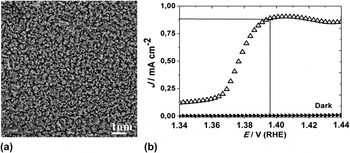
In the same year, it was showed that even with the time of synthesis reduced from 24 (originally proposed) to 6 h, a homogenous iron oxide nanorod distribution can be observed [Fig. 3(a)] covering a large area of the substrate. Reference de Carvalho, Luz, Lima, Crespilho, Leite and Souza82 After treatment at 390 °C for 1 h, the films presented a photocurrent response of around 0.9 mA/cm2 at 1.4 V RHE, with a maximum value of 3.0 mA/cm2 at 1.6 V RHE. The onset potential at 1.37 V RHE was found for this material [Fig. 3(b)]. As previously discussed, the high value of onset potential has been attributed to the presence of defects on the hematite surface reducing the rate of charge transfer along of the nanostructure, consequently increaseing the recombination rate. The promising photoeletrochemical performance must have an efficient solid–solid interface (hematite layer and conductor substrate) for avoiding a fast recombination between the photogenerated electron–hole pair.
(a) Top-view of SEM images of vertical hematite nanorods; (b) current density versus voltage (RHE) curves under dark and illuminated conditions for vertical hematite nanorods thermally treated at 390 °C for 1 h. Ozone-free xenon lamp coupled to AM 1.5 global filters. Electrolyte 1 M NaOH (set at pH 13.6).

Moreover, the authors studied the water oxidation reaction, considered as a major challenge to be overcome and understanding in the area. From the cyclic voltammetry results, an important step in explaining the mechanism of evolution of molecular oxygen onto vertically oriented nanorod hematite surfaces was presented. The researchers assumed that the molecular oxygen evolution was preceded by the formation of an oxyhydroxide group on the electrode/electrolyte interface, seen as a slow and possibly limiting step. The Eqs. (4) and (5) below summarize the proposed steps on the oxygen evolution reaction (OER) mechanism on the hematite surface:
Step1: OH− adsorption (slow)
 $$4{\rm{\alpha - F}}{{\rm{e}}_{\rm{2}}}{{\rm{O}}_{\rm{3}}} + 4{\rm{O}}{{\rm{H}}^ - } \to 4{\rm{\alpha - F}}{{\rm{e}}_{\rm{2}}}{{\rm{O}}_{\rm{3}}}\left( {{\rm{OH}}} \right)_{{\rm{ads}}}^ - \quad {\rm{.}}$$
Step2: molecular oxygen evolution (E = 0.38 V)
 $$4{\rm{\alpha - F}}{{\rm{e}}_{\rm{2}}}{{\rm{O}}_{\rm{3}}}\left( {{\rm{OH}}} \right)_{{\rm{ads}}}^ - +\, {\rm{4h{{\nu}}}} \to 4{\rm{\alpha - F}}{{\rm{e}}_{\rm{2}}}{{\rm{O}}_{\rm{3}}} + \uparrow {{\rm{O}}_{\rm{2}}} + 2{{\rm{H}}^ + } + 2{{\rm{H}}_2}{\rm{O}} + 2{{\rm{e}}^ - }\quad .$$
Usually, the OH− adsorption process on the metal oxide surface is governed by a Nernstian equilibrium (already observed for TiO2). Reference Kanan and Nocera107–Reference Schultze111
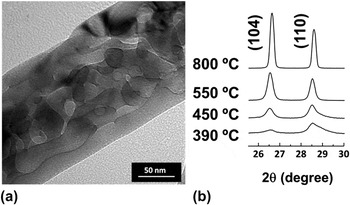
Later, this OER mechanism was confirmed to be strictly dependent on the OH− group concentration and playing an important role in shifting the water oxidation to a lower positive potential. Reference Ferraz, Carvalho, Criado and Souza83 In addition, the impact of different temperatures of thermal treatment on the electrochemical and photoeletrochemical properties of vertical hematite nanorod arrays was discussed. For hematite films thermally treated at temperatures higher than 400 °C, the photocurrent response displayed a negligible response, indistinguishable from the dark current on the range measured. The unexpected PEC response of films treated at a high temperature compared with the literature can be related to morphology and crystallographic orientation. Reference Ferraz, Carvalho, Criado and Souza83 The high temperature of thermal treatment could not be enough to eliminate the major content of defects on the morphology, meaning that the presence of defects increases the electron–hole recombination rate, reducing the hematite performance. An example of this morphology is illustrated in Fig. 4(a), electronic transmission microscopy images showing a view of nanorods thermally treated at 800 °C, at which it is possible to observe a polycrystalline rod. In the case of crystallographic orientation, the high temperature of thermal treatment could alter the preferential orientation of the crystal, compromising the efficiency of electron transport, as represented in Fig. 4(b).
(a) Electronic transmission microcopy image of a vertical hematite nanorod sintered at 800 °C for 15 min; (b) zoom of x-ray diffraction curve exhibiting the evolution of preferential crystallographic orientation with different temperatures of sintering for vertical hematite nanorods. Reference Xavier, Ferreira and Souza112

Another alternative proposed in 2012 was the introduction of lattice defects into pure hematite composed of vertical nanorods by adding inorganic salts to enhance the PEC performance. Lattice defects are expected to act in hematite to decrease the flat band potential from 0.63 to 0.58 V RHE and increase the carrier density from 1.83 × 10²⁰ to 5.44 × 1020 cm−3, consequently reducing the oxygen evolution potential and enhancing the PEC performance. Actually, a significant photocurrent density (1.2 mA/cm2) was only achieved at the higher onset potential 1.6 V RHE. Nevertheless, the introduction of lattice defects on the hematite surface can be an alternative way to improve the photocatalytic performance than inclusion of dopant. Reference Wang, Wang, Lin, Li, Peng, Gao, Huang, Wang, Xu and Fan97
In fact, a consensus is seen in the literature that hematite electrodes sintered at a high temperature is an efficient way to obtain materials for PEC cells, independent of the method used to produce them. Reference Sivula, Zboril, Le Formal, Robert, Weidenkaff, Tucek, Frydrych and Grätzel65 Moreover, concomitant of the advances presented above for pure hematite electrodes, significant studies demonstrate that the coupling of the vertical hematite nanorod electrode with oxygen catalysts can play a distinct role in enhancing PEC activity. For instance, oxygen catalysts as a dopant can reduce the overpotential required to oxidize water. Reference Kanan and Nocera107,Reference Cook, Dogutan, Reece, Surendranath, Teets and Nocera113
C. Doped vertical hematite nanorod electrodes
The insertion of a variety of elements such as Si, Sn, Pt, Ti, etc. as dopants is known to lead to enhanced photocatalytic activity of the hematite photoanode produced for any method. Reference Cesar, Kay, Gonzalez Martinez and Grätzel39,Reference Souza, Lopes, Longo and Leite48,Reference Jorand Sartoretti, Alexander, Solarska, Rutkowska, Augustynski and Cerny62,Reference Zhong and Gamelin114–Reference McDonald and Choi118 As mentioned above, hematite films prepared under hydrothermal conditions enable efficient coverage of a large area of different kinds of substrates, allowing modifications during materials processing. Among these modifications, doping metal oxide films with any elements via the hydrothermal process is also considered a simple alternative to improve the performance of PEC.
For instance, the intentional insertion or diffusion from the FTO conductor glass substrate of Sn during the synthetic process of vertically aligned hematite nanorods or the use of high-temperature sintering can give an effective gain in electronic properties.
Vertical hematite nanorod thermally treated at 550 °C for 2 h and additionally treated at a higher temperature (e.g., 800 °C) for 20 min was investigated. From x-ray diffraction (XRD) and scanning electron microscopy (SEM) results, no changes in the morphology in either the structural or crystal phase can be observed after high-temperature sintering (800 °C), as previously discussed here. However, by x-ray photoelectron spectroscopy analysis, the presence of Sn from the FTO conductor glass substrate by a diffusion process during the hematite nanorod film sintering was found. The photoeletrochemical response was recorded using a solar simulator (Newport, model 69907) coupled to a filter (AM 1.5G) using a 150-W xenon lamp as the white light source. The illuminated area was 0.12 cm2 with a light power density of 100 mW/cm2. A better photocurrent response was found for films treated at a higher temperature (800 °C), approximately 1.24 mA/cm2 at 1.23 V RHE with a maximum around 1.95 mA/cm2 at 1.6 V RHE exhibiting a very low onset potential between 0.6 and 0.7 V RHE. Reference Ling, Wang, Wheeler, Zhang and Li36 Hematite synthesized using the same procedure with the intentional addition of tin (IV) chloride as a source of Sn, and sintered at a different temperature, also changed the electronic properties. At 800 °C, both situations described displayed approximately the same Sn percentage and high photocurrent response starting at low onset potential. Sn doping in the initial stage of hematite preparation showed a higher PEC performance and drastic change in morphology, attributed to the smaller feature size of nanocoral obtained in the second case, consequently exhibiting a high active surface area. Reference Ling, Wang, Wheeler, Zhang and Li36 A flat band potential around 0.49 V RHE and donor density between 1.89 × 10¹⁹ and 5.38 × 1019 cm−3 were extracted from Mott–Schottky plots (samples treated from 650 to 800 °C). Usually, one strategy used to identify the insertion of dopants on the semiconductor is examining changes in the concentration of charge carrier density. As aforementioned, these results confirmed the presence of Sn on the hematite photoanode prepared by different strategies allied with high-temperature sintering and can be used to enhance the hematite performance on PEC cells. Reference Ling, Wang, Wheeler, Zhang and Li36,Reference Kronawitter, Zegkinoglou, Rogero, Guo, Mao, Himpsel and Vayssieres37,Reference Sivula, Zboril, Le Formal, Robert, Weidenkaff, Tucek, Frydrych and Grätzel65
Another promising set of dopants based on Ni and Co oxygen evolution catalysts (OEC) on hematite nanorods has been used as a simple strategy to improve the photoresponse and shift the onset potential required to oxidize water in a PEC cell close to the flat band potential of hematite. Reference Sun, Zhong and Gamelin16,Reference Dinca, Surendranath and Nocera18,Reference Kanan and Nocera107,Reference Zhong and Gamelin114,Reference McDonald and Choi118,Reference Zhong, Sun, Inumaru and Gamelin119 Following this strategy, Co–Pi and Ni–Bi thin catalyst layers were inserted in vertically aligned hematite nanorod films. As expected, the Co–Pi OEC exhibited an overall improvement on the PEC performance, showing a prominent onset potential reduction, whereas the Ni–Bi OEC displayed a significant photoresponse close to the flat band potential of hematite, with gradual reduction of performance at higher overpotential for reasons not yet elucidated. Reference Hong, Liu, Al-Bukhari, Lee, Yung, Chi and Hor120
An element commonly used as a catalyst is platinum. The inclusion of Pt on hematite improves the photoinduced conductivity and enhances charge transfer by suppressing a carrier recombination due to the substitution of Pt4+ for Fe3+ as electron donor. Pt-doped hematite has enhanced photocurrent density from 1.2 to 1.38 mA/cm2 at 1.23 V RHE under 1 sun illumination. The flat band potential was around −0.78 V Ag/AgCl and the charge carrier density was found to be 1.1 × 1021 cm−3 at 3 kHz for samples. Reference Cha, Song, Kim, Shin, Yoon and Kang121 It is worth mentioning that the temperature used for sintering the Pt-doped hematite was 170 °C, relatively low compared with what is usually reported.
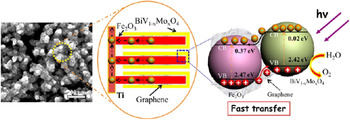
Recently, a novel design of heterojunction arrays of hematite nanorod being cores (produced by the hydrothermal process onto the Ti substrate), with graphene acting as an interlayer, and BiV1−x Mo x O4 as shells both deposited by a spin-coating technique was investigated. Reference Hou, Zuo, Dagg and Feng122 The heterojunction arrays exhibit a pronounced photocurrent density of 1.97 mA/cm2 at 1.0 V Ag/AgCl, and photoconversion efficiency around 0.53% at −0.04 V Ag/AgCl. The PEC enhancement was achieved due to high light absorption between hematite cores—BiV1−x Mo x O4 shell interaction, and also due to more efficient photogenerated electron–hole pair separation on the heterojunction array interfaces mediated by graphene (Fig. 5).
Heterojunction of hematite nanorod arrays (cores) prepared under hydrothermal conditions modified by graphene (interlayer) and BiV1−x Mo x O4 actuated as shells deposited by a spin-coating technique. Reprinted with permission from Reference Hou, Zuo, Dagg and FengRef. 122. Copyright 2012, American Chemical Society.

More recently, a new direction was pointed out for producing highly efficient vertical hematite nanorod electrodes. The proposed strategy is based on hematite nanorod changes in synthesis and surface treatment. Reference Xi, Chiam, Mak, Tran, Barber, Loo and Wong123 First, hematite is synthesized, modifying the concentration of chloride in the precursor solution to change the NaNO3 and HCl from the original PBM method to urea and, after few hours under hydrothermal conditions, the iron oxyhydroxide phase composed of nanorod arrays was obtained. Second, before the sintering process, at 750 °C for 30 min in air, 5 to 20 mmol/L of Sn(IV) in an aqueous solution was uniformly dropped on the film surface to penetrate all covered areas. During the sintering process, a solid-state diffusion reaction Sn(IV) was gradually incorporated, forming a thin layer of SnO2 coating the hematite rods. Reference Spray, McDonald and Choi124 In a previous study, the possible excess of SnO2 on the surface was removed by NaOH treatment, and as a consequence, a very thin layer of Fe x Sn1−x O4 could be formed on the surface and remains unaffected by repeating this treatment. Reference McDonald and Choi125
For the PEC experiment, a light source was simulated sunlight from a 150-W xenon solar simulator (67005, Newport corporation) through a solar filter with a measured intensity equivalent to standard AM 1.5 sunlight (100 mW/cm2) at the sample face. The highest photocurrent value of 2.25 mA/cm2 at 1.23 V RHE was found for hematite nanorod films modified with 20 mmol/L of Sn(IV) and treated at 750 °C for 30 min. Additionally, a shift in the low onset potential at 100 mV, improvements in IPCE, and an increase in the efficiency of oxygen evolution were observed. Xi et al. Reference Xi, Tran, Chiam, Bassi, Mak, Mulmudi, Batabyal, Barber, Loo and Wong73 attributed their improvements to the very thin layer of tin oxide coating the hematite rods, reducing surface defects, increasing the charge injection efficiency and avoiding a fast electron–hole recombination at hematite nanorod–electrolyte interface.
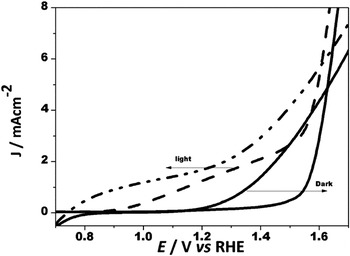
These changes to the original PBM synthetic process opened new perspectives and opportunities for understanding the real role of urea, as well as the effect of a thin layer of tin oxide and eventually enabling the process for commercial applications. Revisiting the strategy adopted by Wong changing from 10 to 2 h the period of synthesis, a pure and modified hematite (tin oxide layer) photoanodes showed a significant enhancement (Fig. 6).
Photocurrent density versus voltage (Ag/AgClsat) curves under dark (solid line curves) and illuminated (dash dot and dash lines) conditions for undoped vertical hematite nanorods photoanode synthesized by the PBM process during 2 h and thermally treated at 750 °C for 30 min. Ozone-free xenon lamp coupled to AM 1.5 global filters. Electrolyte 1 M NaOH (set at pH 13.6) and 1 M NaOH + 0.5 M H2O2.

The photocurrent density of undoped hematite photoanode performed in the dark (solid line curve) and under stander illuminated conditions (dash dot and dash line curve) using aqueous electrolyte with 1 M NaOH (set at pH 13.6) exhibited a value of 1.40 mA/cm2 at 1.23 V RHE with the overpotential at around 0.95 V RHE. Although the photocurrent response is slightly higher than the value reported for undoped hematite photoanode (PBM), the overpotential around 0.95 V RHE is far from an ideal for favoring electrochemical reaction. To understand the impact of the overpotential on photocurrent response on the n-type semiconductor, the PEC experiment was conducted in the presence of a “hole scavenger” like H2O2. This strategy has been pointed as a useful tool for diagnosing the limitations of high performance. Reference Sivula105 The current density response of vertically aligned nanorod hematite photoanode in the presence of hole scavenger (in dark and under illuminated standard conditions, dotted and solid green curves, Fig. 6) exhibited a high photocurrent value of 1.8 mA/cm2 at 1.23 V RHE with lower overpotential value of 0.75 V RHE. This experiment illustrated in Fig. 6 is in agreement with many investigations reported in the literature examining different hematite nanostructures produced by several strategies. The plausible explanation for a superior photocurrent response observed in this condition must be related to the shift in the overpotential. This means that since the photogenerated hole is available for oxidation, the rate of water oxidation can be very low limiting hematite photocurrent response. Reference Sivula105,Reference Dotan, Sivula, Grätzel, Rothschild and Warren126,Reference Klahr and Hamann127 From these results using H2O2, a real perspective is open to find a way to improve the hematite photocurrent response produced by several methods including the PBM process.
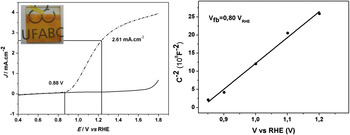
For instance, incorporating a thin layer of tin oxide on the hematite films produced at 2 h and heat treated at 750 °C for 30 min, a superior photocurrent was observed. The photocurrent density was found at around 2.61 mA/cm2 at 1.23 V RHE, as illustrated in Fig. 7 (left). As aforementioned, concomitant with a high photocurrent value, the onset potential (∼0.8 V RHE) was shifted to lower values, making the modified vertical hematite nanorod a more efficient material for oxidizing water. Reference Xi, Chiam, Mak, Tran, Barber, Loo and Wong123 Generally, the Mott–Schottky plots are used to elucidate the role of the insertion of a dopant on a semiconductor material, which changes the concentration of the charge carrier (ex. N d). Particular attention should be given for estimating the N d from Mott–Schottky plots for electrodes with a morphology composed by nanorods because the space charge regions is not similar to planar electrodes. Reference Walter, Warren, McKone, Boettcher, Mi, Santori and Lewis28,Reference Xi, Chiam, Mak, Tran, Barber, Loo and Wong123,Reference Rahman and Joo128 The addition of Sn(IV) to vertical hematite nanorod electrodes was found to increase the donor density (N d) from 1018 for pure hematite to 1020 cm−3 (modified with Sn) both at a frequency of 1 KHz. Contrary to this value found by Wong et al., for a higher photocurrent value presented in Fig. 7 (left), the donor density (N d) was 9.05 × 1017 cm−3 estimated at a frequency of 1 KHz [see Fig. 7 (right)].
Left: current density versus voltage (RHE) curves under dark (solid line) and illuminated (dash line) conditions for vertical hematite nanorod photoanode doped with 20-mM Sn(IV) thermally treated at 750 °C for 30 min. Ozone-free xenon lamp coupled to AM 1.5 global filters. Electrolyte 1 M NaOH (set at pH 13.6).

However, the flat band potential (V fb) was estimated to be around 0.8 V RHE [Fig. 7 (right)]. Both results combined (N d and V fb), meaning that the space charge region width (W) could be slightly higher, favoring the charge separation at the space charge region. In addition, allied to the description above, the formation of a thin layer of Sn coating the hematite nanorod can increase the efficiency of the electron injection, which could be a reasonable explanation for the photocatalytic enhancement observed in Fig. 7 (Left). In addition, for undoped investigation in the presence of a hole scavenger, the close values of the overpotential and flat band potential suggest that the available photogenerated holes present at the solid–liquid surface junction are being efficiently used for water photooxidation. Finally, the high temperature of sintering is an important requirement for hematite films produced by any synthetic route, and a dopant working in harmony with the morphology can be very useful for obtaining efficient materials for PEC cells. In addition, Xi et al. Reference Xi, Chiam, Mak, Tran, Barber, Loo and Wong123 strategy gives new opportunities to improve the vertical hematite nanorod as photoanode.
III. SUMMARY
After 10 years, since was first used, the vertical hematite nanorod produced by the PBM process seems to have achieved important advances. To find ways for improving the photoacatalytic performance of “PBM hematite,” innumerous works were investigated focusing on the electronic properties, doping effect, prelayer, and hematite surfaces activation using temperature. However, the real perspective for the use of the PBM process was only recently presented by Wong et al., where they proposed efficient changes to the original method. The strategy consisted in the use of urea during the initial stage of the synthesis, and the tin oxide layer deposited before thermic treatment seems to play in great harmony increasing the photocurrent and concomitant reducing the overpotential. This means that both alteration done in the original PBM process was attributed to reduce the recombination rate at the solid–liquid junction allied with a more efficient electron injection at back contact (substrate) favoring the electrochemical reaction in both electrodes. In the present manuscript, this novel strategy was revisited and the results clearly confirm the real perspectives for improving the PEC performance of hematite electrodes. In fact, the investigation carried out in undoped hematite in the presence of hole scavenger (H2O2) and in its absence clearly showed the possibility for enhancing its photocatalytic performance. For instance, with addition of the tin oxide layer on the hematite nanorod before the thermal treatment, following the Wong strategy, a superior photocurrent response with low overpontential compared with undoped material was obtained. It is worthmentioning that the undoped and modified hematite electrodes presented in this work show a superior performance inclusive comparing with results shown by Wong. Additionally, a complementary discussion about the use of a novel PBM strategy and the effect of the tin oxide layer on the hematite electrode was pointed out. Then, since there are many possibilities to overcome hematite limitations, new advances in the use of vertical hematite nanorods have gained a significant foothold allying favorable morphology and active surface with a simple and inexpensive way to produce a large-area electrode. Further, investigation on identifying and understanding a remarkable strategy to activate the hematite nanorod surface and making possible the use of the PBM process interesting for commercial applications will be addressed in the future.
ACKNOWLEDGMENTS
We gratefully acknowledge financial support from the Brazilian agencies of FAPESP (Grant Nos. 2011/19924-2, 2012/19926-8, and 2013/07296-2), CAPES, CNPq (Grant No. 555855/2010-4), InstitutoNacionalemEletrônicaOrgânica (INEO), NanoBioMed Brazil Network (CAPES), and INCTMN.