INTRODUCTION
Approximately 70,000 people have cystic fibrosis (CF) worldwide (Cystic Fibrosis Foundation, 2016), and disease-related survival is steadily improving. In 2015, the median survival for the 30,000 CF patients in the United States was over 40 years of age (Cystic Fibrosis Foundation, 2016). The genetic defect leading to abnormal salt and water exchange in the mucous membranes of CF patients manifests most markedly in pulmonary morbidity, but it also affects other mucus-producing organs, including the pancreas, sinuses, and reproductive system (Ratjen et al., Reference Ratjen, Bell and Rowe2015). These changes may lead to respiratory distress, gastrointestinal symptoms, infections, and related symptoms, such as cough, dyspnea, fatigue, pain, and depressed mood. While there have been advances in treatments, the daily management of thickened secretions, as well as associated inflammation and infection, remains complex and involves inhaled and oral medication treatments, physical airway clearance maneuvers, and frequent visits to specialized centers (Sawicki et al., Reference Sawicki, Sellers and Robinson2009; Quittner et al., Reference Quittner, Saez-Flores and Barton2016). A typical medical care routine for a CF patient often takes 2–3 hours a day (Sawicki et al., Reference Sawicki, Sellers and Robinson2009). Several studies have shown that longer survival can be associated with high treatment and symptom burden, including pulmonary dysfunction, pain, and psychological distress (Habib et al., Reference Habib, Manji and Wilcox2015; Sawicki et al., Reference Sawicki, Sellers and Robinson2008; Sawicki & Tiddens, Reference Sawicki and Tiddens2012).
Adult CF patients may depend on family members to address complex and dynamic practical, medical, and psychosocial issues. This may include assistance with airway clearance maneuvers, medication management, accompaniment to medical visits, psychological support, and financial assistance. If the experience of caregivers of adult CF patients is similar to caregivers of other chronically ill populations, some may experience effects that are distressing and burdensome, others may experience aspects that are meaningful and satisfying, and some may experience both positive and negative outcomes (Etters et al., Reference Etters, Goodall and Harrison2008; Li & Loke, Reference Li and Loke2013; Quittner et al., Reference Quittner, Goldbeck and Abbott2014). Most extant studies of caregivers have focused on patients with dementia or cancer (Glajchen et al., Reference Glajchen, Kornblith and Homel2005; Hosmer et al., Reference Hosmer, Lemeshow and Sturdivant2013). Prior studies on caregivers of children with CF show that 19–37% report anxiety, depression, and impaired life satisfaction (Besier et al., Reference Besier, Born and Henrich2011; Quittner et al., Reference Quittner, Goldbeck and Abbott2014). Currently, little is known about family caregivers of adults with CF (Dellon et al., Reference Dellon, Shores and Nelson2010).
A trial of a new service model for adult CF patients assessed caregiver outcomes using a validated instrument that measures both positive and negative experiences. This provided a unique opportunity to evaluate the caregivers of adults with CF in terms of variation in outcomes and stability over time.
METHODS
This was an exploratory analysis of longitudinal data from caregivers of adult CF patients participating in an early intervention cohort trial of palliative care at an urban CF center. The methods for the main study have been described previously (Balzano et al., Reference Balzano, Fresenius and Walker2016). The patient intervention involved web-based screenings every 30 days, triage for early palliative care intervention, and quality improvement programming. Web-based screenings consisted of items assessing global symptom and psychological distress, and advance care planning (ACP) preferences. Patients were triaged for early palliative care if ratings on the survey reflected high distress for two consecutive timepoints or if the patient desired to discuss ACP with the CF team. Both patients and caregivers completed quarterly outcome assessments on illness burden and caregiver burden, respectively. In the current study, quarterly data from outcomes assessments on caregiver burden were evaluated. The institutional review board at Mount Sinai Beth Israel in New York approved the protocol, and participants provided informed consent.
Participants and Procedures
CF patients identified a single caregiver who provided primary caregiving responsibilities, and this person was later contacted by a study assistant. Inclusion/exclusion criteria were limited to English or Spanish fluency and the ability to provide informed consent. Caregivers completed validated measures online, by mail, or via telephone at baseline and every 3 months (there was a maximum of eight total assessments). One Spanish-speaking caregiver used a medical translator (language line).
Measures
Caregivers completed the validated 14-item Brief Assessment Scale for Caregivers (BASC; Glajchen et al., Reference Glajchen, Kornblith and Homel2005). Items are scored on a 4-point Likert-type scale ranging from 0 to 3. The total BASC score is a global assessment of caregiver burden (Glajchen et al., Reference Glajchen, Kornblith and Homel2005), determined by an average score of all 14 items. In this sample, the total BASC score had a Cronbach's α of 0.88. The BASC contains five subscales: Positive Personal Impact (PPI), Negative Personal Impact (NPI), Concern for Patient, Medical Issues, and Other Family Members (Glajchen et al., Reference Glajchen, Kornblith and Homel2005). The PPI subscale addresses positive changes for the caregivers relative to the patients, to others, or to the caregivers themselves (Cronbach's α = 0.82; Glajchen et al., Reference Glajchen, Kornblith and Homel2005) and includes items like: “Taking care of my relative or friend has drawn the two of us closer together” and “Taking care of my relative or friend has brought meaning to my life.” The NPI subscale addresses the impact of caregiving on psychological state, employment, finances, healthcare, or other relationships (Cronbach's α = 0.89; Glajchen et al., Reference Glajchen, Kornblith and Homel2005) and include items like: “Been depressed because of your relative or friend's illness” and “Been overwhelmed by the responsibility of caring for your relative or friend”.
Selection of potential predictors of caregiver burden was guided by the research literature and included patient and caregiver age, sex, race/ethnicity, marital status, education, and employment status; caregiver acculturation, relationship to patient, and living status; and patient income, insurance status, diabetes status, FEV1% (forced expiratory volume in the first second) predicted, and hospitalizations within the past year (Adelman et al., Reference Adelman, Tmanova and Delgado2014; Gallicchio et al., Reference Gallicchio, Siddiqi and Langenberg2002; Vincent et al., Reference Vincent, Desrosiers and Landreville2009; Burton et al., Reference Burton, Sautter and Tulsky2012). FEV1% predicted is the most common marker for disease monitoring and aids in classifying disease severity: mild (>60 or 70%), severe (<40 or 30%), and moderate in between (Davies & Alton, Reference Davies and Alton2009). Predictor variables were assessed at baseline only.
Analysis
Continuous variables were summarized with mean ± standard deviation (SD), and categorical variables were summarized by frequency (percentages). Continuous covariates were also assessed for nonlinearity with the outcomes. Because of nonlinearity with the BASC, FEV1% predicted was categorized into three groups: <40, 40–69, and ≥ 70. Statistical tests accounted for the correlation in repeated measures across participants, primarily using multilevel models. The variances of total BASC score and NPI and PPI scores (both within and between caregivers) were analyzed through a variance-component model, and to evaluate changes over time, the univariate significance of time in caregiver burden was assessed with a growth curve model (not shown). We also tested the appropriateness of a random coefficient for the effect of time for each caregiver. Candidate covariance structures were assessed for each model with all eligible baseline predictors and compared to an unstructured model to confirm the best structure. For model selection, we used the purposeful selection of covariates framework described by Hosmer and colleagues (2013), a general approach to modeling that reduces the inherent risk of traditional stepwise approaches (Hosmer et al., Reference Hosmer, Lemeshow and Sturdivant2013). An initial value of p of 0.25 was used for inclusion of predictors based on bivariate analyses, and all final variables had a value of p < 0.05. Interactions between significant variables were also assessed. Model diagnostics, including residuals and multicollinearity, were evaluated for all models.
Analyses were performed using SPSS, R 3.3.1, and Stata 14.2 (IBM Corp, 2013; StataCorp, 2015; R Core Team, 2016).
RESULTS
A total of 113 patients were approached, 101 were screened, 93 were eligible, and 74 enrolled in the study. Of the 74 patients who enrolled in the study, 63 identified a family caregiver to participate in the study, 59 of whom were approached and screened, leading to 54 pairs (patients and caregiver) with analyzable data.
Baseline Patient and Caregiver Characteristics
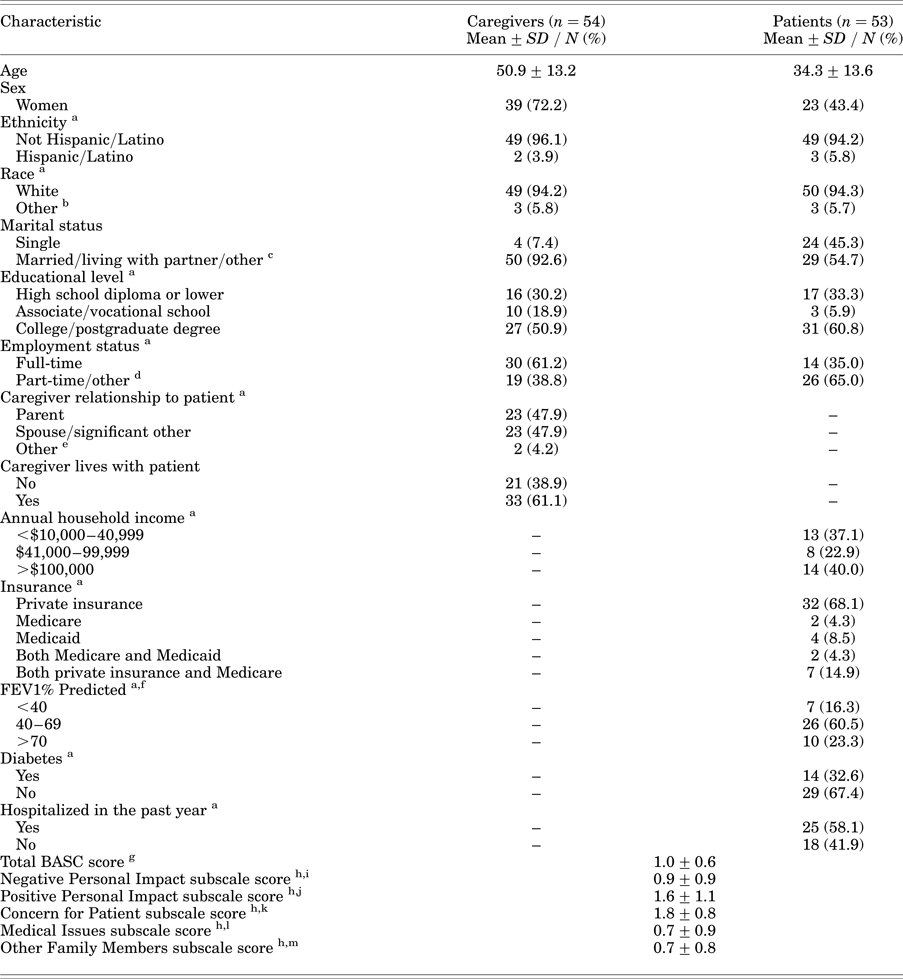
Patients' mean age was 34.3 years (SD = 13.6, range = 19–62); 43.4% were women; 60.8% had a college degree or higher; and 57.5% were employed. Further, 58.1% had been hospitalized more than one time during the prior year, and 60.5% had an FEV1% (one second forced expiratory volume) predicted score between 40 and 69, suggesting that most in the sample had moderate disease severity. Caregivers' mean age was 50.9 years (SD = 13.2, range = 26–80); 72.2% were women; 75.9% were married/partnered; and 63.0% were employed. Most caregivers were parents (47.9%) of patients or spouses/partners (47.9%) of patients (Table 1).
Baseline caregiver and patient characteristics (n = 107)

a Sample sizes. Patients: ethnicity, n = 52; education, n = 51; employment, n = 40; income, n = 35; insurance, n = 47; FEV1% predicted, diabetes, and hospitalization in the past year, n = 43. Caregivers: ethnicity, n = 51; race, n = 52; education, n = 53; employment, n = 49; relationship to patient, n = 48.
b Other includes black or African American, Asian/Pacific Islander, Spanish, Hispanic, or Latino.
c Other includes: divorced/separated, widowed.
d Other includes: retired, homemaker, unemployed.
e Other includes: aunt/uncle.
f FEV1% cutoffs were clinically derived.
g Measured on the Brief Assessment Scale for Caregivers (BASC), total scores range from 0 to 3, with higher scores indicating greater caregiver burden.
h Total subscale scores range from 0 to 3, with higher scores indicating greater impact (i.e., i negative impact; j positive impact; k concern/worry about patient; l distress about medical issues and decision making; m caregiving impact on other family members).
Variation in Caregiver Experience Over Time
The mean total BASC score was low to moderate over time, with most respondents reporting <50% of the maximum level of burden (score = 3). Only 11.9% of caregivers reported severe burden one or more times (score > 2). Similarly, the NPI subscale scores were low to moderate over time. However, the total PPI scores were moderate or high over time, with 71.2% reporting positive experiences one or more times (score > 2).
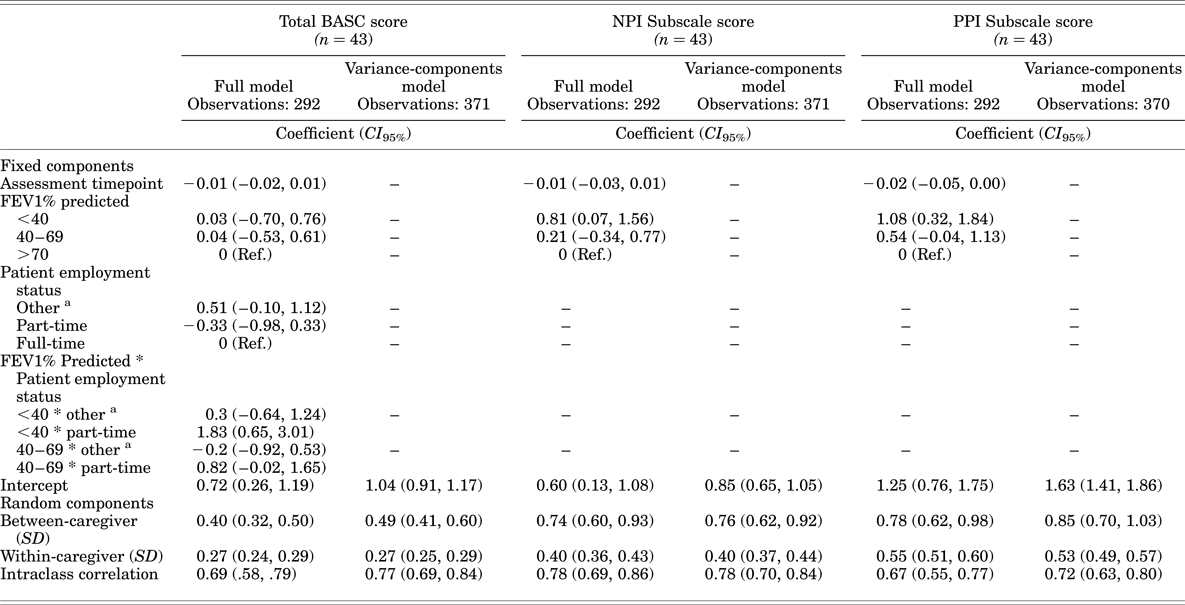
Although some caregivers experienced changes over time, the mean scores were relatively stable (Figure 1). The variation between caregivers in all three mean BASC scores was greater than the variation observed within caregivers over time (Table 2). Baseline differences were more important than change over time, with caregiver burden at baseline predicting subsequent burden levels over time. Correspondingly, a random intercept model was best for all outcomes, and both univariate and multivariate models demonstrated that time was not a significant predictor for any BASC scores (all p > 0.05). Allowing the effect of time to vary across participants using random coefficients did not improve the models (all p > 0.05).
Aggregate and individual mean caregiver burden scores over time (n = 54).

Multilevel models with random intercepts for BASC total score, and NPI and PPI subscale scores (n = 54)

BASC = Brief Assessment Scale for Caregivers; NPI = Negative Personal Impact; PPI = Positive Personal Impact.
Observations for each model vary based on covariate missingness.
a Other includes: retired, homemaker, unemployed.
Multivariate Associations with Caregiver Experience Over Time
In bivariate analyses, FEV1% predicted, patient employment status, and patient educational level were associated with total BASC scores over time. FEV1% predicted and patient employment status were associated with NPI scores over time. FEV1% predicted, having one or more hospitalizations in the past year, and patient educational level were associated with PPI scores over time (all p < 0.25). These variables were included in the multivariate models.
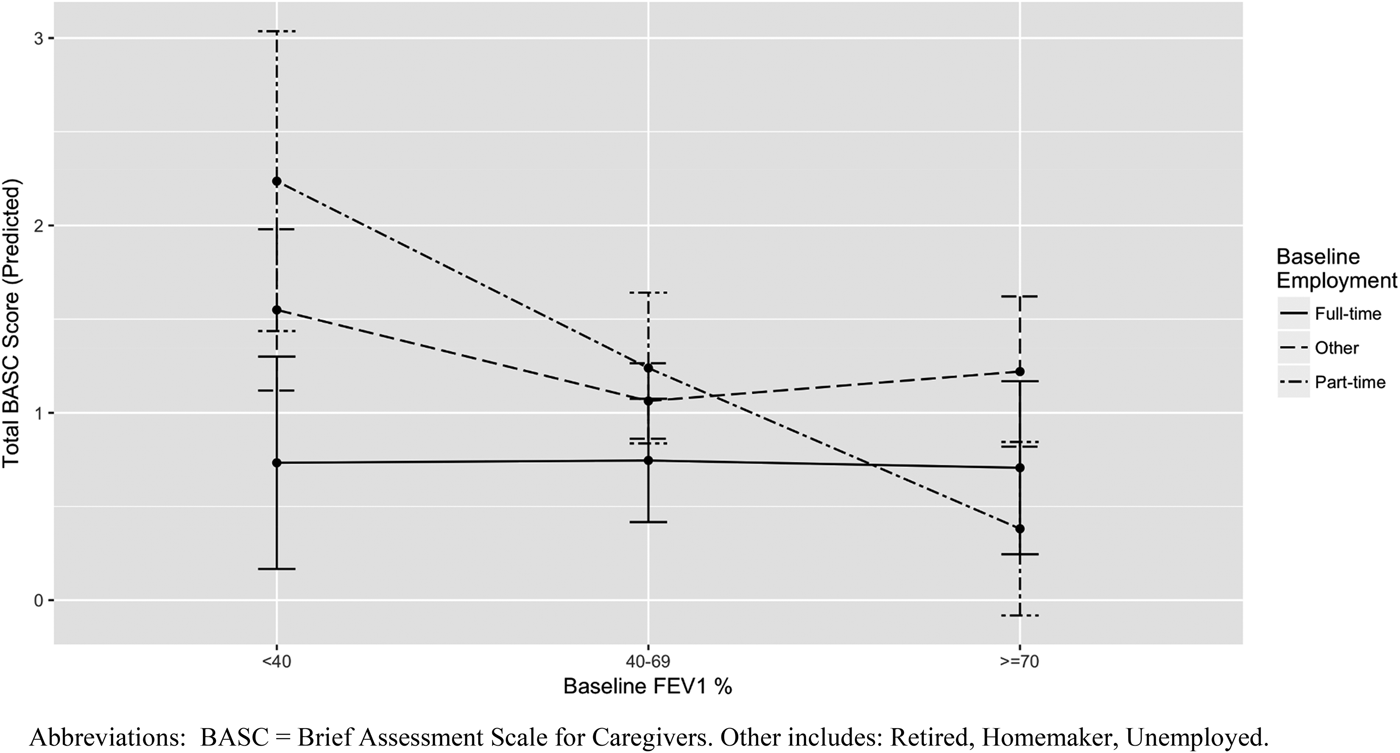
In multivariate analysis, both FEV1% predicted and patient employment status at baseline predicted BASC total score, with a significant interaction term between them (p = 0.001). Specifically, for patients employed full-time, overall caregiver burden was low and stable over time regardless of patient lung function. For patients with part-time or other employment status (unemployed, retired, or homemaker), overall caregiver burden increased as patient lung function worsened, with the highest burden for caregivers of patients who worked part-time and had the lowest category of lung function (FEV1% < 40) (Figure 2).
Interaction between patient lung function and employment status at baseline for BASC total score (n = 107).

For both NPI and PPI scores, only FEV1% predicted remained as a significant predictor in the multivariate models (both p < 0.05). Specifically, caregivers of patients with poorer lung function had higher NPI subscale scores (patients with FEV1% > 70 vs. 40–69 and <40 had a 0.21 [95% confidence interval (CI 95%) = –0.34, 0.77] and 0.81 [CI 95% = 0.07, 1.56] increase in NPI scores, respectively). Unexpectedly, caregivers of patients with poorer lung function also had higher PPI subscale scores (patients with FEV1% > 70 vs. 40–69 and <40 had a 0.54 [CI 95% = –0.34, 1.13] and 1.08 [CI 95% = 0.04, 1.84] increase in PPI scores, respectively). For each model, residuals were distributed normally, with no signs of collinearity or undue influence of a single observation or caregiver.
DISCUSSION
This is the first study to evaluate experiences over time in caregivers of adult CF patients. Caregivers reported stable levels of low to moderate burden across time, with 12% reporting severe burden at least once. Conversely, positive impact was moderate to high, with 71% reporting increased caregiving benefits at least once. Variation was higher between caregivers than within caregivers, and baseline burden predicted later burden. Patient employment status predicted overall caregiver burden, and poorer lung function was associated with both negative and positive caregiver experiences.
The finding that burden in individual caregivers was stable between baseline and later measurements was observed in a prior epidemiological study in the Netherlands (Oldenkamp et al., Reference Oldenkamp, Hagedoorn and Slaets2016). Although we cannot determine whether burden among caregivers would fluctuate more when observed for a longer period than the current study (about 2 years), in this sample, a one-time measurement of high burden at baseline was a predictor of persistent elevated burden. This supports the targeting of services for caregivers who screen high for initial burden to minimize their future burden.
Associations between FEV1% predicted values and quality of life in CF patients are well-documented (Habib et al., Reference Habib, Manji and Wilcox2015). Similarly, caregivers in our study reported more burden as patients' lung function worsened. However, when patients were employed full-time, caregivers reported low burden regardless of patients' FEV1% predicted values. This suggests that burden in CF caregivers may be predicted by social and financial strain. As pulmonary function declines, patients may be unable to work, leading to income loss and financial stress on caregivers, as well as increased social isolation for patients. In a study of caregivers of adolescents with CF, higher burden was associated with changing jobs and productivity losses (Habib et al., Reference Habib, Manji and Wilcox2015). The ability to maintain employment despite disease severity may stabilize the financial situation of the dyad while also providing increased social support for the patient.
Our finding that poorer lung function was associated with positive experiences may suggest that the role of CF caregivers becomes more meaningful as disease severity worsens. In general, we found that positive impact was moderate to high across our sample, which may have attenuated the levels of caregiver burden observed in the study (e.g., low to moderate). The positive impact of caregiving has been described in other populations (Li & Loke, Reference Li and Loke2013; Adelman et al., Reference Adelman, Tmanova and Delgado2014). Among older adults with varied illnesses, women caring for a spouse have reported greater well-being than men caregivers (Freedman et al., Reference Freedman, Cornman and Carr2014), while studies of cancer caregivers have reported more inconsistent results. Caregiver experience did not vary by sex in our study, but the inclusion of more women may have attenuated this effect. Future studies using mixed-methods approaches would be useful in understanding why some caregivers experience caregiving as positive and meaningful while others do not.
LIMITATIONS OF THE STUDY
This study had several limitations. The sample size was small, and recruitment included a single site, which may limit the ability to identify significant associations. Further, the specific characteristics of the sample (average age was 34.3 years, most had moderate to severe disease severity, and half were employed full-time) may limit the generalizability of the findings. The results require replication with larger and more varied samples. Little longitudinal data are available on the caregiver measure used in this study, limiting our ability to draw conclusions about the clinical significance of the changes in BASC scores. The lack of information on potentially important covariates of caregiver burden—including social support, caregiver depression, and health status—was another limitation. We also lacked longitudinal data about patients' symptoms or lung function, which should be considered for evaluation in future studies.
CONCLUSIONS
These limitations notwithstanding, this is the first longitudinal evaluation of the experiences reported by caregivers of adult CF patients. Positive caregiving experiences were more prevalent than negative experiences, and variation was greater across caregivers than within caregivers over time. Poor patient disease status was associated with both positive and negative caregiver effects, and caregiver burden was lower when patients were employed full-time. Future studies can refine these findings and inform practice to support the early identification of caregivers at risk for burden.
DISCLOSURES AND ACKNOWLEDGMENTS
This research was supported by a grant from Cystic Fibrosis Foundation Therapeutics Inc. (no. PORTEN13A0). None of the authors have any conflicts of interest associated with this research.
We gratefully acknowledge Todd Ricker and Phil Huang for their assistance with data analysis and management; Alice Chu, Jane Lipnitsky, and Anna Gordon for their assistance with data collection; Donna Dibenedetto for consultation on methods; Tema Roman for administrative support; and the patients and their family caregivers for participating in our study.