


1. Introduction
Developed in the 1970s by Usher (Reference Usher1973) in the (income, life expectancy) space, the equivalent income is a preferences-based index of well-being, which can potentially include all non-monetary dimensions of standards of living. The equivalent income is defined as the hypothetical income, which, when combined with reference achievements on non-monetary dimensions of well-being, makes an individual indifferent between that hypothetical situation and his current situation. In the recent decades, the equivalent income approach has become increasingly used in the measurement of well-being across countries and epochs.Footnote 1
By relying on individual preferences, the equivalent income is a measure of subjective well-being. However, it differs from other measures of subjective well-being, such as happiness surveys, which elicit direct answers from the population about various aspects of subjective well-being [Diener (Reference Diener2000); Layard (Reference Layard2005); Clark (Reference Clark2016)]. The main difference is that happiness surveys give a paramount importance to emotional states, feelings and mental health, which constitute only some dimensions - among many others - of subjective well-being. On the contrary, the equivalent income can take into account all dimensions of subjective well-being, including - but not limited to - emotional states, and weight these according to the individual's own priorities in life [Fleurbaey (Reference Fleurbaey2016)].Footnote 2
As stated in Fleurbaey (Reference Fleurbaey2016), the equivalent income is an inclusive well-being index satisfying two properties. On the one hand, that index satisfies Respect for Preferences, since it assigns a larger value to a bundle that individuals regard, in the light of their preferences, as better. On the other hand, the equivalent income index satisfies Resourcism, a property according to which, when non-monetary dimensions of standards of living take their reference levels, the comparison of the well-being of two individuals can be carried out merely by comparing their income levels. Resourcism, when combined with Respect for Preferences, leads to constructing an index of well-being whose metric is money, in line with Pigou (Reference Pigou1920) definition of economic welfare (“the part of welfare that can be brought, directly or indirectly, with the measuring rod of money”).
Among those properties, Respect for Preferences has a strong ethical appeal. When individual preferences are well-defined (and not anti-social), it is hard to see why the measurement of well-being should abstract from how individuals weight the different components of their living conditions.Footnote 3
Resourcism is, from an ethical perspective, more difficult to assess. Using money as a metric for well-being measurement seems at first glance intuitive, since individuals are familiar with that metric. That point was made by Sen (Reference Sen1973) in an early attempt to adjust national income statistics in such a way as to incorporate non-monetary dimensions of standards of living (anterior to Sen's theory of functionings and capabilities). The familiarity with the money metric motivated Sen (Reference Sen1973) to normalize his measure of lifetime income, by dividing it by a reference level of life expectancy, in order to obtain an amount in monetary units, which is of the same order of magnitude as GDP per capita.
However, relying on the money metric can also be questioned. Following Fleurbaey (Reference Fleurbaey2016), an important criticism against Resourcism is that one may want, ideally, to measure well-being in terms of a metric that is a fundamental human functioning in Sen's sense, i.e. something that is necessary to realize one's conception of a good life, whatever that conception is. Fleurbaey considers that money is not such a fundamental functioning, which questions the attractiveness of Resourcism. Moreover, Sen (Reference Sen1998) argued that lifetime is a fundamental dimension of standards of living, since “being alive” is a necessary condition to achieve the goals that one pursues in life, whatever these goals are.Footnote 4 In the light of this, one may question the reliance on the income metric, and suggest that lifetime may be a more appealing metric for well-being measurement.
To what extent does the choice of a particular metric matter for well-being measurement? Does the choice of money or lifetime as a metric have some impact on well-being comparisons across individuals having different preferences? Alternatively, when considering the measurement of well-being under a unique indifference map, does the reliance on a particular metric matter?
This paper proposes to examine the impact of the postulated metric on the measurement of well-being, by comparing, in the (income, lifetime) space, two well-being indexes: on the one hand, the equivalent income index, and, on the other hand, the equivalent lifetime index.Footnote 5 The equivalent lifetime index is defined as the hypothetical lifetime (number of life-years) which, combined with the reference income level, would make the individual indifferent with respect to his current situation. The equivalent lifetime index is built while respecting the same kind of procedure as for the equivalent income index, but differs regarding the metric that is used: life-years instead of money.
Within the economics literature, the life-year metric is not as widespread as the money metric.Footnote 6 Most theoretical and applied papers rely on the money metric when constructing equivalents. Note, however, an important exception in the field of health economics: in a pioneer paper, Canning (Reference Canning2013) developed a life metric utility index, defined as “the life span lived at the reference point endowment that would give the same utility to the agent as the allocation” [Canning (Reference Canning2013), p. 1408]. Canning highlights that the life metric utility index is close to money metric utility, and differs only regarding the numéraire and the range of allocations covered by the metric. While Canning's study focuses on the life metric utility index, the present paper aims to going further in the comparison of the equivalent lifetime and the equivalent income, in order to examine how the choice of a metric affects the measurement of well-being.
In order to examine the impact of the metric on well-being measurement, we develop a simple lifecycle model, where individuals have preference defined in the (income, lifetime) space, and we propose to compare, within that framework, the two equivalent indexes, which differ only regarding the postulated metric. Our comparison proceeds in three stages. First, we study the conditions under which the equivalent income index and the equivalent lifetime index exist. Second, we examine the properties satisfied by those two indexes, while paying a particular attention to interpersonal comparisons of well-being under distinct indifference maps. Third, we examine the extent to which the measurement of well-being is sensitive to the postulated metric, while assuming a unique indifference map (supposed to represent the preferences of a representative agent), as in most applied economic works using the equivalent income approach.Footnote 7
Anticipating our results, we first show that the conditions under which the equivalent lifetime exists are more restrictive than the ones under which the equivalent income exists. Actually, the existence of an equivalent lifetime index requires, in addition to the usual conditions on preferences, that the reference income level and the actual income level are both either larger or smaller than the critical income level making life neutral (defined as the income per period making the individual indifferent between, on the one hand, further life with that income, and, on the other hand, death). However, we also show that it is possible to define an alternative equivalent lifetime index (based on two reference income levels), for which the non-existence problem is less acute.
At the qualitative level, we show that the equivalent income index and the (alternative) equivalent lifetime indexes satisfy different properties concerning interpersonal comparisons of well-being. Whereas the equivalent income index satisfies Resourcism, the (resp. alternative) equivalent lifetime index satisfies (resp. Alternative) Lifetimism. Those properties, when combined with Respect for Preferences, lead to interpersonal rankings that can be contradictory. Furthermore, we show that the alternative equivalent lifetime index is the only one, among the three indexes, to satisfy the Respect for Value of Life property (which states that a person whose life is worth being lived should be ranked as better off than an individual whose life is not worth being lived).
At the quantitative level, and assuming a single indifference map, we show that the measured relative variations in well-being generally differ under the equivalent income and the equivalent lifetime. To illustrate this, we use equivalent income and equivalent lifetime indexes to compute the (average) welfare loss due to the Syrian War. Our calculations show that, although these are constructed on the basis of the same indifference map, the two well-being indexes provide, from a quantitative perspective, different pictures of the deprivation due to the War. This illustrates that the choice of the metric matters for the measurement of well-being not only when individuals have distinct preferences, but also when there is a unique indifference map.
This paper is related to several branches of the literature. First, it is related to the welfare economics literature about the strengths and limitations of the equivalent income approach [Fleurbaey and Maniquet (Reference Fleurbaey and Maniquet2011); Fleurbaey and Blanchet (Reference Fleurbaey and Blanchet2013); Fleurbaey (Reference Fleurbaey2016)].Footnote 8 This paper complements those works by focusing on the impact of the postulated money metric on well-being measurement. From that perspective, this paper complements also the literature in economics and economic history using the equivalent income [see Usher (Reference Usher1980); Williamson (Reference Williamson1984); Costa and Steckel (Reference Costa and Steckel1997); Crafts (Reference Crafts1997); Murphy and Topel (Reference Murphy and Topel2003); Nordhaus (Reference Nordhaus2003); Becker et al. (Reference Becker, Philipson and Soares2005); Fleurbaey and Gaulier (Reference Fleurbaey and Gaulier2009); Decancq and Schokkaert (Reference Decancq and Schokkaert2016); Ponthiere (Reference Ponthiere2016)]. At the conceptual level, the present paper, by introducing the equivalent lifetime index, can also be related to the article of Canning (Reference Canning2013) on the life metric utility index, to which we referred above. We complement [Canning (Reference Canning2013)] by providing a comparison of the equivalent lifetime and the equivalent income, concerning the existence of indexes and the effects of the metric on the measurement of well-being. Our study is also related to the literature on fairness, such as Fleurbaey and Maniquet (Reference Fleurbaey and Maniquet2011), since the measurement of well-being, by involving ethical judgements on how to compare the situations of individuals, plays a key role in identifying who is the worst-off, and, hence, who should have priority when considering the allocation of resources. Finally, our study is also linked to papers in development economics, such as Ravallion (Reference Ravallion2012), who showed the sensitivity of standards of living indexes to the postulated functional forms in a multidimensional setting.Footnote 9
The rest of the paper is organized as follows. Section 2 presents our framework. The equivalent income index and the equivalent lifetime index are presented in Section 3. The existence of those indexes is studied in Section 4. Section 5 compares well-being indexes regarding their capacity to respect individual preferences. Then, Section 6 compares indexes concerning interpersonal comparisons of well-being under distinct indifference maps. Then, assuming a unique indifference map, Section 7 compares the relative variations in well-being measured under the equivalent income and the equivalent lifetime indexes. Section 8 illustrates our results by means of the measurement of the (average) welfare loss due to the Syrian War. Section 9 concludes.
2. The framework
Let us first introduce the lifecycle model on which our analysis is based. The economy is composed of N individuals, indexed with letters i, j, …. For the sake of the presentation, we consider, throughout this paper, a simple two-dimensional model. In that model, a human life is reduced to two dimensions, which summarize, in a nutshell, the “quality” and the “quantity” of life.
The first dimension is income per period, denoted by $y_{i}\in {\mathbb R} ^{ + }$ . Income is here assumed to be constant along the lifecycle. This income per period dimension is a proxy for the “quality” of each period of life.
The second dimension is the length of life $L_{i}\in {\mathbb R} ^{ + }$ . This length of life captures the pure “quantity” of life.Footnote 10
Individuals have well-defined preferences on the set of all bundles (y i, L i), which are represented by the utility function U i(y i, L i).
Throughout this paper, we assume that the function U i( ⋅ ) is (strictly) increasing in income y i, that is, that U iy(y i, L i) > 0. This assumption amounts to state that, whatever the length of life is, it is always strictly welfare-improving to increase income per period, which is here a proxy for the “quality” of life at a given period. Note that this assumption of strict monotonicity rules out the case of perfect complementarity between income per period and lifetime.
Concerning the impact of lifetime L i on well-being U i( ⋅ ), we follow the literature, and assume that additional lifetime is desirable only if the quality of life (here captured by income per period) is sufficiently high.Footnote 11 This amounts to assume that there exists a (finite) individual-specific critical income level $\tilde {y} _{i}\geq 0$ that makes individual i indifferent between, on the one hand, further life with that income, and, on the other hand, death.Footnote 12 If income is above $\tilde {y} _{i}$
 , adding some extra life periods increases individual well-being. If, on the contrary, income is below $\tilde {y}_{i}$
 , adding some extra life periods reduces well-being.
At first glance, assuming the existence of an income level $0\leq \tilde {y} _{i}< + \infty$ making the individual indifferent between additional lifetime and death looks like a strong assumption. However, assuming, on the contrary, that such a neutral income level does not exist would be an even stronger assumption. This would amount to assume that either being alive - even in extreme misery, with zero income - would always be better, for an individual, than being dead, or, alternatively, that being alive - even with a very high income - would always be worse, for an individual, than being dead. Those two alternative assumptions are not plausible, which justifies assuming $0\leq \tilde {y}_{i}< + \infty$
 .Footnote 13
Normalizing the utility of being dead to 0, we have thus $U_{i}( \tilde {y}_{i},\; \, L_{i}) = 0$ for any L i, as well as U i(y i, L i) > 0 when $y_{i}> \tilde {y}_{i}$
 and U i(y i, L i) < 0 when $y_{i}< \tilde {y}_{i}$
 . We have also that: U iL(y i, L i) > 0 when $y_{i}> \tilde {y}_{i}$
 , U iL(y i, L i) = 0 when $y_{i} = \tilde {y}_{i}$
 and U iL(y i, L i) < 0 when $y_{i}< \tilde {y}_{i}$
 .Footnote 14
Figure 1 shows an example of indifference map in the (y i, L i) space satisfying our assumptions. Indifference curves are decreasing when $y_{i}> \tilde {y}_{i}$ , since in that area both income per period and lifetime are desirable goods. When $y_{i} = \tilde {y}_{i}$
 , lifetime is a neutral good, so that the indifference curve is a vertical line at $y_{i} = \tilde {y}_{i}$
 . Finally, when $y_{i}< \tilde {y}_{i}$
 , lifetime is an undesirable good, and indifference curves are increasing in the (y i, L i) space. Arrows in Fig. 1 show the direction in which well-being increases in the two areas of the indifference map.
Indifference map in the (income per period, lifetime) space.

Finally, for the purposes of constructing our well-being indexes - equivalent incomes and equivalent life years - we assume that there exists some reference levels for the two dimensions of standards of living considered. We denote by $\bar {y}> 0$ the reference income per period level, and by $\bar {L}> 0$
 the reference level of the length of life. Those two parameters are supposed to be unique (i.e. the same for all individuals), so that $( \bar {y},\; \, \bar {L})$
 constitutes a reference point for all.
3. Two well-being indexes
Let us first introduce the equivalent income index, which has been widely studied in the recent years [see Fleurbaey and Blanchet (Reference Fleurbaey and Blanchet2013); Fleurbaey (Reference Fleurbaey2016)]. Suppose that an individual i has income y i and lifetime L i. In the present setting, the equivalent income $\hat {y}_{i}$ is defined as the hypothetical income level which, combined with the reference level for lifetime $\bar {L}$
 , would make the individual indifferent with respect to its bundle (y i, L i).
Definition 1 (equivalent income)
Suppose a reference level for the length of life $\bar {L}$ . Suppose that an individual i has preferences represented by the utility function U i(y i, L i). For any bundle (y i, L i), the equivalent income index $\hat {y}_{i}$
 is defined implicitly by the following equality:

The equivalent income is an inclusive measure of well-being, since it includes not only the income dimension, but, also, the other dimension of well-being, here the length of life L i. The equivalent income $\hat {y} _{i}$ is a function of income y i and lifetime L i, so that it can be rewritten as $\hat {y}_{i} = \hat {y}_{i}( y_{i},\; \, L_{i})$
 . The equivalent income index is increasing in y i. Moreover, as long as $y_{i}> \tilde {y} _{i}$
 , so that U iL(y i, L i) > 0, the equivalent income is also increasing in L i. However, when $y_{i}< \tilde {y}_{i}$
 , the equivalent income is decreasing in L i. Figure 2 illustrates the construction of the equivalent income index in the (income, lifetime) space.
Construction of the equivalent income index.

The equivalent income measures well-being by using the income metric. Note, however, that one may want to proceed differently, and to construct an equivalent index while using not the income metric, but the lifetime metric. This is the intuition behind the equivalent lifetime index.
Consider, here again, an individual i with income y i and lifetime L i. The equivalent lifetime index $\hat {L}_{i}$ is defined as the hypothetical lifetime level which, combined with the reference level for income per period $\bar {y}$
 , would make the individual indifferent with respect to its bundle (y i, L i).
Definition 2 (equivalent lifetime)
Suppose a reference level for the income per period $\bar {y}> 0$ . Suppose that an individual i has preferences represented by the utility function U i(y i, L i). For any bundle (y i, L i), the equivalent lifetime index $\hat {L}_{i}$
 is defined implicitly by the following equality:

Figure 3 below illustrates the construction of an equivalent lifetime index, using the same example of indifference map as above. From the definition of the equivalent lifetime index, one can rewrite the equivalent lifetime index as a function of income y i and lifetime L i, i.e. $\hat {L}_{i} = \hat { L}_{i}( y_{i},\; \, L_{i})$ .
Construction of the equivalent lifetime index.

At first glance, the equivalent lifetime index seems to be very similar to the equivalent income index. Actually, both indexes are constructed on the basis of indifference maps, and both indexes consist of fixing a reference level for one dimension, and looking for the hypothetical level of either income or lifetime that makes the individual indifferent with respect to his bundle. Hence, both indexes look like quite similar inclusive measures of well-being, which synthesize standards of living in a single number. However, as we will argue in the rest of this paper, those two well-being indexes differ on various important aspects.
4. Existence
Consider first the existence of the equivalent income index. The existence of that index requires, in the (y i, L i) space, that the indifference curve on which a bundle lies must cross, at some point, the horizontal line drawn at $\bar {L}$ .
Proposition 1 (existence of equivalent income)
Conditionally on a reference level for lifetime $\bar {L}> 0$ , the equivalent income index $\hat {y}_{i}$
 exists if and only if, for any individual i, the utility function U i(y i, L i) satisfies the following property: $\forall ( y_{i},\; \, L_{i}) \in {\mathbb R} ^{ + + }\times {\mathbb R} ^{ + },\; \, \exists x> 0$
 such that: $U_{i}( x,\; \, \bar {L}) = U_{i}( y_{i},\; \, L_{i})$
 .
Proof. See Fig. 2. □
Note that, in the case of perfect complementarity between income per period and lifetime, the above property is not satisfied, so that the equivalent income does not necessarily exist for all lives (y i, L i).Footnote 15 That case is quite extreme, and is actually ruled out here by the strict monotonicity of preferences in income per period. Note also that, given our assumptions on preferences, the conditions of Proposition 1 also guarantee the uniqueness of the equivalent income index.Footnote 16
The condition stated in Proposition 1 is not as weak as it may seem at first glance. Actually, there are specifications of the utility function U i(y i, L i) that seem quite plausible, but still do not guarantee the existence of the equivalent income even though they depart from perfect complementarity between the dimensions. Take, for instance, the utility function:

for κ > 0. This function satisfies all properties of Section 2, but still it does not guarantee the existence of the equivalent income. Indeed, for each L i, there is an upper bound for the utility that is set at L i. More income cannot always compensate for low levels of lifetime. As a consequence, an individual with the reference lifetime $\bar {L}$ may not be able to reach the same utility as the one with lifetime $L_{i}> \bar {L}$
 even if endowed with a very high income. This illustrates that the existence of the equivalent income is not trivial.
Let us now turn to the equivalent lifetime index. As we just showed, the existence of the equivalent income is not a weak assumption. But the existence of the equivalent lifetime requires even stronger restrictions, because there are general classes of situations where the equivalent lifetime does not exist. To avoid these general cases of non-existence, one must impose restrictions on where the reference income $\bar {y}$ must be fixed in comparison to the prevailing income.
Proposition 2 (existence of equivalent lifetime)
Assume a reference level for income $\bar {y}> 0$ . Then, for any individual i with bundle (y i, L i):
• If $y_{i}< \tilde {y}_{i}$
 and $\bar {y}> \tilde {y}_{i}$, or if $y_{i} = \tilde {y}_{i}$ and $\bar {y}\neq \tilde {y}_{i}$, or if $y_{i}> \tilde {y}_{i}$ and $\bar {y}< \tilde {y}_{i}$, or if $y_{i}< \bar {y} = \tilde {y}_{i}$, or if $y_{i}> \bar {y} = \tilde {y}_{i}$, the equivalent lifetime index does not exist.
• If $y_{i}> \tilde {y}_{i}$
and $\bar {y}> \tilde {y}_{i}$, the equivalent lifetime index exists if and only if the utility function U i(y i, L i) satisfies the following property: $\forall ( y_{i},\; \, L_{i}) \in {\mathbb R} ^{ + }\times {\mathbb R} ^{ + + }$ with $y_{i}> \tilde {y}_{i},\; \, \exists x> 0$ such that: $U_{i}( \bar {y} ,\; \, x) = U_{i}( y_{i},\; \, L_{i})$.• If $y_{i}< \tilde {y}_{i}$
and $\bar {y}< \tilde {y}_{i}$, the equivalent lifetime index exists if and only if the utility function U i(y i, L i) satisfies the following property: $\forall ( y_{i},\; \, L_{i}) \in {\mathbb R} ^{ + }\times {\mathbb R} ^{ + + }$ with $y_{i}< \tilde {y}_{i},\; \, \exists x> 0$ such that: $U_{i}( \bar {y} ,\; \, x) = U_{i}( y_{i},\; \, L_{i})$.• If $y_{i} = \tilde {y}_{i}$
and $\bar {y} = \tilde {y}_{i}$, the equivalent lifetime index exists but is not unique.


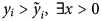



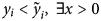


Proof. See Fig. 3. □
The intuition behind that result goes as follows. Remind that the indifference map in the (y i, L i) space involves indifference curves that are decreasing when $y_{i}> \tilde {y}_{i}$ , a vertical line at $y_{i} = \tilde {y}_{i}$
 , and increasing when $y_{i}< \tilde {y} _{i}$
 . As a consequence of that, the existence of an equivalent lifetime level requires that the reference income level $\bar {y}$
 lies, with y i, on the same side of the vertical line drawn at $\tilde {y}_{i}$
 . Otherwise, it is not possible, by moving along an indifference curve, to find the hypothetical lifetime level that, combined with the reference income, will make the individual indifferent with respect to his current bundle.Footnote 17
For instance, if the current bundle involves a life not worth living, (i.e. $y_{i}< \tilde {y}_{i}$ ), and if $\bar {y}> \tilde {y}_{i}$
 , then it is impossible to find a hypothetical lifetime that would, jointly with the reference income level $\bar {y}$
 , make the individual as worse off as he is under his bundle, since the hypothetical life would, at worst, involve $\hat {L}_{i} = 0$
 , which would still be better than the life not worth living.
But even if one focuses on cases of lives worth living (i.e. $y_{i}> \tilde {y} _{i}$ ) and with a reference income $\bar {y}> \tilde {y}_{i}$
 , the existence of the equivalent lifetime is not always guaranteed. To illustrate this, take the case of the utility function U i(y i, L i):

with λ > 0. Although this function satisfies all properties mentioned in Section 2, this does not guarantee the existence of the equivalent lifetime. The reason is that the utility is here bounded upward at $( y_{i}- \tilde {y}_{i})$ . Hence, if the reference income $\bar {y}$
 is low, it can be the case that even very high lifetime levels do not allow the individual to reach the same well-being as under his actual income y i.
In the light of all this, a first, major difference between the equivalent income and the equivalent lifetime lies in the conditions under which these indexes exist. The existence of the equivalent income is not trivial (Proposition 1), but the existence of the equivalent lifetime is even more demanding, because this requires stricter conditions (Proposition 2).Footnote 18 This restricts the possible uses of the equivalent lifetime with respect to the ones of the equivalent income. To illustrate this, take the case of a poor individual, whose initial income is above the critical income making lifetime neutral $\tilde {y}_{i}$ . Then, a natural disaster arises, which reduces his income to a level that lies below $\tilde {y}_{i}$
 . Given that the initial bundle and the final bundle lie on two distinct sides of the critical income making lifetime neutral, one cannot, on the basis of a single reference income level, compute the equivalent lifetime for both the pre-disaster and the post-disaster period. On the contrary, one can, for a broad set of indifference maps, compute the equivalent income for both periods, since the horizontal line drawn at $\bar {L}$
 generally crosses the two indifference curves along which the bundles lie.
To avoid that general non-existence problem, a solution is to define the equivalent lifetime in an alternative way. Let us call this new index the alternative equivalent lifetime.
Definition 3 (alternative equivalent lifetime)
Suppose two reference levels for the income per period $\bar {y}_{1}$ and $\bar {y}_{2}$
 , such that $\bar {y}_{1}< \min _{j}\left\{\tilde {y}_{j}\right\}$
 and $\bar {y}_{2}> \max _{j}\left\{\tilde {y}_{j}\right\}$
 for all j. Suppose that an individual i has preferences represented by the utility function U i(y i, L i). For any bundle (y i, L i), the alternative equivalent lifetime index $\breve {L}_{i}$
 is defined as follows.
∙ $\forall ( y_{i},\; \, L_{i}) \, \colon \, y_{i}< \tilde {y}_{i}\, \colon \, \breve {L}_{i} = -\hat {L}_{i}$
, where $U_{i}( \bar {y}_{1},\; \, \hat {L}_{i}) = U_{i}( y_{i},\; \, L_{i})$;∙ $\forall ( y_{i},\; \, L_{i}) \, \colon \, y_{i} = \tilde {y}_{i}\, \colon \, \breve {L}_{i} = 0;\;$
∙ $\forall ( y_{i},\; \, L_{i}) \, \colon \, y_{i}> \tilde {y}_{i}\, \colon \, \breve {L}_{i} = \hat {L}_{i}$
, where $U_{i}( \bar {y}_{2},\; \, \hat {L}_{i}) = U_{i}( y_{i},\; \, L_{i}).$




The ethical intuition behind the alternative equivalent lifetime goes as follows. Under the standard equivalent lifetime, there exists a unique reference income $\bar {y}$ , that is, it is only when y i equals $\bar {y}$
 that the comparison of two lives can be made solely on the basis of the lifetime enjoyed. The income $\bar {y}$
 was supposed to be a relevant reference whatever the lives under comparison are worth living or not. But assuming this unique reference income level is a strong assumption, since the valuation of the lifetime variable depends on whether lives are worth living or not worth living. When lives are not worth living, lifetime is not a desirable good, whereas, when lives are worth living, lifetime is a desirable good. This crucial difference questions the relevancy of having a unique reference income level for all well-being comparisons. The alternative equivalent lifetime index avoids that problem, by relying on two distinct reference incomes $\bar {y}_{1}$
 and $\bar {y}_{2}$
 , such that, for all individual i, we have $\bar {y}_{1}< \tilde {y}_{i}< \bar {y}_{2}$
 . The reference income $\bar {y}_{1}$
 concerns lives not worth living, while $\bar {y }_{2}$
 concerns lives worth living. When comparing lives not worth living with income $\bar {y}_{1}$
 , the alternative equivalent lifetime regards the longer life as worse than the shorter one. On the contrary, when comparing two lives worth living with income $\bar {y}_{2}$
 , the alternative equivalent lifetime regards the longer life as better than the shorter one.
The alternative equivalent lifetime avoids the systematic problem of non-existence that the standard equivalent lifetime faces when the actual income y i and the reference income $\bar {y}$ lie on different sides of the neutral income $\tilde {y}_{i}$
 . The alternative equivalent lifetime index overcomes that non-existence problem by relying on two reference levels for income $\bar {y}_{1}$
 and $\bar {y}_{2}$
 , such that, for all individual i, we have $\bar {y}_{1}< \tilde {y}_{i}< \bar {y}_{2}$
 . The alternative equivalent lifetime index is constructed while using the low reference level when income is below $\tilde {y}_{i}$
 , and the high reference level when income is above $\tilde {y}_{i}$
 (see Fig. 4).
Construction of the alternative equivalent lifetime index.

Shifting from the standard to the alternative equivalent lifetime index has the advantage to simplify the conditions necessary for the existence of the index.
Proposition 3 (existence of alternative equivalent lifetime)
Assume two reference levels for the income per period $\bar {y}_{1}$ and $\bar {y}_{2},\;$
 such that $\bar {y}_{1}< \min _{j}\left\{\tilde {y}_{j}\right\}$
 and $\bar {y}_{2}> \max _{j}\left\{\tilde {y}_{j}\right\}$
 for all j. Then, for any individual i with bundle (y i, L i):
∙ If $y_{i}< \tilde {y}_{i}$
, the alternative equivalent lifetime index $\breve {L}_{i}$ exists if and only if, for any individual i, the utility function U i(y i, L i) satisfies the following property: $\forall ( y_{i},\; \, L_{i}) \in {\mathbb R} ^{ + }\times {\mathbb R} ^{ + + },\; \, \exists x> 0$ such that: $U_{i}( \bar {y}_{1},\; \, x) = U_{i}( y_{i},\; \, L_{i})$.∙ If $y_{i} = \tilde {y}_{i}$
, the alternative equivalent lifetime index $\breve {L}_{i}$ exists and is equal to zero.∙ If $y_{i}> \tilde {y}_{i}$
, the alternative equivalent lifetime index $\breve {L}_{i}$ exists if and only if, for any individual i, the utility function U i(y i, L i) satisfies the following property: $\forall ( y_{i},\; \, L_{i}) \in {\mathbb R}^{ + }\times {\mathbb R}^{ + + },\; \, \exists x> 0$ such that: $U_{i}( \bar {y}_{2},\; \, x) = U_{i}( y_{i},\; \, L_{i})$.


Proof. See Fig. 4. □
The alternative equivalent lifetime can be regarded as a solution when facing the non-existence of the equivalent lifetime.Footnote 19 This solution does not guarantee the existence of the index under all kinds of preferences. But, at least, it immunizes us against a large class of non-existence cases.
Having stressed this, one should not reduce the alternative equivalent lifetime to merely a technical solution to the problem of non-existence faced by the equivalent lifetime. The alternative equivalent lifetime relies on a different way of making well-being comparisons, by means of reference income levels that differ depending on whether lives are worth living or not. This other way of comparing lives relies on an alternative normative view for well-being evaluations.
5. Respect for preferences
Let us now examine the properties satisfied by the equivalent income and the two equivalent lifetime indexes. For that purpose, this section and the next one consider some properties to be satisfied by a well-being index b i(y i, L i) defined in the (income per period, lifetime) space. That index is supposed to measure the well-being of person i under the life (y i, L i), that is, it assigns a real number to pairs (y i, L i) in such a way as to describe these lives in terms of well-being:

The equivalent income $\hat {y}_{i}$ and the equivalent lifetime indexes $\hat {L}_{i}$
 and $\breve {L}_{i}$
 belong to the set of all well-being indexes b i(y i, L i). Throughout this section, we will define general properties of a well-being index by mentioning the index b i(y i, L i), and, then, we study whether $\hat {y}_{i}$
 , $\hat {L}_{i}$
 and $\breve {L}_{i}$
 satisfy these properties.Footnote 20
A first, standard property is Respect for Preferences [see Fleurbaey and Maniquet (Reference Fleurbaey and Maniquet2011); Fleurbaey (Reference Fleurbaey2016)]. That property states that, if a variation in y i or L i increases (resp. decreases) individual welfare, this will necessarily lead to increase (resp. decrease) the well-being index, and that any variation in the well-being index must necessarily coincide with a variation, in the same direction, of individual welfare.
Definition 4 (Respect for Preferences)
A well-being index b i(y i, L i) satisfies Respect for Preferences if and only if, for any individual i and any two bundles (y i, L i) and $( y_{i}^{\prime },\; \, L_{i}^{\prime })$ , we have:

That ethical property states that moving an individual to a bundle that he considers to be better (resp. worse) must lead to a rise (resp. a fall) of the measured well-being for that person. That property is quite intuitive, and one may want that well-being indexes satisfy that property.
Proposition 4
• The equivalent income index satisfies Respect for Preferences.
• Regarding the equivalent lifetime index,
◦ if $y_{i},\; \, \bar {y}> \tilde {y}_{i}$
, the equivalent lifetime index satisfies Respect for Preferences.◦ if $y_{i},\; \, \bar {y}< \tilde {y}_{i}$
, the equivalent lifetime index does not satisfy Respect for Preferences, but Reverse Respect for Preferences (it takes a lower (resp. higher) value when the bundle is better (resp. worse)).
• The alternative equivalent lifetime index satisfies Respect for Preferences.


Proof. See Appendix A. □
The fact that the equivalent income index satisfies the Respect for Preferences property is not a new result [see Fleurbaey and Blanchet (Reference Fleurbaey and Blanchet2013); Fleurbaey (Reference Fleurbaey2016)]. The major novelty in Proposition 4 concerns the equivalent lifetime index. It is stated there that the equivalent lifetime index satisfies Respect for Preferences only if the bundles under comparison involve an income that is higher than the critical income level making the individual indifferent between life and death. However, the equivalent lifetime index does not respect preferences in the case where a life is not worth living (i.e. the case where $y_{i},\; \, \bar {y}< \tilde {y}_{i}$ ). The intuition behind that violation goes as follows. When $y_{i}< \tilde {y}_{i}$
 , an individual who lies on a lower indifference curve is better off. Thus, when moving along indifference curves so as to cross the vertical line at $\bar {y}$
 , it appears that a bundle involving a higher level of well-being is being assigned a lower level of the equivalent lifetime index $\hat {L} _{i}$
 .
This violation may be qualified, since, when $y_{i}< \tilde {y}_{i}$ , a lower lifetime implies a higher well-being. Thus assigning a lower value of the index when individuals are better off may not be so problematic; preferences are being respected, in the sense of another definition of “respecting preferences”, which would consist of “assigning a higher level of a desirable good” to situations that are regarded as better by the individual. Lifetime being undesirable when $y_{i}< \tilde {y}_{i}$
 , “respecting preferences” can here be interpreted as the requirement of “assigning a lower level of the undesirable good” to situations that are regarded as better by the individual, which is indeed satisfied. One should thus not exaggerate the violation of Respect for Preferences, even though it may be disturbing, when interpreting measurement results, to see larger values of the index assigned to bundles that are actually regarded as worse by individuals.
Interestingly, the alternative equivalent lifetime index does not face those problems, and satisfies Respect for Preferences. Thus the alternative formulation of the equivalent lifetime index allows us not only to avoid (some) non-existence problems, but, also, to satisfy Respect for Preferences.
6. Interpersonal well-being comparisons
6.1. Resourcism and Lifetimism
Let us consider how the equivalent income index and the equivalent lifetime index compare individuals with different preferences. For that purpose, this section will focus on two properties, Resourcism and Lifetimism, which lead to distinct metrics for well-being measurement.
Resourcism states that, when comparing the well-being of two individuals, it is sufficient to consider the income level of those individuals when the non-monetary dimension takes its reference level.
Definition 5 (Resourcism)
A well-being index b i(y i, L i) satisfies Resourcism if and only if, when comparing the well-being of two individuals i and j, it is sufficient to consider the income level of those individuals when the non-monetary dimension - here L i - takes its reference level $\bar {L}$ (for both individuals):

Resourcism is ethically attractive when comparing two lives worth living, that is, for which $y_{i}> \tilde {y}_{i}$ and $y_{j}> \tilde {y}_{j}$
 . Indeed, in that case, it makes sense to suppose that, if those two lives involve the reference lifetime, the well-being index should take a higher value for the life with the largest income per period. Note also that Resourcism keeps its ethical appeal when comparing two lives not worth living. To see this, take two individuals i and j with incomes $y_{i}< y_{j}< \tilde {y}_{i},\; \, \tilde {y} _{j}$
 and with lifetimes $L_{i} = L_{j} = \bar {L}$
 . Resourcism ranks individual j as better off than individual i, which is intuitive, since, despite the fact that the two lives are not worth living, at least individual j enjoys a higher income.
Note, however, that the ethical appeal of Resourcism is less clear when considering two lives, one worth living, whereas the other is not worth living, that is, the case where $\tilde {y}_{i}< y_{i}< y_{j}< \tilde {y}_{j}$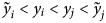 . In that case, if both individuals enjoy $\bar {L}$
 , Resourcism ranks individual j as better off than individual i (since y i < y j), even though individual i has a life worth living, whereas individual j has a life not worth living. That result is counterintuitive. Thus the ethical appeal of Resourcism is limited when comparing some lives worth living with lives not worth living.
Let us now introduce a second property, i.e. Lifetimism. Lifetimism states that, when comparing the well-being of two individuals at the reference income level, it is sufficient to compare their lifetimes.Footnote 21
Definition 6 (Lifetimism)
A well-being index b i(y i, L i) satisfies Lifetimism if and only if, when comparing the well-being of two individuals i and j, it is sufficient to consider the lifetime level of those individuals when the income takes its reference level $\bar {y}$ (for both individuals):

Lifetimism has some intuitive support when considering two individuals with lives worth living and incomes equal to the reference level, that is, when $y_{i} = y_{j} = \bar {y}> \tilde {y}_{i},\; \, \tilde {y}_{j}$ . In that case, it makes sense that the well-being index takes a higher value when the lifetime is larger. However, once lives under comparison are not worth living, the ethical appeal of Lifetimism becomes questionable. Take, for instance, two individuals i and j with incomes $y_{i} = y_{j} = \bar {y}< \tilde {y}_{i},\; \tilde {y}_{j}$
 and with lifetimes L i < L j. In that case, Lifetimism ranks individual j as better off than individual i, since he has a longer lifetime. However, since lifetime is, for such low income levels, an undesirable good, one may consider that individual i should be ranked as better off than individual j, contrary to what Lifetimism recommends. Moreover, Lifetimism leads also to counterintuitive results when comparing a life worth living with a life not worth living.
In the light of the lack of attractiveness of Lifetimism in case of lives not worth living, one may reformulate Lifetimism as follows.
Definition 7 (Alternative Lifetimism)
A well-being index b i(y i, L i) satisfies Alternative Lifetimism if and only if, when comparing the well-being of two individuals i and j, we have that:

Alternative Lifetimism states that, if individuals have incomes equal to reference income levels, then the comparison of their well-being can be made by focusing merely on their lifetime if lifetime is a good, and on minus their lifetime if lifetime is a bad.
Resourcism, Lifetimism and Alternative Lifetimism are three distinct approaches to interpersonal well-being comparisons. Under Respect for Preferences, those approaches are logically incompatible, since these lead to contradictory rankings. Let us first show this incompatibility for Resourcism and Lifetimism. To illustrate this, Fig. 5 compares two individuals, a and b, who have different preferences. Those two individuals have the same lifetime (equal to the reference lifetime $\bar {L}$ ), but the income is larger for a than for b. When comparing a and b , Resourcism considers that individual a, who has a larger income than individual b, is better off than b. On the contrary, Lifetimism leads to the opposite result: individual a is, under Lifetimism, regarded as worse off than b. Indeed, Lifetimism ranks d (which lies on the same indifference curve as b) as strictly better than c (which lies on the same indifference curve as a). Thus, if one wants to respect preferences, Resourcism and Lifetimism lead to contradictory rankings.
Incompatibility of Resourcism and Lifetimism under Respect for Preferences.

Figure 6 illustrates the incompatibility between Resourcism and Alternative Lifetimism. On Fig. 6, we have that (y a, L a) and (y d, L d) are equally good, so that, by Respect for Preferences, individuals a and d, who share the same preferences, are ranked as equally well off. Similarly, (y b, L b) and (y c, L c) are equally good, so that, by Respect for Preferences, individuals b and c, who share the same preferences, are ranked as equally well off. But since a and b enjoy the reference lifetime level, and since y b > y a, Resourcism ranks b is strictly better off than a. Note also that Alternative Lifetimism requires d to be strictly better off than c. But then we obtain a contradiction, since a is as well off as d and c as well off as b, and therefore a should be strictly better off than b. Thus Resourcism and Alternative Lifetimism are incompatible.
Proposition 5 Under Respect for Preferences, Resourcism and Lifetimism are not compatible. Moreover, under Respect for Preferences, Resourcism and Alternative Lifetimism are not compatible.
Incompatibility of Resourcism and Alternative Lifetimism under Respect for Preferences.

Proof. The incompatibility between Resourcism and Lifetimism under Respect for Preferences is illustrated by Fig. 5. The incompatibility between Resourcism and Alternative Lifetimism under Respect for Preferences is illustrated by Fig. 6. □
Proposition 6 states that the three well-being indexes under comparison rely on different approaches for the interpersonal comparisons of well-being.
Proposition 6 The equivalent income index satisfies Resourcism. The equivalent lifetime index satisfies Lifetimism. The alternative equivalent lifetime index satisfies Alternative Lifetimism.
Proof. See Appendix B. □
An interesting implication of Proposition 6 is that the equivalent income index and the two equivalent lifetime indexes carry a cardinal meaning. To see why, let us take the case of the equivalent income. As shown in Proposition 6, the equivalent income satisfies Resourcism, which states that ordinary income can serve as an acceptable measure of well-being under some circumstances (i.e., when lifetime takes its reference level). While the indifference map is used to extend measurement beyond these circumstances, it remains nonetheless that the equivalent income carries a cardinal meaning, just as ordinary income does [see Fleurbaey (Reference Fleurbaey2016)]. The same kind of rationale holds for equivalent lifetime indexes, which carry a cardinal meaning (just as ordinary lifetime does).Footnote 22
What can Proposition 6 tell us about the attractiveness of the three well-being indexes under comparison? At first glance, there is an advantage for Resourcism over Lifetimism. The major problem with Lifetimism is that lifetime is not necessarily a desirable good: if the quality of life is very low (extreme misery), lifetime becomes an undesirable good. On the contrary, income is always a desirable good: a higher quality of life is always more desirable than a lower quality of life for a given duration of life. The fact that income is necessarily a desirable good - unlike lifetime - makes it a better candidate for being the metric of well-being measurement. That argument supports Resourcism against Lifetimism, and thus the equivalent income over the equivalent lifetime.
But Resourcism also faces some criticisms. As stated above, Resourcism may, in some cases, lead to the counterintuitive conclusion that a person considering his life not worth living may be ranked as better off than a person considering his life worth living. Interestingly, Alternative Lifetimism does not face that criticism: when comparing a life worth living with a life not worth living, it always ranks the former as better off than the latter. This provides some support for the alternative equivalent lifetime.
6.2. Respect for value of life
All individuals have their own ideas of what makes a life worth living. This is captured, in our model, by the parameter $\tilde {y}_{i}$ , the critical income level making life neutral for individual i. Considering one's own life as worth living, or, alternatively, as not worth living, is something that has strong significance, and one may want a well-being index to respect this. In particular, if two persons must be compared, one who regards his life as worth living, whereas the second regards his life as not worth living, one may require that a well-being index ranks the first person as better off than the second person. That intuitive property can be coined as the Respect for Value of Life.
Definition 8 (Respect for Value of Life)
A well-being index b i(y i, L i) satisfies Respect for Value of Life if and only if, when comparing the well-being of two individuals i and j, where i regards his life as worth living, whereas j regards his life as not worth living, the index ranks i as better off than j:

Respect for Value of Life is intuitive, since it is hard to see how a well-being index could rank a person who regards his life as not worth living as better off than a person who regards his life as worth living. However, although intuitive, that property is not compatible with Resourcism and Lifetimism, but is only compatible with Alternative Lifetimism.
Proposition 7 Neither Resourcism nor Lifetimism are compatible with Respect for Value of Life. On the contrary, Alternative Lifetimism is compatible with Respect for Value of Life.
Proof. Consider first Resourcism and Respect for Value of Life. Assume that $\tilde { y}_{i}< y_{i}< y_{j}< \tilde {y}_{j}$ . If both individuals enjoy $\bar {L}$
 , Resourcism implies that j is ranked better off than i (since y i < y j), against Respect for Value of Life.
Consider now Lifetimism and Respect for Value of Life. Assume that $\tilde {y} _{i}< y_{i} = y_{j} = \bar {y}< \tilde {y}_{j}$ , whereas L i < L j. Lifetimism leads to $\hat {L}_{i}< \hat {L}_{j}$
 , against Respect for Value of Life.
Consider now Alternative Lifetimism. Assume that $\bar {y}_{1}< \tilde {y} _{j}< y_{j}< y_{i}< \tilde {y}_{i}< \bar {y}_{2}$ and L i > L j. Alternative Lifetimism ranks j as better off than i, in line with Respect for Value of Life. Actually, since $\breve {L}_{j} = \hat {L}_{j}> 0> -\hat {L}_{i} = \breve {L} _{i}$
 , it is always the case that Alternative Lifetimism ranks a life worth living as better off than a life not worth living. □
If one believes in the intuitive appeal of Respect for Value of Life, Proposition 7 provides ethical support for Alternative Lifetimism.
Back to our well-being indexes, it is easy to show that the equivalent income, which satisfies Resourcism, cannot satisfy Respect for Value of Life. In the same way, it follows also from above that the equivalent lifetime, which satisfies Lifetimism, cannot satisfy Respect for Value of Life. However, the alternative equivalent lifetime satisfies Respect for Value of Life.
Proposition 8 The equivalent income index and the equivalent lifetime index do not satisfy Respect for Value of Life. On the contrary, the alternative equivalent lifetime index satisfies Respect for Value of Life.
Proof. The proof follows immediately from Propositions 6 and 7. □
All in all, this section provides some support for the alternative equivalent lifetime. Among the three well-being indexes under comparison, only the alternative equivalent lifetime satisfies Respect for Value of Life.
7. Well-being variations under same preferences
Let us now examine to what extent our indexes yield distinct pictures of well-being under a unique indifference map. The reason why we explore the sensitivity of well-being measures to the postulated metric in that simplified context is that most applied studies using equivalent incomes assume, due to the lack of microeconomic data, the existence of a representative agent.Footnote 23
Under a single indifference map (and assuming that lives are worth living), the equivalent income and the equivalent lifetime (under standard or alternative form) rank any two situations in the same way, since these respect preferences and rely on the same indifference map. But beyond the robustness of rankings, one may want to know whether the reliance on a particular metric has, under a unique indifference map, a quantitative impact on well-being measurement.
To explore that issue, this section considers a representative agent model, whose preferences are given by the function U(y, L), which has the same properties as the functions U i(y i, L i) studied above. There exists a critical income level $\tilde {y}$ making the representative individual indifferent between life and death.
Let us consider a shift from the initial situation (y′, L′) to the final situation (y′′, L′′). Using the equivalent income, the relative variation of well-being is:

where $\hat {y}( y^{\prime \prime },\; \, L^{\prime \prime })$ is defined implicitly by the equality: $U( \hat {y}( y^{\prime \prime },\; \, L^{\prime \prime }) ,\; \, \bar {L}) = U( y^{\prime \prime },\; \, L^{\prime \prime })$
 .
Using the equivalent lifetime, the relative variation of well-being is:

where $\hat {L}( y^{\prime \prime },\; \, L^{\prime \prime })$ is defined by the equality: $U( \bar {y},\; \, \hat {L}( y^{\prime \prime },\; \, L^{\prime \prime }) ) = U( y^{\prime \prime },\; \, L^{\prime \prime })$
 .
Using the alternative equivalent lifetime, the relative well-being variation is:

where $\breve {L}( y^{\prime \prime },\; \, L^{\prime \prime }) = \hat {L} ( y^{\prime \prime },\; \, L^{\prime \prime })$ if $y^{\prime \prime }> \tilde {y}$
 , $\breve {L}( y^{\prime \prime },\; \, L^{\prime \prime }) = - \hat {L}( y^{\prime \prime },\; \, L^{\prime \prime })$
 if $y^{\prime \prime }< \tilde {y}$
 and $\breve {L}( y^{\prime \prime },\; \, L^{\prime \prime }) = 0$
 if $y^{\prime \prime } = \tilde {y}$
 , and where also $\breve {L} ( y^{\prime },\; \, L^{\prime }) = \hat {L}( y^{\prime },\; \, L^{\prime })$
 if $y^{\prime }> \tilde {y}$
 , $\breve {L}( y^{\prime },\; \, L^{\prime }) = -\hat {L}( y^{\prime },\; \, L^{\prime })$
 if $y^{\prime }< \tilde {y}$
 and $\breve {L}( y^{\prime },\; \, L^{\prime }) = 0$
 if $y^{\prime } = \tilde {y}$
 .
In cases of lives worth living (i.e. when $y^{\prime },\; \, y^{\prime \prime }> \tilde {y}$ ), which is the most relevant case from an empirical perspective, we have that $\Delta \breve {L}/\breve {L} = \Delta \hat {L}/\hat {L}$
 , that is, the measured relative welfare variation under the alternative equivalent lifetime is equal to the measured relative welfare variation under the equivalent lifetime. In the light of this, we will, in this section, focus only on the comparison of measured well-being variations under the equivalent income and the standard equivalent lifetime.
Without imposing further assumptions on U(y, L), it is difficult to derive results concerning the comparison of ${\Delta \hat {y }}/{\hat {y}}$ with ${\Delta \hat {L}}/{\hat {L}}$
 . Let us assume that U(y, L) takes the following form, which is standard since [Becker et al. (Reference Becker, Philipson and Soares2005)]:Footnote 24

where L is the life expectancy, while 0 < σ < 1 and $\alpha \lessgtr 0$ .Footnote 25 This function is increasing in income y, but can be increasing or decreasing in lifetime L, depending on how large y is. There exists a threshold for income $\tilde {y} = [ \alpha ( 1-\sigma ) ] ^{{1}/( {1-\sigma }) }$
 such that lifetime is a desirable good for $y> \tilde {y}$
 , whereas lifetime is an undesirable good for $y< \tilde {y}$
 , and a neutral good for $y = \tilde {y}$
 .Footnote 26
Based on that functional form, the equivalent income is equal to:

where $\bar {L}$ is the reference lifetime.
Moreover, the equivalent lifetime is equal to:

where $\bar {y}$ is the reference income per period.
The equivalent income index and the equivalent lifetime index defined on the basis of U(y, L) = L[(y)1−σ/(1 − σ) − α] exhibit some interesting invariance properties. Actually, both the equivalent income and the equivalent lifetime are, under that utility function, robust to the rescaling of all lifetime variables by a constant k > 0, and, also, robust to the rescaling of all income variables by a constant k > 0.Footnote 27 These invariance properties suggest that comparing relative variations in measured well-being ${\Delta \hat {y}}/{ \hat {y}}$ with ${\Delta \hat {L}}/{\hat {L}}$
 makes sense, since these comparisons do not reflect arbitrary differences in how income or lifetime is measured.
Proposition 9 summarizes our results concerning the comparison of relative welfare changes under the equivalent income and the equivalent lifetime indexes in case of a shift from (y′, L′) to (y′′, L′′).
Proposition 9 Assume common preferences, with U(y, L) = L[(y)1−σ/(1 − σ) − α] where $\alpha \gtrless 0$ and 0 < σ < 1. Consider a shift from (y′, L′) to (y′′, L′′), with $\bar {y},\; \, y^{\prime },\; \, y^{\prime \prime }> \tilde {y}$
 .
• The measured relative variation in well-being under the equivalent income and under the equivalent lifetime satisfy:
$${\Delta \hat{y}\over \hat{y}}\geq {\Delta \hat{L}\over \hat{L}}\iff { U^{\prime \prime } + \alpha \bar{L}\over U^{\prime } + \alpha \bar{L}}\geq \left({U^{\prime \prime }\over U^{\prime }}\right)^{1-\sigma }$$where U′ ≡ L′(((y′)1−σ/1 − σ) − α) and U′′ ≡ L′′(((y′′)1−σ/1 − σ) − α).• When α = 0, leading to $\tilde {y} = 0$
, we have:$${\Delta \hat{y}\over \hat{y}}\geq {\Delta \hat{L}\over \hat{L}}\iff U^{\prime \prime }\geq U^{\prime }$$


Proof. See Appendix C. □
Proposition 9 tells us that even if all individuals have the same preferences (so that interpersonal well-being comparisons are not a source of concerns), the postulated metric matters for the measurement of well-being. Proposition 9 states that the measured relative well-being variations in case of a shift from (y′, L′) to (y′′, L′′) vary across well-being indexes. When the condition stated in Proposition 9 is verified, the measured relative variation in well-being is larger when well-being is measured by the equivalent income rather than when it is measured by the equivalent lifetime. It is only in a special case, when the left-hand side and the right-hand side of the condition are exactly equal, that measured relative well-being variations are equal across well-being indexes.
The last part of Proposition 9, which concerns the case where the critical income making lifetime neutral is zero (i.e., α equals 0), states that in that case, if there is a welfare gain by shifting from (y′, L′) to (y′′, L′′), the measured relative welfare gain is always larger when measured with the equivalent income than when measured with the equivalent lifetime index.
8. An application to the Syrian War
In order to further examine the sensitivity of the measurement of well-being to the postulated metric, this section takes the case of the measurement of well-being in the context of the Syrian War. The Syrian War (2011–2019) is at the origin of thousands of deaths and injured persons, and caused the displacement of thousands of refugees, a strong contraction of economic activity and massive destructions (including important cultural sites) (see Table 1).Footnote 28
Basic indicators, Syria, 2010 and 2016.

Sources: World Bank.
Whereas the War affected numerous dimensions of life, we will, throughout this section, focus only on the two dimensions that were studied in the theoretical part of the paper, i.e. income per period and lifetime. Due to data limitation, we will abstract here from inequality among those two dimensions, and consider a representative agent framework. We will measure the first dimension by the income per capita (in current US$), denoted by y, and measure the second dimension by life expectancy at birth, denoted by L.Footnote 29 Throughout this section, we assume, as in Section 7, that:

in line with [Becker et al. (Reference Becker, Philipson and Soares2005)].
Concerning the calibration of preference parameters α and σ, we proceed as follows. As far as the calibration of σ is concerned, we follow Blundell et al. (Reference Blundell, Browning and Meghir1994) and take σ = 0.83. Concerning α , this can be calibrated using studies on the value of a statistical life (VSL), defined as the marginal rate of substitution between income and mortality risk:Footnote 30

where d j is the probability of death at age j conditional on survival to that age, while $s_{i + 1} = \prod _{j = 0}^{i}( 1-d_{j})$ is the (unconditional) probability of survival to age i + 1.
In order to calibrate α on the basis of VSL estimates, we rely here on the meta-analysis of VSL studies carried out by Miller (Reference Miller2000). Miller collected 68 studies estimating VSL across 13 countries, while using various methodologies (wage-risk studies, contingent valuation methods, behavioral studies), in order to estimate rules of thumb, which relate the VSL to the level of GDP per capita. The interest of those rules of thumb is the following. Most VSL studies have focused exclusively on rich countries, whereas for most countries there exists no direct VSL estimate. Hence, the rules of thumb estimated by Miller allow us to extrapolate VSL estimates for any country, by merely knowing the GDP per capita of that country. This is the case for Syria, for which there exists no direct VSL estimate. Thus Miller's rules of thumb allow us to have an indirect estimate of the VSL for Syria, and to use it for our calibration.Footnote 31
Following Miller (Reference Miller2000) rules of thumb, the VSL amounts to between 120 and 180 times GDP per capita. Hence, on the basis of the pre-conflict income per head ($2806), we obtain two values for α: α equal either to 16.46 (lower bound of VSL) or to 13.35 (upper bound of VSL). This implies that the critical income level $\tilde {y}$ is equal to $ 424 (low VSL) or to $ 123 (high VSL).Footnote 32 Observed income levels being above those levels, this implies that, provided $\bar {y}_{2} = \bar {y}$
 , the alternative equivalent lifetime index takes here the same level as the standard equivalent lifetime index. This section will thus concentrate on the comparison between the equivalent income and the equivalent lifetime indexes.
In order to compute equivalent income and equivalent lifetime indexes, we take, as reference levels for income per period and lifetime, the pre-War levels of y and L, which leads to $\bar {y} = 2806$ and $\bar {L} = 74.4$
 .Footnote 33 Figure 7 shows the equivalent income index for 2010 (pre-War) and 2016 (War), under low and high VSL, whereas Fig. 8 shows the equivalent lifetime index for 2010 and 2016 (also under low and high VSL).
Income and equivalent income in Syria, 2010 and 2016.

Lifetime and equivalent lifetime in Syria, 2010 and 2016.

Figures 7 and 8 show the strong deterioration in standards of living due to the War. However, although the two indexes agree qualitatively, in the sense that these provide the same rankings, these lead to quite different pictures from a quantitative perspective. Two main differences should be highlighted.Footnote 34
A first important difference concerns the measurement of the well-being loss due to the War. Using the equivalent income, the average well-being loss due to the War lies, in relative terms, between |(1140 − 2806)/2806| = 0.593 (under the low VSL) and |(1071 − 2806)/2806| = 0.618 (under the high VSL). However, when one uses the equivalent lifetime, the measured (average) well-being loss lies, in relative terms, between |(47 − 74.4)/74.4| = 0.368 (under the high VSL) and |(36 − 74.4)/74.4| = 0.516 (under the low VSL). Those results are in line with Proposition 9, which states that measured well-being variations vary with the postulated metric. However, our application reveals that adopting the income metric or the lifetime metric can have substantial quantitative consequences, by strongly affecting the measured (relative) average well-being loss due to the War.
Second, whereas the equivalent income indexes during the War are close to the standard income, this is not the case when considering equivalent lifetime indexes, which exhibit much lower levels than the (unadjusted) lifetime.Footnote 35 Figure 8 shows that the hypothetical lifetime that would, combined with the pre-War income, make the representative individual indifferent with respect to the War situation is as low as 36 years (under the low VSL) and 47 years (under the high VSL). Thus the deprivation due to a lower income has been so strong that a representative individual would be willing to give up between 22.5 years (i.e. 69.5 − 47) and 33.5 years (i.e. 69.5 − 36) of life to go back to the pre-War income. In relative terms, the differential between the equivalent lifetime and the standard lifetime (between $32\%$ and $48\%$
 ) is much larger than the differential between the equivalent income and the standard income (between $6\%$
 and $12\%$
 ).
Why is it the case that adopting Resourcism or Lifetimism makes such a large difference here? To have a clue, Fig. 9 reproduces the indifference map in the (income, lifetime) space, under the low VSL estimate, as well as the equivalent income index and the equivalent lifetime index. Figure 9 makes appear that the reason why the equivalent income and the equivalent lifetime indexes lead to different pictures lies in the curvature of indifference curves in the area of the indifference map between the initial point (2010) and the War point (2016).
Construction of equivalent income index and equivalent lifetime index for 2016.

Consider first the equivalent income index. The high slope of indifference curves for income levels lower than the War level explains why a small movement along the indifference curve - and thus a small income reduction - suffices to compensate for the 5-year improvement in life expectancy when the reference (pre-conflict) survival conditions are imposed. This low WTP for coming back to pre-conflict survival conditions can be explained by the extreme poverty due to the War. This low WTP, in income terms, for an increase in lifetime, explains why the equivalent income is very close to the standard income in 2016.
Consider now the equivalent lifetime index. The high slope of the indifference curve around the War point explains that a large lifetime reduction is needed to compensate the substantial loss in income (from $ 2805 to $ 1215). Thus the high WTP, in life-year terms, for an increase in income explains why the equivalent lifetime index is much lower than (unadjusted) lifetime in 2016. This high WTP (in life-year terms) for coming back to the pre-War income is also explained by the extreme poverty due to the War. Extreme poverty explains why, although individuals would be willing to give up little income to turn back to pre-conflict survival conditions, they would be willing to give up a large number of life-years to turn back to pre-War material standards of living.
All in all, the measurement of the (average) well-being loss due to the War illustrates that relying on Resourcism or on Lifetimism leads to different pictures of the deprivation caused by the War. The reason why the pictures provided by the two indexes are so different lies in the fact that the War bundle lies in an area of the indifference map where life-years have a low value with respect to income (or, alternatively, income has a high value with respect to life-years). Hence, relying on the income metrics or on the lifetime metrics makes a substantial difference when describing the overall deprivation due to the War.
9. Conclusions
In this paper, we proposed to examine the role of the metric in the measurement of well-being by means of equivalent indexes, by comparing, in the (income, lifetime) space, the equivalent income index with the equivalent lifetime index. At first glance, one may believe that relying on the money metric or on the life-year metric does not make a difference for well-being measurement. However, our analysis revealed that relying on a particular metric makes a substantial difference, at various levels of analysis.
A first important difference lies in the fact that, even if the existence of the equivalent income is not a weak assumption, the existence of the equivalent lifetime is even stronger. However, the alternative equivalent lifetime index can, by relying on two reference income levels, solve, to some extent, the non-existence problems faced by the latter. Moreover, the three indexes under comparison rely on different approaches for the interpersonal comparison of well-being: Resourcism and (Alternative) Lifetimism, which, under Respect for Preferences, lead to contradictory rankings. Furthermore, among the three indexes under study, the alternative equivalent lifetime is the only index that satisfies Respect for Value of Life. Thus, from a qualitative perspective, the postulated metric definitely affects well-being comparisons. From a quantitative perspective, relying on a particular metric also matters. Under a unique indifference map, the measured relative well-being variations vary across the index chosen. That point is illustrated by the measurement of the (average) well-being loss due to the Syrian War. That well-being loss differs depending on whether this is computed under the equivalent income or the equivalent lifetime.
In sum, our comparison of the equivalent income index and the equivalent lifetime index shows that the choice of the metric matters for well-being measurement. This is true when considering the comparison of well-being across individuals having distinct indifference maps. But even if one assumes a unique indifference map, the chosen metric still matters, not from a qualitative perspective (since rankings are here preserved), but from a quantitative perspective. The choice of a metric for well-being measurement definitely matters, and this choice of metric is a normative issue. There is nothing “natural” in adopting Resourcism or Lifetimism, and this choice was shown in this paper to have non-negligible consequences on how well-being is measured.
To conclude, it should be stressed that this paper focused only on the issue of the metric for well-being measurement, while relying on equivalent indexes, constructed by fixing (constant) reference levels for some dimensions of well-being. Alternatively, one may consider other well-being indexes relying not on a fixed reference level, but, instead, on a reference ray increasing in both arguments, as in Fleurbaey and Maniquet (Reference Fleurbaey and Maniquet2017, Reference Fleurbaey and Maniquet2018, Reference Fleurbaey and Maniquet2019). Relying on such a reference ray is a way to escape from other criticisms against the standard equivalent income index, which point to the arbitrariness of the (fixed) reference level [see Fleurbaey (Reference Fleurbaey2016)]. The present paper did not consider that issue, and focused instead on a more particular problem, i.e. the comparison of the income and the lifetime metrics for well-being measurement. Moreover, Fleurbaey and Ponthiere (Reference Fleurbaey and Ponthiere2023) consider, in a recent article, the construction of an index defined as the equivalent income net of the income making lifetime neutral, and show that this alternative measure of well-being satisfies Respect for the Value of Life. A more comprehensive study of well-being measurement should include all those aspects of the construction of well-being indexes. Much work remains to be done, in the future, on the construction of appealing well-being indexes.
Supplementary material
The supplementary material for this article can be found at https://doi.org/10.1017/dem.2023.16
Acknowledgements
The authors are most grateful to Helmuth Cremer, Franz Dietrich, Fabrice Etilé, Marc Fleurbaey, Stephan Klassen, Jean-François Laslier, Erik Schokkaert, Claudia Senik, Holger Strulik and Stephane Zuber, as well as two anonymous reviewers, for their comments on a previous version of this paper. We also thank participants of seminars at the University of Gottinghen and at Paris School of Economics, as well as participants of LAGV 2019 (Aix-en-Provence), SAET 2019 (Ischia) and PET 2019 (Strasbourg).Footnote 36



