The electoral aspirations of any movement are dependent on links the movement can establish between voters and the movement's preferred candidate. The components involved in establishing this link are many, but tend to be some manifestation of group, especially interest groups and their leadership and grassroots organizations, like churches. Over the last 30 years, many have studied support for the Christian Right (CR) and its influence from varied theoretical perspectives, all with different conceptions of the most politically salient meaning of group, but all assuming an essential grassroots component. Noting the diverse array of methodological approaches and the number of competing theoretical constructions of the CR that scholars have forwarded, Regnerus, Sikkink, and Smith (Reference Regnerus, Sikkink and Smith1999, 1376) find that “This methodological and theoretical diversity suggests that the CR, as a social, political, and religious entity, is much more complex than often assumed and deserves closer scrutiny.”
We take just such a closer look to address two questions in this paper: what affects support for CR organizations and leaders? In addition, how does a broad set of movement support factors affect voting for the movement's preferred candidate? We place the dominant schools of thought on CR influence in a broader and yet more tightly specified portrait of the movement. We argue that establishing movement ties, which allow for CR influence, is dependent on the structure of a citizen's social relations in ways that affect how we will think about the power of organizations and movements.
We first articulate our own suppositions about the grassroots underpinnings of the movement as well as the findings of a generation of research into the nature of support for the CR. We then detail the setting for our test of movement influence, which is essential to reaching valid inferences about movement support, before going on to test these approaches on affect toward Ohio CR groups and elites and assessing their collective effect on the vote.
A CONTEXTUAL THEORY OF CHRISTIAN RIGHT INFLUENCE
Since the very beginning of scholarly inquiry into the workings of the “New Christian Right” in the early 1980s, many observers have believed that “The centerpiece of [the Christian Right's] mobilization campaign was the local church” (Liebman Reference Liebman, Liebman and Wuthnow1983, 72). According to some CR studies, clergy, in their historical role as prophets speaking truth to power, were expected to relay the message of CR organizations to their congregations couched in terms of Christian duty (Oldfield Reference Oldfield1996). If it is indeed the case that churches are homogenous social groupings as some observers assume (Mutz Reference Mutz2006; Scheufele et al. Reference Scheufele, Nisbet, Brossard and Nisbet2004), then the delivery of political cues from an influential leader would essentially flip a participation switch. It is no wonder that studies of the CR often begin with a militaristic metaphor, though that metaphor almost never lasts through the conclusion.
Few scholars adhere to a strictly “top-down” view of the effects of the church environment on political behavior, however, as most emphasize the important role that social interaction can play in influencing church-goers' electoral decisions (Gilbert Reference Gilbert1993; Jelen Reference Jelen1992; Wald, Owen, and Hill Reference Wald, Owen and Hill1988). Typical examinations of the effects of the church social context have conceived of such influence in direct terms. That is, individuals involved in the church are exposed to contagious norms that eventually serve to bring them in line with the dominant political view of the congregation. There is little doubt that this process affects voting patterns, but how it relates to connections with movement organizations is not so clear. It is possible that social networks could transmit interest group mobilization as a byproduct of political discussion and thereby expand the influence of group action. However, if the acquisition of political norms is rooted in the observation of behavior and explicit political discussion is generally limited to issues and not the groups, parties, and candidates involved in elections, then the diffusion model (Wald, Owen, and Hill Reference Wald, Owen and Hill1988) is an unlikely one to build and sustain a movement.
A more productive use for social networks in this case was advanced by Granovetter (Reference Granovetter1973), who argued that the real power of social networks lay in the diffusion of information moderated by the strength of social ties. Instead of thinking only of the degree of the homogeneity of information content supplied through networks, the crucial measure of the power of a network is located in another variable — the strength of ties. Strong ties, where everyone knows each other, serve to limit the diffusion of the opinions and values of the network — strong ties make the network inaccessible to the broader context. Weak ties, however, serve to spread a message to a broader audience; those with weak ties are accessible to society.
This perspective is particularly important when we consider the potential connection of individual church members to social movement organizations. Greater insularity in the network may actually inhibit the formation of interest group ties. Insular networks (those with strong ties) are exposed to fewer cues from the broader context, where interest groups operate. Moreover, insular networks with agreeable discussants easily satisfy citizens' need for trusted information, undermining a need to search further. If citizens' need for information is satisfied by immediate social sources, they will not expend further energy to learn about interest groups, even those that accurately represent their opinions and values (Paul A. Djupe, n.d.).
The implications of this pattern are profound for understanding the connection of groups to the grassroots. The more obvious one is that high concentrations of a natural constituency may be inaccessible to the very groups attempting to represent their interests to government. Such insulated citizens may still act in concert with the movement leadership, but that action is purely serendipitous.
Second, the types of citizens who seek out information about interest groups are those exposed to a broader array of information and hence more likely to be exposed to political dissonance. Arguments gained from a group search may then be folded back into social discussion, enhancing the deliberative possibilities of political talk. However, social interaction with those holding dissonant opinions is simultaneously likely to shift the values and opinions of the information seeker (Huckfeldt and Sprague Reference Huckfeldt and Sprague1995). That is, in the strongest case, individuals exposed to difference in the network may learn about and identify with an interest group despite growing gaps in value agreement with the interest group due to the social exposure to political difference.
Third, if citizens seek out information about interest groups when exposed to social difference, then any subsequent mobilization from the group will likely be limited by the very difference that spawned the information search. That is, the implication is the exact opposite of the traditional assumption about interest group membership. Instead of platoon commanders, members might be better considered lone wolves, and group mobilization attempts may be limited to the member instead of diffusing through a broader network.
Last, social networks are not synonymous with social contexts (Huckfeldt and Sprague Reference Huckfeldt and Sprague1987). Attributes of a discussant should not be mapped on to the social context and network effects should be understood as contingent on the context (Huckfeldt, Johnson, and Sprague Reference Huckfeldt, Johnson and Sprague2004). In the context of the church, network insularity may be overcome by a cascade of political information in the church, which may be the result of clergy speech, small group discussion, or other sources (Djupe and Gilbert Reference Djupe and Gilbert2003, Reference Djupe and Gilbert2006). Without such contextually-supplied information, however, the context can serve as an additional access barrier to external mobilization attempts (such as from interest groups).
We do not deny the frequent assumption that churches are important components of the CR. Under certain (and generally rare) conditions, a church might be considered an extension of the larger movement. Otherwise, the connections individuals make with the movement will be dependent, in part, on their relationships with other intimates that may encourage them to seek additional political information or that may limit their exposure to external information sources.
Of course, research on the CR has offered a number of competing ideas about what drives support for the CR. But, as Regnerus, Sikkink, and Smith (Reference Regnerus, Sikkink and Smith1999, 1375) note, “little research to date has examined an important means of Christian Right influence in the contemporary political process: helping people decide how to vote in elections.” They contend that any study of CR support must do more than simply gauge “support,” which very many have done. Rather, they suggest that a far more focused approach to measuring support for the CR entails measuring the effects of CR mobilization efforts on vote choice. In fact, the best approach is to assess the determinants of support and how those forces affect the selection of a movement's candidate.
Even though most existing theories of CR mobilization typically fail to make the distinction between “influence” and “support,” the literature has forwarded a number of promising perspectives on CR attachments — perspectives that are frequently offered as clear alternatives. The dominant themes can perhaps best be categorized as social-psychological (most often represented as religious commitment) and psychological (group consciousness explanations).
Each perspective contends, in its own way, with the most politically relevant connection of citizens with groups, and therefore attempts to operationalize what is seen as the likely residue of the group taint. As Green (Reference Green, Freeman and Johnson1999b, 154) summarizes the psychological approach, “[C]ollective identity is a cognitive encapsulation of group values, group attachments, and orientations toward group action. [It is] … relevant to the mobilization of resources for the movement activity.” Individuals identify with salient groups, such as CR organizations or religious groups (e.g., evangelical identification) and thus are mobilized through their attachments to such groups (Jelen Reference Jelen1993; Wilcox, Jelen, and Leege Reference Wilcox, Jelen, Leege, Leege and Kellstedt1993). Those who identify with the CR then rally to help the cause when CR leaders and religious elites speak out on an issue or a candidate (Kellstedt Reference Kellstedt, Leege and Kellstedt1993). According to some formulations of the psychological approach, these identity connections are likely fashioned through social interactions among like-minded individuals — a type of exchange often referred to as enclave deliberation (Sunstein Reference Sunstein2000).
In contrast to the psychological approaches, social-psychological theories of CR mobilization that emphasize the fundamental differences in religious commitment (or religiosity) between religious groups have dominated the field (e.g., Green et al. Reference Green, Guth, Kellstedt and Smidt1996; Layman Reference Layman2001). In part, the religious commitment approach has been popular because it lends itself to a culture wars storyline pitting religious liberals against conservatives (see Wuthnow Reference Wuthnow1988). Religious commitment perspectives on how religion influences political behavior involve specifying the degree of individual religiosity within a religious tradition or, somewhat more pointedly, within a denomination. In this way, proponents purport to tap the “social embodiment of religion” and, consequently, the “mass constituency of the Christian Right” (Green et al. Reference Green, Guth, Kellstedt and Smidt1996, 174). Such a conceptualization of how religion influences political behaviors is not without its critics, however (see Djupe and Gilbert Reference Djupe and Gilbert2004, Reference Djupe and Gilbert2006; Hart Reference Hart1996; Gilbert Reference Gilbert1993; Wald, Owen, and Hill Reference Wald, Owen and Hill1988).
A clear problem in this and related literatures is that “group” is a loosely used term that refers to social categories, organizations, and social networks with little differentiation made in theory or analyses. Moreover, the “Christian Right” is an academic classification that has little meaning outside the specific groups, leaders, and issues that compose the movement. With this confusion, few systematic attempts have been made to link the various levels of “groups” despite the widespread assumption that the CR has its roots in churches. It is our view that the particular way in which these group levels are linked matters greatly in understanding the movement. Therefore, a way forward lies in providing greater specificity of groups — identifying specific interest groups, leaders, information that is conveyed in churches, and the opinions and values of close confidants — and how they are linked. The setting for testing such links must in our view satisfy a number of conditions. That is, it should involve a primary election (so as to remove party identification from the equation) in which the movement is in play and in which there is a clear CR candidate — just the type of electoral contest in which CR organizations are most likely to have an effect on voters' decisions at the polls.
DATA AND DESIGN: THE CHRISTIAN RIGHT IN OHIO
Our setting is Ohio, where fresh off of the passage of Issue 1 in 2004 — a constitutional amendment banning same-sex marriage — elements of the CR took on the Republican establishment in pushing for their candidate for Ohio governor in 2006. That candidate, Ohio Secretary of State J. Kenneth Blackwell, stood out among other candidates vying for the Republican nomination as one of the only statewide officeholders to have supported the ban on gay marriage.Footnote 1 His ultimate opponent in the primary, Ohio Attorney General Jim Petro, was one of many Republicans who spoke out against the ballot initiative as being unnecessary, while at the same time maintaining an opposition to gay marriage. As a social conservative with all the right stances on moral issues, the religious right saw Blackwell as having more than just sympathy for their cause — they saw him as a national leader in their movement. Blackwell's status as a conservative Christian and faithful supporter of the CR's policy initiatives brought him the support of prominent conservative religious leaders and moral concerns organizations. For CR activists, Blackwell's candidacy represented a unique opportunity for homegrown CR organizations to push their agenda in Ohio — a state in which the movement's efforts to make a direct political impact had often been checked by its close ties with Republican Party organizations (Green Reference Green, Green, Rozell and Wilcox2006, 81).
Disheartened by the fact that its contributions as a coalition partner in the Republican Party had accomplished little in terms of its policy initiatives (see Green Reference Green, Green, Rozell and Wilcox2006, 81), and emboldened by its victories in 2004, elements of the religious right broke ranks with the Republican Party and threw its support behind Blackwell in his quest for the governor's mansion in 2006. This split seemed to signal a return to the kind of ideological purism that had characterized the movement's approach to politics prior to the demise of the Moral Majority and subsequent turn toward a more pragmatic tack (Green and Guth Reference Green and Guth1988; Moen Reference Moen1992; Rozell and Wilcox Reference Rozell and Wilcox1996).
But while uprisings against the Republican establishment led by movement purists are not altogether unusual (Green Reference Green1999a; Green, Rozell, and Wilcox Reference Green, Rozell and Wilcox2001; Rozell and Wilcox Reference Rozell and Wilcox1996), scholarly studies that have seized upon such occurrences to advance our understanding of this important social movement are indeed rare. Previous studies of the CR's involvement in electoral politics and the influence that it has on voters have often gauged the movement's success by the degree of Republican voting in general elections (e.g., Green et al. Reference Green, Guth, Kellstedt and Smidt1996) when such a measure is clearly over-determined.
The primary contest between Ken Blackwell and Jim Petro, however, provides an occasion for a more independent, more conclusive test of the movement's ability to influence voters' decisions. While anyone can cast a ballot for Blackwell for his or her own reasons, the choice helps to distinguish among Republicans. Ohio's primary contest therefore provides an ideal setting in which to make such a distinction for a number of reasons. The CR clearly backed one candidate, with CR leaders and organizations using the resources at their disposal to push for Blackwell's nomination over the more moderate Petro. In addition, the CR's favored candidate, Ken Blackwell, hit the campaign trail as anything but a “stealth” candidate for the movement, as he openly courted the CR in many of his public statements and appeared with CR leaders at public rallies around the state.
Blackwell and Petro were separated by more than just their respective stances on the hot-button social issues that came to occupy much of each candidate's focus during the campaign though. There were other issues that, while they did not perhaps attract as much attention as their differing stances on abortion (Petro supported a woman's right to an abortion in cases where the woman's life was in danger, whereas Blackwell supported no such exemptions), distinguished the candidates from one another. One such issue was the Tax Expenditure Limitation amendment (known throughout the campaign as TEL) that Blackwell heartily endorsed as a way to cut government spending. Petro, on the other hand, feared that the amendment would hurt local government, and spoke out against the proposal. Republican primary voters were therefore likely able to discriminate between the two candidates on issues on which the various CR groups in Ohio were largely silent. It seems altogether possible then that the bulk of Republican primary voters made their decision between Blackwell and Petro on the basis of an issue far removed from those most commonly associated with the core platform of the CR — yet another reason as to why the 2006 Ohio Republican primary provides an interesting test case for the grassroots strength of the movement.
We take full advantage of this setting in order to test several hypotheses with regard to the influence that the CR enjoys at the polls. Immediately following the May, 2006 gubernatorial primary, a random sample of 4,000 Republican primary voters in Franklin County, Ohio was drawn immediately after the voter file was released to the public and was surveyed by mail. Franklin County was selected, in part, because the county is among the quickest in Ohio to compile and release its voter file. In all, 1,062 usable surveys were received from three waves of mailing for a response rate of 26.6%; the total return was a few percentage points higher. The response rate is not high, though it is in line with or greater than typical mail surveys. The sample is representative of primary voters in at least one important respect — the vote. According to the Secretary of State's report on the gubernatorial primary, Jim Petro won the majority of the vote in Franklin County with 52.3% of the vote; the sample records Petro receiving 49.7%, with his rival Ken Blackwell (the controversial Secretary of State) besting him with 50.3%. Though it is just one county, Franklin County is a favorite for marketing surveys because of its rough representativeness of Americans (Hawkings and Nutting Reference Hawkings and Nutting2003), and others have argued that Ohio is a decent proxy for American politics as a whole (e.g., Green Reference Green, Green, Rozell and Wilcox2006).
Ohio is also home to a wide variety of religious traditions (Green Reference Green, Green, Rozell and Wilcox2006). Moreover, the state has long been the focus of a variety of CR organizations, as different elements of the movement have been active in Ohio since the late 1970s (Green Reference Green, Green, Rozell and Wilcox2006; Green, Guth, and Hill Reference Green, Guth and Hill1993; Wilcox Reference Wilcox1992). A number of prior studies have detailed the organizational landscape of CR groups in Ohio and have been able to shed a measure of light on the grassroots workings of organizations such as the Ohio Christian Coalition (Berkowitz and Green Reference Berkowitz, Green, Smidt and Penning1997). Franklin County in particular has often been a hotbed of CR activity, as several different CR organizations targeted houses of worship around the urban center of Columbus in making a push for the passage of a proposed ban on gay marriage in 2004 (Djupe, Neiheisel, and Sokhey Reference Djupe, Neiheisel, Sokhey, Djupe and Olson2007).
Perhaps most importantly, Ohio's primary contest provides a unique opportunity to test the efficacy of the CR, as the movement is seldom in contention, while at the same time in confrontation with the Republican Party (see Green Reference Green, Green, Rozell and Wilcox2000, 6). Though the CR has challenged the establishment GOP (Grand Old Party, another name for the Republican Party) in other states, those states have been non-primary (that is, convention or caucus) states, and the fights occurred largely in the past. The combination of a seemingly viable candidate and coming on the heels of a successful push to ban same-sex benefits brought on a very public fight.
Unlike many previous studies of the CR, the survey instrument utilized in this study was specifically designed to adjudicate between various ways in which scholars have suggested that the CR affects voters' decisions at the polls. Voters were queried about their contacts with CR organizations (whether they received any information about the candidates from a religious or moral concerns organization), their opinions on issues that form the core of the CR's political agenda, such as gay rights and abortion, and their feelings toward a number of CR groups and leaders—a measure included to assess the extent to which voters identify with the movement. Moreover, the survey included substantial church and social network batteries that allow us to map grassroots connections with prior indicators of movement support.
GOD AT THE GRASSROOTS: THE CHRISTIAN RIGHT IN OHIO
From the movement's inception, scholars have encountered a number of difficulties in identifying CR supporters. As a result, investigations of the CR have operationalized support variously, but generally by either membership in a CR organization or by strongly positive feelings toward CR groups and leaders (e.g., Green et al. Reference Green, Guth, Kellstedt and Smidt1996; Jelen Reference Jelen1993; Shupe and Stacey Reference Shupe, Stacey, Liebman and Wuthnow1983; Wilcox Reference Wilcox1992). Others, though, (e.g., Simpson Reference Simpson, Liebman and Wuthnow1983) argue that the CR's constituency is perhaps better identified by those who agree with the movement's agenda. Thus, we begin our investigation of CR influence in the 2006 Ohio Republican primary contest by examining what portion of primary voters might be considered CR supporters according to the different measures used in previous studies.
We began by asking Republican primary voters how they felt toward eight political elites, including Rev. Rod Parsley and Rev. Russell Johnson — the most visible representatives of the Ohio CR. Because feeling thermometer scores have a tendency to reflect systematic positive or negative bias, we adjusted scores by subtracting feelings toward CR groups from the mean for all groups (see Wilcox, Sigelman, and Cook Reference Wilcox, Sigelman and Cook1989). Consistent with previous studies of CR support (e.g., Shupe and Stacey Reference Shupe, Stacey, Liebman and Wuthnow1983), we find that only 10.7% of respondents held favorable opinions of both Parsley and Johnson. The unadjusted feeling scores are lower still in the case of Rev. Johnson. Less than 6% (61 respondents) of the total sample rated Johnson positively (6 or higher on the 0–10 scale). Slightly more, however, felt warmly toward Parsley, as 11.6% of all respondents rated him positively.
Respondent's evaluations of CR organizations were higher across the board than their feelings toward CR leaders might suggest — a strange finding given the extent to which the CR leadership in Ohio presumably contributed to the public image of Ohio's CR organizations. Such a finding is curious indeed, as Wilcox (Reference Wilcox1992, 191) found that CR elites enjoyed more support than did CR groups. On the whole, 16.9% of respondents expressed net positive feelings toward listed groups on an adjusted index (see the appendix) including feelings toward four CR organizations: Ohio Christian Coalition, Ohio Right to Life, Citizens for Community Values, and Ohio Restoration Project. This figure compares with the roughly 15% base of popular support that the CR is said to hold among the U.S. population (Regnerus, Sikkink, and Smith Reference Regnerus, Sikkink and Smith1999).
Since this sample is of GOP primary voters, however, the low level of affect for CR organizations runs counter to expectation. Given the number of previous studies that have found CR supporters have been moving steadily toward the Republican Party, we would have expected a much higher proportion of CR identifiers. On the other side of things, 39% of respondents held unfavorable feelings toward Ohio's CR organizations. The rest of those who rated their feelings toward the different groups were neutral toward the CR. That is, 27.6% of respondents reported feeling scores that, once adjusted, were zero — meaning that their scores for CR groups were no higher or lower than those for all other listed groups (the overwhelming balance of which were conservative).
The movement's platform elicits much more support than do the organizations and leaders that stand as the most visible representatives of the CR (Wald Reference Wald2003, 225; Wilcox Reference Wilcox1992) and the same was true here. We asked respondents if “We need an amendment prohibiting all abortions,” and whether “Homosexuals deserve all the same rights as others.” Given a sample of Republican primary voters, it makes sense that over 30% of respondents agreed that there needs to be an amendment prohibiting all abortions. Similarly, almost half of respondents registered their disagreement with the statement: “Homosexuals deserve all the same rights as others.” Of the total sample, 21.5% agreed with the CR's stance on both issues.
The perils of using a solitary measure of CR support, however, is evident by finding that those who expressed positive feelings toward CR organizations did not overwhelmingly support the CR's core platform. While affect toward CR organizations is positively correlated with support for the movement's policy agenda, the relationship is strong, but not overwhelmingly so (r = .325, p = .000, n = 874). Examined more closely, it appears that only 39.4% of those with positive adjusted evaluations of CR groups agreed with all items on the CR's agenda (represented by abortion and gay rights). Support for individual components, however, was higher: roughly 60% of respondents who expressed warm feelings toward CR groups agreed with the statement: “We need an amendment prohibiting all abortions,” and about 65% of this same segment registered their disagreement with the statement: “Homosexuals deserve all the same rights as others.” In some ways, however, such findings are not entirely surprising. Since the reemergence of the CR in the late 1970s, scholars who have used measures of group affect to identify CR supporters (e.g., Shupe and Stacey Reference Shupe, Stacey, Liebman and Wuthnow1983; Wilcox Reference Wilcox1992) have found that there is a great deal of variance among CR sympathizers in terms of support for the movement's policy agenda.
Also striking is the lack of overlap between those who felt close to CR organizations and those who felt close to CR elites. Only 34 respondents — just over 3% of the total sample, and roughly 13% of those who felt close to either of the CR referents — had positive adjusted feeling scores for both CR organizations and CR elites. Wilcox (Reference Wilcox1992) reported similar findings using a nationally-representative dataset (see also Jelen Reference Jelen1993). When taken together, however, nearly a quarter of the sample (24.5%) felt close to at least one element of the Ohio CR, and thus by most rubrics, might be considered to be CR supporters. These findings beg the obvious question: about the factors that influence support for the movement as a whole, but also suggest another question: How do those who feel close to CR organizations differ from those who feel close to CR elites? Clearly, there is overlap among the two different groups of supporters as the two measures are correlated (r = .253, p = .000, n = 776). However, the relationship is weaker than expected given the clear connection that existed between the movement's leaders and organizations in Ohio.
THE DETERMINANTS OF CHRISTIAN RIGHT SUPPORT
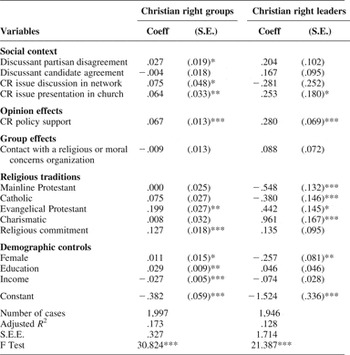
To begin to assemble the group layers and test the varied theories of CR influence, we assess separately the determinants of affect toward CR organizations and leaders. In the two models in Table 1 (of organizations in the first column and leaders in the second), we include measures of support for the CR agenda, discussion of CR agenda issues in the social network, contacts from CR groups, and traditional measures of religious identification and involvement. The data are constructed at the dyad-level,Footnote 2 allowing a test of measures of network discussion and agreement alongside the measures found in previous scholarly treatments of the CR.
Factors influencing support for the Christian Right among Ohio Republican primary voters (OLS regression estimates)

Source: 2006 Ohio Republican Primary Study. ***p < 0.01; ** p < 0.05; * p < 0.10.
In line with theories that argue that group identities are forged through social interaction, Table 1 shows that the more discussion of the CR's core policy issues that took place within a respondent's social network, the greater the affect toward CR organizations, though it has no effect on affect toward CR elites. Moreover, the more presentation of core CR issues in various settings in the church, the more positive affect CR groups and elites gain. It seems possible that discussions about social or moral issues help individuals to connect their beliefs with groups that best represent the same views.
One could argue that these relationships work in the opposite way, however, that identifiers are more likely to have conversations about issues on the agenda of identified groups. There is certainly some truth to this, but, by and large, individuals do not have much control over the content of their conversations (Huckfeldt and Sprague Reference Huckfeldt and Sprague1988) and certainly not much control over the political content transmitted in churches (Wald, Owen, and Hill Reference Wald, Owen and Hill1988). Only a panel design, however, can sort out this issue conclusively.
Contrary to the implicit expectation that group affect is developed in homogenous circumstances with perhaps limited exposure to disliked people, discussions among partisan fellow travelers do not seem to generate higher levels of support for CR organizations. Instead, more cross-cutting political discussion in a social network appears to increase support for CR organizations (it points in the same direction for CR elites, but is not significant). Such a finding seems to be counterintuitive, as it goes against much of the research that has been done in recent years on deliberation. As some scholars have suggested (e.g., Sunstein Reference Sunstein2000), deliberation — a concept often operationalized as ideological heterogeneity within a social network (e.g., Mutz Reference Mutz2002) — may serve to push people to extremes on an issue after mulling it over with an ideological compatriot (a phenomenon known as enclave deliberation). Presumably, it is within these enclaves of like-minded discussants that group identities are forged.
This finding suggests that a different process may be at work. Discussions that take place between political opposites likely force supporters of a particular viewpoint to seek out additional stores of information in order to present the best possible case for their point of view. An individual's search for information to reinforce a viewpoint likely leads to investigations that may include interest groups that promote the same values. Ready-made arguments for such exchanges are easily available from interest groups. And, an information search may thus stimulate the formation of affective ties with interest groups. In this view, individuals do not come to support organizations like the Ohio representatives of the CR through their involvement in homogeneous networks, but rather through social networks in which political discussions make salient differences between their own views and those of their discussants (Paul A. Djupe, n.d.).
Note that this theory also provides a plausible explanation for why scholars have long found that substantial proportions of those who sign on to the CR's policy agenda fail to register any kind of affective ties with the movement's most visible representatives. In essence, supporters of the CR agenda likely exist in homogenous social networks and are not motivated to seek out additional information, which may include information about interest groups. Homogenous, insular networks may build a potential constituency of issues supporters but inhibit organizational ties that underpin movement formation.
Table 1 also shows that support for the movement's policy agenda has a positive effect on support for CR groups and elites. Such a finding is unsurprising to say the least. Somewhat unexpected, though, is that contacts from religious or moral concerns organizations do not have an effect on support for those organizations nor their leadership.
The question still remains as to why the overlap between respondents who felt close to CR organizations and those who felt close to CR leaders was so slight. The second model displayed in Table 1 provides a few insights into what separates supporters of CR elites from supporters of CR organizations. The short answer is that the two groups are separated by religious particularism. Mainline Protestant and Catholic identifications drive down support for CR leaders. Identification as a charismatic,Footnote 3 however, has a positive and strong influence on support for Revs. Parsley and Johnson, who are charismatic Christians themselves. On the other hand, evangelicals, who are different than charismatics (Smidt Reference Smidt1989), are more likely to support CR groups. Identification with the other traditions or as a charismatic has no systematic effect on CR group affect.
To be sure, others have often noted that the CR is fragmented along religious lines (e.g., Jelen Reference Jelen1993; Wilcox Reference Wilcox1992; Wilcox and Larson Reference Wilcox and Larson2006). Indeed, one of the explanations given for the collapse of earlier incarnations of the CR is that the movement's leaders and organizations failed to put aside theological differences. With the movement's revival, however, CR leaders seemed to be making overtures in an effort to garner the support of all people of faith (e.g., Wilcox and Larson Reference Wilcox and Larson2006). For their parts, Revs. Johnson and Parsley, too, sought to attract a wide range of people of faith, and their public pronouncements during the primary campaign suggested little in the way of the exclusionary rhetoric that prevailed in the earliest incarnations of the CR. The most likely explanation here is that positive affect is generated in charismatic churches.
Religious commitment, too, has a positive effect on support for CR groups (it approaches significance for CR elite support). Consistent with a contextual theory of religious influence, however, we suspect that the effects of religious commitment differ not only by religious tradition (e.g., Green et al. Reference Green, Guth, Kellstedt and Smidt1996), but also in accordance with the specific congregational context in which individuals reason through the political implications of their faith. There may be nothing inherent about religious commitment, per se, that leads to higher levels of support for the CR, as the individual is committed to a particular church environment, complete with a number of potential fonts for congregants to obtain politically-relevant information.
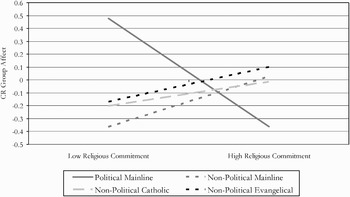
To test the contextual nature of religious commitment, we interacted religious commitment with three of the major religious traditions — Mainline Protestant, Catholic, and Evangelical Protestant — and tested their joint effects on CR group affect under two conditions: for respondents who reported that they attend a politicized church and for respondents who attend non-political churches (the models are otherwise the same as those listed in Table 1). All of the interaction terms were statistically significant, except for Catholics and evangelicals in political churches. The results are displayed graphically in Figure 1, where all non-political church results are shown with dashed lines and political church results are shown with solid lines.
The estimated effect of religious commitment for different religious traditions in political versus non-political churches on affect toward Christian Right groups.

Figure 1 presents a varied portrait of religious linkages to the CR. Higher religious commitment does not function the same way in each tradition and varies based on the political nature of the church. In non-political churches, more religious commitment modestly boosts positive feelings toward CR groups, which is the expected result. However, in political churches where a desired connection between faith and political choices is articulated, the effect of religious commitment disappears for both Catholics and evangelical Protestants. This suggests that alternate mechanisms, such as social transmission, suffice to transmit the dominant message of the church. Among mainline Protestants, however, we see a considerable difference based on religious commitment. Contrary to the arguments advanced by proponents of the “culture wars” thesis (e.g., Hunter Reference Hunter1991; Wuthnow Reference Wuthnow1988), higher degrees of religious commitment among mainline Protestants only have a positive effect on support for CR groups among those who do not attend political churches. Those with high religiosity in political churches, on the other hand, are the most negative toward CR groups, which is expected given the antipathy for the CR expressed by various mainline clergy (especially in the form of the organization formed in 2006 called “We Believe Ohio” to counter the CR). However, those with low religiosity in political mainline Protestant churches are also the most positive toward CR groups, hinting that their low religiosity is actually an expression of dissatisfaction with their church.
These results seem to reinforce Wald's (2003, 195) point that, “Churches are not equally successful in prompting members to perceive connections between religious and political ideas.” The specific political nature of the church context is essential to consider and easy assumptions made at the denominational or greater levels are likely to miss an important story.
DISCUSSION
Some argue that it is the cognitive attachment to the religious reference group that allows individuals to self-select supportive social environments that would produce greater levels of affect for relevant reference groups. However, the primacy of group identification may be misguided, as it assumes the ability of individuals to self-select to a degree that simply is not supported by close studies of church influence on political behavior (Gilbert Reference Gilbert1993; Wald, Owen, and Hill Reference Wald, Owen and Hill1988). Instead, it seems likely that interaction in church and other social networks helps in the creation of group identities in unforeseen ways. Most often scholars have thought such identities to be the product of homogeneous groups that reinforce a certain set of views and aid in identity formation. These results suggest that it may be exposure to difference and the explicit examination of the political implications of faith in church that help individuals to construct affective ties with interest groups.
VOTING WITH THE CHRISTIAN RIGHT
Unlike a number of previous studies that have attempted to gauge public support for the CR, this study does not end with an examination of support for the movement's most visible elements. Instead, a true test of CR support must determine whether higher levels of CR support translate into CR influence at the polls. And while previous studies (e.g., Green et al. Reference Green, Guth, Kellstedt and Smidt1996) have taken the degree of Republican voting in general elections as a measure of CR influence, we probe the connections between support for the movement and voting for the movement's clearly preferred candidate in a non-partisan contest.
Clearly, greater proportions of CR supporters than non-supporters voted for Blackwell. Two-thirds of those few who supported CR organizations voted for Blackwell, compared to 40% voting for Blackwell among those who had negative adjusted feeling scores toward CR groups. Seventy percent of CR elite supporters (of whom there were far fewer than group supporters) voted for Blackwell, while only 47% of non-supporters voted the same way. Not surprising, either, is that the vast majority of those who supported the CR's policy agenda voted for Blackwell. Almost three-quarters of those who supported the CR's agenda cast their ballot for Blackwell, whereas Petro received the majority of the vote among those who did not support the movement's policy agenda (56.4%). The relationships are far from deterministic, raising the question of what additional factors were at play in shaping the primary vote.
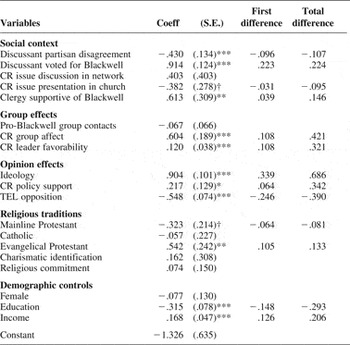
The logistic regression estimates shown in Table 2 examine the factors that influence voting for Blackwell. To assist in the substantive interpretation of the estimates, we also present the probability difference generated by first differences and the full variable range for significant effects. Given Blackwell's sponsorship of the Tax Expenditure Limitation (TEL)—a ballot initiative that proposed to curb drastically government spending in Ohio – it makes sense that those with higher incomes and who are more conservative are more likely to be Blackwell voters. Indeed, next to political ideology, support for the TEL amendment is the strongest predictor of voting for Blackwell. In more concrete terms, support for the TEL amendment increases the likelihood of being a Blackwell voter by more than 30%. Despite the fact that opposition to gay rights motivated Blackwell to run and the CR to offer their support to him, CR agenda support is a relatively weak predictor of the primary vote choice, though it is still a significant one.
Determinants of the Ohio Gubernatorial Primary vote choice (logistic regression estimates)

Source: 2006 Ohio Republican Primary Voter Survey. ***p < .01; **p < .05; *p < .10 (two-tailed tests) †p < .10 (one-tailed test).
Model statistics: N = 1,639; % correct = 77.5; % error reduction = 53.8; −2LL = 1617.088; Cox & Snell R 2 = .328.
Note: First difference is the probability difference from ± one standard deviation from the mean holding all else at their means. Total difference is the probability difference from the minimum to the maximum value, holding all else constant.
The social context has a potent effect on helping voters choose a primary candidate. Partisan disagreement within the social network, which generally means the respondent has a Democratic discussant in this sample, drives up voting for Petro, just as the perception of the discussant voting for Blackwell tugs the respondent toward the same choice (these two measures are correlated, but not overwhelmingly so). A CR discussion agenda within the network does not drive the vote in either direction, but a focused CR issue agenda in church moves a vote for Petro, controlling for the perception of the clergy's vote preference. Thus, outside of a small set of churches where the clergy's preference for Blackwell was perceived, largely Catholic churches in which an agenda was focused on abortion helped voters perceive a difference and vote for Petro. Although it is possible that some churchgoers project their own views on to others around them, these relationships hold even when controlling for value congruence. Moreover, most church members were not able to provide the likely stance of their clergy, intimating that the cues must be clear to make an assessment. While the effect would seem to align with the CR's own claims of its strengths and the fears of many of the movement's most virulent critics, the actual paucity of available cues from clergy about their own candidate support undermines the ability to make broad claims of clergy influence.
Table 2 also shows that support for CR organizations, support for CR elites, and Evangelical Protestant identification all drive up voting for Blackwell, suggesting that each form of group interface has an independent effect on vote choice for the movement's candidate. Each of these connections increases the likelihood of voting for Blackwell by about 10%. While there is clearly overlap among identifiers, the fact that each variable has an independent effect on voting for Blackwell speaks to the lack of unity within the CR. Moreover, the lack of effect from group contacts signals the inability of groups to dictate elections through cold contacts (see also Green and Gerber Reference Green and Gerber2004).
While it seems likely that a sizeable portion of Blackwell's vote came from strong fiscal conservatives who were brought to his side because of his sponsorship of the TEL, the findings displayed in Table 2 also suggest that Blackwell drew much of his vote from a loosely-knit coalition of those with strong affective ties to CR groups and leaders, Evangelical Protestants, those who supported the CR's stance on social issues, and those who received a clear cue from their clergy. This may seem surprising given recent studies that have found the movement's claimed influence at the grassroots to outstrip its actual mass appeal (e.g., Deckman Reference Deckman2004; McConkey and Hickman Reference McConkey and Hickman1997). But, it is important to remember very few clergy sent clear signals, the leadership was openly reviled, and support for CR groups was tepid and isolated among potential supporters. Moreover, the social network factors that promoted voting for Blackwell (partisan and candidate disagreement) had the opposite effect when assessing ties to the movement (recall Table 1), a point to which we will return in the conclusion.
DISCUSSION – PRO-BLACKWELL GROUP CONTACTS
One additional analysis, of the pro-Blackwell balance of group contacts, may help us understand the limits of movement formation. Those who have acceptable sources of information available inside their social networks or through their existing organizational ties are less likely to search out new sources of information upon which to base their political decisions. On the other hand, those whose primary channels of information acquisition are rife with conflicting viewpoints are encouraged to engage in an informational search that may direct individuals to a number of information sources, including the local church and interest groups (Paul A Djupe, n.d.).
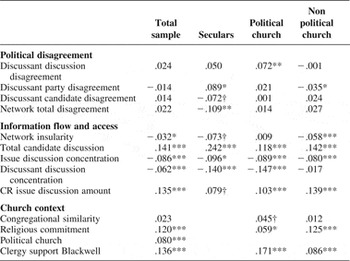
In Table 3, we assess with bivariate correlations how the social network and church structure who is most likely to receive pro-Blackwell interest group contacts. We also examine the set of correlations for several subgroups in the population – seculars and those in political and non-political churches. While measures of disagreement in the network have no effect when using the total sample, for those who attend a political church, network discussion disagreement is positively correlated with pro-Blackwell contacts. In a political church, there are likely a number of conduits that can connect congregants to interest groups. With the exception of seculars exposed to network discussions that are politically cross-cutting, though, all other forms of network disagreement are negatively correlated with pro-Blackwell contacts, suggesting the existence of social connections that promote moderation and a balance of group contacts.
Network and church correlates of the balance of pro-Blackwell contacts from interest groups for the total sample and select sub-groups (pearson's correlations)

Source: 2006 Ohio Republican Primary Voter Survey. ***p < .01; **p < .05; *p < .10 (two-tailedtests) †p < .10 (one-tailed test).
Perhaps equally important as the presence of disagreement for engendering contact with interest groups is the insularity of the network. More network insularity is near universally and negatively correlated with pro-Blackwell interest group contacts. That is, networks in which the named discussants know each other are less accessible to interest groups. The same consequence emanates from networks in which discussion was more concentrated on a few issues and in networks with a greater concentration of discussion with particular discussants – behavioral measures of insularity. These relationships hold across all subgroups as well as in the total sample. Conversely, more discussion about the candidates with the discussant is positively correlated with pro-Blackwell contacts from interest groups. The same is true for the amount of discussion about abortion and gay rights, surely as the result of a reciprocal, reinforcing relationship.
The lesson that emerges here is simple, and comports well with a process of a socially-dictated informational search. Those who are exposed to conflicting views are those most likely to seek out information to either reinforce their pre-deliberative views or engage in debates with their political or ideological opposites. And those insulated by strong ties are either unable or unwilling to seek out additional information.
As the last four rows in Table 3 show, network effects are not the end of the story, as feeling similar to the congregation is positively correlated with pro-Blackwell interest group contacts, but only among those who attend political churches. Religious commitment is also positively correlated with interest group contacts, but the relationship is twice as strong among those in a non-political church. In a political church, the free flow of political information largely overcomes the effect provided by individual-level measures of religious engagement, of which religious commitment is one. Knowing that their clergy supported Blackwell is positively correlated with pro-Blackwell contacts, but is dramatically stronger when the respondent attends a political church, where clergy cues are reinforced by political discussion. Essentially, interaction patterns in networks and churches may act as the key point of exchange between individuals and public interest groups.
CONCLUSION
Although the competing theories of CR mobilization have often been presented as clear alternatives, our findings suggest that no one theory is capable of providing a coherent mechanism for CR mobilization at the grassroots. While we ratify common explanations of affect toward CR groups, we also find that affect is spawned, in part, by the social structure. Up until this time, it has often been assumed that homogeneous networks were the key to identity formation. The results here suggest a different story supporting new contextual theories arguing that the social environment gives rise to group identities. Individuals have no need to develop group identities until they are exposed to dissonant voices within a network of weak ties. That is, cross-cutting network discussions in loose knit networks stimulate an informational search that leads to affective ties with groups. This search often leads to any number of interest groups that offer a host of ready-made arguments that can be used in political exchanges and which makes citizens more accessible and susceptible to group-supplied political cues or calls to action.
Interestingly, this theory references work on the role of groups in citizen political calculi. This body of work often trumpets the role that salient out-groups play in the formation of group-based heuristics (e.g., Brady and Sniderman Reference Brady and Sniderman1985) — citizens develop affective ties that help approximate their own place in politics and rationalize their choices (Lupia Reference Lupia1994). Because dissonant voices within an individual's social environment are the catalyst for the development of affective ties with groups, the social ties that motivate the development of group identities also supply information that affects the political choices people make. The outcome of this process has consequences that may not be obvious at first blush.
That is, the theory forwarded here also provides a plausible explanation for a seeming paradox of CR support at the mass level. Significant numbers of social conservatives fail to register positive affect toward movement groups and elites and those with positive affect are not all lock-step social conservatives. Essentially, motivated by dissonant information, citizens that forge affective ties with a politically consonant group may at the same time succumb to the influence of dissonant information in the network. On the flip side, those who support the movement's policy agenda in insular networks may pick up on the cues necessary to connect their values with the “right” stances on candidates, but they do not need to seek out group-based cues to do so. Therefore, a portion of the movement's de facto supporters are in actuality moving in parallel with the CR more or less oblivious to the movement and inaccessible to its entreaties, while some of the actual supporters may be pulled away from the group by their dissonant social relations.
Nevertheless, there is evidence to suggest that the presence of the CR in a political contest can help certain select segments of the voting public to connect their beliefs with a particular candidate. For those whose social environments do not give rise to an unambiguous decision, affect toward CR groups and elites may act as a useful heuristic that can inform voters' choices at the polls or in other political arenas. But, in spite of calculated attempts to broaden the movement's appeal by reaching out beyond evangelicals, the CR's efforts are still tainted by the lingering shadow of religious particularism. Likewise, the movement failed to attract the attention of significant proportions of its potential supporters. Only those who find themselves in a social environment littered with mixed political messages and loose ties, it seems, come to rely upon the movement for guidance. What emerges from our findings is a vision of the CR that is a great deal more fragmented than media accounts lead one to believe — the bedrock of the movement is actually composed of schist.
APPENDIX: VARIABLE CODING
Clergy supported Blackwell “Do you think your minister personally favored a particular candidate for governor in the May primary?” 1 = Ken Blackwell; 0 = Another candidate or don't know.
CR group affect “For the following groups, please tell us how close you feel to them.” Each item is coded 1 = very far; 2 = far; 3 = close; 4 = very close. Using the same procedure used to create the CR leadership favorability index below, this index averages adjusted feeling scores for The Ohio Christian Coalition, Ohio Right to Life, Citizens for Community Values, and Ohio Restoration Project. Other groups rated and used in the index adjustment included: We Believe Ohio, The Ohio Republican Party, The Ohio Taxpayers Association, and the Buckeye Firearms Association.
CR issue discussion in network Respondents were asked, “Did you discuss the candidates for the Republican nomination for governor?” and then if they discussed five specific issues: “If yes, the candidates' abortion stances?”; “The candidates' gay marriage views?”; “The candidates on taxes and spending?”; “The candidates' general election chances?”; and “The candidates' personal integrity?” As with CR issue presentation in church below, this variable reports the proportion of all discussion in the network involving the abortion and gay rights stances of the candidates.
CR issue presentation in church Respondents were asked whether they heard conversations in church (from clergy, in small groups, and informally) about the Republican candidates' stances on abortion and gay marriage. Specifically, the question asked, “We would like to know about conversations in church about the Republican candidates for governor before the May primary election. Did clergy discuss them? Did you discuss them in a church small group/activity? Did you discuss them informally with other church members?” The variable is a proportion, reporting the portion of all such discussions from any source that involved abortion and gay rights. The values thus range from 0 (no CR issue presentation) to 1 (in which all issue presentation in church concerned CR issues).
CR leader favorability “We would like to get your feelings towards some candidates: On a scale of 0 to 10, where 10 is very favorable, and 0 is very unfavorable, how do you feel about these public figures?” This averaged index uses adjusted feeling scores for both Rev. Russell Johnson and Rev. Rod Parsley. Scores (ranging from 0 to 10) were adjusted by subtracting each respondent's mean feeling score for all public figures from their mean feeling score for these two CR elites (see Wilcox, Sigelman, and Cook 1989). The other public figures used to calculate the mean included: Ken Blackwell, Ted Strickland (U.S. senator), Bob Taft (Ohio governor), George W. Bush, Jim Petro, and Mike Coleman (Columbus mayor).
CR policy support An averaged index ranging from 1 to 4 (higher is more conservative), created using agreement (combining strongly agree and agree) with the following statements about public affairs: “We need an amendment prohibiting all abortions,” and “Homosexuals deserve all the same rights as others.”
Discussant candidate agreement “How often did you disagree in these conversations about the primary campaign and the candidates (Petro and Blackwell)?” 1 = Very often; 2 = Often; 3 = Rarely.
Discussant concentration A Herfindahl-like index, summing the squared proportion of discussion with a particular discussant. That is, the amount of discussion of the candidates with a discussant is divided by the total candidate discussion (see the description for the total measure to see the components of this measure). That proportion is squared and added to the parallel measures for each discussant. A higher value signals greater concentration for a particular discussant.
Discussant partisan disagreement “In general, does the person identify with the same political party as you do?” 1 = discussant has the same party identification and 2 = does not.
Discussant voted for Blackwell “Did the person support the same Republican candidate for governor as you?” 1 = either the discussant supported the same candidate when the respondent voted for Blackwell or the discussant did not support the same candidate when the respondent voted for Petro; 0 = either the discussant did not support the same candidate when the respondent voted for Blackwell or did support the same candidate when the respondent supported Petro.
Education “What is the highest level of education you have received?” 1 = Less than high school; 2 = High school/GED; 3 = Some college; 4 = College degree; 5 = Graduate school/degree.
Ideology “Now, thinking of your general political views, which of these labels best describes you?” 1 = Strongly liberal; 2 = Liberal; 3 = Moderate; 4 = Conservative; 5 = Strongly conservative.
Income “In what category does your total family income fall before taxes?” 1 = <$25,000; 2 = $25–40,000; 3 = $40–60,000; 4 = $60–80,000; 5 = $80–100,000; and 6 = >$100,000.
Issue discussion concentration A Herfindahl-like index, summing the squared proportions of discussion of each issue. That is, the total amount of discussion of a particular issue across all discussants is divided by the total candidate discussion (see the description for the total measure to see the components of this measure). That proportion is squared and added to the parallel measures for each issue. A higher value signals greater concentration on a particular issue.
Network insularity “Does this person know others you listed?” 1 = yes; 0 = no.
Network partisan agreement “How often do you think this person would disagree about politics and public affairs with other people you know?” 1 = Very often; 2 = Often; 3 = Rarely.
Political church Equals 1 if respondents noted any of the following happened in their church (and 0 otherwise): Someone in the church asked the respondent to go vote in the primary, vote for a specific candidate, or attend a political rally (question text: “Had someone in your church asked you do these items before the May primary? (circle any that apply)”); the church held events to discuss or promote gay marriage, education, electoral choices, church and state issues, abortion, Iraq War, campaign rallies, or government spending and taxes (question text: “Has your church held events to discuss or promote these items this year? (circle all that apply)”).
Pro-Blackwell group contacts Respondents were asked, “During campaigns, many citizens are contacted by groups providing information designed to influence their vote. During the May, 2006 primary campaign, did you receive information backing Blackwell and/or Petro from any of the following sources? (circle as many as apply) (A) A political party or candidate committee, (B) A religious or moral concerns organization, (C) An anti-tax and spending, organization, (D) A gun rights organization.” The measure sums the “Blackwell” responses and ranges from 0–4.
Religious Commitment Composed of church attendance and religious importance items. Attendance was measured by: “Aside from weddings and funerals, how often have you attended a church in the past year? 1 = More than once a week; 2 = Once a week; 3 = Once or twice a month; 4 = A few times a year; 5 = Seldom; 6 = Never.” Importance was assessed with: “How important is religion in your life? 1 = Not at all important; 2 = Not very important; 3 = Somewhat important; 4 = Very important.” Both were standardized to a 0–1 scale, added, and then averaged so the composite variable ranges from 0 to 1.
Similarity to church members Respondents who attended church more often then never were asked, “Are your fellow church members mostly the same as or different from you in these ways?” Respondents noting congregation members are the “same as me” in terms of their “theological beliefs,” “political party affiliation,” “ethnicity/race,” “stance on gay marriage,” “support for the Religious Right,” and “members' political activism” gained a point for each mention. The index values are averaged and the final measure ranges from 0 (wholly dissimilar) to 1 (wholly similar).
TEL opposition “Please tell us whether you agree or disagree with the following statements about public affairs: The Tax Expenditure Limitation (TEL) proposal is needed to limit government spending in Ohio.” 1 = Strongly agree; 2 = Agree; 3 = Disagree; 4 = Strongly disagree.
Total candidate discussion An index ranging from 0 to 24 created by summing each mention of a discussion item for each discussant. The items (all coded 1 = yes, 0 =no) included, “Did you discuss the candidates for the Republican nomination for governor?”; “If yes, the candidates' abortion stances?”; “The candidates' gay marriage views?”; “The candidates on taxes and spending?”; “The candidates' general election chances?”; and “The candidates' personal integrity?”