

INTRODUCTION
Nerja Cave (Nerja, Malaga, southern Spain), discovered in 1959, is a large cavity (surface of ca. 35,484 m2 and length of ca. 4843 m) located in the southern part of the Iberian Peninsula. Between 1960 and 1987 excavations in the outer galleries revealed a long Upper Palaeolithic sequence including layers attributed to the Gravettian, the Solutrean, and the Magdalenian cultures. Numerous archaeological materials such as flints, bones, ocher fragments, and charred plant remains were found on the floor of the inner galleries. These galleries contain many examples of parietal art: 32 figurative motifs (horses, deer, ibex, and undefined quadrupeds), 254 signs and 263 stained speleothems (Sanchidrián Reference Sanchidrián1994, Reference Sanchidrián1997, Reference Sanchidrián, Márquez, Valladas and Tisnerat2001). Radiocarbon (14C) analyses were done on archaeological samples found during excavations to establish the periods of human occupation within the cave (Jordá and Aura Reference Jordá and Aura2008, Reference Jordá and Aura2009) but in the absence of direct dating, the chronology of the parietal art still remains problematic since the majority of Palaeolithic paintings were made with red pigment, especially the graphics located in the inner galleries.
Scientific investigations have been carried out since 2008 by Sanchidrián and his team to study the periods of Palaeolithic occupation of the inner galleries and to connect them with the chronology of the parietal art and the geomorphological evolution of the cave. In 2012, a research program was run by Cordoba University and the Fundación Cueva de Nerja, in collaboration with the Laboratoire des Sciences du Climat et de l’Environnement, to develop protocols to date the parietal representations (Quilès et al. 2014). At present, a thin secondary carbonate deposit covers part of them. Therefore the age of these overlying formations is assumed to provide a minimum age (terminus ante quem) for the underlying representations.
Since the 2000s, the uranium-thorium (or 230Th/234U) method has been used to date thin calcite layers deposited on decorated walls in order to constrain the age of the parietal representations situated below or above these calcite layers. The method was first applied to the Covalanas Cave, Spain (Bischoff et al. Reference Bischoff, García-Diez, González Morales and Sharp2003) and to the Creswell Cave in the United Kingdom (Pike et al. Reference Pike, Gilmour, Pettitt, Jacobi, Ripoll, Bahn and Muñoz2005) where calcite deposits covered parietal engravings. Then, in 2012, 230Th/234U ages obtained on ca. 50 parietal representations of 11 Palaeolithic Spanish caves were published by Pike et al. However, in most cases it was only possible to make one 230Th/234U analysis per representation and the results obtained remain uncertain because of the impossibility of assessing their reliability by showing that the dated calcite samples did not undergo diagenetic processes and behave as a closed system (Clottes Reference Clottes2012; Pike et al. Reference Pike, Hoffmann, García-Diez, Pettitt, Alcolea, De Balbín, González-Sainz, de las Heras, Lasheras, Montes and Zilhão2012; Pons-Branchu et al. Reference Pons-Branchu, Bourrillon, Conkey, Fontugne, Fritz, Gárate, Quiles, Rivero, Sauvet, Tosello, Valladas and White2014a). For this reason, Hoffmann et al. (Reference Hoffmann, Pike, García-Diez, Pettitt and Zilhao2016) therefore proposed to check the relevance of the 230Th/234U ages by dating several subsamples along the growth axis of the calcite deposit. Assuming that leaching cannot affect all calcite sublayers, obtaining 230Th/234U ages in stratigraphic order would confirm the closed system behavior. This approach, applied to two Spanish caves (La Pasiega and Fuente del Trucho), provided coherent results that are in agreement with the results previously obtained by Pike et al. (Reference Pike, Hoffmann, García-Diez, Pettitt, Alcolea, De Balbín, González-Sainz, de las Heras, Lasheras, Montes and Zilhão2012) for the same paintings. A similar approach was used by Aubert et al. (Reference Aubert, O’Connor, McCulloch, Mortimer, Watchman and Richer-La-Fleche2007, Reference Aubert, Brumm, Ramli, Sutikna, Saptomo, Hakim, Morwood, van den Bergh, Kinsley and Dosseto2014) who performed analyses on several carbonate layers located on either side of parietal decorations present in Asian caves (Timor and Sulawesi). This stratigraphic control makes it possible to test the coherence of the results and to constrain the ages of the representations.
However, as many calcite layers are too thin for several 230Th/234U analyses to be performed across their growth axis, some researchers have proposed to perform crossdating by using 230Th/234U and 14C methods on the same parietal CaCO3 sample to compare the results and to check that the sample behaved as a “closed” system (Plagnes et al. Reference Plagnes, Causse, Fontugne, Valladas, Chazine and Fage2003; Fontugne et al. Reference Fontugne, Shao, Frank, Thil, Guidon and Boeda2013; Pons-Branchu et al. Reference Pons-Branchu, Bourrillon, Conkey, Fontugne, Fritz, Gárate, Quiles, Rivero, Sauvet, Tosello, Valladas and White2014a; Shao et al. Reference Shao, Pons-Branchu, Zhu, Wang, Valladas and Fontugne2017). For example, these two methods applied on a calcite deposit in the cave of Gua Saleh (Borneo) yielded compatible or rather different results depending on the samples and thus this comparison showed that in some cases the sample behaved as a geochemically open system and yielded erroneous 230Th/234U ages (Plagnes et al. Reference Plagnes, Causse, Fontugne, Valladas, Chazine and Fage2003).
This approach based on 230Th/234U combined with 14C analyses enables the results obtained on the same sample by the two methods to be compared and can thus be very useful to highlight possible post-deposition diagenetic processes leading to a geochemically open system and erroneous ages. It can be inferred that agreement between the two results suggests a closed system behavior of the dated sample and that the dates obtained are reliable, whereas disagreement between them should indicate that geochemical alteration has affected the sample and that one or both results are inaccurate. This crossdating approach was tested in Nerja Cave on secondary carbonate samples deposited on two parietal red marks. We also discuss the validity of the correction to be applied on each method, i.e. detrital correction for the 230Th/234U method, and dead carbon correction for the 14C method.
SAMPLES AND METHODS
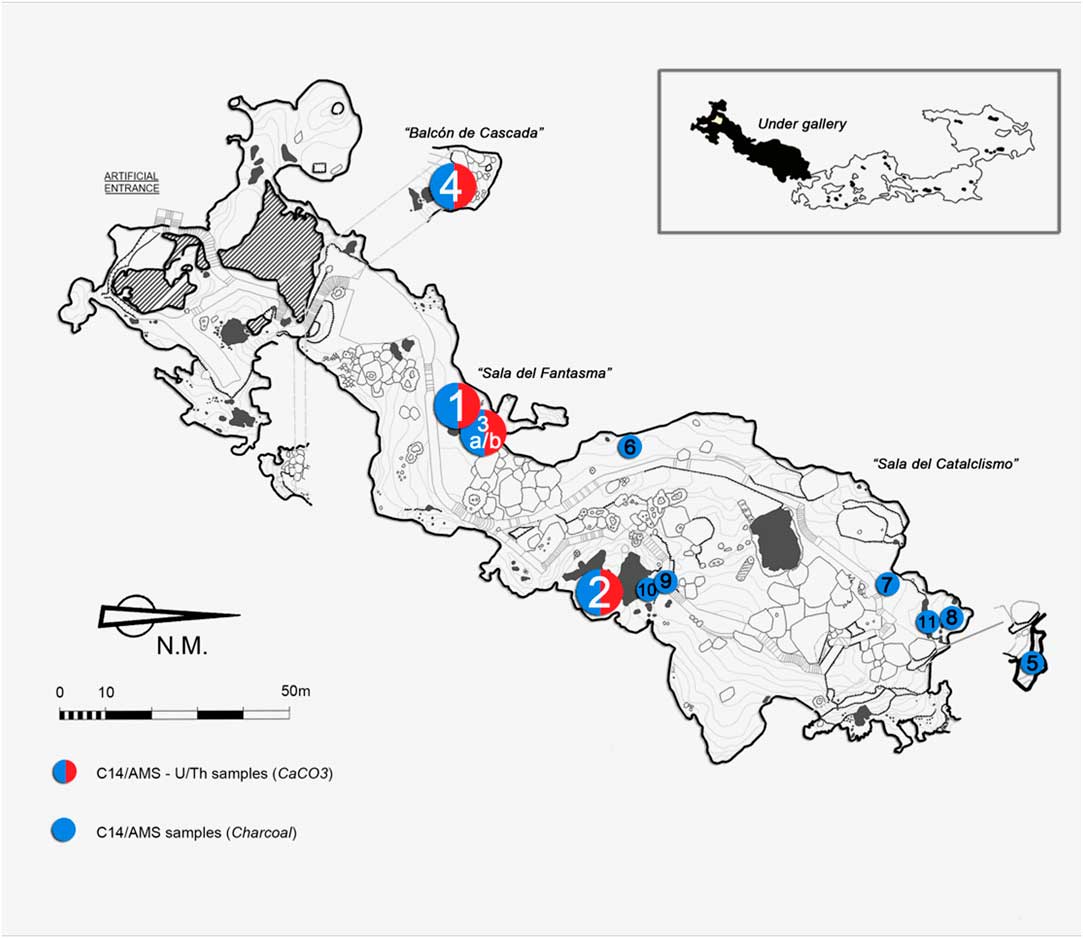
Two red marks that are clearly of anthropic origin were selected because they were in the same area (Figure 1) and were overlain by a secondary carbonate deposit. These types of red signs that are not figurative graphical symbols are commonly found in prehistoric caves but their meaning remains unknown (Medina-Alcaide et al. Reference Medina-Alcaide, Garate and Sanchidrián2017).
-
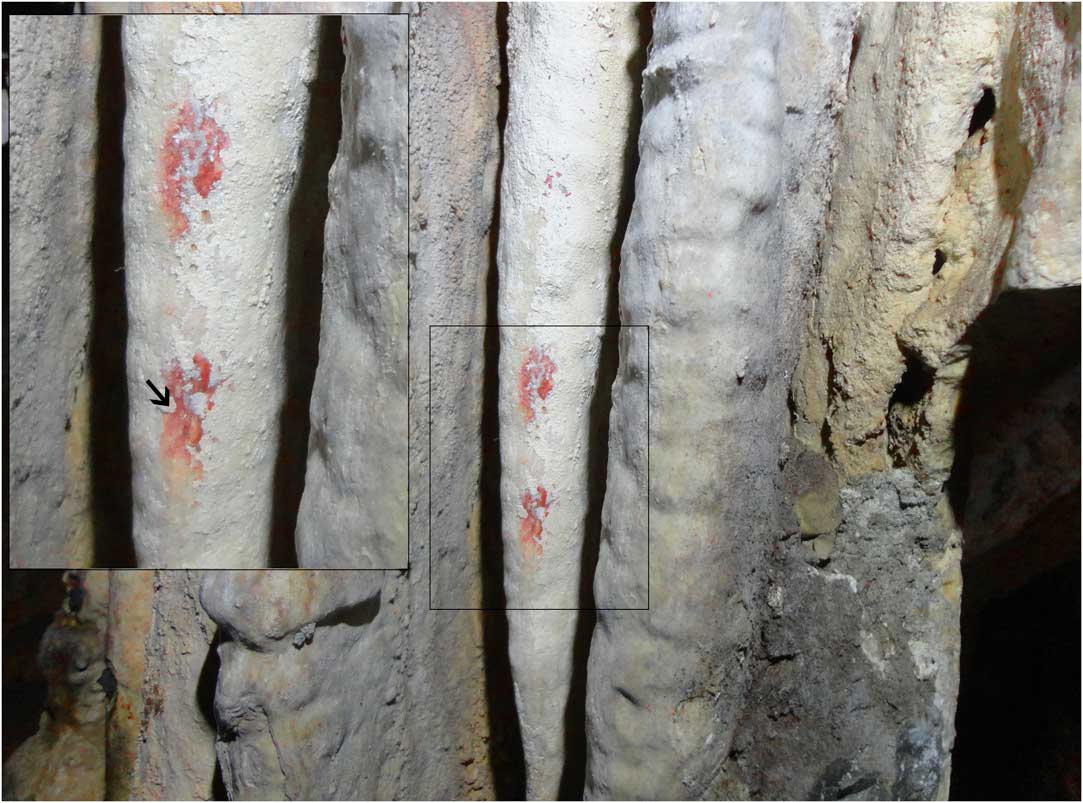
∙ Mark 1 is an ensemble of three aligned red dots measuring 2×1.5 cm, drawn with ocher on a speleothem. The support matches with the edge of the calcite draperies located at a height of 160 cm. The dots are partially overlain by a thin secondary carbonate deposit (Figure 2).
-
∙ Mark 2 is composed of large red spots located in a stalagmitic flowstone at a height of 130 cm (Figure 3). The spots are also partially overlain by two thin superposed secondary calcareous deposits.
Locations of the dated samples in the upper galleries: dots 1 and 2 are modern CaCO3 deposits (GN12-29 and GN12-24); dots 3 and 4 are CaCO3 deposited on mark 2 (samples GN12-25 and GN12-27) and on mark 1 (sample GN14-17); and dots 5–11 are charcoal samples whose 14C results are discussed in the article (Sanchidrian Reference Sanchidrián1994, Reference Sanchidrián1997).
Picture of mark 1 with localization of the sampled point (GN14-17), in the area of the Balcon de Cascada en galerias Bajas.
Sampling
Small fragments (a few mm2 to ca. 1 cm2) of the CaCO3 layers overlying the red marks 1 (GN sample GN14-17) and 2 (GN12-25 and GN12-27 samples) were carefully sampled with a scalpel as close as possible to the marks, without causing any visible deterioration. GN12-25 and GN12-27 samples originating from two different layers (yellow and gray, respectively) are in stratigraphic order: the deepest sample GN12-25 is situated just above the red mark 2 and below GN12-27 (see Figure 3).
Picture of mark 2 with localization of the two sampled points (GN12-25 and GN12-27), in the area of Sala del Fantasma. The two samples are 40 cm apart. The lowest part of the figure shows the wall before and after the sampling of GN12-25.

Their stratigraphic relation with the painting was carefully verified and pictures were taken throughout the sampling process to record the exact location of the samples. Each sample was divided into two aliquots for 230Th/234U and 14C dating. For the largest sample (GN12-27), it was possible to perform three replicate 230Th/234U analyses on three aliquots (GN12-27a, b and c), taken one next to the other in the same layer. In order to constrain the detrital fraction content for 230Th/234U dating, two recent/modern CaCO3 samples were also collected. The first was a still active soda straw (GN12-29), previously analyzed for 14C dating (Sanchidrián et al. Reference Sanchidrián, Valladas, Medina-Alcaide, Pons-Branchu and Quiles2017) and the second (GN12-24) was a very recent deposit that grew on a bowl placed below water dripping from the roof.
Dating Analyses
14C Dating
The three aliquots of carbonate samples (solid fragments of GN14-17, GN 2-25, and GN12-27) were prepared according to the protocol described by (Tisnérat-Laborde et al. Reference Tisnérat-Laborde, Poupeau, Tannau and Paterne2001). First, they were cleaned using an ultrasound bath in distilled water, then gently attacked for 3 min in nitric acid (0.01N) and finally rinsed again in distilled water. The calcite was reacted with phosphoric acid under vacuum and the CO2 produced was converted to graphite then measured using the accelerator mass spectrometer of the LMC14 (Artemis, CEA Saclay; Cottereau et al. Reference Cottereau, Arnold, Moreau, Baqué, Bavay, Caffy and Salomon2007).
14C measurements were first corrected according to the 13C values measured by the Artemis facility and for the background contribution, the ages were calculated following Mook and van der Plicht (Reference Mook and van der Plicht1999).
230Th/234U Dating
U and Th analyses were performed on GN12-25, GN12-27a, b, c, GN14-17 and on the modern samples (GN12-29 and GN12-24). U-Th separation and purification were performed at LSCE following a procedure described in Pons-Branchu et al. (Reference Pons-Branchu, Douville, Roy-Barman Dumont, Branchu, Thil, Frank, Bordier and Borst2014b). Between ca. 50 and 125 mg of sample was dissolved with diluted HCl in a Teflon beaker and mixed with a triple 229Th 233U 236U spike. U and Th were co-precipitated with Fe(OH)3. U-Th separation and purification were performed on a 0.5-mL column filled with U-TEVA and a small amount of pre-filter resin at the bottom of the column. The CaCO3 matrix and trace elements were eluted in 3N HNO3, while the Th fraction was eluted using 3N HCl and the U fraction using 1N HCl. The U and Th isotopic analyses were performed on a Neptune Plus multi-collector inductively coupled plasma mass spectrometer (MC-ICP-MS) fitted with a jet pump interface. For mass fractionation corrections of isotopic ratios, we used an exponential mass fractionation law (normalized to natural 238U/235U isotopic ratio) and standard/sample bracketing (using a mixture of our triple spike and Hu-1 uraninite). For more details on the analytical procedure, see Pons-Branchu et al. (Reference Pons-Branchu, Douville, Roy-Barman Dumont, Branchu, Thil, Frank, Bordier and Borst2014b).
After corrections for peak tailing, hydrate interference and chemical blanks, age calculations from the isotopic data were carried out based on iterative age estimation.
RESULTS
14C Dating
The 14C ages of the CaCO3 specimens were corrected for dead carbon contents (called dead carbon proportion or dcp) assuming five percentage values (respectively 0, 5, 10, 20, and 50%) that cover the range of possible dcp values in speleothems. Typical dcp values range between 5 to 15%. The corrected values were then calibrated (Table 1) using the IntCal13 calibration curve (Reimer et al. Reference Reimer, Bard, Bayliss, Beck, Blackwell, Bronk, Buck, Cheng, Edwards, Friedrich, Grootes, Guilderson, Haflidason, Hajdas, Hatté, Heaton, Hoffmann, Hogg, Hughen, Kaiser, Kromer, Manning, Niu, Reimer, Richards, Scott, Southon, Staff, Turney and van der Plicht2013). For the samples GN14-17, GN12-25, and GN12-27, the corrected calibrated age ranged respectively between 25,374 and 18,430 cal yr BP, between 33,769 and 27,491 cal yr BP and between 17,024 and 9142 cal yr BP, depending on the dead carbon proportion considered (0, 5, 10, 20, and 50%). Sample GN12-29 (a soda straw) displayed a modern age.
Results of 14C analyses performed on three carbonate deposits sampled respectively on mark 1 (GN14-17), mark 2 (GN 12-25 and GN 12-27) and on a still active soda straw (GN12-29; *from Sanchidrián et al. Reference Sanchidrián, Valladas, Medina-Alcaide, Pons-Branchu and Quiles2017).

Uranium and thorium contents, isotopic ratios and ages.

238U/230Th, 234U/238U (expressed as δ234U), and 230Th/232Th activity ratios are reported.
δ234U=({234U/238U}meas/{234U/238U}equilibrium – 1)×1000 with 234U/238Uequilibrium=54.97×10–6 (molar ratio, Cheng et al. Reference Cheng, Edwards, Shen, Polyak, Asmerom, Woodhead, Hellstrom, Wang, Kong, Spötl and Wang2013). The ages are expressed as yr BP (before 1950).
*Corrected ages using 230Th/232Th0 activity ratio of 1.25±50%.**Corrected ages using 230Th/232Th0 activity ratio of 5.2±0.3.
230Th/234U Results
Uranium content varied between 19.60±0.04 and 1.40±0.001 ppm. The isotopic composition of uranium was relatively close to equilibrium, with δ 234Ui between 31.5±0.6 and –14.7±1.2‰. The 232Th content ranged between 78.05±0.10 and 4.08±0.01 ppb; the 230Th/232Th ratio varied between 5.16±0.14 and 68.93±0.18, indicating that a proportion of 230Th originated from the detrital fraction was present at the time of the speleothem formation.
A correction for the detrital fraction assuming a 230Th/232Th initial (230Th/232Th0) value of 1.25±50% was applied to calculate the corrected ages. Another correction was applied using the measured 230Th/232Th0 of the present day CaCO3 precipitated within the bowl (equal to 5.2 and with a double error bar at±0.3), because the age of this sample (GN12-24) is known to be less than 10 yr. This higher correction results in younger ages (see Table 2). The different analysis of the youngest layer covering mark 2 (Gn12-27a, b, and c) displayed a slight variability in uranium content, uranium isotopic composition and age.
DISCUSSION
Chronology
14C and 230Th/234U Ages
14C age determination of thin calcareous layers in karstic environments is hampered by the dcp that leads to an overestimation of the real age. This dead carbon results from soil (with old carbon) or host rock carbon (with no 14C); see for instance Gascoyne and Nelson (Reference Gascoyne and Nelson1983), Goslar et al. (Reference Goslar, Hercman and Pazdur2000), and Genty et al. (Reference Genty, Baker, Massault, Proctor, Pons-Branchu and Hamelin2001). Previous 14C analysis of the active soda straw (GN12-29) of Nerja Cave indicated a very small amount of dead carbon (less than 10%) for at least the recent period (Sanchidrián et al. Reference Sanchidrián, Valladas, Medina-Alcaide, Pons-Branchu and Quiles2017). Comparison between 230Th/234U and 14C ages obtained on GN12-29 confirmed this suggestion for the modern period. As underlined by Tuccimei et al. (Reference Tuccimei, van Strydonck, Ginés, Soligo, Villa and Fornós2011), a very low fraction of dead carbon indicates limited interaction between water percolating through the epikarst and host rock and a short time transit of the water. However, dcp content can vary in time and space by a few percent, in relation with hydrological changes within the cave (e.g. Griffiths et al. Reference Griffiths, Fohlmeister, Drysdale, Hua, Johnson, Hellstrom, Gagan and Zhao2012; Noronha et al. Reference Noronha, Johnson, Hu, Ruan, Southon and Ferguson2014).
The GN14-17 sample shows a good agreement between the 230Th/234U ages (25,189±212 yr BP) and the 14C calibrated result (25,374–25,002 cal yr BP) assuming 0% dcp. This agreement suggests a closed system evolution and validates the results of the two methods and the small amount of dcp assumed at Nerja Cave. Therefore the ages deduced for the carbonate sample GN14-17 can be considered as a reliable terminus ante quem (i.e. minimum age) for the underlying red marking.
In the case of GN12-25 and GN12-27, the two methods yield results which are in agreement with their stratigraphic position: the age obtained on the deepest sample, GN12-25, is greater than the ages of GN12-27 which is located just above. However very different 230Th/234U and 14C ages are obtained for these two samples. In the case of GN12-25, the 230Th/234U method yields 60,276±1300 yr BP while the calibrated 14C result, significantly younger, ranges between 33,770 and 27,491 cal yr BP depending on the considered dcp (0 to 50%). For the aliquot samples GN12-27a, b, c, the 230Th/234U ages are consistent and fall in the same time range, between 26,024±534 and 28,321±579 but the 14C gives younger ages, from 17,024 to 9142 cal yr BP depending on the dcp. Therefore for these samples, the two methods yield divergent results, with 230Th/234U ages greater than 14C ages (whatever the dcp taken into account). This age difference which reaches ca. 30,000 yr for the oldest sample (GN12-25) and ca. 10,000 for the youngest one (GN12-27) could be explained by two processes affecting the dated samples: the first one is an open system behavior of the carbonate layer with exchange of chemical elements (uranium, thorium, or carbon) between the CaCO3 layer and seepage water or atmosphere; the second one is the incorporation of a small amount of the host rock in the dated carbonates (Fontugne et al. Reference Fontugne, Shao, Frank, Thil, Guidon and Boeda2013).
An open system behavior of secondary carbonate deposits is expected to lead to uranium leaching due to its higher solubility than that of thorium. This phenomenon, previously observed in both massive speleothems and thin CaCO3 deposits (see for example Borsato et al. Reference Borsato, Quinif, Bini and Dublyansky2003 or Plagnes et al. Reference Plagnes, Causse, Fontugne, Valladas, Chazine and Fage2003), produces 230Th/234U apparent ages older than the true ones. Thorium addition (230Th alone or via addition of a detrital component with a very high 230Th/232Th ratio) is also a possibility in the case of an open system and has already been proposed for some alpine speleothems (Borsato et al. Reference Borsato, Quinif, Bini and Dublyansky2003). The addition of a 230Th-rich detrital phase (for instance by dust particles) could not explain the age discrepancy obtained by the two methods for GN 12-17; indeed, the 230Th/234U ages of the three coeval samples are in close agreement but display, however, different 232Th content and 230Th/232Th ratios. An open system behavior could also affect 14C age determination by replacing intrinsic old carbon by cave atmospheric CO2 at the time of alteration, leading to apparent 14C ages younger than the true ones (e.g. Holmgren et al. Reference Holmgren, Lauritzen and Possnert1994; Goslar et al. Reference Goslar, Hercman and Pazdur2000; Bruthans et al. Reference Bruthans, Schweigstillova, Jenč, Churáčková and Bezdička2012; Roy-Barman and Pons-Branchu Reference Roy-Barman and Pons-Branchu2016). Thus, the effect of the opening of the system is expected to be different for the two chronometers.
On the other hand, the incorporation of a small amount of host rock within the sample could bias both 14C and 230Th/234U toward apparent ages older than the real ones. For a 25,000-yr-old secondary deposit that contains the same amount of U as the host rock and a 234U/238U activity ratio close to 1, 1% of host rock contamination (older than 1,000,000 yr) results in a 230Th/234U age overestimated by ca. 1000 yr whereas 10% of host rock contamination leads to a 230Th/234U age overestimated by ca. 10,000 yr. The same amounts (1% and 10%) of host rock in the 25,000-yr-old carbonate sample will make the calibrated 14C age older by ca. 50–100 yr and ca. 1000 yr, respectively. The impact of contamination for different amounts of host rock on the age of a 25,000-yr-old secondary carbonate sample is presented in Figure 4. In order to explain the discrepancy between 14C and 230Th/234U ages, the amount of contamination by the host rock would have to be as high as 30%, assuming the same amount of uranium within the host rock and the secondary CaCO3 layer. Such a process appears to be rather unlikely in the Nerja case, and therefore an open geochemical system with uranium leaching is a more probable explanation of the age difference between the two dating methods for the GN12-25 (and GN12-27) samples. Further investigations are necessary to show evidence of such a process before dating.
Effect of different percentages of host rock contamination on the 14C and U/Th ages of a ca. 25,000-yr-old secondary thin layer.

Implication for Rock Art Dating Methodology Using CaCO3 Layers
During this study, the application of the 14C and 230Th/234U chronometers to CaCO3 thin layers demonstrated that the concomitant use of these two methods makes it possible to validate the ages obtained when the two methods give coherent results, and to invalidate them when the discrepancy cannot be explained by the incorporation of dead carbon (open system or contamination with host rock). This approach previously applied in different archaeological contexts proved to be very useful to discuss the validity of the results (e.g. Plagnes et al. Reference Plagnes, Causse, Fontugne, Valladas, Chazine and Fage2003; Fontugne et al. Reference Fontugne, Shao, Frank, Thil, Guidon and Boeda2013; Shao et al. Reference Shao, Pons-Branchu, Zhu, Wang, Valladas and Fontugne2017). The present study provides further support for generalizing the use of several dating methods whenever possible. 14C and 230Th/234U are not the only methods applicable for dating such samples, and in certain cases, the 226Ra/238U or 231Pa/235U chronometers can also be successfully applied (Edwards et al. 1997; Pons-Branchu et al. 2005).
Speleothem Growth during Glacial Time
Speleothem deposition is controlled by climatic and environmental factors such as water availability, pCO2 in the soil, dissolved calcium concentration and drip rate. Dry and/or ice cover periods are generally characterized by a lack of deposition due to slower water infiltration and to a lower CO2 supply from vegetation and soil. Speleothem growth cessation has been observed in northern Europe during the coldest phases of the last glacial periods (Gordon et al. Reference Gordon, Smart, Ford, Andrews, Atkinson, Rowe and Christopher1989; Baker et al. Reference Baker, Smart, Edwards and Richards1993; Pons-Branchu et al. Reference Pons-Branchu, Hamelin, Losson, Jaillet and Brulhet2010), whereas southern European and circum-Mediterranean regions are characterized by speleothem growth during the last glacial period, suggesting that this period was relatively humid (Kaufman et al. Reference Kaufman, Wasserburg, Porcelli, Bar-Matthews, Ayalon and Halicz1998; Bar-Matthews et al. Reference Bar-Matthews, Ayalon, Gilmour, Matthews and Hawkesworth2003; Siddall et al. Reference Siddall, Rohling, Thompson and Waelbroeck2008; Fleitmann and Matte Reference Fleitmann and Matte2009; Moreno et al. Reference Moreno, Stoll, Jiménez-Sánchez, Cacho, Valero-Garcés, Ito and Edwards2010). GN14-17 was deposited during the maximum of the last glacial period (marine isotope stage 2). Therefore our results show that during MIS2 the climatic conditions in the Nerja area were humid enough to permit the formation of a thin calcite layer, at least for a short period. This result is in agreement with the climate reconstruction of central and southern Spain that evidenced a cold but humid period between 29 and 25 kyr BP (Domınguez-Villar et al. Reference Domínguez-Villar, Carrasco, Pedraza, Cheng, Edwards and Willenbring2013).
Archaeological Significance
The consistent results obtained so far using the U/Th and 14C analysis in the case of sample GN14-17 from mark 1 indicate that these red dots are older than ca. 25,000 yr. This age is coherent with some 14C-AMS dates obtained on charcoals found in the inner galleries, which are attributed to the oldest period of prehistoric occupation (40,000–25,000 yr, cf. Table 3) (Medina-Alcaide and Sanchidrián Reference Medina-Alcaide and Sanchidrián2014; Medina-Alcaide et al. Reference Medina-Alcaide, Sanchidrián and Zapata2015). These charcoals were sampled from different Palaeolithic lighting systems (torches, fixed lamps, etc.) that used wood as fuel, as shown by anthracological analyses.
Results of anthropological determinations performed on charcoals from human occupancy of Nerja Cave and 14C ages. They were calibrated using IntCal13 (Reimer et al. Reference Reimer, Bard, Bayliss, Beck, Blackwell, Bronk, Buck, Cheng, Edwards, Friedrich, Grootes, Guilderson, Haflidason, Hajdas, Hatté, Heaton, Hoffmann, Hogg, Hughen, Kaiser, Kromer, Manning, Niu, Reimer, Richards, Scott, Southon, Staff, Turney and van der Plicht2013). Data from Medina-Alcaide and Sanchidrián (Reference Medina-Alcaide and Sanchidrián2014) and Medina-Alcaide et al. (Reference Medina-Alcaide, Sanchidrián and Zapata2015).

This dating result, which provides a terminus ante quem (i.e. a minimum age) for this Palaeolithic mark is the oldest so far obtained in the southern Iberian Peninsula. The only other published 14C dates come from black aurochs in La Pileta Cave, which were dated to 20,130±350 BP (GifA 98162; 25,224–23,444 cal BP) (Sanchidrián et al. Reference Sanchidrián, Márquez, Valladas and Tisnerat2001).
This type of non-figurative marking, related with the oldest phase of Palaeolithic art in this geographical area, can also be found in other caves in southern Spain, such as Ardales, Malalmuerzo, Navarro, Pileta, and Victoria.
CONCLUSIONS AND FUTURE PERSPECTIVES
Two red non-figurative marks representing an ensemble of three red dots (mark 1, GN14-17) and a larger red mark (mark 2, samples GN12-25 and GN12-27) were studied because they are both partially overlain by thin secondary calcareous layers (one layer for mark 1 and two layers in stratigraphic order for mark 2). 230Th/234U and 14C crossdating was performed on these three carbonate layers in an attempt to provide a minimum age for the underlying marks. The ages obtained on modern samples were coherent. For sample GN14-17 (mark 1), 230Th/234U and 14C age estimations are very close, which suggests the reliability of the two chronometers and the low proportion of dead carbon in this part of Nerja Cave for ages of ca. 25,000 yr BP. Considering the large size of the cave (several kilometers in area and two levels of galleries), however, one can expect different proportions of dead carbon from place to place, and further analyses are necessary to date the CaCO3 samples in other galleries. For sample GN12-25 and GN12-17 (mark 2), the very large discrepancy (ca. 30,000 and 10,000 yr, respectively) between the two methods suggests an open system behavior of the secondary carbonate thin deposit and hence an inaccurate age determination. At the archaeological level, the chronological information provided for mark 1 (red dots) indicates that this type of non-figurative sign is older than 25,000 cal BP and that it can be associated with the oldest Palaeolithic occupation of Nerja Cave (39,035–25,555 cal BP).
This paper has reported an attempt to develop an ongoing methodology that could provide an age for non-organic parietal representations. Our results demonstrate that 230Th/234U analysis of thin secondary calcareous layers deposited on decorated walls is a very interesting application that needs to be investigated using a rigorous methodological approach: the application of an independent dating method such as 14C dating is mandatory in order to validate the determined ages. Several more sampling campaigns have already been done in Nerja Cave to extend this methodology and to confirm these initial results. They will provide an overview of the possibility of using combined U-Th and 14C dating to understand the chronology of non-organic parietal representations.
ACKNOWLEDGMENTS
The authors wish to thank the IPSL research project (LSCE-CNRS, grant to H Valladas) and Proyecto General de Investigación Interdisciplinar de la Cueva de Nerja for their financial support and access to Nerja Cave.
Maria Á Medina-Alcaide has a PhD grant from The Ministry of Education, Culture and Sport of Spain (MECD-FPU) awarded by the University of the Basque Country (UPV/EHU) and the results presented in this paper have been partially funded by the research project of the Spanish Science Ministry HAR2014-53536-P (La ruta occidental del poblamiento de la Península Ibérica durante el Paleolítico medio y superior), and the Research Team in Prehistory at the University of the Basque Country (IT-622-13). We thank Nadine Tisnérat-Laborde for her contribution in the preparation of one calcite sample dated by 14C. The two reviewers are also thanked for their valuable remarks. This is LSCE contribution number 6600.



