Writing the unwritable
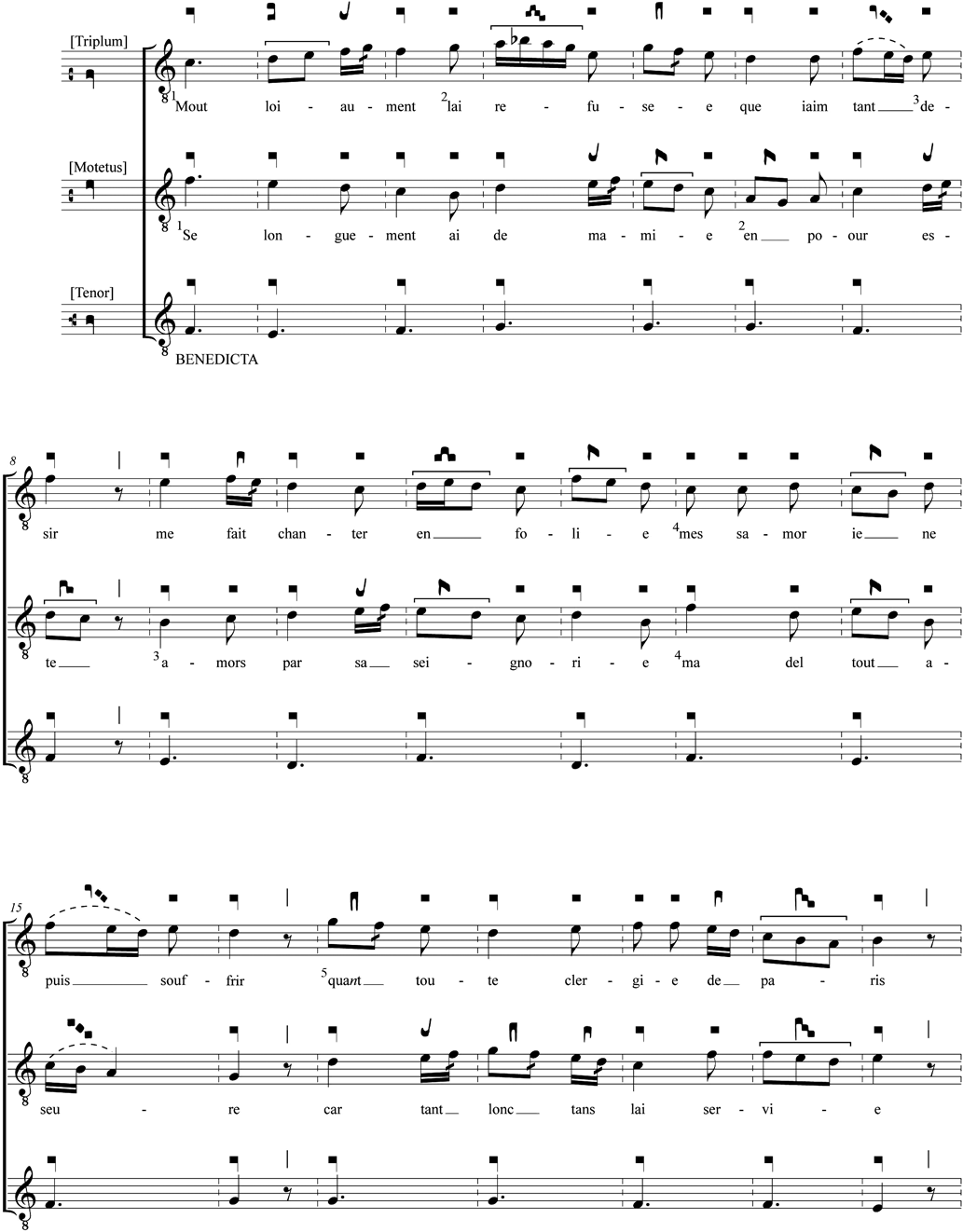
Consider the thirteenth-century motet Mout loiaument / Se longuement / benedicta (Ex. 1).Footnote 1 Although madly in love with his ‘amie’, the triplum's protagonist has refused her, and his unconsummatable desire finds alternative expression as the song he sings ‘in folly’. It does not provide the desired relief – and how could it? As he explains, even all the clerks in Paris could not enumerate the woes he suffers. This is an enduring topos: the narrator here demonstrates that those who can, do, while those who can't, sing songs.Footnote 2
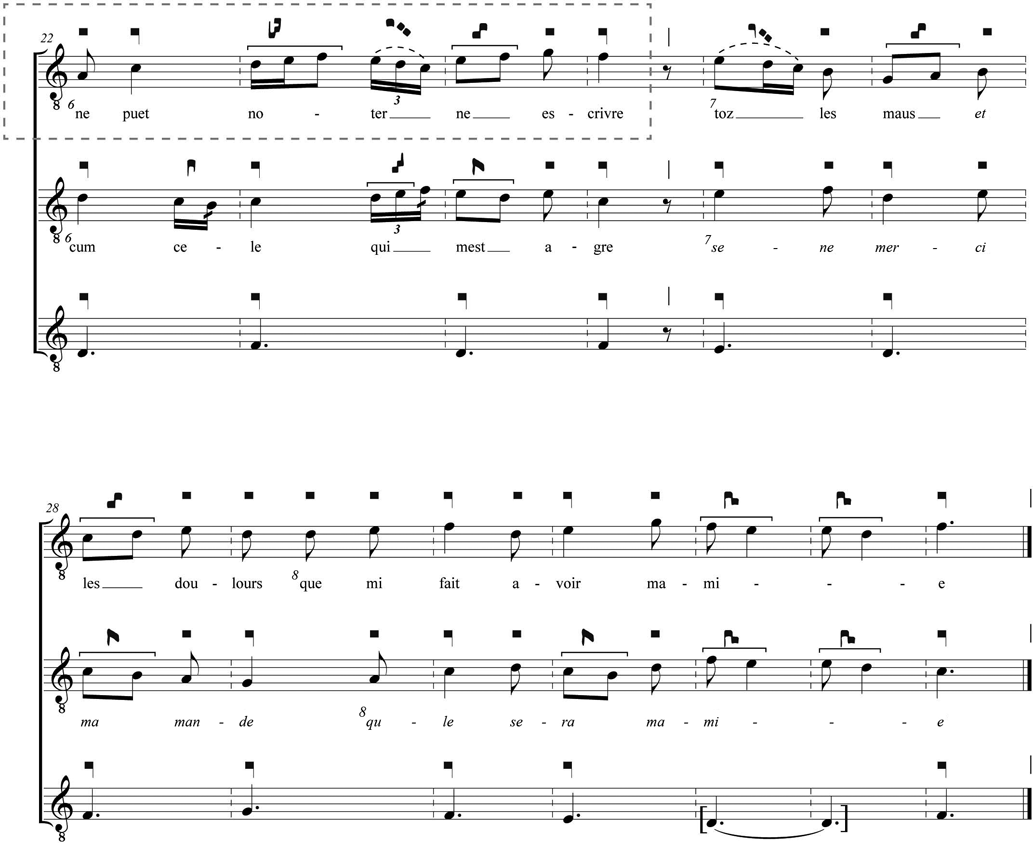
Motet, Mout loiaument / Se longuement / benedicta, transcribed from La Clayette, fol. 370v.

Grammatically, ‘les maus et les doulours’ the narrator feels are direct objects of the verbs ‘noter’ and ‘escrivre’: in part, the clerks of Paris are unable to operate those verbs on his experience, because as experience, his pain is inimical to language.Footnote 3 But the song it induces fares better. Perhaps the triplum communicates the narrator's self-declared irrationality: in an obvious melodic pun, the word ‘noter’ is set to the densest patch of fractio modi heard in the piece (Ex. 1, bar 23, boxed in the score.)Footnote 4 Contemporaneous French lyrics often use the word ‘noter’ interchangeably with ‘jouer’ or ‘chanter’ to describe performance; they do so, not coincidentally, just as vernacular music-writing comes newly into its own. The primary sense of ‘noter’ is graphological, designating that which is to be ‘noted’, perhaps through close attention, but also through writing: it stems from Latin notare, meaning ‘to observe; to record; to brand, or write’.Footnote 5 This song commands visual attention as much as aural.
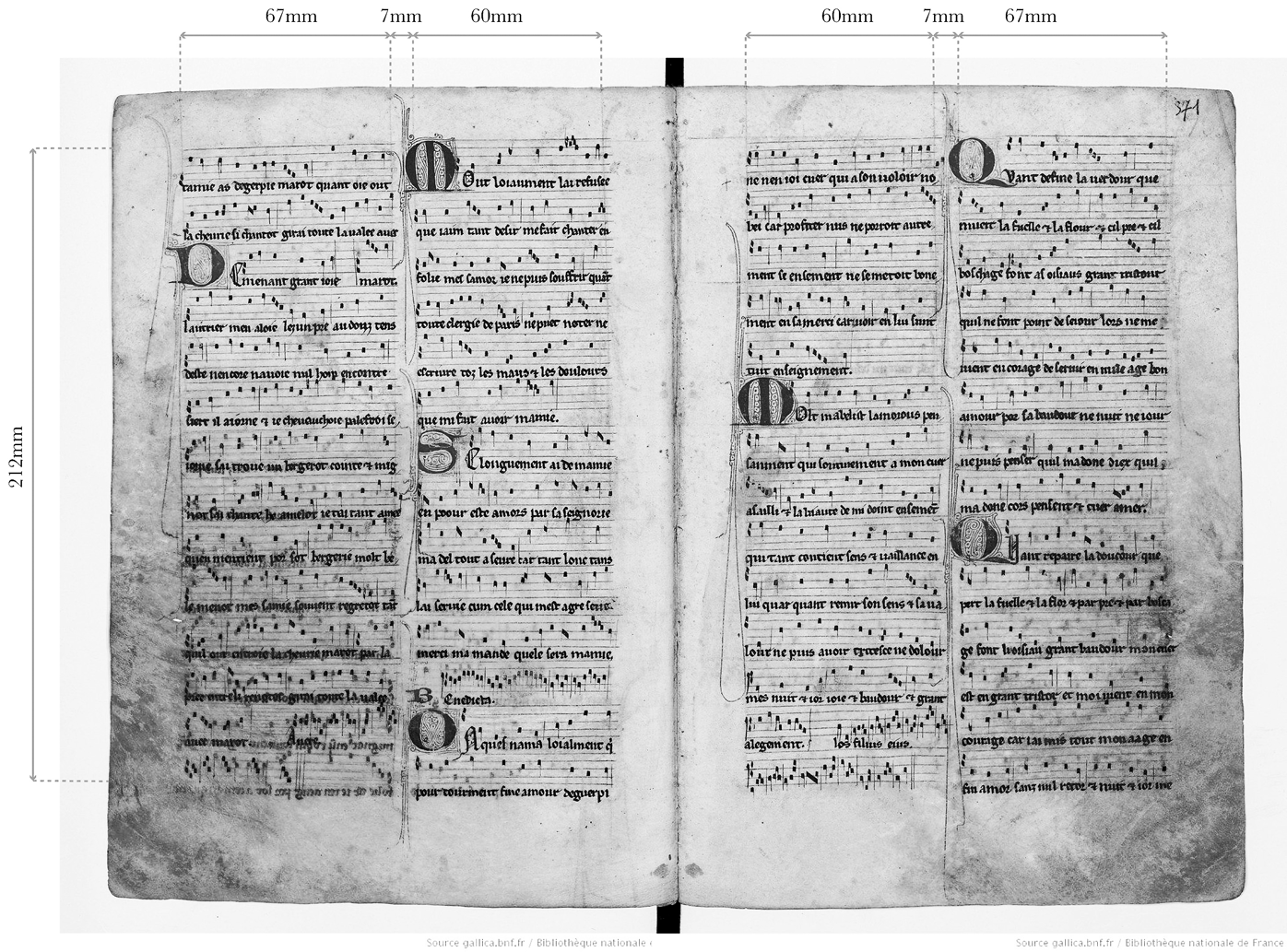
By the time we learn exactly what it is that clerks ‘cannot note or write’, we have already seen its lyric metonym rendered in a determined written form – at least in the sole manuscript to transmit it. Example 1 presents the medieval notation above my transcription, while Figure 1 shows the opening of the manuscript source (fols. 370v–371r).Footnote 6 At bars 22–3 (fol. 370v,b,4 on the facsimile), the two musical perfections over ‘ne puet noter’ begin with a second-mode foot in an otherwise exclusively first-mode piece. The perfection on ‘noter’ is written with a ternaria and coniunctura, their combined duration indicated by several techniques: the ascending stem makes the former a ternaria cum opposita proprietate (henceforth ‘c.o.p.’) signalling the presence of semibreves; and the coniunctura begins with a square punctum, here signalling that its three pitches fit into the time of a breve. Any remaining ambiguity about the value of the final ligated pitch is dispelled by the visual contrast of the ligature and coniunctura, which articulates the underlying L-B foot.Footnote 7
La Clayette, opening of fols. 370v–371r, annotated to show measurements of the ruling frame. By permission of the Bibliothèque nationale de France.
An irony seems lost on the narrator, then, who sings his complaint unaware that a scribe has rendered his song with a nifty bit of penmanship. If there is an authorial commentary here distinct from the narrator's, it is created by a detail of orthography: the singer's folie has indeed been ‘noted’. Emerging more competent than ‘all the clerks of Paris’, this particular composer (or the scribe who transmitted his work) achieved what the narrator claims no one else could: he found a written form for the inexpressible.
Given that this triplum is so concerned with reading, it may surprise that it only appears in La Clayette. Since the manuscript was rediscovered in the 1950s, scholars have repeatedly lodged complaints about its quality as a source, and especially about its notation. This is unfortunate, because the codex offers many more clues about the social practice of polyphony than others whose contents are exclusively musical: La Clayette's fifty-five motets occupy only twenty-two of its 419 folios (fols. 369r–390v), and the rest of the book comprises thirty-four Old French literary texts, concerned for the most part with religious instruction in the vernacular.Footnote 8 Some historical possibilities afforded by this mix of materials will come under discussion in the present article.
But first, let us review the complaints. In 1955, Leo Schrade spoke of the errors he found in the musical fascicle as ‘disturbing deficiencies’ that obscure correct musical readings. He was ‘frequently … at a loss to explain the errors’, suggesting they were related to the unperformable layout: ‘Whatever the purpose of compiling La Clayette may have been, it certainly was not guided by considerations of performance.’Footnote 9 James Heustis Cook endorsed these views, and added a further conundrum: that the damaged leaves of this unperformable source apparently provided evidence of heavy use.Footnote 10 Patricia Norwood drew much the same conclusions: for all sources except Ba and Tu, the answer to her title question ‘Performance Manuscripts From the Thirteenth Century?’ was a definitive ‘No’.Footnote 11
Albi Rosenthal noted that successive layout of voice parts is a feature of the manuscripts F, W2, R and N, ‘the oldest manuscripts’, so he considered La Clayette to be ‘kin’ with those books (by which I understand him to mean, contemporaneous with them; though he does not state opinions about when, precisely, any of the manuscripts were made).Footnote 12 He described La Clayette's notation simply as ‘proportional’.Footnote 13 Other comments about La Clayette's notation are equally cursory and conflicting. Luther Dittmer calls it ‘partially mensural’,Footnote 14 while Friedrich Gennrich declares the notator ‘unaware’ of Franconian precepts for ligatures: in La Clayette, ligatures (he claims) display modal rather than mensural signification.Footnote 15 David Hiley and Thomas B. Payne consider La Clayette to be one of the two ‘earliest surviving manuscripts clearly and consistently making the distinction’ between simplex breves and semibreves, and to notate semibreves with lozenges.Footnote 16 Ernest H. Sanders and Peter M. Lefferts claim that La Clayette's notation ‘uses “Franconian” symbols for single longs, breves and semibreves, but still nearly always uses ligatures of the “Notre Dame” type, i.e. cum proprietate et perfectione, no matter what rhythmic patterns they are intended to convey’.Footnote 17 Mark Everist comments only that the manuscript ‘uses a crude cum littera notation which simply differentiates between longs and breves and seems to predate the notation of fascicles 2–6 of [Mo]’.Footnote 18
In contrast, Gordon Athol Anderson published several studies on La Clayette, and attributed greater skill to the notator.Footnote 19 He identified passages of rhythmic-mode change, and considered La Clayette the first mensural source specifying them unambiguously; though he assumed the manuscript provided unmediated access to the intended rhythms of earlier, non-mensural sources (a proposition to which very few scholars would now acquiesce).Footnote 20 Anderson makes only one observation about the notation (really a judgement about rhythm that assumes full transparency between figure and rhythmic denotation); namely, when a ‘ternaria is used to fill out a full perfection, with only one text syllable underlaid’, that ‘the notator of La Clayette has made a clear distinction between 3 currentes and joined ligatures’ to denote the SSL and BBB patterns, respectively.Footnote 21
Nevertheless, Anderson overlooked many variations suggested by the notation, preferring to keep a single rhythmic mode in each voice.Footnote 22 For example, in his edition of Mout loiaument / Se longuement / Benedicta, the second-mode foot opening the triplum passage ‘ne puet noter’ is given in the same first-mode rhythm with which the piece began.Footnote 23 More detailed information about the notation is difficult to glean from Anderson's edition, because he does not distinguish coniuncturae from ligatures, and always transcribes them with the shortest elements first, even though (as I shall argue below), the scribe often specifies other readings.
All told, concerns about La Clayette fall into three categories: first, its layout does not allow performance; second, its notational orthography is deficient against a modern desire for greater mensural precision; and third, it is so riddled with copying errors that it would have been useless as a basis for performance.
I address each of these points in the sections that follow, suggesting that codicological choices made before the copying of the notation explain many of its apparent deficiencies. However, this article should not be construed as an apologia for the La Clayette manuscript. Rather than defend the source against allegations of its poor quality, I will use a close study of the book to put pressure on the scholarly presuppositions that have made it seem aberrant. The complaints harbour related assumptions about the production, use and function of music books in the thirteenth century that need to be examined, because they relate in turn to assumptions about who could have sung the thirteenth-century motet, and how.
Preparing the page, spacing the parts
La Clayette's music fascicle comprises three gatherings (nos. 50–2 of the whole manuscript), originally two quaternions and a final ternion (gathering 50: fols. 369–76; 51: fols. 377–84; 52: fols. 385–90). Two single leaves were added at the front of gathering 50 (fols. 367 and 368), which terminate in stubs visible at its end (before fol. 377).Footnote 24 The leaves measure 262 mm x 184 mm.Footnote 25 The inner column on both pages is 60 mm wide, the outer, 67 mm, with an intercolumnar gap of 7 mm, for a total measurement of 134 mm; the frame's vertical edge measures 212 mm (Figure 1). The discrepant column widths are consistent throughout the fascicle, the inner column always narrower than the outer. (This pattern obtains even after the centrefold of a gathering: the leaves were pricked when already folded and collated.) The same irregularity obtains in the mise en page of literary gatherings 4 to 10. This suggests that the musical layout was fitted to the design of the literary works with which the motets were bound. As I have argued elsewhere, this was the earliest layer of the manuscript, for which collection almost certainly began before 1270.Footnote 26
Frame lines were ruled faintly in lead, with text lines spaced 15 mm from one another. These often extend over the inner margin to the fold, meeting those on the other side: lines were ruled across the whole opening from edge to edge. This ruling anchors the layout of the parts, whose hierarchy is projected by the placement and decoration of painted initials. Upper voices always begin at the left margin; but to avoid waste, the end of one part may be copied at the end of the next part's first line. This happens at fol. 370v,a,3, where the last word of the triplum L'autrier m'esbatoie, ‘marot’, is placed at the end of the line beginning the motetus Demenant grant ioie. Tenors also receive a painted initial, but without filigree. Unlike upper parts, they may also begin mid-line. This had consequences for the artist: while the reserved spaces at the left margin were obvious, tenor parts had no consistent place in the page's architecture, and their decoration was often overlooked; for example, the missing initial ‘F’ for the tenor [F]los filius eius at fol. 371r,a,13. Texts are copied in a highly compact script: spaces between words are clear but small, and words are always copied as units, without regard for the number of notes each syllable must sustain.
Contrasting with the uniformly neat ruling of the text lines, staff lines are often irregularly spaced. On only one of the forty-four pages (fol. 373r) are staff lines aligned between the left and right columns so as to suggest both were ruled at the same time. Occasionally the top staff line is ruled over the lead text line as a guide; but even in such cases, the staff on the other side may not be so placed. Some even seem to have been traced freehand: on fol. 376r,a,12, for example, the lines of the first two staves ‘wobble’ separately from one another (though this may result from later re-reddening of the staff lines on rubbed folios). The only palaeographical feature of the staves consistent throughout is also the most revealing about working method: every time the bottom staff line overlaps the words beneath, its red pigment sits atop the text's black. Throughout, staves were ruled after the inscription of text, not before.
Habitually irregular in their appearance, it is difficult to determine how often staves were ruled relative to the copying of text. This raises the question whether text and music were copied by the same scribe. If the page or opening were already filled with writing, we might have expected the notator to rule staff lines across the whole page or opening, but lifting the pen at the intercolumnar gap and inner margins. This would resemble the way text lines were ruled. I have already noted that only one page seems to reflect such a procedure (fol. 373r). Here, all lines of the page are filled by parts of a single motet. This might imply that the whole polyphonic piece was the unit of text copying, after which staves were drawn. However, in other positions where such a procedure would have been possible, it cannot be shown to have been adopted: on fol. 375r for instance, the first six lines of both columns contain parts of no. 17 (Par une matinee / Mellis stilla / Alleluya), but their staves do not align. This does not prove that all the text of either the page or the motet was not copied before the staves were ruled; but it certainly implies that, however frequently this part of the notator's task was executed, it was done by labour-intensive methods that would be streamlined for later manuscripts.Footnote 27 I suspect that one scribe copied the texts first, then sent the fascicle to a notator to receive music, just as he left space for an artist to add initials. Perhaps he did so more than once, as his collection of pieces grew. Everist observed that ‘setting up … a prepared ruling and altering it as required is a characteristic of Parisian production of music books and does not appear to be found in other music manuscripts of this period’; he also noted that ‘the exact mechanics of actually aligning the four or five lines is still something of a mystery’.Footnote 28 La Clayette would therefore seem unusual for a later thirteenth-century Parisian production, in that it imposes a single ruling design on all of its musical contents, regardless of their configuration of parts.Footnote 29
Because tenors have no text beyond their incipit, their role in the page design is significant. No standard amount of space was left for each; rather, the space allotted typically reflected its individual length. The fit is usually snug: only seven tenors spill over into the margin,Footnote 30 while only five were given significantly more space than they required.Footnote 31 (Both categories of error suggest that the spaces were already fixed, and the next texts copied, when the notator filled the tenors in.) The close fit between tenor and space has often been achieved through the singular use of repeat marks. Nineteen of the fifty-four tenors use repeats: these are always marked with multiple strokes at the end of the notated cursus, and sometimes also marked ‘iter’.Footnote 32 Especially skilful are the three pieces that ‘embed’ the repeat within the tenor, before notating a final altered cursus.Footnote 33 It is possible that repeat marks were used in the exemplars the scribe copied. But as they are used so frequently in this source and so scarcely in others, they may well represent a unique and relatively expert skill of this particular scribe: recognising that tenors may contain repeats, he looked for them in his exemplars, planning the space he would leave accordingly. Either way, an activity we would recognise as analysis functions here as part of the process of textual transmission. It was doubtlessly aided by the fact that sine littera tenors can be perceived by the eye in their entirety much more easily than can the cum littera upper parts.Footnote 34 Compactly inscribed upon the page, the tenors of the La Clayette manuscript draw attention to their status as ‘rhythmic drones’, palpably reliant upon the repetition of rhythmic patterns within a pitch cursus.Footnote 35 It would be possible for a singing reader to repeat the rhythmic pattern numerous times, hearing the changing accompaniments provided by the upper voices whose discant the tenor anchors; while upper parts might be decrypted against this readily navigable, often repeating foundation.
The notation of rhythm
Other Ars Antiqua sources have enjoyed detailed palaeographical reassessment since La Clayette was last studied. In both repertoire and notation, La Clayette bears close resemblance to the Old Corpus of the Montpellier Codex, whose orthography was ably described by Mary Wolinski in 1988.Footnote 36 More recently, Nicolas Bell elaborated an ‘empirical approach’ to musical palaeography,Footnote 37 which neither assumes nor searches for an underlying theoretical system in a scribe's work, but ‘merely assumes that the notation has the pragmatic purpose of denoting the manner of performance of the music’.Footnote 38 Bell developed his method to account for the notoriously problematic notation of the Las Huelgas manuscript, which comprises a broader range of figures and styles than La Clayette, whose repertoire comprises only motets. In light of these studies, La Clayette's rhythmic notation may be dealt with quickly, largely using examples drawn from fols. 370v–371r (Figure 1).
As all commentators agree, the scribe makes a consistent distinction between virga ( ) and punctum (
 ) for long and breve, and uses a rhomb (
 ) for the simplex semibreve.Footnote 39 A very few ambiguous simplices result from an idiosyncrasy of ductus: the scribe finishes squares with a stop of the pen and a downwards movement, producing a slight stroke that can appear as a short tail; but this has no morphological significance. The rhythmic modes of strictly syllabic passages are notated unambiguously. Thus the five syllables of ‘longuement ai de’ at fol. 370v,b,7 are clearly in the LBLBL pattern of mode one, and the six syllables of ‘mes s'amië souvent’ at fol. 370v,a,10 yield BLBLBL in mode two.Footnote 40 Two puncta between two virgae (i.e. ) are read BB(alt), as throughout the motet Onques n'ama / Molt m'abelist / Flos filius eius (beginning at fol. 370v,b,13) to produce mode three. Passages of successive puncta clearly describe phrases in mode six; for example, over ‘car iai mis tout mon a[-ge]’ at fol. 371r,b,13.
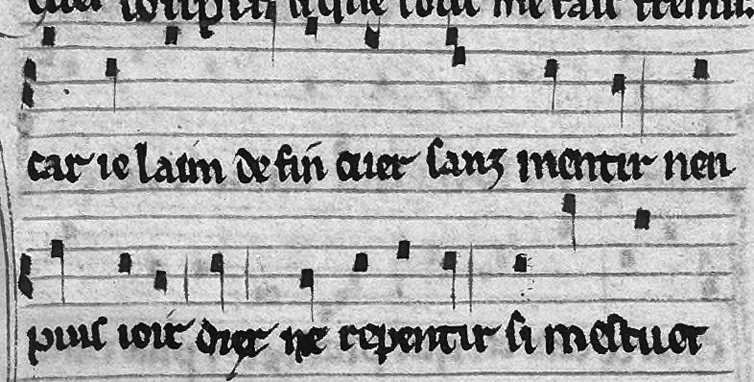
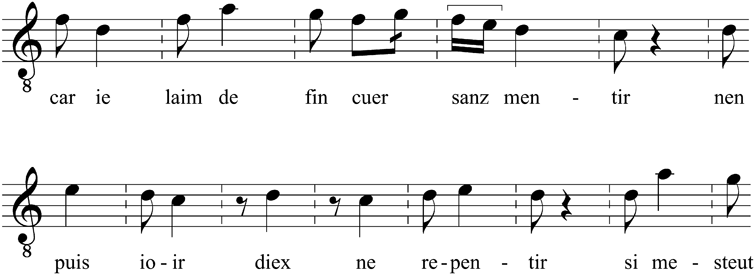
The scribe uses a single form for almost all rests: a stroke roughly the length of two spaces on the staff, but seldom aligned with the staff lines. When a piece contrasts rests of different values, or uses imperfect modes that force the construal of notational groupings in variance with the underlying succession of perfections, strokes of different length can (but need not) be used to signal the contrast. Their morphology hinges on relative length or shortness, not on exact measurement against the staff. This is pre-eminently found in the four pieces making use of hockets (nos. 10, 44, 46 and 54). Figure 2 presents fol. 372v,b,7–8, while Example 2 offers a transcription of the passage. Note the contrast between the length of the final stroke on line 7 and the two shorter strokes on line 8 flanking the virga above the word ‘diex’. Of these three graphemes, the first represents the end of a phrase, and is of the scribe's usual variety.Footnote 41 Each shorter stroke describes a breve rest at the start of a perfection.
La Clayette, fol. 372v,b,7–8, detail, showing the contrasting length of the notator's strokes when notating rests. By permission of the Bibliothèque nationale de France.
Transcription of La Clayette, fol. 372v,b,7–8, offering rhythmic interpretations of the notator's strokes.
Textless tenors are equally straightforward. When a tenor's ordines are long enough, their mode is indicated by ligature succession: thus 3li+2li for mode one; 2li+3li for mode two; and 1+3li for mode three. The conventional LLL ordines of mode five are notated 3li throughout; while unbroken chains of perfect longs are notated as virgae. In all modes, ternariae are written with both propriety and perfection. (Three-note ordines in La Clayette's tenors are usually ligated where possible, and are never written with a climacus [ ] as they often are in F and W2.) When pitch repetitions force the breaking of a ligature, the resulting binaria also usually has propriety and perfection (e.g.
 for
 ); but the created simplex note is given its ‘correct’ mensural form under the prevailing mode. By scanning the tenor for simplices, its mode can be readily determined. Frequent exceptions concern broken ternariae in mode two, where a final simplex note is often notated with a virga, even though its modal value is a breve (e.g. for BLB). This corresponds to the scribe's procedure with upper voices in mode two, where the final note of a perfect ordo, a breve, is often also written with a virga, apparently as a convention for handling the end of a phrase.Footnote 42
Only a handful of unusual forms are found. Seventeen pieces have an extended penultimate note, written with a variety of extended figures (e.g.  in no. 9).Footnote 43 Nine pieces have tenor ligatures with a descending tail on the right of a note, and in contexts that do not imply a plication (e.g.
 in no. 7).Footnote 44 In all such cases, the value of the marked note is a long, which the tail apparently signals by analogy with the long's simplex form. Five tenors have isolated ternariae with propriety but without perfection.Footnote 45 (The forms are
 in nos. 9 and 37 and
 in nos. 27, 29, 36, 37.) All four pieces are in second mode, and require the ternariae to be read BLB. Perhaps the scribe had an exemplar that used unfamiliar forms for second-mode tenors, and replicated some of them. This is surely what happened in no. 36, whose tenor contains a c.o.p. ternaria (
 ) that must be interpreted BLB, which seems a scribal ‘best guess’ in the face of something whose form or sense was unclear. Another c.o.p. ligature (
 ) is found at the start of the tenor of no. 45, where it denotes LBL. Its use is inexplicable, and erroneous.
Forms of plica, ligature and coniunctura are all regularly deployed to describe rhythmic nuances. Of the variety of plicas, most frequent are  for melodic descents (with two roughly equal tails, the left falling at a slight angle) and
 in ascending positions (with a rounded notehead and a slanted tail on the right). Sometimes tails of unequal length are used to clarify the value of the figure (long tail on the right for a long, on the left for a breve). Context makes the value clear in almost all cases.
Binariae substituting for a long of two tempora in modes one and two are often written with both propriety and perfection in the manner Johannes de Garlandia described as ‘improper’.Footnote 46 (In Figure 1, see ‘loi-au-’ of ‘loiaument’ at fol. 370v,b,1, which gives  for BB SS.) However, such binariae more regularly have imperfect forms, descending imperfect being used far more often than ascending. (See fol. 371r,b,9, ‘-pai-re la dou-’, where the ascending perfect and descending imperfect forms are clearly equivalent:

 .) Ligatures without propriety are extremely rare in descending position, and not used at all in ascending position. Plicas are often preferred to ligatures for liquescent syllables (especially in French texts). For example, at fol. 370v,b,9, liquescences account for the use of two consecutive plicas (
 ) for the mode-one fractio pattern BB SS over the words ‘lonc tens’. (The breve value of the second plica is disambiguated by a mensural adaptation, its left tail longer than its right; but the first is not adapted.)
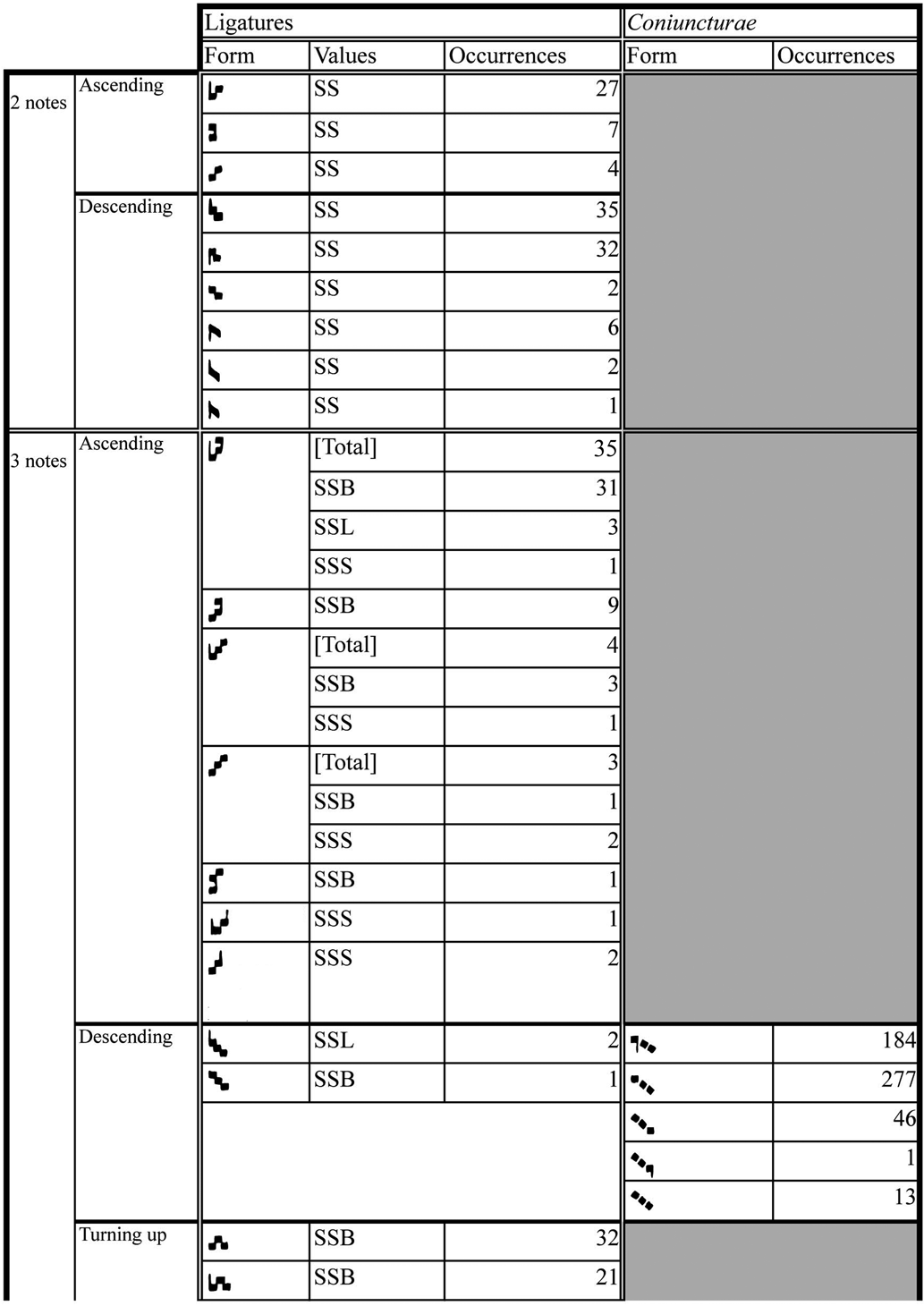
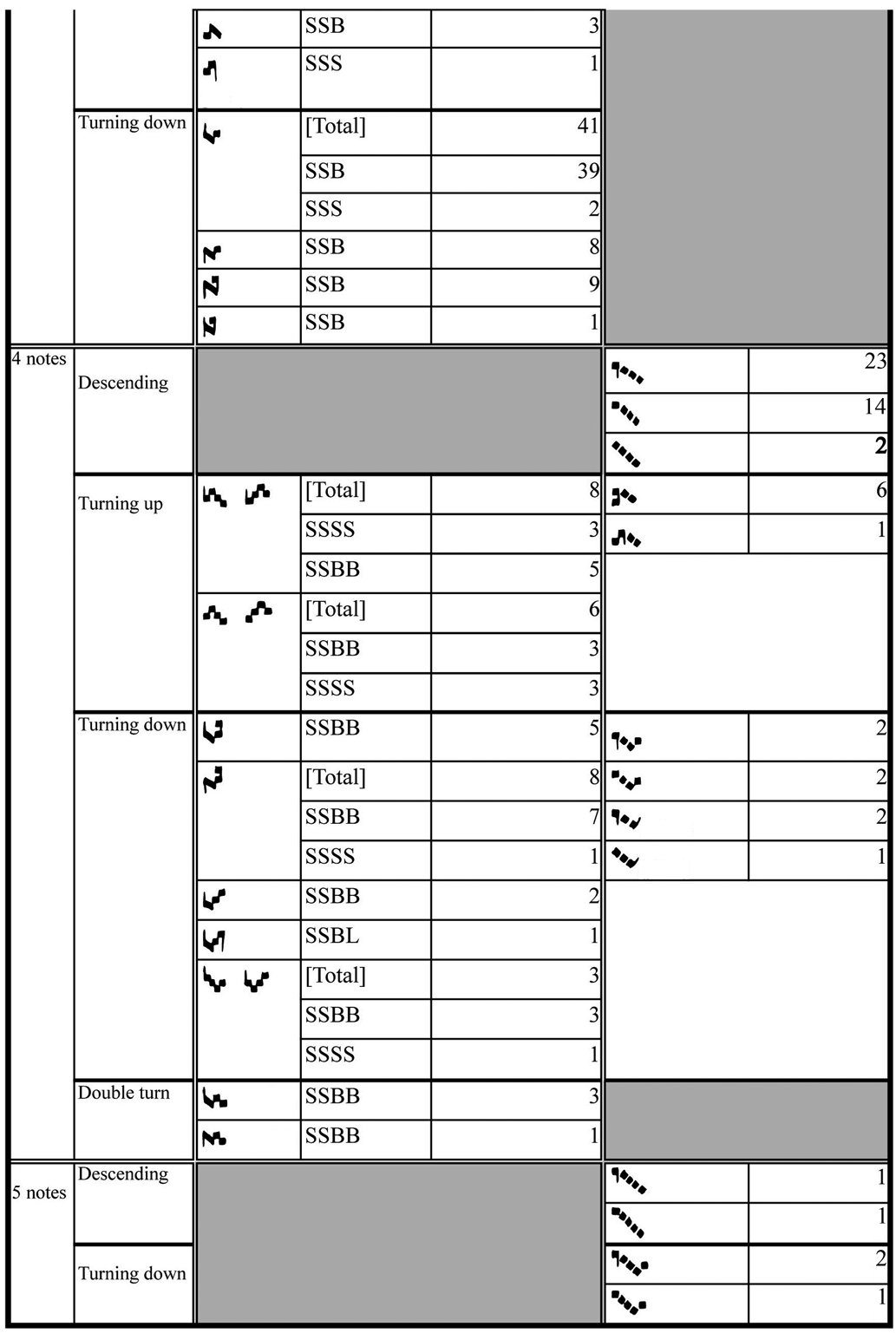
The evaluation of ligatures and coniuncturae requiring semibreves is more complicated. Figure 3 compares ligatures and coniuncturae according to the number of notes in the figure and their melodic contour, indicating how frequently each form is encountered in La Clayette. Evaluations are given for ligatures, but not for coniuncturae (whose interpretative problems will be touched upon below). This pure-palaeographical presentation obscures as much as it reveals of the scribe's flexibility, for it cannot indicate the contexts distinguishing the use of forms, nor reveal the multiple rhythmic situations in which a single form may be used. However, it does reveal that the scribe preferred one or two forms within each class of melodic motion. With all caution due when dealing with the unique musical features of an individual piece, these frequently occurring figures may nevertheless be considered the cornerstones of La Clayette's ‘house style’ for semibreves.Footnote 47
Figures for semibreves in the La Clayette motets, comparing ligatures and coniuncturae.
C.o.p. ligatures clearly predominate over forms with propriety that produce semibreves by reduction. They may or may not also have imperfect forms, whether in medial, ‘incomplete’ positions, or at the end of a modal foot; though in general the scribe is more likely to use an imperfect ligature when its final note ascends than when it descends. (Compare  for SSSS at fol. 370v,b,1, with
 for SSBB at fol. 371r,b,8.)
The two most frequent forms of coniunctura are  and , usually substituting for breve and long respectively. Thus at fol. 370v,b,3 above the word ‘puis,’ substitutes for an imperfect long; but at ‘me-’ of ‘menot’ at fol. 370v,a,10, substitutes for an altered breve. In coniuncturae, semibreves can also be placed at the start of the figure; for example,
 above the Tironian ‘et’ sign on fol. 371r,a,10, where the figure substitutes for a perfection divided into two unequal breves, BB(alt); and
 for SSL at fol. 370v,a,13, where the final virga clearly specifies a return to a mode-two fractio pattern after a phrase notated in mode one. In such cases, the constituent elements of the figure clearly have mensural significance. This raises questions about where the semibreves are positioned in the most frequently encountered figures, and . Anderson consistently transcribes La Clayette's coniuncturae by placing the semibreves at the start of the perfection; but here, as Wolinski suggests for Mo,Footnote 48 the scribe's ample collection of mensural coniuncturae may justify a literal reading of their component parts (e.g. for BSS rather than SSB).Footnote 49 In Example 1, I transcribe coniuncturae according to the mensural forms of their constituent elements. Discussing the Montpellier Codex (roughly contemporary with La Clayette), Wolinski observes that ‘there was no rule at that time requiring all semibreves to fall at the beginning of a perfection’.Footnote 50 Given theoretical support for the mensural reading of coniuncturae, there seems no reason to prefer a ‘semibreves-first’ interpretation here, except where the figure specifies one unambiguously.
Regarding Las Huelgas's notation, Nicolas Bell argued that ‘the concept underlying the scribe's process was centred not so much on an abstract modal system as on the idea of what we call the perfection, which is notionally a regular pulse lasting a perfect long and divisible into three breves’.Footnote 51 Just so for La Clayette's scribe. To tailor Bell's formulation to our notator's work, I would add only that he proceeded with a modal idea of the perfection, one involving an unequal subdivision into LB or BL. The succession of ternary perfections is visually articulated by pairs of figures, each component of a pair which corresponds to one or the other of the two perfections' unequal parts. One seldom has to read far before reaching an unambiguous simplex note that delimits the modal context in which remaining figures must be interpreted. The particular forms chosen for the figures may (and often do) indicate the values of their constituent notes with greater mensural precision; but they need not do so for the script to be construable, and for polyphony to proceed, because it is at the level of the perfection that the discantal grammar of a motet is articulated.Footnote 52 As long as the perfections align between the parts (a matter we shall consider presently), the exact delineation of smaller components is less important, given that they seldom form grammatically essential consonances. As Roesner et al. suggested for the tails on semibreves in Fauvel, so for the mensurally adapted ligature forms in La Clayette, which may be considered something like ‘accidentals’: an adaptation may signal something already inferable from context, especially as that context is usually delimited by mensural simplices in surrounding positions.Footnote 53
Errors of texting and errors of notation
Once each figure has been evaluated according to its function in the succession of LB or BL patterns, visually anchored by notae simplices, few passages remain that are not readily construable. Erasures and palimpsests indicate that the notator was concerned about the accuracy of his work, and proofed it accordingly, as John Haines has rightly observed.Footnote 54 It was the text scribe, rather than the notator, who was less than fully successful.
The most frequent categories of error are additions or omissions of syllables and words, or even omissions of whole phrases of text. Motet texts are rich in assonance and rhyme, often displaying unpredictable versification schemes; they present the scribe with abundant opportunities to slip by haplography or dittography. Of 122 texted parts in the collection, I count fifty-five (i.e, some 45 per cent) that show errors where the text scribe transmits an incorrect number of syllables. That figure includes the many occasions in French texts where he wrote out in full those particles which normally contract in speech and in musical setting, and which are usually not separated in motet manuscripts. However, having too many syllables to match the notes presented nothing like the problems of having too few. Words were already written in a compact script, with no separation of syllables to accommodate musical overlay. Musical passages involving heavy fractio were already difficult to accommodate; and when words were missing, the problems of spacing were almost insurmountable. Remarkably, when faced with this situation, the music scribe persistently included all the music in his exemplar. But he had to abandon his usual careful alignment of note and syllable, crowding the notes in as best he could until they could again be aligned over the appropriate syllables.
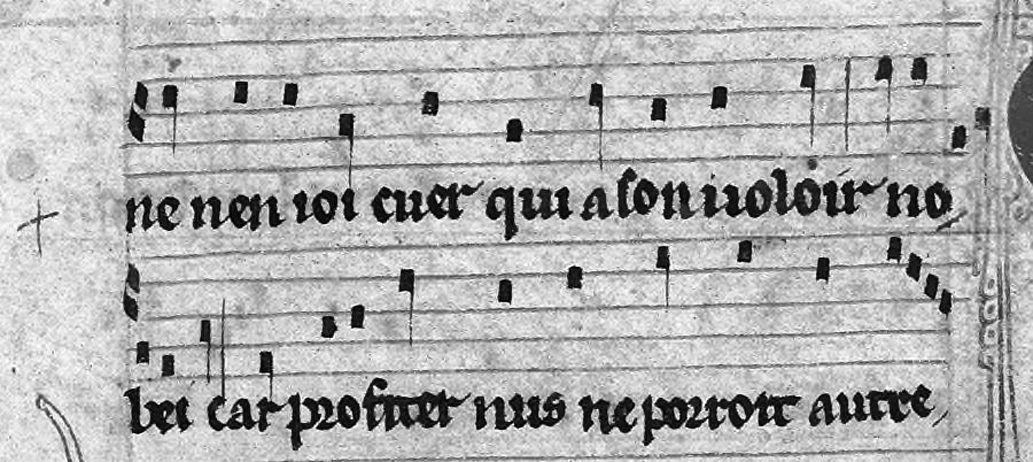
There are two such cases in Figure 1. At fol. 371r,a,1, the word ‘entierement’ has been omitted. (Mo, at fol. 151v, lines 4 to 5, gives ‘ne n'en ioi / cuer qui entierement a son voloir’). Here the notator sets the correct pitches of the missing text to the next three words (‘a son voloir’), also four syllables in total length. Realising the error, he then cramped four simplices over the final syllable of the line, and two notes over the first syllable of the next, the correct alignment resuming at ‘car’ on line two (see Fig. 4).
La Clayette, fol. 371r,a,1–2, detail, where the notator recognises a textual error. By permission of the Bibliothèque nationale de France.
Because the pitches are given in simplices (when ligatures would have saved space), the presence-in-absence of the missing text is signalled: a reader would not be able to tell what the missing text was, if he did not already know the piece; but he would readily recognise from the notation that further text was indeed missing. Perhaps a replacement could have been agreed in rehearsal and supplied in performance. Although the manuscript has many textual errors, I find that in all but the most unsalvageable cases, the music scribe has met the challenge with remarkable skill. The total number of perfections indicated in the notation is almost always correct, subject to the principles of rhythmic interpretation I have already outlined.Footnote 55
The omission of text is worst in the Latin texts, which the scribe copied with minimal understanding. The most egregiously erroneous piece is no. 11, the four-part Latin motet Mors a primi patris / Mors que stimulo / Mors morsu / Mors. There are eight errors of omission here, and many further errors resulting from the scribe's misconstrual of consecutive minim strokes in the text, guided by little more than guesswork. This recurring problem with Latin, in a book whose other contents are entirely in French, is significant. The scribe of the motet texts was a vernacular specialist.
All this shows the musical consequences of a layout made primarily to accommodate literary works elsewhere in the manuscript – one adapted here to fit a kind of polyphony that presented rich problems to even the most skilled book designers. La Clayette's motets show a clear divergence of textual and musical competence: French texts are likely to be more reliable than those in Latin, musical readings more reliable than textual ones. In his work on the stemmatology of thirteenth-century manuscripts of polyphony, James Heustis Cook took La Clayette's repertory of Latin and bilingual motets as a set of case studies, stating that ‘Latin provides more opportunities for analysis through the method adopted here than does medieval French’.Footnote 56 The first reason for selecting these pieces was to reduce the size of his project to manageable proportions. But it involved the assumption that Latin texts would offer a more stable platform upon which to build a theory of musical copying and transmission than French texts, Latin usually showing greater orthographical consistency across the sources. Cook's hypothesis cannot be sustained in the light of the evidence presented here, and his stemmata must be reassessed accordingly.
Reading, readers, and the question of performance
Could La Clayette have supported performance? The question – or assumptions about musical literacy pertinent to the question – lurks behind most judgements about the manuscript. Only Patricia Norwood has posed the question directly, but, as we have seen, she did not believe any manuscripts except Ba and Tu could have been used by performers.Footnote 57 Others have been more open to the possibility, when it has arisen in the course of their work on other issues. Roesner, for instance, suggested in passing that Fauvel was ‘probably performed from’.Footnote 58 Nicolas Bell has pointed out that, while errors are frequently found in Las Huelgas, this does not mean that it was not intended for performance use – indeed, its errors usually cannot be identified except in the act of performance.Footnote 59 Doubtless the errors would have been identified in the course of a ‘choir practice’.Footnote 60 Speaking primarily of fourteenth- and fifteenth-century books, Margaret Bent has challenged the scholarly incredulity about performance from uncorrected manuscripts, arguing that medieval singers must have been much less dependent than we are on written parts, and much more adept at using their memory: singers could have resolved erroneous passages in rehearsal, and then committed their solutions to memory.Footnote 61 Albeit that Ars Antiqua manuscripts present some different challenges, much of what Bent claims is certainly true of them too.
If our definition of a ‘performable’ polyphony manuscript requires synoptic visual presentation of all segments of a motet that are to sound synchronised, then La Clayette clearly comes up short. But not so short. Twenty-two of its motets have voices on different openings; but that leaves thirty-three whose layout presents no barrier to synchronised performance. For these pieces, I see no problem imagining musically (if not poetically) acceptable performances from the book. But it cannot really be thought appropriate to judge musical documents in terms of prima vista performance, at least in the thirteenth century. Once it is acknowledged that pieces must have been rehearsed, a host of possibilities for performed, literate interaction with Ars Antiqua manuscripts is brought back into play – possibilities to which each strategy of manuscript design might have responded in different ways.
Recent studies have offered powerful arguments that Ars Antiqua polyphony could have been composed without writing, especially in institutions such as Notre Dame, where professional singers would have collaborated closely in the liturgy.Footnote 62 However, music historians have not yet found a definitive institutional home for the polytextual motet of the mid-thirteenth century, except by assuming that because it seems difficult, it could only have made sense to clerical intellectuals associated with the Cathedral and the burgeoning University of Paris, and could only have been sung by professionals. In support of this view, scholars regularly invoke the authority of Johannes de Grocheio, who writes that the motet
ought not to be celebrated in the presence of common people, because they do not notice its subtlety, nor are they delighted in hearing it, but in the presence of the educated and of those who are seeking out subtleties in the arts. And it is customarily sung at their feasts for their enhancement, just as the cantilena that is called a rotundellus [is sung] at feasts of the common laity.Footnote 63
Christopher Page voiced dissatisfaction with the assumed elitism of the motet, arguing that ‘the base for the materials of the Ars antiqua motet was a broad one’, and that it ‘may have been matched by a breadth in the constituency of the audience for these pieces’.Footnote 64 For instance, he suggests that lighter-hearted two-part motets might have been performed by singers of Notre Dame as entertainment for the laity on a commercial basis.Footnote 65 He also points out that the litterati to whom Grocheio refers could have encompassed a broad sweep of men, from the highest prelates to boys beginning their training for orders.Footnote 66 Nevertheless, Page assumes the motet was performed by clerics;Footnote 67 and those few lay people who might have heard a polytextual piece were, according to Page's reading of Grocheio, ‘laymen of unusual aptitude’.Footnote 68 Ultimately Page acknowledges that there ‘is certainly an elitism in Grocheio's view of the audience for motets’;Footnote 69 and he is surely right that it hinges on ‘the cleric's sense of distinctive juridical status; his consciousness of advancing mankind's supreme purpose in God while maintaining a powerful influence over temporal powers; pride in the ability to read and write: clergie’.Footnote 70 But this is not much less elite than the notion Page set out to challenge, and is evidently gender-biased. At the root of it all, for Grocheio and then for Page, is a belief about who is literate and who is not, and how literacy should inform the kind of music people ought to make and enjoy.
Elaborate manuscripts such as Montpellier fit Grocheio's vision of writing neatly. Yet there are many other thirteenth-century sources containing polyphony, and most do not look like the celebrated anthologies. La Clayette is one of them. I contend that its notation displays sufficient attention to rhythmic detail to have served not just as a prompt for those who already knew how the music went, but also as an aid for those who wanted to learn it. If a singer had sufficient knowledge of the music's style and the manuscript's notational conventions, he or she could have learnt on their own. Or a singer could be taught with the book as an aid. As the music is readily construable to one reader at a time, perhaps only one reader would have been required to construct a whole polyphonic edifice, by whatever didactic method proved effective.
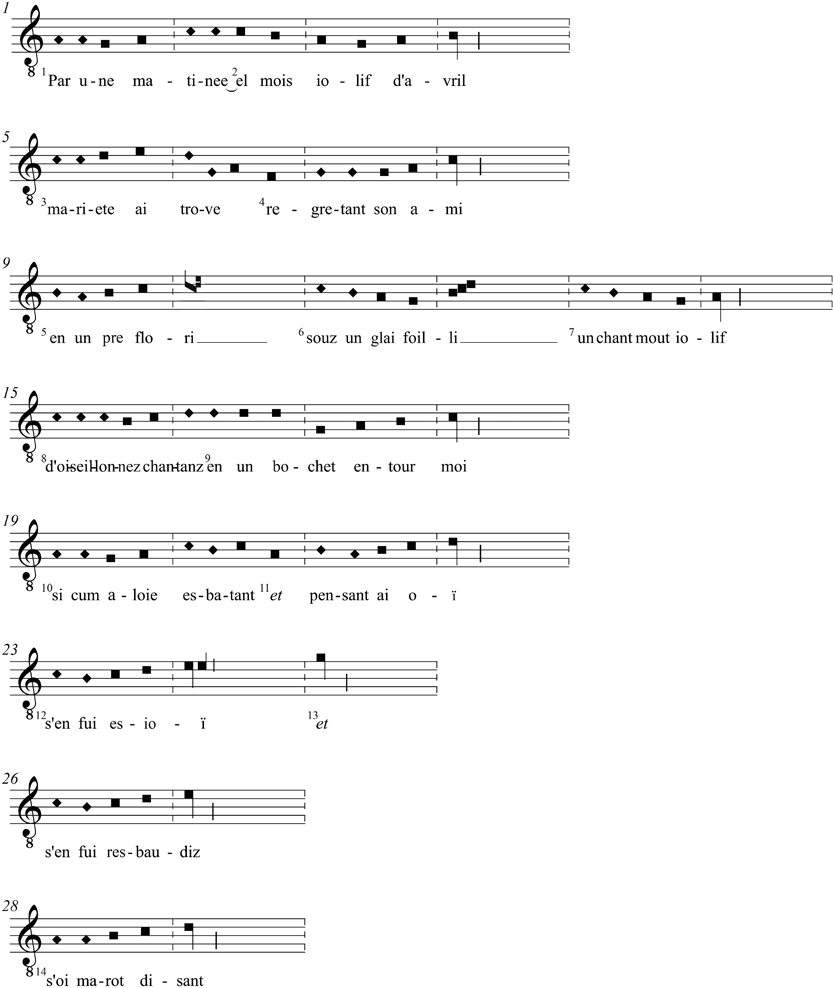
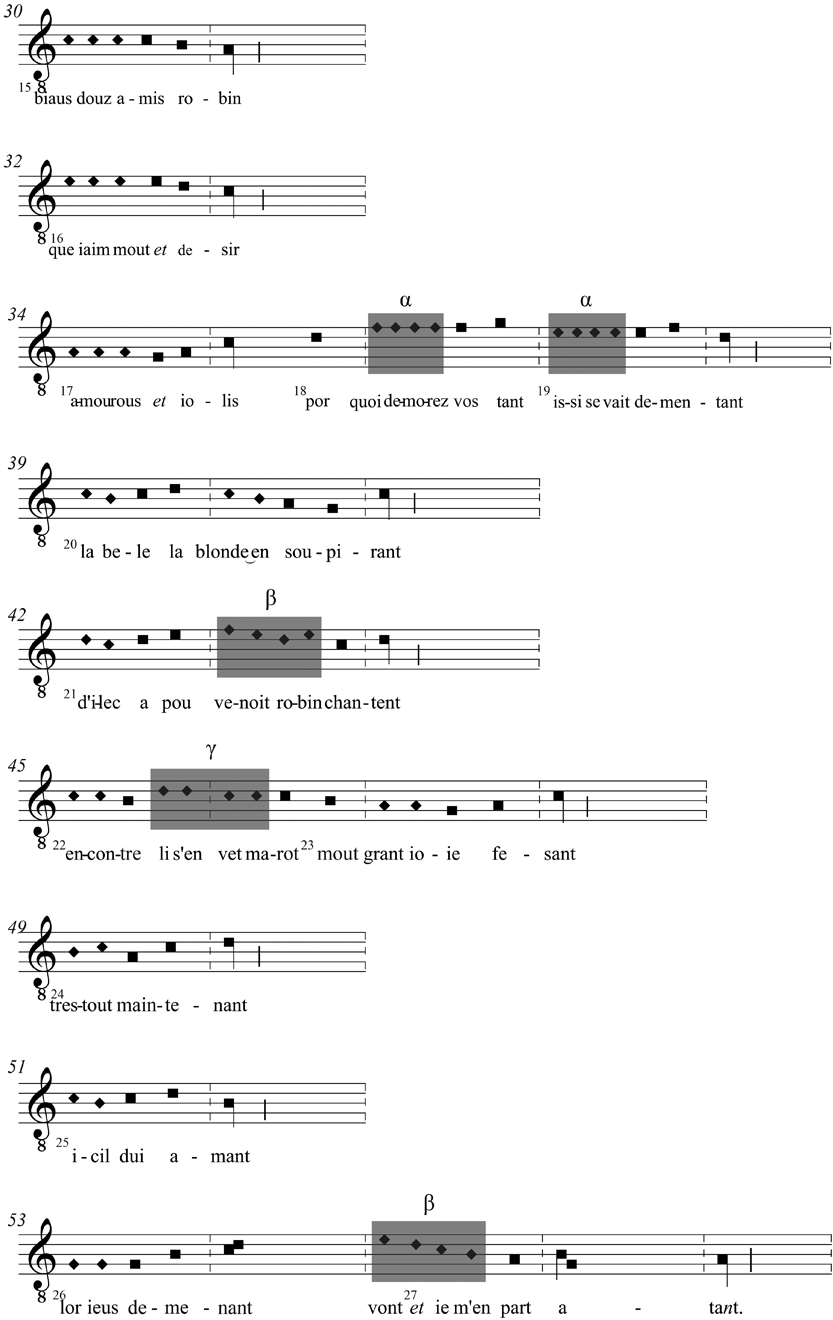
Of all notational features inviting such an interpretation, most telling are passages comprising four consecutive, texted semibreves, which are found in four pieces.Footnote 71 The triplum of no. 17, Par une matinee / Mellis stilla / Alleluia, has no fewer than five such passages. For the discant to work correctly, they must be interpreted in one of three different rhythms relative to the underlying perfections. (Example 3 gives a transcription, preserving the original note shapes but barring them by perfections. The relevant passages are highlighted, their different rhythms marked with Greek letters.) No palaeographical clues guide interpretation. One must test each passage against the tenor, trying different solutions until something works. Someone who read fluently enough to perform musical calculations in the mind could have counted perfections from the start of the piece, correlating against another calculation for the tenor. Another option would be to teach the repetitive tenor to someone, and have him or her sing it while the reader broaches various solutions. And so on. Any number of strategies might have worked, and could have been tried, when only one reader is assumed. The only model which could not have worked for all pieces in the manuscript is one where all singers read their parts all the time.
Triplum, Par une matinee, transcribed from La Clayette, fols. 374v,b,11–375r,a,11.
The literate practice I imagine here would resemble Brian Stock's conception of a ‘textual community’ with unevenly distributed literacy, in which a single reader proposed interpretations of authoritative texts to which other, perhaps non-literate, members of a community would acquiesce.Footnote 72 Joyce Coleman, moreover, has demonstrated that vernacular literature of the later Middle Ages was most often consumed through ‘praelection’: a social event in which a reader would perform the written text to his audience live from the book – this, even when the auditors were also able to read.Footnote 73 La Clayette's motets sit alongside didactic literary works either composed in or translated into Old French, and took their place early in the volume's active life of growth and use. Their texts were written by a scribe far more adept with the vernacular than with Latin. In this vernacular book, the motets seem a kind of vernacular polyphony, and a vernacular reading procedure seems eminently possible for them too.
La Clayette's literary texts certainly presume their praelection. For instance, in the prologue to his Bestiaire (at fol. 22r in La Clayette), Pierre de Beauvais relates how he undertook to translate the work for those not schooled in Latin. Not without a note of pride, he writes:
En cest livre translater de latin en romanz mist lonc travail Pierres qui volontiers le fist et pour ce que rime se vieut afaitier de moz concueilliz hors de verité, mist il sanz rime cest livre selonc le latin dou livre que Phisiologes, uns boens clers d'Athenes, traita et Jehans Crisothonus enchoisi en les natures des bestes et des oisiaus… Si parole ci premierement a l'entendement des espiriteus Escritures et commence du lyon pour ce que il est rois de toutes les bestes. Si font bien a oïr et a entendre et a retenir les natures de li dont li sens commance ci apres.Footnote 74
[Pierre put long hours into translating this book from Latin into romance, and did so willingly. And because rhyme seeks to fashion words that are gathered together without regard for truth, he has rendered this book without rhyme, according to the Latin of the book that Physiologus (a good clerk of Athens) set forth; and [according to how] John Chrysostom perceived the natures of the beasts and birds… So it speaks here first of the understanding of the holy scriptures, and it begins with the lion, for he is king of all the beasts. His natures are good to hear, and to understand, and to remember; and their sense follows here, afterwards.]
Pierre's gesture of transparency – that he has remained faithful to the letter of a Latin book he has seen – may not be without ideological purpose;Footnote 75 but I see no reason to question his belief that this vernacular book will be heard. And the means by which he floats the idea are brilliant. The deictic intensifiers (‘So it speaks here first’) make present to his audience's imagination an absent Latin volume that stood open before him, much as a vernacular book such as La Clayette would now have stood open before a praelector who stood in front of them. Pierre is eager to point out that the Latin text to which he has been so unusually transparent has textual credentials going all the way back to early Christian Athens; thus he anchors this vernacular literature's live performance in a bookish tradition extending back as far as the mind's eye can see. Run forward, all this projects a hope for unmediated textual fidelity: en romanz, this literature will be more widespread; but even in the vernacular, it will live again in the same way.
Live effects produced with a new textual fixity: this seems a productive way to think about the motet. It is true that motets are found in multiple versions, with different texts or added music, from one manuscript witness to the next. But to inscribe music in mensural notation was an act of preservation that hoped for the future relevance of the version put down, and enabled its future performance. And once motets were learned (by whatever means), they structured singers' labour by co-ordinating their voices in the grammar of discant and by disposing their efforts in precisely measured musical time, in ways that stayed the same from one performance to the next. A practice of musical praelection would be unlike its literary counterpart only in that it offered determined participatory roles for the audience to whom the pieces were taught from the book. This is hardly a difference at all, but an intensification of praelection's social work. These are implications that must be explored elsewhere. For now, the palaeographical testimony of the La Clayette manuscript should remind us that the only quality needed for singing one of these apparently difficult, elite, literate, polytextual motets would have been the willingness to be taught how.
Appendix: List of manuscript sigla
- Ba
Bamberg, Staatsbibliothek, Lit. 115
- F
Florence, Biblioteca Medicea Laurenziana, Plut. 29.1
- Fauvel
Paris, Bibliothèque nationale de France, français 146
- La Clayette
Paris, Bibliothèque nationale de France, nouvelle acquisitions françaises 13521
- Las Huelgas
Burgos, Monasterio de Las Huelgas, MS 9
- LoC
London, British Library, Additional 30091
- Mo
Montpellier, Bibliothèque Inter-Universitaire, Section Médicine, H196 (the ‘Montpellier Codex’)
- N
Paris, Bibliothèque nationale de France, français 12615 (the ‘chansonnier de Noailles’)
- R
Paris, Bibliothèque nationale de France, français 844 (the ‘chansonnier du Roi’)
- Tu
Turin, Biblioteca Reale, Vari 42(1)
- W2
Wolfenbüttel, Herzog August Bibliothek, Guelf. 1099 Helmst.