In an article arguing that because of ‘Turkish-Islamic exceptionalism’ Turkey’s political experience cannot be replicated in the rest of the Middle East, the eminent scholar Şerif Mardin (Reference Mardin2005: 148) traced this notion of exceptionalism back ultimately to Alexis de Tocqueville. The central thrust of Tocqueville’s observations on democracy in America, however – as he made clear in the introduction to his famous work on the subject – was precisely the opposite: ‘the same democracy reigning in American societies appeared to me to be advancing rapidly toward power in Europe . . . A great democratic revolution is taking place among us.’ And: ‘It appears to me beyond doubt that sooner or later we shall arrive, like the Americans, at an almost complete equality of conditions . . . I wanted to find lessons there from which we could profit’ (de Tocqueville Reference de Tocqueville2000: 3, 12). This article argues that, in the most important respects at least, the future Tocqueville discerned in America is now materializing not just in Turkey, but also in the rest of the Middle East. It is an argument that runs counter to much of the contemporary scholarship on the region.
‘Robust Authoritarianism’
Impressed by the persistence of authoritarian rule in the Arab world, the dominant trend among Western – and especially American – scholars by the turn of this century was to move away from assessing the prerequisites and prospects for democracy, and towards explaining (in Eva Bellin’s influential formulation) the ‘robustness of authoritarianism’ throughout the region (Bellin Reference Bellin2004; Heydemann Reference Heydemann2007). This generated a rich research programme that has yielded valuable insights on a variety of fronts. Thus, Bellin (Reference Bellin2004: 143) herself focused on the ‘will and capacity of the state’s coercive apparatus’, which ‘have extinguished the possibility of transition. Herein lies the region’s true exceptionalism.’ Others showed how controlled liberalization – for example allowing a degree of multiparty politics – could be used to consolidate authoritarian rule (Blaydes Reference Blaydes2011; Brumberg Reference Brumberg2002; Lust-Okar Reference Lust-Okar2005; Posusney Reference Posusney2005a); or how the proliferation of civil society-based non-governmental organizations under authoritarian conditions could actually retard democratization (Jamal Reference Jamal2007; Langohr Reference Langohr2005; Yom Reference Yom2005). Still other approaches studied the dependence of business interests on the regime and their acquiescence in the status quo (Bellin Reference Bellin2002; Moore Reference Moore2004), or the politically enervating effects of ‘rentier’ economies (Beblawi Reference Beblawi1990; Ross Reference Ross2001). An entire sub-genre analysed the distinctive durability of monarchies (Herb Reference Herb1999; Lawrence Reference Lawrence2014; Menaldo Reference Menaldo2012; Yom and Gause Reference Yom and Gause2012).
Then came the Arab uprisings of 2011. Jason Brownlee provides an instructive illustration of one set of responses to this upheaval in the robust authoritarianism literature. Whereas he had earlier argued that ‘ruling parties have been the root cause of regime persistence’ because authoritarian regimes are better able to weather divisive crises when they have party structures that can maintain elite cohesion, adding that this ‘theory provides a complete explanation for the varying regime outcomes of developing countries’ (Brownlee Reference Brownlee2007: 3, 33), Brownlee now acknowledged ‘the power of “bottom-up” mass movements to influence otherwise complacent elites’ even in an Egypt where the authoritarian single-party ‘regime cohered’ rather than experiencing elite defection (Brownlee Reference Brownlee2012: 123). Nevertheless, arguing that Mubarak’s ouster ‘fell short of regime change’, he concluded: ‘As the dust settled, authoritarian regimes that initially appeared brittle had withstood the strongest regional challenge in decades and looked resilient once more. When regimes survived they reinforced prior theories of robust authoritarianism – theories that had seemed analytically bankrupt when the revolts first erupted’ (Brownlee Reference Brownlee2012: 174, 171).
The striking point here is the proposition that the dust had settled by the time Brownlee completed his book – apparently barely a year after Egypt’s uprising broke out. This certitude was reinforced in an article he co-wrote with Tarek Masoud and Andrew Reynolds, suggestively titled ‘Why the Modest Harvest?’, focusing on another pair of variables: ‘oil wealth . . . and the precedent of hereditary succession (which indicates the heightened loyalty of coercive agents to the executive)’ – ‘only regimes’ lacking both ‘succumbed relatively quickly and nonviolently to domestic uprisings’, while ‘Either characteristic is enough to ensure that the regime will retain power’ (Brownlee et al. Reference Brownlee, Masoud and Reynolds2013: 30, 42). Once again, some otherwise reasonable observations are presented in an unwarranted or at least premature cloak of certainty – that this or that combination of variables will ‘ensure’ regime survival, and that the result is ‘a parsimonious theory that predicts outcomes in fourteen Arab-majority states’ (Brownlee et al. Reference Brownlee, Masoud and Reynolds2013: 32) – with the overall effect of downplaying the transformative significance of the Arab uprisings.
Parallel to such a narrow temporal perspective is a peculiarly restricted spatial focus. One would think that scholars of comparative politics studying Arab countries would naturally look to the experience of another majority-Sunni Muslim successor state to the Ottoman Empire that encompassed most of them until only about a century ago. Yet the degree to which Turkey is absent in this scholarship is astonishing. Discussing the rare occasions when authoritarian ruling parties have in fact splintered and suffered electoral defeat – paving the way for democratizing transitions – Brownlee, for example, looked at Mexico’s Institutional Revolutionary Party and Taiwan’s Kuomintang, but never mentioned Turkey’s Republican People’s Party (Brownlee Reference Brownlee2007: 41–2, 221–2). Even in a volume on the region that laudably did include a chapter on Turkey, the editor, in a momentary lapse reflecting the general blind spot, writes: ‘What distinguishes the Middle East is not simply the phenomenon of enduring authoritarianism but rather the density of it and the absence of a case of successful democratization’ (Posusney Reference Posusney2005b: 2). In order to see whether Turkey’s democratizing experience provides useful insights into the future of Arab politics, therefore, a closer look at that country’s political development would seem to be warranted.
Robust Kemalism?
From the proclamation of the Republic on 29 October 1923 until the first generally free and fair elections on 14 May 1950, Turkey was ruled by a single-party regime – founded by Atatürk and institutionalized in the Republican People’s Party (CHP) – that serves as a template for many of the authoritarian secular nationalist regimes that would subsequently come to dominate Arab politics as well. Growing out of a struggle against Western powers seeking to partition and occupy Turkey in the aftermath of the Ottoman Empire’s defeat and collapse in the First World War, it adopted a profoundly ambivalent attitude towards the West, captured in the formula ‘Westernizing despite the West’. Internally, this entailed embracing ‘modern’ Western norms and institutions, such as secularism and nationalism, that were seen to have decisively outpaced ‘traditional’ Islamic religiosity and multiculturalism. Externally, it was reflected in an ardent desire to join the ranks of the Western powers on an equal footing, coupled with a fearful conviction that those Western powers would never abandon their hostile, indeed predatory, posture towards Turkish sovereignty.
It is worth underlining the authoritarian character of this Kemalist regime. Seeking to explain Turkey’s democratic exceptionalism in the Middle Eastern context, Michele Penner Angrist (Reference Angrist2005: 133) argues that the transition to democracy was facilitated by a ‘two-party system’ that promoted ‘depolarization’ and mass mobilizational capacity between 1923 and 1950. But the two opposition parties lasted a mere seven months and 98 days respectively: the first did exhibit a distinct liberal orientation, but its existence was a manifestation of the Kemalist regime’s initial consolidation phase which ended with its suppression in 1925; the second emerged in 1930 when Atatürk, seeking to contain rising social discontent, instructed some of his most trusted associates to form the party, compelled others – including his own sister – to join it, and even came up with its name himself. Even so, when the party proved too popular, he ordered its leaders to shut it down (Ağaoğlu Reference Ağaoğlu1994: 19–49; Okyar Reference Okyar1987: 7–70). In short, until the Democrat Party was allowed to form in the late 1940s and to compete in the first free and fair national election in May 1950, a remarkably robust single-party authoritarian regime held sway in Turkey for almost 30 years. As Ayşe Kadıoğlu (1996: 188) points out, referring to the ruling party’s core principles (the ‘Six Arrows’ of Republicanism, Populism, Nationalism, Secularism, Etatism and Revolutionism), ‘Democracy was not one of the six arrows of the Republican People’s Party’.
The central question therefore remains: can Turkey’s transition from single-party rule to multiparty politics in 1950 constitute a model for future such transitions in the Arab world? One set of negative answers focuses on the allegedly distinctive features of ‘Turkish Islam’. An illustrative example by Hakan Yavuz highlights two reasons in particular. The first is a ‘Sufi’ tradition said to combine Islam with older Central Asian ‘shamanism’ to produce a ‘nonliteral and inclusive reading of religion’ lacking a concept of the ‘other’ and having ‘more in common with Balkan Christianity’ than with Arab or Iranian articulations of Islam. The second is that as colonizers of parts of Europe but ‘never colonized’ themselves, Turkey’s Muslims are at once more tolerant towards, and less resentful of, the West than their Arab counterparts (Yavuz Reference Yavuz2004: 219–20, 221–2). Here one may only point out that those same Sufi traditions in many times and places of the Muslim world have not prevented quite vigorous conceptions of the ‘other’ from emerging, and that the contention ‘For Turkey, therefore, Europe never became the “other” in the construction of its identity’ (Yavuz Reference Yavuz2004: 222) would strike many students of the country as debatable, to say the least.
A second set of explanations centres on the existence of a significant secularist counterforce to Islamism. Here, however, it is worth disaggregating the pre-Republican and Kemalist periods in the evolution of such a counterforce. Thus, Şerif Mardin (Reference Mardin2005: 146, 147, 148) posits an Ottoman political outlook characterized by ‘positivism’ and statist realpolitik in which ‘secularism and Islam interpenetrate’ in a manner that is ‘sui generis’ and that has given rise to a ‘modern Turkish Islamic “exceptionalism”’ – in contrast to ‘the Islam of Arabs’. Extending this temporal conflation, Ömer Taşpınar also points to the subordination of the religious establishment to Ottoman ‘state tradition and raison d’état’ – reflected in the designation of the Ottoman Empire ‘as one entity’ in the phrase ‘din-ü devlet’ (religion and state) – to argue that: ‘Turkey’s imperial tradition, the role of Ataturk and the Kemalist understanding of secularism clearly illustrate the sui generis nature of the Turkish model. A contemporary attempt at similar reforms to what went on in Turkey under Ataturk would undoubtedly face serious legitimacy and implementation problems in the Arab world’ (Taşpınar Reference Taşpınar2003: 19, 24; see also Ülgen Reference Ülgen2011: 13). While acknowledging this ‘legal or cultural tradition’, finally, Daniel Brumberg (2005–Reference Brumberg6: 110) completes the shift of focus to the modern context by pointing to the creation of ‘a political arena in which non-Islamist parties can mobilize a significant following’ as the ‘most crucial point’ distinguishing Turkey from the Arab world: ‘Consequently, talk of importing the Turkish model . . . to the Arab world is, as they say in Arabic, kilam fadi (empty words).’
Since the contrast posited is between Turks and Arabs, however, where their political traditions converge and diverge needs to be clearly delineated. The trope pairing religion and state and the predominance of raison d’état in practice, for example, both long pre-date the Ottoman Empire, extending back to the Arab ‘Abbasid and Umayyad Empires at least. Moreover, as Meliha Benli Altunışık (Reference Altunışık2005: 51) points out, ‘Most of the countries in the region were part of the Ottoman Empire and thus were influenced by the particular form of relations between politics and Islam that existed in the empire.’ A more compelling analysis of the distinctive characteristics and consequences of Turkish secularism consequently needs to focus primarily on the Kemalist era extending between 1923 and 1950.
The main observation in this regard is the extraordinary autonomy enjoyed by the Kemalists when they first came to power. On the political level, their leadership of the War of Independence (1919–23) against occupying Western powers positioned them to eliminate rivals ranging from Ottoman loyalists to alternative currents within the nationalist movement. On the economic level, they had no significant urban interest groups to contend with: just prior to the collapse of the Ottoman Empire, 80 per cent of the country’s finance and commerce was effectively controlled by Greeks, Armenians and Jews, often serving as local agents of European-owned firms (Roos and Roos Reference Roos and Roos1971: 17). Greeks and Armenians together accounted for 70 per cent of the capital and 75 per cent of the labour in all Turkish factories in 1914, with Muslims accounting for only 15 per cent of the total in each category (Kerwin Reference Kerwin1956: 2–xv, 84–5). With the all but total liquidation of both non-Muslim communities during the First World War and the post-war population transfers, therefore, Turkey essentially was left without an indigenous urban private sector to make demands on the new regime. On the social level, finally, the Kemalists ruled a population not only overwhelmingly illiterate (89 per cent in 1927), but rendered still more tractable by the fact that so many – 25 per cent of the total, by one count (Pekesen Reference Pekesen2012; see also Karpat Reference Karpat1985: 11) – belonged to families which had arrived during the previous few decades from other parts of the Ottoman Empire as frightened refugees fleeing ethnic cleansing.
Externally, the Kemalists enjoyed a prolonged period of significant autonomy as well. Britain and France, drained by the First World War, had much less energy to pursue claims on Turkey after the War of Independence. Russia, the traditional enemy, remained preoccupied first with its domestic power struggles and purges, then with the Nazi German threat, through the Second World War, and so was content to adhere to its non-aggression pact with Turkey from 1925 to 1945. A series of bilateral border demarcation agreements with Iraq, Iran and Greece normalized relations with those neighbouring countries as well. Another advantage turned out to be Turkey’s lack of oil reserves, which further reduced Great Power interest and allowed it to maintain its neutrality during the Second World War – unlike Iran, which also sought to remain neutral but was not allowed to do so. Finally, the Great Depression that got underway in 1929 led to a dramatic decline in international trade that reinforced Turkey’s isolation from global influences. As trade contracted, moreover, the influence of the cash-crop-producing big landlords – the only significant economic interest group left – declined as well.
The combined effect was to leave the new Kemalist regime in an extraordinarily advantageous position. With no significant internal opposition (other than some Kurdish rebellions, which were suppressed) or external threats, Atatürk and his associates were free to implement their famous modernizing reforms, including the deployment of the Republican People’s Party as a mass-mobilizing institution to inculcate the core ideological values of nationalism and secularism. While the general popularity of the party and its ideology should not be exaggerated, a sizeable and enduring Kemalist constituency did emerge, particularly among the country’s bureaucratic and intellectual elites.
It is this robust and therefore comparatively mild character of Kemalist authoritarian secular nationalism that explains the Republican People’s Party’s momentous decision to respond to growing social pressures after the Second World War by allowing a transition to genuine multiparty politics. The pressures themselves were on the whole unexceptional: most importantly, growing demand for political participation, particularly from the new, increasingly integrated and self-aware (in short, mobilized) rural and urban middle class that had emerged as the successful outcome of modernizing Kemalist reforms – such as infrastructure investments and the tripling of the literacy rate from 11 per cent in 1927 to 34 per cent by 1950 (Cillov Reference Cillov1974: 78) – but was now chafing at the dysfunctional effects of statist and autarchic economic policies. A secondary incentive may have been the imperative of ensuring American support after the resurgence of the Soviet threat in 1945, when Stalin suspended the bilateral non-aggression pact and renewed claims on Turkish territory.
What allowed such considerations to override hardliner resistance, at any rate, was the Republican People’s Party leadership’s complacency about the electoral outcome; a complacency shaped by: (1) the magnitude of the Kemalist constituency created during the previous three decades; (2) the control the Kemalists retained over key state institutions such as the military and the judiciary; (3) comparatively mild opposition sentiment – itself a consequence of comparatively mild Kemalist authoritarianism – reflected in the fact that the leaders of the challenger Democratic Party were mostly former ruling party members with very similar social and ideological backgrounds; and (4) a perhaps exaggerated sense of the Republican People’s Party’s broader popularity among the masses as an ongoing after-effect of the struggle against Western colonialist domination.
As so often happens in such situations, however, the Republican People’s Party instead suffered a devastating defeat in the very first free election it permitted. Running on a platform combining greater empathy for the religious sentiments of the bulk of the population and greater affinity with the more liberal political and economic outlooks of the emerging middle class, the Democrats went on to win two more elections and remained in power for 10 years, during which Turkey’s modernization drive really got underway. The fact that many of the most disruptive socioeconomic aspects of this drive – such as mass migration from the countryside to the cities, for example – came after the 1950 political transition, then, may have also contributed to the comparative smoothness of that transition.
Nevertheless, there was some turbulence. The central dynamic of Turkish politics now became one in which a Kemalist establishment that had not entirely shed its authoritarian tendencies, entrenched in the state bureaucracy and backed by a sizeable but still minority constituency, confronted a democratic political system that constantly generated challenges to various elements of its ‘Six Arrows’ ideology. Class conflict, a product of urbanization, marketization and industrialization, for example, eroded ‘Populism’, which upheld a unitary, organicist view of society. The emergence of identity politics engendered by increasing literacy and media exposure, sparked a revival in both religious (Islamic) and ethnic (for example, Kurdish) self-assertion, undermining ‘Secularism’ and ‘Nationalism’ as well. Such challenges were felt particularly acutely by the officer corps of the Turkish Armed Forces, which viewed its core mission as defending the Republic and its Kemalist principles.
Because it would henceforth play a central role in Turkish politics, it is worth dwelling on this institution’s salient features. Socialization and training began in a network of military high schools that admitted a select number of well-vetted students, followed by a four-year course at the War Academies for those who qualified as officer candidates, followed finally by staff officer training at the War Colleges for the cream of the crop destined for top command positions. The curriculum at each stage included a heavy component of Kemalist ideology, and there was a continuous weeding out of those who fell short in the socialization process. Enhancing the military’s corporate character was a rigorous set of rules about promotion, rotation and retirement that prevented officers from remaining in any single command position for too long, and ensured that the chief of staff, for example, had to retire after four years (with allowance for one additional year in exceptional circumstances) – all so that they could not cultivate the kinds of personalistic power bases that led to warlordism and praetorianism in so many other Middle Eastern militaries. Similar features of corporate identity, professional autonomy and ideological mission characterized other key institutions of the Kemalist regime, most notably the judiciary and academia.
This well-entrenched Kemalist establishment held a dim view of populist democracy. As a group of military students told a researcher in the mid-1980s: ‘My people are ignorant. Politicians and opportunists can fool them’, and ‘Whether they come from the ballot box or from Parliament, we stand against everyone who tries to damage Atatürk’s principles’ (Birand Reference Birand1986: 51–2; see also Mardin Reference Mardin1975: 28). It would therefore intervene repeatedly when it felt the survival of the regime was at stake, beginning with the 1960 coup that overthrew the Democrat Party government and hanged three of its leaders. Three other interventions (in 1971, 1980 and 1997) followed, each one intended as a corrective measure, and each one culminating – in an impressive display of military corporate professionalism – in a restoration of civilian rule in relatively short order.
The Republican People’s Party itself continued to perform poorly electorally, winning an average of 27.7 per cent, and a plurality of the vote only three times, in the 16 national elections held since 1950. Two of those three victories (1961 and 1973) came in the aftermath of military interventions, and the last was in 1977. Nevertheless, its institutional and elite support base – along with its coercive capability as reflected in military coups as well as the judiciary’s repeated readiness to ban political parties and prosecute individual politicians – ensured that the opposition never strayed too far over Kemalism’s ideological red lines. This is most evident in the evolution of Turkey’s Islamist movement, which was allowed to enter the political stage in the 1970s and averaged some 12–13 per cent of the popular vote in national elections during the following three decades.
Under Necmettin Erbakan’s leadership, the various incarnations of this movement – the National Order Party, shut down by the Constitutional Court after the 1971 military coup; the National Salvation Party, banned after the 1980 coup; the Welfare Party, banned after the 1997 coup; and the Virtue Party, banned in 2001 – each adopted a stance not unlike that of the Muslim Brotherhoods of many Arab countries in recent decades, a stance that combined democratic majoritarianism with political, social and economic policies reflecting its underlying illiberal and Third Worldist tendencies.
The story of how the debate within Turkey’s Islamist movement about Islam versus democracy played out during the 1970s and 1980s, and how that debate has subsequently been replicated in strikingly parallel fashion among the Arab Muslim Brothers, has been told elsewhere (Mufti Reference Mufti2010). By the late 1990s, at any rate, after the fourth military intervention brought down Erbakan’s government (formed following his single electoral victory in 1995 with 21.4 per cent of the vote), a group of dissidents concluded that an entirely new approach was needed. Arguing for a whole-hearted rather than merely opportunistic adoption of democratic norms and procedures, as well as a complete embrace of economic liberalism, a faction led by Recep Tayyip Erdoğan and Abdullah Gül broke away from Erbakan to form the Justice and Development Party (AK Party) in August 2001. Its electoral victory the next year constituted the second major turning point (after the 1950 transition) in Turkey’s democratization process. Erdoğan and his associates were able to reconcile Islamic values with democratic politics in a way that captured the allegiance of the Turkish mainstream: the Justice and Development Party raised its share of the vote in each of the three national elections it has contested so far, from 34 per cent in 2002, to 47 per cent in 2007, to 50 per cent in 2011.
The significance of 2002 lies in the distance covered by each of the two protagonists on the Turkish political scene. Confronted by a Kemalist elite that retained an influential constituency of some 30 per cent of the electorate, as well as potent coercive capability, the Islamists had been compelled over the years to move in the only direction available: an increasingly democratic direction. This was true not just of its multicultural and free-market policies, which appealed to the country’s numerous ethnic groups and growing private sector, but also of its religious stance. The key lay in a distinction the Islamists had come to draw between Kemalist secularism, which they depicted as Jacobin-type hostility towards religion, and their understanding of laicism, which the Justice and Development Party embraced as the principle of state neutrality vis-à-vis religion. As Erdoğan himself put it to a rather surprised audience of Egyptian Muslim Brotherhood supporters in September 2011: ‘Laicism is definitely not atheism . . . In a laicist regime, people have the freedom to be religious or not’ (Kılınç Reference Kılınç2014). In its attempt to combine a legal state structure that accommodates all beliefs with a political system that allows an elected government to reflect the religious values of its constituency, this is a conception that may well require further elaboration on the theoretical level, but has so far managed to keep Turkey’s experiment in reconciling Islam and democracy on track quite impressively on the practical level.
Confronted by a populace that remained overwhelmingly attached to its religion, and by the logic of a development process that had activated and mobilized that population politically for several decades now, the secular nationalist Kemalist elite for its part had reached a point where it found its authoritarian options dwindling. Thus, conventional measures of modernization such as higher literacy and urbanization rates do not seem to have correlated with a significant decline in religiosity, at least not yet. A 2012 Pew Research Center study (2012a: 38, 40, 54), for example, found that 97 per cent of Turks believe in God and the Prophet Muhammad, 84 per cent fast during Ramadan, and 67 per cent say religion is very important in their lives.Footnote 1 Moreover, according to a 2006 study published by a leading Turkish think-tank, the percentage of Turks who consider themselves ‘very religious’ doubled from 6.0 per cent in 1999 to 12.8 per cent in 2006, while those who identified themselves primarily as Muslim rose from 35.7 per cent in 1999 to 44.6 per cent in 2006 (as opposed to 29.9 per cent who said ‘Citizen of the Turkish Republic’ and 19.4 per cent who said ‘Turk’). Perhaps most strikingly, when asked to place themselves on a ‘secular’-to-'Islamist’ scale, 48.5 per cent of respondents identified themselves as Islamist, while 20.3 per cent self-identified as secular and 23.4 per cent put themselves in the middle (Çarkoğlu and Toprak Reference Çarkoğlu and Toprak2006: 29–30). Small wonder, then, that when Turkey’s top generals reportedly convened in 2003 and 2004 to discuss the possibility of overthrowing the new government, most of them ultimately pulled back, to a large extent on the basis of insufficient public support.Footnote 2
Instead, the Justice and Development Party’s crushing parliamentary and presidential victories paved the way for a decisive counterattack. A wave of arrests and prosecutions began in January 2008, which led to the jailing of hundreds of retired and serving military officers – including force commanders and a chief of staff – as well as civilian Kemalist activists, on charges of conspiring to overthrow Turkey’s elected government. During the next few years, this crackdown would purge the Turkish Armed Forces of its most hardline elements, rendering it much more tractable politically. A constitutional referendum in September 2010, which passed with 58 per cent of the vote, gave parliament more power to appoint judges and broke the ultra-Kemalist hold on the judiciary as well, while also making the armed forces more accountable to civilian courts. By the time of the Justice and Development Party’s third electoral victory in June 2011, as a result, the subordination of Kemalist state institutions to the democratic order seemed to have become complete.
Here, then, is the real Turkish model: the story of two initially undemocratic forces representing leading political value systems (Islam and secular nationalism), compelled by their inability to eradicate each other altogether to compete for the favour of an integrated and mobilized electorate. It is precisely this balance, fragile as it is, that underlies the relative success of Turkey’s democratic experience. Viewed in this light, the various downturns of their interaction – highlighted by the military coups – can be understood as essential, indispensable steps in their mutual socialization process. Other factors, such as cultural or institutional legacies, the influence of the US and the European Union accession process, or the extraordinary legitimacy enjoyed by the Kemalist leadership as a result of the War of Independence, are secondary.
Arab Comparison
The same gap between largely illiterate and conservative masses and a statist elite that sought to emulate the advances of the West characterized the Ottoman Empire’s Arab provinces as much as it did its Turkish provinces at the end of the First World War. It is not surprising, therefore, that the elites who led the Arab struggle against post-war European colonialism should have exhibited political values and attitudes – particularly with regard to the imperative of modernization based on concepts such as nationalism and secularism – similar to those of the Kemalists. This is true not only of the Algerian and Tunisian nationalists, the Nasserists, and the Ba'thists, but even of supposedly ‘traditional’ monarchs such as the Hashemites. Consider the following lament by Iraq’s first post-war king, the Hashemite Faisal I, as he contemplated the task ahead:
In Iraq there is still – and I say this with a heart full of sorrow – no Iraqi people but unimaginable masses of human beings, devoid of any patriotic ideal, imbued with religious traditions and absurdities, connected by no common tie, giving ear to evil, prone to anarchy, and perpetually ready to rise against any government whatsoever. Out of these masses we want to fashion a people we would train, educate, and refine.
(Simon Reference Simon1986: 3–4)
The key difference between the Turkish and Arab experiences therefore lay instead in the much weaker levels of autonomy and legitimacy enjoyed by the modernizing secular nationalist elites of the Arab world as they first assumed power. This was due, above all, to the fact that instead of ousting the Western occupiers in a war of independence, most Arab states remained divided under British and French control – whether as colonies, protectorates and mandates, or as nominally independent states obliged by ‘treaty’ to host foreign military bases – until the 1940s, 1950s and even 1960s. Several negative consequences ensued. First, the Arab elites that emerged during that initial period were compromised in the eyes of their own populations by their collaboration with, and indeed dependence on, the tutelary foreign powers. Egypt’s nationalist Wafd Party is a typical example. Second, the British and French often opposed the most basic state-building steps for fear of losing control. In Iraq, for instance, the British opposed King Faisal’s efforts to gain control over oil revenues, to build up a central army through compulsory military conscription and to develop a national public education system (Mufti Reference Mufti1996: 24–9). Third, the physical partition of the Arab world – despite widespread pan-Arab sentiment – further hampered state-building efforts by creating opportunities for Arab leaders to interfere in each other’s internal affairs. Gamal ‘Abd al-Nasser was only the most successful practitioner of pan-Arab ‘transnational penetration’.
Such destabilization continued even after the departure of the British and French, further depriving fledgling Arab regimes of a period of relative isolation similar to the one that had proven so beneficial to Turkey’s Kemalists between the two world wars. In several cases, international demand for oil and the challenge posed by Israel also diverted attention from domestic developmental concerns. The result was a prolonged period of political disorder in which various elite factions tried, and failed, to impose their hegemony. For all these reasons, the Arab secular nationalists generally contended with greater obstacles, and enjoyed narrower bases of support, than their Turkish counterparts. Their greater vulnerability and lack of self-confidence impelled them to pursue courses of action that further undermined the prospects for healthy political and institutional development – as illustrated most vividly by Syria’s Ba’thists, who, fearing defeat in nationwide elections scheduled for November 1957, turned their backs decisively on electoral party competition in favour of intrigues with military officers that undermined the professionalism of the armed forces, and opportunistic appeals for Nasser’s pan-Arab backing that ended up destroying Syria’s sovereignty as an independent state altogether the following year (Mufti Reference Mufti1996: 87–98).
There were variations even within the Arab context, of course. In Algeria, for example, its leadership of the ultimately successful struggle against colonialism did endow the National Liberation Front with a degree of prestige analogous to that of the Kemalists, although the timing of its independence (1962 as opposed to Turkey’s 1923) differed consequentially, and although much higher levels of inter-elite conflict remained in evidence until the end of the decade. In Tunisia, Habib Bourguiba and his Neo-Destour Party came still closer to the Kemalist model after that country’s belated independence in 1956. For the most part, however, by the time the secular nationalists finally consolidated their hold on power in many Arab states, a vicious cycle was in place wherein regimes held onto power through a combination of violent repression and cooptation, while opposition forces seethed in the shadows, waiting for an opportunity to exact violent revenge.
When the entire region suffered an economic downturn as a result of the fall in oil prices during the 1980s, therefore, and Arab regimes confronted the need to find some kind of political outlet for popular frustration – much as the Kemalists had done in the late 1940s – they were ultimately deterred by fear of their own mobilized and hostile populations. Two examples will illustrate the point. It is perhaps not surprising that the secular nationalist leadership in Algeria, relying partly on its residual cachet from the war of independence, and partly on the potency of its coercive apparatus, initially reacted by following the Turkish example and allowing the country’s first free national multiparty elections in December 1991. As in Turkey, however, the outcome proved disappointing: a mere 23.4 per cent of voters opted for the ruling party in the first round of voting, as opposed to 47.3 per cent for the Islamic Salvation Front. At this point, however, the Algerian and Turkish trajectories diverged. On one side, Islamist leaders immediately began to threaten the secular nationalist establishment with retribution for its abuses and failures during previous decades. On the other side, the secular nationalists displayed equally little tolerance for their antagonists, mounting a military coup on 11 January 1992 that suspended the rest of the elections, declared a state of emergency and arrested thousands of Islamist activists. As armed conflict intensified, Algeria underwent the exact obverse of the moderating effects of Turkey’s ‘democratizing tango’ between Kemalists and Islamists. On both sides, moderate forces gave way to hardline elements: the ultra-secularist ‘éradicateurs’ both within the military and without; and the takfiri militants who eclipsed (and violently attacked) the Islamic Salvation Front. By the end of the decade, after about 50,000 people died, the regime prevailed.
Algeria’s brief flirtation with competitive politics coincided with a much more modest analogue on the other side of the Arab world, in Iraq. Here, rising social pressure was dramatically exacerbated by the effects of the 1980–8 Iraq–Iran War, which closed down much of the country’s oil export capability, necessitated massive foreign borrowing and forced the Ba’thist regime to implement a wide-ranging privatization programme (Mufti Reference Mufti1996: 225–8). Confronted at the end of the war with hundreds of thousands of soldiers returning to dismal economic prospects after having experienced citizen mobilization and participation in the most literal sense, the regime took a number of pre-emptive conciliatory steps. Two months after the ceasefire Saddam Hussein announced plans for a new constitution and multiparty politics, and the Ba’th Party suffered significant losses to independents running in the parliamentary elections of April 1989. For a brief moment it appeared that Saddam Hussein might try to reposition himself as a quasi-monarch overseeing a somewhat competitive parliamentary system similar to the one under the Hashemites until 1958. In the end, however, he seems to have calculated that years of brutal Ba'thist repression had generated too much popular hostility to risk any relaxation of control, and opted for the diversionary gamble of invading Kuwait instead.
In both cases, failure to pursue the pluralization path was due not so much to the absence of secularist or statist traditions, but to the greater degree of social mobilization, and therefore political participation and polarization, that characterized Algeria and Iraq (with urbanization rates of 51 and 70 per cent, and literacy rates of 50 and 80 per cent, respectively in 1990) as opposed to Turkey, which had an urbanization rate of just 21 per cent and a literacy rate of 30 per cent in 1950 (von Sponeck 2006: 64; United Nations 2004: 168–71; UNESCO 2005: 193; UNESCO n.d.). Although the authoritarian regimes in both countries, like their counterparts throughout the Arab world, survived this round of crises in the late 1980s and 1990s, its effects on regimes, Islamist oppositions and public opinion in general would prove enduring. Thus, many of these regimes, recognizing that their populations – with urbanization and literacy rates heading towards overall Arab averages of over 70 and 80 per cent, respectively by 2010 – could no longer be ignored as apathetic or apolitical, embraced the practice of controlled electoral contestation (in which the opposition had no chance of gaining power) that has been the subject of so much recent scholarship. Morocco had been holding such elections sporadically since 1964, and Egypt adopted the practice in 1976, but they were now joined by a slew of others: Jordan (1989), Tunisia (1989), Algeria (1991), Kuwait (1992) and Yemen (1993). In these countries, authoritarian regimes tried, with varying degrees of success depending on their skill and local circumstances, to present enough of a representative façade to satisfy public opinion and coopt opposition.
Most Arab Islamists, for their part, reacted to the shattering defeats of militant uprisings during the 1990s in countries such as Algeria, Iraq and Egypt by coming to the same conclusion their Turkish counterparts had reached several decades earlier: authoritarian secular nationalist regimes, with powerful security agencies at their disposal and enjoying a relatively small but still significant level of public support, were unlikely to be overthrown by force. Any attempt to do so, moreover, facilitated the rise of Islamist extremists who were if anything even more frightening to the mainstream Islamists of the Islamic Salvation Front and the Muslim Brotherhood than the ruling regimes themselves. The best alternative therefore seemed to lie in appealing directly to the people – in short, in more democracy. As Ishaq Farhan, secretary-general of the Jordanian Muslim Brotherhood’s political wing, put it in 1996: ‘Our phobia is Algeria. That is what we want to avoid . . . We take no issue with pluralism and democracy. If we win that’s good, but if we sometimes fall short that’s fine as well. Let us accept this game’ (Mufti Reference Mufti1999: 116, 124). As in Turkey, this was a decision born of practical necessity rather than theoretical conviction, but again as in Turkey, it led to a progressively deepening socialization into the rhetoric and practice of democratic politics.
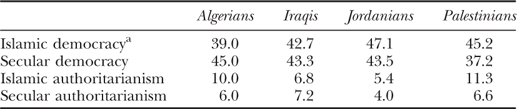
As for Arab populations in general, finally, public opinion polls have consistently shown a decisive consolidation of the legitimacy of democratic discourse across the region. A series of polls taken between 2000 and 2003, for example, revealed that 89 per cent of Algerians, 91 per cent of Jordanians and 96 per cent of Egyptians either ‘agreed’ or ‘agreed strongly’ that democracy, despite its limitations, is the best form of government (Tessler and Gao Reference Tessler and Gao2005: 87–8; see also Pew Research Center 2012b: 14–17). A question soliciting preferences more specifically between various forms of government (Tessler and Gao Reference Tessler and Gao2005: 91) yielded the results shown in Table 1.
Proportion of Algerians, Iraqis, Jordanians and Palestinians Preferring Various Models of Government (%)

Note: aThe authors derive the category ‘Islamic democracy’ – as an alternative to ‘secular democracy’ – by cross-tabulating favourable attitudes towards democracy with support for Islam playing a significant role in government decisions (Tessler and Gao Reference Tessler and Gao2005: 90–1).
Poll responses in the Arab world, as elsewhere, can vary significantly, depending on context. In addition, as is widely recognized, agreeing that democracy is good is not the same thing as internalizing the pluralistic and tolerant values that sustain consolidated democracy. Nevertheless, some general conclusions seem indisputable. First, the discourse, if not the underlying norms, of democracy has now become hegemonic through much of the Arab world.Footnote 3 Second, there is now also, as in Turkey, a sizeable secularist constituency. Another poll in 2005 asking whether respondents would ‘be likely to trust a popularly elected Islamic government to abide by the rules of a democracy’ elicited the following levels of ‘No’ answers (Zogby International 2005: 8): Jordan (33 per cent), Egypt (34 per cent), Morocco (36 per cent), Lebanon (Muslims only: 39 per cent).Footnote 4 These are results that mirror the Turkish picture remarkably closely. Third, based on the electoral performances so far of Turkey’s Justice and Development Party and its counterparts in the Arab world, Islamist parties are likely to fare well when relatively free elections are held.
These then are the elements that align the Arab world with Turkey’s trajectory: an authoritarian secular nationalist establishment with daunting coercive capabilities and substantial electoral support, an Islamist opposition with often greater popular grounding, and a population that has increasingly come to believe that democracy is the only legitimate form of government. In Turkey, the timing and dynamics of their interaction – especially the slowly shifting balance of power between the first two elements – explains the relatively smooth character of democratization there. Since all three essential elements are now falling into place in many Arab countries as well, albeit under less propitious circumstances, they can be expected to follow similar overall trajectories, although the timing and dynamics of their transitions will depend on more contingent factors such as luck and the skill of individual leaders. Particularly consequential in this regard will be the ability to reform state institutions – especially the military and judiciary – so that they can sustain the secularist counter-force without lapsing into praetorianism.
Conclusions
In a thoughtful reconsideration of the robust authoritarianism thesis, Eva Bellin (Reference Bellin2012: 142) notes ‘the difficulty of distilling a simple parsimonious hypothesis that predicts the incidence of mass protest during the Arab Spring’, and wonders whether such difficulty ‘is a consequence of the peculiar nature of the subject under study’. While Bellin’s implicit warning against excessive predictive confidence is certainly to the point, the most lamentable shortcoming was not the failure to foresee the 2011 uprisings but the failure to appreciate their significance after the fact. Thus, it is perhaps understandable that the scramble to identify this or that definitive cause of long-lasting authoritarianism in the Arab world led many analysts to lose sight of the big picture, the underlying earthquake already underway even before 2011 – for example, by viewing the controlled elections of the preceding quarter-century merely as regime-sustaining strategies rather than also as frightened concessions to increasingly mobilized electorates. But to see in 2013 only ‘a bitter litany of failed uprisings, halting or reversed “transitions,” and autocratic continuity’ (Brownlee et al. Reference Brownlee, Masoud and Reynolds2013: 43) is to miss the crucial development highlighted by Bassam Haddad (Reference Haddad2012: 215): ‘The running theme across these cases . . . is that they are Arab countries that are experiencing high levels of mass mobilization on a scale hitherto unseen in the Arab part of the Middle East.’ Or in Marwan Muasher’s words (2014: 24–5): ‘A sense of powerlessness permeated the Arab world for decades, leaving ordinary citizens feeling they had no choice but to submit to policies made by either their governments or the outside world. Those feelings are gone.’
A temporal frame restricted to three years or less, and a spatial frame that ignores relevant comparisons such as Turkey, can easily lead to the empirical conclusion that Egypt and Syria, for example, are neither ‘democratizing’ nor ‘likely to do so in the wake of the 2011 Arab uprisings’, and thence to the broader conceptual conclusion that ‘the field’ therefore ‘should do away with general democratization and modernization theoretical frameworks once and for all’ (Stacher Reference Stacher2012: 162, 174) – or at least that it should ‘advance beyond the teleological framework of “transitions” that sets all countries on a course toward Western-style democracy’ (Brownlee Reference Brownlee2012: 174). Leaving aside the question of why democratization has to be Western-style, if to ‘advance beyond’ means also to investigate the more contingent factors that shape significant secondary variations between countries, then that is one thing. But if it means to deny the primary dynamic – ‘nonlinear... uncertain, and . . . reversible’ (O’Donnell and Schmitter Reference O’Donnell and Schmitter1986: 70), to be sure – of the great transition defining modernity wherein social mobilization generates political participation, which forces ruling elites to resort to accommodationist strategies, which fosters the gradual emergence of democratic practices and values; a dynamic observed in virtually every other region of the world, and even within this region in Turkey as well – then that is to embrace a static monism that will have to resort to ever more fantastic contortions (the regime survived in Syria, nothing changed in Egypt, Tunisia is an exception, Turkey doesn’t exist) in order to sustain itself.
An approach that attends to both the secondary variations and the primary dynamic is obviously in line with recent calls for a temporal or historical ‘turn’ in comparative political analysis (Capoccia and Ziblatt Reference Cappocia and Ziblatt2010; Mahoney and Rueschemeyer Reference Mahoney and Rueschemeyer2003; Pierson Reference Pierson2004). Taking into account key event and decision junctures that occurred a relatively long time ago will make it possible not only to better understand early and often self-reinforcing divergences in the trajectories of the Ottoman Empire’s various successor states, but also to benefit from this understanding by identifying the most urgent practical imperatives (establishing professional, corporate state judicial and security institutions, for instance) for democratizing change.Footnote 5 Taking into account longer-term structural dynamics such as urbanization, education and social mobilization, on the other hand, can bring convergences into sharper relief as well, so that the big picture is kept in view. This can usefully offset the tendency to wall off a particular region as exceptional or sui generis – a tendency that seems to recur with some regularity, as with the resistance of many East Europe area specialists to more general comparative analysis after the collapse of Communism (Schmitter and Karl Reference Schmitter and Karl1994).
It can therefore also highlight meaningful comparisons, such as how the democratizing evolution of Arab Islamists of the Muslim Brotherhood type today parallels that of mainstream Turkish Islamists several years earlier (Mufti Reference Mufti2010), which in turn parallels that of political Catholicism in nineteenth-century Europe (Kalyvas Reference Kalyvas2012); how illiberal secularists in different contexts can likewise evolve as well (Kuru and Stepan Reference Kuru and Stepan2012); and how most Arab countries have more in common, in terms of fundamental structural features, with Turkey than with truly distinctive entities such as the United Arab Emirates. Such comparisons, in turn, will suggest that existing structures (cultural, institutional, political) in the Arab world are not immutable, that the top-down authoritarian secular nationalist order is bankrupt if not yet defunct, and that it is giving way to a prolonged and more participatory period in which the central political cleavage will pit Islamists against secular-nationalists. This is already evident from the picture in Egypt, where 51 per cent of respondents in one 2013 poll (Zogby 2013) opposed the military takeover earlier that summer, while 46 per cent approved, indicating if nothing else that General Sisi’s coup is no more the end of this story than was Muhammad Morsi’s election one year earlier. It is also evident from the current political discourse in countries such as Tunisia and Algeria, which will strike even a casual observer by how closely it mirrors, on both the secularist and Islamist sides, the divisions and debates of the Turkish polity.Footnote 6
Finally, a more expansive perspective can help avert premature conclusions about success or failure – as long as both the spatial and temporal dimensions are kept in mind: noting the similarities between the 2011 Arab Spring and Europe’s 1848 revolutionary uprisings, Kurt Weyland, for example, nevertheless concluded that both ‘achieved similar outcomes, namely a low rate of successful advances toward political liberalism and democracy’, primarily because in both cases the upheavals were driven not by organized leaderships but by ‘ordinary people’ unable to conduct strategic calculations ‘according to the rules of Bayesian updating and standard logic’ (Weyland Reference Weyland2012: 918, 922, 928). Taking into consideration the possibility that there is in fact a relationship between the political mobilization of European populations in 1848 and the transitions to democracy that took place 50–70 years later, however, can cast a somewhat different light on both series of events.
All of which is to suggest a more nuanced conclusion about the prospects for Arab democracy. On the one hand, Turkish democratization itself took six decades, four military coups and massive violence claiming tens of thousands of lives just to get to this point – a fact that has prompted sceptics to question whether such a ‘Hegelian process of a clash of forces’ can constitute any kind of ‘appealing’ model (Taşpınar Reference Taşpınar2003: 39; Ülgen Reference Ülgen2011: 13–14; de Waal Reference de Waal2011: 11–12). Indeed, the comparative advantages, outlined in some detail above, enjoyed by Turkey over its neighbours suggest that the Arabs will be lucky not to fare much worse. As with the European states of the mid-nineteenth century, their individual trajectories will vary according to circumstances as well as intangibles such as skill and luck (rendering precise prediction all the more difficult); there will be all kinds of setbacks and disasters; and even in the most fortunate cases democratization is likely to take, as Marwan Muasher (Reference Muasher2014: 2) has warned, ‘decades, not years’. Moreover, reverses can still befall Turkey too, and indeed any polity at all, as the very oldest transition theorists in ancient Greece well understood.
On the other hand, a long-term dynamic has now been set in motion that points unmistakably in the direction of democracy. For at least some regional countries, therefore, it may not even be too early to start shifting scholarly attention to the kinds of questions Gerardo Munck (Reference Munck2015, in this issue) raises in this special issue with regard to politics within and about democracy in post-transitional Latin America. However smoothly or catastrophically it plays out, at any rate, and whichever competing visions of the ends of the new regime prevail, the age of the common man and woman – the revolution Tocqueville foresaw – is for better or worse now coming to the Arab world as well.
Acknowledgements
I am grateful for the helpful comments of F. Gregory Gause III, Ali Kassay, Kemal Kirişci, the organizers and participants of the workshop that generated this special issue, and the anonymous reviewer for Government and Opposition.