Introduction
Stereotactic treatments (SRS, SRT and SBRT/SABR) provide precise dose delivery of less-fractionated radiotherapy, or a single high dose to a tumour, having a sharp dose fall-off for sparing of critical normal structures. Stereotactic treatments could also have biological advantages when treating small metastatic tumours, post-surgical cavities in brain and extra-cranial metastases in lung, liver, spine, and other locations.
The development in technologies for stereotactic treatments has spanned decades. The conceptual introduction of a radioactive, isotope-based, Gamma Knife stereotactic system by Professor Lars Leksell in the 1950s was primarily for intracranial brain tumours. Reference Leksell1 The advent of multi-leaf collimation-based intensity-modulated radiation therapy (IMRT) and stereotactic cones, using advanced radiotherapy machines, allowed for precise treatments with linear accelerators (LINAC). This stereotactic technique reduced treatment time compared with Gamma Knife radiosurgery. Further developments in advanced image guidance/tracking and 4-dimensional computerised tomography allowed for precise targeting of extra-cranial tumours, so stereotactic treatments have wider applicability.
Effective radiation treatment planning is critically important in stereotactic treatments to achieve highly desired tumour control while reducing toxicity. Reducing toxicity requires restricting the physical dose to surrounding organs at risk (OARs). Treatment planning optimisation is a computerised process to design a radiation treatment plan by setting desired objective criteria to the tumour target and engulfing critical OAR structures, with the purpose of a clear dose distribution into the target and away from OARs. Radiotherapy physics has powerful optimiser algorithms to design and calculate a treatment plan using appropriate objective functions, accurate calculations and verifications.
The conventional Physical dose-volume histogram (DVH) model has an objective function with maximum (upper), minimum (lower) and mean criteria for physical dose distribution in the target and OARs. Human interpretation is then applied to determine whether the dose distribution is acceptable for clinical application. This Physical DVH-based optimisation method has been foundational in clinical practice for many years. In recent times, inverse-planning optimisation has evolved to encompass a range of cost function objectives within various planning system’s optimisers. These objectives include radiobiological objective functions of tumour control probability (TCP), normal tissue complication probability (NTCP) and generalised equivalent uniform dose (gEUD). The assumption that these directly predict clinical outcomes requires definitive validation through a future pattern of prospective clinical trials.
As one option, gEUD is applicable for separately estimating TCP and NTCP. The concept of EUD was originally described by Niemierko as the uniform dose equivalent to a non-uniform dose distribution given the same radiobiological effect. Reference Andrzej2,Reference Andrzej3 Many treatment planning systems have adopted this concept in their optimisation tools 4–Reference Wu, Mohan, Niemierko and Schmidt-Ullrich6 using gEUD in both TCP and NTCP formulas to estimate the clinical outcomes of tumour control and the toxicity probabilities, respectively. The American Association of Physicists in Medicine (AAPM) Task Group report (TG-166) extensively addressed the benefits and downsides of utilising biologically based models in the treatment planning process, suggesting that EUD-based optimisation is more flexible for planning, is a better way to achieve results faster and simpler, and also suggests that these models should be used with caution. 4
Fogliata et al. Reference Feng, Tao, Zhu, Chen, Yu, Qin, Yin and Li7 studied the performance of gEUD-based objectives in the Eclipse photon optimiser with geometrical virtual phantom contours, demonstrating benefit, with sparing OARs without compromising target coverage for different ‘a’ parameters. Other authors investigated planning for conventional treatment techniques in patient image sets for various standard anatomic sites, Reference Lee, Ting, Chao, Wang, Shieh, Horng, Wu, Yeh, Cho, Huang, Huang, Chen and Fang8–Reference Qiuwen, David, Yan, Jining, Helen and Radhe12 comparing biological optimisation with gEUD against Physical dose distribution planning.
A planning study evaluated by Lee et al. Reference Stanley, Breitman, Dunscombe, Spencer and Lau13 concluded that gEUD-based optimisation effectively produced better quality treatment plans in the context of OAR reductions in the re-irradiation scenarios for head and neck cancers. Another planning study by Wu et al. Reference Sio, Jang, Lee, Curran, Pyakuryal and Sternick14 demonstrated that gEUD-based optimisation is useful for protecting critical structures while maintaining target coverage similar to that of dose-volume-based optimisation. The drawbacks of using gEUD objectives were also studied and were improved by mixing the Physical dose-volume-based objectives in the optimisation of prostate and head and neck cases.
The performance of gEUD-based objectives has yet to be thoroughly explored for stereotactic treatments. This study aimed to compare stereotactic optimisation using gEUD and Physical planning methods. In the optimisation tool, gEUD objectives were upper and lower target, while Physical objectives were maximum (upper), minimum (lower) and mean physical dose. We compared gEUD and Physical methods for stereotactic treatments in 30 patient scenarios, for different cancer metastases, in 3 common anatomic sites of brain, lung and spine.
Methods
We randomly obtained 30 cases from our database, comprising all treatments administered over a span of 3 years (from January 2020 to December 2022). The criterion for inclusion was the inherent complexity of these cases owing to their proximity to critical OARs. For the brain, OARs were brainstem and optical structures. For the lungs, the OAR was the proximate bronchial tree. For spinal SBRT, the OAR was spinal cord. The result was ten cases each for brain, lung and spine treatments.
Two plans were developed for each case using either gEUD-based or Physical-based cost function optimisations, for a total of 60 plans (30 pairs). All gEUD-based plans are called ‘gEUD’, and Physical-based plans are called ‘Physical’.
For brain, four arcs were used, one coplanar full arc and three non-coplanar partial arcs with couch angles of 45, 315 and 90 degrees. A 2-mm planning target volume (PTV) was expanded from gross tumour volume (GTV). The brain target was prescribed 30 Gy in five fractions. Tumours were distributed around the mid-cerebellum and frontal and temporal lobes. The critical OARs selected were brainstem, optic chiasm, optic nerves and normal brain. The mean ± SD for GTV volume (cc) brain was 8·2 ± 2·9 and total PTV volume (cc) brain was 16·0 ± 6·0.
For lung, two coplanar partial arcs were used. A 5-mm PTV was expanded from the internal target volume. The target PTV was prescribed 60 Gy in five fractions. The critical OARs selected were bronchus, smaller airways and normal lung. The mean ± SD for GTV volume (cc) lung was 7·4 ± 5·6 and total PTV volume (cc) lung was 30·3 ± 16·6.
For spine, two full coplanar arcs were used. A 2-mm PTV margin was applied. The primary and elective clinical target volumes were prescribed 30–35 Gy in five fractions and 25 Gy in five fractions, respectively. The critical OAR selected was spinal cord. The mean ± SD for GTV volume (cc) spine was 9·4 ± 8·1 and total PTV volume (cc) spine was 43·5 ± 20·9.
In all 60 plans, collimators and field sizes were fitted to the tumour geometry with multi-leaf collimators. Clinac-ix, True Beam machines were used for treatment planning with 6X flattening filter-free (6XFFF) for brain and lung, and 10X flattening filter-free (10XFFF) beam energy for spine. Plans were generated in Eclipse photon optimiser 16.1 treatment planning system with AAA 16.1 calculation algorithm.
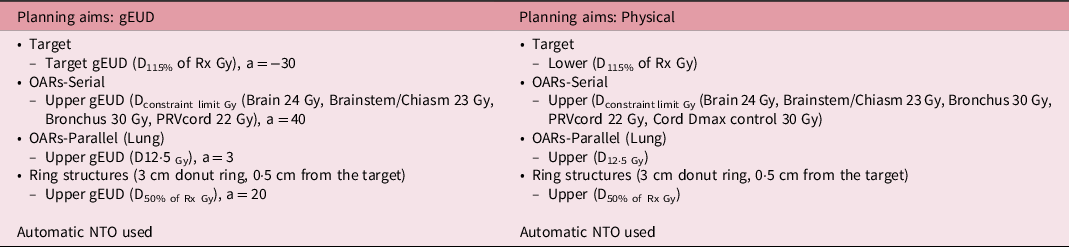
For Physical dose optimisation, physical dose-volume objective functions used a lower objective for the target to distribute 115% of the prescribed dose. For example, the prescription was 30 Gy, mean 34·5 Gy was applied in the lower objective to avoid the normalisation adjustments after the plan calculation, upper dose objectives were used for both serial and parallel structures to control the maximum and volume doses, and one additional upper objective was used for the spinal cord to achieve the volume-dose constraint. No maximum dose control objective was assigned to the target to allow the optimiser to distribute the inhomogeneity inside the target, and no plan normalisation was maintained for all treatment plans. In addition to using the automatic normal tissue objective (NTO), the ring structure had an upper objective to control the 50% isodose outside the planning target.
In gEUD, the parameter ‘a’ is the volume-affecting scalar within the gEUD objective function. Appropriate selection of an objective function and volume-affecting parameter values are crucial for achieving planning results more quickly and without complicating the optimiser. For the target gEUD, values of ‘a’ from −1 to −40 penalise dose deviations from the selected target dose constraint. The more negative is ‘a’, the more heterogeneous the dose distribution is inside the target volume. For example, a target structure constrained with a gEUD of 115% of the maximum prescribed dose makes the choice of ‘a’ = −30 reasonable. This distributes the optimal dose around the target. Next, when considering the upper gEUD parameter ‘a’ for the OARs, reasonable values of ‘a’ are between +1 and +40. The upper gEUD (parameter a = +1 to +40) penalises the maximum dose deviations from the selected dose constraint. It can be applied to both serial (higher ‘a’) and parallel (lower ‘a’) OARs. It limits the maximum dose-volume with greater value of ‘a’, and control of the DVH tail increases with greater value of ‘a’. For the parallel structure of lung, a = +3 was used to achieve the desired volume constraint dose of 12·5 Gy. For serial structures, the upper gEUD used a = +40, to limit the highest doses. In addition to using the automatic NTO, the ring structure had an upper gEUD constraint set at ‘a’ = 20 to control the 50% isodose outside the planning target.
Both gEUD and Physical underwent optimisation using consistent machine parameters and calculation processes. The differentiation arose in the optimisation objectives: gEUD plan employed gEUD-specific objectives, while Physical plan used distinct physical objectives.
During the optimisation, the process was closely monitored, particularly at levels 1 and 2 (multi-resolution levels 1 and 2 in Eclipse TPS, version 16.1). The criteria were to maintain a balance between the target coverage and the OAR dose constraints. Progress was visually assessed using real-time evolving dose distributions and DVHs. A noticeable shift in the target’s peripheral coverage, as priority weights were increased for OAR constraints, served as an indicator that approached the desired balance. Upon reaching this stage, we transitioned to level 3 and the final calculation. This methodology was consistently applied to both plans to ensure a uniform optimisation approach. The final calculated plans were evaluated by both the clinical Physicist and Radiation Oncologist as part of the treatment planning quality assessment.
Table 1 summarises the objectives pattern for both gEUD and Physical. Final plans were evaluated with the parameters of the DVH analysis of targets, OARs, and planning risk volumes (PRVs), plus the conformity index (CI), Reference Popple, Roger and Sui15 homogeneity index (HI), Reference Popple, Roger and Sui15 gradient index (GI), Reference Tom and Fowler16 and predicted treatment monitor units (MUs). Statistical analyses were done in Stata 16.2 (College Station TX), and statistical means were compared by paired t-test, two-sided and with an alpha of 0·05.
Planning objectives pattern

Furthermore, for all 60 plans, we conducted portal dosimetry QA (Portal Dose Image Prediction (PDIP) version 16.1) and gamma analysis based on dose difference (DD) settings of 1%, 2% and 3%, as well as the distance to agreement (DTA) criteria set at 1 mm, 2 mm and 3 mm.
Results
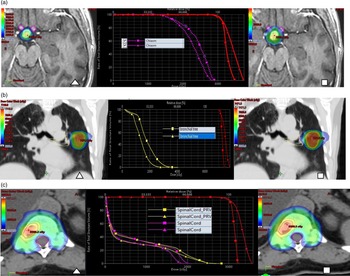
All three anatomical sites of brain, lung and spine were assessed for potential differences in input values for gEUD and Physical, both visually (Figure 1) and statistically.
Dose distributions. (a) Brain SRT, triangle indicates gEUD (left) versus square indicates Physical (right), red DVH; target. (b) Lung SBRT, triangle indicates gEUD (left) versus square indicates Physical (right), red DVH; target. (c) Spine SBRT, triangle indicates gEUD (left) versus square indicates Physical (right), red DVH; target

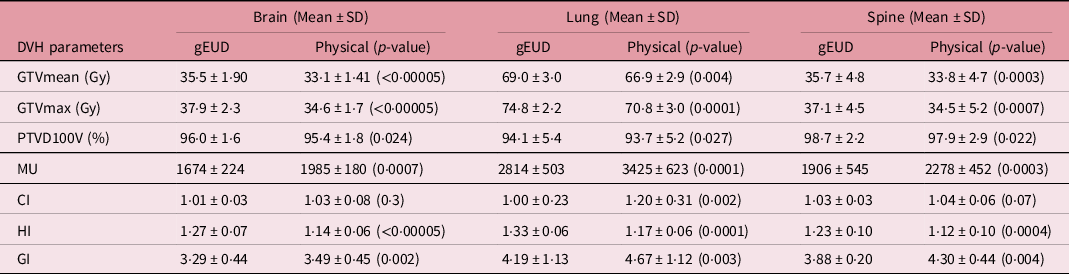
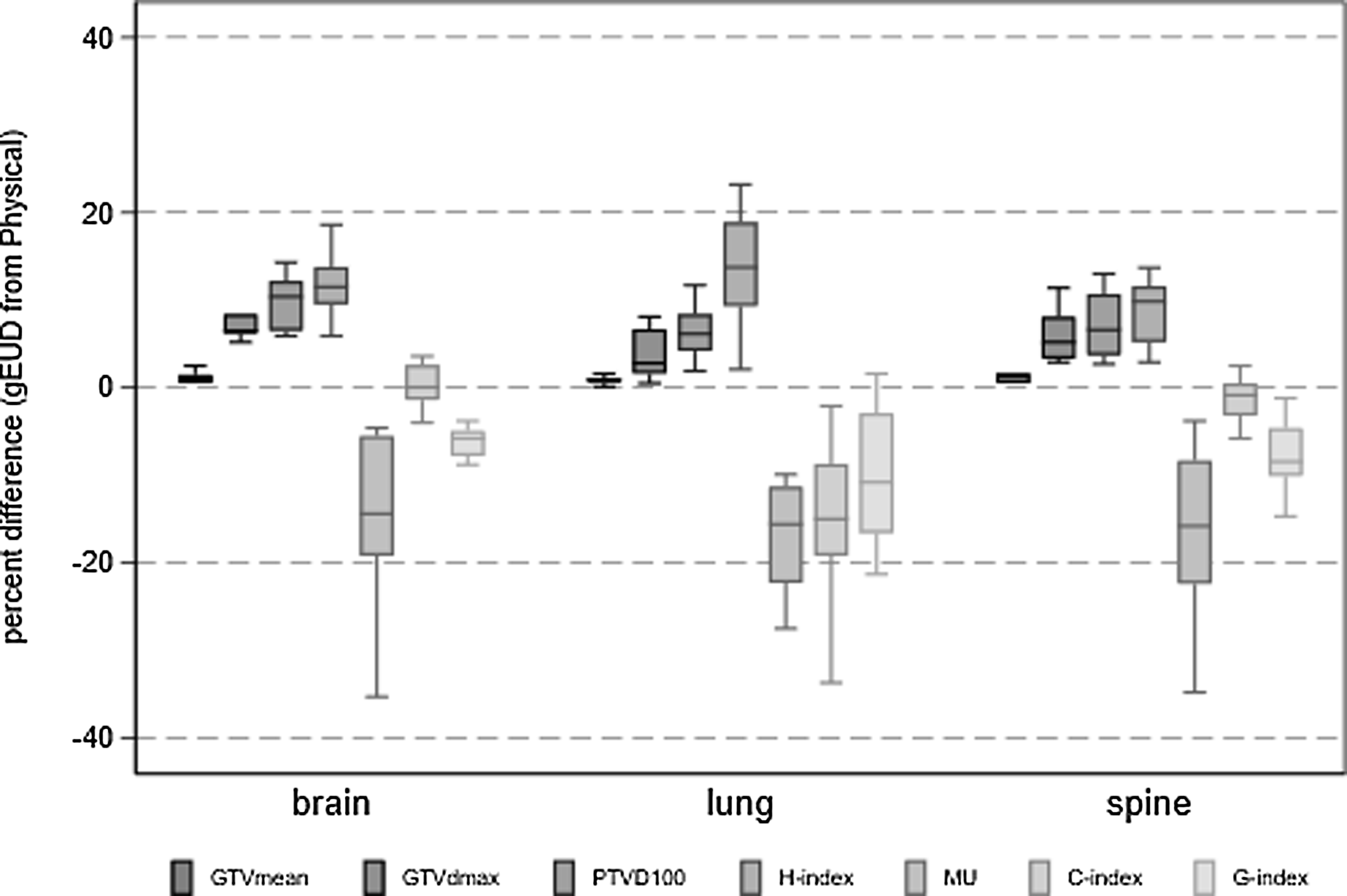
As shown in Table 2 and Figure 2, mean doses to the GTV were higher in gEUD compared with Physical for all three anatomical sites. The difference in means between plans were: brain 2·4 Gy, p < 0·00005; lung 2·1 Gy, p < 0·004; and spine 1·9 Gy, p < 0·0003. The maximum dose to the GTV was more heterogeneous in gEUD compared with Physical. The differences in means between plans were: brain 3·3 Gy, p < 0·00005; lung 4·0 Gy, p < 0·0001; and spine 2·6 Gy, p < 0·0007. In addition, monitor units were significantly lower in gEUD compared with Physical, with differences in means between plans of: brain 311, p < 0·0007, lung 611, p < 0·0001; and spine 372, p < 0·0003. Table 2 also demonstrates that the indices of CI, HI and GI were comparable or better with gEUD versus Physical.
Analyses of the target DVH

p-value is 2-tailed for the paired t-test of the means comparing gEUD and Physical internal to brain, lung or spine, respectively.
The distributions of the differences in percent for targets

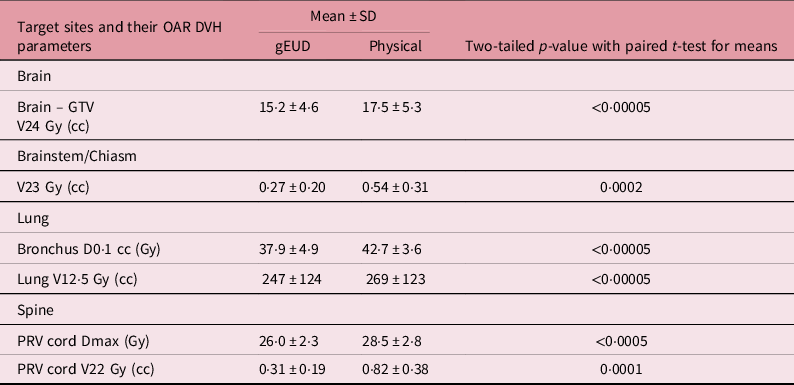
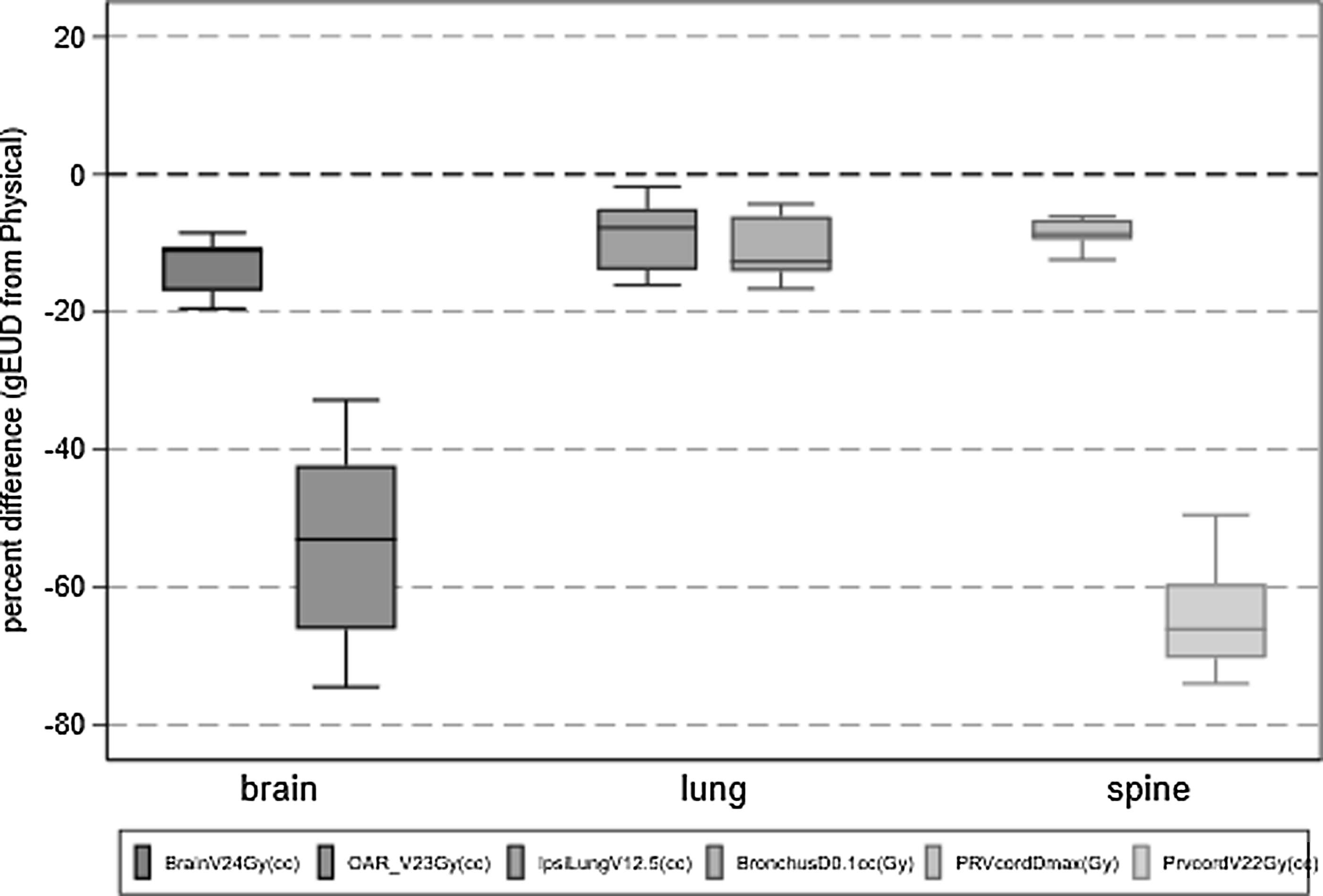
As shown in Table 3 and Figure 3, all OAR constraints in gEUD were more favourable compared with Physical across all 30 case scenarios. For brain, differences in the means were: for brain-GTV V24 Gy it was 2·3 cc, p < 0·00005; for brainstem/chiasm V23 Gy it was 0·27 cc, p = 0·0002. For lung, difference in means for bronchus D0·1 cc was 4·8 Gy, p < 0·00005, and lung V12·5 Gy was 22·0 cc, p < 0·00005. For spine, difference in means for PRV cord Dmax was 2·5 Gy, p < 0·0005, and for PRV cord V22 Gy it was 0·51 cc, p < 0·0001.
Analyses of OAR DVH parameters

The distributions of the differences in percent for OARs

Therefore, gEUD optimisation produced better results than Physical optimisation in almost all considered outcome parameters, as displayed in Tables 2 and 3 and Figures 1–3 and summarised in the preceding paragraphs.
Regarding the quality assurance, the portal dosimetry QA gamma passing rates in percentage for gEUD predominantly showed better in all three parameter settings (Table 4).
Analyses of the portal dosimetry QA

DD, dose difference; DTA, distance to agreement; %, gamma evaluation passing rate in percentage.
Breakdown of gamma passing results were, for brain, 1%DD/1 mmDTA: gamma passing was better with gEUD in all 10 cases, 2%DD/2 mmDTA: gamma passing was better with gEUD in 6 out of 10 cases, 2 cases were similar, and 3%DD/3 mmDTA: gamma passing was better with gEUD in 5 out of 10 cases, 5 cases were similar. For lung, 1%DD/1 mmDTA: gamma passing was better with gEUD in 6 out of 10, 2 were similar, 2%DD/2 mmDTA: gamma passing was better with gEUD in 7 out of 10 cases, 2 cases were similar, and 3%DD/3 mmDTA: gamma passing was better with gEUD in 4 out of 10 cases, 6 cases were similar. For spine, 1%DD/1 mmDTA: gamma passing was better with gEUD in 6 out of 10, 2 were similar, 2%DD/2 mmDTA: gamma passing was better with gEUD in 8 out of 10 cases, 1 case was similar, and 3%DD/3 mmDTA: gamma passing was better with gEUD in 5 out of 10 cases, 5 cases were similar.
Discussion
This study has shown that gEUD is preferable to Physical dose-volume-based planning methods for stereotactic treatments across three anatomic regions of brain, thorax and spine. Most notable is the clear reduction in OAR dosing combined with reduced monitor units. The decrease in monitor units with gEUD-based plans is an advantage of a possible reduction in the integral dose and treatment delivery time. In addition, utilising the gEUD optimisation tool is a more flexible way to plan. One cost function with a proper parameter value of ‘a’ = −1 to −40 for targets and +1 (for parallel organs) to +40 (for serial organs) achieves the primary goal in a gEUD-based plan. Conversely, for plans based on the dose-volume Physical method, multiple cost functions are required to reach the level of clinical acceptability, which may increase the complexity of optimisation.
In many clinical situations, a metastatic tumour is adjacent to and geometrically wrapped with radiosensitive serial and parallel critical organs. These imaging characteristics increase the complexity of the stereotactic plan to produce an appropriate dose difference between the targets and OARs, aiming for patient safety and good clinical outcomes. The strengths of this study include the use of 30 complicated cases, 10 at each anatomical site, with OARs and targets in close and challenging proximities. Despite our small sample size, statistical significance was evident, indicating the strong impact of a gEUD strategy compared to a strategy based on Physical dose. Another strength is that it addresses sites where many metastatic cancer deposits occur, frequently with clinically significant sequelae, including those in the brain and thoracic and spinal locations. This is an alternate solution to planning for these sites, where the critical OARs surrounding the targets. This is especially compounded by the clinical shift towards using stereotactic treatment at these sites and with a greater dose per fraction.
Typical stereotactic treatments range from single fractions of 15–24 Gy to 3 to 5 fractions of 25–40 Gy, with the prescription isodose set at 50–90% depending on the cancer tumour type and volume of the tumour (e.g., in brain). This automatically produces a dose hotspot in the middle of the target, higher than the prescribed absolute dose. For example, with Gamma Knife stereotactic treatments, the normalisation to the 50% isodose line makes the target centre double the prescribed dose. In LINAC-based stereotactic planning methods, effective use of optimiser algorithms in treatment planning aims at getting the desired hot dose in the middle of the target volume, and this may also increase the sharp dose gradient around PTV edges, with relative sparing of important OARs.
Dose heterogeneity within a target volume should receive some attention, when evaluating a plan. In some hypoxic tumours and radio-resistive cell type cancers, highly heterogeneous dose distributions in the middle of a target when using gEUD-based optimisation has potential radiobiological advantages. Most brain and lung tumours have hypoxic cells that may be resistant to direct cell kill with radiation. In hypoxic regions, higher dose can increase the TCP; Reference Amichetti, Amelio and Minniti17,Reference Qiu, Aili, Xue, Jiang and Wang18 and with brief fractionated stereotactic treatments, both redistribution of the cell cycle and re-oxygenation could make the target more sensitive to cell killing to the repeated high dosing in subsequent fractions. Reference Daguenet, Louati, Wozny, Vial, Gras, Guy, Vallard, Rodriguez-Lafrasse and Magné19,Reference Farias, Tovar, Del Moral, O’Valle, Expósito, Oliver, Ruiz de Almodóvar, Qiu, Aili, Xue, Jiang and Wang20 (Of note, the majority of the cases in our study had primary renal cell, adeno and non-small cell carcinomas). In gEUD-based optimisation, the GTV objective can mean selecting for the target gEUD parameter ‘a’ value of -10 to -40 to align with tumour type and dose-killing requirements, without controlling the maximum dose in the target. That could further increase heterogeneity inside the GTV. Using the combination of smaller field margins than the radiation penumbra and biological optimisation can produce a potentially more beneficial high-dose distribution in the middle of the target, with a noticeably sharper dose fall-off outside the target. Then, for the OARs, using an upper gEUD to a maximum +40 for ‘a’ makes the rapid fall-off sharper.
A customised heterogeneous dose distribution within and around targets is a potential opportunity to improve abscopal and bystander effects. Reference Tubin, Popper and Brcic21–Reference Amin, Baine, Meza and Lin23 Recent developments in systemic immunotherapy are improving the long-term survival of patients. Reference Kowalchuk, Niranjan, Lee, Yang, Liscak, Guseynova, Tripathi, Kumar, Peker, Samanci, Hess, Chiang, Iorio-Morin, Mathieu, Pikis, Wei, Lunsford, Trifiletti and Sheehan24,Reference Grambozov, Wass, Stana, Gerum, Karner, Fastner, Studnicka, Sedlmayer and Zehentmayr25 At the same time, there are metastases that clinically emerge over time, sometimes leading to re-irradiations close to, or overlapping, prior delivered radiotherapy. These clinical scenarios are challenging for radiation planning, particularly in relation to estimated or consensus constraint limits for re-irradiation scenarios. Reference Semenenko, Reitz, Day, Qi, Miften and Li26,Reference Qi, Semenenko and Li27 For this type of situation, advanced technologies are being developed, to provide submillimeter accuracy in targeting tumour volumes, but superior optimisation tactics as with gEUD are equally important in the context of challenging cases and in grid/lattice SBRT treatment planning. Possibly, a combination of Physical dose-volume maximum dose objective and upper-maximum gEUD in serial structures may be used to finely control pixel maximum point dose.
Further research is clearly needed. One direction is to estimate TCP and NTCP by using published model parameters in treatment planning and then to explore whether estimated biological outcomes are associated or predictive of established clinical outcomes in longitudinal datasets of sufficient sample size. The results and scope of this study are limited to a single treatment planning optimiser, and other optimisers Reference Antonella, Stephen, Antonella, Stefano, Marta and Luca5,Reference Wu, Mohan, Niemierko and Schmidt-Ullrich6 should be considered in comparative studies, both in image sets and in clinical datasets with measured clinical outcomes of cancer control, catalogued adverse events and patient-reported outcomes.
Conclusions
When directly comparing challenging stereotactic cases at the brain, lung and spine locations, gEUD optimisation parameters in Eclipse TPS can yield high-quality dose distributions more rapidly and with significantly fewer monitor units than traditional Physical dose optimisation parameters. These advantages suggest potential benefits such as reduced toxicity to OARs without compromising tumour control. The results of this study are based on a selected set of cases, and the generalisability to all clinical scenarios may vary. Furthermore, the application of gEUD optimisation should be approached with caution, especially in clinical cases where customised radiotherapy dose distribution is necessary.
Abbreviations
D115% of Rx Gy: dose to 115% of the prescribed dose; V24 Gy (cc): volume of a structure receiving 24 Gy in cubic centimetres; V23 Gy (cc): volume of a structure receiving 23 Gy in cubic centimetres; D0·1 cc (Gy): dose to 0·1 cc volume of a structure; V12·5 Gy (cc): volume of a structure receiving 12·5 Gy in cubic centimetres; V22 Gy (cc): volume of a structure receiving 22 Gy in cubic centimetres; Dmax (Gy): maximum dose pixel to a structure; D50% of Rx Gy: dose to 50% of the prescribed dose to a structure; Dconstraint limit Gy: applied dose objective in the optimisation to achieve the constraint.
Acknowledgements
We thank Thanh Nguyen and Daniel Rucka for finding complicated cases in this study.
Financial Support
This research received no specific grant from any funding agency, commercial or not-for-profit sectors.
Competing Interests
The author(s) declare none.