1 Introduction
We start by sketching the emergence and development of the technique of forcing with conditions with small working parts and side conditions. This will allow us to then give an overview in an appropriate context of the results of this paper and the motivation for proving them.
The technique of forcing is a way of moving from one collection of sets (i.e., model of set theory/universe of sets) to another. More precisely, by each specific (nontrivial) forcing one passes from any collection of sets possessing the properties required to fuel the forcing to a new one. The destination model will share many of the features of the point of departure, including satisfying the same basic axioms (usually ZFC or ZF) and having the same ordinals, but will also have some differences.
Typically, forcings are designed with particular desired features of the destination models in mind. The differences between origin and destination models ensure that, while the origin either may not or certainly will not have these features, the destination model is guaranteed to have them. However, one usually wants to control at the same time whether, or the extent to which, other important features of the original model are lost on the voyage; being a cardinal is a prominent example.
There are many forcings whose elements can be thought of informally as breaking down into a part which gives ‘positive’ information about a desired destination model feature and another which gives constraints, limitations or ‘negative’ information – often aimed at ensuring that key origin model features are not lost. Such descriptions can be useful ways of thinking, albeit that they should not be taken too literally. These ‘positive’ parts have also been called working parts. The first use of the phrase ‘working parts’ in this context of which I am aware is in Todorčević’s book [Reference Todorčević34]. This term, despite its evocativeness, is not literally accurate as everything in an element of a forcing is doing some work. Nevertheless the term has gained currency and we use it here.
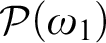
A fascinating phenomena discovered relatively early in the development of forcing was that desired combinatorial features can be forced into existence by forcings with differing sizes of working part. In particular, some uncountable structures of size
 $\omega _1$
can be forced not only by using conditions with countable working parts, but also by perhaps less intuitively likely ones with finite working parts.
An early example is that of adding Souslin trees. Tennenbaum’s original proof [Reference Tennenbaum32] using a partial order consisting of finite conditions can be contrasted with Jech’s forcing [Reference Jech12] with countable initial segments. Each forcing has a property that ensures the
 $\omega _1$
of an origin model remains a cardinal in the corresponding destination model: Tennenbaum’s has the countable chain condition, while Jech’s is countably closed.
Another instructive example is that of adding closed unbounded subsets to stationary subsets of
 $\omega _1$
. Baumgartner, Harrington, and Kleinberg [Reference Baumgartner, Harrington and Kleinberg3] used countable putative initial segments as conditions; the forcing is countably closed. Baumgartner [Reference Baumgartner and Mathias2] then gave a forcing with finite conditions and which uses side conditions to restrict the way in which the working parts can be extended. This partial order does not have the countable chain condition, but cardinals are preserved as the forcing is proper.
Somewhat later it was seen that even certain structures of size
 $\omega _2$
can sometimes be added by forcing with finite working parts. Ensuring the preservation of cardinals in such arguments, however, is more delicate. Often, as in Roitman’s forcing to add a tall, very-wide superatomic Boolean algebra [Reference Roitman29], Baumgartner and Shelah’s forcing to add a thin, very-tall superatomic Boolean algebra [Reference Baumgartner and Shelah4], Veličković’s proof of Jensen’s result that
 $\square _{ \omega _1}{\!}$
implies there is a ccc forcing adding a Kurepa tree [Reference Veličković38], the author’s remarks on these three forcings in [Reference Morgan24], and later papers, it is necessary to use auxiliary functions definable from structured objects available in the ground model to do so.
In fact, some of the most efficacious of these objects are not available in all ground models and must either themselves be added by forcing or be derivable from the internal structure of the ground model. In the cited instances, for example, Roitman used the negation of Chang’s conjecture (in the equivalent form of the existence of a function with the ‘new
 $\Delta $
-property’), Baumgartner and Shelah used historicised forcing, in effect generically adding an
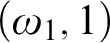 $(\omega _1,1)$
-simplified morass with continuous paths, whilst Veličković used the instance of Todorčević’s
 $\rho $
-function obtained from
 $\square _{ \omega _1}{\!}$
in [Reference Todorčević33], proving some further properties of the function, and the author discussed the relationship between some of these objects and their derivations and connectedness functions derivable from gap-one simplified morasses.
This approach to forcing to add objects of size
 $\omega _2$
with conditions with finite working parts was eventually subsumed by a more powerful one, introduced by Koszmider in [Reference Koszmider15],Footnote
1
where the consistency of there being a chain of length
 $\omega _2$
of functions in
 $^{\omega _1}\omega _1$
modulo finite is shown. Koszmider’s work adapted Todorčević’s elaboration, in terms of
 $\in $
-chains of models, of Baumgartner’s idea of using side conditions to restrict the possible extensions of forcing conditions, to the structured objects mentioned above.
A key difference is that in Koszmider’s technique the structured objects are sampled dynamically during the forcings, in contrast to fixed, static uses in the earlier papers. For some time it was reasonable to think that this was the ‘right’ way to do such forcing while avoiding collapsing cardinals by using ‘collections of models as side conditions.’ (See also, [Reference Morgan25], [Reference Morgan, Bagaria and Todorčević26] and related work in [Reference Koszmider17]).
Mitchell ([Reference Mitchell21], Section 2) then produced a remarkable argument where the structure on the collection of models, whilst still intricate, was produced as part of the forcing, there called
 $\mathbb {P}_B$
. One needs almost no initial structure apart from some weak cardinal arithmetic constraints (for example,
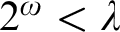 $2^{\omega }<\lambda $
when one wants to preserve
 $\omega _1$
and some larger
 $\lambda $
).
Note that in this forcing all of the models considered are countable. In the paragraphs immediately below we comment further on this forcing. Further below again we briefly mention the forcings Mitchell produced in [Reference Mitchell21], Section 3, [Reference Mitchell20] and [Reference Mitchell22] which have side conditions in which several sizes of models are permitted in the collections constituting them. Those forcings are the product of very important ideas, but are not the focus of this paper.
The argument of [Reference Mitchell21], Section 2, should be seen as being more dynamic again than Koszmider’s. Not only are the collections of models used as side conditions chosen on the fly, but the structured collection from which they are chosen is also generated spontaneously.
It would be good to understand better the properties of the structured collections added as a by-product of the constructions’ main objectives when using this technique of Mitchell, and to see to what extent those properties rely on the collections being dynamically assembled, and when and whether, in contrast, static axiomatizations of them could be useful.
Mitchell places constraints on the collections of models which form the side conditions which are strongly reminiscent of the patterns formed by the ranges of maps in gap-one simplified morasses – see, for example, the visual representations in [Reference Mitchell21], Figure 1 and the analogous [Reference Mitchell20], Figure 1. In particular, one has the phenomenon that the ordinals in pairs of models from a collection forming a side condition have a common initial segment and thereafter intertwine but do not intersect. (Trivial intertwining, where all of the ordinals in one model are smaller than all of the noncommon initial segment ones in the other, is allowed.) This resemblance speaks to the prescience of Velleman’s definition of gap-one simplified morasses [Reference Velleman36].
Nevertheless, we do not know, for example, whether the forcing
 $\mathbb {P}_B$
of [Reference Mitchell21], Section 2, in itself adds an
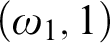 $(\omega _1,1)$
-simplified morass. Moreover, this paper does not address the structure of the collection of models added in the course of this argument of Mitchell directly, but instead takes inspiration from Mitchell’s argument in a different way.
The referee of the original submission of this paper took the, to us perfectly reasonable, view that the comparison made above between the constraints on these collections of models which form the side conditions and the ranges of maps in gap-one simplified morasses is “interesting” but “[too] weak.” However, we found the comparison sufficiently intriguing and suggestive so as to wonder whether one could define forcings ‘in the style of [Reference Mitchell21], Section 2,’ that is, where the structure of the side conditions and the arguments involving them are similar to, or perhaps, more weakly, analogous to, those of [Reference Mitchell21], Section 2, but for which the collection of models generically added through the side conditions do in fact give a gap-one simplified morass. The main theorems in this paper show that we can indeed define and carry out such forcings.
Our curiosity had two principal roots. First, we believe to be of intrinsic interest the question, asked independently by Shelah and Velleman (each by personal communication) in the early 1990s, and resolved positively in this paper, of whether a
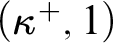
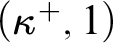 $(\kappa ^{+},1)$
-simplified morass can be added by a forcing with working parts of size less than
 $\kappa $
. At the time the question was posed the goal seemed to be one of the most ambitious objectives amongst structures of size
 $\kappa ^{++}$
which could be perhaps added by forcing with working parts of size smaller than
 $\kappa $
and without collapsing cardinals, and, it still, we believe, ranks high on that scale.
In order to explain the second root of our curiosity we will touch lightly on some technical differences between the constraints on the side conditions in Mitchell’s [Reference Mitchell21], Section 2 and the principal forcing in this paper. Rather than use the constraints Mitchell uses in [Reference Mitchell21], Section 2, here the structure we impose on such collections of models is a miniaturization of that of a gap-one simplified morass. (We defer the details to the body of the paper, they are not necessary for the present explanation of motivation.)
Hence the paper also shows that one can successfully run arguments ‘in the style of Mitchell’ [Reference Mitchell21], Section 2 (albeit, arguably, loosely), but where the structured collections of models added in the course of the construction not only in some ways resembles a gap-one simplified morass, but actually gives rise to one. It seems reasonable to hope that the extensive analysis of gap-one simplified morasses already carried out may prove useful in pushing through further arguments of this type in which the collections of side conditions, as here, give rise to a gap-one simplified morass. That is, that there may be advantages, in certain forcing constructions, to constrain side conditions through demanding they incorporate appropriate miniaturizations of simplified morasses rather than, for example, constraining them in the style of [Reference Mitchell21], Definition 2.1(4)(b) directly.
We make one more comment on the contrast between Mitchell’s [Reference Mitchell21], Section 2 and the principal forcing here. In the former the collections of models forming side conditions are constrained by properties about (as the referee of the original submission adroitly puts it) “belonging and intersection,” whilst in the latter the constraints are a more explicit requirement of incorporation of/conformity with appropriate miniaturizations of simplified morasses. This leads back to the question of what a “working part,” as opposed to a “side condition,” actually is. Do the constraints in either of these forcings on the side conditions make the side conditions into “working part-side condition” hybrids? Or, even, does the distinction have much value for these forcings?
One reasonable view is that, as far as the principal forcing of this paper goes, the miniaturizations of simplified morasses (which all have size smaller than
 $\kappa $
) are the working parts and the side conditions are a “bare collection of models,” and moreover that “belonging and intersection”-based constraints are qualitatively different. However, we believe it is at least arguable that “belonging and intersection”-based constraints do generically impose subtle combinatorial structure, even though it remains murky as to exactly what that structure actually is, and that both types of constraint should be treated similarly. Ultimately, such judgements may come down to taste or to whatever an individual reader finds methodologically inspiring, enlightening, or convenient.
To conclude discussion of relevant related work we should also mention the papers of Abraham-Cummings [Reference Abraham and Cummings1], where forcing is used to add a colouring witnessing the negative polychromatic partition property
 $\omega _2 \not \rightarrow ^{\text {poly}} (\omega _1)^2_{2-\text {bdd}}$
, and Dolinar-Džamonja [Reference Dolinar and Džamonja5], where forcing is used to add
 $\square _{ \omega _1}{\!}$
. Each of these forcing each add an object of size
 $\omega _2$
using conditions with finite working parts and side conditions in the style of Mitchell’s in [Reference Mitchell21], Section 2.
In the forcings discussed so far in this introduction the models in the collections constituting side conditions are all of the same size. For example, as is the cases of the work in Abraham-Cummings and Džamonja-Dolinar cited in the previous paragraph, they will all be countable if the working parts are all finite. However, the forcings in Mitchell’s [Reference Mitchell21], Section 3, and the bulk of the work in [Reference Mitchell20], and the contemporaneous and independent paper of Friedman [Reference Friedman, Bagaria and Todorčević8], these latter two concerning adding closed unbounded subsets to certain stationary subsets of
 $\omega _2$
, are the start of a currently very active line of work on forcings with small working parts and collections of models of more than one size as side conditions. This idea, of collections of models of more than one size as side conditions, has been taken up by Neeman [Reference Neeman28], Gitik-Magidor [Reference Gitik9], Gitik [Reference Gitik and Magidor10], Krueger [Reference Krueger18], [Reference Krueger19], Veličkovic-Venturi [Reference Veličković and Venturi39], and in a number of further papers, to prove, amongst other things interesting extensions of the proper forcing axiom and results in cardinal arithmetic. We do not attempt to survey this highly important line of work in this paper: here our concerns are strictly with side conditions consisting of models all of the same size.
This paper is self-contained. For all of our motivational remarks, the reader does not need acquaintance with Mitchell’s [Reference Mitchell21]. Furthermore, no external material concerning simplified morasses is needed. Nevertheless, there is an extensive literature on gap-one simplified morasses to which the reader looking for background material can refer, including, inter alia, Velleman’s [Reference Velleman36] and [Reference Velleman37], Donder’s [Reference Donder and Koepke7], and the author’s [Reference Morgan24] and [Reference Morgan25].
We now give a more concrete outline of the remainder of the paper. We start by mentioning some of the notation that will be used, then remind the reader of the definition of simplified morasses and conclude by sketching the forcing we shall use and summarizing its key properties.
Most of our set theoretic notation is standard.
Notation 1.1. On is the class of ordinals and Card is the collection of infinite cardinals. The letter
 $\kappa $
will always denote a cardinal. If X is a set and
 $\kappa $
a cardinal we write
 $[X]^{\kappa }$
for
 $\{ Y\subseteq X| \overline {\overline {Y}}=\kappa \}$
and
 $[X]^{<\kappa }$
for
 $\{ Y\subseteq X| \overline {\overline {Y}}<\kappa \}$
. If a is a set of ordinals then
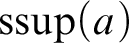 $\mathrm {ssup}(a)$
is the least ordinal
 $\xi $
such that
 $a\subseteq \xi $
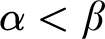
. For
 $\alpha $
,
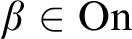 $\beta \in \mathrm {On}$
with
 $\alpha <\beta $
we write
 $f:\alpha \longrightarrow _{\text {o.p.}} \beta $
to indicate that f is an order preserving function from
 $\alpha $
to
 $\beta $
.
We often use the following (standard) notation as short-hand.
Definition 1.2. For
 $\alpha $
,
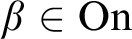 $\beta \in \mathrm {On}$
with
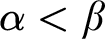 $\alpha <\beta $
we write
 $(\beta )^{\alpha }$
for
 $\{\; f|\; f:\alpha \longrightarrow _{\text {o.p.}}\beta \}$
– equivalently the set of increasing sequences of length
 $\alpha $
from
 $\beta $
, and set
 $(\beta )^{<\alpha }=\bigcup _{\gamma <\alpha } (\beta )^{<\gamma }\!$
.
The following definition is also used frequently.
Definition 1.3. For
 $\tau $
,
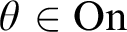 $\theta \in \mathrm {On}$
with
 $\tau <\theta $
we say
 ${\mathcal {F}}=\{ \mathrm {id}, h\} \subseteq (\theta )^{\tau }$
is an amalgamation pair if there is some
 $\sigma <\tau $
such that
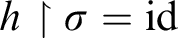 $h\upharpoonright \sigma =\mathrm {id}$
, for all
 $\xi $
such that
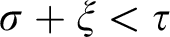 $\sigma +\xi <\tau $
we have
 $h(\sigma +\xi )=\tau +\xi $
, and
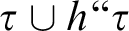 $\tau \cup h``\tau $
is an initial segment of
 $\theta $
. In this case we say that
 $\sigma $
is the splitting point of
 ${\mathcal {F}}$
. We say
 ${\mathcal {F}}$
is exact if
 $\theta =\tau \cup h``\tau $
and almost exact if
 $\theta = (\tau \cup h``\tau ) + 1$
.
We recall the definition of an
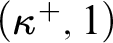 $(\kappa ^{+},1)$
-simplified morass. Parsing the definition below, a simplified morass consists of an increasing sequence of length
 $\kappa ^{+}$
of ordinals smaller than
 $\kappa ^{+}$
, with
 $\kappa ^{++}$
added at the top – the levels of the simplified morass – and collections of maps from lower levels to higher ones.
The remaining axioms specify: the possible maps from one level to its successor, that pairs of maps up to limit levels ‘split’, i.e., factor through a common second factor, that there are only at most
 $\kappa $
many maps from any level to any other below the top level and that maps from one level to another factor at every intermediate level and. Finally, every element of
 $\kappa ^{++}$
is in the range of some map up to the top level.
Definition 1.4. [Reference Velleman36]
 $\langle \langle \theta _\alpha | \alpha \le \kappa ^{+}\rangle , \langle {\mathcal {F}}_{\alpha \beta }| \alpha \le \beta \le \kappa ^{+}\rangle \rangle $
is a
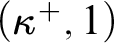 $(\kappa ^{+},1)$
-simplified morass if
-
•
 $\langle \theta _\alpha | \alpha < \kappa ^{+}\rangle \in (\kappa ^{+})^{\kappa ^{+}}$
and
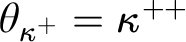
$\theta _{\kappa ^{+}}=\kappa ^{++}$
,
-
• for each
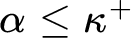
$\alpha \le \beta \le \kappa ^{+}$
one has that
${\mathcal {F}}_{\alpha \beta }\subseteq \{\; f|\; f:\theta _\alpha \longrightarrow _{\text {o.p.}/} \theta _\beta \}$
and-
– for each
$\alpha \le \kappa ^{+}$
,
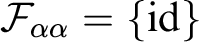
${\mathcal {F}}_{\alpha \alpha } =\{ \mathrm {id}\}$
, -
– for each
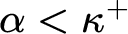
$\alpha <\kappa ^{+}$
,
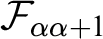
${\mathcal {F}}_{\alpha \alpha +1}$
is a singleton or an amalgamation pair, -
– for each
$\alpha \le \beta \le \gamma \le \kappa ^{+}$
,
${\mathcal {F}}_{\alpha \gamma } = \{ g\cdot f|\; f\in {\mathcal {F}}_{\alpha \beta } \&\ g\in {\mathcal {F}}_{\beta \gamma }\}$
, -
– for each
$\alpha \le \beta < \kappa ^{+}$
,
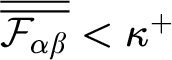
${\overline {\overline {\mathcal {F}_{\alpha \beta }}}}<\kappa ^{+}$
,
-
-
• the simplified morass is directed at each limit ordinal
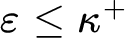
$\varepsilon \le \kappa ^{+}$
:
$ \text{ if }\alpha,\beta < \varepsilon, e_\alpha\in {\mathcal{F}}_{\alpha\varepsilon}\text{ and } e_\beta\in {\mathcal{F}}_{\beta\varepsilon} \text{ there are }\gamma\in [\alpha\cup \beta, \varepsilon), g\in {\mathcal{F}}_{\gamma\varepsilon}, f_{\alpha}\in {\mathcal{F}}_{\alpha\gamma}\text{ and } f_{\beta}\in {\mathcal{F}}_{\beta\gamma}\text{such that } e_\alpha = g\cdot f_\alpha \text{ and } e_\beta=g\cdot f_\beta $
, -
•
$\bigcup \{\; f``\theta _\alpha | \alpha <\kappa ^{+} \&\ f\in {\mathcal {F}}_{\alpha \kappa ^{+}}\} = \kappa ^{++}$
.








Let
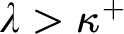 $\lambda>\kappa ^{+}$
be regular. A forcing will be given to add a
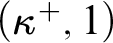 $(\kappa ^{+},1)$
-simplified morass and make
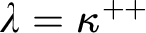 $\lambda =\kappa ^{++}$
in the generic extension.
Conditions will consist of a simplified morass segment of size less than
 $\kappa $
, a map into
 $\lambda $
(the map ‘up to the top’), which will also eventually be one of the simplified morass maps, and a collection of elementary submodels of
 $H_{\lambda }$
, which combine well with the maps in the simplified morass segment, as side conditions. Note, however, that the simplified morass segments in conditions in a generic for the forcing, having size smaller than
 $\kappa $
, do not constitute initial segments of the added simplified morass: stronger conditions interleave more levels.
In Section 7 we show that the forcing does indeed add an
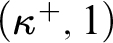 $(\kappa ^{+},1)$
-simplified morass.Footnote
2
This allows us to observe that the forcing must also collapse all cardinals strictly between
 $\kappa ^{+}$
and
 $\lambda $
.
The forcing does not have the
 $\kappa ^{+}$
-chain condition, and indeed this is inevitable, because a
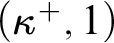 $(\kappa ^{+},1)$
-simplified morass provides one with a counterexample to the weak Chang conjecture [Reference Donder, Nerode and Shore6, Reference Kanai13]: an increasing, modulo bounded, sequence of
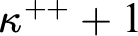 $\kappa ^{++}+1$
-many functions from
 $\kappa ^{+}$
to itself. To see that a
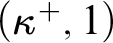 $(\kappa ^{+},1)$
-simplified morass does indeed furnish such a sequence, simply consider the functions which, for each ordinal
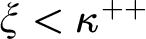 $\xi <\kappa ^{++}$
, tell us the predecessors of
 $\xi $
in the simplified morass tree ordering: that is, the functions given by
 $\alpha \mapsto $
that
 $\xi _\alpha $
such that there is some map f in the
 ${\mathcal {F}}_{\alpha \kappa ^{+}}$
of the simplified morass such that
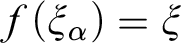 $f(\xi _\alpha )=\xi $
if there is any such, and
 $0$
otherwise, and finally take the function
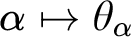 $\alpha \mapsto \theta _\alpha $
. Todorcevic has observed that no
 $\kappa ^{+}$
-cc forcing can add such a counterexample.
However the forcing does preserve many cardinals. We survey the background material for these results in the next section, Section 2, and in Section 4 we show that the forcing has a variant of (
 $\kappa $
-)properness, giving that
 $\kappa ^{+}$
is preserved.
In Section 5 we show that
 $\lambda $
and all cardinals greater than it are preserved. The programmatic way to do this is to show that the forcing has the variant of properness which preserves
 $\lambda $
provided
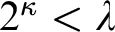 $2^{\kappa }<\lambda $
and has the
 $\lambda ^{+}$
-chain condition if
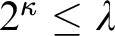 $2^{\kappa }\le \lambda $
. We give proofs in this style in order to make clear how such proofs should run in forcing arguments where the forcing conditions discussed here are used as side conditions. However, as the forcing discussed in this paper is (almost) a pure side conditions forcing, we are actually able to show that it has the
 $\lambda $
-chain condition provided
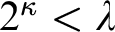 $2^{\kappa }<\lambda $
, and thus have from this that
 $\lambda $
and all greater cardinals are preserved.
In Section 6 we show that if
 $\kappa $
is a regular cardinal the forcing is
 ${<}\kappa $
-closed and thus
 $\kappa $
and all smaller cardinals are preserved. The proof is similar to the proof in Section 7, easier in some places, essentially because we are dealing with a descending chain of conditions as opposed to a directed set, but a little more involved in others because of the technical constraints on limit levels of the working parts of the forcing conditions. (Of course, Section 6 can be skipped if one is only interested in the case
 $\kappa =\omega $
.)
Finally, in Section 8, we collect together the results proven.
2 Background material on cardinal preservation and ‘good’ models
We start this section by reviewing some relevant definitions and results on cardinal preservation.
Definition 2.1. Let
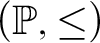 $(\mathbb {P},\le )$
be a partial order and
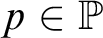 $p\in \mathbb {P}$
. A set
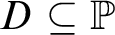 $D\subseteq \mathbb {P}$
is predense below p if for all
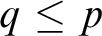 $q\le p$
there is some
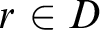 $r\in D$
such that there is some
 $s\in \mathbb {P}$
with
 $s\le q$
, r.
Definition 2.2. Let
 $\chi $
be a regular cardinal,
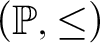 $(\mathbb {P},\le )$
be a partial order and
 $(\mathbb {P},\le )\in N\prec (H_\chi ,\in )$
. Then
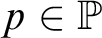 $p\in \mathbb {P}$
is
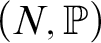 $(N,\mathbb {P})$
- generic if for every dense set
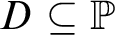 $D\subseteq \mathbb {P}$
with
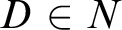 $D\in N$
we have that
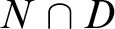 $N\cap D$
is predense below p.
The following proposition is essentially from Hyttinen and Rautila’s [Reference Hyttinen and Rautila11]; Roslanowski and Shelah [Reference Roslanowski and Shelah30] cite it as being due to “folklore; Hyttinen-Rautila.” We give the proof in detail for two reasons. First, the result in [Reference Hyttinen and Rautila11] only covers preservation of successor cardinals and here we want a mild generalization covering both successor and limit cardinals. Second, [Reference Hyttinen and Rautila11] is interested in iterable forcings whereas here we only need worry about single step forcings and so can pare away some restrictions on the forcings covered.
Proposition 2.3 (cf. [Reference Hyttinen and Rautila11], 3.6)
Let
 $\mathbb {P}$
be a partial order, let
 $\lambda $
be an uncountable regular cardinal and let
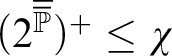 $(2^{{\overline {\overline {\mathbb {P}}}}})^{+} \le \chi $
. Suppose that
 $\mathbb {P}$
is such that for all regular
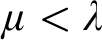 $\mu <\lambda $
, there is a set
 ${\mathcal U}\subseteq \{ N \prec (H_\chi ,\in ) | \mu \subseteq N \&\ {\overline {\overline {N}}} <\lambda \}$
which is unbounded in
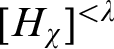 $[H_\chi ]^{<\lambda }$
and such that for every
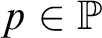 $p\in \mathbb {P}$
there is some
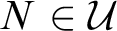 $N \in {\mathcal U}$
with
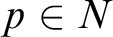 $p\in N$
and some
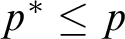 $p^*\le p$
which is
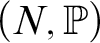 $(N,\mathbb {P})$
-generic. Then forcing with
 $\mathbb {P}$
preserves that
 $\lambda $
is an uncountable regular cardinal.
Proof. Let
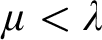 $\mu <\lambda $
be a cardinal. Let G be
 $\mathbb {P}$
-generic over V. Let
 $f:\mu \longrightarrow \mathrm {On}$
enumerate a set of ordinals in
 $V[G]$
of size
 $\mu $
. Let
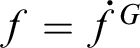 $f=\dot {f}^G$
for some
 $\mathbb {P}$
-name
 $\dot {f}$
. Let
 $\phi $
be the sentence
 $\forall \kappa <\lambda \forall C\in [\mathrm {ssup}(\mathrm {rge}(f))]^\kappa (\mathrm {rge}(f) \not \subseteq C)$
. Suppose, towards a contradiction,
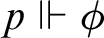 $p\Vdash \phi $
. Let
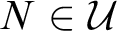 $N\in {\mathcal U}$
with
 $\dot {f}$
, p,
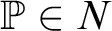 $\mathbb {P}\in N$
,
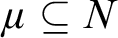 $\mu \subseteq N$
and
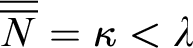 ${\overline {\overline {N}}}=\kappa <\lambda $
.
For each
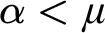 $\alpha <\mu $
let
 $D_\alpha =\{ r\in \mathbb {P}| \exists \beta r\Vdash \dot {f}(\alpha )=\beta \text { or }r \text { is incompatible with }p\}$
. Then for each
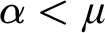 $\alpha <\mu $
we have that
 $D_\alpha $
is dense in
 $\mathbb {P}$
and
 $D_{\alpha }$
is definable from
 $\dot {f}$
,
 $p,$
and
 $\mathbb {P}$
and hence is an element of N.
For each
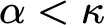 $\alpha <\kappa $
let
 $C_\alpha = \{ \beta \in \mathrm {On}| \exists r\in \mathbb {P}\cap N r\Vdash \dot {f}(\alpha )=\beta \}$
, so
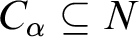 $C_\alpha \subseteq N$
.
By the hypothesis on
 $\mathbb {P}$
let
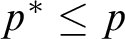 $p^*\le p$
be
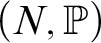 $(N,\mathbb {P})$
-generic. Then, by the definition of
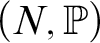 $(N,\mathbb {P})$
-genericity we have for each
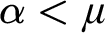 $\alpha <\mu $
that
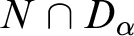 $N\cap D_\alpha $
is predense below
 $p^*$
: if
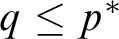 $q\le p^*$
there is some
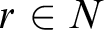 $r\in N$
and some
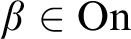 $\beta \in \mathrm {On}$
such that
 $r\Vdash \dot {f}(\alpha )=\beta $
and there is some
 $s\in \mathbb {P}$
with
 $s\le q$
, r. Hence for all
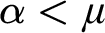 $\alpha <\mu $
and for all
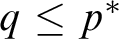 $q\le p^*$
we have that there is some
 $s\le q$
such that
 $s\Vdash \dot {f}(\alpha )\in C_\alpha $
(since r forces this) and thus
 $p^*\Vdash \dot {f}(\alpha )\in C_\alpha $
.
Set
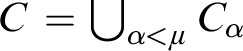 $C=\bigcup _{\alpha <\mu }C_\alpha $
. It is clear that
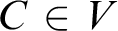 $C\in V$
and from the previous paragraph we have that
 $p^*\Vdash \mathrm {rge}(\;\dot {f})\subseteq C$
. Moreover, as
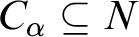 $C_\alpha \subseteq N$
for each
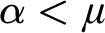 $\alpha <\mu $
we have that
 ${\overline {\overline {C}}}\le \mu .\kappa = \kappa <\lambda $
. This gives the sought after contradiction.
 $\blacktriangle _{2.3}$
Definition 2.4. If
 $\;\mathbb {P}$
has the property hypothesised in the statement of the previous proposition for
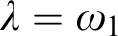 $\lambda =\omega _1$
it is proper. If
 $\;\mathbb {P}$
has the same property for some successor of a regular cardinal
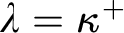 $\lambda =\kappa ^{+}$
it is (a mild generalization of being)
 $\kappa $
- proper in the sense of [Reference Hyttinen and Rautila11]. The referee very reasonably suggests this property should be named, so in this paper such
 $\mathbb {P}$
will be called surely
 $\kappa $
-proper.
We shall also need some technical material on elementary submodels of
 $H_\lambda $
for regular
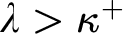 $\lambda>\kappa ^{+}$
.
Lemma 2.5. Suppose
 $\lambda $
,
 $\theta $
are regular cardinals with
 $\kappa ^{+}<\lambda <\theta $
. Suppose
 $(N,\in )\prec (H_{\theta },\in )$
and either
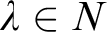 $\lambda \in N$
or
 $\mathrm {Card} \cap N$
is unbounded in
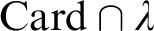 $\mathrm {Card}\cap \lambda $
. Then
 $(N\cap H_\lambda )\prec H_\lambda $
.
Definition 2.6. A structure
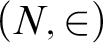 $(N,\in )$
is a good model if
 $(N,\in )\prec (H_{\lambda },\in )$
,
 $\delta ^N=\kappa ^{+}\cap N<\kappa ^{+}$
,
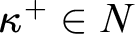 $\kappa ^{+}\in N$
and
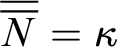 ${\overline {\overline {N}}}=\kappa $
.
Lemma 2.7. If M, N are good models,
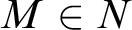 $M\in N$
and
 $\mathrm {otp}(M\cap \lambda )<\delta ^N$
then
 $M\cap \lambda \subseteq N$
.
Proof. As
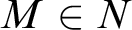 $M\in N$
we have
 $M\cap \mathrm {On} \in N$
. Let
 $\gamma =\mathrm {otp}(M\cap \lambda )$
. As
 $H_\lambda \models \gamma =\mathrm {otp}(M\cap \lambda )$
and
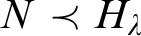 $N\prec H_\lambda $
one also has
 $N\models \gamma =\mathrm {otp}(M\cap \lambda )$
. Since
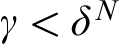 $\gamma <\delta ^N$
we have
 $\mathrm {otp}((M\cap \lambda )^N)=\mathrm {otp}(M\cap \lambda )$
, and hence
 $(M\cap \lambda )^N =\{ \alpha \in M\cap \lambda | \alpha \in N\} =M\cap \lambda $
.
 $\blacktriangle _{2.7}$
Let
 $\lambda $
be a regular cardinal with
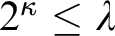 $2^\kappa \le \lambda $
.
By this assumption, let
 $\triangleleft $
be a well-ordering of
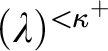 $(\lambda )^{<\kappa ^{+}}$
in order-type
 $\lambda $
.
Definition 2.8.
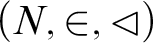 $(N,\in ,\triangleleft )$
is a very good model if
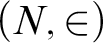 $(N,\in )$
is a good model and
 $(N,\in ,\triangleleft )\prec (H_\lambda ,\in ,\triangleleft )$
.
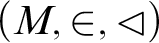
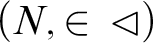
Lemma 2.9. Suppose
 $(M,\in ,\triangleleft )$
and
 $(N,\in \,\triangleleft )$
are very good models,
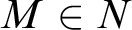 $M\in N$
and
 $\mathrm {otp}(M\cap \lambda )<\delta ^N$
. Then
 $((\lambda )^{<\kappa ^{+}})^M\subseteq N$
.
(Observe that
 $((\lambda )^{<\kappa ^{+}})^M = \{ f:\gamma \longrightarrow _{\text {o.p.}} \lambda | \gamma <\delta ^M\&\ f\in M\}=$
 $\{ f:\gamma \longrightarrow _{\text {o.p.}} \lambda | \gamma <\delta ^M\&\ \mathrm {rge}(\;f)\subseteq M\cap \lambda \}$
.)
Proof. By Lemma 2.7 we have
 $M\cap \lambda \subseteq N$
. Let
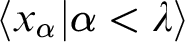 $\langle x_\alpha | \alpha <\lambda \rangle $
enumerate
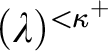 $(\lambda )^{<\kappa ^{+}}$
. For all
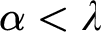 $\alpha <\lambda $
we have that
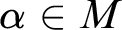 $\alpha \in M$
if and only if
 $x_\alpha \in ((\lambda )^{<\kappa ^{+}})^M$
, and similarly for N. Thus
 $((\lambda )^{<\kappa ^{+}})^M\subseteq ((\lambda )^{<\kappa ^{+}})^N$
.
 $\blacktriangle _{2.9}$
Definition 2.10. If N is a good model write
 $\overline {N}$
for the transitive collapse of N and let
 $\pi ^N:\overline {N}\longrightarrow N$
be the inverse of the transitive collapsing map.
Lemma 2.11. Suppose N is a good model,
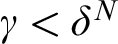 $\gamma <\delta ^N$
, and
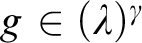 $g\in (\lambda )^{\gamma }$
and
 $\mathrm {rge}(g)\subseteq N\cap \lambda $
. Then
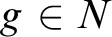 $g\in N$
if and only if
 $(\pi ^N)^{-1}\cdot g\in \overline {N}$
.
Proof. Immediate.
 $\blacktriangle _{2.11}$
Definition 2.12. Let
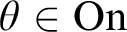 $\theta \in \mathrm {On}$
and let
 $f:\theta \longrightarrow \lambda $
be an order-preserving map. A good model
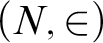 $(N,\in )$
fits f if and only if
 $f=\pi ^N\upharpoonright \mathrm {On}$
. Equivalently,
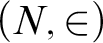 $(N,\in )$
fits f if and only if
 $\mathrm {rge}(\;f)=N\cap \lambda $
.
3 Definition of the main forcing
Definition 3.1.
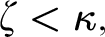
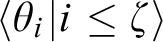
 $S=\langle \langle \theta _i| i\le \zeta \rangle , \langle {\mathcal {F}}_{ij}| i\le j\le \zeta \rangle \rangle $
is a small
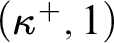 $(\kappa ^{+},1)$
-simplified morass segment (SMS) if
-
•
$\zeta <\kappa ,$
-
•
$\langle \theta _i| i\le \zeta \rangle $
$\in (\kappa ^{+})^{\zeta +1}$
, -
• if
$i\le \zeta $
is a limit ordinal then
$\mathrm {cf}(\theta _i)<\kappa ,$
-
• for each
$i\le j\le \zeta $
one has that
${\mathcal {F}}_{ij}\in [(\theta _j)^{\theta _i}]^{<\kappa }$
, and-
– for each
$i\le \zeta $
,
${\mathcal {F}}_{ii} =\{ \mathrm {id}\},$
-
– for each
$i<\zeta $
either-
*
${\mathcal {F}}_{ii+1}=\{ f_i\}$
is a singleton and
$\mathrm {ssup}(\mathrm {rge}(\;f_i))<\theta _{i+1}$
, or -
*
${\mathcal {F}}_{ii+1}=\{ \mathrm {id}, h_{i}\}$
is an almost exact amalgamation pair (as defined in Definition (1.3)),
-
-
– if
$k\le \zeta $
is a limit ordinal then-
* for all
$i_0$
,
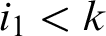
$i_1<k$
and
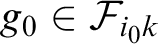
$g_0\in {\mathcal {F}}_{i_0k}$
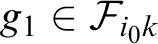
,
$g_1\in {\mathcal {F}}_{i_0k}$
there is
$j\in [\max (\{ i_0,i_1\}), k)$
, and
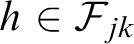
$h\in {\mathcal {F}}_{jk}$
,
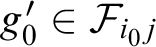
$g^{\prime }_0\in {\mathcal {F}}_{i_0j}$
,
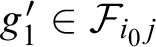
$g^{\prime }_1\in {\mathcal {F}}_{i_0j}$
such that
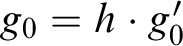
$g_0 = h \cdot g^{\prime }_0$
and
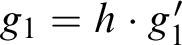
$g_1= h\cdot g^{\prime }_1$
.
-
-
– for each
$i\le j\le k\le \zeta $
one has that-
*
${\mathcal {F}}_{ik} = \{ g\cdot f| f\in {\mathcal {F}}_{ij} \&\ g\in {\mathcal {F}}_{jk}\}.$
-
-
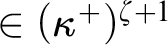

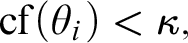
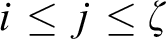


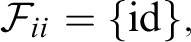









For technical reasons (see the remarks in the paragraphs leading up to the definition of S in Proposition (6.1), ensuring that we can choose the
 $\theta ^*_\xi $
suitably) we have defined small SMS in such a way as to make sure that the following lemma holds.
Lemma 3.2. If S is a small
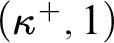 $(\kappa ^{+},1)$
-SMS,
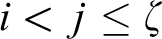 $i < j\le \zeta $
, and
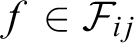 $f\in {\mathcal {F}}_{ij}$
then f is not cofinal into
 $\theta _j$
.
Proof. The proof is by induction on j for each fixed i. If
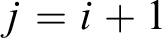 $j=i+1$
the result is immediate from the definition of
 ${\mathcal {F}}_{ii+1}$
. (Recall that if
 ${\mathcal {F}}_{ii+1}=\{ \mathrm {id},h_i\}$
is an almost exact amalgamation pair then
 $\mathrm {ssup}(\mathrm {rge}(h_i))=\theta _i\cup h_i``\theta _i < \theta _{i+1}$
.) If
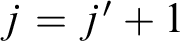 $j=j'+1$
for some
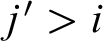 $j'>i$
then let
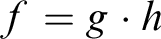 $f=g\cdot h$
for some
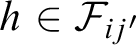 $h\in {\mathcal {F}}_{ij'}$
and
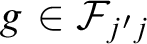 $g\in {\mathcal {F}}_{j'j}$
. Again by the definition of
 ${\mathcal {F}}_{j'j}$
we have that g is not cofinal and hence neither is f. Finally, if j is a limit ordinal then choose any
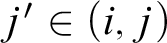 $j'\in (i,j)$
; then
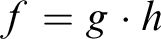 $f=g\cdot h$
for some
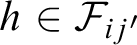 $h\in {\mathcal {F}}_{ij'}$
and
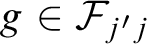 $g\in {\mathcal {F}}_{j'j}$
. By the inductive hypothesis h is not cofinal, hence neither is f.
 $\blacktriangle _{3.2}$
Lemma 3.3. If S is a small
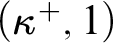 $(\kappa ^{+},1)$
-SMS,
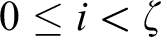 $0\le i < \zeta $
,
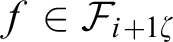 $f\in {\mathcal {F}}_{i+1\zeta }$
,
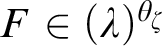 $F\in (\lambda )^{\theta _\zeta }$
and N fits
 $F\cdot f$
then
 ${\mathcal {F}}_{ii+1}=\{ f_{i}\}$
.
Proof. By the definition of an almost exact sequence
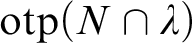 $\mathrm {otp}(N \cap \lambda )$
should be a successor ordinal, contrary to the fact that
 $(N,\in )\prec (H_{\lambda },\in ).$
 $\blacktriangle _{3.3}$
Unsurprisingly, a variant of a generalization of the combination of Velleman and Stanley’s ubiquitously helpful lemmas for simplified morasses ([Reference Velleman36], Lemma 3.2, and [Reference Velleman36], Theorem 3.9, respectively) is very useful here.
Lemma 3.4. Suppose
 $S=\langle \langle \theta _i| i\le \zeta \rangle , \langle {\mathcal {F}}_{ij}| i\le j\le \zeta \rangle \rangle $
is a small
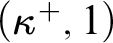 $(\kappa ^{+},1)$
-SMS,
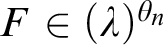 $F\in (\lambda )^{\theta _n}$
,
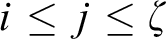 $i\le j\le \zeta $
, f,
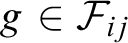 $g\in {\mathcal {F}}_{ij}$
, and
 $\xi $
,
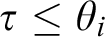 $\tau \le \theta _i$
. If
 $\mathrm {ssup}(\;f``\xi )=\mathrm {ssup}(g``\tau )$
or if
 $j=n$
and
 $\mathrm {ssup}(F\cdot f``\xi )=\mathrm {ssup}(F\cdot g``\tau )$
then
 $\xi =\tau $
and
 $f\upharpoonright \xi =g\upharpoonright \xi $
.
Proof. By induction on j for each i. If
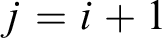 $j=i+1$
the lemma is immediate from the two possible cases for the structure of
 ${\mathcal {F}}_{ii+1}$
. If
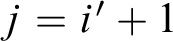 $j=i'+1$
for some
 $i'>i$
, note that one can factor f, g as
 $f=f_1\cdot f_0$
and
 $g=g_1\cdot g_0$
with
 $f_0$
,
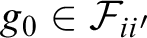 $g_0\in {\mathcal {F}}_{ii'}$
and
 $f_1$
,
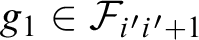 $g_1\in {\mathcal {F}}_{i'i'+1}$
. If
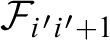 ${\mathcal {F}}_{i'i'+1}$
is a singleton then this instance of the lemma is immediate from the lemma for i and
 $i'$
. Otherwise,
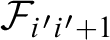 ${\mathcal {F}}_{i'i'+1}$
is an amalgamation pair with splitting point
 $\sigma _{i'}$
and either
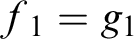 $f_1=g_1$
, in which case the lemma is again immediate by the induction hypothesis, or
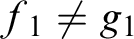 $f_1\ne g_1$
and hence
 $\mathrm {ssup}(f_0``\xi )=\mathrm {ssup}(g_0``\tau )\le \sigma _{i'}$
and so the lemma is once again true. If
 $j\le \zeta $
is a limit ordinal then there is some
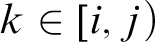 $k\in [i,j)$
,
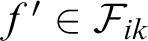 $f' \in {\mathcal {F}}_{ik}$
,
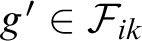 $g' \in {\mathcal {F}}_{ik}$
and
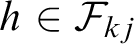 $h \in {\mathcal {F}}_{kj}$
such that
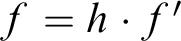 $f=h\cdot f'$
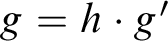
and
 $g=h\cdot g'$
. If
 $\mathrm {ssup}(f``\xi )=\mathrm {ssup}(g``\tau )$
then
 $\mathrm {ssup}(f'``\xi )=\mathrm {ssup}(g'``\tau )$
. By the inductive hypothesis the lemma is true for k,
 $f'$
and
 $g'$
. Hence, applying h on both sides, it is true of j, f and g. If
 $j=\zeta $
then
 $\mathrm {ssup}(F\cdot f``\xi )=\mathrm {ssup}(F\cdot g``\tau )$
if and only if
 $\mathrm {ssup}(f``\xi )=\mathrm {ssup}(g``\tau )$
, and so the lemma for
 $F\cdot f$
and
 $F\cdot g$
is true by the lemma for f and g.
 $\hphantom {w}$
 $\blacktriangle _{3.4}$
We now introduce the main forcing notion that will be considered in this paper.
Definition 3.5.
 $\mathbb {P}$
is the forcing notion in which conditions other than
 $\mathbb {1}$
are of the form
 $p=(S^p,{\mathcal {F}}^p,{\mathcal N}^p)$
where
-
•
$S^p=\langle \langle \theta ^p_i| i\le \zeta ^p\rangle , \langle {\mathcal {F}}^p_{ij}| i\le j\le \zeta ^p\rangle \rangle $
is a small
$(\kappa ^{+},1)$
-SMS, -
•
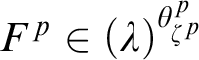
${\mathcal {F}}^p=\{ (F^p\cdot f, \theta ^p_i)| i\le \zeta ^p\&\ f\in {\mathcal {F}}_{i\zeta ^p}\}$
for some
$F^p\in (\lambda )^{\theta ^p_{\zeta ^p}}$
, -
•
${\mathcal N}^p$
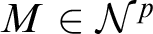
is a set of very good models such that for every
$M\in {\mathcal N}^p$
there is a unique
$(i^M,f^M)\in \bigcup _{j\le \zeta ^p}\{ j\}\times {\mathcal {F}}^p_{j\zeta ^p}$
such that M fits
$F^p\cdot f^M$
and-
${\circ }_{1}$
$\forall i\le j \le i^M ({\mathcal {F}}^p_{ij}\subseteq \overline {M}),$
-
${\circ }_{2}$
$\forall N\in {\mathcal N}^p \forall \gamma <\delta ^N \forall g\in (\theta _{i^N})^{\gamma }$
$(i^N\le i^M \&\ g\in \overline {N} \Longrightarrow g\in \overline {M}).$




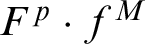





We sometimes write instead, more informally,
 $p=(S^p,F^p,{\mathcal N}^p)$
, as clearly
 ${\mathcal {F}}^p$
is recoverable from
 $F^p$
and
 $S^p$
.
We take
 $\mathbb {1}$
to be the empty condition
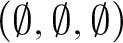 $(\emptyset ,\emptyset ,\emptyset )$
and, for numerological reasons, formally take
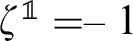 $\zeta ^{\mathbb {1}} = -1$
.
The ordering is given by
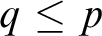 $q\le p$
if (
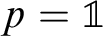 $p=\mathbb {1}$
or)
-
•
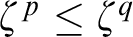
$\zeta ^p\le \zeta ^q$
, -
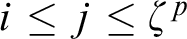
• there is some
$k:\zeta ^p+1\longrightarrow _{\text {o.p.}} \zeta ^q+1$
such that-
– for all
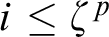
$i\le \zeta ^p$
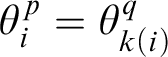
one has
$\theta _i^p=\theta ^q_{k(i)}$
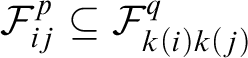
, -
– for all
$i\le j\le \zeta ^p$
one has
${\mathcal {F}}^p_{ij}\subseteq {\mathcal {F}}^q_{k(i)k(j)}$
, -
– if
$k(i+1)=k(i)+1$
then
${\mathcal {F}}^p_{ii+1}={\mathcal {F}}^q_{k(i)k(i)+1}$
,
-
-
• there is some
$f^{pq}\in {\mathcal {F}}^q_{k(\zeta ^p)\zeta ^q}$
such that
$F^p=F^q\cdot f^{pq}$
, -
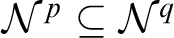
•
${\mathcal N}^p\subseteq {\mathcal N}^q$
, -
• if
$N\in {\mathcal N}^q$
is witnessed by
$(k(i),f^{pq}\cdot g)$
for some
$g\in {\mathcal {F}}^p_{i\zeta ^p}$
, then
$N\in {\mathcal N}^p$
(and this is witnessed by
$(i,g)$
since
$F^q\cdot f^{pq}\cdot g=F^p\cdot g$
).



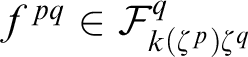

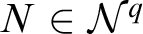

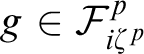
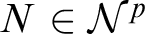


We remark that the definition of f makes sense because
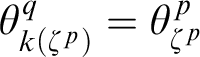 $\theta ^q_{k(\zeta ^p)} = \theta ^p_{\zeta ^p}$
.
The clauses
 ${\circ }_{1}$
and
 ${\circ }_{2}$
are succinct and straightforward. However it is useful for the proofs below to unpack them into a sequence of conditions which involve the small SMS structure more explicitly.
Lemma 3.6. Suppose (as in Definition 3.5) that
 $p=(S^p,{\mathcal {F}}^p,{\mathcal N}^p)$
, where
 $S^p=\langle \langle \theta ^p_i| i\le \zeta ^p\rangle , \langle {\mathcal {F}}^p_{ij}| i\le j\le \zeta ^p\rangle \rangle $
is a small
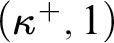 $(\kappa ^{+},1)$
-SMS,
 ${\mathcal {F}}^p= \{ (F^p\cdot f, \theta ^p_i)| i\le \zeta ^p\&\ f\in {\mathcal {F}}_{i\zeta ^p}\}$
for some
 $F^p:\theta ^p_{\zeta ^p}\longrightarrow _{\text {o.p.}}\lambda $
, and
 ${\mathcal N}^p$
is a collection of very good models such that for all
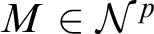 $M\in {\mathcal N}^p$
there is some (unique)
 $(i^M,f^M)\in \bigcup _{j\le \zeta ^p}\{ j\}\times {\mathcal {F}}^p_{j\zeta ^p}$
such that M fits
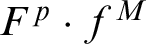 $F^p\cdot f^M$
.
Then
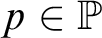 $p\in \mathbb {P}$
, i.e.,
 ${\circ }_{1}$
and
 ${\circ }_{2}$
hold, if and only if the following conditions hold:
-
$\bullet _1$
$\forall i\le j < i^M (\theta ^p_i < \delta ^M \&\ {\mathcal {F}}^p_{ij}\subseteq M ),$
-
$\bullet _2$
$\forall i< i^M \forall g\in {\mathcal {F}}_{ii^M} (F^p\cdot f^M\cdot g\in M),$
-
$\bullet _3$
$\forall N\in {\mathcal N}^p ( i^N\le i^M \Longrightarrow ((\kappa ^{+})^{<\kappa ^{+}})^N \subseteq ((\kappa ^{+})^{<\kappa ^{+}})^M ),$
-
$\bullet _4$
$\forall N \kern-1pt\in\kern-1pt {\mathcal N}^p \forall \gamma <\kern-1pt\delta ^N \forall g\kern-1pt\in\kern-1pt (\theta _{i^N})^{\gamma } (i^N\kern-1pt =\kern-1pt i^M \kern-1.3pt\Longrightarrow\kern-1pt (F^p\cdot f^N\cdot g \in N \kern-1pt\Longleftrightarrow\kern-1pt F^p\cdot f^M\cdot g \kern-1pt\in\kern-1pt M) ),$
-
$\bullet _5$
$\forall N\in {\mathcal N}^p \forall \gamma <\delta ^N \forall g\in (\theta _{i^N})^{\gamma } (i^N<i^M \kern-1.2pt\Longrightarrow\kern-1.2pt (F^p\cdot f^N\cdot g \in N \kern-1.2pt\Longrightarrow\kern-1.2pt g \in\kern-1pt M) ).$










Proof. For
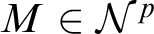 $M\in {\mathcal N}^p$
we have
 $\pi ^M\upharpoonright \mathrm {On} = F^p\cdot f^M$
. Note that
 $\pi ^M\upharpoonright \delta ^M=\mathrm {id}$
,
 $\pi ^M(\delta ^M)=\kappa ^{+}$
and that
 $\forall i< i^M \theta _i<\delta ^M$
. Observe that it is now immediate that for
 $i\in \{ 1,2,3,4,5\}$
we have that
 $\bullet _i$
holds if and only if
 $\bullet ^{\prime }_i$
does, where the
 $\bullet ^{\prime }_i$
are given by
-
$\bullet ^{\prime }_1$
$\forall i\le j <i^M {\mathcal {F}}^p_{ij}\subseteq \overline {M},$
-
$\bullet ^{\prime }_2$
$\forall i <i^M {\mathcal {F}}^p_{ii^M}\subseteq \overline {M},$
-
$\bullet ^{\prime }_3$
$\forall N\in {\mathcal N}^p \forall \gamma <\delta ^N \forall g\in (\delta ^N)^{\gamma } (i^N\le i^M \Longrightarrow ,$
-
$(g\in \overline {N} \Longleftrightarrow g\in \overline {M})),$
-
$\bullet ^{\prime }_4$
$\forall N\in {\mathcal N}^p \forall \gamma <\delta ^N \forall g\in (\theta _{i^N})^{\gamma } (i^N=i^M \Longrightarrow $
-
$(g\in \overline {N} \Longleftrightarrow g\in \overline {M}))$
,
-
$\bullet ^{\prime }_5$
$\forall N\in {\mathcal N}^p \forall \gamma <\delta ^N \forall g\in (\theta _{i^N})^{\gamma } (i^N<i^M \Longrightarrow $
-
$(g\in \overline {N} \Longrightarrow g\in \overline {M})).$
The conclusion now follows as
${\circ }_{1}$
is the conjunction of
$\bullet ^{\prime }_1$
and
$\bullet ^{\prime }_2$
and
${\circ }_{2}$
is the conjunction on
$\bullet ^{\prime }_3$
,
$\bullet ^{\prime }_4,$
and
$\bullet ^{\prime }_5$
.
$\blacktriangle _{3.6}$















Before proceeding we give a useful lemma showing that for a condition
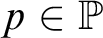 $p\in \mathbb {P}$
the relationship of one member of the collection of good models
 ${\mathcal N}^p$
being an element of another behaves well with respect to the SMS structure
 $S^p$
of p.
Lemma 3.7. Suppose
 $p=(M,{\mathcal {F}},{\mathcal N})\in \mathbb {P}$
and write
 $\zeta $
for
 $\zeta ^p$
. If N,
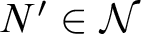 $N'\in {\mathcal N}$
with
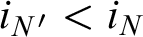 $i_{N'} <i_N$
and
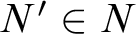 $N'\in N$
then
 $\exists f\in {\mathcal {F}}_{i_{N'}i_N} (f^{N'} = f^N\cdot f )$
.
Proof. By
 $\bullet _1$
for p applied to
 $\theta _{i_N'}$
and N one has
 $\mathrm {otp}(N'\cap \lambda )<\delta ^N$
. By hypothesis
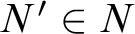 $N'\in N$
, so, by Lemma 1.7,
 $\mathrm {rge}(F\cdot f^{N'}) = N'\cap \lambda \subseteq N\cap \lambda $
 $= \mathrm {rge}(F\cdot f^{N})$
. As F is order preserving
 $\mathrm {rge}(\;f^{N'})\subseteq \mathrm {rge}(\;f^N)$
. By the last property of
 ${\mathcal {F}}_{i_{N'}\zeta }$
given in Definition 3.5, we may factor
 $f^{N'}$
as
 $h\cdot f$
where
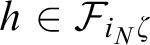 $h\in {\mathcal {F}}_{i_N\zeta }$
and
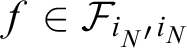 $f\in {\mathcal {F}}_{i_{N'}i_N}$
. Then
 $h\upharpoonright \mathrm {ssup}(\mathrm {rge}(\;f)) = f^N\upharpoonright \mathrm {ssup}(\mathrm {rge}(\;f))$
, by Lemma 3.4, so
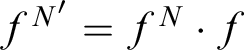 $f^{N'} = f^N\cdot f$
.
 $\blacktriangle _{3.7}$
4 Preservation of
$\kappa ^{+}\!$

Proposition 4.1.
 $\mathbb {P}$
is surely
 $\kappa $
-proper and hence forcing with it preserves
 $\kappa ^{+}$
.
Proof. Let
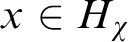 $x\in H_\chi $
and
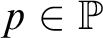 $p\in \mathbb {P}$
. Suppose N is a very good model with x,
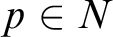 $p\in N$
,
 $\{ g\in (\theta ^p_{i^M})^{\gamma }| M\in {\mathcal N}^p \&\ \gamma <\delta ^M \&\ F^p\cdot f^M\cdot g\in M \} \subseteq N$
, and
 $\mathrm {cf}(N\cap \lambda )=\kappa $
. (It is easy to find such an N by the downward Lowenheim-Skolem theorem.)
As
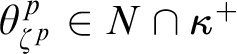 $\theta ^p_{\zeta ^p}\in N\cap \kappa ^{+}$
one has that
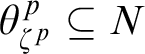 $\theta ^p_{\zeta ^p}\subseteq N$
. Since
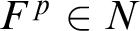 $F^p\in N$
we have that
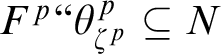 $F^p``\theta ^p_{\zeta ^p}\subseteq N$
.
Let
 $\theta ^*=\mathrm {otp}(N\cap \lambda )$
, let
 $F^*$
be the inverse of the transitive collapse of
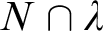 $N\cap \lambda $
and let
 $f^*={F^*}^{-1}\cdot F^p$
. Note that the definition of
 $f^*$
makes sense by the observation of the previous paragraph. Now define
 $p^*=(S^*,{\mathcal {F}}^*,{\mathcal N}^*)$
by
 $S^*=\langle \langle \theta ^p_{i} | i\le \zeta ^p \rangle \frown \theta ^*, \langle {\mathcal {F}}^p_{ij} | i\le j\le \zeta ^p \rangle \frown \langle \{ f^*\cdot f | f\in {\mathcal {F}}^p_{i\zeta ^p} \} | i\le \zeta ^p\rangle \rangle $
,
 ${\mathcal {F}}^*=\{ (F^*\cdot f, \theta ^{p^*}_i) | i\le \zeta ^p+1 \&\ f\in {\mathcal {F}}^*_{i\zeta ^p+1} \}$
and
 ${\mathcal N}^*={\mathcal N}\cup \{ N\}$
.
Lemma 4.2.
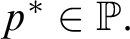 $p^*\in \mathbb {P}.$
Proof. The witnessing pair for N is
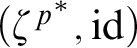 $(\zeta ^{p^*},\mathrm {id})$
. The only thing to check is that N satisfies
 $\bullet _1$
–
 $\bullet _5$
.
 $\bullet _1$
: It is immediate that
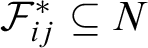 ${\mathcal {F}}^*_{ij}\subseteq N$
for all
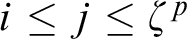 $i\le j\le \zeta ^p$
as
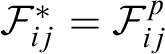 ${\mathcal {F}}^*_{ij}={\mathcal {F}}^p_{ij}$
for all
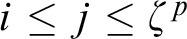 $i\le j\le \zeta ^p$
and
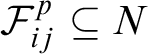 ${\mathcal {F}}^p_{ij}\subseteq N$
since
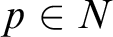 $p\in N$
,
 $\zeta ^p$
and each
 ${\mathcal {F}}^p_{ij}$
has size
 ${<}\kappa $
and
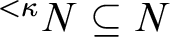 ${{\hspace {-0.0001pt}}}^{<\kappa }N \subseteq N$
.
 $\bullet _2$
: It is also immediate that
 $F^*\cdot f^*\cdot g =F^p\cdot g\in N$
for all
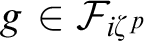 $g\in {\mathcal {F}}_{i\zeta ^p}$
as for each
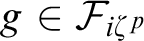 $g\in {\mathcal {F}}_{i\zeta ^p}$
one has
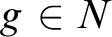 $g\in N$
, as mentioned in the proof of
 $\bullet _1$
, and
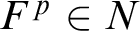 $F^p\in N$
(since
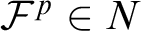 ${\mathcal {F}}^p\in N$
has size
 ${<}\kappa $
and
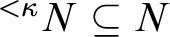 $^{<\kappa }N\subseteq N$
, and
 $F^p=F^p\cdot \mathrm {id}\in {\mathcal {F}}^p$
).
 $\bullet _3$
–
 $\bullet _5$
: Lemma 2.9 gives
 $\bullet _3$
,
 $\bullet _4$
is vacuously true, and
 $\bullet _5$
is true by the construction of N.
 $\blacktriangle _{4.2}$
Lemma 4.3.
 $p^*$
is
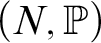 $(N,\mathbb {P})$
-generic.
Proof. Let
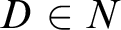 $D\in N$
be a dense subset of
 $\mathbb {P}$
.
Let
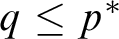 $q\le p^*$
, and let
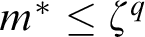 $m^*\le \zeta ^{q}$
be such that
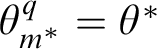 $\theta ^q_{m^*} = \theta ^*$
.
By the definition of small SMS we have two cases:
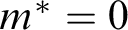 $m^*=0$
or
 $m^*$
is a successor ordinal. For if
 $m^*$
were to be a limit ordinal we would have that
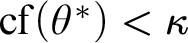 $\mathrm {cf}(\theta ^*)<\kappa $
, contradicting the fact that
 $\mathrm {cf}(N\cap \lambda )=\kappa $
.
In the former case we take
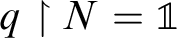 $q\upharpoonright N= \mathbb {1}$
. Clearly in this case
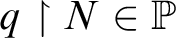 $q\upharpoonright N\in \mathbb {P}$
.
Now suppose (until the end of Claim (4.4)) that we are in the other case, so that
 $m^* = m +1$
for some
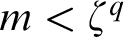 $m< \zeta ^{q}$
. In this case
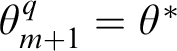 $\theta ^q_{m+1}=\theta ^*$
. Note, as remarked in Lemma 3.3, that we must have that
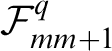 ${\mathcal {F}}^q_{mm+1}$
is the singleton
 $\{ f^q_{m}\}$
.
Define
 $q\upharpoonright N$
as follows. Let
 $S^{q\upharpoonright N}= \langle \langle \theta ^q_i| i\le m\rangle ,\langle {\mathcal {F}}^q_{ij}| i\le j\le m\rangle \rangle $
. Let
 $F^{q\upharpoonright N}= F^*\cdot f^q_{m}$
and
 ${\mathcal {F}}^{q\upharpoonright N}= \{ (F^*\cdot f^q_m \cdot f,\theta ^q_i)| i\le m \&\ f\in {\mathcal {F}}^q_{im}\}$
. Let
 ${\mathcal N}^{q\upharpoonright N}={\mathcal N}^q \cap N$
. Set
 $q\upharpoonright N=(S^{q\upharpoonright N},{\mathcal {F}}^{q\upharpoonright N},{\mathcal N}^{q\upharpoonright N})$
.
Claim 4.4.
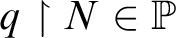 $q\upharpoonright N\in \mathbb {P}$
.
Proof. We start by showing that the ‘
 ${\mathcal {F}}$
’-component of
 $q\upharpoonright N$
is exactly the intersection of the ‘
 ${\mathcal {F}}$
’-component of q with N.
Subclaim 4.5.
 ${\mathcal {F}}^{q\upharpoonright N}= {\mathcal {F}}^q\cap N$
.
Proof. In one direction, if
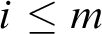 $i\le m$
and
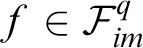 $f\in {\mathcal {F}}^q_{im}$
one has that
 $$\begin{align*}F^{q\upharpoonright N} \cdot f = F^* \cdot f^q_m \cdot f = F^q \cdot f^{p^*q} \cdot f^q_m \cdot f,\end{align*}$$
where
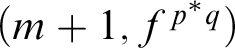 $(m+1,f^{p^*q})$
witnesses that
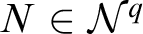 $N\in {\mathcal N}^q$
and the second equality holds since
 $f^{p^*q}$
witnesses that
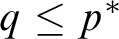 $q \le p^*$
and so by the definition of the
 $\le $
-relation
 $F^* = F^q\cdot f^{p^*q}$
. Consequently
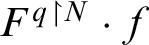 $F^{q\upharpoonright N} \cdot f$
is of the form
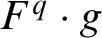 $F^q\cdot g$
for some
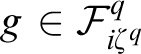 $g\in {\mathcal {F}}^q_{i\zeta ^q}$
and
 $F^{q\upharpoonright N} \cdot f\in N$
(by
 $\bullet _2$
for N and q). Thus
 ${\mathcal {F}}^{q\upharpoonright N}\subseteq {\mathcal {F}}^q\cap N$
.
In the other direction, suppose\
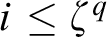 $i\le \zeta ^q$
,
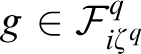 $g\in {\mathcal {F}}^q_{i\zeta ^q}$
and
 $(F^q\cdot g,\theta _i)\in N$
. Then
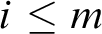 $i\le m$
, since
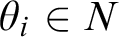 $\theta _i\in N$
, and so
 $F^q\cdot g``\theta _i\subseteq N$
. Write g as
 $g= l\cdot f^q_{m}\cdot f$
where
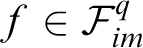 $f\in {\mathcal {F}}^q_{im}$
and
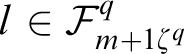 $l\in {\mathcal {F}}^q_{m+1\zeta ^q}$
. Then
 $F^q\cdot l\upharpoonright (f^q_m \cdot f``\theta ^q_i) = F^q\cdot f_N\upharpoonright (f^q_m \cdot f``\theta ^q_i)$
, where
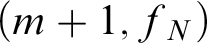 $(m+1,f_N)$
witnesses that
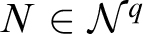 $N\in {\mathcal N}^q$
(and hence
 $f_N$
is the map
 $f^{p^*q}$
), by Lemma 1.10. Thus
 $F^q\cdot g = F^q\cdot f^{p^*q}\cdot f^q_m \cdot f = F^{*}\cdot f^q_m\cdot f = F^{q\upharpoonright N}\cdot f$
. Hence
 ${\mathcal {F}}^q\cap N\subseteq {\mathcal {F}}^{q\upharpoonright N}$
.
 $\blacktriangle _{4.5}$
Suppose
 $N'\in {\mathcal N}^q\cap N$
. Then, by Lemma 3.7,
 $f_{N'}=f_N\cdot f^q_m\cdot f$
for some
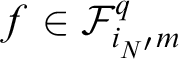 $f\in {\mathcal {F}}^q_{i_{N'}m}$
. Recalling that
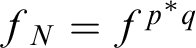 $f_{N}=f^{p^*q}$
and that
 $F^{q\upharpoonright N}=F^q\cdot f^{p^*q}\cdot f^q_m$
, one thus has that
 $F^q\cdot f_{N'}= F^{q\upharpoonright N}\cdot f$
. Hence
 $(i,f)$
is the (unique) witness that
 $N'\in {\mathcal N}^{q\upharpoonright N}$
. Consequently
 $\bullet _1$
and
 $\bullet _2$
for
 $q\upharpoonright N$
are immediate from these properties for q. Clearly,
 $\bullet _3$
–
 $\bullet _5$
hold since they do for q.
Thus we have shown that
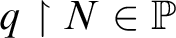 $q\upharpoonright N\in \mathbb {P}$
.
 $\blacktriangle _{4.4}$
Now let
 $s=(S^s,{\mathcal {F}}^s,{\mathcal N}^s)\in N\cap D$
be such that
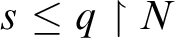 $s\le q\upharpoonright N$
.
Claim 4.6. There is some
 $r\in \mathbb {P}$
with
 $r\le q$
, s.
Proof. Let
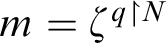 $m=\zeta ^{q\upharpoonright N}$
. Let
 $k:m+1\longrightarrow \zeta ^s+1$
witness that
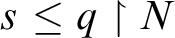 $s\le q\upharpoonright N$
. Extend k so that
 $\mathrm {dom}(k) =\zeta ^q+1$
by setting
 $k(m+1+i)=\zeta ^s+1+i$
for
 $i\in \mathrm {otp}((m, \zeta ^q])$
.
Set
 $\zeta ^r=\zeta ^s+ \mathrm {otp}((m, \zeta ^q])$
and
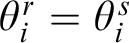 $\theta ^r_i=\theta ^s_i$
for
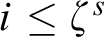 $i\le \zeta ^s$
and
 $\theta ^r_{\zeta ^s+1+i}=\theta ^q_{m+1+i}$
for
 $i\in \mathrm {otp}((m, \zeta ^q])$
. The sequence
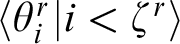 $\langle \theta ^r_i| i<\zeta ^r\rangle $
is increasing because
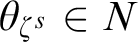 $\theta _{\zeta ^s}\in N$
and hence
 $\theta _{\zeta ^s}<\delta ^N<\mathrm {otp}(N\cap \lambda )=\theta ^q_{m+1}$
.
Let
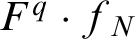 $F^q\cdot f_N$
be the inverse of the transitive collapse of
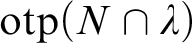 $\mathrm {otp}(N\cap \lambda )$
, where
 $(m+1,f_N)\in {\mathcal {F}}^q_{m+1\zeta ^q}$
witnesses that
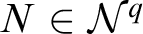 $N\in {\mathcal N}^q$
.
Again, as
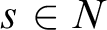 $s\in N$
one has that
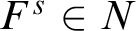 $F^s\in N$
and hence
 $F^s``\theta _{\zeta ^s}\subseteq N$
. Thus one can make the following definition.
For
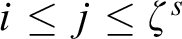 $i\le j\le \zeta ^s$
let
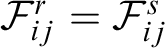 ${\mathcal {F}}^r_{ij}={\mathcal {F}}^s_{ij}$
. Let
 ${\mathcal {F}}^r_{\zeta ^s\zeta ^s+1} = \{ f_N^{-1}\cdot ({F^q})^{-1}\cdot F^s\}$
. Hence, in the notation for small SMSs from Definition (3.1),
 $f^r_{\zeta ^s} = f_N^{-1}\cdot ({F^q})^{-1}\cdot F^s$
. For
 $1\le i\le j\le \mathrm {otp}((m, \zeta ^q])$
let
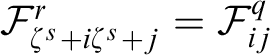 ${\mathcal {F}}^r_{\zeta ^s+i\zeta ^s+j}={\mathcal {F}}^q_{ij}$
. Finally, for
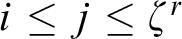 $i\le j\le \zeta ^r$
with
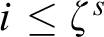 $i\le \zeta ^s$
and
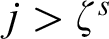 $j>\zeta ^s$
set
 ${\mathcal {F}}^r_{ij} = \{ f \cdot f^r_{\zeta ^s} \cdot g | g\in {\mathcal {F}}^r_{i\zeta ^s} \&\ f\in {\mathcal {F}}^r_{\zeta ^s+1j} \}$
.
Then
 $S^r= \langle \langle \theta ^r_i| i\le \zeta ^r\rangle , \langle {\mathcal {F}}^r_{ij}| i\le j\le \zeta ^r\rangle \rangle $
is a small SMS.
Next, set
 $F^r=F^q$
and
 ${\mathcal {F}}^r= \{ (F^r\cdot f, \theta _i)| i\le \zeta ^r\&\ f\in {\mathcal {F}}_{i\zeta ^r}\}$
.
Lastly, set
 ${\mathcal N}^r={\mathcal N}^s\cup {\mathcal N}^q$
.
In order to finish the proof we must show that
 $\bullet _1$
–
 $\bullet _5$
hold for r. If
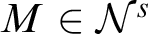 $M\in {\mathcal N}^s$
then
 $\bullet _1$
–
 $\bullet _5$
hold for r since they do for s. So suppose
 $M\in {\mathcal N}^q\setminus {\mathcal N}^s$
.
We shall write
 $i^M$
for
 $(i^M)^r$
,
 $i^N$
for
 $(i^N)^r$
, and so on, in the remainder of the proof.
 $\bullet _1$
. Let
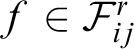 $f\in {\mathcal {F}}^r_{ij}$
with
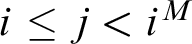 $i\le j<i^M$
.
Case 1(i).
 $i\le j< i^N \le i^M$
. Then
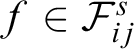 $f\in {\mathcal {F}}^s_{ij}$
. As
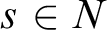 $s\in N$
we have
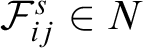 ${\mathcal {F}}^s_{ij}\in N$
and so
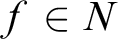 $f\in N$
(because both s and
 ${\mathcal {F}}^s_{ij}$
are of size
 ${<}\kappa $
). As
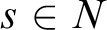 $s\in N$
we have
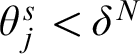 $\theta ^s_j<\delta ^N$
and so
 $f\in ((\kappa ^{+})^{<\kappa ^{+}})^N$
. As
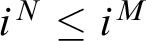 $i^N\le i^M$
we have
 $((\kappa ^{+})^{<\kappa ^{+}})^N\subseteq ((\kappa ^{+})^{<\kappa ^{+}})^M$
by
 $\bullet _3$
for q. Thus
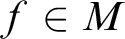 $f\in M$
.
 $\vphantom {i}$
 $\blacktriangle _{\text {(Case 1(i))}}$
Case1(ii).
 $i\le j = i^N<i^M$
. In this case we can factor f as
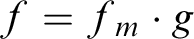 $f=f_m\cdot g$
with
 $g\in {\mathcal {F}}^r_{im}={\mathcal {F}}^s_{im}$
and
 $f_m$
is the (unique) map in
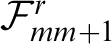 ${\mathcal {F}}^r_{mm+1}$
. By definition
 $f_m = (F^r\cdot f^N)^{-1}\cdot F_s$
, so
 $F^r\cdot f^N\cdot f_m=F^s$
. Since
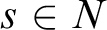 $s\in N$
and s,
 ${\mathcal {F}}^s$
are of size
 ${<}\kappa $
, we have that
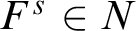 $F^s\in N$
. As
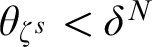 $\theta _{\zeta ^s}<\delta ^N$
, and by the case hypothesis that
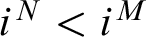 $i^N<i^M$
, we can apply
 $\bullet _5$
for q (to N and M), obtaining that
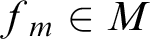 $f_m\in M$
. However, we also have that
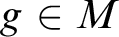 $g\in M$
by Case 1(i). Hence
 $f=f_m\cdot g\in M$
.
 $\vphantom {i}$
 $\blacktriangle _{\text {(Case 1(ii))}}$
Case 1(iii).
 $i<i^N<j<i^M$
. In this case we can factor f as
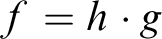 $f=h\cdot g$
with
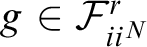 $g\in {\mathcal {F}}^r_{ii^N}$
and
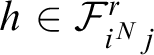 $h\in {\mathcal {F}}^r_{i^Nj}$
. Then
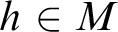 $h\in M$
by
 $\bullet _1$
for q and
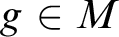 $g\in M$
by Case 1(ii). Hence
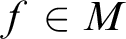 $f\in M$
.
 $\blacktriangle _{\text {(Case 1(iii))}}$
Case 1(iv).
 $i^N\le i\le j<i^M$
. In this case
 ${\mathcal {F}}^r_{ij}={\mathcal {F}}^q_{ij}$
and so
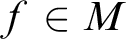 $f\in M$
by
 $\bullet _1$
for q.
 $\blacktriangle _{\text {(Case 1(iv)), (Verification of } \bullet _1)}$
 $\bullet _2$
. Let
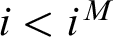 $i<i^M$
and
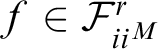 $f\in {\mathcal {F}}^r_{ii^M}$
.
Case2(i).
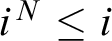 $i^N\le i$
. Then
 $\bullet _2$
for f and M holds by
 $\bullet _2$
for q.
 $\blacktriangle _{\text {(Case 2(i))}}$
Case 2(ii).
 $i<i^N<i^M\!{.}$
Factor f as
 $f=h\cdot f_m\cdot g$
where
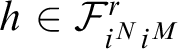 $h\in {\mathcal {F}}^r_{i^Ni^M}$
and
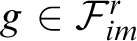 $g\in {\mathcal {F}}^r_{im}$
. Then
 $F^r\cdot f^M\cdot h\in M$
by
 $\bullet _2$
for q. Also,
 $f_m\cdot g\in M$
by
 $\bullet _1$
for r. So
 $F^r\cdot f^M\cdot h\cdot f_m\cdot g=F^r\cdot f^M\cdot f\in M.$
 $\blacktriangle _{\text {(Case 2(ii))}}$
Case 2(iii).
 $i<i^N=i^M$
. Factor f as
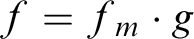 $f=f_m\cdot g$
where
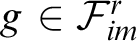 $g\in {\mathcal {F}}^r_{im}$
. As in Case 2(ii),
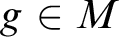 $g\in M$
by
 $\bullet _1$
for r. As in the proof of Case 1(ii),
 $F^r\cdot f^N\cdot f_m = F^s\in N$
. So
 $F^r\cdot f^M\cdot f_m\in M$
by
 $\bullet _4$
for q.
 $\blacktriangle _{\text {(Case 2(iii)), (Verification of } \bullet _2)}$
Now let
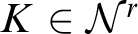 $K\in {\mathcal N}^r$
. If
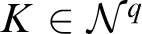 $K\in {\mathcal N}^q$
then each of
 $\bullet _1$
–
 $\bullet _5$
holds for r by the corresponding property for q. So suppose
 $K\in {\mathcal N}^s\setminus {\mathcal N}^q$
.
 $\bullet _3$
. By Lemma 2.9 we have that
 $((\lambda )^{<\kappa ^{+}})^K\subseteq N$
. By
 $\bullet _3$
for q we have
 $((\kappa ^{+})^{<\kappa ^{+}})^N\subseteq ((\kappa ^{+})^{<\kappa ^{+}})^M$
. Thus
 $((\kappa ^{+})^{<\kappa ^{+}})^K\subseteq ((\kappa ^{+})^{<\kappa ^{+}})^M$
.
 $\blacktriangle _{\text {(Verification of } \bullet _3)}$
 $\bullet _4$
. As
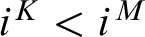 $i^K<i^M$
there is nothing to check here.
 $\blacktriangle _{\text {(Verification of } \bullet _4)}$
 $\bullet _5$
. Suppose
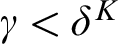 $\gamma <\delta ^K$
,
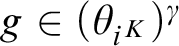 $g\in (\theta _{i^K})^\gamma $
and
 $F^r\cdot f^K\cdot g\in K$
. By Lemma 2.9, since s,
 ${\mathcal N}^s$
and K are all elements of N, we have
 $((\lambda )^{<\kappa ^{+}})^K\subseteq N$
, and so
 $F^r\cdot f^K\cdot g\in N$
.
We also have that
 $f^K=f^N\cdot f_m\cdot (\;f^K)^s$
, so
 $F^r\cdot f^K = F^r\cdot f^N\cdot (\;f_m\cdot (\;f^K)^s)$
. Thus
 $F^r\cdot f^K\in N$
by
 $\bullet _2$
for r applied to N and
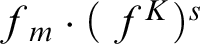 $f_m\cdot (\;f^K)^s$
.
Hence g,
 $ = (F^r\cdot f^N)^{-1} \cdot (F^r\cdot f^N\cdot g)$
,
 $\in N$
. But then
 $g\in ((\kappa ^{+})^{<\kappa ^{+}})^N$
and so
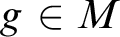 $g\in M$
by
 $\bullet _3$
for q.
 $\blacktriangle _{\text {(Verification of } \bullet _5)}$
Thus
 $r=(S^r,{\mathcal {F}}^r,{\mathcal N}^r)\in \mathbb {P}$
.
 $\blacktriangle _{4.6}$
Hence we have shown that
 $p^*$
is N-generic.
 $\blacktriangle _{4.3}$
Thus forcing with
 $\mathbb {P}$
preserves
 $\kappa ^{+}$
.
 $\blacktriangle _{4.1}$
5 Preservation of
$\lambda $
and greater cardinals

We need a couple of auxiliary definitions for this section.
Definition 5.1. For
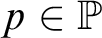 $p\in \mathbb {P}$
let
 $Z^p=\{ i\le \zeta ^p| \exists M\in {\mathcal N}^p (i=i^M)\}$
and, for
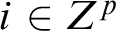 $i\in Z^p$
,
 $X_i^p= \{ g\in (\theta _{i^M})^{\gamma }| \exists M\in {\mathcal N}^p (i=i^M\&\ \gamma <\delta ^M\&\ g\in \overline {M})\} $
.
Note, for each
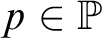 $p\in \mathbb {P}$
we have that
 $\forall i\le j\le \zeta ^p(X^p_j\ne \emptyset \Longrightarrow X^p_i\subseteq X^p_j)$
, by
 ${\circ }_{2}$
, and for
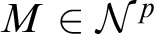 $M\in {\mathcal N}^p$
that
 $X^p_{i^M}=\{ g\in (\theta _{i^M})^{\gamma }| \gamma <\delta ^M\&\ g\in \overline {M}\}$
.
For
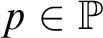 $p\in \mathbb {P}$
and
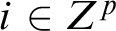 $i\in Z^p$
one has that
 $X_i^p$
is a subset of
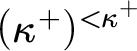 $(\kappa ^{+})^{<\kappa ^{+}}$
of size at most
 $\kappa $
.
We start by showing that
 $\mathbb {P}$
satisfies the criterion of Proposition (2.3) for preserving
 $\lambda $
, being surely
 $\kappa $
-proper. In fact here, when considering that criterion, for each
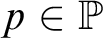 $p\in \mathbb {P}$
we will be able to take the relevant
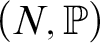 $(N,\mathbb {P})$
-generic
 $p^*$
to be p itself. Consequently, as we will see below, a similar argument allows us to show the stronger conclusion that
 $\mathbb {P}$
has the
 $\lambda $
-chain condition.
Nevertheless, we give the more general argument here as a template, because variants of it will be necessary when employing
 $\mathbb {P}$
as a collection of side conditions in forcings
 $\mathbb {Q}$
(when the
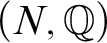 $(N,\mathbb {Q})$
-generic
 $p^*$
will in general not always be able to be taken to be the
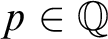 $p\in \mathbb {Q}$
itself) which cannot have the
 $\lambda $
-chain condition.
Proposition 5.2. Suppose
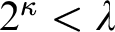 $2^\kappa <\lambda $
. Then forcing with
 $\mathbb {P}$
preserves
 $\lambda $
.
Proof. Let
 $\chi $
be a cardinal such that
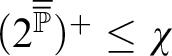 $(2^{{\overline {\overline {\mathbb {P}}}}})^{+} \le \chi $
,
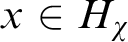 $x\in H_\chi $
and
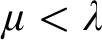 $\mu <\lambda $
. Suppose that D is a dense set in
 $\mathbb {P}$
and x, p, D,
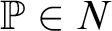 $\mathbb {P}\in N$
where
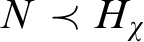 $N\prec H_{\chi }$
,
 $\mu \le \delta ^N=N\cap \lambda \in \lambda $
and
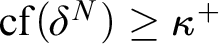 $\mathrm {cf}(\delta ^N)\ge \kappa ^{+}$
,
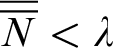 ${\overline {\overline {N}}}<\lambda $
, and
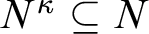 $N^{\kappa }\subseteq N$
.
Claim 5.3. If
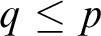 $q\le p$
and
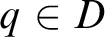 $q\in D$
there is some
 $s\in D\cap N$
such that
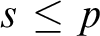 $s\le p$
and s and q are compatible.
Proof. As
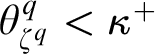 $\theta ^q_{\zeta ^q}<\kappa ^{+}$
we have that
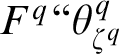 $F^q``\theta ^q_{\zeta ^q}$
is of size at most
 $\kappa $
, so since
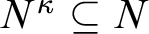 $N^\kappa \subseteq N$
we have that
 $Y=N\cap F^q``\theta ^q_{\zeta ^q} \in N$
. Also, as
 $N\cap \lambda \in \lambda $
we have that Y is an initial segment of
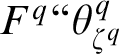 $F^q``\theta ^q_{\zeta ^q}$
. Also, again as
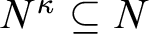 $N^\kappa \subseteq N$
, each
 $X_i^q$
for
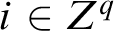 $i\in Z^q$
is an element of N.
Let
 $\phi (x)$
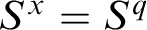
be the formula which is the conjunction of the following subformulae:
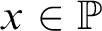 $x\in \mathbb {P}$
;
 $S^x=S^q$
;
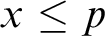 $x\le p$
; Y is an initial segment of
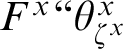 $F^x``\theta ^x_{\zeta ^x}$
;
 $Z^x=Z^q$
; and
 $\langle X_i^x| i\in Z^x\rangle =\langle X_i^q| i\in Z^q\rangle $
.
Since q witnesses
 $H_{\chi }\models \exists x \phi (x)$
there is some
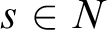 $s\in N$
such that
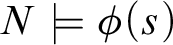 $N\models \phi (s)$
.
It is easy now to amalgamate the morass parts of s and q - our comments about Y have ensured that we have a head-tail-tail amalgamation which we can use in the morass. We give the details in the next-but-one paragraph.
(We believe the term ‘head-tail-tail’ amalgamation was first coined in [Reference Baumgartner and Shelah4]. The general idea is easily grasped: it is amalgamation of two objects, in a situation where is there some notion of ordering on the elements of their union, where the two objects share with a common “initial segment” and where all of the remainder of one of the objects “comes before” all of the remainder of the other.)
In more detail, define r by setting
 $\zeta ^r=\zeta ^q+1$
,
 $S^r\upharpoonright \zeta ^r = S^q = S^s$
,
 $\theta ^r_{\zeta ^r}=\mathrm {otp}(\mathrm {rge}(F^s)\cup \mathrm {rge}(F^q))+1$
,
 ${\mathcal {F}}^r_{\zeta ^q\zeta ^r}=\{ \mathrm {id}, h^r_{\zeta ^q}\}$
, where the splitting point of
 ${\mathcal {F}}^r_{\zeta ^q\zeta ^r}$
,
 $\sigma ^r_{\zeta ^q}$
, is
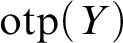 $\mathrm {otp}(Y)$
,
 ${\mathcal {F}}^r_{i\zeta ^r}=\{ f\cdot g| f\in {\mathcal {F}}^r_{\zeta ^q\zeta ^r}\&\ g\in {\mathcal {F}}^r_{i\zeta ^q}\}$
for
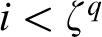 $i<\zeta ^q$
,
 $F^r\upharpoonright \mathrm {otp}(\mathrm {rge}(F^s)\cup \mathrm {rge}(F^q))$
is the inverse of the transitive collapse of
 $\mathrm {rge}(F^s)\cup \mathrm {rge}(F^q)$
,
 $F^r (\mathrm {otp}(\mathrm {rge}(F^s)\cup \mathrm {rge}(F^q)))=\mathrm {ssup}(\mathrm {rge}(F^s)\cup \mathrm {rge}(F^q))$
, and
 ${\mathcal N}^r={\mathcal N}^s\cup {\mathcal N}^q$
.
Subclaim 5.4.
 ${\mathcal N}^r$
is such that
 $r\in \mathbb {P}$
, whence r witnesses that s and q are compatible.
Proof. The property
 ${\circ }_{1}$
holds for r immediately from
 ${\circ }_{1}$
for q and s. We will be finished if we show that
 ${\circ }_{2}$
also holds for r.
Suppose that
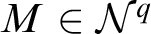 $M\in {\mathcal N}^q$
and
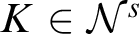 $K\in {\mathcal N}^s$
. (In all other cases
 ${\circ }_{2}$
holds by virtue of holding for q or s.)
Since
 $Z^s=Z^q$
there are
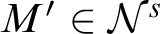 $M'\in {\mathcal N}^s$
and
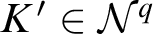 $K'\in {\mathcal N}^q$
such that
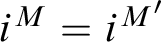 $i^M=i^{M'}$
and
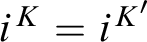 $i^K=i^{K'}$
and, as s,
 $q\in \mathbb {P}$
we have that
 ${\circ }_{2}$
holds for each of the two pairs K,
 $M'$
and
 $K'$
, M. Thus, if
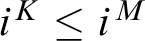 $i^K\le i^M$
we have that
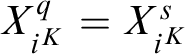 $X^q_{i^K}=X^s_{i^K}$
implies that
 ${\circ }_{2}$
holds for K, M, while if
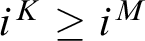 $i^K\ge i^M$
then
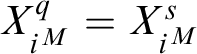 $X^q_{i^M}=X^s_{i^M}$
implies that
 ${\circ }_{2}$
holds for K, M.
 $\blacktriangle _{5.4}$
Thus we have shown Claim (5.3).
 $\blacktriangle _{5.3}$
Hence forcing with
 $\mathbb {P}$
preserves
 $\lambda $
.
 $\blacktriangle _{5.2}$
Proposition 5.5. If
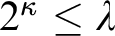 $2^\kappa \le \lambda $
then cardinals above
 $\lambda $
are preserved.
Proof. As
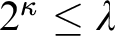 $2^{\kappa }\le \lambda $
the forcing has the
 $\lambda ^{+}$
chain condition.
 $\blacktriangle _{5.5}$
Of course, if
 $\lambda $
is strongly inaccessible then clearly the forcing
 $\mathbb {P}$
has the
 $\lambda $
-chain condition. However, as mentioned above in the preamble to Proposition (5.2), we can in fact show that
 $\mathbb {P}$
always has the
 $\lambda $
-chain condition.
Proposition 5.6. If
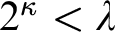 $2^\kappa <\lambda $
then
 $\mathbb {P}$
has the
 $\lambda $
-chain condition.
Proof. Suppose that
 ${\mathcal A}$
is an antichain in
 $\mathbb {P}$
and
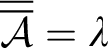 ${\overline {\overline {\mathcal {A}}}}=\lambda $
. Let
 $\chi $
be large enough so that
 ${\mathcal A}$
,
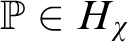 $\mathbb {P}\in H_\chi $
(e.g.,
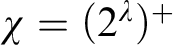 $\chi = (2^{\lambda })^{+}$
). Let
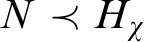 $N\prec H_{\chi }$
be such that
 $\delta ^N=N\cap \lambda \in \lambda $
and
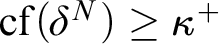 $\mathrm {cf}(\delta ^N)\ge \kappa ^{+}$
,
 ${\overline {\overline {N}}}<\lambda $
, and
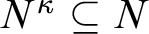 $N^{\kappa }\subseteq N$
and
 ${\mathcal A}$
,
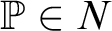 $\mathbb {P}\in N$
. Choose
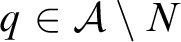 $q\in {\mathcal A}\setminus N$
. Since every condition in
 $\mathbb {P}$
is
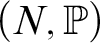 $(N, \mathbb {P})$
-generic, q certainly is. Thus there is some
 $s\in {\mathcal A}\cap N$
compatible with q. This contradicts the assumption that
 ${\mathcal A}$
is an antichain. Thus we have shown that
 $\mathbb {P}$
contains no antichains of size
 $\lambda $
.
 $\blacktriangle _{5.6}$
We are grateful to the referee for the suggestion that in the proof of this Proposition we re-use what was proved in Claim (5.3), rather than essentially re-cycling its proof, as we originally had done.
6 Preservation of
$\kappa $
and all smaller cardinals

In this section we show that if
 $\kappa $
is a regular cardinal then
 $\mathbb {P}$
is
 ${<}\kappa $
-closed. The proof is similar to the proof in the following section that forcing with
 $\mathbb {P}$
adds a
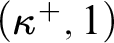 $(\kappa ^{+},1)$
-simplified morass.
Suppose that
 $\kappa $
is a regular cardinal.
Proposition 6.1. The forcing with
 $\mathbb {P}$
is
 ${<}\kappa $
-closed.
Proof. Let
 $\mu $
be a cardinal with
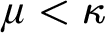 $\mu <\kappa $
. Let
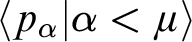 $\langle p_\alpha | \alpha <\mu \rangle $
be a descending sequence of conditions from
 $\mathbb {P}$
. For
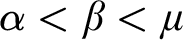 $\alpha <\beta <\mu $
let
 $k_{\alpha \beta }$
witness that
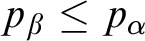 $p_\beta \le p_\alpha $
. Note that if
 $\alpha <\beta <\gamma <\mu $
then
 $k_{\alpha \gamma }=k_{\beta \gamma }\cdot k_{\alpha \beta }$
.
We start by constructing a small SMS segment S into which each
 $S^{p_\alpha }$
is embedded.
Define two relations
 $\sim $
and
 $<$
on the set
 $\{ (\alpha ,i)| \alpha <\mu \&\ i\le \zeta ^{p_\alpha }\}$
, by
 $(\alpha ,i)\sim (\beta ,j)$
if
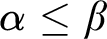 $\alpha \le \beta $
and
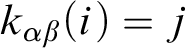 $k_{\alpha \beta }(i)=j$
or
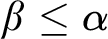 $\beta \le \alpha $
and
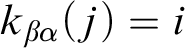 $k_{\beta \alpha }(j)=i$
, and, similarly,
 $(\alpha ,i) < (\beta ,j)$
and
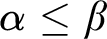 $\alpha \le \beta $
and
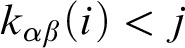 $k_{\alpha \beta }(i)<j$
or
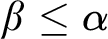 $\beta \le \alpha $
and
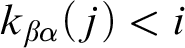 $k_{\beta \alpha }(j)<i$
. Clearly
 $\sim $
is an equivalence relation and
 $<$
is a linear ordering which respects
 $\sim $
, inducing a linear ordering on the
 $\sim $
-equivalence classes
 ${\mathcal E}=\{ [(\alpha ,i)]_\sim | \alpha <\mu \&\ i\le \zeta ^{p_\alpha }\}$
.
For
 $x=[(\alpha ,i)]_\sim \in {\mathcal E}$
let
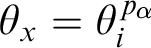 $\theta _x = \theta ^{p_\alpha }_i$
. Note, by the definition of
 $\sim $
and of
 $\le _{\mathbb {P}}$
, that
 $\theta _x$
is independent of the choice of the pair
 $(\alpha ,i)$
. Note, also, that
 $x = [(\alpha ,i)]_{\sim } < y = [(\beta ,j)]_{\sim }$
if and only if
 $\theta _x<\theta _y<\kappa ^{+}$
. Consequently,
 $<$
well-orders
 ${\mathcal E}$
.
For x,
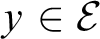 $y\in {\mathcal E}$
define
 ${\mathcal {F}}_{xy}=\bigcup \{ f\in {\mathcal {F}}^{p_\alpha }_{ij}| \alpha <\mu \&\ x=[(\alpha ,i)]_\sim \&\ y=[(\alpha ,j)]_\sim \}$
. Let
 ${\mathcal {F}}_x= \{ F^{p_\alpha }\cdot f| x=[(\alpha ,i)]_\sim \&\ f\in {\mathcal {F}}^{p_\alpha }_{i\zeta ^p_{\alpha }} \}$
.
Let
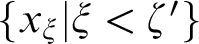 $\{ x_{\xi }| \xi <\zeta '\}$
be the
 $<$
-increasing ordering of
 ${\mathcal E}$
. We must have that
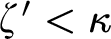 $\zeta '<\kappa $
since
 $\overline {\overline {\{ (\alpha ,i)| \alpha <\mu \&\ i\le \zeta ^{p_\alpha }\}}} < \kappa $
.
Let
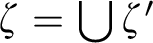 $\zeta = \bigcup \zeta '$
. That is, if there is a
 $<$
-maximal element of
 ${\mathcal E}$
, and so
 $\zeta '$
is a successor, set
 $\zeta $
to be the predecessor of
 $\zeta '$
; otherwise, let
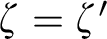 $\zeta =\zeta '$
.
For
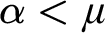 $\alpha <\mu $
define
 $k_\alpha :\zeta ^{p_{\alpha }}+1\longrightarrow \zeta +1$
by
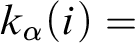 $k_\alpha (i)= $
that
 $\xi $
such that
 $x_\xi = [(\alpha ,i)]_{\sim }$
for
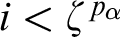 $i<\zeta ^{p_{\alpha }}$
.
For
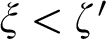 $\xi <\zeta '$
let
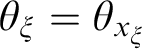 $\theta _\xi =\theta _{x_\xi }$
. For
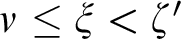 $\nu \le \xi <\zeta '$
let
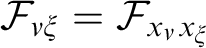 ${\mathcal {F}}_{\nu \xi }={\mathcal {F}}_{x_\nu x_\xi }$
. If
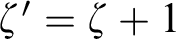 $\zeta '=\zeta +1$
and
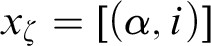 $x_\zeta =[(\alpha ,i)]$
for
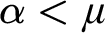 $\alpha <\mu $
and
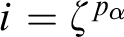 $i=\zeta ^{p_\alpha }$
, let
 $F= F^{p_{\alpha }}$
.
If
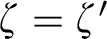 $\zeta =\zeta '$
let
 $\theta _\zeta = \mathrm {otp}(\bigcup \{ \mathrm {rge}(F^{p_\alpha })| \alpha <\mu \})$
, let F be the inverse of the transitive collapse of
 $\bigcup \{ \mathrm {rge}(F^{p_\alpha })| \alpha <\mu \}$
and for
 $\xi <\zeta $
let
 ${\mathcal {F}}_{\xi \zeta } = \bigcup \{ F^{-1}\cdot F^{p_{\alpha }}\cdot f| \alpha <\mu \&\ k_\alpha (i)=\xi \&\ f\in {\mathcal {F}}^{p_\alpha }_{i\zeta ^{p_\alpha }} \}$
.
We shall show that the structure
 $\langle \langle \theta _\xi | \xi \le \zeta \rangle , \langle {\mathcal {F}}_{\nu \xi }| \nu \le \xi \le \zeta \rangle \rangle $
has almost all of the properties of a small SMS and then show how to gently interleave limit levels of small cofinality where necessary.
We start with the structure of the sets
 ${\mathcal {F}}_{\xi \xi +1}$
for
 $\xi <\zeta $
.
Given
 $\xi <\zeta $
let
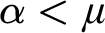 $\alpha <\mu $
be such that for some
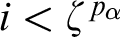 $i<\zeta ^{p_{\alpha }}$
one has
 $x_\xi =[(\alpha ,i)]_\sim $
and
 $x_{\xi +1}=[(\alpha ,i+1)]_\sim $
. Then, by the definition of
 $\mathbb {P}$
,
 ${\mathcal {F}}^{p_\alpha }_{ii+1}$
is either a singleton (consisting of an order-preserving map) or an amalgamation pair, and for all
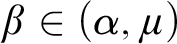 $\beta \in (\alpha ,\mu )$
we have
 $k_{\alpha \beta }(i+1)=k_{\alpha \beta }(i) + 1$
and
 ${\mathcal {F}}^{p_\beta }_{k_{\alpha \beta }(i)k_{\alpha \beta }(i)+1}= {\mathcal {F}}^{p_\alpha }_{ii+1}$
. Hence we must then have that
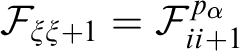 ${\mathcal {F}}_{\xi \xi +1}= {\mathcal {F}}^{p_\alpha }_{ii+1}$
and is a singleton (consisting of an order-preserving map) or an amalgamation pair. (Note that, by the definition of small SMS, if
 ${\mathcal {F}}_{\xi \xi +1}={\mathcal {F}}^{p_\alpha }_{ii+1} =\{ f_i\}$
is a singleton then
 $f_i$
is not cofinal.)
Now we show the
 ${\mathcal {F}}_{\nu \xi }$
have the required factorization property.
Suppose
 $\nu \le \tau \le \xi <\zeta '$
and
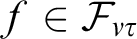 $f\in {\mathcal {F}}_{\nu \tau }$
and
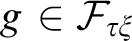 $g\in {\mathcal {F}}_{\tau \xi }$
. As
 $\mu $
is a limit ordinal there is some
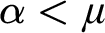 $\alpha <\mu $
with some
 $i\le j \le l\le \zeta ^{p_\alpha }$
such that
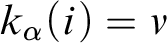 $k_\alpha (i)=\nu $
,
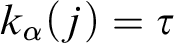 $k_\alpha (j)=\tau $
and
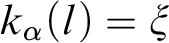 $k_\alpha (l)=\xi $
(i.e.,
 $x_\nu =[(\alpha ,i)]_\sim $
,
 $x_\tau =[(\alpha ,j)]_\sim $
and
 $x_\xi =[(\alpha ,l)]_\sim $
),
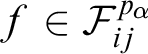 $f\in {\mathcal {F}}^{p_{\alpha }}_{ij}$
and
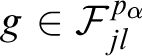 $g\in {\mathcal {F}}^{p_{\alpha }}_{jl}$
. Thus
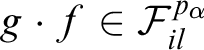 $g\cdot f\in {\mathcal {F}}^{p_{\alpha }}_{il}$
, and hence
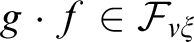 $g\cdot f\in {\mathcal {F}}_{\nu \xi }$
.
Similarly, suppose
 $\nu \le \tau \le \xi <\zeta $
and
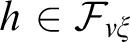 $h\in {\mathcal {F}}_{\nu \xi }$
. There is some
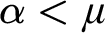 $\alpha <\mu $
and
 $i\le j \le l\le \zeta ^{p_{\alpha }}$
such that
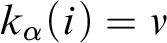 $k_\alpha (i)=\nu $
,
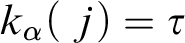 $k_\alpha (\;j)=\tau $
,
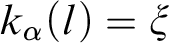 $k_\alpha (l)=\xi $
and
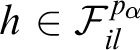 $h\in {\mathcal {F}}^{p_{\alpha }}_{il}$
. But then, as
 $S^{p_{\alpha }}$
is a small SMS, there are
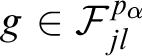 $g\in {\mathcal {F}}^{p_{\alpha }}_{jl}$
,
 $\subseteq {\mathcal {F}}_{\tau \xi }$
, and
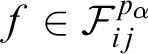 $f\in {\mathcal {F}}^{p_{\alpha }}_{ij}$
,
 $\subseteq {\mathcal {F}}_{\nu \tau }$
, such that
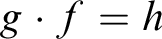 $g\cdot f= h$
.
Now suppose that
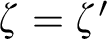 $\zeta =\zeta '$
and
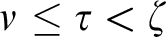 $\nu \le \tau <\zeta $
. If
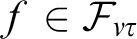 $f\in {\mathcal {F}}_{\nu \tau }$
and
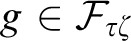 $g\in {\mathcal {F}}_{\tau \zeta }$
there is some
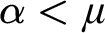 $\alpha <\mu $
,
 $i\le j \le l\le \zeta ^{p_{\alpha }}$
and
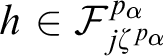 $h\in {\mathcal {F}}^{p_\alpha }_{j\zeta ^{p_{\alpha }}}$
such that
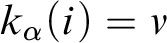 $k_\alpha (i)=\nu $
,
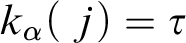 $k_\alpha (\;j)=\tau $
,
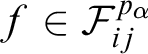 $f\in {\mathcal {F}}^{p_\alpha }_{ij}$
and
 $g=F^{-1}\cdot F^{p_{\alpha }} \cdot h$
. Then
 $g\cdot f = F^{-1}\cdot F^{p_{\alpha }} \cdot (h\cdot f)$
, where
 $h\cdot f \in {\mathcal {F}}^{p_\alpha }_{i\zeta ^{p_{\alpha }}} \subseteq {\mathcal {F}}_{\nu \tau }$
, and hence
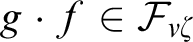 $g\cdot f\in {\mathcal {F}}_{\nu \zeta }$
.
Similarly, if
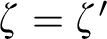 $\zeta =\zeta '$
,
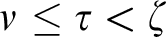 $\nu \le \tau <\zeta $
and
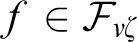 $f\in {\mathcal {F}}_{\nu \zeta }$
there is some
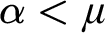 $\alpha <\mu $
,
 $i\le j \le l\le \zeta ^{p_{\alpha }}$
,
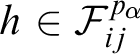 $h\in {\mathcal {F}}^{p_\alpha }_{ij}$
and
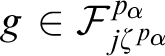 $g\in {\mathcal {F}}^{p_\alpha }_{j \zeta ^{p_{\alpha }}}$
such that
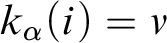 $k_\alpha (i)=\nu $
,
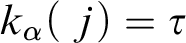 $k_\alpha (\;j)=\tau $
, and
 $f=(F^{-1}\cdot F^{p_{\alpha }}\cdot g)\cdot h$
.
Next, we show directedness at limits.
Suppose
 $\nu $
,
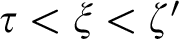 $\tau <\xi <\zeta '$
,
 $\xi $
is a limit ordinal,
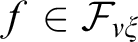 $f\in {\mathcal {F}}_{\nu \xi }$
and
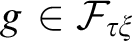 $g\in {\mathcal {F}}_{\tau \xi }$
. Let
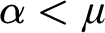 $\alpha <\mu $
be such that there are
 $i\le j< l\le \zeta ^{p_{\alpha }}$
with
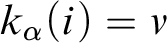 $k_\alpha (i)=\nu $
,
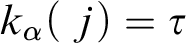 $k_\alpha (\;j)=\tau $
,
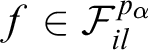 $f\in {\mathcal {F}}^{p_\alpha }_{il}$
and
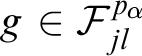 $g\in {\mathcal {F}}^{p_\alpha }_{jl}$
.
If l is a successor then
 ${\mathcal {F}}^p_{l-1l}$
is a singleton, say
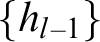 $\{ h_{l-1}\}$
(as otherwise
 $k_{\alpha \beta }(l)=k_{\alpha \beta }(l-1)+1$
for all
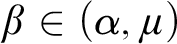 $\beta \in (\alpha ,\mu )$
and hence
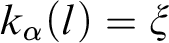 $k_\alpha (l)=\xi $
is a successor). Furthermore, as
 $S^p$
is a SMS there are
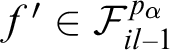 $f'\in {\mathcal {F}}^{p_{\alpha }}_{il-1}$
and
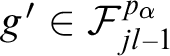 $g'\in {\mathcal {F}}^{p_{\alpha }}_{jl-1}$
such that
 $f=h_{l-1}\cdot f'$
and
 $g=h_{l-1}\cdot g'$
. But then
 $k_\alpha (l-1) \in [\nu \cup \tau ,\xi )$
and
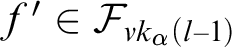 $f'\in {\mathcal {F}}_{\nu k_\alpha (l-1)}$
,
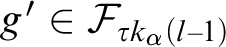 $g'\in {\mathcal {F}}_{\tau k_\alpha (l-1)}$
and
 $h_{l-1}\in {\mathcal {F}}_{k_\alpha (l-1)\xi }$
.
If l is a limit, by the definition of small SMS, there is some
 $m\in [\max (\{ i,j\}), l)$
, and
 $h\in {\mathcal {F}}^{p_{\alpha }}_{ml}$
,
 $f'\in {\mathcal {F}}^{p_{\alpha }}_{im}$
and
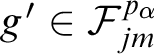 $g'\in {\mathcal {F}}^{p_{\alpha }}_{jm}$
such that
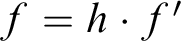 $f = h \cdot f'$
and
 $g= h\cdot g'$
. Hence
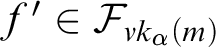 $f'\in {\mathcal {F}}_{\nu k_\alpha (m)}$
,
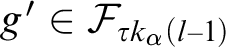 $g'\in {\mathcal {F}}_{\tau k_\alpha (l-1)}$
and
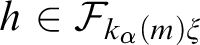 $h\in {\mathcal {F}}_{k_\alpha (m)\xi }$
.
Now suppose that
 $\nu $
,
 $\tau <\zeta =\zeta '$
,
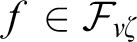 $f\in {\mathcal {F}}_{\nu \zeta }$
and
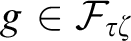 $g\in {\mathcal {F}}_{\tau \zeta }$
. Then there is some
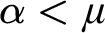 $\alpha <\mu $
and
 $i\le j\le \zeta ^{p_{\alpha }}$
with
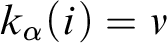 $k_\alpha (i)=\nu $
,
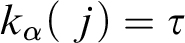 $k_\alpha (\;j)=\tau $
, and
 $k_\alpha (\zeta ^{p_{\alpha }})=\xi <\zeta $
, and some maps
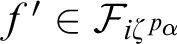 $f'\in {\mathcal {F}}_{i\zeta ^{p_{\alpha }}}$
and
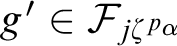 $g'\in {\mathcal {F}}_{j\zeta ^{p_{\alpha }}}$
with
 $f=F^{-1}\cdot F^{p_{\alpha }}\cdot f'$
and
 $g=F^{-1}\cdot F^{p_{\alpha }}\cdot g'$
. As
 $F^{-1}\cdot F^{p_{\alpha }}\in {\mathcal {F}}_{\xi \zeta }$
we are done.
We have now shown that
 $\langle \langle \theta _\xi | \xi \le \zeta \rangle , \langle {\mathcal {F}}_{\nu \xi }| \nu \le \xi \le \zeta \rangle \rangle $
has all of the properties of a small SMS, except possibly the property that if
 $\xi \le \zeta $
is a limit ordinal then
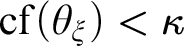 $\mathrm {cf}(\theta _\xi )<\kappa $
. In order to guarantee this last property, in general, we must add additional levels to
 ${\mathcal E}$
.
In order to see why consider the example of some
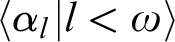 $\langle \alpha _l| l<\omega \rangle $
in which for all
 $l<\omega $
we have
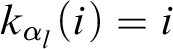 $k_{\alpha _l}(i) = i$
for all
 $i<l$
but
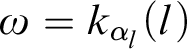 $\omega = k_{\alpha _l}(l)$
and
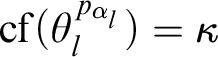 $\mathrm {cf}(\theta ^{p_{\alpha _l}}_l)=\kappa $
. We then need to insert a ‘new’
 $\omega $
th level in order to ensure that the
 $\theta $
of the
 $\omega $
th level of the lower bound we are constructing does not have cofinality
 $\kappa $
.
This interleaving of additional levels is not hard to do, but writing down the details formally, as we do in the following four paragraphs, is a little involved.
So, set
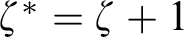 $\zeta ^*=\zeta +1$
if
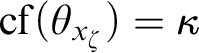 $\mathrm {cf}(\theta _{x_\zeta })=\kappa $
, and otherwise let
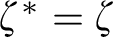 $\zeta ^*=\zeta $
. For
 $\alpha <\mu $
we define
 $k^*_\alpha :\zeta ^{p_{\alpha }}\longrightarrow \zeta ^*$
as follows. For each
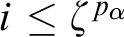 $i\le \zeta ^{p_{\alpha }}$
let
 $\xi _i$
be the greatest limit ordinal such that
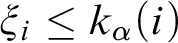 $\xi _i\le k_\alpha (i)$
if it exists and undefined otherwise. If
 $\xi _i$
is defined and
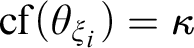 $\mathrm {cf}(\theta _{\xi _i})=\kappa $
then
 $k^*_\alpha (i)=k_\alpha (i)+1$
. Otherwise we take
 $k^*_\alpha (i)=k_\alpha (i)$
.
For
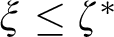 $\xi \le \zeta ^*$
such that
 $\xi \in \bigcup \{ \mathrm {rge}\;{k^*_\alpha }| \alpha <\mu \}$
we let
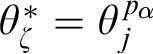 $\theta ^*_\zeta = \theta ^{p_{\alpha }}_j$
for any pair
 $(\alpha ,j)$
such that
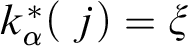 $k^*_{\alpha }(\;j)=\xi $
. If
 $\nu \le \xi \le \zeta ^*$
and
 $\nu $
,
 $\xi \in \bigcup \{ \mathrm {rge}\;{k^*_\alpha }| \alpha <\mu \}$
let
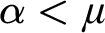 $\alpha <\mu $
be such that
 $\nu $
,
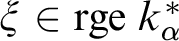 $\xi \in \mathrm {rge}\;{k^*_\alpha }$
, let
 $\nu '= k_\alpha ((k^*_{\alpha })^{-1}(\nu )$
and
 $\xi '= k_\alpha ((k^*_{\alpha })^{-1}(\xi )$
and set
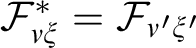 ${\mathcal {F}}^*_{\nu \xi }= {\mathcal {F}}_{\nu '\xi '}$
.
Now suppose otherwise, that
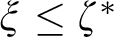 $\xi \le \zeta ^*$
but
 $\xi \notin \bigcup \{ \mathrm {rge}\;{k^*_\alpha }| \alpha <\mu \}$
, hence
 $\xi $
is a limit ordinal. Let
 $\alpha ^*$
be least such that
 $\xi \in \mathrm {rge}\;(k_{\alpha ^*})$
. For all
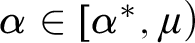 $\alpha \in [\alpha ^*,\mu )$
and all
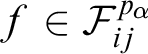 $f\in {\mathcal {F}}^{p_\alpha }_{ij}$
, where
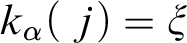 $k_\alpha (\;j)=\xi $
let
 $\gamma _f=\mathrm {ssup}(\mathrm {rge}(\;f))$
. For all such f we have
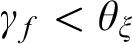 $\gamma _f<\theta _\xi $
. Hence, as
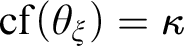 $\mathrm {cf}(\theta _\xi )=\kappa $
, we have
 $\mathrm {ssup}(\{ \gamma _f| \alpha \in [\alpha ^*,\mu )\&\ k_\alpha (\;j)=\xi \&\ f\in {\mathcal {F}}^{p_\alpha }_{ij}\})<\theta _\xi $
.
So we can choose
 $\theta ^*_\xi $
such that
 $\mathrm {ssup}(\{ \gamma _f| \alpha \in [\alpha ^*,\mu )\&\ k_\alpha (\;j)=\xi \&\ f\in {\mathcal {F}}^{p_\alpha }_{ij}\})<\theta ^*_\xi <\theta _\xi $
and
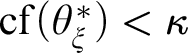 $\mathrm {cf}(\theta ^*_\xi )<\kappa $
. We set
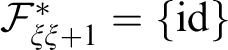 ${\mathcal {F}}^*_{\xi \xi +1} = \{ \mathrm {id}\}$
and define the other sets of maps in the obvious way using composition to ensure the last clause in the definition of small SMS holds: e.g., for
 $\nu \in \bigcup \{ \mathrm {rge}{k^*_\alpha }| \alpha <\mu \}$
if
 $\nu <\xi $
we take
 ${\mathcal {F}}^*_{\nu \xi +1}=\{ \mathrm {id}\cdot f| f\in {\mathcal {F}}^*_{\nu \xi }\}$
and if
 $\xi <\nu $
we take
 ${\mathcal {F}}^*_{\xi \nu }=\{ f\cdot \mathrm {id}| f\in {\mathcal {F}}^*_{\xi +1\nu }\}$
.
Now set
 $S=\langle \langle \theta ^*_\xi | \xi \le \zeta ^*\rangle , \langle {\mathcal {F}}^*_{\nu \xi }| \nu \le \xi \le \zeta ^*\rangle \rangle $
. It is clear that S is an small SMS.
We also define
 $\mathcal {N}=\{ N| \exists \alpha <\mu N\in \mathcal {N}^{p_\alpha }\}$
and set
 $p=(S,F,\mathcal {N})$
.
In order to finish the proof we must show that
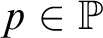 $p\in \mathbb {P}$
and that
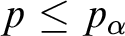 $p\le p_\alpha $
for each
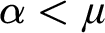 $\alpha <\mu $
.
For the former all that is left to show is that
 $\mathcal {N}$
is as required.
Suppose
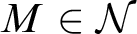 $M\in \mathcal {N}$
. Let
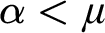 $\alpha <\mu $
be such that
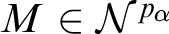 $M\in \mathcal {N}^{p_\alpha }$
., and let
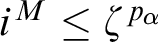 $i^M\le \zeta ^{p_\alpha }$
and
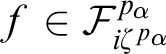 $f\in {\mathcal {F}}^{p_\alpha }_{i\zeta ^{p_\alpha }}$
witness this. Then M fits
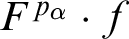 $F^{p_\alpha } \cdot f $
,
 $=F\cdot (F^{-1}\cdot F^{p_\alpha } \cdot f )$
and the uniqueness of
 $(k^*_\alpha (i^M), F^{-1}\cdot F^{p_\alpha } \cdot f)$
follows from Lemma 3.2.
Suppose
 $i'\le j'\le k^*_\alpha (i^M)$
and
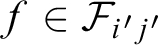 $f\in {\mathcal {F}}_{i'j'}$
. If
 $i'\in \bigcup \{ \mathrm {rge}(k^*_\beta )| \beta \in (\alpha ,\mu )\}$
let
 $i=i'$
and otherwise let
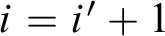 $i=i'+1$
. Define j similarly. Then there is some
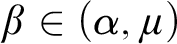 $\beta \in (\alpha ,\mu )$
and
 $\overline {i}$
,
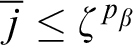 $\overline {j}\le \zeta ^{p_\beta }$
such that
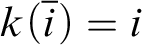 $k(\overline {i})=i$
,
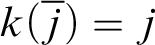 $k(\overline {j})=j$
and
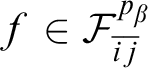 $f\in {\mathcal {F}}^{p_\beta }_{\overline {i}\overline {j}}$
. As
 $M\in {\mathcal N}^{p_\beta }$
we have that
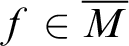 $f\in \overline {M}$
.
Similarly, if
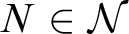 $N\in {\mathcal N}$
,
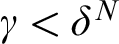 $\gamma <\delta ^N$
,
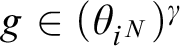 $g\in (\theta _{i^N})^\gamma $
,
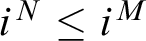 $i^N\le i^M$
and
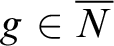 $g\in \overline {N}$
there is some
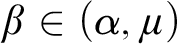 $\beta \in (\alpha ,\mu )$
such that
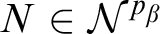 $N\in {\mathcal N}^{p_\beta }$
and
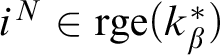 $i^N\in \mathrm {rge}(k^*_\beta )$
and hence
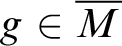 $g\in \overline {M}$
.
Now let
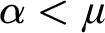 $\alpha <\mu $
. We check that
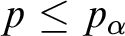 $p\le p_\alpha $
.
We take the witnessing ‘k’ to be
 $k^*_\alpha $
. The three bulleted properties of
 $k^*_\alpha $
are immediate from the definition of
 $k^*_\alpha $
and that of S. We take
 $f^{p_\alpha p}$
to be
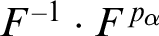 $F^{-1}\cdot F^{p_\alpha }$
, making it immediate that
 $F^{p_\alpha } = F\cdot f^{p_\alpha p}$
. It is also immediate from the definition of
 ${\mathcal N}$
that
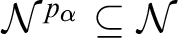 ${\mathcal N}^{p_\alpha }\subseteq {\mathcal N}$
.
Finally, if
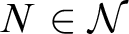 $N\in {\mathcal N}$
is witnessed by
 $(k^*_\alpha (i),f^{p_\alpha p}\cdot g)$
for some
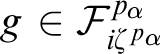 $g\in {\mathcal {F}}^{p_\alpha }_{i\zeta ^{p_\alpha }}$
then we must show that
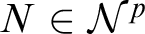 $N\in {\mathcal N}^p$
.
Let
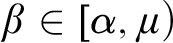 $\beta \in [\alpha ,\mu )$
be such that
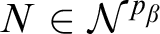 $N \in {\mathcal N}^{p_\beta }$
. By the definition of
 $k^*_\alpha $
and the fact that
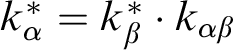 $k^*_\alpha = k^*_\beta \cdot k_{\alpha \beta }$
, and since
 $F^{p_\alpha } = F^{p_\beta }\cdot f^{p_\alpha p_\beta }$
, we have that this is witnessed by
 $(k_{\alpha \beta }(i),f^{p_\alpha p_\beta }\cdot g)$
. As
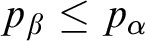 $p_\beta \le p_\alpha $
we have (by the final property in the list of requirements defining
 $\le _{\mathbb {P}}$
) that
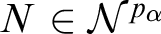 $N\in {\mathcal N}^{p_\alpha }$
(and
 $(i,g)$
witnesses that N fits
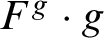 $F^g\cdot g$
).
 $\blacktriangle _{6.1}$
7 Showing
$\mathbb {P}$
adds an
$(\kappa ^{+},1)$
-simplified morass

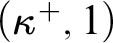
Lemma 7.1. Let
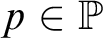 $p\in \mathbb {P}$
,
 $\zeta <\lambda $
and
 $\theta \in (\mathrm {otp}(\mathrm {rge}(F^p)\cup \{ \zeta \})), \kappa ^{+})$
. Then there is some
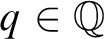 $q\in \mathbb {Q}$
such that
 $\zeta ^q=\zeta ^p+1$
,
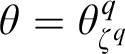 $\theta =\theta ^q_{\zeta ^q}$
and
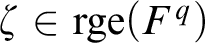 $\zeta \in \mathrm {rge}(F^q)$
.
Proof. Define q as follows. Let
 $\zeta ^q=\zeta ^p+1$
.
If
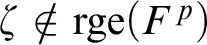 $\zeta \notin \mathrm {rge}(F^p)$
let
 $\gamma =\mathrm {otp}(\mathrm {rge}(F^p)\cap \zeta ))$
. Define
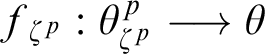 $f_{\zeta ^p}:\theta ^p_{\zeta ^p}\longrightarrow \theta $
by
 $f_{\zeta ^p}\upharpoonright \gamma =\mathrm {id}$
and
 $f_{\zeta ^p}(\gamma +\xi )=\gamma +1+\xi $
for
 $\xi \in \mathrm {otp}(\theta ^p_{\zeta ^p}\setminus \gamma )$
. Define
 $F^q:\theta \longrightarrow \lambda $
by
 $F^q(\xi )=F^p(\xi )$
for
 $\xi <\gamma $
,
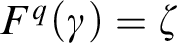 $F^q(\gamma )=\zeta $
,
 $F^q(\gamma +1+\xi ) =F^p(\gamma +\xi )$
for
 $\xi \in \mathrm {otp}(\theta ^p_{\zeta ^p}\setminus \gamma )$
and
 $F^q(\theta ^p_{\zeta ^p} + \xi )= \mathrm {ssup}(F^p``\theta ^p_{\zeta ^p})+\xi $
for
 $\xi \in \mathrm {otp}(\theta \setminus (\gamma +1+\mathrm {otp}(\theta ^p_{\zeta ^p} \setminus \gamma )))$
.
If, on the other hand,
 $\zeta \in \mathrm {rge}(F^p)$
let
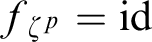 $f_{\zeta ^p}=\mathrm {id}$
and let
 $F^q:\theta \longrightarrow \lambda $
be given by
 $F^q(\xi )=F^p(\xi )$
for
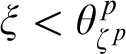 $\xi <\theta ^p_{\zeta ^p}$
and
 $F^q(\theta ^p_{\zeta ^p} + \xi )= \mathrm {ssup}(F^p``\theta ^p_{\zeta ^p})+\xi $
for
 $\xi \in \mathrm {otp}(\theta \setminus \theta ^p_{\zeta ^p})$
.
Finally, let
 $S^q=\langle \langle \theta ^p_{i} | i\le \zeta ^p \rangle \frown \theta , \langle {\mathcal {F}}^p_{ij} | i\le j\le \zeta ^p \rangle \rangle $
 $$ \begin{align*} \hskip7pc \langle \{ f_{\zeta^p} \cdot f | f\in {\mathcal{F}}^p_{i\zeta^p} \} | i\le \zeta^p\rangle \rangle ,\end{align*} $$
 ${\mathcal {F}}^*=\{ (F^q\cdot f, \theta ^{q}_i) | i\le \zeta ^p+1 \&\ f\in {\mathcal {F}}^q_{i\zeta ^p+1} \}$
and
 ${\mathcal N}^q={\mathcal N}^p$
.
 $\blacktriangle _{7.1}$
Proposition 7.2. Forcing with
 $\mathbb {P}$
adds an
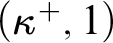 $(\kappa ^{+},1)$
-simplified morass.
Proof. Let G be
 $\mathbb {P}$
-generic. Define two relations
 $\sim $
and
 $<$
on the set
 $\{ (p,i)| p\in G\&\ i\le \zeta ^p\}$
, by
 $(p,i)\sim (q,j)$
if there is some
 $r\in G$
with
 $r\le p$
, q witnessed by
 $k:\zeta ^p\longrightarrow \zeta ^r$
and
 $l:\zeta ^q\longrightarrow \zeta ^r$
and
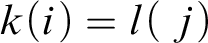 $k(i)=l(\;j)$
and, similarly,
 $(p,i) < (q,j)$
if there is some
 $r\in G$
with
 $r\le p$
, q witnessed by
 $k:\zeta ^p\longrightarrow \zeta ^r$
and
 $l:\zeta ^q\longrightarrow \zeta ^r$
and
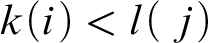 $k(i)<l(\;j)$
. Clearly
 $\sim $
is an equivalence relation and
 $<$
is a linear ordering which respects
 $\sim $
, inducing a linear ordering on the
 $\sim $
-equivalence classes
 ${\mathcal E}=\{ [(p,i)]_\sim | p\in G\&\ i\le \zeta ^p\}$
.
For
 $x=[(p,i)]_\sim \in {\mathcal E}$
let
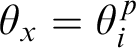 $\theta _x = \theta ^p_i$
. Note, by the definition of
 $\sim $
and of
 $\le _{\mathbb {P}}$
, that
 $\theta _x$
is independent of the choice of the pair
 $(p,i)$
. Note, also, that
 $x = [ p,i)]_{\sim } < y = [(q,j)]_{\sim }$
if and only if
 $\theta _x<\theta _y<\kappa ^{+}$
. Consequently,
 $<$
well-orders
 ${\mathcal E}$
and, by Lemma 7.1, it does so in order-type
 $\kappa ^{+}$
, since
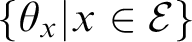 $\{ \theta _x| x\in {\mathcal E}\}$
is unbounded in
 $\kappa ^{+}$
. Let
 $\{ x_{\alpha }| \alpha <\kappa ^{+}\}$
be the
 $<$
-increasing ordering of
 ${\mathcal E}$
.
For x,
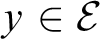 $y\in {\mathcal E}$
define
 ${\mathcal {F}}_{xy}=\bigcup \{ f\in {\mathcal {F}}^p_{ij}| p\in G \&\ x=[(p,i)]_\sim \&\ y=[(p,j)]_\sim \}$
. Let
 ${\mathcal {F}}_x= \{ F^p\cdot f| p\in G\&\ x=[(p,i)]_\sim \&\ f\in {\mathcal {F}}^p_{i\zeta ^p} \}$
.
For
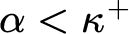 $\alpha <\kappa ^{+}$
let
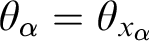 $\theta _\alpha =\theta _{x_\alpha }$
. Let
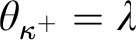 $\theta _{\kappa ^{+}}=\lambda $
. For
 $\alpha \le \beta <\kappa ^{+}$
let
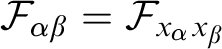 ${\mathcal {F}}_{\alpha \beta }={\mathcal {F}}_{x_{\alpha }x_{\beta }}$
. For
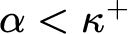 $\alpha <\kappa ^{+}$
let
 ${\mathcal {F}}_{\alpha \kappa ^{+}}= {\mathcal {F}}_{x_\alpha }$
.
It remains to check that
 $M=\langle \langle \theta _\alpha | \alpha \le \kappa ^{+}\rangle , \langle {\mathcal {F}}_{\alpha \beta }| \alpha \le \beta \le \kappa ^{+}\rangle \rangle $
is an
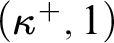 $(\kappa ^{+},1)$
-simplified morass.
Given
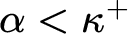 $\alpha <\kappa ^{+}$
let
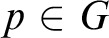 $p\in G$
be such that for some
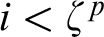 $i<\zeta ^p$
one has
 $x_\alpha =[(p,i)]_\sim $
and
 $x_{\alpha +1}=[(p,i+1)]_\sim $
. Then, by the definition of
 $\mathbb {P}$
,
 ${\mathcal {F}}^p_{ii+1}$
is either a singleton (consisting of a order-preserving map) or an amalgamation pair, and by the definition of
 $\le _{\mathbb {P}}$
, one must then have that
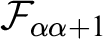 ${\mathcal {F}}_{\alpha \alpha +1}$
is a singleton (consisting of a order-preserving map) or an amalgamation pair.
Suppose
 $\alpha \le \beta \le \gamma \le \kappa ^{+}$
and
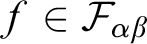 $f\in {\mathcal {F}}_{\alpha \beta }$
and
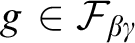 $g\in {\mathcal {F}}_{\beta \gamma }$
. If
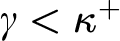 $\gamma < \kappa ^{+}$
then by the directedness of G there is some
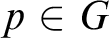 $p\in G$
and
 $i\le j \le k\le \zeta ^p$
such that
 $x_\alpha =[(p,i)]_\sim $
,
 $x_\beta =[(p,j)]_\sim $
,
 $x_\gamma =[(p,k)]_\sim $
,
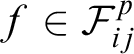 $f\in {\mathcal {F}}^p_{ij}$
and
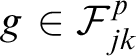 $g\in {\mathcal {F}}^p_{jk}$
. Thus
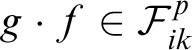 $g\cdot f\in {\mathcal {F}}^p_{ik}$
, and hence
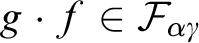 $g\cdot f\in {\mathcal {F}}_{\alpha \gamma }$
. Similarly, if
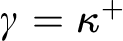 $\gamma =\kappa ^{+}$
there is some
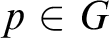 $p\in G$
and
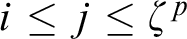 $i\le j \le \zeta ^p$
such that
 $x_\alpha =[(p,i)]_\sim $
,
 $x_\beta =[(p,j)]_\sim $
,
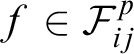 $f\in {\mathcal {F}}^p_{ij}$
and
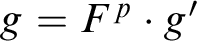 $g = F^p\cdot g'$
where
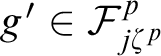 $g'\in {\mathcal {F}}^p_{j\zeta ^p}$
. Thus
 $g\cdot f = F^p\cdot g'\cdot f\in {\mathcal {F}}_{\alpha \kappa ^{+}}$
.
Similarly, suppose
 $\alpha \le \beta \le \gamma \le \kappa ^{+}$
and
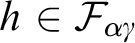 $h\in {\mathcal {F}}_{\alpha \gamma }$
. If
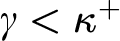 $\gamma <\kappa ^{+}$
there is some
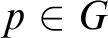 $p\in G$
and
 $i\le j \le k\le \zeta ^p$
such that
 $x_\alpha =[(p,i)]_\sim $
,
 $x_\beta =[(p,j)]_\sim $
,
 $x_\gamma =[(p,k)]_\sim $
and
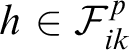 $h\in {\mathcal {F}}^p_{ik}$
. But then, as
 $S^p$
is a small SMS, there are
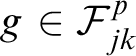 $g\in {\mathcal {F}}^p_{jk}$
,
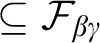 $\subseteq {\mathcal {F}}_{\beta \gamma }$
, and
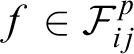 $f\in {\mathcal {F}}^p_{ij}$
,
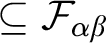 $\subseteq {\mathcal {F}}_{\alpha \beta }$
, such that
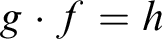 $g\cdot f= h$
. Likewise, if
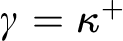 $\gamma =\kappa ^{+}$
there is some
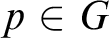 $p\in G$
and
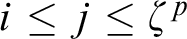 $i\le j \le \zeta ^p$
such that
 $x_\alpha =[(p,i)]_\sim $
,
 $x_\beta =[(p,j)]_\sim $
, and
 $h = F^p \cdot h'$
with
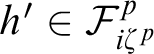 $h'\in {\mathcal {F}}^p_{i\zeta ^p}$
. Then, once more, as
 $S^p$
is a small SMS, there are
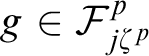 $g\in {\mathcal {F}}^p_{j\zeta ^p}$
and
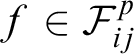 $f\in {\mathcal {F}}^p_{ij}$
,
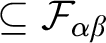 $\subseteq {\mathcal {F}}_{\alpha \beta }$
, such that
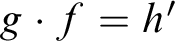 $g\cdot f= h'$
, and so
 $F^p\cdot g\in {\mathcal {F}}_{\beta \kappa ^{+}}$
.
Directedness at limits: suppose
 $\alpha \le \beta <\varepsilon \le \kappa ^{+}$
,
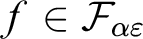 $f\in {\mathcal {F}}_{\alpha \varepsilon }$
and
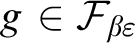 $g\in {\mathcal {F}}_{\beta \varepsilon }$
, and
 $\varepsilon $
is a limit ordinal.
First of all suppose
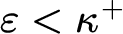 $\varepsilon <\kappa ^{+}$
. By the directedness of G let
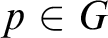 $p\in G$
be such that there are
 $i\le j< k\le \zeta ^p$
with such that
 $x_\alpha =[(p,i)]_\sim $
,
 $x_\beta =[(p,j)]_\sim $
,
 $x_\varepsilon =[(p,k)]_\sim $
,
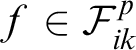 $f\in {\mathcal {F}}^p_{ik}$
and
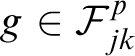 $g\in {\mathcal {F}}^p_{jk}$
.
If
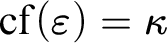 $\mathrm {cf}(\varepsilon )=\kappa $
then k is a successor and
 ${\mathcal {F}}^p_{k-1k}$
is a singleton, say
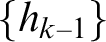 $\{ h_{k-1}\}$
. Furthermore, as
 $S^p$
is a SMS there are
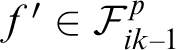 $f'\in {\mathcal {F}}^p_{ik-1}$
and
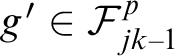 $g'\in {\mathcal {F}}^p_{jk-1}$
such that
 $f=h_{k-1}\cdot f'$
and
 $g=h_{k-1}\cdot g'$
. But then there is some
 $\gamma \in [\alpha \cup \beta ,\varepsilon )$
such that
 $x_\gamma =[(p,k-1)]_\sim $
and
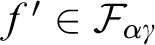 $f'\in {\mathcal {F}}_{\alpha \gamma }$
,
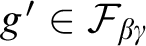 $g'\in {\mathcal {F}}_{\beta \gamma }$
and
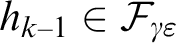 $h_{k-1}\in {\mathcal {F}}_{\gamma \varepsilon }$
.
If
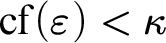 $\mathrm {cf}(\varepsilon )<\kappa $
we may suppose by the closure of
 $\mathbb {P}$
and genericity that k is a limit ordinal. Whence by the definition of SMS that there are
 $l\in [\max (\{ i,j\}), k)$
, with
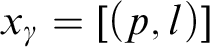 $x_\gamma = [(p,l)]_{~}$
,
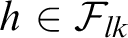 $h\in {\mathcal {F}}_{lk}$
,
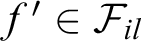 $f'\in {\mathcal {F}}_{il}$
, and
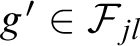 $g'\in {\mathcal {F}}_{jl}$
such that
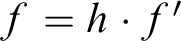 $f = h \cdot f'$
and
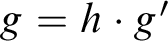 $g= h\cdot g'$
. Hence
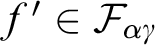 $f'\in {\mathcal {F}}_{\alpha \gamma }$
,
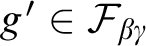 $g'\in {\mathcal {F}}_{\beta \gamma }$
and
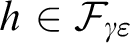 $h\in {\mathcal {F}}_{\gamma \varepsilon }$
.
If
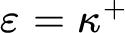 $\varepsilon =\kappa ^{+}$
then, again by the directedness of G, there is some
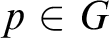 $p\in G$
such that there are
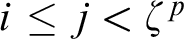 $i\le j< \zeta ^p$
such that
 $x_\alpha =[(p,i)]_\sim $
,
 $x_\beta =[(p,j)]_\sim $
, and there are
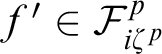 $f'\in {\mathcal {F}}^p_{i\zeta ^p}$
and
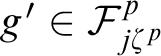 $g'\in {\mathcal {F}}^p_{j\zeta ^p}$
with
 $f= F^p\cdot f'$
and
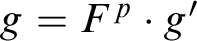 $g= F^p\cdot g'$
.
Thus we have verified directedness at
 $\varepsilon $
.
We have that
 $\bigcup \{ f``\theta _\alpha | \alpha <\kappa ^{+} \&\ f\in {\mathcal {F}}_{\alpha \kappa ^{+}}\} = \lambda $
by Lemma 7.1.
Finally, we shall show that
 $V[G]\models \hat {\lambda } = \dot {\kappa ^{++}}$
.
We recall a useful lemma of Velleman’s and a couple of related definition.
Lemma 7.3 ([Reference Velleman36], Lemma 3.2.)
If
 $\alpha \le \beta \le \kappa ^{+}$
,
 $f_0$
,
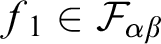 $f_1\in {\mathcal {F}}_{\alpha \beta }$
,
 $\tau _0$
,
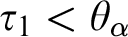 $\tau _1<\theta _\alpha $
and
 $f_0(\tau _0)=f_1(\tau _1)$
then
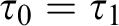 $\tau _0=\tau _1$
and
 $f_0\upharpoonright \tau _0+1=f_1\upharpoonright \tau _1+1$
.
Proof. By induction on
 $\beta $
for each fixed
 $\alpha $
, using the simplicity of the structure of the sets
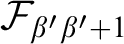 ${\mathcal {F}}_{\beta '\beta '+1}$
at successor steps and the directedness at limits at limit steps.
 $\blacktriangle _{7.3}$
Definition 7.4. [Reference Morgan24]
If
 $\alpha \le \beta \le \kappa ^{+}$
,
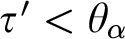 $\tau '<\theta _\alpha $
and there is some
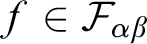 $f\in {\mathcal {F}}_{\alpha \beta }$
and
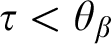 $\tau <\theta _\beta $
such that
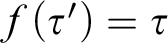 $f(\tau ')=\tau $
, let
 $\psi _{(\alpha ,\tau '),(\beta ,\tau )} = f\upharpoonright \tau ' + 1$
.
By Lemma 7.3 each such
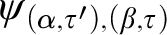 $\psi _{(\alpha ,\tau '),(\beta ,\tau )}$
is well defined.
Definition 7.5. [Reference Morgan24]
If
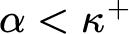 $\alpha <\kappa ^{+}$
,
 $\tau <\lambda $
and there is some
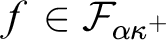 $f\in {\mathcal {F}}_{\alpha \kappa ^{+}}$
with
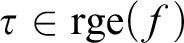 $\tau \in \mathrm {rge}(f)$
write
 $\tau _\alpha $
for the unique
 $\tau '$
such that
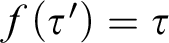 $f(\tau ')=\tau $
.
Let
 $\xi <\lambda $
. There is some
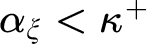 $\alpha _\xi <\kappa ^{+}$
such that for all
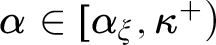 $\alpha \in [\alpha _\xi ,\kappa ^{+})$
there is some
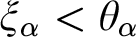 $\xi _\alpha <\theta _\alpha $
with
 $\psi _{(\alpha ,\xi _\alpha ),(\kappa ^{+},\xi )}$
well defined. For such
 $\alpha $
set
 $A_\alpha =\mathrm {rge}(\psi _{(\alpha ,\xi _\alpha ),(\kappa ^{+},\xi )}\upharpoonright \xi _\alpha )$
.
By directedness at the limit ordinal
 $\kappa ^{+}$
, we have that for every
 $\tau < \xi $
there is some
 $\alpha \in [\alpha ^*,\kappa ^{+})$
and
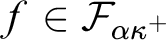 $f\in {\mathcal {F}}_{\alpha \kappa ^{+}}$
such that
 $\tau $
,
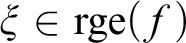 $\xi \in \mathrm {rge}(f)$
, and hence
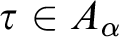 $\tau \in A_\alpha $
. So
 $\xi = \bigcup \{ A_\alpha | \alpha \in [\alpha _\xi ,\kappa ^{+})\}$
and thus is the union of the
 $\kappa ^{+}$
many countable sets; hence we must have that
 $V[G]\models \hat {\lambda } = \dot {\kappa ^{++}}$
.
 $\blacktriangle _{7.2}$
In [Reference Shelah, Väänänen and Veličković31], Shelah, Väänänen, and Veličković introduced the antichain property for simplified morasses, a property related to prior work of Miyamoto [Reference Miyamoto23].
Definition 7.6. [Reference Shelah, Väänänen and Veličković31]
Let
 $M=\langle \langle \theta _\alpha | \alpha \le \kappa ^{+}\rangle , \langle {\mathcal {F}}_{\alpha \beta }| \alpha \le \beta \le \kappa ^{+}\rangle \rangle $
be a
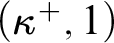 $(\kappa ^{+},1)$
-simplified morass. As in Definition (7.5), if
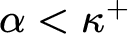 $\alpha <\kappa ^{+}$
,
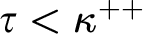 $\tau <\kappa ^{++}$
and there is some
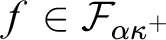 $f\in {\mathcal {F}}_{\alpha \kappa ^{+}}$
with
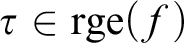 $\tau \in \mathrm {rge}(f)$
write
 $\tau _\alpha $
for the unique
 $\tau '$
such that
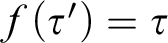 $f(\tau ')=\tau $
. We say M has the
 $\kappa ^{++}$
- antichain property if
 $$ \begin{align*} \forall X & \in [\kappa^{++}]^{\kappa^{++}} \exists\tau, \xi\in X \forall \alpha < \kappa^{+} \\ &\; (\tau_\alpha \text{ and }\xi_\alpha\text{ are both defined} \Longrightarrow \tau_\alpha \le \xi_\alpha). \end{align*} $$
Note 7.7. We note that the analogue for
 $(\omega ,1)$
-simplified morasses always fails if Martin’s Axiom holds: whilst ZFC shows there are always
 $(\omega ,1)$
-simplified morasses, MA
 $_{\omega _1}$
implies that no
 $(\omega ,1)$
-simplified morass has the
 $\omega _1$
-antichain property [Reference Morgan27]. As far as we know it is open whether there is a similar consistency result in the case of
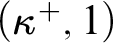 $(\kappa ^{+},1)$
-simplified morasses.
Proposition 7.8. The
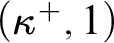 $(\kappa ^{+},1)$
-simplified morass added by forcing with
 $\mathbb {P}$
has the
 $\kappa ^{++}$
-antichain property.
Proof. Suppose
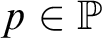 $p\in \mathbb {P}$
and
 $p\Vdash \dot {X}\in [\kappa ^{++}]^{\kappa ^{++}}$
. We can find some
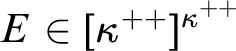 $E\in [\kappa ^{++}]^{\kappa ^{++}}$
and for each
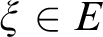 $\xi \in E$
some
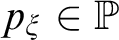 $p_\xi \in \mathbb {P}$
such that
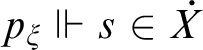 $p_\xi \Vdash s\in \dot {X}$
. By Lemma 7.1 we may assume that
 $\xi \in \mathrm {rge}(F^{p_\xi })$
for each
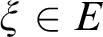 $\xi \in E$
. By the
 $\Delta $
-system lemma we may thin E, if necessary, so that for distinct
 $\xi $
,
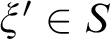 $\xi '\in S$
we have
 $\mathrm {dom}(F^{p_\xi })=\mathrm {dom}(F^{p_{\xi '}})$
, there is some
 $\overline {\xi }$
such that
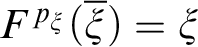 $F^{p_{\xi }}(\overline {\xi })=\xi $
,
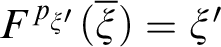 $F^{p_{\xi '}}(\overline {\xi })=\xi '$
,
 $\xi '\notin \mathrm {rge}(F^{p_\xi })$
and
 $\xi \notin \mathrm {rge}(F^{p_{\xi '}})$
. Now apply the proof of Proposition 5.6 to the collection of
 $p_\xi $
for
 $\xi $
in the thinned E. This gives us some
 $\xi $
,
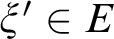 $\xi '\in E$
with
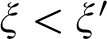 $\xi <\xi '$
and some
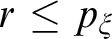 $r\le p_\xi $
,
 $p_{\xi '}$
such that
 $r\Vdash \forall \alpha <\kappa ^{+} (\xi _\alpha \text { and }\xi ^{\prime }_\alpha \text { are both defined} \Longrightarrow \xi _\alpha \le \xi ^{\prime }_{\alpha })$
.
 $\blacktriangle _{7.8}$
8 Summary of results proven
Theorem 8.1. Suppose
 $\lambda $
is regular and
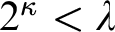 $2^\kappa < \lambda $
. There is a
 $\kappa ^{+}$
-proper,
 $\lambda $
-chain condition forcing (hence preserving
 $\kappa ^{+}$
,
 $\lambda $
and all larger cardinals and cofinalities) which collapses any cardinals
 $\mu $
with
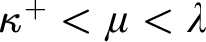 $\kappa ^{+}<\mu <\lambda $
, and such that in the forcing extension there is an
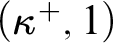 $(\kappa ^{+},1)$
-simplified morass with the
 $\kappa ^{++}$
-antichain condition.
Corollary 8.2. If
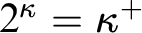 $\;2^{\kappa }= \kappa ^{+}$
then there is a
 $\kappa ^{+}$
-proper,
 $\kappa ^{++}$
-cc forcing which preserves all cardinals and cofinalities and adds an
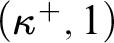 $(\kappa ^{+},1)$
-simplified morass with the
 $\kappa ^{++}$
-antichain condition.
Proof. By the premise that
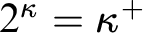 $2^{\kappa }= \kappa ^{+}$
we may apply Theorem 8.1 with
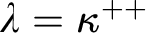 $\lambda =\kappa ^{++}$
.
 $\blacktriangle _{8.2}$
Corollary 8.3. If
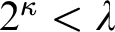 $2^\kappa <\lambda $
the forcing
 $\mathbb {P}$
of Theorem 8.1 adds an
 $\kappa ^{+}$
-Kurepa tree. If
 $\kappa =\omega $
then
 $\mathbb {P}$
adds
 $\square _{ \omega _1}{}\!.$
Proof. Immediate from Theorem 8.1 and the work of Velleman in [Reference Velleman36], and [Reference Velleman36] and [Reference Velleman35], respectively, where it is shown that if there is a
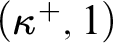 $(\kappa ^{+},1)$
-simplified morass then there is a Kurepa tree, and if there is a
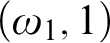 $(\omega _1,1)$
-simplified morass then
 $\square _{ \omega _1}{\!}$
holds.
 $\blacktriangle _{8.3}$
Remark 8.4 That, when
 $\kappa =\omega $
,
 $\mathbb {P}$
adds a Kurepa tree should be contrasted with the old theorem of Jensen that if
 $\square _{ \omega _1}{\!}$
holds there is a ccc forcing – with finite working parts – to add an
 $\omega _1$
-Kurepa tree. See [Reference Veličković38] for a proof of this result in the style of the introductory remarks to this paper.
However there can be no direct extension of that theorem to a one that asserts that if
 $\square _{ \omega _1}{\!}$
holds there is ccc forcing to add an
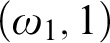 $(\omega _1,1)$
-simplified morass. This is because
 $\square _{ \omega _1}{\!}$
is consistent with the weak Chang conjecture holding, and as mentioned in the Introduction, Todorčević showed no ccc forcing can destroy the truth of the weak Chang conjecture, whilst the existence of an
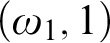 $(\omega _1,1)$
-simplified morass implies the failure of the weak Chang conjecture.
Acknowledgments
The author thanks EPSRC for their support through grant EP/I00498 and the Rheinische Friedrich-Wilhelms-Universität Bonn, UCL, and UEA for institutional support.
The author is extremely grateful to the referee for their assiduous reading of, and detailed comments on, the original submission. Not only have they saved the reader from the frustrations of many typographical errors, but their remarks and questions have, I hope, led to substantial clarifications in the Introduction. Remaining errors and obscurities are, naturally, the author’s sole responsibility.