1. Introduction
Meaning construction in the human brain is an intensely discussed topic in cognitive science, psychology, and psycholinguistics. The contemporary generation of cognitive science reformulates cognition as inherently embodied (Binder & Desai, Reference Binder and Desai2011; Clark, Reference Clark1997; Gibbs, Reference Gibbs2006; Lakoff & Johnson, Reference Lakoff and Johnson1999; Schuil, Smits, & Zwaan, Reference Schuil, Smits and Zwaan2013). Embodied cognition considers that language meaning is grounded in sensorimotor systems. The activated embodied meaning is related to the individual’s bodily experiences in the world. If individuals have had the sensory and motor experiences described by language, those experiences will be recreated during language processing and language production (Barsalou, Reference Barsalou2008; Gallese, Reference Gallese2008). From the embodied perspective, a recent surge of behavioral and neuroimaging research has explored the interaction between language comprehension and action (Glenberg & Kaschak, Reference Glenberg and Kaschak2002; Pulvermüller, Reference Pulvermüller2005; Tettamanti et al., Reference Tettamanti, Buccino, Saccuman, Gallese, Danna, Scifo and Perani2005; Zwaan & Taylor, Reference Zwaan and Taylor2006). In particular, an influential and widely cited methodology is known as the ‘Action-Sentence Compatibility Effect’ (ACE), in which participants are presented with sentences describing motor events and then they respond with actions which are compatible or incompatible with the sentence meaning. The findings of various modifications of this ACE design indicate that both compatible and incompatible meaning–action conditions can facilitate (responding faster in compatible meaning–action conditions) or interfere with (responding faster in incompatible meaning–action conditions) response outcomes (Borreggine & Kaschak, Reference Borreggine and Kaschak2006; de Vega, Moreno, & Castillo, Reference de Vega, Moreno and Castillo2011; Santana & de Vega, Reference Santana and de Vega2011; Zwaan & Taylor, Reference Zwaan and Taylor2006; but see the work of Papesh, Reference Papesh2015, who found different results, with mouse-tracking hand movements). Among these studies, de Vega et al. (Reference de Vega, Moreno and Castillo2011) found both facilitating and interfering ACE in his experiment paradigm. de Vega et al. (Reference de Vega, Moreno and Castillo2011) varied the temporal intervals between motor event presentation and motor performance. They collected participants’ button-press response times after three different intervals, 100 ms, 200 ms, and 350 ms. They showed that interference in the ACE was evident in the 100 ms and 200 ms interval, where response times after verb presentation were reduced for the incompatible meaning–action condition, and that facilitating the ACE was evident in the 350 ms time-window (de Vega et al., Reference de Vega, Moreno and Castillo2011). Other works on ACE (Borreggine & Kaschak, Reference Borreggine and Kaschak2006; de Vega & Urrutia, Reference de Vega and Urrutia2011; Kaschak & Borreggine, Reference Kaschak and Borreggine2008), have found that the temporal interval between verb meaning presentation and motor action played a crucial role in ACE manifestation. That is, the presence of facilitation or interference depended on the experiment design and tasks.
Notably, under the guidance of the embodied approach, a neural network model was proposed (Chersi et al., Reference Chersi, Thill, Ziemke and Borghi2010), clarifying the influence of processing action-related sentences on action performance. The neural underpinning of this model is the activation of mirror neurons encoding motor acts (Bonini, Rozzi, Serventi, Simone, Ferrari, & Fogassi, Reference Bonini, Rozzi, Serventi, Simone, Ferrari and Fogassi2010; Fogassi, Ferrari, Gesierich, Rozzi, Chersi, & Rizzolatti, Reference Fogassi, Ferrari, Gesierich, Rozzi, Chersi and Rizzolatti2005). According to the model, the comprehension of action-related sentences activates the mirror neurons in the parietal and premotor cortices corresponding to these motor acts. When a motor response is required, the corresponding neurons will be activated in the prefrontal cortex. However, the mirror neurons are active only for a very short interval, around 200–300 ms (Chersi et al., Reference Chersi, Thill, Ziemke and Borghi2010). During this interval, the meaning and action relating to the same effector compete for the same neural resources, leading to interference in the meaning–action matching condition. After this interval, the activated mirror neurons gradually adapt and calm down because of their slower internal dynamics. As a result, considering the active period of mirror neurons (around 200–300 ms), the interference ACE in the meaning–action matching condition should occur due to neural resources competition within this time-window or earlier (Brass, Bekkering, & Prinz, Reference Brass, Bekkering and Prinz2001; Fischer & Zwaan, Reference Fischer and Zwaan2008; Gallese, Reference Gallese2008; Hauk, Johnsrude, & Pulvermüller, Reference Hauk, Johnsrude and Pulvermüller2004). Conversely, if the interval between language meaning and motor performance is longer than 300 ms, facilitating ACE should be found.
Factual action-related language, such as I delivered the pizza to Andy or Andy delivered the pizza to me (Glenberg & Kaschak, Reference Glenberg and Kaschak2002) has generally been the research focus of embodied simulation in language comprehension, while little attention has been paid to the counterfactual one. Counterfactual language describes counter-to-fact events or situations, for example, If Li Yang had stayed with me last Thursday, I would have given an apple to her, enabling people to shift from the immediate situation to an imagined and alternative perspective, which is common in everyday life. The canonical form of counterfactual language is a counterfactual condition, taking the factually false antecedent (the ‘if’ part) as suppositionally true (Byrne, Reference Byrne2002; Roese, Reference Roese1997; Thompson & Byrne, Reference Thompson and Byrne2002). In the sentence If Li Yang had stayed with me last Thursday, I would have given an apple to her, the condition after ‘if’ does not happen in the actual world. We suppose, however, that the condition can occur, and imagine the corresponding consequence. Theoretical foundations and empirical research in the field of cognitive linguistics and conditional reasoning provide converging evidence that understanding counterfactuals involves dual representations: one is the real situation stating the counterfactual event that actually does not happen in the real world; the other is an ‘imagined’ scenario supposing that the event has occurred (Byrne, Reference Byrne2007; Fauconnier, Reference Fauconnier1994; Ferguson & Sanford, Reference Ferguson and Sanford2008; Johnson-Laird & Byrne, Reference Johnson-Laird and Byrne2002; Santamaría, Espino, & Byrne, Reference Santamaría, Espino and Byrne2005). Like the sentences Last Thursday was Thanksgiving Day. If Li Yang had stayed with me, I would give an apple to her, the real situation is Last Thursday was Thanksgiving Day. Li Yang did not stay with me, and I did not give an apple to her, and the ‘imagined’ scenario is Last Thursday was Thanksgiving Day. Li Yang stayed with me, and I gave an apple to her.
European languages such as English, Dutch, and Spanish can offer linguistic cues or markers to represent and clarify counterfactual expressions. For example, in English the subjunctive mood can be used to deal with the counterfactual sentence as If Li Yang had stayed with me last Thursday, I would have given an apple to her, distinguishing the counterfactual conditions from those factual conditions. However, Chinese belongs to the ideographic language family and lacks morphological inflections (Jiang, Reference Jiang2000; Zhuo, Reference Zhuo2017). Most previous research in Mandarin counterfactuals was generally prescriptive and static, including topics such as the validity of Mandarin counterfactual constructions, the counterfactual reasoning of Chinese people, the comparison between English and Chinese in counterfactual thinking, the emotional basis of Mandarin counterfactuals, and the pragmatic functions of Mandarin counterfactuals (Shao, Reference Shao1988; Wang, Reference Wang2016; Yuan, Reference Yuan2015). Little research (Wang, Reference Wang2016; Zhuo, Reference Zhuo2017) has touched upon the processing mechanism of Mandarin counterfactual sentences. As far as Chinese counterfactual sentences are concerned, the consensus is that counterfactual interpretation can be detected and recognized in the located context. In Mandarin, without the preceded context of Last Thursday was Thanksgiving Day, the sentence If Li Yang had stayed with me, I would have given an apple to her can be regarded as an open condition. Thus, linguistic context or a previously mentioned context plays a significant role in processing Mandarin counterfactuals (Chen, Reference Chen1988; Jiang, Reference Jiang2000; Zhuo, Reference Zhuo2017).
Action-related counterfactual language does not refer to actual actions, explicitly or implicitly contradicting the factual world knowledge. Therefore, counterfactual language raises a challenge for embodied theories of comprehension. In the processing of Indo-European counterfactual languages, linguistic cues in tense inflections enable readers to grasp the meaning of counterfactuals. Meanwhile, the debate about counterfactuality in Chinese has emerged since 1980s as described in Bloom’s (Reference Bloom1981) The Linguistic Shaping of Thought: A Study in the Impact of Language on Thinking in China and the West. Bloom postulated that in Mandarin the lack of distinct counterfactual devices and morphological inflections caused the absence of counterfactual thinking in Mandarin speakers. However, later related research in Chinese counterfactuals (Au, Reference Au1983; Liu, Reference Liu1985; Qian, Reference Qian2016) revealed that Mandarin speakers had little deficiency in comprehending counterfactuals. Thus the questions arise: How do Mandarin speakers understand counterfactual language and what is the processing mechanism of action-related Mandarin counterfactual sentences?
In the present research we chose action-related Mandarin counterfactual sentences describing transfer events as experimental materials. The experimental paradigm of de Vega & Urrutia (Reference de Vega and Urrutia2011) was employed, to investigate whether the embodied meaning was activated in comprehending action-related Mandarin counterfactual sentences. We also examined whether the neural network model of Chersi et al. (Reference Chersi, Thill, Ziemke and Borghi2010) could be applied in processing action-related Mandarin counterfactual sentences. The hypothesis is that the ‘imagined’ meaning of counterfactual sentences is similar to the factual meaning, triggering the embodied meaning as a result in the presence of ACE. Moreover, it is consistent with ACE predictions and the neural network model of Chersi et al. that there should be an interaction between language meaning and motor performance. Specifically, the interfering interaction between language meaning and motor action should be present in earlier transfer verb onset, and the possible difference should be found between factuals and counterfactuals in terms of language category.
2. Method
2.1. participants
103 healthy, right-handed Chinese native university students with normal or corrected-to-normal vision (32 males and 71 females; mean age = 23.98 years, SD = 2.832) were recruited to participate in the experiment by advertising in social media. All participants volunteered and were rewarded with RMB 15 and a small box of candy for their participation.
2.2. material
2.2.1. Development of materials
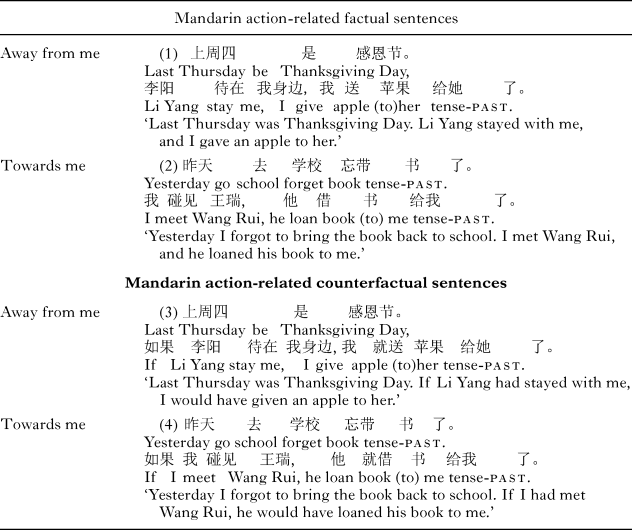
144 sentences, including 72 counterfactual and 72 factual sentences, were constructed (see Table 1). Both factual and counterfactual sentences contained approximately 24 or 25 Chinese characters. Critical words were verbs with ‘transfer’ characteristics. As in previous research (Glenberg & Kaschak, Reference Glenberg and Kaschak2002), the experimental materials were sentences containing the ‘transfer verb’ accompanied by a simple direction: towards the subject’s body (e.g., I borrowed a book from Andy) or away from the subject’s body (e.g., I lent a book to Andy), providing participants with an implicit psychophysical motor direction (Glenberg & Kaschak, Reference Glenberg and Kaschak2002). Each counterfactual and factual sentence was composed of three clauses. The first clause provided a context or a situation for the whole sentence; the second clause introduced the transfer agents (participants); and the third clause described the direction of the transfer action (towards or away from the transfer agent). Note that one of the transfer agents was in the first person view, expecting participants to understand the sentences from the perspective of the first person (Glenberg & Kaschak, Reference Glenberg and Kaschak2002). Counterfactual and factual sentences differed in two aspects: counterfactuals started with the conditional “如果 ‘if’ … 就 ‘then’ …”, and described the hypothetical consequences of past events, whereas factual sentences were the same sentences as counterfactuals except for deleting the conjunction “如果 ‘if’ … 就 ‘then’ …” and stating the actual consequences of these past events. Some examples of the experimental materials were shown in Table 1.
Examples of experimental materials

note: Both the factual and counterfactual sentences were divided into ‘Away from me’ and ‘Towards me’ on the basis of the implied linguistic meaning of the sentences.
2.2.2. Pretests of materials
We first established the counterfactuality of counterfactual sentences. 35 Chinese native university students (who did not participate in the main experiment) read 72 counterfactual sentences and judged on a 5-point scale whether the events in the sentences could possibly happen in the real world from 1 (extremely impossible) to 5 (extremely possible), skipping the sentences if they could not evaluate them.
We subsequently determined the sensibility of both factual and counterfactual sentences in the real world. 36 Chinese native university students (who did not participate in the main experiment) read the factual and counterfactual sentences and judged on a 5-point scale how sensible each sentence was, from 1 (extremely non-sensible) to 5 (extremely sensible), skipping the sentences if they could not evaluate them.
Based on the pretest results, we chose those sentences with high counterfactuality rated below 2 in the first pretest, and excluded those sentences with sensibility below 4 in the second pretest and those sentences skipped by more than two participants. Ultimately, 112 sentences (56 counterfactual and 56 factual sentences) were collected. Besides the experimental sentences, 48 filler sentences (24 factual and 24 counterfactual sentences) were created, containing non-transfer verbs like ‘think’, ‘remember’, ‘check’, ‘know’, etc.
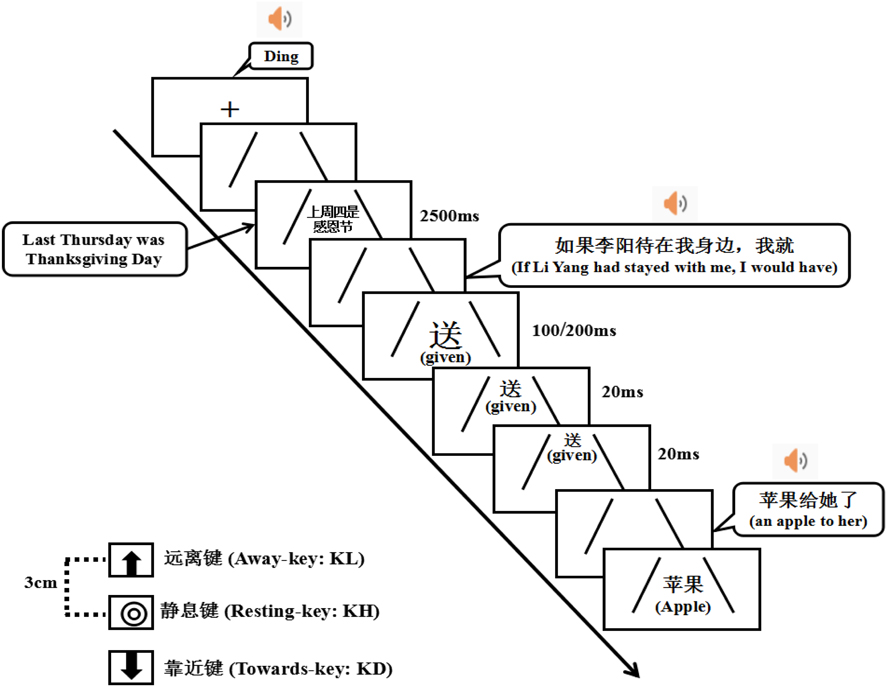
In this experimental paradigm, materials were presented in black font against a gray background. Two parallel-oriented convergent lines like a road served to visually reinforce the transfer action. In the process of each trial presentation, the context (first clause) was presented visually on one line, and the second and third clauses were presented aurally, except for the visually presented transfer verb. The aurally presented materials were recorded using a female voice whose mean intensity was 70 dB. The original font of the transfer verb was Song size 48, and the corresponding apparent visual motion effects of the verb were achieved by increasing the font size to 72 (for towards motion) or reducing to 24 (for away motion). The transfer verb was always kept within the two convergent lines. After being presented with the transfer verb, participants were required to press a direction key on a modified qwerty keyboard (rotated 90o in a counter-clockwise direction). The keys H, L, and D were used as the resting-key, away-key, and towards-key, respectively (see Figure 1, bottom left). At the end of each trial, participants were instructed to judge a memory question by button-pressing to make a choice to ensure their attention to the experiment. Thus participants processed the action-related sentences describing transfer events, while they also needed to perform a hand motion. In the present experiment, the significant interaction between bodily movement and implied sentence meaning, specifically between transfer verb direction and hand movement direction, would demonstrate the presence of ACE. If there was no interaction, no ACE can be observed.
The display of response keys in the experiment (bottom left) and the flowchart of the experiment (top right).

2.3. procedure and design
The experiment was conducted using E-Prime 2.0 software (http://pstnet.com/welcome-to-e-prime-2-0/). Before taking part in the experiment, all participants were instructed to familiarize themselves with the tasks by practicing with eight training sentences, and were encouraged to read or to listen to the experimental materials carefully. A qwerty keyboard rotated 90o in a counter-clockwise direction was used in the experiment. The experiment flowchart of a trial is exemplified in Figure 1 (top right). Participants were instructed to press the resting-key H, with right index finger. Each trial started with the auditory tone ‘Ding’ for 300 ms, followed by a centrally located fixation cross of in a font size 48 and two parallel oriented convergent lines like a road. After the onset of the two convergent lines, the first clause of the sentence (Last Thursday was Thanksgiving Day) was immediately presented on the screen for 2500 ms as the context. At its offset the second part except for the transfer verb ‘given’ was presented aurally according to the video length (If Li Yang had stayed with me, I would have). Without the time interval, the transfer verb ‘given’ was presented on the screen, for either 100 ms or 200 ms, and then the verb ‘given’ had an apparent motion, displacing towards or away from the participant according to the animation sequence of E-Prime. Trials for ‘towards’ or ‘away’ motion displacement of the transfer verb were counterbalanced within each block. The displacement served as a cue for participants to release the resting key (H), and to press the motion key (L or D) with the right index finger in the same direction as the motion cue of the transfer verb. The duration of pressing the key was 500 ms. After this time interval, the next part was presented automatically. After pressing the corresponding motion key, the rest of the experimental sentences were presented auditorily (an apple to her). At offset of the last spoken word, a noun appeared on the screen visually, and the noun did not disappear until participants made a judgment response. Participants were required to judge whether the noun had appeared in the whole sentence (Last Thursday was Thanksgiving Day. If Li Yang had stayed with me, I would have given an apple to her). Participants used the middle and index fingers of the left hand to press Key 1 and Key 2 (numeric keys in the keyboard) corresponding to ‘Yes’ and ‘No’, respectively. Key display and trial events are depicted in Figure 1.
The experiment was a repeated-measures factorial design: 2 sentence type (factual and counterfactual) × 2 transfer verb displacement direction (away and towards) × 2 hand motion direction (away and towards) × 2 motion delay (100 ms and 200 ms). Apart from factor motion delay (100 ms and 200 ms), the other three factors were within-participants. Behavioral measurements were: (1) the response time (in milliseconds) of pressing the corresponding motion direction key (L or D); (2) the response time (in milliseconds) of judging the noun in the word probe task at the offset of the auditory sentences; and (3) the errors (accuracy) in response keys and judging the nouns.
3. Results
SPSS 23.0 software (https://spss.updatestar.com/en) was adopted to analyze the dependent variables including motor response time and word probe reaction time. Across all analyses, alpha was maintained at .05. Analyses of variance (ANOVAs) were performed for the experimental transfer sentences in both motor response and word probe tasks. Only trials with correct sensibility judgments were analyzed, resulting in an average loss of 2 trials (1.8%) per participant in motor response, and 3 trails (2.3%) in the word probe task. For any participant, outliers were defined as reaction times that exceeded their respective means by more than 2 standard deviations; outliers were replaced with the cut-off value (2*Standard Deviation+Mean) (Winer, Reference Winer1971). Totally 3% of the data in motor response and 4.3% in word probe were replaced. Reaction times to nonsense and no-transfer sentences, by their nature, did not show compatibility effects and were thus not reported for any of the experiments. Errors and outliers of the collected data were analyzed in order to guarantee the speed–accuracy trade-offs in the experiment.
3.1. motor response time
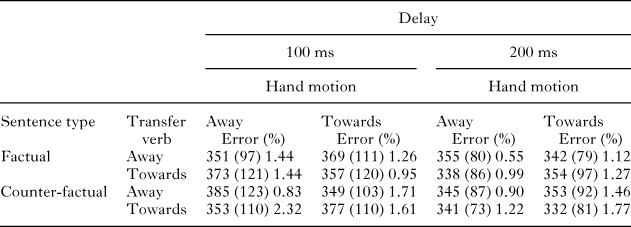
In Table 2, the most significant effect was found among transfer verb direction, hand motion direction, motion delay, and sentence type (F(1,103) = 10.709, p = .001). To clarify this complex interaction, the factual and counterfactual sentences were separately analyzed.
Mean motor response time and standard deviation

note: Table 2 described mean reaction time of motor response (milliseconds), standard deviation (in brackets), and average errors percentages for factual and counterfactual sentences, for the 100 and 200 ms delay groups.
For factual sentences, a three-way interaction was observed among transfer, hand motion direction, and motion delay (F(1,103) = 4.713, p = .032), indicating that the presence of ACE was related to the motion delay. In the group that was administered the motion delay of 100 ms, there was no significant difference between the matching and mismatching conditions of transfer verb direction and hand motion (F(1,52) = 1.706, p = .197). However, in the group of 200 ms motion delay (F(1,51) = 5.229, p = .026), the significant effect indicated an interaction between transfer verb processing and motor action. And the response times in the transfer–motion mismatching condition were shorter than in the matching condition (Mmismatching= 340 ms, SD = 82 and Mmatching= 355 ms, SD = 88), showing the presence of interfering ACE.
For counterfactual sentences, there was also a three-way interaction among transfer verb direction, hand motion direction, and motion delay (F(1,103) = 4.882, p = .029). A significant interaction was found between transfer verb direction and hand motion direction in the group that was administered the motion delay of 100 ms (F(1,52) = 5.114, p = .028), qualifying the action simulation or motor resonance in comprehending counterfactuals at this motion delay. Similarly, response times were significantly reduced in the mismatching condition compared with the matching condition (M = 351 ms, SD = 106 and M = 381 ms, SD = 117). There was no significant interaction for the motion delay of 200 ms (F(1,51) = 1.757, p = .191).
In sum, there was evidence for the presence of ACE in action-related Mandarin factual and counterfactual sentences. The occurrence of ACE indicated a link between language meaning and our bodily movement, supporting the idea that language processing is not wholly symbolic, but embodied and inherently involving the participation of our sensorimotor systems. The pattern of results also indicated there was a difference in the time course of ACE manifestation between factual sentences and counterfactual sentences. ACE, specifically interfering ACE in factual sentences, occurred in the 200 ms interval of transfer verb and hand motion, while in the 100 ms interval for counterfactual one.
3.2. word probe time
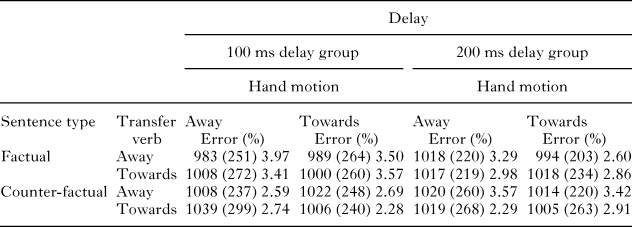
With regard to reaction time in the word probe task, no significance was found, probably because the task was intended to detect whether participants did the experiment attentively by a memory question. By analyzing the collected data, a main pattern in Table 3 was the response time in different sentence types, such that responses were slowed for the counterfactual sentences compared with the factual ones (factual: M = 1003 ms, SD = 240; counterfactual: M = 1017 ms, SD = 254). Probably, the increased response time on average indicated that greater cognitive cost was required in processing the whole counterfactual sentences than factual sentences.
Mean word probe time and standard deviation

note: Table 3 describes mean reaction times of word probe (milliseconds), standard deviation (in brackets), and average errors percentages for factual and counterfactual sentences, for the 100 and 200 ms delay groups.
In conclusion, the word probe task required participants to process the whole sentences in order to judge the presence or absence of the noun presented on the screen. Possibly the greater complexity of sentence structure and dual meaning representation involved in counterfactual sentences led to increased response times for counterfactual compared with factual sentences in the word probe task.
4. Discussion and conclusion
The present research employed the action-sentence compatibility effect paradigm to explore whether embodied meaning was activated in processing action-related Mandarin counterfactual sentences. Action-related counterfactual language does not refer to actual actions in the real world, positing a challenge to the embodied view of language comprehension. However, the data obtained demonstrated the interaction between language meaning and motor performance in both factual and counterfactual sentences, showing the presence of embodied meaning. Meanwhile, a difference was found in the temporal course of ACE between counterfactual and factual sentences. Specifically, interfering ACE in action-related factual sentences was found in the 200 ms interval after the transfer verb in terms of hand motion response, and in the 100 ms interval for counterfactual sentences. Moreover, performance in the word probe task demonstrated that more cognitive cost (in terms of increased response times) was needed in counterfactual sentences compared with factual ones.
We speculate that embodied representation is triggered in action-related Mandarin counterfactual sentences as a result of dual meaning. The theoretical approaches from the perspectives of cognitive linguistics and conditional reasoning assume that two meanings are involved in processing counterfactuals. One is the real representation describing the events that actually do not happen in the real world; the other is the imagined representation supposing that the situation happened. The imagined meaning can be equivalent to the meaning representation of factual sentences. As a result, the embodied meaning should be generated by counterfactual comprehension. Meanwhile, according to the three processing stages (activation, inference, and adaptation) (Barbey, Krueger, & Grafman, Reference Barbey, Krueger and Grafman2009; Byrne, Reference Byrne2002), in the processing of counterfactual sentences like Last Saturday was Thanksgiving Day. If Li Yang had stayed with me, I would have given an apple to her, prior memories are activated (e.g., Thanksgiving Day and give an apple) and a mental simulation of the imagined event is simulated (e.g., staying with Li Yang and giving an apple to her). A further step in the period of the activation stage is the proposal that comprehension of the counterfactual sentence relies on the mental simulation of alternative possibilities (Barsalou, Kyle, Barbey, & Wilson, Reference Barsalou, Kyle, Barbey and Wilson2003; Damasio, Reference Damasio1989; Markman, Suhr, & Klein, Reference Markman, Suhr and Klein2012). It is the mental simulation that provides the basis for building the mental models of events or situations and imagining the ‘if’ event happening. In some degree, therefore, the activation process in the counterfactual comprehension triggers the simulation of the described event, certainly as a result of the embodied meaning in action-related counterfactual sentences.
The interfering ACE is associated with a reduced response time in the meaning–action mismatching condition compared with the matching one. According to embodied account language comprehension, understanding action words or sentences recruits brain regions overlapping with those involved in performing and planning actions (Azizzadeh, Wilson, Rizzolatti, & Iacoboni, Reference Azizzadeh, Wilson, Rizzolatti and Iacoboni2006; Boulenger, Roy, Paulignan, Deprez, Jeannerod, & Nazir, Reference Boulenger, Roy, Paulignan, Deprez, Jeannerod and Nazir2006; Buccino, Riggio, Melli, Binkofski, Gallese, & Rizzolatti, Reference Buccino, Riggio, Melli, Binkofski, Gallese and Rizzolatti2005; Hauk et al., Reference Hauk, Johnsrude and Pulvermüller2004; Pulvermüller, Reference Pulvermüller2005; Sato, Mengarelli, Riggio, Gallese, & Buccino, Reference Sato, Mengarelli, Riggio, Gallese and Buccino2008; Tettamanti et al., Reference Tettamanti, Buccino, Saccuman, Gallese, Danna, Scifo and Perani2005). In other words, neural activation is shared by processing action-related sentence and performing actions, consequently contributing to the resource competition of the motor cortex. Understanding action-related sentences would partially activate the same motor regions as performing actions. In the meaning–action compatible condition, language-based motor ‘resonance’ and action performance compete for motor and neural resources in the initial period. Therefore, it takes extra time to simulate the action. In the mismatching condition, however, no competition occurs between verb meaning and motor performance, so less time is required to simulate the action.
What is worth noting is the different temporal courses between processing factual and counterfactual sentences. The ACE can be influenced by many factors, including the complexity of the linguistic material, the experimental paradigm, and the experimental task, demonstrating that the timing of motor resonance is not fixed (Zwaan & Taylor, Reference Zwaan and Taylor2006). In the present experimental materials, the difference between counterfactuals and factuals was the addition of conjunction 如果 … 就 ‘If … then …’. An explanation for the reduced response time for counterfactual sentences is that a suppositional situation was induced by the linguistic marker 如果 ‘if’ building up a context for participants, who can naturally process the meaning of the subsequent sentences. Therefore, in the case of counterfactual sentences, the processing of the hypothetical meaning starts earlier than the realistic meaning. With this premise in mind, in a counterfactual context, readers may have speeded up the ‘counterfactual’ meaning associated with the earlier motor resonance as a strategy to free cognitive resources for processing the implied realistic meaning of counterfactual sentences. As for the factual sentences without the linguistic marker 如果 ‘if’, participants needed to judge or consider the true meaning. Moreover, when readers began with a factual context, they only needed to process a single meaning. As a result, they did not need to speed up the ‘motor resonance’. Therefore, compared to the factual sentences, the motor resonance in counterfactual processing could likely be earlier.
The temporal course of motor resonance in factual and counterfactual sentences in the present study is similar to the study of de Vega and Urrutia (Reference de Vega and Urrutia2011) using Spanish experimental material. The mean response time in the present study is longer than that reported by de Vega and Urrutia (M = 355 ms, SD = 15), while in de Vega and Urrutia it was about 250 ms (M = 248 ms, SD = 31), indicating that Mandarin readers require more time to process and infer the counterfactual meaning. As described in the book The Linguistic Shaping of Thought: A Study in the Impact of Language on Thinking in China and the West (Bloom, Reference Bloom1981), language plays a crucial part in orienting our thoughts, and in determining our world views. In Mandarin, there are no distinct grammatical markers representing the counterfactual condition, and a relatively low number in counterfactual usage, compared with English counterfactuals. Mandarin speakers are not accustomed to processing counterfactuals. Different linguistic devices between Chinese and the Indo-European languages caused different response times, showing that language and thought are closely connected (Bloom, Reference Bloom1981).
In conclusion, the experimental results fitted well with the model of embodied language of Chersi et al. (Reference Chersi, Thill, Ziemke and Borghi2010). First, the embodied meaning was activated in comprehending action-related Mandarin counterfactual sentences, demonstrating the interaction between language meaning and motor action. Second, the observed interfering ACE in the 100 ms motion delay in processing action-related Mandarin counterfactual sentences further supported the proposal of this neural network model (Chersi et al., Reference Chersi, Thill, Ziemke and Borghi2010). According to this model, mirror neurons activate at around 200–300 ms. The temporal overlap in shorter interval like 100 ms or 200 ms between language comprehension and motor performance causes interference from the competition for neural resources. Overall, motor simulation occurred and embodied meaning was activated in comprehending action-related Mandarin counterfactual sentences. Additionally, the distinct features of Mandarin counterfactuals (including dual representations, complex sentence structures, and some explicit linguistic markers) gave rise to such characteristics as different temporal courses from factual ones and more cognitive cost in language comprehension.
Appendix
Action-related Chinese counterfactual sentences
1. 上周四是感恩节, 如果李阳待在我身边, 我就送苹果给她了。
Last Thursday was Thanksgiving Day. If Li Yang had stayed with me, I would have had given an apple to her.
2. 昨天是我的生日, 如果王瑞记得我生日, 他就送礼物给我了。
Yesterday was my birthday. If Wang Rui had remembered it, he would have given a gift to me.
3. 那家花店很有名, 如果李欢以前喜欢花, 我就送盆栽给她了。
That flower shop was very famous long ago. If Li Huan had used to like flowers, I would have sent potted plants to her.
4. 昨天领导搬新家, 如果我提前知道消息, 我就送礼品给他了。
The leader moved to his new house yesterday. If I had known the news in advance, I would have given a gift to him.
5. 那报纸昨天到了, 如果李佳找到我住址, 他就送报纸给我了。
The newspaper arrived yesterday. If Li Jia had known my address, he would have delivered it to me.
6. 欠条我一直收着, 如果我爸爸昨天汇款, 我就还欠款给你了。
I have been collecting IOUs. If my father had remitted the money yesterday, I would have returned the money to you.
7. 我橡皮找不到了, 如果李莉昨天借走了, 她就还橡皮给我了。
I can’t find my eraser now. If Lily had borrowed it yesterday, she would have returned it to me.
8. 刘波拿着我答案, 如果他已经做完题了, 他就还答案给我了。
Liu Bo took my answer. If he had finished the homework, he would have returned it to me.
9. 李刚拿着我笔记, 如果他早上已看完了, 她就还笔记给我了。
Li Gang just took my notes. If he had finished reading them this morning, he would have returned them to me.
10. 借的书快到期了, 如果我前天去图书馆, 我就还书给管理员了。
The book I borrowed is about to expire. If I had gone to the library the day before yesterday, I would have returned it to the librarian.
11. 王芳喜欢写信件, 如果我以前认识汉字, 她就寄信件给我了。
Wang Fang likes writing letters. If I had known Chinese characters before, she would have sent letters to me.
12. 快递一天就到了, 如果李明昨晚需要证明, 我就寄快递给他了。
Express delivery often takes a day. If Li Ming had needed the paper, I would have sent it to him by express delivery.
13. 我负责办理签证, 如果张伟护照办理好了, 他就寄护照给我了。
I was responsible for the visa application. If Zhang Wei’s passport has been prepared, he would have sent it to me.
14. 稿子上周改好了, 如果我查到报社邮箱, 我就寄稿件给他们了。
The manuscript was revised last week. If I had checked the newspaper’s mailbox, I would have sent it to them.
15. 烤鸭现在很火爆, 如果我提早些到店里, 老板就卖烤鸭给我了。
The roast duck is very popular. If I had gone to the shop earlier, the boss would have sold it to me.
Action-related Chinese factual sentences
1. 上周四是感恩节, 李阳待在我身边, 我送苹果给她了。
Last Thursday was Thanksgiving Day. Li Yang stayed with me, and I gave an apple to her.
2. 昨天是我的生日, 王瑞记得我生日, 他送礼物给我了。
Yesterday was my birthday. Wang Rui remembered it, and he gave a gift to me.
3. 那家花店很有名, 李欢以前喜欢花, 我送盆栽给她了。
That flower shop was very famous long ago. Li Huan used to like flowers, and I sent potted plants to her.
4. 昨天领导搬新家, 我提前知道消息, 我送礼品给他了。
The leader moved to his new house yesterday. I knew the news in advance, and I gave a gift to him.
5. 那报纸昨天到了, 李佳找到我住址, 他送报纸给我了。
The newspaper arrived yesterday. Li Jia knew my address, and he delivered it to me.
6. 欠条我一直收着, 我爸爸昨天汇款, 我还欠款给你了。
I have been collecting IOUs. My father remitted the money yesterday, and I returned the money to you.
7. 我橡皮找不到了, 李莉昨天借走了, 她还橡皮给我了。
I can’t find my eraser now. Lily borrowed it yesterday, and she returned it to me.
8. 刘波拿着我答案, 他已经做完题了, 他还答案给我了。
Liu Bo took my answer. He finished the homework, and he returned it to me.
9. 李刚拿着我笔记, 他早上已看完了, 他还笔记给我了。
Li Gang just took my notes. He finished reading them this morning, and he returned them to me.
10. 借的书快到期了, 我前天去图书馆, 我还书给管理员了。
The book I borrowed is about to expire. I went to the library the day before yesterday, and I returned it to the librarian.
11. 王芳喜欢写信件, 我以前认识汉字, 她寄信件给我了。
Wang Fang likes writing letters. I knew Chinese characters before, and she sent letters to me.
12. 快递一天到了, 李明昨晚需要证明, 我寄快递给他了。
Express delivery often takes a day. Li Ming needed the paper, and I sent it to him by express delivery.
13. 我负责办理签证, 张伟护照办理好了, 他寄护照给我了。
I was responsible for the visa application. Zhang Wei’s passport was prepared, and he sent it to me.
14. 稿子上周改好了, 我查到报社邮箱, 我寄稿件给他们了。
The manuscript was revised last week. I checked the newspaper’s mailbox, and I sent it to them.
15. 烤鸭现在很火爆, 我提早些到店里, 老板卖烤鸭给我了。
The roast duck is very popular. I went to the shop earlier, and the boss sold it to me.
Filler sentences
1. 李莉擅长画水彩, 如果我昨天去找她玩, 她就画水彩给我了。
Lily is good at painting watercolors. If I had gone to play with her yesterday, she would have painted watercolors for me.
2. 上周是期末考试, 如果班主任陪着复习, 他就划重点给我们了。
Last week was the final exam. If the head teacher had stayed with us, he would have underlined the key points for us.
3. 衬衣都起褶皱了, 如果你昨晚说今天穿, 我就熨衬衣给你了。
The shirt is ruffled up. If you had said you would wear it today, I would have ironed the shirt for you.
4. 姐姐喜欢吃鸡蛋, 如果她前天放假回家, 我就煎鸡蛋给她了。
My sister likes to eat eggs. If she had come home for a holiday the day before yesterday, I would have fried eggs for her.
5. 期末成绩出来了, 如果李燕昨天能上网, 她就查成绩给我了。
The final result came out. If Li Yan had surfed the Internet, she would have checked the result for me.
6. 王瑞是我的闺蜜, 如果我前天遇到困难, 她就想办法给我了。
Wang Rui is my best friend. If I had met with difficulties the day before yesterday, she would have figured out a way for me.
7. 李靖和我是同桌, 如果我早上没去上课, 她就记笔记给我了。
Li Jing and I are deskmates. If I had not gone to school in the morning, she would have taken notes for me.
8. 李月喜欢做料理, 如果我昨晚去他家玩, 他就做饭菜给我了。
Li Yue likes cooking. If I had gone to his house last night, he would have cooked dinner for me.
9. 放学了收拾书包, 如果王蓉知道我胃疼, 她就背书包给我了。
I packed up my schoolbag after school. If Wang Rong had known I had a stomachache, she would have carried it for me.
10. 财务处需要发票, 如果我提前跟店家说了, 店家就开发票给我了。
The finance department needs the invoice. If I had told the shop in advance, the shop would have issued the invoice for me.
11. 李丽在复印室帮忙, 如果今早我需要复印, 她就印文件给我了。
Li Li was helping in the copy room. If I had duplicated a document this morning, she would have printed the document for me.
12. 王林的声音清晰, 如果我昨天找他录音, 他就录音频给我了。
Wang Lin’s voice is clear. If I had asked him to record yesterday, he would have recorded it for me.
13. 妈妈生病感冒了, 如果我上周待在家里, 我就做家务给她了。
Mother had a cold. If I had stayed at home last week, I would have done some housework for her.
14. 周末图书馆爆满, 如果王丽今早起的早, 她就占座位给我了。
The library is full on weekends. If Wang Li had got up early this morning, she would have found a seat for me.
15. 上课要保持安静, 如果李明有事找我, 他就写纸条给我了。
We need to keep quiet in class. If Li Ming had had something with me, he would have written a note for me.