

“SORRY”
On August 21, 2015 Daniel Ek, founder and CEO of Spotify, took the unusual action of posting a personal message to the official company blog. The substance of the message was summed up by the single word blazoned in all caps across the top of the page: “SORRY.”Footnote 1 Ek's act of public contrition was prompted by the outcry to recent changes in Spotify's privacy policy. What had appeared as a run-of-the-mill update to the platform's terms of service turned out to be anything but.Footnote 2 Closer inspection revealed a regime that threatened to further erode what little online privacy individuals had managed to preserve in an era of pervasive corporate and governmental surveillance. The new provisions would grant Spotify permission to retrieve personal data held on third-party apps like Facebook; to access GPS and other sensors on mobile devices; to collect voice commands captured by built-in microphones; and to scan local media files on users’ devices, including mp3 libraries, photo albums, and address books.Footnote 3 This last provision presented a peculiar complication. Individuals whose contact information Spotify could now access via users’ address books would need to assent to their information being divulged in this way, despite the fact that they themselves weren't parties to the user agreement. Section 3.3 sought to resolve this conundrum by making users responsible for obtaining such permission: “Local law may require that you seek the consent of your contacts to provide their personal information to Spotify.”Footnote 4 In other words, under the terms of the policy, individuals would not only be the targets of Spotify's data collection regime; access to the service required that they become its accomplices.
The hue and cry that ensued from Spotify's update to its privacy policy indicated that it had crossed the line separating those breaches of online privacy that individuals were willing to countenance from those still deemed illegitimate. It is a line that digital media companies have taken great pains to blur in recent years. In 2011, the online radio service Pandora came under scrutiny from federal investigators for allegedly obtaining information about users without their knowledge or consent.Footnote 5 More recently, a class action lawsuit was filed against the music service Tidal in spring 2016 by fans claiming they had been lured into subscribing to the platform on the (false) promise that it would be the exclusive outlet for Kanye West's album The Life of Pablo. The eighty-four-million-dollar claim sought to compensate users for the value of the personal information they had disclosed upon joining the platform, including their music preferences. Lawyers for the plaintiffs argued that it was precisely in order to collect such information that Tidal had misleadingly promoted itself as the only site where Kanye's fans could hear his new album.Footnote 6
In the case of Spotify, criticism of its abortive data grab stemmed not only from the nature of the information the company was seeking to obtain, but from the uncertain ends to which it would be put. “What kind of media files Spotify will collect from you is vague,” wrote one journalist, “and why the company needs it is unclear, but it's doing it regardless.”Footnote 7 In seeking to quell the furor, company spokespersons sought to assure users that such aggressive gathering of data served but one purpose: the platform's ongoing improvement. “Spotify is constantly innovating and evolving its service” read one press release, noting that “the data accessed simply helps us to tailor improved experiences to our users, and build new and personalized products for the future.”Footnote 8 The language of the privacy policy, however, pointed to a different rationale. Significantly, Spotify reserved the right to transmit the data it gathered to various third parties, including its so-called “advertising partners.” As one clause explained, such data would allow marketers to “show you more tailored content, including relevant advertising for products and services that might be of interest to you.”Footnote 9 Provisions like these make clear that it was not just music delivery that was being customized. Also gaining access to users’ personal information were other unspecified third parties, euphemistically referred to as “trusted business partners.” Why Spotify trusted these business partners—and why users should do likewise—went unexplained.
This episode is instructive, as it throws into relief a pair of issues that this article will explore at length: the increasing importance data has assumed within the economy of online music streaming, and the implications that follow from the intensified collection, use, and valorization of such data by sites like Spotify, Deezer, or Pandora. These developments within the digital music ecosystem have been noted by a number of scholars, including Tim Anderson, who observes that “what differentiates so many music services in the new paradigm [of music distribution] from the older one is the reliance on end user data.”Footnote 10 Commercial exploitation of user data is of course not limited to music services, but characterizes new media companies more generally; notable examples include Google and Facebook, which rely on deriving advertising revenue from information gathered on users via search queries and social graphs, respectively.Footnote 11 For standalone streaming sites like Spotify, Deezer, or Pandora, their shaky financial standing has made the monetization of user data a matter of urgency. This is ironic, given that services like Spotify, Tidal, Deezer, Google Play, and others have often been depicted as the agents whereby a recording industry ravaged by rampant file sharing might recoup revenue lost since the beginning of the millennium.Footnote 12 To win over skeptical record labels, services have positioned themselves as the means by which listeners at risk of slipping through the bounds of commercial exchange might be reintegrated into a “digital enclosure” over which rights holders could exercise greater control.Footnote 13 What streaming promised was to remonetize musical commodities previously demonetized by file sharing.Footnote 14 But its ability to deliver on this promise seems increasingly tenuous in light of the difficulties most standalone platforms have encountered in achieving financial viability.
Consider the case of Spotify. Its business model has long been built on funneling consumers drawn to the service by its ad-supported freemium service into the more lucrative subscription tier. By the end of 2014, paid subscribers comprised only a quarter of the platform's user base, but accounted for ninety percent of its revenue.Footnote 15 Since then, the proportion of advertising-based to paid subscriptions has changed, with 2015 and 2016 witnessing a marked increase in the latter relative to the former (as of summer 2017, paid subscribers to Spotify numbered more than 60 million worldwide).Footnote 16 But even if the service was to succeed in converting more of its user base to the paid tier, it is not clear that this would resolve all the challenges Spotify faces. Crucially, licensing deals signed with labels and publishers for the rights to their catalogues obliges Spotify to pay out upwards of eighty-three percent of its earnings to rights holders, irrespective of the total number of users, paid or freemium, it attracts.Footnote 17 Barring a more favorable renegotiation of these licensing arrangements—which would require a significant recalibration in the balance of power between labels and streaming services—the company's path to profitability remains vanishingly narrow. This explains why, despite a surge in earnings in 2015, grossing 2.18 billion dollars, Spotify still posted a net loss of 194 million dollars.Footnote 18
It is in light of these daunting economic realities that Spotify's August 2015 update to its privacy policy needs to be read. Motivating its attempt to expand the range of information it was legally entitled to access was the need to develop additional revenue streams beyond paid subscriptions. Hence the growing value of user data, not just for Spotify, but also for other streaming platforms. Even as data drives the various features and functionalities platforms offer to users, most notably those relating to the customization of the listening experience, such data is also capable of being monetized in a variety of ways: 1) As a commodity, data about users can be sold directly to third parties, such as ad servers, credit agencies, insurers, or general-purpose data aggregators; 2) as a factor of production, such data can be used to define the users whose attention is sold to advertisers, specifying their demographic and psychographic attributes and thereby making each audience segment more valuable; and 3) as an asset, user data can contribute to a platform's market valuation, making it a more attractive vehicle for capital investment or acquisition.
More will be said about the first two approaches to monetizing user data later in this article. As for the third—user data as asset—it has proven vital in enabling platforms to postpone the moment when they will need to make good on their much-vaunted economic potential. As businesses whose promise of profitability is forever being deferred to some later date, streaming services have managed to stay afloat in many cases only by virtue of the periodic infusions of capital they have received from investors. Again, the case of Spotify is revealing. In spring 2015, the platform raised 350 million dollars from a group of investors that included Goldman Sachs, its market valuation having been set at 8.4 billion dollars.Footnote 19 As commentators noted, such a high valuation was hard to square with the company's parlous financial situation (the net losses it posted from one year to the next, the unfavorable licensing deals it was locked into, the increased competition it faced from deep-pocketed firms such as Apple, etc.).Footnote 20 If some part of this bullish assessment of the company's worth was due to the belief that it is on the leading edge of a new paradigm of music distribution, another part was no doubt due to the intangible and informational assets in its possession: the proprietary algorithms that drive its various services and functionalities, the knowledge of the software engineers and data analysts responsible for constructing these algorithms, and, not least of all, the stockpile of user and music data that serve as the raw material upon which these algorithms work.Footnote 21 Ultimately, however, this 8.4 billion dollar valuation was less a statement about Spotify's present worth than a wager on its future potential. Were this potential to be appraised highly enough, it might open the door to another way Spotify might profit from its trove of user data: through the platform's acquisition by some larger firm, such as Facebook or Amazon. “In many ways, the preferred solution [for Spotify] would be to get sold to someone,” music industry analyst Mark Mulligan remarked in 2014.Footnote 22 If so, then the data that Spotify has accumulated over the years would prove vital not only for its ability to commodify music or its user base; it would also prove vital for Spotify's ability to commodify itself.
A key question that will be pursued over the course of this article concerns how streaming services have sought to shore up their uncertain economic position by casting themselves as sources of highly precious, because highly personal, information about their customers. This raises a host of additional questions. What data on users’ listening practices do platforms collect, and how do they extrapolate from these to draw inferences about users’ lives beyond the platform? What strategies do streaming services adopt to valorize the data generated via user interactions, to render it distinctive—and thus desirable—for advertisers and other aggregators of user data? And what makes music in particular so effective a means of procuring such information? Scholarship addressing data analytics in streaming has tended to focus on the way such techniques are used by firms to position themselves within the competitive market of digital music providers, differentiating their services from those of rivals.Footnote 23 Among the few studies that have examined the role of consumer surveillance in online music streaming, their focus has been more on questions of media and music industry economics than on the way music's specific qualities inform such surveillance.Footnote 24
These questions cannot be easily disentangled. After all, the same techniques and the same data that enable platforms to provide users with a customized listening experience may also be put to work for different ends: not only to specify what a given listener might want to hear at any given moment, in any given context, but also to specify who that same listener is, at any given moment, in any given context. Revealing in this regard are representations of music in marketing campaigns directed not at prospective consumers, but at prospective advertisers and investors. Such representations cast music as a medium that offers streaming platforms, advertisers, and data brokers alike privileged access to listeners’ innermost selves. But they also cast music as something that pervades our everyday lives, and for that reason can function as an ideal tracking device, providing unique insights into who we are, how we feel, what we do, and how these fluctuate from one moment to the next. Within this emerging commercial paradigm, the intensity and intimacy of our engagement with music are not exploited simply in order to sell us more music; instead they are exploited in order to sell us, by means of the intensive and intimate knowledge music reveals of our selves and our lives. Treated not solely as a commodity, music is transformed into an instrument by which listeners can themselves be more thoroughly commodified, their attention parceled out into evermore finely gradated segments to be auctioned off to advertisers, their personal data rendered evermore personal so it might command a higher price on the open market.
Selling Music, Selling Listeners
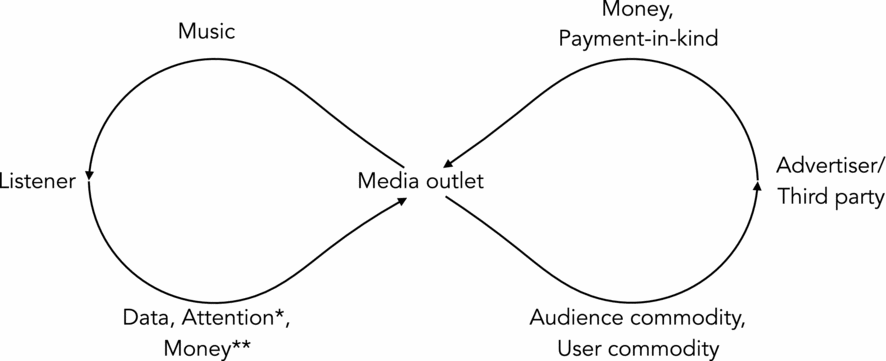
Far from marking a clean break with the past, streaming platforms’ recourse to user data as a way of generating revenue hearkens back to older practices, inherited from the world of commercial broadcast media.Footnote 25 At work in both commercial radio and streaming is what economists call a two- or multi-sided market, with stations or platforms mediating the transactions of two or more distinct groups of users. Celebratory accounts of such two-sided markets tend to emphasize the mutually beneficial “network effects” that arise once different sets of users are brought into relation with one another.Footnote 26 More critical accounts tend to emphasize by contrast the asymmetries that two-sided markets foster, perpetuate, and/or exacerbate.Footnote 27 One critical account that has proven quite influential can be found in the work of Marxist communications scholar Dallas Smythe. For Smythe, the main product the mass media under monopoly capitalism fabricated was not programming (i.e., the music or shows disseminated on air). Rather, it was the audiences that were attracted to such programming, which were then packaged and sold to advertisers.Footnote 28 More precisely, what media outlets assemble is “audience power,” a commodity isomorphic to the “labor power” that employers purchase for the production of goods and services. Just as labor power is to be distinguished from labor as such, referring to a capacity for work that can be bought and sold, as opposed to the actual work performed, so too is audience power distinct from the actual “work” (of watching, listening, reading, perceiving, etc.) that audiences carry out. It describes an abstract potential to attend to advertising and to thereby learn “to buy the goods [advertised] and to spend their income accordingly.”Footnote 29 But if audiences are the main commodities produced by radio stations, television channels, and other ad-supported media, what does that make the content they broadcast? According to Smythe, it is nothing more than an inducement, a means for mobilizing audiences and fabricating audience commodities. The songs played on the radio, the text and images posted to websites, the programs aired on television, all of this is what Smythe, following A. J. Liebling, refers to as a “free lunch.”Footnote 30 Hence the two-sided market operative in commercial radio as well as streaming: in both, media outlets stand at the point of intersection between two circuits of exchange, one that trades programming for an audience's time and attention, the other that trades this time and attention for advertising dollars (see Figure 1).Footnote 31
The Two-Sided Market of Music Streaming.

Smythe's model has garnered renewed interest in light of recent developments in digital media. The internet, mobile telephony, the web 2.0, social media, the proliferation of portable (and now wearable) devices, ubiquitous computing, the so-called “internet of things”: each of these technologies has opened the way to more intensive methods of commodifying media audiences. Scholars have identified a number of ways the audience commodity has evolved in tandem with the spread of interactive networks. Particularly important is the increasing precision with which users may be packaged and sold to advertisers. A baseline for comparison may be found in the publics solicited by broadcast media like radio and television, the object of Smythe's research. Such publics are largely indeterminate. Membership in them depends not on a fixed attribute that individuals share, but on a transient action they perform: that of listening, reading, watching, or partaking. “The existence of a public,” Michael Warner observes, “is contingent on its members’ activity, however notional or compromised, and not on its members’ categorical classification, objectively determined position in social structure, or material existence.”Footnote 32
It is precisely this fluctuating and uncertain character of mass-mediated audiences that has driven attempts to find some “external way of identifying [them],” some means by which they may be compassed.Footnote 33 One strategy for delineating publics involves the identification of some demographic trait binding individuals together; to the extent that membership within a demographic category is understood to motivate patterns of cultural consumption, it may serve as a proxy for the more amorphous figure of the audience. This strategy not only motivates the longstanding practice among record companies and radio broadcasters to subdivide the music-listening public by race, class, age, or gender. It is also what has driven them to develop ever more finely grained segmentations of the market, to lend these virtual publics an increasing degree of precision. In the case of the U.S. record industry, this process has led from the partitioning of the market according to the crude race- and class-based categories operative in the 1920s and 1930s (“race,” “old time,” “foreign,” and an unmarked mainstream) to the more fractured genre space of the early twenty-first century.Footnote 34 In the case of the U.S. radio market, this same process has prompted the multiplication of ever more tightly focused radio formats over the past half-century, with the “format revolution” of the early 1970s and the associated decline of top 40 radio marking a pivotal moment in this long-term trend.Footnote 35
The need to make the otherwise intangible entities that are audiences more tangible has also driven the development of a coterie of techniques aiming to measure audience size, composition, and behavior. For both broadcast media and advertisers alike, the ability to quantify audiences—and to do so with some semblance of objectivity—is of the utmost importance. For it is only when audience commodities can be quantified that they can be priced in a manner mutually satisfactory to both buyers and sellers, necessary for their exchange on an open market.Footnote 36 One consequence of this has been the development of a secondary industry devoted to the measure of audience ratings. As Eileen Meehan noted in an important revision to Smythe's model, firms dedicated to the measurement of audiences such as AC Nielsen or Arbitron have proven so successful in interposing themselves between media companies and advertisers that ultimately what is sold by the former and bought by the latter are not audiences as such, but ratings—symbolic constructs, usually derived from techniques of statistical sampling.Footnote 37 Such statistical approximations have long been the source of conflicting attitudes among both commercial media outlets and advertising agencies. On the one hand, numerical representations of “average quarter-hour persons,” “time spent listening,” “audience share,” “cume” (short for cumulative audience), and other artifacts of the radio ratings industry foster a misplaced sense of confidence in station programmers and advertisers. As Ien Ang remarks in connection to television ratings, such figures give rise to “a sense of concreteness, a sense of ontological clarity about who or what the [. . .] audience is.”Footnote 38 On the other hand, the latent awareness that such statistical approximations are precisely that—approximations of an actually existing public whose exact contours can never be adequately grasped—makes them a source of anxiety, clouding the “ontological clarity” they promise to bestow. The tension generated by this desire to know the public, a desire whose intensity is only heightened by the impossibility of ever attaining such knowledge, has fueled the production of newer and ostensibly better technologies of audience research over the years: from the telephone polls and audimeters of the 1930s and 1940s, to Broadcast Data Services and the “portable people meters” of more recent decades.Footnote 39 Yet the fundamental unknowability of audiences means that each innovation that promises to reliably measure them invariably falls shy of the mark.
With the rise of interactive, networked media, however, a qualitatively different kind of entity may be targeted and sold to advertisers: the individual user. Unlike broadcast media, which transmit messages indiscriminately to individuals dispersed in space and/or time, interactive media can exploit user logins, IP addresses, cookies, and more recent advances in digital fingerprinting to connect specific individuals to specific devices and online activities. As a result, streaming sites and other digital media platforms are able to sell the user not as a potential member of a supraindividual category like a public, but as an individual. Larger groups may of course still be formed, by collating a number of different users into demographic tranches that can then be sold en masse to advertisers. But in contrast to the publics convened by technologies of mass mediation, the groups aggregated via interactive technologies can be disaggregated into the individuals that comprise them. As Anderson notes in connection with Pandora, the platform is able to deliver “specific categories to advertisers as the listener listens,” which contrasts with commercial radio's reliance of formats “to find audiences that are based on estimates and projections.”Footnote 40 Pandora may still sell users in bulk, but each demographic package it assembles and sells is comprised of only those individuals who manifest whatever trait advertisers desire, at whatever time and for however long they happen to exhibit it. A consequence of this increased specificity is a commensurate increase in the value generated by such advertising. As Sut Jhally and Bill Livant noted in connection with niche television programming, the “specification and fractionation of the audiences leads to a form of ‘concentrated viewing,’” apparently minimizing the amount of advertising money wasted on “irrelevant” or undesirable consumers.Footnote 41
The shift from audience to user commodities is only one of the ways new media platforms have increased the value deriving from their consumers. Another involves the exploitation of the “free labor” that individuals supply in producing the user-generated content upon which many platforms depend.Footnote 42 As regards music streaming services, such content includes the playlists curated on sites like 8tracks.com; the tags appended to songs on Last.fm; the lyric annotations published on Genius.com; and not least of all music itself, which sites like Soundcloud and YouTube encourage users to upload and make publicly available on their platforms.Footnote 43 More important for our purposes, however, is the way in which any kind of online activity can be rendered valuable, to the extent that it provides potentially useful information about the user who performed it. As Mark Andrejevic has noted, interactive technologies allow for “the redoubling of user activity in the reflexive form of information about this activity.”Footnote 44 For streaming platforms such “reflexively redoubled” information include the more conspicuous signals that users emit, such as which songs or artists are searched for, which are played, how often, for how long, which are added to playlists, etc. But they may also include less conspicuous “digital traces” that are a byproduct of users’ online activities, such as the date and time tracks are added (or removed) from playlists, at what point in a track a user skips ahead, the cursor's movement across the screen, the distribution of listening activity across different time-scales (days, weeks, months, years), and so forth.Footnote 45
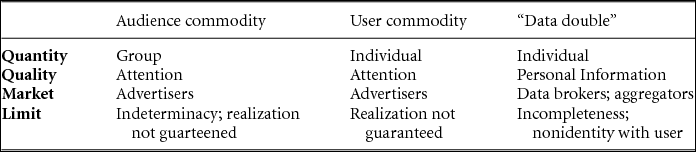
Being the property of the platform that captures and records it, such surplus information may be monetized in turn. The result is a cybernetic commodity par excellence, insofar as it “consists of the information or feedback created from [one's] actions and interactions online.”Footnote 46 When coupled with other forms of user information, collected during the registration process (name, address, credit card information, etc.) or from other third parties, such “reflexively redoubled” data can generate still more information, through the correlations that emerge from the combination of distinct datasets.Footnote 47 Demand for the resulting information stems from a variety of commercial actors, most notably data management platforms, credit reporting agencies, ad servers, and other aggregators of consumer information.Footnote 48 Their use-value for such buyers resides in the contribution they make to the construction of detailed data profiles of individuals—or what Kevin Haggerty and Richard Ericson have dubbed “data doubles,” the “decorporealized bod[ies] . . . of pure virtuality” that not only derive from our real-world bodies, but increasingly structure the space of possibility in which the latter act.Footnote 49 But despite their similarity to the user commodities that are sold to advertisers, data doubles represent an altogether different kind of good: whereas the user commodity packages the individual's powers of attention for sale, the data double packages a reified, datafied version of the self. Table 1 summarizes the distinctions separating audience commodities, user commodities, and data doubles.
Methods of user commodification.

Despite improvements in the ability to extract additional value from users’ attention, voluntary labor, and digital traces, there still exist limits to these commodification processes. Consider the user commodities that new media sell to advertisers. Even if interactive technologies promise greater precision in targeting individuals, what is packaged and sold to third parties are no less a representation than the statistical projections used to establish audience ratings and assign value to audience commodities. Recall that the audience commodity is not a tangible good but an abstract capacity, one that may or may not be realized: what is commodified is “audience power,” that is, the potential of audiences to attend to advertising. What is not sold—and cannot be sold—is their actual attention. A similar dynamic is evident with regard to user commodities. They too package for commercial exchange an abstract potential, albeit one that exists at an individual rather than a populational level. As with the audience commodity, what is at stake with the user commodity is a capacity to attend to information, whose realization can never be guaranteed, only inferred through indirect signals (whether a user clicked on a banner ad or not, whether they muted an audio ad, etc.). A user commodity is not to be conflated with a user, nor is a user to be conflated with a flesh-and-blood person.
Similar observations may be made with regard to data doubles. In the case of audience commodities, their non-identity with actual audiences stems from the fact that they are but a rough, statistical approximation of a messy and indeterminate public. In the case of data doubles, their non-identity with the individuals they purport to represent results from the fact that these present but a partial and fragmentary image of their real-world counterparts, a disjointed outline created from an array of data points. Data doubles may be associated with specific persons, they may even be extended through the collection of ever more information, but they are only ever piecemeal versions of their real-world counterparts. For this reason, Matthew Crain observes, the task of “confronting information gaps about current and potential customers has always been a fundamental challenge for marketers.”Footnote 50 No matter how much information is added to profiles, the fact that data is never simply given but the product of contingent techniques of measurement, recording, and representation means that such profiles do not transparently reflect the users to which they are assigned.Footnote 51 Data doubles may correspond to individuals, but they are not equivalent to them.
The persistence of such gaps has driven two important trends in the market for consumer attention and information, particularly as these related to music and music streaming. One concerns efforts undertaken by marketers, data brokers, and commercial media outlets to disaggregate users, transforming them into what Deleuzians would refer to as a collection of dividuals: the various sub- or pre-individual elements out of which individuals are assembled (affects, behaviors, drives, habits, physiological responses, and so on).Footnote 52 Such an understanding of the self as a multiple informs much work in music recommendation systems. For instance, a common approach to the problem of how to automatically curate playlists sensitive to changes in listeners’ context is to subdivide a single user profile into a number of discrete profiles, differentiated according to situational factors such as time of day, ambient temperature, social setting, or geographic location. In the words of one Spotify employee: “We believe that it's important to recognize that a single listener is usually many listeners, and a person's preference will vary by the type of music, by their current activity, by the time of day, and so on.”Footnote 53 The logic is straightforward: if the individual is still too inexact a target, then it is necessary to go beyond this construct, to something ostensibly more elemental. But while the logic may be straightforward, its ramifications are less so. Notably, with the development of ever more refined recommendation services, a shift takes place in how listeners are interpellated by way of music.Footnote 54 Personalized, context-sensitive playlists hail listeners less as members of some abstract demographic category than as concrete particulars. As such each recommendation may be understood as a proposition about one's musical identity—or, more precisely, about one's identity at a particular moment, within a particular context.Footnote 55 Though this promises to provide a more accurate image of one's multiple musical selves, an image that is specific to the in/dividual and that adjusts to its vicissitudes, a more subtle form of interpellation still occurs. Despite their particular differences—or perhaps because of them—each and every listener is called upon to inhabit what might be described as a paradigmatically postmodern version of the musical self, one that is multiple, decentered, and fluid. At the same time, if a given recommendation should be judged unsuitable for such work of musical self-fashioning, it may still be refused, whether by skipping to the next recommendation, rating it negatively, or—more drastically still—by exiting the platform altogether. But even when users fail to recognize themselves in the refracted self-images that music recommendations propose, their response still performs a kind of identity work. The difference is that such identity work is performed as much for the benefit of streaming platforms and their third-party partners as it is for listeners themselves. Even negative feedback provides valuable information by which individuals can be further dividuated, and data doubles further refined and valorized.
A second trend that has arisen in response to the gap separating users and user-commodities, individuals and their data doubles, hinges on attempts to improve the quality of the data that are the stock in trade of advertisers, aggregators, and other buyers and sellers of consumer information. Indeed, “data quality” has become something of a watchword in digital advertising. Typical is a report titled “Enriching Media Data,” issued by the consortium Coalition for Innovative Media Measurement in 2015. The report cites a number of problems with the data advertisers acquire, listing “source credibility, recency, consumer classifications, collection method, [and] representativeness” as perennial matters of concern.Footnote 56 The obsession with identifying sources of high-quality data has created a situation that media companies—including streaming platforms—have been quick to exploit. This typically takes the form of an intensified competition, as each site or service engaged in consumer surveillance strives to differentiate its data from that produced by rival firms. Such efforts at product differentiation are as much rhetorical as they are substantive—which is to say that they themselves involve marketing. But it is not consumers who are the targets of these marketing efforts; it is rather other marketers, whose business media companies wish to attract. The proliferation of media outlets and the heightened competition for advertising revenue this has engendered means that in order to sell users’ attention or personal information to third parties, media companies also have to work hard to sell themselves—or, more precisely, to position themselves as purveyors of particularly valuable forms of user attention and personal data.
You Are What You Listen To
How then does the intensified competition over user attention and information shape the practices of streaming platforms like Pandora, Spotify, or Deezer? To answer this question, it may prove helpful to recall the two-sided markets at work in cloud-based streaming (Figure 1). That platforms are engaged in two different types of exchange means that they transact with two distinct kinds of consumer: consumers of music and consumers of user data. This also means that platforms operate within two markets, one centered on the circulation of music, the other centered on the circulation of user data and attention. In the former, the competitive struggle sets a streaming platform like Deezer against other music distributors for listeners; its rivals in this regard include not only other streaming platforms, but also terrestrial and satellite radio stations, digital music stores, record stores, and so on. In the latter, platforms are locked in a different competitive struggle, one that pits them against other media outlets for the business of advertisers, data brokers, and other third parties; its rivals within this market likewise go beyond the limited sphere of streaming platforms, encompassing the entire spectrum of media, old and new alike.
Because standalone platforms like Spotify, Deezer or Pandora have to compete against a panoply of media for the business of advertisers and data aggregators, it is imperative that they confer a distinctive value upon the data they generate. Moreover, these efforts at product differentiation rely on the collaboration of a range of actors.Footnote 57 Marketing executives, data analysts, and other personnel in the employ of platforms like Tidal, Pandora, and Spotify are of course important participants in such processes. But they are hardly the only ones. Also important are the contributions made by nonhuman actors, in particular the technologies responsible for capturing and processing user data; by users, whose interactions form the basis of the data commodities platforms fabricate; by rival platforms, who have an interest in dedifferentiating their competitors’ data and user commodities, casting them as generic goods for which others may substitute; and by the broader set of discourses that circulate around music, which, in shaping impressions about what our musical preferences reveal, also shape impressions about how valuable data about our musical preferences might be.
Taking place in a complex ecosystem of competing actors and practices, the question of what a product or service is, of how its qualities are defined and hierarchized, is never settled once and for all, but is subject to a continuous process of negotiation. The attributes that are seen to define data commodities, and that form the basis of their use-value, are themselves matters of controversy. This does not stop firms from trying to assert the distinctiveness of the data they produce, however. On the contrary, it makes such endeavors all the more urgent. There are a number of ways they may go about doing so. Platforms might tout the size of their user base. Or they might point to the vast quantity of data they have managed to collect on listener activity over time.Footnote 58 Or they might cite the greater number of user interactions that music elicits relative to other media.Footnote 59 Or they might make an argument as to the heightened attention that audio, unlike images or text, is purportedly able to command.Footnote 60 Of all these strategies, two stand out. One focuses on the techniques of data analysis developed by Pandora, Spotify, Deezer, and other platforms. The privilege accorded these techniques is largely a function of their much-vaunted capacity to microtarget individual users and dividuated user-attributes. The second approach centers on the virtues seen to inhere in the very thing that, by prompting users to engage with platforms, also prompts users to produce data about themselves. This thing is, of course, the music itself.
I will address each of these strategies of product differentiation in turn. As regards data analytics, the nominal aim of the techniques platforms have developed to index, sort, and match audio files to users is to provide an ever-improving service for customers. Given the enormous amount of music that streaming platforms make available to users (over 30 million tracks in the case of Spotify or Deezer), tools that help individuals navigate this abundance assume tremendous importance. As Jeremy Wade Morris remarks, such “infomediation” becomes under these circumstances “increasingly important vectors on which companies seek to differentiate themselves.”Footnote 61 This is what ostensibly motivated Spotify's August 2015 update to its privacy policy. Recall that the company justified the expansion of the kinds of data it collected on users as being driven by its mandate of building “new and personalized products for the future.” Generally speaking, platforms are able to undertake personalization at a mass scale due to the suite of proprietary algorithms each has developed to collate various kinds of music data with various kinds of user data. This is true even of companies like Apple or Pandora, both of which tout the input provided by the human actors they employ (to curate playlists in the case of Apple Music, to analyze audio tracks and tag them with metadata in the case of Pandora's well-publicized “music genome project”). Of course, the rhapsodies these companies sing to the ineffable “human touch” supplied by the curators or “musicologists” they have on payroll function as yet another tactic by which the goods and services they produce may be qualified, distinguished from those of their rivals within the competitive market for music consumers on the one hand and data consumers on the other. “Algorithms aren't personal. People are personal” declares the Pandora for Brands website, as part of its efforts to woo potential clients away from Spotify and other firms denigrated as being overly reliant on the rote, empty, and meaningless data processing performed by machines.Footnote 62 But no matter how much of a premium firms place upon the affective investments human actors make in music—which is what presumably imbues the fruits of their labors with an affective surplus value—virtually every service employs algorithms at some level, to automate recommendations, generate playlists, and facilitate other forms of mass customization. Otherwise, the labor costs involved in personalizing either the listening experience or advertising at a mass scale would prove unsustainable.
Although they vary in their details, these algorithms draw upon a few basic methodologies. The first of these are “content-based” approaches, derived from work in music information retrieval and machine listening, which seek to extract from audio files compact representations of acoustic features. The resulting feature vectors are then used to situate files within some kind of multidimensional similarity space, so that a listener expressing a preference for a given track may be recommended another on the basis of its proximity within this space.Footnote 63 A second approach, semantic analysis, involves mining the web for “cultural metadata,” that is, terms associated with a track, artist, or album to a statistically significant degree. Here too a similarity space may be constructed, albeit one that uses ranked keywords rather than auditory features to position tracks, artists, or genres relative to one another; again, listeners expressing preference for an item would be recommended another on the basis of their proximity within this semantic space.Footnote 64 A third method is the by-now pervasive technique of collaborative filtering, which seeks out similarities in consumption patterns to cluster both users and items (the best-known example of this is Amazon's recommendation system, which proposes customers additional products on the basis of what individuals with similar purchasing histories have bought in the past, but that the customer in question has not).Footnote 65 Each platform's proprietary data analytics technology involves the combination of some or all of these methods. When coupled with user profiles compiled on the basis of past listening activity, user registration information, or third-party data, these techniques of data analysis allegedly permit platforms to anticipate the desires of individual listeners with remarkable accuracy. To each of Spotify's or Pandora's millions of users is promised a unique experience, with recommendations and playlists tailored to one's idiosyncratic tastes.
More recent developments have expanded upon this basic set of techniques. Notable in this regard is work on mood-, activity-, and context-based recommendation, some of the most active areas of research in music information retrieval in recent years.Footnote 66 These and related advances in music recommendation seek to exploit data about contingent, situational factors to better match songs to users’ fluctuating desires. One might understand such endeavors as building on—but also radically transforming—music's use as a means of self-regulation, such as Tia Denora has discussed.Footnote 67 But where for Denora's informants the use of music to adjust emotional or physiological states is a quasi-artisanal practice, guided by informal musical knowledge, for researchers in MIR it is an industrial problem, to be resolved through a combination of abstract reasoning and technical instruments. For instance, context-aware recommendation systems typically make use of information gathered from sensors embedded in mobile devices to identify patterns in musical preference that correlate strongly with location, local weather, speed and type of movement, time of day, heart rate, and so forth. To the extent that shifts in listening habits correspond to shifts in observed context, such information can be used to divide a single user profile into a number of context-specific profiles. Such techniques of “user-splitting” are more sensitive to how musical taste varies across space, time, and social setting.Footnote 68 By contrast, techniques of music emotion recognition typically employ some combination of semantic analysis and machine learning in order to automatically tag audio files with metadata describing their affective features. These can then be used to curate mood-based playlists or to recommend music on the basis of various kinds of explicit or implicit user feedback. Or they can be used to situate music within a similarity space measured not in terms of auditory features or “cultural metadata,” but in terms of affect, with recommendations for tracks proceeding in terms of how close they are within this map of musical emotion.
Increasingly, the appeals platforms make to would-be users emphasize such innovations, the promise of an individualized experience having been surpassed by the promise of a dividualized one, a service that adjusts to users whose musical selves are not one but many, modulating according to context, mood, or activity. “The right music for every moment” is the way Spotify describes this paradigm, one in which actions ranging from the most mundane to the most consequential can find a suitable musical accompaniment: “From scrambling an egg to choosing the next leader of the free world, all moments can be made better with music.”Footnote 69 But what is crucial to observe is how the pitch made to prospective users, that of an individualized or dividualized music service, is echoed in the pitch platforms make to prospective advertisers, data brokers, and other third parties. The same innovations that platforms’ highlight in order to differentiate themselves within the competitive market for music are also highlighted to differentiate themselves within the no less competitive market for user attention and data. A short video, produced for the benefit of potential advertisers and posted to the Pandora for Brands portal in 2015, makes this parallelism clear. Accompanying an image of a garishly colored gumball machine, a woman's voice cheerily asks viewers to hearken back to the frustrated desires of childhood: “Remember when you were a kid, staring at that big gumball machine, and all you wanted was to get your hands on the bright blue berry-flavored gumball? Imagine a world where you can finally ask for and receive the exact gumball you want, and get it in real time.”Footnote 70 Like music consumers, advertisers are guaranteed they will get exactly what they want, when they want it. But whereas for the listener the object of desire dangled before one's ears is a piece of music perfectly attuned to whatever context or state of mind one happens to be in, for advertisers this object is none other than the in/dividuated listener, the “bright blue berry-flavored gumball” the voice-over invokes (and it is worth noting that the listener is figured here as something to be consumed—or at least chewed up and spit out). Later in the same video, Pandora specifies what, exactly, has brought advertisers’ dream of “reach[ing] the right audience, with the right contextual messaging, at the right place and time” to the brink of realization: it is the mass of information on individual listening activity that the platform has collected over the years, overtly for the purposes of refining the delivery of music to users, covertly for the purposes of refining the delivery of user data and attention to third parties. “Pandora has one of the largest logged in user bases,” the video announces, “and our rich targeting capabilities are driven by insightful data points, such as music listening preferences, that we have been processing from our listeners for nearly a decade.”Footnote 71 Even more explicit in connecting techniques of customized music recommendation to customized marketing is a tweet published by a Spotify executive during an advertising exposition that took place in Fall 2016: “Our algorithms build hugely successful listening experiences. We are using the same expertise to build our ad products.”Footnote 72 Here, as elsewhere, the precision with which musical desire can be anticipated is presented as an index of the precision with which other kinds of desire can be anticipated.Footnote 73
The push toward mood- and context-based recommendation in MIR research takes on a particular significance in light of this concurrent push toward real-time microtargeted advertising. If information about who one is, what one is doing, or how one is feeling can be marshaled for the purposes of finding the “perfect song” for the “perfect moment” (as one Spotify promotion puts it),Footnote 74 then the harnessing of such techniques for advertising and data collection instead proposes to reverse these relationships. It is no longer simply that contextual information can help to identify songs or playlists appropriate for a given user, in a given situation, at a given moment in time; songs or playlists may by the same token be used to infer what a given user's situation might be, at a given moment in time. To an extent, the reversibility of these relations follows from the big data ideology that subtends much of the work done in music recommendation and discovery. A key tenet of this ideology maintains that if a correlation between two variables is strong enough—that is, if it is supported by a sufficiently large body of data—then knowledge of the one is tantamount to knowledge of the other. It is of little matter whether variations in the kind of music one wants to listen to are actually motivated by context or mood. As big data advocates are wont to argue, causal explanation may have been a necessity in “a small data world,” where limited sample sizes meant that theoretical models had to serve as a stopgap, something that might compensate for shortcomings in our capacity to directly observe phenomena.Footnote 75 But in a “big data world,” such as we are now alleged to inhabit, appeals to causal mechanisms can be dispensed with. The quantity of data now available is such that correlations are of sufficient predictive reliability to make them adequate as bases for action; and this in turn renders causal models—or any kind of theory whatsoever—obsolete: “Petabytes allow us to say: ‘Correlation is enough.’ We can stop looking for models. We can analyze the data without hypotheses about what it might show.”Footnote 76 In contrast to the one-way movement that leads from cause to effect, correlation admits to a bidirectional traffic between any two variables having a statistically significant relationship. Whether one uses contextual data to predict musical preferences, or uses data on musical preference to predict context, makes no difference. At least this is what the correlationist doctrine that rules data analytics would have us believe.Footnote 77
An example of this doctrine at work can be seen in a recommendation system sketched by a trio of MIR researchers in 2012.Footnote 78 Starting from the premise that taking contextual data into account can help improve music recommendations, the researchers take note of the fact that such contextual data is not always readily available. While some dimensions of a setting may be “fully observable” by means of various sensors, others might only be “partially observable” and still others not observable at all.Footnote 79 For that reason, the proposed system looks to patterns in the semantic metadata that have been tagged to songs in a user's listening queue. Since such metadata more often than not refer to the settings in which a song is typically heard, or the activities it typically accompanies, these can serve to extrapolate pieces of contextual data that are missing. Thus, if a series of songs a user is listening to have been repeatedly tagged with descriptors like “dance” or “party” on a site like Last.fm, or if these tracks appear frequently in (humanly) compiled playlists bearing these same keywords, then this provides a clue as to the listening context—a clue that might be further reinforced when conjoined with other pieces of observable contextual data (like time of day or motion sensors). Admittedly, the aims of the proposed recommendation system are relatively modest, its primary purpose being to detect potential changes in the listening environment so as to dynamically adapt music recommendations, rather than to identify this environment as such. But it is not difficult to envisage extensions of this approach that would treat music as just another sensor by which various “extramusical” determinants of music consumption are registered. If current work in MIR on context- or mood-detection is any indication, it is just a matter of time before this eventuality comes to pass, before the correlations linking music preferences to emotional and environmental factors are put to work not in order to refine music recommendations, but in order to work backwards from one's musical behavior to the emotional and environmental factors that are presumed to motivate it.
Until then, there are more straightforward ways that streaming platforms can draw inferences about how users are feeling, what they are doing, and where they are doing it. Crucial in this regard has been the proliferation of mood-, activity-, and context-based playlists on platforms like Spotify, Deezer, or Google Play (especially following the latter's acquisition of Songza, whose “concierge” service pioneered mood and activity based playlisting). Interviewed for Advertising Age magazine in spring 2015, as part of the launch of Spotify's new “playlist targeting” initiative, Vice President for Advertising Brian Benedik noted that the company increasingly uses “playlists as a proxy for the activity or mood you're in.”Footnote 80 As a press release explained, “when users hit play on one of the billions of playlists on Spotify, they often signal a common activity or mood—like workout or chill.” Such signals make it possible for brands to “target unique audience segments based on streams from Spotify's 1.5 billion-plus playlists, from workout enthusiasts and commuters to millennials, parents and more.”Footnote 81 By tracking which activity- or context-based playlists users listen to on a regular basis, more granular audience segments may be assembled, and more elaborate user profiles constructed. For instance, a person who listens to a running playlist every morning might be identified as a jogger, while someone who makes a habit of listening to sleep playlists in the small hours of the night might instead be identified as an insomniac. Not only does playlist targeting thereby encourage the multiplication of interest-based, lifestyle, and/or psychographic audience segments that can be sold to advertisers; it also expands the range of attributes that may be added to individual users’ profiles, increasing the detail—and thus the value—of their data doubles.Footnote 82
Playlist targeting is just a beginning. In 2016 Spotify expanded its exploitation of such data, unveiling an automated auction market for advertisers that would allow them to bid on users’ attention in real time, on the basis of the playlists individuals happen to be listening to at any given instant.Footnote 83 As with playlist targeting, activity- or mood-based playlists are treated as a stand-in for whatever activity users’ are engaged in or whatever mood they are experiencing (or would like to experience). But whereas playlist targeting seeks to identify the stable features that define users, this latest innovation in consumer profiling—what marketing professionals term “programmatic”—operates on an altogether different temporal horizon. The aim is to address users at precisely those moments when they are deemed most receptive to an advertising message. Playlists here function as a means to determine when that moment may be, based on what individual users are doing or how they are feeling from one point in time to the next. As a writer for Advertising Age describes it, the approach looks past audience segments, even past the individual, in order to target the user as s/he is fractionated across the moments that comprise everyday life: “Activity categories . . . such as workout . . . will allow a sportswear brand to play an audio ad while someone's on their morning run. . . . And mood categories like happy, chill and sad will let a brand like Coca-Cola play on its ‘Open Happiness’ campaign when people are listening to mood-boosting music.”Footnote 84 The shift here is from being to event, from a focus on the allegedly invariant features that constitute one's identity, to the transient phenomena that compose the temporal unfolding of our lives. But whether they are used to figure durable features of our selves or to monitor more short-lived actions or affects, playlists increasingly function as a means whereby music consumption taking place within the digital enclosure erected by streaming platforms can be used to track who we are, how we feel, and what we do outside this digital enclosure.
These developments in the targeting and profiling of listeners point to a second major way that streaming platforms go about distinguishing the user and data commodities they produce. Ultimately, what underpins claims made about the value data analytics impart to these commodities is a more basic claim about the value of the data being analyzed. As streaming services aver, this is data that only music can generate. Its distinctive value derives from music's distinctive properties—specifically, from the intimate relation people have with music. This relation is both extensive and intensive. It is extensive, given music's role in accompanying all sorts of quotidian activities, at least within the (post)industrial global North. This is partly a function of technological innovations that have progressively detached music from any fixed site of performance over the past century (sound recording, miniaturization, digitization, audio compression, the proliferation of mobile devices, to name a few). Such factors, in creating conditions propitious for the development of “ubiquitous music,” have at the same time created conditions propitious for the development of the kind of “ubiquitous listening” that Anahid Kassabian has trenchantly discussed. Such listening is characterized by its inattentiveness, its tendency to “dishearken” from music once it is transformed into an immersive environment. Bathed in music, one cannot help but “listen ‘alongside,’ or simultaneous with, other activities.”Footnote 85 This is, in other words, a quintessentially distracted form of listening. But distraction works in both directions: just as a quotidian activity may distract one from the music that accompanies it, such music can serve just as well as a distraction from whatever activity one is engaged in (which is often the case in connection to work, workouts, and other kinds of tedious and/or strenuous occupations).
Technological innovations alone, however, cannot be blamed for the spread of ubiquitous music and ubiquitous listening. The distracted listening that is so often regarded as a peculiarly modern phenomenon has ample precedents in cultures predating sound recording.Footnote 86 Conversely, even after radio, phonography, and other technologies of musical reproduction had ushered in an era of relative sonic abundance, distracted modes of listening “alongside” other everyday activities did not ineluctably follow; rather, they were the subject of fierce debate and resistance.Footnote 87 Individuals had to become habituated to music in the background, acculturated into a world where disattending to music is not just accepted but unexceptional. The normalization of “listening alongside” is anything but a natural or necessary development. Indeed, as Noriko Manabe has observed, part of the reason that music streaming services have encountered greater resistance in Japan concerns the different practices that have developed around radio use and, more broadly, the different culture of listening this instantiates. If in the United States the development of genre-specific radio formats and embedded technologies (like the car radio) encouraged listeners to engage with music broadcast over the air while undertaking other activities, in Japan the more heterogeneous character of radio programming and the absence of a comparable “car culture” have militated against such distracted listening. A comment by one of Manabe's informants, an executive at Warner Records in Japan, is telling: “Americans and Japanese don't listen to music in the same way. Americans spend more time in cars and listen to the radio while they drive. But in Japan, radio's not as central as it is in the U.S. . . . People in Japan don't have as much of a history of listening to music in a passive manner.”Footnote 88 Much as listeners have to be taught to listen attentively, they also have to be taught to listen inattentively, to engage with music as an adjunct to some other action.
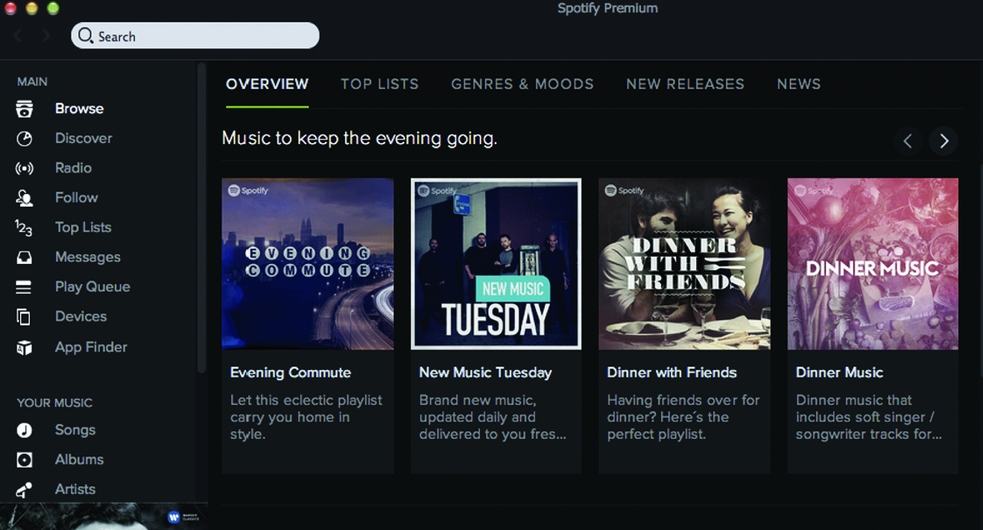
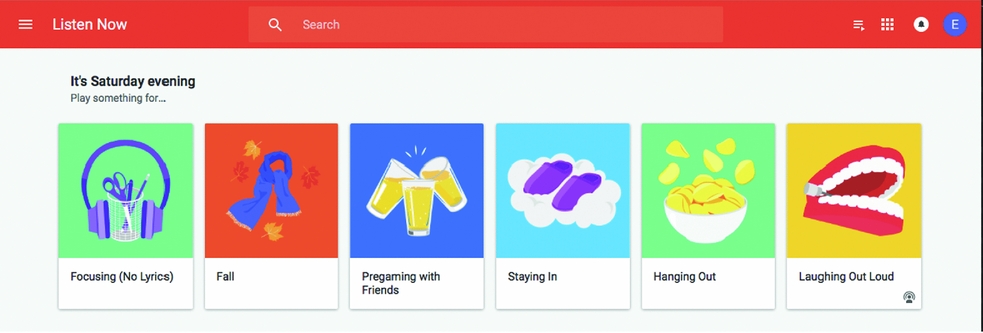
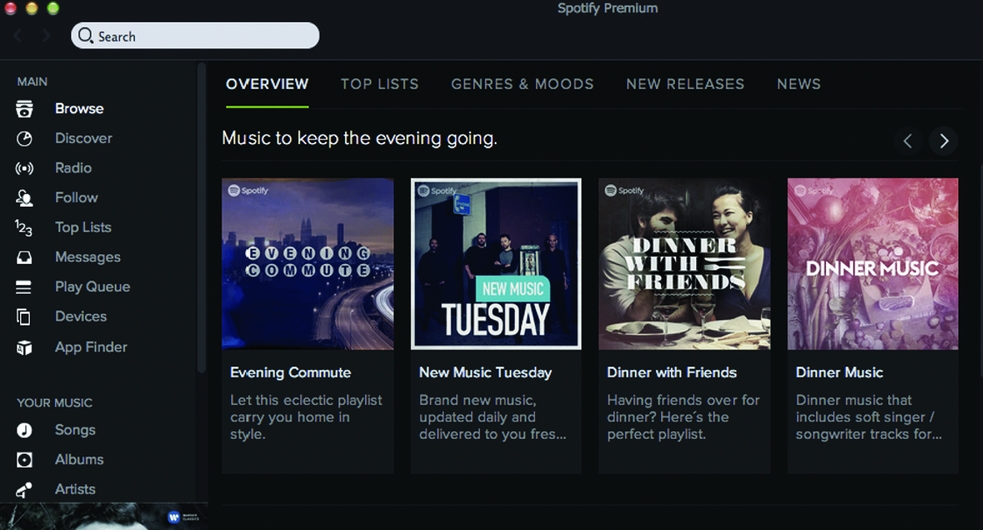
Streaming services, like radio broadcasters before them, have played no small role in this peculiar education of the senses. Consider the way activity and mood-based playlists are foregrounded on the user interfaces of certain platforms, such as Spotify or Google Play Music (see Figures 2 and 3). Even if this interface design is to some extent a response to listeners’ habitual use of music as a “technology of the self,” it cannot help but have a feedback effect, encouraging listeners to engage with music less as an autotelic activity and more as an accessory to something else. Also relevant is the way music is framed in the marketing discourse of streaming platforms. Symptomatic is the subtle yet significant shift that has taken place in the promise of providing listeners with music “anytime, anywhere,” a discursive trope whose longstanding role in selling mobile music to consumers has been incisively analyzed by Sumanth Gopinath and Jason Stanyek.Footnote 89 The image of consumer emancipation this phrase conjures, an image of individuals empowered to listen to whatever music they want, whenever and wherever they want, has in recent years become less a promise than an injunction: the trope of music “anytime, anywhere” is increasingly eclipsed by that of music “every time, everywhere.” What was once a matter of choice is recast as a matter of fact. “Now playing everywhere”—such is the pledge that Spotify makes to the brands it partners with, a guarantee that it can reach its tens of millions of users “when they're most engaged,” whenever this might be, “from morning to night.”Footnote 90
Recommended mood- and activity-based playlists on Spotify (Spotify.com).
Recommended mood- and activity-based playlists on Google Play Music (GooglePlay.com).
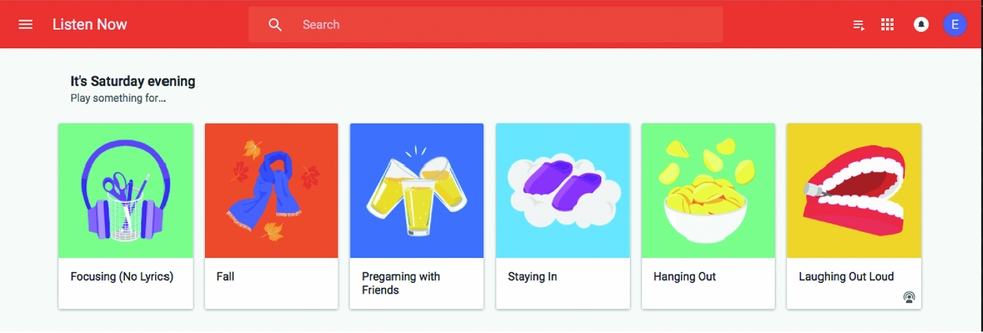
It is this pervasiveness of music, both real and perceived, that underwrites the claims platforms make about music streaming's usefulness for consumer surveillance. Likewise, it is music's capacity to insinuate itself into every corner of people's lives that qualifies the data and user commodities fashioned by virtue of this surveillance. At the same time as listeners are induced to use streaming music to maximize the value of the moments that fill each day—to compose, as the cliché goes, the “soundtrack of one's life”—advertisers and data harvesters are encouraged to treat this same sound track as a means of tracking users through sound.Footnote 91 For instance, a video on the “Spotify for Brands” site invites prospective advertisers to take “a deep dive into a day in the life of the Spotify for Free listener,” so they might discover “the various ways brands can be a part of each moment.” Shot from an idealized user's point-of-view, the video presents an image of daily life that is partitioned into a series of discrete settings and activities: commute, work, lunch, workout, “chillin’,” and party. It is no coincidence that each of these segments corresponds to a playlist category found on Spotify's splash page. The video's message is clear: just as an appropriate music may be found to accompany every moment, so too may an appropriate advertisement.
In fact, the value of streaming music depends on more than its ability to follow users through different parts of their daily routine. It also resides in its ability to multiply the number, variety, and specificity of the parts that comprise this routine, identifying those moments that music can infiltrate and that other, rival media cannot. This is the assertion made by Danielle Lee, Vice President of Global Partner Solutions for Spotify, during a talk at New York Advertising Week in September 2016. Discussing the different contexts in which individuals can listen to streaming audio, she makes an important distinction: “If you think about those moments when you are connected, such as driving, running, cooking, [for] many of them it's not possible to watch video.”Footnote 92 She later expands on this point, clarifying what sets music—and music streaming—apart from other media: “You can see from the data that audio is a companion through more parts of the day than video. So while you may sing along to your favorite songs in the shower, chances are that you aren't watching the artist's video.”Footnote 93 Addressed to an audience of marketing professionals, the claim advanced by Lee aims at differentiating the data and user commodities that Spotify produces from those of rival media outlets. She presumably has in mind YouTube and other streaming video sites, for which music is no different than any other kind of media content (cat videos, vlogs, unboxing videos, etc.).Footnote 94 But it is not just that streaming music affords advertisers access to more of the moments that comprise people's lives, including those beyond the reach of video (or text). It also allows access to more private moments, including those when individuals are particularly exposed, both figuratively and literally. The example of music one might listen to while showering is pertinent in this regard. Remarks made by one of Lee's colleagues at Spotify, Jana Jakovljevic, Head of Programmatic Solutions, hint at the discomfiting reality that lies behind streaming music's ability to accompany listeners into intimate spaces, like the shower, that other media cannot penetrate. Speaking at ATS New York 2015, Jakovljevic cited showering playlists to illustrate the degree to which Spotify can monitor individuals’ activities via music. “Yes, a user will create a playlist for partying and working out, that makes sense, but they are also creating playlists for more obscure activities. For example showering. We have 39,000 showering playlists on Spotify, 550,000 shower streams per day. So we not only know what are users are listening to, we also know their personal activities as well.” After a brief pause, she follows up this comment with what appears to be an impromptu aside: “Maybe a little bit too personal sometimes.”Footnote 95 The aside, and the nervous laugh she lets slip upon uttering it, are perhaps indicative of a guilty conscience, a latent awareness of the abuse of confidence that is being committed when Spotify and other firms use people's quotidian musical practices as a way of getting them to divulge aspects of their lives that they may not wish to divulge, that they may even be unaware of divulging.
If streaming platforms have been quick to exploit the extensive character of individuals’ relation to music, they have been equally quick to exploit the intensive character of this relation. One way they have done so is by drawing attention to the strong affective charge that runs through most people's musical preferences and practices. The implication is that users’ emotional attachment to music will redound upon the advertisements streamed alongside this music. Thus, in their bid to sell marketers and data aggregators on the virtues of streaming music, platforms habitually stress music's status as a “passion point” whereby attention may be captured, advertising messages imparted, and valuable consumer information harvested. “We connect artists, fans, and brands through the passion point of music,” Pandora announces to prospective advertisers.Footnote 96 Similarly, Spotify touts its brand-sponsored playlists as a way of “reach[ing] and engag[ing] target audiences through the passion point of music.”Footnote 97 Tacit in claims like these is the proposition that the particular content to which music streaming services rent access generates a stronger response than other kinds of online content (video, ebooks, video games, etc.). Such claims hearken back to the “hypodermic needle” theory of the media popular in the 1930s and ’40s, according to which radio, cinema, and other mass media were seen to possess an almost magical capacity to directly “inject” ideas and beliefs into audiences. But in contrast to this long-discarded model of media communication, which was developed in order to denounce the dangers of propaganda, Pandora and Spotify's updated version of this discourse is celebratory, not critical, in its tenor. That music might function as the tip of the proverbial needle, that the passions it arouses might serve to open a more direct line of communication with users’ psyches, is extolled precisely because it enables streaming platforms to valorize the user attention they garner and the user data they generate.
Yet the relation that individuals have with music, and that platforms seek to capitalize upon, is not just intensive in the sense that it is infused with a high degree of affective force. According to a longstanding and widely shared cultural trope, music is intensive in the additional sense of affording access to our innermost lives, to our hidden psychic depths, to an extent that other media cannot replicate. In this respect, platforms draw upon a vein of aesthetic discourse on music that extends back at least as far as the German Romantics, for whom music was nothing less than a sensuous figuration of the modern subject's interiority. Holly Watkins, in charting the progressive elaboration of this “metaphor of depth” in German musical thought, has noted how for writers like Wackenroder and Hoffman, the “truth of the self” was not to be discovered through rational self-reflection, as Enlightenment thinkers had maintained; rather, it could only be glimpsed via a medium whose ineffability and ephemerality provided an analogue to the boundlessness and elusiveness of the soul. Vestiges of this discursive tradition linger to this day; indeed, streaming platforms’ efforts to valorize music—and the data and user commodities produced via music—is built upon the foundation provided by these earlier efforts. This is implicit in the arguments advanced by streaming platforms and their representatives. “You are what you listen to” proclaims customer analytics start-up Preceptiv, in promoting its ability to generate incisive psychographic profiles of individuals on the basis of their musical preferences.Footnote 98 Brian Whitman, co-founder of the Echo Nest, a music analytics firm acquired by Spotify in 2014, goes further in his proclamation that “music preference can predict more about you than anything else. If all I know about you was the last five books you read, I wouldn't know much.”Footnote 99 It is by means of assertions like these that data on one's listening habits are qualified as equivalent to—and thus a potential proxy for—data about who one “really” is. At the same time, such claims portray music as an invaluable resource for anticipating other behaviors, other interests, and other desires, beyond strictly musical ones.
As proof of concept for the notion that our musical dispositions have a special power to predict other dispositions, the Echo Nest announced in advance of the 2012 U.S. presidential election that by analyzing the taste profiles of users who self-identified as either Democrat or Republican, it was then able to employ machine learning techniques to accurately infer the political orientation of other users, strictly on the basis of their listening behavior.Footnote 100 The Echo Nest is not alone in pursuing such research. In 2014, Pandora announced that it was going a step further, microtargeting political ads based on the partisan affiliations that users’ listening habits disclosed.Footnote 101 Already problematic when they were announced, such claims seem all the more disturbing in light of revelations in March 2018 concerning Cambridge Analytica's unauthorized exploitation of Facebook user data to microtarget political advertisements for the 2016 Trump presidential campaign. An overlooked aspect of Cambridge Analytica's alleged misuse of user information, however, is how entirely ordinary it is, being standard practice within the largely unregulated market for data commodities.Footnote 102 Indeed, the fact that so much data is so readily available on the open market makes it all the more imperative for streaming platforms to persuade potential buyers of user data and user attention that what we listen to is uniquely revealing of who we really are, that there is a distinctive value that accrues to the data generated by means of music. In their telling, it is a value that derives from the possibility that such information might close the gap separating our data doubles from our selves. And it is distinctive insofar as other media lack music's purported capacity to pierce past the external facades individuals erect, to confound the artifices of “self-presentation” they engage in, so as to gain admittance to the “backstage” area where their authentic selves are thought to reside.Footnote 103 As Danielle Lee notes at another point in her presentation at New York Advertising Week, “If social media is a filter, streaming is a mirror. So much of social media is about curating your persona. It's a performance of sorts, it's for public consumption. And yes, people are judging you. . . . Streaming is all about a reflection of who you really are. It's different, because you are not crafting a public image for others. You're just you, living in the moment.”Footnote 104 If it is true that music's capacity to both permeate and envelope the listener is no small part of the pleasure or utility it provides, it is no less true that these same qualities cast it as a potent means of knowing the listener, both inside and out. In this way the very qualities of music that people put to work in shaping their everyday lives and regulating their emotional lives are increasingly turned against them. What makes music so powerful a “technology of the self,” as Tia DeNora and others have posited, is also what allows streaming platforms to repurpose it as an equally powerful technology of surveillance.Footnote 105