“The typical large business twenty years hence … is far more likely to resemble organizations that neither the practicing manager nor the management scholar pays much attention to today: the hospital, the university, the symphony orchestra”
(Peter F. Drucker 1988).Reference Drucker 1
There is increasing interest in the principles of effective team-based health care.Reference Katkin, Kressly and Edwards 2 Indeed it might be considered that those who care for children with congenital heart disease lead the field in this respect. Despite increasing data to suggest that team-based health care may result in significant improvements in patient outcomes,Reference Neily, Mills and Young-Xu 3 – Reference Wolf, Way and Stewart 5 difficulties remain in developing these teams within almost every medical and non-medical organisation.
According to Patrick Lencioni, “if you could get all the people in an organization rowing in the same direction, you could dominate any industry, in any market, against any competition, against any time”. However, Lencioni continues that “for all the attention that it has received…teamwork is as elusive as it ever has been within most organizations. Teams because they are made up of imperfect human beings, are inherently dysfunctional”.Reference Lencioni 6
Before considering how we may overcome these difficulties in the practice of team-based health care, it is important first to consider what the fundamental characteristics of a team actually are. According to Katzenbach et al, “a team is a small number of people with complimentary skills who are committed to a common purpose, set of performance goals, and approach for which they hold themselves mutually accountable”.Reference Katzenbach and Smith 7 It is therefore important for us to acknowledge that while we may frequently refer to our “team”, many of our organizations are more akin to “working groups” rather than teams. It appears that a fundamental characteristic that distinguishes a working group from a team is that for the latter, there is not only individual but also mutual accountability and that it is important to consider not only individual but also collective work products.
In a recent special issue in the British Medical Quality and Safety Journal, Salas and Rosen, while highlighting some of the benefits of team-based care, suggested that “team building is a cultural intervention dependent on leadership support and to become an expert team player is a lifelong journey”.Reference Salas and Rosen 8 Here I consider other models of team-based endeavour that might be used to provide the cultural framework for teambuilding and the signposts for this lifelong journey in team-based health care.
The orchestra as a model for the ultimate team
If we consider an internationally renowned symphony, we see that it might fulfil many of the characteristics of a high-performing team. Certainly, while each individual within the orchestra may play at an extremely high level in solo performance, it is essential that in the environment of the orchestra, the talents of the individual are subordinated to the collective work “product”, whether it is a symphony or a concerto. Within the orchestra, there has to be excellent clarity of role, trust between individuals, and seamless handover between different sections of the orchestra. This leads one to consider whether the orchestra might provide us with useful lessons as we develop our teams in health care, whether the conductor could play a useful role as a metaphor for the health-care leader and whether the members of the orchestra can teach us about the role of the team member.
The conductor as a model of leadership
If one examines the role of the conductor over the centuries it is clear that it has evolved considerably. It is said that the one of the most famous conductor-composers of the 17th century, Jean Baptiste Lully, was a tyrant who used a large stave which he hammered on the ground to denote the beat, which the orchestra members would follow in submission. This view of conductors of the past is shared by the British conductor Charles Hazlewood who suggests that they were often “dictators…tyrannical figures, who would rehearse not only the orchestra as a whole but the individual members to within an inch of their lives”.Reference Hazlewood 9 According to Ben Zander, founder and conductor of The Boston Philharmonic Orchestra, “The conductor is the last bastion of totalitarianism in the world-the one person whose authoritarianism never gets questioned. There’s a saying: Every dictator aspires to be a conductor”.Reference LaBarre 10
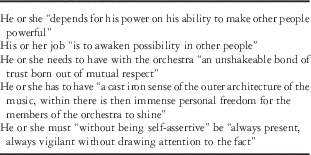
Thankfully, the role of the conductor has evolved, particularly over the past few decades. Zander made the observation that while his picture is on the front of the CD, “the conductor doesn’t make a sound”. Rather he saw that the fundamental attribute of the conductor is that “he depends for his power on his ability to make other people powerful” and suggested that the main job of the conductor is to “awaken possibility in other people”.Reference Zander 11 It is said that the conductor Claudio Abbado had a leadership style based upon his “restraint” and “personal reticence” such that “without being self-assertive, he was always present, always vigilant without drawing attention to the fact”.Reference Smaczny 12
These leadership characteristics of awaking possibility in other people, personal humility, and reticence and allowing the members of the orchestra to “shine” are part of the essence of what Jim Collins would consider to be level 5 leadership.Reference Collins 13 Collins describes a leadership hierarchy in which at level 1, a highly capable individual makes productive contribution from his or her talent, through levels 2, 3, and 4, which are characterised by working effectively with others, organising people and resources toward the pursuit of effective objectives, and sharing a vision to stimulate the group to high performance. At the pinnacle of Collins hierarchy is the Level 5 Leader. This is someone who “builds enduring greatness through a paradoxical combination of personal humility and professional will”. According to Collins, the level 5 leader will demonstrate compelling modesty, shunning public adulation, he or she will act with quiet, calm determination and will channel his or her ambition into the company rather than him- or herself. This personal humility will be coupled with unwavering professional will in which the leader demonstrates an unwavering resolve to do whatever must be done to produce the best, long-term results, no matter how difficult. The leader will set the standard for building and enduring great company and will settle for nothing less.
Another important characteristic of the modern conductor resides in his or her ability to earn the trust of the orchestra. According to Charles Hazlewood, there has to be between him and the orchestra “an unshakeable bond of trust born out of mutual respect”. As a result of this trust, there is now a much more democratic view in which the conductor “has a cast iron sense of the outer architecture of the music within which there is then immense personal freedom for the members of the orchestra to shine”.Reference Hazlewood 9 (Table 1).
Important principles upon which the conductor’s leadership role is based.

This combination of personal humility, unwavering resolve superimposed on enormous trust between the conductor and the orchestra is well manifest in some of the great performances conducted by the German born Austrian conductor Carlos Kleiber and the American conductor Leonard Bernstein, both of whom would be widely regarded as being among the great conductors of the 20th century. There are many-quoted examples of how Kleiber would empower the members of the orchestra while being ever vigilant during their solos and even of how Leonard Bernstein stood in front of the orchestra with his arms folded while his orchestra performed a beautiful movement from a Haydn symphony. 14
The importance of trust
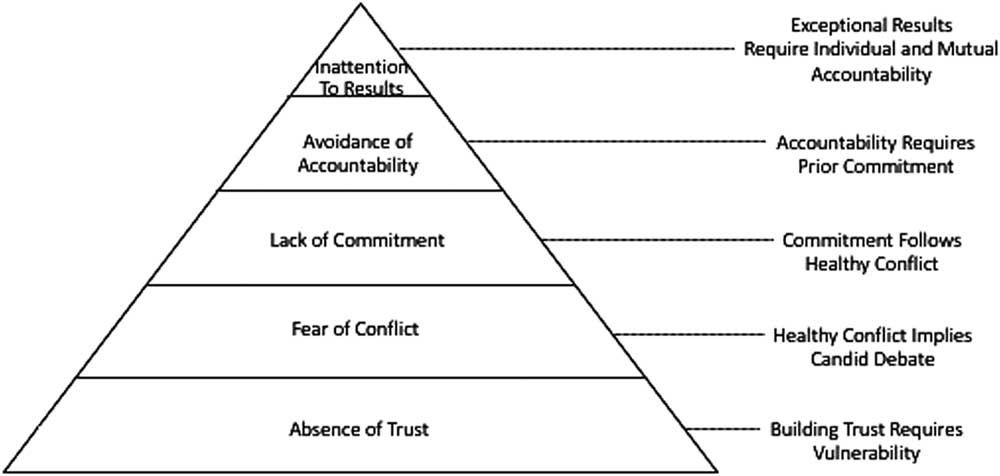
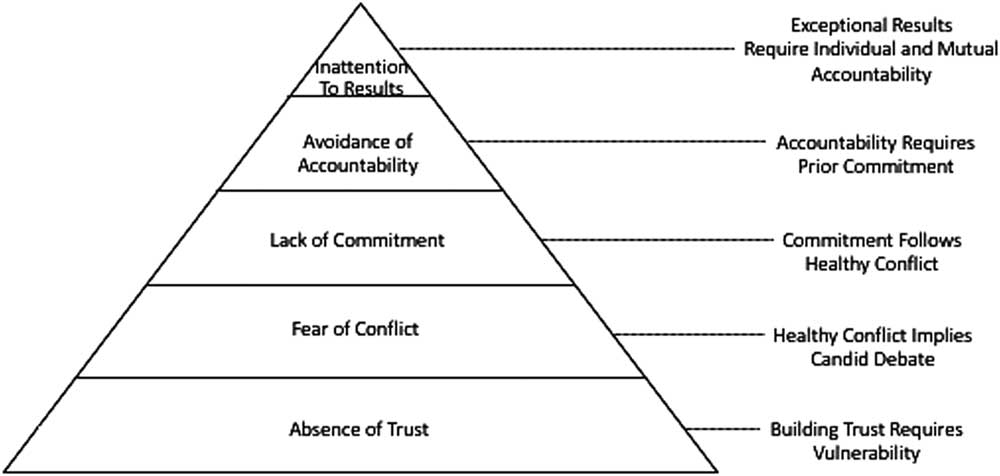
Trust, as highlighted by Hazelwood above, is one of the bedrocks of any successful team and has been highlighted by Lencioni in his classic monograph “The Five Dysfunctions of a Team”. The principal character in Lencioni’s book reminds us to “Remember, teamwork begins by building trust. And the only way to that is to overcome our need for invulnerability”.Reference Lencioni 6 The author continues to describe how in the absence of trust, built on vulnerability, there will be fear of above-board conflict, which will result in lack of commitment, resulting in avoidance of accountability and ultimately inattention to results (Fig 1).
The fundamental role of trust within the team. In the absence of trust, there will be a fear of above-board conflict. It is only after an opportunity for respectful, above-board conflict that commitment is engendered within the group. Without commitment, there will be an avoidance of accountability, which, in turn, leads to an lack of attention to results. Based on the principles of Patrick Lencioni.Reference Lencioni 6
According to Drucker, “To trust a leader, it is not necessary to like him. Nor is it necessary to agree with him. Trust is the conviction that the leader means what he says… A leader’s actions and a leader’s professed beliefs must be congruent, or at least compatible. Effective leadership… is not based on being clever; it is based primarily on being consistent”.Reference Drucker 15
Lencioni continues to suggest that having established the underlying principles upon which the team can be formed, based on vulnerability, trust, above-board conflict, mutual accountability, and attention to shared results, the evolving team then needs to answer six fundamental questions: “Why do we exist?”; “How do we behave?”; “What do we do?”; “How will we succeed?”; “What is most important, right now?”; and “Who must do what?”. This clarity of purpose must be “over-communicated” to every member of the team and reinforced with “just enough” structure.Reference Lencioni 16
The members of the orchestra
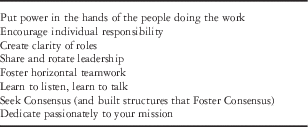
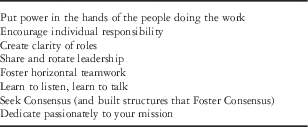
Until now I have paid most attention to the behaviour and leadership styles that will be required of a modern leader. It is also clear that the individual team member plays a fundamental role in charting the journey toward success. Nowhere is this role more clearly demonstrated than in the famous Orpheus Chamber Orchestra. This orchestra might be considered to be “leaderless” in that it has no conductor. It might be more accurate, however, to consider that this orchestra has more “leadership” than almost any orchestra in the world, in that every member of the orchestra provides leadership to the team at different times. According to Seifter and Economy in their book “Leadership Ensemble”, “Great music does not flow from the conductor’s baton. It flows instead from the hearts and minds and musical souls of the players”.Reference Seifter and Economy 17 It is clear that for such a team to succeed, every member of the orchestra needs to feel not only responsible but empowered to influence the team. The “Orpheus Model” is based on a number of fundamental principles, dedicated to putting power in the hands of those doing the work, encouraging individual responsibility, creating clarity of role, developing the ability of the individual to influence one’s peers, and to seek consensus (Table 2). In Orpheus, individual musicians constantly rotate formal leadership roles, while others spontaneously take on ad hoc leadership responsibilities according to the specific requirements of each particular piece of music. The so-called “Orpheus Process” has been refined to include five key elements in developing each separate work product – piece of music: choosing leaders; developing strategies; developing the product within a smaller ensemble group – the music; perfecting the product through above-board conflict across the whole orchestra; and finally, delivering the product – the performance.Reference Seifter and Economy 17
The eight Orpheus principles.
The importance of psychological safety
Although it might be reasonable for a leader to expect the team members to both feel responsible for change and to be empowered to make that change, it is essential that the he or she creates a “psychologically safe” environment in which the members of the team can operate. According to Edmondson, “psychological safety is a belief that one will not be punished or humiliated for speaking up with ideas, questions, concerns or mistakes”.Reference Edmondson 18 It appears that teams perform best in an environment in which there are high levels of psychological safety, combined with elevated levels of accountability. There is a growing literature on the importance of psychological safety in health care, including, for example, a study of 23 neonatal intensive care units in which it was shown that the degree of psychological safety is a powerful predictor of the amount of staff engagement in quality improvement work.Reference Nembhard and Edmondson 19 In order to create this psychologically safe environment, it is important for the leader to model “inclusiveness”, in terms of works and deeds that invite and appreciate the contributions of others and thereby break down the traditional hierarchies that have characterised health care for centuries.
A weakness in the model
Until now, this article has explored the hypothesis that the orchestra might be a good model for teambuilding in health care, examining the concepts of mutual responsibility, shared work outputs, and the role of empowering leaders, who provide a psychologically safe environment in which team members feel responsible and empowered to make change. A fundamental flaw in the metaphor, however, is that typically an orchestra plays from a score that may have been written two or even three hundred years ago. This bears little resemblance to recent trends in health care in which significant changes pile one on top of the other with increasing frequency. According to Drucker, “The model for management that we have right now is the opera. The conductor of an opera has a very large number of different groups that he has to pull together… but they have a common score. What we are increasingly talking about today are diversified groups that have to write the score while they perform. What you need now is a good jazz group”.Reference Schwartz and Kelly 20 To this end, the jazz vibraphonist, Stefon Harris, begins his TED talk with the phrase “I have no idea what we are going to play. I won’t be able to tell you what it is until it happens”.Reference Harris 21 One could venture that leaders in health care have no idea what they are “going to be playing” next year or indeed next month and often do not know what they will be expected to “play” until “it happens”. It is worth considering, therefore, whether the jazz ensemble might provide additional guidance to the team in the increasingly unpredictable health care environment.
The jazz ensemble as a model
In their paper “Jazz as a process of organizational innovation”, Bastien et al wrote: “As a collective approach to the process of innovation, jazz specifies a turbulent task environment for individual musicians, a complex field for interaction in which individuals are simultaneously required to invent new musical ideas and to adapt their playing to that of the collective. Turbulence in this environment not only results from the dynamic process of individual invention; turbulence also arises from the dynamic process of coordinating invention. … The inherent turbulence in this jazz process produces uncertainty for performers insofar as each musician cannot fully predict the behavior of the other musicians or, for that matter, the behavior of the collectivity”.Reference Bastien and Hostager 22 It might be considered that by replacing the word “jazz” with “pediatric cardiology” one might reflect the state of play in our environment, in which our team members are simultaneously trying to innovate and develop at an individual level, as well as a collective, all the while managing the enormous transformations that are being required by outside influences.
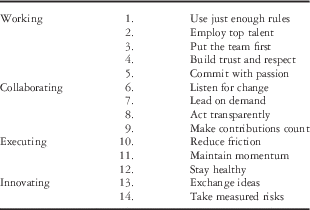
The “Jazz Process” is now widely used in business as a model for collaboration, innovation, and agility, as exemplified by the book of the same title by Adrian Cho.Reference Cho 23 The book highlights 14 fundamental principles, which appear to be intrinsic to any high-performing, innovative jazz ensemble and which might be considered to be essential to any collaborative venture. These principles examine, first, the nature of the individual and his or her relationship to work and the team; second, the essential elements of contribution and collaboration; third, the transformation from collaboration to execution; and finally, the processes that underlie creative, collective innovation (Table 3). Some key elements to this process include the use of just enough rules, the importance of employing top talent, and the importance of “listening” for change.
The principles underlying the jazz process.

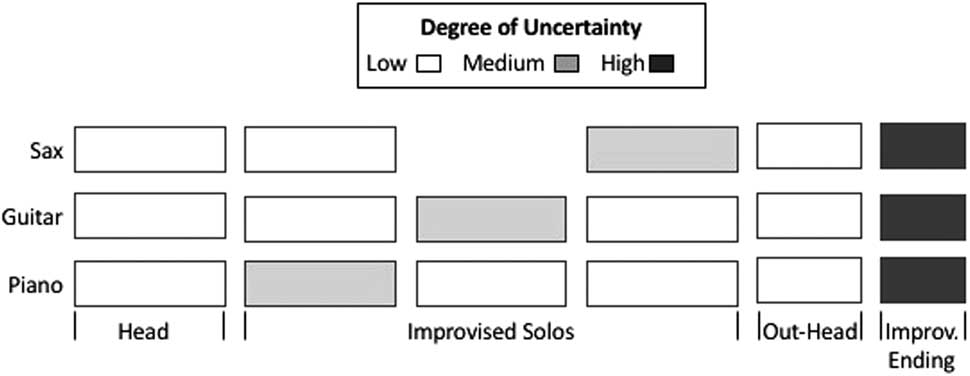
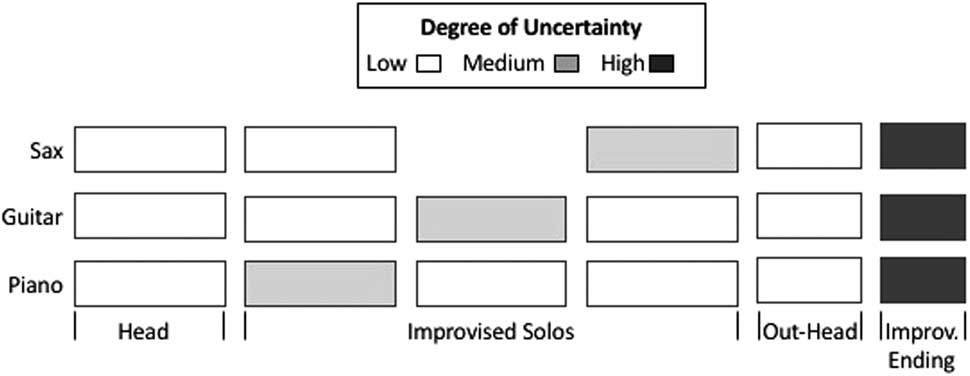
Rules provide an important safeguard against chaos in every team. In the practice of paediatric cardiology, such chaos can easily be translated in adverse outcomes and cost lives. As a result, while Einstein suggested that “Bureaucracy is the death of all sound work”, it would be inconceivable to contemplate any health care environment without rules. It is important, nonetheless, that we do not allow too many rules to get in the way of execution, stifle innovation, and healthy levels of personal freedom. The jazz process is based on the principle of “just enough rules”, providing “just enough structure”, while allowing opportunities for the individuals to lead and improvise. The general structure, which can be used as a model for innovation in almost any type of team, is that a performance begins with an initial statement of the form, usually a pre-composed melody, the so-called “head”. Each member of the group is then given an opportunity to improvise/innovate in a solo. The group then restates the “head”, the so-called “out-head”, and finally an ending is improvised, as the piece concludes (Fig 2).Reference Cho 23 This model of stating the general architecture of an issue, of allowing individual members of the team to improvise and lead, of re-examining where the team has got to, before allowing all members to contribute to the conclusion of the project or negotiation, can be widely applied. According to Michael Wheeler, author of the book “The Art of Negotiation: How to Improvise Agreement in a Chaotic World”,Reference Wheeler 24 “I’m not speaking metaphorically. By emulating what jazz masters do, we all can become better negotiators”. Indeed, Wynton Marsalis in the PBS documentary “Jazz” observed that it is this very negotiation that is the true “art” of jazz: “The real power of jazz… is that a group of people can come together and create … improvised art and negotiate their agendas… and that negotiation is the art”. For it to work optimally, the team has to be comfortable and able to manage periods of instability, particularly during the improvised solos and the improvised ending.
The Jazz process, as a model of negotiation. The (usually) pre-composed opening, “the head”, is stated (akin to the current state in organisational development principles), following which all members are provided an opportunity to innovate and lead. The enhanced head (the “out-head”) is then stated, following which the piece (or project or negotiation) is concluded. The amount of uncertainty varies throughout the performance or negotiation from low, to moderate, to high. Modified from Cho A.
Central to the Jazz Process is the concept of employing top talent and allowing them to innovate. A similar idea is emphasised by Collins in his book “Good to Great”.Reference Collins 25 In this, Collins refers to the ‘Level 4’ executive team, which uses a somewhat traditional model, in which the leadership sets a vision for the organisation (first “What?”), develops a “map” and enlists a crew of “helpers” to make the vision happen (then, “Who?”). What Collins suggests is that we should turn this process on its head and that we aspire to create “Level 5” executive teams, which first ask the question “Who do we need to have on the team?” Then once the people are in place, together develop the path to greatness.Reference Wheeler 24 It is suggested by Collins that subtle shift from “what” to “who”, will allow the team to achieve exceptional levels of innovation. Again, to quote Stefon Harris: “I have no idea what we are going to play”.Reference Harris 21 He had confidence nonetheless, that he and his exceptional ensemble would produce something that would be better than if he had developed a score and then recruited the musicians to play it.
A further central part of the Jazz Process is what Harris describes in his TED talk as the “science of listening”.Reference Harris 21 He suggests that “If I come up and I dictate to the band … I want to play like this and I want the music to go This Way!… It becomes chaotic because I am bullying my ideas”. He concludes that “If I really want the music to go there the best way for me to do it is listen… it has far more to do with what I can perceive, rather than what I can do…It’s a much more different experience when I am pulling ideas…”. Frank Barrett wrote, “jazz musicians need to be very good listeners. They need to interpret others’ playing, anticipate likely future directions, make instantaneous decisions in regard to harmonic and rhythmic progressions. But they also may see beyond the player’s current vision, perhaps provoking the soloist in different directions. None of this responsiveness can happen unless players are receptive… If everyone tries to be a star and does not engage in supporting the evolution of the soloist’s ideas, the result is bad jazz”.Reference Barrett 26 To this end, Daniel Goleman, author of the book “Emotional Intelligence”, describes the importance of “Social Intelligence”,Reference Goleman 27 that is, “the ability to recognize social contexts and cues in conversations and business transactions” as an essential tool toward business development. Similarly, Gladwell in his book “The Tipping Point” hypothesises that “the success of any kind of social epidemic is heavily dependent on the involvement of people with a particular and rare set of social gifts”.Reference Gladwell 28
A framework for putting it all together
It can be a challenge to transform some of the theoretical concepts of shared ‘Level 5’ leadership, mutual accountability, psychological safety, inclusiveness, and the “science of listening” into a practical, operational framework. One approach that I have used in the past is a method called “Open Space Technology”, which we adopted to develop teambuilding and culture in a cardiology department.Reference Long, Penny, Gold and Harding 29 This method is best described in detail by Owen Harrison in his text “Open Space Technology: A User’s Guide”.Reference Harrison 30 In brief, Open Space meetings do not begin with a pre-determined agenda. Rather, after a brief statement of purpose, a facilitator invites participants to raise topics of interest or for improvement. Participants then try to engender support for exploration of the topic in a “marketplace”. Those participants who wish to engage with an issue do so for as long as they are interested and contributing. Attendees can freely decide which session they want to attend and can switch from one to another at any time. This supports different styles of participation. The reports of all discussions are compiled and sent to the wider group unedited. This method is somewhat reminiscent of the jazz process described earlier. Open Space appears to work well when certain conditions are present. First, it addresses real issues that people care about. Second, the issue is complex, so that no single person can fully understand it or can solve it. Third, resolution of the issue requires significant diversity in terms of the skills and people. Fourth, there is much passion and real or potential conflict related to the issue. And finally, there is a real sense of urgency for action.
Conclusion
Teamwork is elusive in all areas of endeavour. It is a cultural process, whereby a group of individuals work together toward collective goals, with high levels of mutual accountability, within an environment of safety built on a foundation of trust. Many of the characteristics required of a modern orchestra conductor can be used to model leadership characteristics in business and health care. Some of these include the appreciation that the single, most important role of the leader is to “awaken possibility” in other people and the recognition that the leader’s only source of power is in his or her ability to make other “people powerful”. The modern conductor, as indeed all leaders of the future, will lead using reticence and humility, combined with unwavering will toward exceptional outcomes. Further particular lessons can be learned about teambuilding and dynamics from jazz performers, including the importance of getting the right people on the team, feeling comfortable with some degree of uncertainty, and of learning not to bully ideas, but rather to develop skills related to listening and environmental awareness. Ultimately, it is these skills that will maximise influence.