1 Introduction
Old English word order has been, and continues to be, the subject of extensive research, but there remain a number of syntactic phenomena which are not fully understood. One such phenomenon concerns variation in the placement of bare, i.e. unmodified and uncoordinated, personal pronouns functioning as the object of a preposition. These pronouns can be found immediately to the right or the left of their governor, as in (1a, b) or somewhere even further to its left, as in (1c). Full DPs, demonstrative pronouns and coordinated or modified personal pronouns, on the other hand, are almost invariably positioned immediately to the preposition's right (Wende Reference Wende1915: 136–41; Mitchell Reference Mitchell1978: §4; Allen Reference Allen1980: 287; Taylor Reference Taylor2008: 343), as in (2).Footnote 2
- (1)
(a)

(b)
(c)

(2)
Leading analyses of Old English syntax predict the placement of bare personal pronouns to the left of a governing preposition to be a freely available option (e.g. van Kemenade Reference Kemenade1987; Pintzuk Reference Pintzuk1991), although there is evidence to suggest that such special placement is sensitive to a number of factors, including: pronoun case (Wende Reference Wende1915: 80–1; Mitchell Reference Mitchell1978: §3; Taylor Reference Taylor2008: 351, table 8); grammatical number of the pronoun (Taylor Reference Taylor2008: 357, fn. 9); modification or coordination of the preposition (Wende Reference Wende1915: 65–8); the particular preposition involved (Wende Reference Wende1915: 71–3; Kitson Reference Kitson1996: 28–32; Taylor Reference Taylor2008: 352, table 10); the preposition's semantics (Wende Reference Wende1915: 73–6); the preposition's function (Wende Reference Wende1915: 68–9); the particular verb with which the preposition co-occurs (Taylor Reference Taylor2008: 353, table 11); and whether or not the pronoun occurs in a Latin translation (Taylor Reference Taylor2008: 347–9). The focus of this article, however, is one particular correlation, first noted by Wende (Reference Wende1915), involving the pronouns’ specification for grammatical person.
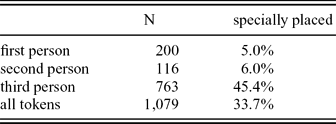
Table 1 summarises the results of Wende's (Reference Wende1915: 76) analysis, by person, of the bare personal pronoun objects of seven prepositions occurring in four major prose texts.Footnote 3 Percentages in the ‘specially placed’ column of table 1 (and subsequent tables) represent proportions of tokens placed somewhere to the preposition's left.
Special placement of pronominal prepositional objects by grammatical person (Wende Reference Wende1915: 76)
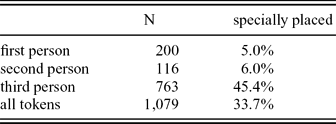
There are two notable aspects to Wende's data: (1) first- and second-person tokens precede their governor with approximately the same frequency; and (2) first- and second-person tokens precede their governor significantly less frequently in comparison to third-person tokens. Despite more recent reports of a range of person-related grammatical asymmetries crosslinguistically (see section 4), there has been no further investigation of the apparent significance of third-person reference for the special placement of personal pronouns in Old English prose and so it is presently unclear how the distribution shown in table 1 should be interpreted.
This article aims to establish whether an independent explanation can be found for the distribution in table 1. Section 2 establishes that it is not an artefact of Wende's sampling, while section 3 shows that it also does not result from: (1) the pronouns’ specification for the feature [human]; (2) a previously unreported effect of narrative mode; or (3) the effects of other factors known to correlate with the variable placement of pronominal prepositional objects in Old English, including the effect of the relative ordering of preposition and verb, a factor which has hitherto lacked quantification. On the basis of these findings, the treatment of grammatical person as an independent variable in the predictability of personal pronoun placement in Old English is defended in section 4.
2 Extending the evidence base
2.1 Introduction
As the data in table 1 are limited to the bare personal pronouns governed by a small number of prepositions occurring in a small number of (admittedly sizeable) texts, it is entirely possible that the correlation between special placement and third-person reference is simply a sampling artefact. With the aid of CorpusSearch 2 (Randall Reference Randall2005), all bare personal pronouns parsed as the object of a preposition in the York−Toronto−Helsinki Parsed Corpus of Old English Prose (YCOE) (Taylor et al. Reference Taylor, Warner, Pintzuk and Beths2003) were identified and classified for person and position.Footnote 4 As person features are not labelled in the YCOE, tokens were classified according to their word-initial letter, with <m-> and <u-> forms classified as first person, <þ->, <ð->, <i-> and <e-> forms as second person, and <h-> forms as third person.Footnote 5 For the positional variable, pronouns were classified as specially placed when situated somewhere to the preposition's left.Footnote 6 For comparative purposes, all other (pro)nominal prepositional objects were separately identified and classified for the positional variable.
2.2 Results
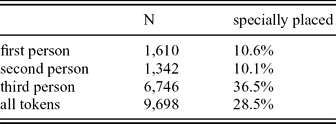
Table 2 summarises the results for the bare personal pronouns.Footnote 7 While the percentages in table 2 differ somewhat from those in table 1, the same general trends clearly obtain: (1) first- and second-person tokens show a similar frequency of special placement to each other (χ2 = 0.14, p = 0.7), justifying their merger into a single ‘non-third-person’ category; and (2) the difference in rate of special placement between third- and non-third-person tokens suggests that third-person reference does indeed significantly increase the probability of special placement (χ2 = 686.15, p < 0.0001).Footnote 8 Strikingly, of the 33 YCOE text files which contain at least ten third-person tokens and at least ten non-third-person tokens, the correlation between third-person reference and special placement is evident in all but two: ‘coalex’ (Alexander's letter to Aristotle), which contains an unusually high number of non-third-person tokens (N = 43, 20 (47%) specially placed) in comparison to third-person tokens (N = 15, 4 (27%) specially placed);Footnote 9 and ‘corood’ (History of the Holy Rood-Tree), in which special placement of non-third-person tokens (N = 20, 8 (40%) specially placed) and third-person tokens (N = 82, 31 (38%) specially placed) occurs with approximately the same frequency.
Special placement of pronominal prepositional objects by grammatical person (YCOE)
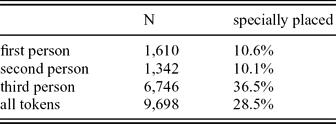
The YCOE data thus provide clear evidence that the apparent significance of third-person reference for the special placement of bare personal pronouns functioning as the object of a preposition (henceforth ‘PPOPs’) reported by Wende (Reference Wende1915: 76) cannot be explained as an artefact of his sampling. Furthermore, its consistency in 31 of the 33 text files which provide a meaningful number of tokens strongly suggests that this correlation is (at least partially) independent of any chronological, authorship and genre considerations relevant to this corpus.
The positional analysis of other (pro)nominal prepositional objects occurring in the YCOE confirms that special placement of full DPs, demonstrative pronouns and modified or coordinated personal pronouns is indeed exceptional: just 99 out of 109,849 such tokens (0.09%) occur somewhere to the preposition's left.Footnote 10
3 Grammatical person as an independent variable
3.1 Introduction
This section seeks an explanation for the generalised person asymmetry evident in table 2 by reference to factors other than the pronouns’ specification for person. In each case, however, the evidence favours person as the more likely conditioning factor. The first study, motivated by cross-linguistic work on pronoun typology, considers whether the asymmetry results from the pronouns’ specification for the feature [human] (section 3.2). The second study, prompted by an empirical observation of the data reported in table 2, tests whether the person asymmetry is simply a consequence of the high frequency of third-person tokens and the low frequency of non-third-person tokens in one particular context which appears to favour special placement of PPOPs (section 3.3). The final study explores whether the asymmetry can be explained as a by-product of the effects of various other factors which have been associated with PPOP placement in Old English (section 3.4).
3.2 The [human] hypothesis
3.2.1 Introduction
Across many unrelated languages, pronouns with nonhuman reference have been shown to exhibit special syntactic behaviour, such as an inability to be modified or coordinated and an inability to appear in peripheral positions (for evidence from modern West Germanic varieties, see Haegeman Reference Haegeman1993; Cardinaletti & Starke Reference Cardinaletti, Starke, Thráinsson, Epstein and Peter1996, Reference Cardinaletti, Starke and Riemsdijk1999; Cardinaletti Reference Cardinaletti and Riemsdijk1999). Assuming, uncontroversially, that nonhuman reference typically entails third-person reference, it seems reasonable to hypothesise that the data distribution in table 2 follows from the pronouns’ feature specification for [human] rather than [person].
In order to falsify this hypothesis, a small study was conducted to investigate whether PPOPs are specially placed significantly more frequently when their referent is nonhuman. This study therefore focuses on third-person tokens as these are naturally the most likely to have nonhuman reference. Since neuter pronouns are significantly more likely than either masculine or feminine pronouns to have a nonhuman referent in Old English (Mitchell Reference Mitchell1985), two separate samples were drawn from the third-person data reported in table 2.
3.2.2 First sample
The first sample targeted neuter pronouns, because, according to Mitchell (Reference Mitchell1985: §§55–71): (1) neuter pronouns typically refer to neuter nouns; (2) neuter nouns typically refer to nonhumans; and (3) anaphoric reference to those few neuter nouns with human reference tends to reflect natural gender, for example:
- (3)
(a)
(b)
On the basis of these generalisations we may assume that neuter pronouns are highly likely to have nonhuman reference. Consequently, if PPOP special placement is associated with nonhuman reference, we should expect most neuter PPOPs to be specially placed.
Since hit ‘it (acc, 3sg, neut)’ is the only unambiguously neuter object pronoun in the Old English personal pronoun paradigm, all instances of this pronoun were isolated from the 6,746 third-person tokens reported in table 2.Footnote 11 Surprisingly, just seven tokens were found, including one, given in (4), whose prepositional governor is an editorial addition (Sweet Reference Sweet1871: 405, l.6).
(4)
Of the other six tokens: two have human reference, illustrated by (5); one refers to an idea expressed earlier in the text, (6);Footnote 12 and three, illustrated by (7), have a nonhuman referent.
(5)
(6)
(7)
Of the six valid tokens, only that in (6) is specially placed.Footnote 13 However, there are clearly too few hit tokens to conclude anything meaningful about their placement. For the moment, then, it is sufficient to note that hit, the pronoun most likely to have a nonhuman referent, rarely occurs as the object of a preposition in the YCOE, a matter which I discuss further in section 3.2.4.
3.2.3 Second sample
Although Old English neuter pronouns typically denote nonhuman entities, it is not the case that pronominal reference to nonhumans typically involves a neuter form (Mitchell Reference Mitchell1985: §60). A second sample, consisting of the 517 third-person tokens occurring in the YCOE's Lives of Saints text file (‘coaelive’), was therefore chosen to gauge the frequency with which masculine and feminine PPOPs occur with nonhuman reference.Footnote 14 Each token's antecedent was categorised as either ‘human’ or ‘other’, with the former category reserved for: persons (living or dead); Christ; God; the gods; angels; and the devil or devils. All but fourteen tokens were found to occur with a ‘human’ referent, although some of the ‘other’ referents also show signs of personification, for example:
(8)
Being coindexed with the subject of winnan ‘to fight, strive, struggle’, se lichama (nom, masc) and seo sawl (nom, fem) are clearly understood with a sense of agency which is further implied in the immediately ensuing text:
(9)
The remaining ‘other’ referents include concrete entities such as the sun and the earth, as well as abstract concepts such as life, pride and God's holy law. While this is not the place to debate Anglo-Saxon philosophy or anthropomorphism, I suggest that such considerations might help explain the apparently exceptional reference to nonhuman entities by tokens in this sample.
3.2.4 Summary
The analyses of both samples suggest that third-person PPOPs with nonhuman reference are somewhat exceptional in Old English.Footnote 15 Such a restriction on the semantics of PPOPs is not without parallel: see Toebosch (Reference Toebosch2003: 45–7) for evidence from non-Southern Dutch and Zwart (Reference Zwart, Cinque and Kayne2005: 920) for evidence from other West Germanic varieties. The parallel with Old English does not end there, however. In these other varieties, an anaphoric prepositional object with nonhuman reference is realised either as a demonstrative pronoun, which invariably follows the preposition, or as a form equivalent to ‘there’ or ‘here’, which invariably precedes the preposition. The YCOE data show that this is precisely the situation in Old English also: demonstrative pronouns invariably follow a governing preposition and refer freely to nonhuman entities, as in (10), while þœr ‘there’ and her ‘here’ invariably precede a governing preposition, sometimes at a distance, and also freely (perhaps even typically) have nonhuman reference, as in (11).Footnote 16
- (10)
(a)
(b)
- (11)
(a)
(b)
If, as the evidence suggests, Old English grammar does indeed inhibit the realisation of a prepositional object as a personal pronoun where the referent is nonhuman, then the three hit tokens with nonhuman reference reported in section 3.2.2 must be seen as rare exceptions.Footnote 17
In terms of understanding the person asymmetry in table 2, however, it seems safe to conclude that it is highly unlikely to result from the pronouns’ specification for [human] since the personal pronouns most likely to be specified [-human], i.e. third-person forms, appear rarely to be so when functioning as the object of a preposition.
3.3 Narrative mode
3.3.1 Introduction
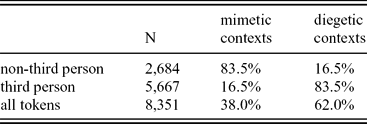
The YCOE's identification of material occurring in clauses of direct speech enabled the discovery of another person-related asymmetry exhibited by PPOPs, as shown in table 3.Footnote 18 To make the relevant distinctions, I adopt the term ‘mimetic’ (from mimesis ‘imitation of another person's words’, OED) to refer to direct speech contexts, and ‘diegetic’ (from diegesis ‘the narrative presented by a literary work’ OED) to refer to ‘elsewhere’ contexts.Footnote 19
PPOP distribution by grammatical person and narrative mode
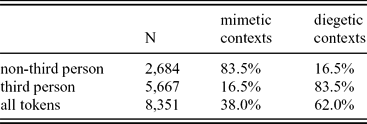
As is clear from table 3, non-third-person tokens preponderate in mimetic contexts, whereas third-person tokens preponderate in diegetic contexts. This section therefore tests whether there is a link between the asymmetric distribution of PPOPs according to person and their asymmetric distribution according to narrative mode.
3.3.2 Results
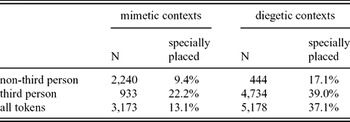
Table 4 cross-tabulates the frequency of special placement by grammatical person and narrative mode. Table 4 reveals, firstly, that PPOPs are significantly less likely to be specially placed in mimetic contexts than in diegetic contexts: 9.4% vs 17.1% for non-third-person data (χ2 = 23.33, p < 0.0001); and 22.2% vs 39% for third-person data (χ2 = 95.09, p < 0.0001). To my knowledge this correlation has not previously been reported and its underlying basis is far from clear (although see section 4 for a possible explanation).
PPOP placement by grammatical person and narrative mode

However, despite the preponderance of non-third-person tokens in mimetic contexts (where special placement is less frequent) and the preponderance of third-person tokens in diegetic contexts (where special placement is more frequent), table 4 also shows that third-person tokens are specially placed significantly more frequently in comparison to non-third-person tokens, both in mimetic contexts (χ2 = 94.71, p < 0.0001) and in diegetic contexts (χ2 = 83.1, p < 0.0001).
In summary, the discovery that special placement of these constituents is significantly less frequent in direct speech than elsewhere is an extremely interesting finding in its own right, but appears to offer no insight into the underlying basis of the person asymmetry evident in table 2.
3.4 Cweðan to study
3.4.1 Introduction
This final study attempts to control for a number of other effects which have been associated with the placement of PPOPs in Old English, namely (see section 1 for references): pronoun case; the particular preposition involved, as well as its semantics and function; the particular verb with which the preposition co-occurs; and, in translations, interference from Latin word order. By controlling for these factors, the goal of this study is to identify whether the apparent effect of grammatical person is simply an epiphenomenon of these other effects. The required controls are achieved by focusing on the behaviour of PPOPs co-occurring with a cweðan to ‘to say, speak, declare to’ construction.Footnote 20 This construction was chosen, firstly, because it is one of the most frequently occurring verb + preposition combinations in the YCOE and, secondly, because it invariably occurs with a dative object (Ogura Reference Ogura, Rissanen, Ihalainen, Nevalainen and Taavitsainen1992: 373).Footnote 21 The data examined consist of the 1,022 cweðan to tokens occurring in the 18 YCOE text files which contain at least one third-person and at least one non-third-person cweðan to token. To help gauge whether any interesting aspects of the cweðan to data are construction-specific or obtain more generally, a control dataset, consisting of the remaining 3,968 PPOPs in the same 18 text files, is subjected to identical analyses.
3.4.2 Initial findings
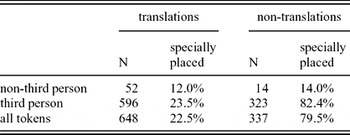
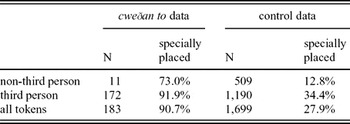
Frequencies of special placement of cweðan to tokens according to person and text type are given in table 5. From table 5 it is clear, firstly, that even within this tightly controlled dataset, special placement of PPOPs is significantly less frequent overall in Latin translations than in nontranslations, consistent with the findings of Taylor (Reference Taylor2008).Footnote 22 However, it is also evident that, in both translations and non-translations, third-person tokens are still significantly more likely than non-third-person tokens to be specially placed.
PPOP placement by grammatical person and text type (cweðan to data)

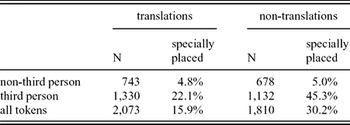
The results for the control data are given in table 6. Table 6 provides assurance that the cweðan to construction is not responsible for the person asymmetry evident in table 2 and, further, that the asymmetry is indeed manifest in both translations and nontranslations.Footnote 23
PPOP placement by grammatical person and text type (control data)

3.4.3 Effect of position of preposition relative to the verb
Immediately apparent from a cursory inspection of the cweðan to data is the strong correlation between the position of the pronoun relative to to, and the position of to relative to the form of cweðan, as illustrated by the following minimal pairs:
- (12)
(a)
(b)
- (13)
(a)
(b)
In (12a, 13a), where the preposition follows the verb, the pronoun follows the preposition, whereas in (12b, 13b), where the preposition precedes the verb, the pronoun precedes the preposition. This observation prompted an analysis of the frequency of PPOP placement according to the preposition's position relative to the main verb. These results are given in table 7.Footnote 24
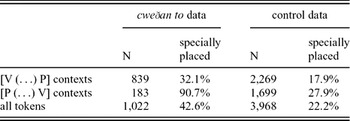
PPOP placement by position of P relative to V

Table 7 shows that the special placement of PPOPs does indeed occur significantly more frequently when the preposition precedes the verb, i.e. in [P (. . .) V] contexts, than when the preposition follows the verb, i.e. in [V (. . .) P] contexts.Footnote 25 This is especially true of the cweðan to data (χ2 = 211.37, p < 0.0001), but holds for the control data also (χ2 = 55.81, p < 0.0001). Although this provides (hitherto lacking) quantitative evidence for the claim by Quirk & Wrenn (Reference Quirk and Wrenn1955: §141) that ‘postposition [of the preposition] is most frequent . . . when it enables the preposition to stand before a verb form’, the reason for this correlation is presently unclear.Footnote 26
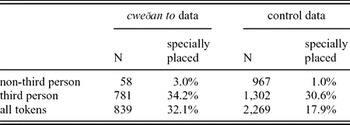
Having observed that the frequency of special placement of PPOPs varies according to the preposition's position relative to the main verb, the data in table 7 were further analysed by grammatical person to determine whether a person effect is evident in both contexts. The results for data occurring in [V (. . .) P] contexts are given in table 8.
PPOP placement by grammatical person in [V (. . .) P] contexts

In [V (. . .) P] contexts of both datasets, a person effect is clearly manifest. In addition, frequencies of special placement according to person differs little between the two datasets, with both showing non-third-person tokens to be very rarely in a special position when the preposition follows the main verb.Footnote 27
The results for data occurring in [P (. . .) V] contexts are given in table 9. Once again, a person effect is clearly evident in both datasets, although special placement in [P (. . .) V] contexts is considerably (and inexplicably) more frequent in cweðan to constructions in comparison to the control conditions.Footnote 28
PPOP placement by grammatical person in [P (. . .) V] contexts

3.4.4 Summary
The results of the cweðan to study show that even when the preposition, verb, pronoun case and text type (i.e. translation or nontranslation) are held constant, third-person PPOPs are still significantly more likely than non-third-person PPOPs to be specially placed. Although special placement also appears to be sensitive to the relative ordering of preposition and lexical verb, the data further suggest that the person asymmetry is independent of this factor also.
4 Discussion and outlook
The special placement of personal pronouns to the left of a governing preposition in Old English prose has so far evaded a comprehensive account. In this article, however, three factors, two seldom noted and one previously unreported, are shown to correlate significantly with the phenomenon.
Firstly, we have seen that the grammatical person effect reported by Wende (Reference Wende1915: 76) cannot be attributed to his sampling methods, to a contrast in the pronouns’ specification for the feature [human], or to the effects of the various factors controlled for in sections 3.3 and 3.4. The likelihood that person does indeed play a role in conditioning the placement of personal pronouns in Old English is further supported by observations of many other person-conditioned grammatical phenomena crosslinguistically, for example: the general Person−Case Constraint (Bonet Reference Bonet1994), which precludes the combination of a non-third-person accusative pronoun with a third-person dative pronoun, specifically where both pronouns are weak or both are clitics (Cardinaletti Reference Cardinaletti and Riemsdijk1999: 64–5); restrictions on third-person pro-drop in German (Cardinaletti Reference Cardinaletti, Mascaró and Nespor1990: 79) and in Standard Finnish and Hebrew (Gutman Reference Gutman2004) in contexts where first and second-person pro-drop is licit; and, in French, the requirement for clitic doubling of first and second-person pronouns in contexts where third-person clitic doubles are not required (Sichel Reference Sichel2002: 14, fn. 7). Viewed from this perspective, it is unsurprising that the special placement of PPOPs in Old English exhibits a third-person vs non-third-person asymmetry in particular (rather than, say, a second- vs non-second-person asymmetry), although more data are needed to determine whether the asymmetry is also unsurprising in terms of the special placement of personal pronouns in other functions and in other languages.
The two other factors found to correlate with PPOP placement are narrative mode and positioning of the preposition relative to the main verb. It is tempting to speculate that the former may in some way be related to the loss of PPOP special placement, already underway during the Old English period (Taylor Reference Taylor2008: 346–7), although this line of argument would rest on two assumptions: firstly, that written language is conservative in comparison to spoken language; and secondly, that written representations of direct speech reflect spoken rather than written norms. Being in a position to defend neither assumption for Old English, I leave this matter, as well as the apparently promoting effect of preverbal placement of the preposition for PPOP special placement, for future research.
When viewed as a whole, the results presented in this article provide compelling evidence that variation in the placement of bare personal pronouns functioning as the object of a preposition in Old English prose is neither a completely unconditioned phenomenon nor the product of any single categorical distinction: instead the special placement of these constituents appears to be best understood in probabilistic terms. Thus while this article goes some way towards establishing a main effect of grammatical person, it is only through the application of multivariate analysis techniques that main, interaction and epiphenomenal effects may be fully differentiated, and the predictive ability of different permutations of conditioning factors may be calculated. This type of analysis will therefore be key to elucidating precisely which facts need be accommodated in a theory of the placement of Old English PPOPs, and its results may perhaps also shed new light on the apparently optional movement of pronouns in other functions and other languages.