





Introduction
Older adults living with mental health (MH) conditions often face significant difficulties accessing and navigating healthcare systems, especially during critical junctures like hospital discharge (Kim et al., Reference Kim, Wister, Mitchell, Li and Kadowaki2024). This transition can be particularly challenging for those managing both MH concerns and multiple chronic physical conditions – such as diabetes, cardiovascular disease, or arthritis – which can complicate recovery and increase the risk of poor health outcomes (Bradshaw et al., Reference Bradshaw, Goldberg, Lewis, Whittamore, Gladman, Jones and Harwood2013). In addition, many older adults experience cognitive decline or physical impairments (Wittlinger et al., Reference Wittlinger, Bekic, Guljas, Perisa, Volaric and Trtica Majnaric2022), further complicating their ability to manage care independently. Discharge from the hospital may leave them susceptible to fragmented services, missed follow-up appointments, and hospital readmissions, particularly when they face challenges connecting with community supports (Turbow et al., Reference Turbow, Walker, Culler and Ali2024).
MH conditions, such as disturbances in cognition, emotional regulation, or behaviour (Calabrese et al., Reference Calabrese, Emery, Evans and Simms2024), are common among people aged 50 and older, with high rates of disorders such as depression (Blazer, Reference Blazer2003), anxiety (Wolitzky-Taylor et al., Reference Wolitzky-Taylor, Castriotta, Lenze, Stanley and Craske2010), dementia (Arvanitakis et al., Reference Arvanitakis, Shah and Bennett2019), and substance use (Kuerbis & Sacco, Reference Kuerbis and Sacco2013). Depression and anxiety frequently coexist with chronic illnesses (Cavdar et al., Reference Cavdar, Ballica, Aric, Karaca, Altunoglu and Akbas2024), while dementia presents unique challenges because it requires an increased level of support (Liu et al., Reference Liu, Chi and Wu2022). Although less commonly addressed in this age group, substance use disorders – especially involving alcohol or prescription medications – are becoming increasingly prevalent (Lin et al., Reference Lin, Arnovitz, Kotbi and Francois2023). Many of these issues are made worse by social determinants of health like limited income, unstable housing, poor transportation access, and social isolation, all of which create additional barriers to care (Lavingia et al., Reference Lavingia, Jones and Asghar-Ali2020).
The complexity of mental illness requires personalized, coordinated responses, often requiring the involvement of multiple healthcare providers and services (Mullen et al., Reference Mullen, Levitt and Markoulakis2023). However, systems of MH care can be fragmented, with poor coordination across professionals and settings (Sartorious, Reference Sartorious2013; Storm et al., Reference Storm, Husebo, Thomas, Elwyn and Zisman-Ilani2019). Services may be geographically distant, funded through various sources, and delivered by different specialists. Successful treatment often depends on the sequential addressing of MH needs (Sartorious, Reference Sartorious2013), and relies heavily on timely, clear communication between those managing both physical and MH issues (Storm et al., Reference Storm, Husebo, Thomas, Elwyn and Zisman-Ilani2019). In many cases, MH symptoms may overshadow coexisting chronic diseases, making it difficult for providers to deliver comprehensive, integrated care (Shefer et al., Reference Shefer, Henderson, Howard, Murray and Thornicroft2014). In addition, transitions across healthcare settings present particular challenges for older adults with MH needs, as effective discharge planning depends on comprehensive support, coordination, and collaboration among care providers to facilitate a safe return to the community (Manderson et al., Reference Manderson, Mcmurray, Piraino and Stolee2012). In their absence, patients are at increased risk of fragmented care.
Patient navigation programs (PNPs) may serve as a promising strategy to address some of these challenges. Navigators help individuals move through the healthcare system by coordinating services, identifying appropriate resources, and minimizing barriers to timely care (Biringer et al., Reference Biringer, Hartveit, Sundfor, Ruud and Borg2017). While patient navigation has been most commonly applied in cancer and chronic disease contexts (Freeman & Rodriguez, Reference Freeman and Rodriguez2011), its relevance for older adults with MH needs – especially during care transitions – has gained increasing recognition (Mullen et al., Reference Mullen, Levitt and Markoulakis2023).
Patient Navigators work with patients and/or their families or caregivers to identify barriers to care, connect them to services, support care transitions, and promote self-management (Budde et al., Reference Budde, Williams, Scarpetti, Kroezen and Maier2022). However, there are variations in navigator roles, functions, professional backgrounds, and care models, which highlight the need for research to determine the most appropriate navigator type for specific populations (Kokorelias et al., Reference Kokorelias, Shiers-Hanley, Rios, Knoepfli and Hitzig2021). Quantitative evidence is required to characterize patients referred to PNPs, identify optimal delivery methods for different settings, and evaluate program outcomes (Kokorelias et al., Reference Kokorelias, Shiers-Hanley, Rios, Knoepfli and Hitzig2021). Guidance is also needed on best practices for program implementation, including duration and frequency of the navigator’s involvement. As a relatively new model of care, PNPs warrant further evaluation to determine their impact, caseload capacity, and effectiveness in diverse healthcare contexts (Kokorelias et al., Reference Kokorelias, Shiers-Hanley, Rios, Knoepfli and Hitzig2021).
To address these gaps, we conducted a study to characterize patients referred to an MH PNP and examine key aspects of program delivery and service use. The study was conducted at a large urban hospital serving a high-complexity adult population, including a high proportion of older adults. In the fall of 2023, the hospital introduced a novel MH PNP pilot in partnership with a community agency. The target population was older adults (age 55+) with MH and/or addiction needs that were affecting their ability to safely and independently live in the community. The navigators were two Occupational Therapists (OTs), with the lead OT having expertise in MH and working full-time, and the other OT providing part-time support in physical medicine and rehabilitation. OTs have been identified as particularly well-positioned to serve as MH Navigators, as their training equips them to assess and address cognitive, physical, emotional, and environmental factors that influence well-being (Snodgrass, Reference Snodgrass2011). OTs focus on helping individuals perform meaningful daily activities, manage functional impairments, and access needed services. For older adults facing MH difficulties, OTs can provide essential support by establishing therapeutic relationships, identifying systemic barriers, and advocating for appropriate community resources during the critical period following discharge (Nagashima et al., Reference Nagashima, Hayasaka, Teruya, Hoshino, Murao, Matumoto, Maruki, Katagiri, Imamura, Kurihara, Oe, Tsuboi, Watanabe and Sakurai2024). Patients were usually referred and introduced to the OT Navigators by hospital healthcare providers prior to discharge, and received support for a period ranging from several days to several months.
To assess the MH PNP’s potential to improve discharge processes and hospital-to-community transitions for older adults with MH needs, this study collected metrics to inform navigators’ scope of practice, examine patient characteristics referred to the program, and describe patient discharge outcomes.
Methods
Study design
This study utilized a retrospective cohort observational design, structured according to the Strengthening the Reporting of Observational Studies in Epidemiology (STROBE) guidelines (Ghaferi et al., Reference Ghaferi, Schwartz and Pawlik2021). Data were obtained by reviewing a standardized patient-tracking tool developed by the study team and routinely completed by the navigators as part of clinical care. This tool was used to document essential patient information, types of services provided, and care outcomes. All data were de-identified prior to analysis to ensure patient confidentiality. The study received ethics approval from the Sunnybrook Health Sciences Centre Research Ethics Board (REB #1598).
Setting and participants
The study was conducted at a Level I trauma, tertiary care, academic hospital in Ontario, Canada, and focused on older adults (aged 55 years and older) who were referred to the MH PNP between October 2023 and December 2024, typically prior to their hospital discharge. Patients were eligible for inclusion if they had their first contact with an MH Navigator during this period and were assigned to the navigator’s caseload. Patients who had short-term interactions with the navigators, such as an initial assessment to determine program eligibility or the provision of brief information or referrals, and were not added to the MH Navigator’s formal caseload, were excluded from data analysis. Caseload Patients received follow-up support in the community, beyond the initial consultation. This may have included multiple follow-up phone calls, coordination with community services, and home visits, based on the complexity of the patient’s needs and the MH Navigators’ clinical judgment.
Data collection and analysis
Data were abstracted from the MH Navigator patient-tracking tool, which contained standardized fields completed for all patients receiving routine care. The variables extracted for analysis included: patient demographics (e.g., chronological age, gender), patient characteristics (e.g., primary MH condition impacting transition, cognition), intervention characteristics (e.g., type(s) of intervention provided, length of service), and service utilization (e.g., referring unit, reason for discharge). The final data set contained some missing data because it was extracted from a clinical tool developed for routine patient care, where data entry was primarily driven by clinical considerations. Therefore, we report the number of observations for each analysis. Open-text entries detailing the types of interventions provided by the navigators were coded by the first author (MM). Given the data’s relative brevity and descriptive nature, a second coder was not deemed necessary.
A modified Synergy Model was used to gauge patients’ complexity. This tool was originally developed for acute and critical care. The Synergy Model guides nurses in managing complex clients through acute illness episodes and in reducing disease progression (Nania et al., Reference Nania, Barello, Caruso, Graffigna, Stievano, Pittella and Dellafiore2021). The eight patient characteristic domains identified in the model are resiliency, vulnerability, stability, complexity, resource availability, participation in care, participation in decision making, and predictability (Kaplow, Reference Kaplow2003). This tool was adapted for MH navigation by clinicians on the study team, resulting in eight similar domains with 2–5 subdomains each (see Table 1 for a detailed description of the adapted model). Navigators scored each subdomain on a scale from 1 (low) to 5 (high), with ratings benchmarked against the patient group rather than the general population and informed by clinician experience with similarly complex cases. This tool was primarily used for research purposes and was not intended to guide clinical care or decision making. Data were analyzed using mainly descriptive statistical methods, including frequencies and proportions, to summarize patient characteristics, types of interventions, and service utilization patterns. Inferential statistics, such as t-tests and correlation analyses, were performed to assess group differences and relationships between variables; however, these analyses did not yield statistically significant findings. Preliminary findings were then shared with the MH PNP’s leadership team (TD, IC, NZ, SL), who reviewed the summary results to confirm their accuracy and relevance in the context of clinical practice.
Synergy model domains and subdomains for mental health navigation

Table 1. Long description
The table is organized into four columns: Domain, Scoring, Description, and Sub-categories. It details eight core domains:
* Stability: Defined as the ability to maintain steady-state equilibrium. Scoring ranges from 5 (Minimally stable, high risk of death) to 1 (Highly stable, low risk). Sub-categories include risk of harming self or others, agitation, and alterations in psychosis or mood.
* Complexity: The entanglement of systems. Scoring ranges from 5 (Highly complex, atypical presentation) to 1 (Minimally complex, routine). Sub-categories include comorbidities and medication side effects.
* Vulnerability: Susceptibility to stressors. Scoring ranges from 5 (Highly vulnerable, fragile) to 1 (Minimally vulnerable, safe). Sub-categories include cognitive capacity, insight, inhibition, and environmental triggers.
* Predictability: Expectation of illness course. Scoring ranges from 5 (Not predictable, uncertain) to 1 (Highly predictable, follows critical pathway). Sub-categories include treatment response, adherence, rules/boundaries, and impulsivity.
* Resiliency: Capacity to bounce back. Scoring ranges from 5 (Minimally resilient, brittle) to 1 (Highly resilient, strong reserves). Sub-categories include coping skills, emotional expression, self-efficacy, and interest in learning.
* Participation in decision-making: Engagement in choices. Scoring ranges from 5 (No participation, requires surrogacy) to 1 (Full participation). Sub-categories include perception of control and family participation.
* Participation in care: Engagement in aspects of care. Scoring ranges from 5 (No participation, unwilling) to 1 (Full participation). Sub-categories include therapeutic alliance and participation in recommended care plans.
* Resource Availability: Extent of technical, fiscal, and social resources. Scoring ranges from 5 (Few resources) to 1 (Many resources). Sub-categories include formal and informal supports, financial access, and transitional planning.
Results
Seventy-four patients were referred to the MH PNP between October 2023 and December 2024. Fifty-three patients (71.6%) were assigned to the MH Navigator caseload. Patients not admitted were either appropriately supported by other agencies (9 patients, 42.9%), declined the service (3 patients, 14.3%), or were awaiting placement in long-term care (one patient, 4.8%). The following analysis will focus on patients who were assigned to the MH Navigators’ caseloads.
Patients’ characteristics
Patients were predominantly female (58.5%). The average patient age was 71.68 years, ranging from 52 to 95 years (median = 71, SD = 9.69, n = 53). Most patients were already receiving formal support at the time of referral. Specifically, 94.1 per cent had a family physician (n = 51), and 61.2 per cent were engaged with community programs or agencies (n = 49), independent of the MH PNP. A much lower proportion (26%; n = 50) received informal support in the home, mainly from adult children (33.3%) and spouses (25.9%, n = 28), while 30.4 per cent were designated as Alternative Level of Care (ALC, n = 46).
The primary MH conditions affecting patients’ healthcare transitions included mood disorders (31.4%, e.g., major depression, bipolar disorder), alcohol and/or substance misuse (21.6%), anxiety disorders (13.7%), psychotic disorders (11.8%, e.g., delusional disorder, schizophrenia), neurocognitive disorders (9.8%, e.g., dementia, cognitive decline), personality disorders (3.9%), and other conditions (7.8%, n = 51) such as Progressive Supranuclear Palsy, cerebellar injury, and psychological trauma. In some cases, patients did not have a confirmed diagnosis: 8.5 per cent had a physician-suspected diagnosis, 12.8 per cent had no formal diagnosis, and in 2.1 per cent of cases, the diagnostic status was unknown (n = 47). The majority of conditions (76.6%) were formally diagnosed. Additionally, 41.1 per cent of patients had a secondary MH condition affecting transition (e.g., psychosis as a primary MH condition, and a mood-related disorder as a secondary MH condition, n = 51).
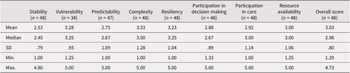
With regard to complexity, the results indicated that patients supported by the PNP were highly vulnerable to stressors that could adversely affect their outcomes, particularly those with highly complex healthcare needs, such as comorbidities and medication side effects (M = 3.28, SD = 0.95; M = 3.53, SD = 1.28). However, these patients were fairly stable and responsive to therapies, as well as predictable in their behaviour and course of illness (M = 2.53, SD = 0.79; M = 2.75, SD = 1.09). No gender differences emerged in the patient characteristic domains or in the overall model score. See Table 2 for a full summary of the synergy model results.
Synergy model results summary

Table 2. Long description
The table consists of 10 columns and 6 rows.
Column headers from left to right are:
1. Category (unlabeled)
2. Stability (n = 48)
3. Vulnerability (n = 34)
4. Predictability (n = 47)
5. Complexity (n = 48)
6. Resiliency (n = 48)
7. Participation in decision making (n = 48)
8. Participation in care (n = 48)
9. Resource availability (n = 48)
10. Overall score (n = 48)
Data rows:
* Mean: Stability 2.53, Vulnerability 3.28, Predictability 2.75, Complexity 3.53, Resiliency 3.23, Participation in decision making 2.88, Participation in care 2.92, Resource availability 3.00, Overall score 3.03.
* Median: Stability 2.45, Vulnerability 3.25, Predictability 2.67, Complexity 3.50, Resiliency 3.25, Participation in decision making 2.67, Participation in care 3.00, Resource availability 3.00, Overall score 2.98.
* S D: Stability .79, Vulnerability .95, Predictability 1.09, Complexity 1.28, Resiliency 1.04, Participation in decision making .89, Participation in care 1.14, Resource availability 1.06, Overall score .80.
* Min.: Stability 1.00, Vulnerability 1.25, Predictability 1.00, Complexity 1.00, Resiliency 1.00, Participation in decision making 1.33, Participation in care 1.00, Resource availability 1.25, Overall score 1.29.
* Max.: Stability 4.80, Vulnerability 5.00, Predictability 5.00, Complexity 5.00, Resiliency 5.00, Participation in decision making 5.00, Participation in care 5.00, Resource availability 5.00, Overall score 4.73.
Intervention characteristics
The MH Navigators provided a range of supports, with most patients receiving more than one type of intervention (76.5%, n = 51). These supports included healthcare navigation (70.6%, e.g., managing referrals, medications, and appointments), home safety assessments that included provision of mobility aids and safety equipment (52.9%), supportive counselling encompassing therapeutic interventions (56.9%), and caregiver support (13.7%). They also assisted with meeting patients’ basic needs by facilitating connections to community resources for food and transportation (27.5%) and by delivering education on topics such as home safety, fall prevention, and brain health (19.6%, n = 51). The navigators described intensity of service as low in 28.6 per cent of cases, 38.1 per cent as moderate, and 33.3 per cent as high (n = 42). These categories (low, moderate, high) were assigned subjectively, based on the amount of time spent providing direct or indirect support and the level of need. For example, patients requiring sustained but low-level involvement were classified as lower intensity than those needing high levels of support over a shorter duration. A home visit was conducted in 97.9 per cent of cases (n = 48), and 37.8 per cent of patients received consultation with the part-time MH Navigator that focused on physical medicine and rehabilitation (n = 45).
Service utilization
The majority (90.6%) of patients were referred to the MH PNP by the hospital, most frequently by acute care (58.3%) and the emergency department (25%, n = 48) prior to discharge. The referring staff were typically social workers (51.1%) and occupational or physical therapists (44.7%, n = 47). The remaining patients (7.5%) were referred by community agency social workers involved in their care and were either admitted or recently discharged (n = 53). At the time of data extraction, 35 patients were discharged from the MH PNP. These patients were supported by the MH Navigators for an average of 119.74 days (range 9–280; median = 99; SD = 77.98; n = 35). Patients were discharged from the MH PNP or were considered for discharge when they were appropriately connected to services (55.8%, e.g., case management, community supports), transferred to another agency (4.7%), were awaiting placement in assisted living or a retirement home (4.7%), were deceased (2.3%), or were no longer interested in the service (11.6%). Other reasons for discharge (16.3%, n = 43) included continued support from the community agency and rehospitalization.
Discussion
This study explored the introduction of a novel MH PNP for older adults, developed through a hospital–community partnership. Data drawn from a clinical tracking tool highlighted the program’s contribution to meeting the complex needs of this population across care settings. Most of the patients supported by the program were women with significant vulnerabilities, including limited informal support and a high proportion designated as ALC. The higher number of women being served by the program aligns with findings that women are more likely to be socially isolated (Requena et al., Reference Requena, Reher, Padyab and Sandström2019), and have a MH condition (Kiely et al., Reference Kiely, Brady and Byles2019), such as depression, compared to men (Reppas-Rindlisbacher et al., Reference Reppas-Rindlisbacher, Mahar, Siddhpuria, Savage, Hallet and Rochon2022). Gender differences in MH have been attributed to women being more likely than men to self-report having a MH challenge and seek and/or accept help (Doherty & Kartalova-O’Doherty, Reference Doherty and Kartalova-O’Doherty2010).
The distribution of MH diagnoses, most commonly mood disorders, substance misuse, and anxiety, illustrates the considerable impact of these conditions on healthcare transitions. These conditions may affect patients’ ability to engage in care, adhere to treatment plans, and navigate complex health and social service systems, thereby increasing the risk of fragmented care and unmet needs during transitions (Krumholz, Reference Krumholz2013; Naylor et al., Reference Naylor, Aiken, Kurtzman, Olds and Hirschman2011). Many patients also presented with additional psychiatric or cognitive diagnoses, underscoring the layered complexity of their care needs. There is strong evidence that older adults who are discharged from a hospital setting with complex needs are likely to have poor outcomes, with MH needs as a noted indicator (Bradshaw et al., Reference Bradshaw, Goldberg, Lewis, Whittamore, Gladman, Jones and Harwood2013). Hence, the use of an adapted Synergy Model offered a structured way to capture patient vulnerability and complexity, while also revealing relative stability in illness trajectories. This suggests that, when adequate supports are in place, patients may remain engaged in care and avoid deterioration. However, the absence of validated benchmarks for this tool in community MH settings indicates that findings should be interpreted with caution.
The MH Navigators provided a wide range of interventions, including care coordination, counselling, home safety assessments, and caregiver support. This flexibility allowed services to be tailored to individual needs. The types of supports are similar to those of another PNP at our hospital site that uses social workers as navigators, but that service is not specific to MH (e.g., Liu et al., Reference Liu, Knoepfli, DasGupta, Ziegler, Elliot, English, Hitzig and Guilcher2025). The average navigation period of approximately 120 days may reflect both the complexity of the patient population and gaps in continuity of care. Although transitional care interventions commonly concentrate their most intensive support within the first 30 to 90 days following discharge (Naylor et al., Reference Naylor, Aiken, Kurtzman, Olds and Hirschman2011), older adults with coexisting MH, functional, and social needs may require more intensive support to achieve a stable transition to the community. This is consistent with prior literature suggesting that post-discharge recovery is shaped not only by medical needs but also by challenges related to caregiver support, service coordination, and access to community resources (Krumholz, Reference Krumholz2013). In this context, the extended service duration observed in our study likely reflects both the time required to address these multidimensional needs and the role of navigation in bridging gaps while longer-term supports are established.
At the same time, this finding highlights potential limitations of fixed-duration PNPs and supports the need for more flexible, needs-based approaches. On average, patients were supported for approximately four months, a duration that appears sufficient to stabilize care transitions and facilitate connections to ongoing services. These findings align with existing evidence demonstrating that PNPs enhance continuity of care and coordination for individuals with complex health needs (Freeman, Reference Freeman2006; Kokorelias et al., Reference Kokorelias, DasGupta and Hitzig2022). Importantly, integrating therapeutic counselling with practical supports may be particularly valuable, as it enables PNPs to address both clinical needs and broader social determinants of health, thereby supporting more comprehensive and sustained transitions to the community.
Our study also suggests that OTs are well-positioned to serve as patient navigators for older adults with MH conditions. Their training in both physical and psychosocial domains allowed a broad range of interventions, from mobility assessments to therapeutic counselling. The use of OTs as navigators has been identified in the literature (Kokorelias et al., Reference Kokorelias, Singh, Thompson, Nesbitt, Shiers-Hanley, Nelson and Hitzig2024), with additional studies demonstrating their effectiveness in addressing a wide range of patients’ needs (e.g., Deeks et al., Reference Deeks, Cooper, Draper, Kurrle and Gibson2016). Prior research has identified the clinical expertise and extensive experience of OT MH Navigators as key facilitators of successful healthcare transitions (Motsenok, Mirbaha, et al., Reference Motsenok, Mirbaha, Clarke, Morrow, Knoepfli, Ziegler, DasGupta and Hitzig2026). Their training enables them to conduct functional assessments and deliver patient-centred interventions not typically offered within traditional navigation models (Kokorelias et al., Reference Kokorelias, Shiers-Hanley, Rios, Knoepfli and Hitzig2021), thereby helping address important gaps in community-based care (Motsenok, Mirbaha, et al., Reference Motsenok, Mirbaha, Clarke, Morrow, Knoepfli, Ziegler, DasGupta and Hitzig2026).
The existing literature on the integration of allied healthcare professionals, such as OTs, in transitional care for older adults with MH needs remains limited, with most studies focusing on transitions from hospital-to-community, highlighting the emotional burden of these transitions and the importance of follow-up support (Motsenok, Wong, et al., Reference Motsenok, Wong, Sothilingam, Antunes, Devion, Wilson, Knoepfli, Elliot, DasGupta, Ziegler and Hitzig2026). Future work could explore ways to expand the scope of practice in the OT field related to navigation, as well as how OTs may work with other professionals or lay navigators as part of a team-based approach.
Although this study was not designed to evaluate outcomes such as readmissions, emergency department visits, or patient-reported measures, the findings provide a foundation for future research examining the impact of MH PNPs on health system performance and patient well-being. Evaluating these outcomes will help demonstrate the effectiveness and value of MH PNPs, which may provide the needed evidence to support their sustainability. Additionally, further work is needed to examine implementation considerations, including optimal duration, intensity of support, and integration within existing health and community systems. Obtaining data on these factors will help inform how the service is ideally delivered, thereby enhancing studies focused on clinical effectiveness, as outcomes will be directly tied to the quality of the service. Mixed methods approaches, informed by implementation frameworks such as the Consolidated Framework for Implementation Research (CFIR; Damschroder et al., Reference Damschroder, Reardon, Widerquist and Lowery2022), may be particularly valuable for examining both outcomes and the contextual factors influencing implementation.
Limitations
This retrospective observational cohort study, conducted over 15 months (November 2023–October 2024), examined a novel MH PNP for older adults. In the absence of a standardized MH PNP patient-tracking tool, the research team developed a data-collection instrument to capture patient demographics, types of interventions, and discharge outcomes. The clinical tracking tool also included measures of patients’ complexity, based on an adaptation of the Synergy Model, originally developed in the context of acute and critical care. In the absence of validated benchmarks for applying the Synergy Model in MH and patient navigation contexts, the generalizability of our findings may be limited. Further work is required to validate this tool for the older adult MH patient population.
As the data were primarily collected for routine clinical care, in some cases, demographics, service information, and patient context (e.g., diagnosis, caregiver support) were incomplete. Additionally, other performance indicators, such as repeat hospital visits, lengths of stay, and patient-reported outcomes, were not captured.
Conclusion
This study introduces a novel MH PNP for older adults with MH needs, where an MH Navigator engages with patients before and after hospital discharge. The descriptive findings offer valuable insights into the MH PNP’s impact, such as facilitating timely access to appropriate resources and supporting safer aging in the community. By outlining the navigators’ scope of practice and patient characteristics, the study offers insights that may inform decision-makers and health system leaders exploring the adoption of similar roles to optimize care transitions for older adults with MH needs and establish informative evaluation metrics.
Financial support
This study was funded by the Slaight Family Foundation. Dr. Sander L. Hitzig holds the John and Sally Eaton Chair in Rehabilitation Research, a joint Hospital–University Chair between the University of Toronto, the Sunnybrook Health Sciences Centre, and the Sunnybrook Health Sciences Centre Foundation.


 Open access

