Stress within the teaching profession has been defined as ‘a negative emotional experience being triggered by the teacher’s perception that their work situation constituted a threat to their self-esteem or well-being’ (Kyriacou, Reference Kyriacou2001, p. 28). In New Zealand, research has found that fewer than 50% of educators believed their workload to be manageable (Wylie, Reference Wylie2007). Intensified workloads are related to reduced job satisfaction and increased intentions to quit among teachers (Grant, Jeon, & Buettner, Reference Grant, Jeon and Buettner2018; Warren, Reference Warren2018), and teachers’ psychological distress is related to poorer mental health and wellbeing among students (Harding et al., Reference Harding, Morris, Gunnell, Ford, Hollingworth, Tilling and Brockman2019). These findings indicate potential difficulties recruiting and retaining staff, yet many teachers regard their profession as highly rewarding and are strongly motivated to contribute to children’s emotional and academic development and to make a difference to society (Cancio et al., Reference Cancio, Larsen, Mathur, Estes, Johns and Chang2018). Exploring and identifying individual differences that reduce the effects of stress or promote wellbeing may help better understand stress and wellbeing and inform interventions.
While teacher stress has been widely studied, there has been less focus on wellbeing (Mankin, von der Embse, Renshaw, & Ryan, Reference Mankin, von der Embse, Renshaw and Ryan2018). Subjective wellbeing (SWB) comprises the experience of frequent positive affect and infrequent negative affect (Diener, Reference Diener2009; Diener, Oishi, & Tay, Reference Diener, Oishi and Tay2018). Positive affect (PA) reflects the extent to which individuals experience positive emotions such as enthusiasm and excitement, while negative affect (NA) refers to emotions such as fear, sadness or guilt (Watson, Clark, & Tellegen, Reference Watson, Clark and Tellegen1988). Among teachers, SWB has been found to be related to work performance and job satisfaction (Duckworth, Quinn, & Seligman, Reference Duckworth, Quinn and Seligman2009; Moè, Pazzaglia, & Ronconi, Reference Moè, Pazzaglia and Ronconi2010).
A useful framework for exploring and understanding stress and wellbeing is provided by the Job-Demands-Resources (JD-R) model (Schaufeli & Bakker, Reference Schaufeli and Bakker2004). Job demands are the physical, social or organisational aspects of the work that necessitate sustained physical or mental effort. Job resources are the physical, psychological, social or organisational aspects of work that facilitate achieving work goals, personal growth and development (Schaufeli & Taris, Reference Schaufeli, Taris, Bauer and Hämmig2014). Unless demands are balanced by appropriate resources, they are associated with stress, burnout and poor health, but appropriate resources can mean that even highly demanding work can result in satisfaction, engagement and wellbeing (Dicke, Stebner, Linninger, Kunter, & Leutner, Reference Dicke, Stebner, Linninger, Kunter and Leutner2018; Xanthopoulou, Bakker, Demerouti, & Schaufeli, Reference Xanthopoulou, Bakker, Demerouti and Schaufeli2012). While the job demands faced by teachers have been widely studied (Collie, Granziera, & Martin, Reference Collie, Granziera and Martin2018; Warren, Reference Warren2018), less is known about the psychological resources that may help them manage the demands of their work.
Based on the JD-R framework, the present study will examine how psychological capital may act as a resource that helps reduce work stress and increase wellbeing for teachers. Psychological capital is a multidimensional construct made up of self-efficacy, hope, optimism, and resilience (Luthans & Youssef-Morgan, Reference Luthans and Youssef-Morgan2017). Self-efficacy is the perception that one possesses the necessary abilities to be able to engage with a task and achieve success (Bandura, Reference Bandura1977; Cetin & Dede, Reference Cetin and Dede2018). Hope is a positive expectation about the future; it includes a belief in the ability to identify and achieve personally important goals (Luthans, Avey, Avolio, Norman, & Combs, Reference Luthans, Avey, Avolio, Norman and Combs2006). Optimism relates to the ability to attribute positive events to internal, lasting and global causes, and to attribute negative events to external, temporary and specific causes (Seligman, Steen, Park, & Peterson, Reference Seligman, Steen, Park and Peterson2005). The fourth component, resilience, is the ability to handle adversity through adaptation and positive coping (Avey, Wernsing, & Luthans, Reference Avey, Wernsing and Luthans2008; Luthans, Reference Luthans2002; Masten, Reference Masten2001). Higher levels of psychological capital are related to less burnout (Cheung, Tang, & Tang, Reference Cheung, Tang and Tang2011), more wellbeing (Avey, Luthans, & Jensen, Reference Avey, Luthans and Jensen2009), and higher work engagement and job performance (Alessandri, Consiglio, Luthans, & Borgogni, Reference Alessandri, Consiglio, Luthans and Borgogni2018). Importantly, psychological capital can be built by training and experience (Luthans et al., Reference Luthans, Avey, Avolio, Norman and Combs2006).
Psychological capital can also help build adaptive ways of appraising and coping with work demands, which in turn can reduce stress and improve wellbeing. Appraisal is the assessment of the significance and relevance of demands (Folkman & Moskowitz, Reference Folkman and Moskowitz2004). A challenge appraisal is the perception that sufficient resources are available to enable a demand to be successfully addressed, whereas a threat appraisal is the perception that resources are insufficient to successfully deal with a demand (Folkman & Moskowitz, Reference Folkman and Moskowitz2004). Compared to threat appraisals, challenge appraisals are associated with reduced stress and burnout (Crawford, LePine, & Rich, Reference Crawford, LePine and Rich2010; Lin, Wu, Chen, & Chen, Reference Lin, Wu, Chen and Chen2014; Simães, Gomes, Faria, & Gonçalves, Reference Simães, Gomes, Faria and Gonçalves2014). In addition, appraisals relate to the coping strategies used to deal with demands. Coping is the constantly changing cognitive and behavioural efforts to manage specific external and/or internal demands that are appraised as taxing (Lazarus & Folkman, Reference Lazarus and Folkman1984). Many different forms of coping have been identified, but the distinction between task- focused and emotion-focused coping is widely recognised (Folkman & Moskowitz, Reference Folkman and Moskowitz2004). Task-focused coping (TFC) refers to the use of practical task-oriented strategies to manage demands and acquire additional resources. Emotion-focused coping (EFC) aims at reducing emotional distress rather than addressing demands, and may include avoidance, minimisation, rumination and denial. TFC is of particular value when situations are controllable and demands can be addressed; EFC is of value when demands cannot readily be addressed (Lazarus & Folkman, Reference Lazarus and Folkman1984; Van Loon, Heerema, Weggemans, & Noordegraaf, Reference Van Loon, Heerema, Weggemans and Noordegraaf2018). In reality, both forms of coping are often used in tandem (Cancio et al., Reference Cancio, Larsen, Mathur, Estes, Johns and Chang2018), as the effectiveness of a coping strategy depends on how well it meets the demands of the situation. Psychological capital is expected to be related to adaptive appraisal and coping strategies, which in turn will be related to lower stress and higher wellbeing. The study hypotheses are as follows:
Hypothesis 1: Psychological capital will be related to (a) higher levels of wellbeing and (b) lower levels of stress.
Hypothesis 2: The relationship between psychological capital and stress will be mediated by threat appraisal and EFC.
Hypothesis 3: The relationship between psychological capital and wellbeing will be mediated by challenge appraisal and TFC.
Method
Information about the study and an invitation to participate were emailed to the principals of all primary, intermediate and secondary schools in New Zealand (total 2,700). Principals were asked to forward details of the study to teaching staff. The questionnaire was available online and a link was included in the email invitation. Social media were also used to advertise the survey, targeting online teaching groups, teacher wellbeing community groups, Principals’ Associations pages and the New Zealand Educational Institute webpages. In addition, the first author met with a regional group of principals and discussed the importance of the research, the study aims and objectives, and how to access the questionnaire electronically. Ethical approval was gained from the institutional Ethics Committee.
Participants
There were 1,502 responses to the online questionnaire. Participants with more than 10% missing data were excluded from analysis, leaving 1,040 participants. It is not known how many teachers the survey reached so a response rate cannot be calculated.
Most respondents were female (female: n = 919, 89%; male n = 113, 11%). Years of teaching experience ranged from 1 to 50 (M = 15.44, SD = 10.7). The mean number of hours worked per week was 48 (range 0–90). Six percent of respondents (n = 58) were principals; 115 (11%) were deputy or assistant principals; 142 (14%) were team/syndicate leaders; 80 (8%) were heads of department, 590 (57%) were teachers; 13 (1%) were resource teachers of learning and behaviour (RTLB), and 36 (3%) classed themselves as ‘other’ (e.g., administrator, librarian).
Measures
Psychological capital was measured using the 24-item Psychological Capital Questionnaire (PCQ; Luthans et al., Reference Luthans, Avolio, Sosik, Jung, Berson, Avey and Norman2007), with all items rated on a 6-point scale (1 = strongly disagree to 6 = strongly agree). A sample item is ‘I feel confident analysing a long-term problem to find a solution’. Three items were reverse coded; for example, ‘If something can go wrong for me work-wise, it will’. Principal component analysis identified a single factor accounting for 41.5% of the variance. All items loaded at least .40 on the common factor. A single scale comprising the mean of all items was computed for psychological capital (α = .94).
Coping strategies were measured using the 28-item Brief COPE (Carver, Reference Carver1997) using a 4-point scale anchored with the statements ‘I don’t do this at all; I do this sometimes; I do this frequently’ and ‘I do this a lot’. Principal component analysis identified two factors accounting for 32% of the variance. Two scales were computed: TFC (10 items; e.g., ‘I try hard to think about what steps to take’, α = .82), and EFC (12 items; e.g., ‘I blame myself for the things that happened’, α = .79).
Wellbeing was conceptualised as high levels of positive affect and low levels of negative affect. It was measured by asking respondents to rate how often they had experienced each of 15 positive (e.g., ‘enthusiastic’) and 15 negative (e.g., ‘miserable’) emotions related to their job over the previous month, using the Job Affective Related Well-Being Scale (JAWS; van Katwyk, Fox, Spector, & Kelloway, Reference van Katwyk, Fox, Spector and Kelloway2000). Responses ranged from 1 = never to 5 = always. Negative items were reverse scored. Reliability of the 30 item scale was (α = .96).
Stress was measured using the 14-item Perceived Stress Scale (Cohen, Kamarck, & Mermelstein, Reference Cohen, Kamarck and Mermelstein1983). Responses were on a 5-point scale ranging from never to very often (e.g., ‘In the last month, how often have you felt nervous or “stressed”’). Seven items were reverse coded. Reliability was α = .90.
The Cognitive Appraisal Scale (Skinner & Brewer, Reference Skinner and Brewer2002) was used to measure challenge and threat appraisals of workplace stressors. Eight items measured challenge appraisals (e.g., ‘I tend to focus on the positive aspects of any situation’, α = .73) and 10 items measured threat appraisals (e.g., ‘I worry that I will say or do the wrong things’, α = .94).
Data Analysis
Data met assumptions of normality, linearity and homoscedasticity. Exploratory factor analysis using principal component analysis with varimax rotation was conducted for the measures of psychological capital, appraisal and coping, as a range of factor structures for these measures have previously been identified. Eigenvalues and scree plots indicated the number of factors to retain. Alpha reliability coefficients are reported based on the data in this study. Bivariate relationships were analysed using Pearson’s r. Group differences were explored using independent samples t tests. For the regression analyses, males were coded as 0 and females were coded as 1. For teaching position, a Leadership group (Principals, Deputy and Associate Principals, Team Leaders, Syndicate Leaders and Heads of Department) was coded as 1, and classroom teachers were coded as 0. Responses to the RTLB and ‘Other’ categories were low, and it was not possible to establish the exact roles of the ‘other’ participants, so these were excluded from the analysis of roles. Control variables were entered first (hours worked per week, gender and position). Years of experience were confounded with role (leader/teacher) so were not added to the analysis. To test mediation we used the Process macro (Hayes, Reference Hayes2013) in SPSS Statistics. In mediation, a series of regression analyses partitions the effect of the predictor (psychological capital) on the criterion variables (stress and wellbeing) into the direct effect and the indirect effect via the mediators (appraisal and coping). The Process macro bootstraps the indirect effect, which allows the calculation of effect sizes and hypothesis tests when underlying distributions are unknown. Bootstrapping was set to 10,000 resamples. If the 95% confidence interval includes zero, then the indirect effect is not significant at the .05 level.
Results
Compared to male participants, female participants had higher levels of challenge appraisal, threat appraisal, EFC and wellbeing, but not psychological capital or stress (Table 1). Those in leadership roles were higher than teachers on psychological capital, challenge appraisal, TFC and wellbeing. Teachers were higher than leaders on threat appraisal, EFC and stress. Those with more years of teaching had higher levels of psychological capital, and less threat appraisal, EFC, negative affect and perceived stress (Table 1). Teachers working longer hours per week had less psychological capital and positive affect, and more EFC, negative affect and stress. Because of the group differences, gender, position and hours worked were entered as control variables in the regression.
Means, Standard Deviations and Correlations for Study Variables, and Differences by Gender

Note: Female = 0, Male = 1; Teacher = 0, Leadership Role = 1.
*p < .05; **p < .01, ***p < .001
Hypothesis Testing
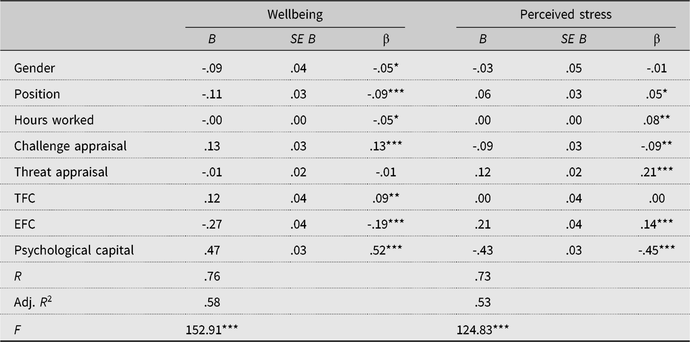
Hypothesis 1, that psychological capital would be related to higher levels of wellbeing and lower levels of stress, was supported (Table 2).
Regression Analyses Identifying Predictors of Wellbeing and Stress

Note: TFC = Task-focused coping, EFC = Emotion-focused coping.
*p < .05; **p < .01, ***p < .001.
As expected, psychological capital was related to higher levels of wellbeing and lower levels of stress, over and above the effects of appraisal and coping. In line with other research, the predictors of stress differed somewhat from those of wellbeing (McGowan, Gardner, & Fletcher, Reference McGowan, Gardner and Fletcher2006). Challenge appraisal was a stronger predictor of wellbeing than of stress, while threat appraisal predicted stress but not wellbeing; TFC predicted wellbeing but not stress, and EFC was negatively related to wellbeing, and positively related to stress.
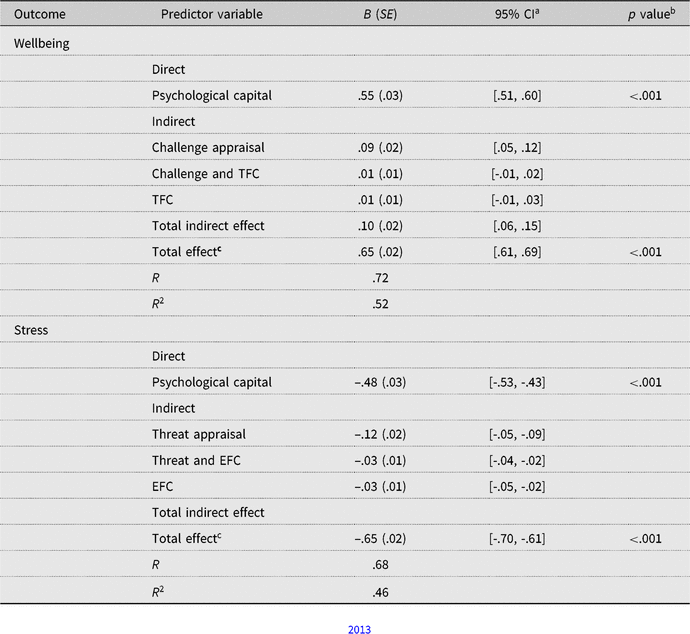
The relationship between psychological capital and stress (hypothesis 2) and wellbeing (hypothesis 3) was expected to be mediated by appraisal and coping. Results of the linear regression models used to examine the mediation are presented in Table 3 and Figures 1a and 1b. Control variables were not significant in the analysis so are excluded from the results reported.
Results Of Linear Regression Models Used to Examine the Direct Effect of Psychological Capital, and Mediation (Indirect Effects) of Appraisal and Coping on Wellbeing and Stress

Note:aBootstrapped 95% CI for B; bSignificance of B for direct and total effects; indirect effects are deemed different from zero with 95% confidence if zero is outside the 95% confidence intervals (Hayes, Reference Hayes2013). cDirect + indirect effects. TFC = Task-focused coping, EFC = Emotion-focused coping.
Figure summarising the findings for Hypothesis 2, that the relationship between psychological capital and stress would be mediated by threat appraisal and EFC. Solid lines show the direct effect; dashed lines show indirect (mediated) effects. Coefficients are unstandardised; all pathways are significant (Table 3).

Figure summarising the findings for Hypothesis 3, that the relationship between psychological capital and wellbeing would be mediated by challenge appraisal and EFC. Solid lines show the direct effect; dashed lines show indirect (mediated) effects. Coefficients are unstandardised; all pathways are significant (Table 3).

Direct effects of psychological capital on wellbeing and strain were apparent. While the mediated indirect pathways were significant, they were extremely small. At best, it seems that appraisal and coping partially mediate the relationships between psychological capital and stress and wellbeing.
Discussion
Participants with higher levels of psychological capital had less stress and more wellbeing, were more likely to see work demands as challenges than threats, and reported using more TFC and fewer EFC strategies. These findings support previous research that has linked psychological capital to stress and wellbeing, as well as to increased job satisfaction and organisational commitment (Cheung et al., Reference Cheung, Tang and Tang2011; Luthans & Youssef-Morgan, Reference Luthans and Youssef-Morgan2017; Milan & Luthans, Reference Milan and Luthans2006). These were direct effects; psychological capital appears to support the use of challenge appraisals and achievement-oriented coping approaches. More surprising was the limited role of appraisal and coping in mediating the link between psychological capital, wellbeing and stress. The indirect effects, while statistically significant, were extremely small, especially in comparison to the direct effect of psychological capital. Clearly, much more work is needed to establish how psychological capital has its effects on wellbeing and stress. Transactional theories of stress and wellbeing emphasise the importance of cognitive and behavioural processes, such as coping in addressing demands and helping to determine outcomes (Lazarus, Reference Lazarus1966; Lazarus & Folkman, Reference Lazarus and Folkman1984), but in this study, psychological capital was related to stress and wellbeing largely independently of appraisal and coping. A more nuanced understanding of how psychological capital may help support teachers’ adaptive functioning, and how it may be related to personal resources such as resilience, affect and social support, is required to identify ways of addressing demands and fostering wellbeing. In relation to personal resources, examining how the different aspects of psychological capital affect wellbeing would also be worthwhile. Its role is complex: it could reduce perceived demands, increase perceived resources, or both. The findings support the hypothesised model, suggesting direct and indirect effects of psychological capital in measures of wellbeing and stress, but direct effects predominated.
Limitations and Implications for Further Research
Longitudinal studies are required to examine causal relationships and to look at how psychological capital, appraisal and coping change with time, context and in response to different demands. Male teachers were underrepresented in the present study; a purposive sampling approach may be required for a more representative sample. We did not collect data on ethnicity or whether respondents were primary or secondary level teachers, so further exploration on these aspects is needed. The data only reflect the experiences of teachers who are still in the profession; it would be valuable to know more about the cognitions and emotions of those who have left teaching, possibly due to occupational stress. Teachers who are most pressured for time may have been less likely to take part in the study; alternatively, they may also have had a greater interest in the topic of work stress, so these effects on response rates are unknown. In addition, qualitative studies can provide valuable insight into how psychological capital, appraisal and coping may relate to stress and wellbeing. Research studies focusing on the educational sector have largely explored the antecedents and consequences of work demands but have not addressed the roles played by policy, regulations and governing bodies. A fuller understanding may benefit from including variables at this level.
Implications for Practice
Psychological capital, a combination of hope, resilience, self-efficacy and optimism, is a valuable personal resource. An increase in hope, self-efficacy, optimism and resilience can support wellbeing in the work and home environments. Importantly, psychological capital can be fostered by interventions and professional development programs aimed at increasing wellbeing and self-care among teachers. Interventions might, for instance, consider goal setting and strategising around goal achievement, relevant skills development, supportive interpersonal environments, role models and feedback (Luthans et al., Reference Luthans, Avey, Avolio, Norman and Combs2006; Luthans, Avey, Avolio, & Peterson, Reference Luthans, Avey, Avolio and Peterson2010). It is important, however, to realise that relying on teachers’ own abilities to manage demanding work is not a suitable long-term strategy. Even individuals who are hopeful, optimistic, confident and resilient cannot manage high levels of demands without supporting resources for very long. It is imperative to create well-resourced and psychologically safe school contexts that foster teacher commitment and wellbeing, and this requires initiatives at policy, systems and societal levels. Wellbeing is not the absence of stress, and a stress-free job or environment is not a realistic goal to aim for. Stressful demands can be challenges as well as threats, and the key is to ensure that personal, interpersonal and work resources are available to manage demands. Wellbeing can mean thriving when high levels of demands and resources are present, so the aim should be to ensure demands are manageable and resources are sufficient.
Conclusion
Psychological capital is a valuable resource for teachers to have in their demanding but rewarding work roles. Training and development initiatives may want to consider how best to build hope, resilience, efficacy and optimism in teachers. It is also important that teachers work in safe and supportive workplaces with effective leadership and strong social support, in order to provide a positive and supportive environment for students.