Introduction
The presence/absence dichotomy is fundamental to understanding change, continuity and cultural significance in the archaeological record across time and space. Within an Australian context, spatial patterning in the distribution of tula adzes across the continent during the Late Holocene (e.g. Maloney & Dilkes-Hall Reference Maloney and Dilkes-Hall2020) and chronological changes in the subject matter and style of rock art from panels of layered imagery illustrate choice in the uptake and expression of social and cultural behaviours (e.g. Mulvaney Reference Mulvaney2010). Yet what informs and drives these choices? People can make choices in response to a variety of factors, such as environmental or climate change, and exposure to new peoples, ideas and objects. Whatever the case, broad-scale studies into the absence of ‘things’ across time and space can be revealing and offer insights into peoples’ relationships to/with the material world and how people experienced, shaped and expressed their landscapes and place-worlds.
In contrast to broad-scale studies, culturally specific approaches to absences and fine-grained methodologies on how to infer and approach absences of objects and images in geographically constrained archaeological records remain undeveloped. This underdevelopment is particularly the case in conceptualizing absences in socio-cultural and more fundamental ontological and epistemological terms. An important exception is Fowles’ (Reference Fowles and Fogelin2008) work on ‘negative archaeology’ and the methodological challenges of investigating an archaeology of taboo and prohibition. He suggests that ‘not only must we demonstrate an absence … but also we must further demonstrate that it was a meaningful absence, a culturally marked or accentuated absence’ (Fowles Reference Fowles and Fogelin2008, 17–18). Likewise, Sørensen (Reference Sørensen, Bille, Hastrup and Sørensen2010, 116) asks: ‘if an absence is the expression of lack of a given element in the past, is that lack intentional, or has the given element vanished through time?’ In short, are absences deliberate, and if so, why?
In this paper we address these questions by investigating absence in the post-European contact rock-art record in northeastern Australia. Specifically, we explore the meaningfulness of the absence of European ships from the corpus of watercraft motifs—canoes—in Torres Strait rock art. More generally, the absence of introduced subject-matter motifs may reflect the removal of paintings by taphonomic factors concerning the preservation of pigment-based motifs (e.g. Davidson Reference Davidson, Conkey, Soffer, Stratmann and Jablonski1997), or the removal of artists by massacres through colonial acts of violence. However, such explanations do not explain the absence of post-contact depictions of European ships in the post-contact rock art of Torres Strait. Alternatively, attention needs to be given to how these absences can be construed as culturally informed, meaningful social action(s). Using a methodology guided by ethnographic data, we interrogate the absence of introduced subject matter in Torres Strait rock art despite initial exposure to European ships over 400 years ago. By exploring the network of relationships where this absence is embedded, we aim to deliver new insights into how peoples of Torres Strait experienced, shaped and expressed their spiritscapes through place-marking strategies. In doing so, we contribute another layer of understanding to the question of ‘why some absent things matter’ (Bille et al. Reference Bille, Hastrup, Sørensen, Bille, Hastrup and Sørensen2010, 13).
Absence in archaeological and rock-art research
Over the past two decades, studies of absence(s) in archaeology have covered several themes. Fowles and Heupel (Reference Fowles, Heupel, Graves-Brown, Harrison and Piccini2013, 179) suggest that in many respects, the investigation of absence is in a ‘mournful’ sense, such that it is ‘alienated from the start, like subalterns waiting to be “presenced” through the gift of archaeology's material evidence’. In cultural heritage management frameworks, the non-artefactual spaces between archaeological sites are, from the perspective of some Aboriginal Australians, equally as meaningful in terms of Aboriginal cultural landscapes and the world of the ancestors (Owen Reference Owen2015). Similarly, contact archaeology projects often use the presence/absence of European objects as indices of acculturation (see e.g. Lightfoot Reference Lightfoot1995, 206–7; Lydon & Ash Reference Lydon and Ash2010, 8–9; Silliman Reference Silliman2009). In the context of representational systems, Bailey (Reference Bailey, Renfrew and Morley2007, 124) suggests that the absence of faces on Neolithic figurines was a deliberate strategy to provoke thought and challenge the viewer to ‘draw inferences from what was represented and what was left out’.
In rock-art contexts, Ouzman et al. (Reference Ouzman, Veth, Myers, Heaney, Kenneally, David and McNiven2018, 470) consider the absence of plant motifs in hunter-gatherer rock art and suggest that ‘[p]erhaps plants are present, hidden in visual codes unintelligible to outsiders or only present as constituent ingredients of paint recipes’. In the American Southwest, Fowles (Reference Fowles and Fogelin2008) explores the absence of depictions of powerful katsina spirit beings within Northern Tiwa Pueblo society. As all other Pueblo groups had elements of katsina iconography in the archaeological record, Fowles (Reference Fowles and Fogelin2008) suggests that the Northern Tiwa absence can be conceptualized as an iconographic taboo. Furthermore, this taboo emerged as a conscious and intentional decision by the Northern Tiwa Pueblo to define their own identity as part of a ‘unique Northern Tiwa sect of the katsina religion arising in conscious reaction to the new indulgence in mask iconography at the neighboring Pueblos’ (Fowles Reference Fowles and Fogelin2008, 32). In Australia, the discovery of two rare beeswax motifs in the southwestern Gulf of Carpentaria was used to ask why beeswax motifs were largely restricted to western Arnhem Land and the Kimberley despite the occurrence of native bee species across northern and eastern Australia. Brady et al. (Reference Brady, Bradley and Wesley2019, 135) link the rarity of beeswax motifs in this region of the Gulf with local ethnographic information on the restricted use of beeswax due to its feared association with sorcery.
Post-European contact rock art and absence
In Australia, studies into contact-themed rock art (introduced subject matter and continuity of pre-contact motif styles) have flourished over the past two decades. Various themes of cross-cultural interaction have been explored through the investigation of motifs such as guns, smoking pipes, watercraft (paddle-steamers, praus from Southeast Asia [see below], etc.), stockmen, horses, cattle and metal knives. These themes include antiquity of cross-cultural interactions, Indigenous uptake of new technologies and involvement in colonial industries, and motifs as symbols of power, resistance, performance and memory (e.g. Clarke & Frederick Reference Clarke, Frederick and Lilley2006; Frederick Reference Frederick1999; May et al. Reference May, Taçon, Wesley and Pearson2013; McNiven & Russell Reference McNiven, Russell, David and Wilson2002; Taçon et al. Reference Taçon, May, Fallon, Travers, Wesley and Lamilami2010). However, the absence of introduced subject matter has largely escaped in-depth consideration.
In the northwestern Kimberley region where tens of thousands of rock-art sites and motifs occur, Walsh (Reference Walsh2000, 53) attributes the scarcity of introduced subjects as an expression of the ‘religious’ nature of most of the region's rock art, and the agency of artists who were ‘effectively resisting any divergence to record the secular wonders of new people, animals and objects’. Similarly, in the graphically adorned Jawoyn Country landscape in southern Arnhem Land, very few motifs depict introduced subject matter despite rock-art production continuing until at least 1940. According to Gunn et al. (Reference Gunn, David, Whear, David, Taçon, Delannoy and Geneste2017, 192), during the European contact period (from 1845), Aboriginal artists continued to paint motifs that, for the most part, reflected ‘everyday concerns that featured in established cosmologies that continued to guide how they viewed the world to operate’.
Population decrease due to colonial violence (massacres) and the introduction of diseases (e.g. smallpox) are factors contributing to the (relative) absence of motifs depicting introduced subject matter. For example, in the Sydney region, McDonald (Reference McDonald, Veth, Sutton and Neale2008) argues that social engagement between colonial settlers and local Aboriginal people was minimal, largely a result of a smallpox epidemic that decimated much of the Aboriginal population, and probably resulted in the cessation of rock-art production. Similarly, Mulvaney (Reference Mulvaney2018) refers to depopulation of Yaburara Traditional Owners of Murujuga in northwestern Pilbara region by disease and massacres through contact with pastoralists and pearl-shellers as the likely reason for the minuscule amount of introduced subject matter amongst the region's more than one million engravings.
The nature of cross-cultural interactions also plays a role in accounting for absence. The most frequently occurring (albeit rare) introduced subject matter in the Kimberley region is watercraft (Walsh Reference Walsh2000, 53). Ross and Travers (Reference Ross and Travers2013) identify 34 introduced watercraft motifs: European vessels, and Macassan praus that came from Sulawesi in Indonesia to gather trepang annually from Australia's north coast since the late 1600s/early 1700s (Macknight Reference Macknight1976; Taçon et al. Reference Taçon, May, Fallon, Travers, Wesley and Lamilami2010). This rarity has been linked to fluctuating relationships and periodic hostile Aboriginal–Macassan/European relationships that could have led to less contact between groups and thus ‘less familiarity with the working of their boats [praus]’, a circumstance that could account for the lack of interest in depicting these vessels (O'Connor & Arrow Reference O'Connor, Arrow, Clark, Leach and O'Connor2008, 400). Similarly, Ross and Travers (Reference Ross and Travers2013) suggest that the lack of prau rock paintings reflected a socially distant and ‘moderated relationship’ between Kimberley Aboriginal people and foreign visitors.
Absence of introduced subject matter often expresses different modes of symbolic expression. In the southern Kimberley region, only a single panel of contact-themed rock art depicting introduced subject matter is known, despite over 20 years of intensive archaeological research. The lone painting is a ‘port scene’, argued to represent the port town of Derby during the period 1886–1938, and probably a response to contact and interaction with Europeans made by an Aboriginal stockman who had travelled there with cattle (Balme & O'Connor Reference Balme and O'Connor2015).
These case studies reveal, in the first instance, an absence of contact-themed rock art with introduced subject matter using quantitative (proportional) data; and secondly, varying levels of attempts at understanding and explaining the meaningfulness of such absences. The wide range of theoretical considerations to account for these absences reveals considerable potential to explore further the nature of symbolic behaviour as a form of absence. Building on this research, we offer a nuanced approach to understanding the absence of introduced subject matter in Torres Strait rock art. By drawing on ethnography, we demonstrate how this absence is embedded within a network of spiritscape relations underpinned by historical forces, cosmology, ontology, epistemology and the sea.
Torres Strait: seascapes and spiritscapes
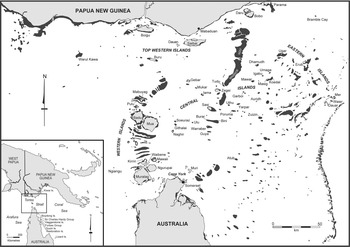
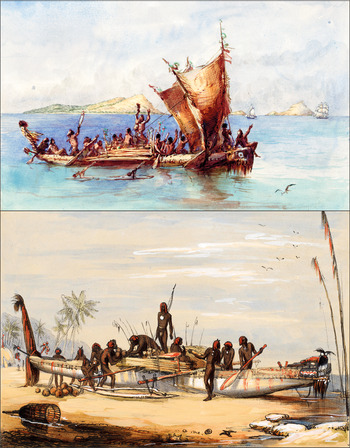
Torres Strait is a tropical archipelago of hundreds of islands, reefs and sandy cays located across a 150 km stretch of water separating the northern tip of northeastern mainland Australia from the southern coast of Papua New Guinea (Fig. 1). The islands are divided into three major geo-cultural groups: Western, Central and Eastern with the Western Islands sub-divided into the Top Western, mid Western and south Western Islands. The region is home to Torres Strait Islanders, except for the Kaurareg Aboriginal people of the south Western Islands. Indigenous peoples of Torres Strait are maritime specialists, whose lives, subsistence pursuits and worldviews centre on the sea such that they identify themselves as ‘Saltwater People’ (Sharp Reference Sharp2002) (Fig. 2). Although only 17 islands are currently inhabited, nineteenth-century historical records attest to villages on 20 islands with settlement patterns ranging from single-island (Eastern and Western Islands) to multi-island (Central Islands) residential communities (McNiven Reference McNiven2015a; McNiven et al. Reference McNiven, Fitzpatrick and Cordell2004a, 88).
Map of Torres Strait showing major islands and reefs (black).

(Top) Watercolour painting of a Torres Strait canoe (with sails) from Mer by Edwin Porcher based on observations on board H.M.S. Fly in 1845. (Courtesy National Library of Australia, nla.pic-an4101817.) (Bottom) Hand-coloured lithograph of a Torres Strait canoe (with sails folded) from Erub by H.S. Melville based on observations on board H.M.S. Fly in 1844–45. (c. 1849, from Melville Reference Melvillen.d., pl. XIX.)

Alfred C. Haddon's anthropological research in the region in 1888 and 1898 produced the largest collection of ethnographic data and objects concerning Islander and Kaurareg life, including data pertinent to this paper on oral histories, cosmologies, linguistics, rituals and kinship (Herle & Philp Reference Herle and Philp2020; Herle & Rouse Reference Herle and Rouse1998). For the Kaurareg, the detailed recordings of Oswald Brierly augment ethnographic details for the 1840s (Moore Reference Moore1979). Over the past 20 years, archaeological research has revealed human occupation of the region back to ~9000 years ago with major cultural changes including the introduction of pottery and horticulture ~2500 years ago, establishment of large shoreline villages over the past 1400 years, and intensification of ceremonial and ritual activities and installations within the past 400–500 years (see McNiven Reference McNiven, Kennard, Mutch and Ryan2011 for a review).
Islander and Kaurareg landscapes and seascapes are replete with spiritual forces, energies and beings. In this context, McNiven (Reference McNiven2004) elaborated the theoretical construct of ‘seascapes as spiritscapes’ to reframe archaeological discussions of the ways Indigenous maritime peoples conceptualize and ritually engage with and orchestrate their seas. Although anthropological understanding of Torres Strait seascapes centres on Haddon's research, negotiation and engagement with the marine spiritual world continues to be a constant presence in the lives of Torres Strait peoples. Much of this negotiation and engagement, both past and present, centres on an animistic, relational ontology whereby the sea, including waves, winds, currents and many marine animals, possesses sentient life forces and intensions that can be experienced by people but also energized and even manipulated to support human endeavours through ritual performances. Examples include rituals to increase winds for canoe travel, increase the abundance of food and water sources (e.g. fish, plants), bring turtles and dugongs closer to hunters and intentionalize and predatorize canoes to aid hunting of turtles and dugongs (e.g. McNiven Reference McNiven2016; Reference McNiven, Harrison-Buck and Hendon2018a; McNiven & Feldman Reference McNiven and Feldman2003). In many cases, spiritual efficacy of rituals explicitly necessitates negotiation with, and propitiation of, the ancestral dead with whom the living share their lives (McNiven Reference McNiven and Watts2013).
Islander/Kaurareg–European mariner interaction
The first known European vessels to transit the strait were the San Pedrico and Los Tres Reyes Mago in October 1606 (Hilder Reference Hilder1980). The vessels were part of a Spanish expedition led by Captain Luis Vaéz de Torres, who successfully navigated through the treacherous, shallow patchwork of reefs and sandbars. The expedition landed on at least two islands, probably Zegey and Iama in the Central Islands, where they recorded turtleshell plates and turtleshell masks and shot and ate a pet dog (Hilder Reference Hilder1980, 74). In addition to describing objects (bows, arrows, stone-headed clubs, outrigger canoes) and sighting people on several islands, the expedition murdered three Islanders and abducted three women (Hilder Reference Hilder1980, 74–6, 83).
It was only in the early nineteenth century, 200 years after Torres’ transit, that Torres Strait became an established thoroughfare for European sailing ships travelling from the rapidly expanding British colony on Australia's east coast. These voyages inevitably led to varying degrees of interaction with Europeans, particularly through Islander and Kaurareg desires for iron, and European desires for food, drinking water, and artefacts such as turtleshell masks (e.g. Flinders Reference Flinders1814, II, 108; Haddon Reference Haddon1904, 296–7; Moore Reference Moore1979, 150; Wilson Reference Wilson1835, 106). However, these interactions were complex, nuanced, and fluctuated between enmity and amity (McNiven Reference McNiven and Russell2001). Historical records from the late 1700s onwards reveal increasing episodes of violence of varying degrees by each side, in some instances characterized by massacres (e.g. Edwards Reference Edwards1870; Flinders Reference Flinders1814; King Reference King1837a; McFarlane Reference McFarlane1888) and what McNiven (Reference McNiven2018b) refers to as ‘ritual mutilation’ of outsiders by Islanders and the Kaurareg. McNiven (Reference McNiven and Russell2001; Reference McNiven2018b) has argued that in many instances much of this violence resulted from European disrespect for protocols around trade. However, gradually, around the 1840s, trade relationships began to improve as European mariners better understood and respected these protocols. However, violence continued to occur occasionally, leading to a continued atmosphere of uncertainty and fear (McNiven Reference McNiven and Russell2001; Mullins Reference Mullins1995).
Other crucial details of maritime frontier interactions come from the narratives of two shipwrecked Europeans who lived among Islander and Kaurareg communities in the 1830s and 1840s. The narratives of John Ireland, one of the survivors of the 1834 wreck of the Charles Eaton, and Barbara Thompson, sole survivor of the 1844 America shipwreck, provide valuable and nuanced insights into the lives, perspectives and spiritual beliefs of Eastern Islanders and the Kaurareg respectively (e.g. King Reference King1837a; Moore Reference Moore1979). Of significance is the fact that within local Indigenous ontology and epistemology, Europeans and their ships were seen as dimensions of the spiritual realm, in particular as part of the spiritual world of the dead (see below).
Torres Strait post-contact rock art
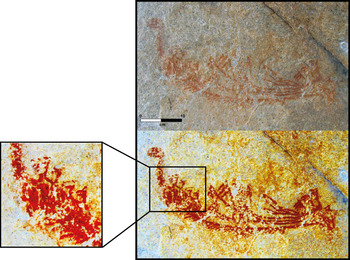
Rock-art research in Torres Strait began in 1888 with cursory and unsystematic recordings by travel writers, anthropologists and archaeologists (for a review, see McNiven & David Reference McNiven and David2004). In 2000, a collaborative and systematic recording programme was established with Western and Central Islanders, the Kaurareg, and the Gudang at the tip of Cape York (see Brady Reference Brady2010 for overview). To date, 998 motifs (anthropomorphs, zoomorphs, material culture, faces/masks, geometric and abstract designs) have been documented from the region. Many motifs have distinctive design conventions in common with decorated objects and cicatrices from across Torres Strait and New Guinea, north to the Sepik River region, northeast into the Fly River region and the Papuan Gulf and westwards into Marind-anim territory in West Papua (e.g. McNiven et al. Reference McNiven, David, Brady and Brayer2004b; see also Brady Reference Brady2010; Haddon Reference Haddon1912; Wright et al. Reference Wright, Stephenson, Taçon, Williams, Fogel, Sutton and Ulm2016). The canoe motifs (n = 41) discussed in this paper are, apart from two, red and depicted with a range of design conventions including sails, people, and a variety of hull adornments/attachments (flags, booms/paddles, central platform, grass fringe) (Fig. 3).
Rock painting of a canoe from the island of Badu in Western Torres Strait (from Brady Reference Brady2010, 437). (Top) original photograph; (Bottom) computer enhancement of same painting, with inset showing stern staves with tassels.

The oldest evidence for pigment-based rock art in Torres Strait comes from indirect dating of in situ ochres recovered from excavations directly below painted panels. The oldest known phase dates to around 1200–1400 years ago with another phase occurring around 500–700 years ago (McNiven et al. Reference McNiven, Brady and Barham2009a). However, other lines of evidence can be used to infer that rock art continued to be made into the post-1606 European contact period. At the Turao Kula site on the island of Mua, in situ powdered ochre recovered from an excavation directly below a painted panel featuring an anthropomorph climbing between two coconut palm trees was dated to between 1400 and 1850 ad (David et al. Reference David, McNiven, Manas, Manas, Savage, Crouch, Neliman and Brady2004). The panel depicts the well-known Mualgal (people of Mua) story of Goba, a boy who had climbed a tree to escape headhunters from a nearby island who attacked and killed his father. Oral tradition suggests Goba's father died sometime before the arrival of missionaries at Mua in the early 1870s. Observations of the Goba panel made by Tennant (Reference Tennant1959, 193) in the mid twentieth century describe the panel of palm trees and climbing anthropomorph as ‘the clearest painting’. However, by 2001 the paintings could only be seen through computer enhancement, leading David et al. (Reference David, McNiven, Manas, Manas, Savage, Crouch, Neliman and Brady2004, 169) to suggest that, based on their rapid degradation, the paintings were made ‘most probably during the nineteenth century’.
Much like elsewhere in Australia, there are no records of Europeans witnessing rock-art production in Torres Strait during the early contact period. This absence is unsurprising, given that apart from Ireland and Thompson, Islanders and the Kaurareg rarely allowed European visitors to venture inland beyond the beach (see McNiven Reference McNiven and Russell2001). However, the practice of rock painting was documented in 2001 and 2002 at the ceremonial (kod) site on the sacred islet of Pulu in the central Western Islands which is owned by the Goemulgal people from the adjacent island of Mabuyag. The kod hosted death (funerary) dances and various rituals (see McNiven et al. Reference McNiven, David, Kod and Fitzpatrick2009b for overview), and features rock art consisting of stencilled hands and paintings of zoomorphs, a dugong hunting platform, a canoe, a waterspout and mŭri spirit beings, whose meanings Haddon recorded from Goemulgal men in 1898. In 2001–02, five Goemulgal made a total of 37 paintings using crushed ochre and brushes made from plants at four locations at the kod site and at nearby Mask Cave. Among the motifs depicted were dari (feathered headdresses), mŭri (spirit beings), modern watercraft (dinghies), and clan totems (Brady Reference Brady2010). That paintings were created at such a sacred and revered place reflects a continuing practice of inscribing the Torres Strait landscape with symbolic markers referencing contemporary totemic identity and the spiritual world.
More broadly, observations of the rapid rate of deterioration of Torres Strait rock art suggest that much of the region's rock-art corpus is of recent age (i.e. <500 years). Paintings occur on boulders of the Badu Suite of granite, and Torres Strait Volcanics (restricted to the Western and Central Islands). Given these geological substrates, motifs would not be expected to have a long life-span, owing to their exposure to humidity and harsh coastal conditions and the fact that pigments do not penetrate the rock surfaces as they would on sandstone (e.g. Cole & David Reference Cole and David1992, 7). Based on this observation, the presence of many motifs with a fresh and vibrant appearance would appear to support a hypothesis that they are of a relatively recent origin. However, as McNiven et al. (Reference McNiven, Brady and Barham2009a, 37) note, ‘associating degrees of weathering with age is potentially spurious given weathering … is also influenced by wall topography, aspect and relative exposure to the elements, especially rainfall runoff’. Nevertheless, in some instances, comparative observations of painted panels reveal some rock art was probably made after contact with Europeans. For example, in 1898 at the Menguzi Kula boulder outcrop at the kod site on Pulu, Haddon recorded ‘some nearly effaced paintings’ of animals (curlew, cassowary, spoon-bill, crayfish), a canoe and a dugong-hunting platform. In 1976, the crayfish, spoonbil, and dugong-hunting platform remained discernible. However, by 2001, only the canoe and dugong-hunting platform could be observed, indicating rapid deterioration of most of the paintings over a period of 103 years (Brady Reference Brady2010).
Torres Strait post-contact material culture
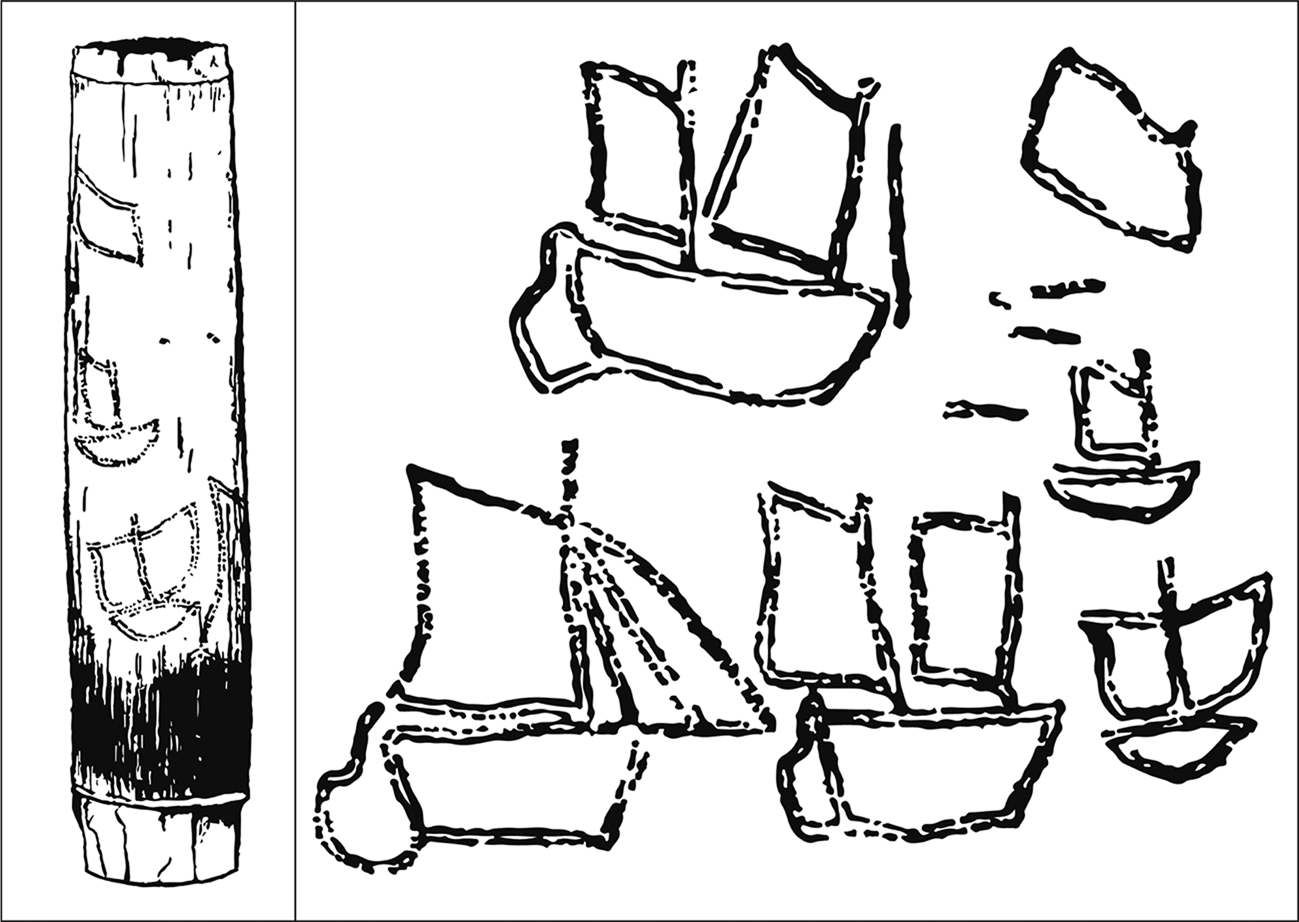
Torres Strait and its highly decorative items of material culture such as turtleshell masks, elaborate feather headdresses, drums, sculptures and canoes have long caught the eye of European observers and collectors (e.g. Fraser Reference Fraser1978; Lahn Reference Lahn2013; McNiven Reference McNiven2015b; Moore Reference Moore1984; Philp Reference Philp2015). Collections from the late 1700s onwards reveal that Islanders and the Kaurareg were integrating European objects into decorative/ceremonial objects. For example, Ireland observed cabin doors from the wrecked Charles Eaton adorning the bow of an Islander canoe (King Reference King1837b, 658). Turtleshell masks integrated a variety of introduced materials—glass beads, cloth and metal (e.g. plates, wire)—into their design structure (e.g. Fraser Reference Fraser1978; Haddon Reference Haddon1912; Moore Reference Moore1984; Philp Reference Philp2015, 117). In one rare instance, a distinctive European-style top-hat made from turtleshell has been added to a turtleshell mask, while other objects feature depictions of introduced subject matter such as a burar (small bamboo container) with engravings of European ships (Fig. 4) and spinning tops decorated with images of people in European-style dress. The quantity of decorative material observed and collected indicates artistic activity continued from the pre- to post-European contact period. We suggest that it would be highly unlikely to see other artistic practices such as rock-art production cease during this time; indeed, many rock-art motifs feature distinctive design conventions found on decorative portable objects, suggesting a degree of contemporaneity.
(Left) A burar (bamboo container) collected by Haddon from the island of Mer with engraved dots depicting European vessels (Haddon Reference Haddon1912, 123, fig. 153; Moore Reference Moore1984, 64, pl. 28). (Right) Close-up of burar's motifs (Haddon Reference Haddon1912, 360, fig. 341).

How Islanders and the Kaurareg saw European objects is often not obvious, given they were operating under epistemologies and ontologies often radically different to those of Europeans. It is clear, however, that they saw European objects through the lens of their own culturally specific experiences. For example, Brierly reported in 1849 that a Kaurareg man named Cheakow looked up at the cannons of HMS Rattlesnake and asked if they were wurrup drums (Moore Reference Moore1979, 105). In this instance, Cheakow's knowledge of large hollow cylindrical objects made by people was limited to hollowed-out wooden drums.
These examples reveal Torres Strait peoples were clearly incorporating aspects of interaction with outsiders such as Europeans into elements of their graphic systems. This presence of European contact items also indicates that Torres Strait Islanders and the Kaurareg were not averse to integrating new and foreign materials into the production of culturally significant objects. However, understanding the decision not to integrate European subject matter into rock art requires an appreciation of Torres Strait Islander and Kaurareg cosmology and spirits of the dead.
Presence of Indigenous ‘spirits of the dead’ and ‘spirit canoes’ in Torres Strait rock art
Spirits of the dead
In Torres Strait cosmology, markai (Western and Central Islands) and lamar (also lamoor) (Eastern Islands) are ‘ghosts’ of the dead (Beckett Reference Beckett and Hiatt1975, 181; Shnukal Reference Shnukal2008, 147). Mari ‘is the term most often used’ as mar is the common root of both terms (Beckett Reference Beckett and Hiatt1975, 181). Markai are ‘shades of the departed’ (Shnukal Reference Shnukal2008, 148) and mar are similarly seen as a ‘shadow’ or ‘reflection’ (Beckett Reference Beckett and Hiatt1975, 181; Haddon Reference Haddon1904, 355). Another term, mŭri, is frequently encountered in Haddon's writing. He believed this to refer to a separate type of spirit being; however, his linguist Sidney Ray disagreed and understood mŭri to be the same as mari (Haddon Reference Haddon1904, 359).
The transformation of the dead into ghosts is not a natural process, but a cultural one. As Beckett (Reference Beckett and Hiatt1975, 167) remarked, ‘ghosts are made by ritual’ and ‘funerary rites’. Haddon documented funerary rites (including preparation of the corpse) of the Western Islanders, with most information obtained from Mabuyag in the central Western Islands (Haddon Reference Haddon1904, 248–62; see also Fitzpatrick-Nietschmann Reference Fitzpatrick-Nietschmann1980). The funerary rites helped control the mari (spirit/soul) of the deceased, particularly its staged release from the decomposing corpse (exposed on a raised platform, sara), and prepare it for its journey to the land of the dead known as Kibu (Fitzpatrick-Nietschmann Reference Fitzpatrick-Nietschmann1980, 144–5; Haddon Reference Haddon1904, 355) (also Kibuka: Haddon Reference Haddon1890, 318, or Kibukuth: Elu Reference Elu and Davis2004, 143). Presentation of the deceased's decorated skull to relatives marked ‘the final separation of the spirit of the deceased from the physical world of the living … [and] the dissolution of the body substance and the spirit's success in reaching Kibu’ (Fitzpatrick-Nietschmann Reference Fitzpatrick-Nietschmann1980, 154).
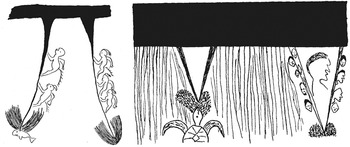
Kibu is a spirit-island located somewhere to the northwest of the strait (sometimes identified as Boigu: e.g. Elu Reference Elu and Davis2004, 143; Haddon Reference Haddon1904, 355; Lawrie Reference Lawrie1970, 27). In some instances, markai are known to reside at other locations such as Zurzur on the island of Mua (Shnukal Reference Shnukal2008, 139) and Mauar in the Eastern Islands (Haddon Reference Haddon1935, 95). Upon arrival in the land of the dead, resident markai hit the mari on the head with their gabagab (stone-headed clubs), after which the mari becomes a true markai (Haddon Reference Haddon1904, 356). The old markai then teach the new markai life skills, including how to make a waterspout to spear and suck up turtle and dugong for food (Haddon Reference Haddon1904, 356–9) (Fig. 5). Fitzpatrick-Nietschmann (Reference Fitzpatrick-Nietschmann1980, 282, 318) points out that without elaborate and morally prescribed ritual interventions and obligations, a deceased's mari would be ‘shunned’ by the resident markai of Kibu and ‘cause innumerable disturbances’ among the living.
(Left) A drawing by Gizu of Mabuyag of mŭri on a waterspout (baiu) hunting dugong (from Haddon Reference Haddon1904, fig. 78). Right: a drawing by Gizu of Mabuyag of two waterspouts and rainfall, with mari associated with the right-hand waterspout (from Haddon Reference Haddon1904, fig. 75).

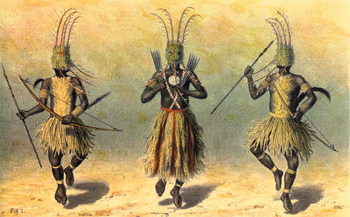
For the Goemulgal, the final formal event of the funerary process was the celebratory Markai Tai ceremony (or ‘death-dance’) performed annually (usually in June/July) for the year's deceased after they had transformed into markai (Fitzpatrick-Nietschmann Reference Fitzpatrick-Nietschmann1980, 157). The Markai Tai was performed in front of members of the Goemulgal community at the kod site on Pulu. It focused on specially selected men who ‘represented the ghosts or spirits of recently deceased people’, both men and women, by impersonating their mannerisms (Haddon Reference Haddon1904, 256) (Fig. 6).
Men representing recently deceased members of the Goemulugal community performing at the annual Markai Tai or ‘death-dance’ at the ceremonial (kod) site on Pulu, central Western Islands (from Haddon Reference Haddon1893, pl. XIV.1).

According to Beckett (Reference Beckett and Hiatt1975, 181), markai (and presumably lamar) ‘seems to be a ghost that appears before mortals, an apparition’. Linguist Sidney Ray informed Haddon that ‘Markai is … derived from mari-kai, i.e. ghost-person, and as practically synonymous with mari, but applied to a “ghost” of a dead person rather than to a “disembodied spirit”’ (Haddon Reference Haddon1904, 355–6). Furthermore, until ‘the mari becomes a markai he [sic] is a very intangible sort of thing’ (Haddon Reference Haddon1904, 356).
The activities of mari feature heavily in oral histories and legendary narratives across the strait (e.g. Haddon Reference Haddon1904; Reference Haddon1935; Lawrie Reference Lawrie1970). Mari also had various forms of interaction with the living, including chasing and teasing people, punishing people for transgressions such as stealing (e.g. calling up powerful storms and waterspouts as retribution), and taking interest in the activities of their families and descendants (e.g. Elu Reference Elu and Davis2004, 143; Haddon Reference Haddon1904, 85, 356; Lawrie Reference Lawrie1970, 29; Shnukal Reference Shnukal2008, 148). Indeed, spirits of the dead were an active part of the lives of the living (Fitzpatrick-Nietschmann Reference Fitzpatrick-Nietschmann1980; McNiven Reference McNiven and Watts2013). In the 1840s, Thompson noted that ‘[w]hen the wind blows and the clouds break open, they [Kaurareg] will point to them and say, Markieli warroo-ya ypoo—“The marki (spirits) are looking at the turtle in the water”, and say that the spirits come down and take the turtle up into the clouds and eat them’ (Moore Reference Moore1979, 151).
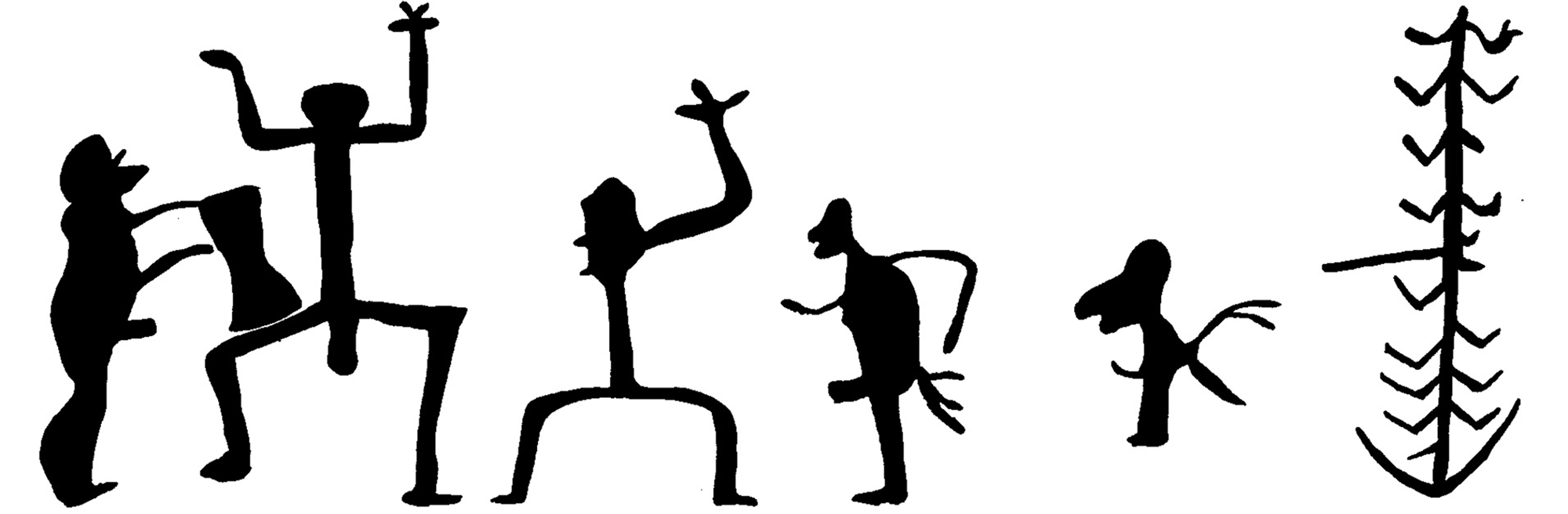
Haddon also recorded depictions of mari/markai and mŭri. One of his main cultural experts, Gizu of Mabuyag, produced a series of pencil drawings illustrating the mŭri and mari association with waterspouts (e.g. climbing or looking down from them) (Haddon Reference Haddon1904, 357, 360, figs 75, 78; see Figure 5). At the kod site on Pulu, Haddon recorded two panels of rock-art paintings depicting mŭri: one panel with two mŭri dancing and a third beating a drum, and a second panel of two mŭri and a waterspout that Gizu said was the harpoon of the mŭri (Haddon Reference Haddon1904, 5) (Fig. 7).
Painted rock-art representations of mŭri spirits and a waterspout at the ceremonial (kod) site on Pulu, Western Islands (from Haddon Reference Haddon1904, 5).

Spirit canoes
Canoes feature in numerous stories and legendary narratives about the spiritual realm across Torres Strait. Well-known culture heroes such as Sida and Kwoiam/Kuyam and spiritual beings such as dogai, mari, markai and lamar are regularly linked to canoes (also of spiritual form) through their travels, actions, activitie and, importantly, in death and burial contexts. For example, culture heroes such as Muta and Zub heard and/or saw markai or lamar paddling in their spirit canoes to specific locales or undertaking activities such as fishing (e.g. Lawrie Reference Lawrie1970, 39–40, 276–7). When Sida was killed in battle, men placed his body into a canoe. However, his mari [soul] rejected the first two types of canoes (guguba wake, kim) chosen for his body before it agreed to be placed into a ‘straight canoe’ called karar mad, which then floated away down a creek (Haddon Reference Haddon1904, 29). In another legendary story, Naga and Waiat arrived at Daru (island west of the Fly River estuary), where they ‘performed a death dance (make markai) and by-and-by they made a small toy canoe and floated it in the sea’ that eventually arrived at Tudu in the Central Islands. Two men picked up the toy canoe and brought it back to Daru, where Naga and Waiat performed the death dance for them. Naga and Waiat then sailed to the residential island of Ugar (Eastern Islands), where they again performed the death dance for locals (Haddon Reference Haddon1904, 48–9). When preparing canoes for turtle hunting, Islanders spoke to small models of mari spirits to help ensure a safe and successful hunt (Haddon Reference Haddon1904, 331).
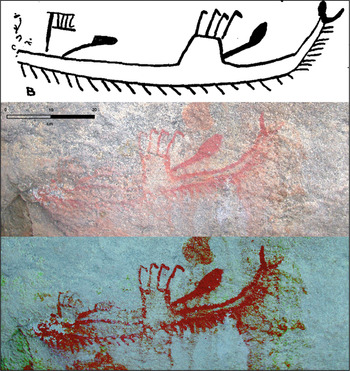
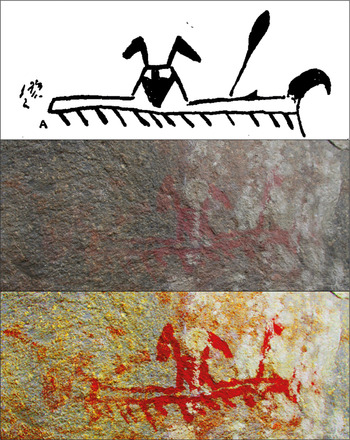
Most importantly, canoes of the spiritual realm are referenced in rock art. When Haddon visited Kirriri (south Western Islands) in 1888, he was taken to a small rock-shelter on the southwestern side of the island containing a panel of zoomorphs and two canoe motifs (Fig. 8 & 9). He described the site and its motifs:
[o]n certain rocks in Keriri [Kirriri], close by the crevices in which we found the skulls … are various pictographs representing totem animals and two canoes … They were called Moiaran gul, or canoe from Moiar (Moi or Mui is the western name for Murray Island). The canoe was taken by the markai from the sara, sea-birds, who formed the crew of the canoe. The canoe is now at Tagaini, a hill in Muralug [Muralag]. On ordinary occasions the markai paddle the canoe in the open sea on calm nights to catch turtle, dugong or fish. (Haddon Reference Haddon1904, 358; see also Herle & Philp Reference Herle and Philp2020, 323)
Rock painting of a spirit canoe, Kirriri, south Western Islands, shown to A.C. Haddon in 1888. (Top) Haddon's sketch of the painting (from Haddon Reference Haddon1904, fig. 76); (Middle) photo of the same painting in 2002; (Bottom) computer enhancement of same painting (from Brady Reference Brady2010, 445).

Rock painting of a spirit canoe, Kirriri, south Western Islands, shown to A.C. Haddon in 1888. (Top) Haddon's sketch of the painting (from Haddon, Reference Haddon1904, fig. 76); (Middle) photo of the same painting in 2002; (Bottom) computer enhancement of same painting (from Brady Reference Brady2010, 280).

This information reveals that painted canoes represented spirit canoes used by markai, thus revealing how motifs were a means of visually expressing the spiritual world. Equally of importance, canoe paintings represent a symbol of engagement with the spiritual world, and more specifically, spirits of the dead.
The spiritual relationship between canoes and markai also involves the living. The lone canoe painting at Pulu is situated at the kod site where Markai Tai (‘death-dance’) ceremonies were performed to general audiences visiting from the nearby residential island of Mabuyag (see above). Such a context indicates a link between a vessel used by spirits of the dead in their journey to the land of the dead, and public celebrations concerned with the well-being of the spirits at Kibu.
Other examples indicating a relationship between canoe motifs and the dead involve the proximity of motifs to human skeletal remains. At Zurath (a remote islet south of Badu), one canoe painting is located at a small boulder complex containing skeletal remains in a small crevice; a second canoe painting is located on a boulder adjacent to the complex. At Mua, 12 painted canoes are situated next to a site containing a quantity of human remains.
Absence of European ‘spirts of the dead’ and ‘ghost ships’ in Torres Strait rock art
European mariners as ghosts of the dead
Indigenous peoples of Torres Strait, like numerous Indigenous peoples of Australia, saw Europeans in the early years of contact as ghosts of the returned dead (MacGillivray Reference MacGillivray1852, II, 29; Roth Reference Roth1903, 16; Swain Reference Swain, Swain and Trompf1995, 58). A similar understanding was held by neighbouring Kiwai peoples at the mouth of the Fly River to the immediate northeast of Torres Strait, who believed European mariners obtained objects from the dead (Landtman Reference Landtman1917, 26):
The white men, it is believed, have not themselves manufactured the things they possess, steam-boats, tomahawks, calico, etc., but have obtained them from the spirits of the dead. This is evident from the fact that, if for instance a tamahawk [sic] is broken, a white man cannot make it intact. The spirits bring the various things from their land on steamers, and when they arrive, the white men go out to meet them and seize all the things, steamers and all, carrying them off. (Landtman Reference Landtman1917, 181)
Information collected from the early contact period reveals that Torres Strait Islanders and the Kaurareg were positioning light-skinned Europeans into their existing spiritual framework, identifying them as markai or lamar based on their physical appearance. Indeed, in contemporary Torres Strait Islander creole, markai and lamar are generic terms for ‘white people’ (Shnukal Reference Shnukal1998, 154, 162). The Kiwai similarly refer to a ‘white man’ as ‘mánakai or márkai’, meaning ‘spirit of a dead person’ (Landtman Reference Landtman1917, 181). John Ireland stated that lamar meant ‘white man’, and that Eastern Islanders believed that ‘white people live always in ships, and possess no terrestrial home’ (King Reference King1837b, 26, 29). In her 1840s narrative to Oswald Brierly, Thompson commented that ‘[t]hey [Kaurareg] believe that when any of their people die they become white people who they call markili, or ghosts’ (Moore Reference Moore1979, 230); ‘[a]ll these blacks [Kaurareg] think that white men are spirits of blacks come again in a new form’ (Moore Reference Moore1979, 143). Indeed, Thompson was ‘greeted by one of the [Kaurareg] leaders named Peaqui as the reincarnation of his dead daughter Giom and, as a result, was integrated into the social system of the Kaurareg and treated, on the whole, with great kindness’ (Moore Reference Moore1979, 8). John MacGillivray (Reference MacGillivray1852, II, 29–30), also on board HMS Rattlesnake, noted that
[t]he Cape York people even went so far as to recognise in several of our officers and others in the ship, the ghosts of departed friends to whom they might have borne some fancied resemblance, and, in consequence, under the new names of Tamu, Tarka, &c. they were claimed as relations, and entitled to all the privileges of such.
European ships as ships of the dead
Thompson further noted: ‘[t]hey [Kaurareg] believe that people who die come back again in the ships of the white people. They call this ship, the Rattlesnake, marki angool, ghost's ship’ (Moore Reference Moore1979, 146). She expanded upon this relationship by noting that ‘[o]ne of the people died lately and soon after a ship passed. They said a blackfellow was on board this ship’. Thus, Torres Strait Islanders and the Kaurareg were identifying European ships in a similar way to spirit canoes, that is, they were the vessels used by markai to voyage across the sea. However, perceptions of European ships did not align exactly with spirit canoes, given the periodic violent nature of interactions between Islanders, Kaurareg and Europeans (see below), and trade relationships, especially the desire for highly coveted iron. For example, Thompson (Moore Reference Moore1979, 199–200) described how the people at ‘Nagi’ [Naghir, Central Islands] created a special dance about European goods:
Within the last 12 months they have made a kowb, a dance, about the white men. In this dance two of them are dressed up to imitate a white man with a mask made of bark and rind stripped from the broad part where the central stem of a coconut joins the trunk … While in this kowb they sing songs about ships, that they are gone away to their own land and will come again with biscuits, tobacco, and knives and shirts, the two marki [men acting as Whites] imitate the motions of a white man, holding up and shaking their hands … They call this dance marki angul kowb—ghost ship dance.
Other dimensions of the European–markai relationship that speak to the perception and interpretation of Europeans and their objects is through Indigenous epistemologies. For example, in eastern Torres Strait on Mer, Haddon recorded that spider webs hanging on bushes at the divinatory shell shrine of Tomog zogo represented rigging on ships and would ‘foretell the [immanent] appearance of a white man's ship—the ship coming from the same direction where the web was’ (Herle & Philp Reference Herle and Philp2020, 138). In western Torres Strait, Thompson noted how the Kaurareg referred to European biscuits as beeseekari, as they thought they were made from beesee—the starch extracted from sago palms. The Kaurareg obtain sago palms as drift objects, said to originate from ‘the Markianlag–ghosts’ islands’ [i.e. New Guinea mainland coast] (Moore Reference Moore1979, 211). Here again, European ships and their associated objects (ranging from ship's rigging to biscuits) were linked to the spiritual realm.
Ritual mutilation of European mariners
Although it appears that most visiting European mariners were ghosts of the returned Indigenous dead in the eyes of Torres Strait Islanders and the Kaurareg during the early contact era, it is clear that these ghosts were sometimes considered dangerous. McNiven (Reference McNiven2018b) explores ontological issues associated with the periodic killing and mutilation of castaways from a series of European shipwrecks by Torres Strait Islanders and the Kaurareg between 1793 and 1869. In some cases, such killings related to the traditional concept of sarup, whereby most castaways (Indigenous and European) were executed on the beach, as they were seen as ‘metaphysically unstable and liminal’, and by extension, a spiritual threat (McNiven Reference McNiven2018b, 250). European castaways could escape execution if they were identified as the returned spirit of a relative (as with Barbara Thompson).
In some cases, European castaways were ritually mutilated by the severing of hands and/or heads. Although the skulls of family members were often kept in houses for divination, in the case of violent decapitation (of outsiders), skulls were used as a source of spiritual power and status. In the case of executed members of the Charles Eaton shipwreck of 1834, skulls were added to Indigenous skulls adorning the sacred turtleshell mask representing the culture hero Kulka located on the island of Auridh in the Central Islands (Lahn Reference Lahn2013). This case demonstrates that European skulls could be treated in similar ways to Indigenous skulls taken in traditional headhunting raids.
Discussion and conclusion
We argue that, despite considerable epistemological and ontological congruence between Indigenous understandings of Indigenous ghosts of the dead and Europeans as ghosts of the dead, European ghost ships were not directly equivalent to Indigenous spirit canoes. For example, whereas within Islander and Kaurareg ontology Europeans were often identified as the ghosts of dead Islanders or Kaurareg, European ghost ships had no prior Indigenous state or form. In addition, European ghost ships possessed a physical form and presence unlike that of spirit canoes. In short, the phenomenology of European ships was metaphysically different to that of spirit canoes. European ghost ships could be wrecked on reefs and be available for the salvaging of objects, especially iron. In marked contrast, no references document Indigenous spirit canoes becoming wrecked and/or abandoned. It is for these reasons that we argue that European ships possessed a different ontological status to Indigenous spirit canoes, and as such, they fell outside the representational (rock-art) genre of marine vessels that was limited to spirit canoes.
Despite their status as marine specialists par excellence with a rich tradition of rock art, the Indigenous peoples of Torres Strait did not paint representations of European ships. This absence is remarkable, given that Islanders and the Kaurareg (1) had experienced European ships sailing through their territorial seas for 300 years during the seventeenth to nineteenth centuries, and (2) possessed a strong rock-art tradition of painting representations of their own large sailing canoes. This absence is not a result of post-contact changes in Islander and Kaurareg society, such as depopulation and cultural change, as significant European colonial impact commenced in the 1860s (i.e. 250 years after first contact with European mariners). What makes this absence curious is that Islanders and the Kaurareg created rock-art representations of spirit canoes used by their spirits of the dead, and European ships were considered ghost ships crewed by Europeans who were ghosts of the returned Indigenous dead. We argue that, despite superficial similarities, European ghost ships were not ontologically and epistemologically equivalent to Indigenous spirit canoes in the eyes of Islanders and the Kaurareg. It is for this reason that Islanders and the Kaurareg excluded European ships from their representational genre of painting sailing vessels in rock art. In short, the Torres Strait tradition of painting sailing vessels was limited to spirit vessels of the dead and not secular vessels of the dead. Drawing on Fowles (Reference Fowles and Fogelin2008, 17), we interpret the absence of European ships in Torres Strait post-contact rock art as a culturally ‘meaningful absence’.
A broader implication of our explanation for the absence of European ships in Torres Strait post-contact rock art is that the presence of European ships in post-contact rock art in other Indigenous contexts should not been seen as somehow a natural response to exposure to new experiences and what became familiar phenomena. Indeed, we argue that the issue of familiarity and ‘naturalness’ is twofold. First, the question of the degree to which the appearance of European ships was considered a new experience is dependent on local Indigenous epistemology and ontology. In the case of Torres Strait, Islanders and the Kaurareg positioned European ships as ghost ships and a cosmological dimension of marine voyaging by Indigenous ghosts of the dead. Second, the question of the degree to which conceptions of European ships fitted into existing traditions of rock-art representations.
Frederick (Reference Frederick1999, 134, emphasis added) defines contact rock art as:
rock art/markings produced within a context of cross-cultural exchange. In general terms this exchange, whether it be a fleeting encounter or a sustained relationship, does not and will not always relate to a specific event or date but marks the beginning of a process of awareness of or interaction with another cultural group. In this way, contact rock art may have been made during and/or after interaction (direct or indirect) between cultural groups.
In the case of Torres Strait, it could be argued that the potential for contact rock art was reduced because Islanders and the Kaurareg did not consider Europeans as another cultural group. That is, they conceptualized Europeans as a dimension of themselves in the form of ghosts of the Indigenous dead. As the nineteenth century progressed and Islanders and the Kaurareg gradually repositioned Europeans ontologically as another form of living (mortal) person and less as the returned dead, the tradition of rock-art production had all but ceased.
Acknowledgements
Special thanks to the Kaurareg, Badulgal, Dauanalgal, Goemulgal, Mualgal and Kulkalgal communities for their invitations to record rock art on their islands. Fieldwork was supported by grants from the Australian Institute of Aboriginal and Torres Strait Studies (G2002-6625, G2003-6758) and the Australian Research Council (ARC) Centre of Excellence for Australian Biodiversity and Heritage. LMB's position is funded by an ARC Future Fellowship grant (FT180100038). Thanks also to Jeremy Ash for helpful comments on an earlier draft of this paper, and two reviewers for their insightful feedback.