INTRODUCTION
In his 1938 volume, The Inscriptions of Petén, Morley (Reference Morley1938:vol I., p. 318) wrote that the stelae of Chinkultic, in Chiapas, Mexico, displayed a “lack of skill and technical proficiency.” For Morley, the location of Chinkultic on the western frontier of the Maya cultural zone explained the unsophisticated nature of its monuments. It was no “matter of surprise,” he wrote, “that…in a place so far removed from the great centers of contemporary inspiration and learning, errors or, perhaps more grotesque, deliberate omissions were made” (Morley Reference Morley1938:vol. I, pp. 317–318). Morley dismissed the site as a provincial center, unstudied in the delicacies of Maya art and writing—or worse, aware of those delicacies and deliberately dismissive of them.
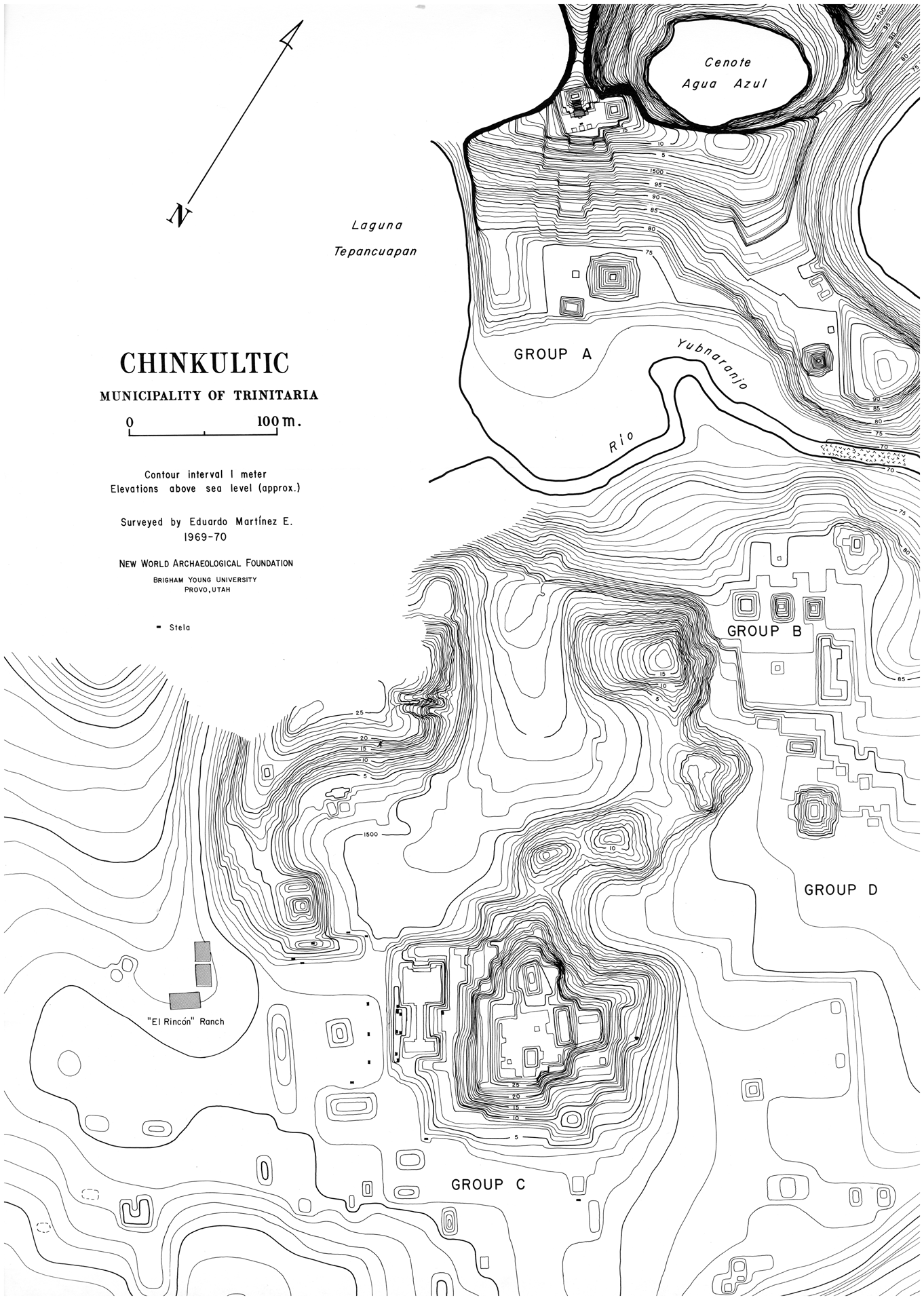
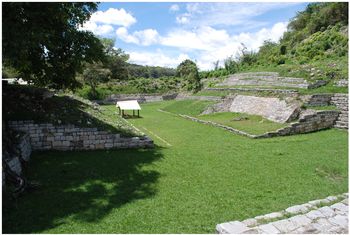
Morley based his analysis of Chinkultic on a few early monuments brought to the American academic audience by Seler (Reference Seler and Weeks2003 [1901]) and Blom (Blom and La Farge Reference Blom and LaFarge1926–1927). Since then, decades of excavation at the site have revealed more about its settlement history (Ball Reference Ball1980; Gallegos Reference Gallegos Ruiz1976; Navarrete Reference Navarrete1975, Reference Navarrete1976). Spread over a series of hills on the eastern edge of the Comitán valley in Chiapas, Mexico (Figure 1), the ceremonial center of Chinkultic comprises four architectural groups, lettered A–D (Figure 2). Most prominent to visitors today is Group A, which features an upper acropolis perched atop a spur between two cenotes and connected to a lower plaza by a 60-m-high monumental stairway. Group C (Figure 3) includes the ballcourt, while a sunken plaza dominates Group B (Navarrete Reference Navarrete, Laporte, Arroyo and Mejia2007). Archaeologists have discovered over 40 carved stone monuments at Chinkultic, varying in size and style from pecked boulders to finely carved low-relief stelae (Navarrete Reference Navarrete1984, Reference Navarrete2001).
Map of the Comitán area, Chiapas, Mexico. Map by Aaron Giddings.

Map of Chinkultic. Courtesy of the New World Archaeological Foundation.

The ballcourt, Group C, Chinkultic. Photograph by the author.

Despite its history of archaeological investigation and its sizable corpus of sculpture, Chinkultic remains absent from most scholarly reconstructions of Maya history. This study works to amend that gap by tracing two groups of monuments at the site. Research for this study included visual analysis and raking-light photography of over 20 sculptures at Chinkultic, the Museo Arqueológico de Comitán, and the Museo Regional de Chiapas in Tuxtla Gutierrez. Combined, these methods allowed the production of new line drawings of monuments from Chinkultic.
The first group of sculptures discussed in this paper comprises a series of accession monuments that document a royal dynasty. The second group depicts a consistent ritual involving rulers of Chinkultic and kneeling subsidiary individuals. Together, these monuments reveal information about the history of Chinkultic and the interests of its elite patrons. I argue that, far from a culturally impoverished frontier outpost, Chinkultic was home to a consistent sculptural program used by local elites to celebrate identities based on warfare and control. The sculptures of Chinkultic hint at the sociopolitical history of the Comitán valley, suggest dynamic overlapping spheres of political and artistic influence in the Late Classic period, and demonstrate iconographic and stylistic innovation typical of frontier places in the ancient Maya world.
CHINKULTIC AND THE WESTERN MAYA FRONTIER
That Chinkultic was home to Maya kings was clear to the earliest Western explorers of the site. Stopping at Chinkultic in the last years of the nineteenth century, Seler (Reference Seler and Weeks2003 [1901]) noted similarities between monuments from Chinkultic and those of Copan; over 20 years later, Blom and La Farge (Reference Blom and LaFarge1926–1927:vol. 2, p. 436) compared the monuments of the Comitán area with those of Chichen Itza. Decades later, large-scale investigations at the site were initiated by de Borhegyi (Reference de Borhegyi1968) of the Milwaukee Public Museum and the New World Archaeological Foundation (NWAF), under the direction of Lowe. After the death of de Borhegyi, archaeologists from NWAF and Mexico's Instituto Nacional de Antropología e Historia (INAH), including Gallegos (Reference Gallegos Ruiz1976), Ball (Reference Ball1980), Agrinier (Reference Agrinier1969), and Navarrete (Reference Navarrete1975, Reference Navarrete1976, Reference Navarrete and Ségota2000, Reference Navarrete, Laporte, Arroyo and Mejia2007), continued work at the site. INAH excavations under the direction of Navarrete (Reference Navarrete1975, Reference Navarrete1976, Reference Navarrete and Ségota2000, Reference Navarrete, Laporte, Arroyo and Mejia2007; Navarrete and Hernandez Juarez Reference Navarrete and Juárez2002) have investigated and consolidated Groups A, B, and C at Chinkultic.
Ceramic, archaeological, and art historical evidence suggests Chinkultic was first settled in the Late Preclassic period, most likely by a Maya group (Ball Reference Ball1980:92; Navarrete Reference Navarrete1984, Reference Navarrete and Ségota2000). In his analysis of ceramics from Chinkultic, Ball (Reference Ball1980:93–103) concluded that the site was abandoned in the Early Classic period and resettled, probably by a different Maya group, around a.d. 700. According to Ball, large-scale construction of the major architectural groups began after this resettlement and was not completed until the Early Postclassic period (ca. a.d. 900–1250). This suggests that Chinkultic, like many of its neighbors on the western Maya frontier, did not fall victim to processes of collapse visible in other parts of the Maya world at the end of the Late Classic period. Reconstructions of regional communication routes, meanwhile, emphasize that Chinkultic fronted transit routes between the highlands of Chiapas and the highlands and coast of Guatemala (Navarrete Reference Navarrete, Lee and Navarrete1978). Thus while Chinkultic appeared isolated to Morley, its artists in the Late Classic period may have been privy to influences and ideas from broad swaths of Mesoamerica.
The majority of monuments at Chinkultic were discovered in Group C (Navarrete Reference Navarrete1984:Figure 2), which contains the ballcourt and the large, unexcavated Structure 23. Existing sculptures from Chinkultic point to the engagement of local artists with themes familiar from other Maya places. This is important to establish at the outset because of Chinkultic's location on the frontier of the Maya area. The Comitán valley sits on a borderland that progresses roughly from the southeast to the northwest and represents the westernmost extent of Classic Maya cultural characteristics in this part of Chiapas. While Chinkultic was occupied by Maya peoples in the Late Classic and Early Postclassic periods (Ball Reference Ball1980; Campbell Reference Campbell1988), the area to the west was populated by Zoque and Chiapanec groups, who produced art, ceramics, and architecture that is stylistically different from that produced in Maya areas (Calnek Reference Calnek1988; Domenici and Lee Reference Domenici, Lee, Lowe and Pye2012; Lowe Reference Lowe and Adams1977). The material record, however, has not revealed a distinct boundary between Maya and non-Maya peoples in this area in the Late Classic period (Paris and López Bravo Reference Paris and Bravo2017), and isolated examples of art in a Maya style have been found far to the west at sites like Lopez Mateos and Peñitas (Navarrete et al. Reference Navarrete, Lee and Rhoads1993:Figures 27, 31, 39). Because there is no distinct boundary between culture groups in this area, I refer to the Comitán area as a frontier rather than a border, a region rather than a line (Adelman and Aron Reference Adelman and Aron1999:815; Rodseth and Parker Reference Rodseth, Parker, Parker and Rodseth2005:10). Unlike borders, frontiers consist of multiple overlapping boundaries that may vary over time (Elton Reference Elton1996; Parker Reference Parker2002).
The frontier location of Chinkultic offers a productive way of understanding the eclectic sculpture produced by artists in the Late Classic period. Early studies of Chinkultic relied, sometimes implicitly, on models in which people living in peripheral areas are passive recipients of the cultural production of the center. In this paper, I consider Chinkultic from a different perspective, using recent understandings of frontiers as zones of cultural exchange, places where identities and art forms are actively constructed in conversation with diverse actors and influences (Lightfoot and Martinez Reference Lightfoot and Martinez1995; Parker Reference Parker2002; Rodseth and Parker Reference Rodseth, Parker, Parker and Rodseth2005; White Reference White1991). Frontiers, in this view, are characterized by innovation and hybridity. This is not to say that innovation does not happen at the center; rather, it assigns equal value to artistic variation occurring on the periphery and ascribes agency to artists working in frontier areas. It asserts that the artistic styles of frontier places are the result of choices made by artists in response to specific historical contingencies. Art that comes from frontier areas is not by definition innovative but, by understanding frontiers as places where peoples and ideas are coming together, we can understand eclecticism in artistic style not as a failure to understand the canons of the center, but as an active manipulation and expansion of those canons.
Archaeological research supports the study of frontiers as dynamic, and the material culture of frontier places reflects innovation, interchange, and hybridity (Hirth Reference Hirth, Boone and Willey1988; Joyce Reference Joyce, Boone and Willey1988; Rice and Rice Reference Rice, Rice, Parker and Rodseth2005; Schortman and Urban Reference Schortman and Urban1994). Investigation on the southeastern Maya frontier, for example, has revealed that elites deftly manipulated the artistic record to pursue specific symbolic and material goals (Schortman et al. Reference Schortman, Urban and Ausec2001). Similarly, the artists of Chinkultic innovated within broad Maya themes, drawing from the artistic conventions of the Usumacinta region but modifying those conventions to create local iconographic programs. As the sections that follow demonstrate, the artists of Chinkultic created a corpus of sculpture with a consistent local style—one that presented the rulers of the site as warriors, and emphasized the city's control over other peoples and places.
GROUP A: DYNASTY AND ACCESSION AT CHINKULTIC
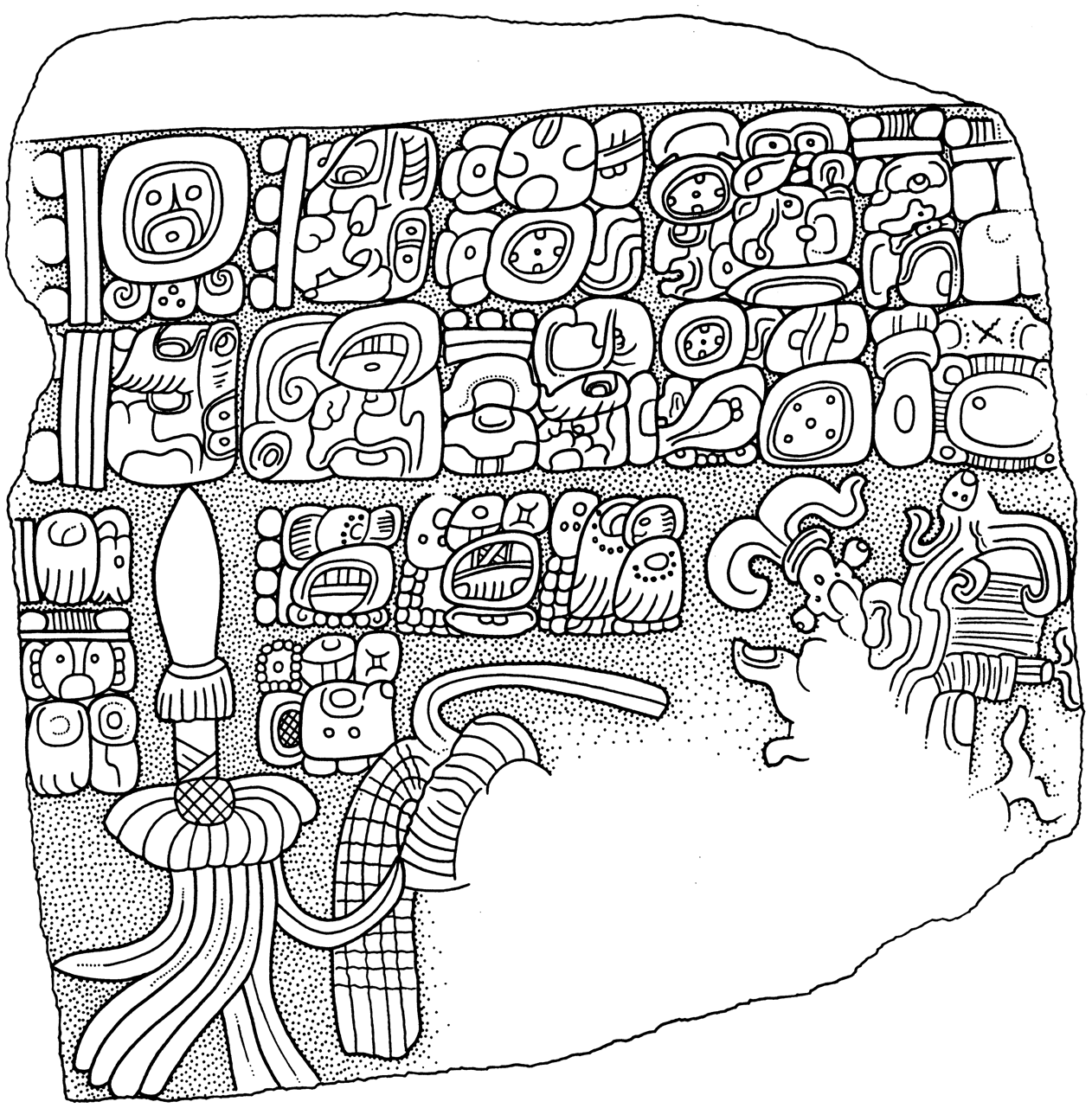
The monumental record of Chinkultic indicates that a royal dynasty existed at the site in the Late Classic period. Grube (Reference Grube2002) first identified an emblem glyph, “Chan,” for the Chinkultic dynasty in an unnumbered monument discovered in the ballcourt at Chinkultic. Hieroglyphic text on this sculpture discusses a four-katun ajaw of Chan (Figure 4; Navarrete and Hernandez Juarez Reference Navarrete and Juárez2002:24). As Grube also pointed out, the Chan emblem glyph appears in the ballcourt marker from La Esperanza (Kowalski Reference Kowalski1989) and on Chinkultic Monument 9 (Navarrete Reference Navarrete1984:Figure 37). In a more recent analysis, Wölfel and Wagner (Reference Wölfel and Wagner2010) have recovered glyphic evidence for at least six rulers and posited the existence of a “Chan” lineage based at Chinkultic. One of these rulers appears on Monument 40, discussed below, and another is featured on Monument 1. A third appears on the unnumbered monument discussed above. The glyphic record of Chinkultic is fragmentary, however, underscoring the ability of art historical analysis to expand and enrich hieroglyphic information.
Monument discovered in the ballcourt at Chinkultic. Drawing by Christian Prager.

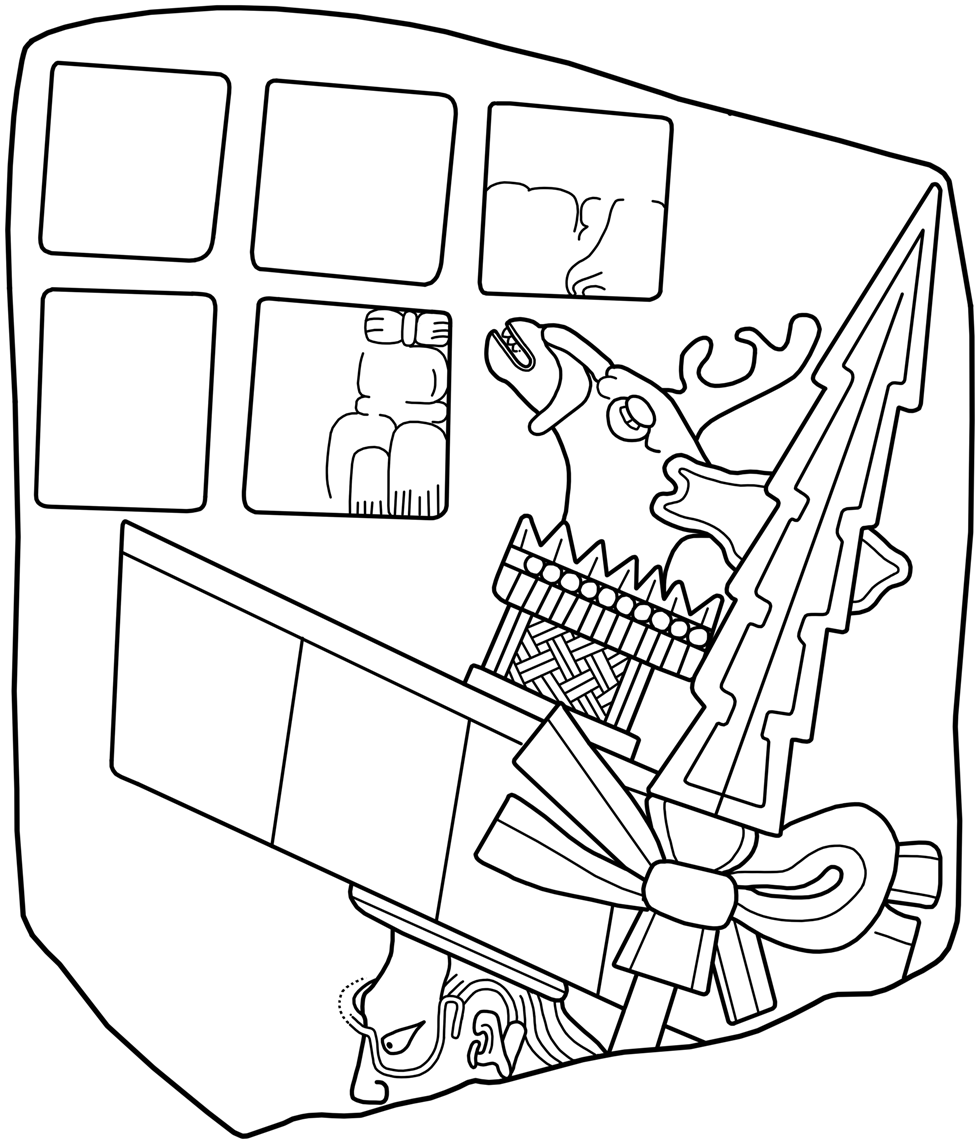
One group of sculptures, including Monuments 38, 40, 2, and 21, depicts the accession of rulers. A detailed analysis of the text and imagery on this group of sculptures offers information about the nature of rulership at Chinkultic and how local depictions of accession paralleled and diverged from accession records at other Maya centers. Monument 38 (Figure 5) features an individual standing frontally but facing to the viewer's left. The main figure wears a rectangular apron with an inverted ik sign, as well as a large headdress with a trapezoidal base. A short column-like element emerges from the base; it is topped with the head of a dead deer. In his left hand, the figure holds a spear as if to strike the individual kneeling beneath him. The tip of the spear, featuring three points, is pointed toward the top of the monument. The figure's right hand holds a shield with spiked “rays” emerging from the center; Navarrete (Reference Navarrete1999:14) calls this the solar shield, and I retain this term here for continuity.
Chinkultic Monument 38. Drawing by the author.

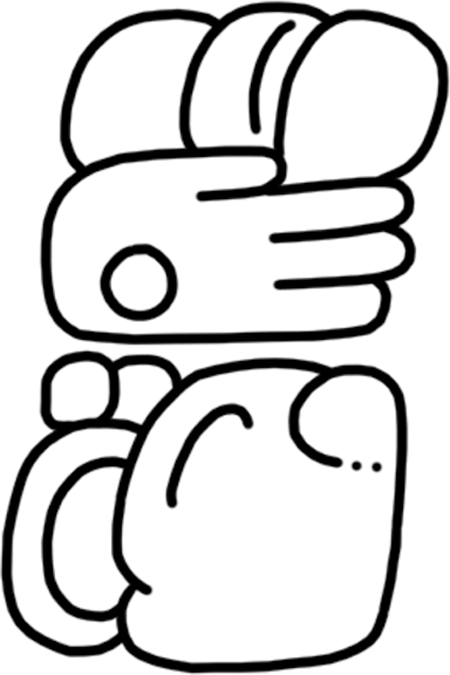
To the left of the headdress is a line of text that includes an accession phrase (Figure 6). Of the glyphs that are legible today, the first appears to be part of a date in the 260-day Maya calendar. The next glyphs represent the verbs in the statement. David Stuart (personal communication 2009) has suggested that two glyphs in particular refer to a royal accession. These glyphs read k'al huun t-u-baah, or “(it is) the paper-headband fastening on the head of….” First identified by Mathews and Schele (Reference Mathews, Schele and Robertson1974; see also Schele and Mathews Reference Schele and Mathews1998:382), this phrase describes the accession of rulers. When crowned with the bark paper headband, Maya rulers associated themselves with Juun Ajaw, a foundational figure in Maya mythology (Stuart Reference Stuart, Golden, Houston and Skidmore2012:120–121). This particular phrase appears in two texts at Palenque: the Kan Tok Tablet and the Palace Tablet (Bernal Romero Reference Bernal Romero, Blos, Cobos and Robertson2002; Robertson Reference Robertson1985:Figure 259; Stuart Reference Stuart2003, Reference Stuart, Golden, Houston and Skidmore2012). The final block of glyphs on Monument 38 is damaged but, based on what we know from other Maya texts, it likely included the name of the person acceding to the throne.
Accession phrase on Chinkultic Monument 38. Drawing by the author after field drawing by Eric von Euw.

The glyphs on this sculpture indicate that Monument 38 records the accession of a ruler. Sculptures depicting accession are familiar from other Maya sites. First identified by Proskouriakoff (Reference Proskouriakoff1960) at Piedras Negras, accession monuments record the assumption of royal office by specific individuals. In the western Maya area, accession monuments from the same site tend to display similar iconography; at Piedras Negras, for example, acceding rulers traditionally sit inside a niche atop a scaffold (Proskouriakoff Reference Proskouriakoff1960; Stuart and Graham Reference Stuart and Graham2003:36, 57). Classic-period Palenque accessions often involve a tri-figure arrangement in which the ruler is surrounded by his parents, who hand him implements of rulership (Schele Reference Schele, Robertson and Jeffers1979). At Bonampak, rulers were surrounded by nobles as they took office (Schele and Miller Reference Schele and Miller1986:112–113). Study of hieroglyphic texts, meanwhile, indicates that artists at ancient Maya sites consistently used formulaic, site-specific phrases to describe accession (Eberl and Graña-Behrens Reference Eberl, Graña-Behrens, Graña-Behrens, Grube, Prager, Sachse, Teufel and Wagner2004:102–103; Proskouriakoff Reference Proskouriakoff1960; Stuart Reference Stuart1995:204). In both word and image, then, dynasts chose distinctive and consistent ways to represent accession.
At Chinkultic, three other monuments display iconography similar to that of Monument 38. If Chinkultic artists used a specific “formula” for depicting accession, like artists at other sites in the western Maya area, then these monuments represent accession records. The fragmentary Monument 40 (Figure 7) depicts an individual facing to the left. The individual wears a “cruller” associated with the Jaguar God of the Underworld, and his headdress consists of a large trapezoidal base with a column-like element and a dead deer head. Exquisitely rendered, the deer has closed eyes, an open mouth, and a row of tiny teeth. As on Monument 38, a spear with stacked points is visible, positioned from lower left to upper right. The inscription on Monument 40 consists of five large blocks. Each large block is made up of four smaller glyph blocks. As interpreted by David Stuart (personal communication 2011), the glyphs include the kaloomte’ title on block B2 and Thompson's ajaw “vulture” (glyph T747a) in block C1, indicating that this text most likely discusses the ruler depicted on its face. Stuart's analysis accords with that of Wölfel and Wagner (Reference Wölfel and Wagner2010), who also identified the kaloomte’ and ajaw titles. The textual references to a ruler, combined with the striking iconographic similarity between this monument and Monument 38, suggests this monument also depicts accession.
Chinkultic Monument 40. Drawing by the author.

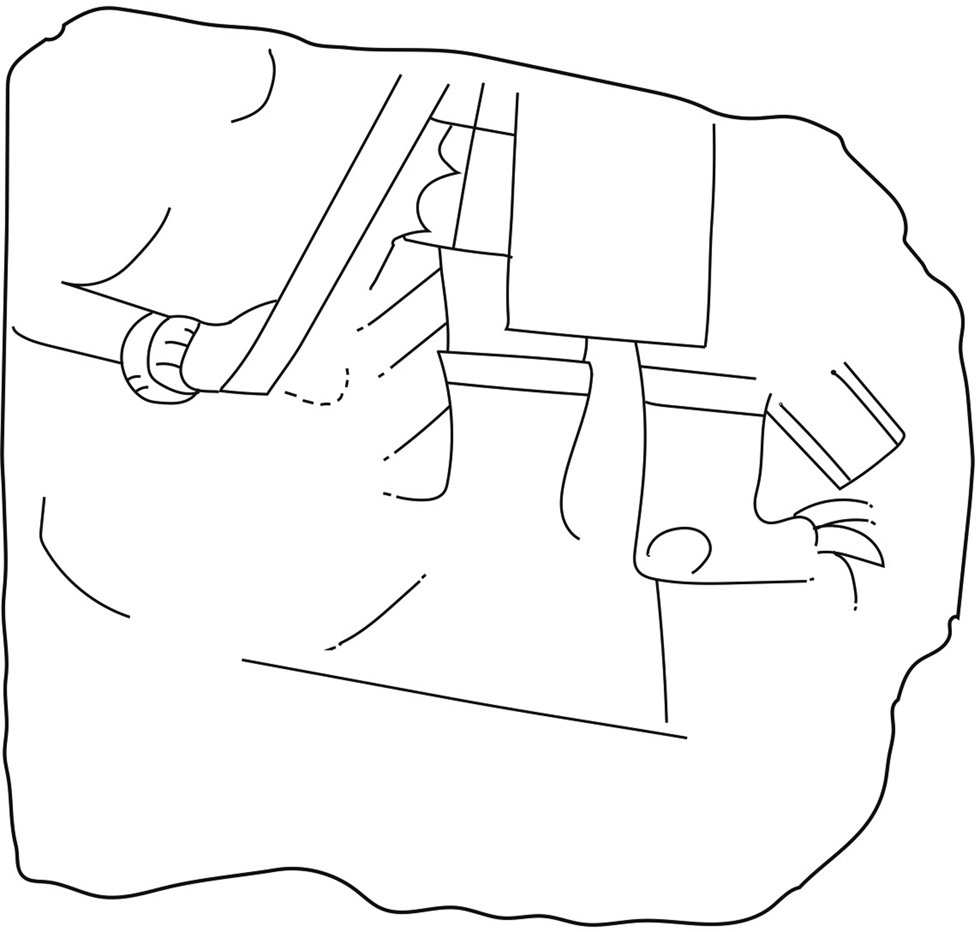
Monument 2 (Figure 8), first recorded by Blom and La Farge (Reference Blom and LaFarge1926–1927:vol. 2, p. 430), may also depict an accession. This monument displays the lower section of a figure from the chest down. The figure wears a central apron or loincloth marked with two mirror-image ik signs. Hanging in front of the shins are jaguar paws, which may be attached to a cape that is partly visible behind the right leg. The figure's feet are splayed and he holds a spear in his right hand. Like the spears on Monuments 38 and 40, the spear is positioned diagonally, extending from the lower left to upper right. On his right arm is a solar shield, familiar from Monument 38. On the figure's left side is an incense bag topped with the head of the Teotihuacan War Serpent. Iconographic connections between this monument and Monuments 38 and 40 suggest this, too, may represent accession.
Chinkultic Monument 2. Drawing by the author after field drawing by Eric von Euw.

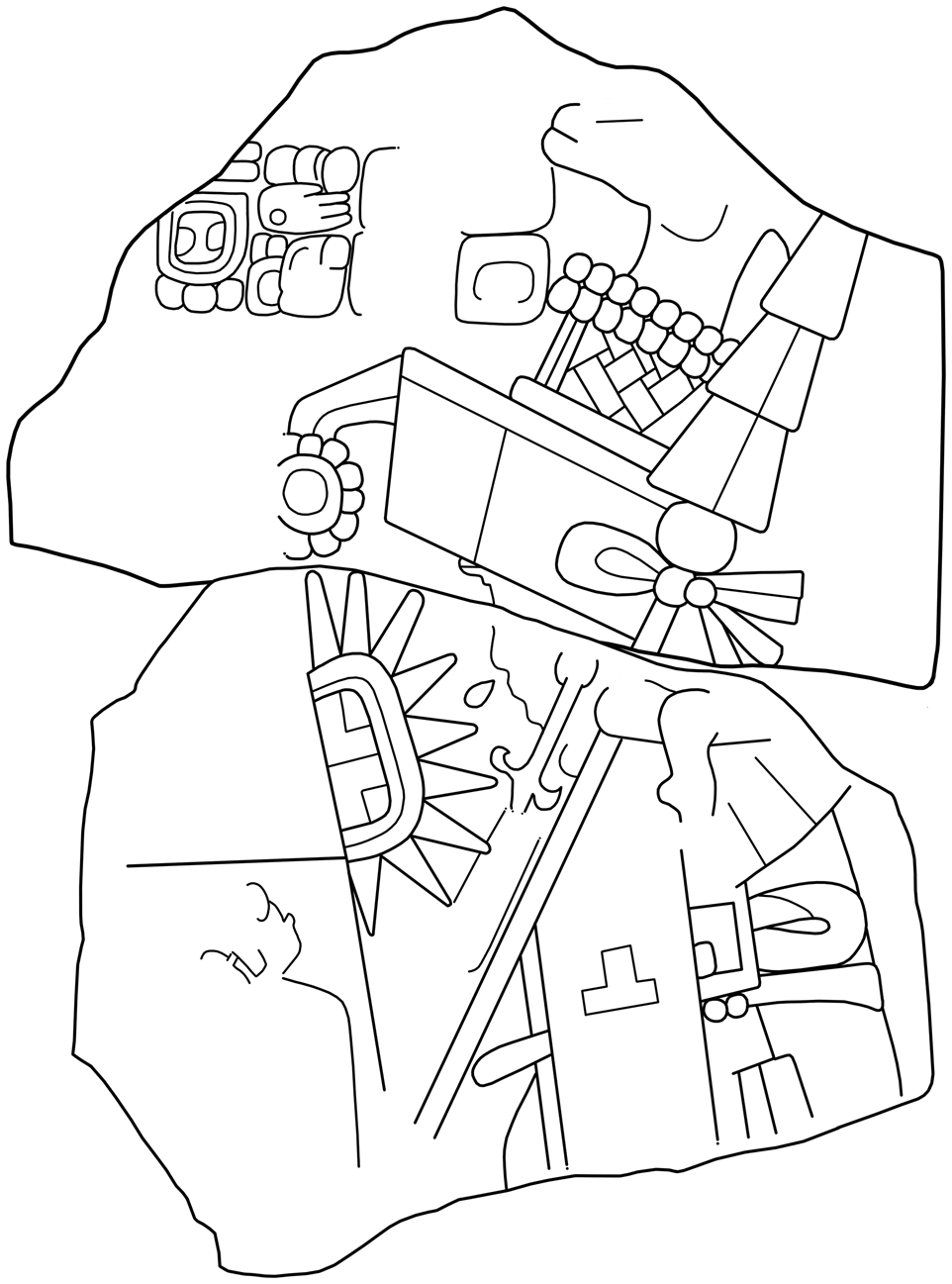
Finally, the very fragmentary Monument 21 (Figure 9) from Chinkultic displays iconographic traits that connect it to the accession monuments discussed above. This sculpture was discovered in 1969 inside the ballcourt (Navarrete Reference Navarrete1984:34). On it, we can see the legs and feet of a primary figure. His feet are splayed and he wears a wide central apron. He holds a long thin object, presumably a spear, that extends from the lower left to the upper right, as on Monuments 38, 40, and 2. Like on Monument 2, jaguar paws dangle above his feet. On the individual's right is a seated figure who may be a captive or subordinate. Despite the poor condition of the monument, the existing iconography reveals connections to Monuments 38, 40, and 2.
Chinkultic Monument 21. Drawing by the author.

The hieroglyphs on Monument 38 indicate it records the accession of a ruler, and iconographic similarities between this sculpture and Monuments 40, 2, and 21 suggest they are also scenes of accession. Although it is possible that these monuments depict the same ruler over time, I think it more likely that they depict at least three different rulers. As accession monuments, this small corpus is compelling evidence of dynasty, of kings who adhered to the same traditions as their forebears. A closer look at these monuments reveals information about how kingship was presented to the public at Chinkultic.
The Warrior Kings of Chinkultic
The accession monuments of Chinkultic demonstrate that its rulers took the throne as warriors. A number of elements point to the militaristic presentation of site dynasts. Clearest to modern viewers are the shield and/or spear carried by the primary individuals. The solar shields on Monuments 2 and 38 recall the sun disc of Terminal Classic Chichen Itza, where triangular rays frame important personages and appear in scenes of political accession (Coggins Reference Coggins1984; Miller Reference Miller and Hammond1977:220; Schele and Mathews Reference Schele and Mathews1998:252) and El Tajín, where a panel in the South Ballcourt features a heavily defaced individual holding a similar object (Kampen Reference Kampen1972:Figure 24). In addition, a column from Dsecilna, Yucatan, depicts an individual in a textured bodysuit holding a similar shield (Mayer Reference Mayer and Brizee1981:Plate 2) as does Column 2 from Oxkintok (Mayer Reference Mayer and Brizee1981:Plate 6).
The headdress worn by the individuals on Monuments 38 and 40 also suggests that Chinkultic rulers took the throne as warriors. These headdresses are made up of a trapezoidal base, a column, and a deer head. This exact combination of traits does not appear elsewhere in Maya art. Headdresses featuring deer heads, however, appear with some frequency in the western Maya area in the Late Classic period. They are particularly common at Yaxchilan, where Tate (Reference Tate1992:77–78) noted they are worn by captives or warriors. Based on the evidence now available, I suggest that, while deer headdresses carried multiple meanings, they were specifically associated with warriors in the western Maya region and may have designated a military rank or office in the Late Classic period.
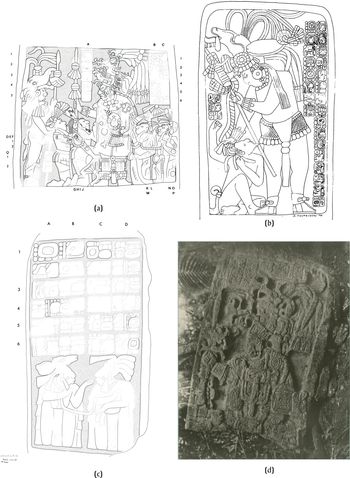
In Late Classic art from western Maya sites, nobles wear the deer headdress while taking or delivering captives. Lintel 12 from Yaxchilan, for instance, depicts an individual wearing the deer headdress and holding the shoulder of a captive on the left side of the monument (Figure 10a). In the Bonampak murals, the North Wall of Room 2 depicts an individual standing to the left of Yajaw Chan Muwaan wearing a jaguar cape—perhaps like those on Chinkultic Monuments 2 and 21—and a dead deer headdress (Miller and Brittenham Reference Miller and Brittenham2013:Figure 125). In these examples, the headdress is worn by people of rank, but not rulers. This changes at La Mar, where Stela 3 shows Parrot Chaak wearing a deer headdress, holding a captive by the hair (Figure 10b). Yet, this leader was a subordinate himself: the same individual appears on Piedras Negras Stela 12, where he wears a deer headdress to deliver his captives to Ruler 7. These images suggest that the deer headdress was worn by individuals of high military standing.
The deer headdress worn by warriors and captives. (a) Yaxchilan Lintel 12. Drawing by Ian Graham © President and Fellows of Harvard College, Peabody Museum of Archaeology and Ethnology, PM#2004.15.6.5.11. (b) La Mar Stela 3, Chiapas, Mexico. Maya, Late Classic (a.d. 795). Copyright © 2000 John Montgomery, JM00919. (c) Step VI, Hieroglyphic Stairway 3, Yaxchilan. Drawing by Ian Graham ©President and Fellows of Harvard College, Peabody Museum of Archaeology and Ethnology, PM#2004.15.6.7.36. (d) Yaxchilan Stela 5. Courtesy of the Peabody Museum of Archaeology and Ethnology, Harvard University, PM#2004.29.6587.

People in the deer headdress also appear as captives but, because only high-ranking captives were recorded in stone, this supports the interpretation that the deer headdress was worn by individuals who held important military rank. At Yaxchilan, Step VI of Hieroglyphic Stairway 3 on Structure 44 records the capture of someone wearing the deer headdress by Shield Jaguar III (Figure 10c; Mathews Reference Mathews1988:165). At least two generations later, Stela 5 depicts two kneeling captives flanking Shield Jaguar IV; the captive on the right wears the deer headdress (Figure 10d; Maudslay Reference Maudslay1889–1902:vol. 2, plate 97; Tate Reference Tate1992:78). Interestingly, as Mathews (Reference Mathews1988:297) explains, one of the captives on Stela 5 is also described as the captor of another individual, raising the intriguing possibility that the captive wearing the deer headdress on Stela 5 was a warrior who had distinguished himself in battle by taking his own captives. Together, this evidence suggests the deer headdress was worn by warriors of a specific title or rank. This role for the deer headdress makes sense given the symbolic connections between deer hunting, warfare, and sacrifice (Taube Reference Taube, Benson and Griffin1988:332). Existing representations indicate it was worn by secondary nobles at large sites, and by rulers at small sites like La Mar and Chinkultic.
The accession monuments of Chinkultic point to a strong interest in warfare—and it is not uncommon to find references to warfare in Maya accession monuments. At Yaxchilan, for example, Mathews (Reference Mathews1988:159) notes that both Shield Jaguar III and Bird Jaguar IV took captives shortly before their accession. At Palenque, too, warfare is a consistent part of accession imagery. On both the Palace Tablet and the Tablet of the Slaves, the acceding ruler receives implements of rulership, including a military headdress and the took’ pakal, or “knife shield,” the preeminent Maya symbol of warfare (Stuart Reference Stuart, Golden, Houston and Skidmore2012:122).
Although warfare and accession imagery are combined at other sites, the association is particularly strong at Chinkultic. At some sites, accession monuments combine references to warfare with cosmological concepts: as Taube (Reference Taube, Benson and Griffin1988:343) noted, for example, the accession stelae of Piedras Negras are “virtually dripping with imagery of agricultural renewal associated with scaffold sacrifice.” The accession monuments of Chinkultic, though, eschewed cosmological contextualization in favor of explicit depictions of dynasts as warriors. While we lack direct epigraphic evidence of conflicts between Chinkultic and other Maya sites, the militaristic focus of the site's accession monuments suggests that it was embroiled in broader regional politics. As we shall see, another group of monuments strengthens this impression.
GROUP B: ROYALTY AND RITUAL
The iconography of the Group A monuments indicates that rulers consistently stressed their identities as warriors. Another group of monuments demonstrates a different but cohesive tradition: rituals conducted with captives or secondary nobles. Navarrete (Reference Navarrete1984, Reference Navarrete1999) was the first to identify the similarities among many of these monuments. Including Monuments 1, 7, 17, 18, 20, and 43 (Figures 11a–11e), this group of monuments demonstrates that the sculptural program of Chinkultic emphasized the ability of the ruler to subdue and control others.
Monuments in Group B at Chinkultic. (a) Chinkultic Monument 1. Gift of the Carnegie Institution of Washington, 1958 ©President and Fellows of Harvard College, Peabody Museum of Archaeology and Ethnology, PM# 58-34-20/41969. (b) Chinkultic Monument 7, (c) Chinkultic Monument 17, and (d) Chinkultic Monument 18. Drawings by the author after field drawings by Eric von Euw. (e) Monument 20. Drawing by the author.

Legible dates appear on only two of the monuments in this group. Monument 1 includes a date that has been interpreted as 10.0.15.0.0 12 Ahau 18 Kumku (Blom and La Farge Reference Blom and LaFarge1926–1927:vol. 2, p. 430; Proskouriakoff Reference Proskouriakoff1950:187) and 9.17.0.0.0 (Thompson Reference Thompson1937). The date on Monument 7 appears to be 9.17.10.0.0 (Blom and La Farge Reference Blom and LaFarge1926–1927:vol. 2, pp. 432–433; Morley Reference Morley1938:vol. 1, pp. 317–318). Thus, despite the difficult date on Monument 1, both of these monuments likely fall within one hundred years of one another, between a.d. 770 and 844.
Each monument in this series depicts a primary figure standing on the right side of the monument. Elaborately dressed, the primary figure extends his right arm over a kneeling subordinate figure who occupies the lower left corner of the pictorial frame. Behind each kneeling figure is a column-like element, and on top of each element is a small figure. The figures vary from monument to monument, but include birds, monkeys, and a human head and torso. While there are slight variations, this group of monuments appears to depict the same ritual—and this ritual points to the performance of elite identity at Chinkultic. Let us look more closely at the visual elements that make up these monuments, focusing on the primary figure, the subsidiary figure, and the “column”/animal combinations.
Primary Figures in the Group B Monuments
On each monument in this group, a figure stands on the right side of the scene facing to the left. Large and ornately dressed, this figure is most likely a Maya ruler. On each monument, the ruler wears a large headdress and long robes, carries an incense bag, and gestures above a kneeling individual.
The long robes worn by the majority of rulers in this group (see Monuments 7, 17, and 18) are voluminous and consist of hanging vertical elements, marked occasionally with squares, as on Monument 17. Unlike typical kingly Maya dress, this garment covers the legs of the ruler and includes no belt assemblage. Similar robes appear on Naranjo Stela 11 (Graham and Von Euw Reference Graham and Von Euw1975:33) and Sacul Stela 6. On Maya Vase K638, meanwhile, an individual dressed in similar robes leads a naked captive in a procession, hinting at associations with warfare and sacrifice; another figure wearing long robes with vertical elements appears in a sacrifice-related scene on Maya Vase K1490 (Kerr Reference Kerr2018).
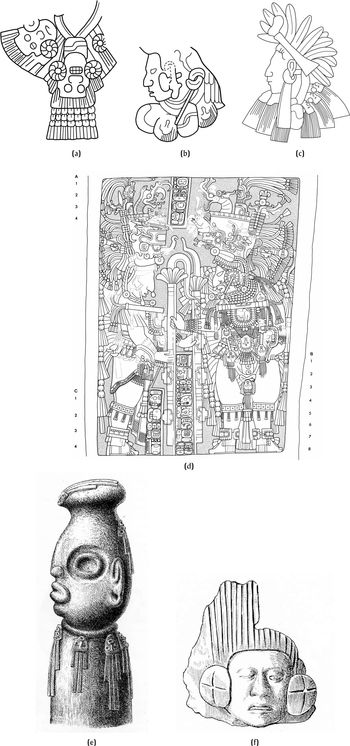
Many of the primary figures in the Group B monuments also wear necklaces made of severed heads (Figures 12a and 12b; see Monuments 7, 17, and 18), suggesting connections to warfare. These most likely represent shrunken, preserved heads, perhaps those of captives taken in battle (Houston et al. Reference Houston, Stuart and Taube2006:70). All of the heads hang upside-down, with their hair streaming below them. The “wild hair” of these heads is characteristic of captives and death gods (Houston et al. Reference Houston, Stuart and Taube2006:25) and comparative examples of severed heads in the Usumacinta region reveal associations with warfare. On Yaxchilan Lintel 9 (Figure 12d), for example, Bird Jaguar IV wears an elaborate “bib” that contains six upside-down heads with dangling hair. Severed head necklaces appear at Bonampak, as well, where Yajaw Chan Muwaan wears one in Room 2 of Structure 1. Severed heads also appear in the art of Tonina (Yadeun Reference Yadeun Angulo, Equilibrista and Libros1992) and the nearby Quen Santo area, where Seler (Reference Seler and Weeks2003 [1901]:Figures 54, 55, 180, 265–269) recovered ceramic and stone examples (Figures 12e and 12f; Earley Reference Earley2015). While necklaces or collars of severed heads appear elsewhere in Maya art, this theme is particularly consistent at Chinkultic, appearing on Monument 8 (Figure 12c) and Monument 3, as well as on the sculptures in this group.
Necklaces or collars of severed heads. (a) Detail of Chinkultic Monument 17. Drawing by the author. (b) Detail of Chinkultic Monument 18. Drawing by the author. (c) Detail of Chinkultic Monument 8. Drawing by the author after field drawing by Eric von Euw. (d) Yaxchilan Lintel 9. Drawing by Ian Graham ©President and Fellows of Harvard College, Peabody Museum of Archaeology and Ethnology, PM# 2004.15.6.5.9. (e) Sculpture from Quen Santo (after Seler Reference Seler and Weeks1901[2003]:Figure 177). (f) Ceramic fragment from Quen Santo (after Seler Reference Seler and Weeks1901[2003]:Figure 264).

On Monuments 1, 7, 17, and 43 the ruler wears a headdress derived from the Teotihuacan War Serpent (Figure 13; Stone Reference Stone, Diehl and Berlo1989; Taube Reference Taube1992:60–61). First introduced to the Maya area in the Early Classic period, the motif carried powerful “outsider” affiliations in the Late Classic period, and was used in the context of political expansion and warfare (Stone Reference Stone, Diehl and Berlo1989). The headdresses share a large central eye, a flared frontal nose ridge, and dangling elements that hang in front of the face. On Stela 3 from Bonampak, Yajaw Chan Muwaan wears an almost identical headdress to perform a scattering ritual above a kneeling captive (Figure 13c; Mathews Reference Mathews and Robertson1980). The headdress is associated with warfare at Piedras Negras and Palenque. At the former site, it is featured on several “warrior stelae” (Stone Reference Stone, Diehl and Berlo1989), including Stelae 7 and 26. At Palenque, meanwhile, a tablet from Temple 17 depicts K'inich Kan Bahlam, holding a spear and incense bag, standing over a kneeling captive and wearing the familiar headdress.
War Serpent headdresses. (a) Chinkultic Monument 7. Drawing by the author. (b) Chinkultic Monument 17. Drawing by the author. (c) Bonampak Stela 3. Drawing by the author after Mathews Reference Mathews and Robertson1980:Figure 4.

The headdresses worn by the primary figures in Group B are variations on this headdress, but they exhibit some significant differences from examples at Bonampak and Piedras Negras. First, on the Chinkultic stelae, none of the headdresses have a lower jaw. Second, the style of the Chinkultic monuments is different. Although the component parts are recognizable, the headdresses at Chinkultic appear abstracted, reduced to a combination of parts. The upper jaw of the zoomorphic being, for instance, is on the Chinkultic monuments depicted as a strong diagonal element, almost unrecognizable as part of a mouth. In this sense, the War Serpent headdresses of Group B demonstrate the stylistic eclecticism of Chinkultic. The close correspondence between these headdresses and examples from Bonampak also suggests that artists at Chinkultic may have been familiar with examples from the Usumacinta region, raising questions about the communication of artistic motifs in the western Maya area.
The primary figures of the Group B monuments, in their long robes, severed head necklaces, and War Serpent headdresses, are the first indication that these monuments depict a consistent ritual related to warfare or sacrifice. The secondary figures on the monuments of Group B reinforce this idea.
Secondary Figures in the Group B Monuments
The secondary figures of the Group B sculptures kneel or sit on the bottom left corner of each scene and look at the primary figure above them (Figure 11). Smaller in stature and clearly subordinate, these figures represent either nobles or captives. In both cases, their presence underlines the display of a warfare-oriented elite identity at Chinkultic. In their kneeling subordination, these figures also hint at the political history of Chinkultic, implying the site may have exerted political control over other Maya communities.
All of the secondary figures in Group B are dressed. The figure on Monument 7 wears a back-sloping headdress and carries a mallet-like instrument in his right hand; it is slanted diagonally toward the ground, calling to mind the captive who holds a broken fan on Yaxchilan Lintel 16. On Monument 17, the figure wears a more substantial headdress, as well as a collar consisting of round beads and tabs. Monument 18 features a secondary figure wearing a large collar or necklace, wrist cuffs, a headdress, and ear flares. At least two of the secondary figures cross one arm over the chest, touching the right shoulder with the left arm in a gesture believed to indicate subservience (Baudez and Mathews Reference Baudez, Mathews, Robertson and Jeffers1979:2) or respect (Miller Reference Miller1983). On Monument 17, the secondary figure holds out his left hand as if to shake hands. The secondary figures on Monuments 20 and 43 are too eroded or fragmentary to discern, and, on Monument 1, the lower left fragment has been separated from the remainder of the stela.
The secondary figures on these monuments have traditionally been understood as captives (Taube Reference Taube, Benson and Griffin1988). They lack the usual diagnostic features of captives, however, like nudity, visible rope bindings, and replacement of the earflares with strips of paper. While they are clearly subordinate to the figures standing above them, it is possible that they represent secondary nobles. Particularly common in art from the western Maya area in the Late and Terminal Classic periods, secondary nobles are often depicted interacting with rulers. In the Yaxchilan polity, for instance, Bird Jaguar IV dances with a sajal named Ahkmo’ on Lintel 4 from Site R. At Piedras Negras, Parrot Chaak delivers captives to Ruler 7 on Stela 12 (Figure 14a). On other monuments, secondary nobles kneel before rulers: on the New Orleans Panel, for instance, a sajal is pictured kneeling in a position of deference (Figure 14b). As Golden (Reference Golden2010) has explored, in the Usumacinta region, representations of rulers with subsidiary lords often reflect the control that large sites maintained over small ones. The rulers of Yaxchilan, in particular, exercised strict control over their secondary centers, in part by depicting rulers and secondary nobles together in the center of Yaxchilan (Golden Reference Golden2010:378–379). While the exact status of these figures is unknown, they are clearly subordinates depicted in deference to the rulers of Chinkultic.
Depictions of rulers with secondary nobles. (a) Piedras Negras Stela 12. Drawing by David Stuart ©President and Fellows of Harvard College, Peabody Museum of Archaeology and Ethnology, PM# 2004.15.6.19.38. (b) Unprovenanced Wall Plaque in the collection of the New Orleans Museum of Art. Maya, Late Classic (a.d. 650–750). Copyright ©2000 John Montgomery, JM00928.

Architectural Elements and Emblematic Figures
Behind each subsidiary figure on these monuments is an architectural element that Navarrete (Reference Navarrete1984:58) identified as a column (Figure 11), although the left side of these elements is never shown. The upper edges of the architectural elements on Monuments 7, 17, and 18 are marked with rows of flags and ornamentation and include a skyband, indicated by crossed-band designs.
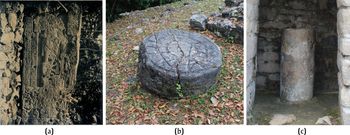
These architectural elements represent altars or posts. Their shape and ornamentation recall column altars from the Northern lowlands, particularly Uxmal and Oxkintok (Pollock Reference Pollock1980). Altars 19 (Figure 15a), 25, and 26 from Oxkintok display an intertwined band across the top of the column, with hanging tabs that resemble those on Monuments 7 and 18 from Chinkultic. At Uxmal, Altar 8 displays a similar pattern (Figure 15b). At Yaxchilan, meanwhile, column altars appear in the archaeological record and are regularly depicted on stelae. Stela 1, for instance, depicts a ruler performing a scattering ritual above an altar bound with cloth, indicated by knots and bands (Figure 16a; Stuart Reference Stuart1996:157). The column altars of Yaxchilan tend to be fairly short (Figure 16b), but column altars from the acropolis of Bonampak (Figure 16c) indicate that tall examples, like those depicted at Chinkultic, were in use in the Usumacinta area. The objects depicted at Chinkultic may have been made of wood or other perishable material, in line with Taube's (Reference Taube, Benson and Griffin1988:348) suggestion that the architectural elements are standing posts, Classic-period versions of the acante of the Dresden Codex. Whether altars or posts, these elements represent objects associated with veneration, sacrifice, and performance.
Column altars from the northern Maya area. (a) Oxkintok Altar 19. Drawing by the author after Pollock Reference Pollock1980:Figure 551. (b) Uxmal Altar 8. Gift of the Carnegie Institution of Washington, 1958 ©President and Fellows of Harvard College, Peabody Museum of Archaeology and Ethnology, PM# 58-34-20/28941.

Column altars in the Usumacinta region. (a) Yaxchilan Stela 1. Courtesy of the Peabody Museum of Archaeology and Ethnology, Harvard University, PM# 2004.29.6590. (b and c) Column altars at Yaxchilan. Photographs by the author.

On top of each architectural element is a small figure that likely performed an emblematic function (Figure 17). On Monument 18, a bird stands on top of the element. On Monuments 17 and 20, sinuous tails identify each figure as a monkey, while on Monument 7 a human torso faces left, holding a cacao pod. Photographs reveal that an anthropomorphic figure originally topped the architectural element on Monument 1. Navarrete (Reference Navarrete1984, Reference Navarrete1999) has suggested that these figures represent trained animals who took part in the ritual being depicted. The anthropomorphic figure and human torso, however, suggest an emblematic function that references the identity of the subsidiary individuals.
Emblematic figures on the Group B Monuments from Chinkultic. (a) Chinkultic Monument 17, (b) Chinkultic Monument 20, and (c) Chinkultic Monument 18. Drawings by the author. (d) Detail of Chinkultic Monument 1. Gift of the Carnegie Institution of Washington, 1958 ©President and Fellows of Harvard College, Peabody Museum of Archaeology and Ethnology, PM# 58-34-20/41969. (e) Monument 7. Drawing by the author.

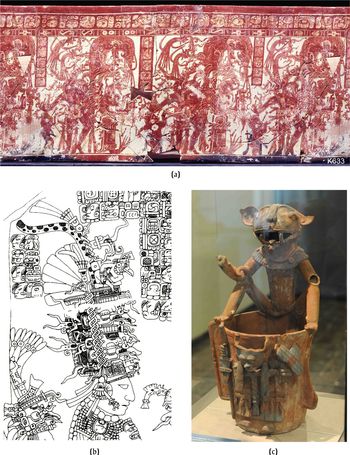
Emblematic figures appear in a variety of contexts in Maya art. The figures atop the architectural elements are comparable to those appearing in backracks worn by the Holmul Dancer on Maya ceramics (Figure 18a). In these backracks, small animals seated on top of mountains and underneath skybands reference the royal dynasty with which each maize deity is associated (Tokovinine Reference Tokovinine2013:116–119). Another example can be found at Bonampak, where on Stela 2 Yajaw Chan Muwaan wears a headdress consisting of a turkey vulture seated atop a sky band and several witz heads (Figure 18b). As Stuart (Reference Stuart2006) has demonstrated, the vulture represents the ancient name of Bonampak, “Vulture Hill.” The emblematic figures we see on the monuments may represent objects made of ceramic or wood. A series of distinctive incensarios from the Comitán valley presents intriguing similarities: on each incensario, a figure is perched on the lip of the columnar base (Figure 18c). Emblematic figures are also characteristic of art from outside the Maya area, including Cacaxtla and central Mexico. At Cacaxtla, floating glyphs accompanied warriors on the Battle Mural and on the Captive Stair (Brittenham Reference Brittenham2015). It was a convention of central Mexican writing, moreover, for personal names and toponymic identifiers to float near individuals or attach to them with a thin line. Naming conventions applied to more public media, as well; on sculptures such as the Stone of Tizoc, for instance, individuals were named with floating personal or toponymic elements (Townsend Reference Townsend1979:46).
Emblematic figures in Maya art. (a) Detail of the Holmul Dancer, Maya Vase K633. Courtesy of Justin Kerr. (b) Detail of toponymic headdress on Bonampak Stela 2. Drawing by Peter Mathews. (c) Incensario from the Comitán region in the Museo Regional de Chiapas, Tuxtla Gutierrez. Photograph by the author.

It was customary in Maya sculpture to identify important captives and secondary nobles, and the monuments of Group B follow this naming convention. Rather than relying solely on hieroglyphic inscriptions, however, these sculptures also used emblematic figures associated with the subordinate individuals. These figures could represent modifications of Maya emblematic figures appearing in headdresses and backracks, as discussed above; they may also hail from artistic trends outside the Maya area. In either case, the use of figural imagery would have made these monuments legible to diverse audiences. Unique to Chinkultic, this local iconographic suite typifies the innovative style of frontier places and points to the incorporation and active modification of diverse artistic themes.
Scattering and Severed Heads: The Monuments of Group B
The monuments of Group B display a consistent ritual scene involving a ruler, a subsidiary individual, and an architectural element topped with an emblematic figure. Iconographic and hieroglyphic evidence can help us tease out the meaning of this scene.
Iconographically, these scenes bear striking resemblance to scattering rituals depicted at Bonampak and Yaxchilan. One of the most widespread events recorded on Maya sculpture, the scattering ritual involves a ruler or elite scattering a substance, perhaps incense, water, maize, or blood, often to celebrate period endings (Stuart Reference Stuart1984; Stone and Zender Reference Stone and Zender2011:69). On Bonampak Stela 3 (Figure 19), for instance, Yajaw Chan Muwaan wears the War Serpent headdress and gestures over a well-dressed, kneeling captive. The hieroglyphs describe a scattering ritual (Mathews Reference Mathews and Robertson1980:64). The visual structure of the Chinkultic monuments suggests a scattering context, although there is no visible substance emerging from the hands of the rulers and the rulers do not make the typical “CHOK” gesture.
Bonampak Stela 3. Drawing by Peter Mathews.

Whether or not they depict scattering rituals, the six monuments in Group B represent a local artistic tradition that emphasizes the performance of control through the co-presence of ruler and subsidiary figure. The secondary figure is clearly subordinate and, unlike rulers at other western sites who perform scattering ceremonies in short skirts, elaborate belt assemblages, and ancestor heads, the rulers of Chinkultic wear long robes, the War Serpent headdress, and necklaces of severed heads. This departure from the standardized iconography of scattering rituals points to Chinkultic's interest in warfare as a central component of elite identity and the dynamic sculptural programs of the western frontier, in which sculptors mixed and matched styles and iconographic elements to create eclectic local traditions.
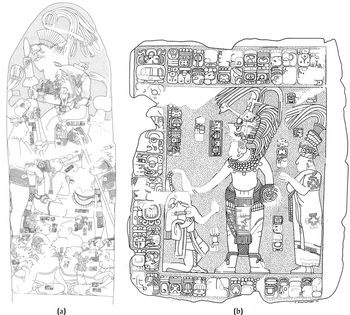
In both their placement and iconography, the Group B monuments at Chinkultic bear particular similarity to a series of stelae at Yaxchilan (Figure 20). First noted by Maler (Reference Maler1903:126), these sculptures display rituals with rulers and subordinates on one side and militaristic scenes with rulers and captives on the other (Stuart Reference Stuart1984; Tate Reference Tate1992). The Group B monuments of Chinkultic seem to conflate the two sides of stelae at Yaxchilan, including kneeling subordinates taking part in a ritual while the primary figure wears a costume referencing warfare. This series of monuments from Yaxchilan is also similar to Chinkultic in its location. As Tate (Reference Tate1992:100) noted, visitors to the site would have seen images of the ruler as a victorious warrior as they approached from the river. Moving in the opposite direction, they would have seen scattering imagery. Similarly, at Chinkultic, many of the sculptures appear to have been originally set in Group C, which is where visitors to the site would have entered (Navarrete and Hernandez Juarez Reference Navarrete and Juárez2002:36).
Yaxchilan Stela 20. Drawing by Carolyn Tate.

Similarities between the sculptural programs of Yaxchilan and Chinkultic, combined with other iconographic links between Chinkultic and the Usumacinta River region, hint at patterns of artistic communication in the western Maya area. It seems likely that artists at Chinkultic took part in information networks that allowed them access to the sculptural program of Yaxchilan. Yet, they did not copy that program wholesale. Instead, the artists of Chinkultic mixed the widespread and the local, using general paradigms common to polity centers in the western area and innovating within those paradigms to create a consistent local iconography.
DISCUSSION: DYNASTY AND RITUAL AT CHINKULTIC
The sculptural program of Chinkultic reveals information about the history of the site and the ways in which the rulers of Chinkultic wished to be perceived. The accession monuments clearly portray the rulers of Chinkultic as warriors, while the Group B monuments emphasized the control of Chinkultic rulers over subordinate individuals.
This emphasis on warfare is in keeping with other sculptures in the Chinkultic corpus. One example comes from the sculpture explored above, in which Grube (Reference Grube2002) identified the “Chan” emblem glyph. The hieroglyphic text of this monument discusses acts of warfare in block E1, which includes the took’-pakal phrase. Other monuments from the site, like Monuments 3 and 8, feature rulers wearing necklaces of severed heads (Earley Reference Earley2015:Figure 101; Navarrete Reference Navarrete1984:Figures 12, 32), and two additional, heavily fragmented sculptures likely depict a ruler with a warrior, much like similar examples from Yaxchilan (Earley Reference Earley2015:186–195). Thus, the monuments of Group A and B are consistent with themes of warfare expressed in other sculptures at Chinkultic.
From an historical standpoint, the emphasis on warfare and control in the sculptures of Chinkultic suggests that the site was involved in altercations with other polities. Potential antagonists include polities in the Usumacinta area, nearby sites in highland Guatemala (Wölfel and Wagner Reference Wölfel and Wagner2010), and sites in and around the Comitán valley. Although the iconographic program of Chinkultic borrows heavily from the Usumacinta area, its textual record is silent on the identities of its adversaries. Moreover, Chinkultic is never mentioned in the extensive hieroglyphic record of the Usumacinta region. This suggests that Chinkultic did not participate directly in the web of political altercations and alliances in the Usumacinta region.
If Chinkultic was not involved in Usumacinta politics, what explains the stylistic and iconographic connections between Chinkultic monuments and those of the Usumacinta region, particularly Yaxchilan and Bonampak? Scholars often use style and iconography to infer political relationships. For example, Schele and Miller (Reference Schele and Miller1986; Miller Reference Miller and Houston1998; Pasztory Reference Pasztory2005) argue that Stela 1 at Palenque and the panel of K'inich K'an Joy Chitam II at Tonina reflect the relationship between the two sites, and perhaps even the capture and forced labor of artists. As discussed above, Golden (Reference Golden2010:381) has also suggested that Yaxchilan maintained stylistic control over the art of subsidiary sites. In contrast, the sculptural record of Chinkultic reveals artistic influence from the Usumacinta region but no evidence of political relationships. Chinkultic's absence from Usumacinta-area inscriptions suggests that, in the western Maya area, spheres of artistic and political influence did not map cleanly onto one another in the artistic and archaeological record. The sculptures of Chinkultic point, instead, to a dynamic network of artistic communication that could operate independently from political networks. Perhaps, as Miller (Reference Miller and Houston1998:218) has suggested, western artists worked from books or patterns that moved from site to site.
Chinkultic may instead have engaged with polities that were closer to home. In the Late Classic period, Chinkultic was one of several large communities in this area of Chiapas, including Tenam Puente, Tenam Rosario, and Santa Elena Poco Uinic (Taladoire Reference Taladoire2015). Most of these sites produced art relating to warfare, buttressing the idea of regional conflict in the Comitán area. A ruler at the site of Santa Elena Poco Uinic, for instance, wears a headdress festooned with severed heads (Palacios Reference Palacios1928). Headless captives adorned the ballcourt at Tenam Puente, which likely dominated the western side of the Comitán valley in the Late Classic period (Earley Reference Earley2015; Laló Jacinto Reference Laló Jacinto and Pacheco2005; Navarrete Reference Navarrete and Ségota2000:282). The ballcourt markers of Tenam Rosario, meanwhile, feature squatting individuals holding darts as well as ritual implements; scholars have noted connections between the iconography of Tenam Rosario and the Usumacinta area (Agrinier Reference Agrinier, Ochoa and Lee1983; de Montmollin Reference de Montmollin1989). Chinkultic had many potential local adversaries.
Although the art of Chinkultic is similar in some ways to other art from the Comitán area (Earley Reference Earley2015) and the Usumacinta region (Agrinier Reference Agrinier, Ochoa and Lee1983), the sculptural corpus of Chinkultic is both innovative and consistent. Artists at Chinkultic modified widespread motifs like the Teotihuacan War Serpent, and adapted the iconography of scattering rituals to create a unique local formula for the sculptures of Group B. The artists of Chinkultic also pushed beyond established motifs to create new, local designs. In the deer headdresses on the monuments of Group A, for instance, artists combined a familiar element—the head of a dead deer—with a new one: a broad, trapezoidal brim. The column-like elements of the Group B monuments, too, are local creations, as are the small figures atop them. Thus, while the artists of Chinkultic were drawing artistic inspiration from other places, they were also creating something new.
If the mechanism of artistic influence at Chinkultic remains unclear, we can at least revisit Morley's consideration of Chinkultic and its frontier locale. Although Morley (Reference Morley1938:vol I, p. 318) decried the “deliberate omissions” of the Chinkultic sculptures as “grotesque,” he also, in doing so, ascribed agency to site artists. The material record supports this idea: consistent in its iconography and warfare-associated themes, the sculptural program of Chinkultic reveals the active manipulation of artistic motifs and the construction of specific local elite identities by site artists. It is a program, in other words, that supports the study of frontiers as places where “cultural constructs are created and transformed” (Lightfoot and Martinez Reference Lightfoot and Martinez1995:472) by local actors. Chinkultic was located on the Maya frontier, and its monuments and writing are in some ways unusual. It was not, however, an isolated backwater. Instead, the sculptures of Chinkultic evince a sophisticated artistic program in which artists combined widespread motifs with local iconographic innovations. Documenting rulers and rituals, the monuments of Chinkultic worked to construct an elite identity based on warfare and control. Their unusual style and iconography support the study of frontiers as sites of innovation and cultural exchange, and hint at broader themes in the sociopolitical history of the western Maya area.
RESUMEN
A pesar de décadas de excavaciones arqueológicas y un gran corpus de escultura monumental, la historia de Chinkultic en Chiapas, México, sigue siendo poco conocida. En este estudio, analizo dos grupos de monumentos del sitio, un grupo que representa el acceso de los gobernantes, y otro que muestra un ritual consistente que involucra a un gobernante y un cautivo o noble secundario. Argumento que estos monumentos son evidencias de un programa escultórico sofisticado y consistente que construyó una identidad de la élite basada en la guerra y el control. Los monumentos de acceso de Chinkultic documentan una dinastía real y presentan a gobernantes que tomaron el trono como guerreros. El segundo grupo de monumentos representa los rituales e involucran a un gobernante de pie, figuras subordinadas arrodilladas y figuras emblemáticas que hacen referencia a la identidad de los individuos subordinados. Este grupo representa el interés de las elites de Chinkultic en representar su control sobre otros pueblos y lugares. Sugiero que el arte de Chinkultic se basa en motivos muy difundidos, pero en última instancia es una producción local, que refleja la innovación típica de los lugares fronterizos. Finalmente, exploro cómo el arte de Chinkultic revela información sobre la historia sociopolítica del valle de Comitán. Aunque las esculturas de Chinkultic se basan en el estilo y la iconografía de la región de Usumacinta, no hay evidencia de que Chinkultic estuviera involucrado en esa esfera política, lo que sugiere que la influencia artística y política podría haber funcionado independientemente en el período clásico tardío.
ACKNOWLEDGMENTS
The author would like to thank Carlos Navarrete, Gabriel Laló Jacinto, and Roberto López Bravo, as well as Julia Guernsey, David Stuart, Charles Golden, and Barbara Fash. Research for this project was made possible by the Instituto Nacional de Antropología e Historia in Mexico and supported by the Jacob K. Javits Fellowship Program, the Department of Art and Art History at the University of Texas at Austin, and Dumbarton Oaks Research Library and Foundation. A draft of this article was completed at the Metropolitan Museum of Art. Alicia Boswell, Jeffrey Dobereiner, Aaron Gidding, and Ulrich Wölfel contributed valuable comments and suggestions, as did five anonymous reviewers. All remaining errors are my own.