1. Introduction
Compound words (hereafter referred to as compounds) are words created by combining two or more existing words, written with a space, without a space, or with a hyphen. Among the different types of compounds, noun-noun compounds are highly productive and prevalent in English (Algeo Reference Algeo1991; Biber and Gray Reference Biber and Gray2013) and characteristic features of academic and technical texts (e.g., Parkinson and Musgrave, Reference Parkinson and Musgrave2014; Trişcă Reference Trişcă2016). Unlike established noun-noun compounds (e.g., apple cake), language users need to infer the meanings of newly created or less established noun-noun compounds because the compounds often do not have prescribed definitions. For instance, the meaning of participant perspective requires language users to supply additional words, such as ‘the perspective that considers the participant's point of view’ (Biber and Gray Reference Biber and Gray2010, 9). In order to investigate the meanings of less established noun-noun compounds, this study focused on the ambiguity of semantic relations, which specify the ways in which the meanings of the modifier (the first noun) and the head (the second noun) should be combined (e.g., Levi Reference Levi1978). For example, the meaning of family support varies depending on the semantic relation, such as ‘support FROM family’ (support someone receives from their own family) or ‘support FOR family’ (support a family receives from some organization). Although semantic relation is an important factor in understanding the meanings of noun-noun compounds, research involving nonnative speakers is scarce at present. Thus, this study investigated whether college students with contrasting L1 backgrounds (Arabic and Chinese) would be able to identify the meanings of ambiguous noun-noun compounds.
2. Literature review
2.1 Noun-noun compounds and semantic relation
Most English noun-noun compounds are categorized as endocentric, where the first noun, the left element, serves as a modifier and the second noun, the right element, serves as the head of the compound (Jackendoff Reference Jackendoff2010). For instance, in tea cup, the second noun, cup, is the head, and the modifier, tea, adds more information about the purpose of the cup, which is to be used for having tea. Endocentric compounds are typically considered to be semantically transparent, as the meanings of the compounds are directly related to the meanings of the constituent nouns. However, as shown below, the ways in which the meanings of the modifier and head are combined are inconsistent, even between the compounds that share the same head or the same modifier.
chocolate cake ‘a cake made with chocolate in it’
birthday cake ‘a cake to be eaten as part of celebrating a birthday’
coffee cake ‘a cake to be eaten along with coffee and the like’
marble cake ‘a cake that resembles marble’
cupcake ‘a little cake made in a cup’
urinal cake ‘a (nonedible) cake to be placed in a urinal’ (Jackendoff Reference Jackendoff2010, 416)
fire alarm ‘alarm which warns of a fire’
fire ball ‘a ball made of fire’
fire-bomb ‘bomb which causes fire’
fire line ‘a line in vegetation cleared to prevent a fire from spreading’
fire service ‘group of people dedicated to extinguishing fires’
fire trap ‘a place which would be dangerous in the event of a fire’ (Bauer Reference Bauer2017, 71)
The inconsistency introduced above is due to the fact that some modifiers and heads allow multiple possibilities of semantic relation. For instance, the meaning of apple sauce requires the semantic relation MAKE (productive), which specifies that the modifier, apple, is the ingredient of the head, sauce. However, the meaning of the novel compound, apple ring, is ambiguous because it could be understood differently depending on semantic relation, such as MAKE (a ring made of apple) or HAVE (a ring that has a picture of an apple on it). Earlier research has proposed various classifications of semantic relations based on descriptive analysis of noun-noun compounds in English (e.g., Downing Reference Downing1977; Gleitman and Gleitman Reference Gleitman and Gleitman1970). This study adopted the classification by Levi (Reference Levi1978), which was developed based on an analysis of the predicates that supposedly had been deleted during the compounding process when an original clause was made into a compound. The classification included the following semantic relations: USE (instrumental), BE (essive), IN (locative – spatial or temporal), FOR (purposive), FROM (source), ABOUT (topic), CAUSE (causative), HAVE (possessive), and MAKE (productive). For example, steam iron can be recovered by adding the relation USE, as in ‘an iron that uses steam’, and tax law by adding the relation ABOUT, as in ‘law about tax’.
Although classifications of semantic relations inform us about common patterns in English, the current consensus is that it is not possible to classify all of the semantic relations that exist in English (Culicover et al. Reference Culicover, Jackendoff and Audring2017; Jackendoff Reference Jackendoff2010). Consequently, understanding the meanings of noun-noun compounds depends on language users’ ability to infer the combined meanings of the modifier and head in a given context (Connolly et al. Reference Connolly, Fodor, Gleitman and Gleitman2007). Noun-noun compounds with unconventional semantic relations (e.g., bat boy) are likely to pose a challenge to nonnative speakers because the most appropriate semantic relation might require cultural knowledge unique to the language (Culicover et al. Reference Culicover, Jackendoff and Audring2017; Jackendoff Reference Jackendoff2010). It seems likely that nonnative speakers will not always be able to understand the intended meanings of less established noun-noun compounds, depending on their familiarity with the cultural context related to the specific compound.
2.2 Ambiguity of noun-noun compounds
Some noun-noun compounds are ambiguous due to the possibility of multiple semantic relations. However, what is most challenging is the fact that native speakers may have a preference among possible semantic relations. In Gagné et al. (Reference Gagné, Spalding and Gorrie2005), English-speaking college students selected the meanings of ambiguous novel noun-noun compounds from multiple-choice options. The results indicated that some compounds were less ambiguous than others. For example, for woman judge, the students selected ‘a judge that is a woman’ 96% of the time, compared to the alternative meaning, ‘a judge for a woman’. In contrast, for wool basket, the students did not show a clear preference, selecting at about 50% each for the two possible meanings, ‘a basket for wool’ and ‘a basket made of wool’. These findings demonstrate that native speakers have implicit knowledge about which sematic relation is most preferred for a given noun-noun compound.
Studies involving children and nonnative speakers have shown that those who are still developing proficiency in the language struggle with identifying a preferred semantic relation. Krott et al. (Reference Krott, Gagné and Nicoladis2009) found that English L1 children (ages 4–5) were able to identify only 39.7% of the preferred meanings of novel compounds, which were the meanings selected by adult participants (e.g., ‘a ring made of apple’ for apple ring). In Zhou and Murphy (Reference Zhou and Murphy2011), college-level English learners in China were able to identify the meanings of noun-noun compounds in English with 59.87% accuracy. Some of the students’ errors included incorrect semantic relations (e.g., ‘burger made of cheese’ for cheeseburger), which the researchers attributed to a lack of exposure to English-speaking culture.
2.3 Issues in translation of noun-noun compounds
Translation involves translators’ intention to transfer the meaning they inferred from the source text to the translated text (Baker Reference Baker, Baker, Francis and Tognini-Bonelli1993). Findings from translation research are relevant to this study because a translation task uncovers whether nonnative speakers are able to understand the meanings of ambiguous noun-noun compounds. A common issue in translation of noun-noun compounds seems to be the literal translation of each constituent noun into the target language equivalent, which is often nonsensical. For instance, Al–Smaihyeen, Bani Abdo, and Al–Amer (Reference Al–Smaihyeen, Bani Abdo and Al–Amer2018) reported that Jordanian college students translated compounds into the Arabic equivalent of each constituent word, such as translating bellboy to the Arabic equivalent of bell and boy, even though the translations were uninformative.
To our knowledge, there are only a handful of studies that addressed semantic relation in the translation of noun-noun compounds. Trişcă (Reference Trişcă2016) investigated how compound nouns in naval architecture texts were translated from English to Romanian and reported that a majority of compound nouns required translators to determine semantic relation. For instance, coal grab would need to be translated with the FOR relation as in ‘a grab used for coal’, whereas a compound with the same modifier, coal paste, would need to be translated with the MAKE relation as in ‘a paste made from coal’. Similarly, Komaromi and Jerković (Reference Komaromi and Jerković2021) reported that Serbian-speaking college students experienced difficulty translating technical terms from English into Serbian. For example, cancer therapy should be translated as ‘a therapy used for treating cancer or cancer patients’, but 43% of the students incorrectly translated it as terapija raka, in which cancer was in the genitive (or possessive) form. Pointing out the differences between English and Serbian, the researchers argued that translators would need to be able to identify and supply additional prepositions or verbs in translating from English to Serbian (e.g., sun protection should be translated as ‘protection from sun’). The findings from these studies demonstrate that nonnative speakers may not always be able to understand the intended meanings of noun-noun compounds, due to difficulty identifying appropriate semantic relations.
3. The Study
The literature reviewed above suggests that the meanings of less established noun-noun compounds can be difficult to identify due to ambiguity of semantic relation between the modifier and head. In order to offer more findings on the issue of ambiguity, this study examined the following set of research questions.
Are nonnative speakers able to identify the meanings of ambiguous noun-noun compounds?
How does accuracy differ according to the degree of ambiguity and native language background?
In this study, the degree of ambiguity was defined based on the preference in English, in particular, how commonly a particular meaning was used in English, to be detailed in the next section. The native language backgrounds focused on in this study were Arabic and Chinese, which have contrasting head structures for noun-noun compounds. In Chinese, although a large proportion of compounds do not have a clear head, such as in the case of coordinative compounds (e.g., 声音, voice + sound = ‘voice’), the structure of compounds with a head is the same as in English, where the first element (noun on the left) is the modifier, and the second element (noun on the right) is the head (Cui et al. Reference Cui, Cong, Wang, Zhang, Zheng and Hyönä2018), as shown in example (1) below.
(1) 茶杯 /chá bēi/ ‘tea cup’
= 茶/chá/ ‘tea’ (modifier) + 杯/bēi/ ‘cup’ (head)
[first element] [second element]
In Arabic writing, which reads right to left, the head is located on the right side, and the modifier is located on the left side, as shown in example (2) below.
(2) رفوف الكتب /rofoof al-kutu/ ‘bookshelf’
= الكتب /Al-kutub/ ‘books’ (modifier) + رفوف /rofoof/ ‘shelves’ (head)
[second element] [first element]
In contrast to English, the head is the first element in Arabic and the modifier is the second element (e.g., Altakhaineh Reference Altakhaineh2016), which has been reported to cause misunderstanding (e.g., book is misunderstood as the head in bookshelf) in studies conducted with bilingual children who speak English and a head-first language, such as Persian (Foroodi–Nejad and Paradis Reference Foroodi–Nejad and Paradis2009) or French (Nicoladis Reference Nicoladis2002).
4. Method
4.1 Selection of English noun-noun compounds
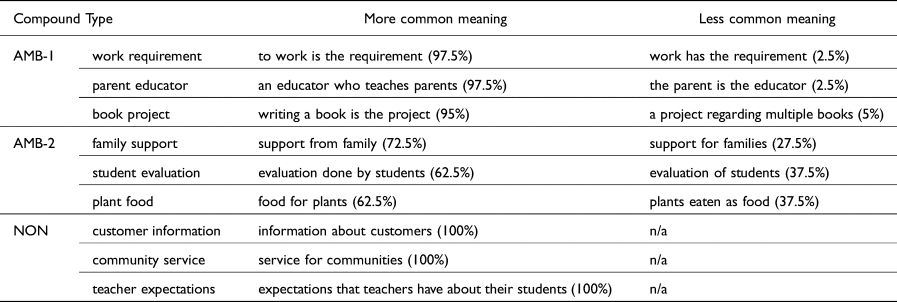
A total of nine noun-noun compounds with varying degrees of ambiguity were selected through an analysis of the compounds and their contexts from the Corpus of Contemporary American English (COCA) (Davies Reference Davies2008). Compound selection began with the initial pool of 40 head-noun candidates, randomly selected from the first 2,000 words of the BNC/COCA headword lists (Nation Reference Nation2017). Next, for each head candidate, sequences of each candidate and another noun, which served as a modifier, were compiled using COCA. The sequences that had fewer than 40 contexts were eliminated, but the rest of the sequences (compound candidates) were analyzed to determine their ambiguity. For each compound candidate, two independent coders jointly made a list of possible semantic relations using the Levi (Reference Levi1978) classification and then independently analyzed the 40 newest contexts to determine the semantic relation and meaning of the compound candidate in each context. The interrater agreement was 95.2%, and the disagreements were resolved by discussion between the coders. Finally, based on the frequency of semantic relation (or meaning), three types of compounds with differing degrees of ambiguity were selected (see Table 1): ambiguous with one commonly used meaning (hereafter referred to as AMB-1), ambiguous with two commonly used meanings (hereafter referred to as AMB-2), and non-ambiguous (hereafter referred to as NON) (see Table 1).
Compounds and meaning preferences

The AMB-1 type included compounds that exhibited two meanings, with one of the meanings more common than the other meaning. For instance, for book project, the more commonly used meaning was ‘writing a book is the project’ (95%), coded as the semantic relation BE, as shown in example (3), while the other meaning was ‘a project regarding multiple books’ (5%), coded as the semantic relation ABOUT (topic), as shown in example (4).
(3) Not the sort of thing they teach you when you're getting a creative-writing MFA and his fiancé, both working on novels, retreated from New York to a family farm in Georgia, where he spent his days alternating between writing and working around the property. The book project was frustrating, and when he was finished, he swore off writing for three months. ‘But I needed to work,’ he says, ‘to make something.’ (COCA, 2014: MAG – National Review)
(4) so that they can use their works in ways such as posting to an institutional repository, using them in future publications, and distributing to students and colleagues. The second area that is growing by leaps and bounds is copyright issues associated with mass digitization projects. They range from the Google book project to Hathi Trust to institutional repositories. # Over my tenure as director of a copyright office, copyright laws have changed and major copyright decisions have been handed down by the courts. (COCA, 2011: ACAD – Reference & User Services)
The second type, the AMB-2 type, also included compounds that exhibited two meanings, with one of the meanings more common than the other. However, the differences between the meanings were not as distinctive as the AMB-1 type, which made both meanings relatively more commonly used than in the AMB-1 type. For example, the more commonly used meaning for family support was ‘support from family (72.5%)’, coded as the semantic relation, FROM, as shown in example (5), while the other meaning was ‘support for families’, coded as the semantic relation, FOR (27.5%), as shown in example (6).
(5) I dropped out of college due to mental health issues and not having enough money. I've been working minimum wage retail and trying to live day by day, with no family support to speak of -- though, thankfully, no debt! (COCA, 2019: MAG – Slate Magazine)
(6) The CRCC provides family support services and comprehensive care to regional children with medically developmental, physical and mental impairments. Therapy and outpatient behavioral health therapy programs help children and young adults develop intellectually and socially. Services include educational, nursing and therapeutic care through behavioral health, day and weekend programs. (COCA, 2018: NEWS – Omaha World–Herald)
Lastly, the NON type included the compounds that exhibited only one meaning in the contexts, as shown in example (7) below. For instance, for customer information, the preferred meaning was ‘information about customers (100%)’, coded as the semantic relation ABOUT (topic), and there was no other meaning identified in the contexts.
(7) We've identified a fix and are taking corrective action immediately. While those responsible were able to create DNS entries on dormant domains, at no time did account ownership change nor was customer information exposed. Beware of ‘‘ orphan ’’ domains # GoDaddy didn't detail the weakness that was abused, but several pieces of evidence make a compelling case that it involved an industry-wide shortcoming that in the past has affected other providers of managed DNS services. (COCA, 2019: MAG – Ars Technica)
4.2 Participants
The participants were two groups of college students, the Arabic group (n = 20) and the Chinese group (n = 20), majoring in various fields (e.g., science, education, business, communication) in the Midwestern region of the U.S. The participants were native speakers of the language, from Saudi Arabia and China, respectively. Based on the information from a background questionnaire, their mean ages were 26.1 (SD = 4.90) for the Arabic group and 21.8 (SD = 2.53) for the Chinese group, and the mean length of residency (months) in an English-speaking country was 26.80 (SD = 11.37) for the Arabic group and 25.15 (SD = 22.88) for the Chinese group. To ensure that the groups were comparable in ability with compounds, the participants completed a compound production task, a task commonly used in compound research (e.g., McBride–Chang et al. Reference McBride–Chang, Wagner, Muse, Chow and Shu2005). The participants wrote down a novel compound that would match a sentence description, such as for the description, Early in the morning, we can see the sun rising. This is called a sunrise. At night, we might also see the moon rising. What should we call this?, the expected answer was moon rise. There were 15 items in the task, and the mean scores and standard deviations (SD) were 13.45 (SD = 1.22) for the Arabic group and 13.25 (SD = 1.80) for the Chinese group. A two-tailed t-test indicated that the mean scores were not significantly different between the groups (p = .683).
4.3 Task and procedures
The data collection instrument was a compound translation task, in which the participants translated the meanings of the compounds that were embedded in contexts (a total of 18 contexts) while thinking-aloud their thought processes in their native language. For each of the nine compounds, a pair of contexts was constructed by modifying the original contexts from the COCA (see Appendix for samples). The modification included replacing technical or advanced words with basic words and using simpler grammar structures, both of which were for the purpose of making the contexts comprehensible to the participants. For the AMB-1 and AMB-2 types, the contexts represented each of the two meanings (more common and less common). For instance, the expected translation of work requirement is ‘to work is the requirement’ in the context, I think it's a good policy to add a work requirement when people request welfare money from the government. As a taxpayer, I am in favor of being more strict about what people should do to receive the money. On the other hand, the expected translation for the same compound was ‘work has the requirement’ in the context, Lack of a work requirement for vaccination was not the main reason for not getting vaccinated. For healthcare workers who refused to be vaccinated, the main reason was concern about side effects. For the NON type, both of the contexts represented the same meaning, in order to allow each compound to appear in two different contexts. To ensure that the contexts in fact matched the expected meanings, the task was piloted with eight native speakers of English (undergraduate and graduate students), and they all provided the expected meanings for all of the compounds.
The data was collected from each participant individually by either the Arabic-English or Chinese-English bilingual research assistant who had a graduate degree in Linguistics. The research assistant explained the procedures in the native language, and the participant completed the background questionnaire, the compound production task, and the compound translation task, in that order. For the compound translation task, in order to elicit more detailed responses regarding the compounds’ meanings rather than simply the literal translation of the two nouns, the participant was asked to think-aloud while inferring the meanings of the compounds, which was audio recorded for the subsequent analysis.
The think-aloud data were transcribed and translated into English by the research assistants. The transcripts were then scored by the two independent coders who also analyzed the English compounds from COCA, using the following all-or-nothing criteria: one point for the translations that were the same as the expected meanings or demonstrated the same semantic relation as in the expected meanings, and zero points for all others, including inaccurate meanings or no answer (e.g., simply reading aloud the context). For instance, for the parent educator context that required ‘parent is the educator’ as the expected meaning, ‘parents who work as a teacher’ was coded as correct (received one point), whereas ‘a parent who is educated’ and ‘unusual parenthood’ received zero points. The inter-rater agreement was 96.67%, and disagreements in coding were resolved by discussion between the coders.
5. Results
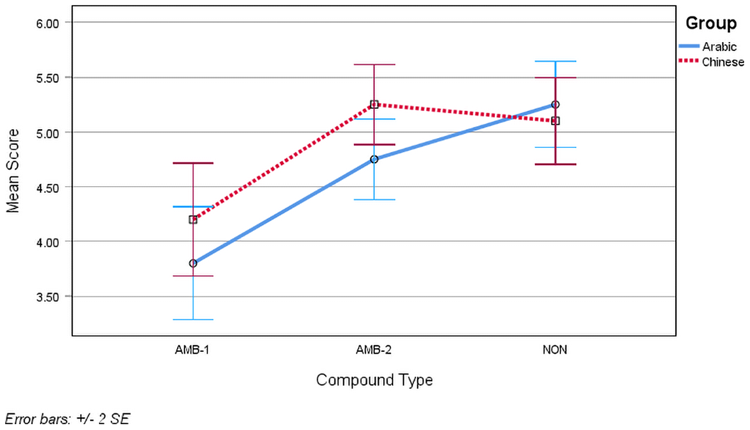
Figure 1 displays the mean scores (max 6) for each compound type. The Arabic group scored 3.80 (63.3%) (SD = 1.15) for the AMB-1 type, 4.75 (79.2%) (SD = .85) for the AMB-2 type, and 5.25 (87.5%) (SD = .97) for the NON type. The Chinese group scored 4.20 (70%) (SD = 1.15) for the AMB-1 type, 5.25 (87.5%) (SD = .79) for the AMB-2 type, and 5.10 (85%) (SD = .79) for the NON type. In order to examine the differences in these mean scores, a two-way repeated measures analysis of variance (ANOVA) was conducted, with compound type (AMB-1, AMB-2, and NON) as the within-subject factor and group (Arabic vs. Chinese) as the between-subject factor.Footnote 1 The results indicated that the main effect for compound type was significant, F (2, 76) = 22.05, MSE = 16.08, p < .001, ηp2 = .37. Neither the main effect for group nor the interaction between compound type and group was significant. To further examine the differences in mean scores between the compound types, post-hoc pairwise comparisons were conducted for each participant group, using the Least Significant Difference test. For the Arabic group, all of the types demonstrated significant differences, with the NON type higher than the AMB-1 (p = .043) and the AMB-2 type (p < .001), and the AMB-2 type higher than the AMB-1 type (p = .001). For the Chinese group, the AMB-2 and NON types were significantly higher than the AMB-1 type (p < .001; p = .004, respectively) but there was no difference between the AMB-2 and the NON types.
Mean scores from the compound translation task.

6. Discussion
This study examined whether nonnative speakers would be able to identify the meanings of ambiguous noun-noun compounds, focusing on the degree of ambiguity and native language background. In terms of overall accuracy, the results demonstrated that the Arabic and Chinese groups did not differ significantly. The overall accuracy in the compound translation task was 76.67% for the Arabic group and 80.83% for the Chinese group, which appear to be higher than the previous studies with Chinese L1 college students (Zhou and Murphy Reference Zhou and Murphy2011) and English L1 children (Krott et al. Reference Krott, Gagné and Nicoladis2009). Arabic compounds employ the head-first structure, but the difference did not seem to affect the group's performance, unlike the findings from bilingual children (e.g., Foroodi–Nejad and Paradis Reference Foroodi–Nejad and Paradis2009). Given that the previous studies examined compounds in isolation, the higher accuracy in this study could be due to the availability of contexts, which provided additional clues to the meanings of the compounds. Regarding the degree of ambiguity, the results indicated that the AMB-1 type was the most difficult for both groups, but the accuracy in the other two types differed between the groups. The Arabic group scored highest in the NON type, which was expected to be easier due to having only one common meaning, followed by the AMB-2 type. However, the Chinese group's accuracy was statistically non-significant between the AMB-2 and NON types, even scoring lower in the NON type (85%) than the AMB-2 type (87.5%). These findings appear to imply that the degree of ambiguity established through the usage of English noun-noun compounds is not always perceived by nonnative speakers.
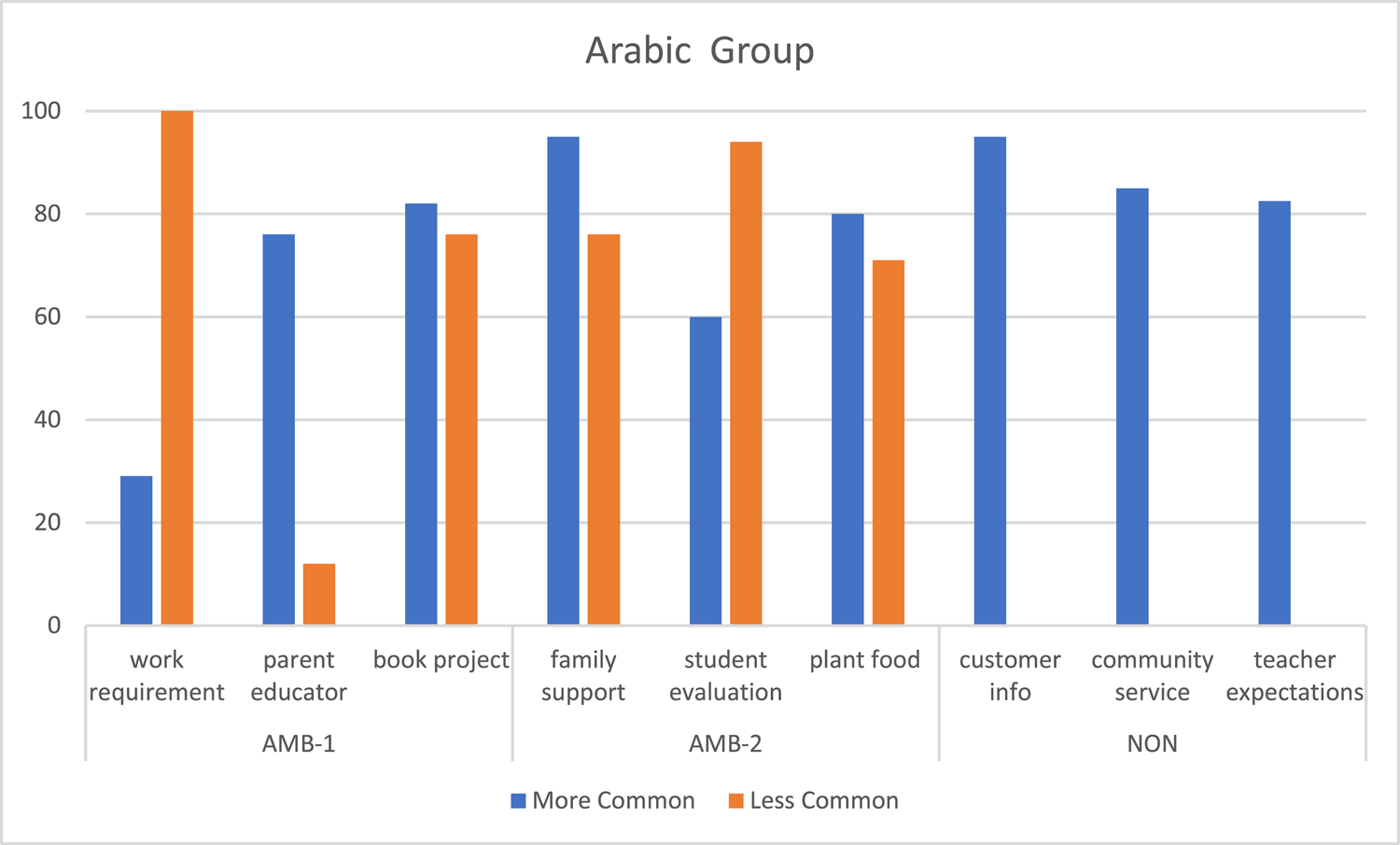
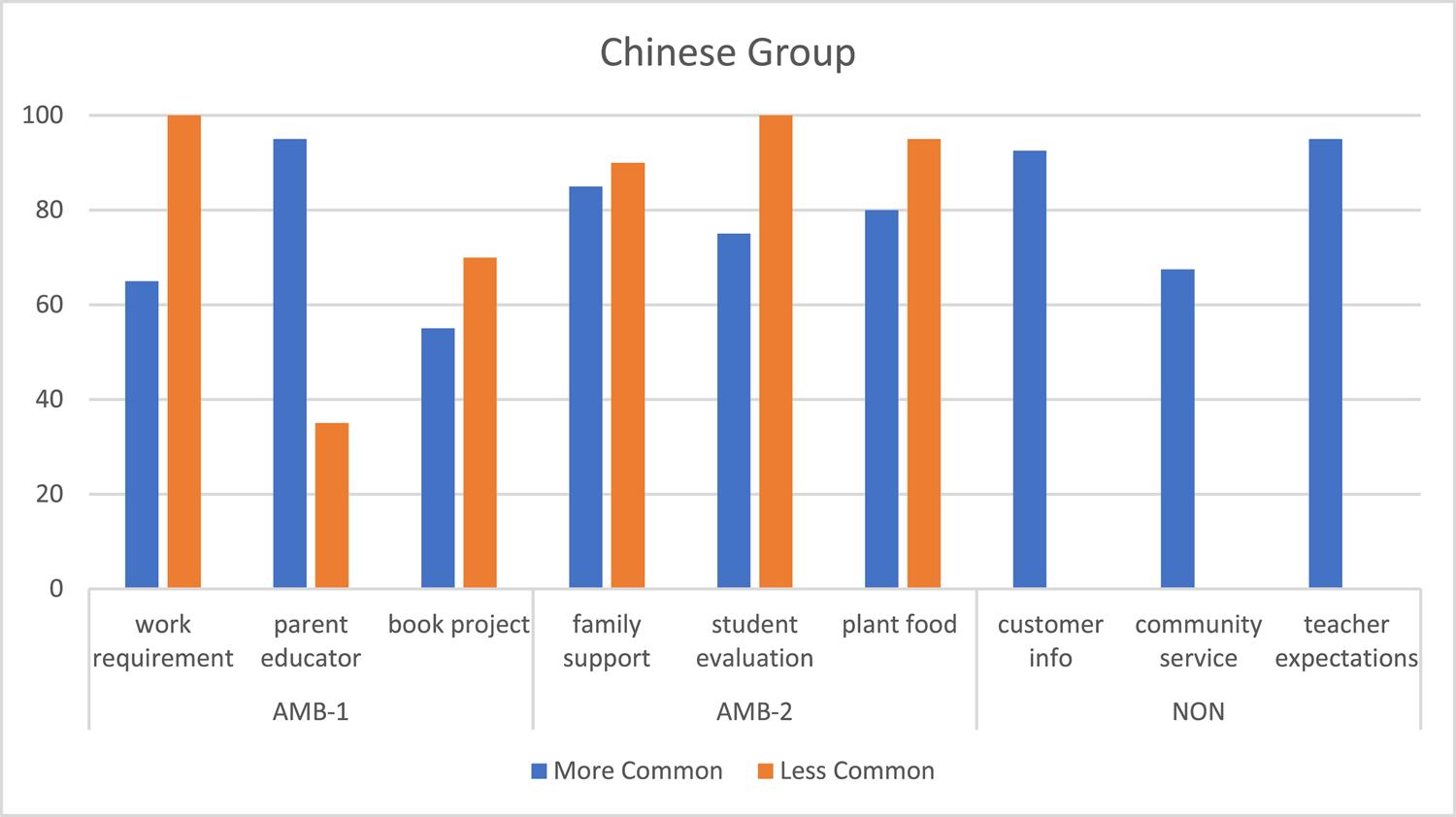
To further discuss the Chinese group's performance, the accuracy percentages for each of the meanings are presented in Figure 2 and Figure 3. Although the NON type was expected to be easier, the Chinese group was noticeably inaccurate for community service (67%), which was nearly 14% lower than the group's overall mean accuracy percentage. The think-aloud data revealed that the majority of inaccurate answers were ‘service provided by or in the community’ for the context that described fostering leadership in community service, and ‘labor reform’ for the context that described community service as a consequence of committing crimes, as shown in the excerpts in examples (8) and (9) below. It appears that the context with only a couple of sentences was not sufficient for the participants to generate the correct semantic relation, which was the FOR relation (‘service for helping communities’).
(8) so, the management focus and direction of community service now…it seems like there is no context, but it should be about community's service. It feels like community is providing service (Participant C20)
(9) It should be labor reform but community service… yes, it should be that it seems there isn't a direct Chinese equivalent and labor reform is the closest one (Participant C4)
The by-item accuracy percentages in the AMB-1 and AMB-2 types in Figures 2 and 3 also indicated that the participants were not necessarily more accurate in the more common meanings than the less common meanings. For both of the AMB types, the Arabic group's mean accuracy percentages were 70.33% for the more common meanings and 71.5% for the less common meanings. The Chinese group's mean accuracy percentages were 75.83% for the more common meanings and 81.67% for the less common meanings, showing a higher accuracy in the less common meanings. Regarding specific compounds and their meanings, the Arabic group demonstrated higher accuracy in the more common meanings in four of the compounds in the AMB types, while being more accurate in the less common meanings in two of the compounds (work requirement and student evaluation). However, the Chinese group demonstrated higher accuracy in the more common meanings only for parent educator, while being more accurate in the less common meanings in the other five compounds in the AMB types. These findings demonstrate similarities and differences between the groups, also suggesting that nonnative speakers may not always have the same preference of semantic relation based on native speaker usage (e.g., Komaromi and Jerković Reference Komaromi and Jerković2021; Zhou and Murphy Reference Zhou and Murphy2011).
Accuracy percentage for each meaning in the Arabic group.

Accuracy percentage for each meaning in the Chinese group.

We further analyzed the think-aloud data for possible explanations of difficulty in the more common meanings. Among the compounds, work requirement showed a stark difference between the two meanings, with both groups scoring 100% accuracy on the less common meaning, but only 29% (the Arabic group) and 65% (the Chinese group) accuracy on the more common meaning (‘to work is the requirement’). In the think-aloud excerpts below, the difference between accurate and inaccurate translations in examples (10) and (11) seems to be familiarity with government entitlement programs in the U.S., which was not explicitly stated in the context.
(10) Oh, does it mean you have to have a job when you apply for the ‘welfare’ money? For example, you know, the kind of policy that you need to have a job. Maybe the need for work or for a job? Anyways, I guess it is like a premise or requirement that you need to satisfy. (Participant C17)
(11) They use in America, but I am not sure if I understand it but in general it means requirements you have to do for your job (Participant A13)
The excerpts seem to underscore the importance of prior knowledge or cultural knowledge in understanding the meanings of ambiguous noun-noun compounds (Culicover et al. Reference Culicover, Jackendoff and Audring2017; Jackendoff Reference Jackendoff2010). Identifying the most appropriate meaning requires language users to infer the semantic relation in a given context (Connolly et al. Reference Connolly, Fodor, Gleitman and Gleitman2007), but not all language users may be able to generate the same information from the context. Without appropriate prior or cultural knowledge, nonnative speakers of English may experience difficulty identifying the meanings of ambiguous noun-noun compounds even when the compounds are presented with context.
7. Conclusion
This study explored how ambiguity of semantic relations affects nonnative speakers’ understanding of noun-noun compounds. The findings appear to suggest that the participant groups demonstrated some sensitivity to the degree of ambiguity, but accuracy largely depended on specific meanings of the compounds. Compound meanings, such as ‘to work is the requirement’ for both participant groups and ‘service for communities’ for the Chinese group were apparently more difficult to identify than the others, even when contexts were available. Although the underlying factors that caused the difficulty need to be verified in future study, a possible explanation is a lack of cultural knowledge necessary to fully understand the contexts. Further investigation is warranted to verify the role cultural knowledge and degree of ambiguity play in understanding the meanings of English noun-noun compounds.
The meanings of noun-noun compounds vary greatly depending on semantic relation, which specifies how the meanings of the nouns are combined. Because English noun-noun compounds are highly productive (e.g., Algeo Reference Algeo1991), an infinite number of compounds can be created in everyday language use. Although this study is exploratory in nature, it revealed a semantic issue associated with newly created or less established noun-noun compounds. We acknowledge that one of the limitations was the small number of noun-noun compounds examined in this study. For future study, it would be beneficial to conduct an analysis of semantic relation involving a larger number of newly created or less established noun-noun compounds using English corpora, which could potentially lead to the verification and refinement of classifications from previous works (e.g., Levi Reference Levi1978).
Appendix
Samples from the compound translation task
Note: The expected meanings are in parentheses.
AMB-1
a) I think it's a good policy to add a work requirement when people request welfare money from the government. As a taxpayer, I am in favor of being more strict about what people should do to receive the money. (to work is the requirement)
b) Lack of a work requirement for vaccination was not the main reason for not getting vaccinated. For healthcare workers who refused to be vaccinated, the main reason was concern about side effects. (work has the requirement)
AMB-2
a) I gave up going to college due to not having enough money. I've been working at a restaurant and trying to live day by day, with no family support. (support from family)
b) The program provides family support services and comprehensive care to children who have developmental, physical and mental disabilities. (support for family)
NON
a) We've identified the problem and are taking corrective action immediately. While some damage was caused in our systems, customer information was never leaked. (information about customers)
b) Companies differ in how they collect and use customer information. This is an important business decision for small companies that are just starting up. (information about customers)
MEGUMI HAMADA is a Professor of English at Ball State University, in Indiana, USA. She teaches undergraduate and graduate courses in applied linguistics, second language acquisition, and TESOL. Her research integrates psycholinguistic theories into second language vocabulary and reading theories. She has published articles in major international journals. Email: mhamada@bsu.edu
FAISAL HAMAD ALHARBI is an assistant professor of Applied Linguistics at King Saud University and also the Managing Editor of The Arabic Linguistics Journal. He received a PhD in Applied Linguistics from Ball State University, and master's degrees in Applied Linguistics from Texas Tech University and Arabic Language and Literature from King Saud University. His research interests include computer-assisted language learning, interlanguage pragmatics, and material development for language learners. Email: alhfaisal@ksu.edu.sa