Anorexia nervosa is a major eating disorder characterised by restriction of caloric intake relative to requirements that leads to significantly low body weight 1 and has been associated with an increased risk of mortality.Reference Rosling, Sparen, Norring and von Knorring 2 Suicide and sudden cardiac death are considered major contributors to patient mortality,Reference Rosling, Sparen, Norring and von Knorring 2 – Reference Neumarker 4 although the precise aetiology behind sudden cardiac death in this population remains unknown. Prolongation of the QT interval, a marker of abnormal ventricular re-polarisation, has been considered a potential factor in the underlying mechanism of sudden cardiac death in these patients.Reference Durakovic, Durakovic and Korsic 5 – Reference Nahshoni, Weizman, Yaroslavsky, Toledano, Sulkes and Stein 9 Controversy remains, however, as to the utility of corrected QT (QTc) measurement as a proxy to disease severity and risk of cardiac death, as studies to date have been unable to consistently correlate a QTc threshold with disease progression.Reference Krantz, Sabel and Sagar 3 , Reference Mehler and Krantz 8 , Reference Koschke, Boettger and Macholdt 10 , Reference Krantz, Donahoo, Melanson and Mehler 11 Although it has been described that some patients with eating disorders can experience electrolyte abnormalities and loss of cardiac muscle mass,Reference Durakovic, Durakovic and Korsic 5 , Reference Takimoto, Yoshiuchi and Kumano 12 whether these factors are directly associated with QTc prolongation or malignant arrhythmias has not been well-demonstrated.Reference Koschke, Boettger and Macholdt 10 , Reference Facchini, Sala, Malfatto, Bragato, Redaelli and Invitti 13 – Reference Ulger, Gurses, Ozyurek, Arikan, Levent and Aydogdu 15 In addition, it remains unknown whether the previously described association between QTc interval and anorexia nervosa translates to patients with restrictive eating patterns early in the course of the eating disorder.
The aims of this study were as follows: (1) to describe the frequency of QTc prolongation in children with restrictive eating disorders admitted for inpatient therapy, (2) to describe the frequency of ventricular arrhythmia during re-feeding in patients early in the course of restrictive eating disorders, and (3) to evaluate the relationship between QTc interval and concomitant electrolyte abnormalities and rate of weight loss.
Methods
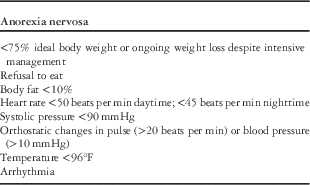
This is a retrospective cohort study of children with restrictive eating disorders admitted for inpatient medical treatment based on the American Academy of Pediatrics-recommended admission criteria (Table 1).Reference Rosen 16 This study was approved by the Cincinnati Children’s Hospital Medical Center Internal Review Board (study # 2012–2910). For the purpose of this study, restrictive eating disorders included anorexia nervosa sub-types and eating disorder not otherwise specified. The relationship between QT interval on electrocardiogram and eating disorder diagnosis, weight on admission, and serum electrolyte levels were analysed.
American Academy of Pediatrics criteria for hospital admission for patients with eating disorders.

Patient selection
Patients with anorexia nervosa or eating disorder not otherwise specified were identified using ICD-9 diagnostic codes from existing electronic medical records. The ICD codes included 307.1 – anorexia nervosa – 307.59 – other disorders of eating – V69.1 – inappropriate dieting and eating habits – and 307.4 – eating disorder not otherwise specified. Patients diagnosed with eating disorder not otherwise specified included those who met the criteria for anorexia nervosa, but continued to have menses or body weight within or above the normal range for age. 17 Consecutive adolescent patients between the ages of 11 and 25 years with previously diagnosed or newly diagnosed restrictive eating disorder that required medical inpatient hospital services between 1 January, 2009 and 30 June, 2012 were included. Only the patient’s first hospitalisation during the study period was included in the analysis.
Patients with a known clinical history – before diagnosis of an eating disorder – of any of the following were excluded from the study: congenital long QT syndrome, ventricular tachycardia, ventricular fibrillation, aborted sudden cardiac death, and catecholaminergic polymorphic ventricular tachycardia. In addition, patients with previous diagnosis of Tetralogy of Fallot, Gitelman syndrome, and Bartter syndrome were excluded, given their proclivity to ventricular arrhythmia and electrolyte imbalances, respectively. Finally, patients without a baseline electrocardiogram on day one of hospital admission or before the start of the re-feeding process were excluded, as there could be no comparison of before re-feeding and after re-feeding electrocardiograms.
Electrocardiogram review
Admission electrocardiogram was defined as an electrocardiogram completed within 24 hours of hospital admission. The admission electrocardiogram was reviewed for the following: heart rate, frontal axis, PR interval, QRS interval, presence of bundle branch block, QT interval, QT dispersion, and QTc interval. QTc prolongation was defined as a QTc interval >440 ms using the Bazett formula and was confirmed by a paediatric cardiac electrophysiologist.Reference Goldenberg, Moss and Zareba 18 , Reference Johnson and Ackerman 19 “Borderline” QTc reflects a QTc interval between 440 and 470 ms.Reference Johnson and Ackerman 19 , Reference Van Dorn, Johnson, Taggart, Thorkelson and Ackerman 20 When available, QTc intervals on subsequent electrocardiograms were used to analyse the change in the QTc interval through admission and on patient discharge. Hospital history and physical examination notes, along with same-day adolescent medicine clinic visit notes, were reviewed for risk factors for familial long QT syndrome, including patient history of syncope and family history of syncope or sudden cardiac death, and medications associated with prolonged QTc interval – for example, selective serotonin re-uptake inhibitor or neuroleptic therapies.
Clinical data
Baseline demographic data included the following: current age (months), gender, race, age at diagnosis (months), eating disorder diagnosis, weight at diagnosis (kg), and body mass index. Electronic medical records were reviewed for serum electrolyte levels, number of documented episodes of torsades de pointes, ventricular arrhythmia, or sudden cardiac death during hospitalisation, and the number of documented episodes of ventricular arrhythmia or death within 30 days of discharge from the hospital. Hypokalaemia was defined as potassium levels <3 mmol/L, hypomagnesaemia as magnesium levels <1.8 mg/dl), and hypophosphataemia as phosphorus levels <2.5 mg/dl.
Rate of weight loss was determined from the weight documented in clinic visit notes completed within 30 days of hospital admission. For study purposes, acute weight loss was defined as loss of >10% of body weight within 30 days of hospital admission. Pre-admission weight loss data were measured by objective data documented in clinic notes. Historical data as reported by the patient or family were not included in the analysis. In order to mitigate variation in growth, per cent ideal body weight was calculated, which takes into account the weight required to be at the 50th percentile body mass index for age. Ideal body weight was calculated from the 50th percentile body mass index for age (in months)×height m2.Reference Kuczmarski, Ogden and Grummer-Strawn 21 Per cent ideal body weight was calculated as follows: %IBW=weight (kg)/IBW (kg).
Statistical analysis
Demographic and clinical characteristics of the study sample were summarised using measures of central tendency, variability, and frequency. Mean and standard deviation were reported for continuous variables. Frequency and percentage were reported for categorical variables. The two-sample t-test or Fisher’s exact test was used to compare baseline characteristics and electrocardiogram findings between patients with normal QTc interval and patients with prolonged QTc interval during hospital admission. The QTc interval in anorexia nervosa patients were compared with that of eating disorder not otherwise specified patients using the two-sample t-test. The association between QTc interval and weight loss or serum electrolyte levels was analysed using Fisher’s exact test based on dichotomised values. All tests were two-sided with reported 95% confidence interval of the difference between means. A p-value<0.05 was considered statistically significant.
Results
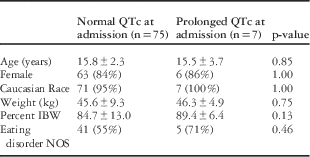
There were 103 patients admitted for medical management of eating disorder sequelae during the study period, and 82 of them met the study criteria for inclusion; five patients were re-hospitalised at least 30 days after the initial encounter, and the second encounter was not included in analysis. Furthermore, six patients were excluded from the study due to failure to adhere to the hospital re-feeding process, and 12 patients were excluded because they did not have an electrocardiogram completed within 24 hours of hospital admission. In all, three patients were excluded for reported medical history of bulimia nervosa with associated restrictive eating patterns. Baseline characteristics of the 82 patients included in the study are summarised in Table 2. The predominant characteristics were female sex (84%), Caucasian race (95%), and diagnosis of eating disorder not otherwise specified (56%). Mean age was 15.7±2.4 years. Mean weight was 45.7±9 kg. Mean per cent ideal body weight was 85.1±12.6% on hospital admission. Reasons for hospital admission included bradycardia with heart rate <50 beats per minute during daytime or <45 beats per minute during nighttime (37.8%), syncope (3.6%), and irregular heart rhythm (2.4%).
Baseline patient characteristics at the time of hospital admission.

IBW=ideal body weight; NOS=not otherwise specific
Data expressed as mean±standard deviation or n(%)
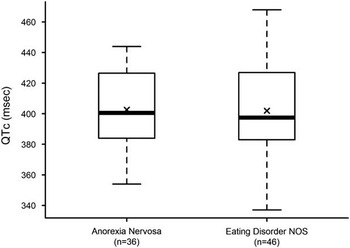
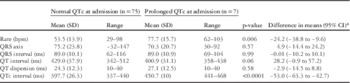
In total, eight patients (9.8%) demonstrated a prolonged QTc interval at some point during hospitalisation; seven patients (8.5%) had a QTc >440 ms on admission. The eighth patient developed prolonged QTc on the subsequent electrocardiogram during hospitalisation. There was no significant difference in baseline QTc interval on hospital admission between patients with anorexia nervosa and eating disorder not otherwise specified (difference in means=0.6, 95% CI 12.1–13.4, p=0.92) (Fig 1). Of the patients with prolonged QTc interval, three of the eight (37.5%) were reported as taking medications associated with prolonged QTc interval. This included selective serotonin re-uptake inhibitors – citalopram, fluoxetine, and sertraline – atypical anti-psychotic – quetiapine – and anti-emetic – ondansetron. Exclusion of patients prescribed chronic medications associated with prolonged QTc interval would yield a prevalence of 6% in this population. The mean QT dispersion on admission electrocardiogram in the study population was 24 ms±12. Electrocardiogram characteristics of the patients during hospital admission are summarised in Table 3, demonstrating that those with prolonged QTc had significantly higher resting heart rates (difference in means=24.2, 95% CI 9.6–38.8, p=0.006).
Boxplot of the QTc interval on electrocardiogram during hospital admission. The “x” designates the mean QTc interval for each group.

Electrocardiogram characteristics at the time of hospital admission.

BPM=beats per minute
Data expressed as mean (standard deviation) and range
* Two-sided 95% confidence interval of the difference between means for normal QTc interval and prolonged QTc interval at the time of hospital admission
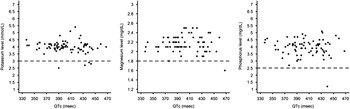
The relationship between QTc interval and serum electrolyte levels on hospital admission is illustrated in Fig 2. Upon hospital admission, four patients (5%) had hypokalaemia, of which one had prolonged QTc interval; one patient (1%) had hypomagnesaemia and prolonged QTc interval; and one patient (1%) had hypophosphataemia without prolonged QTc interval. An additional five patients (6%) experienced hypomagnesaemia during the course of hospitalisation. We found no significant association between prolonged QTc interval and hypokalaemia (p=0.31), hypomagnesaemia (p=0.43), or hypophosphataemia (p=1) during hospitalisation.
Scatterplot of QTc Interval by Electrolyte Levels on Hospital Admission. Horizontal dashed lines designate the abnormal low threshold for the respective electrolyte levels.

Pre-admission weight loss data were available for 37 of the 82 patients. Of the 37 patients with pre-admission weight loss data, two (5%) had prolonged QTc on admission; six of the 37 patients (16%) experienced acute weight loss, but without prolonged QTc on admission. There was no association between acute weight loss and prolonged QTc interval on hospital admission (p=1). In addition, there was no significant difference in per cent ideal body weight on hospital admission in patients with prolonged QTc interval compared with patients with normal QTc interval (difference in means=4.7, 95% CI 1.6–10.9, p=0.13).
None of the patients had documented episodes of torsades de pointes, ventricular arrhythmia, or sudden cardiac death during the study period. A total of 61 patients (74%) had documented follow-up 30 days after hospital discharge and all remained episode free. Data for the remaining 21 patients, including four with prolonged QTc, were incomplete due to transfer to an outside institution, failure to show up for the follow-up clinic visit, or the first follow-up clinic visit scheduled beyond 30 days after hospital discharge.
Of the eight patients with QTc prolongation during the course of hospitalisation, two (29%) showed normalisation on the subsequent electrocardiogram and two (25%) did not. The remaining four did not have repeat electrocardiogram before hospital discharge for various reasons, including plan to repeat during outpatient therapy. Of the three patients with prolonged QTc interval and reported as taking medications associated with prolonged QTc interval, two did not demonstrate QTc interval normalisation with re-feeding. Repeat QTc interval measurement for the third patient was not completed before hospital discharge.
Discussion
The association between anorexia nervosa and increased risk of mortality has been well-described, although the precise aetiology behind sudden cardiac death in this population and whether it translates to patients with restrictive eating patterns early in the disease course remains unclear. This study demonstrated a 9.7% prevalence of mild or “borderline” QTc prolongation during hospitalisation in a select paediatric population. None of the patients had documented episodes of ventricular arrhythmia during hospitalisation. Unlike previous studies, there was no significant association between prolonged QTc interval and abnormal electrolyte levels. In addition, acute weight loss and per cent ideal body weight were not associated with prolonged QTc interval.
Of significance, patients with prolonged QTc exhibited significantly higher resting heart rates compared with patients with normal QTc intervals. To our knowledge, this is the first study to note this relative tachycardia rather than the more commonly described bradycardia in patients with restrictive eating patterns and prolonged QTc interval. Previous reportsReference Krantz, Sabel and Sagar 3 , Reference Koschke, Boettger and Macholdt 10 , Reference Ulger, Gurses, Ozyurek, Arikan, Levent and Aydogdu 15 , Reference Mont, Castro and Herreros 22 , Reference Roche, Barthelemy and Mayaud 23 suggest an autonomic imbalance or increase in vagal tone as the mechanism for bradycardia in patients with restrictive eating patterns. Sinus bradycardia has been reported to be as prevalent as occurring in 60% of a study population.Reference Roche, Barthelemy and Mayaud 23 Our finding of higher resting heart rates may suggest a possible alternative manifestation of autonomic dysfunction where increased vagal tone is not the sole presentation, but may reflect the underlying sub-clinical injury from malnutrition leading to excessive sympathetic activity and subsequent tachycardia early in the course of restrictive eating patterns. Whether similar findings would be found in other patient cohorts with early restrictive eating patterns remains to be seen and would benefit from future studies, as this may serve as an important marker of increased association with prolonged QTc interval.
These findings suggest that, although electrolyte abnormalities and rapid weight loss may serve as markers of disease severity and indicators for medical hospitalisation, the change in clinical status may not translate to a reciprocal change in cardiac cell re-polarisation. Considering this, investigation into other potential risk factors of prolonged QTc interval may be warranted.
There are limitations in this study that should be considered when interpreting our findings. Compared with previous studies, patients in this study were mild to moderately malnourished and the milder nature of their condition may preclude extension to patients with more severe disease. The small number of patients with prolonged QTc limits the generalisability of the study findings. Although we report no association between rapidity of weight loss and QTc interval, the small sample size precludes generalisability. Evaluating the relationship between maximum lifetime weight and QTc interval may have yielded different results. In addition, the timing of the electrocardiogram was not uniform, and we therefore cannot account for the possible diurnal variations in QTc that may lead to under-representation of patients with prolonged QTc.
In conclusion, prolonged QTc interval in this population of children with early restrictive eating disorder was not associated with abnormal serum electrolyte levels or acute weight loss. These findings suggest that, although electrolyte abnormalities and rapid weight loss may be of concern to clinicians when present, the change in clinical status may not translate to a reciprocal change in cardiac cell re-polarisation. Considering this, investigation into other potential risk factors of prolonged QTc interval may be warranted, including medication use, personal or family history of syncope, or sudden death.
Acknowledgements
The authors acknowledge Eileen King, PhD, for her invaluable contribution to the revision of this manuscript.
Financial Support
This research received no specific grant from any funding agency, commercial, or not-for-profit sectors.
Conflicts of Interest
None.