1. Introduction
In 2001, the New Zealand government introduced the Primary Health Care Strategy (the Strategy) aimed at improving the health of New Zealanders and at reducing inequalities in health (King, Reference King2001). The Strategy emphasised population health, health promotion and preventive care, and was aimed at improving access to primary health care services, particularly for people who previously faced financial and other barriers to using these services (Cumming et al., Reference Cumming, Raymont, Gribben, Horsburgh, Kent, McDonald, Mays and Smith2005; Cumming and Gribben, Reference Cumming and Gribben2007).
Implementation of the Strategy has involved significant changes in the funding, payment system and organisation of primary health care, particularly for one of the main groups of providers of primary health care services in New Zealand – general practice services (Cumming et al., Reference Cumming, Mays and Gribben2005, Reference Cumming, Raymont, Gribben, Horsburgh, Kent, McDonald, Mays and Smith2008; Cumming and Gribben, Reference Cumming and Gribben2007). This paper focuses on recent changes in the funding of, and payment for, general practice services in New Zealand; the key issues faced by the government as it set about making such changes; and the policy challenges the government now faces in relation to the future funding and organisation of general practice services.
2. Background and rationale for change
New Zealand’s health care sector is predominantly financed from public sources (Ministry of Health, 2008b), with hospital care, community mental health care and public health services provided free of charge to all New Zealanders. However, the publicly financed system has never been regarded as offering fully comprehensive coverage, as the government has only ever partially funded many primary health care services. General practice services have been the main focus of primary health care service delivery in New Zealand for many years, incorporating services delivered by general practitioners (GPs), practice nurses and, at times, community health and other health professional staff. These services have traditionally been publicly funded through fee-for-service patient subsidies paid to individual GPs. Before the introduction of the Strategy (i.e. before 2002), government subsidies were focused on children under six years of age (with the aim of enabling free services for this age group), those aged 6–17 years and low income and high user adult patients eligible for a community services card or high user health card (Cumming et al., Reference Cumming, Mays and Gribben2008). Around half the population were entitled to a subsidy card, but with the subsidy for adults (then $15Footnote 1) covering only around one-third to two-fifths of the average charge ($37.50–$45; Ministry of Health, personal communication), even those eligible for a public subsidy paid a significant proportion of general practice service costs out-of-pocket, whereas the majority of adults paid the full costs of general practice services themselves (or from private insurance).
This approach to government involvement in general practice services dates back to the 1940s when the medical profession resisted the First Labour government’s proposals for a free, at the point-of-use, universal GP service (Hay, Reference Hay1989; Gauld, Reference Gauld2001). New Zealand researchers and commentators have criticised this approach for many years. Government subsidies failed to keep up with rising costs, and the resulting high patient charges were a major financial barrier to accessing services. In addition, the fee-for-service approach was seen to provide little incentive to promote health or prevent illness, as practitioners earned higher incomes when they delivered more services. It was also suggested that the government could not fund patient populations according to their health needs because expenditure was largely driven by practitioners’ choice of location and patient demand. Finally, the system was seen to be biased towards patients having to visit the GP to receive subsidised care, leading to an inefficient pattern of service delivery and relative underdevelopment of primary health care team provision (Health Benefits Review, 1986; Coster and Gribben, Reference Coster and Gribben1999; Crampton, Reference Crampton1999; Crengle, Reference Crengle1999; Cumming, Reference Cumming1999; Tukuitonga, Reference Tukuitonga1999).
The financial barriers to care were of particular concern. First, there were problems arising from the subsidy card system, with around 21% of those eligible for assistance not actually holding the community services card that would have enabled them to access cheaper care (Ministry of Health, personal communication). Second, there were concerns over unmet need, with as many as 20% of all New Zealanders reporting in surveys that patient charges had stopped them from accessing services when they needed them, with lower-income New Zealanders, Māori and Pacific peoples, and those with poorer health status reporting even higher rates of unmet need (Schoen et al., Reference Schoen, Davis, DesRoches, Donelan and Blendon2000; Ministry of Health, 2004d; Raymont, Reference Raymont2004; Schoen and Doty, Reference Schoen and Doty2004).
During the late 1990s, policymakers and analysts began to pay increasing attention to the poor state of primary health care access, organisation and service delivery in New Zealand, and to develop new ideas for strengthening the role of primary health care in the wider health care system (Health Benefits Review, 1986; Health Funding Authority, 1998; Coster and Gribben, Reference Coster and Gribben1999; Crampton, Reference Crampton1999; Crengle, Reference Crengle1999; Cumming, Reference Cumming1999; Tukuitonga, Reference Tukuitonga1999; National Advisory Committee on Health and Disability, 2000). Once a new Labour-led government was elected in 1999, these ideas for reform were picked up and set out in a discussion document, The Future Shape of Primary Health Care (Ministry of Health, 2000a, 2000b), which was followed by the announcement, in February 2001, of the Primary Health Care Strategy (King, Reference King2001).
3. The Strategy
The Strategy proposed a strong primary health care system aimed at improving health and reducing inequalities in health. The Strategy envisaged a primary health care system in which primary health care providers work with local communities and enrolled populations to promote health; collaborate with all health service providers to coordinate patient care; and develop the primary health care workforce, including the primary health care nursing workforce that was expected to play a more significant role in delivering primary health care services (King, Reference King2001).
The Strategy began to be implemented in 2002, and has involved three major changes. First, the government has provided a significant increase in funding to support primary health care. The new funding has been aimed at reducing the charges patients pay when they use primary health care services, extending eligibility for government funding to the entire population, and encouraging the development of new services. The government planned to spend an additional $2.2 billion over seven years from 2002/03 implementing the Strategy (King, Reference King2005). This provided around $300 million additional funding per annum on top of previous annual general medical services public expenditure of about $445 million in 2002/03 (Ministry of Health, 2005).
Second, the government has encouraged the development of Primary Health Organisations (PHOs) as local non-governmental organisations to serve the primary health care needs of their enrolled patients. PHOs are not-for-profit organisations. They are funded to provide essential primary health care services; to improve and maintain the health of the population; and to reduce health inequalities. PHOs can either provide services themselves or services can be delivered through existing primary health care providers (mostly general practices). PHOs are required to involve their communities in their governance arrangements; to be responsive to community needs; and to involve all their primary health care providers in their decision-making (King, Reference King2001). Patients can choose to enrol and practitioners can choose to affiliate with PHOs or not; however, neither patients nor practitioners who remain outside of a PHO can access any of the new public funding. PHOs work with, and are contracted by, their local District Health Board (DHB), with 21 DHBs across New Zealand, each responsible for the planning and funding of all health services within their geographically defined locality (Cumming and Mays, Reference Cumming and Mays2002).
Third, the Strategy has changed the method of allocating the public share of primary health care funding from fee-for-service patient subsidies paid at the practitioner level to largely capitation funding of PHOs (King, Reference King2001). One key reason for moving to public capitation was to be able to redistribute public resources and, thereby, reduce inequalities by ensuring that PHOs are funded according to the needs of their populations, rather than according to the number of services delivered (King, Reference King2001). A move to capitation was also considered essential to encouraging multidisciplinary/team approaches to care and a focus on wellness as opposed to sickness (National Advisory Committee on Health and Disability, 2000). How PHOs pay practices and practitioners has, however, been left up to PHOs and general practices to negotiate locally. Unusually, for a now majority-capitated system, patient copayments for most GP and related consultations remain, set by individual GPs, not by the government.
The new arrangements brought about by the Strategy have a number of major advantages, in principle, over the previous primary health care system. First, they have offered the ability to link the delivery of personal health services with a greater emphasis on prevention and health promotion and on improving the health of the whole population. Second, they have provided increased potential for collaboration between various professional and provider groups, with the aim of better integrating services. Third, the new arrangements have been seen to offer greater job opportunities and an increased scope of practice for a range of staff, especially nurses. Finally, the Strategy has also been seen to offer New Zealanders significantly improved access to services, facilitated by out-of-pocket fee reductions and the availability of a greater range of services, including as a result of public funding no longer being tied automatically to the GP visit (Perera et al., Reference Perera, McDonald, Cumming and Goodhead2003; Cumming et al., Reference Cumming, Raymont, Gribben, Horsburgh, Kent, McDonald, Mays and Smith2005).
4. Implementation challenges in funding and payment reform
The introduction of the Strategy in New Zealand potentially represents a major change to the way in which primary health care is funded, paid for and organised in New Zealand. The policy of introducing PHOs has been an initial success in so far as PHOs were rapidly established, resulting in 82 PHOs in existence at the end of 2008, and with almost all New Zealanders enrolled in PHOs via their ‘usual’ general practice. Key factors in the rapid early implementation of the Strategy have included strong support for its broad philosophy within the health sector and among the public (Ministry of Health, 2000b; Perera et al., Reference Perera, McDonald, Cumming and Goodhead2003; Cumming et al., Reference Cumming, Raymont, Gribben, Horsburgh, Kent, McDonald, Mays and Smith2005), and the fact that the higher level of public funding could only be obtained from PHO-affiliated general practices and by enrolled patients.
Early research has shown that a wide range of new services is being provided or planned through PHOs, including preventive services, and community-based initiatives, including school and mobile clinics, with a focus on improving access for particular groups, such as Māori, Pacific peoples and those on low incomes (Perera et al., Reference Perera, McDonald, Cumming and Goodhead2003; Cumming et al., Reference Cumming, Raymont, Gribben, Horsburgh, Kent, McDonald, Mays and Smith2005).
However, the implementation of new funding and payment arrangements has raised a number of important issues, including aspects of policy design, considered in the following sections.
4.1 Shifting from a targeted approach to a universal approach to paying for general practice services
One of the most salient early implementation issues has been how to move from a policy focused on the targeting of subsidies for those with high needs and/or low incomes towards more universal funding. With limits on the amount of new money available to support the Strategy, not all New Zealanders could have been eligible for higher subsidies at once. In order to move towards a more universal approach, and at the same time to ensure new funding went to those most in need, the government chose, at first, to create two forms of PHO funding – one known as Access funding, the other as Interim funding. Access PHOs are those in which more than 50% of the enrolled population comprises Māori, Pacific peoples or people from lower socio-economic areas [as measured by a deprivation index (Crampton et al., Reference Crampton, Salmond and Kirkpatrick2004)]. These populations in Access PHOs generally have poorer health status on average and higher needs than other New Zealanders (Pōmare et al., Reference Pōmare, Keefe-Ormsby, Ormbsy, Pearce, Reid, Robson and Watene-Haydon1995; Ajwani et al., Reference Ajwani, Blakely, Robson, Tobias and Bonne2003; Ministry of Health, 2004a, 2004d; Ministry of Health and Ministry of Pacific Island Affairs, 2004). Interim PHOs are all other PHOs.
Across all PHOs, capitation rates have varied first by age and gender, to reflect higher levels of need on average for younger and older enrolees and for women. In addition, at first, Access PHOs received a much higher capitation payment for each enrolled person than Interim PHOs. The higher capitation rates paid to Access PHOs enabled them to reduce the user charges that all their enrollees paid for general practice services, regardless of whether an individual patient was in fact a member of one of the high-need groups. Interim PHOs were paid a lower capitation payment per enrollee, again for all their enrollees, regardless of the individual enrollee’s socio-economic position or ethnicity.
Since 2003, the government has provided further funding to gradually increase the per capita funding for those enrolled with Interim PHOs to the level paid to Access PHOs. From July 2007, both PHOs have had virtually the same levels of funding per capita for ‘first contact services’ (general practice services) (capitation payments in Access PHOs are still slightly higher than those in Interim PHOs for those under 18 years of age; Ministry of Health, 2004c).
Some critics have suggested that the transitional approach of Access and Interim PHOs was inequitable, as it meant that higher income or healthy enrolees in Access PHOs could obtain cheaper care than lower income or less healthy enrolees in Interim PHOs (Perera et al., Reference Perera, McDonald, Cumming and Goodhead2003). However, it is difficult to see how the government could have avoided this problem, as it moved from a targeted to a universal approach with funding allocated for groups of people, not individuals. As it was, a large proportion of those receiving initially higher subsidies were from higher need groups, although the policy did not perfectly reach all the individuals with the highest needs (Ministry of Health, 2004b). In addition, the government has provided extra funding for individuals with chronic conditions under a scheme known as Care Plus. This has enabled extra funding to be allocated to higher need (and cost) individuals.
4.2 Reducing fees and improving access
In the early stages of implementation, some providers were concerned that the government aimed to cap the fees that PHOs and general practices could charge patients, thereby reducing their flexibility to manage their finances (Cumming et al., Reference Cumming, Goodhead, Barnett, Walker, Clayden, Churchward, Simonsen, Ashton, Boulton, Russell, Perera, Fa’alau, Asiasiga, Cunningham, Lungley, Murphy, Cochrane, French and Davis2003; Perera et al., Reference Perera, McDonald, Cumming and Goodhead2003). This issue had to be resolved before progress could be made; but eventually, it was agreed that practices should remain free to set their own fees, and the government also promised regularly to review its funding to keep pace with inflation (King, Reference King2004). After this, PHO establishment was rapid, fuelled by the availability of significant sums of new money for PHOs to spend on primary health care, and by the requirements that new funding would only be available to enrolees and practices linked with a PHO. Ministers also chose to promise the New Zealand public that the increases in public funding would be reflected directly in lower patient user charges, despite the fact that GPs ultimately remain in control of their own fees.
However, as new funding was rolled out, the government became concerned about whether enough of the new funding was being passed to patients in the form of lower fees and it began to set increasingly clear expectations around fees levels and fees reductions with this in mind. As a result, over several rounds of new funding, local agreements have had to be reached between DHBs and their local PHOs about the degree to which new funding should result in reduced scheduled GP fees, about fee review processes if new funding does not result in the expected level of GP fee reductions, and about how much scheduled GP fees may rise each year without triggering a formal fees review. For Access PHOs, ‘low’ fees have generally been seen to be zero for those aged six years and under; $7–$10 for those aged 6–17 years; and $15–$20 for adults. For Interim PHOs, the focus has been on two issues: first, the normal fee increases that could be brought about by cost increases; and second, fees reducing in line with the increases in government subsidies. These have generally involved a $10 subsidy increase for those adults with subsidy cards and a $25 increase for those adults without subsidy cards and $5 and $10 increases, respectively, for those aged 6–17 years of age with and without subsidy cards (Cumming and Gribben, Reference Cumming and Gribben2007).
The government has avoided the statutory regulation of fees that exists in similar situations in other countries, most likely because of a fear of the political furore that this would likely generate from the GP community. New Zealand GPs have traditionally distrusted the ability and willingness of successive governments to fund their services adequately to maintain their professional standards and meet their income aspirations. Although a higher proportion of GPs than in the past probably supports a larger share of public funding being available to reduce the costs associated with using primary health care services, there is still widespread suspicion of government controls on fees (Perera et al., Reference Perera, McDonald, Cumming and Goodhead2003; Cumming et al., Reference Cumming, Raymont, Gribben, Horsburgh, Kent, McDonald, Mays and Smith2005; Cumming and Gribben, Reference Cumming and Gribben2007; Croxson et al., Reference Croxson, Smith and Cumming2009).
One way in which the government has worked to improve the incentives to keep fees low is to introduce additional funding streams to ensure ‘very low cost access’ for specific high-need groups. Only those who promise to keep scheduled fees below stipulated levels – the low fee levels set out above for Access PHOs – are able to claim such additional funding (Ministry of Health, 2007a, 2007b). This approach provides a modest lever for the government to keep fees low for some New Zealanders in future.
It is worth noting, however, that the levers of ‘capped’ fees and fee review processes mentioned above apply only to ‘scheduled’ fees; that is, the fees that general practices ‘advertise’ to patients for standard GP consultations, and not the fees that are actually ‘charged’ to patients. Under certain circumstances, this would allow practitioners to not pass on to patients the full value of the new funding they receive, while still complying with the requirement to reduce their scheduled fees by a certain amount, allowing them to pocket the difference between the new funding they receive and the reduction in fees they offer patients. Practices also have the ability to set their own fees and charge for other services, such as practice nurse services and repeat telephone prescriptions, as well as for longer or more complex consultations.
The first five years of the Strategy are the subject of an independent evaluation that includes monitoring of actual fees paid by patients (as opposed to scheduled fees). Key questions for assessing the Strategy and its implementation are whether fees have reduced for patients as a result of the Strategy, and whether GPs have passed on all or part of the new funding, thereby reducing patient user charges for services. Analyses of the actual fees paid by patients also provide a view of the impact of the Strategy from a patient perspective. In addition, the evaluation is assessing changes in consultation rates as a result of the Strategy.
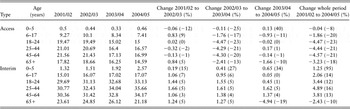
Data on patient fees and consultation rates have been collected directly from the general practice information systems in a representative sample of 99 practices and are summarised in Table 1 [detailed methods are set out in Cumming et al. (Reference Cumming, Mays and Gribben2008)]. Interim findings from mid-2001 (before the Strategy began to be implemented) to the end of 2005 show that the average fee paid for a GP or nurse visit in Access (higher need) practices fell for all age groups across the entire period, particularly for those aged six years and above where the reduction in fees was approximately 20%. In Interim practices, with the exception of those above 65 years once they became eligible for higher public funding (in 2004/05), fees generally rose, as would have been expected due to general inflation, although by modest amounts each year.
Mean fees by funding model and age for doctor and nurse encounters, 2001/02 to 2004/05

All financial data are reported as New Zealand dollars. Percentage change is reported rounded to the nearest per cent. The data apply to financial years, July–June. In Interim practices, subsidies increased in October 2003 by $5 and $10 for those aged 6–17 years with and without subsidy cards, respectively; and in July 2004, by $10 for adults 65 years and above with subsidy cards and $25 for adults 65 years and over without subsidy cards.
Source: (Cumming and Gribben, Reference Cumming and Gribben2007; Cumming et al., Reference Cumming, Mays and Gribben2008).
Overall, in Access practices, fees fell and the government’s prevailing target fee rates (see above) were, on average, being achieved in 2004/05 for young people aged 6–17 years and for adults, while not quite being achieved for children under six years. In Interim practices, average reductions in fees were generally not at the levels hoped for by the government.
The most probable explanation for this was that general practices were previously discounting fees for some patients, given they were operating in a competitive environment and that some patients would have found higher charges unaffordable, and practices were subsequently recovering these discounts, as the public capitation payments made to them increased (Cumming et al., Reference Cumming, Mays and Gribben2008). Other evidence showing that GP incomes have increased significantly in the past few years (Management Research Centre, 2003, 2006; Raymont and Cumming, Reference Raymont and Cumming2009) tends to support the theory that at least some of the new funding has gone into raising general practice incomes. Although this can be viewed as a negative outcome in that the government missed opportunities to further reduce the charges that patients pay when they use services, it can also be viewed as a positive outcome given concerns in New Zealand over the recruitment and retention of GPs in New Zealand (Health Workforce Advisory Committee, 2005).
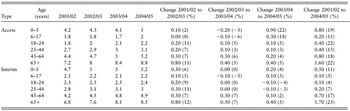
The evaluation is also studying trends in general practice consultation rates to examine whether or not utilisation of services is changing as a result of the Strategy (see Table 2). In Access practices, GP consultation rates per annum increased in all age groups, especially among those above 65 years. In Interim practices, there was also an increase in GP consultation rates, but it was lower than in Access practices, except for those above 65 years. The increases were significant in service delivery terms, equating to an estimated increase of almost 1.7 extra GP consultations per year for those above 65 years (increasing from almost seven consultations per annum in 2001/02), and almost one additional consultation in the 45–64-year-old age group (increasing from just over four consultations per annum in 2001/02; Cumming et al., Reference Cumming, Mays and Gribben2008). However, although consultation rates per annum have been rising, this has not always appeared to be consistently linked to fee reductions. This is to be expected given that other funding has also been provided to PHOs and practices to reduce other barriers to access (e.g. by developing mobile services, increasing opening hours and so on; Cumming et al., Reference Cumming, Raymont, Gribben, Horsburgh, Kent, McDonald, Mays and Smith2005; Cumming and Gribben, Reference Cumming and Gribben2007).
Mean consultation rates per annum for doctor and nurse encounters by funding model and age, 2001/02 to 2004/05

Percentage change is reported rounded to the nearest per cent. The data apply to financial years, July–June.
Source: (Cumming and Gribben, Reference Cumming and Gribben2007; Cumming et al., Reference Cumming, Mays and Gribben2008).
This pattern of generally rising consultation rates differs from the trends reported from successive waves of the New Zealand Health Survey, which have suggested that median consultation rates did not increase for men and women between 1996/97 and 2006/07 (remaining at two visits per annum), although the median number of visits for Māori men has increased from one visit to two visits per annum (Ministry of Health, 2008a). However, New Zealand Health Survey rates are self-reported, whereas the Strategy evaluation data reported above were collected from practices themselves. Further analyses of the New Zealand Health Survey and other data are hence required to confirm rising consultation rates, although the rise in consultation rates has also been confirmed in interview data collected as part of the Strategy evaluation (Cumming et al., Reference Cumming, Raymont, Gribben, Horsburgh, Kent, McDonald, Mays and Smith2005; Raymont and Cumming, Reference Raymont and Cumming2009).
The Strategy, then, appears to be encouraging an increased use of general practice services, as hoped for by the government, which believed that there were unmet needs under the previous system. It is too soon, however, to know what effect the large increase in public spending is likely to have in terms of health problems averted, better health and reduced inequalities, and whether the new spending is cost-effective; that is, whether it has led to lower use of expensive hospital services due to identifying problems early and keeping people out of hospital, something which has been a key aim of the new investment in primary health care in New Zealand (King, Reference King2001; Health Services Assessment Collaboration, 2008; Ministry of Health, 2008a) and which is regularly reported as a key likely outcome of improved primary health care service delivery internationally (World Health Organization, 2008).
5. Future issues in relation to the payment system
New Zealand has made good progress in implementing some aspects of the Strategy over the past few years. Significant new public funding has been provided, new organisations have been established through which the Strategy can be implemented, the fees patients pay for general practice services have fallen and consultation rates have risen largely as intended by the Labour-led government of 1999–2008. However, a number of challenges remain, specifically related to the payment system, if the Strategy is to achieve its goals of improving health and reducing inequalities. These are discussed in this section.
5.1 Paying providers
A first issue relates to the ways in which general practice services are paid for. Public capitation at the PHO level, in theory, generates the desired focus on population health and prevention, and encourages the development of extended primary health care services, such as better community nursing, counselling and other services (Cumming, Reference Cumming1999; National Advisory Committee on Health and Disability, 2000). PHOs are in a particularly good position to develop new services that work across practices. However, most primary health care services are not provided by PHOs, but by traditional GP-owned and GP-managed practices.
At the general practice level, it is known that different payment systems have different effects on practice patterns (Gosden et al., Reference Gosden, Forland, Kristiansen, Sutton, Leese, Giuffrida, Sergison and Pedersen2001). It is now widely understood that blended payment systems may be the best way to offset the intrinsic limitations of fee-for-service, salary and capitation (Robinson, Reference Robinson2001). A major concern in the early days of implementing the Strategy was whether capitation payments to PHOs would flow to general practices or whether the traditional fee-for-service arrangements would remain in place. Furthermore, even if ‘practices’ were paid on a capitation basis, how would ‘practitioners’ themselves be paid?
Little research evidence was available on this issue in the early days of the Strategy’s implementation, but there is now evidence that PHOs are indeed passing on funding to general practices via capitation. A recent telephone survey of all PHOs (with 73/80 responding, a 91% response rate) found that 67/73 (92%) PHOs have been distributing first contact funding to practices using the same weighted capitation formula that the Ministry of Health has been using to fund PHOs (A. Raymont, personal communication).
Overall, the use of capitation payments to fund PHOs and general practices is seen as a positive move in the New Zealand environment, given the goals laid out in the Strategy to encourage prevention and teamwork, and to ensure that resources are allocated based on needs. However, the first contact services noted above make up only around 75% of government health funding in primary health care, and other funding, which, for example, supports services to improve access, health promotion services and services for those with chronic illnesses, is provided to practices on a different basis. Furthermore, other public funding from outside the health budget, such as Accident Compensation Corporation funding for accident-related care, continues to be paid on a fee-for-service basis.
In addition, private fee-for-service charges are still paid by patients directly to practices when they use services. This, in particular, provides an unusual blend of reimbursement methods, since funding is coming from different sources and the fee-for-service element is uncapped for many New Zealanders and generally unknown to the government, making the overall effect on access out-of-pocket payments and clinical behaviour complex to predict. The lack of any formal contract between PHOs and practices in relation to fees charged to patients also perpetuates the notion that the government is subsidising private businesses rather than using capitation and other funding to contract for the delivery of a set of services at an agreed price to produce specific results in terms of health improvement.
This mix of practice payment systems is reflected in responses to a recent survey of general practices. The 2008 survey of 99 randomly selected general practices, with a 94% response rate (93/99), asked about how individual GPs (practice owners and non-practice owners) have been receiving their personal incomes. Fifty-four practices reported on the allocation of income to practice owners. Twenty-eight practices (52%) reported practice owners receiving some income based on the number of patients they cared for (i.e. capitation); 17 out of 54 (31%) received some form of fixed income. Thirty-two out of 54 (59%) practices received income in part based on the number of patients seen and 37/54 (69%) received income based on the fees earned. A higher percentage of practices reported a fixed income (55/67 or 82%) being paid to non-owners, 9/67 (13%) reported using list size, whereas 24/67 (36%) reported receiving income based on patients seen and 18/67 (27%) based on fees earned (Smith and Cumming, Reference Smith and Cumming2009). This suggests that around two-thirds of practices reward GP owners and around one-third of practices reward non-GP owners through some form of fee-for-service payment, although we do not know what proportions of income are earned from each source. This is likely to vary considerably across practices.
To make the best of a set of reimbursement incentives that they only partly control, PHOs will need to experiment with alternative ways of funding their providers, including developing more sophisticated contracts with general practices or practitioners, in order to encourage them to achieve the more ambitious goals of the Strategy. Potentially, this provides an important and unusual opportunity to learn more about the impact of different methods for paying general practices. However, it is unclear whether individual PHOs will have the management capacity to develop new blended reimbursement methods unassisted, given that many PHOs are small and leadership and management capacity are likely to have been stretched by the development of these new organisations.
5.2 Cream skimming
A second issue relates to the extent and potential consequences of user choice of, and competition between, PHOs and practices. Recently, government policy has aimed, in general, to foster a collaborative health care sector (King, Reference King2001) and some DHBs have decided to encourage geographically based PHOs, even in areas where user choice and competition might be helpful levers to deliver responsive and high-quality care. In some parts of the country, however, patients do have a choice of a general practice and given that their choice of general practice determines the PHO they are enrolled with, there is a de facto element of competition between PHOs for patient enrolments in some parts of the country (there has always been competition between general practices for patients). Yet, where there is competition, a key concern must be that the partial shift from fee-for-service subsidies to capitation brings with it new financial incentives to cream skim; that is, new financial incentives for PHOs and general practices not to take on new patients who might cost them a lot in terms of visits and to underserve existing high-cost patients in order to encourage them to seek care elsewhere (Robinson, Reference Robinson2001; Howell, Reference Howell2008).
In New Zealand, it is likely that the current relatively crude funding formula operating at PHO and practice level (i.e. based on age and gender alone for the first contact general practice services) provides incentives to cream skim. To date, annual increases in funding and the range of supplementary public funding streams may have largely mitigated this risk. For example, the Care Plus scheme has provided additional payments to practices to cover the extra costs generated by individual, enrolled patients with chronic illnesses, and this was specifically introduced by the government in response to organised GP concerns about the consequences of bearing financial risk through capitation. In addition, the fact that GPs are still at least partially being paid on a fee-for-service basis and can still levy fees from patients provides a ‘safety valve’ from the rigours of capitation. Despite this, there is a concern that the funding formula does not adequately recompense PHOs and practices for high-need patients, and that this may have implications for achieving reductions in inequalities in health (Hefford et al., Reference Hefford, Crampton and Foley2005), and for ensuring the sustainability of PHOs and practices that are working with higher-need populations. Research is needed to identify the extent to which the risk profile of enrolees differs across PHOs and practices, in order to identify whether the current funding formulae are fair. Anecdotal evidence suggests that New Zealand does have an increasing problem with practices closing their lists (i.e. not accepting new patients), although it is difficult to determine whether this has been due to a shortage of practitioners, increases in consultation rates having placed pressure on staff and facilities or from the incentives that arise whether a greater proportion of practices’ and practitioners’ incomes come from capitation. Therefore, further investigation of the impact of the new funding policies on enrolment, disenrolment and patient movement between practices is warranted.
5.3 Targeting vs universality
As a result of the Strategy, New Zealand now has universal funding of primary health care in place, although not full funding of primary health care services as patients still pay user fees when they use GP and related services. However, the issue of whether there should be cost sharing and, if so, its extent and distribution (in this case, through fee-for-service, out-of-pocket payments) still elicits strong, conflicting views that will continue to affect primary health care policy in New Zealand in the next few years.
On the one hand are those, such as the Labour-led government of 1999–2008 (King, Reference King2001), that would agree with those who argue that cost sharing leads to underuse of appropriate and inappropriate care about equally, and that it harms health, particularly of the most vulnerable, and thus that out-of-pocket costs should be reduced as far as possible to zero so that health care use should relate to health status and risk (need), and nothing else (see e.g. Roos et al., Reference Roos, Forget, Walld and MacWilliam2004). Such commentators would point out, for example, that there is evidence that reduced charges can improve health by encouraging visits that enable preventive measures to be initiated (e.g. blood pressure checks) that are likely to be particularly beneficial to those with lower incomes (Rice and Morrison, Reference Rice and Morrison1994).
The argument for eliminating user charges as far as possible also rests on the practical grounds that there is commonly inadequate take-up of targeted measures by the relevant population subgroups they are intended to benefit. As noted earlier, in the early 2000s, it was estimated that around 21% of those adult New Zealanders eligible for a subsidy card that would have enabled them to access cheaper general practice services did not have a card. Universal funding is seen by some as the best way to ensure that resources reach the neediest and worst off, ensuring higher take-up rates and reducing administrative complexity, as well as reducing the potential for high marginal tax rates, which result as people lose their entitlements to state benefits and subsidies (Boston and St John, Reference Boston and St John1999).
A different view has been taken by others, following authors such as Pauly (Reference Pauly2007). Pauly argues that governments should leave the majority of people (i.e. those on middle and higher incomes, who tend to be more healthy generally) to reach their own decisions about the level of cost sharing vs private insurance they wish to accept, and that governments should subsidise only low-income and high-risk people to enable them to use more health care than they would otherwise.
This second view is closer to the system of targeted subsidy that existed in New Zealand primary health care before the introduction of the Strategy. Pauly’s view was informed by his interpretation of the RAND Health Insurance Experiment, 1971–1986, designed to estimate the impact of health insurance with varying degrees of cost sharing on utilisation, expenditure and health outcomes (Newhouse, Reference Newhouse1993). Those with free care generally consumed the most services, and for the vast majority of the population that were neither on low incomes nor at high risk of ill-health, the lower levels of use associated with higher percentages of cost sharing had no measurable adverse effect on their health (even though they forewent some effective care). However, there was a definite adverse effect on the health outcomes of low-income people who had been initially at high risk (particularly those at high risk of hypertension). Pauly concluded that poor, sick people should not be subject to cost sharing in general, and that for the rest, ideally, cost sharing should be applied in such a way as to discourage care with low marginal benefit and to encourage use of high marginal benefit care that tends to be underused (e.g. beta blockers; Pauly, Reference Pauly2007).
Seen from Pauly’s perspective, a key challenge for the next phases of primary health care development in New Zealand would be to balance two rather different allocative principles: compensating PHOs for the relatively higher costs of needier patients vs maintaining low fees for all New Zealanders needing to use general practice services. Although the New Zealand reforms to date show evidence of increased use of general practice services (see above), there is not yet evidence to identify whether population health has improved as a result of having reduced the charges that the patients pay when they use services and of the move to a universal system. We also cannot be sure whether the reforms are leading to reductions in inequalities in health – a key goal of the government of 1999–2008 – or whether the move to a part-funded, but universal, system has benefited the better off and healthy, given they have had the greatest reductions in fees for using general practice services. New research led by the authors will focus on the changes in health and use of resources that have been brought about by the Strategy, and it is hoped that this will inform any future policy changes.
6. Conclusions
It is generally recognised internationally that bolstering primary health care services, including GP and related services, should lead to significant improvements in health, reduced inequalities in health and lower overall system expenditure, for example, by reducing, in the longer term at least, unnecessary hospitalisations (Starfield et al., Reference Starfield, Shi and Macinko2005; World Health Organization, 2008). This is turn should enable a more cost-effective approach to health care service delivery, enabling expensive hospital services to focus on treating those who need that level of care. Consistent with this broad-brush evidence of associations at country level between a strong primary health care system and improved health outcomes, New Zealand has recently taken a bold approach to primary health care reform, by injecting large sums of money to support the Strategy and reducing the fees paid by patients when they use GP services. These reforms have provided the most significant investment in primary health care services since New Zealand governments began funding such care in the 1940s. Although the shift from fee-for-service public subsidy to a greater reliance on public capitation, and the establishment of new organisations – PHOs – would most likely attract wide international support, the move over 8–10 years from a targeted approach with extensive user charges to universal public part funding with much lower user charges was not supported in all quarters in New Zealand.
A new National Party-led (conservative) government was elected in New Zealand at the end of 2008, and must now decide on the future direction of primary health care financing in New Zealand. The National (conservative) Party, when in opposition, was critical of key aspects of the Strategy and its implementation, noting the criticisms that new funding was not being targeted sufficiently to those with the highest needs and therefore was unlikely to improve health. They also suggested that the different funding arrangements across different types of PHOs, and as a result of the very low-cost access policies, were leading to people in similar circumstances receiving different levels of subsidy (Ryall, Reference Ryall2007).
The National Party and others have argued that New Zealand could have concentrated its efforts and extra funding on improving access to GP and related services by reforming the pre-Strategy system of subsidies targeted at those on low incomes and so-called ‘high users’ of GP services (e.g. to ensure that all those eligible for subsidies were taking them up; Cumming et al., Reference Cumming, Raymont, Gribben, Horsburgh, Kent, McDonald, Mays and Smith2005; Ryall, Reference Ryall2007; Raymont and Cumming, Reference Raymont and Cumming2009). Instead of this more limited reform to the subsidy regime, much effort was devoted to bringing PHOs into existence (Ryall, Reference Ryall2007), accompanied by lower fees for GP and related services for all New Zealanders, and a general increase in GP and related health care utilisation. These improvements in access may, in time, improve health status and reduce inequalities in health, but there is no guarantee that higher use across the entire population will necessarily improve average health or reduce inequalities. Much depends on the services being delivered and the populations that are benefiting most, but the combination of user fees paid directly to practices by patients and public capitation payments in the absence of any contract for services gives the government little influence over this.
In spite of these concerns, in the run up to the general election held in late 2008, the National Party did acknowledge the problems under the previous targeted regime that arose when those eligible for subsidies did not pick up their entitlements to subsidy cards and recognised the difficulties in removing universal subsidies given they are ‘well entrenched’ as a result of the implementation of the Strategy. The National Party’s 2007 health policy document, therefore, reported that universal funding would be maintained (Ryall, Reference Ryall2007).
New Zealand is at a crucial point in its development of primary health care policy. Hitherto, fee reductions had been possible because of a large increase in the share of funding coming from public sources, because of the availability of the government funding to support new expenditure. Given the worsening economic outlook for New Zealand (Treasury, Reference Treasury2009), it might no longer be possible for any New Zealand government to increase this source in line with GPs’ income expectations and the cost pressures they face over the longer term. With pressure on government resources, and a new National government having new priorities for its health dollars (Ryall, Reference Ryall2008), expenditure on primary health care services is likely to come under close scrutiny. It will be particularly important to gauge the full impact of the Strategy to date on service development, utilisation, health and health inequalities, including identifying when extra funding is no longer producing gains, so that any additional funding could potentially go to other areas of health care.
Acknowledgements
The authors acknowledge the Health Research Council of New Zealand, the Ministry of Health and the Accident Compensation Corporation (ACC) for their financial support of this research. Thanks also to three anonymous referees for their helpful comments. All errors remain the responsibility of the authors.