This article reports preliminary findings of an investigation into the acquisition of second language (L2) phonemic contrasts. The case at hand centers on acquisition of the English contrast between /s/ and /ʃ/, as in sip versus ship, by native speakers of Japanese and Korean.Footnote 1 These languages exhibit two important similarities and one crucial difference with respect to these two sounds. Both Japanese and Korean have the phones [s] and [ʃ], and both languages exhibit a pattern—or motivate a rule—whereby /s/ is realized as [ʃ] before the vowel [i] and the glide [j]—that is, high front vocoids. The crucial difference, and the focus of this study, is that in Korean [s] and [ʃ] are in complementary distribution as allophones of /s/, whereas in Japanese the two sounds arguably instantiate different phonemes, the contrast of which is merged before high front vowels and glides. In other words, the rule whereby /s/ is realized as [ʃ] is allophonic in Korean but neutralizing in Japanese.
In this study, we present data showing that variances in the functioning of [s] and [ʃ] in the L2 learner’s native language (NL) have consequences for the learning of /s/ versus /ʃ/ in English. We argue the following four points. First, structural differences in the NL phonologies lead to divergent patterns in acquiring this contrast. Second, systematic variation emerges in the error types made by Korean versus Japanese learners in producing the contrast. Third, these divergent patterns and variations in error types are predictable on the basis of the distribution of [s] and [ʃ] in the learner’s interlanguage (IL). Finally, the relevant IL differences between Korean and Japanese learners derive from abstract, phonological properties rather than superficial, phonetic ones, as the articulation and production of [s] and [ʃ] in the two NLs are otherwise parallel.
The article is structured as follows. In the background section, we place our study in context by reviewing previous research in which facts about the L2 learner’s NL phonology have been shown to have an effect on the development of the learner’s IL phonology, or interphonology. We then lay out the relevant facts of Korean and Japanese motivating a rule that realizes /s/ as [ʃ] before high front vocoids and show that the rule is allophonic in Korean but neutralizing in Japanese. After stating our hypotheses, we describe the methodology by which the data were gathered, report the results, and conclude by discussing our findings in light of the hypotheses.
BACKGROUND
Discussion of the Literature
There are two major areas pertinent to this article in which there is extensive literature on the role that the NL plays in the development of an interphonology. The first area is the body of work dating back to Lado’s (Reference Lado1957) contrastive analysis hypothesis (CAH) and includes studies on the acquisition of an allophonic split—namely, a two-way phonemic contrast in the target language (TL) in which the sounds in question function as allophones of the same phoneme in the NL. The second is the research done over the years on the effect that the NL phonemic inventory has on the development of the IL phonology.
There have been numerous proposals to explain L2 speech patterns in terms of similarities and differences between NL and TL phonologies. In some cases, the explanation involved phonological differences between the NL and TL (e.g., Lado, Reference Lado1957; Stockwell & Bowen, Reference Stockwell and Bowen1965). In other cases, the account of the L2 patterns revolved around similarities between the NL and TL (Oller & Ziahosseiny, Reference Oller and Ziahosseiny1970; Wode, Reference Wode1976; Young-Scholten, Reference Young-Scholten1985). Research in SLA addressing the acquisition of an allophonic split dates back to empirical studies by Hammerly (Reference Hammerly1982) and Hardy (Reference Hardy and Eckman1993) in which the difficulty of this process—highlighted in Lado (Reference Lado1957)—was confirmed. The literature during this era is extensive (see Eckman, Reference Eckman2004, and Major, Reference Major, Hansen Edwards and Zampini2008, for reviews).
There has also been a significant amount of research on the role of the L2 learner’s NL in acquiring TL pronunciation patterns. Due to space constraints, we only cite a portion of it. Suter (Reference Suter1976) looked at more than 60 learners from four different NL backgrounds and considered at least 20 variables related to pronunciation accuracy. The results indicated that NL background was one of the strongest factors to correlate with targetlike pronunciation. In a study of IL pronunciation patterns, Eckman (Reference Eckman1981) argued that NL phonology was a good predictor of the kinds of IL rules that a learner would develop, even in cases in which the IL rules were independent of both the NL and TL. Flege (Reference Flege1987) expanded on his concept of equivalence classification to explain the relationship between the TL sounds that a learner could produce and those that could be perceived. Major, in his 1986 article and 2001 book, put forth the roles that NL influence and universal processes have on the development of L2 phonology. Weinberger (Reference Weinberger, Ioup and Weinberger1987), using data from coda simplification, was one of the earlier studies to point out the relationship among the NL syllable structure, task formality, phonological environment, and linguistic context. Carlisle (Reference Carlisle1998) reported evidence showing that principles of typological markedness could explain learners’ performance on the production of various TL onset clusters that were not present in the NL. Results showed that learners modified consonant clusters by inserting epenthetic vowels, and the likelihood of a cluster undergoing epenthesis increased with the degree of markedness of the cluster in question. Baptista and da Silva Filho (Reference Baptista, da Silva Filho, Baptista and Watkins2006) investigated the influence of voicing and sonority relationships both within and across syllables on the production of English word-final consonants by native speakers of Brazilian Portuguese. Finally for our purposes, Shea and Curtin (Reference Shea and Curtin2011) examined the production of L2 Spanish allophones by native speakers of English as a function of context and learner experience.
In sum, at least 50 years of research on the effect of the NL on L2 pronunciation show that similarities and differences between the NL and TL have been invoked to explain learning difficulty. More recently, stemming in large measure from Flege’s (Reference Flege and Strange1995) speech learning model and Best’s (Reference Best and Strange1995) perceptual assimilation model, careful phonetic studies have shed light on the relationship among a L2 learner’s native phonetic inventory, the learner’s ability to perceive the TL sounds in question, and the ability to produce the TL sound. The present study adds to this body of research by showing how, despite remarkable phonetic similarities, a small phonological difference between NL grammars can have significant implications for learners’ patterns of acquisition.
NL Japanese and Korean
As previously noted, both Japanese and Korean have the sounds [s] and [ʃ]. However, following Heo (Reference Heo, O’Grady, Yoon, Han, Lee, Kim, Hong, Chung and Torres2006, Reference Heo2010), whose work we recapitulate here, these segments function differently in the two languages. In Japanese, which distinguishes long vowels from short ones within a five-vowel system /i, e, a, o, ɯ/, the two fricatives arguably represent different phonemes because they contrast before [a, o, ɯ] in native Japanese words, as shown by select minimal pairs in (1). The fricatives also contrast before the vowel [e] in recent loanwords, as exemplified in (2), but otherwise [ʃ] only occurs before [i]—a position in which [s] notably does not occur—as illustrated in (3).
(1) sakai [sakai] shakai[ʃakai]
“boundary” “society”
sookai [so:kai] shookai[ʃo:kai]
“general meeting” “introduction”
suu kai [sɯ:kai] shuukai[ʃɯ:kai]
“several times” “assembly”
(2) seekoo [se:ko:] sheebingu[ʃe:biŋgɯ]
“success,” “Seiko” “shaving (cream)”
sekai [sekai] sheeku[ʃe:kɯ]
“world” “shake”
semai [semai] sheedo[ʃe:do]
“narrow” “(lamp) shade”
(3) (*[siki]) shiki[ʃiki]
“ceremony”
(*[sita]) shita[ʃita]
“tongue”
(*[siroi]) shiroi[ʃiroi]
“white”
That is, the /s/–/ʃ/ contrast in Japanese is neutralized in favor of [ʃ] before the high front vowel [i] or glide [j]. This generalization can be expressed by a simple rule—or equivalent constraint—of coronal sibilant palatalization to the effect given in (4), which specifies [ʃ] over [s] before a high front vocoid (s → ʃ / __ i, j).
(4) [sibilant] → [palato-alveolar] / __ [high front vocoid]
Korean, with the monophthongal vowels /i, ɛ, ɨ, ə, a, o, u/, also has both [s] and [ʃ]; however, the two fricatives are demonstrably allophones of the same phoneme, with [ʃ] occurring natively only before the high front vowel [i], and [s] obligatorily appearing in front of all other vowels in the native vocabulary, as exemplified in (5).
(5) saram [saɾam] (*[ʃaɾam]) oseul[osɨl] (*[oʃɨl])
“person” “clothing”OBJ
segeum [segim] (*[ʃegim]) osi[oʃi] (*[osi])
“tax” “clothing”SUBJ
Seoul [səul] (*[ʃəul]) si[ʃi] (*[si])
“Seoul” “poetry”
Thus, the two languages are both governed by s-palatalization as presented in (4), but in Japanese the effect is neutralizing, or phonemic, whereas in Korean it is nonneutralizing, or allophonic, due to the fact that no native words exist in which [ʃ] occurs before back vowels (though there are foreign words like syo [ʃo] “show,” which we analyze phonemically as /sjo/, and casual, fast speech reductions in the native vocabulary may juxtapose [ʃ] with a back vowel, as in sieo (/siə/) [ʃiə] “be sour” > [ʃə]).Footnote 2 This phonological distinction between Japanese and Korean has important implications for the L2 English pronunciation patterns of native speakers of these languages. More specifically, general phonological considerations (notably the derived environment effect, per Kiparsky, Reference Kiparsky and Yang1982)Footnote 3 require that the acquisition of the English /s/–/ʃ/ contrast by Koreans fall into implicationally related patterns, whereby the contrast is acquired in relevant morphologically composite words (i.e., derived environments) only if the contrast is acquired in morphologically simple words (i.e., basic environments) but not vice versa. However, these principles make no such predictions concerning patterned acquisition of the English /s/–/ʃ/ contrast for Japanese-speaking learners. In the Hypotheses section, we lay out the particulars of these predictions, but because they rest crucially on the status of [s] in relation to [ʃ] in Japanese versus Korean, we first review Heo’s (Reference Heo, O’Grady, Yoon, Han, Lee, Kim, Hong, Chung and Torres2006, Reference Heo2010) arguments for phonemic /ʃ/ in Japanese but allophonic [ʃ] in Korean.
The question of phonemic status for [ʃ] remains open in many interpretations of Japanese phonology (see Tsujimura, Reference Tsujimura1996, and discussion by Vance, Reference Vance1987)—despite the existence of numerous native minimal pairs as revealed in (1)—because the historical emergence of [ʃ] in Japanese (and in Korean) is due to the operation of sibilant palatalization before the palatal glide [j] as well as before [i]—that is, before high front vocoids in general. The distribution of Japanese [ʃ] would parallel Korean if Japanese words like shakai[ʃakai] “society” were to derive synchronically (not just historically) from a fricative plus palatal glide sequence, blending disegmental /sj/ into monosegmental [ʃ]—that is, [ʃakai] < /sjakai/. Reflecting its historical source, then, Japanese [ʃ] would be the product of the palatalization of /s/ before [j], with which it blends into a single segment, or before [i], thus accounting for the gap of [s] before the high front vowel while denying phonemic status to [ʃ] in any environment. Although obviously abstract in view of the minimal pairs observed in (1), this historical recapitulation of the emergence of [ʃ] in the synchronic phonology of Japanese is still a possible analysis and indeed appears to be the right one for Korean on the basis of distributional grounds. Unrelated facts associated with epenthesis phenomena in the two languages suggest, however, that this is incorrect for Japanese.
Heo specifically points out that the default epenthetic vowel in Japanese (i.e., high back unrounded [ɯ]) and Korean (i.e., high central-to-back unrounded [ɨ]) is replaced by high front [i] in words borrowed from English that end in a palato-alveolar affricate (i.e., [tʃ] or [dʒ]), as in inch or orange (see also Kim, Reference Kim, Calabrese and Wetzels2009). The default vowels are found in adaptations of other final consonants in the source language, of course, as is the case for [s], which must be syllable initial in both Japanese and Korean and thus triggers epenthesis (Iverson & Lee, Reference Iverson and Lee2006), as exemplified in (6).
(6) Korean Japanese
beoseu [pəs’ɨ] basu[basɯ]
“bus”
gaseu [kas’ɨ] gasu[gasɯ]
“gas”
daenseu [tɛns’ɨ] dansu[dansɯ]
“dance”
After final affricates in words borrowed from English, however, the epenthetic vowel is instead [i], as cited in (7). We note that Korean phonemically distinguishes lax, tense (transcribed with a diacritic apostrophe, as in [s’]), and aspirated obstruents, in plosives as well as affricates (Ahn & Iverson, Reference Ahn and Iverson2004; Kim & Duanmu, Reference Kim and Duanmu2004), and that Japanese makes medial contrasts between simplex and geminate obstruents (see Vance, Reference Vance1987, for this moraic contrast and Kaneko & Iverson, Reference Kaneko and Iverson2009, for geminate adaptation in loanwords; for early review of Japanese epenthetic vowels in the generative tradition, see Lovins, Reference Lovins1973, and Ohso, Reference Ohso1973).
(7) Korean Japanese
inchi [intʃʰi] inchi[intʃi]
“inch”
maechi [mɛtʃʰi] matchi[mattʃi]
“match”
orenji [oɾɛndʒi] orenji[oɾendʒi]
“orange”
keiji [kʰɛidʒi] keeji[ke:dʒi]
“cage”
The reason for this departure from the default epenthetic vowel, Heo maintains, is that native postalveolar affricates in Korean and Japanese in environments other than before [i] are more anterior, and markedly less palatal, than in English. In the native vocabulary of both languages, as shown in (8), affricates before [i] are subject to palatalization in the same manner as is the sibilant fricative /s/. The effect is allophonic on affricates in both Japanese and Korean because neither language contrasts the more anterior postalveolar articulations (i.e., alveopalatals, [tɕ] and [dʑ]) with posterior palatalized ones (i.e., palato-alveolars, [tʃ] and [dʒ]); that is, the palato-alveolars occur before [i], and the alveopalatals elsewhere.
(8) a. Korean
cha [tɕʰa] ija[idʑa]
“car” “interest”
cheryu [tɕʰɛɾju] guje[kudʑɛ]
“stay” “help”
chima [tʃʰima] daeji[tɛdʒi]
“skirt” “site”
b. Japanese
cha [tɕa] jaku[dʑakɯ]
“tea” “sparrow”
chumoku [tɕɯmokɯ] juudo[dʑɯ:do]
“attention” “judo”
chikai [tʃikai] jiki[dʒiki]
“close” “period”
This palatalizing influence of following [i] also comes into play in the adaptation of foreign final affricates, which must be made syllable initial in Japanese and Korean via epenthesis. Rather than default [ɯ] or [ɨ], the inserted vowel is that which results in the closest perceived acoustic match with the source pronunciation—namely, palatalization-inducing [i]. For example, as Heo (Reference Heo2010) illustrates in the adaptation of the English word orange, the epenthetic vowel assumes a palatal quality on the basis of approximation to the palato-alveolar properties of the affricate in the source language to yield [oɾɛndʒi] rather than *[oɾɛndʑɨ] in Korean or *[oɾɛndʑɯ] in Japanese. To ensure that the adapted foreign affricate retains its palato-alveolar quality, in other words, the epenthetic vowel takes on properties—those of [i]—that elsewhere in the language cause affricates to be more nearly palato-alveolar rather than alveopalatal. Palato-alveolar articulation in these languages, thus, requires the presence of a following palatal vowel—or glide—as expressed in (4).
The nature of the epenthetic vowel, which follows adapted palato-alveolar affricates, also bears on the allophonic-versus-phonemic status of the palato-alveolar fricative in Korean and Japanese. Parallel to the adaptation of English final affricates with paragogic [i], rather than the default epenthetic vowel, it is expected that Korean would borrow an English word like push with a final [i] rather than [ɨ], which is indeed the case. Because indigenous Korean /s/ palatalizes to [ʃ] before [i] and because there is no independent source of [ʃ] in the language, the only way for Korean to remain acoustically faithful to the palatal quality of a postalveolar fricative in the source language is to have it occur before a high front vocoid, which results in epenthesis of [i] rather than [ɨ] in [pʰuʃi]. In Japanese, conversely, the incidence of minimal pairs in native vocabulary that contrast [s] with [ʃ]—see the example in (1)—points toward the independent status of these two sounds—that is, toward /ʃ/ standing in phonemic opposition to /s/. Because the postalveolar fricative in Japanese is not dependent on a following [i] but rather has inherent palato-alveolar qualities, there is no reason for the epenthetic vowel following /ʃ/ to deviate from the default, which in Japanese is [ɯ]. The result is epenthesis of [ɯ] rather than [i] in [pɯʃʃɯ] because /ʃ/ is phonemic. Some examples showing this critical difference between Korean and Japanese with respect to the adaptation of English final palato-alveolar fricatives are given in (9).
(9) Korean Japanese
pusi [pʰuʃi] pusshu[pɯʃʃɯ]
“push”
kaesi [kʰɛʃi] kyasshu [kjaʃʃɯ]
“cash”
ingeullisi [iŋgɨlliʃi] ingurisshu[ingɯɾiʃʃɯ]
“English”
busi [puʃi] busshu[bɯʃʃɯ]
“(George) Bush”
The similarities between Korean and Japanese with respect to the phonology of /s/ are striking. In both languages, a rule such as that in (4) operates to palatalize /s/ when before [i] to a segment transcribed as [ʃ]. This, however, is articulated in both Japanese and Korean without the lip protrusion often characteristic of the analogous English fricative, and with more apical rather than laminal tongue involvement. Moreover, minimal pairs involving [s] and [ʃ] occur in the native vocabulary of Japanese—see the example in (1)—but before [i] the contrast is neutralized to [ʃ]; see the example in (3). Even though [ʃ] occurs before [i] at the expense of [s] in Korean as well, the palatalization there is not neutralizing inasmuch as [ʃ] occurs elsewhere only in foreign vocabulary—for example, in syaweo[ʃawə] “shower,” where it arguably derives from /sjawə/. Finally, the parasitic epenthesis of palatalizing [i] following final [ʃ] in English words recently borrowed into Korean compares with the default epenthesis of [ɯ], not [i], in the same words adapted into Japanese, which confirms that the palato-alveolar properties of [ʃ] in Japanese are inherent and phonemic (i.e., /ʃ/ vs. /s/), whereas in Korean they are derivative and allophonic (i.e., [ʃ] < /s/).
THE PRESENT STUDY
The purpose of the present study is to show that a phonological difference between Japanese and Korean involving [s] and [ʃ] determines, on the one hand, a different pattern of acquiring the contrast and, on the other hand, a different system of errors in producing TL words that exhibit the contrast. Each of these patterns harks back to the function of [s] and [ʃ] in the NL phonology—that is, to whether the rule in (4) is allophonic or neutralizing in the NL. We take up each pattern in turn.
For native Korean speakers, we assume that, in the early stages of English acquisition, the rule relating [s] and [ʃ] as allophones of /s/ will be transferred into the IL grammar and be applied to the pronunciation of TL words, which will consequently cause errors. Moreover, the application of this IL rule is subject to the general phonological constraints that pertain to primary language grammars—namely, the derived environment effect (adapted from Kiparsky, Reference Kiparsky and Yang1982), which is explained as follows: Rules involving the obligatory substitution of one phoneme for another apply only in derived environments, whereas allophonic rules apply across the board. Two phonological contexts are relevant to this distinction: (a) morphologically basic (henceforth, basic) environments whereby monomorphemic words contain the appropriate segments for the application of the NL rule in the IL and (b) morphologically derived (henceforth, derived) environments whereby words contain a representation to which the NL rule would apply intermorphemically; that is, the segments in question are separated by a morpheme boundary.
The derived environment effect holds implications for interphonologies in which a L2 learner must acquire a TL contrast between two segments that are allophones of the same phoneme in the NL. The following three patterns of acquisition are specifically predicted. Pattern 1 arises if the L2 learner transfers the allophonic rule into the interphonology; the application of this allophonic rule to TL words will cause the learner to err on all such words in all environments in which the rule can apply. Learners evince Pattern 2 if they acquire the contrast in question in at least some TL words, thereby introducing the sounds into the IL lexicon as phonemes. As predicted by the derived environment effect, the rule will be restricted to apply only in derived contexts, which cause the learner to err on the contrast in derived environments but succeed on the contrast in basic environments. Pattern 3 results when the learner is able to suppress the application of the allophonic rule and to acquire the contrast in all environments. It is important to note that the derived environment effect excludes a fourth logically possible pattern—namely, one in which the learner suppresses the application of the rule in only derived environments and thereby evidences the contrast in derived environments but errs on the contrast in basic environments.
These three attested patterns of acquisition along with a fourth logical possibility are exemplified in (10) for native speakers of Korean learning the /s/–/ʃ/ contrast in English.
- (10)
a. Pattern 1, No contrast: The sibilant palatalization rule applies in both basic and derived contexts; the learner says the pairs sea–she and messing–meshing homophonously—that is, incorrectly.
b. Pattern 2, Partial contrast: The contrast occurs in some words; the derived environment effect constrains palatalization to apply only in derived contexts, such that the learner says sea–she correctly but errs by producing messing–meshing homophonously.
c. Pattern 3, Contrast: The learner makes the contrast throughout and does not apply the palatalization rule in either basic or derived contexts, saying the pairs sea–she and messing–meshing correctly.
d. Pattern 4, Intermorphemic contrast only: The learner makes the contrast in some words and applies the rule only in basic contexts, pronouncing the pair sea–she homophonously but saying messing–meshing correctly.
The patterns outlined in (10) can be attributed to the derived environment effect on the interphonology of each learner. The first results when the L2 learner has transferred the NL allophonic rule into the IL, whereby the learner errs on all TL words that contain [s] before a high front vowel. This lasts until the learner acquires the /s/–/ʃ/ contrast in at least some TL words, introducing /ʃ/ as a phoneme into the IL lexicon. The derived environment effect then limits the application of the transferred, originally allophonic rule to only morphologically derived contexts. The third pattern is the one in which the learner can suppress the NL rule altogether and has thus acquired the /s/–/ʃ/ contrast. The fourth pattern is predicted not to occur if the derived environment effect is in operation.
For the Japanese-speaking learners, however, no such pattern of acquisition for the contrast should occur, and the distribution of errors is predicted to be different. Japanese shows a phonemic contrast between /s/ and /ʃ/, thus the rule by which /s/ is realized as [ʃ] before high front vowels in this language is neutralizing rather than allophonic. As a consequence, when Japanese-speaking learners of English transfer their NL rule into the interphonology, they are predicted to err on TL words containing /s/ before high front vowels only in derived contexts.
This brings us to the second difference in the learning of the English /s/–/ʃ/ contrast that stems from Japanese and Korean NL phonology. We specifically expect that Japanese learners will produce a different pattern of errors than Korean learners when attempting to pronounce TL words with [s] or [ʃ] before a high front vowel. As was reported in Eckman, Elreyes, and Iverson (Reference Eckman, Elreyes and Iverson2003), when learners have to acquire a TL contrast involving NL allophones, the acquisition patterns adhere to those outlined in (10). However, it was also reported in the Eckman and colleagues study that Pattern 3 in (10) is not necessarily the end point of the acquisition. Instead, learners generally—if not invariably—proceed to a stage in which they not only have the contrast but also produce hypercorrection errors.
We have identified two error patterns in the acquisition of the contrast in question: (a) NL transfer errors in which the NL rule causes /s/ to be realized as [ʃ] before high front vowels, and (b) hypercorrection errors in which TL words that contain [ʃ] before a high front vowel are pronounced with [s] instead of [ʃ]. The linguistic mechanisms underlying these hypercorrection errors will be reviewed in a subsequent article; however, such errors appear to stem from learner awareness that their past productions of [ʃ] + [high front vocoid] sequences have resulted in errors. The learners therefore overcompensate in the TL words that contain these sequences and produce [s] instead of [ʃ].
Hypotheses
On the basis of these assumptions, principles, and definitions, we postulate the following hypotheses:
1. Acquisition of the /s/–/ʃ/ contrast by Korean learners of English will exhibit a derived environment effect and be sensitive to morphological structure consistent with the patterns of acquisition outlined in (10).
2. Acquisition of the /s/–/ʃ/ contrast by Japanese learners of English will not exhibit a derived environment effect sensitive to morphological structure and will not be constrained by the patterns in (10).
3. The error patterns produced by learners who are in the early stages of acquiring the /s/–/ʃ/ contrast will differ for Korean speakers versus Japanese speakers, in that Japanese speakers will produce a preponderance of hypercorrection errors, whereas Korean speakers will produce a preponderance of NL errors.
Evidence of a derived environment effect is found in the systematic occurrence of the relevant contrast in only a basic environment, or in both a basic and derived environment, but not in only a derived environment. An example of an NL error is the pronunciation of “kissing” as [kɪʃɪŋ]; an example of a hypercorrection error is the production of “wishing” as [wɪsɪŋ].
It is also important to note that hypercorrection errors do not occur—indeed, cannot occur—until the learners have acquired the contrast in question, at least to some degree. Whereas Korean learners do not have a contrast between [s] and [ʃ] in their NL, Japanese speakers do. Consequently, we expect differences in the error types produced by Korean as compared to Japanese speakers.
Methodology
To test our hypotheses, we elicited productions of the /s/–/ʃ/ contrast from 49 L2 learners of English (L1 Japanese, n = 23; L1 Korean, n = 26). The subjects were between the ages of 18 and 36.Footnote 4
The stimuli used to elicit the productions consisted of a set of 90 words, 60 of which were targets (see the Appendix) and 30 fillers. All were existing lexical items in English, and each target word contained /s/ or /ʃ/, in one of three different positions in a morphologically basic word: initial before a high front vowel (e.g., sip–ship), medial (e.g., lesson–ocean), or final (e.g., pass–crash). One additional position—medial, at the juncture with another morpheme—was included in morphologically composite words containing either the suffix -ing or -y (passing–brushing or messy–bushy).Footnote 5
Several custom programs were written in MATLAB for the purposes of the present study. A set of pictures, clues, and commands, such as Wait or Speak, were displayed on a computer screen. These were designed to guide the subject and the experimenter through the elicitation of each word. Words were elicited not by giving their spelling but by displaying an image depicting the action or object in question for both basic forms (e.g., a picture of a woman kissing a child to elicit the word kiss) and derived forms (the same picture, but with the cue current action appearing on the screen 500 ms after the appearance of the image to elicit the word kissing). If subjects did not immediately recognize the word being depicted, they were given on-screen clues, or definitions, and, if need be, a recorded model of the word’s pronunciation. The subjects were also given a practice exercise with a different set of words, which used the same cues, to ensure that they could correctly produce the intended derived words with the appropriate suffix, in this case, -ing. The stimuli were presented in a pseudorandomized order, in that all basic forms were elicited before their related derived forms. The elicitations were recorded directly onto a hard disc drive at the sampling rate of 44.1 kHz. Subjects spoke into a head-mounted microphone at a distance of 1 in. from the lips and produced the set of 90 words twice, both during the same session.
The data were collected at the University of Wisconsin–Milwaukee and then transferred to the Ohio State University, via file transfer protocol, where they were transcribed by assistants who were blind to the hypotheses. Not only did the transcribers not know what the hypotheses were but they also were unaware of the intended target segments. The transcribers listened to the utterances in question and were focused on either a consonant in word-initial position or a word-medial consonant occurring before the suffix -ing or -y. The transcribers’ task was then to choose from a menu of four choices: (a) strong palatal, (b) weak palatal, (c) nonpalatal, or (d) unidentifiable segment. The completed transcriptions were then returned to Milwaukee where they were scored.
To test the hypotheses, we considered the basic environment to be exemplified by words containing [s] and [ʃ] in word-initial position before a high front vowel, and the derived environment to be exemplified by words in which either segment in question occurred before the suffix -ing or -y (e.g., kissing, messy, crashing, or bushy). This way of scoring made the basic and derived environments comparable by virtue of having [s] and [ʃ] occur in syllable onset position before a high front vowel in each environment.
For productions in the basic environment, each subject produced a total of 10 words with initial [s] and 10 words with initial [ʃ]. For productions in the derived environment, subjects produced a total of 20 words in which [s] occurred before the suffix -ing or -y, and the same number of words in which [ʃ] occurred in the same environment.Footnote 6 A subject’s performance on the productions had to reach the 80% criterial threshold for both [s] and [ʃ] in a given environment for the subject’s IL grammar to be credited with having the contrast in that environment. If a subject’s performance reached the criterial threshold on only one of the segments in a given environment or did not reach criterion on either segment, the subject’s IL grammar was scored as lacking the contrast in that environment. For example, a subject had to produce [s] in at least 8 of the 10 words in which it occurred in initial position before a high front vowel, and likewise for [ʃ], for the subject’s IL to be given credit for having the /s/–/ʃ/ contrast in the basic environment.
We also scored the kinds of errors subjects made in their attempts to produce the contrast. If a subject erred by substituting [ʃ] for [s], we labeled this a NL error because [ʃ] is the segment that occurs in that environment in the subject’s NL. Alternatively, if the subject erred by incorrectly producing [s] in words containing [ʃ], we designated the utterance as a hypercorrection error. Thus, a subject producing the word sink as [ʃɪŋk] is an example of a NL error, whereas the production of shin as [sɪn] is a hypercorrection error.Footnote 7
Results
Each of the hypotheses makes claims about the state of IL grammars. Because ILs are mental systems whose placement in time and space is in the mind of individual learners, we must test the hypotheses in question using data from individuals rather than data that is aggregated across subjects. This process is necessitated, of course, by the fact that there is no IL grammar of a group, just as there is no mind of a group.
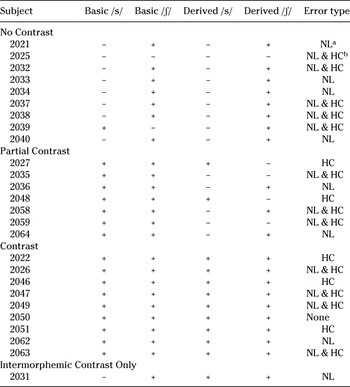
Within this context, to test Hypothesis 1, we consider each subject’s performance on the productions of the /s/–/ʃ/ contrast for the Korean speakers, as summarized in Table 1. Hypothesis 1 is supported if the data summarized in Table 1 show a derived environment effect whereby the Korean subjects show the contrast (a) in neither basic nor derived environments, (b) in basic but not derived environments, or (c) in both basic and derived environments. A pattern in which a subject has the contrast in derived environments but lacks it in basic environments is counter to the hypothesis.
Korean subjects’ performance and error types on the production of the /s/–/ʃ/ contrast according to the 80% criterial threshold

Note.
No contrast requires “−” in at least one Basic and one Derived column; Partial contrast requires “−” in at least one Derived column and “+” in both Basic columns; Contrast requires “+” in all columns.
a NL = native language.
b HC = hypercorrection.
In Table 1, subjects are listed in the first column and grouped according to the four acquisition patterns listed in (10). In columns 2 and 3, a subject’s performance on the production of the phones [s] and [ʃ] in the basic environment is shown as it pertains to the 80% criterial threshold. A + indicates that this performance reached the criterial threshold of 80%, and a − signifies that the performance fell below criterion. Columns 4 and 5 in the table show whether a subject’s performance on the sounds in the derived environment reached the 80% criterion. Column 6 reports the error types for each subject. If the subject made at least one NL error, this is designated as NL, and HC indicates that a subject made at least one hypercorrection error.
We interpret the results in Table 1 as being supportive of Hypothesis 1, in that 25 of 26 of the Korean subjects fell into the patterns of acquisition outlined in (10).Footnote 8 Nine of the subjects in Table 1 lacked the /s/–/ʃ/ contrast altogether; 7 of the participants exhibited the contrast in the basic environment but not in the derived environment; and 9 of the subjects had the contrast in both the basic and the derived environment. These are the three patterns of acquisition that are predicted if IL grammars are subject to the same considerations as primary language grammars.
More specifically, subject 2021 lacks the /s/–/ʃ/ contrast in both the basic and derived environments because, on the one hand, this subject did not produce [s] at the 80% level on words with word initial [s] before a high front vowel, and, on the other hand, the subject’s production of [s] did not reach the 80% level on words containing [s] in a derived environment. Most of the other subjects in this group exhibited a pattern of performance that was similar to that of subject 2021 in that they reached criterion on one of the two segments in each environment but did not reach criterion on both segments in either environment. The exception to this pattern is 2025, who did not perform to criterion on either segment in either environment. Subject 2027 falls into the Partial contrast group and exhibits the /s/–/ʃ/ contrast in the basic environment but not the derived environment because performance on [ʃ] did not reach the 80% level in this environment. Similar patterns of performance can be seen by the other six subjects in this group in which the /s/–/ʃ/ contrast is present in the basic environment, but the subject’s performance on [s], [ʃ], or both does not reach criterion in the derived environment. Subject 2022 exemplifies the Contrast group. This subject, as with others in this group, reached 80% criterion on productions of both [s] and [ʃ] in both basic and derived environments.
One subject, however, evidenced the pattern of contrast that was excluded under our hypotheses—namely, having the contrast in the derived environment but lacking it in the basic environment. In general, we expect that the derived environment effect holds for all IL grammars, and therefore it is troubling if the acquisition pattern of even one subject reflects the excluded pattern. Subject 2031 performed at the 50% level on [s] in the basic environment, and at the 85% level in the derived environment, contrary to expectation. The subject’s performance at the 50% level in the basic environment stems from producing both trials of the words seats and sink with what was discerned by the transcribers as a weakly palatal fricative, and from one production of see with an initial segment that the transcribers could not identify.
We offer two observations about the data from this subject. First, the word seat is an English borrowing in Korean, pronounced [ʃ’itʰɨ], with the meaning of “car seat,” and sink has also recently been integrated into the Korean lexicon, as [ʃ’iŋkʰɨ], with the meaning of “(kitchen) countertop” (see Iverson & Lee, Reference Iverson and Lee2006; Lee, Reference Lee2009, on the adaptation of English prevocalic /s/ as tense /s’/ in Korean). Thus, the subject’s transcribed rendering of seat and sink with (weak) palato-alveolar fricatives could be due more to the pronunciation of nativized lexical items still subject to NL phonological requirements than to the operation of an IL rule. Second, the authors listened to the sound files for both tokens of seat and sink that were the basis for the transcriptions. In each case, we perceived the segments in question as more nearly alveolar as opposed to the transcriber’s rendering as weak palatals. However, given the protocol that all transcriptions were to be done by research assistants at the Ohio State University, we did not waver from this principle and simply accepted the transcriptions as they were returned to us. In view of the two preceding observations, the basic point of this discussion, which surrounds the contrary data from subject 2031, is that his performance does not constitute persuasive counterevidence to our hypotheses.
An additional and important aspect of the results from subject 2031 relates to the question of whether data bearing on the status of IL grammars should be analyzed individually or aggregated. We have argued that our hypotheses can be adequately tested only with individual data. As a consequence, it is incumbent on us to address results such as those from subject 2031. However, had we grouped the data for the purpose of analysis, the countervailing force of this subject’s data would be diminished considerably.
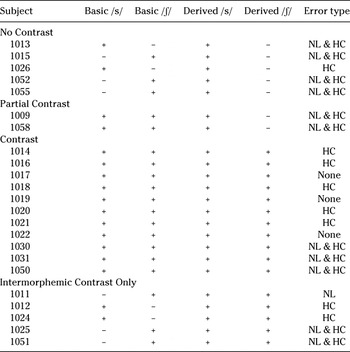
Turning to Hypothesis 2, we summarize the performance of the Japanese subjects in Table 2, which is laid out in a similar manner as that of Table 1. The first column lists the subjects, who are grouped according to their pattern of acquisition as derived from their performance on the production of [s] and [ʃ] listed in columns 2–5. Column 6, as in Table 1, indicates whether the subjects made NL or HC errors.
Japanese subjects’ performance and error types on the production of the /s/–/ʃ/ contrast according to the 80% criterial threshold

Note.
No contrast requires “−” in at least one Basic and one Derived column. Partial contrast requires “−” in at least one Derived column and “+” in both Basic columns. Contrast requires “+” in all columns.
The results in Table 2 support Hypothesis 2 in that the pattern of acquisition exhibited by the Japanese subjects does not show a derived environment effect. The learning of the /s/–/ʃ/ contrast for the Japanese subjects shows no sensitivity to morphological structure; rather, all four of the logically possible acquisition patterns with respect to basic and derived environments are attested, including five subjects in the Intermorphemic contrast only category.
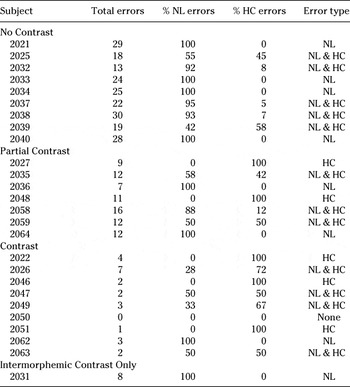
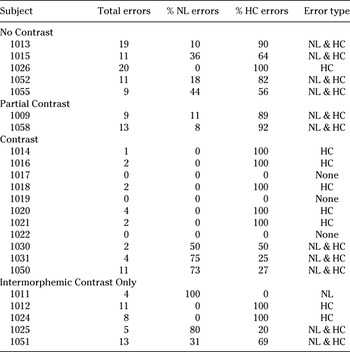
The final hypothesis to be tested, Hypothesis 3, predicts different error patterns for the Korean and Japanese subjects and therefore involves a comparison of the results in Tables 3 and 4 as well as of those in column 6 of both Table 1 and Table 2. Tables 3 and 4 give the details regarding the number and percentage of NL and HC errors made by the Korean and Japanese subjects. These are laid out identically: Table 3 provides the results for the Koreans and Table 4 shows them for the Japanese. The first column in both Tables 3 and 4 lists the subjects; column 2 gives the number of errors produced by a subject; and columns 3 and 4, respectively, list the percentage of NL errors and the percentage of HC errors for each subject. Each subject produced a total of 60 relevant words containing [s] and [ʃ] across the two elicitation trials: 10 in the basic environment × 2 elicitations, plus 20 in the derived environment × 2 elicitations, which equals 60. The maximum number of errors a subject could produce was 60. Given that one Korean subject, 2050, and three Japanese subjects, 1017, 1019, and 1022, produced no errors at all, their performance cannot be analyzed with respect to the hypothesis. Therefore, we consider these four subjects to be irrelevant for testing Hypothesis 3, and we will base our results with respect to Hypothesis 3 on the other 45 subjects.
Number and percentage of NL and HC errors for Korean subjects

Number and percentage of NL and HC errors for Japanese subjects

Hypothesis 3 is supported to the extent that the errors made by Korean subjects tend to be NL errors and the errors produced by the Japanese subjects tend to fall into the HC type. The rationale for this claim stems from the observation that HC errors are, in fact, an overextension of a contrast; this is a state of affairs that cannot occur until a subject evidences the contrast. Because Japanese arguably has a contrast between /s/ and /ʃ/, whereas Korean does not, Korean learners of English must acquire the /s/–/ʃ/ contrast before they can hypercorrect it, whereas the Japanese learners are in a position to hypercorrect the contrast from the outset of their exposure to it in the TL.
The results under column 6, Error type, in Tables 1 and 2 reflect this pattern of errors. Although the Korean subjects in the No contrast, Partial contrast, and Contrast groups show a mixture of NL and HC type errors, the subjects evidence the contrast to a greater extent as one moves down the groups in Table 1. The mixture of error types changes incrementally from predominantly NL errors in the first group to a preponderance of HC errors in the third group. More specifically, all of the Korean subjects in the No contrast group exhibit NL errors, and four of the nine subjects evince only NL errors. The mixture in the Partial contrast group shows that two of the subjects made only NL errors, and two made only HC errors, and the remaining three subjects committed a combination of both error types. In the Contrast group, we see the mixture turn in the other direction, toward a higher rate of HC errors, with only a single subject making exclusively NL errors, three exhibiting only HC errors, and the remaining four subjects showing both NL and HC errors.
This same pattern that is supportive of Hypothesis 3 emerges when we consider the number and percentage of each error type shown in Table 3. The actual number of errors for the Korean subjects decreases markedly from the first to the third group: No contrast group (M = 23.1), Partial contrast group (M = 11.3), and Contrast group (M = 3.0). Although the No contrast subjects make HC errors, except for subjects 2025 and 2039, this error type amounts to a small percentage of the total errors committed. The pattern is different for the Contrast group in which, aside from subject 2062, the HC errors are never less than the number of NL errors for any subject in this group.
Results for the Japanese subjects with respect to Hypothesis 3 are given in Table 4 and in column 6 of Table 2, and the pattern of errors differs from that observed for the Korean subjects. Eight of the 20 subjects (in Table 2) who made errors evince only HC errors, and 11 of the 12 remaining subjects produced both types of errors. Only one subject in Table 2 (i.e., 1011) made exclusively NL errors. However, in Table 4 the same pattern as in Table 3 emerges with respect to a decreasing number of NL errors in correlation with an increasing number of HC errors, proceeding down the table from the No contrast to the Contrast group. It is noteworthy in this error pattern that three Japanese subjects (i.e., 1026, 1012, and 1024) failed to reach criterion on the contrast solely because of HC errors, not because of any NL errors. These circumstances lead us to conclude that Hypothesis 3 is supported; in fact, the results reported here support all three of the hypotheses.
DISCUSSION
The major claim of this article is that differences in the acquisition patterns of the English /s/–/ʃ/ contrast on the part of learners whose NL is either Korean or Japanese can be shown to follow from two factors—one universal and the other language specific. The universal factor involves the derived environment effect on the application of a phonological rule according to whether it is allophonic or neutralizing. The language-specific factor is a single, relatively subtle distinction between Korean and Japanese with respect to the phonemic status of [s] and [ʃ]. We discuss each of these in turn.
The fact that 25 of the 26 Korean subjects exhibited states of acquisition that reflect the pattern outlined in (10) is accounted for if we assume that ILs are subject to the derived environment effect and consider that [s] and [ʃ] are allophones of the same phonemic class in Korean. The fact that the Japanese subjects, as charted in Table 2, do not exhibit an acquisitional pattern sensitive to morphological structure follows from the analysis that [s] and [ʃ] stand in phonemic opposition in this language, on the assumption, again, that the grammars of ILs and primary languages are governed by the same principles.
The second salient point is that the distinct acquisition and error patterns of the Korean and Japanese subjects stem from key differences between their NLs—namely, that Japanese, but not Korean, maintains a contrast between [s] and [ʃ]. In this respect, the four divisions that are laid out in Table 2 for the performance of the Japanese speakers (i.e., No contrast, Partial contrast, Contrast, and Intermorphemic contrast only) are misnomers. We labeled these partitions in Table 2 to be parallel with those for the Korean speakers in Table 1; however, the Japanese speakers distinguish /s/ and /ʃ/ phonemically in their NL, and it seems clear from Table 2 that they also evidence the contrast in their IL. More specifically, with the single exception of subject 2025, the pattern of performance on the contrast in the derived environment for the Korean speakers is the inverse of that for the Japanese speakers. Whereas the Korean subjects (except 2025) reach criterion in their performance on [ʃ] in the environment before [i] but not on [s], the Japanese speakers do the opposite and achieve targetlike productions on [s] before [i] but err in some cases on [ʃ]. Because the Japanese subjects hypercorrect with respect to the pronunciation of target [ʃ] before [i] and because hypercorrection errors can occur only if a subject already maintains the relevant contrast elsewhere, we must conclude that the Japanese speakers listed under No contrast in Table 2 do, in fact, have the contrast. Thus, the Korean participants listed under No contrast in Table 1 do not reach criterion on their productions of [s] because they are applying their NL allophonic rule to TL words. The Japanese subjects listed under No contrast in Table 2, however, fail to reach criterion on [ʃ] because they are not applying their NL rule that neutralizes /s/ with /ʃ/ in the NL; instead, the Japanese subjects in some instances hypercorrect [ʃ] to [s] before the high front vowel rather than produce the palatalized segment that regularly occurs in this environment in the NL. This pattern is true also for the Japanese participants listed under Partial contrast in Table 2.
Finally, it is important to note in this context that the relevant differences between Korean and Japanese are phonological and not phonetic and thus are abstract and not superficial. That is, the IL performance differences are not based on the properties of [s] versus [ʃ], which are phonetically parallel in the two languages but rather center on the familiar—albeit relatively abstract—notion of contrast for which there are no superficial or phonetic correlates. Interlanguage grammars, accordingly, can be adequately characterized only by invoking the same constructs and abstractions as are necessary to represent the grammars of primary languages.
CONCLUSION
This article has reported results from a study on the production of the English /s/–/ʃ/ contrast by participants from two NL backgrounds, Korean and Japanese. Although both languages have the sounds [s] and [ʃ], the analysis of these segments as allophones of the same phoneme in Korean but of different phonemes in Japanese leads to different paths of acquisition and the production of distinct error patterns, all of which are predictable on the basis of the NL phonology.
APPENDIX
Target words used for eliciting the [s]–[ʃ] contrast: