BACKGROUND
The influence of the ward atmosphere on the treatment of psychiatric inpatients has been acknowledged for decades. The psychological, social, and physical aspects of the ward milieu affect treatment outcomes and patient satisfaction (Friis, Reference Friis1986; Melle et al., Reference Melle, Friis, Hauff, Island, Lorentzen and Vaglum1996; Middelboe et al., Reference Middelboe, Schjodt, Byrsting and Gjerris2001). Positive experiences from admissions in psychiatric departments are considered an indicator of the quality of the healthcare services and can have positive effects on treatment such as increased compliance and cooperation. Having positive experiences may also increase the probability that patients take advantage of these services if a need for psychiatric healthcare arises later (Prince, Reference Prince2006; Svensson & Hansson, Reference Svensson and Hansson2006).
Both psychiatric acute units and psychiatric intensive care units (PICUs) focus on acute treatment, function, and behavioural disturbances. Psychopharmacology (Cornwall & Scott, Reference Cornwall and Scott1996; Raja & Azzoni, Reference Raja and Azzoni2000), different forms of psychotherapy (Crowhurst & Bowers, Reference Crowhurst and Bowers2002; O'Brien & Cole, Reference O'Brien and Cole2003), and a therapeutic milieu are cornerstones of the treatment. Different levels of segregation are commonly used both as an emergency management procedure and a treatment technique (Vaaler et al., Reference Vaaler, Morken, Flovig, Iversen and Linaker2006). Different cultures have varying attitudes toward and procedures for segregation of behaviourally disturbed patients. In some countries seclusion is practised by placing the patient alone in a padded room. Norwegian segregation practice differs by placing patients separately in locked areas with staff. In these seclusions areas the patients are never alone. The principles of stimulus reduction and segregation from other patients are similar to other segregation settings. There are indications that this practice is effective (Vaaler et al., Reference Vaaler, Morken, Flovig, Iversen and Linaker2006; Vaaler et al., Reference Vaaler, Morken and Linaker2005).
Secluded patients themselves have expressed a desire for more contact with staff during seclusion, the elimination of coercion and stigmatising conditions, and unlocked and more comfortable seclusion rooms (Hammil, Reference Hammil1987). Other investigators have addressed the need for innovative approaches to PICU patients, such as ‘extra care areas’ away from the main clinical areas, more non-confrontational nursing approaches that allow expression of anger and confusion, and the need for personal space within a safe, secure, and stimulus-controlled setting (Crowhurst & Bowers, Reference Crowhurst and Bowers2002; Jeffery & Goldney, Reference Jeffery and Goldney1986).
AIMS
The primary aims of the present study were to describe and explore patients’ perceptions of their stay at a Norwegian seclusion area. Our focus was on the patients’ experience of having received help and support from the staff, respectful treatment, and information regarding effects and side effects of medication, and their feelings of security. Secondly, we wanted to explore the relationship between patients’ characteristics and their experiences during their stay in the seclusion area.
METHOD
Participants
The acute psychiatric department of St Olav’s University Hospital has a catchment area of 140,000 inhabitants both from the city of Trondheim (50%) and rural areas (50%) in Sør-Trøndelag County, Norway. Approximately 600 patients above 18 years of age suffering from acute psychiatric conditions are admitted annually. Norwegian acute psychiatric emergency services are publicly funded and available to everyone. All the patients in the catchment area are admitted to this department. Acute admissions to other psychiatric hospitals occur only if inhabitants temporarily reside outside the catchment area when the need for acute admission arises.
In the periods 13th November 2000 to 25th March 2001, and 1st October 2001 to 21st March 2002, 56 and 62 patients respectively were included. All patients were included except those with excessive dementia, mental retardation, autism, or lack of language skills in Norwegian or English. Immediately after discharge from the seclusion area the patients were invited to rate their treatment satisfaction on an eight-item visual analogue scale with scorings of 0–10.
Among 118 admittances, 53 (45%) returned complete questionnaires, 62 (53%) did not want to participate, and 3 (3%) returned incomplete questionnaires.
Legal basis for a voluntarily admitted patient to be restricted to a locked area
In Norway, the criteria for involuntary admissions are different to those in some other countries (Nijman et al., Reference Nijman, Merckelbach, Evers, Palmstierna and à Campo2002), where forced hospitalization only occurs when a patient’s behaviour constitutes a direct and clear danger to the patient or others. Norwegian law extends this concept to allow involuntary admissions in other cases of severe mental illness based on the need of treatment.
Patients are admitted to the seclusion area based on the clinical conditions regardless of admittance status. These clinical conditions are: a need for close observation, reduction of stimuli, control of behaviour, or the patient’s own wish. Patients admitted voluntarily are free to leave the seclusion area and the hospital at any time.
The study ward with the seclusion area
The study ward consists of an ordinary closed ward area (310 m2) and a seclusion area (190 m2). The main entrance leads to the ordinary area of the ward. A locked door separates the seclusion area from the ordinary area of the ward.
The seclusion area consists of two wings with sitting room, bathroom, WC, and two single patient rooms in each. The wings are separated by an entrance, a dining room and a staff room in the middle. Two to four patients and two to three nurses are present in the seclusion area. The patients stay mostly in the wings with nurses, and contact with other patients is limited. The seclusion area thus limits emotional and sensory stimuli and provides segregation from other persons.
Procedure and ethical considerations
All scale ratings were done by specially trained nurses. At admittance the physician on duty evaluated the patient’s psychiatric, medical, and general condition, and assessed the patients’ need and reason for staying in the seclusion area. The patient’s experiences were assessed at discharge from the seclusion area with an eight-item treatment satisfaction VAS-scale. Ethical approval was obtained from the Regional Medical Ethical Committee, Mid-Norway, and Norwegian Social Sciences Services.
Measures
Legal status for hospitalization and length of stay in the seclusion area
The legal status of admissions was split between voluntarily (volunteer) or involuntarily (coercion) admitted patients. The length of stay in the seclusion area was noted as the number of days from the date of admission to transfer from the seclusion area.
Diagnoses
Diagnoses according to ICD-10 ‘Diagnostic criteria for research’ (WHO, 1993) were set by consensus of the department’s staff, including at least two specialists in psychiatry or clinical psychology.
PANSS
The Positive and Negative Syndrome Scale (PANSS) is a 30-item instrument that evaluates the presence/absence and severity of symptoms (Kay et al., Reference Kay, Fiszbein and Opler1987). The instrument has operational criteria for conducting a 30–40-minute, semi-structured interview and detailed rating criteria for each item. The PANSS total positive scale scores, total negative scale scores, and total general psychopathology scale scores were noted. PANSS is used widely in psychiatric research and has established inter-rater, test-retest, and internal reliability, and internal, external, and construct validity (Santor et al., Reference Santor, Ascher-Svanum, Lindenmayer and Obenchain2007; Van den Oord et al., Reference Van den Oord, Rujescu, Robles, Giegling, Birrell, Bukszar, Murrelle, Moller, Middleton and Muglia2006). Usually the time criterion in PANSS assessments is the previous week, but because of the fast changes in symptoms during the stay in the seclusion area, we chose the past 24 hours.
GAF-S
GAF-S is based on DSM-IV’s Global Assessment of Functioning (GAF). In 1998, Karterud and colleagues constructed a GAF Split Version Scale that was divided into a two-item scale measuring symptoms (GAF-S) and social and occupational functioning (GAF-F) (Pedersen et al., Reference Pedersen, Hagtvet and Karterud2007). GAF is an observer-based rating scale with a scoring manual divided into 10 main sections, each with a general description, examples, and keywords for the symptoms and functioning level it represents on the scale. Both reliability and validity are satisfactory (Yamauchi et al., Reference Yamauchi, Ono, Baba and Ikegami2001).
The patient rated treatment satisfaction VAS-scale
This questionnaire developed by an expert group from St. Olav’s University Hospital, Østmarka (Vaaler et al., Reference Vaaler, Morken and Linaker2005), contains major item traits from known/validated questionnaires concerning patients’ experiences. Two specific items measuring the patients’ reaction to the interior decoration and how it affected them were published previously (Vaaler et al., Reference Vaaler, Morken and Linaker2005).
The present paper reports their experiences with the help received, support from the staff, sense of respectful treatment, information on effects of medication, and their feeling of safety at the seclusion area on five different visual analogue scales (VAS), each 100 mm long. Each scale covers one experience. Examples of the questions are:
• How satisfied were you with the help you got for your problems?
• How was the support you got from the staff while you were in the seclusion area?
• How respectfully were you treated in general?
• How satisfying was the information given to you about effects and adverse effects of the medication received while you were in the seclusion area?
• How secure did you feel while you were staying in the seclusion area?
Statistical analysis
Statistical analysis of the data was performed using SPSS, version 14 (SPSS, 2006). Background data (demographic data and length of stay) for all patients admitted to the seclusion area (respondents and non-respondents) were analysed by chi-square tests. A p-value of <0.05 was considered statistically significant.
The legal status (volunteer/coercion) of the study participants was described with chi-square tests and T-tests for categorical data and continuous data, respectively. The length of stay was dichotomised according to the median (four days). The diagnoses were categorised as either schizophrenia (DSM-IV F 20.00–29.9) or other diagnoses.
The VAS-measured patient experiences were not normally distributed, but instead were skewed to the left, with a long left tail caused by isolated small values. The age and PANSS score were skewed to the right, with a long right tail caused by isolated large values. In order to fulfil normal distribution criteria, distributions were power transformed: skew to the left was corrected by raising the variable to a power >1 (e.g. squaring). Conversely, skew to the right was corrected by raising the variable to a power <1 (e.g. taking the square root). After power transformation, the two groups were more nearly equal and subsequently analysed with T-tests. The overall patient experience of the seclusion area was calculated from forms with ≥80 % (4 of 5) of the items completed. Cut-off points were set for positive responses (single items ≥66 mm; overall experience ≥330 mm), neutral responses (single items 34–65 mm; overall experience 166–329 mm) and negative responses (single items ≤33 mm; overall experience ≤165 mm).
Linear regression analyses, crude and adjusted, were used to assess associations between demographic variables, diagnoses, legal status, and the overall patient experience. Age was categorised according to quartiles. Female gender, legal status as a volunteer, diagnoses other than schizophrenia, and youngest age category were used as reference values. The criteria for entry of independent variables into the adjusted multivariate regression analyses was based on the results from the crude analysis with a p-value <0.2. A forced-entry method was used for the variables that satisfied the p-value <0.2 criterion.
RESULTS
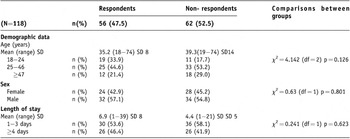
Characteristics of the respondents and non-respondents are shown in Table 1.
Demographic characteristics of respondents and non respondents

Estimated in cross tabulations by chi square. df= degrees of freedom. SD= standard deviation.
We found no differences between respondents and non-respondents regarding age or sex distribution or in proportion with a stay of more than three days in the seclusion area.
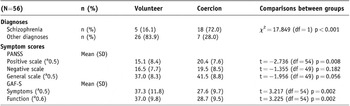
The characteristics of the respondents according to legal status upon admission (volunteer or coercion) are shown in Table 2. More than half of the respondents (31/56, 55 %) were admitted voluntarily.
Characteristics of the respondents according to legal status upon admission

Estimated in cross-tabulations by chi-square and independent sample T-test (2-tailed). apower transformed to meet normal distribution criteria; number indicates power used. df= degrees of freedom. SD= standard deviation. Significance level p≤ 0.05.
Twenty-three (41 %) of the respondents were diagnosed with schizophrenia. More respondents diagnosed with schizophrenia were admitted under coercion (p < 0.001). Differences according to legal status were statistically significant for PANSS positive symptom scale, GAF-S, and GAF-F (p < 0.05) while the PANSS general scale did not reach statistical significance (p = 0.056). Overall, the PANSS and GAF scores showed a more severe morbidity among respondents admitted under coercion.
Description of patient experiences by legal status
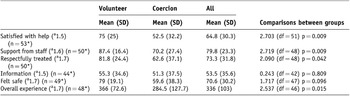
Most of the mean scores of patient experiences measured after their stay at the seclusion area were positive (≥66 mm) with regard to support from staff, respectful treatment, and feeling safe (Table 3). Also, their overall patient experience was positive (≥330 mm).
Mean level of experience ratings from VAS scores according to legal status at admission

Estimated by independent sample T-Test (2-tailed). apower transformed to meet normal distribution criteria; number indicates power used. df=degrees of freedom. SD=standard deviation. Significance level p ≤ 0.05. *number of respondents considered in the equation. The means and SD of the table are of the original variables.
The respondents that were admitted voluntarily reported significantly better experiences with regard to the help received, support from the staff, and respectful treatment. Both voluntarily admitted patients and patients admitted under coercion rated the support from staff positively. Information received on effects/side effects of medication scored lowest in both groups, but none of the scores for either group were negative.
Association between overall patient experience and patient characteristics
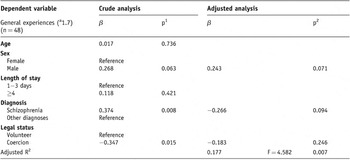
A multivariate linear regression model built on crude analyses between the overall experience and a description of patients is shown in Table 4. The adjusted model was estimated to account for 17.7% of the variance in responses (F = 4.582, p = 0.007). When controlling for the other variables, the equation did not find statistically significant associations between patient experiences and gender, diagnosis, or legal status (all p-values >0.05).
Factors potentially associated with overall experiences

Estimated by bivariate and multivariate linear regression. apower transformed to meet normal distribution criteria; number indicates power used. Significance level p ≤ 0.05. ß=unstandardized coefficient. p1=statistical significance bivariate linear regression. p2=statistical significance multivariate linear regression.
DISCUSSION
The purpose of the present study was to explore patients’ perceptions of their stay in a Norwegian seclusion area. This study is from 2002. However, there is no reason to believe that a recent data collection would have appeared to be much different. The working routines in the department are still the same, and so we think that the findings of this study are highly relevant. The main finding in the present study is that the patients generally viewed their stay as positive. The three single items (support from the staff, a sense of respectful treatment, and feeling safe at the seclusion area) were assessed as positive, while the patients’ experience of having received help and information regarding medication was evaluated as neutral. In a previous study the main conclusions were that Norwegian seclusion areas are efficient in reducing both behaviours associated with violent and threatening incidents, and the actual numbers of such incidents, in acutely admitted, behaviourally disturbed psychiatric patients (Vaaler et al., Reference Vaaler, Morken, Flovig, Iversen and Linaker2006). Therefore, there is reason to assume that Norwegian seclusion areas are both clinically effective and acceptable to the patients.
Voluntarily admitted patients reported mostly positive experiences while the patients admitted under coercion reported more neutral experiences. Among the respondents, a significantly greater number of patients admitted under coercion were diagnosed with schizophrenia than voluntarily admitted patients. Neither the diagnosis of schizophrenia nor the legal status at admission was significantly associated with the overall patient experience. The stay in the seclusion area involves locked doors, restrictions on daily activities, and loss of autonomy. In spite of this the patients’ level of positive responses was high. One explanation may be that an adaptation to the situation occurs during the acute phase of the severe psychiatric condition. People seem to have a high capacity for adapting to new situations and their expectations may adjust to the reality of the situation. Additionally, the positive aspects of the experiences may overshadow the negative ones. The recovery that occurs prior to the transfer from the seclusion area might bring about relief and an increased insight that influences the experience in a positive way. The definition of patients’ experiences are tied to the relationship between the patient’s expectations of the health service and the service rendered (Crow et al., Reference Crow, Gage, Hampsom, Hart, Kimber, Storey and Thomas2002). The patient’s experiences may provide indirect information concerning the relationship between the expectations for services and the actual services rendered. However, Norwegian seclusion areas represent an alternative way to supply the needs and desires of patients who have experienced different psychiatric acute settings (Crowhurst & Bowers, Reference Crowhurst and Bowers2002; Hammil, Reference Hammil1987; Jeffery & Goldney, Reference Jeffery and Goldney1986). These aspects may be reflected in the patients’ evaluations.
Findings according to single items
Help received
In the present study, the patients rated their satisfaction with help received positively (volunteer) and neutrally (coercion). These findings are consistent with earlier studies. The majority of patients who rate satisfaction with help and care highly belong to a majority of patients who give generally high scores (Habibis et al., Reference Habibis, Schneider, Hazelton, Bowling and Davidson2002; Poulsen et al., Reference Poulsen, Sondergard, Hansen and Lindhardt2005; Svensson & Hansson, Reference Svensson and Hansson2006), while patients who were admitted under coercion gave lower scores (Bramesfeld et al., Reference Bramesfeld, Wedegartner, Elgeti and Bisson2007; Kuosmanen et al., Reference Kuosmanen, Hatonen, Jyrkinen, Katajisto and Valimaki2006; Leavey et al., Reference Leavey, King, Cole, Hoar and Johnson-Sabine1997; Sørgaard, Reference Sørgaard2007).
Support from staff
Support from staff obtained the highest scores in the present study, both from voluntarily and involuntarily admitted respondents. These findings are in accordance with previous studies, showing that the development of a good relationship and communication with staff is highly estimated by respondents experiencing inpatient psychiatric care (Bramesfeld et al., Reference Bramesfeld, Wedegartner, Elgeti and Bisson2007; Johansson & Lundman, Reference Johansson and Lundman2002; Poulsen et al., Reference Poulsen, Sondergard, Hansen and Lindhardt2005; Svensson & Hansson, Reference Svensson and Hansson2006). The situation in the present seclusion area with a high staff-patient ratio provides the opportunity for one-to-one contact. The high level of positive responses may reflect this, resulting in the patients’ perception that the staff were supportive.
Respectful treatment
The single item of respect from staff scored well. This high appreciation for the relationship with staff contrasts with former qualitative research showing that psychiatric inpatients want to be shown more respect (Olofsson & Norberg, Reference Olofsson and Norberg2001). The patients’ dissatisfaction is linked to the staff’s lack of availability and time to listen (Wykes & Carroll, Reference Wykes and Carroll1993). The availability of staff in our seclusion area makes it possible for patients to address their frustrations, anger or confusion directly in this continuous therapeutic setting (Crowhurst & Bowers, Reference Crowhurst and Bowers2002; Jeffery & Goldney, Reference Jeffery and Goldney1986). This is probably most important in the patients’ perception of being treated respectfully.
Providing information
Information about the effects and adverse effects of medication received was graded as the least satisfying item. This agrees with the general findings of previous studies (Alexander, Reference Alexander2006; Poulsen et al., Reference Poulsen, Sondergard, Hansen and Lindhardt2005; Svensson & Hansson, Reference Svensson and Hansson2006). Insufficient information is often given by informal routines that lack clear responsibilities (Leavey et al., Reference Leavey, King, Cole, Hoar and Johnson-Sabine1997). The severity of the patient’s psychiatric condition may limit information giving and receiving during a patient’s stay in the seclusion area, especially when the patient experiences reduced endurance and concentration. Since sufficient information is of major importance to achieve a patient’s involvement, the results indicate that there is much room for improvement to achieve routines that promote informed users of the services. This requires special attention to information giving, both from the staff and at the organizational level.
Safety
The feeling of safety during a stay at the seclusion area was rated positively by voluntarily admitted respondents and neutrally by respondents admitted under coercion. The physical safety of patients and staff is important and at the same time represents a challenge in PICUs with selection of patients dominated by fluent psychiatric symptoms and behavioural dyscontrol (Dix, Reference Dix2005).
Creating a calm atmosphere that gives the patients a subjective sense of safety is even more challenging. Human contact is known to make people feel more secure when subjected to coercion (Olofsson & Norberg, Reference Olofsson and Norberg2001). In the Norwegian seclusion areas patients are never alone. This may be an important factor in the sense of safety felt by the patients in these facilities.
Methodological considerations
There are some limitations to this study. Firstly, the patient-rated treatment satisfaction VAS-scale was completed by only 44 % of the patients. One of the reasons for the low figures was that the scale was administered immediately following the patients’ discharge from the seclusion area and many still suffered from substantial symptom pressure. This reflects some of the problems with rating scales. The patients’ ability to self rate is limited due to their psychiatric conditions and affected cognitive functions in an acute psychiatric ward (Linaker & Moe, Reference Linaker and Moe2005). Secondly, a low participation rate may introduce selection bias; those with more divergence between expectations of the service and the service rendered may be non-responders more often. However, the age, gender, and length of stay for the participants were not different from the non-participants and previous studies obtained equally low and/or lower participation rates (Bramesfeld et al., Reference Bramesfeld, Wedegartner, Elgeti and Bisson2007; Johansson & Lundman, Reference Johansson and Lundman2002; Poulsen et al., Reference Poulsen, Sondergard, Hansen and Lindhardt2005; Svensson & Hansson, Reference Svensson and Hansson2006). Thirdly, the relatively small sample size may have reduced the power of the study. In the linear regression model the use of forced-entry method for variables that satisfied the criterion of p < 0.2, is the reason for the model with no significant predictors to explain 17.7% of the variance.
Previous studies with larger sample sizes have found statistically significant associations between age, gender, and diagnosis and the overall patient experience (Greenwood et al., Reference Greenwood, Key, Burns, Bristow and Sedgwick1999). Nevertheless, there are several strong points that should not be overlooked. First, the psychometric instruments used in this study (PANSS and GAF) are robust and validated instruments. Second, the daily routines of the department changed as little as possible during the study process to avoid influencing the results. The admissions, flow of patients, treatment, and staff resources were unaltered. The same staff treated the responders and the non-responders thus limiting environmental differences between the groups.
In conclusion, patients experienced their stay in the seclusion areas as positive. The patients that were admitted voluntarily reported significantly better experiences with regard to the help received, support from the staff, and respectful treatment.