Language is a social phenomenon and, as such, context plays an important role for language acquisition (Vygotsky, Reference Vygotsky1978; Yont, Snow, & Vernon-Feagans, Reference Yont, Snow and Vernon-Feagans2003). Toy play and book-reading are dyadic contexts, usually between caregiver and child, that have often been used to study child language (e.g., Hoff-Ginsberg, Reference Hoff-Ginsberg1991; Salo et al., Reference Salo, Rowe, Leech and Cabrera2016; Yont, Snow, & Vernon-Feagans, Reference Yont, Snow and Vernon-Feagans2003). Yet, they might create different types of language input from the caregiver, for example, with regard to focus on action (use of verbs) versus objects (use of nouns) (Choi, Reference Choi2000; Yont et al., Reference Yont, Snow and Vernon-Feagans2003). The literature reports differences in child-directed speech (CDS) and/or children's language production across the two contexts, but findings remain inconsistent and seem to depend on children's age and language spoken. The present study explored cross-contextual and cross-linguistic comparisons of features of speech among German and US-American mothers with their 24-month-olds and of children's language production.
Language acquisition is embedded in the socio-cultural context (McGregor, Munro, Chen, Baker, & Oleson, Reference McGregor, Munro, Chen, Baker and Oleson2018) that influences opportunities for language learning (Hoff, Reference Hoff2006). How parents organize communicative interactions with their children is influenced by cultural belief systems about child-rearing (Barza, Reference Barza2014; Harkness et al., Reference Harkness, Super, Bermudez, Moscardino, Rha, Mavridis and Olaf Zylicz2010; Keller et al., Reference Keller, Lamm, Abels, Yovsi, Borke, Jensen and Chaudhary2006). In this study, countries were not selected to maximize cultural differences but to allow for a comparison of features of speech in mother–child conversations. This was based on arguments that too large differences, for example in how and how much cultures expect children to talk, may limit what could be learned about language acquisition from comparative work (Hoff, Reference Hoff2006). Germany and the United States (US) are often referred to as individualistic cultures (Keller et al., Reference Keller, Lamm, Abels, Yovsi, Borke, Jensen and Chaudhary2006; Keller & Demuth, Reference Keller and Demuth2006). Children are given high levels of personal control and are frequently treated as quasi-equal communication partners in adult–child conversations. Nevertheless, comparisons reveal differences in ideas about caregiving between Germany and the US (Keller & Demuth, Reference Keller and Demuth2006). Interestingly, one study showed that linguistic features reflected mothers’ representations of parenting ideas (Hentschel & Keller, Reference Hentschel and Keller2006). It is, thus, possible that input mechanisms for language learners differ across the two socio-cultural contexts. These, in turn, may result in differences in language production.
In addition, different situational contexts provide different language experiences (Salo et al., Reference Salo, Rowe, Leech and Cabrera2016; Soderstrom & Wittebolle, Reference Soderstrom and Wittebolle2013). Evidence suggests that toy play and book-reading contexts may generate different types of language input even within the same language (Choi, Reference Choi2000). Yet, empirical findings of cross-linguistic studies are inconclusive, with some finding more nouns than verbs in book contexts across groups (among English- and Mandarin-speaking caregivers of 19- to 23-month-olds; Gelman & Tardif, 1998, cited in Choi, Reference Choi2000), while others did not (among English- and Korean-speaking mothers of 18-month-olds; Choi, Reference Choi2000). Findings suggest that the examination of various contexts is crucial for understanding the mechanisms underlying language development (Choi, Reference Choi2000; Salo et al., Reference Salo, Rowe, Leech and Cabrera2016). Practically, such research can provide information for parents about engaging in stimulating communicative interactions in various everyday activities (De la Rie, Van Steensel, van Gelderen, & Severiens, Reference De la Rie, Van Steensel, van Gelderen and Severiens2018).
The most common approaches to the study of CDS and child language include parent reports and language samples from (naturalistic) interactions. The latter have higher ecological validity because interactions are an important context for children's language learning (Harris, Golinkoff, & Hirsh-Pasek, Reference Harris, Golinkoff, Hirsh-Pasek, Neuman and Dickinson2011). Different measures are used to assess expressive language, including counts of various word types (i.e., nouns and verbs), number of utterances, and unique words (DeThorne, Johnson, & Loeb, Reference DeThorne, Johnson and Loeb2005). Variability increases dramatically by two years of age, such as in the size of children's vocabularies, complexity of produced language structures, and communication skills (Bates, Dale, & Thal, Reference Bates, Dale and Thal1995; Hoff, Reference Hoff2006). Around the second birthday, children start to produce combinatorial speech (Bates et al., Reference Bates, Dale and Thal1995) and develop an understanding for grammar and the function of specific parts of speech (Langobardi, Spataro, Putnick, & Bornstein, Reference Langobardi, Spataro, Putnick and Bornstein2016), which is the reason for this study's focus on two-year-olds.
Multiple-word utterances are often analyzed with regard to lexical, syntactic, and pragmatic utterance complexity (Conti-Ramsden & Durkin, Reference Conti-Ramsden and Durkin2012). The mean length of utterance (MLU) is an established measure of grammatical and morphosyntactic utterance complexity (Brown, Reference Brown1973). An alternative is the average number of words per utterance (MLUw), which is easier to extract from language samples compared to MLU that uses the average number of morphemes per utterance. MLUw is sufficient for assessing utterance complexity (Ezeizabarrena & Fernandez, Reference Ezeizabarrena and Fernandez2018; Parker & Brorson, Reference Parker and Brorson2005). The literature recommends using MLUw in languages that differ in their amount of morphology, for example English and German (Snape & Leung, Reference Snape, Leung, Snape and Kupisch2017). Another frequently used variation of MLU is the mean length of the three longest utterances (LLU3) that reflects peaks of utterance complexity and is susceptible to differences in language input (Brown, Reference Brown1973; DeMaris & Smith, Reference DeMaris and Smith2017).
A growing body of research highlights the importance of assessing dialogue behavior in communicative exchanges (Hsu, Hadley, & Rispoli, Reference Hsu, Hadley and Rispoli2017; Rowe, Leech, & Cabrera, Reference Rowe, Leech and Cabrera2017). A common strategy is the assessment of wh-questions. Parents’ use of wh-questions may elicit more complex verbal responses from toddlers than simple yes/no questions and may thus help the child build more advanced language skills (Rowe et al., Reference Rowe, Leech and Cabrera2017). Additional behaviors that facilitate high-quality, back-and-forth communicative interactions include imitating, repeating, expanding, and scaffolding (Salo et al., Reference Salo, Rowe, Leech and Cabrera2016; Sénéchal, Cornell, & Broda, Reference Sénéchal, Cornell and Broda1995). All of these behaviors independently and jointly foster children's language learning (Rowe, Reference Rowe2008).
The present study reports a systematic comparison of various features of speech in mother–toddler interactions during toy play and book-reading in two socio-cultural contexts, Germany and the US. More specifically, two research questions were investigated: (1) How do features of speech (i.e., expressive language, utterance complexity, and dialogue behavior) in mother–toddler communicative exchanges differ across toy play versus book-reading, comparing German and US-American dyads? We addressed this question by comparing features of mothers’ and toddlers’ speech during each context within and across the two samples from Germany and the US. (2) How are features of mothers’ and toddlers’ speech related to one another? To address the second objective, we tested for associations between measures of mothers’ and toddlers’ speech and explored potential similarities or differences across situational and socio-cultural contexts.
Method
Participants
Seventy-six mothers and their toddlers from Germany (n = 39) and the US (n = 37) participated in the study. Participants in the US were recruited in New York City through flyers distributed at nursery schools and snowball sampling. Two dyads were excluded, resulting in a final analytical sample of 35 mother–toddler dyads (18 girls). Reasons for exclusion were failure to complete the activities and unintelligible child speech because of a pacifier. German participants were recruited in the city of Muenster using the address directory requested from the city's Residents Registration Office. Families with children in the targeted age were sent flyers; in addition, snowball sampling was used. Five dyads were excluded due to technical problems (n = 3) and unintelligible child speech because of a pacifier (n = 2). The final analytical sample included 34 German mother–toddler dyads (19 girls).
Children's mean age was 2;1 in the US sample (SD = 0;3) and 2;0 in the German sample (SD = 0;2). According to mothers’ reports, all children were typically developing. A demographic survey asked mothers to indicate their nationality and other languages spoken at home. Mothers and children in the German sample were German nationals who primarily spoke German at home (two mothers also spoke an additional language). In the US sample, 82% identified as Caucasian, 9% as Asian-American, 3% as African-American, and 3% as Hispanic. All mothers reported English as the primary home language (8 mothers also spoke an additional language). In both samples, half of the children were the first-born child. All families were from a middle-class socio-economic background. The level of maternal education was similar in both samples with, on average, 18;0 years of education (SD US = 3;7 years; SD GER = 2;8).
Procedure
Families who gave their written consent were visited at home by two female researchers. Mother and child were videotaped while engaging in toy play and book-reading activities. Toys (stuffed animals, wheeled toys, puppets) and the book were provided by the researchers. Based on prior research suggesting that language samples of a few minutes are enough to obtain a sufficient number and variation of utterances across contexts and languages (Choi, Reference Choi2000), we observed four minutes of mother–toddler interactions in both contexts. For toy play and book-reading, dyads were instructed to engage in the activity “however they choose to”. The book-reading context used the book From Head to Toe (Carle, 1997) (English original and German translation of the book are available in bookstores). The book provides labels for animals and body parts, and prompts readers to engage in imitating the actions described in the book. The book was selected because it was thought to prompt more CDS. Prior research found more CDS with two-year-old children using books with fewer words compared to traditional story-books (Noble, Cameron-Faulkner, & Lieven, Reference Noble, Cameron-Faulkner and Lieven2018). The book was novel to all dyads but one in the German and five in the US sample. The instruction avoided using the word ‘reading’, so that mothers were free to choose to do what they wanted / felt appropriate for their child. Mothers received monetary compensation for their participation and children were given a small toy.
Measures and coding
Videotapes from both situational contexts were transcribed at the level of utterances by trained researchers following a standard transcription manual (Leyva, Suchodoletz, Doering, Shroff, Hinojo, & Kärntner, unpublished observations) (see ‘Appendix’ for parts of an example transcript). Transcripts of the book-reading activity only included extra-textual speech (Melzi, Schick, & Kennedy, Reference Melzi, Schick and Kennedy2011). Five videotapes for each activity and sample (in total, 20 videotapes) were transcribed by two researchers for reliability purposes. Reliability (percent agreement) was calculated for words (Germany: 77%; US: 85%) and utterances (Germany: 85%; US: 85%).
Expressive language behaviors were measured by counts of word types (nouns, pronouns, and verbs), number of utterances, and unique words. Verbs, nouns, and pronouns were coded by two trained researchers (reliability: Germany: 89%, US: 84%). To account for individual differences, raw frequencies of word types and unique words were divided by the total number of utterances, thus resulting in proportional scores. MLUw and LLU3 assessed utterance complexity.
We used wh-questions as one measure of the level of dialogue behavior. In addition, dialogue-promoting behaviors (requesting, questioning, responding, repeating, and expanding) were coded at the utterance level by two researchers (reliability: Germany: 85%; US: 87%). A global score for dialogue-promoting behavior was created based on the temporal sequence of dialogue-promoting behaviors, ranging from 1 = low-quality exchange to 4 = high-quality exchange. Based on prior literature (Salo et al., Reference Salo, Rowe, Leech and Cabrera2016; Sénéchal et al., Reference Sénéchal, Cornell and Broda1995), mothers’ requests were coded as 1 because requests do not require a verbal response from the child. Mothers’ questioning, if not followed by a response from the child, was coded as 2. If a mother's question was followed by a response from the child it was coded as 3, indicating one back-and-forth exchange. A sequence of mother's question–child's response–mother's repetition/expansion was coded as 4, indicating a high-quality back-and-forth exchange. Dialogue-promoting behaviors were coded whenever they occurred in the language sample. For the analyses, an overall mean score was calculated.
Results
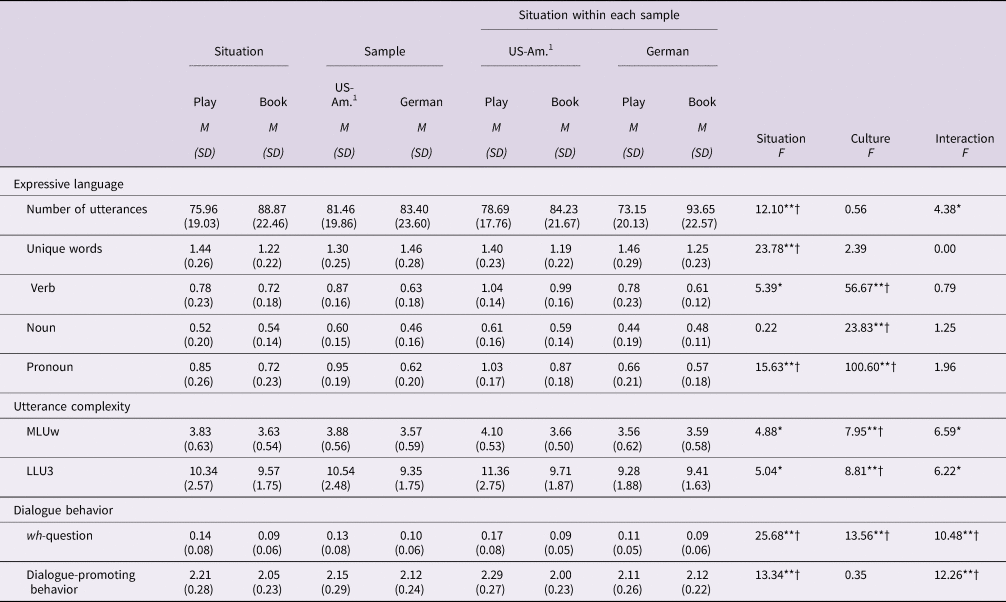
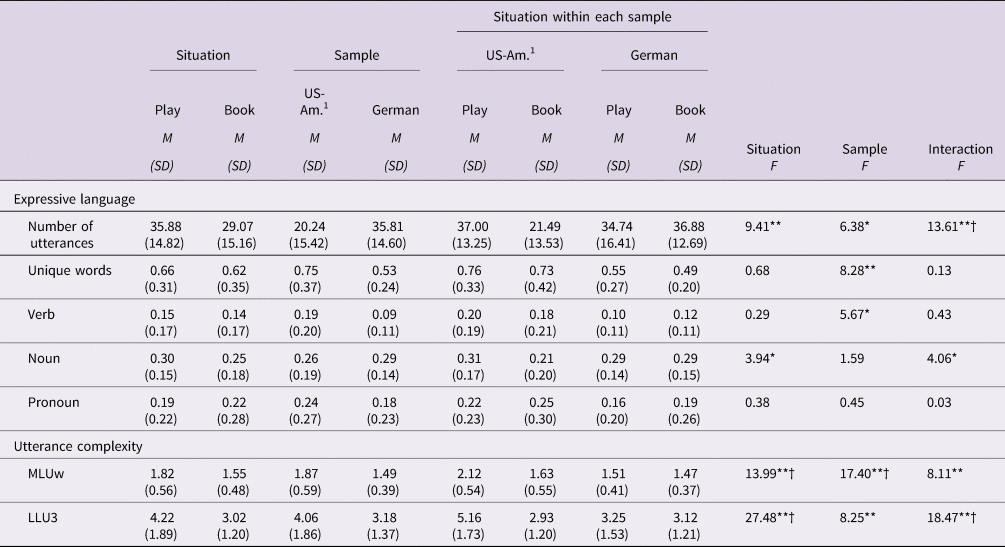
Descriptive information of all variables is presented in Tables 1 and 2. There were no significant differences between dyads where an additional language was spoken at home and dyads who spoke just one language. To compare features of speech across toy play and book-reading, 16 2 × 2 ANCOVAs were run (factor situational context: toy play versus book-reading; factor socio-cultural context: Germany versus US) (Tables 1 and 2). When an interaction of the two factors was detected, we tested for simple effects of the factor situational context at each level of the factor socio-cultural context. Next, partial correlations between measures of mothers’ and toddlers’ speech were run to explore associations for each situational and socio-cultural context. All analyses controlled for child age and gender, maternal education, and home language. Significance levels are indicated for p < .05, p < .01, p < .003 (Bonferroni correction), and p < .001.
Means, standard deviations, and statistical comparisons of mothers’ expressive language behavior, utterance complexity, and dialogue-promoting behavior

Notes. 1 US-Am. = US-American; * p < .05, ** p < .01; † significant after Bonferroni correction (p < .003); control variables: child age, child gender, maternal education, and home languages; all degrees of freedom were 126.
Means, standard deviations, and statistical comparisons for children's expressive language and utterance complexity

Notes. 1 US-Am. = US-American; * p < .05, ** p < .01; † significant after Bonferroni correction (p < .003); control variables: child age, child gender, maternal education, and home languages; all degrees of freedom were 126, except for child LLU3, which had a degree of freedom of 125 (one dyad was excluded due to an insufficient number of utterances).
Features of speech during toy play and book-reading within and across countries
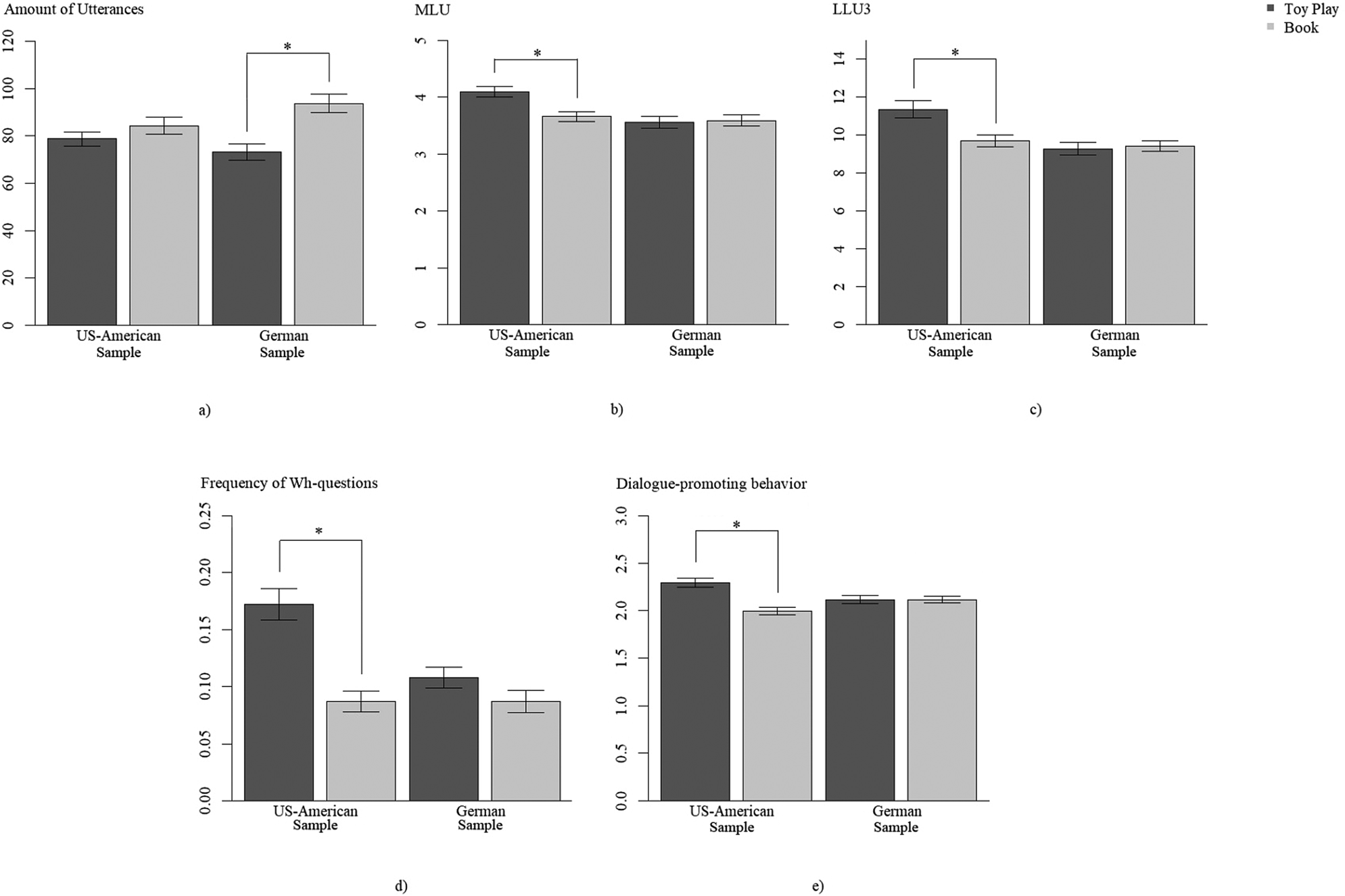
The total number of mothers’ utterances was significantly higher during book-reading compared to toy play. However, there was a significant interaction effect of situation and socio-cultural context (F(1,126) = 4.38; p < .05; Figure 1a). Utterance counts were significantly higher during book-reading than during toy play for German mothers, while the effect was not significant for US-American mothers (Table 1). Utterance complexity (MLUw and LLU3) was higher during toy play compared to book-reading, however, only for US-American mothers (MLUw: F(1,126) = 6.59; p < .05; LLU3: F(1,126) = 6.22; p < .05; Figures 1b & 1c). Furthermore, mothers in both samples had significantly higher proportions of verbs, pronouns, and unique words in the toy play context (verbs: M = 0.78, SD = 0.23; pronouns: M = 0.85, SD = 0.26; unique words: M = 1.44, SD = 0.26) compared to the book-reading context (verbs: M = 0.72, SD = 0.18; pronouns: M = 0.72, SD = 0.23; unique words: M = 1.22, SD = 0.22). Proportions of word types were generally higher for US-American mothers (verbs: M = 0.87, SD = 0.16; nouns: M = 0.60, SD = 0.15; pronouns: M = 0.95, SD = 0.19) than German mothers (verbs: M = 0.63, SD = 0.18; nouns: M = 0.46, SD = 0.16; pronouns: M = 0.62, SD = 0.20). Overall, mothers asked more wh-questions and had a higher dialogue-promoting behavior score during toy play than during book-reading. However, the difference between the two situational contexts was only significant for US-American mothers (wh-questions: F(1,126) = 10.48, p < .01; dialogue-promoting behavior: F(1,126) = 12.26, p < .003; Figures 1d & 1e).
Interaction effects between situational context and socio-cultural context for mothers’ features of speech. Error bars represent standard errors.

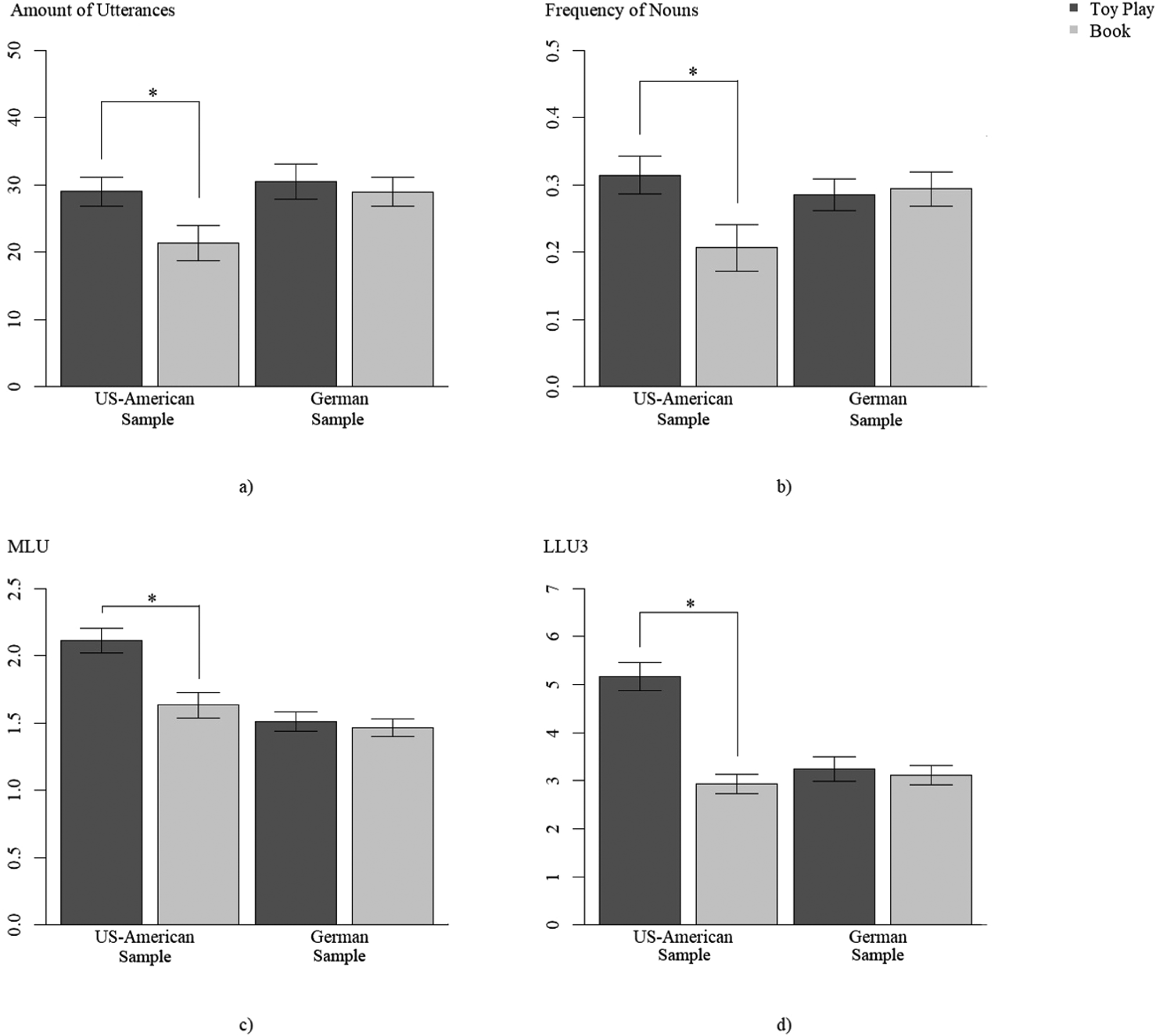
Children produced more utterances during toy play compared to book-reading, and German children produced more utterances than US-American children (Table 2). The difference between the two situational contexts was only significant for US-American children (Figure 2a), as indicated by a significant interaction effect of situation and socio-cultural context (F(1,126) = 13.61, p < .003). The proportion of nouns was also higher during toy play compared to book-reading; however, this was only significant for US-American children (F(1,126) = 4.06, p < .05; Figure 2b). In addition, the complexity of children's utterances was higher during toy play compared to book-reading (MLUw: F(1,126) = 8.11; p < .01, and LLU3: F(1,126) = 18.47; p < .003) and significant for US-American children only (Figures 2c & 2d). Additional effects of the socio-cultural context were found for the proportion of unique words (higher for US-American children [M = 0.75, SD = 0.37] than for German children [M = 0.53, SD = 0.24]), and the proportion of verbs (higher for US-American children [M = 0.19, SD = 0.20] than for German children [M = 0.09, SD = 0.11]).
Interaction effects between situational context and socio-cultural context for children's features of speech. Error bars represent standard errors.

Associations between features of mothers’ and toddlers’ speech
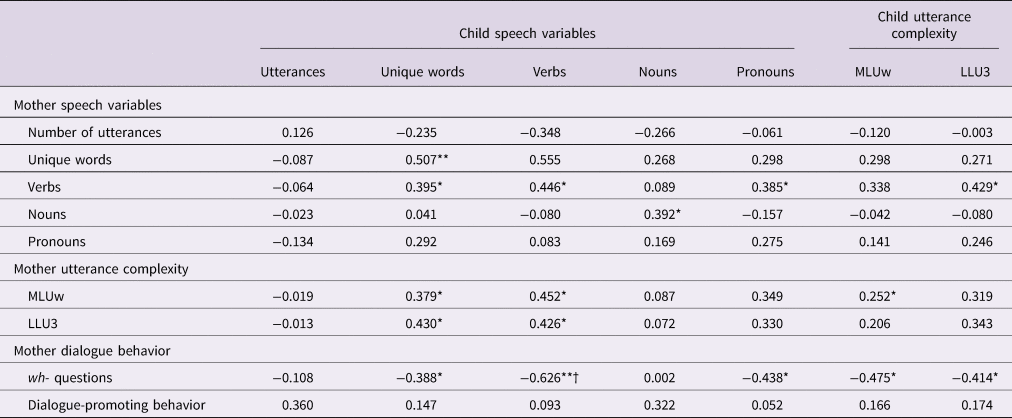
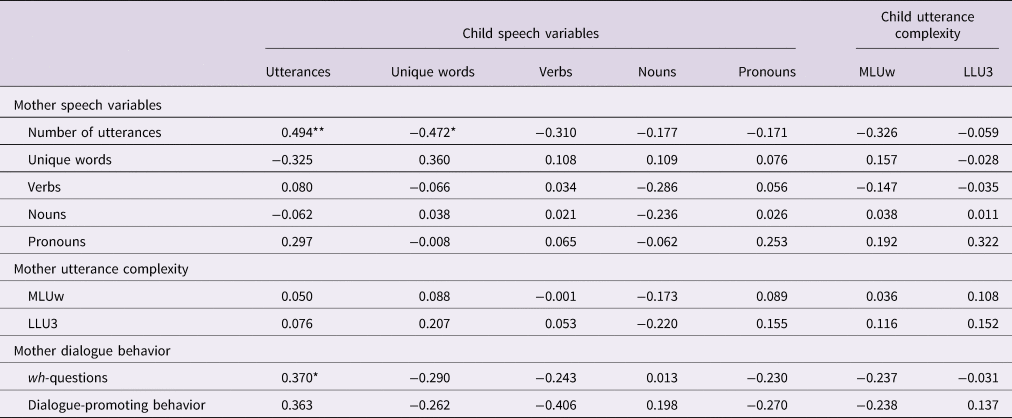
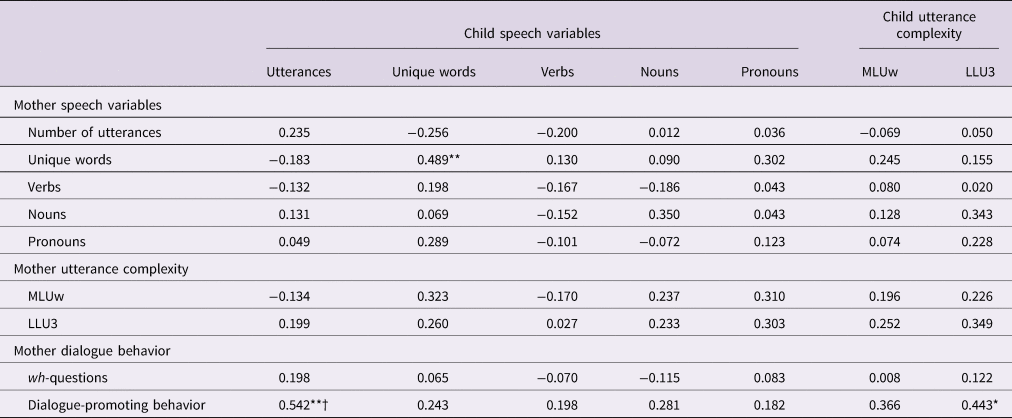
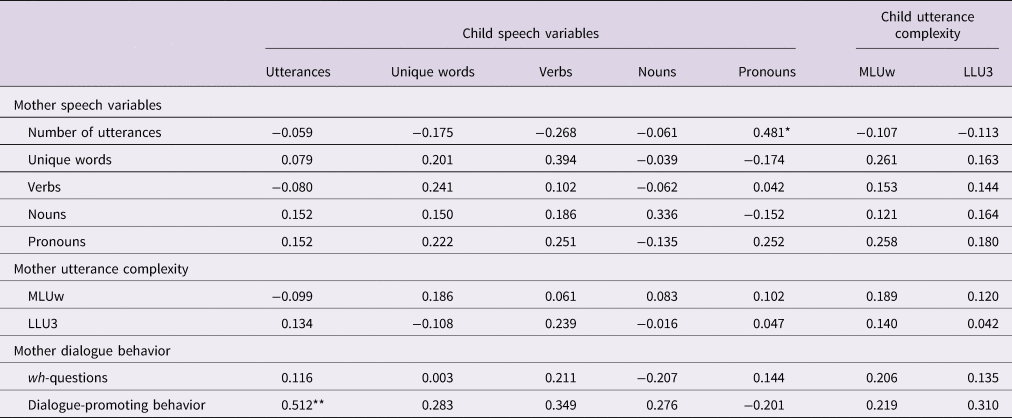
Measures of mothers’ and toddlers’ speech were correlated in the US-American toy play context (Table 3). Significant positive correlations were found between the proportion of unique words of mothers and of children, between the proportion of mothers’ verbs and of children's unique words, and between the proportion of mothers’ verbs and of children's verbs and pronouns. Mothers’ and children's noun proportions were positively associated with one another. Measures of mothers’ utterance complexity were positively correlated with the proportion scores of children's unique words, and verbs, and children's MLUw. Wh-questions were negatively correlated with all features of child speech, except the number of utterances and noun proportion. In the US-American book-reading context (Table 4), as well as in both German contexts (Tables 5 and 6), significant associations between mother and toddler speech were rarely found.
Partial correlations between children's and mothers’ features of speech in the toy play context: United States sample

Notes. * p < .05, ** p < .01; † significant after Bonferroni correction (p < .003); control variables: child age, child gender, maternal education, and home languages.
Partial correlations between children's and mothers’ features of speech in the book-reading context: US sample

Notes. * p < .05, ** p < .01; control variables: child age, child gender, maternal education, and home languages.
Partial correlations between children's and mothers’ features of speech in the toy play context: Germany sample

Notes. * p < .05, ** p < .01; † significant after Bonferroni correction (p < .003); control variables: child age, child gender, maternal education, and home languages.
Partial correlations between children's and mothers’ features of speech in the book-reading context: Germany sample

Notes. * p < .05, ** p < .01; control variables: child age, child gender, maternal education, and home languages.
Discussion
The current study investigated features of speech during mother–toddler interactions across toy play and book-reading activities, comparing two socio-cultural contexts: Germany and the US. Toy play and book-reading are dyadic contexts that are relevant to early language learning. Similar to previous research (Hoff-Ginsberg, Reference Hoff-Ginsberg1991; Salo et al., Reference Salo, Rowe, Leech and Cabrera2016; Yont et al., Reference Yont, Snow and Vernon-Feagans2003), results of the present study showed that features of speech differed across situational contexts. However, the pattern of results was inconsistent across the two socio-cultural contexts. The majority of situational differences in CDS were found in the US sample, with higher utterance complexity, more wh-questions, and higher dialogue-promoting behaviors during toy play compared to book-reading. Similarly, differences in children's language production between situational contexts were mostly found in the US sample, where children produced more, and more complex, utterances, and more nouns during toy play than book-reading. In contrast to prior research, we did not find consistent correlations between mother and toddler language variables, even given that the measures were taken during the same interaction. The majority of significant associations were found in the toy play context for the sample from the US.
Comparison of features of speech during mother–toddler interactions suggests context differences in CDS and in toddlers’ language production for the majority of language variables. Mothers provided more CDS of higher complexity and made more dialogue-promoting intents during toy play than during book-reading. Similarly, children produced more, and more sophisticated, utterances during toy play compared to book-reading. It is possible that the less structured context of toy play facilitates communicative interactions, whereas, during book-reading activities the interaction is more determined by the properties of the book (i.e., text and illustrations). This might be particularly true with children who are not yet literate and who depend on parental guidance in book situations (Yont et al., Reference Yont, Snow and Vernon-Feagans2003). Indeed, many story-books are controlled for language and intentionally present simplistic content.
Interestingly, cross-situational differences were mostly found for mothers and toddlers from the US but not from Germany. Differences in parental beliefs about how to best stimulate children's language development may explain the different pattern of context-specific variation (Barza, Reference Barza2014). There is a heightened focus on academic skill building in the early years among parents in the US (Bassok, Latham, & Rorem, Reference Bassok, Latham and Rorem2016) compared with a stronger focus on object play, social interactions, and exploration in Germany (Keller & Lamm, Reference Keller and Lamm2005). Therefore, mothers from the US may feel the need to structure their child's toy play for it to become a context for promoting emerging academic skills, resulting in higher CDS and child language production (Keller & Demuth, Reference Keller and Demuth2006). In contrast, mothers from Germany might view play more as a context to observe their child (Keller, Borke, Lamm, Lohaus, & Yovsi, Reference Keller, Borke, Lamm, Lohaus and Yovsi2011; Keller & Demuth, Reference Keller and Demuth2006) or to allow their child to guide and initiate the play, which may have been inconsistent with the act of labeling objects or actions that could elicit child talk in the play scenario. Book reading in the US may also render the child a more passive role as a listener compared to a more active role expected during play. Differences in findings between the samples highlight the need for more cross-country studies to better understand the role of context for language acquisition.
Alternatively, the different pattern of context effects across samples could reflect the dynamic interaction between mother and child that might lead to specific patterns of language input and production across situational contexts. Although we cannot draw causal conclusions from our data, it is possible that there are bi-directional effects of mothers’ CDS and children's language production (Damast, Tamis-LeMonda, & Bornstein, Reference Damast, Tamis-LeMonda and Bornstein1996). Yet, such reciprocal interactions may differ depending on the demands of a context. How a child responds to a specific context might influence mothers’ CDS, which in turn is likely to influence the child's subsequent language use. Longitudinal studies could shed light on variations in developmental trajectories of language use as a function of context.
With regard to our second research question that tested associations between mother and toddler language variables, we found that most of the variables were uncorrelated. The finding is in contrast to prior research, which suggests a very early onset of the link between CDS and children's language development (Yont et al., Reference Yont, Snow and Vernon-Feagans2003). An exception was the toy play context, for which we found some significant associations in the sample from the US, in line with previous studies showing that quantity and complexity of CDS relate to children's language skills (Hoff-Ginsberg, Reference Hoff-Ginsberg1991; Yont et al., Reference Yont, Snow and Vernon-Feagans2003).
Wh-questions are commonly assumed to be beneficial for child language production (Rowe et al., Reference Rowe, Leech and Cabrera2017; Salo et al., Reference Salo, Rowe, Leech and Cabrera2016). However, negative correlations between wh-questions and most features of child speech in the toy play context were found for the US sample. In an attempt to explain the unexpected findings, we ran a post-hoc correlation between the proportion of wh-questions and the dialogue-promoting behavior score. Results showed no significant association in the toy play context for the sample of mothers from the US (r(28) = .22, p = .24). A high dialogue-promoting behavior score indicates that a mother's question is followed by a response from the child. It is possible that mothers, despite asking frequent wh-questions, gave their child little room to express themselves in complex ways. In terms of stimulating children's language skills, this means that mothers should be encouraged to pose wh-questions and, importantly, allow the child ample time to reflect and respond. Benefits of wh-questions can only unfold if the child is given the opportunity to participate in communicative interactions and provide verbal responses (Rowe et al., Reference Rowe, Leech and Cabrera2017). Further research is warranted to better understand the input mechanisms that matter most for the language learning process.
There were very few significant correlations between mother and toddler language variables in our sample from Germany. The finding was unexpected, as one could assume that CDS should relate to children's language skills independent of the socio-cultural context. It is possible that the stronger emphasis on play, social interactions, and exploration among mothers from Germany might have resulted in them taking more of an observing role that is consistent with a holistic approach to parenting (Keller et al., Reference Keller, Borke, Lamm, Lohaus and Yovsi2011; Keller & Demuth, Reference Keller and Demuth2006). In contrast, mothers from the US emphasize a functionalistic approach to parenting that mainly implies stimulating the child's development (Keller & Demuth, Reference Keller and Demuth2006). Together with heightened expectations for school readiness at or before kindergarten entry in the US (Bassok et al., Reference Bassok, Latham and Rorem2016), such beliefs might have led mothers to be more strategically focused on language and encouraging the child to verbally attend to them. Yet, it is important to note that our interpretation remains speculative and further cross-country research is needed to investigate parental beliefs about their role in language learning.
There are several limitations that should be considered when interpreting the findings. First, due to the small sample size and other sample characteristics, significant differences and correlations may not have been detected. It is, however, also possible that not all of the detected differences and correlations were actually significant. Significance levels were also reported applying Bonferroni correction and it was found that significance could not be confirmed for some results after Bonferroni correction. In addition, we used a convenience sample of educated middle-class families. Thus, the findings may not generalize to other socioeconomic groups since variation in parents’ level of income and education have been linked to quantity and quality of CDS (Rowe, Reference Rowe2008; Rowe, Pan, & Ayoub, Reference Rowe, Pan and Ayoub2005). Second, the situational context did not happen naturally but was induced by the researchers, and the toy play context always preceded the book-reading context. While this is the case in many studies (Salo et al., Reference Salo, Rowe, Leech and Cabrera2016; Yont et al., Reference Yont, Snow and Vernon-Feagans2003), it is possible that context differences in CDS and children's language production emerged as a function of ‘warm-up’ effects. Furthermore, mothers and toddlers were given the toys and book which could have resulted in more talk related to the procedure than the actual play and reading. Relatedly, four minutes may not have been enough to observe general patterns of everyday language of mothers and toddlers which might have affected our findings (Pan, Rowe, Singer, & Snow, Reference Pan, Rowe, Singer and Snow2005). In addition, it is possible that the highly structured and repetitive book might have changed the communicative interactions thus limiting comparisons with previous studies using traditional story-books. The repeated action prompt might have resulted in the mother focusing on helping the child imitate the action rather than on language. Finally, our study could only focus on mother–toddler language samples. However, it is well established that children's language acquisition is also affected by other caregivers, such as fathers (Salo et al., Reference Salo, Rowe, Leech and Cabrera2016; Schwab, Rowe, Cabrera, & Lew-Williams, Reference Schwab, Rowe, Cabrera and Lew-Williams2018), and other caregiving contexts, such as daycare (Li, Farkas, Duncan, Burchinal, & Vandell, Reference Li, Farkas, Duncan, Burchinal and Vandell2013). In future studies, additional environmental influences should be included to better understand language as a social phenomenon.
In conclusion, findings of the present study suggest differences in mothers’ and toddlers’ features of speech across toy play and book-reading contexts. However, such differences were dependent on the socio-cultural context. Thus, findings contribute to the literature by providing information on situational variations in features of speech. They additionally suggest that socio-cultural differences may exist in CDS among mothers, important for successfully encouraging parents to engage in stimulating communicative interactions with their children.
Acknowledgments
This project was supported in part by a grant to Antje von Suchodoletz from the New York University Research Challenge Fund Program. The authors would like to thank all children and mothers who participated in this project and the undergraduate student research assistants who made this work possible.
Appendix