At 8:02 AM on April 20, 2013, Beijing time, a 7.0-magnitude earthquake struck Lushan County, Sichuan Province, at a depth of 13 km. According to the National Health and Family Planning Commission, armed police officers and logistics specialists from a college-affiliated hospital quickly responded to the disaster. Twenty-two emergency medical rescue team members rushed to the disaster area and arrived in Chengdu at 6:30 PM the same day. They conducted medical rescue work as soon as they arrived at Ya’an People’s Hospital at 10:00 PM. According to Affiliated Hospital records, the medical rescue team performed medical aid in Ya’an City in Lushan County and in the town of Lingguan in Baoxing County, where the disaster situation was the most serious. This team included the first responders who arrived at the Ya’an disaster area, with the exception of the local national medical rescue team, which arrived 10 hours after the earthquake. The author is a member of the national disaster emergency medical rescue team that took part in the emergency medical rescue work, and this article analyzes the classification system used for the emergency medical treatment work that was undertaken following the Lushan earthquake. The authors hoped to provide evidence and reference data by combining the practices that were utilized and by using the disaster situation and treatment information officially released by the Sichuan Province Health Department.
KearnsReference Kearns, Cairns and Cairns 1 researched the collaborative relationship between emergency rescue work and emergency rescue organizations and other organizations. The results showed that the coordination efficiency of the emergency rescue elements was relatively high. Emergency relief work is critical after an event, and study of the synergistic elements of emergency rescue can provide a valuable reference for earthquake emergency rescue coordination and can improve the efficiency of earthquake emergency rescue. Deng and Liu,Reference Deng and Liu 2 when studying the Yushu (Qinghai, China) earthquake rescue process, proposed a coordinated emergency method and established a cooperative efficiency evaluation model that focused on the collaborative efficiency curve of the rescue teams, medical departments, traffic departments, and associated organizations. SongReference Song 3 outlined an earthquake emergency collaborative logistics network based on Complex Adaption System theory to build an earthquake emergency logistics network. XieReference Xie 4 studied the secondary disasters of an earthquake emergency management coordination mechanism and proposed that earthquake emergency management work should be divided according to the rescue phase and that rescue organizations should be reasonably configured to reduce the possibility of secondary disasters. All these measures improved the rescue efforts. The 3-tiered treatment can also obtain the same results.
METHODS
Source of Materials
The data from the disaster situation and the treatment information were officially released by the Sichuan Province Health Department for this article.
Statistical Methods
Microsoft Excel (Microsoft Corp, Redmond, WA) was used to establish a unified database, to perform the data analysis, and to analyze the results descriptively.
RESULTS
Primary Treatment
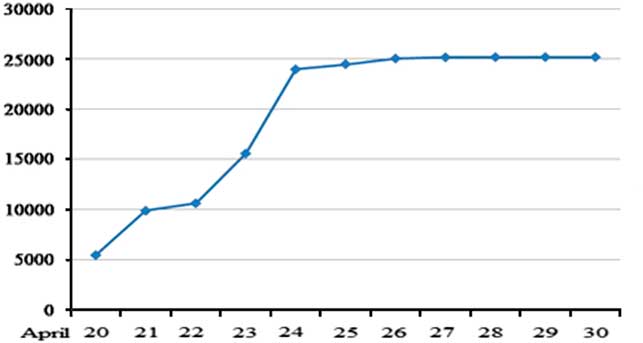
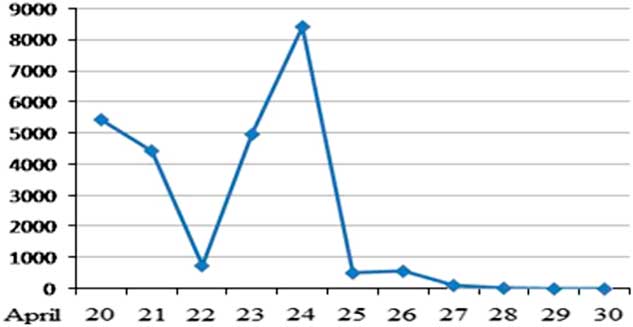
The Sichuan Province Health Department activated its emergency response plan quickly after the powerful Lushan earthquake, and health administrative personnel and medical institutions at all levels and broad masses of medical workers quickly organized to respond to the emergency. Within 10 hours after the earthquake, the author’s national disaster emergency medical rescue team had been sent by the national health development planning commission and was the first team other than the national medical rescue team to reach the Ya’an disaster area. As of 6:00 PM on April 30, a total of 25,176 wounded people had been treated in the province, including 18,611 outpatients. A total of 6565 people were hospitalized, including 662 seriously injured people and 315 severely injured people. The number of patients increased over time in the disaster area (Figure 1). The number of earthquake victims treated peaked at 8405 on April 24 (Figure 2).
Time Series Diagram of Injuries Received and Cured After the Earthquake.

Time Series Diagram of Injuries Received and Cured Daily After the Earthquake.

Secondary Treatment
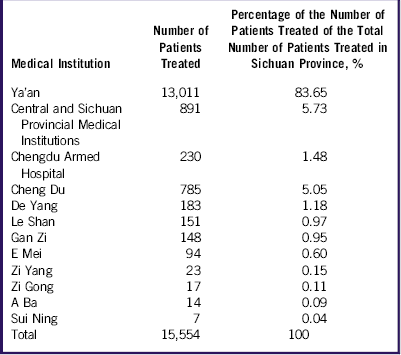
Because the medical rescue team arrived in the disaster area first and because the normal operation of the local medical institutions responded very quickly, most of the injured people who were taken to local medical institutions were properly treated. By April 23, for example, 15,554 wounded people had received treatment in Sichuan Province, and 13,011 people were treated in Ya’an, accounting for 83.65% of the total number of patients treated. At the Central and Sichuan Provincial Medical Institutions, 891 people were treated, accounting for 5.73% of the total. Cheng Du admitted 785 people, accounting for 5.05%, and the number of patients treated in other cities accounted for the remaining 5% (Table 1).
Medical Institutions That Treated the Wounded in Sichuan Province on April 23

Tertiary Treatment
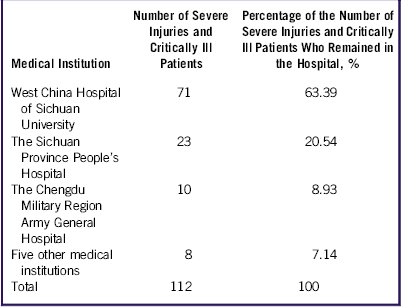
The National Health and Family Planning Commission’s emergency requirements include offering proper medical treatment for victims of an earthquake, and the Sichuan Provincial Health Office conscientiously implemented treatment plans for the wounded, gathered experts, centralized resources, centralized treatment according to the “four principles,” and transferred critically ill patients from the Lushan earthquake zone into large-scale integrated hospitals for treatment. These larger facilities included the hospital of Sichuan University, the Sichuan Province People’s Hospital, and the Chengdu Military Region Army General Hospital. These efforts not only ensured that critically ill patients had access to adequate medical resources but were also conducive to implementing centralized management of the medical department for critically ill patients. As of April 26, in Sichuan Province, the number of patients with severe injuries and critically ill patients who remained in the hospital was 112, including 71 people in the West China Hospital of Sichuan University, 23 people in the Sichuan Province People’s Hospital, 10 people in the Chengdu Military Region Army General Hospital, and 8 people in 5 other medical institutions (Table 2). These specialized hospitals employ medical experts from inside and outside the province and played a vital role in the successful treatment of critically ill or injured patients.
Rescue and Treatment of Critically Ill Earthquake Patients by Major Hospitals in China as of April 26

DISCUSSION
Earthquakes are disasters that result in sudden, serious, and complicated secondary damage; numerous casualties; and severe and complicated injuries that make medical rescue treatments more difficult. Conventionally, a 3-tiered treatment model is used.Reference Li 5 The large volume of medical rescue work following the Lushan earthquake primarily followed this pattern.
Primary Treatment (Treatment on the Spot)
Initially, medical personnel and equipment arrived at the scene by land, sea, or air. A mobile hospital was rapidly erected on the scene to treat patients in the equivalent of hospital operating rooms and critical care units. This approach was able to greatly reduce the mortality and disability rates.Reference Li and Huang 6 Thus, treatment on the spot is the first step. Following the earthquake, national, provincial, and municipal leaders at all levels responded swiftly and prepared contingency plans, and most of the rescue teams arrived at the disaster site on the day the earthquake struck. Thus, the number of wounded patients treated was the highest on the day of the earthquake, and the number of patients treated declined rapidly over the subsequent days. The number of wounded patients treated later surged on April 22, when the roads in Baoxing County leading to the disaster zone were repaired, allowing successive rescue teams to enter. Thus, the number of wounded patients treated on April 23 increased significantly.
Secondary Treatment (Early Treatment)
Secondary treatment refers to the treatment provided by the local medical institutions in the disaster area or to other aid put in place for medical treatment during the implementation of the treatment plan near the scene of the disaster (ie, areas that could be reached via the highway within 1 hour). When responding to a disaster, patients with infectious diseases and those who are mildly wounded should be treated, but critically wounded patients should be referred to specialized treatment centers.Reference Hou and Fan 7 On-site treatment and early treatment do not have clear boundaries, and in some cases, on-site treatment and early treatment can be combined. Early treatment is a key link in the treatment process, and it is a continuation of primary treatment.Reference Weijian, Zhao and Li 8 Because local medical resources did not suffer significant losses, all the medical rescue teams were able to establish temporary medical treatment facilities immediately at the scene of the disaster. Most of the injured people in the affected areas required only local treatment, and treatment of the wounded in Ya’an City accounted for 84% of total aid provided to the injured. Clearly, secondary treatment plays a vital role in the treatment system.
Tertiary Treatment (Specialized Treatment)
Specialized treatment refers to hospitals operating in safe areas locally and to military hospitals that are relatively close to the disaster site. These medical institutions accept transfers of patients from disaster areas and offer definitive treatment until the patient has healed sufficiently to leave the hospital. This third level of treatment is certainly an important part of the treatment plan.Reference Wegscheider, Schneiderhan and Mager 9 Following the Ya’an earthquake, the West China Hospital of Sichuan University, the Sichuan Provincial People’s Hospital, and the Chengdu Military Region Army General Hospital comprised the 3 largest surrounding hospitals, and they undertook the treatment of severely injured and critically ill patients. Thankfully, the magnitude of this earthquake was lower than that of the Wenchuan earthquake, and relatively fewer people sustained injuries severe enough to require treatment at large hospitals. Thus, tertiary treatment was an important part of the 3-tiered treatment model implemented after the Lushan earthquake.
Not every patient required tertiary treatment after the earthquake. Injury severity, the scope of the disaster (the number of injured patients), and the conditions of local medical resources are the main determining factors when deciding whether this level of treatment is warranted.Reference Achour, Pascale and Soetanto 10 According to the actual conditions after the earthquake, governmental departments at all levels have plans in place and can enact measures to strengthen those plans. Because the earthquake’s magnitude was not high, most houses had a large number of cracks, but relatively few collapsed; therefore, few people were seriously injured. Most patients presented with minor bruising, and the loss of local medical resources was not very serious. The spirit of self-help and communal consciousness was strong, and a large number of wounded patients were treated via primary or secondary treatment.
The American College of Emergency Physicians has published a policy statement on health care surges during emergencies, 11 and the 3 most important points are as follows: (1) Emergency departments are increasingly faced with the challenge of ensuring that patients have access to care during periods when demand exceeds available resources. (2) Surge capacity is a measurable representation of the ability to manage a sudden influx of patients. 3) Health care systems must develop and maintain outpatient and inpatient surge capacity for the triage, treatment, and tracking of patients at the facility, alternative care sites, or alternative hospitals during infectious disease outbreaks, hazardous materials exposures, and mass casualty incidents. All of the above points were beneficial to the rescue efforts in response to the Lushan earthquake.
In summary, after the medical teams arrived in the earthquake zone, they implemented plans to provide the best medical service to the maximum number of individuals in the disaster area in the shortest time possible to save lives and reduce disability. The response and actions of these medical teams evolved according the situation and local needs, and the teams adjusted their response based on local conditions to provide various forms of medical treatment at the local level. Ultimately, the goals of earthquake relief were achieved: to heal the wounded and to rescue the dying. Our present results can be applied to provide appropriate supports for students during future large-scale disasters.
Acknowledgments
This work was supported by grants from the National Natural Science Foundation of China (71533008,71173232,71473264) and Project of the Ministry of Logistics of CAPF (FYM201418, WHJ2016025, 2015KZ123). The authors thank all the individuals who participated in this study for their support.