

INTRODUCTION
Terracotta dedicatory offerings, found in abundance throughout the Greek world, are expressive products of human cultic behaviour. They can thus shed light not only on the nature and character of the divine or heroic recipients but also on the associated cult practices. In addition to their value in a religious sense, terracotta offerings also have a social value. In particular, types featuring a distinctive local iconography can often give us glimpses of the process by which dedicators constructed their social and cultural identity, and help us understand the social and political functions of local ritual practice.
This article concerns the characteristic terracotta plaques depicting seated figures often accompanied by snakes, which were used as votive offerings throughout Laconia and Messenia from the sixth through to the fourth century bc. It will argue that the plaques were employed in hero cults of local mythical or historical personalities, with the seated figure acquiring the identity of the locally honoured hero or heroine in a specific sanctuary setting. These heroes, who could have been worshipped by all residents of Laconia and Messenia, helped forge a strong communal and civic, but not necessarily ethnic, identity.
PLAQUES WITH SEATED FIGURES
Mould-made terracotta relief plaques are one of the most characteristic types of votive offerings in Laconia. Fabric, manufacture, style and iconography indicate that these plaques were produced locally, probably in or near Sparta (Salapata Reference Salapata, Palagia and Coulson1993, 189). Many such plaques were discovered with other offerings in two votive deposits excavated at Amyklai, the fifth kome of Sparta, located about five kilometres to the south and a short distance south-west of the famous Amyklaion sanctuary.Footnote 1
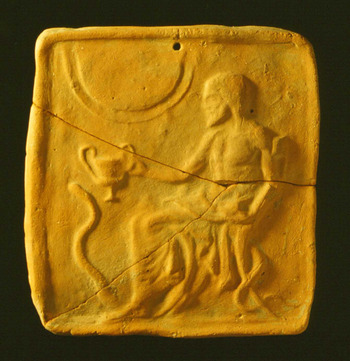
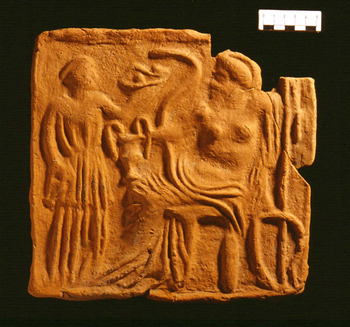
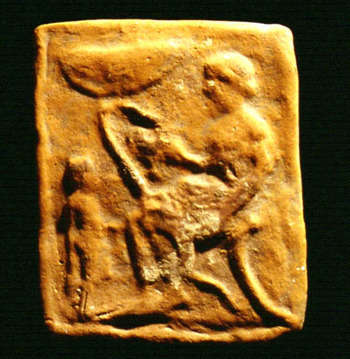
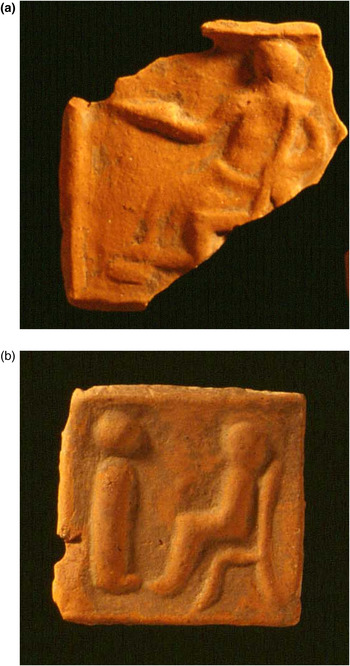
Among the various subjects depicted on the Amyklaian plaques, the most dominant is that of a seated man holding a drinking cup, usually a kantharos, and often accompanied by a snake (Fig. 1), a type created in the late sixth century bc (Salapata Reference Salapata, Palagia and Coulson1993; Salapata Reference Salapata2006, 542, 553–4). Other types include an attending figure, either a woman with oinochoe and offerings (Fig. 2) or a boy with strainer and oinochoe (Fig. 3). Later variations show a female with a sceptre seated next to the man (Salapata Reference Salapata, Gorman and Robinson2002b, fig. 3), or even represented alone, again accompanied by a snake (Salapata Reference Salapata, Gorman and Robinson2002b, fig. 4). Plaques with seated figures show a wide spectrum of quality and size, ranging from large, detailed images to small and simplified versions (Fig. 4 a–b).
Terracotta plaque with seated man holding kantharos and accompanied by snake from Amyklai. Sparta Museum no. 6230/1.

Terracotta plaque with seated man holding kantharos and staff, and accompanied by female attendant and snake from Amyklai. Sparta Museum no. 6231/1.

Terracotta plaque with seated man holding kantharos and accompanied by boy attendant and snake from Amyklai. Sparta Museum no. 6229/1.

Small, schematic terracotta plaques from Amyklai. a: seated man with phiale and staff: Sparta Museum no. 6039/222; b: seated figure accompanied by standing figure: Sparta Museum no. 6039/104.

Literary, epigraphic and archaeological evidence clearly associates the Amyklaian deposits with the sanctuary of Cassandra (known in Laconia as Alexandra), which allegedly contained the graves of Agamemnon and Cassandra (Pausanias 3.19.6; Salapata Reference Salapata, Gorman and Robinson2002b). Pottery shows that a heroic cult was practised there since at least the early seventh century. This cult is related to a variant tradition that placed the palace, and therefore the murder of Agamemnon and Cassandra, not in the Argolid as the tragic poets said, but in Laconia. Sixth-century Spartan aspirations for leadership over the Peloponnese probably enhanced the pre-existing local tradition and cult; thus, by promoting Agamemnon, the ‘lord of men’ in Homer, to the role of a Laconian hero personifying the glorious past and symbolising local history and identity, Sparta would have nicely mirrored and legitimised her ambitions for a Peloponnesian alliance and, at the same time, would have undermined any Argive claim (Salapata Reference Salapata2011, 41–3).
The dedication of the first plaques indicates an intensification of the cult at the Amyklai sanctuary from the late sixth century on. The iconography fits well with the identification of the recipients as Agamemnon and his consort, the prophetess Cassandra. The stock image of a seated figure with cup, and its variations, would have denoted the ideal mythical hero as known primarily from epic poetry, with the kantharos referring to wine consumption during feasting. The woman, seated by herself or next to him, assumes the role of his consort Cassandra, with the sceptre alluding to her priestly status and especially her prophetic abilities (Salapata Reference Salapata, Gorman and Robinson2002b, 142–3; Salapata Reference Salapata2011, 52). The commonly occurring snake, which appears also in other media from the sanctuary deposits, would have referred to the heroic nature of the couple, who are frequently accompanied by attendants and adorants (Salapata Reference Salapata, Gorman and Robinson2002b, 142–3; Salapata Reference Salapata2006, 552–3).
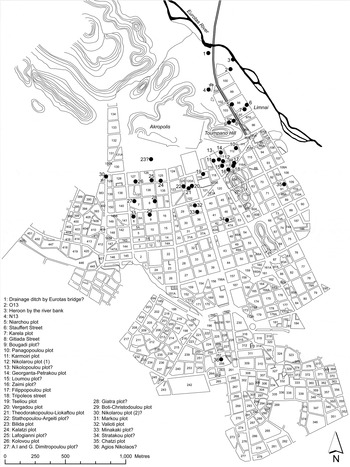
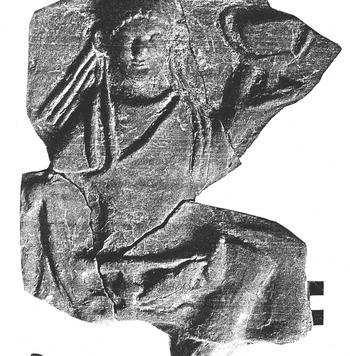
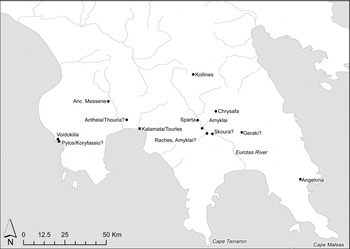
Plaques with seated figures, many made in the same (or derivative) moulds as those from Amyklai, have been discovered at various other Laconian sites both as isolated finds and as part of comparable votive deposits. They have been found in more than 30 sites throughout Sparta, but with major concentrations to the south and east of the acropolis hill, especially in the kome of Limnai (Fig. 5) (e.g. Wace Reference Wace1905–6; Flouris Reference Flouris2000; Steinhauer Reference Steinhauer1973–4; Pavlides Reference Pavlides, Cavanagh, Cavanagh and Roy2011, 563–8; Tosti Reference Tosti2011; Salapata in press, Appendix 1).Footnote 2 An example found in a deposit in Stauffert Street is illustrated in Fig. 6. Far fewer have been discovered in other Laconian sites (Fig. 7; Salapata in press, Appendix 1), for example at Angelona (Wace and Hasluck Reference Wace and Hasluck1904–5; Stibbe Reference Stibbe1991, 9, 38, 43, fig. 31 no. a4).
Map of Sparta showing findspots of terracotta plaques with seated figures.

Terracotta plaque with seated man holding kantharos from deposit on Stauffert Street in Limnai, Sparta. Sparta Museum no. 13471. After Flouris Reference Flouris2000, pl. 29.

Map of southern Peloponnese showing findspots of terracotta plaques with seated figures.

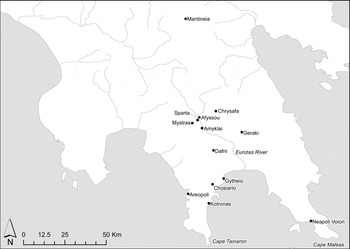
The iconography of the plaques is closely related to a series of more than 50 stone reliefs discovered throughout Laconia but mainly in and around Sparta (Fig. 8). These reliefs encompass an astonishingly broad range of dates, beginning in the third quarter of the sixth century, a little earlier than the plaques, and lasting through the Hellenistic period into Roman times (Andronikos Reference Andronikos1956; Stibbe Reference Stibbe1991; Hibler Reference Hibler, Palagia and Coulson1993; Salapata Reference Salapata, Palagia and Coulson1993; Salapata in press, chapter 4 and Appendix 2).Footnote 3 As I have argued in detail elsewhere (Salapata in press, chapter 5), the eclectic iconographic type of the seated figure holding a cup and accompanied by a snake was created in Laconia during the third quarter of the sixth century based on regional, panhellenic and foreign (Egyptian and Near Eastern) prototypes, which were modified according to Greek aesthetic and cultic requirements. Remarkably, this iconographic type remained basically the same through the centuries, although in a stylistically updated form.
Map of southern Peloponnese showing findspots of stone reliefs with seated figures.

Reliefs and plaques with seated figures conform to the same basic types (single man alone, single man or couple accompanied by woman or boy attendant) and follow a similar stylistic development. The series of plaques probably started as an inexpensive and quickly made alternative to the larger stone reliefs (Salapata Reference Salapata, Palagia and Coulson1993), but the religious significance of all these votive types must have been the same, with symbolic value most important: as long as the type of offering was appropriate, material, size and quality of execution were probably secondary (cf. Andronikos Reference Andronikos1956, 301; Kyrieleis Reference Kyrieleis, Hägg, Marinatos and Nordquist1988, esp. 215). The persistence of the imagery for more than five centuries with a clear stylistic evolution but few variations indicates that the scheme was fixed by tradition and expressed an important aspect of local religiosity.
Distribution
Terracotta relief plaques in general are widely distributed in the Greek world, showing they were not restricted to particular deities or sanctuaries (Salapata Reference Salapata, Gorman and Robinson2002b, 25–6).Footnote 4 Plaques with seated figures, however, were created for a specific local use, as they are hardly ever found outside Laconia and Messenia, an area greatly influenced by Sparta, as I will discuss later.
The vast majority of plaques with seated figures were found in Sparta and Amyklai. Their distribution in votive deposits throughout the city (Fig. 5) emphasises their total absence from major divine sanctuaries such as those of Athena Chalkioikos, Orthia and Apollo Amyklaios, all of which have been extensively excavated, and also from the more recently excavated sanctuary of Zeus Messapeus at Tsakona, to the north-east of Sparta (Catling Reference Catling2002). This absence seems related to the nature of the recipients of these votives and can be explained if this type of offering was reserved for heroes, like Agamemnon and Cassandra at Amyklai (Salapata Reference Salapata, Palagia and Coulson1993, 194; Salapata in press), with the similar iconographic types showing their affinity.Footnote 5 This also seems to be true for the related stone reliefs of pre-Hellenistic times,Footnote 6 whether they were dedicated to heroes of the mythical past or to exceptional historical personalities (like Chilon).Footnote 7 Their dedication to a range of different heroes would account for both their widespread distribution (Fig. 8)Footnote 8 and their complete absence from divine sanctuaries. Support for this interpretation comes from plaques (and reliefs)Footnote 9 associated with earlier burials, which must have been the centre of a heroic cult (see further below).Footnote 10
The wide regional distribution of reliefs and plaques with seated figures corresponds to the pattern of small local shrines commonly scattered throughout the Greek countryside and especially Laconia, an area exceptionally rich in hero shrines. Pausanias mentions more than 50 such hero shrines in Sparta proper and about 25 more in other Laconian sites (Stibbe Reference Stibbe and Lorenz1978, 7–8; Hibler Reference Hibler, Palagia and Coulson1993, 199).Footnote 11
The image of the seated man, woman or couple accompanied by a snake was generic enough to allow dedicators to offer it to different heroes in Laconia, so in a specific sanctuary setting the general image of the seated figure would have been ascribed the identity of the locally honoured hero (Salapata Reference Salapata, Palagia and Coulson1993, 194).
Plaques with seated figures and hero cults
As a diverse class of superhuman being, heroes were honoured by a variety of social groups and for different reasons. The Spartan interest in their heroic past goes back at least to the early seventh century, as the cult of Agamemnon at Amyklai shows.Footnote 12 Some heroic figures may have been worshipped privately and informally by members of specific professional categories or by leading families,Footnote 13 because the mirage of egalitarianism among the homoioi does not mean absence of differentiation in social, economic and political matters. Down to the Classical period some families had managed to enjoy more status and prestige than others (Hodkinson Reference Hodkinson2000, 399–445; Christesen Reference Christesen2010, esp. 51, 60), and one of the methods to maintain and legitimise their elite status could have been the forging of connections with heroes of the past from whom they claimed descent.
The kome of Limnai was the earliest region of Sparta to be occupied and is rich in Protogeometric and Geometric burials (Kennell and Luraghi Reference Kennell, Luraghi, Raaflaub and Wees2009, 240). In association with such tombs, various deposits have been found, some dating as early as the seventh century, with several containing terracotta plaques among the finds (Fig. 5 nos. 1, 3, 5–7; for more details, see Salapata in press, Appendix 1 nos. 3, 5, 6, 9–11; Pavlides Reference Pavlides, Cavanagh, Cavanagh and Roy2011, 563–5). The concentration there of such deposits may indicate that an ancestral burial ground became the focus of heroic cults from early in the Archaic period, some of which may have survived until the time of Pausanias' visit (Pausanias 3.16.6). Some cults would have been established not long after the burials, while others would have developed when graves were discovered by chance during later building activities (Pavlides Reference Pavlides, Cavanagh, Cavanagh and Roy2011, 562–9).Footnote 14 Some of these private or familial cults may have been appropriated and formalised by the state, so that these heroes were eventually worshipped by the entire community, as was the case in other regions (cf. Mazarakis Ainian Reference Mazarakis Ainian and Hägg1999, 36; Taita Reference Taita2001, 69–70).
Other heroic cults were newly created in the Archaic period and were community-oriented from the beginning (cf. Wees Reference Wees, Deger-Jalkotzy and Lemos2006, 376–7). Important local individuals of the mythological and historical past, like Agamemnon and Chilon, represented the values and ideals of the entire polis (Pavlides Reference Pavlides, Cavanagh, Cavanagh and Roy2011, 561–2), and, by honouring these kinds of heroes who transcended individual families, the Spartan state sought to discourage family allegiances and foster a strong communal civic identity that bound not only the homoioi but also the perioikoi (cf. Hall Reference Hall and Flensted-Jensen2000, 87–8). The perioikoi formed a distinct status-group within the Lacedaemonian polis that lacked full political rights. They were, however, ethnically and culturally indistinguishable from the homoioi, and integrated into the political and military structure of the polis (on the perioikoi see Hall Reference Hall and Flensted-Jensen2000; Mertens Reference Mertens, Powell and Hodkinson2002; Nafissi Reference Nafissi, Raaflaub and Wees2009, 123–4); in addition, they worshipped the same divinities, adopted similar cult practices and participated in important festivals of the polis, as Spartiates attended festivals in perioikic regions (Parker Reference Parker and Powell1989, 145; Shipley Reference Shipley and Hansen1997, 203; Mertens Reference Mertens, Powell and Hodkinson2002, 288; Luraghi Reference Luraghi2008, 143). Group solidarity and strong communal civic identity constructed through links with ancestors or heroes would have been crucial during the Archaic period, as Sparta aspired to bolstering her position in the Peloponnese and claiming its leadership.
All these various heroic cults could have been well served by the reliefs and plaques with seated figures. The original but adaptable iconography could be applied in different cases, and, most importantly, this peculiarly Laconian class of votives would have differentiated local Laconian heroes from all others.
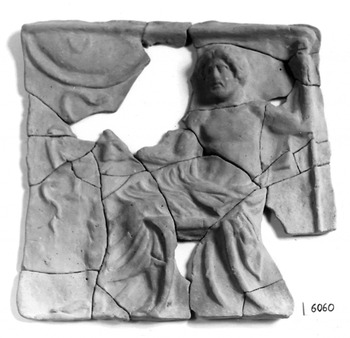
This distinctive Laconian iconography influenced terracotta plaques produced in Messenia, a region under Spartan control for centuries.Footnote 15 Such plaques were dedicated along with other offerings at urban sanctuaries in ancient Messene, and also at Bronze Age cemetery sites, especially in the area of Pylos and near Kalamata (Fig. 7) (see e.g. Messene: Themelis Reference Themelis1993, 49–55; Themelis Reference Themelis and Hägg1998; Voidokilia: Peppa-Papaioannou Reference Peppa-Papaioannou2012). They clearly depend thematically and typologically on the Laconian plaques, with some evidently made in the same or derivative moulds (Fig. 9). However, production in local clay suggests that these were not imports but that moulds, or plaques from which new moulds could have been manufactured, were imported from Laconia (Peppa-Papaioannou Reference Peppa-Papaioannou2012, 103–8).Footnote 16
Terracotta plaque with seated man holding kantharos and staff, and accompanied by snake from ancient Messene. Archaeological Museum of Messenia no. 6060. Photo courtesy of Petros Themelis.

Like the Laconian plaques, the Messenian plaques with seated figures have been connected with heroic cults. For example, the cult at the earlier shrine at the Demeter sanctuary in Messene has been attributed to Leukippos and his daughters (Themelis Reference Themelis1993, 52–4; Themelis Reference Themelis2000, 27; Zunino Reference Zunino1997, 257–62, 290),Footnote 17 and the cult at the Asklepieion court to Asklepios and Messene, worshipped there as mythical pre-Dorian rulers of Messenia at least since the time of liberation in 369 bc (Themelis Reference Themelis2000, 5–24, Themelis Reference Themelis2003, 9; Luraghi Reference Luraghi2008, 234, 270, 275).
However, while the finds at the Demeter sanctuary do indicate a hero cult, nothing allows a specific identification (cf. Boehringer Reference Boehringer2001, 274–7, 282, 352; Luraghi Reference Luraghi2008, 126). On the other hand, the plaques at the Asklepieion court may indeed at some point have been offered to Asklepios and Messene. Asklepios was probably a newcomer, since his panhellenic cult expanded from the late fifth century onwards (Riethmüller Reference Riethmüller2005, 76–7). The iconography of the plaques from the sixth to the fourth century remained unchanged, implying there was no change in the deities worshipped, but because the iconography is not very specific and the seated figure resembles Asklepios (especially because of the snake), his identification with this iconography may have arisen from an earlier, possibly healing, local hero.
Several plaques with seated figures and other subjects (riders, banqueters and warriors) from Voidokilia on the Messenian west coast were found in and around a small Early Hellenistic building located inside a Bronze Age cemetery, pointing to its use as a shrine (Antonaccio Reference Antonaccio1995, 80–1; Korres Reference Korres1985, 164–5).Footnote 18 The excavator argued that the tholos tomb there was intact and visible during historic times and the area of this prehistoric cemetery was selected by later inhabitants of the area for ancestor cult or perhaps cult specifically to the hero Thrasymedes, son of Nestor. Other groups of plaques, mainly depicting banqueters, are associated with cults at or near Bronze Age tombs in Messenia (Salapata in press, Appendix 1, nos. 56, 57, 60); this is a distinctive local cult practice that differs strongly from Laconia, where such cults connected with Bronze Age tombs did not exist.Footnote 19
Identity of dedicators
The dedication of Messenian plaques at heroic sanctuaries and their similarity to those found in Laconia contribute to the long-running debate on the Messenians' ethnic identity. Did the Messenians have a collective consciousness and distinct identity that they managed to preserve during the centuries of Spartan subjugation, and which was resurrected with the founding of Messene (Zunino Reference Zunino1997, 253, 297; Alcock Reference Alcock2002, 32–75; Themelis Reference Themelis2003, 6)? Or, did Messenian identity emerge only during the fifth century in opposition to Spartan domination, as an articulation of the distinction within the Spartan social system (Hall Reference Hall, Luraghi and Alcock2003; Luraghi Reference Luraghi2008)?
According to one view, Messenian cultural and religious traditions survived during Spartan domination and found expression mainly in the cults at Bronze Age tombs. These cults began in the eighth century and continued sporadically in Archaic and Classical times, flourishing again after independence (Korres Reference Korres1985, 163, 168; Korres Reference Korres1988, 312, 325; Musti and Torelli Reference Musti and Torelli1991, 270; Alcock Reference Alcock2002, 146–52, 165–7).Footnote 20 They presumably honoured ancestors and local heroes, and are seen as a form of resistance by the Messenians to ethnic assimilation by the Spartans; thus, they are associated with a feeling of nationalism and regional identity which was oppressed but not quenched during Spartan rule. According to this view, then, a link to the heroic Achaean past would have united the Messenian population and created a sense of Achaean identity in opposition to the Dorian identity of the Spartiates. The implication is that the Messenians regarded themselves, or were thought of, as having pre-Dorian or Achaean heritage (see Hall Reference Hall, Luraghi and Alcock2003, 155–62).Footnote 21
A second view questions the notion that Messenia had a cohesive and distinct regional and political identity before the Spartan conquest in the eighth century. This view argues that Messenian identity was constructed consciously, starting in the fifth century, either among the Messenian diaspora or in the context of the perioikic revolt in the 460s, and building up after liberation with largely invented traditions.Footnote 22 Laconian and Messenian helots were not pre-existing homogeneous ethnic groups enslaved early on and en masse within their own territories;Footnote 23 they were instead impoverished members of the community taken into servitude somewhat later. Their subservient status and ensuing resentment and hatred over their exploitation by the Spartiates would have been enough to foster solidarity among the Messenian helots, who then started fabricating a nationalist history. Thus, this view argues that the notion of ‘the Messenians’ was a gradual development over centuries, emerging out of a broader Laconian identity (Luraghi Reference Luraghi2008, 202, 229, 339; cf. Patterson Reference Patterson, Luraghi and Alcock2003).Footnote 24
It does seem likely that the idea of Messenia as an ethnic or territorial unit was not something that already existed and managed to survive under Spartan domination, but instead arose during the Spartan conquest and was indeed a by-product of that subjugation. Archaic Messenia appears to have been integrated with the Lacedaemonian state, with the population culturally and ethnically almost completely homogeneous with that in Laconia (Luraghi Reference Luraghi2008, 134–6). This is shown by the common dialect and alphabet, similar material culture since Geometric times, and closely related cults that continued even after liberation.Footnote 25 Among the Laconian type of votive offerings found in Messenia are the plaques with seated figures (as well as several other subjects), many of which are similar to those found at Amyklai and Sparta, and some even produced in the same or derivative moulds.
Who dedicated these plaques in the Laconian and Messenian hero shrines? The low cost, mediocre quality and intensive production over a long period indicate a broad level of participation in such cults. These were popular mass-produced offerings affordable by most dedicators, but not necessarily restricted to the lower socio-economic strata. Rather than just reflecting the financial means or social status of the votaries, the terracotta plaques must have fulfilled a cultic need (cf. Bonias Reference Bonias1998, 104; Baumbach Reference Baumbach2004, 5).Footnote 26
In Laconia, the distribution of plaque findspots shows this type of offering was favoured more in the region inhabited by the Spartiates. Still, the discovery of some plaques in perioikic territory suggests that perioikoi, who were culturally homogeneous with the Spartiates, may also have dedicated such plaques.Footnote 27 In contrast, the Messenian plaques dedicated to heroes at urban sanctuaries and Bronze Age tombs must have been dedicated primarily by perioikoi, since the homoioi were based in Sparta (Hall Reference Hall2007, 175). Nonetheless, there are indications that helots may also have dedicated such plaques.Footnote 28 The Messenian helotic pattern of settlement suggests some independent social organisation and even some social differentiation. Messenian helots lived in agglomerated settlements or extensive estates rather than in small farmsteads dispersed through the countryside as in Laconia (Luraghi Reference Luraghi2008, 138–40); thus ‘elite’ overseer helots, who managed the estates of the absentee Spartiates, could well have been involved in such cults (Hodkinson Reference Hodkinson2000, 125–31; Alcock Reference Alcock2002, 154; Patterson Reference Patterson, Luraghi and Alcock2003).
Like other manifestations of a shared culture, the continuity in the cult at Messenian sanctuaries after liberation and the fact that the plaques remain similar to those in Laconia indicate that the residents of Messenia were ethnically indistinguishable from the Spartans (cf. Luraghi Reference Luraghi2008, 133, 144–5, 233–9). Still, I believe that the Messenian cults that attracted plaque dedications honoured heroes not necessarily because they were Achaean, but because they were celebrated local mythical or historical figures. Reaching back to the heroic age through heroes was a well-established way to articulate a strong local and communal identity, but not necessarily an ethnic one.Footnote 29
In conclusion, the similarities between Laconian and Messenian plaques with seated figures need not be correlated with the contested ethnic identity of the Messenians. Rather, they should be attributed to the flexibility and variety in their use. The same types of plaques could be used in separate heroic cults because they depicted versatile, generalised images that assumed their significance from the specific context (cf. Lippolis Reference Lippolis2001, 228, 235). Rather than being specific to a particular cult, the plaques with seated figures served a type of cult – the heroic – and could be dedicated by residents of both Laconia and Messenia, whether they were homoioi, perioikoi or helots.
ACKNOWLEDGEMENTS
I would like to thank David Hibler and the second, anonymous, referee for their valuable suggestions for improvements. I also thank Petros Themelis for permission to publish the photograph of the Messene plaque reproduced here as Fig. 9.