


1. INTRODUCTION
Over the last two decades, there has been significant research activity in the area of acceleration of particles by plasma waves using high-power lasers (Faure et al., Reference Faure, Glinec, Pukhov, Kiselev, Gordienko, Lefebvre, Rousseau, Burgy and Malka2004; Esirkepov et al., Reference Esirkepov, Bulanov, Yamagiwa and Tajima2006; Faure et al., Reference Faure, Rechatin, Norlin, Lifschitz, Glinec and Malka2006; Gupta et al., Reference Gupta, Gopal, Nam, Kulagin and Suk2014). The immense accelerating fields, exceeding those yielded by standard high-frequency accelerators; make it possible to design compact charged-particle accelerators for different applications in fundamental science and medicine (Geddes et al., Reference Geddes, Toth, Tilborg, Esarey, Schroeder, Bruhwiler, Nieter, Cary and Leemans2004; Gupta & Suk, Reference Gupta and Suk2007; Hoffmann et al., Reference Hoffmann, Blazevic, Rosmej, Spiller, Tahir, Weyrich, Dafni, Kuster, Ni, Roth, Udrea and Varentsov2007). The laser intensities involved in these acceleration schemes are very high, which results in the high-energy gain of the accelerated particle. For some applications one requires beams of low energy. The low-energy particle beams are expected to be useful for a wide range of contexts, including proton therapy for the treatment of cancers, materials characterization, radiation driven chemistry, and in security application through the detection of explosives and narcotics. For these applications low-energy electron beams are obtained by using surface plasma wave (SPW). Significant research work has been reported on electron acceleration by a SPW.
SPW can be excited by laser overdense plasma coupling over a wide range of laser intensity (from 1015 to 1020 W cm−2) (Bigongiari et al., Reference Bigongiari, Raynaud and Riconda2011a
, Reference Bigongiari, Raynaud, Riconda, Heron and Macchi
b
) and by prism coupled configuration using low-intensity laser beams (Kretschmann & Raether, Reference Kretschmann and Raether1968). The SPW is a guided electromagnetic mode that propagates along the interface of metal and dielectric, its amplitude falls off exponentially with distance away from the interface in either medium. In the present study, SPW is excited by using p-polarized laser incident on the base of high-refractive index prism at an angle equal to or greater than the critical angle (Fig. 1). The base of the prism is coated with metal layer. The evanescent wave arises at the prism–metal interface due to attenuated total reflection. An evanescent wave is an exponentially decaying wave propagating along the prism–metal interface due to the occurrence of attenuated internal reflection. The evanescent field through the metal film couples to the SPW at the resonance conditions given by
 $K_{\rm s} = {\rm \omega} /c\sqrt {{\rm \varepsilon} _0} \sin {\rm \theta} = K_{{\rm sp}}$
, where θ is the angle of incidence of the laser at the prism–metal interface, ε0 is the dielectric constant of the prism. K
s and K
sp are the wavenumber of the laser and the SPW respectively. When the reflected intensity of the laser is measured as a function of incident angle, a sharp dip is observed at a particular angle due to the transfer of laser energy to SPW. The laser energy couples to the SPW through evanescent wave at the metal–free space interface with almost 100% efficiency (Kretschmann & Raether, Reference Kretschmann and Raether1968). Hence, the material heating is being neglected in the SPW excitation through Kretschmann treatment. Also, The SPW field gets enhanced over the laser field due to localization of the wave to the small spatial region resulting in increased energy density. This enhancement and exponential decay of the SPW electric field provides a large electromagnetic field gradient that is suitable for ponderomotive acceleration of electrons (Irvine et al.,
Reference Irvine, Dechant and Elezzabi2004). Zawadzka et al. (Reference Zawadzka, Jaroszynski, Carey and Wynne2001) discussed electron acceleration experimentally as well as theoretically by SPW excited by a laser of intensity 1013 W/cm2 over the single metal surface and obtained electrons of energy 0.39 KeV. Liu et al. (Reference Liu, Kumar, Singh and Tripathi2007) theoretically studied electron acceleration by SPW over the single and double metal surfaces and obtained electron beams of tens of KeV energy. However over the single metal surface as the electron gains energy the field gradient normal to the interface pushes the electrons away from the high-field region, limiting the acceleration process. The energy of electrons can be modified by applying external magnetic field (Hur et al.,
Reference Hur, Gupta and Suk2008; Vieira et al.,
Reference Vieira, Martins, Pathak, Fonseca, Mori and Silva2011). For a different geometry, Singh (Reference Singh2004) studied electron acceleration in the presence of static magnetic field using Gaussian and temporal profile lasers. The electron can gain and retain a significant energy in the form of cyclotron oscillations in the presence of a static magnetic field (Dieckmann et al.,
Reference Dieckmann, Ljung, Ynnerman and Mcclements2002; Gupta & Ryu, Reference Gupta and Ryu2005).
Schematic of SPW propagating on metal–free space interface.

In this paper, we have studied the enhancement of the electron beam energy by SPW in the presence of external magnetic field. SPW (propagating in
 $\hat z$
direction) are excited over the metal–vacuum interface using prism coupled configuration having maximum amplitude at the interface. The excitation is based on total internal reflection when a p-polarized light beam strikes the metal–vacuum interface (Kretschmann & Raether, Reference Kretschmann and Raether1968). The direction of static magnetic field along
 $\hat y$
direction that is parallel to surface and perpendicular to direction of propagation. The applied magnetic field may be useful for accelerating electrons to achieve desired energies of moderate range. The dispersion relation of the SPW in the presence of magnetic field and electron acceleration by a SPW has been established in Section 2. In Section 3, we have discussed results and conclusions in Section 4.
2. ELECTRON ACCELERATION IN THE PRESENCE OF MAGETIC FIELD
Consider the interface of metal (x < 0) and free space (x > 0) at x = 0. The SPW propagates along
 $\hat z$
direction, having components in
 $\hat x$
and
 $\hat z$
directions. The external magnetic field
 $(\vec B_{\rm s})$
is applied parallel to the surface and perpendicular to the SPW propagation that is in
 $\hat y$
-direction. In this work, we have assumed that the SPW is excited at the metal–free space interface using Kretschmann geometry.
The dispersion relation is obtained for this configuration by using Maxwell's equations, as follows
 $$\vec {\,\nabla} \times \!\vec {\,B} = \displaystyle{1 \over {c^2}}\displaystyle{\partial \over {\partial t}}(\tilde {\rm \varepsilon} \!\vec {\,E}),$$
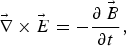 $$\vec {\,\nabla} \times \!\vec {\,E} = - \displaystyle{{\partial \vec {\,B}} \over {\partial t}},$$
where
 $\tilde {\rm \varepsilon} $
is the dielectric tensor. The effective permittivity of metal in the presence of magnetic field is given by
 $$\tilde {\rm \varepsilon} = \left( {\matrix{ {{\rm \varepsilon} _{\rm L}\left( {1 - \displaystyle{{{\rm \omega} _{\rm p}^2} \over {({\rm \omega} ^2 - {\rm \omega} _{\rm c}^2 )}}} \right)} & 0 & {\displaystyle{{ - i{\rm \omega} _{\rm c}} \over {\rm \omega}} \displaystyle{{{\rm \varepsilon} _{\rm L}{\rm \omega} _{\rm p}^2} \over {({\rm \omega} ^2 - {\rm \omega} _{\rm c}^2 )}}} \cr 0 & {{\rm \varepsilon} _{\rm L}\left( {1 - \displaystyle{{{\rm \omega} _{\rm p}^2} \over {{\rm \omega} ^2}}} \right)} & 0 \cr {\displaystyle{{i{\rm \omega} _{\rm c}} \over {\rm \omega}} \displaystyle{{{\rm \varepsilon} _{\rm L}{\rm \omega} _{\rm p}^2} \over {{\rm \omega} ^2 - {\rm \omega} _{\rm c}^2}}} & 0 & {{\rm \varepsilon} _{\rm L}\left( {1 - \displaystyle{{{\rm \omega} _{\rm p}^2} \over {{\rm \omega} ^2 - {\rm \omega} _{\rm c}^2}}} \right)} \cr}} \right),$$
where εL is the lattice permittivity
 ${\rm \omega} _{\rm p}^2 = 4{\rm \pi} ne^2/{\rm \varepsilon} _{\rm L}m$
and ωc = eB
s/m are the plasma and cyclotron frequency respectively. Here, −e and m are the charge and effective mass of electron. n is the electron density at the metal surface. On eliminating
 $\vec {\,B}$
from Eqs. (1) and (2), the wave equation can be found as
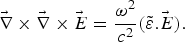 $$\vec {\,\nabla} \times \!\vec {\,\nabla} \times \!\vec {\,E} = \displaystyle{{{\rm \omega} ^2} \over {c^2}}(\tilde {\rm \varepsilon}. \!\vec {\,E}).$$
Equation 4 can be expanded as follows
 $$\vec {\,\nabla} (\!\vec {\,\nabla} \!\cdot\! \vec E) - \nabla ^2\vec E = \displaystyle{{{\rm \omega} ^2} \over {c^2}}(\tilde {\rm \varepsilon}. \vec E)$$
Separating
 $\hat x$
and
 $\hat z$
components of Eq. 5(a), we get
 $$\displaystyle{{\partial ^2E_x} \over {\partial x\partial z}} - \displaystyle{{\partial ^2E_z} \over {\partial x^2}} = \displaystyle{{{\rm \omega} ^2} \over {c^2}}( - {\rm \varepsilon} _{xz}E_x + {\rm \varepsilon} _{xx}^{} E_z),$$
 $$\displaystyle{{\partial ^2E_z} \over {\partial x\partial z}} - \displaystyle{{\partial ^2E_x} \over {\partial z^2}} = \displaystyle{{{\rm \omega} ^2} \over {c^2}}({\rm \varepsilon} _{xz}E_z + {\rm \varepsilon} _{xx}^{} E_x),$$
where
 ${\rm \varepsilon} _{xx} = {\rm \varepsilon} _{\rm L}(1 - {\rm \omega} _{\rm p}^2 /({\rm \omega} ^2 - {\rm \omega} _{\rm c}^2 )$
for x < 0 and ε
xx
= 1 for x > 0 and
 ${\rm \varepsilon} _{xz} = - i{\rm \varepsilon} _{\rm L}{\rm \omega} _{\rm c}{\rm \omega} _{\rm p}^2 /{\rm \omega} ({\rm \omega} ^2 - {\rm \omega} _{\rm c}^2 )$
for x < 0 and ε
xz
= 1 for x > 0. The well behaved solution of Eq. (5), satisfying
 $\nabla. \tilde {\rm \varepsilon} E = 0$
in each region are
 $$\hskip-75ptE_1 = \left[ {\displaystyle{{ik_z} \over {{\rm \alpha} _1}}\hat x + \hat z} \right]Ae^{ - {\rm \alpha} _1\,x}.e^{ - i({\rm \omega} t - k_zz)}\quad {\rm for}\quad x \gt 0,$$
 $$E_2 = \left[ { - \left( {\displaystyle{{ik_z{\rm \varepsilon} _{xx} + {\rm \alpha} _2{\rm \varepsilon} _{xz}} \over {{\rm \alpha} _2{\rm \varepsilon} _{xx} - ik_z{\rm \varepsilon} _{xz}}}} \right)\hat x + \hat z} \right]A_1e^{{\rm \alpha} _2\,x}e^{ - i({\rm \omega} t - k_zz)}\quad {\rm for}\quad x \lt 0,$$
where
 ${\rm \alpha} _1 = (k_z^2 - {\rm \omega} ^2/c^2)^{1/2},{\rm \alpha} _2 = (k_z^2 - {\rm \omega} ^2{{\rm \varepsilon}} ^{\prime}/c^2)^{1/2}$
and
 ${{\rm \varepsilon}} ^{\prime} = {\rm \varepsilon}_{xx} + {\rm \varepsilon}_{xz}^2 /{\rm \varepsilon} _{xx}$
is the Voigt dielectric constant. A and A
1 are constants. Applying conditions of continuity E
z
and ε′E
x
at x = 0, the dispersion relation of SPW in the presence of external magnetic field is given by (Brion et al.,
Reference Brion, Wallis, Hartstein and Burstein1974)
 $${\rm \alpha} _2 + {\rm \alpha} _1{{\rm \varepsilon}} ^{\prime} = ik_z\left( {\displaystyle{{{\rm \varepsilon} _{xz}} \over {{\rm \varepsilon} _{xx}}}} \right).$$
The dispersion curve between the wavenumber and frequency of the SPW consists of two parts with separation between them due to the presence of external magnetic field. For large values of k z , one of the branches occurs at a higher frequency and other at a lower frequency as compared with the zero field value of the SPW. In the lower portion, frequency rises linearly with the wavenumber and saturates at higher values as observed by Deepika et al. (Reference Deepika, Chauhan, Varshney, Singh and Sajal2015).
The motion of electron beam launched parallel to the metal surface is goverened by two fields, electric field due to SPW [Eq. 6(a)] and externally applied static magnetic field. The equation of motion is given by Prasad et al. (Reference Prasad, Singh and Tripathi2009)
 $$\displaystyle{{d\!\vec {\,p}} \over {dt}} = - e\left[ {\left( {\!\vec {\,E} + \!\vec {\,v} \times \!\vec {\,B}} \right) + \left( {\!\vec {\,v} \times B_s} \right)} \right],$$
where v is the velocity of electron. We can replace magnetic field of SPW by
 $$\vec {\,B} = \displaystyle{{\nabla \times \!\vec {\,E}} \over {i{\rm \omega}}}.$$
Here A = −A 1 that is E x is symmetric about x = 0. The equations governing electron momentum and energy are the following:
 $$\eqalign{\displaystyle{{dp_x} \over {dz}} & = A_1^{} \left[ {\displaystyle{{ - em{\rm \gamma}} \over {\,p_z}}\left( {\displaystyle{{k_z} \over {{\rm \alpha} _1}}} \right) + \displaystyle{e \over {\rm \omega} }\left( {\displaystyle{{k_z^2 } \over {{\rm \alpha} _1}} - {\rm \alpha} _1} \right)} \right]\, \cr & \quad e^{ - {\rm \alpha}_1x}\sin ({\rm \omega} t - kz + {\rm \phi} ) + eB_{\rm s},} $$
 $$\eqalign{\displaystyle{{dp_z} \over {dz}} & = A_1^{} \left[ \matrix{ - \displaystyle{{me{\rm \gamma} } \over {\,p_z}}\cos ({\rm \omega} t - kz + {\rm \phi} ) \hfill \cr \quad - \displaystyle{{\,p_x} \over {\,p_z}}\displaystyle{e \over {\rm \omega} }\left( {\displaystyle{{k_z^2 } \over {{\rm \alpha} _1}} - {\rm \alpha} _1} \right)\sin ({\rm \omega} t - kz + {\rm \phi} ) \hfill} \right] \cr & \quad e^{ - {\rm \alpha} _1x} - e\displaystyle{{\,p_x} \over {\,p_z}}B_{\rm s},} $$
 $$\displaystyle{{dx} \over {dz}} = \displaystyle{{\,p_x} \over {\,p_z}},$$
 $$\displaystyle{{dt} \over {dz}} = \displaystyle{{{\rm \gamma} m} \over {\,p_z}},$$
where
 ${\rm \gamma} ^2 = 1 + (\,p_x^2 + p_y^2 + p_z^2 )/m^2c^2$
is the energy gained by the particle and ϕ is the initial phase of the wave.
The set of Eqs. (9)–(12) are normalized by introducing dimensionless quantities, X → ωp
x/c, Z → ωp
z/c, P
x
→ p
x
/mc, P
z
→ p
z
/mc, T → ωp
t, Ω → ω/ωp, Ωc → ωc/ωp, q → k
z
c/ωp, and
 $A_1^{\prime\prime} \to eA_1^{} /m{\rm \omega} _{\rm p}c$
are solved numerically for electron energy and electron trajectory. Variation of SPW phase velocity with k
z
c/ωp on varying normalized cyclotron frequency is shown in Figure 2. The kinetic energy gained by electron beam with normalized distance has been ploted in Figures 3, 4, and 8 with and without magnetic field. Figure 5 shows effect of amplitude variation on electron energy. Trajectory of the electron beam has been plotted in Figures 6, 7, and 9 respectively on varying magnetic field and amplitude of the wave.
Plot of SPW phase velocity with k z c/ωp on varying normalized cyclotron frequency.

Plot of kinetic energy (γ − 1)mc
2 in KeV gained by electron versus normalized distance (zωp
/c) on varying strength of magnetic field. The parameters are
 $A_1^{\prime\prime} = 0.00181,\,k_zc/{\rm \omega} _{\rm p} = 0.1,\;k_zc/{\rm \omega} _{\rm p} = 0.1$
and ω/ωp = 0.09655.

Plot of kinetic energy (γ − 1)mc
2 in KeV gained by electron verses normalized distance (zωp
/c) on varying wavenumber of SPW for (ωc/ωp) = 0.003 and
 $A_1^{\prime\prime} = .00181 $
.

Plot of kinetic energy (γ − 1)mc 2 in KeV gained by electron versus normalized distance (z ωp /c) on varying amplitude of SPW for (ωc/ωp) = 0.003, k z c/ωp = 0.2 and ω/ωp = 0.1958.

Trajectory of the accelerated electron on varying strength of magnetic field. The parameters are
 $A_1^{\prime\prime} = 0.00181,\;k_zc/{\rm \omega} _{\rm p} = 0.1$
and ω/ωp = 0.09655.

Trajectory of the accelerated electron on increasing amplitude of SPW when (ωc/ωp) = 0.003, k z c/ωp = 0.2 and ω/ωp = 0.1958.

Plot of kinetic energy (γ − 1)mc
2 in KeV gained by electron versus normalized distance (zωp/c) for higher values of magnetic field. The parameters are
 $A_1^{\prime\prime} = 0.00181,\;k_zc/{\rm \omega} _{\rm p} = 0.1$
and ω/ωp = 0.09655.

Trajectory of the accelerated electron for higher values of magnetic field. The parameters are
 $A_1^{\prime\prime} = .00181,\;k_zc/{\rm \omega} _{\rm p} = 0.1$
and ω/ωp = 0.09655.

3. RESULTS AND DISCUSSION
The electron energy as a function of z and the corresponding electron trajectories in the x–z plane are studied by varying the amplitude of SPW and applied magnetic field. The initial parameters at z = 0 are p
x
= 0.0, p
z = 0.09, x = 0.0, t = 0.0, ϕ = π,
 ${\rm \varepsilon} _{\rm L} = 1,\;A_1^{\prime\prime} = 0.00181 $
(the corresponding value is 4 × 10¹⁰ V/m). The frequency ω
p
= 1.3 × 10¹⁶
rad/s corresponds to silver metal having free electron density n
0 = 5.85 × 1028 /m3. The parameters used for this numerical analysis, are in agreement with the parameters used in the experimental and analytical studies by Zawadzka et al. (Reference Zawadzka, Jaroszynski, Carey and Wynne2001) and Liu et al. (Reference Liu, Kumar, Singh and Tripathi2007). The values of the magnetic field corresponding to (ωc/ωp) = 0.001, 0.003 and 0.005 are 0.73, 2.19 and 3.65 MG respectively. Lagutin et al. (Reference Lagutin, Rosseel, Herlach, Vanacken and Bruynseraede2003) and Zherlitsyn et al. (Reference Zherlitsyn, Herrmannsdorfer, Wustmann and Wosnitza2010) observed experimentally the magnetic field strength of the order of 100 T by using pulsed magnet technology.
Figure 2 shows the plot of SPW phase velocity with k
z
c/ωp on varying normalized cyclotron frequency. For smaller values of k
z
c/ωp, there is no change in the phase velocity with the cyclotron frequency. The change in the phase velocity with the increase in cyclotron frequency is negligible even at higher values of k
z
c/ωp. In Figure 3, we have plotted the energy (in KeV) gained by the electrons versus normalized distance (zωp/c) for different values of normalized cyclotron frequency (ωc/ωp) for k
z
c/ωp = 0.1 and ω/ωp = 0.09655. It is observed that the energy gained by the electron increases with applied magnetic field. In the absence of the magnetic field, the electron gains energy during the rising part of the electric field of the SPW but cannot retain it sufficiently as the electron loses most of its energy during interaction with the trailing part of the SPW and moves with small amount of energy. In the presence of external magnetic field, the electron moves under the influence of Lorentz force given by Eq. (8). Its motion will be the sum of two motions: The usual circular Larmor gyration and the drift of the guiding center
 $v_{\rm {\,E}} = \vec E \times \!\vec {\,B}_{\rm s}/B_{\rm s}^2 $
that is the motion of the electron is like a slanted helix with changing pitch. In heuristic view, the motion can be represented by v
x
= v
⊥
e
iωc
t
− E
z
/B
s and v
z
= ±iv
⊥
e
iωc
t
+ E
x
/B
s, where v
⊥ is the positive constant denoting the speed in the perpendicular direction to B
s. During the first half cycle of the electron orbit, it gains energy from the electric field and increases in v
⊥and hence in Larmor radius (r
L = mv
⊥/eB
s). In the second half cycle, it loses energy and decreases in r
L. The difference in r
L on the left and right sides of the orbit causes the drift v
E and gains energy. As observed from Figure 2, the change in the phase velocity with the magnetic field is negligible; hence the electron gains and retains energy in the form of cyclotron oscillations due to the combined effect of the static magnetic field and SPW field. Singh (Reference Singh2004) discussed the electron acceleration by an intense short pulse laser on applying the static magnetic field of tens of tesla, parallel to the magnetic field of the laser pulse.
Figure 4 shows the kinetic energy gained by the electron versus normalized distance for different wavenumber of the SPW at ωc/ωp = 0.003 (B s = 2.19 MG). Rest of the parameters is same as Figure 3. The increase in wavenumber of the SPW results in decrease of electron acceleration, due to decrease in phase velocity of the SPW (Figure 2).
In Figure 5, we have plotted energy (in KeV) gained by the electrons versus normalized distance (zωp/c) for different values of SPW amplitude at ωc/ωp = 0.003 (Bs = 2.19 MG), k
z
c/ωp = 0.2 and ω/ωp = 0.1958. Rest of the parameters is same as Figure 3. As the laser intensity increases, evanescent wave provides higher oscillatory velocity to the electrons and excites the SPW of higher amplitude (Raether, Reference Raether1988). The increased SPW amplitude assists in increment of the electron energy gain during acceleration as observed in Figure 5. In the present scheme, electron beams can achieve maximum of 15 KeV energy for the SPW amplitude
 $A_1^{\prime\prime} = 0.00721$
(the corresponding value is A
1 = 1.6 × 10¹¹ V/m) and normalized cyclotron frequency ωc/ωp = 0.003 (Bs = 2.19 MG).
The trajectories of the accelerated electrons are plotted in Figures 6 and 7 on varying the applied magnetic field and amplitude of the SPW wave respectively. The initial parameters in Figures 6 and 7 are same as in Figures 3 and 5 respectively. It is observed from Figures 6 and 7 that divergence of electron beam increases with increase in static magnetic field and amplitude of the SPW. These observations regarding the electron movement are corresponding to drift of the guiding center
 $v_{\rm E} = \vec E \times \vec B_{\rm s}/B_{\rm s}^2 $
under the influence of crossed electric field and magnetic fields. The trajctory of the electron beam can be controlled by changing the direction and strength of applied magnetic field. Figures 8 and 9 shows the electron energy and trajectory in the x–z plane for higher values of magnetic field. The initial parameters are same as in Figure 3. It is observed from Figure 8 that the electron energy gain increases with increase in applied magnetic field upto particular value (ωc/ωp = 0.01). For higher values of the magnetic field, the electron propagation becomes out of phase with the SPW or damped towards the metal (Figure 9) resulting in decrease of electron energy.
4. CONCLUSIONS
We have studied the enhanced electron acceleration by SPW over single metal surface on applying external magnetic field. SPW are electromagnetic oscillations at the metal–vacuum interface that are excited by low-intensity lasers. Irvine & Elezzabi (Reference Irvine and Elezzabi2005) used surface plasma electric field of the order of 2.83 × 10⁹ V/cm and 2.4 × 10⁹ V/cm (using 30 GW/cm2, 30 fs pulses from a Ti: Sapphire laser amplifier and the corresponding electric field strength of the order of 4.8 × 10⁶ V/cm) for silver and gold metal films respectively and reported acceleration of the electrons upto 2 KeV. While Liu et al., Reference Liu, Kumar, Singh and Tripathi2007 reported electron acceleration of the range 0.4 KeV by the SPW (E SP = 1.2 × 10⁹ V/cm) using laser of amplitude 2.9 × 10⁵ V/cm. In our analysis, we have obtained the electron beam of 10–15 KeV by using SPW of electric field amplitude of the order of 109 V/m.
In the presence of external magnetic field, the electron gains higher energy due to the combined effect of the static magnetic field and SPW field. On increasing the amplitude of SPW, energy gain and trajectory of accelerated electrons are further improved.
In conclusion, the external magnetic field shows a significant effect on the energy gain and trajectory of electrons accelerated by SPW propagating in the presence of static magnetic field. This scheme is viable to achieve beams of KeV energy for optimum values of magnetic field and SPW amplitude.



