Staphylococcus aureus bacteremia (SAB) is a severe infection that causes significant morbidity and mortality. Infectious diseases consultation (IDC) improves adherence to management guidelines and reduces SAB mortality.Reference Vogel, Schmitz and Hagel1, Reference Fowler, Sanders and Sexton2 Therefore, the Infectious Diseases Society of America guideline for methicillin-resistant Staphylococcus aureus (MRSA) infections recommends IDC for cases of bacteremia.Reference Liu, Bayer and Cosgrove3 The antimicrobial stewardship team (AST) provides expert involvement in SAB management complementary to IDC. The AST improves antimicrobial utilization and reduces healthcare expenditures.Reference Nagao, Yamamoto and Matsumura4 Prior AST interventions in SAB, such as pharmacy-driven initiations and bundled care, have improved adherence to guidelines but did not reduce mortality.Reference Wenzler, Wang and Goff5, Reference Nguyen, Gandhi and Chenoweth6
At our institution, IDC is not mandatory for SAB but occurs per primary team discretion. The AST, comprised of an infectious diseases (ID) physician, a pharmacist, and pharmacy residents, reviews electronic medical records (EMR) of patients on broad-spectrum antibiotics and determines antibiotic appropriateness. In SAB cases, ASTrecommends guideline-based management and IDC. Recommendations are reviewed and approved by the AST ID attending physician and are then communicated to the patient’s provider. Hence, AST and IDC provide 2 complementary pathways for providers to receive expert input on ID management, including SAB. We evaluated the impact of AST and/or IDC involvement on SAB outcomes.
Methods
We performed a quality improvement project evaluating SAB management and outcomes in a 1,541-bed academic medical center. The microbiology laboratory provided a list of blood cultures positive for S.aureus. We included adults age ≥18 years admitted in 2015 with an initial with S. aureus–positive blood culture. We excluded patients who died within 3 days of initial positive BC, patients managed by primary provider who was an infectious diseases (ID) physician, patients with recurrent SAB episodes, and patients for whom follow-up was limited (Supplemental Fig. 1 online). Patients meeting inclusion criteria underwent EMR review. Demographics, comorbidities, presence of medical devices, laboratory data, AST/IDC involvement were collected. Clinical management was evaluated based on established standards of care.Reference Vogel, Schmitz and Hagel1 Appropriate antibiotic selection was based on methicillin susceptibilities. AST involvement required EMR documentation of specific recommendations for the management of SAB. The AST/IDC group included patients evaluated by IDC and/or the AST. We classified SAB based on epidemiology and infection severity. The primary outcome was 30-day mortality from day 0, when the sample for blood culture was drawn. Relapse and reinfection were evaluated as secondary outcomes.
Categorical variables were compared using the χ2 test or the Fisher exact test. Continuous variables were compared using the Student t test. Univariate logistic regression analysis was performed on host characteristics and infection characteristics. Variables with P < .10 in univariate analysis were included in a multivariable logistic regression model with AST/IDC or IDC alone to determine independent risk factors associated with 30-day mortality. Statistical significance was set at P < .05. Stata version 15.0 software (StataCorp LLC, College Station, TX) was used for the analyses.
Results
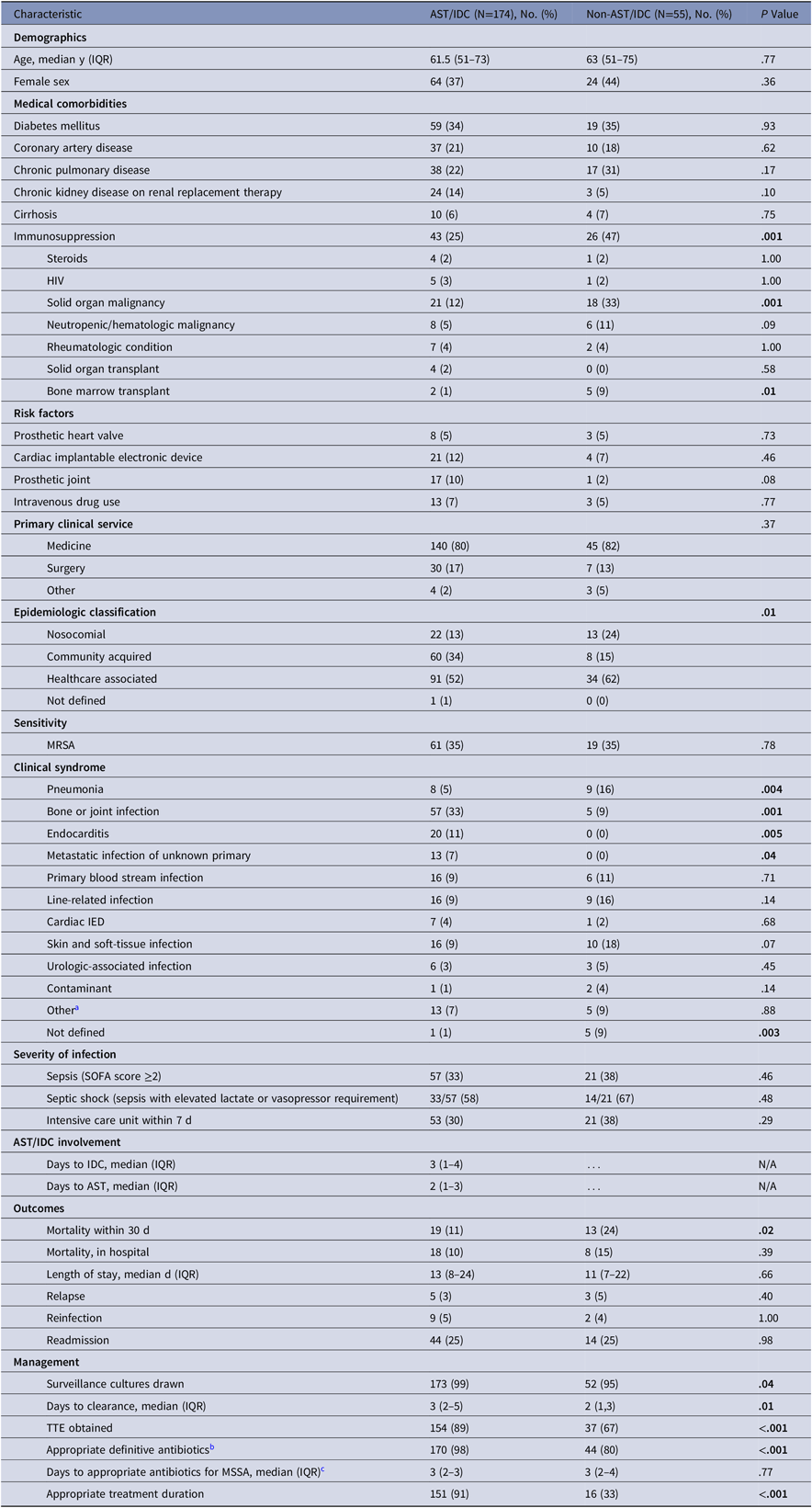
Of 303 SAB episodes, 261 unique patients met our inclusion criteria. Following chart review, 229 patients were included in the analysis (Supplemental Fig. 1 online). Overall, 174 patients (76%) received AST/IDC input. Of these 174 patients, 30 (17%) were initially identified and evaluated by AST. The groups were comparable with regards to age, gender, diabetes mellitus, coronary artery disease, and chronic pulmonary disease (Table 1). The non-AST/IDC group included more immunosuppressed patients (47% vs 25%) (P < .05). The AST/IDC group had more patients with cardiovascular implantable electronic device (12% vs 7%) and prosthetic joints (10% vs 2%) compared to those in the non-AST/IDC group, but these differences were not statistically significant. Healthcare-associated infections accounted for 91 patients (52%) in the AST/IDC group and 34 patients (62%) and non-AST/IDC group. MRSA, sepsis, and intensive care admissions were similar in both groups. Bone and joint infections were more common in the AST/IDC group (33% vs 9%), as was endocarditis (11% vs 0%). Metastatic infections (7% vs 0%) were more common in the AST/IDC group (P < .05).
Baseline Patient Characteristics, Clinical Characteristics, Management, and Outcomes of Staphylococcus aureus bacteremia (SAB)

Note. AST, antimicrobial stewardship team; IDC, infectious diseases consult; IQR, interquartile range; HIV, human immunodeficiency virus; MRSA, methicillin-resistant Staphylococcus aureus; MSSA, methicillin-sensitive Staphylococcus aureus. IED, implantable electronic device. SOFA, sequential organ-failure assessment.
a Other clinical syndromes included AV graft or AV fistula infections (n=6), postoperative wound infection (n=2), septic thrombophlebitis (n=2), peritonitis (n=1), blood transfusion (n=1), dental infection (n=1), prostate abscess (n=1), excoriations (n=1), infected VP shunt (n=1), meningitis (n=1), infected left atrial thrombus (n=1).
b Inappropriate antibiotics in the AST/IDC group included oral trimethoprim/sulfamethoxazole (n=1), oral doxycycline (n=1), oral linezolid (n=1), and vancomcyin for MSSA without a documented allergy/intolerance to beta-lactams (n=1). Inappropriate antibiotics in the non-AST/IDC group included oral amoxicillin-clavulanate (n=1), oral trimethoprim/sulfamethoxazole (n=2), oral doxycycline (n=4), oral cephalexin (n=1), vancomycin for MSSA without a documented allergy/intolerance to beta-lactams (n=1), and no antibiotics in cases thought to be contaminants (n=2).
c Included those with MSSA who received appropriate definitive antibiotics, N=110 in the AST/IDC group and N=30 in the non-AST/IDC group.
Logistic Regression Models for Patient and Infection Characteristics Associated With 30-Day Mortality in Staphylococcus aureus Bacteremia (SAB) (n = 217)

Note. AST, antimicrobial stewardship team; IDC, infectious diseases consult. The multivariable logistic regression model included the variables included in this table.
a From initial positive culture to negative culture.
Compared to the non-AST/IDC group, the AST/IDC group had lower 30-day mortality (11% vs 24%; P = .02) (Table 1). Survival curves diverged at 3 weeks from the initial culture (Supplemental Fig. 2 online). Relapse and reinfection occurred in ≤5% of both groups. Hospital length of stay (LOS) and readmission rates were comparable. In the AST/IDC group, a higher proportion had surveillance cultures, transthoracic echocardiograms, appropriate definitive antibiotics, and treatment duration (P < .05).
In the univariate logistic regression model (Supplemental Table 1, online) the following factors were associated with increased risk for 30-day mortality: age ≥60 years, sepsis, septic shock, intensive care, and SAB ≥3 days (P < .05). Odds of mortality were lower in the AST/IDC group (odds ratio [OR], 0.4; P = .02) (Table 2). The multivariable logistic regression model revealed that advanced age, sepsis, and SAB ≥ 3 days were independently associated with an increased mortality risk (P < .05), whereas the AST/IDC group had a lower mortality risk (OR, 0.4; P = .046). When the same multivariable analysis was performed with IDC in place of AST/IDC, the odds ratio of IDC on mortality was not statistically significant (OR, 0.4; P = .062). Sensitivity analyses including immunosuppression and other variables did not change results.
Discussion
Improved clinical outcomes of SAB have been demonstrated with IDC.Reference Vogel, Schmitz and Hagel1 Hence, many programs have mandated IDCReference Martin, Harris, Brooks, Main and Mertz7 or have developed systems that automatically notify IDC.Reference Eby, Richey, Platts-Mills, Mathers, Novicoff and Cox8 The SAB volume can be substantial, however, and immediate bedside IDC may not always be feasible.Reference Norris, Shrestha and Allison9 Therefore, exploring support through AST may be beneficial. The AST and IDC partnership at our institution provided a unique model for evaluation. In our study, AST involvement reduced rates of 30-day mortality beyond the benefits seen through IDC alone. Adherence to the IDSA management guidelineswas notably improved in the AST/IDC group compared to the non-AST/IDC group. Adjunct tests and appropriate selection and duration of antibiotics likely impacted the mortality rate observed in the AST/IDC.
Previously developed models include pharmacy-led bundled care to provide standard recommendations,Reference Wenzler, Wang and Goff5, Reference Nguyen, Gandhi and Chenoweth10 which demonstrated a clear trend of reduced mortality, though this study was underpowered to support statistical significance. Pharmacist-led AST recommending IDC can improve IDC rates.Reference Wenzler, Wang and Goff5 Automatic notification of either AST or IDC can be utilized to improve time to appropriate treatment.Reference Eby, Richey, Platts-Mills, Mathers, Novicoff and Cox8 Although our overall mortality of 14% was comparable to prior reports, we were able to demonstrate, for the first time to our knowledge, reduced mortality with AST/IDC.Reference Vogel, Schmitz and Hagel1, Reference Wenzler, Wang and Goff5, Reference Nguyen, Gandhi and Chenoweth10 Most SAB cases require prolonged therapy, outpatient antibiotic use, and hence, outpatient follow-up. The involvement of infectious diseases consultants in transitioning patients requiring intravenous antibiotics from inpatient to outpatient reduces readmission and hospital length of stay.Reference Norris, Shrestha and Allison9 Our study was unable to show significant difference in readmission rate and LOS, possibly because study was limited to a 1-year experience.
The main limitations of the study are its small sample size, retrospective nature, and reliance on EMR documentation. An inherent selection bias in cases evaluated by IDC may have affected our results. IDC utilization was possibly influenced by infection severity, clinical syndrome, and host factors. Notably, patients assessed by AST were limited to those receiving empiric broad-spectrum antibiotics; therefore, these patients may have had severe infection. The impact of the AST on time to appropriate antibiotics and time to IDC was limited to whole-day intervals, and we are unable to detect difference on scale of hours.
Because of the reduced mortality in SAB with AST/IDC in our institution, the AST has been proactively reviewing EMR-generated report of SAB and recommending appropriate antibiotics and IDC. This new practice will be evaluated later to redemonstrate the value of AST/IDC in SAB management. In conclusion, the optimal approach to SAB management may involve both IDC and AST depending on the resources and structure of the institution. Our findings of the additive effect of AST to the known benefit of IDC on mortality contribute to our effort to provide a unified model of care.
Supplementary material
To view supplementary material for this article, please visit https://doi.org/10.1017/ice.2019.136
Author ORCIDs
Jacqueline Sherbuk 0000-0002-0052-7510
Acknowledgments
Financial support
None reported.
Conflicts of interest
All authors report no conflicts of interest relevant to this article.