Heart failure and heart transplantation sessions
The first heart transplants in children and adults were performed in 1967.Reference Kantrowitz, Haller, Joos, Cerruti and Carstensen 1 , Reference Barnard 2 As such, the overarching theme of the heart failure and heart transplantation sessions of the 2017 World Congress was a celebration of the 50th anniversary of heart transplantation.
Monday
The initial session on Monday was entitled “50 years of Transplantation: What are Best Practices?” Steven Webber led the session with an initial discussion of management of sensitised patients before and after transplant, which included an in-depth discussion of recently published CTOT-C trial data.Reference Dipchand, Webber and Much 3 This was followed by Francesco Parisi presenting an update on the need for myocardial biopsies after transplantation. Elfriede Pahl gave a state-of-the-art presentation on coronary artery vasculopathy, emphasising the need for new strategies for ameliorating coronary artery vasculopathy , a disease that remains the biggest limitation to the life of transplanted hearts.Reference Rossano, Dipchand and Edwards 4 The session continued with Anne Dipchand presenting data on the outcomes after re-transplantation, a sobering reminder that a second heart transplant typically does not last as long as the first transplant.Reference Conway, Manlhiot, Kirk, Edwards, McCrindle and Dipchand 5 The session ended with Jonathan Johnson presenting the status of combined heart–liver and heart–kidney transplants in children.
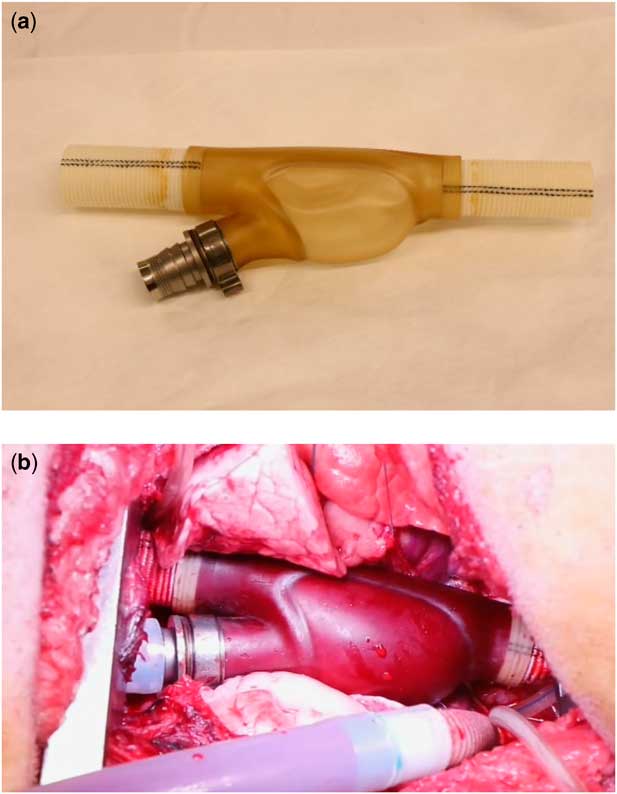
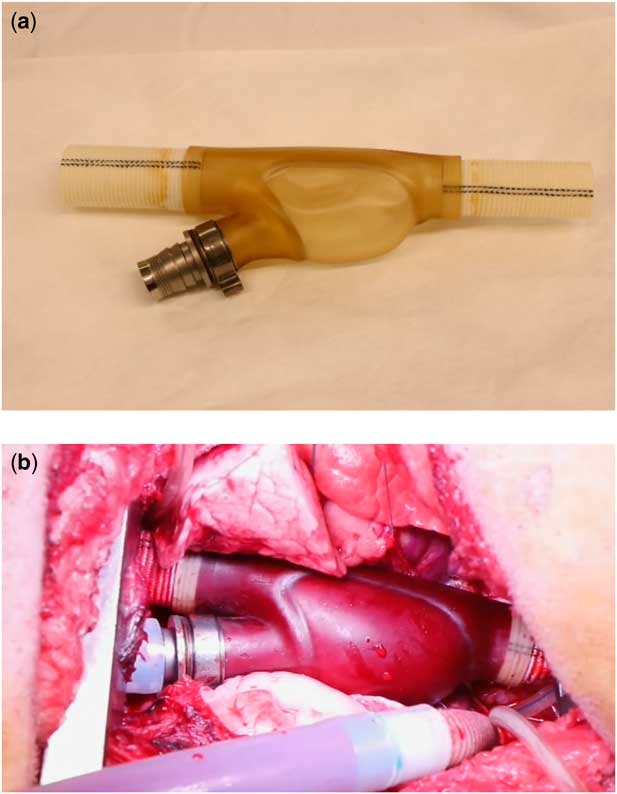
Monday afternoon saw a “Bridging Together” session convened between the Heart Failure and Heart Transplant Workgroup and the Intensive Care workgroup. The theme of the session was “Ventricular Assist Devices in the Intensive Care Unit: Controversies”. The first two presentations from Eugen Sandica and David Morales shared experiences with the use of Ventricular Assist Devices in tough situations, including small infants, hypertrophic and restrictive cardiomyopathy, and in patients with functionally univentricular physiology. Dr Sandica presented a novel animal model of using the Berlin Heart EXCOR (Berlin Heart GmbH, Berlin, Germany) as an right ventricular assist device, using an inflow cannula designed to mimic the bicaval/right atrial connection (Fig 1). Jennifer Conway led an interesting discussion of weaning paediatric patients from ventricular assist devices, highlighting the need for further study into determining which patients may be considered for weaning from their devices.Reference Schubert, Nordmeyer and Peters 6 Christina Vander Pluyme presented a great talk on managing common ventricular assist device complications in the ICU, carefully examining the role of each team member in the management of common complications such as bleeding and thrombosis. Antonio Amodeo from Bambino Gesu Children’s Hospital presented the world’s largest experience in the use of ventricular assist devices as destination therapy in teenagers and young adults with Duchenne’s muscular dystrophy.Reference Perri, Filippelli and Adorisio 7 Dr Amodeo demonstrated excellent results, but also provided cautionary tales regarding pre-implantation decision-making for the patient and their family. Finally, Iki Adachi presented a review of the “Future of Ventricular Assist Device Therapy in Children”, examining the role of newer devices such as the HeartMate III, the Total Artificial Heart, and the upcoming PumpKIN Trial.Reference Baldwin, Adachi and Teal 8
Images courtesy of Dr Eugen Sandica, Bad Oeynhausen, Germany. ( a ) Demonstrates a new inflow cannula designed for the Berlin EXCOR device, designed to mimic the bicaval/right atrial anatomy. ( b ) Shows the device in use in an animal model of the Fontan circulation.
Tuesday
Tuesday’s morning session looked at “Pushing the Limits in Heart Transplantation”, areas where there is little consensus. Shigetoyo Kogaki began with a discussion of transplantation after chemotherapy and cancer, providing guidance to a difficult topic of how soon to list a patient if they have had cancer in the past. Linda Addonizio followed with a discussion of transplantation in patients with difficult anatomy, including patients with heterotaxy and those with functionally single-lung physiology.Reference Lamour, Hsu and Quaegebeur 9 Christian Pizarro discussed the role of ventricular assist devices in patients with elevated pulmonary vascular resistance, and whether or not these devices could make a patient eligible for heart transplantation. Betsy Blume presented on heart transplantation in patients with genetic syndromes and autism, a difficult topic that transplant physicians worldwide face commonly. Dr Blume reminded the audience of the primary role of transplantation, namely, replacing organ function with the goal of improving quality of life, functional capacity, and improving risk of morbidity and mortality. The role of alternatives to transplantation (ongoing care and/or palliative care) was emphasised, and need to be offered in a caring and collaborative manner.Reference Morell, Wolfe and Scheurer 10 The session concluded with Massimo Griselli examining the role of repeat heart transplants in children, again emphasising the diminishing returns of each successive transplant.
Wednesday
On Wednesday morning, a second “Bridging Together” session was hosted by the Heart Failure, Heart Transplantation and Pulmonary Hypertension workgroup and the Imaging Workgroup, examining the role of imaging in the management of cardiomyopathies. The spectrum of imaging, from basic two-dimensional imaging to extensive and complex functioning imaging, was presented. Claudia Stollberger began with a discussion of imaging in non-compaction cardiomyopathy, followed by Satoshi Yasokochi taking an in-depth view of imaging in management of dilated cardiomyopathy, including discussions of resynchronisation therapy. Frank Cetta examined imaging in hypertrophic and restrictive cardiomyopathies, reminding the audience that simple two-dimensional measures on echo still carry significant weight.Reference Cetta, O’Leary, Seward and Driscoll 11 John Lawrenson followed with a talk on HIV cardiomyopathy, and Luc Mertens closed the session with a state-of-the-art discussion of advanced functioning imaging in the cardiomypathies in children.Reference Mertens, Ganame and Eyskens 12 , Reference Dragulescu, Mertens and Friedberg 13
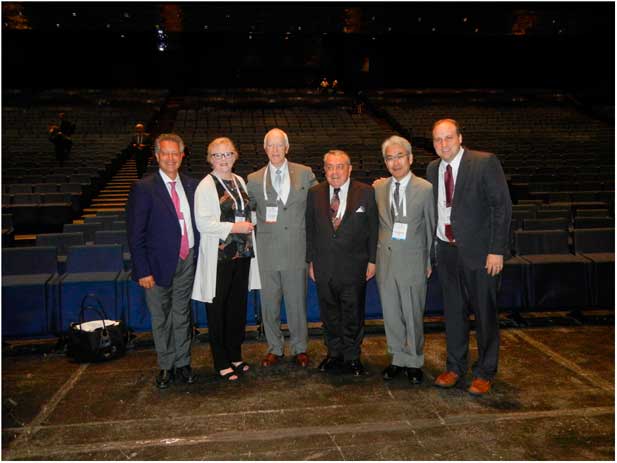
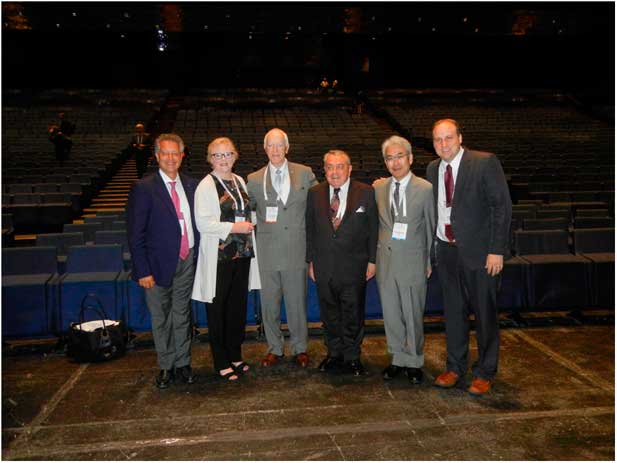
A significant highlight of the meeting was the Wednesday evening plenary session, entitled “The Past, Present and Future of Pediatric Heart Transplantation: 50 Years Beyond Barnard” (Fig 2). The session was held in honour of Dr Magdi Yacoub and his contributions to the field. The session began with Shinichi Nunoda from Japan presenting the increasing Japanese experience with heart transplantation, and how their programmes coped during eras of minimal donor availability. Len Bailey presented the next talk about the history of heart transplantation, looking at the beginnings of infant transplantation in the early to mid-1980s. This incredible presentation included an in-depth discussion, both positive and negative, of the initial xenotransplantation attempt with Baby Fae, and resulted in a standing ovation from the attendees. Roland Hetzer from Germany discussed the experiences in starting the original Berlin Heart trials in children, from initial device design to human implantation. Dr Hetzer showed the incredible expansion of the use of ventricular assist devices in children, and how “bridging” to transplantation using these devices has become commonly accepted and is preferred to other forms of mechanical support. Finally, Lori West concluded the session with a discussion of the “Future of Heart Transplantation”, including the potential for tolerance or other immune modulatory therapy to change how we currently think about transplantation. All of the presenters represented pioneers in their respective fields, a fitting session to honour Dr Yacoub.
Picture of the presenters and moderators of the plenary session, “The Past, Present and Future of Pediatric Heart Transplantation: 50 Years Beyond Barnard”, held in honour of Magdi Yacoub. From left: Antonio Amodeo, Lori West, Len Bailey, Roland Hetzer, Shinichi Nunoda, and Jonathan Johnson.
Thursday
Thursday morning’s session brought together the Heart Failure, Heart Transplantation, and Pulmonary Hypertension Workgroups with the Adult Congenital Heart Disease Workgroup. Nazzareno Galie examined the ways to approach concomitant pulmonary hypertension and shunt lesions, discussing whether to “treat and repair”, “repair and treat”, or “don’t close the shunt”. Anne Marie Valente discussed imaging in adult CHD patients, specifically looking at those patients in heart failure and how we can better understand them through imaging. Steve Zangwill provided an in-depth presentation of the role of transplantation in adult CHD patients, looking at all potential clinical outcomes, both good and bad. The session concluded with a debate between Jonathan Chen and David Crossland, looking at current heart transplant listing allocation policies, and whether or not adult CHD patients are disadvantaged in these systems. Although the debate was well argued, it was clear from the audience and speakers that there continues to be a feeling of difficulty in getting an adult CHD patient transplanted, even among different countries and different allocation policies.
Thursday’s morning session included the top-rated heart failure and transplantation abstracts (discussed below), along with three platform presentations. Joseph Rossano presented a clinical update on myocarditis, discussing recent literature linking clinical myocarditis with a genetic disposition to ventricular dilatation and dysfunction.Reference Belkaya, Kontorovich and Byun 14 Dr Rossano reminded the attendees of a recent Cochrane review that did not support using intravenous immunoglobulin for all patients with myocarditis.Reference Robinson, Hartling, Vandermeer and Klassen 15 Juan Pablo Kaski presented an update on the management of hypertrophic cardiomyopathy in childhood, emphasising the role of medical treatment primarily in the setting of symptoms or in sudden death prevention. The roles of disease-specific therapies (for instance, in the setting of a specific genetic mutation or syndrome) were introduced, recognising that this is likely to become more common in the future as genetic characterisation becomes standard. Finally, Lori West presented the history of ABO-incompatible heart transplantation in children, including a dramatic decrease in waitlist mortality for infants waiting for transplants. Dr West also demonstrated new microarray technology being used to better characterise the typical ABO antigens.Reference Jeyakanthan, Tao and Zou 16
On Thursday afternoon, a basic science forum for heart failure and transplantation was hosted, looking specifically at a more detailed genetic evaluation of paediatric heart failure patients. Joshua Sparks led the session with a discussion of the importance of genetic and metabolic evaluations in paediatric dilated cardiomyopathy, followed by presentations looking at proteomics in heart failure by Anne Murphy, and mitochondria in heart failure by Gary Lopaschuk. Daphne Hsu presented a state-of-the-art discussion of biomarkers in paediatric heart failure, and the session concluded with Seema Mital’s discussion of “Clinical Diagnosis in the Genome Era”. Dr Mital examined the challenges and future opportunities, considering the massive influx of genomic data becoming widely available to clinicians.
Abstracts
Two heart failure and transplantation oral abstract sessions were held, including 17 oral presentations. Although all of the speakers gave wonderful presentations, we chose to focus on several highlighted abstracts as follows.
Lucy Roche from Toronto presented an abstract looking at the outcomes of patients referred to a specific heart failure clinic designed for adult CHD patients. The morbidity and mortality occurring in this patient population is incredible, with a mortality rate of 10% per year and a hospitalisation rate of 17% per year. These outcomes emphasise that the patients getting to this stage of advanced care are the sickest of the sick, and could perhaps have benefitted from advanced heart failure therapy earlier in their course.
Rachel Adorisio from Bambino Gesu Children’s Hospital in Rome presented a study looking at patients with Duchenne’s muscular dystrophy who underwent a heart-rate reduction strategy as part of their medical heart failure treatment. This included the use of β-blockers and ivabradine standardly in these patients, in addition to usual heart failure therapies for afterload reduction. Intriguingly, the patients they studied with the heart-rate reduction strategy had an improvement in ejection fraction at 1 year, and maintained this at 3 years, compared with continually decreasing function in patients not using this strategy.
Betsy Blume from Boston Children’s Hospital presented an update of the Pedimacs registry, looking at the use of durable ventricular assist devices in children with planned long-term follow-up. Initial data from the registry show a clear improvement in survival for those patients in whom implantable continuous flow devices can be used, compared with paracorporeal continuous devices.Reference Blume, Rosenthal and Rossano 17 In recognition of this, the registry has witnessed younger patients being implanted with the durable implantable continuous devices, including nine patients under 20 kg.
Pulmonary hypertension
Tuesday
The first pulmonary hypertension session at the 2017 World Congress of Pediatric and Cardiac Surgery included presentation of the top abstracts in pulmonary hypertension, followed by an opening session aimed at understanding the basic aspects of the disease. Rolf Berger led the session with a discussion of the epidemiology and classification of pulmonary hypertension, specifically looking at children. Mark Friedberg followed with a discussion of basic imaging modalities in pulmonary hypertension, questioning whether the imaging was all about estimating a pulmonary artery pressure, or if imaging of the right ventricle was really the better focus. Shahin Moledina presented the role of the advanced imaging modalities such as cardiac MRI in the assessment of paediatric pulmonary hypertension, and Christian Apitz followed with an overview of diagnostic cardiac catheterisation in these patients. Maria Del Cerro concluded the session with an in-depth examination of a bronchopulmonary dysplasia, a cause of pulmonary hypertension unique to the paediatric population, and one that is ever-present as a result of ongoing success in premature neonatal care.
Wednesday
Wednesday’s morning session was focussed on pulmonary hypertension in CHD. Maurice Beghetti presented an overview of the pathophysiology of pulmonary hypertension in this setting, with Antonio Augusto Lopes providing a further discussion of operability in paediatric patients with congenital shunt lesions and pulmonary hypertension. The subsequent presentations then focussed on specific clinical presentations; Gül Sağın Saylam examined our current understanding of Eisenmenger Syndrome, followed by Robert Weintraub who discussed secondary pulmonary hypertension in the setting of left heart failure and elevated filling pressures. Mary Mullen presented common aetiologies of pulmonary hypertension in patients with Trisomy 21. Finally, Gu Hong demonstrated the common situation of postoperative pulmonary hypertension, an issue our ICUs struggle with on a daily basis.
The last pulmonary hypertension session focussed on the specific treatment of pulmonary hypertension, with initial talks on general workup by Krishna Kumar, cyclic guanosine monophosphate treatment by Tilman Humpl, prostacyclin therapy by Shozaburo Doi, and endothelin receptor antagonist therapy by Maurice Beghetti. Although focussed on the specific therapies, these talks also examined the intricacies of multi-drug therapies, management of side effects and other complications, and the cost of medications. Dietmar Schranz followed these talks with an examination of interventional approaches and their clinical outcomes, including balloon atrial septostomies and percutaneous creation of other shunts such as a Potts shunt. This wonderful session concluded with a discussion of surgical interventions by Damien Bonnet, up to and including lung or combined heart–lung transplant. In response to these last talks, a debate emerged regarding the paediatric patient with pulmonary hypertension on maximal medical therapy, who presents with syncope. The debate examined the roles of atrial septostomy versus surgical Potts shunt in this troubling clinical situation. Reflective of the need for further studies in pediatric patients, there was no consensus that was able to be reached.
Conclusions
The sessions on Heart Failure, Heart Transplantation, and Pulmonary Hypertension at the 2017 World Congress of Pediatric Cardiology and Cardiac Surgery included excellent presentations from many speakers of diverse backgrounds. The World Congress provided a forum to discuss these complex pathologies with a global audience.
Acknowledgements
The authors would like to acknowledge the outstanding contributions of all the speakers and moderators of the heart failure, heart transplantation, and pulmonary hypertension sessions at the World Congress in Barcelona. Further, the authors would like to thank the Organising Committee for allowing a full slate of presentations from the Heart Failure and Pulmonary Hypertension communities; the opportunity to discuss these topics in such a global forum is unprecedented and inspiring.
Financial support
Dr. Ivy indicates that the University of Colorado receives consultant fees from Actelion Pharmaceuticals, US, Inc, Bayer Healthcare, Lilly, Inc, and the United Therapeutics Corporation.
Conflicts of Interest
None.