


INTRODUCTION
With the introduction of effective vaccines against Haemophilus influenzae and Streptococcus pneumoniae, two of the major causes of invasive bacterial disease in childhood are coming under control [Reference Whitney1, Reference Schuchat2]. However, invasive meningococcal disease (IMD) caused by Neisseria meningitidis still remains an important infectious disease in many industrialized countries, and a cause of periodic epidemics in non-industrialized countries [Reference Pollard and Moxon3]. In half the cases of IMD the clinical presentation is meningitis, while 40% present with meningococcal septicaemia [Reference Rosenstein4]. The case- fatality rate of fulminating meningococcaemia, which previously exceeded 50%, declined over time to 8–15% with improving care and recently to about 5% of children treated in specialist paediatric intensive care units in the United Kingdom [5–Reference Dankert, Cohen and Powderly8].
The geographical prevalence of N. meningitidis varies, serogroups B, C and Y prevail in Europe, America and Australia, while serogroup A is prevalent in Africa and Asia [Reference Pollard and Moxon3, Reference Lapeyssonnie9–Reference Tsolia11]. The most prevalent serogroup in Israel during the last two decades has been B, accounting for some two thirds of cases [Reference Block12]. The incidence and mortality of IMD are correlated with age and socio-economic factors, with increased risk in children and in deprived populations [Reference Williams13–Reference Deutch17]. The rapid onset of the disease, the sometimes fulminant course, and the subsequent disability and mortality are cause for serious concern. Although 95% of meningococcal cases are sporadic, the emergence of several cases of IMD in a community engenders considerable parental, medical and social anxiety [18]. Therefore the investigation and control of IMD present a significant public health challenge.
In late December 2003, a cluster of severe IMD cases in children emerged in Jerusalem. Analysis of the clinical, demographic and socio-economic characteristics of the cases in children during the years 1999–2005 revealed some noteworthy features.
METHODS
IMD is a notifiable disease in Israel by law, applying both to physicians and to microbiological laboratories. All IMD cases are reported to the district health office (usually by an immediate telephone call and later in writing). The data of all IMD cases in Jerusalem district during 1999–2005 were collected from epidemiological investigations, hospital files and laboratory results. The demographic and socio-economic variables recorded were age, gender, ethnicity, religious observance, household crowding (persons per room, children aged <5 years per household) and the educational or child-care setting. Clinical data included the presentation, antibiotic treatment and short-term outcome (survival/death). The clinical presentation was divided into two categories: (a) meningococcaemia with or without meningitis or (b) meningitis and other invasive conditions (e.g. septic arthritis). Laboratory data included cerebrospinal fluid (CSF) Gram stain and culture, blood cultures, bacterial serogrouping and pulsed-field gel electrophoresis (PFGE). PCR diagnosis of meningococcal disease is not routinely available in Israel. The epidemiological variables were: number of contacts and emergence of secondary cases. Close contacts were defined as: (1) household members; (2) child-care centre contacts; and (3) persons directly exposed to the patient's oral secretions [18].
Case definition
Cases were classified according to standard IMD definitions: confirmed case – isolation of N. meningitidis from blood or CSF or other sterile site, from a person with clinically compatible illness; probable case – clinically diagnosed meningococcal disease without laboratory confirmation [18]. Meningococcaemia was defined as a confirmed case with positive blood cultures with or without a purpuric rash, or a probable case with the purpuric rash typical of meningococcaemia. These case definitions were applied for the national as well as the Jerusalem district IMD cases.
Laboratory investigation
Isolates in hospital laboratories of N. meningitidis from blood or CSF were sent to the national Meningococcal Reference Laboratory for serogroup determination. Serosubtyping was not performed during the study period. All the viable isolates preserved from February 2003 to November 2005 were submitted to PFGE typing analysis, which was performed according to the PulseNet protocol for E. coli with some modifications [19]. The isolates were grown overnight on chocolate agar at 37°C in a CO2 incubator. The DNA extracts were digested with the NheI restriction enzyme (New England Biolabs, Ipswich, MA, USA). PFGE was carried out in a CHEF DRIII apparatus (Bio-Rad, Hercules, CA, USA) for 18 h at 14°C at 6 V/cm and ramping times were 2·2–35 s for the samples digested with both enzymes. For data analysis Tiff images of the gels were normalized using the Bionumerics software (Applied Maths, Sint-Martens-Latem, Belgium); an 85% correspondence was considered as similarity.
IMD incidence rates
IMD incidence rates in the Jerusalem district were compared to the national rates provided by the Israel Ministry of Health [20]. The same procedure was applied in regard to age-specific rates in children aged 0–14 years. The incidence rates in the various subgroups in the Jerusalem district were compared. Over the years 1999–2005 the average population of the Jerusalem district was 775 000, comprised essentially of two ethnic groups – Jews (71·3%) and Arabs (28·7%). The Jewish population was divided into two subgroups based on religious observance – ultra-orthodox and traditional/secular, 37·7% and 62·3% respectively [21, 22]. Children aged 0–14 years (270 250) comprised 34·9% of the district's population during 1999–2005.
The cluster study
The cluster was defined on the basis of several cases occurring in spatial and temporal proximity [Reference Hoebe23]. The cluster group included cases (all aged 0–14 years) in the 10-week period (16 December 2003 to 7 February 2004); the reference group included all cases aged 0–14 years, from 1 January 1999 to 31 December 2005, excluding the cluster period. We determined the number of cases occurring each year in the 10-week period (December–February) for 5 years before and 1 year after the 2003–2004 cluster. The age (0–14 years) and period specific incidence was compared to that of the cluster period.
Statistical analysis
Incidence rates and seasonal trends were analysed with WINPEPI® [Reference Abramson24]. The demographic, laboratory and clinical data were analysed using SPSS 14.0 for Windows (SPSS Inc., Chicago, IL, USA). Continuous variables were compared using Student's t test; dichotomous variables were analysed by Pearson's χ2 test, with a P value <0·05 considered significant. A multiple logistic regression model was used for two variables (clinical presentation and mortality).
RESULTS
IMD in Jerusalem 1999–2005
During the 7-year period 1999–2005, 512 cases IMD occurred in Israel; 133 of them (26%) in the Jerusalem district, whose population is 12% of the national population [21]. The annual incidence rate of IMD in 1999–2005 in the Jerusalem district was significantly higher than the national average [2·45±0·6 vs. 1·13±0·16/100 000 population; rate ratio (RR) 2·17, 95% confidence interval (CI) 1·3–3·6, P=0·002]. The mean annual number of cases in the district was 19±5·2 (range 14–30 without a specific trend).
Most patients were children – of the 133 cases, 112 (84·2%) were children aged ⩽14 years. The peak incidence was in infants aged <1 year (21±11·9/100 000). Children aged 0–14 years in Jerusalem had a higher rate of IMD than the national average (5·92±1·82 vs. 2·23±0·46; RR 2·7, 95% CI 1·47–4·81, P=0·001).
The average annual incidence rates in children aged 0–14 years of the Arab and Jewish ultra-orthodox groups differed significantly from those of the Jewish traditional/secular group (8·95, 8·63 and 2·41/100 000, respectively, P<0·05). Evaluation of certain socio-economic factors among the IMD cases (age 0–14 years) revealed significant differences between the sub-populations. The Arab and ultra-orthodox patients tended to be younger than the traditional/secular patients (mean age 3·8±3·6, 2·9±3·2 and 7·1±5·2 years, P<0·0001), came from overcrowded households (average persons/room 2·57±1·2, 2·2±0·69 and 1·63±0·67, P=0·003) with more children aged <5 years (2·24±1·2, 2·58±1·1 and 1·3±1·34, P=0·001).
The cluster study
On 16 December 2003 two unrelated children with severe meningococcaemia were hospitalized in one hospital on the same day. Eight similar cases appeared within 10 weeks. The 10 cases from 16 Dec-ember 2003 to 7 February 2004 were referred to as the cluster group and were compared to all the other 102 IMD cases aged 0–14 years in the district in 1999–2005, which comprised the reference group. Overall, 37·5% (42/112) of cases occurred during the winter months (December–February), with a significant seasonal trend (Ratchet circular scan method, P<0·01). Hence, the comparison was made for a specific time period. The period specific incidence of IMD in the cluster period (3·7/100 000) was significantly higher (χ2=4·69, P=0·03) than in the 5 years before and 1 year after (range 0·37–2·22/100 000, average 1·23±0·68/100 000) the 2003–2004 cluster. The proportion of the cluster cases was 50% (10/20) of the annual number of cases, compared to 22·5% average (range 9–25%) in the reference years (OR 4, 95% CI 0·7–26·2, P=0·069). Intensive epidemiological work-up did not reveal any link between the cases. All the cluster children were from either the Arab or the ultra-orthodox Jewish sub-populations.
Patient characteristics (Table)
Most of the IMD patients were young children, with 68·8% aged <5 years, and with male predominance (59·8%). The clinical presentation and mortality differed between the two groups. All the cluster cases presented with meningococcaemia, compared to 51% of the reference group (OR 1·19, 95% CI 1·07–1·3, P=0·003). No significant differences between the groups were found with respect to age, gender, ethnicity and antibiotic therapy. Most of the patients (80·9%) were treated with ceftriaxone and the rest were treated with other antibiotic combinations. The clinical presentation varied with age group, the proportion of meningococcaemia rose with age, with 35·5% of children aged 0–1 year, 58·7% aged 1–4 years and 68·6% aged 5–14 years. In a multivariate analysis model, children aged 1–14 years were at higher risk for meningococcaemia than those aged 0–1 year (OR 2·8, 95% CI 1·14–6·8, P=0·024). No other variables were significantly associated with the clinical presentation. The clinical presentation was meningococcaemia in 57·8% of the Jewish children and 52·1% of the Arab children (P=n.s.).
General characteristics of 112 children with invasive meningococcal disease in Jerusalem, 1999–2005
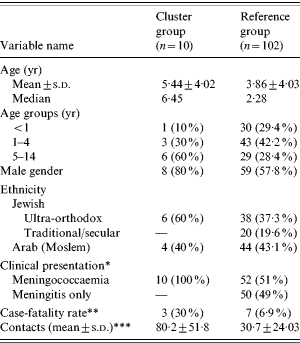
* P=0·003, ** P=0·014, *** P<0·0001.
Mortality
During 1999–2005, 10 children died from IMD. All except one patient, who was dead on arrival, died in paediatric intensive care units after an average stay of 3·8±3·3 days. The overall case-fatality rate in children aged 0–14 years was 8·9%, being higher in children with meningococcaemia (14·5%) compared to 2% in those with meningitis alone (OR 8·3, 95% CI 1·02–68, P=0·021). The cluster case-fatality rate was 30% (3/10) compared to 6·9% (7/102) in the reference group (OR 5·8, 95% CI 1·2–27·5, P=0·014). In a multivariate analysis model, which included the study group, age group, gender and ethnicity, the study group was the only risk factor significantly associated with mortality. The case-fatality rate was higher in Arab (14·6%) than Jewish children (4·7%) (χ2=3·3, P=0·069), as was the IMD mortality rate (1·3/100 000 person-years in Arab and 0·22/100 000 person-years in Jewish children; χ2=8·45, P=0·004).
Laboratory results
Of 112 cases in both groups, 68 (60·7%) were laboratory confirmed; the others were defined as probable cases. There were 46 positive blood cultures (41·1%), 35 positive CSF cultures (31·2%); in 12 patients both cultures were positive. Fifty-two cases were of serogroup B, two – group C, 10 – group Y, three – group W135, and two ungrouped. Within the cluster group all five positive cultures were of serogroup B. All the isolates were found to be rifampicin susceptible.
PFGE analysis was performed on 13 isolates: five confirmed cluster cases (two Arabs, three Jews) and eight reference cases (six Arabs, two Jews). Analysis by means of the NheI restriction enzyme showed no single pattern epidemic clone in the isolates of the cluster cases (Fig.). A high resemblance (above 90%), including four indistinguishable isolates, was found in six Arab patients (lanes 1–6, two cluster and four reference cases). Although not closely related to these, another two (lanes 7 and 8 reference cases) were identical. There was no direct epidemiological link between the patients in whom this resemblance was found. The isolates from Jewish cases demonstrated considerable variability.
Results of Pulsed-field gel electrophoresis analysis of 13 Neisseria meningitidis isolates, using NheI restriction enzyme. Lanes 1–3, 6–8, Arabs from the reference group; lanes 4, 5, Arabs from the cluster group; lanes 10, 13, Jews from the reference group; lanes 9, 11, 12, Jews from the cluster group.

Epidemiological investigation and secondary prevention
All the cluster patients were from either the Arab or the ultra-orthodox Jewish groups, which in general have a low socio-economic level. Intensive epidemiological investigation did not reveal any association between the cluster cases. The average number of contacts requiring post-exposure prophylaxis varied according to several variables. About half (58/112, 51·8%) of the patients attended an educational facility. The mean number of contacts per patient was higher among those who attended an educational facility compared to children at home (48·1±35·3 and 21·5±16·9 respectively, P<0·0001). Using a multivariate analysis model, the variable educational setting was independently associated with the number of contacts and accounted for 32·2% of variance. The average number of contacts per patient in the whole group (n=112) was 35·3±30·9 (median 25, range 6–175). The average number of contacts was significantly higher in the cluster group (80·2 vs. 30·7, P=0·0001). A single secondary case was observed in the reference group.
DISCUSSION
The occurrence of several IMD cases in children within a short period of time induces public anxiety and concern. It is essential that public health professionals offer timely and precise information about IMD, particularly advice regarding the risk of transmission to families and contacts within educational settings and in the community. Such information requires a thorough epidemiological investigation to analyse the characteristics and risk factors of the disease cases.
Meningococcal outbreaks often occur in distinct settings, including child-care centres, schools, college dormitories and military camps [Reference Hoebe23, Reference Pickering25]. Outbreaks have been described in Israel in military camps and in rural settlements such as kibbutzim and Arab villages [Reference Almog26, Reference Shehab27]. An outbreak may be defined on the basis of standard epidemiological data, molecular epidemiology tools or a combination of the two. Based on the epidemiological investigation and molecular analysis of the cases in question we found no evidence that the current event was in fact an outbreak, hence it was defined as a cluster of meningococcaemia cases. The fulminant clinical presentation in several patients led to a high mortality, consistent with reported case-fatality rates in cases of meningococcal sepsis (meningococcaemia) [Reference Rosenstein7, Reference Dankert, Cohen and Powderly8]. Mortality rate correlated not only with the severity of the clinical presentation, but also with ethnic origin, as Arab children had a significantly higher mortality rate. Case-fatality rates for meningococcal disease remain high in spite of antibiotic and supportive treatment, and are still of the order of 10–15% in industrialized countries [Reference Goldacre, Roberts and Yeates28–Reference Jackson and Wenger31].
The population of Jerusalem as a whole was at increased risk for IMD, particularly in children younger than 14 years. The demographic profile of Jerusalem is unique, with overrepresentation of two population groups: Arabs and ultra-orthodox Jews [22]. These two groups tend to live in overcrowded conditions with large families residing in a single household, and frequent social gatherings being part and parcel of their lifestyles.
The role of socio-economic determinants of morbidity and mortality in IMD has been evaluated in various communities. Heyderman et al. [Reference Heyderman14] studied the association between the incidence and mortality of meningococcal disease in young children and socio-economic deprivation in the United Kingdom. The incidence rates for the most deprived quintile were twice those of the most affluent quintile. In a geographical study in Wales, Fone et al. [Reference Fone15] determined that the incidence rate of meningococcal disease increased significantly from 8·1/100 000 in the least deprived quintile to 19·8/100 000 in the most deprived quintile. In a case-control study in the region of Valencia in Spain, Pereiro et al. [Reference Pereiró16] evaluated the risk factors related to invasive disease caused by N. meningitidis, H. influenzae type b (Hib) and S. pneumoniae. For N. meningitidis, relative crowding – living with more than four people (OR 1·7) – and smoking at home (OR 3·6) were found to be significant risk factors. In a study of risk factors for meningococcal disease in Danish pre-school children, Deutch et al. [Reference Deutch17] showed that the risk of IMD increased significantly with increasing household density in children aged 0–1 year and 1–5 years (OR for IMD 1·5). A similar conclusion was drawn from a study conducted in an Eastern region of England, using an ecological design with Geographical Information System (GIS) mapping [Reference Williams13]. The incidence of meningococcal disease was highest in the most deprived areas, with a relative risk of 1·97. These findings further reinforce the need for action to reduce health inequalities as a prerequisite to preventing serious infectious diseases.
Most cases of IMD in Israel are caused by serogroup B, for which no appropriate vaccine is currently available in Israel. Control measures therefore depend on antibiotic prophylaxis for contacts of patients. The cornerstone of prevention of secondary cases of IMD is wide-ranging contact tracing to identify close contacts, who are at increased risk of disease, with an attack rate considerably higher than those in the general population. These close contacts include household members, child-care centre contacts, and anyone directly exposed to the patient's oral secretions [18, Reference Pickering25].
The preventive approach implemented by the District Health Office involves immediate antibiotic prophylaxis to household contacts (within hours of notification), and within 24 h to other contacts, including those from educational and other social settings.
A systematic review of the effectiveness of antibiotics in preventing meningococcal disease found that chemoprophylaxis given to household contacts after a case of meningococcal disease reduces the risk of subsequent cases by 89%, and that in order to prevent one case about 200 household contacts need to be treated [Reference Purcell32].
Within the day-care setting some health authorities (e.g. the United Kingdom and Denmark) recommend chemoprophylaxis only after the second case. In countries such as the United States, Ireland, Sweden, Spain, and Germany the prevailing approach recommends chemoprophylaxis after a single case. The Israel Ministry of Health policy is similar to the latter approach [33]. In our group the mean number of contacts was significantly higher in children who attended an educational facility than in children at home. Davison et al. [Reference Davison34] evaluated the risk of further cases in educational settings. The relative risk of further cases in the 4 weeks after a single case compared with the background rate was significantly raised in all settings, ranging from RR 27·6 in preschool settings to RR 3 in secondary schools. Most secondary cases (68%) occurred within 7 days of the first case. In view of the sociological characteristics of our patient population, a strategy of widespread antibiotic prophylaxis was employed. As a result, the range of persons receiving chemoprophylaxis was extended beyond the usually accepted definitions of ‘close contacts’. Consequently an average of 80 contacts per patient within the cluster group received treatment. The absence of secondary cases may attest to the effectiveness of this approach. We believe that a widespread approach of preventive antibiotic prophylaxis is called for in deprived, overcrowded populations. There is no doubt that the cluster described in Jerusalem raised several cardinal issues in public health. There were obviously serious morbidity and high mortality rates within risk populations of a low socio-economic level. The media ‘alert’ instigated by the District Health Office increased the general public's awareness of the disease, prompting them to seek medical attention early. Similarly, urgent promulgation of the alert to health professionals in the community and the hospitals resulted in heightened awareness of the diagnosis, with earlier referral and treatment. More lives could be saved through earlier admission to hospital. This can be achieved through more information to the public about the early signs of meningococcal septicaemia, in particular skin rash during the first 24-h period of acute fever in children as a sign of need for urgent medical evaluation and treatment. The close cooperation between community and hospital health providers and the public health authorities facilitated the aggressive search for contacts and the widespread chemoprophylactic administration of antibiotics. We believe that this combined approach in deprived populations when no appropriate vaccine is available should be adopted by public health services.
The resemblance shown by PFGE among several meningococci isolated from the Arab patients suggests that a particular clone is being transmitted efficiently in this population. This, and the associated increased morbidity and mortality, require further study including comparative immunological and socio-demographic characterization of the Arab and Jewish sub-populations.
The problem of case ascertainment is an issue which requires attention in Israel. More complete data regarding laboratory confirmation of the diagnosis would have been invaluable in this study. PCR diagnosis of meningococcal meningitis is not available in hospital laboratories in Israel which usually deal with a small number of cases each year. A centralized DNA based diagnostic service is required which would improve both the case ascertainment data and provide epidemiological characterization of meningococci, including those which cannot be cultured [Reference Nadel and Kroll6, Reference Yazdankhah, Lindstedt and Caugant35, Reference Trotter36]. Nucleic acid-based determination of serotypes and serosubtypes and genetic characterization by multilocus sequence typing (MLST) will provide much needed information that will serve as a basis for decision-making, e.g. regarding the need for development and introduction of multivalent or specific meningococcal vaccines. Vaccines are available against some serogroups of meningococci (polysaccharide vaccines against serogroups A, C, W-135 and Y, and conjugate vaccine against serogroups C, A and C and recently A, C, W-135 and Y). Protein-based, outer membrane vesicle vaccines against serogroup B meningococcal disease have been used in Norway and Cuba [Reference Holst37]. Tailor-made vaccine against serogroup B (strain-specific MeNZB vaccine) has been used effectively in New Zealand [Reference O'Hallahan38]; however, such vaccines are not generally commercially available. The future prevention of serogroup B disease will depend on both outer membrane protein vaccines being used for serosubtype-specific outbreaks and new vaccines containing multiple other antigens [Reference Hall39–Reference Girard41.
Meanwhile, the basis of the public health control of IMD rests on timely and effective diagnosis and treatment of cases, and public health interventions to prevent secondary cases. Public health authorities must address the challenge of serious infectious diseases occurring within high-risk groups, in order to develop preventive strategies, be they by means of immunization or other approaches.
ACKNOWLEDGEMENTS
The authors thank the nursing staff of the Jerusalem District Health Office, for their assistance in the investigation of IMD in the district and implementation of the control measures.
DECLARATION OF INTEREST
None.



