Atrial fibrillation is the most common arrhythmia among the elderly or patients with heart disease; however, it is not rarely seen in young patients without history or evidence of heart disease.Reference Arroja, Burri, Park, Giraudet and Zimmermann 1 Atrial fibrillation is associated with increased risk of severe stroke, myocardial infarction, and premature death,Reference Wijesurendra, Liu and Eichhorn 2 and although atrial fibrillation incidence increases with advancing age, the number of young patients with atrial fibrillation is also growing as part of the rising global burden of the disease.Reference Chugh, Havmoeller and Narayanan 3 Currently, catheter ablation has been recommended as a front line therapy for maintaining sinus rhythm in elderly patients with atrial fibrillation, and also yields favourable long-term outcomes. However, few studies focused on the young adults with atrial fibrillation and reported the long-term outcome of catheter ablation. The present retrospective study assessed the effectiveness of radiofrequency catheter ablation for lone atrial fibrillation among young adults under 35 years old.
Methods
Patients
From 8567 patients screened, the present study retrospectively enrolled 75 consecutive young adults with drug-resistant lone atrial fibrillation (49 patients had been prescribed propafenone and 26 had been prescribed amiodarone) who underwent radiofrequency catheter ablation between April 2009 and May 2017 at our institution and met the inclusion criteria of age <35 years; undergoing first catheter ablation; and excluding any cardiovascular comorbidity, cardiopulmonary disease, or structural heart disease. Before the procedure, each patient was evaluated using standard Doppler transthoracic echocardiography to exclude cardiac structural abnormalities, and transesophageal echocardiography to exclude left atrial thrombi. Definitions of paroxysmal, persistent, and long-standing persistent atrial fibrillation conformed to the ESC guidelines.Reference Kirchhof, Benussi and Kotecha 4 Anticoagulation entailed long-term treatment with warfarin and bridging low molecular weight heparin during the ablation procedure. Antiarrhythmic drugs were discontinued ≥5 half-lives before the procedure. Written informed consent was obtained from all patients, and the study was approved by the institutional ethics committee.
Electrophysiological study and catheter ablation
The details have been described in our previous work.Reference Zhao, Xu and Jiang 5 In the index procedure, for patients with paroxysmal atrial fibrillation, circumferential pulmonary vein ablation was performed, and pulmonary vein isolation was monitored during the procedure and subsequently confirmed with a circular mapping catheter in each pulmonary vein. Pulmonary vein triggers were considered when burst electrical activity was observed inside the pulmonary veins from the circular catheter recordings or intermittent pulmonary vein tachycardia observed with faster tachycardia cycle length inside the pulmonary veins when compared to that of the rest of the atrium or coronary sinus recordings.Reference Oral, Ozaydin and Tada 6 Non-pulmonary vein trigger was defined as atrial extrasystole or rapid-firing focus of atrial tachycardia or atrial flutter originating from left or right atrium and out of pulmonary vein. In patients with paroxysmal atrial fibrillation without clear trigger, complex fractionated atrial electrograms were mapped and ablated in left atrium or right atrium or coronary sinus. In patients with persistent and long-standing persistent atrial fibrillation, the first ablation step was circumferential pulmonary vein ablation to obtain pulmonary vein isolation. Second, three lines then were ablated as roof line, between the two pulmonary vein circles; mitral isthmus line, between the mitral annulus and the left inferior pulmonary vein; and right atrial cavotricuspid isthmus (CTI) line, if atrial tachyarrhythmia was consistent with CTI-dependent atrial flutter. Complex fractionated atrial electrograms then were mapped and ablated in the left atrium. Complex fractionated atrial electrograms were defined as atrial fractionated electrograms composed of two deflections or more, and perturbation of the baseline with continuous deflection of a prolonged activation complex over a 10-second recording period; and atrial electrograms with a very short cycle length (<120 ms) averaged over a 10-second recording period.Reference Aksu, Guler, Yalin and Oto 7 On the endocardium, irrigated radiofrequency energy was delivered during circumferential pulmonary vein ablation with a flow rate of 20 ml/minute and a maximum power of 30 W, and during complex fractionated atrial electrograms and linear ablation with a flow rate of 25 ml/minute and a maximum power of 35 W. Flow and power of ablation were limited to an irrigation rate of 25 ml/minute and a maximum 25 W inside the coronary sinus. If atrial fibrillation termination was not achieved after the latter steps, cardioversion was used to restore sinus rhythm. Under sinus rhythm, pulmonary vein isolation was reconfirmed, and additional linear ablation was undertaken if necessary to obtain bidirectional block of lines.Reference Jais, Hocini and O’Neill 8
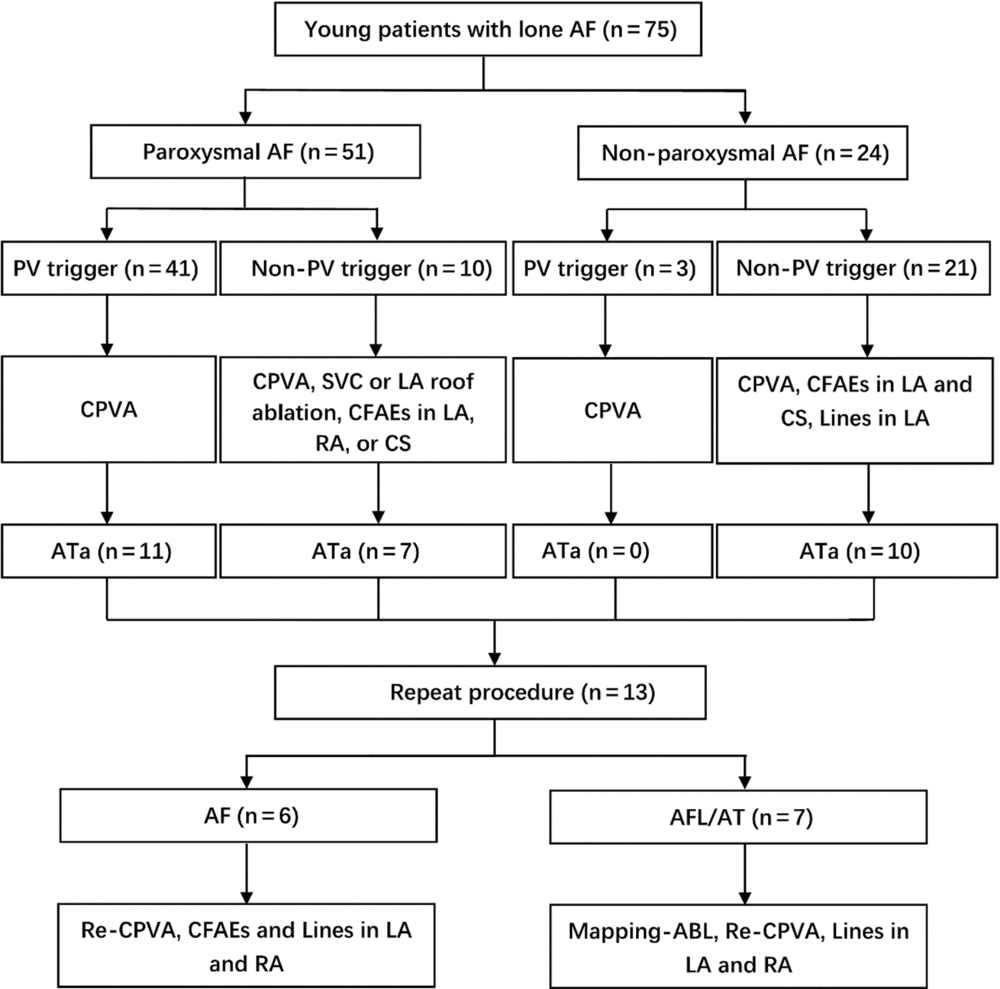
During repeat procedures, if the patient presented with atrial tachycardia or atrial flutter, activation and entrainment mapping were used to identify underlying mechanisms and to guide the following ablation. After terminating atrial tachycardia/atrial flutter, pulmonary vein isolation and the bidirectional block of three lines were reconfirmed. In patients with recurrent paroxysmal atrial fibrillation, if spontaneous atrial fibrillation did not appear, short-duration burst pacing from the right atrium, coronary sinus, and pulmonary veins was used to facilitate the spontaneous atrial fibrillation under isoproterenol infusion. And then, all common triggers were re-mapped and re-ablated. If the patient presented with recurrent persistent atrial fibrillation, pulmonary vein isolation was reconfirmed with a circular mapping catheter at each pulmonary vein, and circumferential pulmonary vein ablation was used to eliminate the recovery of pulmonary vein potentials. Complex fractionated atrial electrograms then were re-mapped and ablated in the left atrium and right atrium. After restoring sinus rhythm by ablation or cardioversion, bidirectional block of three lines was reconfirmed (Fig 1).
Ablation strategy in the study. ABL = ablation; AF = atrial fibrillation; AFL = atrial flutter; AT = atrial tachycardia; ATa = atrial tachyarrhythmia; CFAEs = complex fractionated atrial electrograms; CPVA = circumferential pulmonary vein ablation; CS = coronary sinus; LA = left atrium; PV = pulmonary vein; RA = right atrium; SCV = superior caval vein.

Follow-up
All patients were assessed during follow-up using 12-lead electrocardiography, 24-hour ambulatory electrocardiography monitoring, and transthoracic echocardiography. All patients were anticoagulated with warfarin with a target international normalised ratio of 2–3 or with a new oral anticoagulant. Twenty-four-hour Holter monitoring was scheduled at 1, 3, 6, 9, and 12 months, and thereafter every 6 months. After the procedure, in all cases, treatment with antiarrhythmic drugs was continued for 3 months, and during this blanking period arrhythmia recurrence was managed medically. Patients were instructed to obtain an additional electrocardiography every time they had symptoms.
Study outcomes
The main study outcome was the rate of survival free from recurrence of atrial tachyarrhythmia which was defined according to consensus guidelines as any documented electrocardiographic episode of atrial tachyarrhythmia lasting 30 seconds or longer with or without symptoms. Secondary outcomes included rates of survival free from atrial tachyarrhythmia recurrence by atrial fibrillation type and trigger, and rate of periprocedural complications.
Statistical analysis
Continuous variables were expressed as mean ± standard deviation or median (interquartile range) and were compared using independent-samples t-test, while categorical variables were expressed as numbers and percentages and were compared using χ2 test. Event-free survival was estimated by the Kaplan–Meier method and compared using the log-rank test. Multivariate logistic regression was used to determine the relation between baseline characteristics and recurrent atrial tachyarrhythmia. A two-tailed p value <0.05 was considered statistically significant. SPSS statistical software, version 18.0, was applied (SPSS Inc., Chicago, IL, United States of America).
Results
Baseline clinical characteristics
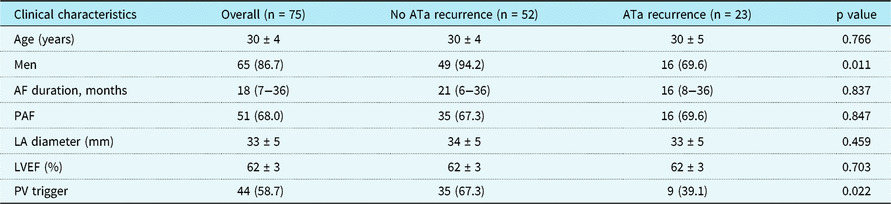
Baseline clinical characteristics for the 75 patients studied overall (median age, 30 years, range 19–35 years; 86.7% men) and by the absence or presence of atrial tachyarrhythmia recurrence at the last follow-up (i.e., after multiple ablation procedures in 13 patients) are shown in Table 1. Baseline characteristics, including left atrium diameter and atrial fibrillation duration, were similarly distributed between groups without and with atrial tachyarrhythmia recurrence except for significantly greater proportions of men and pulmonary vein trigger among patients without atrial tachyarrhythmia recurrence.
Baseline clinical characteristics of the patients.

AF = atrial fibrillation; ATa = atrial tachyarrhythmia; LA = left atrium; LVEF = left ventricular ejection fraction; PAF = paroxysmal atrial fibrillation; PV = pulmonary vein
Data are expressed as mean + SD, median (interquartile range) or n (%)
Procedural outcomes
Circumferential pulmonary vein ablation and pulmonary vein isolation were achieved in all 75 patients. Among the 51 patients with paroxysmal atrial fibrillation, trigger in pulmonary vein was in 41 (80.4%) patients, in superior caval vein in 1 (2.0%) patient, and in left atrial roof in 1 (2.0%) patient; 8 (15.7%) patients had an unclear trigger. Among the 24 patients with non-paroxysmal atrial fibrillation (i.e., persistent or long-standing persistent atrial fibrillation), pulmonary vein trigger was identified in 3 (12.5%) patients with persistent atrial fibrillation: in 2 patients pulmonary vein isolation was achieved with atrial fibrillation termination, and in 1 patient arrhythmia converted post-pulmonary vein isolation to atrial flutter, which was terminated after bidirectional block of CTI line. In the remaining 21 (87.5%) patients with unclear trigger, linear ablation and complex fractionated atrial electrogram ablation were performed to restore sinus rhythm, among whom 2 patients restored sinus rhythm during ablation and the other 19 patients by cardioversion. Compared with patients with paroxysmal atrial fibrillation, patients with non-paroxysmal atrial fibrillation had significantly longer procedure time (126.5 ± 17.3 versus 79.6 ± 7.6 minutes; p < 0.001), radiofrequency delivery time (33.8 ± 7.4 versus 13.9 ± 8.3 minutes, p < 0.001), and fluoroscopy time (16.8 ± 8.5 versus 9.9 ± 6.5 minutes, p < 0.001). Vascular access complications, including pseudoaneurysm and arteriovenous fistula at the femoral vein, occurred in three (4.0%) patients, and there were no major complications.
All patients completed follow-up with 12-lead electrocardiography and 24-hour ambulatory electrocardiography monitoring. After the index procedure, 47 (62.7%) of the 75 patients studied were free from atrial tachyarrhythmia (33 [64.7%] of 51 patients with paroxysmal atrial fibrillation versus 14 [58.3%] of 24 patients with non-paroxysmal atrial fibrillation). Among patients with paroxysmal atrial fibrillation, 18 experienced atrial tachyarrhythmia recurrence: atrial fibrillation in 14 patients (77.8%) and atrial tachycardia/atrial flutter in 4 patients (22.2%). Among patients with non-paroxysmal atrial fibrillation, 10 experienced atrial tachyarrhythmia recurrence: atrial fibrillation in 5 patients (50.0%) and atrial tachycardia/atrial flutter in 5 patients (50.0%).
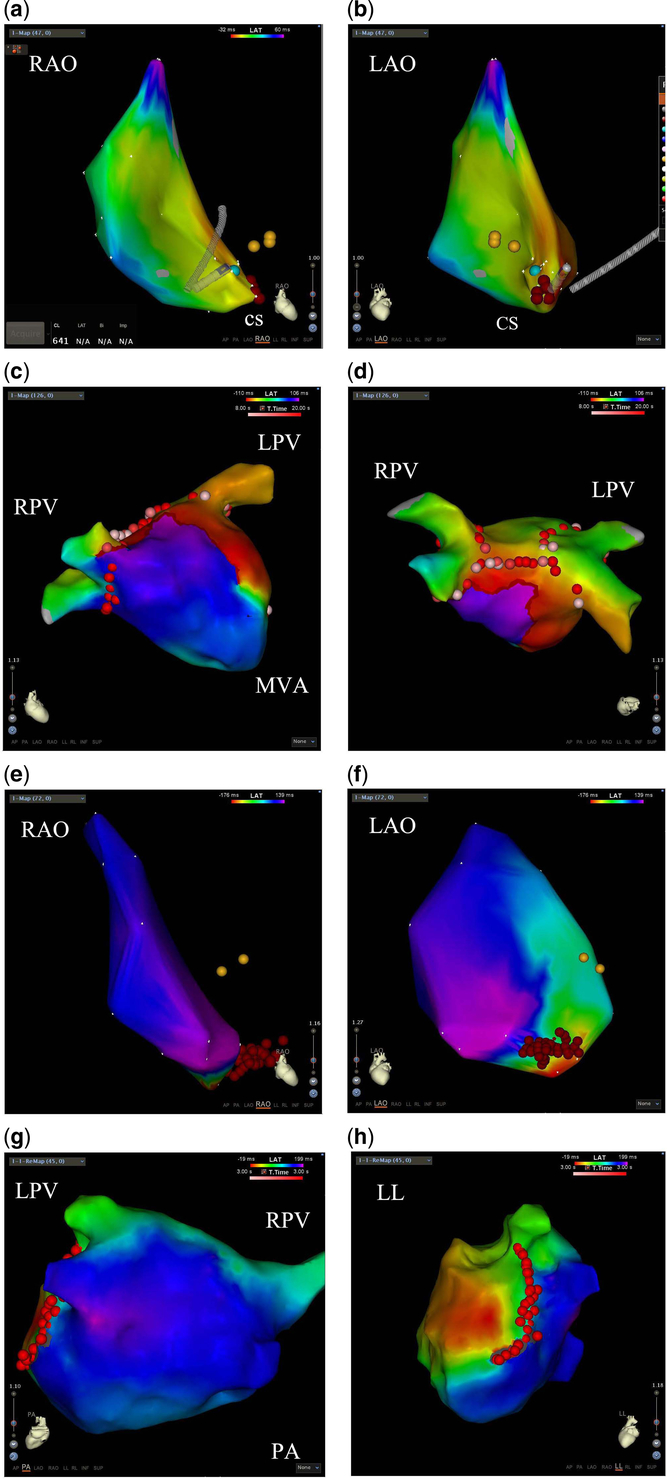
Thirteen patients with recurrent atrial tachyarrhythmia, including seven patients with atrial tachycardia/atrial flutter and six patients with atrial fibrillation, underwent re-ablation. During the re-ablation procedure in patients with atrial tachycardia/atrial flutter, seven atrial tachycardia/atrial flutter mechanisms were identified, including macroreentry atrial flutter (two mitral isthmus-related atrial flutters, one roof-related atrial flutter, and two CTI-related atrial flutters) and microreentry or foci atrial tachycardia (two from coronary sinus) (Fig 2). Three of these seven patients remained sinus rhythm after the second ablation. In six patients with recurrent atrial fibrillation, atrial fibrillation was terminated by circumferential pulmonary vein ablation in 1 patient (trigger from left superior pulmonary vein), and the remaining patients underwent cardioversion to restore sinus rhythm. One of these six patients remained sinus rhythm after the second ablation. Two patients accepted the third ablation (2 mitral isthmus-related atrial flutter) with one patient experiencing recurrent atrial flutter during follow-up. Drug treatment (amiodarone, propafenone, or metoprolol) was given to the recurrent atrial fibrillation patients. Overall success rate among patients with atrial fibrillation recurrence receiving second or third ablations was only 38.5%.
Examples of activation maps of recurrent AFL/AT. Yellow dots indicated His-bundle, red dots indicated ablation lesions. ( a and b ) CS-related focal AT from RAO 45º and LAO 45º view; ( c and d ) left atrium roof-related AFL/AT from AP and superior view; ( e and f ) cavotricuspid isthmus-related AFL/AT from RAO 45º and LAO 45º view; ( g and h ) mitral isthmus-related AFL/AT from PA and LL view. AP = anterior posterior; CS = coronary sinus; LAO = left anterior oblique; LL = left lateral; LPV = left pulmonary vein; MVA = mitral valve annulus; PA = posterior anterior; RAO = right anterior oblique; RPV = right pulmonary vein.

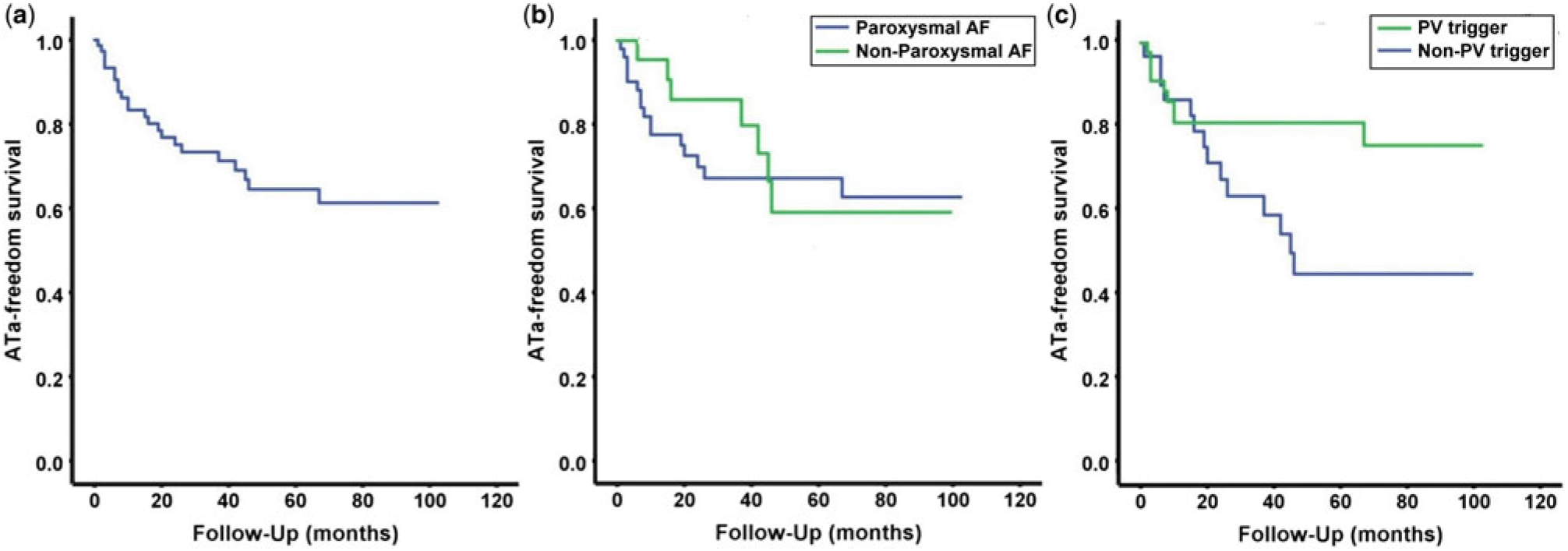
Kaplan–Meier survival curves showing freedom from atrial tachyarrhythmia recurrence after multiple procedures: ( a ) overall; or by atrial fibrillation ( b ) type and ( c ) trigger. ATa = atrial tachyarrhythmia; PV = pulmonary vein, AF = atrial fibrillation.

Long-term follow-up
The main study outcome was the rate of survival free from atrial tachyarrhythmia recurrence, which at median 61 (range, 5–102) months’ follow-up was 62.7% (64.7 and 58.3% for paroxysmal and non-paroxysmal atrial fibrillation, respectively) after single ablation and 69.3% (68.6 and 70.8% for paroxysmal and non-paroxysmal atrial fibrillation, respectively) after mean 1.2 ablations (2 and 3 ablations in 11 and 2 patients, respectively). After multiple catheter ablation (mean of 1.2 ablation procedures), atrial tachyarrhythmia recurrence persisted in 23 patients (14 [45.2%] of 31 patients with non-pulmonary vein trigger versus 9 [20.5%] of 44 patients with pulmonary vein trigger; p = 0.022), and recurrent atrial tachyarrhythmia was not associated with left atrium size (sinus rhythm group, 33.67 ± 4.56 mm versus atrial tachyarrhythmia group, 32.83 ± 4.50 mm; p = 0.459), atrial fibrillation duration (sinus rhythm group, 25.37 ± 24.49 months versus atrial tachyarrhythmia group, 26.65 ± 25.81 months; p = 0.837), or types of atrial fibrillation (atrial tachyarrhythmia recurrence persisted in 16 [31.4%] of 51 patients with paroxysmal atrial fibrillation versus 7 [29.2%] of 24 patients with non-paroxysmal atrial fibrillation; p = 0.847). In multivariate logistic analysis, only non-pulmonary vein trigger was a significant independent predictor of recurrent atrial tachyarrhythmia (OR, 10.60 [95%CI, 2.25–49.96]; p = 0.003). Kaplan–Meier estimated cumulative atrial tachyarrhythmia-free survival was 69.3% overall (Fig 3a). Atrial tachyarrhythmia-free survival was not significantly different for paroxysmal atrial fibrillation (mean 1.1 procedures) and non-paroxysmal atrial fibrillation (mean 1.3 procedures) (Fig 3b; p = 0.665), but was significantly higher in pulmonary vein trigger group versus non-pulmonary vein trigger group (Fig 3c; p = 0.043). At follow-up after the last procedure, the arrhythmia recurrence type was atrial fibrillation in 19 patients and atrial tachycardia/ atrial flutter in 4 patients.
Discussion
The present study with the longest follow-up to date in young patients with lone atrial fibrillation documented that long-term survival free from atrial tachyarrhythmia recurrence after catheter ablation was favourable without a significant difference between patients with paroxysmal and non-paroxysmal atrial fibrillation; most paroxysmal atrial fibrillation was pulmonary vein triggered, and survival free from atrial tachyarrhythmia recurrence after catheter ablation of pulmonary vein triggered atrial fibrillation was higher than that of non-pulmonary vein triggered atrial fibrillation; recurrence of atrial fibrillation in patients with multiple ablations warrants careful consideration and further study, especially in patients with non-pulmonary vein triggered atrial fibrillation or without clear target; and freedom from atrial tachyarrhythmia recurrence was not associated with left atrium size or atrial fibrillation duration.
Despite the lack of clinical or echocardiographic evidence of concomitant cardiovascular or pulmonary diseases, patients with lone atrial fibrillation had increased risk for mortality and thromboembolism compared with individuals without atrial fibrillation.Reference Brand, Abbott, Kannel and Wolf 9 , Reference Kim, Yin and Fontes 10 Catheter ablation was highly effective and safe for patients with lone atrial fibrillation,Reference Buiatti, Kaess and Reents 11 and may be appropriate for teenagers with paroxysmal atrial fibrillation and structurally normal hearts.Reference Balaji, Kron and Stecker 12 Consistently, the present study also suggested that catheter ablation was an efficacious and safe treatment strategy with favourable long-term outcomes for young adults aged under 35 years.
In the present study, there was no significant difference in long-term success rate between paroxysmal lone atrial fibrillation and non-paroxysmal lone atrial fibrillation. A similar conclusion was reached in a previous study.Reference Buiatti, Kaess and Reents 11 In patients with non-paroxysmal lone atrial fibrillation, the long-term atrial arrhythmia leads to atrial electrical remodelling and fibrosis, which might contribute to persistent atrial fibrillation.Reference Jalife 13 The pathogenesis of non-paroxysmal atrial fibrillation entails not only the pulmonary vein trigger but also long duration, complexity of mechanisms, multiple triggers, and substrate sites that are responsible for its perpetuation.Reference Mody, Raza and Jacobson 14 In theory, the efficacy of catheter ablation would be expected to be lower among patients with non-paroxysmal lone atrial fibrillation. However, no significant difference was observed in the success rate of catheter ablation between paroxysmal and non-paroxysmal atrial fibrillation, which might be secondary to small sample size or inadequate duration of non-paroxysmal atrial fibrillation to induce significant electrophysiological and structural changes.
In the present study, the long-term efficacy after index catheter ablation in young patients with lone atrial fibrillation (both paroxysmal and non-paroxysmal atrial fibrillation) was better than those in previous reports.Reference Ganesan, Shipp and Brooks 15 , Reference Ouyang, Tilz and Chun 16 External stressors such as structural heart disease, diabetes, heart failure, and valvular heart disease (via pressure and volume overload) induce a slow but progressive process of atrial structural remodelling which results in local conduction heterogeneities and electrical dissociation between muscle bundles, favouring re-entry and arrhythmia perpetuation.Reference Kirchhof, Benussi and Kotecha 4 The long-term success rate of catheter ablation for patients with lone atrial fibrillation was higher than that for common atrial fibrillation, maybe because of lack of cardiopulmonary disease or other complications.
In young patients with lone atrial fibrillation, most paroxysmal atrial fibrillation was triggered by pulmonary vein, with a favourable long-term effect of catheter ablation. For persistent atrial fibrillation, pulmonary vein was the trigger in three patients who remained in sinus rhythm during follow-up. Even though we used coronary sinus or left atrial complex fractionated atrial electrograms and lines ablation in left atrium and right atrium in addition to circumferential pulmonary vein ablation, the success rate of ablation for atrial fibrillation with non-pulmonary vein trigger was lower than that for atrial fibrillation with pulmonary vein trigger. Although patients with non-pulmonary vein trigger and no clear target underwent ablation thrice, their atrial tachyarrhythmia recurrence rate was as high as 92%.Reference Mohanty, Trivedi and Gianni 17 During the second ablation procedure, more recurrent atrial tachycardia had clear targets than recurrent atrial fibrillation and had more favourable prognosis.Reference Zhao, Wu and Jiang 18 Atrial fibrillation with pulmonary vein trigger had clear target, and pulmonary vein isolation was effective. It was difficult in identifying and mapping the non-pulmonary vein triggers during the procedures, and the exact mechanisms by which linear and complex fractionated atrial electrograms ablation eliminated atrial fibrillation and prevented recurrence were not fully understood. So extended ablation procedures were applied as empirical treatment for atrial fibrillation patients with non-pulmonary vein trigger. However, as per the 2017 HRS/EHRA consensus statement on ablation of atrial fibrillation, additional linear and complex fractionated atrial electrograms ablation showed no reduction in atrial tachyarrhythmia recurrence after radiofrequency catheter ablation. This is one of the possible explanations for the higher recurrence rate of atrial fibrillation with non pulmonary vein trigger.
Atrial fibrillation in some young patients, especially teenagers, is secondary to undiagnosed supraventricular tachycardia, degenerating to atrial fibrillation. However, in the present study, supraventricular tachycardia was absent in the patients enrolled. And we have noticed a rising trend of young patients diagnosed with atrial fibrillation by electrocardiographic documents or electrophysiology study in our institution, without evidence of pre-existing supraventricular tachycardia as a trigger for atrial fibrillation. Therefore, electrophysiologists should be cautious and prepared for possible atrial fibrillation ablation in advance, rather than presuming nothing but supraventricular tachycardia ablation.
Study limitations
The present study is limited by its observational, retrospective, and nonrandomised design with a relatively small sample size; only 10 of 75 patients were female, so comparisons on atrial fibrillation recurrence between different genders were not performed due to limited efficacy. So the results and conclusions therefore require confirmation in larger, prospective, randomised controlled trials. Because atrial tachyarrhythmia recurrence was assessed with 24-hour Holter monitoring but not with implantable loop recorders or 7-day Holter monitoring before ablation and during follow-up, the overall success rate might have been overestimated, particularly in patients with significant atrial fibrillation regression and symptom improvement. Women were underrepresented in the study which limited interpretation and validity of any analysis involving sex. Because the time span of patient recruitment in this retrospective study was relatively long, improvements in equipment and procedures may affect the results. Also, the range of follow-up duration was broad, and studies meeting a predefined duration of follow-up are warranted.
Conclusion
In this single-centre, retrospective study, catheter ablation in young patients with lone atrial fibrillation appeared effective. Most paroxysmal atrial fibrillation was triggered by pulmonary vein, and long-term survival freedom from atrial tachyarrhythmia was greater for atrial fibrillation with pulmonary vein trigger than with non-pulmonary vein trigger. Atrial tachyarrhythmia recurrence after ablation was not associated with left atrial size, or atrial fibrillation duration or type. Recurrence of atrial tachyarrhythmia in patients with multiple ablations warrants careful consideration and further study.
Acknowledgement
Jindong Chen: Data analysis/interpretation; Drafting article; Statistics
Hao Wang: Data analysis/interpretation; Data collection; Statistics
Mengmeng Zhou: Data collection
Liang Zhao: Concept design; Critical revision of article; Approval of article
Financial Support
This research received no specific grant from any funding agency, commercial or not-for-profit sectors.
Conflicts of Interest
None.