1 Introduction
Korean exhibits two types of vowel harmony for distinct classes of words (Kim-Renaud Reference Kim-Renaud1976, Park Reference Park1990, Sohn Reference Sohn1999, inter alia): verbs and sound-symbolic words. The latter class includes a set of neutral vowels which have a dual functionality, aligning with one vowel-harmony type (the so-called dark vowels) when occurring in the initial syllable and behaving as transparent vowels in non-initial syllables (Kim-Renaud Reference Kim-Renaud1976, Lee Reference Lee1984, Sohn Reference Sohn1986, Park Reference Park1990, Lee Reference Lee1992, Cho Reference Cho1994, inter alia). This article makes use of a corpus of sound-symbolic stems in Korean to examine the strength of vowel harmony in sound-symbolic words from a phonotactic perspective, with special emphasis on the class of neutral vowels. The corpus study confirms the main results of earlier traditional analyses, but also shows the pattern is much more nuanced than earlier thought. In this way, this paper's findings are consistent with the general conclusions of other corpus studies of vowel harmony (Hayes & Londe Reference Hayes and Londe2006, Goldsmith & Riggle Reference Goldsmith and Riggle2012) that the patterns themselves are more intricate than originally assumed.
In particular, the neutrality of the traditional class of neutral vowels, [i] and [ɨ], is verified, and we show that the remaining high vowels in Korean, [u] and [y], which have traditionally been assigned to the class of dark vowels, are at least partially neutral. We also examine the vowel [a] and show that it too appears to be partially neutral. Unlike the other neutral vowels, however, [a] is better classified as opaque than transparent. Second, we examine the behaviour of diphthongs in sound-symbolic harmony and show that they pattern with their nuclei when occurring in initial syllables but not in other syllables.
This article is organised as follows. §2 discusses the vowel-harmony system in Korean, gives a brief historical overview and provides an introduction to the data in the corpus study: the sound-symbolic words of Korean. It also compares the Korean vowel-harmony pattern with the well-known patterns of Finnish and Hungarian. The corpus is described in §3 and the analysis and results pertaining to monophthongs in §4. §5 examines the behaviour of diphthongs in sound-symbolic stems. §6 provides a general discussion of the findings. Finally, we conclude in §7.
2 Overview of vowel harmony
2.1 Vowel harmony in Korean
A shared trait of Altaic languages such as Korean is the presence of vowel harmony (Sohn Reference Sohn1999). In Middle Korean, the classes of vowels – /o a ɔ/ belonging to the class of light vowels and /u ɨ i ə/ belonging to the class of dark vowels – did not co-occur (e.g. Park Reference Park1990, Sohn Reference Sohn1999).Footnote 1 The harmony occurred within words and extended to particles (i.e. postpositions) and predicate suffixes (Sohn Reference Sohn1999). In Modern Korean, the prevalence of vowel harmony has been greatly reduced, with the breakdown beginning around the middle of the fifteenth century (Park Reference Park1990). This is largely due to the large influx of loanwords, mainly from Chinese, which did not obey the harmony process, as well as to a vowel shift causing the light /ɔ/ to become /o/, /a/ or the dark vowel /ɨ/ (Park Reference Park1990, Sohn Reference Sohn1999).
Despite these changes, Modern Korean continues to exhibit vowel harmony. There are two distinct forms of vowel harmony today: verbal suffix harmony and sound-symbolic harmony. This paper only provides a corpus study of sound-symbolic harmony, but, for completeness, both forms are reviewed here.
In verbal suffix harmony, verb stems end in either [-ʌ] or [-a],Footnote 2 and there are two past tense allomorphs [-ʌs'] and [-as']. The choice of [ʌ] or [a] in these forms depends on the final vowel in the root. Verb roots whose final vowel is [o] or [a] take suffixes beginning with [a]. Verb roots with any other final vowel take suffixes beginning with [ʌ]. Examples are given in (1).Footnote 3
(1)


One interesting aspect of Korean vowel harmony is that the harmonic groupings do not fall into traditional natural classes. The vowel system of Korean (ignoring diphthongs) is given in (2), which shows the division between the two verbal suffix harmony classes.Footnote 4
(2)
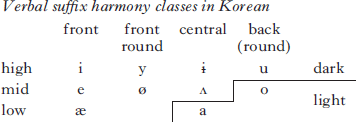
In part because vowels do not divide into natural classes for vowel harmony in Korean, the terms dark and light are often used, and we will adopt these terms in this paper.Footnote 5 In the case of verbal suffix harmony, the terms carry little meaning; however, as will be explained below, they describe the connotation the vowels add when used in sound-symbolic words.
The second type of vowel harmony is called sound-symbolic harmony, and occurs in sound-symbolic words. It is this type that is the subject of this paper. Sound-symbolic words include onomatopoeic words, in addition to words intended to vocally express some sensory perception (taste, sound, colour, action, etc.). Some examples are provided below. As will be observed, direct translation into English is often awkward, if possible at all.
(3)

As is exemplified in (3), sound-symbolic words often come in phonetically similar sets. These sets are frequently composed of a pair of words in which one member contains light vowels while the other contains dark vowels. In sound-symbolic harmony, however, the sets of vowels which belong to each class differ from the sets in verbal suffix harmony. The example below shows the distribution of vowels into the light and dark classes. The curved lines demonstrate the correlations that exist between dark and light vowels, which show up when vowels alternate in sound-symbolic word sets.
(4)
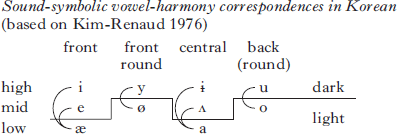
The light and dark classes of vowels in sound-symbolic words have slightly different connotations. Sohn (Reference Sohn1999) provides the following list of nuances associated with each class.
(5)

The examples in (6) show how the connotations differ in accordance with the harmonic class of vowels contained in them.Footnote 6
(6)

There are several thousand sound-symbolic morphemes in Korean, most of which have no direct English translations. These morphemes are generally used as adverbs. Additionally, they can often combine with certain verbs or auxiliaries, such as hata ‘do’ (often translated ‘be’ when combined with sound-symbolic words), or kʌlita ‘keep doing/being’. The reader is referred to Lee (Reference Lee1992), Martin (Reference Martin1992) and Sohn (Reference Sohn1999) for additional details of sound-symbolic words in Korean not covered here.
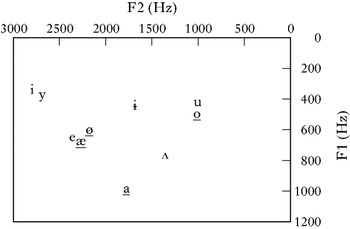
As in the case of verbal suffix harmony, it is not clear which features divide the vowels into the dark and light classes. Proposals typically treat [low] (e.g. McCarthy Reference McCarthy, Richardson, Marks and Chukerman1983, Sohn Reference Sohn1986) or [ATR] (e.g. Lee Reference Lee1992, Cho Reference Cho1994) as the distinguishing feature. Figure 1 shows the F1 and F2 values for Korean monophthongs, demonstrating that these phonetic dimensions do not distinguish the two classes. The figure summarises data from female speakers of Standard Korean presented in Yang (Reference Yang1992).
Average formant frequencies for female speakers of Standard Korean (data from Yang Reference Yang1992). The light vowels are underlined.

Returning to the classification of vowels, the high vowels [i] and [ɨ], given as dark in (6), actually behave as both dark and transparent (e.g. Kim-Renaud Reference Kim-Renaud1976, Lee Reference Lee1984, Sohn Reference Sohn1986, Lee Reference Lee1992, Cho Reference Cho1994). In the initial syllable they behave as dark vowels, whereas in non-initial syllables they behave as transparent vowels (Lee Reference Lee1984, Sohn Reference Sohn1986, Cho Reference Cho1994). This dual functionality of neutral vowels is not unusual cross-linguistically, as neutral vowels in other languages often have a ‘default’ status. However, §2.2 below highlights important differences between this dual functionality of neutral vowels in Korean and neutral vowels in the well-studied patterns in Finnish and Hungarian.
Some authors (e.g. Lee Reference Lee1984, Lee Reference Lee1992, Cho Reference Cho1994) also claim that [u] behaves like a neutral vowel in some forms, but not to the same degree as the non-round high vowels. Lee (Reference Lee1984: n. 8) further suggests that [y] sometimes behaves as a neutral vowel in Modern Korean. We will later show that the corpus supports the hypothesis that [u] and [y] are at least partially neutral vowels; however, when conducting the corpus study below, we will group only the vowels [i] and [ɨ] together into the class of neutral vowels, while considering [y] and [u] individually.
In terms of vowel alternations, the dual functionality of neutral vowels means that in initial syllables neutral vowels undergo harmony alternations but not in non-initial position; thus, k’icʌk-k’icʌk ‘scribbling’ alternates with k’æcak-k’æcak ‘scribbling’ (of a different type). In non-initial position, neutral vowels do not undergo or trigger harmony themselves, but instead allow vowel harmony to spread over them. For example, pusilʌk ‘rustling’ becomes posilak ‘rustling’ (of a different type).
Sound-symbolic morphemes can frequently be reduplicated (the class of colours being a notable exception), leading to a slight difference in connotation (see Sohn Reference Sohn1999). Examples of common reduplicated types are shown below in (7), in order of number of syllables. Sound-symbolic reduplicants regularly involve the reduplication of monosyllabic (a), disyllabic (b, c) or trisyllabic (d–g) stems. In the ‘four’-syllable reduplicant in (h), the individual parts (i.e. reduplicated one-syllable forms) exist in the language as well; thus this is best considered a compound. In fact, each of the ten ‘four’-syllable reduplicants found in our corpus appears to be formed from two reduplicated one-syllable forms.
(7)
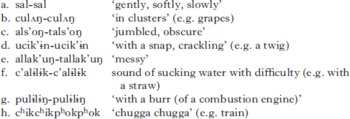
It is not uncommon for the first consonant of the initial morpheme of this type to be unpronounced but to appear on the reduplicated portion, exemplified in (c) and (e) (see Sohn Reference Sohn1999 for further details).
Although many instances of reduplication in Korean are sound-symbolic, not all reduplication is sound-symbolic. We provide a few examples of non-sound-symbolic reduplication below.
(8)

The remainder of this paper examines the phonotactic pattern of sound-symbolic vowel harmony within individual forms only. We will not examine vowel harmony as a pattern of alternation as it applies to morphemes to create semantically nuanced pairs alternating between light and dark vowels, as in (3) and (6). This differs from much of the literature on Korean vowel harmony, which focuses on these light–dark alternations, including the effects of neutral vowels on the spread of such alternations. Furthermore, we will only be concerned with sound-symbolic words which are found in reduplicants. Reasons for this will be discussed in §3.
2.2 Comparison with other languages
Certain aspects of the sound-symbolic vowel-harmony pattern discussed above resemble the well-known patterns of Finnish and Hungarian. Like Korean, these languages also exhibit three vowel classes, two which harmonise and one which acts as neutral and transparent. Closer inspection of the three patterns, however, reveals differences between the behaviour of the neutral vowels in each case.
First, consider Finnish (Karlsson Reference Karlsson1999, Ringen & Heinämäki Reference Ringen and Heinämäki1999, Goldsmith & Riggle Reference Goldsmith and Riggle2012). Like Korean, Finnish divides vowels into three classes: the neutral (N) vowels include [i] and [e]; the front (F) vowels include [y] (<ü>), [ø] (<ö>) and [æ] (<ä>); and the set of back (B) vowels contains [u], [o] and [ɑ]. Vowel harmony in Finnish both occurs within a morpheme and spreads onto suffixes, where the initial vowel of a root determines whether the subsequent vowels, including suffix vowels, will be front or back, as in (9) (from Karlsson Reference Karlsson1999).
(9)

When the initial suffix is a neutral vowel, it does not determine whether front or back harmony should be applied; instead, if no back vowels follow, then front harmony is applied, but if a back vowel follows, back harmony is applied, as in (10). Moreover, Finnish neutral vowels are transparent. As a result, back vowels trigger back harmony on suffixes even if a neutral vowel intervenes (also shown in (10)).
(10)

While Finnish may initially seem to be the same as Korean, there is a crucial difference. In Korean, initial neutral vowels trigger dark harmony to the same extent as dark vowels, and light vowels do not follow them more than they follow initial dark vowels (see Table I in §4 below). Only in non-initial syllables do neutral vowels behave neutrally. In Finnish, on the other hand, neutral vowels can be analysed as neutral regardless of their position. In initial syllables, Finnish neutral vowels do not behave like front vowels. Whereas initial neutral vowels allow back vowels to follow them, initial front vowels generally do not.
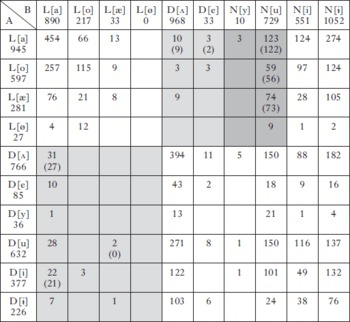
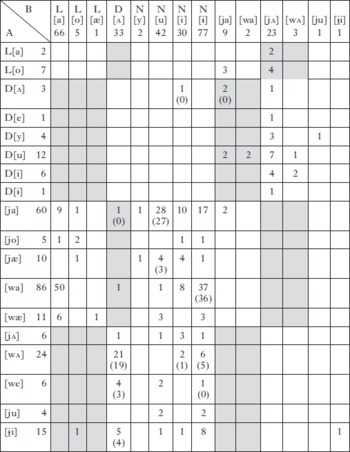
Number of stems with AB sequences, where A is a monophthong in the initial syllable and B is a monophthong in a non-initial syllable. Initial vowels are indicated in the left column, and non-initial vowels are indicated in the top row. The numbers in the left column and top row indicate the total number of stems containing each vowel in initial and non-initial position respectively. Cells containing disharmonic forms are shaded. Darker shading is used for cells in which non-initial [u] and [y] occur after light vowels. Numbers in parentheses indicate the counts after the removal of suspected non-sound-symbolic forms.

Hungarian also exhibits a well-known harmony process (see e.g. Vago Reference Vago1974, Reference Vago1976, Hayes & Londe Reference Hayes and Londe2006). Hungarian divides vowels into front (front rounded), back (back) and neutral (front unrounded) classes, as shown in the chart below, which is based on Hayes & Londe (Reference Hayes and Londe2006).
(11)
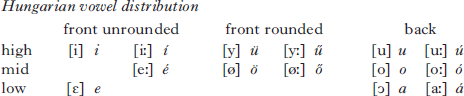
Unlike Finnish, where the initial vowel controls harmony, the final vowel of a stem controls the harmony on suffixes in Hungarian. This is demonstrated by the following examples with disharmonic stems, where a final back vowel chooses a back stem, and a final front rounded vowel chooses a front (rounded or unrounded) stem (from Hayes & Londe Reference Hayes and Londe2006).
(12)

Stems with all neutral vowels usually take suffixes with front vowels, although there are some (‘a few dozen’; 2006: 62) which take back suffixes. Additionally, there are some suffixes containing three allomorphs, such as the allative case marker -hoz (B), -hez (N) and -höz (F), in which cases neutral-final stems take the neutral suffix (Rounds Reference Rounds2001). When a final neutral vowel is preceded by a back vowel, however, the pattern is more complicated (at least for suffixes lacking a neutral allomorph, which Hayes & Londe do not discuss).
Hungarian vowel harmony more closely resembles the pattern in Korean than Finnish. Taking the stem-initial position in Korean and the stem-final position in Hungarian to be the ‘strong’ position for vowel harmony, one could argue that neutral vowels in both languages have a default harmony in the strong position (unless harmony has spread). Hungarian neutral vowels in the strong position appear to differ from Korean neutral vowels in the strong position, in that Hungarian neutral vowels can be transparent. However, this apparent difference may be illusory. Harmony spreads rightward in both languages, and stem-initial vowels by definition cannot be preceded by another vowel. Therefore, in Korean the situation which could reveal whether Korean neutral vowels in the strong position could act as transparent never arises.
As discussed above, while neutral vowels in Finnish and Hungarian resemble those in Korean, there are important differences. On the other hand, as we show below, there is one important similarity between the Korean harmony pattern on the one hand and the Finnish and Hungarian patterns on the other. In each case, careful inspection shows that the patterns are more intricate, variable and gradient than originally anticipated. This was one of the findings both of Hayes & Londe (Reference Hayes and Londe2006) for Hungarian and of Goldsmith & Riggle (Reference Goldsmith and Riggle2012) for Finnish. We return to this point in §6.
3 About the corpus
The corpus used in this study was based on data from a corpus made to aid the National Institute of the Korean Language in the continued development of the Great Standard Korean dictionary (our translation).Footnote 7 The corpus consists of approximately 29,000 sound-symbolic words, although the distributor warns that a small number of the words may not truly be sound-symbolic, and that not all sound-symbolic words are found in the corpus.Footnote 8 Many of the words are variants, often combined with different verbs, built on a single underlying sound-symbolic stem. For example, the initial two words of the file, kakul-kakul ‘winding’ and kakul-kakul-hata ‘to be winding’, are an adverbial form and a basic verb form respectively, based on the same root. In the present study, only one token of each sound-symbolic stem was needed, and these were extracted as described in the following paragraph. Moreover, although the corpus includes a number of semantically distinct homophonous forms distinguished by the inclusion of a number after them, they were treated as non-distinct for the purpose of this study. Thus, although katak-katak was listed twice, only one base form, katak, was kept.
In this study, we chose to look only at reduplicant sound-symbolic forms. As noted above, reduplication is heavily used in Korean sound-symbolic words, and reduplicated forms are generally sound-symbolic. All full reduplicants which had a base form of two and three syllables in length were extracted.Footnote 9 Only the (unreduplicated) base form was kept in each case. Reduplicants with one-syllable bases were not kept, because they give no insight into vowel harmony. Likewise, reduplicants with ‘four’-syllable bases were not kept, because they appear to be compounds of reduplicants with one-syllable bases (see §2.1, especially (7)). Moreover, the data on this latter type of reduplicant was too sparse to be used, as only ten such forms were found in the corpus.
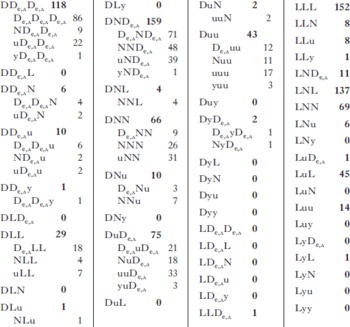
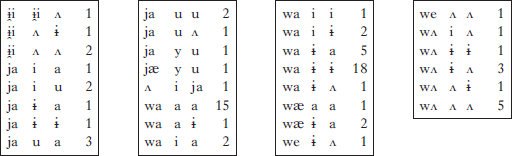
We split the corpus study into two parts. The first part focuses only on those forms containing the vowels regularly included in the light–dark harmony distinction shown in (4); that is, it focuses only on the monophthongs. Forms containing diphthongs such as [wæ], [ja], etc. are not considered, as they have not been discussed in previous literature, and, as we will show, they do not pattern in an entirely predictable or comparable way. In total, 3972 forms were found to match the criteria described above. 2992 of these forms are disyllabic, and 980 are trisyllabic. The second part of our study examines the diphthongs, consisting of 263 forms, including 184 disyllabic and 79 trisyllabic forms. We will use the abbreviations D, L and N for dark, light and neutral. The appendices summarise the corpus and provide counts of the vowel-pattern sequences extracted from the corpus.
A few notes about the limitations of the corpus are in order. First, not all of the reduplicants in the corpus are common, and Korean speakers are not likely to be familiar with every one of them. Second, the corpus does not contain all of the sound-symbolic reduplicants in Korean. In fact, not all reduplicants found in the literature cited in this article are found in the corpus. We did not add any of these missing forms to the corpus.
Third, the reduplicants in the corpus are not limited to forms from one dialect. In a random check of 85 forms in the corpus (cf. note 8), 28 (around 33%), were labelled as North Korean forms. Since North Korean sound-symbolic forms are subject to the same harmony constraints, the forms remain representative of the vowel-harmony pattern we are studying. An anonymous reviewer points out that round and unround vowels in standard North Korean are merging or have merged; specifically, /o/ and /ʌ/ are merging as /o/, while /ɨ/ and /u/ are merging as /u/. If the merger were complete, then the /ʌ o/ merger in particular would be a potential confound, since it appears to transform the dark /ʌ/ into light /o/. While the status of the merger is reported to be complete in the Pyeongyang region (Kwak Reference Kwak2003), it is not complete in all areas of North Korea (Kwak Reference Kwak2003, Ko Reference Ko2010).
Further complicating the issue, Kwak (Reference Kwak2003) states that the pronunciation of the merged /ʌ o/ pair is (using his notation) [ɔ], [ ] and in some areas [ʌ]. Although the phonetic forms would appear to correspond to phonemic /ʌ/ rather than /o/, this is not the case. In South Korean, the letter
 corresponds to the phoneme /o/, and is pronounced as [o] (ignoring the presence of [o]-raising, which we discuss later). The letter
 corresponds to the phoneme /ʌ/, and is pronounced as [ʌ]. In North Korean dialects which have undergone the /ʌ o/ merger, on the other hand, Kwak labels (/o/) as being pronounced synchronically as [ɔ]. In contrast, he describes how (/ʌ/) had come to be pronounced as [o] before merging with /o/. This raises the question of the merged vowel's status as a dark or light vowel.
We conclude that the effects of the /ʌ o/ merger on the North Korean on the sound-symbolic forms in the corpus are far from certain. For this reason, and because North Korean forms are otherwise representative of sound-symbolic harmony, we chose to keep the North Korean forms in the present analysis (though we consider the potential confound in the analysis in §4). Finally, another reason we chose not to add or delete any forms from the corpus for the present study is so that others can replicate it straightforwardly. A more comprehensive study in the future would have to include other forms extracted from larger corpora of natural data, and would distinguish between dialectal forms.
4 Results
4.1 Strength of vowel harmony in Modern Korean
The first aim of this study is to verify the extent to which vowel harmony is present in sound-symbolic reduplicants in Korean. If vowel harmony is prevalent in these forms, we should expect to find few stems containing both light and dark vowels.
Table I provides the counts for the number of stems containing sequences of an initial vowel A followed by another vowel B in Korean sound-symbolic reduplicants.Footnote 10 Cells containing counts of disharmonic forms are shaded. Additionally, we have used a darker shade for the cells when non-initial [u] and [y] occur after light vowels, since treatment of these vowels as dark would classify the combinations in question as disharmonic. When a stem contained three syllables and the second and third syllables contained distinct vowels, it was counted once for each vowel. When a stem contained three syllables and the second and third syllables contained the same vowel, it was only counted once. Although we could have counted each vowel separately, in this way we avoid unnecessarily inflating the number of stems containing harmonic or disharmonic sequences. Numbers in parentheses indicate the counts after the removal of suspected non-sound-symbolic forms (see below for further discussion).
Based on the assumptions (to be validated later) that neutral vowels are dark in initial position and that [i ɨ u y] are all neutral vowels, we find out of a total of 3972 forms only 133 which contain an initial vowel of one type and a non-initial vowel of the opposite harmony type, comprising 3·3% of the total.Footnote 11 This strongly supports earlier claims that vowel harmony is robust in sound-symbolic stems.
While Table I shows a strong correlation between vowels and the three harmony classes, there are a number of apparent disharmonic forms included above, especially involving non-initial [a]. We return to this in §4.3.
We saw in §3 (see also Footnote note 8) that the corpus may contain a small number of non-sound-symbolic forms. If this is the case, we might expect them to occur in the disharmonic forms. We therefore checked all of the disharmonic forms, using the dictionary provided by the Korean search engine Naver.Footnote 12 Of those with non-initial [o] or [y], all were found in the Naver dictionary, as shown in (13) (NK denotes a North Korean form).
(13)
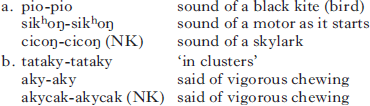
Of those with non-initial [æ], only one was found in the dictionary (14).Footnote 13
(14)

Only one form with with non-initial [ʌ] was not found in the dictionary, and it did not appear to occur as a sound-symbolic reduplicant in natural data. Two were listed as mistakes of forms where [ʌ] should be [a]; nonetheless, they occur in natural data (15a, b).
(15)

Of the forms containing non-initial [e], half (three) were not found in a dictionary. Two of those were found to occur as sound-symbolic forms in natural data ((16a) was found in one context, repeated on several websites; (16b) was common), while the remaining one was not. Of the three in the dictionary, two were listed as North Korean forms.
(16)

Last, almost all forms with non-initial [a] (94/99) were found in the Naver dictionary; however, another concern with this set of morphemes is the presence of North Korean forms which may have undergone the /ʌ o/ merger mentioned in §3. The corpus contains 31 stems with initial [ʌ] and non-initial [a], 27 of which are North Korean, while the remaining four are unattested in the dictionary. If the merger is complete in these forms, such that /ʌ/ is treated as /o/, then these forms are not disharmonic at all, because /o/, like /a/, is light.
Additional discussion of stems with non-initial [a] is provided in §4.3. Forms with non-initial [u] and [y] are discussed in the following section. Despite the few potential errors described above, it is important to observe that almost all of the stems containing disharmonic forms in the corpus were found in the dictionary.
Before closing this subsection, we wish to briefly compare our results with those of Hong (Reference Hong2010). Hong (Reference Hong2010) carried out two corpus studies, one on Korean roots in general and one on sound-symbolic words, with the purpose of determining the degree to which Korean roots as a whole conform to the general vowel-harmony pattern found in sound-symbolic forms. In the study on sound-symbolic words, Hong appears to use the same corpus as us; however, his counts do not match ours. While Hong extracted a total of 3191 sound-symbolic morphemes with two or more syllables which occurred in reduplicated forms, we found 3972 such forms. Part of the explanation is due to the fact that Hong does not consider the vowels [y] and [ø] (cf. note 4), but we can only speculate about the reasons for the remaining difference. Overall, Hong's analysis agrees with the one here: the forms are overwhelmingly harmonic. The largest difference is that Hong found only 21 disharmonic forms when comparing the first and second vowels of sound-symbolic morphemes, whereas we found 116 disharmonic forms in this condition (see Appendix A) and even more when we include the third syllable (which Hong does not). An additional difference between our studies is the statistical methodology, as Hong employs Pierrehumbert's (Reference Pierrehumbert1993) O/E measure, while we use Fisher's exact test below.
4.2 Neutral vowels
As mentioned earlier, the neutral vowels [i] and [ɨ] are claimed to act as dark vowels when in the initial syllable and as transparent vowels elsewhere (Kim-Renaud Reference Kim-Renaud1976, Lee Reference Lee1984, Sohn Reference Sohn1986, Park Reference Park1990, Lee Reference Lee1992, Cho Reference Cho1994). Furthermore, Lee (Reference Lee1984) and Cho (Reference Cho1994) claim that the vowel [u] also behaves like a neutral vowel to some extent, and Lee extends this claim to [y]. In this section, we will use ‘neutral’ to refer to [i] and [ɨ] only. Likewise, we use the term ‘dark’ to the exclusion of the (non-initial) vowels [u] and [y], referring to them simply as [u] and [y].
This section first demonstrates statistically that neutral vowels behave as dark vowels in initial syllables. It then examines vowels in non-initial syllables, showing that non-initial dark, light and neutral vowels have distinct distributions, and that the vowels [u] and [y] pattern more closely with neutral vowels than with dark or light vowels. Finally, we verify that N vowels are transparent, and show that the vowels [u] and [y] are also transparent.
4.2.1 Neutral vowels in initial position
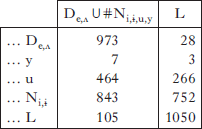
We first demonstrate that [u], [y] and the neutral vowels behave as dark vowels, and are distinct from light vowels in initial syllables. Table II shows the number of stems with initial D, L, N, [u] and [y] vowels followed by the uncontroversial D (i.e. [e] and [ʌ]; henceforth De,ʌ) and L vowels. Any time a stem contained an initial sound followed by a dark or light vowel in the second and/or third syllables, it was counted; however, if a stem contained an initial vowel followed by two dark or light vowels, it was only counted once (since we are counting total stems only).
Stem frequency with which various harmony types in initial position precede dark or light vowels.
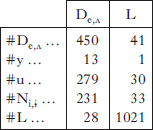
To determine whether the differences in the frequencies of occurrence of dark and light vowels in the second and third syllables as a function of the initial vowel are significant, we conducted Fisher's exact tests on pairs of rows in Table II with the R statistical software package (R Development Core Team 2012). The results of the tests are presented in Table III.
P-values from Fisher's exact test on pairs of rows from Table II. Cells where no statistical difference was found (p>0·05) are shaded in this and subsequent tables.
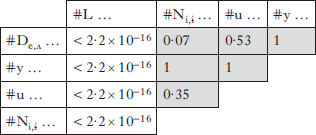
All initial non-light vowels were statistically different from initial light vowels. Furthermore, no pairwise comparison of neutral vowels, dark vowels, [u] and [y] showed a significant difference. These results show that, in the aggregate, initial vowels pattern into two distinct classes. This is consistent with the traditional view that vowels in initial syllables in Korean sound-symbolic words behave as either dark or light.Footnote 14
4.2.2 Neutral vowels in non-initial position
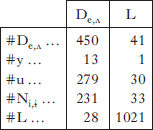
Next, we examine whether non-initial neutral vowels can co-occur with dark and light vowels, and more importantly, whether [u] and [y] pattern with dark vowels or with neutral vowels. Table IV provides the number of forms wherein D, [y], [u], N and L vowels are preceded by D, initial [y], initial [u], initial N and L vowels.
Stem frequency with which various harmony types follow dark or light vowels.
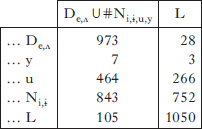
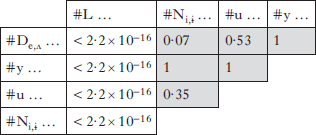
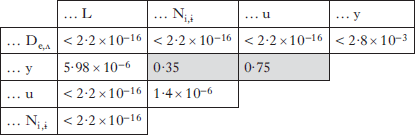
Again, to determine whether any of the differences between non-initial D, [y], [u], N and L vowels are significant, we conducted Fisher's exact test on pairs of rows in Table IV. We present the results in Table V.
Not surprisingly, non-initial light vowels were significantly different from all other vowels. Likewise, non-initial dark vowels were distinct from all other vowels, including the vowels [u] and [y], with a high degree of certainty. Neutral vowels were significantly different from both light and dark vowels, supporting the traditional view that non-initial neutral vowels behave like neither dark nor light vowels non-initially. Interestingly, while the results demonstrate with a very high degree of certainty that [u] and [y] are neither light nor dark, only [y] is not statistically different from the neutral vowels. [u], on the other hand, is statistically different from the neutral vowels, but not from [y].Footnote 15
P-values from Fisher's exact test on pairs of rows from Table IV.
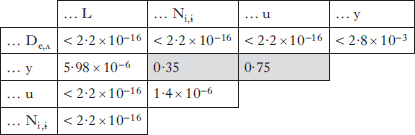
Rather than interpret the above results to mean there is a fourth class of vowels, we take this to indicate varying degrees of neutrality. We believe the statistical difference between [u] and neutral vowels is due to the fact that non-initial [u] is preceded by light vowels proportionally less than non-initial neutral vowels are. While this could be interpreted to mean that [u] is not neutral, there are two reasons not to think so. First, the fact that fewer light vowels precede [u] than precede neutral vowels probably has a historical basis. As noted in §2, vowel harmony in Middle Korean was more prevalent and rigid than in Modern Korean. The dark vowels, including [u], only occurred with neutral and dark vowels; the shift of [u] towards a neutral status appears to be a modern development (see e.g. Lee Reference Lee1984, Cho Reference Cho1994). We would, therefore, expect there to be fewer light vowels preceding the ‘newly minted’ neutral vowel [u] than those preceding the traditional neutral vowels. Second, like non-initial neutral vowels, [u] vowels are preceded by relatively large numbers of both dark and light vowels, which supports the hypothesis that they are neutral. At the very least we can conclude that non-initial [u] vowels are much more like non-initial neutral vowels than non-initial dark or light vowels, though some may wish to call [u] a ‘partially’ neutral vowel.
One additional consideration points to the ‘partial’ neutrality of [u]. In a discussion of vowel alternations in harmony processes, Cho (Reference Cho1994: 116ff) (see also Kim-Renaud Reference Kim-Renaud1976: 400 and Lee Reference Lee1992: 247ff) claims that, depending on the morpheme, [u] either must, may or may not undergo the alternation. The following examples are adapted from Cho (Reference Cho1994).
(17)

Online searches for the ungrammatical forms above reveal that they are actually attested in natural data and in the Naver dictionary (alluk being North Korean), which is why we have placed Cho's judgements in parentheses. Nonetheless, the fact that Cho notes a distinction suggests that [u] is not entirely neutral.
4.2.3 Vowel harmony across medial vowels
Finally, we demonstrate that [u], [y] and the neutral vowels are transparent, allowing both light and dark vowel harmony to spread over them.
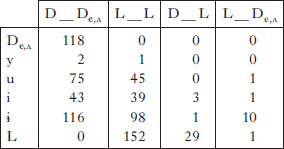
Table VI shows the number of forms in which D, L, N and [u] vowels occur between the four possible binary combinations of dark and light vowels. We have split neutral vowels into [i] and [ɨ], to demonstrate that each is transparent.
Stem frequency with which various harmony types appear between dark and light vowels.
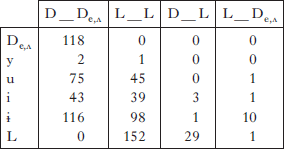
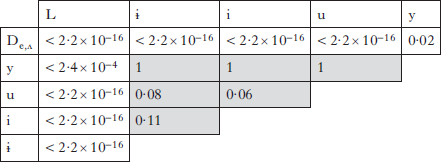
Again, we applied Fisher's exact test to pairs of rows in Table VI, and present the results below in Table VII.
P-values from Fisher's exact test on pairs of rows from Table VI.
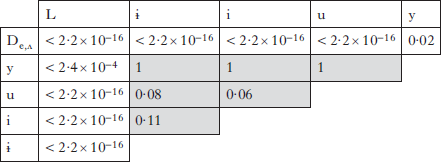
While every pairing with L or D is significantly different, no pairing of [i], [ɨ], [u] and [y] is significantly different.Footnote 16 Although the neutral vowels do occasionally appear between disharmonic vowels (in fewer than 5% of instances for each vowel), the vast majority appear in the frames D̲D and L̲L. The data in Table VI therefore demonstrates quite clearly that [u], [y] and the neutral vowels behave as transparent vowels in non-initial position, while De,ʌ and L vowels do not.
4.2.4 Potential complications: the scarcity of [y], and [o]-raising
While the tests above indicate that both [u] and [y] are neutral vowels, the confidence intervals for Fisher's exact tests are very large in some cases, because there are so few [y] vowels in the corpus (only 46 forms contain [y]). However, it is worth noting that none of these tests reveals a significant difference between [y] on the one hand and [u] and neutral vowels on the other for any of the cases under consideration. Also, Fisher's exact test does reveal significant differences between non-initial [y] on the one hand and non-initial dark and light vowels on the other, no significant differences between initial [y] and initial dark vowels, and significant differences between initial [y] and initial light vowels. In other words, even though there are few [y] vowels in the corpus, the results of these tests are 100% consistent with the hypothesis that [y] is a neutral vowel, and inconsistent with the hypothesis that it is a dark vowel. We further note that [y] appears to pattern more closely with [u] than the other neutral vowels. Both non-initial [y] and non-initial [u] appear to prefer to occur with dark vowels than with light vowels, at a ratio of approximately 2:1, whereas non-initial neutral vowels prefer dark vowels to light at only slightly more than a 1:1 ratio. In terms of ratios, [u] is actually slightly closer to neutral vowels than [y], despite appearing more divergent in the Fisher's exact tests.
Although the relative rareness of the vowel [y] in the corpus makes the hypothesis that [y] is neutral somewhat tentative, there is one additional piece of support for this hypothesis. If [y] is treated as dark, then the corpus contains three forms wherein the second and third syllables are disharmonic, two of which contain [y]. One is of the type LyL (akycak-akycak (13b)), while the other two are of the type LLy/LLD (tataky-tataky (13b) and sæsætʌk-sæsætʌk (said of noisy laughing and bantering)). Considering the rarity of non-initial [y], it would be surprising that it occurs in two out of three of these sequences if [y] is dark. On the other hand, the sequences LyL and LLy are not unexpected if [y] is treated as transparent in non-initial position.
In short, the results of the corpus indicate that the vowel [y], like [u], ought to be classified as a neutral vowel. This result supports a similar observation made in Lee (Reference Lee1984: n. 8) concerning [y]. Finally, if this hypothesis is correct, the addition of [y] would mean that the natural class of [+high] vowels make up the class of neutral vowels, rather than the unnatural class of [i ɨ u] to the exclusion of [y].Footnote 17
Before continuing to the next section, we wish to address one further issue. An anonymous reviewer suggests that the raising of [o] to [u] in fast speech, which occurs especially in non-initial positions, might impinge upon the vowel-harmony facts (see also Lee Reference Lee1992: 247ff). To test this, we checked all 265 of the disharmonic forms containing non-initial [u] on the Korean search engine Naver to see whether they appeared in its dictionary. Of these, only five, or 1·9%, were not found in the dictionary.Footnote 18 We also replaced [u] with [o] in all 265 of the disharmonic forms and checked whether they appeared in the Naver dictionary. A total of 67 [o] forms were listed in the dictionary. In one of these instances, the corresponding [u] form was not in the dictionary (though it was in the corpus). Of the 66 forms listed with both [o] and [u], all of the pairs contained at least one related meaning (with different connotations). In some cases, one of the forms contained an additional meaning not listed for the other form. Additionally, it was sometimes the case that one form was listed as a North Korean form and the other was not marked for dialect. In these cases, exemplified in (18), the form listed as North Korean was not consistently the [o] or [u] form.
(18)
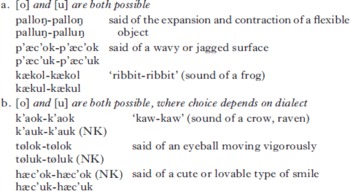
While this data is not inconsistent with a hypothesis that speakers are raising [o], there are strong reasons to believe this is not the case. First, it is important to stress that 192 attested disharmonic forms containing [u] were not found in the dictionary when [u] was replaced with [o]. If these forms are simply the result of fast speech [o]-to-[u] raising, we would expect the dictionary to include the original [o] forms, but this is not the case. Moreover, the [o]-variants are frequently absent from naturalistic data as well, as confirmed by web searches (see (19)).
(19)
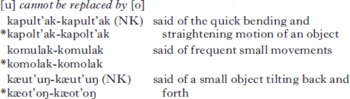
Second, only two of the 265 disharmonic [u] forms were claimed to be mistakes in the corresponding [o] forms, while five of the harmonic [o] forms were listed in the dictionary as mistakes in [u] forms. Third, Lee (Reference Lee1992: 249) notes that, in cases where we see an [o]∼[u] alternation, the alternative forms have different connotations (this was also reflected in the dictionary), which suggests they contain different vowels. Because of these facts, we do not believe the fast speech raising of [o] to [u] is an adequate explanation of the abundance of non-initial [u] vowels following light vowels. On the other hand, the claim that [u] is a neutral vowel predicts that the frequency of its occurrence after light vowels should approach that of the neutral vowels [i] and [ɨ].
The data above argues against the hypothesis that synchronic raising of [o] to [u] can account for the seemingly disharmonic forms containing a non-initial [u]. Such an account would claim that all instances of disharmonic sound-symbolic stems containing a non-initial [u] must be derived from phonemic /o/, which would allow one to maintain that phonemic /u/ is actually dark. While this could hold in the examples provided in (18a), under the assumption that raising is optional, it would not explain why only the seemingly disharmonic variants in (19) are attested. One would need to claim that raising is sometimes required and sometimes optional, but unless the phonetic environment can be determined as the cause of the (non-)optionality of raising, this would be the same as positing a phonemic difference between the surface [u] forms in (18a) and (19). If, on the other hand, we accept that phonemic /u/ is neutral, then the pattern in (19) could be explained by positing an underlying /u/, given that [u]-to-[o] lowering has not, to our knowledge, be claimed to occur in Korean.Footnote 19 The optionality in (18a) may then indicate either the presence of a phonemic /o/ with optional [o]-to-[u] raising or that each form is derived from a (slightly) distinct underlying representation.Footnote 20
4.3 The partial neutrality of [a]
One of the most salient pieces of data presented in Table I is the large number of mismatches involving the vowel [a]. In all, approximately 84% of the total mismatches involve [a]. An anonymous reviewer points out that the asymmetry between non-initial [a], which follows dark vowels approximately 11% of the time, and non-initial [o], which almost never does, matches their behaviour in verbal suffix harmony, as discussed in Hong (Reference Hong2008). The reviewer suggests that [a] is becoming a neutral vowel in Korean. This hypothesis deserves consideration, and we point out some important differences between [a] and the neutral vowels.
First, [a] is clearly a light vowel in initial syllables, occurring in mismatches in just under 1·4% of instances, whereas the neutral vowels (including [u] and [y]) have been demonstrated to be dark in initial syllables. Second, [a] is found much more frequently after light vowels than after dark vowels, whereas neutral vowels follow both dark and light vowels to relatively the same degree. Third, whereas neutral vowels appear in the frames DND and LNL with the same frequency (see Table VI), showing that they are transparent vowels, [a] never occurs in the frame DaD (unless we treat non-initial [u] as a dark vowel, as it is traditionally classified; even then, [a] only occurs in the frame DaD once, shown in (20)).
(20)

Instead, when [a] occurs in the second syllable of a three-syllable word containing an initial D vowel, it is almost always followed by [a] in the third syllable (29/30 roots; examples are provided in (21)). This strongly suggests that [a], if partially neutral, is not transparent, but rather opaque.
(21)

The sum of these facts suggests that [a] is fundamentally different from the traditional neutral vowels, as well as from [u] and [y]. While the vowels [i ɨ u y] are transparent, [a] instead appears to be partially opaque. The only issue with this characterisation is that if [a] is partially opaque, then why must the light vowel in DaL sequences be, without exception, [a], as opposed to any other light vowel? We leave this as an open question.
An alternative explanation for the high number of mismatches involving the vowel [a] is that it may be due to the presence of North Korean words in the corpus. While the majority of seemingly disharmonic stems with non-initial [a] were found in the Naver dictionary (94/99), a much larger percentage of the forms were labelled as North Korean than in our random searches on the entire corpus (58% compared to 33%). As mentioned in §4.1, all stems attested in the dictionary (27/31) containing the sequence #ʌ … a were North Korean forms, and are potentially not disharmonic in North Korean.
While the presence of dialectal variation should be unsurprising, what may be surprising is that in some dialects (e.g. standard South Korean), non-initial [a] occurs in disharmonic stems only after certain initial dark vowels. While it is found after initial [e i u y ɨ], it appears to never occur after [ʌ] in the South Korean forms.Footnote 21 If we wish to maintain that [a] is partially neutral, it seems we must consider its ‘neutrality’ vis à vis different dark vowels individually. If [a]'s behaviour is relative to individual vowels, we should also expect other vowels to behave slightly differently, depending on the exact vowels with which they occur. For example, a quick look at initial [æ] suggests it may also be partially neutral. Focusing only on its occurrences with light or dark vowels, it occurs with [ʌ] in 7·9% of instances (alternatively, this may mean that [ʌ] is not entirely dark).Footnote 22 We return to these issues in §6.
5 Diphthongs
The inventory of Korean also contains a large number of opening diphthongs, with the onglides [j], [w] and [ ]. The full inventory is provided in (22), though we exclude [y] and [ø], which are pronounced as diphthongs in some dialects (see Footnote note 4).Footnote 23
(22)
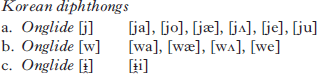
We ignored the harmonic classification of diphthongs in the discussion above because the literature on Korean vowel harmony in sound-symbolic words does not generally discuss diphthongs. We might, however, expect diphthongs to fall into one of the three harmonic classes, based on either their onglide or nucleus. The data from the corpus indicates the latter suggestion is correct for the cases where the diphthong is found in the first syllable. When diphthongs occur in non-initial syllables, the results are equivocal.
Table VIII shows the number of vowels which occurred in forms with diphthongs.Footnote 24 The shaded cells indicate where a vowel-harmony mismatch has occurred, under the assumption that diphthongs fall into harmonic classes as determined by their nuclei.Footnote 25
Number of stems with AB sequences, where A is a vowel in the initial syllable and B is a vowel in a non-initial syllable, and either A or B is a diphthong. Initial vowels are indicated in the left column, and non-initial vowels are indicated in the top row. The numbers in the left column and top row indicate the total number of stems containing each vowel in initial and non-initial position respectively. The shaded cells indicate a vowel-harmony mismatch. Numbers in parentheses indicate the counts after the removal of suspected non-sound-symbolic forms.

Though the data is sparse, it strongly supports the conclusion that diphthongs in the initial syllable pattern with their nuclei, with only three harmonic mismatches (one of which we determined was not a legitimate sound-symbolic form) compared to 96 stems occurring with two light or dark vowels. It should also be noted that only three tokens contained two diphthongs, in each instance the diphthong in initial position matching the diphthong in non-initial position. The low number of co-occurrences is perhaps surprising when we consider that, as Table I shows, many tokens are found which contain the same monophthong in initial and non-initial positions.
If the conclusion that diphthongs pattern with their nuclei is correct, the above data provides further support for the claim that [y] and [u] are neutral rather than dark. [y] follows two light diphthongs, but does not follow any dark diphthongs, which is expected only if [y] is neutral (having already shown [y] is clearly not light). Similarly, [u] follows both light and dark diphthongs; indeed, it follows light diphthongs with greater frequency. Again, this is only expected if [u] is neutral.
Diphthongs in non-initial position do not appear to pattern with their nuclei. While the diphthongs [i], [ju] and [wʌ] could be argued to do so, this cannot be the case for [ja], [jʌ] and [wa]. Moreover, non-initial [ja] and [jʌ], seemingly disharmonic in 44% and 26% of tokens respectively, are the only forms with enough data to draw any (even tentative) conclusions. It may be the case that diphthongs are all neutral in non-initial position, thereby patterning with their onglides, but this conclusion remains highly speculative.
To summarise, the corpus data suggests that diphthongs in initial positions fall into the classes of dark and light corresponding to their nuclei. In contrast, non-initial diphthongs do not appear to do so.
6 Discussion
The corpus study in the preceding sections reveals a much more nuanced picture of sound-symbolic vowel harmony in Korean than earlier research suggests. The back high rounded vowel [u], while exhibiting the dual functionality of the other neutral vowels, is preceded in non-initial position by far fewer light vowels than one would expect, given the distributions of the other neutral vowels. Also, some of disharmonic stems exhibit regularities. Specifically, the light vowel [a] precedes dark vowels in slightly more than 10% of [a]-initial stems, but it does not precede all dark vowels to the same extent (perhaps subject to dialectal variation). The ‘messiness’ of the data is reminiscent of the study of Hungarian vowel harmony by Hayes & Londe (Reference Hayes and Londe2006), where they demonstrate that the actual distribution of vowels in Hungarian exhibits patterned regularities in forms otherwise taken to be exceptional.
The above facts raise questions about whether classifications like dark, light and neutral are appropriate. Should vowel categories instead reflect each unique vowel distribution? If any statistically significant difference in any aspect of a vowel's distribution is the basis for forming a new category, then it is plausible that at least in the corpus study above, every vowel may, in fact, end up being the sole member of its category.
There are two points to be made in this regard. First, the distribution of individual vowels reflects the culmination of several different factors, not all of them being aspects of the grammar. For example, we mentioned the role history may have played in the distribution of [u]. If the goal is to determine aspects of the nature of Korean speakers' grammar from distributional studies of corpora, we need to be able to set aside non-grammatical factors. Without theories of those non-grammatical factors which make quantitative predictions, this is especially difficult.
Second, one purpose of categorising sounds into groups is to capture common elements in their behaviour. There are common elements in major aspects of the distributions of the vowels above, which we believe are captured well by the traditional classification of light, dark and neutral vowels. These classifications, however, cannot distinguish minor aspects of the vowels' distributions. These minor aspects cannot be captured on a linear scale, for the simple reason that the major categories are defined by a cluster of properties.
For example, in Korean sound-symbolic harmony, neutral vowels (i) behave like dark vowels syllable-initially, and (ii) are transparent non-initially. We consider both of these properties to be major aspects of the distribution of neutral vowels. But property (ii) can be broken down into occurrences in several different environments, such as #D̲, #L̲, #D̲D and #L̲L. For example, we said that the vowel [u] was ‘less’ neutral because it occurs much less frequently than other neutral vowels in the #L̲ environment than in the #D̲ environment. We consider this to be a minor aspect of the distribution of vowels because it is one aspect of property (ii). In this respect, the clustering of properties discussed here is reminiscent of the cluster properties associated with other grammatical categories in other domains, such as subjecthood in syntax (Keenan Reference Keenan and Li1976).
The extent to which these lexical frequencies are internalised in the grammars of native speakers is an open question. Many researchers have argued in favour of such a hypothesis, including Coleman & Pierrehumbert (Reference Coleman, Pierrehumbert and Coleman1997), Zuraw (Reference Zuraw2000) and Hayes & Londe (Reference Hayes and Londe2006). On the other hand, recent research has documented ‘surfeit of the stimulus’ effects (Becker et al. Reference Becker, Ketrez and Nevins2011). The important question, of course, is which lexical frequencies are tracked by speakers. Therefore, it is clear that future research on the vowel-harmony pattern of Korean ought to include experiments with Korean speakers looking for psycholinguistic evidence that that they have knowledge of the minor aspects of the distributions of the vowels. Modelling this knowledge with grammars and accounting for its learnability are additional worthwhile goals.
7 Conclusion
Our goal at the outset of this research was to examine the major aspects of the distribution of vowels with respect to their traditional classification as dark, light or neutral. By examining a corpus of 3972 sound-symbolic stems, we confirmed that neutral vowels have a dual nature, behaving as dark vowels in initial position and as transparent vowels in non-initial position. Furthermore, this study has concluded that the vowels [u] and [y] behave like neutral vowels, as claimed by Lee (Reference Lee1984), Lee (Reference Lee1992) and Cho (Reference Cho1994). It was observed that [u] was distinct from the traditional neutral vowels [i] and [ɨ] in minor aspects of its distribution. We also showed that non-initial [a] behaves like a neutral vowel to some degree, but unlike the other neutral vowels in Korean, it is best described as opaque in these cases. Next, we demonstrated that when Korean sound-symbolic words contain diphthongs in the initial syllables, they pattern with the harmony class of their nuclei; however, when diphthongs occur in non-initial syllables, it is unclear how they should be classified.
Taken together, these results show that the vowel-harmony pattern in sound-symbolic words in Korean, like the patterns in Finnish and Hungarian, is much more nuanced than previously thought. This research lays the groundwork for complementary studies which can probe speakers' fine-grained knowledge of these vowel patterns, and can model the learnability and nature of this knowledge.
Appendix A
Total sequence counts for monophthongs (D = [e ʌ u y i ɨ], De,ʌ = [e ʌ])
1 Two-syllable patterns
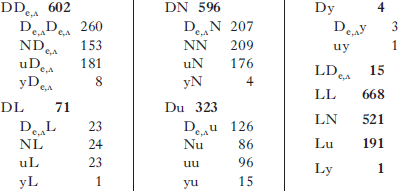
2 Three-syllable patterns
Appendix B
Vowel sequences of forms not containing diphthongs (excepting [y] and [ø])
1 Two-syllable patterns

2 Three-syllable patterns

Appendix C
Vowel sequences of forms containing diphthongs (other than those with [y] or [ø])
1 Two-syllable patterns

2 Three-syllable patterns
 = 2000-09-18. Searches may have to be done manually rather than by using the search function.