Implications
The data presented are unpublished. A study has been made of the reference values of certain important physiological parameters in the definition of the Spanish purebred throughout an exercise test on a treadmill. This permitted the establishment of very objective and desirable conditions for testing horse responses. In addition, the genetic parameters of the horses’ traits have been estimated. The social impact of this research is justified by the confirmation that the repeatability of traits measured on an objective system (treadmill) is very high and that the genetic transmission capacity is great enough to use in a genetic selection process. Nor should the economic impact of an early selection of reproducers with sporting aptitudes and with an ensured genetic transmission of its characteristics be ignored.
Introduction
The physiology of horse performance in the context of functional tests is aimed at assisting clinicians, trainers and owners in their search for explanations of the individual's limitations, actual or perceived as being below expectations (Evans, Reference Evans2007).
The Spanish purebred horse (SPB, Andalusian) is the most important breed in Spain. It is a highly versatile breed in the horse world, appreciated for its fine qualities (‘beauty, boldness, intelligence, nobility, agility and resistance’), which make it a prized animal whether as a saddle horse, for dressage, bull-fighting horse, work horse, light cart-horse and even a sport horse (Molina et al., Reference Molina, Valera, Dos Santos and Rodero1999) competing with the highest standards in international events (Molina et al., Reference Molina, Valera, Galisteo, Vivo, Gómez, Rodero and Agüera2008). In spite of being one of the oldest horse breeds in the world, the objectives of functional selection in the SPB have not been determined until the last decade. Knowledge of genetic parameters of certain physiological variables measured on an objective system can support the functional selection of the horse or be used for preselecting animals which are going to be subjected to functional field tests.
Currently, heritability in the SPB has been estimated in morphofunctional and biokinematic traits, and in dressage aptitude variables (Molina et al., Reference Molina, Valera, Dos Santos and Rodero1999 and Reference Molina, Valera, Galisteo, Vivo, Gómez, Rodero and Agüera2008; Valera et al., Reference Valera, Molina, Gutiérrez, Gómez and Goyache2005, Reference Valera, Gómez, Cervantes and Molina2006 and Reference Valera, Galisteo, Molina, Miró, Gómez, Cano and Agüera2008; Sánchez et al., Reference Sánchez, Valera, Gómez, Cervantes and Gutiérrez2012).
Some haematological (haemoglobin) and biochemical parameters (creatine-quinase (CK), lactate dehydrogenase (LDH), aspartate transaminase (AST), uric acid, lactate) have been suggested as being useful for categorizing SPB horses before and after a standardized exercise test on a treadmill in order to establish different types of training (Escribano et al., Reference Escribano, Agüera, Rubio, Santisteban, Vivo, Agüera and Tovar2011). However, in this context, it is very important to find out if these parameters are inheritable. At this moment, reference values for haematological and biochemistry parameters have only been published in SPB horses at rest (Muñoz et al., Reference Muñoz, Riber, Trigo and Castejón2012) but never before, during, or after an exercise test on a treadmill.
Up until now, in the SPB, variations with exercise had only been observed in field, for haematological and biochemical parameters, aerobic capacity and fitness, muscle fibre type characteristics and normal kinematic patterns (López Rivero et al., Reference López-Rivero, Agüera, Monterde, Rodríguez and Miró1989; Escribano et al., Reference Escribano, Castejón, Santisteban, Agüera and Rubio1995; Rubio et al., Reference Rubio, Muñoz, Santisteban, Tovar and Castejón1995). Only the biokinematic variables had been standardized under treadmill conditions in a numerous group of horses (Cano et al., Reference Cano, Miró, Vivo and Galisteo2000).
The use of a treadmill for performing exercise tests in horses has been extensively documented by various authors (Schuback and Essen-Gustavsson, Reference Schuback and Essén-Gustavsson1998) in different horse breeds. The main advantage of using treadmill v. field tests to evaluate the fitness and health of horses is its ease of standardization (physical environment, speeds and duration of each step; Fraipont et al., Reference Fraipont, Van Erck, Ramery, Fortier, Lekeux and Art2012).
In summary, the principal goals of this work were (i) to describe in SPB horses the reference values of certain haematological and biochemical parameters in each exercise level of a programmed test on a treadmill; (ii) the establishment of desirable and objective conditions for testing horse responses and (iii) to establish the genetic parameters for these haematological and biochemical traits.
Materials and methods
Animals and exercise test
This work has been done on 94 untrained young male horses SPB, 4.22 ± 2.27 years old. The horses were from 16 different studs to ensure that they represented the maximum variability of this breed (bloodlines, strain, morphological lines…). During the experiment, they were all housed in the same environment, with the same vaccine status and no signs of clinical disease. Their food consisted of 4 kg of a complete high-quality commercial feed and 2 kg of grassy oats distributed in three takings and 6 kg of hay administered ad libitum (digestible energy = 2.75 Mcal; protein = 10%; digestible protein = 5.3%; calcium = 0.20%; phosphorus =0.15%; vitamin A = 12.5 UI).
The complete experiment lasted 2 weeks. One week prior to the exercise test, the horses (in groups of six each 2 weeks) were housed in the Equine Medicine Centre facilities at Cordoba University (Spain). In that week, the animals were also familiarized with walking and trotting on the treadmill (Mustang 2000) following the modified protocol described by Rose and Hodgson (Reference Rose and Hodgson1994) of 4 min of walking at 1.5 to 2.0 m/s, after 3 min at 4 m/s, 2 min at 6 m/s and the last 1 min at 7 m/s. Protocol frequency was of two acclimatizing runs per day during the week. For the test, the horses performed a standardized exercise of increasing intensity at a T = 15.75 ± 3.82°C, on a treadmill with a 6% incline. The speed was increased from 4 to 7 m/s, at the rate of 1 m/s every 2 min. Between each velocity stage, the horses rested for 3 min. The studies were performed in accordance with the ethics standards of the Committee on Animal Experimentation of Cordoba University.
Sample collection and analysis method
A jugular venous blood sample was obtained at rest, immediately after each exercise speed and at 5, 10 and 20 min of a passive recovery, and transferred into vacutainers containing ethylenediaminetetraacetic acid (EDTA) (haematological analysis) and lithium-heparin (biochemical analysis). The blood for biochemical analysis was immediately centrifuged at 3000 rpm. Tubes were packed on ice and the analyses were made within 2 h of sample collection. In blood, total red blood cells (RBC; ×106/mm3), haematocrit (Hc; %), haemoglobin (Hb; g/dl), total white blood cells (WBC; ×103/mm3) and neutrophils and lymphocytes in absolute number and percentages were recorded with a semi-automatic counter (Sysmex F-820). In plasma, lactate (mmol/l), uric acid (mg/dl), creatinine (mg/dl), AST (UI/l), LDH (UI/l), CK (UI/l) and total plasma proteins (g/dl) were determined by spectrophotometry (Biosystems BTS-310).
Genetic and statistical analysis
Data analysis was carried out according to IFCC (International Federation of Clinical Chemistry) Approved Recommendations on the Theory of Reference Values. Exploratory analyses (Shapiro-Wilk's test and Levene test) showed the distribution of most observations to be Gaussian; non-Gaussian distributions were transformed using the natural logarithm. The 95% reference intervals were calculated by removing the upper and lower 2.5% of the range for each haematological and plasma biochemical parameter to give 2.5 and 97.5 percentiles. Confidence intervals (0.95) were calculated for each reference limit, to determine their precision (Pritchard et al., Reference Pritchard, Burn, Barr and Whay2009).
A mixed model with repeated measure designs for each parameter analysed was set up in order to observe the changes in the haematological and biochemical variables with the exercise's intensity. These models included as a categorical predictor the horse's age (as a fixed factor) and the stud (as a random factor). The repeated subject (within factor) was the exercise test stages for each horse. The interaction stage × stud and stage × age was included as a random and fixed factor, respectively, to detect statistical changes in the form of the curve parameter throughout the exercise test. The Satterthwaite adjustment takes into account that the degrees of freedom in the denominator are not constant so it uses the LS-mean differences. P < 0.05 was taken as a minimum significance level. Statistical analysis was performed using the mixed SAS (Statistical analysis system), v. 9.2 (Cary, NC, USA) procedure.
The genetic parameters (heritability, repeatability and genetic correlations) of these traits were estimated using the VCE v. 6.02 programme (Groeneveld et al., Reference Groeneveld, Kovac and Mielenz2010). A multivariate repeatability animal model separating biochemical and haematological variables was used, including the animal's stud as fixed effects, age as a linear covariable and permanent environmental effect of the horse and animal additive genetic effect as random effects. To complete the pedigree for the calculation of the inverse of the relationship matrix, the SPB Horse Studbook was used, and this added all the recorded ancestors (a maximum of 20 generations, 11.8 average equivalent discrete generations) of the animals evaluated, giving a total of 1801 animals. The additive genetic variance and covariance of the traits were estimated according to a restricted maximum likelihood procedure using a Quasi-Newton algorithm with exact derivatives to maximize the log likelihood. An approximate standard error (s.e.) of the genetic parameters was estimated front the inverse of the approximation of the Hessian matrix when convergence was reached (Groeneveld, Reference Groeneveld1996).
Results
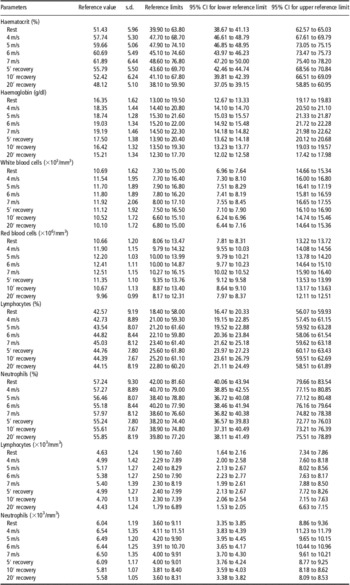
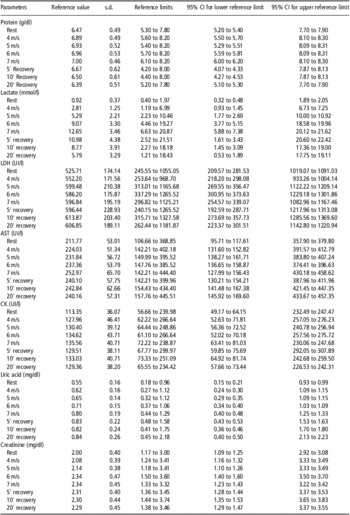
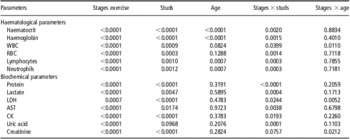
All the variables increased with the exercise (P < 0.001). Recovery was produced at 10 min except for the lactate, which at 20 min of recovery had not reached the resting values (Tables 1 and 2). Only the haematocrit, haemoglobin, lymphocyte and neutrophil parameters were significantly different between ages (Table 3).
Reference value (mean value ± s.d.), reference limits (2.5 and 97.5 percentiles) and CIs (95%) for each reference limit, for the haematological parameters in a population of 94 SPB horses

Reference value (mean value ± s.d.), reference limits (2.5 and 97.5 percentiles) and CIs (95%) for each reference limit, for the biochemical parameters in a population of 94 SPB horses

LDH = lactate dehydrogenase; AST = aspartate transaminase; CK = creatine-quinase.
Statistical significance (P value) of repeated measures mixed model factors for haematological and biochemical parameters analysed in SPB horses according to exercise stages (rest, 4, 5,6 and 7 m/s and 5, 10 and 20 min of recovery), studs used in this study, age and interactions between them

WBC = white blood cells; RBC = red blood cells; LDH = lactate dehydrogenase; AST = aspartate transaminase; CK = creatine-quinase; Stages × studs and stages × age = interactions between variables.
Mean reference values ± standard deviation (s.d.), reference intervals (2.5 and 97.5 percentile), confidence intervals (0.95) for each reference limit are presented in Tables 1 (haematological values) and 2 (biochemical values) for each exercise level.
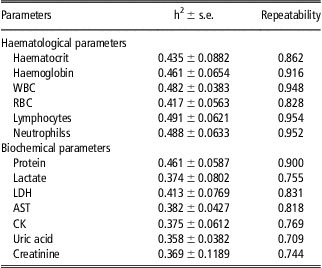
Heritability (h2) ± standard error (s.e.) and repeatability values for haematological and biochemical parameters are depicted in Table 4. All the parameters presented a medium-high heritability (between 0.3% and 0.5%) and a high repeatability (>0.7).
Genetic parameters (heritability and repeatability) for haematological and biochemical traits analysed in SPB horses
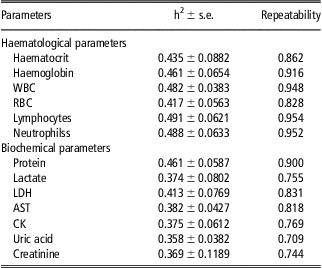
WBC = white blood cells; RBC = red blood cells; LDH = lactate dehydrogenase; AST = aspartate transaminase; CK = creatine-quinase.
Supplementary Tables S1 to S4 show all the haematological and biochemical parameters studied in two age groups, horses of 2 to 3 years old and horses over 4 years old. The genetic and phenotypic correlations are shown in the Supplementary Tables S5 and S6. The variables with high correlations (positive or negative) imply that the parameters analysed will change together strongly (range of 0.7 to 1.0), and the moderate correlation indicates that the variables will change together in some way (range of 0.35 to 0.7). High genetic positive correlations have been observed between biochemical variables such as AST and uric acid (0.88 ± 0.15) and LDH and CK (0.83 ± 0.15). LDH presented a moderate positive correlation with lactate, total plasma protein, uric acid and AST (>0.30). Negative genetic correlations have been observed between lactate and creatinine (−0.76 ± 0.10), AST and creatinine (−0.76 ± 0.29), creatinine and LDH (−0.57 ± 0.37) and creatinine and uric acid (−0.47 ± 0.22). In the haematological variables, high genetic correlations have been obtained between RBC and Hc (0.87 ± 0.18), Hc and Hb (0.98 ± 0.03), RBC and Hb (0.87 ± 0.29) and neutrophils and lymphocytes (−0.99 ± 0.32).
Discussion
Most equine clinical textbooks containing reference ranges do not include descriptions of the conditions under which samples were obtained, the animals to which they are applicable, the laboratory instruments used, or the specific statistical descriptors used (Pritchard et al., Reference Pritchard, Burn, Barr and Whay2009). In this context, the first objective of this study was to establish some reference values in the SPB, under standardized treadmill conditions.
However, the IFCC (1987) sets out clear guidelines for the production of reference values and limits, establishing that at least 120 values are necessary to obtain reliable estimates. These values are recommended because the normal ranges of haematological and biochemical parameters for an individual horse are usually quite narrow, whereas normal values for a breed fall into a wide range (Rose and Hodgson, Reference Rose and Hodgson1994). However, the ASVPC (American Society for Veterinary Clinical Pathology) recommends a minimum of 40 observations for estimated 95% reference intervals in animals (ASVCP, 2005; Muñoz et al., Reference Muñoz, Riber, Trigo and Castejón2012). This study used a carefully selected and relatively large reference population of 94 animals.
Reference limits have never been established for the haematological and biochemical parameters during an exercise on a treadmill, but some haematological and biochemical parameters have been suggested as being of use for categorizing SPB horses on a treadmill in order to establish different types of training (Escribano et al., Reference Escribano, Agüera, Rubio, Santisteban, Vivo, Agüera and Tovar2011). The resulting haematological and biochemical reference limits are shown in Tables 1 and 2.
When analysing those data for resting, it was observed that the values obtained in this paper showed higher reference limits (upper and lower) for some of the haematological and biochemical parameters on comparing them with the reference limits for UK horses (Knottenbelt, Reference Knottenbelt2006; Pritchard et al., Reference Pritchard, Burn, Barr and Whay2009). However, the reference limits for RBC, lymphocytes, neutrophils, AST, CK, lactate and total plasma proteins are in agreement with those obtained by UK horses (Knottenbelt, Reference Knottenbelt2006), and healthy horses working in Lahore (Pakistan; Pritchard et al., Reference Pritchard, Burn, Barr and Whay2009).
As important differences between breeds in the reference values in resting have been described in haematological and biochemical parameters (Muñoz et al., Reference Muñoz, Riber, Santisteban, Lucas and Castejón2002; Pritchard et al., Reference Pritchard, Burn, Barr and Whay2009; Simenew et al., Reference Simenew, Gezahegne, Getachew, Wondyefraw, Alemayehu and Eyob2011), the data obtained in this study were also compared with those observed by other authors in the same breed. Thus, the reference limits obtained by them in RBC, Hb, Hc and LDH (Muñoz et al., Reference Muñoz, Riber, Trigo and Castejón2012) were lower in their upper limit than those observed in this study (Muñoz et al., Reference Muñoz, Riber, Trigo and Castejón2012). Similarly, RBC, Hb and Hc reference values, were higher than the normal values shown by other authors for untrained SPBs (Escribano et al., Reference Escribano, Castejón, Santisteban, Agüera and Rubio1995; Rubio et al., Reference Rubio, Muñoz, Santisteban, Tovar and Castejón1995 and Reference Rubio, Escribano, Oropesa, Tovar, Castejón and Vivo1996; Satue et al., Reference Satue, Blanco and Muñoz2009). However, with the exception of the reference value for the Hc, all the haematological and biochemical parameters studied were inside the reference limits described by Muñoz et al. (Reference Muñoz, Riber, Trigo and Castejón2012) for the adult SPB. This difference in the Hc could be attributed to the stress in the horse caused by the placement of the safety harnesses and by its position on the treadmill.
With exercise, there was a significant increase (P<0.001) in the different haematological parameters, which is a typical response to exercise and is produced by an increase in sympathetic activity with a contractile effect on the spleen (Rose and Hodgson, Reference Rose and Hodgson1994). In addition, the lactate, uric acid and creatinine plasma concentrations experienced significant increases throughout the exercise test. These metabolites are indices of lactic fermentation, purine degradation and creatine muscular degradation, which are the metabolic routes implicated in the production of energy during exercise. AST, CK and LDH also increased with the exercise, which could be related to the muscular impact caused by a great effort (Bis-Wencel et al., Reference Bis-Wencel, Lutnicki, Rowicka, Nowakowicz-Dębek and Bryl2012).
The influence of the age on haematological and biochemical parameters has been investigated (Gurgoze and Icen, Reference Gurgoze and Icen2010; Muñoz et al., Reference Muñoz, Riber, Trigo and Castejón2012). Statistically significant effects of age are described in Table 3, but all these effects were small, lying well within the reference limits shown in Table 1. The Supplementary Tables S1 to S4 show all the haematological and biochemical parameters studied in two age groups, horses of 2 to 3 years old and horses over 4 years old.
Finally, the differences between studs in the parameters studied were carefully examined to ensure that they represented the maximum variability of this breed (bloodlines, strain, morphological lines, etc.) for the determination of the heritability of the parameters evaluated.
From a genetic viewpoint, heritability is defined as the proportion of phenotypical variation in a population which is attributable to the genotypical variation between individuals (Valera et al., Reference Valera, Gómez, Molina and Rodero2007). The sport horse is an athlete and its value mainly depends on its sporting performance in equine competitions. But that performance is the result of a complex combination of conformational parameters, both physiological and behavioural, with a certain degree of genetic transmission (Giulotto, Reference Giulotto2001). There are many studies on the correct way to obtain heritability in the horse in order to gauge its performance (Tolley et al., Reference Tolley, Notter and Marlowe1983; Ricard and Legarra, Reference Ricard and Legarra2010). This paper used a multivariate repeatability animal model separating biochemical and haematological variables and including the stud of the animal as fixed effects, age as a linear covariable and permantent environmental effect of horse and the animal additive genetic effect as random effects. Thus, this model included all the factors influencing the results, and it therefore contributed to the model's validation.
Equine breeding selection has evolved by applying quantitative genetic methods for calculating the heritability of complex traits such as performance in racing or sports competitions. However, the genetic parameters in physiological variables have not been determined.
With the development of equine exercise physiology, more functional traits can be measured for early evaluation of exercise ability, whose objective is to predict the level of performance that a young horse can reach by measuring some of its physiological characteristics during an exercise test. For breeding purposes, the heritability of each trait should be determined to find out if it is useful for breeding selection (Barrey, Reference Barrey2010). It is therefore very important to estimate heritability and apply the method to some physiological and locomotors traits related to equine exercise ability. Several exercise traits have been studied in different breeds: muscle fibre types, heart rate, blood lactate, gait, jumping style and conformation (Barrey, Reference Barrey2010). As an example, some French trotters performed an exercise test at an increasing speed. Their blood lactate was measured in order to determine speed-related changes in this variable. The speed eliciting a blood lactate concentration of 4 mmol/l (VLa4) was calculated and also the VLa4 h2 (0.10), which was highly influenced by the training effect (Barrey et al., Reference Barrey, Courouce, Langlois, Blouin and Auvinet1999).
In equine breeding, there are no genetic parameter data of the physiological variables either in-field or on a treadmill. Thus, this is the first paper on horses in which the heritability of haematological and biochemical parameters has been studied. According to our results (Table 4), all the parameters showed a medium to high heritability. Heritability values (h2) >0.4 indicate that 40% of the variability in the offspring trait is because of genetic transmission by mare and stallion. Forty percent represents a high percentage of genetic influence. This is very positive, because some of the parameters analysed have shown themselves to be very important in the functional categorization of horses on a treadmill with a view to making a pre-selection of their training (Escribano et al., Reference Escribano, Agüera, Rubio, Santisteban, Vivo, Agüera and Tovar2011).
In addition, the very high repeatabilities obtained for all the parameters permit an evaluation of the athletic capacity of the animal with very few controls (1 to 2). This fact is justified by the possibility of fixing some objective conditions for the treadmill exercise as well as by the amplitude of the genetic variability in all these traits (repeatability is considered to be a higher limit of heritability).
However, high-medium genetic correlations have been established between the different haematological (Supplementary Table S5) and biochemical parameters (Suplementary Table S6). Those correlations with a high magnitude (e.g. AST with uric acid or LDH with CK) should be taken into account when selecting which variables will finally be used in evaluating the animals since they permit one to eliminate some parameters strongly correlated with others. Similarly, those genetic correlations which are high but have a negative sign should be heeded in order to prevent the selection of a variable from carrying an unwanted correlated indirect response. In our work, most of them were positive, only creatinine demonstrated negative correlations with some biochemical parameters (uric acid, lactate and AST). The concentration of creatinine in the blood is the result of metabolism. It depends directly on muscle mass and the efficiency of renal function (Bis-Wencel et al., Reference Bis-Wencel, Lutnicki, Rowicka, Nowakowicz-Dębek and Bryl2012). This negative correlation must be held in consideration because uric acid, lactate and AST have an influence on the categorization of horses in accordance with physiological variables with the exercise. It has been concluded that higher genetic correlations have been presented between the most important variables in the categorization of SPBs (AST, CK, LDH, uric acid, lactate and Hb). This may back up the choice of these variables as being important in the categorization of SPB horses, and training should perhaps be oriented towards a drop in their reference values and the narrowing of their reference limits.
Finally, as conclusions, reference limits for untrained young SPBs have been established for haematological and biochemical parameters with the exercise on the treadmill. These could be used as a reference in training, while seeking an improvement in these limits in the athletic horse, because the heritability and repeatability of these parameters have been demonstrated.
Acknowledgements
This work was financed by FEDER funds through the project: ‘Morfo-functional evaluation in the Breeding scheme of Spanish purebred (Andalusian) horses’ (1FD97-0891), awarded to the University of Cordoba (Spain).