1. Introduction
Measurement of the true cost of living is essential for both correctly understanding economic welfare and better implementation of monetary policy. If the cost-of-living index entails measurement errors, it will have detrimental effects on the decision-making of economic agents. An implicit assumption in measuring the cost of living is that agents can purchase all goods using credit. However, it is often necessary to pay for some goods with cash. In such cases, not only relative prices but also the interest rate affects the demand for goods because the interest rate is the opportunity cost of cash payment. The conventional demand system approach to the cost of living does not take into account the substitution among goods based on their means of payment. This study examines how the conventional demand system approach can be modified if there is substitution among goods based on means of payment. Given the rapid progress in payment technologies,Footnote 1 developing a cost-of-living index that takes into account differences in payment methods has contemporary significance. To this end, I employ the traditional cash-credit goods model of Lucas and Stokey (Reference Lucas and Stokey1983), in which there are two types of goods: cash goods and credit goods. Consumers can purchase cash goods to the extent of their cash balance, whereas credit goods can be purchased without cash at hand.
First, in this study, I argue that the conventional approach to the measurement of the cost of living entails internal inconsistency when applied to the cash-credit goods economy. This internal inconsistency arises as a result of the treatment of relative prices. When calculating the cost-of-living index, the conventional approach uses relative prices of individual goods (hereafter the “narrowly defined” relative price) and their observed expenditure shares. In the cashless economy, there is no internal inconsistency because the observed expenditure share is also determined by the narrowly defined relative prices. Conversely, in the cash-credit goods economy, the observed expenditure share of cash goods is determined not by the narrowly defined relative prices but by “broadly defined” relative prices, which include the interest rate as an opportunity cost of cash goods. This discrepancy in relative prices is the source of the internal inconsistency. I reveal that the aggregate price index computed following the conventional approach fails to be the minimum unit expenditure given a constant utility, which is the definition of the cost-of-living index.
Second, I construct an internally consistent cost-of-living index in the cash-credit goods economy. Specifically, I develop a new Sato-Varia (SV) index for the cash-credit goods economy, which I refer to as the SVCC index.Footnote 2 The SVCC index maintains theoretical coherency by using the broadly defined relative prices and observed expenditure shares. Consequently, this new index satisfies the definition of the cost-of-living index—a minimum unit expenditure for a given utility—in a cash-credit goods economy. Further, I present three important characteristics of the SVCC index: (i) it systematically deviates from the conventional SV index; (ii) the deviation of the SVCC index from the SV index, which is the measurement error of the conventional index, is interest rate elastic; and (iii) this measurement error is asymmetric to the interest rate movement, whereby interest rate reductions are more reflective of the cost of living than are interest rate hikes—this asymmetry emerges because the higher expenditure share of cash goods results in a cost-of-living index that is more sensitive to the interest rate, and the expenditure share of cash goods is decreasing with respect to the interest rate.
Third, this study quantitatively evaluates the newly developed SVCC index using historical US data from the past 20 years. The empirical assessment suggests that the average quantitative effect is not large. Specifically, the SVCC index closely follows the conventional price index. The maximum deviation of these two series reaches 1.5% point in terms of annual inflation rate. Considering that the current inflation target of the Federal Reserve is 2% points, the 1.5% point mismeasurement in the conventional price index is not large; nevertheless, it is nonnegligible. Further, it is worth noting that such mismeasurements often occur after changes in monetary policy, when people are most interested in the behavior of the price index. Therefore, I conclude that the SVCC index provides useful information to policymakers and the general public. In addition to the above quantitative evaluation, I report the predictive power of the SVCC index for the total consumer price index (CPI) and find that the forecast performance is not better than that of the commonly used core CPI.
This study is closely related to the literature on the extension of constant elasticity of substitution (CES) price indices, including Feenstra (Reference Feenstra1994), Broda and Weinstein (Reference Broda and Weinstein2010), Ueda et al. (Reference Ueda, Watanabe and Watanabe2019), and Redding and Weinstein (Reference Redding and Weinstein2020). These studies discuss measurement biases that arise when factors other than relative prices influence the cost of living. Specifically, Feenstra (Reference Feenstra1994) and Broda and Weinstein (Reference Broda and Weinstein2010) examine the effects of supply-side product turnovers. Ueda et al. (Reference Ueda, Watanabe and Watanabe2019) also explore the “fashion” effects at the time of product turnovers. Redding and Weinstein (Reference Redding and Weinstein2020) examine the effects of demand-side taste shocks. In this study, I argue that a different payment method can create a different demand shifter and point out that such an exogenous demand shifter entails internal inconsistency in the conventional cost-of-living index.
More broadly, this study is related to the literature on the economic approach to price measurement following Konüs (Reference Konüs1939). This literature includes Fisher and Shell (Reference Fisher and Shell1972), Lloyd (Reference Lloyd1975), Diewert (Reference Diewert1976), Sato (Reference Sato1976), Vartia (Reference Vartia1976), Lau (Reference Lau1979), Caves et al. (Reference Caves, Christensen and Diewert1982), Feenstra (Reference Feenstra1994), Hausman (Reference Hausman1996), Moulton (Reference Moulton1996), Bils and Klenow (Reference Bils and Klenow2001), Neary (Reference Neary2004), Feenstra and Reinsdorf (Reference Feenstra and Reinsdorf2007), Hsieh and Klenow (Reference Hsieh and Klenow2009), Jones and Klenow (Reference Jones and Klenow2016), Syverson (Reference Syverson2017), and Hamano and Zanetti (Reference Hamano and Zanetti2018).Footnote 3 In the main text, I discuss the difference between my approach and that of the dynamic cost-of-living index advocated and explored by Alchian and Klein (Reference Alchian and Klein1973), Pollak (Reference Pollak1989), Shibuya (Reference Shibuya1992), Shiratsuka (Reference Shiratsuka1999), Reis (Reference Reis2005), Aoki and Kitahara (Reference Aoki and Kitahara2010), Gowrisankaran and Rysman (Reference Gowrisankaran and Rysman2012), Osborne (Reference Osborne2018), and Ueda (Reference Ueda2020).
In addition, this study is related to the literature on the cash-credit goods model, in which some goods can be purchased using only cash and the others using only credit. Since its development by Lucas and Stokey (Reference Lucas and Stokey1983), the cash-credit goods model has become a core model in the field of monetary economics. Previous studies include Lucas and Stokey (Reference Lucas and Stokey1987), Cooley and Hansen (Reference Cooley and Hansen1989), Chari et al. (Reference Chari, Christiano and Kehoe1991), Cooley and Hansen (Reference Cooley and Hansen1991), Woodford (Reference Woodford1994), Correia and Teles (Reference Correia and Teles1999), Carlstrom and Fuerst (Reference Carlstrom and Fuerst2001), Albanesi et al. (Reference Albanesi, Chari and Christiano2003), Ishise and Sudo (Reference Ishise and Sudo2013), Arseneau et al. (Reference Arseneau, Chahrour, Chugh and Shapiro2015), and Alvarez and Lippi (Reference Alvarez and Lippi2017). By setting the price of the cash good as the numeraire, most of these studies define a price index in terms of money and do not explicitly use the concept of the aggregate price index for the whole consumption basket. In this regard, the current study complements the existing works by explicitly defining a different price index with a different purpose.
The remainder of this study is organized as follows. Section 2 illustrates the conventional SV index in a cashless economy. Section 3 first points out that the conventional index entails internal inconsistency when applied to the cash-credit goods economy. Then, it develops an internally consistent cost-of-living index and discusses its properties. Section 4 examines the quantitative importance of the opportunity cost of settlements for the cost of living using US data. Section 5 concludes.
2. The cost-of-living index in a cashless economy
This section reviews the SV index in a cashless economy where a consumer can purchase all goods using credit. For ease of explanation in the latter section, I present the model in a dynamic context.
2.1. A consumer’s problem
In this economy, there are many goods indexed as
 $i \in \boldsymbol{I}$
. The consumption index is a CES composite of goods;
 $c_{t} \equiv [ \sum _{i \in \boldsymbol{I}} b_{i}^{1/\sigma } c_{i,t}^{(\sigma -1)/\sigma } ]^{\sigma/(\sigma -1)}$
where
 $b_{i}$
is a preference parameter and
 $\sigma \gt 1$
is the elasticity of substitution. Consumers can purchase all goods on credit.
A representative consumer maximizes the lifetime discounted utility
 $E_{t}\sum^{\infty }_{t=0}\beta^{t}U\left ( c_{t} \right )$
subject to the budget constraint:
 \begin{align*} \sum _{i \in \boldsymbol{I}}p_{i,t}c_{i,t} + d_{t+1} &= x_{t} + \left ( 1+r_{t-1} \right )d_{t}, \end{align*}
for any
 $t \geq 0$
, where
 $d_{t}$
,
 $x_{t}$
,
 $r_{t}$
,
 $c_{i,t}$
, and
 $p_{i,t}$
are the amounts of risk-free bonds, an exogeneous endowment, the nominal interest rate, the demand for good
 $i$
, and its price, respectively. The utility function is continuously twice differentiable and quasi concave.
The first-order conditions are derived as follows:
 \begin{align*} \lambda _{t} p_{i,t} &= U_{c,t}\left ( b_{i}\frac{c_{t}}{c_{i,t}}\right )^{1/\sigma }, \\ \lambda _{t} &=\beta \left ( 1+r_{t} \right )E_{t}\left [ \lambda _{t+1} \right ], \end{align*}
where
 $\lambda _{t}$
is the Lagrange multiplier of the budget constraint. Further, I define the (inverse of) the aggregate price index
 $1/p_{t}$
as the shadow price of the intertemporal budget constraint in terms of the marginal utility of consumption:
 \begin{equation} \frac{1}{p_{t}}\equiv \frac{\lambda _{t}}{U_{c,t}}. \end{equation}
Rearranging the first-order conditions leads to the individual demand function for good
 $i$
and the aggregate consumption Euler equation:
 \begin{align} c_{i,t}&=b_{i}\left ( \frac{p_{i,t}}{p_{t}}\right )^{-\sigma } c_{t},\\ U_{c,t} &= \beta \left (1+r_{t}\right )E_{t}\left [ U_{c,t+1}\frac{p_{t}}{p_{t+1}} \right ]. \nonumber \end{align}
The above demand function [equation (2)] and the corresponding aggregate price
 $p_{t}$
are the same as those obtained through the expenditure minimization problem to achieve a given period utility because a two-stage budgeting procedure is valid under the homothetic aggregator [Green (Reference Green1964)]. In other words, the above price index,
 $p_{t}$
, is the conventional cost-of-living index. It may be useful to note that
 $p_{t}$
gives the consumption aggregator
 $c_{t}$
when deflating the nominal expenditure
 $\sum _{i \in \boldsymbol{I}} p_{i,t}c_{i,t}$
. This property also implicates that
 $p_{t}$
is the cost of living as a unit expenditure function
 $e \left (\boldsymbol{p}_\boldsymbol{t}, \boldsymbol{I}\right )$
for any given
 $c_{t}$
as follows:
 \begin{align*} p_{t} &= \frac{\sum _{i\in \boldsymbol{I}}p_{i,t}c_{i,t}}{c_{t}} = \frac{\sum _{i\in \boldsymbol{I}}p_{i,t} b_{i} \left ( p_{i,t}/p_{t}\right )^{-\sigma }c_{t}}{c_{t}}=\left (\sum _{i\in \boldsymbol{I}}b_{i} p_{i,t}^{1-\sigma } \right )^{\frac{1}{1-\sigma }}, \\ & \equiv e\left ( \boldsymbol{p}_\boldsymbol{t},\boldsymbol{I}\right ). \end{align*}
2.2. The SV index
Next, I derive the SV index [Sato (Reference Sato1976) and Vartia (Reference Vartia1976)], which is important because it is an “exact” price index in the sense of Diewert (Reference Diewert1976) for the CES demand aggregator. Specifically, taking the logarithm of equation (2) and rearranging terms leads to the following:
 \begin{equation} \ln (p_{t}) = \ln (p_{i,t}) + \frac{1}{1-\sigma } \left \{ \ln \left ( b_{i} \right ) - \ln \left [s_{i,t}\left (\boldsymbol{I} \right ) \right ]\right \}, \end{equation}
where
 $s_{i,t}(\boldsymbol{I})$
is the expenditure share of variety
 $i \in \boldsymbol{I}$
. Now, let me define an arbitrary weight,
 $\omega _{i,t}(\boldsymbol{I})$
, as follows:
 \begin{equation} \omega _{i,t}(\boldsymbol{I}) \equiv \frac{\left [ \frac{s_{i,t}(\boldsymbol{I}) - s_{i,t-1}(\boldsymbol{I})}{ \ln s_{i,t}(\boldsymbol{I}) - \ln s_{i,t-1}(\boldsymbol{I}) }\right ]}{ \sum _{i \in \boldsymbol{I}} \left [ \frac{s_{i,t}(\boldsymbol{I}) - s_{i,t-1}(\boldsymbol{I})}{ \ln s_{i,t}(\boldsymbol{I}) - \ln s_{i,t-1}(\boldsymbol{I}) }\right ] }. \end{equation}
Taking the time difference of equation (3), a weighted average over
 $i \in \boldsymbol{I}$
using
 $\omega _{i,t}(\boldsymbol{I})$
, and its exponential, I derive the SV index as follows:
 \begin{align} P\left ( \boldsymbol{p}_\boldsymbol{t}, {\boldsymbol{p}_{\boldsymbol{t}-\textbf{1}}}, \boldsymbol{I} \right ) = \frac{e\left (\boldsymbol{p}_\boldsymbol{t}, \boldsymbol{I} \right )}{e\left ({\boldsymbol{p}_{\boldsymbol{t}-\textbf{1}}}, \boldsymbol{I} \right )} = \prod _{i \in \boldsymbol{I}}\left ( \frac{p_{i,t}}{p_{i,t-1}}\right )^{\omega _{i,t}(\boldsymbol{I})}, \end{align}
where
 $\boldsymbol{p}_\boldsymbol{t}$
is a vector of individual prices. Equation (5) suggests that the exact price index is the geometric mean of changes in individual prices.
2.3. The cost-of-living index: Static versus dynamic
It is worth discussing the type of cost-of-living index on which I focus. There are two types of cost-of-living indices: static and dynamic. The aggregate price index
 $p_{t}$
is a static cost-of-living index, which is defined as a minimum expenditure to achieve a given “period” utility. Conversely, a dynamic cost-of-living index is defined as a minimum expenditure to achieve a given (discounted) “lifetime” utility.
Offsetting the disadvantage of computational complexity, the advantage of the dynamic cost-of-living index is that it can incorporate intertemporal substitution effects. A strand of the relevant literature, including Alchian and Klein (Reference Alchian and Klein1973), Pollak (Reference Pollak1989), Shibuya (Reference Shibuya1992), Shiratsuka (Reference Shiratsuka1999), Reis (Reference Reis2005), Aoki and Kitahara (Reference Aoki and Kitahara2010), Gowrisankaran and Rysman (Reference Gowrisankaran and Rysman2012), Osborne (Reference Osborne2018), and Ueda (Reference Ueda2020), criticize the static cost-of-living index because it focuses only on the current period utility and lacks intertemporal substitution effects.Footnote 4
In this study, I argue that the internal inconsistency arises when the static cost-of-living index is used in a cash-credit goods economy. Although I acknowledge the importance of the intertemporal substitution effect, to make the contribution of my paper clearer, it is not my focus. Recent studies such as Ueda et al. (Reference Ueda, Watanabe and Watanabe2019) and Redding and Weinstein (Reference Redding and Weinstein2020) also examine the static cost of living in a similar manner.
3. The cost-of-living index in a cash-credit goods economy
This section extends the analysis to the case of a cash-credit goods economy. I first present the consumer’s problem and then demonstrate the internal inconsistency when the conventional cost-of-living index is applied to the cash-credit goods economy. In addition, I propose an internally consistent cost-of-living index and discuss its properties.
3.1. A consumer’s problem
Following Lucas and Stokey (Reference Lucas and Stokey1987), I categorize the set of goods into two types: cash goods (type
 $1$
) and credit goods (type
 $2$
). I assume that
 $\boldsymbol{I}={\boldsymbol{I}}^{\textbf{1}}+{\boldsymbol{I}}^{\textbf{2}}$
where
 ${\boldsymbol{I}^{\textbf{1}}} \neq \varnothing$
and
 ${\boldsymbol{I}^{\textbf{2}}} \neq \varnothing$
. Consumers can purchase cash goods to the extent of their cash balance, that is, they are subject to the cash-in-advance (CIA) constraint, whereas they can purchase credit goods on credit, irrespective of cash balances at hand.
A representative consumer begins the period with
 $m_{t}$
money and
 $d_{t}$
holdings of nominal bonds. Before opening the goods market, the consumer visits the financial market, where he/she trades bonds and receives an endowment
 $x_{t}$
. Accordingly, when entering the goods market, the consumer has cash balances:
 $m_{t} + x_{t} + (1+r_{t-1})d_{t} - d_{t+1}$
where
 $r_{t-1}$
represents the nominal interest rate between
 $t-1$
and
 $t$
. To focus on the environment where cash and credit goods are different, I presume that
 $r_{t} \neq 0$
. The CIA constraint requires that the consumer cannot purchase cash goods beyond the amount of cash balances at hand. After trading in the goods market, the consumer has cash balances given by the intertemporal budget constraint. This timing convention follows the existing literature, including Lucas (Reference Lucas1982) and Carlstrom and Fuerst (Reference Carlstrom and Fuerst2001).
In the above environment, the consumer maximizes the lifetime discounted utility
 $E_{t}\sum _{t = 0}^{\infty }\beta^{t} U(c_{t})$
, subject to the following intertemporal budget and CIA constraints:
 \begin{align*} m_{t+1} &= m_{t} + x_{t} + \left ( 1+r_{t-1} \right )d_{t} - \sum _{i \in {\boldsymbol{I}}}p_{i,t}c_{i,t} - d_{t+1}, \\ \sum _{i \in {\boldsymbol{I}^{\textbf{1}}}} p_{i,t}c_{i,t} &\leq m_{t} + \left ( 1+r_{t-1} \right )d_{t} - d_{t+1}, \end{align*}
for any
 $t \geq 0$
, taking
 $m_{0}$
,
 $d_{-1}$
, and
 $r_{-1}$
as given.Footnote
5
The first-order conditions are derived as follows:
 \begin{align*} \left (\lambda _{t} + \mu _{t}\right ) p_{i,t} &= U_{c,t}\left ( b_{i}\frac{c_{t}}{c_{i,t}}\right )^{1/\sigma }, & i \in {\boldsymbol{I}}^{\textbf{1}}, \\ \lambda _{t}p_{i,t} &= U_{c,t}\left ( b_{i}\frac{c_{t}}{c_{i,t}}\right )^{1/\sigma }, & i \in {\boldsymbol{I}}^{\textbf{2}},\\ \lambda _{t}&=\beta E_{t}\left [ \lambda _{t+1} + \mu _{t+1}\right ],\\ \lambda _{t} + \mu _{t} &=\beta \left ( 1+r_{t} \right )E_{t}\left [ \lambda _{t+1} + \mu _{t+1}\right ], \end{align*}
where
 $\lambda _{t}$
and
 $\mu _{t}$
are the Lagrange multipliers of the budget and CIA constraints, respectively.
As in the cashless economy case, I define the (inverse of) the price index
 $1/p_{t}$
as the shadow price of the intertemporal budget constraint in terms of the marginal utility of consumption:
 \begin{align*} \frac{1}{p_{t}}\equiv \frac{\lambda _{t}}{U_{c,t}}. \end{align*}
Rearranging the first-order conditions, I obtain the following optimality conditions:
 \begin{align} c_{i,t} &= b_{i}\left [ \frac{p_{i,t}}{p_{t}}\left (1+r_{t}\right ) \right ]^{-\sigma }c_{t}, &\textrm{ for } i \in {\boldsymbol{I}}^{\textbf{1}}, \end{align}
 \begin{align} c_{i,t} &= b_{i}\left ( \frac{p_{i,t} }{p_{t}} \right )^{-\sigma }c_{t}, & \qquad\quad\textrm{ for } i \in {\boldsymbol{I}}^{\textbf{2}}, \end{align}
 \begin{align} \frac{1}{1+r_{t}} &= \beta E_{t}\left [ \frac{U_{c,t+1}}{U_{c,t}}\frac{1}{\pi _{t+1}}\right ].\qquad\qquad\qquad\qquad\qquad\qquad\qquad \end{align}
In contrast with the case of a cashless economy, the demand functions are different depending on the means of payments. Specifically, the demand function for cash goods in equation (6) indicates that the demand for cash goods depends on broadly defined relative prices, which include the interest rate as an opportunity cost of cash goods. Conversely, the demand function for credit goods in equation (7) is the same as that in the cashless economy. As in the cashless economy case, these demand functions are the same as those obtained through the expenditure minimization problem of achieving a given period utility because a two-stage budgeting procedure remains valid under the homothetic aggregator. Consequently, the dynamic aspect of the consumer’s problem is reflected only in the consumption Euler equation in equation (8).
I have one more comment to make on the dynamic aspect of the problem. The demand functions for cash and credit goods in equations (6) and (7) reveal that the choice between cash and credit goods is a matter of intratemporal substitution. If intertemporal substitution is involved, the calculation of the aggregate price index would be much more complex. The reason why this choice is merely intratemporal (not intertemporal) is related to the timing assumption of the model; time-
 $t$
bond market trading precedes time-
 $t$
goods market trading. If the goods market opens before the bond market, the money-holding decision in the previous period will affect the choice between cash and credit goods in the current period, bringing intertemporal substitution into play. However, Carlstrom and Fuerst (Reference Carlstrom and Fuerst2001) criticize this timing assumption as artificial because agents would prefer to visit the bond market before visiting the goods market. Hence, I follow the former timing assumption.
3.2. Internal inconsistency in a conventional index
This subsection clarifies the internal inconsistency in a conventional cost-of-living index that arises when it is applied to the cash-credit goods economy. As presented in the cashless economy case of equation (5), the conventional index consists of observed expenditure shares and changes in narrowly defined relative prices, which do not include the interest rate. In the cashless economy, there is no internal inconsistency because the observed expenditure share is also a function of narrowly defined relative prices. However, in the case of the cash-credit economy, internal inconsistency arises because the observed expenditure share is a function of broadly defined relative prices. As a result of this internal inconsistency, the conventional aggregate price index deviates from the cost-of-living index, which is defined as a unit expenditure function. In the following, I show that the conventional aggregate price index, which is calculated using narrowly defined prices and observed expenditure shares, does not coincide with the unit expenditure in the cash-credit goods economy.
Suppose that prices of cash goods do not include the interest rate. This assumption is conventionally used when deriving the aggregate price index. Accordingly, the unit expenditure
 $\hat{p}_{t}$
is defined as:
 \begin{equation} \hat{p}_{t}=\frac{\sum _{i\in \boldsymbol{I}}p_{i,t}c_{i,t}}{c_{t}}. \end{equation}
Plugging the optimality conditions of cash and credit goods into equation (9) and rearranging terms leads to the following:Footnote 6
 \begin{align} p_{t} &= \left [ 1+r_{t}\sum _{i \in {\boldsymbol{I}}^{\textbf{1}}} s_{i,t}(\boldsymbol{I}) \right ] \hat{p}_{t}. \end{align}
Equation (10) suggests that the aggregate price index
 $p_{t}$
always deviates from the unit expenditure
 $\hat{p}_{t}$
in the cash-credit goods economy, where neither the interest rate is zero nor the share of cash goods is zero (
 $r_{t} \neq 0$
and
 $\sum _{i \in {\boldsymbol{I}}^{\textbf{1}}} s_{i,t}(\boldsymbol{I}) \neq 0$
, respectively). If the aggregate price index
 $p_{t}$
does not coincide with the unit expenditure, it is not a cost-of-living index in this environment.
3.3. Internally consistent aggregate price index
The above conclusion is rooted in my presumption that the prices of cash goods are narrowly defined ones, which do not include the interest rate. Now, I show that the use of broadly defined prices can resolve this inconsistency. Specifically, when I take the opportunity cost of cash goods into consideration, equation (9) is altered as follows:
 \begin{align} \hat{p}_{t}&=\frac{\sum _{i \in {\boldsymbol{I}}^{\textbf{1}}}p_{i,t}\left ( 1+r_{t} \right )c_{i,t} +\sum _{i \in {\boldsymbol{I}}^{\textbf{2}}}p_{i,t}c_{i,t} }{c_{t}}, \end{align}
where the first term in the denominator is multiplied by the interest rate term, which represents broadly defined prices of cash goods. Plugging the optimality conditions for cash and credit goods into equation (11), I can show that the aggregate price index always coincides with the unit expenditure:Footnote 7
 \begin{align*} p_{t} = \hat{p}_{t} \equiv e' \left ( \boldsymbol{p}_\boldsymbol{t}, {\boldsymbol{I}}^{\textbf{1}}, {\boldsymbol{I}}^{\textbf{2}} \right ). \end{align*}
Finally, I can regard the aggregate price index
 $p_{t}$
as the cost-of-living index in the cash-credit economy because the unit expenditure coincides with the cost of living when the aggregator is homothetic.
3.4. The SVCC index and the CIA effect
Applying a similar calculation as in the cashless economy case, I obtain a new SV index (that, as noted above, I refer to as the SVCC index), which is internally consistent in the cash-credit goods economy:
 \begin{align} P\left ( \boldsymbol{p}_\boldsymbol{t}, {\boldsymbol{p}_{\boldsymbol{t}-\textbf{1}}}, {\boldsymbol{I}}^{\textbf{1}}, {\boldsymbol{I}}^{\textbf{2}}\right ) &= \frac{e'\left ( \boldsymbol{p}_\boldsymbol{t}, {\boldsymbol{I}}^{\textbf{1}}, {\boldsymbol{I}}^{\textbf{2}}\right )}{e'\left ( {\boldsymbol{p}_{\boldsymbol{t}-\textbf{1}}}, {\boldsymbol{I}}^{\textbf{1}}, {\boldsymbol{I}}^{\textbf{2}}\right )},\nonumber \\ &= \underbrace{\prod _{i \in \boldsymbol{I}}\left ( \frac{p_{i,t}}{p_{i,t-1}}\right )^{\tilde{\omega }_{i,t}(\boldsymbol{I})} }_{\substack{\textrm{The effect of}\\\textrm{individual prices}}} \underbrace{\left ( \frac{\Phi _{t}}{\Phi _{t-1}}\right )^{\sum _{i \in {\boldsymbol{I}}^{\textbf{1}}}\tilde{\omega }_{i,t}(\boldsymbol{I})}}_{\substack{\textrm{The effect of}\\ \textrm{the CIA constraint}}}. \end{align}
where
 $\Phi \equiv 1+r_{t}$
is the interest rate term that reflect the opportunity cost of cash payments;
 $\tilde{\omega }_{i,t}(\boldsymbol{I}) \equiv \left[\tilde{s}_{i,t}(\boldsymbol{I})-\tilde{s}_{i,t-1}(\boldsymbol{I})\right]/\left[\ln \tilde{s}_{i,t}(\boldsymbol{I})-\ln \tilde{s}_{i,t-1}(\boldsymbol{I})\right]/ \sum _{i \in \boldsymbol{I}}\left\{ \left[\tilde{s}_{i,t}(\boldsymbol{I})-\tilde{s}_{i,t-1}(\boldsymbol{I})\right]/\left[\ln \tilde{s}_{i,t}(\boldsymbol{I})\right.\right.$
 $\left.\left.-\ln \tilde{s}_{i,t-1}(\boldsymbol{I})\right] \right\}$
;
 $\tilde{s}_{i,t}(\boldsymbol{I}) \equiv (1+r_{t})p_{i,t}c_{i,t}/(p_{t}c_{t})$
for
 $i\in {\boldsymbol{I}}^{\textbf{1}}$
and
 $\tilde{s}_{i,t}(\boldsymbol{I}) \equiv p_{i,t}c_{i,t}/(p_{t}c_{t})$
for
 $i\in {\boldsymbol{I}}^{\textbf{2}}$
.
This is the main result of this study. The key difference from the price index in the cashless economy is the second element on the right-hand side of equation (12), which I call the CIA effect. The CIA effect reflects the change of the opportunity cost of cash goods. If the economy is at the cashless limit
 $\left(\sum _{i \in {\boldsymbol{I}}^{\textbf{1}}}\tilde{\omega }_{i,t}(\boldsymbol{I})=0\right)$
, the CIA effect disappears and equation (12) is equal to the conventional SV index. However, as long as some goods require cash at the time of purchase
 $\left(\sum _{i \in {\boldsymbol{I}}^{\textbf{1}}}\tilde{\omega }_{i,t}(\boldsymbol{I})\gt 0\right)$
, the SVCC index is different from the SV index.
Another difference of the SVCC index from the conventional SV index is the aggregation weight
 $\tilde{\omega }_{i,t}(\boldsymbol{I})$
. As clarified in Section 3.2, the conventional SV index that uses observed expenditure shares entails internal inconsistency. Therefore, the SVCC index, which keeps the internal coherency, aggregates individual prices using the “broadly defined” expenditure shares that include the interest rate as an opportunity cost of cash goods.
Interestingly, the main result [equation (12)] suggests that the interest rate directly affects the consumers’ cost of living. Usually, the cost-of-living index does not include an opportunity cost of settlements. Therefore, a central bank that uses a short-term interest rate as a policy instrument can only control the price index indirectly. However, if we consider this cost-of-living index with an opportunity cost of settlements as an improved measure of monetary policy, the central bank will directly affect the inflation rate by manipulating the interest rate.Footnote 8
3.5. Asymmetry of the CIA effect
Another interesting feature of the CIA effect is its asymmetry. If the aggregate weight of cash goods
 $\sum _{{\boldsymbol{I}}^{\textbf{1}}}\tilde{\omega }_{i,t}(\boldsymbol{I})$
is orthogonal to the interest rate term
 $\Phi _{t}$
, the CIA effect is symmetric to the SV index. However, this is not the case. An increase in the interest rate term
 $\Phi _{t}$
mechanically decreases the weights for cash goods and increases those for credit goods:Footnote
9
 \begin{align} \frac{d \tilde{\omega }_{i,t}(\boldsymbol{I})}{d \Phi _{t}}\frac{\Phi _{t}}{\tilde{\omega }_{i,t}(\boldsymbol{I})} \lt ({\gt}) 0, \textrm{ for } i \in {\boldsymbol{I}}^{\textbf{1}} ({\boldsymbol{I}}^{\textbf{2}}). \end{align}
The intuition for this asymmetric CIA effect is as follows. The expenditure share function derived from the optimality condition [equation (6)] shows that
 $\Phi _{t}$
is the demand shifter and directly affects the expenditure share:
 \begin{align*} \tilde{s}_{i,t}(I)=b_{i} \left ( \frac{p_{i,t}}{p_{t}} \Phi _{t}\right )^{1-\sigma }, \textrm{ for } i\in {\boldsymbol{I}}^{\textbf{1}}. \end{align*}
Then, the weight
 $\tilde{\omega }_{i,t}(\boldsymbol{I})$
, which is a function of
 $\tilde{s}_{i,t}(I)$
, systematically comoves with
 $\Phi _{t}/\Phi _{t-1}$
, and consequently, the CIA effect tends to be larger when the interest rate falls. In other words, when interest rates rise, the weight of cash goods falls because the opportunity cost of holding cash rises, and vice versa. According to this logic, the interest rate term
 $\Phi _{t}$
and the weight of cash goods are not orthogonal and have a positive correlation.
The asymmetry of the CIA effect suggests that the SVCC index does not satisfy the circularity test, which is one of several desirable axioms for price indices [c.f. Fisher (Reference Fisher1922)]. The following is a three-period illustrative example. If
 $P({\cdot})$
satisfies the circularity test, it satisfies
 $P \left({\boldsymbol{p}_{\textbf{3}}},{\boldsymbol{p}_{\textbf{1}}}, {\boldsymbol{I}}^{\textbf{1}}, {\boldsymbol{I}}^{\textbf{2}}\right) = P\left( {\boldsymbol{p}_{\textbf{3}}},{\boldsymbol{p}_{\textbf{2}}}, {\boldsymbol{I}}^{\textbf{1}}, {\boldsymbol{I}}^{\textbf{2}}\right) P\left({\boldsymbol{p}_{\textbf{2}}}, {\boldsymbol{p}_{\textbf{1}}}, {\boldsymbol{I}}^{\textbf{1}}, {\boldsymbol{I}}^{\textbf{2}}\right)$
. Now, suppose that the interest rate drops from period 1 to period 2 and returns to the original level from period 2 to period 3. Specifically, from period 1 to period 3, the interest rate term progresses through the following stages:
 $\Phi \rightarrow \Phi ' \rightarrow \Phi$
. At the same time, individual prices are constant for all periods. Then, the left-hand side of the above circularity is zero but the right-hand side is positive:
 \begin{align*} \underbrace{\ln P\left ( {\boldsymbol{p}_{\textbf{3}}},{\boldsymbol{p}_{\textbf{1}}}, {\boldsymbol{I}}^{\textbf{1}}, {\boldsymbol{I}}^{\textbf{2}}\right )}_{\substack{\textrm{The log of the left-hand side}\\ \textrm{of the circularity}}} &= 0,\\ \underbrace{\ln \left [P\left ( {\boldsymbol{p}_{\textbf{3}}},{\boldsymbol{p}_{\textbf{2}}}, {\boldsymbol{I}}^{\textbf{1}}, {\boldsymbol{I}}^{\textbf{2}}\right )P\left ( {\boldsymbol{p}_{\textbf{2}}},{\boldsymbol{p}_{\textbf{1}}}, {\boldsymbol{I}}^{\textbf{1}}, {\boldsymbol{I}}^{\textbf{2}}\right )\right ]}_{\substack{ \textrm{The log of the right-hand side}\\ \textrm{of the circularity}}} &= \underbrace{\left [\sum _{i \in {\boldsymbol{I}}^{\textbf{1}}} \tilde{\omega }_{i,2}(\boldsymbol{I}) - \sum _{i \in {\boldsymbol{I}}^{\textbf{1}}} \tilde{\omega }_{i,3}(\boldsymbol{I})\right ]}_{+} \underbrace{\left ( \ln \Phi ' - \ln \Phi \right )}_{+} \gt 0. \end{align*}
Consequently, I conclude that the SVCC index does not satisfy the circularity test. The failure of the circularity test means that it is necessary to be careful when using the SVCC indicator. Nevertheless, it does not indicate that the SVCC indicator is worthless. For example, the Fisher index does not satisfy the circularity test but is considered a superlative index.
3.6. Relation to the other cost-of-living indices
The main results in equation (12) indicate that factors other than individual prices affect aggregate prices. This study is not the first to find that the aggregate price index includes nonprice factors. Feenstra (Reference Feenstra1994), for example, suggests that the cost-of-living index deviates from the conventional SV index because of firms’ entry and exit. Feenstra’s index is as follows:
 \begin{equation} P\left (\boldsymbol{p}_\boldsymbol{t}, {\boldsymbol{p}_{\boldsymbol{t}-\textbf{1}}}, \boldsymbol{I}_\boldsymbol{t}, {\boldsymbol{p}_{\boldsymbol{t}-\textbf{1}}}\right ) = \underbrace{\prod _{i \in \bar{\boldsymbol{I}}}\left ( \frac{p_{i,t}}{p_{i,t-1}}\right )^{\omega _{i,t}(\bar{\boldsymbol{I}})} }_{\substack{\textrm{Conventional}\\\textrm{SV index}}} \underbrace{\left ( \frac{\lambda _{t}}{\lambda _{t-1}}\right )^{\frac{1}{\sigma -1}}}_{\substack{\textrm{The effect of}\\ \textrm{entry and exit}}}, \end{equation}
where
 $\boldsymbol{I}_\boldsymbol{t}$
,
 $\bar{\boldsymbol{I}}$
, and
 $\lambda _{t} \equiv \sum _{i \in \bar{\boldsymbol{I}}} p_{i,t}c_{i,t}/\sum _{j \in \boldsymbol{I}_\boldsymbol{t}} p_{j,t}c_{j,t}$
denote the finite varieties of firms at
 $t$
, the varieties of continuing firms for
 $t$
and
 $t-1$
, and the sales share of continuing firms, respectively. Equation (14) clearly suggests that an increase in the varieties of firms results in a decrease in aggregate prices, reflecting the love-of-variety effect.
Further, Redding and Weinstein (Reference Redding and Weinstein2020) clarify that the cost-of-living index deviates from the conventional SV index when consumers’ taste for good
 $i$
is time-varying, that is,
 $b_{i,t} \neq b_{i,t-1}$
.Footnote
10
Their index is as follows:
 \begin{equation} P\left ( \boldsymbol{p}_\boldsymbol{t}, {\boldsymbol{p}_{\boldsymbol{t}-\textbf{1}}}, \boldsymbol{I}, {\boldsymbol{b}}_\boldsymbol{t}, {\boldsymbol{b}_{\boldsymbol{t}-\textbf{1}}}\right )= \underbrace{\prod _{i \in \boldsymbol{I}}\left ( \frac{p_{i,t}}{p_{i,t-1}}\right )^{\omega _{i,t}(\boldsymbol{I})} }_{\substack{\textrm{Conventional }\\\textrm{SV index}}} \underbrace{\left ( \frac{b_{i,t}}{b_{i,t-1}}\right )^{-\omega _{i,t}(\boldsymbol{I})}}_{\substack{\textrm{The effect of}\\ \textrm{taste shocks}}}. \end{equation}
My contribution to the existing literature is to find another source of deviation between the cost of living and the conventional SV index. In addition to individual prices, the interest rate, which is an opportunity cost of settlements, directly affects the aggregate price index.
4. A quantitative assessment
In this section, I first examine the quantitative importance of the measurement errors caused by the CIA constraint in the US economy and then evaluate the forecast performance of the SVCC index.
4.1. Data
I use the monthly chained CPI and the 1-year government bond as conventional measures of the cost-of-living index and the nominal interest rate, respectively.Footnote 11 In line with the previous literature [see Lucas and Stokey (Reference Lucas and Stokey1987), Svensson (Reference Svensson1985), Woodford (Reference Woodford1994), Ogaki and Reinhart (Reference Ogaki and Reinhart1998), Ogaki and Kakkar (Reference Ogaki and Kakkar2002), and Ishise and Sudo (Reference Ishise and Sudo2013)], I assume that certain types of goods are credit goods. Specifically, I assume that durable goods are credit goodsFootnote 12 and use the “relative importance” weight assigned to durable goods in the chained CPI as the sales weight for credit goods.Footnote 13 The sample period is January 2000 to December 2019.Footnote 14
4.2. Historical developments of the price index and the CIA effect
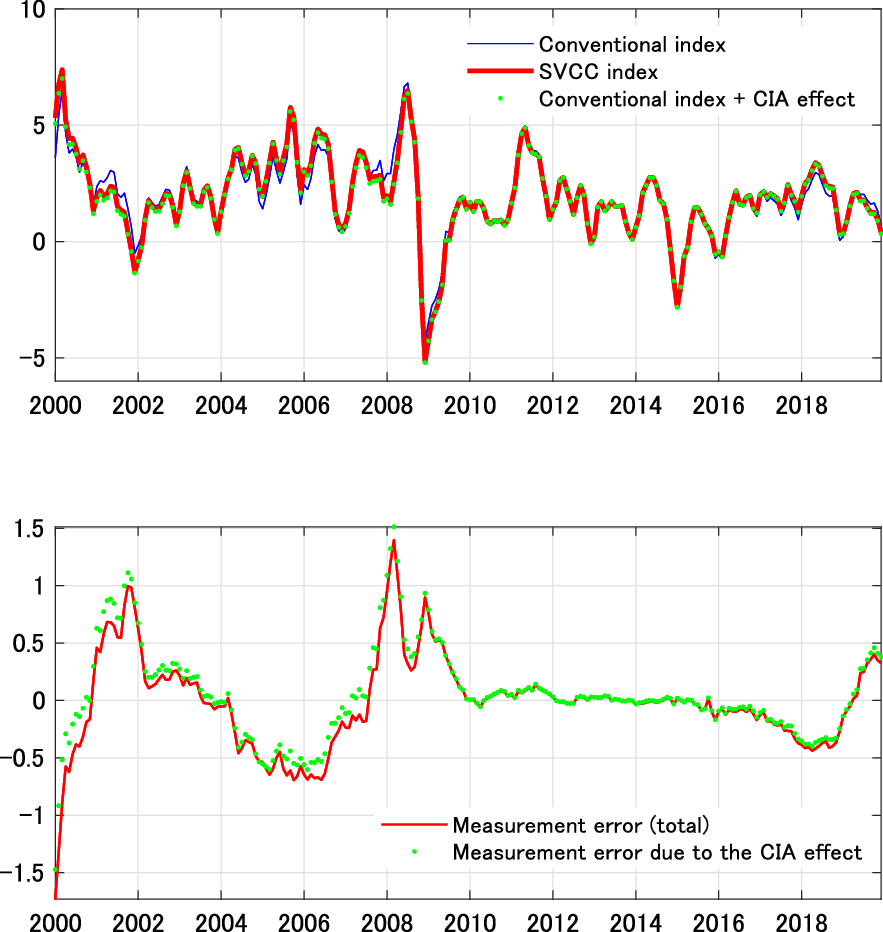
Figure 1 depicts the CIA-adjusted price indices and measurement errors in the conventional index. It clearly indicates that the CIA effect is nonnegligible.
Historical developments of the price index and the CIA effect.
Note: All series are year-on-year and expressed in percent points per annum.

The upper panel of Figure 1 shows the annual inflation rates using both the CIA-adjusted measures and the conventional measure. The red line is the SVCC index that implements both the CIA effect and alternative aggregation weights
 $\tilde{\omega }_{i,t}(\boldsymbol{I})$
, and the green line is the conventional index with the CIA effect. For reference, I also draw the conventional index in blue. The figure suggests that the CIA-adjusted inflation rates deviate from the conventional index from time to time, but they largely move in tandem.
To focus on the quantitative importance of measurement errors in the conventional index, the lower panel shows the differences between the conventional inflation rates and new inflation rates. Several results are evident. First, as this panel indicates, the measurement error reaches approximately 1.5% twice in the past 20-year period of analysis, in 2002 and 2008. Considering that the Federal Reserve targets a 2% inflation rate, the CIA effect is quantitatively nonnegligible. Second, reflecting the stance of monetary policy at particular times, the measurement error does not manifest only in one direction; it was positive in 2002, 2008, and 2019, whereas it was negative in 2001, 2005–2006, and 2018. Table 1 reports the descriptive statistics for the measurement errors. It indicates that (i) the measurement error is almost zero on average, and (ii) maximum and minimum values of the measurement errors are statistically significant. Third, most of the measurement errors stem from the CIA effect.
Descriptive statistics of the measurement errors

Note: The measurement error is expressed in percentage points per annum.
4.3. Forecast performance
This subsection assesses the forecast performance of the SVCC index. Because the SVCC index includes the interest rate, which reflects expectations of the future, it may provide an indication of the future direction of total inflation. Specifically, following Luciani and Trezzi (Reference Luciani and Trezzi2019), I compare the forecast performance of the SVCC index with that of the core inflation measure, that is, the CPI inflation rate of all items excluding foods and energies.Footnote 15
In this exercise, I examine the performance of inflation rates between month
 $t\text{-}s$
and month
 $t$
in predicting the annualized total CPI inflation rate between month
 $t$
and month
 $t+h$
. The first forecasts that I produce are for total CPI inflation over the 6, 12, and 18 months from January 2000 using the past 24-month inflation rates of the SVCC index and CPI core index.Footnote
16
I repeat the same procedure until the end of forecast periods reaches December 2019. The specific forecast equation is expressed as follows:
 \begin{equation} \pi _{t+h,t} = \pi^{\textrm{SVCC}}_{t,t-s} + \epsilon _{t}, \end{equation}
where
 $\pi _{t+h,t}$
,
 $\pi ^{\textrm{SVCC}}_{t,t-s}$
, and
 $\epsilon _{t}$
are logged changes of the total CPI between
 $ t+h$
and
 $t$
, the SVCC index (or logged changes of the core CPI) between
 $t$
and
 $t-s$
, and forecasting errors, respectively.
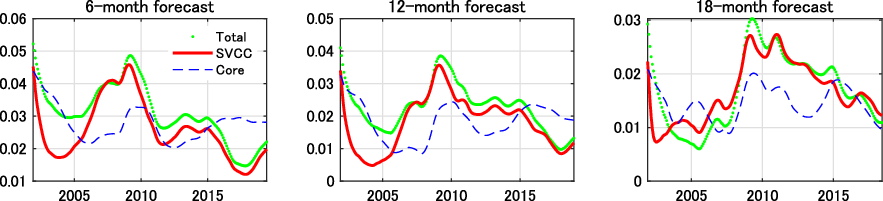
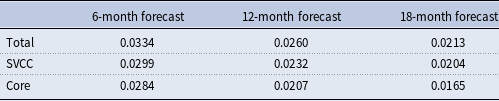
Figure 2 and Table 2 summarize the results of this exercise. Figure 2 shows the root-mean-squared forecast error (RMSFE) obtained over a rolling 5-year window when I use the 6-, 12-, and 18-month changes in the total price index. The red and blue lines correspond to the RMSFEs for the SVCC index and core CPI inflation, respectively. For reference, I depict the RMSFEs of total CPI inflation using green lines. Table 2 presents the period averages of RMSFEs in Figure 2. For most of the sample period, the core CPI inflation outperforms the SVCC index in all forecast horizons, although the forecast performance of the SVCC index is better than that of the total CPI inflation. These results may not be surprising. As shown in Figure 1, the SVCC index closely comoves with the conventional index. Consequently, it does not improve forecast performance as much as using the core CPI inflation rate. Therefore, I can conclude that it is difficult to regard the SVCC index as a new core measure of the CPI inflation rate.
Forecast performance.
Note: Root-mean-squared forecast errors (RMSFEs) are presented. “Total,” “SVCC,” and “Core” represent the RMSFEs of the total CPI, the SVCC index, and the core CPI (all items excluding foods and energies), respectively. I forecast the inflation rate of the total CPI for periods 6, 12, and 18 months ahead using the past 24-month inflation rate of the total CPI, the SVCC index, and the core CPI.

Forecast performance on average

Note: Average root-mean-squared forecast errors (RMSFEs) are presented. “Total,” “SVCC,” and “Core” represent the RMSFEs of the total CPI, the SVCC index, and the core CPI (all items excluding foods and energies), respectively. I forecast the inflation rate of the total CPI for periods 6, 12, and 18 months ahead using the past 24-month inflation rate of the total CPI, the SVCC index, and the core CPI.
5. Conclusion
This study investigates the cost-of-living index in a cash-credit goods economy. A key finding is that the conventional cost-of-living index entails internal inconsistency when applied to the cash-credit goods economy. In addition, I construct an internally consistent cost-of-living index. In contrast with the conventional cost-of-living index, this new index suggests that the interest rate directly affects the cost of living. Further, the effect of the interest rate is asymmetric as a result of substitution between cash goods and credit goods. Historical US data suggest that the effect of the opportunity cost is quantitatively nonnegligible.
In the future, I hope to extend the analysis to the case of durable and nondurable goods. In a world with only nondurable goods, the distinction between cash-credit goods is merely an issue of payment timing. The effects of the CIA constraint may become more significant when the durability of goods is introduced. An extension in this direction is a promising avenue for future work.
Supplementary materials
To view supplementary material for this article, please visit https://doi.org/10.1017/S136510052200027X.